EP0635300A1 - Garnissage de colonne pour la chromatographie en phase liquide - Google Patents
Garnissage de colonne pour la chromatographie en phase liquide Download PDFInfo
- Publication number
- EP0635300A1 EP0635300A1 EP94111169A EP94111169A EP0635300A1 EP 0635300 A1 EP0635300 A1 EP 0635300A1 EP 94111169 A EP94111169 A EP 94111169A EP 94111169 A EP94111169 A EP 94111169A EP 0635300 A1 EP0635300 A1 EP 0635300A1
- Authority
- EP
- European Patent Office
- Prior art keywords
- column
- liquid chromatography
- column packings
- packings
- vitamins
- Prior art date
- Legal status (The legal status is an assumption and is not a legal conclusion. Google has not performed a legal analysis and makes no representation as to the accuracy of the status listed.)
- Granted
Links
Images



Classifications
-
- B—PERFORMING OPERATIONS; TRANSPORTING
- B01—PHYSICAL OR CHEMICAL PROCESSES OR APPARATUS IN GENERAL
- B01D—SEPARATION
- B01D15/00—Separating processes involving the treatment of liquids with solid sorbents; Apparatus therefor
- B01D15/08—Selective adsorption, e.g. chromatography
-
- B—PERFORMING OPERATIONS; TRANSPORTING
- B01—PHYSICAL OR CHEMICAL PROCESSES OR APPARATUS IN GENERAL
- B01J—CHEMICAL OR PHYSICAL PROCESSES, e.g. CATALYSIS OR COLLOID CHEMISTRY; THEIR RELEVANT APPARATUS
- B01J20/00—Solid sorbent compositions or filter aid compositions; Sorbents for chromatography; Processes for preparing, regenerating or reactivating thereof
- B01J20/02—Solid sorbent compositions or filter aid compositions; Sorbents for chromatography; Processes for preparing, regenerating or reactivating thereof comprising inorganic material
- B01J20/10—Solid sorbent compositions or filter aid compositions; Sorbents for chromatography; Processes for preparing, regenerating or reactivating thereof comprising inorganic material comprising silica or silicate
-
- B—PERFORMING OPERATIONS; TRANSPORTING
- B01—PHYSICAL OR CHEMICAL PROCESSES OR APPARATUS IN GENERAL
- B01J—CHEMICAL OR PHYSICAL PROCESSES, e.g. CATALYSIS OR COLLOID CHEMISTRY; THEIR RELEVANT APPARATUS
- B01J20/00—Solid sorbent compositions or filter aid compositions; Sorbents for chromatography; Processes for preparing, regenerating or reactivating thereof
- B01J20/02—Solid sorbent compositions or filter aid compositions; Sorbents for chromatography; Processes for preparing, regenerating or reactivating thereof comprising inorganic material
- B01J20/10—Solid sorbent compositions or filter aid compositions; Sorbents for chromatography; Processes for preparing, regenerating or reactivating thereof comprising inorganic material comprising silica or silicate
- B01J20/12—Naturally occurring clays or bleaching earth
-
- B—PERFORMING OPERATIONS; TRANSPORTING
- B01—PHYSICAL OR CHEMICAL PROCESSES OR APPARATUS IN GENERAL
- B01J—CHEMICAL OR PHYSICAL PROCESSES, e.g. CATALYSIS OR COLLOID CHEMISTRY; THEIR RELEVANT APPARATUS
- B01J20/00—Solid sorbent compositions or filter aid compositions; Sorbents for chromatography; Processes for preparing, regenerating or reactivating thereof
- B01J20/28—Solid sorbent compositions or filter aid compositions; Sorbents for chromatography; Processes for preparing, regenerating or reactivating thereof characterised by their form or physical properties
- B01J20/28014—Solid sorbent compositions or filter aid compositions; Sorbents for chromatography; Processes for preparing, regenerating or reactivating thereof characterised by their form or physical properties characterised by their form
- B01J20/28023—Fibres or filaments
-
- B—PERFORMING OPERATIONS; TRANSPORTING
- B01—PHYSICAL OR CHEMICAL PROCESSES OR APPARATUS IN GENERAL
- B01J—CHEMICAL OR PHYSICAL PROCESSES, e.g. CATALYSIS OR COLLOID CHEMISTRY; THEIR RELEVANT APPARATUS
- B01J20/00—Solid sorbent compositions or filter aid compositions; Sorbents for chromatography; Processes for preparing, regenerating or reactivating thereof
- B01J20/28—Solid sorbent compositions or filter aid compositions; Sorbents for chromatography; Processes for preparing, regenerating or reactivating thereof characterised by their form or physical properties
- B01J20/28054—Solid sorbent compositions or filter aid compositions; Sorbents for chromatography; Processes for preparing, regenerating or reactivating thereof characterised by their form or physical properties characterised by their surface properties or porosity
- B01J20/28078—Pore diameter
-
- B—PERFORMING OPERATIONS; TRANSPORTING
- B01—PHYSICAL OR CHEMICAL PROCESSES OR APPARATUS IN GENERAL
- B01J—CHEMICAL OR PHYSICAL PROCESSES, e.g. CATALYSIS OR COLLOID CHEMISTRY; THEIR RELEVANT APPARATUS
- B01J20/00—Solid sorbent compositions or filter aid compositions; Sorbents for chromatography; Processes for preparing, regenerating or reactivating thereof
- B01J20/281—Sorbents specially adapted for preparative, analytical or investigative chromatography
- B01J20/282—Porous sorbents
- B01J20/283—Porous sorbents based on silica
-
- B—PERFORMING OPERATIONS; TRANSPORTING
- B01—PHYSICAL OR CHEMICAL PROCESSES OR APPARATUS IN GENERAL
- B01J—CHEMICAL OR PHYSICAL PROCESSES, e.g. CATALYSIS OR COLLOID CHEMISTRY; THEIR RELEVANT APPARATUS
- B01J20/00—Solid sorbent compositions or filter aid compositions; Sorbents for chromatography; Processes for preparing, regenerating or reactivating thereof
- B01J20/30—Processes for preparing, regenerating, or reactivating
- B01J20/3078—Thermal treatment, e.g. calcining or pyrolizing
-
- B—PERFORMING OPERATIONS; TRANSPORTING
- B01—PHYSICAL OR CHEMICAL PROCESSES OR APPARATUS IN GENERAL
- B01J—CHEMICAL OR PHYSICAL PROCESSES, e.g. CATALYSIS OR COLLOID CHEMISTRY; THEIR RELEVANT APPARATUS
- B01J2220/00—Aspects relating to sorbent materials
- B01J2220/50—Aspects relating to the use of sorbent or filter aid materials
- B01J2220/54—Sorbents specially adapted for analytical or investigative chromatography
Definitions
- the present invention relates to column packings for liquid chromatography and methods for separating materials using the column packings. More particularly, the present invention relates to column packings for liquid chromatography comprising porous ceramics granules having hydrophilic surface which are prepared by calcining a crystalline clay mineral having fibrous structure and methods for separating materials using the column packings.
- Liquid chromatography is a chromatography utilizing liquid as mobile phase.
- Various types of liquid chromatographies have been developed for separating.
- Liquid chromatography is classified depending on the principle of the separation into ion-exchange chromatography, partition chromatography, adsorption chromatography, gel permeation chromatography, affinity chromatography or the like. Also, it is classified depending on the method of the operation into downward flow method, upward flow method, high performance liquid chromatography or the like.
- HPLC high performance liquid chromatography
- column packings essentially uniform and extremely fine spherical granules as stationary phase (which is referred to as "column packings" hereinafter).
- silica gel As conventional column packings for HPLC, besides silica gel, modified silica gels in which silica gel is modified with octadecyl group or an amino group or the like, ion exchange resin comprising synthetic polymer such as polystyrene and polyvinyl and column packings comprising natural polymer or the like have been used.
- Silica gel has been used for separating lipid related materials as column packings for adsorption chromatography utilizing excellent adsorption performances of silanol groups existing in a great number on internal surfaces of pores.
- silica gel may be easily dissolved in water and has a very low resistance to high pH eluent. Thus it could be hardly used for separating samples using such eluent.
- inorganic column packings active china clay and synthetic zeolite have been conventionally used for separation by adsorption or the like. They had, however, no sufficient separation performances as column packings for chromatography and could not be used for HPLC.
- column packings for chromatography prepared from hydroxy apatite as raw material which is recently developed has a high mechanical strength and low solubility in eluent and thus they are good column packings. They, however, do not adsorb materials having no charge such as lipid although they adsorb materials having charged functional groups such as proteins. Accordingly, they are not proper for separating lipid related materials.
- Japanese Patent Unexamined Publication No.Hei-3-8752 discloses a technique of preparing porous ceramics by calcining a raw material containing clay minerals having fibrous crystal structure such as sepiolite.
- Japanese Patent Unexamined Publication No.Hei-4-183393 discloses a technique of fixing enzyme into such porous granules.
- an object of the present invention is to provide column packings for liquid chromatography which is very stable to eluent having high polarity and/or pH value and may be used for separating lipid related materials.
- Another object of the present invention is to provide methods for separating lipids using the column packings for liquid chromatography.
- Still another object of the present invention is to provide methods for separating vitamins using the column packing for liquid chromatography.
- the inventors have researched and have found that if porous ceramics granules which have hydrophilic surface and are prepared by calcining crystalline clay mineral having fibrous structure are used as column packings for liquid chromatography, the ceramics granules are very stable to eluent having high polarity and/or high pH value and can separate lipid related materials which had been difficult to be separated, and thus the inventors have completed the present invention.
- column packings for liquid chromatography comprising porous ceramics granules which have hydrophilic surfaces and are prepared by calcining crystalline clay mineral having fibrous structure.
- the column packings wherein the fibrous structure are fibrous crystal structure containing parallelepiped intra crystalline tunnel along the fiber.
- column packings wherein the crystalline clay mineral having fibrous structure is sepiolite or attapulgite.
- the column packings wherein SiO2 content of the porous ceramics granule is 60% or more.
- the column packings wherein MgO content of the porous ceramics granule is 30% or less.
- the column packings wherein SiO2 content of the porous ceramics granule is 60% or more and MgO content of the porous ceramics granule is 30% or less.
- a method for separating lipids comprising the steps of: filling the column packing for liquid chromatography; injecting a sample containing lipids; and passing an eluent through the column to separate and elute the lipids in the sample.
- a method for separating vitamins comprising the steps of: filling the column packing for liquid chromatography; injecting a sample containing vitamins; and passing an eluent through the column to separate and elute the vitamins in the sample.
- Fig.1 shows an X ray diffractive pattern of sepiolite first-calcined.
- A corresponds to a peak of crystobalite
- B corresponds to a peak of quartz
- C corresponds to peaks of enstatite.
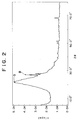
- Fig.2 shows an X ray diffractive pattern of sepiolite treated by an acid.
- "B” corresponds to peaks of quartz and a broad peak appearing at from 15 to 30° corresponds to a peak of non-crystalline SiO2.
- Fig.3 shows an X ray diffractive pattern of sepiolite second-calcined.
- "B" corresponds to peaks of quartz and a broad peak appearing at from 15 to 30° corresponds to a peak of non-crystalline SiO2.
- Fig.4 shows a chromatogram of phosphatidylcholine (PC) and sphingomyelin (SPM) using the column packings for liquid chromatography of the present invention.
- Fig.5 shows variations of the retention time by a continuous use of HPLC columns using silica gel (SC) and the column packings of the present invention.
- ⁇ shows the retention time of sphingomyelin by the present invention
- ⁇ shows that of phosphatidylcholine of the present invention
- ⁇ shows that of sphingomyelin by silica gel column
- " " shows phosphatidylcholine by the silica gel column, respectively.
- Fig.6 shows chromatogram of vitamin K1 and vitamin D3 using the column packings for liquid chromatography of the present invention.
- the crystalline clay mineral having fibrous structure used as raw materials of the present invention may include sepiolite, attapulgite, palygorskite.
- Sepiolite is a clay mineral having a chemical formula of Mg8Si12O30(OH2)4 ⁇ 6 to 8H2O.
- clay minerals sepiolite has a different fibrous crystalline structure from minerals such as kaolinite, montmorillonite having a layered structure. The crystal contains uniform size palallelepiped intracrystalline tunnels along the fiber and their cross section is about 1.35 x 0.67nm2.
- Aggregate of sepiolite has a large pore volume having peaks of pore sizes of 0.001 ⁇ m and 0.02 ⁇ m. It is utilized for many usages such as decoloring agent, water absorption agent, deodorizing agent, oil absorption agent.
- Attapulgite is a crystalline clay mineral having a fibrous crystal structure containing parallelepiped intracrystalline tunnel along the fiber as sepiolite and has a chemical formula of Mg5Si8O20(OH)2(OH2)4 ⁇ 4H2O. It is utilized for many usages such as adsorbing agent, slurry for drilling. Attapulgite is also referred to as palygorskite.
- clay minerals such as talc containing SiO2 and MgO as principal components, and kaolinite, montmorillonite containing SiO2 as a principal component other than the above crystalline clay mineral having fibrous crystal structure containing parallelepiped intracrystalline tunnel along the fiber may be used as raw material of the column packings for liquid chromatography of the present invention.
- the column packings for chromatography of the present invention may be prepared for example by a method described hereinafter.
- the column packings may be prepared by the steps of crushing the raw material described above, then granulating such as by a rolling granulation to have spherical granules having a predetermined grain size, carrying out the first calcination comprising a calcination at a temperature of 100 to 1200°C, treating it by dipping it into a mineral acid such as hydrochloric acid or sulfuric acid to remove alkali oxides, carrying out the second calcination comprising a calcination at a temperature of 100 to 1200°C, and then carrying out a grain size granulation by a classifying to have a predetermined grain size by means of such as levigation, air elutriation and sieving.
- the granulation is preferably carried out to have the raw material of spherical shapes.
- the granulation method may include an extrusion granulation of clay raw material comprising sepiolite powder added by water, a rolling granulation comprising dispersion granulation of sepiolite power and small amount of water in a mixer, and a spray drying.
- the rolling granulation is preferable in granulation into a spherical shape.
- the spray drying method is preferable to have small grain size granules.
- a slurry in which the raw material sepiolite powder is dispersed in water or an organic solvent is previously prepared. At the time, the slurry is preferably deflocculated as much as possible.
- a mechanism of spraying slurry in a form of fine droplet is important. Any known method such as a method rotating a disc, a method spraying slurry from a nozzle under pressure, a method using two-fluid spray nozzles may be used in the present invention.
- the grain diameters can be controlled by the selection of a method or a system.
- the grain size of the raw material obtained by granulation is preferably in the range from 1 to 100 ⁇ m. If the grain size is less than 1 ⁇ m, it is not preferable since clogging occurs easily and a high pressure is required when used as HPLC column packings although theoretical plate numbers may be increased by increasing surface area per unit amount of the column packings, i.e. decreasing grain size in order to increase the area contact with samples. On the other hand, if the grain size is more than 100 ⁇ m, the separating efficiency decreases and thus it is not preferable.
- an organic binder such as cellulose and inorganic binder such as water-glass may be previously added to the slurry.
- the granules prepared is calcined first.
- the first calcination is made in order to avoid the change of the shape of the granules by the treatment by dipping in acid solution in the next acid treatment process.
- the first calcination temperature is preferably in the range from 100 to 1200°C. If the calcination temperature is less than 100°C, deformation of the shape is easily occurred. If the calcination temperature is more than 1200°C, the removal of impurities owing to the acid treatment is difficult and thus it is not preferable.
- sepiolite When sepiolite is calcined first, it becomes metasepiolite with the adsorbed water and the water of crystallization deleted. When it is further treated thermally at a higher temperature, it becomes crystal such as enstatite, quartz, crystobalite.
- the X ray diffraction data at the time is shown in Fig.1.
- an alkali metal oxide or an alkali earth metal oxide contained in sepiolite is removed by acid treatment.
- sepiolite raw material usually contains many impurities and contains MgO, Al2O3, Fe2O3, CaO, K2O, Na2O or the like besides the principle component SiO2 even after the purification though the amounts are very small.
- impurities are preferably removed as much as possible.
- impurities are alkali metal oxides as MgO or alkali earth metal oxides and are soluble in acid so that it can be removed by a treatment by dipping in acid solution.
- Fig.2 shows an X ray diffraction data of the sepiolite in which non-crystalline SiO2 is formed by removing MgO which has been contained in crystal when zeolite having the X ray diffraction data after the first calcination shown in Fig.1 is treated by acid.
- the non-crystalline SiO2 may be formed by removing MgO from sepiolite, metasepiolite or enstatite crystal to destroy crystal structure.
- the acid solution may include mineral acids such as hydrochloric acid, sulfuric acid, phosphoric acid.
- the composition of final column packings may be controlled by the acid treatment.
- the SiO2 ratio is preferably controlled from 60 to 100%.
- the part where MgO was eluted becomes new pores.
- the pore size is about 0.1 ⁇ m or less.
- the specific surface area increased by the new pore formation by the removal of about 25% MgO is about 100m2 or more per 1g of the column packings and thus the new pore formation is a factor causing an improvement in performance as column packings.
- a certain amount of MgO is preferably remained rather than all MgO is removed from the view point of the characteristics as HPLC stationary phase.
- the particularly preferable amount of MgO contained in the porous ceramics is 30% or less.
- the pore formed by the removal of MgO by acid treatment may have uniform shape and uniform pore size although with the conventional methods for preparing ceramics, the pore formation is changed depending on calcination conditions and ceramics having a uniform pore size can not be obtained.
- the second calcination temperature must be set to avoid decrease of the pore volume and is preferably in the range from 100 to 1200°C, more preferably in the range from 800 to 1100°C. If the calcination temperature is less than 100°C, the mechanical strength of the column packings are decreased. If the calcination temperature is more than 1200°C, the pores decreases and thus not preferable.
- the column packings of the present invention contains non-crystalline SiO2 and crystalline SiO2 as principal components.
- the non-crystalline SiO2 has a high surface energy and may be bonded to water easily to form silanol groups that are hydrophilic groups.
- the hydrophilic group fulfill the important functions of the column packings of the present invention.
- the final pore size and pore volume of the column packings are determined depending on the calcining conditions after granulation, the treatment conditions in an acid solution and the calcining conditions after the acid solution treatment.
- the setting of the conditions are important since characteristics as column packings depends on the pore distribution.
- median pore diameter of the column packings of the present invention is important. If the median pore diameter is more than 0.1 ⁇ m, the separating ratio decreases and thus it is not preferable. If the pore size is less than 0.001 ⁇ m, clogging of the pores occurs which causes scattering of separating data and thus it is not preferable. Accordingly, the median pore diameter of the column packings of the present invention is preferably in the range from 0.001 ⁇ m to 0.1 ⁇ m.
- column packings may be prepared, if a uniform grain size is not obtained, a predetermined uniform grain size may be obtained by means of levigation, air elutriation or screening.
- the column packings having uniform grain size filled into a column may be used as a column for separation.
- the column packings may be filled in a column and may be used to carry out liquid chromatography like conventional column packings for liquid chromatography.
- the column packings of the present invention may be used for analyzing protein, enzyme, nucleic acid, glycoside, vitamins, phospholipid, glycolipid, triglyceride, fatty acid.
- the column packings of the present invention exhibits an excellent function in the separation of fat-soluble vitamins, phospholipid, glycoside, triglyceride, fatty acid.
- Eluent used in the separation may include conventional solutions such as an acetonitrile/phosphate buffer solution, hexane/ethanol.
- the column packings for liquid chromatography of the present invention can separate polar materials, which could not be separated efficiently with a conventional HPLC, using an eluent having high polarity in a short time.
- the column packings are thus useful as column packings for preparative chromatography and analytical chromatography.
- the column packings for liquid chromatography of the present invention have a high mechanical strength and are pressure resistant and very stable to eluent having a high pH value and/or a high polarity so that the separating characteristics thereof are not changed even after a long time use.
- the composition of the ceramics was determined by a fluorescent X ray analysis.
- the composition was: SiO2 65.10%, MgO 28.12%, Fe2O3 1.42%, Al2O3 2.75%, CaO 1.83%, K2O 0.67% and Na2O 0.11%.
- the spherical porous ceramics prepared in Example 1(2) was dispersed in solution of methanol/glycerin (1:1) and slurry-filled into a column having an inner-diameter of 3mm and a length of 300mm. Eluent in which 1 part by weight of 10mM phosphorate buffer solution (pH2.6) containing 100mM sodium perchlorate and 9 parts by weight of acetonitrile was mixed was flown through the column at a flow rate of 1ml/min to equilibrate the column sufficiently.
- 10mM phosphorate buffer solution pH2.6
- the spherical porous ceramics prepared in Example 1(2) was dispersed in solution of methanol/glycerin (1:1) and slurry-filled into a column having an inner-diameter of 3mm and a length of 300mm. Eluent of hexane/ethanol (99.5/0.5) was flown through the column at a flow rate of 1ml/min to equilibrate the column sufficiently. 10 ⁇ l of a sample containing 100mg of vitamin K1 and 100mg of vitamin D3 dissolved in 1ml of hexane was injected into the column and the vitamins eluted from the column were detected with a UV detector at 245nm. The column temperature was 20°C. The results of the detection are shown in Fig.6. As shown in Fig.6, the vitamin K1 and the vitamin D3 were satisfactorily separated and eluted after 6.6 min. and 13.8 min., respectively.
- the column packings for liquid chromatography provided by the present invention is very stable to eluent having a high pH value and eluent having a high polarity, the separating characteristics is not changed even after a long time use, and it can separate samples in high efficiency.
- the column packings for liquid chromatography of the present invention can separate lipid related materials which could not be separated in high efficiency and in particular, it is appropriate for analysis of phospholipids and fat-soluble vitamins.
Landscapes
- Chemical & Material Sciences (AREA)
- Analytical Chemistry (AREA)
- Chemical Kinetics & Catalysis (AREA)
- Organic Chemistry (AREA)
- Inorganic Chemistry (AREA)
- Life Sciences & Earth Sciences (AREA)
- Dispersion Chemistry (AREA)
- Geochemistry & Mineralogy (AREA)
- Physics & Mathematics (AREA)
- Thermal Sciences (AREA)
- Solid-Sorbent Or Filter-Aiding Compositions (AREA)
- Treatment Of Liquids With Adsorbents In General (AREA)
Applications Claiming Priority (4)
| Application Number | Priority Date | Filing Date | Title |
|---|---|---|---|
| JP20000893 | 1993-07-19 | ||
| JP5200008A JPH0735736A (ja) | 1993-07-19 | 1993-07-19 | 液体クロマトグラフィー用分離剤並びにそれを使用する分離及び分析方法 |
| JP200008/93 | 1993-07-19 | ||
| US08/722,634 US5707516A (en) | 1993-07-19 | 1996-09-27 | Column packings for liquid chromatography |
Publications (2)
| Publication Number | Publication Date |
|---|---|
| EP0635300A1 true EP0635300A1 (fr) | 1995-01-25 |
| EP0635300B1 EP0635300B1 (fr) | 2000-01-26 |
Family
ID=26511904
Family Applications (1)
| Application Number | Title | Priority Date | Filing Date |
|---|---|---|---|
| EP94111169A Expired - Lifetime EP0635300B1 (fr) | 1993-07-19 | 1994-07-18 | Garnissage de colonne pour la chromatographie en phase liquide |
Country Status (3)
| Country | Link |
|---|---|
| US (1) | US5707516A (fr) |
| EP (1) | EP0635300B1 (fr) |
| JP (1) | JPH0735736A (fr) |
Cited By (3)
| Publication number | Priority date | Publication date | Assignee | Title |
|---|---|---|---|---|
| ES2133133A1 (es) * | 1997-12-11 | 1999-08-16 | Quesada Gomez Jose Manuel | Metodo e instalacion para la detrminacion cuantitativa de hidroximetabolitos de la vitamina d3 de forma continua y automatica. |
| WO2007065461A1 (fr) * | 2005-12-09 | 2007-06-14 | Süd-Chemie AG | Procede de sorption d'au moins une molecule d'acide nucleique a l'aide de phyllosilicates d'activation acide |
| US7897051B2 (en) | 2005-12-16 | 2011-03-01 | Sud-Chemie Ag | Method for separating proteins from liquid media |
Families Citing this family (12)
| Publication number | Priority date | Publication date | Assignee | Title |
|---|---|---|---|---|
| DE102005018949A1 (de) * | 2005-04-18 | 2006-10-19 | Ami-Agrolinz Melamine International Gmbh | Harnstoffpartikel, Verfahren zu dessen Herstellung und dessen Verwendung |
| US20070077546A1 (en) * | 2005-08-10 | 2007-04-05 | Zhenghua Ji | Concentration techniques in chromatographic separation |
| US7422866B2 (en) * | 2005-08-10 | 2008-09-09 | Agilent Technologies, Inc. | On-line enzymatic digestion in separation-detection methods |
| SG149759A1 (en) * | 2007-07-10 | 2009-02-27 | Millipore Corp | Media for affinity chromatography |
| ES2746198T3 (es) * | 2008-12-22 | 2020-03-05 | Glatt Systemtechnik Gmbh | Gránulo adsorbente de material compuesto, proceso para su producción y proceso de separación de gases |
| RU2015114330A (ru) | 2012-09-17 | 2016-11-10 | У.Р. Грейс Энд Ко.-Конн. | Хроматографические среды и устройства |
| CN104919035B (zh) | 2012-12-21 | 2017-08-11 | 精密公司 | 便携式荧光检测系统和微测定盒 |
| JP6484222B2 (ja) | 2013-05-07 | 2019-03-13 | マイクロニクス, インコーポレイテッド | 核酸の調製および分析のためのデバイス |
| JP6472788B2 (ja) * | 2013-05-07 | 2019-02-20 | マイクロニクス, インコーポレイテッド | 粘土鉱物およびアルカリ性溶液を使用して核酸含有試料を調製するための方法 |
| EP2994750B1 (fr) | 2013-05-07 | 2020-08-12 | PerkinElmer Health Sciences, Inc. | Dispositifs microfluidiques et méthodes de séparation du sérum et de compatibilité croisée du sang |
| JP6914189B2 (ja) | 2014-05-02 | 2021-08-04 | ダブリュー・アール・グレース・アンド・カンパニー−コーンW R Grace & Co−Conn | 官能化担体材料並びに官能化担体材料を作製及び使用する方法 |
| CN107921407B (zh) | 2015-06-05 | 2022-07-05 | 格雷斯公司 | 生物处理吸附澄清剂及其制备和使用方法 |
Citations (5)
| Publication number | Priority date | Publication date | Assignee | Title |
|---|---|---|---|---|
| US2968633A (en) * | 1958-05-27 | 1961-01-17 | Minerals & Chem Philipp Corp | Adsorptive porous mineral mass and method of making same |
| SU485752A1 (ru) * | 1974-03-26 | 1975-09-30 | Ордена Трудовго Красного Знамени Институт Нефтехимических Процессов Им.Академика Ю.Г.Мамедалиева | Адсорбент дл газоадсорбционной хроматографии |
| FR2328508A1 (fr) * | 1975-10-22 | 1977-05-20 | Atomic Energy Authority Uk | Gels poreux, leur procede d'obtention et applications |
| EP0297901A1 (fr) * | 1987-07-03 | 1989-01-04 | Shiseido Company Limited | Matériau de remplissage pour chromatographie liquide |
| EP0318236A2 (fr) * | 1987-11-27 | 1989-05-31 | Ecc International Limited | Matériaux minéraux poreux |
Family Cites Families (2)
| Publication number | Priority date | Publication date | Assignee | Title |
|---|---|---|---|---|
| JP2603539B2 (ja) * | 1989-06-02 | 1997-04-23 | 株式会社豊田中央研究所 | 粘土鉱物焼結体およびその製造方法 |
| JP2990790B2 (ja) * | 1990-11-15 | 1999-12-13 | 東陶機器株式会社 | 酵素固定化担体の製造方法 |
-
1993
- 1993-07-19 JP JP5200008A patent/JPH0735736A/ja active Pending
-
1994
- 1994-07-18 EP EP94111169A patent/EP0635300B1/fr not_active Expired - Lifetime
-
1996
- 1996-09-27 US US08/722,634 patent/US5707516A/en not_active Expired - Fee Related
Patent Citations (5)
| Publication number | Priority date | Publication date | Assignee | Title |
|---|---|---|---|---|
| US2968633A (en) * | 1958-05-27 | 1961-01-17 | Minerals & Chem Philipp Corp | Adsorptive porous mineral mass and method of making same |
| SU485752A1 (ru) * | 1974-03-26 | 1975-09-30 | Ордена Трудовго Красного Знамени Институт Нефтехимических Процессов Им.Академика Ю.Г.Мамедалиева | Адсорбент дл газоадсорбционной хроматографии |
| FR2328508A1 (fr) * | 1975-10-22 | 1977-05-20 | Atomic Energy Authority Uk | Gels poreux, leur procede d'obtention et applications |
| EP0297901A1 (fr) * | 1987-07-03 | 1989-01-04 | Shiseido Company Limited | Matériau de remplissage pour chromatographie liquide |
| EP0318236A2 (fr) * | 1987-11-27 | 1989-05-31 | Ecc International Limited | Matériaux minéraux poreux |
Non-Patent Citations (1)
| Title |
|---|
| DATABASE WPI Week 7726, Derwent World Patents Index; AN 77-46409Y * |
Cited By (3)
| Publication number | Priority date | Publication date | Assignee | Title |
|---|---|---|---|---|
| ES2133133A1 (es) * | 1997-12-11 | 1999-08-16 | Quesada Gomez Jose Manuel | Metodo e instalacion para la detrminacion cuantitativa de hidroximetabolitos de la vitamina d3 de forma continua y automatica. |
| WO2007065461A1 (fr) * | 2005-12-09 | 2007-06-14 | Süd-Chemie AG | Procede de sorption d'au moins une molecule d'acide nucleique a l'aide de phyllosilicates d'activation acide |
| US7897051B2 (en) | 2005-12-16 | 2011-03-01 | Sud-Chemie Ag | Method for separating proteins from liquid media |
Also Published As
| Publication number | Publication date |
|---|---|
| EP0635300B1 (fr) | 2000-01-26 |
| US5707516A (en) | 1998-01-13 |
| JPH0735736A (ja) | 1995-02-07 |
Similar Documents
| Publication | Publication Date | Title |
|---|---|---|
| EP0635300A1 (fr) | Garnissage de colonne pour la chromatographie en phase liquide | |
| US5158756A (en) | Porous particles of calcium phosphate compound and production process thereof | |
| US3782075A (en) | Completely porous microspheres for chromatographic uses | |
| US3943072A (en) | Separation of molecules | |
| CN101495225A (zh) | 附聚沸石吸附剂、它们的生产方法和它们的用途 | |
| EP0103875B1 (fr) | Garnissage pour chromatographie | |
| DE60217800T2 (de) | Chromatographisches Sorptionsmittel aus Mineraloxidperlen deren Poren Hydroxylapatit enthalten | |
| US5084169A (en) | Stationary magnetically stabilized fluidized bed for protein separation and purification | |
| JPH07120450A (ja) | 多孔質体クロマトグラフィー用カラム | |
| US5145578A (en) | Packing material for liquid chromatography | |
| GB2255916A (en) | Method of and device for counter-flow separation of mixture | |
| WO1998003242A1 (fr) | Utilisation de sorbants non particulaires pour des procedes de separation a 'lit mobile simule' | |
| CN1118320C (zh) | 一种吸附剂、其制备方法及其在分离二甲苯中的应用 | |
| RU2097124C1 (ru) | Способ получения сорбента и сорбент | |
| US3348911A (en) | Method for preparing high rate zeolitic molecular sieve particles | |
| DE69422753T2 (de) | Säulenpackung für Flüssigkeitschromatographie | |
| US5843731A (en) | Method for purifying plasmid DNA on calcium phosphate compound | |
| EP1960519A1 (fr) | Procede de sorption d'au moins une molecule d'acide nucleique a l'aide de phyllosilicates d'activation acide | |
| Unger et al. | Trends in stationary phases in high-performance liquid chromatography | |
| EP0297901B1 (fr) | Matériau de remplissage pour chromatographie liquide | |
| JPH08136520A (ja) | 液体クロマトグラフィー用カラム | |
| JPH01199155A (ja) | 液体クロマトグラフィー用充填剤 | |
| JP6141256B2 (ja) | フッ素アパタイト、吸着装置および分離方法 | |
| JP7133748B1 (ja) | 吸着剤および吸着装置 | |
| JPH10506043A (ja) | エルビウム同位体のクロマトグラフィー分離法 |
Legal Events
| Date | Code | Title | Description |
|---|---|---|---|
| PUAI | Public reference made under article 153(3) epc to a published international application that has entered the european phase |
Free format text: ORIGINAL CODE: 0009012 |
|
| AK | Designated contracting states |
Kind code of ref document: A1 Designated state(s): DE FR GB SE |
|
| 17P | Request for examination filed |
Effective date: 19950714 |
|
| 17Q | First examination report despatched |
Effective date: 19961114 |
|
| GRAG | Despatch of communication of intention to grant |
Free format text: ORIGINAL CODE: EPIDOS AGRA |
|
| GRAG | Despatch of communication of intention to grant |
Free format text: ORIGINAL CODE: EPIDOS AGRA |
|
| GRAH | Despatch of communication of intention to grant a patent |
Free format text: ORIGINAL CODE: EPIDOS IGRA |
|
| GRAH | Despatch of communication of intention to grant a patent |
Free format text: ORIGINAL CODE: EPIDOS IGRA |
|
| GRAA | (expected) grant |
Free format text: ORIGINAL CODE: 0009210 |
|
| RAP1 | Party data changed (applicant data changed or rights of an application transferred) |
Owner name: SNOW BRAND MILK PRODUCTS CO., LTD. |
|
| AK | Designated contracting states |
Kind code of ref document: B1 Designated state(s): DE FR GB SE |
|
| REF | Corresponds to: |
Ref document number: 69422753 Country of ref document: DE Date of ref document: 20000302 |
|
| ET | Fr: translation filed | ||
| PLBE | No opposition filed within time limit |
Free format text: ORIGINAL CODE: 0009261 |
|
| STAA | Information on the status of an ep patent application or granted ep patent |
Free format text: STATUS: NO OPPOSITION FILED WITHIN TIME LIMIT |
|
| 26N | No opposition filed | ||
| REG | Reference to a national code |
Ref country code: GB Ref legal event code: IF02 |
|
| PGFP | Annual fee paid to national office [announced via postgrant information from national office to epo] |
Ref country code: FR Payment date: 20020828 Year of fee payment: 9 |
|
| PGFP | Annual fee paid to national office [announced via postgrant information from national office to epo] |
Ref country code: SE Payment date: 20020830 Year of fee payment: 9 Ref country code: DE Payment date: 20020830 Year of fee payment: 9 |
|
| PG25 | Lapsed in a contracting state [announced via postgrant information from national office to epo] |
Ref country code: SE Free format text: LAPSE BECAUSE OF NON-PAYMENT OF DUE FEES Effective date: 20030719 |
|
| PGFP | Annual fee paid to national office [announced via postgrant information from national office to epo] |
Ref country code: GB Payment date: 20030725 Year of fee payment: 10 |
|
| PG25 | Lapsed in a contracting state [announced via postgrant information from national office to epo] |
Ref country code: DE Free format text: LAPSE BECAUSE OF NON-PAYMENT OF DUE FEES Effective date: 20040203 |
|
| EUG | Se: european patent has lapsed | ||
| PG25 | Lapsed in a contracting state [announced via postgrant information from national office to epo] |
Ref country code: FR Free format text: LAPSE BECAUSE OF NON-PAYMENT OF DUE FEES Effective date: 20040331 |
|
| REG | Reference to a national code |
Ref country code: FR Ref legal event code: ST |
|
| PG25 | Lapsed in a contracting state [announced via postgrant information from national office to epo] |
Ref country code: GB Free format text: LAPSE BECAUSE OF NON-PAYMENT OF DUE FEES Effective date: 20040718 |
|
| GBPC | Gb: european patent ceased through non-payment of renewal fee |
Effective date: 20040718 |