EP0635308A1 - Procédé et dispositif pour le traitement de corps moulés de polymères différents - Google Patents
Procédé et dispositif pour le traitement de corps moulés de polymères différents Download PDFInfo
- Publication number
- EP0635308A1 EP0635308A1 EP19940110500 EP94110500A EP0635308A1 EP 0635308 A1 EP0635308 A1 EP 0635308A1 EP 19940110500 EP19940110500 EP 19940110500 EP 94110500 A EP94110500 A EP 94110500A EP 0635308 A1 EP0635308 A1 EP 0635308A1
- Authority
- EP
- European Patent Office
- Prior art keywords
- mill
- screen
- impact
- sieve
- particles
- Prior art date
- Legal status (The legal status is an assumption and is not a legal conclusion. Google has not performed a legal analysis and makes no representation as to the accuracy of the status listed.)
- Withdrawn
Links
- 238000000034 method Methods 0.000 title claims abstract description 54
- 229920000642 polymer Polymers 0.000 title claims abstract description 52
- 238000000465 moulding Methods 0.000 title abstract description 7
- 239000002245 particle Substances 0.000 claims abstract description 30
- 239000000463 material Substances 0.000 claims description 28
- 238000000926 separation method Methods 0.000 claims description 24
- 238000005520 cutting process Methods 0.000 claims description 9
- 238000007885 magnetic separation Methods 0.000 claims description 7
- XLYOFNOQVPJJNP-UHFFFAOYSA-N water Substances O XLYOFNOQVPJJNP-UHFFFAOYSA-N 0.000 claims description 7
- 238000012216 screening Methods 0.000 claims description 6
- 238000007873 sieving Methods 0.000 claims description 4
- 238000007667 floating Methods 0.000 claims description 3
- 238000002360 preparation method Methods 0.000 claims description 3
- 238000009434 installation Methods 0.000 claims description 2
- 239000000047 product Substances 0.000 description 9
- 229920003229 poly(methyl methacrylate) Polymers 0.000 description 8
- 239000004926 polymethyl methacrylate Substances 0.000 description 8
- 239000002699 waste material Substances 0.000 description 8
- 238000004064 recycling Methods 0.000 description 7
- PPBRXRYQALVLMV-UHFFFAOYSA-N Styrene Chemical compound C=CC1=CC=CC=C1 PPBRXRYQALVLMV-UHFFFAOYSA-N 0.000 description 6
- 229920001971 elastomer Polymers 0.000 description 6
- 239000005060 rubber Substances 0.000 description 6
- 239000008187 granular material Substances 0.000 description 5
- 238000004519 manufacturing process Methods 0.000 description 5
- -1 ferrous metals Chemical class 0.000 description 4
- 229920003023 plastic Polymers 0.000 description 4
- 239000004033 plastic Substances 0.000 description 4
- 239000004417 polycarbonate Substances 0.000 description 4
- 229920000515 polycarbonate Polymers 0.000 description 4
- 239000005062 Polybutadiene Substances 0.000 description 3
- 239000004793 Polystyrene Substances 0.000 description 3
- 238000005516 engineering process Methods 0.000 description 3
- 230000005294 ferromagnetic effect Effects 0.000 description 3
- 239000012535 impurity Substances 0.000 description 3
- 239000007788 liquid Substances 0.000 description 3
- 239000002184 metal Substances 0.000 description 3
- 229910052751 metal Inorganic materials 0.000 description 3
- 229920002857 polybutadiene Polymers 0.000 description 3
- NLHHRLWOUZZQLW-UHFFFAOYSA-N Acrylonitrile Chemical compound C=CC#N NLHHRLWOUZZQLW-UHFFFAOYSA-N 0.000 description 2
- 239000004698 Polyethylene Substances 0.000 description 2
- 239000004743 Polypropylene Substances 0.000 description 2
- 239000002131 composite material Substances 0.000 description 2
- 230000005291 magnetic effect Effects 0.000 description 2
- 239000000203 mixture Substances 0.000 description 2
- 229920001707 polybutylene terephthalate Polymers 0.000 description 2
- 229920000573 polyethylene Polymers 0.000 description 2
- 229920001155 polypropylene Polymers 0.000 description 2
- 239000004800 polyvinyl chloride Substances 0.000 description 2
- 238000001228 spectrum Methods 0.000 description 2
- 238000007664 blowing Methods 0.000 description 1
- 238000013329 compounding Methods 0.000 description 1
- 239000000356 contaminant Substances 0.000 description 1
- 230000029087 digestion Effects 0.000 description 1
- 238000001035 drying Methods 0.000 description 1
- 239000000428 dust Substances 0.000 description 1
- 230000007613 environmental effect Effects 0.000 description 1
- 239000012634 fragment Substances 0.000 description 1
- 244000144980 herd Species 0.000 description 1
- 239000004615 ingredient Substances 0.000 description 1
- 239000013067 intermediate product Substances 0.000 description 1
- 239000002905 metal composite material Substances 0.000 description 1
- 239000002923 metal particle Substances 0.000 description 1
- 230000002093 peripheral effect Effects 0.000 description 1
- 229920000098 polyolefin Polymers 0.000 description 1
- 229920002223 polystyrene Polymers 0.000 description 1
- 229920000915 polyvinyl chloride Polymers 0.000 description 1
- 239000010802 sludge Substances 0.000 description 1
- 238000003860 storage Methods 0.000 description 1
- 239000000126 substance Substances 0.000 description 1
- 239000004753 textile Substances 0.000 description 1
- 229920001169 thermoplastic Polymers 0.000 description 1
- 239000004416 thermosoftening plastic Substances 0.000 description 1
- 238000005406 washing Methods 0.000 description 1
- 239000002351 wastewater Substances 0.000 description 1
Images
Classifications
-
- B—PERFORMING OPERATIONS; TRANSPORTING
- B29—WORKING OF PLASTICS; WORKING OF SUBSTANCES IN A PLASTIC STATE IN GENERAL
- B29B—PREPARATION OR PRETREATMENT OF THE MATERIAL TO BE SHAPED; MAKING GRANULES OR PREFORMS; RECOVERY OF PLASTICS OR OTHER CONSTITUENTS OF WASTE MATERIAL CONTAINING PLASTICS
- B29B17/00—Recovery of plastics or other constituents of waste material containing plastics
- B29B17/02—Separating plastics from other materials
-
- B—PERFORMING OPERATIONS; TRANSPORTING
- B03—SEPARATION OF SOLID MATERIALS USING LIQUIDS OR USING PNEUMATIC TABLES OR JIGS; MAGNETIC OR ELECTROSTATIC SEPARATION OF SOLID MATERIALS FROM SOLID MATERIALS OR FLUIDS; SEPARATION BY HIGH-VOLTAGE ELECTRIC FIELDS
- B03B—SEPARATING SOLID MATERIALS USING LIQUIDS OR USING PNEUMATIC TABLES OR JIGS
- B03B9/00—General arrangement of separating plant, e.g. flow sheets
- B03B9/06—General arrangement of separating plant, e.g. flow sheets specially adapted for refuse
- B03B9/061—General arrangement of separating plant, e.g. flow sheets specially adapted for refuse the refuse being industrial
-
- B—PERFORMING OPERATIONS; TRANSPORTING
- B29—WORKING OF PLASTICS; WORKING OF SUBSTANCES IN A PLASTIC STATE IN GENERAL
- B29B—PREPARATION OR PRETREATMENT OF THE MATERIAL TO BE SHAPED; MAKING GRANULES OR PREFORMS; RECOVERY OF PLASTICS OR OTHER CONSTITUENTS OF WASTE MATERIAL CONTAINING PLASTICS
- B29B17/00—Recovery of plastics or other constituents of waste material containing plastics
- B29B17/02—Separating plastics from other materials
- B29B2017/0203—Separating plastics from plastics
-
- B—PERFORMING OPERATIONS; TRANSPORTING
- B29—WORKING OF PLASTICS; WORKING OF SUBSTANCES IN A PLASTIC STATE IN GENERAL
- B29B—PREPARATION OR PRETREATMENT OF THE MATERIAL TO BE SHAPED; MAKING GRANULES OR PREFORMS; RECOVERY OF PLASTICS OR OTHER CONSTITUENTS OF WASTE MATERIAL CONTAINING PLASTICS
- B29B17/00—Recovery of plastics or other constituents of waste material containing plastics
- B29B17/02—Separating plastics from other materials
- B29B2017/0213—Specific separating techniques
- B29B2017/0217—Mechanical separating techniques; devices therefor
- B29B2017/0224—Screens, sieves
-
- B—PERFORMING OPERATIONS; TRANSPORTING
- B29—WORKING OF PLASTICS; WORKING OF SUBSTANCES IN A PLASTIC STATE IN GENERAL
- B29B—PREPARATION OR PRETREATMENT OF THE MATERIAL TO BE SHAPED; MAKING GRANULES OR PREFORMS; RECOVERY OF PLASTICS OR OTHER CONSTITUENTS OF WASTE MATERIAL CONTAINING PLASTICS
- B29B17/00—Recovery of plastics or other constituents of waste material containing plastics
- B29B17/02—Separating plastics from other materials
- B29B2017/0213—Specific separating techniques
- B29B2017/0217—Mechanical separating techniques; devices therefor
- B29B2017/0237—Mechanical separating techniques; devices therefor using density difference
- B29B2017/0244—Mechanical separating techniques; devices therefor using density difference in liquids
-
- B—PERFORMING OPERATIONS; TRANSPORTING
- B29—WORKING OF PLASTICS; WORKING OF SUBSTANCES IN A PLASTIC STATE IN GENERAL
- B29B—PREPARATION OR PRETREATMENT OF THE MATERIAL TO BE SHAPED; MAKING GRANULES OR PREFORMS; RECOVERY OF PLASTICS OR OTHER CONSTITUENTS OF WASTE MATERIAL CONTAINING PLASTICS
- B29B17/00—Recovery of plastics or other constituents of waste material containing plastics
- B29B17/02—Separating plastics from other materials
- B29B2017/0213—Specific separating techniques
- B29B2017/0262—Specific separating techniques using electrical caracteristics
- B29B2017/0265—Electrostatic separation
-
- B—PERFORMING OPERATIONS; TRANSPORTING
- B29—WORKING OF PLASTICS; WORKING OF SUBSTANCES IN A PLASTIC STATE IN GENERAL
- B29B—PREPARATION OR PRETREATMENT OF THE MATERIAL TO BE SHAPED; MAKING GRANULES OR PREFORMS; RECOVERY OF PLASTICS OR OTHER CONSTITUENTS OF WASTE MATERIAL CONTAINING PLASTICS
- B29B17/00—Recovery of plastics or other constituents of waste material containing plastics
- B29B17/02—Separating plastics from other materials
- B29B2017/0213—Specific separating techniques
- B29B2017/0268—Separation of metals
-
- B—PERFORMING OPERATIONS; TRANSPORTING
- B29—WORKING OF PLASTICS; WORKING OF SUBSTANCES IN A PLASTIC STATE IN GENERAL
- B29B—PREPARATION OR PRETREATMENT OF THE MATERIAL TO BE SHAPED; MAKING GRANULES OR PREFORMS; RECOVERY OF PLASTICS OR OTHER CONSTITUENTS OF WASTE MATERIAL CONTAINING PLASTICS
- B29B17/00—Recovery of plastics or other constituents of waste material containing plastics
- B29B17/04—Disintegrating plastics, e.g. by milling
- B29B2017/0424—Specific disintegrating techniques; devices therefor
- B29B2017/0488—Hammers or beaters
-
- B—PERFORMING OPERATIONS; TRANSPORTING
- B29—WORKING OF PLASTICS; WORKING OF SUBSTANCES IN A PLASTIC STATE IN GENERAL
- B29B—PREPARATION OR PRETREATMENT OF THE MATERIAL TO BE SHAPED; MAKING GRANULES OR PREFORMS; RECOVERY OF PLASTICS OR OTHER CONSTITUENTS OF WASTE MATERIAL CONTAINING PLASTICS
- B29B17/00—Recovery of plastics or other constituents of waste material containing plastics
- B29B17/04—Disintegrating plastics, e.g. by milling
- B29B2017/0424—Specific disintegrating techniques; devices therefor
- B29B2017/0492—Projecting the material on stationary or moving impact surfaces or plates
-
- B—PERFORMING OPERATIONS; TRANSPORTING
- B29—WORKING OF PLASTICS; WORKING OF SUBSTANCES IN A PLASTIC STATE IN GENERAL
- B29K—INDEXING SCHEME ASSOCIATED WITH SUBCLASSES B29B, B29C OR B29D, RELATING TO MOULDING MATERIALS OR TO MATERIALS FOR MOULDS, REINFORCEMENTS, FILLERS OR PREFORMED PARTS, e.g. INSERTS
- B29K2021/00—Use of unspecified rubbers as moulding material
-
- B—PERFORMING OPERATIONS; TRANSPORTING
- B29—WORKING OF PLASTICS; WORKING OF SUBSTANCES IN A PLASTIC STATE IN GENERAL
- B29K—INDEXING SCHEME ASSOCIATED WITH SUBCLASSES B29B, B29C OR B29D, RELATING TO MOULDING MATERIALS OR TO MATERIALS FOR MOULDS, REINFORCEMENTS, FILLERS OR PREFORMED PARTS, e.g. INSERTS
- B29K2023/00—Use of polyalkenes or derivatives thereof as moulding material
- B29K2023/04—Polymers of ethylene
- B29K2023/06—PE, i.e. polyethylene
-
- B—PERFORMING OPERATIONS; TRANSPORTING
- B29—WORKING OF PLASTICS; WORKING OF SUBSTANCES IN A PLASTIC STATE IN GENERAL
- B29K—INDEXING SCHEME ASSOCIATED WITH SUBCLASSES B29B, B29C OR B29D, RELATING TO MOULDING MATERIALS OR TO MATERIALS FOR MOULDS, REINFORCEMENTS, FILLERS OR PREFORMED PARTS, e.g. INSERTS
- B29K2023/00—Use of polyalkenes or derivatives thereof as moulding material
- B29K2023/10—Polymers of propylene
- B29K2023/12—PP, i.e. polypropylene
-
- B—PERFORMING OPERATIONS; TRANSPORTING
- B29—WORKING OF PLASTICS; WORKING OF SUBSTANCES IN A PLASTIC STATE IN GENERAL
- B29K—INDEXING SCHEME ASSOCIATED WITH SUBCLASSES B29B, B29C OR B29D, RELATING TO MOULDING MATERIALS OR TO MATERIALS FOR MOULDS, REINFORCEMENTS, FILLERS OR PREFORMED PARTS, e.g. INSERTS
- B29K2025/00—Use of polymers of vinyl-aromatic compounds or derivatives thereof as moulding material
-
- B—PERFORMING OPERATIONS; TRANSPORTING
- B29—WORKING OF PLASTICS; WORKING OF SUBSTANCES IN A PLASTIC STATE IN GENERAL
- B29K—INDEXING SCHEME ASSOCIATED WITH SUBCLASSES B29B, B29C OR B29D, RELATING TO MOULDING MATERIALS OR TO MATERIALS FOR MOULDS, REINFORCEMENTS, FILLERS OR PREFORMED PARTS, e.g. INSERTS
- B29K2027/00—Use of polyvinylhalogenides or derivatives thereof as moulding material
- B29K2027/06—PVC, i.e. polyvinylchloride
-
- B—PERFORMING OPERATIONS; TRANSPORTING
- B29—WORKING OF PLASTICS; WORKING OF SUBSTANCES IN A PLASTIC STATE IN GENERAL
- B29K—INDEXING SCHEME ASSOCIATED WITH SUBCLASSES B29B, B29C OR B29D, RELATING TO MOULDING MATERIALS OR TO MATERIALS FOR MOULDS, REINFORCEMENTS, FILLERS OR PREFORMED PARTS, e.g. INSERTS
- B29K2033/00—Use of polymers of unsaturated acids or derivatives thereof as moulding material
- B29K2033/04—Polymers of esters
- B29K2033/12—Polymers of methacrylic acid esters, e.g. PMMA, i.e. polymethylmethacrylate
-
- B—PERFORMING OPERATIONS; TRANSPORTING
- B29—WORKING OF PLASTICS; WORKING OF SUBSTANCES IN A PLASTIC STATE IN GENERAL
- B29K—INDEXING SCHEME ASSOCIATED WITH SUBCLASSES B29B, B29C OR B29D, RELATING TO MOULDING MATERIALS OR TO MATERIALS FOR MOULDS, REINFORCEMENTS, FILLERS OR PREFORMED PARTS, e.g. INSERTS
- B29K2055/00—Use of specific polymers obtained by polymerisation reactions only involving carbon-to-carbon unsaturated bonds, not provided for in a single one of main groups B29K2023/00 - B29K2049/00, e.g. having a vinyl group, as moulding material
- B29K2055/02—ABS polymers, i.e. acrylonitrile-butadiene-styrene polymers
-
- B—PERFORMING OPERATIONS; TRANSPORTING
- B29—WORKING OF PLASTICS; WORKING OF SUBSTANCES IN A PLASTIC STATE IN GENERAL
- B29K—INDEXING SCHEME ASSOCIATED WITH SUBCLASSES B29B, B29C OR B29D, RELATING TO MOULDING MATERIALS OR TO MATERIALS FOR MOULDS, REINFORCEMENTS, FILLERS OR PREFORMED PARTS, e.g. INSERTS
- B29K2067/00—Use of polyesters or derivatives thereof, as moulding material
- B29K2067/006—PBT, i.e. polybutylene terephthalate
-
- B—PERFORMING OPERATIONS; TRANSPORTING
- B29—WORKING OF PLASTICS; WORKING OF SUBSTANCES IN A PLASTIC STATE IN GENERAL
- B29K—INDEXING SCHEME ASSOCIATED WITH SUBCLASSES B29B, B29C OR B29D, RELATING TO MOULDING MATERIALS OR TO MATERIALS FOR MOULDS, REINFORCEMENTS, FILLERS OR PREFORMED PARTS, e.g. INSERTS
- B29K2069/00—Use of PC, i.e. polycarbonates or derivatives thereof, as moulding material
-
- B—PERFORMING OPERATIONS; TRANSPORTING
- B29—WORKING OF PLASTICS; WORKING OF SUBSTANCES IN A PLASTIC STATE IN GENERAL
- B29K—INDEXING SCHEME ASSOCIATED WITH SUBCLASSES B29B, B29C OR B29D, RELATING TO MOULDING MATERIALS OR TO MATERIALS FOR MOULDS, REINFORCEMENTS, FILLERS OR PREFORMED PARTS, e.g. INSERTS
- B29K2705/00—Use of metals, their alloys or their compounds, for preformed parts, e.g. for inserts
- B29K2705/08—Transition metals
- B29K2705/12—Iron
-
- B—PERFORMING OPERATIONS; TRANSPORTING
- B29—WORKING OF PLASTICS; WORKING OF SUBSTANCES IN A PLASTIC STATE IN GENERAL
- B29L—INDEXING SCHEME ASSOCIATED WITH SUBCLASS B29C, RELATING TO PARTICULAR ARTICLES
- B29L2031/00—Other particular articles
- B29L2031/28—Tools, e.g. cutlery
- B29L2031/286—Cutlery
-
- B—PERFORMING OPERATIONS; TRANSPORTING
- B29—WORKING OF PLASTICS; WORKING OF SUBSTANCES IN A PLASTIC STATE IN GENERAL
- B29L—INDEXING SCHEME ASSOCIATED WITH SUBCLASS B29C, RELATING TO PARTICULAR ARTICLES
- B29L2031/00—Other particular articles
- B29L2031/30—Vehicles, e.g. ships or aircraft, or body parts thereof
- B29L2031/3055—Cars
- B29L2031/3061—Number plates
-
- B—PERFORMING OPERATIONS; TRANSPORTING
- B29—WORKING OF PLASTICS; WORKING OF SUBSTANCES IN A PLASTIC STATE IN GENERAL
- B29L—INDEXING SCHEME ASSOCIATED WITH SUBCLASS B29C, RELATING TO PARTICULAR ARTICLES
- B29L2031/00—Other particular articles
- B29L2031/44—Furniture or parts thereof
- B29L2031/445—Cabinets
-
- B—PERFORMING OPERATIONS; TRANSPORTING
- B29—WORKING OF PLASTICS; WORKING OF SUBSTANCES IN A PLASTIC STATE IN GENERAL
- B29L—INDEXING SCHEME ASSOCIATED WITH SUBCLASS B29C, RELATING TO PARTICULAR ARTICLES
- B29L2031/00—Other particular articles
- B29L2031/762—Household appliances
- B29L2031/7622—Refrigerators
-
- Y—GENERAL TAGGING OF NEW TECHNOLOGICAL DEVELOPMENTS; GENERAL TAGGING OF CROSS-SECTIONAL TECHNOLOGIES SPANNING OVER SEVERAL SECTIONS OF THE IPC; TECHNICAL SUBJECTS COVERED BY FORMER USPC CROSS-REFERENCE ART COLLECTIONS [XRACs] AND DIGESTS
- Y02—TECHNOLOGIES OR APPLICATIONS FOR MITIGATION OR ADAPTATION AGAINST CLIMATE CHANGE
- Y02W—CLIMATE CHANGE MITIGATION TECHNOLOGIES RELATED TO WASTEWATER TREATMENT OR WASTE MANAGEMENT
- Y02W30/00—Technologies for solid waste management
- Y02W30/50—Reuse, recycling or recovery technologies
- Y02W30/52—Mechanical processing of waste for the recovery of materials, e.g. crushing, shredding, separation or disassembly
-
- Y—GENERAL TAGGING OF NEW TECHNOLOGICAL DEVELOPMENTS; GENERAL TAGGING OF CROSS-SECTIONAL TECHNOLOGIES SPANNING OVER SEVERAL SECTIONS OF THE IPC; TECHNICAL SUBJECTS COVERED BY FORMER USPC CROSS-REFERENCE ART COLLECTIONS [XRACs] AND DIGESTS
- Y02—TECHNOLOGIES OR APPLICATIONS FOR MITIGATION OR ADAPTATION AGAINST CLIMATE CHANGE
- Y02W—CLIMATE CHANGE MITIGATION TECHNOLOGIES RELATED TO WASTEWATER TREATMENT OR WASTE MANAGEMENT
- Y02W30/00—Technologies for solid waste management
- Y02W30/50—Reuse, recycling or recovery technologies
- Y02W30/62—Plastics recycling; Rubber recycling
Definitions
- the invention relates to a method and an apparatus for the preparation of moldings made of different polymers.
- a sort of density-like or density-like polymers such as polystyrene (PS) with a density of 1.05 g / cm3 and acrylonitrile / polybutadiene / styrene (ABS) with a density of 1.04 to 1.06 g / cm3 or like polymethyl methacrylate ( PMMA) with a density of 1.17 g / cm3 to 1.20 g / cm3 and polycarbonate (PC) with a density of 1.20 g / cm3, this sorting method is not possible. It is completely impossible to separate composite materials, be it composites of different polymers or polymer-textile or polymer-metal composites. Polymers represent a very special problem in automotive engineering. (Helmut Mylenbusch, "On the state of plastics recycling", pages 221 to 230 in Recycling of waste 1, KJ Thomé-Kozmiensky (ed.), EF publishing house for energy andmaschinetechnik GmbH, 1989).
- the invention is therefore based on the object of creating a method which avoids the disadvantages of wet density sorting and enables optimal separation of different types of polymer into different fractions with a recyclable material content of more than 50% and which is also economical.
- the object is achieved in that the shaped bodies are crushed or crushed by impact and / or impact stress at normal temperature and thereby disrupted, and in that the particles are separated according to their size and / or shape by a classification process after the crushing.
- the moldings can be present both in a mixture which consists of moldings of different polymers, and also consist of different polymers which are connected to one another.
- the moldings can still contain impurities. That means they can have other ingredients, for example Seals, metallic fasteners such as screws and nuts or electronic components and cables. These so-called impurities are also valuable substances and can continue to be used.
- the comminution or the comminution and the digestion can generally be carried out in a mill or a crusher.
- Impact mills or hammer mills can be used as mills, for example, and hammer crushers, impact crushers or impact hammer crushers can be used as crushers.
- This type of comminution and separation by means of a classification process gives rise to various fractions, the majority of which consist of a certain polymer, because the disintegration and comminution are carried out selectively, which means that under the same comminution conditions, certain polymers are comminuted into specific particle sizes or particle shapes.
- the shape and size of the fragments depends on the structure and on the different strength and toughness properties, in particular impact and notched impact strength, of the different types of polymer.
- the term "comminution" means a reduction in the grain size.
- connection and disintegration means that the connection of the different polymers of the shaped bodies, which are themselves composed of different and interconnected polymers, is completely or partially dissolved during the comminution, or that the connection between impurity and polymer is completely or partially dissolved.
- the main advantage of the process according to the invention is that the use of liquids, which according to the prior art in the form of wash water or separating liquid is absolutely necessary for the wet density separation process, is avoided becomes. This creates an opportunity to recycle mixed polymer waste using an environmentally friendly process without polluted waste water.
- the process also works very economically because the process step of comminution is usually already part of the treatment of polymer waste for the production of new polymer products. Even density-like or density-like polymers can be separated using the method according to the invention, provided that they have different strength and toughness properties.
- PS Polystyrene
- ABS acrylonitrile / polybutadiene / styrene
- PMMA polymethyl methacrylate
- PC polycarbonate
- the comminution takes place in an impact mill or hammer mill.
- the number and the distance of the blow bar and the baffle plate as well as the circumferential rotor speed in the impact mill and the gap widths of the sieve grate as well as the circumferential rotor speed of the hammer mill are set in accordance with the molded articles.
- the optimal parameters can be determined by a few simple tests.
- the use of the impact mill or hammer mill ensures particularly good selective comminution of various polymers.
- the separation is carried out using a screening process.
- Perforated sheets, wire mesh or slotted screens can be used as screens.
- the screens can be used in screening devices, for example as a linear vibrating screen or a wobble screen.
- a coarser fraction and a finer fraction are obtained by the classification process, at least the finer fraction having a grain size suitable for further processing.
- This fraction can, for example, be used directly as polymer granules for the production of new polymer products.
- the cut between coarser and finer fractions is in the range between 1 and 10 mm. This means that the classification is made on a constant sieve cut, the cut being within a range between 1 and 10 mm.
- Dry hearth sorting can be carried out, for example, with an air cooker, whereby an inclined, longitudinally movable hearth table and by blowing air from below carry out a sorting of heavy goods and light goods and a fine grain fraction is separated at the same time by a suction device.
- Eddy current sorting is to be understood as a separation between electrically conductive and non-conductive particles using different deflections during a movement of these particles by a magnetic field. With a dry stove sorting or an eddy current sorting, metal particles can be separated in an advantageous manner.
- the particles are subjected to a wet density sorting or an electrostatic separation after the separation. This further increases the degree of purity of the polymer granules.
- the particles of the coarser fraction are further comminuted or further comminuted and impacted by impact and / or impact stress at normal temperature, and that the particles are further comminuted according to their size and / or shape a classification process can be separated.
- the separation takes place after the further comminution using a sieving process and that a coarser and a finer fraction are obtained, the coarser fraction being fed to the impact mill or hammer mill again.
- Linear vibrating sieves, wobble sieves or tension shaft sieves can be used as sieves.
- the cut between coarser and finer fractions of the further comminuted particles is in the range between 50 to 200 mm. This means that the classification is made on a constant screen cut, which can be within a range between 50 and 200 mm.
- magnetic separation takes place after further comminution before separation.
- the particles of the finer fraction are further comminuted in a wet cutting mill until the particles have a grain size suitable for further processing.
- the particles of the finer fraction are fed to a swim-sink installation, in which components floating in water are separated off.
- sinking particles of the finer fraction are dried. Sinking particles are the particles of the finer fraction that do not float in water in a swim-sink system.
- the particles of the finer fraction are subjected to wet density sorting or electrostatic separation. This further increases the degree of purity of the polymer granules.
- the method according to the invention is carried out in a device which consists of an impact mill or hammer mill and a linear vibrating screen or wobble screen which are arranged one behind the other and as a result of which a coarser and a finer fraction are obtained.
- This device creates different fractions, which mainly consist of a certain type of polymer.
- the finer fraction can have a grain size that is directly suitable for further processing, for example for use as polymer granules for the production of new polymer products.
- the device consists of an additional magnetic separation device and an additional sieve device with sieve bars arranged in rows and held on one side or a tensioning shaft sieve, which are arranged between the impact mill or hammer mill and the linear vibrating sieve or tumbler sieve, with the aid of the additional sieve device or coarse material separated from the tensioning shaft sieve is fed back to the impact mill or hammer mill with a transport device.
- This allows the aggregate to be broken down into the different fractions of certain types of polymers and into separate other fractions such as rubber ring seals or metallic fasteners such as screws and nuts, or cables.
- the device has an additional air oven, which is arranged after the linear vibrating screen or tumble screen and in which the finer fraction is added. This advantageously allows dust and heavy goods to be separated from the polymer particles.
- the device consists of a further impact mill or hammer mill and a further linear vibrating screen, wobble screen or tension shaft screen, which are arranged one behind the other and in which the coarser fraction is added.
- the device has an additional magnetic separating device which is arranged between the impact mill or hammer mill and the linear vibrating screen, wobble screen or tensioning shaft screen, the coarse material separated with the aid of the linear vibrating screen, wobble screen or tensioning shaft screen being fed again to the impact mill or hammer mill with a transport device becomes.
- the device has an additional air cooker and a wet cutting mill, which are connected in series and which are arranged after the linear vibrating screen, wobble screen or tensioning shaft screen.
- the device has an additional floating-sink system and a centrifuge, which are connected in series and which are arranged after the linear vibrating screen, wobble screen or tension shaft screen or after the wet cutting mill.
- the content of valuable materials in the polymer granules can thus be increased further.
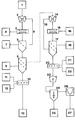
- the drawing shows an example of a flow chart of the preparation process according to the invention, the feed material - in the example of tail lights and turn signals from cars, composed of acrylonitryl / polybutadiene / styrene (ABS), polymethyl methacrylate (PMMA) and polycarbonate (PC) - in an impact or hammer mill (2) is selectively crushed.
- ABS acrylonitryl / polybutadiene / styrene
- PMMA polymethyl methacrylate
- PC polycarbonate
- the feed material is fed from the storage container (1) into the impact mill (2).
- the impact mill (2) inside the mill consists of a rotor with blow bars and two impact plates. Gaps between 20 and 130 mm are set between the blow bars and baffle plates for the shredding process.
- the rotor is operated at a peripheral speed of 15 to 65 m / s.
- this is equipped with a sieve grate with gap widths of 20 to 100 mm and with a rotor on which the shredding tools are movably mounted.
- the circumferential rotor speed is 20 to 70 m / s.
- Ferromagnetic metal is lifted from the regrind coming from the impact or hammer mill with an overband magnet (3) and fed to a collecting container (4).
- the rest of the regrind is a sieve (5) with in Sieve bars arranged in rows and held on one side and mounted on several levels.
- coarse material is classified as fine material.
- the coarse material is fed again to the impact or hammer mill via conveying means (6).
- the coarse material contains rubber and tough polymer pieces. These polymer pieces are further crushed by the circulation in the impact or hammer mill. The piece size of the rubber is not further reduced.
- the rubber accumulates in the circuit and is discharged and fed to the container (7).
- the fine material is classified into the fractions Grobgut II, Feingut II and Feinkorn using a linear vibrating sieve or a tumbler sieve (8).
- the very fine grain with a grain size of ⁇ 1.25 mm is fed to the container (9).
- the fine material II with a grain spectrum of 8 to 1.25 mm is fed to an air cooker (10).
- There heavy goods eg Fe / non-ferrous metals
- a fine-grain plastic with a grain size of ⁇ approx. 1 mm is obtained by a suction device of the air hearth and fed to the container (12).
- the remaining light goods are fed to the container (13).
- Grobgut II is a product of selective comminution and can be used as a starting product for the production of new polymer goods. It consists of approx. 90% of the polymer PMMA.
- Grobgut II also has a sufficient recyclable content of over 60% ABS and can be used as a starting product for the production of new polymer goods after further processing. For this purpose, with the help of an air oven, plastic particles and heavy goods are sorted out and the grain size is reduced to less than 8 mm with the aid of a cutting mill (not shown in the drawing). Grobgut II increases the amount of recyclable material for certain applications. For this purpose, the coarse material II is used for secondary shredding an impact mill (14) fed.
- This is constructed in accordance with the impact mill (2) and is operated with a circumferential rotor speed of 40 to 80 m / s and distances between the blow bars and impact plates of 10 to 30 mm.
- Ferromagnetic metal is excavated from the re-shredded coarse material II using an overband magnet (15) and fed to a collecting container (16).
- the comminuted material is fed to a tensioning shaft sieve (17) and is classified there into the coarse material III, fine material II and medium material.
- the coarse material III with a grain size> approx. 80 to 100 mm reaches the impact mill (14) again via a transport device (18) and is further comminuted.
- the fine material II with a grain size ⁇ approx. 1 mm is fed to a container (19).
- the medium good with a grain spectrum of approx. 1 to 80 mm is fed to an air cooker (20) and freed of heavy goods.
- the heavy goods are fed to the container (21).
- very fine grain with a grain size of ⁇ approx. 1 mm is extracted by a fan of the air cooker and fed to the container (22).
- the air hearth light material is fed to a wet cutting mill (23) and comminuted to a grain size ⁇ 8 mm.
- the moist regrind coming from the wet cutting mill (23) is fed to a floating-sink system (24), in which components of the regrind, in particular rubber, floating in water are separated off and fed to the container (25).
- the sinking regrind is fed to a centrifuge (26) and dried mechanically.
- the product obtained is a dry regrind with a grain size of 1 to 8 mm and with an ABS polymer content of approx. 90%, which is fed to the container (27).
- ABS and PMMA can be separated into fractions with a material content of approx. 90% be won. These fractions can be used as a starting product for further separation or for compounding new polymer products.
- computer keyboards, telephone and household appliances can also be prepared in a system which is very similar to the system described in the exemplary embodiment.
- the polymers polyvinyl chloride (PVC) and polybutylene terephthalate (PBT) can be separated from computer keyboards.
- PVC polyvinyl chloride
- PBT polybutylene terephthalate
- ABS can be separated from PS and PC, from polyethylene (PE) and from polypropylene (PP).
Landscapes
- Engineering & Computer Science (AREA)
- Environmental & Geological Engineering (AREA)
- Mechanical Engineering (AREA)
- Separation Of Solids By Using Liquids Or Pneumatic Power (AREA)
- Separation, Recovery Or Treatment Of Waste Materials Containing Plastics (AREA)
- Crushing And Pulverization Processes (AREA)
Applications Claiming Priority (2)
| Application Number | Priority Date | Filing Date | Title |
|---|---|---|---|
| DE4324237 | 1993-07-20 | ||
| DE19934324237 DE4324237A1 (de) | 1993-07-20 | 1993-07-20 | Verfahren und Vorrichtung zur Aufbereitung von Formkörpern aus unterschiedlichen Polymeren |
Publications (1)
| Publication Number | Publication Date |
|---|---|
| EP0635308A1 true EP0635308A1 (fr) | 1995-01-25 |
Family
ID=6493217
Family Applications (1)
| Application Number | Title | Priority Date | Filing Date |
|---|---|---|---|
| EP19940110500 Withdrawn EP0635308A1 (fr) | 1993-07-20 | 1994-07-06 | Procédé et dispositif pour le traitement de corps moulés de polymères différents |
Country Status (2)
| Country | Link |
|---|---|
| EP (1) | EP0635308A1 (fr) |
| DE (1) | DE4324237A1 (fr) |
Cited By (8)
| Publication number | Priority date | Publication date | Assignee | Title |
|---|---|---|---|---|
| WO1997018071A1 (fr) * | 1995-11-11 | 1997-05-22 | Schäfer Elektrotechnik - Sondermaschinen | Procede et dispositif permettant de traiter des elements constitutifs issus de matieres plastiques mixtes et de materiaux de construction melanges avec, et leur utilisation |
| WO1998001276A1 (fr) * | 1996-07-10 | 1998-01-15 | Guschall, Dietmar | Procede et dispositif pour le traitement de matieres plastiques mixtes |
| EP0779136A3 (fr) * | 1995-12-13 | 1998-07-01 | Ein Engineering Co., Ltd. | Procédé de recyclage et granulation de déchets en résines polymériques |
| WO2000053324A1 (fr) * | 1999-03-12 | 2000-09-14 | Bhs-Sonthofen Maschinen- Und Anlagenbau Gmbh | Procede et dispositif pour valoriser des dechets de broyeur ou d'autres matieres composites similaires et utilisation d'un broyeur a percussion rotorique |
| DE10044109A1 (de) * | 2000-09-07 | 2002-04-04 | Mewa Recycling Maschinen Und A | Einrichtung zur Abfallaufbereitung |
| FR3085866A1 (fr) * | 2018-09-17 | 2020-03-20 | Bigarren Bizi | Procédé et installation de séparation aéraulique |
| FR3101791A1 (fr) * | 2019-10-15 | 2021-04-16 | Broyeurs Poittemill Ingenierie | Procédé et installation de séparation aéraulique en continu de matériaux particulaires constitués d’un mélange de particules hétérogène à la fois en granulométrie et en densité |
| EP4169689A1 (fr) * | 2021-10-22 | 2023-04-26 | Schock GmbH | Procédé de préparation d'un recyclage particulaire en composite de quartz |
Families Citing this family (4)
| Publication number | Priority date | Publication date | Assignee | Title |
|---|---|---|---|---|
| DE19629473C2 (de) * | 1996-07-10 | 2001-06-13 | Sicon Gmbh | Verfahren und Vorrichtung zur Aufbereitung eines Kunststoffgemisches |
| DE19629470C2 (de) * | 1996-07-10 | 2001-12-13 | Sicon Gmbh | Verfahren und Anlage zur Aufbereitung von Mischkunststoffen |
| DE19955697A1 (de) * | 1999-11-18 | 2001-05-31 | Schreiter Klaus | Verfahren und Vorrichtung zum Trennen von Kunststoffen |
| DE102014225105B4 (de) * | 2014-12-08 | 2019-01-03 | Currenta Gmbh & Co.Ohg | Verfahren zur mechanischen Aufbereitung von Carbonfasern |
Citations (4)
| Publication number | Priority date | Publication date | Assignee | Title |
|---|---|---|---|---|
| GB2191118A (en) * | 1986-05-28 | 1987-12-09 | Andritz Ag Maschf | A process and a plant for separating low density material from substrate mixtures |
| FR2671755A1 (fr) * | 1991-01-22 | 1992-07-24 | Francois Fils L | Dispositif de collecte et de tri de matieres plastiques. |
| EP0524396A2 (fr) * | 1991-07-23 | 1993-01-27 | Lindemann Maschinenfabrik GmbH | Procédé et dispositif pour la récupération des rebuts d'appareils |
| NL9101705A (nl) * | 1991-10-11 | 1993-05-03 | Wavin Bv | Werkwijze voor het scheiden van componenten van kunststofprodukten alsmede daarvoor geschikte inrichting. |
-
1993
- 1993-07-20 DE DE19934324237 patent/DE4324237A1/de not_active Withdrawn
-
1994
- 1994-07-06 EP EP19940110500 patent/EP0635308A1/fr not_active Withdrawn
Patent Citations (4)
| Publication number | Priority date | Publication date | Assignee | Title |
|---|---|---|---|---|
| GB2191118A (en) * | 1986-05-28 | 1987-12-09 | Andritz Ag Maschf | A process and a plant for separating low density material from substrate mixtures |
| FR2671755A1 (fr) * | 1991-01-22 | 1992-07-24 | Francois Fils L | Dispositif de collecte et de tri de matieres plastiques. |
| EP0524396A2 (fr) * | 1991-07-23 | 1993-01-27 | Lindemann Maschinenfabrik GmbH | Procédé et dispositif pour la récupération des rebuts d'appareils |
| NL9101705A (nl) * | 1991-10-11 | 1993-05-03 | Wavin Bv | Werkwijze voor het scheiden van componenten van kunststofprodukten alsmede daarvoor geschikte inrichting. |
Non-Patent Citations (1)
| Title |
|---|
| W. MICHAELI ET AL:: "Materielles Recycling thermoplastischer Kunststoffabfälle", CHEMIE. INGENIEUR. TECHNIK, vol. 64, no. 5, 1992, WEINHEIM DE, pages 422 - 429 * |
Cited By (17)
| Publication number | Priority date | Publication date | Assignee | Title |
|---|---|---|---|---|
| WO1997018071A1 (fr) * | 1995-11-11 | 1997-05-22 | Schäfer Elektrotechnik - Sondermaschinen | Procede et dispositif permettant de traiter des elements constitutifs issus de matieres plastiques mixtes et de materiaux de construction melanges avec, et leur utilisation |
| EP0779136A3 (fr) * | 1995-12-13 | 1998-07-01 | Ein Engineering Co., Ltd. | Procédé de recyclage et granulation de déchets en résines polymériques |
| US5961054A (en) * | 1995-12-13 | 1999-10-05 | Ein Engineering Co., Ltd. | Method of recycling and granulating waste container made of resin materials |
| WO1998001276A1 (fr) * | 1996-07-10 | 1998-01-15 | Guschall, Dietmar | Procede et dispositif pour le traitement de matieres plastiques mixtes |
| WO2000053324A1 (fr) * | 1999-03-12 | 2000-09-14 | Bhs-Sonthofen Maschinen- Und Anlagenbau Gmbh | Procede et dispositif pour valoriser des dechets de broyeur ou d'autres matieres composites similaires et utilisation d'un broyeur a percussion rotorique |
| DE10044109A1 (de) * | 2000-09-07 | 2002-04-04 | Mewa Recycling Maschinen Und A | Einrichtung zur Abfallaufbereitung |
| FR3085866A1 (fr) * | 2018-09-17 | 2020-03-20 | Bigarren Bizi | Procédé et installation de séparation aéraulique |
| WO2020058847A3 (fr) * | 2018-09-17 | 2020-05-14 | Bigarren Bizi | Procédé et installation de séparation aéraulique |
| FR3101791A1 (fr) * | 2019-10-15 | 2021-04-16 | Broyeurs Poittemill Ingenierie | Procédé et installation de séparation aéraulique en continu de matériaux particulaires constitués d’un mélange de particules hétérogène à la fois en granulométrie et en densité |
| WO2021074528A1 (fr) * | 2019-10-15 | 2021-04-22 | Broyeurs Poittemill Ingenierie | Procédé et installation de séparation aéraulique en continu de matériaux particulaires constitués d'un mélange de particules hétérogène à la fois en granulométrie et en densité |
| CN114555233A (zh) * | 2019-10-15 | 2022-05-27 | 金融产业公司 | 由颗粒尺寸和密度皆不均匀的颗粒混合物组成的颗粒材料的连续气动分离方法和装置 |
| CN114555233B (zh) * | 2019-10-15 | 2024-02-13 | 金融产业公司 | 由颗粒尺寸和密度皆不均匀的颗粒混合物组成的颗粒材料的连续气动分离方法和装置 |
| US12048933B2 (en) | 2019-10-15 | 2024-07-30 | Societe Financiere Industrielle | Method and facility for continuous aeraulic separation of particulate materials consisting of a mixture of particles heterogeneous in both particle size and density |
| AU2020365494B2 (en) * | 2019-10-15 | 2026-01-08 | Societe Financiere Industrielle | Method and facility for continuous aeraulic separation of particulate materials consisting of a mixture of particles heterogeneous in both particle size and density |
| EP4169689A1 (fr) * | 2021-10-22 | 2023-04-26 | Schock GmbH | Procédé de préparation d'un recyclage particulaire en composite de quartz |
| AU2022252853B2 (en) * | 2021-10-22 | 2023-11-23 | Schock Gmbh | Process for producing a particulate recyclate from quartz composite |
| US12679946B2 (en) | 2021-10-22 | 2026-07-14 | Schock Gmbh | Process for producing a particulate recyclate from quartz composite |
Also Published As
| Publication number | Publication date |
|---|---|
| DE4324237A1 (de) | 1995-01-26 |
Similar Documents
| Publication | Publication Date | Title |
|---|---|---|
| EP0800445B2 (fr) | Procede et installation de traitement de plastiques mixtes | |
| DE102006054770B4 (de) | Verfahren für das Recycling von Abfallkunststoff, insbesondere Mischkunststoff | |
| DE102014220330B4 (de) | Verfahren zur Aufbereitung von Kunststoffen und Vorrichtung | |
| DE4217005C2 (de) | Verfahren zur Wiedergewinnung des Kunststoffes aus lackierten Kunststoffteilen | |
| WO1998018607A1 (fr) | Procede de desagregation de dechets qui contiennent des elements au moins en partie reutilisables | |
| EP4291379B1 (fr) | Procédé de recyclage des déchets plastiques pour le traitement des déchets plastiques | |
| DE4123277C1 (en) | Handling waste combustion slag allowing removal of valuable materials - by reducing raw slag material and then removing dust components and wet sorting to separate light fraction | |
| EP2274103B1 (fr) | Procédé et installation pour préparer une fraction lourde riche en matières plastiques | |
| EP0876847A2 (fr) | Procédé pour séparer un mélange de matières plastiques | |
| EP1721675B1 (fr) | Procédé pour traiter des résidus de déchiquetage pour la production d'une fraction de granulat | |
| DE19911010A1 (de) | Anlage und Verfahren für die Verwendung von Shredderabfällen o. dgl. Verbundstoffen sowie Verwendung einer Rotorprallmühle | |
| DE4324237A1 (de) | Verfahren und Vorrichtung zur Aufbereitung von Formkörpern aus unterschiedlichen Polymeren | |
| US20250319635A1 (en) | Methods and systems for high throughput separation and recovery of plastics from waste material | |
| CN117642363A (zh) | 用于从废物流中分离塑料的方法和系统 | |
| DE4205309A1 (de) | Verfahren zur aufbereitung von reststoffen aus altautomobilen | |
| EP0747126B1 (fr) | Procédé et dispositif pour le traitement de matières fibreuses, en particulier des déchets de laine minerale, comportant des fibres et des matières étrangères | |
| WO1994014542A1 (fr) | Procede et dispositif pour la separation mecanique de melanges de matieres plastiques ou de matieres plastiques composites contenant des metaux | |
| EP4296028B1 (fr) | Procédé de récupération de matières plastiques | |
| DE102004045821B4 (de) | Verfahren und Anlage zur Aufbereitung der Schredderleichtfraktion aus der Zerkleinerung von Schrotten und metallischen Abfällen | |
| EP0623390A1 (fr) | Procédé et installation pour le traitement mécanique de mélanges de déchets | |
| DE10334646A1 (de) | Verfahren und Anlage zur Aufbereitung der Schredderleichtfraktion aus der Zerkleinerung von Schrotten und metallhaltigen Abfällen | |
| EP2254701B1 (fr) | Procédé et installation pour le traitement de déchets de matières plastiques à faible teneur en métaux | |
| EP1652585B1 (fr) | Procédé et installation de traitement de déchets résiduels urbains ou industriels | |
| DE4312429C2 (de) | Verfahren zur trockenen Aufbereitung eines hauptsächlich Kunststoffteile enthaltenden Ausgangsgemenges aus Abfallkunststoff und Verunreinigungen sowie Anwendung des Verfahrens auf besondere Abfallkunststoffe | |
| DE29724012U1 (de) | Anlage zur Aufarbeitung von Restmüll, Sperrmüll, Gewerbeabfällen u.dgl. |
Legal Events
| Date | Code | Title | Description |
|---|---|---|---|
| PUAI | Public reference made under article 153(3) epc to a published international application that has entered the european phase |
Free format text: ORIGINAL CODE: 0009012 |
|
| AK | Designated contracting states |
Kind code of ref document: A1 Designated state(s): AT BE CH DE DK ES FR GB IT LI LU NL |
|
| 17P | Request for examination filed |
Effective date: 19950724 |
|
| RAP1 | Party data changed (applicant data changed or rights of an application transferred) |
Owner name: KENSA GESELLSCHAFT FUER TECHNOLOGIEMANAGEMENT MBH |
|
| 17Q | First examination report despatched |
Effective date: 19970311 |
|
| STAA | Information on the status of an ep patent application or granted ep patent |
Free format text: STATUS: THE APPLICATION HAS BEEN WITHDRAWN |
|
| 18W | Application withdrawn |
Withdrawal date: 19970614 |