EP2274103B1 - Procédé et installation pour préparer une fraction lourde riche en matières plastiques - Google Patents
Procédé et installation pour préparer une fraction lourde riche en matières plastiques Download PDFInfo
- Publication number
- EP2274103B1 EP2274103B1 EP09726667.0A EP09726667A EP2274103B1 EP 2274103 B1 EP2274103 B1 EP 2274103B1 EP 09726667 A EP09726667 A EP 09726667A EP 2274103 B1 EP2274103 B1 EP 2274103B1
- Authority
- EP
- European Patent Office
- Prior art keywords
- fraction
- rich
- plastics
- separation
- metal
- Prior art date
- Legal status (The legal status is an assumption and is not a legal conclusion. Google has not performed a legal analysis and makes no representation as to the accuracy of the status listed.)
- Active
Links
Images

Classifications
-
- B—PERFORMING OPERATIONS; TRANSPORTING
- B03—SEPARATION OF SOLID MATERIALS USING LIQUIDS OR USING PNEUMATIC TABLES OR JIGS; MAGNETIC OR ELECTROSTATIC SEPARATION OF SOLID MATERIALS FROM SOLID MATERIALS OR FLUIDS; SEPARATION BY HIGH-VOLTAGE ELECTRIC FIELDS
- B03B—SEPARATING SOLID MATERIALS USING LIQUIDS OR USING PNEUMATIC TABLES OR JIGS
- B03B9/00—General arrangement of separating plant, e.g. flow sheets
- B03B9/06—General arrangement of separating plant, e.g. flow sheets specially adapted for refuse
- B03B9/061—General arrangement of separating plant, e.g. flow sheets specially adapted for refuse the refuse being industrial
-
- B—PERFORMING OPERATIONS; TRANSPORTING
- B29—WORKING OF PLASTICS; WORKING OF SUBSTANCES IN A PLASTIC STATE IN GENERAL
- B29B—PREPARATION OR PRETREATMENT OF THE MATERIAL TO BE SHAPED; MAKING GRANULES OR PREFORMS; RECOVERY OF PLASTICS OR OTHER CONSTITUENTS OF WASTE MATERIAL CONTAINING PLASTICS
- B29B17/00—Recovery of plastics or other constituents of waste material containing plastics
- B29B17/02—Separating plastics from other materials
-
- C—CHEMISTRY; METALLURGY
- C22—METALLURGY; FERROUS OR NON-FERROUS ALLOYS; TREATMENT OF ALLOYS OR NON-FERROUS METALS
- C22B—PRODUCTION AND REFINING OF METALS; PRETREATMENT OF RAW MATERIALS
- C22B7/00—Working up raw materials other than ores, e.g. scrap, to produce non-ferrous metals and compounds thereof; Methods of a general interest or applied to the winning of more than two metals
- C22B7/005—Separation by a physical processing technique only, e.g. by mechanical breaking
-
- B—PERFORMING OPERATIONS; TRANSPORTING
- B03—SEPARATION OF SOLID MATERIALS USING LIQUIDS OR USING PNEUMATIC TABLES OR JIGS; MAGNETIC OR ELECTROSTATIC SEPARATION OF SOLID MATERIALS FROM SOLID MATERIALS OR FLUIDS; SEPARATION BY HIGH-VOLTAGE ELECTRIC FIELDS
- B03B—SEPARATING SOLID MATERIALS USING LIQUIDS OR USING PNEUMATIC TABLES OR JIGS
- B03B9/00—General arrangement of separating plant, e.g. flow sheets
- B03B9/06—General arrangement of separating plant, e.g. flow sheets specially adapted for refuse
- B03B2009/068—Specific treatment of shredder light fraction
-
- B—PERFORMING OPERATIONS; TRANSPORTING
- B29—WORKING OF PLASTICS; WORKING OF SUBSTANCES IN A PLASTIC STATE IN GENERAL
- B29B—PREPARATION OR PRETREATMENT OF THE MATERIAL TO BE SHAPED; MAKING GRANULES OR PREFORMS; RECOVERY OF PLASTICS OR OTHER CONSTITUENTS OF WASTE MATERIAL CONTAINING PLASTICS
- B29B17/00—Recovery of plastics or other constituents of waste material containing plastics
- B29B17/02—Separating plastics from other materials
- B29B2017/0203—Separating plastics from plastics
-
- B—PERFORMING OPERATIONS; TRANSPORTING
- B29—WORKING OF PLASTICS; WORKING OF SUBSTANCES IN A PLASTIC STATE IN GENERAL
- B29B—PREPARATION OR PRETREATMENT OF THE MATERIAL TO BE SHAPED; MAKING GRANULES OR PREFORMS; RECOVERY OF PLASTICS OR OTHER CONSTITUENTS OF WASTE MATERIAL CONTAINING PLASTICS
- B29B17/00—Recovery of plastics or other constituents of waste material containing plastics
- B29B17/02—Separating plastics from other materials
- B29B2017/0213—Specific separating techniques
- B29B2017/0217—Mechanical separating techniques; devices therefor
- B29B2017/0224—Screens, sieves
-
- B—PERFORMING OPERATIONS; TRANSPORTING
- B29—WORKING OF PLASTICS; WORKING OF SUBSTANCES IN A PLASTIC STATE IN GENERAL
- B29B—PREPARATION OR PRETREATMENT OF THE MATERIAL TO BE SHAPED; MAKING GRANULES OR PREFORMS; RECOVERY OF PLASTICS OR OTHER CONSTITUENTS OF WASTE MATERIAL CONTAINING PLASTICS
- B29B17/00—Recovery of plastics or other constituents of waste material containing plastics
- B29B17/02—Separating plastics from other materials
- B29B2017/0213—Specific separating techniques
- B29B2017/0217—Mechanical separating techniques; devices therefor
- B29B2017/0237—Mechanical separating techniques; devices therefor using density difference
-
- B—PERFORMING OPERATIONS; TRANSPORTING
- B29—WORKING OF PLASTICS; WORKING OF SUBSTANCES IN A PLASTIC STATE IN GENERAL
- B29B—PREPARATION OR PRETREATMENT OF THE MATERIAL TO BE SHAPED; MAKING GRANULES OR PREFORMS; RECOVERY OF PLASTICS OR OTHER CONSTITUENTS OF WASTE MATERIAL CONTAINING PLASTICS
- B29B17/00—Recovery of plastics or other constituents of waste material containing plastics
- B29B17/02—Separating plastics from other materials
- B29B2017/0213—Specific separating techniques
- B29B2017/0262—Specific separating techniques using electrical caracteristics
- B29B2017/0265—Electrostatic separation
-
- B—PERFORMING OPERATIONS; TRANSPORTING
- B29—WORKING OF PLASTICS; WORKING OF SUBSTANCES IN A PLASTIC STATE IN GENERAL
- B29B—PREPARATION OR PRETREATMENT OF THE MATERIAL TO BE SHAPED; MAKING GRANULES OR PREFORMS; RECOVERY OF PLASTICS OR OTHER CONSTITUENTS OF WASTE MATERIAL CONTAINING PLASTICS
- B29B17/00—Recovery of plastics or other constituents of waste material containing plastics
- B29B17/02—Separating plastics from other materials
- B29B2017/0213—Specific separating techniques
- B29B2017/0268—Separation of metals
-
- B—PERFORMING OPERATIONS; TRANSPORTING
- B29—WORKING OF PLASTICS; WORKING OF SUBSTANCES IN A PLASTIC STATE IN GENERAL
- B29B—PREPARATION OR PRETREATMENT OF THE MATERIAL TO BE SHAPED; MAKING GRANULES OR PREFORMS; RECOVERY OF PLASTICS OR OTHER CONSTITUENTS OF WASTE MATERIAL CONTAINING PLASTICS
- B29B17/00—Recovery of plastics or other constituents of waste material containing plastics
- B29B17/02—Separating plastics from other materials
- B29B2017/0213—Specific separating techniques
- B29B2017/0268—Separation of metals
- B29B2017/0272—Magnetic separation
-
- B—PERFORMING OPERATIONS; TRANSPORTING
- B29—WORKING OF PLASTICS; WORKING OF SUBSTANCES IN A PLASTIC STATE IN GENERAL
- B29B—PREPARATION OR PRETREATMENT OF THE MATERIAL TO BE SHAPED; MAKING GRANULES OR PREFORMS; RECOVERY OF PLASTICS OR OTHER CONSTITUENTS OF WASTE MATERIAL CONTAINING PLASTICS
- B29B17/00—Recovery of plastics or other constituents of waste material containing plastics
- B29B17/02—Separating plastics from other materials
- B29B2017/0213—Specific separating techniques
- B29B2017/0279—Optical identification, e.g. cameras or spectroscopy
-
- B—PERFORMING OPERATIONS; TRANSPORTING
- B29—WORKING OF PLASTICS; WORKING OF SUBSTANCES IN A PLASTIC STATE IN GENERAL
- B29B—PREPARATION OR PRETREATMENT OF THE MATERIAL TO BE SHAPED; MAKING GRANULES OR PREFORMS; RECOVERY OF PLASTICS OR OTHER CONSTITUENTS OF WASTE MATERIAL CONTAINING PLASTICS
- B29B17/00—Recovery of plastics or other constituents of waste material containing plastics
- B29B17/02—Separating plastics from other materials
- B29B2017/0213—Specific separating techniques
- B29B2017/0286—Cleaning means used for separation
- B29B2017/0289—Washing the materials in liquids
-
- B—PERFORMING OPERATIONS; TRANSPORTING
- B29—WORKING OF PLASTICS; WORKING OF SUBSTANCES IN A PLASTIC STATE IN GENERAL
- B29K—INDEXING SCHEME ASSOCIATED WITH SUBCLASSES B29B, B29C OR B29D, RELATING TO MOULDING MATERIALS OR TO MATERIALS FOR MOULDS, REINFORCEMENTS, FILLERS OR PREFORMED PARTS, e.g. INSERTS
- B29K2021/00—Use of unspecified rubbers as moulding material
-
- B—PERFORMING OPERATIONS; TRANSPORTING
- B29—WORKING OF PLASTICS; WORKING OF SUBSTANCES IN A PLASTIC STATE IN GENERAL
- B29K—INDEXING SCHEME ASSOCIATED WITH SUBCLASSES B29B, B29C OR B29D, RELATING TO MOULDING MATERIALS OR TO MATERIALS FOR MOULDS, REINFORCEMENTS, FILLERS OR PREFORMED PARTS, e.g. INSERTS
- B29K2023/00—Use of polyalkenes or derivatives thereof as moulding material
-
- B—PERFORMING OPERATIONS; TRANSPORTING
- B29—WORKING OF PLASTICS; WORKING OF SUBSTANCES IN A PLASTIC STATE IN GENERAL
- B29K—INDEXING SCHEME ASSOCIATED WITH SUBCLASSES B29B, B29C OR B29D, RELATING TO MOULDING MATERIALS OR TO MATERIALS FOR MOULDS, REINFORCEMENTS, FILLERS OR PREFORMED PARTS, e.g. INSERTS
- B29K2027/00—Use of polyvinylhalogenides or derivatives thereof as moulding material
- B29K2027/06—PVC, i.e. polyvinylchloride
-
- B—PERFORMING OPERATIONS; TRANSPORTING
- B29—WORKING OF PLASTICS; WORKING OF SUBSTANCES IN A PLASTIC STATE IN GENERAL
- B29K—INDEXING SCHEME ASSOCIATED WITH SUBCLASSES B29B, B29C OR B29D, RELATING TO MOULDING MATERIALS OR TO MATERIALS FOR MOULDS, REINFORCEMENTS, FILLERS OR PREFORMED PARTS, e.g. INSERTS
- B29K2711/00—Use of natural products or their composites, not provided for in groups B29K2601/00 - B29K2709/00, for preformed parts, e.g. for inserts
- B29K2711/14—Wood, e.g. woodboard or fibreboard
-
- Y—GENERAL TAGGING OF NEW TECHNOLOGICAL DEVELOPMENTS; GENERAL TAGGING OF CROSS-SECTIONAL TECHNOLOGIES SPANNING OVER SEVERAL SECTIONS OF THE IPC; TECHNICAL SUBJECTS COVERED BY FORMER USPC CROSS-REFERENCE ART COLLECTIONS [XRACs] AND DIGESTS
- Y02—TECHNOLOGIES OR APPLICATIONS FOR MITIGATION OR ADAPTATION AGAINST CLIMATE CHANGE
- Y02P—CLIMATE CHANGE MITIGATION TECHNOLOGIES IN THE PRODUCTION OR PROCESSING OF GOODS
- Y02P10/00—Technologies related to metal processing
- Y02P10/20—Recycling
-
- Y—GENERAL TAGGING OF NEW TECHNOLOGICAL DEVELOPMENTS; GENERAL TAGGING OF CROSS-SECTIONAL TECHNOLOGIES SPANNING OVER SEVERAL SECTIONS OF THE IPC; TECHNICAL SUBJECTS COVERED BY FORMER USPC CROSS-REFERENCE ART COLLECTIONS [XRACs] AND DIGESTS
- Y02—TECHNOLOGIES OR APPLICATIONS FOR MITIGATION OR ADAPTATION AGAINST CLIMATE CHANGE
- Y02W—CLIMATE CHANGE MITIGATION TECHNOLOGIES RELATED TO WASTEWATER TREATMENT OR WASTE MANAGEMENT
- Y02W30/00—Technologies for solid waste management
- Y02W30/50—Reuse, recycling or recovery technologies
- Y02W30/52—Mechanical processing of waste for the recovery of materials, e.g. crushing, shredding, separation or disassembly
-
- Y—GENERAL TAGGING OF NEW TECHNOLOGICAL DEVELOPMENTS; GENERAL TAGGING OF CROSS-SECTIONAL TECHNOLOGIES SPANNING OVER SEVERAL SECTIONS OF THE IPC; TECHNICAL SUBJECTS COVERED BY FORMER USPC CROSS-REFERENCE ART COLLECTIONS [XRACs] AND DIGESTS
- Y02—TECHNOLOGIES OR APPLICATIONS FOR MITIGATION OR ADAPTATION AGAINST CLIMATE CHANGE
- Y02W—CLIMATE CHANGE MITIGATION TECHNOLOGIES RELATED TO WASTEWATER TREATMENT OR WASTE MANAGEMENT
- Y02W30/00—Technologies for solid waste management
- Y02W30/50—Reuse, recycling or recovery technologies
- Y02W30/62—Plastics recycling; Rubber recycling
Definitions
- the invention relates to a process and a plant for upgrading a heavy fraction, which was produced during the treatment of metal-poor, plastic-rich mixtures, in particular a heavy-weight plastic fraction with a mean bulk weight of> 0.3 t / m 3 .
- a method for processing shredder residues is known, for example, from the European patent specification EP 1 332 001 B1 known.
- a separate shredder light fraction and a shredder heavy fraction are processed in separate preliminary processes.
- comminution of the remaining fraction into a discharge ⁇ 50 mm takes place.
- a ferromagnetic fraction is separated.
- the remaining non-ferromagnetic fraction is fed to a second comminution process in which a further digestion of the material takes place.
- a sand fraction ⁇ 4 mm is separated in a downstream process step.
- the remaining fraction is subjected to air classification and density separation to separate the fraction into a light fraction of lint and a heavy fraction.
- the shredder heavy fraction is subjected to a separation of the ferromagnetic components. This is followed by a classification of the residual current and a separation of non-ferrous metal fractions. This can be done in such a way that initially a classification into fractions larger and smaller than 20 mm takes place and these fractions are fed separately to the metal separator. The focus is on a clean as possible material separation in a non-ferrous metal fraction and a remaining metal-poor fraction. In a subsequent classification, the deposition of a sand fraction with a particle diameter of less than 6 mm takes place.
- the remaining coarse metal-rich fraction is then separated into a heavy fraction and a high-density residual fraction.
- the heavy fractions (raw granules) from the two preliminary processes are summarized.
- the combined fractions are first digested in a further comminution step. After comminution, a density separation and the separation of a fraction of predominantly plastic in granulated form.
- the raw granulate will then be in an additional refining process further worked up.
- the surface is first cleaned with water in an attrition process. In this case, heavy metal-containing, superficially adhering dusts are washed off and concentrated in a sludge fraction. This is followed by drying of the washed granules.
- an all-metal separator with the last remaining metal particles contained in the granules, for example copper strands, can be separated.
- the thus pretreated granules are subjected to a charging of the granules by friction, whereby a PVC separation is possible and a low-chlorine and metal granules fraction, which can be fed to the raw material recovery, is obtained.
- the EP 1 020 225 A1 describes a method for the separation of organic substance groups from autoshredder light fractions.
- the autoshredder light fraction is first subjected to Fe metal deposition to obtain the required release ability to deposit residual Fe metal parts.
- the freed from essential Fe metal parts material is fed to a crushing by a granulator and processed to a uniform maximum grain size.
- After separation of the airborne, light organic fraction by sifting a multiple screening in 3 fractions, wherein the sieve fractions are each subjected to a separate further processing (Fe / NE metal deposition, density separation).
- the multiple screening is done by a double deck (two Sieblagen).
- the DE 103 34 646 A1 are a method and a plant for the treatment of a light fraction from the crushing of scrap and metal-containing waste (Autoshredder) described.
- the light fraction is fed via a Kastenbeschicker after selection of metal heavy parts of an impact mill for crushing and then subjected to a sieve classification (tension wave screening machine) to fractions ⁇ 20mm (fine material) and> 20mm (coarse material).
- the brittle, mineral components of the light fraction eg glass, ceramics, sand
- the fractions obtained by screen classification are then subjected separately to further work-up by zig-zag sifter and aero stoves.
- first pretreatment stages are provided, in which the waste mixture is repeatedly crushed and sorted.
- the crushing and Sorting takes place via hammer mills or magnetic and eddy current separators.
- a classifying device in the form of a sieve is provided, the fine material discharge (0.5-2.8 mm) of which is connected to a vibrating hearth and its coarse material discharge (4.5-6.2 mm) to a wet-setting machine.
- the object of the invention is to provide a method and a plant with which a low-metal heavy fraction, which was produced during the treatment of metal-poor, plastic-rich mixtures, can be refined so that a high-purity end product is obtained for recycling.
- a particularly advantageous embodiment of the invention provides that the treatment of the separated plastic-rich fractions proceeds at least partially in similar processes, whereby an improved process control is possible.
- a separation of the remaining plastic-rich fraction into three plastic-rich fractions of different particle size is not absolutely necessary. For example, it can also be separated into two or even four plastic-rich fractions with naturally somewhat different particle size ranges. However, separation into three plastic-rich fractions (as mentioned above) has proven to be very advantageous.
- the heavy plastic-rich fraction to be reprocessed has, on average, a bulk solids weight of> 0.2 t / m 3 , in particular a bulk solids weight clearly above 0.4 t / m 3 .
- An advantageous embodiment of the invention provides that the separation of the metal parts takes place in two different process steps.
- the first process step the ferromagnetic components of the metal-poor plastic-rich fraction are separated and in the second process step the non-ferromagnetic metal parts.
- a sort of cleaner separation is possible, which in turn ensures an improved feedstock utilization of the individual metals.
- an eddy current deposition can be used as well as methods of sensitive metal separation based on the electrical conductivity of the non-ferromagnetic metal parts.
- the latter method has the advantage that in addition to digested ferromagnetic metal parts and stainless steel, lead and unraised metals are separable. In addition, the individual metals are separable from each other separately and thus easier to feed a material recycling.
- a separation of chlorine-rich polyvinyl chloride (PVC), preferably on the different absorption capacity of the individual plastics of X-radiation is provided.
- the process steps of separating metal parts or separating polyvinyl chloride are followed by the process step of comminuting the metal-reduced heavy plastic-rich fraction to a particle size of less than or equal to 8 mm, preferably less than or equal to 7 mm, which is a prerequisite for separating the metal-reduced heavy plastic-rich fraction into fractions of different particle size ,
- a crushing method is used, which allows digestion of the untreated metals contained in the heavy plastic-rich fraction with a percentage of> 95%, in particular> 99%.
- the process of comminution can advantageously but also multi-stage, for example, take two stages, each intermediate buffering is possible.
- a process step for the separation of raw fluff in particular with a mean bulk material weight of ⁇ 0.3 t / m 3 , preferably ⁇ 0.2 t / m 3 , and / or wood particles follows.
- Another embodiment of the method according to the invention proposes that the separation of the metal-reduced heavy plastic-rich fraction takes place by sieving, preferably with at least three sieve layers of different hole size.
- hole sizes of 7.0 mm, 4.0 mm and 1.5 mm can be used here.
- According to another embodiment of the invention takes place after separation of the separation of the metal reduced heavy plastic-rich fraction of the process of separation of the raw fluff and / or existing wood particles separately for each of the resulting in the separation of the plastic-rich fraction plastic-rich fractions of different grain or particle size.
- the separated plastic-rich fractions are separated from each other subjected to a process of density separation, wherein the density separation depending on the plastic-rich fractions different end and / or intermediates.
- a Kunststoffmahlgut which preferably together with the resulting during the preparation of the metal-poor plastic waste Rohflusen with a mean bulk weight ⁇ 0.2 t / m 3 is further processed.
- a fraction consisting at least for the most part of non-ferromagnetic metal parts is produced.
- a precoated granulate fraction and a non-ferromagnetic metal fraction are formed which can be separated into their individual metal species in subsequent process steps, preferably by sieving.
- Part of the metal fraction thus separated is further processed together with a metal fraction which has formed during the density separation of the plastic-rich fraction with a particle size of about 4.0 mm to 7.0 mm (see also below).
- the joint further processing is advantageously carried out by an optical sorting, in which the common metal fraction is separated into their individual types of metals. It has proven to be advantageous if the optical sorting is preceded by an impact treatment in order to achieve a Verkugelung of copper strands. As a result, a significant increase in the efficiency of optical sorting is possible.
- the non-ferromagnetic metal fractions formed by the density separations in the range from about 1.5 mm to 7.0 mm can be supplied to a deposition of ferromagnetic constituents, in order to possibly still contain fine iron (eg fine metal wires) in the non-ferromagnetic metal fractions. to separate and thus increase their purity.
- fine iron eg fine metal wires
- the non-ferromagnetic metal fractions u. U. may still contain a fine iron content of up to about 5%.
- the granulate fractions are subjected individually or together during the preparation of a surface cleaning for the removal of dusts and / or operating fluids (in particular fats and oils, which may also be partially diffused already in the plastic parts).
- the surface cleaning is followed in highly expedient embodiment of the invention, a process of separating a polyvinyl chloride fraction (PVC), in particular by wet density separation and a process for separating polyolefins, in particular by wet density separation.
- PVC polyvinyl chloride fraction
- the existing rubber parts are removed or at least greatly reduced in a subsequent process step by electrostatic separation according to a development of the invention. It is worth mentioning that the granulated fraction refined in this way can, of course, be further comminuted or ground if required, if downstream processes require this.
- the means present in the system according to the invention for separating the metal-reduced and comminuted plastic-rich fraction are designed such that a first plastic-rich fraction having a particle size in the range of about 0 mm to 1.7 mm, preferably with a particle size of about 0 mm to 1, 5 mm, a second plastic-rich fraction having a particle size in the range of about 1.3 mm to 4.2 mm, preferably in the range of about 1.5 mm to 4.0 mm, and a third plastic-rich fraction having a particle size in the range of about 3.8 mm to 7.2 mm, preferably with a grain size of about 4.0 mm to 7.0 mm.
- the heavy and metal-poor plastic-rich fraction (raw granules) to be reprocessed has, on average, a bulk solids weight of> 0.2 t / m 3 , in particular a bulk solids weight clearly above 0.4 t / m 3 .
- the means for separating the metal parts of the heavy and metal-rich plastic-rich fraction means for separating ferromagnetic components in a first process step, preferably a magnetic separator, in particular a magnetic drum or a Kochbandmagnetleaned, and downstream means for separating non-ferromagnetic metal parts, in particular means for eddy current separation or means for sensitive metal separation based on the electrical conductivity of the metal parts.
- the means for separating metal parts means for separating chlorine-rich polyvinyl chloride (PVC), in particular a separation device using X-rays downstream.
- PVC polyvinyl chloride
- the means for comminuting the metal-reduced plastic-rich fraction are designed in such a way that the plastic-rich fraction is comminuted such that a digestion of unreacted metals contained in the fraction of> 95%, preferably 99% can be achieved.
- the means for comminuting the metal-reduced plastic-rich fraction can be designed such that comminution of the plastic-rich fraction into a particle size of less than or equal to 8.0 mm, preferably 7 mm.
- compositions for separating raw fluff in particular having a mean bulk material weight of ⁇ 0.3 t / m 3 , in particular a bulk material weight of ⁇ 0.2 t / m 3 , are suitable for comminuting the metal-reduced plastic-rich fraction. intended. It is not absolutely necessary to arrange these funds at this point in the process flow. It is also possible to arrange them separately after separation of the metal-reduced plastic-rich fraction in plastic-rich fractions of different particle size or grain size for each of the obtained plastic-rich fractions.
- devices for air separation are used to separate the raw fluff.
- a screening device with at least three screen layers of different hole size is provided as a means for separating the plastic-rich fractions having different particle sizes.
- the means for density separation of the first separated plastic-rich fraction which preferably has a grain size of about 0 mm to 1.5 mm, are designed such that the end product is a non-ferromagnetic metal fraction and Kunststoffmahlgut is obtained.
- the means for density separation of the second separated plastic-rich fraction which preferably has a particle size of about 1.5 mm to 4.0 mm, and the separate means for density separation of the third separated plastic-rich fraction, preferably having a particle size of about 4.0 mm 7.0 mm are formed such that a non-ferromagnetic metal fraction and a pre-refined granule fraction are obtained as the end product, wherein the obtained metal fractions and the granule fractions obtained are each at least partially further processed together.
- the means for density separation of the second and third plastic-rich fractions downstream means for surface cleaning of the resulting granule fractions are designed in such a way that dusts and / or operating fluids adhering to the plastic particles (in particular fats and oils) can be removed.
- the means for surface cleaning are arranged in two stages with means for separating polyvinyl chloride (PVC) and then separating polyolefins, both means being advantageously designed as wet density separation. After the means for the separation of polyolefins from the plastic fraction means are provided for separating rubber particles from the Gutfr syndrome according to an embodiment of the invention.
- a plastic granules obtained by processing a raw granulate produced by the treatment of metal-rich waste rich in metal that can be supplied with high quality standards due to its degree of purity of a material recovery.
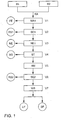
- FIG.1 shown schematic flow diagram shows the process flow in the preparation of low-metal, plastic-rich mixtures KA to obtain a plastic-rich heavy fraction SF and a plastic-rich light fraction LF, which can be followed, for example, a shredder process of end-of-life vehicles.
- a shredder process of end-of-life vehicles In addition to the metal-poor plastic-rich mixtures of substances from a shredder process, other plastic-rich mixtures can be prepared using the invention.
- metal-containing wastes are first digested by a comminution process in a shredder process known per se in a shredder. Subsequent separation of an airworthy shredder light fraction SLF by a suction device.
- the ferromagnetic fraction is referred to as shredder scrap and represents the primary product of the shredder that can be used directly in metallurgy.
- the remaining heavy, non-ferromagnetic fraction is referred to as the shredder heavy fraction SSF.
- the shredder light fraction SLF is further processed alone or together with the shredder heavy fraction SSF and optionally with other metal-poor, plastic-rich mixtures and, when subjected to the process, referred to as low-metal, plastic-rich waste KA.
- These metal-poor, plastic-rich mixtures have a metal content of ⁇ 20%, preferably a metal content in the size range of 5%.
- One or more feed containers B1 and / or B2 are provided for feeding the low-metal, high-plastic substance mixtures in order to decouple the preparation process from upstream processes, for example the shredder process.
- a first method step V1 the ferromagnetic components FE are separated by means of a magnetic separator MA1 as ferromagnetic fraction, which can thus be fed to a metallurgical processing process for material recycling.
- the process step V2 is followed by a process step V3 "deposition of nonferromagnetic metal constituents" (non-ferromagnetic metal fraction), such as copper, brass and aluminum.
- means NE1 for eddy current separation or for sensitive metal separation on the basis of the electrical conductivity of the metal parts can be used here.
- the subsequent process step V4 of the separation of coarse constituents significantly reduces the wear in the next process step V5 of the main comminution.
- process step V4 for separating the coarse constituents (heavy material) SG means ST for heavy material separation, so-called Air Knife systems, come. After the separation of the heavy SG is carried out in process step V5, a crushing of the remaining fractions by means of a hammer mill HM.
- the comminution takes place in such a way that the volume of the light fraction (raw fluff) LF contained in the remaining fractions is increased, whereby in a later process step V7 an improved and fractionally clean separation of the remaining fractions into a light fraction (raw fluff) LF and a heavy fraction (raw granulate) SF is possible.
- means (WS) are provided for air classification.
- the resulting heavy fraction (raw granules) SF has an average bulk material weight> 0.2 t / m 3 , in particular significantly above 0.4 t / m 3 .
- a process step V6 is provided, in which a second raw sand fraction RS2 is separated by means of a sieve SE2.
- the hole size of the sieve device SE2 is preferably in the range of 4 - 8 mm.
- the raw granules SF (heavy fraction) thus produced during refining, whose inventive sequence in the Fig. 2 described in detail, in a first process step VG1 of the deposition of the ferromagnetic constituents FE, which were digested during comminution in process step V5 subjected.
- a magnetic separator MA2 for example a magnetic drum or an overband magnet device, is used for this purpose.
- the nonferromagnetic metals NE and, depending on the type of preparation, also the stainless steel components NES, are separated in the next process step VG2.
- step VG2 the nonferromagnetic metals, such as copper, brass, aluminum, are cut off, as far as they are open or exposed.
- metallic constituents having a particle size of> 1 mm are separated here.
- KFA metal-reduced, plastic-rich fraction
- a method for sensitive metal deposition MS1 based on the electrical conductivity of the different metal parts may also be used.
- the advantage of the sensitive metal deposition is that in addition to the non-ferromagnetic metals and stainless steel, lead and non-digested metals are separable and the different metals can be separated separately and thus a separate metal processing can be fed.
- the sensitivity is adjustable and thus also the desired quality of the separated metal fraction. The setting of a low sensitivity leads to a very clean metal fraction, while increasing the sensitivity also increasingly entails the separation of a cable fraction.
- the sensitive metal deposition may optionally be dispensed with the process step VG1.
- the plastic-rich fraction KFA obtained in process step VG2 has a PVC content which is frequently in the range of 4-8%.
- the grain size of the fraction is> 5 mm, in particular> 10 mm.
- the chlorine-rich PVC component which frequently also has elevated lead and cadmium values, is separated from its X-ray absorption capacity. This is done in an x-ray separation plant.
- the thus obtained Low-chlorine plastic fraction has a chlorine content of 0.6 to 1%.
- the chlorine-rich PVC fraction can also take place before the process step VG1 (deposition of the ferromagnetic constituents FE).
- the PVC separation usually takes place essentially in a downstream process step of wet density separation (VG11), which takes place at smaller particle sizes and will be explained later.
- this fraction is comminuted to a particle size ⁇ 8, preferably less than or equal to 7 mm.
- a cutting crushing ZA1 is selected with the aid of granulators, with which a digestion of the unresolved metals in the range> 99%.
- This process step is especially important if in the process step VG2 an eddy current deposition has been used with the non-decomposed metal composites were not separated. It should be mentioned that the method step VG4 can also be multi-stage.
- the comminution can take place in two stages, wherein an intermediate buffering is possible in each case.
- an intermediate buffering is possible in each case.
- the process step VG4 is followed by a separation VG5 of the plastic light particles formed by the digestion and wood particles by air classification WS1, preferably the plant WS1 is designed to be controllable so that wood particles are also blown out.
- the residual moisture of the materials is preferably measured and the extraction speed is regulated as a function of the residual moisture.
- a separation of the remaining fraction into three fractions of different particle size is carried out by a sieving SE3 with at least three sieve layers of different hole size.
- the metal-reduced, plastic-rich fraction KF1 having a particle size in the range from about 0 mm to about 1.5 mm, the metal-reduced, plastic-rich fraction KF2 having a particle size of about 1.5 mm to about 4 mm and the metal-reduced, plastic-rich fraction KF3 with a grain size of about 4 mm to about 7 mm received.
- Components that are larger, are returned to the process step VG4 (repeated comminution, feedback not shown).
- the metal-reduced, plastic-rich fractions KF1 to KF3 are subsequently processed in different processes.
- the process step VG5 of the separation of the textile and wood particles has been dispensed with in the preceding process sequence, the process step of air classification WS2 in the three process sequences can be provided as process step VG7 (indicated by dashed lines).
- process step VG7 the process sequence for the individual fractions KF1 to KF3 is followed by a separation of non-ferromagnetic metal parts (process step VG8).
- the separation of the non-ferromagnetic metal parts is carried out with the aid of the density separation DT1 to DT3, in a particular embodiment may be a cascaded density separation, for example, provided twice, since only one fraction can be separated cleanly.
- a plastic grinding material KM is obtained which, together with the raw fluff from the first preparation of the low-metal-rich waste KA ( Fig. 1 , LF) can be recycled.
- the plastic grinding material KM is a low-chlorine plastic with a chlorine content of ⁇ 1%.
- a nonferromagnetic metal fraction NE is obtained, which is optionally again supplied to a magnetic separation in order to separate the remaining ferromagnetic constituents. Thereafter, the non-ferromagnetic metal fraction NE consists largely of copper.
- a precoated granulate fraction GF1 and a ferromagnetic metal fraction NE2 are obtained.
- plastic-rich fraction KF3 in the range of about 4 mm - 7 mm a non-ferromagnetic metal fraction NE3 and a pre-refined granulate fraction GF2 are obtained.
- the granulate fraction GF2 is fed together with the granulate fraction GF1 to a further treatment, wherein both granulate fractions GF1, GF2 for decoupling the further process steps of an intermediate storage (buffer P1) can be supplied.
- the non-ferromagnetic metal fraction NE3 is treated together with the non-ferromagnetic metal fraction NE2.
- the non-ferromagnetic metal fraction NE2 obtained after the density separation DT2 receives predominantly copper but also some aluminum, but the ferromagnetic metal fraction NE3 obtained after the density separation DT3 receives predominantly aluminum but also some copper.
- the aluminum can not be cut so well (it is rather pressed to larger, flat platelets), the copper, however, very well. The copper is therefore predominantly found in the finer fraction NE2.
- non-ferromagnetic metal fractions Before the non-ferromagnetic metal fractions are separated into their constituents, they are first subjected to a magnetic separation (eg magnetic drum) in a process step, with the aim of separating off any fine FE components which are still present (so-called fine iron).
- a magnetic separation eg magnetic drum
- fine iron fine iron
- the Sieblochung can be about 0.9 mm to 3 mm, preferably 1.5 mm to 2.5 mm. This gives an almost pure copper fraction CU and an aluminum fraction AL.
- the aluminum fraction AL is then fed to the metal fraction NE3 (predominantly aluminum).
- the separated copper of high purity can be supplied together to a metallurgical utilization.
- the separated aluminum is sent for metallurgical utilization. It has proven to be advantageous if the optical sorting is preceded by an impact treatment in order to achieve a Verkugelung of copper strands. As a result, a significant increase in the efficiency of optical sorting is possible.
- surface cleaning OR1 of the granule particles is carried out to remove dusts and operating fluids, such as, for example, fats and oils, which are also partially diffused into the plastic.
- the surface cleaning OR1 can be done both dry and wet by adding water by cleaning the granulate fractions in a centrifuge with water.
- non-foaming surfactants may be added to the water depending on the degree of soiling.
- a first wet density separation NT1 is carried out, in which the substances are separated with respect to their specific density. So far, a separation cut, which is about 1 to 1.5, preferably about 1.25, has proven successful.
- a separator with lamellae which combines the advantages of laminar separation with those known from wastewater treatment slat separation technology.
- the separation medium is maintained at temperature to avoid variations in density.
- a separation medium for example, magnesium sulfate MgSO 4 is used.
- the proportion of the separation medium on the water is about 20-25%.
- a separation into a PVC-rich and a low-PVC granulate fraction is still about 30-40%, which is supplied to an electrostatic separation and the rubber content can be significantly reduced.
- the separated rubber portion can be recycled, the rest of PVC-rich granular fraction is a disposal, for example, fed to a landfill.
- a reduction in the amount of disposal and an increase in the amount of utilization can be achieved.
- the PVC-poor granule fraction obtained in process step VG11 is subjected to a second wet-density separation NT2 with water in a subsequent process step VG12, preferably to separate polyolefins (for example PS, PE, PP, ABS, PA) from this granule fraction.
- a separating cut with respect to the specific gravity of about 0.8 to 1.2, in particular 1.0 has proven to be particularly advantageous, and here, depending on the requirements, other values are conceivable.
- the wet density separation NT2 produces a polyolefin-rich and a polyolefin-poor granule fraction.
- the polyolefin-rich granulate fraction obtained consists essentially of PE and PP and has a rubber content of ⁇ 2%, which is also removed or reduced in step VG13, at least to a large extent by electrostatic separation. Obtained is a refined granulate fraction GF refined , which can be fed to a (material) recovery with high quality standards. The refined granulated fraction GF refined can be fed to further comminution (post-milling) if required, if this requires downstream recycling processes. The polyolefin-poor granule fraction is also recycled.
Landscapes
- Engineering & Computer Science (AREA)
- Environmental & Geological Engineering (AREA)
- Mechanical Engineering (AREA)
- Chemical & Material Sciences (AREA)
- Manufacturing & Machinery (AREA)
- Geology (AREA)
- General Life Sciences & Earth Sciences (AREA)
- Life Sciences & Earth Sciences (AREA)
- Materials Engineering (AREA)
- Metallurgy (AREA)
- Organic Chemistry (AREA)
- Separation, Recovery Or Treatment Of Waste Materials Containing Plastics (AREA)
- Processing Of Solid Wastes (AREA)
- Separation Of Solids By Using Liquids Or Pneumatic Power (AREA)
- Combined Means For Separation Of Solids (AREA)
Claims (47)
- Procédé pour préparer une fraction lourde, riche en matières plastiques (SF) en tant que granulat brut, qui a été obtenue lors de la préparation de mélanges de substances riches en matière plastiques et pauvres en métaux (KA), comprenant au moins les étapes de procédé successives suivantes:- séparer (VG1, VG2) des parties métalliques (FE, NES, NE) de la fraction lourde riche en matières plastiques (SF),- broyer (VG4) la fraction lourde riche en matières plastiques (KFA) appauvrie en métaux restant après la séparation des parties métalliques,- diviser (VG6) la fraction lourde riche en matières plastiques (KFA), appauvrie en métaux restant après la séparation des parties métalliques en fractions riches en matières plastiques (KF1 à KF3) de granulométrie différente,- préparer (VG8 - VG13) les fractions séparées riches en matière plastiques (KF1 à KF3) au moins en partie dans des processus différents.
- Procédé selon la revendication 1, caractérisé en ce que l'on effectue la préparation (VG8 - VG13) des fractions séparées riches en matières plastiques (KF1 à KF3) au moins en partie dans des étapes de processus similaires séparées.
- Procédé selon la revendication 1 ou 2, caractérisé en ce que l'on divise la fraction riche en matières plastiques (KFA) en une fraction riche en matières plastiques (KF1) avec une granulométrie d'environ 0 à 1,7 mm, une fraction riche en matières plastiques (KF2) avec une granulométrie d'environ 1,3 mm à 4,2 mm et une fraction riche en matières plastiques (KF3) avec une granulométrie d'environ 3,8 mm à environ 7,2 mm.
- Procédé selon l'une quelconque des revendications 1 à 3, caractérisé en ce que la fraction lourde riche en matières plastiques (SF) présente en moyenne un poids en vrac de > 0,2 t/m3.
- Procédé selon l'une quelconque des revendications 1 à 4, caractérisé en ce que l'on effectue la séparation des parties métalliques en deux étapes (VG1, VG2), dans lequel dans la première étape (VG1) on effectue une séparation de constituants ferromagnétiques (FE) et dans la deuxième étape (VG2) on effectue une séparation de parties métalliques non ferromagnétiques (NE, NES).
- Procédé selon la revendication 5, caractérisé en ce que l'on effectue la séparation de parties métalliques non ferromagnétiques (NE, NES) par séparation en lit fluidisé (WA1) ou par séparation métallique sensitive (MS1) sur la base de la conductibilité électrique des parties métalliques (NE, NES).
- Procédé selon l'une quelconque des revendications 1 à 6, caractérisé en ce que l'on effectue une séparation de PVC riche en chlore au moyen de la capacité d'absorption différente de rayonnement X après la séparation de parties métalliques (FE, NE, NES).
- Procédé selon l'une quelconque des revendications 1 à 7, caractérisé en ce que l'on effectue le broyage (VG4) de la fraction riche en matières plastiques restante jusqu'à une granulométrie inférieure ou égale à 8 mm.
- Procédé selon la revendication 8, caractérisé en ce que l'on effectue le broyage (VG4) de la fraction riche en matières plastiques restante de telle manière qu'il se produise une désagrégation des métaux non désagrégés de > 95 %.
- Procédé selon l'une quelconque des revendications 1 à 9, caractérisé en ce qu'une étape de procédé (VG5) pour la séparation de fractions volantes brutes et/ou de particules de bois suit le broyage (VG4).
- Procédé selon l'une quelconque des revendications 1 à 10, caractérisé en ce que l'on effectue la division (VG6) de la fraction riche en matières plastiques restante en des fractions riches en matières plastiques (KF1 à KF3) par criblage (SE3).
- Procédé selon l'une quelconque des revendications 1 à 11, caractérisé en ce que l'on soumet les fractions riches en matières plastiques (KF1 à KF3) indépendamment l'une de l'autre à une séparation de fractions volantes brutes et/ou de particules de bois.
- Procédé selon l'une quelconque des revendications 1 à 12, caractérisé en ce que l'on soumet la fraction riche en matières plastiques (KF1) avec une granulométrie de 0 à 1,7 mm à une séparation par densité (VG8), de telle manière qu'il apparaisse comme produit final une fraction métallique non ferromagnétique (NE) et un produit broyé de matières plastiques (KM).
- Procédé selon la revendication 13, caractérisé en ce que le produit broyé de matières plastiques (KM) est une matière plastique pauvre en chlore avec une teneur en chlore < 1 %.
- Procédé selon l'une quelconque des revendications 3 à 14, caractérisé en ce que l'on soumet la fraction riche en matières plastiques (KF2) avec une granulométrie de 1,3 mm à 4,2 mm à une séparation par densité (VG8) de telle manière qu'il apparaisse comme produit intermédiaire une fraction granulée prétraitée (GF1) et une fraction métallique non ferromagnétique (NE2).
- Procédé selon la revendication 15, caractérisé en ce que l'on envoie la fraction métallique non ferromagnétique (NE2) à un processus partiel, dans lequel on soumet au moins une partie de la fraction métallique (NE2) à un autre processus de triage.
- Procédé selon l'une quelconque des revendications 3 à 16, caractérisé en ce que l'on soumet la fraction riche en matières plastiques (KF3) avec une granulométrie de 3,8 mm à 7,2 mm à une séparation par densité (VG8), de telle manière qu'il apparaisse comme produit intermédiaire une fraction granulée prétraitée (GF2) et une fraction métallique non ferromagnétique (NE3).
- Procédé selon une des revendications 15 à 17, caractérisé en ce que l'on envoie la fraction métallique non ferromagnétique (NE3) à un processus partiel, dans lequel on soumet au moins une partie de la fraction métallique (NE3) à un autre processus de triage, dans lequel on effectue le triage en même temps avec un courant partiel provenant de la fraction métallique ferromagnétique (NE2).
- Procédé selon au moins une des revendications 16 à 18, caractérisé en ce que l'on envoie la fraction métallique non ferromagnétique (NE2) à un criblage avant le processus de triage.
- Procédé selon au moins une des revendications 16 à 19, caractérisé en ce que l'on envoie les fractions métalliques non ferromagnétiques (NE2, NE3) à une séparation de constituants ferromagnétiques.
- Procédé selon l'une quelconque des revendications 17 à 20, caractérisé en ce que l'on envoie la fraction granulée prétraitée (GF1) et la fraction granulée prétraitée (GF2) à un processus partiel, dans lequel on soumet celles-ci à un nettoyage de surface (VG10) afin d'enlever les poussières et/ou des liquides d'exploitation.
- Procédé selon la revendication 21, caractérisé en ce que l'on exécute le nettoyage de surface (VG10) au moyen d'eau dans une centrifugeuse.
- Procédé selon au moins une des revendications 17 à 22, caractérisé en ce que l'on effectue dans une étape de processus suivante (VG11) une division des fractions granulées (GF1, GF2) en une fraction granulée riche en PVC et une fraction granulée pauvre en PVC.
- Procédé selon la revendication 23, caractérisé en ce que l'on effectue dans une étape de processus suivante (VG12) une division de la fraction granulée pauvre en PVC en une fraction granulée riche en polyoléfine et une fraction granulée pauvre en polyoléfine.
- Procédé selon la revendication 24, caractérisé en ce que dans une étape de processus suivante (VG13) on effectue une séparation du caoutchouc de la fraction granulée riche en polyoléfine.
- Procédé selon au moins une des revendications 24 et 25, caractérisé en ce que dans une autre étape de processus on effectue une séparation du caoutchouc de la fraction granulée riche en PVC.
- Procédé selon au moins une des revendications 1 à 26, caractérisé en ce que les déchets riches en matières plastiques pauvres en métaux (KA) sont au moins en partie des résidus de broyage de déchets contenant des métaux.
- Procédé selon au moins une des revendications 1 à 27, caractérisé en ce que les déchets riches en matières plastiques pauvres en métaux (KA) sont au moins en partie des déchets riches en matières plastiques pauvres en métaux, qui ont été produits au moins en partie dans des processus de déchiquetage de véhicules.
- Installation pour préparer une fraction lourde, riche en matières plastiques (SF), qui a été obtenue lors de la préparation de mélanges de substances riches en matière plastiques et pauvres en métaux (KA), caractérisée en ce qu'elle comprend des moyens (MA2, WA1, MS1, ZA1, SE3, DT1 à DT3, P1, OR1, NT1, NT2, ET, KM, SO1), avec lesquels les étapes de procédé successives suivantes peuvent être exécutées:- séparer (VG1, VG2) des parties métalliques (FE, NES, NE) de la fraction lourde riche en matières plastiques,- broyer (VG4) la fraction lourde riche en matières plastiques (KFA) appauvrie en métaux restant après la séparation des parties métalliques,- diviser (VG6) la fraction lourde riche en matières plastiques (KFA), appauvrie en métaux restant après la séparation des parties métalliques en fractions riches en matières plastiques (KF1 à KF3) de granulométrie différente,- préparer (VG8 - VG13) les fractions séparées riches en matière plastiques (KF1 à KF3) au moins en partie dans des processus différents,dans laquelle il est prévu des moyens (SE3) au moyen desquels la fraction riche en matières plastiques (KFA) peut être divisée en une fraction riche en matières plastiques (KF1) avec une granulométrie d'environ 0 à 1,7 mm, une fraction riche en matières plastiques (KF2) avec une granulométrie d'environ 1,3 mm à 4,2 mm et une fraction riche en matières plastiques (KF3) avec une granulométrie d'environ 3,8 mm à environ 7,2 mm.
- Installation selon la revendication 29, caractérisée en ce que la fraction lourde riche en matières plastiques (SF) présente en moyenne un poids en vrac de > 0,2 t/m3.
- Installation selon la revendication 29 ou 30, caractérisée en ce qu'il est prévu des moyens (MA2) pour séparer des constituants ferromagnétiques (FE) dans l'étape de processus (VG1).
- Installation selon la revendication 31, caractérisée en ce que des moyens pour séparer des parties métalliques non ferromagnétiques (NE, NES) sont montés après les moyens (MA2) pour séparer des constituants ferromagnétiques (FE).
- Installation selon au moins une des revendications 29 à 32, caractérisée en ce que des moyens pour séparer du PVC riche en chlore sont montés après les moyens pour séparer des parties métalliques (FE, NE, NES) .
- Installation selon au moins une des revendications 29 à 33, caractérisée en ce que les moyens (ZA1) pour broyer (VG4) la fraction riche en matières plastiques obtenue (KFA) sont configurés de telle manière qu'une désagrégation de métaux non désagrégés puisse être réalisée à > 95 %.
- Installation selon au moins une des revendications 29 à 34, caractérisée en ce que les moyens (ZA1) pour broyer (VG4) la fraction riche en matières plastiques obtenue (KFA) sont configurés de telle manière qu'il se produise un broyage de la fraction riche en matières plastiques obtenue (KFA) à une granulométrie inférieure ou égale à 8 mm.
- Installation selon au moins une des revendications 29 à 35, caractérisée en ce qu'il est prévu des moyens (WS1) pour séparer une fraction volante brute et/ou des particules de bois après les moyens (ZA1) pour broyer la fraction riche en matières plastiques.
- Installation selon au moins une des revendications 29 à 36, caractérisée en ce que les moyens (SE3) pour diviser la fraction riche en matières plastiques restante (KFA) sont un dispositif de criblage avec au moins trois étages de criblage avec une grandeur de trous différente.
- Installation selon au moins une des revendications 29 à 37, caractérisée en ce que des moyens (WS2) pour séparer séparément les fractions volantes brutes et/ou les particules de bois des fractions riches en matières plastiques (KF1 à KF3) obtenues après la division de la fraction riche en matières plastiques (KFA) sont disposés après les moyens (SE3) pour diviser la fraction riche en matières plastiques restante (KFA).
- Installation selon au moins une des revendications 29 à 38, caractérisée en ce que des moyens (DT1) pour la séparation par densité de la fraction riche en matières plastiques (KF1) sont montés après les moyens (SE3) pour diviser les fractions riches en matières plastiques (KFA), et sont configurés de telle manière que l'on obtienne après la séparation par densité un produit broyé de matières plastiques (KM) et une fraction métallique non ferromagnétique (NE).
- Installation selon au moins une des revendications 29 à 39, caractérisée en ce que des moyens (DT2) pour la séparation par densité de la fraction riche en matières plastiques obtenue (KF2) sont disposés après les moyens (SE3) pour diviser la fraction riche en matières plastiques (KFA), et sont configurés de telle manière que l'on obtienne après la séparation par densité une fraction granulée (GF1) et une fraction métallique non ferromagnétique (NE2).
- Installation selon au moins une des revendications 29 à 40, caractérisée en ce que des moyens (DT3) pour la séparation par densité de la fraction riche en matières plastiques obtenue (KF3) sont montés après les moyens (SE3) pour diviser la fraction riche en matières plastiques (KFA), et sont configurés de telle manière que l'on obtienne après la séparation par densité une fraction granulée (GF2) et une fraction métallique non ferromagnétique (NE3).
- Installation selon une revendication 40 et 41, caractérisée en ce qu'il est prévu dans un processus partiel des moyens (SO1), par lesquels au moins une partie des fractions métalliques non ferromagnétiques (NE2, NE3) est soumise à un autre processus de triage.
- Installation selon la revendication 40, caractérisée en ce qu'elle présente dans le processus partiel des moyens pour le criblage de la fraction métallique non ferromagnétique (NE2).
- Installation selon une revendication 40 et 41, caractérisée en ce qu'il est prévu dans un processus partiel des moyens (OR1) pour le nettoyage de surface de fractions granulées (GF1) et/ou (GF2) des poussières et/ou des liquides d'exploitation.
- Installation selon la revendication 44, caractérisée en ce que des moyens (NT1) pour une première séparation humide par densité sont montés après les moyens (OR1) pour le nettoyage de surface des fractions granulées (GF1) et (GF2), et dans lesquels on effectue une division des fractions granulées (GF1, GF2) en une fraction granulée riche en PVC et une fraction granulée pauvre en PVC.
- Installation selon la revendication 45, caractérisée en ce que des moyens (NT2) pour une seconde séparation humide par densité sont disposés après les moyens (NT1) de la première séparation humide par densité, et dans lesquels on effectue une division de la fraction granulée pauvre en PVC en une fraction granulée riche en polyoléfine et une fraction granulée pauvre en oléfine.
- Installation selon une revendication 45 et 46, caractérisée en ce que des moyens (ET1 ou ET2) pour la séparation de caoutchouc sont disposés après les moyens (NT1 ou NT2) pour la séparation humide par densité.
Applications Claiming Priority (3)
| Application Number | Priority Date | Filing Date | Title |
|---|---|---|---|
| DE102008016417 | 2008-03-31 | ||
| DE200910009873 DE102009009873A1 (de) | 2008-03-31 | 2009-02-20 | Verfahren und Anlage zur Aufbereitung einer schweren, kunststoffreichen Fraktion |
| PCT/EP2009/001699 WO2009121466A1 (fr) | 2008-03-31 | 2009-03-10 | Procédé et installation pour préparer une fraction lourde riche en matières plastiques |
Publications (2)
| Publication Number | Publication Date |
|---|---|
| EP2274103A1 EP2274103A1 (fr) | 2011-01-19 |
| EP2274103B1 true EP2274103B1 (fr) | 2018-08-01 |
Family
ID=41011346
Family Applications (1)
| Application Number | Title | Priority Date | Filing Date |
|---|---|---|---|
| EP09726667.0A Active EP2274103B1 (fr) | 2008-03-31 | 2009-03-10 | Procédé et installation pour préparer une fraction lourde riche en matières plastiques |
Country Status (7)
| Country | Link |
|---|---|
| US (2) | US8469296B2 (fr) |
| EP (1) | EP2274103B1 (fr) |
| CN (1) | CN101983105B (fr) |
| BR (1) | BRPI0909845A2 (fr) |
| DE (1) | DE102009009873A1 (fr) |
| RU (1) | RU2469803C2 (fr) |
| WO (1) | WO2009121466A1 (fr) |
Families Citing this family (10)
| Publication number | Priority date | Publication date | Assignee | Title |
|---|---|---|---|---|
| BRPI0822361A8 (pt) * | 2008-03-18 | 2018-12-11 | Sicon Gmbh | processo e instalação para a preparação de resíduos de material sintético com metal reduzido |
| DE102008026417A1 (de) * | 2008-04-12 | 2009-10-15 | Sicon Gmbh | Verfahren und Anlage zur Aufbereitung von kunststoffreichen Abfällen |
| US20120199676A1 (en) * | 2010-12-03 | 2012-08-09 | Valerio Thomas A | Method for Separating and Recovering Concentrated Copper and Other Metal from Processed Recycled Materials |
| FR3025806B1 (fr) * | 2014-09-15 | 2019-09-06 | Bigarren Bizi | Procede de traitement et d'extraction de dechets electroniques en vue de la recuperation des constituants inclus dans de tel dechets |
| MD949Z (ro) * | 2015-07-09 | 2016-04-30 | Институт Химии Академии Наук Молдовы | Procedeu de reciclare a deşeurilor de mase plastice |
| ITUB20153608A1 (it) * | 2015-09-14 | 2017-03-14 | Danieli Off Mecc | Impianto e metodo di recupero e trattamento di residui di frantumazione di rottami ferrosi |
| SE2230201A1 (en) * | 2022-06-21 | 2023-12-22 | Bamdad Payvar | New plastic types that are easy to recycle and to sort |
| DE102023127519A1 (de) * | 2023-10-09 | 2025-04-10 | DEUMU Deutsche Erz- und Metall-Union Gesellschaft mit beschränkter Haftung | Verfahren und Aufbereitungseinrichtung zur Aufbereitung von Shredderprodukten metallhaltiger Abfallstoffe sowie entsprechende Recycling-Anlage |
| WO2025190820A1 (fr) * | 2024-03-13 | 2025-09-18 | Basf Se | Préparation de résidu de déchiqueteuse d'automobile pour transport par récipient à décharge par le fond |
| WO2025190782A1 (fr) * | 2024-03-13 | 2025-09-18 | Basf Se | Résidu de déchiqueteuse d'automobile en vrac homogénéisée en tant que matière première pour recyclage chimique |
Family Cites Families (69)
| Publication number | Priority date | Publication date | Assignee | Title |
|---|---|---|---|---|
| US2924473A (en) * | 1956-07-09 | 1960-02-09 | Chicago Forging & Mfg Co | Safety latch mechanism |
| US3010749A (en) * | 1959-09-21 | 1961-11-28 | Gen Motors Corp | Hood latch assembly |
| US3326551A (en) * | 1964-12-21 | 1967-06-20 | William A Clarke | Water driven hoop toy |
| US3378289A (en) * | 1965-10-21 | 1968-04-16 | Modern Metal Products Co | Hood and deck latch |
| US3738483A (en) * | 1971-11-08 | 1973-06-12 | Kenzie H Mac | Method of and means for classification of heterogeneous shredded refuse materials |
| JPS569634B2 (fr) * | 1973-11-30 | 1981-03-03 | ||
| AT350486B (de) * | 1975-02-27 | 1979-06-11 | Goergen Fritz Aurel | Verfahren und vorrichtung zum abscheiden ver- schiedener fraktionen aus muell |
| US4026678A (en) * | 1975-12-17 | 1977-05-31 | Guaranty Performance Co., Inc. | Process for treating municipal wastes to produce a fuel |
| US4245999A (en) * | 1978-08-25 | 1981-01-20 | Kenneth S. Safe, Jr. | Method and apparatus for obtaining low ash content refuse fuel, paper and plastic products from municipal solid waste and said products |
| NL190634C (nl) * | 1980-12-24 | 1994-06-01 | Orfa Ag | Werkwijze voor het verwerken van afval tot ondermeer vezelachtig materiaal. |
| US4875724A (en) * | 1986-10-29 | 1989-10-24 | Magna International Inc. | Hood latch mechanism |
| US4936611A (en) * | 1988-02-03 | 1990-06-26 | Magna International Inc. | Hood latch |
| US4874134A (en) * | 1988-07-18 | 1989-10-17 | Wiens Thomas J | Solid waste processing facility and process |
| US5184780A (en) * | 1988-07-18 | 1993-02-09 | First Dominion Holdings, Inc. | Solid waste disposal |
| US4917420A (en) * | 1989-02-21 | 1990-04-17 | General Motors Corporation | Low effort cable release hood latch assembly |
| JPH02229376A (ja) | 1989-03-02 | 1990-09-12 | Yuhshin Co Ltd | ボンネットロック装置 |
| JP2798412B2 (ja) | 1989-03-03 | 1998-09-17 | 株式会社ユーシン | ボンネットロック装置 |
| SU1685721A1 (ru) * | 1989-06-05 | 1991-10-23 | Всесоюзный научно-исследовательский и проектный институт по вторичным черным металлам | Способ переработки изношенных покрышек с металлокордом |
| ES2071805T3 (es) | 1989-09-12 | 1995-07-01 | Inter Recycling Ag | Procedimiento para la separacion de materiales de objetos no metalicos y metalicos no magneticos que se presentan mezclados. |
| DE9006995U1 (de) | 1990-06-22 | 1990-09-27 | Volvo Car B.V., Helmond | Motorhaubenverriegelung mit Sicherheitshaken und Schloß |
| DE4031417A1 (de) | 1990-10-04 | 1992-04-09 | Peter Prof Dr Kraus | Verfahren zur auftrennung von metallhaltigen muellkomponenten |
| DE4100346A1 (de) | 1991-01-08 | 1992-07-09 | Preussag Ag | Verfahren zur mechanischen aufbereitung von unsortiertem geraeteschrott |
| US5348355A (en) * | 1991-12-11 | 1994-09-20 | Mazda Motor Corporation | Automotive engine hood latch mechanism |
| DE4205309A1 (de) | 1992-02-21 | 1993-08-26 | Preussag Ag | Verfahren zur aufbereitung von reststoffen aus altautomobilen |
| DE4222379A1 (de) | 1992-07-08 | 1994-01-13 | Finkenrath Industrieverwaltung | Verfahren und Vorrichtung zur Aufbereitung von Rohmüll, insbesondere Haus- und Gewerbemüll |
| DE4225670C2 (de) | 1992-08-04 | 1995-03-09 | Bayerische Motoren Werke Ag | Drehfallenschloß mit Fanghaken |
| DE4239908C1 (de) | 1992-11-27 | 1994-03-10 | Daimler Benz Ag | Drehfallenverschluß für Fahrzeuge, insbesondere zum Verriegeln einer Motorhaube von Kraftwagen |
| DE4301066A1 (de) * | 1993-01-16 | 1994-07-21 | Igu Umweltschutzanlagen | Verfahren und Vorrichtung zum Aufbereiten von Kunststoffabfall |
| DE4306781A1 (de) * | 1993-03-04 | 1994-09-08 | Kloeckner Humboldt Deutz Ag | Verfahren und Anlage zur Aufbereitung von kunststoffreichen Müllgemischen |
| DE4313570C2 (de) | 1993-04-26 | 1995-02-23 | Daimler Benz Ag | Sicherheitsverriegelung für Fahrzeugabdeckungen |
| DE4314759A1 (de) * | 1993-05-05 | 1994-11-10 | Kloeckner Humboldt Deutz Ag | Verfahren und Anlage zur mechanischen Aufbereitung von Abfallgemischen |
| US5445421A (en) * | 1993-10-01 | 1995-08-29 | General Motors Corporation | Dual throat latch assembly |
| RU2060883C1 (ru) * | 1993-11-30 | 1996-05-27 | Мартынов Василий Егорович | Установка для регенерации резины, металла и текстиля из покрышек |
| US5527432A (en) * | 1994-01-28 | 1996-06-18 | Advanced Fiber Technology, Inc. | Method of dry separating fibers from paper making waste sludge and fiber product thereof |
| DE4426503C2 (de) | 1994-07-27 | 1996-07-11 | Noell Abfall & Energietech | Verfahren zur Aufbereitung von Shredderleichtmüll |
| DE4437852A1 (de) | 1994-10-22 | 1996-05-02 | Heckett Multiserv Plc | Verfahren zum Aufbereiten von Shredderrückständen |
| DE4442631C2 (de) | 1994-12-01 | 2002-02-07 | Svedala Lindemann Gmbh | Verfahren und Anlage zur Aufbereitung der in Shredderanlagen anfallenden Leichtfraktion |
| DE19500224A1 (de) | 1995-01-05 | 1996-07-18 | Dietmar Guschall | Verfahren zur Aufbereitung von Mischkunststoffen |
| US5618069A (en) * | 1995-07-21 | 1997-04-08 | General Motors Corporation | Hood and decklid latch assemblies |
| DE19629470C2 (de) * | 1996-07-10 | 2001-12-13 | Sicon Gmbh | Verfahren und Anlage zur Aufbereitung von Mischkunststoffen |
| AU3765497A (en) * | 1996-07-10 | 1998-02-02 | Guschall, Dietmar | Process and system for treatment of mixed plastic materials |
| DE19629473C2 (de) | 1996-07-10 | 2001-06-13 | Sicon Gmbh | Verfahren und Vorrichtung zur Aufbereitung eines Kunststoffgemisches |
| US5853060A (en) * | 1996-10-04 | 1998-12-29 | Chao; Yi Jen | Automotive vehicle hood latch release system |
| US5738393A (en) * | 1996-11-08 | 1998-04-14 | Ford Global Technologies, Inc. | Automotive hood latch having remote actuator |
| DE19724860A1 (de) * | 1997-06-12 | 1998-12-17 | Krc Umwelttechnik Gmbh | Verfahren und Vorrichtung zur Aufbereitung einer Shredderleichtfraktion mit Metallteilen |
| US6075000A (en) * | 1997-07-02 | 2000-06-13 | The Procter & Gamble Company | Bleach compatible alkoxylated polyalkyleneimines |
| DE19755629A1 (de) * | 1997-12-15 | 1999-06-24 | Uwh Ges Fuer Thermische Ruecks | Verfahren zur Aufbereitung der Shredderleichtfraktion aus Shredderanlagen |
| JP3541127B2 (ja) * | 1998-08-13 | 2004-07-07 | エンヴィテック株式会社 | シュレッダーダストの処理方法 |
| US6372085B1 (en) * | 1998-12-18 | 2002-04-16 | Kimberly-Clark Worldwide, Inc. | Recovery of fibers from a fiber processing waste sludge |
| EP1020225A1 (fr) * | 1999-01-04 | 2000-07-19 | R.S.T. Luxembourg S.A. | Procédé pour séparer des groupes organiques de matériaux à partir de fractions légères de broyage d'automobiles |
| US6422616B1 (en) | 1999-03-01 | 2002-07-23 | Dura Global Technologies, Inc. | Adjustable hood latch assembly |
| DE19911010A1 (de) | 1999-03-12 | 2000-10-05 | Georg Schons | Anlage und Verfahren für die Verwendung von Shredderabfällen o. dgl. Verbundstoffen sowie Verwendung einer Rotorprallmühle |
| DE19915481A1 (de) | 1999-04-07 | 2000-10-12 | Lsd Umwelt Und Recyclingtechno | Verfahren zur Gewinnung organischer und anorganischer Bestandteile aus Materialien einer Shredderleichtfraktion sowie Anlage zur Durchführung eines entsprechenden Verfahrens |
| US6361091B1 (en) * | 2000-05-31 | 2002-03-26 | Bradley R. Weschler | Apparatus and methods for opening a vehicle hood |
| US6422493B1 (en) * | 2000-06-01 | 2002-07-23 | Simon Family Partners | Method and apparatus for sorting recyclable products |
| US6974097B2 (en) * | 2000-06-01 | 2005-12-13 | Simon Jonathan L | Method and apparatus for sorting recyclable products |
| DE10053487A1 (de) * | 2000-10-27 | 2002-05-08 | Volkswagen Ag | Anlage und Verfahren zur Aufbereitung von Shredder-Rückständen |
| DE10053488A1 (de) | 2000-10-27 | 2002-05-08 | Volkswagen Ag | Anlage und Verfahren zur Aufbereitung von Shredder-Rückständen und Verwendung einer erzeugten Granulat-Fraktion |
| DE10053491A1 (de) | 2000-10-27 | 2002-05-08 | Volkswagen Ag | Anlage und Verfahren zur Aufbereitung von Shredder-Rückständen und Verfahren einer erzeugten Flusen-Fraktion |
| DE10054507A1 (de) | 2000-11-03 | 2002-05-16 | Witte Velbert Gmbh & Co Kg | Verschluss, insbesondere für Türen, Klappen von Kraftfahrzeugen |
| US6547291B1 (en) * | 2001-01-26 | 2003-04-15 | Midway Products Group, Inc. | Latch assembly for vehicle hood |
| DE10224133A1 (de) | 2001-08-22 | 2003-03-06 | Emschergenossenschaft Lippever | Verfahren zur Behandlung von Schlamm |
| DE10206765B4 (de) * | 2002-02-19 | 2005-12-15 | Daimlerchrysler Ag | Schlossanordnung einer Fahrzeughaube |
| WO2004009312A2 (fr) * | 2002-07-22 | 2004-01-29 | Mba Polymers, Inc. | Systeme transportable de recuperation du plastique |
| JP4456339B2 (ja) * | 2003-06-09 | 2010-04-28 | 株式会社大井製作所 | 車両用フードラッチ装置 |
| DE102004045821B4 (de) | 2003-07-28 | 2008-01-03 | SRW Sächsische Recyclingwerke GmbH | Verfahren und Anlage zur Aufbereitung der Schredderleichtfraktion aus der Zerkleinerung von Schrotten und metallischen Abfällen |
| DE10334646B4 (de) * | 2003-07-28 | 2006-04-27 | SRW Sächsische Recyclingwerke GmbH | Verfahren und Anlage zur Aufbereitung der Shredderleichtfraktion aus der Zerkleinerung von Schrotten und metallhaltigen Abfällen |
| DE10336802B4 (de) | 2003-08-11 | 2017-02-16 | Alexander Koslow | Verfahren und Anlage zum Trennen und Sortieren insbesondere von vorzerkleinerten Stoffen |
| DE102005057820A1 (de) | 2005-12-03 | 2007-06-06 | Volkswagen Ag | Frontklappenschließ- und Sicherheitssystem für Kraftfahrzeuge |
-
2009
- 2009-02-20 DE DE200910009873 patent/DE102009009873A1/de not_active Withdrawn
- 2009-03-10 EP EP09726667.0A patent/EP2274103B1/fr active Active
- 2009-03-10 BR BRPI0909845A patent/BRPI0909845A2/pt not_active IP Right Cessation
- 2009-03-10 RU RU2010144566/03A patent/RU2469803C2/ru not_active IP Right Cessation
- 2009-03-10 CN CN200980111976.3A patent/CN101983105B/zh active Active
- 2009-03-10 WO PCT/EP2009/001699 patent/WO2009121466A1/fr not_active Ceased
-
2010
- 2010-09-29 US US12/893,785 patent/US8469296B2/en not_active Expired - Fee Related
-
2012
- 2012-03-23 US US13/428,514 patent/US8556201B2/en active Active
Also Published As
| Publication number | Publication date |
|---|---|
| US20110042495A1 (en) | 2011-02-24 |
| RU2469803C2 (ru) | 2012-12-20 |
| US20120175445A1 (en) | 2012-07-12 |
| US8556201B2 (en) | 2013-10-15 |
| DE102009009873A8 (de) | 2010-04-29 |
| DE102009009873A1 (de) | 2009-10-01 |
| RU2010144566A (ru) | 2012-05-10 |
| CN101983105B (zh) | 2014-10-01 |
| EP2274103A1 (fr) | 2011-01-19 |
| WO2009121466A1 (fr) | 2009-10-08 |
| CN101983105A (zh) | 2011-03-02 |
| BRPI0909845A2 (pt) | 2015-10-06 |
| US8469296B2 (en) | 2013-06-25 |
Similar Documents
| Publication | Publication Date | Title |
|---|---|---|
| DE102009009873A1 (de) | Verfahren und Anlage zur Aufbereitung einer schweren, kunststoffreichen Fraktion | |
| EP2268406B1 (fr) | Procédé et installation pour le traitement de déchets à teneur élevée en matières plastiques | |
| EP0936962B1 (fr) | Procede de desagregation de dechets qui contiennent des elements au moins en partie reutilisables | |
| DE102014220330B4 (de) | Verfahren zur Aufbereitung von Kunststoffen und Vorrichtung | |
| EP2364246B1 (fr) | Procédés et dispositif de séparation de matières individuelles valorisables à partir de déchets de matières plastiques mélangés, en particulier fragmentés | |
| EP0876847B1 (fr) | Procédé pour séparer un mélange de matières plastiques | |
| EP2823945B1 (fr) | Procédé et dispositif destinés à la récupération de déchets en plastique | |
| EP1721675B1 (fr) | Procédé pour traiter des résidus de déchiquetage pour la production d'une fraction de granulat | |
| EP4169619B1 (fr) | Procédé et dispositif de production de modules photovoltaïques | |
| EP0791396B1 (fr) | Séparation efficace de matières plastiques | |
| WO2002066164A1 (fr) | Installation et procede de traitement de minerais metalliferes | |
| WO2008011993A1 (fr) | Procédé de réduction de matériaux composites | |
| EP4338917A1 (fr) | Procédé de recyclage de plastique pour le traitement de déchets de plastique | |
| EP1333931B1 (fr) | Installation et procede de traitement de residus de dechiquetage et utilisation d'une fraction de dechiquetage produite | |
| DE19629473C2 (de) | Verfahren und Vorrichtung zur Aufbereitung eines Kunststoffgemisches | |
| DE4314759A1 (de) | Verfahren und Anlage zur mechanischen Aufbereitung von Abfallgemischen | |
| DE102012204050B4 (de) | Vorrichtung und Verfahren zum Bearbeiten von Silizium-Stücken | |
| DE10336802B4 (de) | Verfahren und Anlage zum Trennen und Sortieren insbesondere von vorzerkleinerten Stoffen | |
| EP2357067B1 (fr) | Procédé et installation de préparation d'un mélange contenant du métal et une matière synthétique | |
| EP2254701B1 (fr) | Procédé et installation pour le traitement de déchets de matières plastiques à faible teneur en métaux |
Legal Events
| Date | Code | Title | Description |
|---|---|---|---|
| PUAI | Public reference made under article 153(3) epc to a published international application that has entered the european phase |
Free format text: ORIGINAL CODE: 0009012 |
|
| 17P | Request for examination filed |
Effective date: 20101102 |
|
| AK | Designated contracting states |
Kind code of ref document: A1 Designated state(s): AT BE BG CH CY CZ DE DK EE ES FI FR GB GR HR HU IE IS IT LI LT LU LV MC MK MT NL NO PL PT RO SE SI SK TR |
|
| AX | Request for extension of the european patent |
Extension state: AL BA RS |
|
| RIN1 | Information on inventor provided before grant (corrected) |
Inventor name: GOLDMAN, DANIEL Inventor name: DEN DUNNEN, BRAM Inventor name: KNUST, MICHAEL Inventor name: GUSCHALL, HEINER |
|
| DAX | Request for extension of the european patent (deleted) | ||
| RAP1 | Party data changed (applicant data changed or rights of an application transferred) |
Owner name: VOLKSWAGEN AKTIENGESELLSCHAFT Owner name: SICON GMBH |
|
| STAA | Information on the status of an ep patent application or granted ep patent |
Free format text: STATUS: EXAMINATION IS IN PROGRESS |
|
| 17Q | First examination report despatched |
Effective date: 20161118 |
|
| GRAP | Despatch of communication of intention to grant a patent |
Free format text: ORIGINAL CODE: EPIDOSNIGR1 |
|
| STAA | Information on the status of an ep patent application or granted ep patent |
Free format text: STATUS: GRANT OF PATENT IS INTENDED |
|
| RIC1 | Information provided on ipc code assigned before grant |
Ipc: B03B 9/06 20060101AFI20180209BHEP Ipc: B29B 17/02 20060101ALI20180209BHEP Ipc: B29K 27/06 20060101ALI20180209BHEP Ipc: B29K 21/00 20060101ALI20180209BHEP Ipc: B29K 711/14 20060101ALI20180209BHEP Ipc: C22B 7/00 20060101ALI20180209BHEP Ipc: B29K 23/00 20060101ALI20180209BHEP |
|
| INTG | Intention to grant announced |
Effective date: 20180309 |
|
| GRAS | Grant fee paid |
Free format text: ORIGINAL CODE: EPIDOSNIGR3 |
|
| GRAA | (expected) grant |
Free format text: ORIGINAL CODE: 0009210 |
|
| STAA | Information on the status of an ep patent application or granted ep patent |
Free format text: STATUS: THE PATENT HAS BEEN GRANTED |
|
| AK | Designated contracting states |
Kind code of ref document: B1 Designated state(s): AT BE BG CH CY CZ DE DK EE ES FI FR GB GR HR HU IE IS IT LI LT LU LV MC MK MT NL NO PL PT RO SE SI SK TR |
|
| REG | Reference to a national code |
Ref country code: GB Ref legal event code: FG4D Free format text: NOT ENGLISH |
|
| REG | Reference to a national code |
Ref country code: CH Ref legal event code: EP Ref country code: AT Ref legal event code: REF Ref document number: 1023675 Country of ref document: AT Kind code of ref document: T Effective date: 20180815 |
|
| REG | Reference to a national code |
Ref country code: IE Ref legal event code: FG4D Free format text: LANGUAGE OF EP DOCUMENT: GERMAN |
|
| REG | Reference to a national code |
Ref country code: DE Ref legal event code: R096 Ref document number: 502009015145 Country of ref document: DE |
|
| REG | Reference to a national code |
Ref country code: NL Ref legal event code: MP Effective date: 20180801 |
|
| REG | Reference to a national code |
Ref country code: LT Ref legal event code: MG4D |
|
| PG25 | Lapsed in a contracting state [announced via postgrant information from national office to epo] |
Ref country code: LT Free format text: LAPSE BECAUSE OF FAILURE TO SUBMIT A TRANSLATION OF THE DESCRIPTION OR TO PAY THE FEE WITHIN THE PRESCRIBED TIME-LIMIT Effective date: 20180801 Ref country code: IS Free format text: LAPSE BECAUSE OF FAILURE TO SUBMIT A TRANSLATION OF THE DESCRIPTION OR TO PAY THE FEE WITHIN THE PRESCRIBED TIME-LIMIT Effective date: 20181201 Ref country code: PL Free format text: LAPSE BECAUSE OF FAILURE TO SUBMIT A TRANSLATION OF THE DESCRIPTION OR TO PAY THE FEE WITHIN THE PRESCRIBED TIME-LIMIT Effective date: 20180801 Ref country code: NO Free format text: LAPSE BECAUSE OF FAILURE TO SUBMIT A TRANSLATION OF THE DESCRIPTION OR TO PAY THE FEE WITHIN THE PRESCRIBED TIME-LIMIT Effective date: 20181101 Ref country code: GR Free format text: LAPSE BECAUSE OF FAILURE TO SUBMIT A TRANSLATION OF THE DESCRIPTION OR TO PAY THE FEE WITHIN THE PRESCRIBED TIME-LIMIT Effective date: 20181102 Ref country code: FI Free format text: LAPSE BECAUSE OF FAILURE TO SUBMIT A TRANSLATION OF THE DESCRIPTION OR TO PAY THE FEE WITHIN THE PRESCRIBED TIME-LIMIT Effective date: 20180801 Ref country code: SE Free format text: LAPSE BECAUSE OF FAILURE TO SUBMIT A TRANSLATION OF THE DESCRIPTION OR TO PAY THE FEE WITHIN THE PRESCRIBED TIME-LIMIT Effective date: 20180801 Ref country code: NL Free format text: LAPSE BECAUSE OF FAILURE TO SUBMIT A TRANSLATION OF THE DESCRIPTION OR TO PAY THE FEE WITHIN THE PRESCRIBED TIME-LIMIT Effective date: 20180801 Ref country code: BG Free format text: LAPSE BECAUSE OF FAILURE TO SUBMIT A TRANSLATION OF THE DESCRIPTION OR TO PAY THE FEE WITHIN THE PRESCRIBED TIME-LIMIT Effective date: 20181101 |
|
| PG25 | Lapsed in a contracting state [announced via postgrant information from national office to epo] |
Ref country code: HR Free format text: LAPSE BECAUSE OF FAILURE TO SUBMIT A TRANSLATION OF THE DESCRIPTION OR TO PAY THE FEE WITHIN THE PRESCRIBED TIME-LIMIT Effective date: 20180801 Ref country code: ES Free format text: LAPSE BECAUSE OF FAILURE TO SUBMIT A TRANSLATION OF THE DESCRIPTION OR TO PAY THE FEE WITHIN THE PRESCRIBED TIME-LIMIT Effective date: 20180801 Ref country code: LV Free format text: LAPSE BECAUSE OF FAILURE TO SUBMIT A TRANSLATION OF THE DESCRIPTION OR TO PAY THE FEE WITHIN THE PRESCRIBED TIME-LIMIT Effective date: 20180801 |
|
| PG25 | Lapsed in a contracting state [announced via postgrant information from national office to epo] |
Ref country code: CZ Free format text: LAPSE BECAUSE OF FAILURE TO SUBMIT A TRANSLATION OF THE DESCRIPTION OR TO PAY THE FEE WITHIN THE PRESCRIBED TIME-LIMIT Effective date: 20180801 Ref country code: IT Free format text: LAPSE BECAUSE OF FAILURE TO SUBMIT A TRANSLATION OF THE DESCRIPTION OR TO PAY THE FEE WITHIN THE PRESCRIBED TIME-LIMIT Effective date: 20180801 Ref country code: RO Free format text: LAPSE BECAUSE OF FAILURE TO SUBMIT A TRANSLATION OF THE DESCRIPTION OR TO PAY THE FEE WITHIN THE PRESCRIBED TIME-LIMIT Effective date: 20180801 Ref country code: EE Free format text: LAPSE BECAUSE OF FAILURE TO SUBMIT A TRANSLATION OF THE DESCRIPTION OR TO PAY THE FEE WITHIN THE PRESCRIBED TIME-LIMIT Effective date: 20180801 |
|
| REG | Reference to a national code |
Ref country code: DE Ref legal event code: R097 Ref document number: 502009015145 Country of ref document: DE |
|
| PG25 | Lapsed in a contracting state [announced via postgrant information from national office to epo] |
Ref country code: DK Free format text: LAPSE BECAUSE OF FAILURE TO SUBMIT A TRANSLATION OF THE DESCRIPTION OR TO PAY THE FEE WITHIN THE PRESCRIBED TIME-LIMIT Effective date: 20180801 Ref country code: SK Free format text: LAPSE BECAUSE OF FAILURE TO SUBMIT A TRANSLATION OF THE DESCRIPTION OR TO PAY THE FEE WITHIN THE PRESCRIBED TIME-LIMIT Effective date: 20180801 |
|
| PLBE | No opposition filed within time limit |
Free format text: ORIGINAL CODE: 0009261 |
|
| STAA | Information on the status of an ep patent application or granted ep patent |
Free format text: STATUS: NO OPPOSITION FILED WITHIN TIME LIMIT |
|
| 26N | No opposition filed |
Effective date: 20190503 |
|
| PG25 | Lapsed in a contracting state [announced via postgrant information from national office to epo] |
Ref country code: SI Free format text: LAPSE BECAUSE OF FAILURE TO SUBMIT A TRANSLATION OF THE DESCRIPTION OR TO PAY THE FEE WITHIN THE PRESCRIBED TIME-LIMIT Effective date: 20180801 |
|
| PG25 | Lapsed in a contracting state [announced via postgrant information from national office to epo] |
Ref country code: MC Free format text: LAPSE BECAUSE OF FAILURE TO SUBMIT A TRANSLATION OF THE DESCRIPTION OR TO PAY THE FEE WITHIN THE PRESCRIBED TIME-LIMIT Effective date: 20180801 |
|
| REG | Reference to a national code |
Ref country code: CH Ref legal event code: PL |
|
| PG25 | Lapsed in a contracting state [announced via postgrant information from national office to epo] |
Ref country code: LU Free format text: LAPSE BECAUSE OF NON-PAYMENT OF DUE FEES Effective date: 20190310 |
|
| REG | Reference to a national code |
Ref country code: BE Ref legal event code: MM Effective date: 20190331 |
|
| PG25 | Lapsed in a contracting state [announced via postgrant information from national office to epo] |
Ref country code: CH Free format text: LAPSE BECAUSE OF NON-PAYMENT OF DUE FEES Effective date: 20190331 Ref country code: IE Free format text: LAPSE BECAUSE OF NON-PAYMENT OF DUE FEES Effective date: 20190310 Ref country code: LI Free format text: LAPSE BECAUSE OF NON-PAYMENT OF DUE FEES Effective date: 20190331 |
|
| PG25 | Lapsed in a contracting state [announced via postgrant information from national office to epo] |
Ref country code: BE Free format text: LAPSE BECAUSE OF NON-PAYMENT OF DUE FEES Effective date: 20190331 |
|
| PG25 | Lapsed in a contracting state [announced via postgrant information from national office to epo] |
Ref country code: TR Free format text: LAPSE BECAUSE OF FAILURE TO SUBMIT A TRANSLATION OF THE DESCRIPTION OR TO PAY THE FEE WITHIN THE PRESCRIBED TIME-LIMIT Effective date: 20180801 |
|
| PGFP | Annual fee paid to national office [announced via postgrant information from national office to epo] |
Ref country code: GB Payment date: 20200327 Year of fee payment: 12 |
|
| PG25 | Lapsed in a contracting state [announced via postgrant information from national office to epo] |
Ref country code: PT Free format text: LAPSE BECAUSE OF FAILURE TO SUBMIT A TRANSLATION OF THE DESCRIPTION OR TO PAY THE FEE WITHIN THE PRESCRIBED TIME-LIMIT Effective date: 20181201 Ref country code: MT Free format text: LAPSE BECAUSE OF FAILURE TO SUBMIT A TRANSLATION OF THE DESCRIPTION OR TO PAY THE FEE WITHIN THE PRESCRIBED TIME-LIMIT Effective date: 20180801 |
|
| REG | Reference to a national code |
Ref country code: AT Ref legal event code: MM01 Ref document number: 1023675 Country of ref document: AT Kind code of ref document: T Effective date: 20190310 |
|
| PG25 | Lapsed in a contracting state [announced via postgrant information from national office to epo] |
Ref country code: AT Free format text: LAPSE BECAUSE OF NON-PAYMENT OF DUE FEES Effective date: 20190310 |
|
| PG25 | Lapsed in a contracting state [announced via postgrant information from national office to epo] |
Ref country code: CY Free format text: LAPSE BECAUSE OF FAILURE TO SUBMIT A TRANSLATION OF THE DESCRIPTION OR TO PAY THE FEE WITHIN THE PRESCRIBED TIME-LIMIT Effective date: 20180801 |
|
| PG25 | Lapsed in a contracting state [announced via postgrant information from national office to epo] |
Ref country code: HU Free format text: LAPSE BECAUSE OF FAILURE TO SUBMIT A TRANSLATION OF THE DESCRIPTION OR TO PAY THE FEE WITHIN THE PRESCRIBED TIME-LIMIT; INVALID AB INITIO Effective date: 20090310 |
|
| GBPC | Gb: european patent ceased through non-payment of renewal fee |
Effective date: 20210310 |
|
| PG25 | Lapsed in a contracting state [announced via postgrant information from national office to epo] |
Ref country code: GB Free format text: LAPSE BECAUSE OF NON-PAYMENT OF DUE FEES Effective date: 20210310 |
|
| PG25 | Lapsed in a contracting state [announced via postgrant information from national office to epo] |
Ref country code: MK Free format text: LAPSE BECAUSE OF FAILURE TO SUBMIT A TRANSLATION OF THE DESCRIPTION OR TO PAY THE FEE WITHIN THE PRESCRIBED TIME-LIMIT Effective date: 20180801 |
|
| P01 | Opt-out of the competence of the unified patent court (upc) registered |
Effective date: 20230526 |
|
| PGFP | Annual fee paid to national office [announced via postgrant information from national office to epo] |
Ref country code: DE Payment date: 20260331 Year of fee payment: 18 |
|
| PGFP | Annual fee paid to national office [announced via postgrant information from national office to epo] |
Ref country code: FR Payment date: 20260323 Year of fee payment: 18 |