EP0635481A2 - Verfahren zur Herstellung von Fluornitrobenzolen - Google Patents
Verfahren zur Herstellung von Fluornitrobenzolen Download PDFInfo
- Publication number
- EP0635481A2 EP0635481A2 EP94110876A EP94110876A EP0635481A2 EP 0635481 A2 EP0635481 A2 EP 0635481A2 EP 94110876 A EP94110876 A EP 94110876A EP 94110876 A EP94110876 A EP 94110876A EP 0635481 A2 EP0635481 A2 EP 0635481A2
- Authority
- EP
- European Patent Office
- Prior art keywords
- formula
- radical
- linear
- process according
- carbon atoms
- Prior art date
- Legal status (The legal status is an assumption and is not a legal conclusion. Google has not performed a legal analysis and makes no representation as to the accuracy of the status listed.)
- Granted
Links
- 238000000034 method Methods 0.000 title claims description 30
- 238000002360 preparation method Methods 0.000 title claims description 4
- 238000006243 chemical reaction Methods 0.000 claims abstract description 32
- 229910001515 alkali metal fluoride Inorganic materials 0.000 claims abstract description 11
- BFCFYVKQTRLZHA-UHFFFAOYSA-N 1-chloro-2-nitrobenzene Chemical class [O-][N+](=O)C1=CC=CC=C1Cl BFCFYVKQTRLZHA-UHFFFAOYSA-N 0.000 claims abstract description 10
- 229910052801 chlorine Inorganic materials 0.000 claims abstract description 5
- 150000003856 quaternary ammonium compounds Chemical class 0.000 claims abstract description 5
- NROKBHXJSPEDAR-UHFFFAOYSA-M potassium fluoride Chemical group [F-].[K+] NROKBHXJSPEDAR-UHFFFAOYSA-M 0.000 claims description 26
- -1 alkyl radical Chemical class 0.000 claims description 20
- 239000000203 mixture Substances 0.000 claims description 15
- 239000003054 catalyst Substances 0.000 claims description 14
- 150000003242 quaternary ammonium salts Chemical class 0.000 claims description 14
- 150000001875 compounds Chemical class 0.000 claims description 13
- 235000003270 potassium fluoride Nutrition 0.000 claims description 13
- 239000011698 potassium fluoride Substances 0.000 claims description 13
- 125000004432 carbon atom Chemical group C* 0.000 claims description 12
- 125000001997 phenyl group Chemical group [H]C1=C([H])C([H])=C(*)C([H])=C1[H] 0.000 claims description 10
- 150000003254 radicals Chemical class 0.000 claims description 10
- 229910052736 halogen Inorganic materials 0.000 claims description 9
- 150000002367 halogens Chemical class 0.000 claims description 9
- 125000004178 (C1-C4) alkyl group Chemical group 0.000 claims description 8
- 125000000229 (C1-C4)alkoxy group Chemical group 0.000 claims description 8
- 125000004093 cyano group Chemical group *C#N 0.000 claims description 8
- 125000000449 nitro group Chemical group [O-][N+](*)=O 0.000 claims description 8
- 229920000570 polyether Polymers 0.000 claims description 7
- 125000003118 aryl group Chemical group 0.000 claims description 6
- 239000001257 hydrogen Substances 0.000 claims description 6
- 229910052739 hydrogen Inorganic materials 0.000 claims description 6
- 239000002904 solvent Substances 0.000 claims description 6
- 125000001424 substituent group Chemical group 0.000 claims description 6
- CMVQZRLQEOAYSW-UHFFFAOYSA-N 1,2-dichloro-3-nitrobenzene Chemical compound [O-][N+](=O)C1=CC=CC(Cl)=C1Cl CMVQZRLQEOAYSW-UHFFFAOYSA-N 0.000 claims description 5
- UFHFLCQGNIYNRP-UHFFFAOYSA-N Hydrogen Chemical compound [H][H] UFHFLCQGNIYNRP-UHFFFAOYSA-N 0.000 claims description 5
- 150000003983 crown ethers Chemical class 0.000 claims description 5
- XJHCXCQVJFPJIK-UHFFFAOYSA-M caesium fluoride Chemical compound [F-].[Cs+] XJHCXCQVJFPJIK-UHFFFAOYSA-M 0.000 claims description 4
- 125000001624 naphthyl group Chemical group 0.000 claims description 4
- 229910052757 nitrogen Inorganic materials 0.000 claims description 4
- AHLATJUETSFVIM-UHFFFAOYSA-M rubidium fluoride Chemical compound [F-].[Rb+] AHLATJUETSFVIM-UHFFFAOYSA-M 0.000 claims description 4
- NTBYINQTYWZXLH-UHFFFAOYSA-N 1,2-dichloro-4-nitrobenzene Chemical compound [O-][N+](=O)C1=CC=C(Cl)C(Cl)=C1 NTBYINQTYWZXLH-UHFFFAOYSA-N 0.000 claims description 3
- CZGCEKJOLUNIFY-UHFFFAOYSA-N 4-Chloronitrobenzene Chemical compound [O-][N+](=O)C1=CC=C(Cl)C=C1 CZGCEKJOLUNIFY-UHFFFAOYSA-N 0.000 claims description 3
- CPELXLSAUQHCOX-UHFFFAOYSA-M Bromide Chemical compound [Br-] CPELXLSAUQHCOX-UHFFFAOYSA-M 0.000 claims description 3
- VEXZGXHMUGYJMC-UHFFFAOYSA-M Chloride anion Chemical compound [Cl-] VEXZGXHMUGYJMC-UHFFFAOYSA-M 0.000 claims description 3
- KRHYYFGTRYWZRS-UHFFFAOYSA-M Fluoride anion Chemical compound [F-] KRHYYFGTRYWZRS-UHFFFAOYSA-M 0.000 claims description 3
- 125000004435 hydrogen atom Chemical group [H]* 0.000 claims description 3
- 150000004714 phosphonium salts Chemical class 0.000 claims description 3
- 229910052698 phosphorus Inorganic materials 0.000 claims description 3
- 125000003107 substituted aryl group Chemical group 0.000 claims description 3
- RZKKOBGFCAHLCZ-UHFFFAOYSA-N 1,4-dichloro-2-nitrobenzene Chemical compound [O-][N+](=O)C1=CC(Cl)=CC=C1Cl RZKKOBGFCAHLCZ-UHFFFAOYSA-N 0.000 claims description 2
- DVXDJQKEEKXJBW-UHFFFAOYSA-N 1-chloro-4-fluoro-2-nitrobenzene Chemical compound [O-][N+](=O)C1=CC(F)=CC=C1Cl DVXDJQKEEKXJBW-UHFFFAOYSA-N 0.000 claims description 2
- 150000001449 anionic compounds Chemical class 0.000 claims description 2
- QAOWNCQODCNURD-UHFFFAOYSA-M hydrogensulfate Chemical compound OS([O-])(=O)=O QAOWNCQODCNURD-UHFFFAOYSA-M 0.000 claims description 2
- 229910001412 inorganic anion Inorganic materials 0.000 claims description 2
- 239000000460 chlorine Substances 0.000 claims 1
- 150000002222 fluorine compounds Chemical class 0.000 claims 1
- 125000001309 chloro group Chemical group Cl* 0.000 abstract description 4
- 125000001153 fluoro group Chemical group F* 0.000 abstract description 4
- 229910052731 fluorine Inorganic materials 0.000 abstract description 3
- HXELGNKCCDGMMN-UHFFFAOYSA-N [F].[Cl] Chemical group [F].[Cl] HXELGNKCCDGMMN-UHFFFAOYSA-N 0.000 abstract description 2
- NLXLAEXVIDQMFP-UHFFFAOYSA-N Ammonia chloride Chemical compound [NH4+].[Cl-] NLXLAEXVIDQMFP-UHFFFAOYSA-N 0.000 description 28
- CTQNGGLPUBDAKN-UHFFFAOYSA-N O-Xylene Chemical compound CC1=CC=CC=C1C CTQNGGLPUBDAKN-UHFFFAOYSA-N 0.000 description 19
- 239000008096 xylene Substances 0.000 description 19
- 229960001040 ammonium chloride Drugs 0.000 description 16
- 239000000725 suspension Substances 0.000 description 16
- 235000019270 ammonium chloride Nutrition 0.000 description 12
- PWKNBLFSJAVFAB-UHFFFAOYSA-N 1-fluoro-2-nitrobenzene Chemical compound [O-][N+](=O)C1=CC=CC=C1F PWKNBLFSJAVFAB-UHFFFAOYSA-N 0.000 description 11
- 238000004821 distillation Methods 0.000 description 10
- RBAHXNSORRGCQA-UHFFFAOYSA-N 1-chloro-2-fluoro-3-nitrobenzene Chemical class [O-][N+](=O)C1=CC=CC(Cl)=C1F RBAHXNSORRGCQA-UHFFFAOYSA-N 0.000 description 9
- 239000000155 melt Substances 0.000 description 9
- UHOVQNZJYSORNB-UHFFFAOYSA-N Benzene Chemical compound C1=CC=CC=C1 UHOVQNZJYSORNB-UHFFFAOYSA-N 0.000 description 6
- OKIZCWYLBDKLSU-UHFFFAOYSA-M N,N,N-Trimethylmethanaminium chloride Chemical compound [Cl-].C[N+](C)(C)C OKIZCWYLBDKLSU-UHFFFAOYSA-M 0.000 description 6
- YXFVVABEGXRONW-UHFFFAOYSA-N Toluene Chemical compound CC1=CC=CC=C1 YXFVVABEGXRONW-UHFFFAOYSA-N 0.000 description 6
- 238000004817 gas chromatography Methods 0.000 description 6
- 239000000047 product Substances 0.000 description 6
- 239000000010 aprotic solvent Substances 0.000 description 5
- 239000007858 starting material Substances 0.000 description 5
- XLYOFNOQVPJJNP-UHFFFAOYSA-N water Substances O XLYOFNOQVPJJNP-UHFFFAOYSA-N 0.000 description 5
- DPHCXXYPSYMICK-UHFFFAOYSA-N 2-chloro-1-fluoro-4-nitrobenzene Chemical compound [O-][N+](=O)C1=CC=C(F)C(Cl)=C1 DPHCXXYPSYMICK-UHFFFAOYSA-N 0.000 description 4
- 239000002202 Polyethylene glycol Substances 0.000 description 4
- 229920001223 polyethylene glycol Polymers 0.000 description 4
- 239000003586 protic polar solvent Substances 0.000 description 4
- 150000003839 salts Chemical class 0.000 description 4
- WEVYAHXRMPXWCK-UHFFFAOYSA-N Acetonitrile Chemical compound CC#N WEVYAHXRMPXWCK-UHFFFAOYSA-N 0.000 description 3
- XTHFKEDIFFGKHM-UHFFFAOYSA-N Dimethoxyethane Chemical compound COCCOC XTHFKEDIFFGKHM-UHFFFAOYSA-N 0.000 description 3
- OKKJLVBELUTLKV-UHFFFAOYSA-N Methanol Chemical compound OC OKKJLVBELUTLKV-UHFFFAOYSA-N 0.000 description 3
- ZMXDDKWLCZADIW-UHFFFAOYSA-N N,N-Dimethylformamide Chemical compound CN(C)C=O ZMXDDKWLCZADIW-UHFFFAOYSA-N 0.000 description 3
- JFDZBHWFFUWGJE-UHFFFAOYSA-N benzonitrile Chemical compound N#CC1=CC=CC=C1 JFDZBHWFFUWGJE-UHFFFAOYSA-N 0.000 description 3
- 238000010438 heat treatment Methods 0.000 description 3
- 239000012074 organic phase Substances 0.000 description 3
- 229920001451 polypropylene glycol Polymers 0.000 description 3
- 239000011541 reaction mixture Substances 0.000 description 3
- 238000010992 reflux Methods 0.000 description 3
- WFQDTOYDVUWQMS-UHFFFAOYSA-N 1-fluoro-4-nitrobenzene Chemical class [O-][N+](=O)C1=CC=C(F)C=C1 WFQDTOYDVUWQMS-UHFFFAOYSA-N 0.000 description 2
- XKRFYHLGVUSROY-UHFFFAOYSA-N Argon Chemical compound [Ar] XKRFYHLGVUSROY-UHFFFAOYSA-N 0.000 description 2
- IJGRMHOSHXDMSA-UHFFFAOYSA-N Atomic nitrogen Chemical compound N#N IJGRMHOSHXDMSA-UHFFFAOYSA-N 0.000 description 2
- RTZKZFJDLAIYFH-UHFFFAOYSA-N Diethyl ether Chemical compound CCOCC RTZKZFJDLAIYFH-UHFFFAOYSA-N 0.000 description 2
- IAZDPXIOMUYVGZ-UHFFFAOYSA-N Dimethylsulphoxide Chemical compound CS(C)=O IAZDPXIOMUYVGZ-UHFFFAOYSA-N 0.000 description 2
- LFQSCWFLJHTTHZ-UHFFFAOYSA-N Ethanol Chemical compound CCO LFQSCWFLJHTTHZ-UHFFFAOYSA-N 0.000 description 2
- LRHPLDYGYMQRHN-UHFFFAOYSA-N N-Butanol Chemical compound CCCCO LRHPLDYGYMQRHN-UHFFFAOYSA-N 0.000 description 2
- 239000004721 Polyphenylene oxide Substances 0.000 description 2
- 230000015572 biosynthetic process Effects 0.000 description 2
- MVPPADPHJFYWMZ-UHFFFAOYSA-N chlorobenzene Chemical compound ClC1=CC=CC=C1 MVPPADPHJFYWMZ-UHFFFAOYSA-N 0.000 description 2
- 230000000052 comparative effect Effects 0.000 description 2
- 238000006266 etherification reaction Methods 0.000 description 2
- 239000003444 phase transfer catalyst Substances 0.000 description 2
- 230000035484 reaction time Effects 0.000 description 2
- HHVIBTZHLRERCL-UHFFFAOYSA-N sulfonyldimethane Chemical compound CS(C)(=O)=O HHVIBTZHLRERCL-UHFFFAOYSA-N 0.000 description 2
- IXIJRPBFPLESEI-UHFFFAOYSA-N 1,2-difluoro-3-nitrobenzene Chemical class [O-][N+](=O)C1=CC=CC(F)=C1F IXIJRPBFPLESEI-UHFFFAOYSA-N 0.000 description 1
- RUBQQRMAWLSCCJ-UHFFFAOYSA-N 1,2-difluoro-4-nitrobenzene Chemical compound [O-][N+](=O)C1=CC=C(F)C(F)=C1 RUBQQRMAWLSCCJ-UHFFFAOYSA-N 0.000 description 1
- CYSGHNMQYZDMIA-UHFFFAOYSA-N 1,3-Dimethyl-2-imidazolidinon Chemical compound CN1CCN(C)C1=O CYSGHNMQYZDMIA-UHFFFAOYSA-N 0.000 description 1
- XNJAYQHWXYJBBD-UHFFFAOYSA-N 1,4-difluoro-2-nitrobenzene Chemical compound [O-][N+](=O)C1=CC(F)=CC=C1F XNJAYQHWXYJBBD-UHFFFAOYSA-N 0.000 description 1
- CSSSAKOGRYYMSA-UHFFFAOYSA-N 1-chloro-2-fluoro-4-nitrobenzene Chemical compound [O-][N+](=O)C1=CC=C(Cl)C(F)=C1 CSSSAKOGRYYMSA-UHFFFAOYSA-N 0.000 description 1
- XEZNGIUYQVAUSS-UHFFFAOYSA-N 18-crown-6 Chemical compound C1COCCOCCOCCOCCOCCO1 XEZNGIUYQVAUSS-UHFFFAOYSA-N 0.000 description 1
- DIAWBHLTWNWYGR-UHFFFAOYSA-N 4-chloro-1-fluoro-2-nitrobenzene Chemical compound [O-][N+](=O)C1=CC(Cl)=CC=C1F DIAWBHLTWNWYGR-UHFFFAOYSA-N 0.000 description 1
- KFZMGEQAYNKOFK-UHFFFAOYSA-N Isopropanol Chemical compound CC(C)O KFZMGEQAYNKOFK-UHFFFAOYSA-N 0.000 description 1
- FXHOOIRPVKKKFG-UHFFFAOYSA-N N,N-Dimethylacetamide Chemical compound CN(C)C(C)=O FXHOOIRPVKKKFG-UHFFFAOYSA-N 0.000 description 1
- JUJWROOIHBZHMG-UHFFFAOYSA-N Pyridine Chemical class C1=CC=NC=C1 JUJWROOIHBZHMG-UHFFFAOYSA-N 0.000 description 1
- VBIIFPGSPJYLRR-UHFFFAOYSA-M Stearyltrimethylammonium chloride Chemical compound [Cl-].CCCCCCCCCCCCCCCCCC[N+](C)(C)C VBIIFPGSPJYLRR-UHFFFAOYSA-M 0.000 description 1
- QAOWNCQODCNURD-UHFFFAOYSA-N Sulfuric acid Chemical compound OS(O)(=O)=O QAOWNCQODCNURD-UHFFFAOYSA-N 0.000 description 1
- 150000001298 alcohols Chemical class 0.000 description 1
- 125000003545 alkoxy group Chemical group 0.000 description 1
- 125000005210 alkyl ammonium group Chemical group 0.000 description 1
- 125000002947 alkylene group Chemical group 0.000 description 1
- 150000001450 anions Chemical class 0.000 description 1
- 229910052786 argon Inorganic materials 0.000 description 1
- QVGXLLKOCUKJST-UHFFFAOYSA-N atomic oxygen Chemical compound [O] QVGXLLKOCUKJST-UHFFFAOYSA-N 0.000 description 1
- KCXMKQUNVWSEMD-UHFFFAOYSA-N benzyl chloride Chemical class ClCC1=CC=CC=C1 KCXMKQUNVWSEMD-UHFFFAOYSA-N 0.000 description 1
- KXHPPCXNWTUNSB-UHFFFAOYSA-M benzyl(trimethyl)azanium;chloride Chemical compound [Cl-].C[N+](C)(C)CC1=CC=CC=C1 KXHPPCXNWTUNSB-UHFFFAOYSA-M 0.000 description 1
- 238000009835 boiling Methods 0.000 description 1
- 239000006227 byproduct Substances 0.000 description 1
- WOWHHFRSBJGXCM-UHFFFAOYSA-M cetyltrimethylammonium chloride Chemical compound [Cl-].CCCCCCCCCCCCCCCC[N+](C)(C)C WOWHHFRSBJGXCM-UHFFFAOYSA-M 0.000 description 1
- 239000007795 chemical reaction product Substances 0.000 description 1
- 238000004587 chromatography analysis Methods 0.000 description 1
- 230000010485 coping Effects 0.000 description 1
- 238000000354 decomposition reaction Methods 0.000 description 1
- 150000004816 dichlorobenzenes Chemical class 0.000 description 1
- 150000005218 dimethyl ethers Chemical class 0.000 description 1
- REZZEXDLIUJMMS-UHFFFAOYSA-M dimethyldioctadecylammonium chloride Chemical compound [Cl-].CCCCCCCCCCCCCCCCCC[N+](C)(C)CCCCCCCCCCCCCCCCCC REZZEXDLIUJMMS-UHFFFAOYSA-M 0.000 description 1
- 239000004664 distearyldimethylammonium chloride (DHTDMAC) Substances 0.000 description 1
- 239000003814 drug Substances 0.000 description 1
- 239000000975 dye Substances 0.000 description 1
- 150000002169 ethanolamines Chemical class 0.000 description 1
- 239000007789 gas Substances 0.000 description 1
- 239000011261 inert gas Substances 0.000 description 1
- 239000000543 intermediate Substances 0.000 description 1
- AUHZEENZYGFFBQ-UHFFFAOYSA-N mesitylene Substances CC1=CC(C)=CC(C)=C1 AUHZEENZYGFFBQ-UHFFFAOYSA-N 0.000 description 1
- 125000001827 mesitylenyl group Chemical group [H]C1=C(C(*)=C(C([H])=C1C([H])([H])[H])C([H])([H])[H])C([H])([H])[H] 0.000 description 1
- 238000002156 mixing Methods 0.000 description 1
- 239000001301 oxygen Substances 0.000 description 1
- 229910052760 oxygen Inorganic materials 0.000 description 1
- 229920001515 polyalkylene glycol Polymers 0.000 description 1
- BDERNNFJNOPAEC-UHFFFAOYSA-N propan-1-ol Chemical compound CCCO BDERNNFJNOPAEC-UHFFFAOYSA-N 0.000 description 1
- 238000005956 quaternization reaction Methods 0.000 description 1
- 230000009257 reactivity Effects 0.000 description 1
- 125000004079 stearyl group Chemical group [H]C([*])([H])C([H])([H])C([H])([H])C([H])([H])C([H])([H])C([H])([H])C([H])([H])C([H])([H])C([H])([H])C([H])([H])C([H])([H])C([H])([H])C([H])([H])C([H])([H])C([H])([H])C([H])([H])C([H])([H])C([H])([H])[H] 0.000 description 1
- 238000003756 stirring Methods 0.000 description 1
- HXJUTPCZVOIRIF-UHFFFAOYSA-N sulfolane Chemical compound O=S1(=O)CCCC1 HXJUTPCZVOIRIF-UHFFFAOYSA-N 0.000 description 1
- 238000003786 synthesis reaction Methods 0.000 description 1
- RKHXQBLJXBGEKF-UHFFFAOYSA-M tetrabutylphosphanium;bromide Chemical compound [Br-].CCCC[P+](CCCC)(CCCC)CCCC RKHXQBLJXBGEKF-UHFFFAOYSA-M 0.000 description 1
- IBWGNZVCJVLSHB-UHFFFAOYSA-M tetrabutylphosphanium;chloride Chemical compound [Cl-].CCCC[P+](CCCC)(CCCC)CCCC IBWGNZVCJVLSHB-UHFFFAOYSA-M 0.000 description 1
- DDFYFBUWEBINLX-UHFFFAOYSA-M tetramethylammonium bromide Chemical compound [Br-].C[N+](C)(C)C DDFYFBUWEBINLX-UHFFFAOYSA-M 0.000 description 1
- 125000000383 tetramethylene group Chemical group [H]C([H])([*:1])C([H])([H])C([H])([H])C([H])([H])[*:2] 0.000 description 1
- QVBRLOSUBRKEJW-UHFFFAOYSA-M tetraoctylphosphanium;bromide Chemical compound [Br-].CCCCCCCC[P+](CCCCCCCC)(CCCCCCCC)CCCCCCCC QVBRLOSUBRKEJW-UHFFFAOYSA-M 0.000 description 1
- RYVBINGWVJJDPU-UHFFFAOYSA-M tributyl(hexadecyl)phosphanium;bromide Chemical compound [Br-].CCCCCCCCCCCCCCCC[P+](CCCC)(CCCC)CCCC RYVBINGWVJJDPU-UHFFFAOYSA-M 0.000 description 1
- 238000010626 work up procedure Methods 0.000 description 1
Classifications
-
- C—CHEMISTRY; METALLURGY
- C07—ORGANIC CHEMISTRY
- C07C—ACYCLIC OR CARBOCYCLIC COMPOUNDS
- C07C201/00—Preparation of esters of nitric or nitrous acid or of compounds containing nitro or nitroso groups bound to a carbon skeleton
- C07C201/06—Preparation of nitro compounds
- C07C201/12—Preparation of nitro compounds by reactions not involving the formation of nitro groups
Definitions
- the present invention relates to an improved process for the preparation of fluoronitrobenzenes by replacing a chlorine atom by a fluorine atom by reacting the corresponding chloronitrobenzenes with alkali metal fluorides in the presence of a new catalyst system.
- Halogen exchange preferably that of activated chloronitrobenzenes, is a common method of introducing fluorine substituents into an aromatic system.
- the reaction is carried out in the presence of aprotic dipolar solvents and alkali metal fluorides as the fluoride source (US Pat. No. 3,064,058).
- Significant disadvantages of these processes are high reaction temperatures, moderate product yields and long reaction times.
- phase transfer catalysts can be used which can alleviate some of the disadvantages described above.
- Other problems such as poor stirrability of the reaction suspension in solvent-free processes, remain.
- quaternary alkylammonium or alkylphosphonium salts US Pat. No. 4,287,374
- pyridinium salts WO 87/04149
- crown ethers have been used as phase transfer catalysts, some of which show only low reactivities or are only moderately stable under the required reaction temperatures.
- fluoronitrobenzenes and chlorofluoronitrobenzenes can be prepared in an advantageous manner by reacting the corresponding chloronitrobenzenes with alkali metal fluorides in the presence of a quaternary ammonium compound which contains at least one alkoxypolyoxyalkyl radical.
- a chlorine atom is replaced by a fluorine atom in the starting compound of the formula (4) by the process according to the invention.
- the catalyst preferably consists only of component a), but it may be expedient to use a mixture of components a) and b) or of components a) and c) or of components a), b) and c).
- the mixing ratios of components a) and b), a) and c) and a), b) and c) can vary within a wide range, with the proviso that the Component a) makes up at least 5% by weight, preferably 20 to 80% by weight, of the total catalyst.
- the same or different alkoxy units can be linked to one another in the linear or branched alkoxypolyoxyalkyl radical of the formula - (C m H 2m O) p R5 contained in the compound of the formula (1).
- the number of linear or branched alkoxypolyoxyalkyl radicals contained in the compound of the formula (1) is preferably 1 or 2.
- Particularly preferred compounds of the formula (1) for the purposes of the present invention are dimethyldi (ethoxypolyoxypropyl) ammonium chloride, dimethyldi (ethoxypolyoxypropylmethylether) -ammonium chloride, dimethyl- (ethoxypolyoxypropyl) - (ethoxypolyoxypropylmethylether) -ammonium chloride, dimethyl-di (ethoxypolyoxyethyl) -ammonium chloride, dimethyl-di (ethoxypolyoxyethylmethylether) -ammonium chloride, dimethyl- (ethoxypethyloxoxy) with ammoniumchloride an average chain length p of 3, further trimethyl (ethoxypolyoxypropyl) ammonium chloride and trimethyl (ethoxypolyoxypropylmethyl ether) ammonium chloride, each with an average chain length p of 8, or a mixture of the compounds mentioned.
- the compounds of formula (1) described can be prepared in a known manner (US Pat. No. 3,123,641; US Pat. No. 3,141,905) from the corresponding ethanolamines which, after reaction with alkylene oxides and subsequent quaternization with or without simultaneous etherification, give the desired compounds in good yields .
- Preferred compounds of the formula (2) for the purposes of the present invention are octadecyltrimethylammonium chloride, distearyldimethylammonium chloride, tetramethylammonium chloride, tetramethylammonium bromide, hexadecyltrimethylammonium chloride, benzyltrimethylammonium chloride, hexadecyltributylphosphonium bromide, stearyl tribomyl Tetrabutylphosphonium chloride, tetrabutylphosphonium bromide and tetraoctylphosphonium bromide.
- Preferred polyethers of the formula (3) in the sense of the present invention have an average molecular weight between 300 and 800.
- a mixture of polyethylene glycol dimethyl ethers with chain lengths r of 6 to 17 and an average molecular weight of 500 is particularly preferred.
- customary crown ethers for example 18-crown-6, can also be used.
- Suitable starting compounds of the formula (4) for the process according to the invention are: Monochloronitrobenzenes such as 2-chloronitrobenzene and 4-chloronitrobenzene; Dichloronitrobenzenes such as 2,3-dichloronitrobenzene, 3,4-dichloronitrobenzene, 2,5-dichloronitrobenzene, 4-chloro-3-fluoronitrobenzene and 2-chloro-5-fluoronitrobenzene.
- End products of the formula (5) are, for example: Monofluoronitrobenzenes such as 2-fluoronitrobenzene and 4-fluoronitrobenzene; Chlorofluoronitrobenzenes such as 3-chloro-2-fluoronitrobenzene, 3-chloro-4-fluoronitrobenzene and 5-chloro-2-fluoronitrobenzene; Difluoronitrobenzenes, such as 3,4-difluoronitrobenzene and 2,5-difluoronitrobenzene.
- potassium fluoride potassium fluoride
- alkali metal fluorides can be used, the water content of which can be up to 3%. This makes it possible, for example, to use technical potassium fluoride without pretreatment.
- the catalyst is advantageously used in amounts of 1 to 35% by weight, preferably 2 to 20% by weight, based on the aromatic starting compound.
- the molar ratio of catalyst to starting compound is equal to or less than 1: 8, preferably 1:15 to 1: 100.
- the quantitative ratio of the alkali metal fluoride to the starting compound it is expedient to use 60 to 200 mol%, preferably 100 to 140 mol%, based on each chlorine atom to be exchanged, of alkali metal fluoride.
- reaction temperatures of the process according to the invention are 80 to 220 ° C., preferably 90 to 180 ° C., in particular 120 to 170 ° C.
- the process according to the invention can be carried out in the presence or absence of solvents.
- solvents are used, both aprotic and dipolar aprotic as well as protic solvents are suitable.
- Suitable dipolar aprotic solvents are, for example, dimethyl sulfoxide, dimethyl sulfone, sulfolane, dimethylformamide, dimethylacetamide, 1,3-dimethylimidazolin-2-one, acetonitrile and benzonitrile.
- Suitable aprotic solvents without a pronounced dipolar character are, for example, benzene, toluene, xylene, chlorotoluenes, chlorobenzene and dichlorobenzenes.
- protic solvents such as alcohols
- Methanol, ethanol, propanol, butanol, i-propanol or polyalkylene glycols with ethylene, propylene or butylene units are used as protic solvents.
- the aprotic or dipolar aprotic solvent can be used in any amount, but small amounts in the range from 5 to 30% by weight, based on the aromatics used, are preferred.
- the amounts used are in the range of 0.1 to 5 wt .-%, preferably 0.1 to 2 wt .-%, based on the aromatics used.
- the catalyst according to the invention can be used both at atmospheric pressure and under overpressure or underpressure. These properties are used, for example, by adding small amounts of a low-boiling aprotic solvent which forms an azeotrope with water, such as, for example, benzene, xylene, mesitylene or toluene, to the reaction suspension before the start of the reaction. Then part of the solvent is removed from the reaction suspension together with water by applying a reduced pressure. This procedure allows the reaction rate and the yield to be increased and the formation of by-products to be minimized.
- a low-boiling aprotic solvent which forms an azeotrope with water, such as, for example, benzene, xylene, mesitylene or toluene
- the process according to the invention can be carried out in the presence or absence of atmospheric oxygen; preference is given to working under an inert gas, such as argon or nitrogen. In the process according to the invention, it must be ensured that the reaction mixture is thoroughly mixed throughout the reaction.
- Fluoronitrobenzenes play an important role as intermediates in the field of crop protection and as synthesis building blocks for pharmaceuticals and dyes.
- Polyethylene glycol dimethyl ether 500 means said polyether with an average molecular weight of about 500.
- the trimethyl (ethoxypolyoxypropyl) ammonium chloride used in the examples has an average chain length p of 8 and was used as an 84 to 89% by weight product. This product also contains 10 to 13% by weight of free polypropylene glycol and up to 2% by weight of water.
- the dimethyl-di (ethoxypolyoxypropyl) ammonium chloride used has an average chain length p of 3 and is a 90 to 95% by weight product which still contains 5 to 10% by weight polypropylene glycol and about 0.2% by weight water contains.
- the polypropylene glycols were also present in etherified form.
- the degree of etherification in the case of dimethoxy-di (ethoxypolyoxypropylmethylether) ammonium chloride was 86%.
- reaction suspension was then cooled to 70 ° C. and suction filtered.
- the separated salts were washed twice with a total of 360 g of xylene and the combined organic phases were fractionated. 356 g (63% of theory) of 2-fluoronitrobenzene were isolated. Amount of 2-fluoronitrobenzene produced by GC analysis: after 6 hours: 39 GC area% after 21 hours: 64 GC area%.
- reaction suspension was then cooled to 70 ° C. and suction filtered.
- the separated salts were washed twice with a total of 360 g of xylene and the combined organic phases were fractionated. There were 417 g (74% of theory) of 2-fluoronitrobenzene isolated. Amount of 2-fluoronitrobenzene produced by GC analysis: after 6 hours: 37 GC area% after 21 hours: 74 GC area%.
Landscapes
- Chemical & Material Sciences (AREA)
- Organic Chemistry (AREA)
- Chemical Kinetics & Catalysis (AREA)
- Organic Low-Molecular-Weight Compounds And Preparation Thereof (AREA)
- Low-Molecular Organic Synthesis Reactions Using Catalysts (AREA)
Abstract
Description
- Gegenstand der vorliegenden Erfindung ist ein verbessertes Verfahren zur Herstellung von Fluornitrobenzolen unter Austausch eines Chloratoms durch ein Fluoratom durch Umsetzung der entsprechenden Chlornitrobenzole mit Alkalimetallfluoriden in Gegenwart eines neuen Katalysatorsystems. Der Halogenaustausch, bevorzugt der von aktivierten Chlornitrobenzolen ist eine übliche Methode, Fluorsubstituenten in ein aromatisches System einzuführen. Im allgemeinen wird die Reaktion in Gegenwart von aprotisch dipolaren Lösungsmitteln und Alkalimetallfluoriden als Fluoridquelle durchgeführt (US-PS 3 064 058). Markante Nachteile dieser Verfahren sind hohe Reaktionstemperaturen, mäßige Produktausbeuten und lange Reaktionszeiten.
- Als Alternative können herkömmliche Phasentransferkatalysatoren verwendet werden, durch die sich einige der oben beschriebenen Nachteile verbessern lassen. Andere Probleme, wie beispielsweise eine schlechte Rührbarkeit der Reaktionssuspension bei lösungsmittelfreien Verfahren bleiben weiter bestehen. Bislang wurden als Phasentransferkatalysatoren quartäre Alkylammonium- oder Alkylphosphoniumsalze (US-PS 4,287,374), Pyridiniumsalze (WO 87/04149) oder Kronenether verwendet, die zum Teil nur geringe Reaktivitäten zeigen oder unter den benötigten Reaktionstemperaturen nur mäßig stabil sind.
- In Anbetracht dieser Einschränkungen und Nachteile bestand ein großes Bedürfnis nach einem verbesserten Verfahren, durch das die den bekannten Verfahren innewohnenden Nachteile vermieden und gute bis sehr gute Ausbeuten, niedrigere Reaktionstemperaturen und verkürzte Reaktionszeiten ermöglicht und geringere Mengen an polymeren Zersetzungsprodukten erhalten werden. Insbesondere der Bewältigung von Rührproblemen und Aufarbeitungsproblemen in lösungsmittelfreien Verfahren und in Verfahren mit nur sehr geringen Lösungsmittelmengen wurde eine besondere Bedeutung beigemessen.
- Es wurde gefunden, daß man Fluornitrobenzole und Chlorfluornitrobenzole in vorteilhafter Weise herstellen kann, indem man die entsprechenden Chlornitrobenzole mit Alkalimetallfluoriden in Gegenwart einer quartären Ammoniumverbindung, die mindestens einen Alkoxypolyoxyalkyl-Rest enthält, umsetzt.
- Gegenstand der vorliegenden Erfindung ist ein Verfahren zur Herstellung von Fluornitrobenzolen der Formel (5)

durch Umsetzung einer Verbindung der Formel (4)
worin - a
- die Zahl 1 oder 2 und
- b
- eine Zahl von 0 bis 2 sind,
- a) einer oder mehreren quartären Ammoniumverbindung(en) der Formel (1)
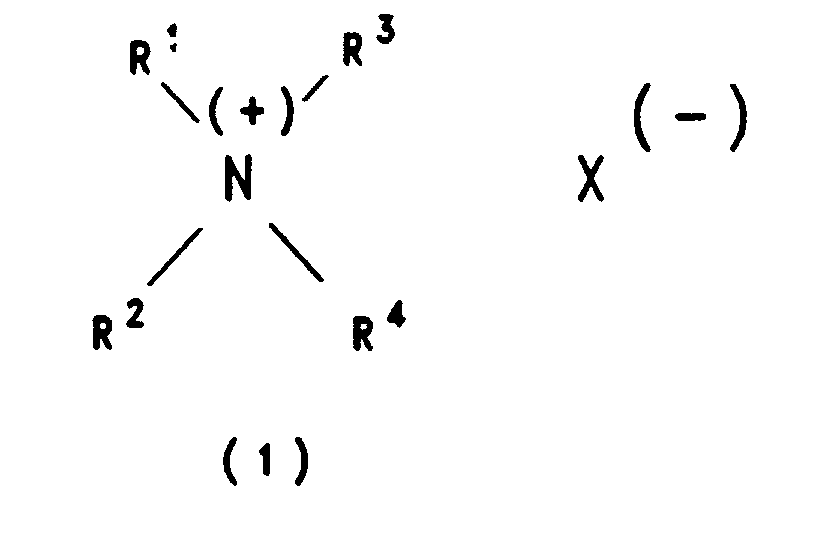
- R¹, R² und R³
- gleich oder verschieden sind und
einen linearen oder verzweigten Alkoxypolyoxyalkyl-Rest der Formel -(CmH2mO)pR⁵ bedeuten, worin R⁵ für Wasserstoff oder einen linearen oder verzweigten Alkylrest mit 1 bis 16, vorzugsweise 1 bis 8, Kohlenstoffatomen steht, m eine ganze Zahl von 1 bis 10, vorzugsweise 1 bis 5, und p eine Zahl von 1 bis 15, vorzugsweise 2 bis 10, bedeuten; oder
einen linearen oder verzweigten Alkylrest mit 1 bis 30, vorzugsweise 1 bis 18, Kohlenstoffatomen; oder einen unsubstituierten Phenyl- oder Naphthylrest; oder einen substituierten Phenyl- oder Naphthylrest, wobei die Substituenten die Bedeutung Halogen, C₁-C₄-Alkyl, C₁-C₄-Alkoxy, Nitro oder Cyano haben; - R⁴
- einen linearen oder verzweigten Alkoxypolyoxyalkyl-Rest der Formel -(CmH2mO)pR⁵ bedeutet; und
- X⊖
- ein anorganisches Anion, vorzugsweise Fluorid, Chlorid, Bromid, SO₄²⁻/2 oder Hydrogensulfat ist;
- b) einem oder mehreren quartären Ammoniumsalz(en) oder Phosphoniumsalz(en) der Formel (2)
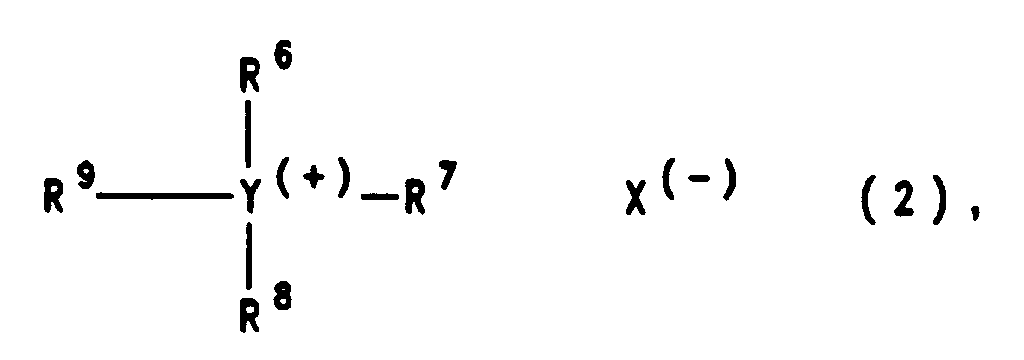
- R⁶, R⁷, R⁸ und R⁹
- gleich oder verschieden sind und einen linearen oder verzweigten Alkylrest mit 1 bis 22, vorzugsweise 1 bis 16, Kohlenstoffatomen; oder einen unsubstituierten oder substituierten Arylrest oder einen C₁-C₄-Alkyl-arylrest, wobei Aryl die Bedeutung Phenyl oder Naphthyl hat und die besagten Substituenten Halogen, C₁-C₄-Alkyl, C₁-C₄-Alkoxy, Nitro oder Cyano bedeuten; und
- Y
- die Bedeutung N oder P hat;
- c) einem oder mehreren Polyether(n) der Formel (3)
R¹⁰-(O-CxH2x)r-OR¹¹ (3),
worin- R¹⁰ und R¹¹
- gleich oder verschieden sind und Wasserstoff oder einen linearen oder verzweigten Alkylrest mit 1 bis 16, vorzugsweise 1 bis 8, Kohlenstoffatomen bedeuten,
- x
- eine ganze Zahl von 2 bis 6, vorzugsweise 2 bis 3, und
- r
- eine Zahl von 0 bis 20, vorzugsweise 4 bis 14, ist;
oder aus einer Mischung der Komponenten a), b) und c) besteht. - Durch das erfindungsgemäße Verfahren wird in der Ausgangsverbindung der Formel (4) ein Chloratom durch ein Fluoratom ausgetauscht.
- Der Katalysator besteht vorzugsweise nur aus Komponente a), es kann jedoch zweckmäßig sein, eine Mischung aus den Komponenten a) und b) oder aus den Komponenten a) und c) oder aus den Komponenten a), b) und c) einzusetzen.
- Die Mischungsverhältnisse der Komponenten a) und b), a) und c) sowie a), b) und c) können in einem weiten Bereich schwanken, mit der Maßgabe, daß die Komponente a) mindestens 5 Gew.-%, vorzugsweise 20 bis 80 Gew.-%, des gesamten Katalysators ausmacht.
- In dem in der Verbindung der Formel (1) enthaltenen linearen oder verzweigten Alkoxypolyoxyalkyl-Rest der Formel -(CmH2mO)pR⁵ können gleiche oder unterschiedliche Alkoxy-Einheiten miteinander verknüpft sein.
Die Anzahl der in der Verbindung der Formel (1) enthaltenen linearen oder verzweigten Alkoxypolyoxyalkyl-Reste beträgt vorzugsweise 1 oder 2. Besonders bevorzugte Verbindungen der Formel (1) im Sinne der vorliegenden Erfindung sind Dimethyl-di(ethoxypolyoxypropyl)-ammoniumchlorid, Dimethyl-di(ethoxypolyoxypropylmethylether)-ammoniumchlorid, Dimethyl-(ethoxypolyoxypropyl)-(ethoxypolyoxypropylmethylether)-ammoniumchlorid, Dimethyl-di(ethoxypolyoxyethyl)-ammoniumchlorid, Dimethyl-di(ethoxypolyoxyethylmethylether)-ammoniumchlorid, Dimethyl-(ethoxypolyoxyethyl)-(ethoxypolyoxyethylmethylether)-ammoniumchlorid, jeweils mit einer mittleren Kettenlänge p von 3, weiterhin Trimethyl-(ethoxypolyoxypropyl)-ammoniumchlorid und Trimethyl-(ethoxypolyoxypropylmethylether)-ammoniumchlorid, jeweils mit einer mittleren Kettenlänge p von 8, oder ein Gemisch der genannten Verbindungen. - Die beschriebenen Verbindungen der Formel (1) lassen sich auf bekannte Weise (US-PS 3,123,641; US-PS 3,141,905) aus den entsprechenden Ethanolaminen herstellen, die nach Umsetzung mit Alkylenoxiden und anschließender Quaternisierung mit oder ohne gleichzeitiger Veretherung in guten Ausbeuten die gewünschten Verbindungen liefern.
- Bevorzugte Verbindungen der Formel (2) im Sinne der vorliegenden Erfindung sind Octadecyltrimethylammoniumchlorid, Distearyldimethylammoniumchlorid, Tetramethylammoniumchlorid, Tetramethylammoniumbromid, Hexadecyltrimethylammoniumchlorid, Benzyltrimethylammoniumchlorid, Hexadecyltributylphosphoniumbromid, Stearyltributylphosphoniumbromid, Tetrabutylphosphoniumchlorid, Tetrabutylphosphoniumbromid und Tetraoctylphosphoniumbromid.
- Bevorzugte Polyether der Formel (3) im Sinne der vorliegenden Erfindung besitzen eine mittlere Molmasse zwischen 300 und 800. Besonders bevorzugt ist ein Gemisch von Polyethylenglykoldimethylethern der Kettenlängen r von 6 bis 17 und einer mittleren Molmasse von 500.
- Anstelle von oder in Kombination mit Polyethern der Formel (3) können auch übliche Kronenether, beispielsweise 18-Krone-6, eingesetzt werden.
- Als Ausgangsverbindungen der Formel (4) für das erfindungsgemäße Verfahren kommen in Betracht:
Monochlornitrobenzole, wie beispielsweise 2-Chlornitrobenzol und 4-Chlornitrobenzol; Dichlornitrobenzole, wie beispielsweise 2,3-Dichlornitrobenzol, 3,4-Dichlornitrobenzol, 2,5-Dichlornitrobenzol, 4-Chlor-3-fluornitrobenzol und 2-Chlor-5-fluornitrobenzol. - Endprodukte der Formel (5) sind beispielsweise:
Monofluornitrobenzole, wie beispielsweise 2-Fluornitrobenzol und 4-Fluornitrobenzol; Chlorfluornitrobenzole, wie beispielsweise 3-Chlor-2-fluornitrobenzol, 3-Chlor-4-fluornitrobenzol und 5-Chlor-2-fluornitrobenzol; Difluornitrobenzole, wie beispielsweise 3,4-Difluornitrobenzol und 2,5-Difluornitrobenzol. - Als Alkalimetallfluoride werden vorzugsweise Kaliumfluorid, Rubidiumfluorid oder Cäsiumfluorid oder Kombinationen aus diesen verwendet, insbesondere Kaliumfluorid. Vorteilhaft bei dem erfindungsgemäßen Verfahren ist, daß Alkalimetallfluoride eingesetzt werden können, deren Wassergehalt bis zu 3 % betragen kann. Dadurch ist es beispielsweise möglich, technisches Kaliumfluorid ohne Vorbehandlung zu verwenden.
- Bei dem erfindungsgemäßen Verfahren wird der Katalysator zweckmäßigerweise in Mengen von 1 bis 35 Gew.-%, vorzugsweise von 2 bis 20 Gew.-%, bezogen auf die aromatische Ausgangsverbindung, eingesetzt. Das molare Verhältnis von Katalysator zur Ausgangsverbindung ist dabei gleich oder kleiner als 1:8, bevorzugt 1:15 bis 1:100.
Was das Mengenverhältnis des Alkalimetallfluorids zur Ausgangsverbindung anbelangt, so werden zweckmäßigerweise 60 bis 200 Mol-%, vorzugsweise 100 bis 140 Mol-%, bezogen auf jedes auszutauschende Chloratom, Alkalimetallfluorid eingesetzt. - Während bislang Temperaturen von 200°C bis über 300°C für Chlor-Fluoraustauschreaktionen erforderlich waren, liegen die Reaktionstemperaturen des erfindungsgemäßen Verfahrens bei 80 bis 220°C, vorzugsweise bei 90 bis 180°C, insbesondere bei 120 bis 170°C.
- Das erfindungsgemäße Verfahren kann in Gegenwart oder Abwesenheit von Lösungsmitteln durchgeführt werden. Werden Lösungsmittel verwendet, so sind sowohl aprotische und dipolar aprotische als auch protische Lösungsmittel geeignet. Geeignete dipolar aprotische Lösungsmittel sind beispielsweise Dimethylsulfoxid, Dimethylsulfon, Sulfolan, Dimethylformamid, Dimethylacetamid, 1,3-Dimethylimidazolin-2-on, Acetonitril und Benzonitril. Geeignete aprotische Lösungsmittel ohne ausgeprägten dipolaren Charakter sind beispielsweise Benzol, Toluol, Xylol, Chlortoluole, Chlorbenzol und Dichlorbenzole. Die Verwendung von protischen Lösungsmitteln, wie beispielsweise Alkoholen, ist ebenfalls möglich. Als protische Lösungsmittel werden Methanol, Ethanol, Propanol, Butanol, i-Propanol oder Polyalkylenglykole mit Ethylen-, Propylen- oder Butyleneinheiten verwendet.
- Das aprotische oder dipolar aprotische Lösungsmittel kann in beliebigen Mengen verwendet werden, bevorzugt werden allerdings geringe Mengen im Bereich von 5 bis 30 Gew.-%, bezogen auf den eingesetzten Aromaten. Bei der Verwendung von protischen Lösungsmitteln liegen die eingesetzten Mengen im Bereich von 0,1 bis 5 Gew.-%, bevorzugt 0,1 bis 2 Gew.-%, bezogen auf den eingesetzten Aromaten.
- Der erfindungsgemäße Katalysator kann sowohl bei Atmosphärendruck als auch bei Überdruck- oder Unterdruck verwendet werden. Diese Eigenschaften wird beispielsweise genutzt, indem geringe Mengen eines leichtsiedenden aprotischen Lösungsmittels, das mit Wasser ein Azeotrop bildet, wie beispielsweise Benzol, Xylol, Mesitylen oder Toluol, vor Beginn der Reaktion in die Reaktionssuspension gegeben werden. Anschließend wird ein Teil des Lösungsmittels durch Anlegen eines Unterdrucks zusammen mit Wasser aus der Reaktionssuspension wieder entfernt. Durch diese Verfahrensweise lassen sich die Reaktionsgeschwindigkeit und die Ausbeute steigern und die Bildung von Nebenprodukten minimieren.
- Das erfindungsgemäße Verfahren kann in Anwesenheit oder Abwesenheit von Luftsauerstoff durchgeführt werden, bevorzugt wird das Arbeiten unter Schutzgas, wie beispielsweise Argon oder Stickstoff. Bei dem erfindungsgemäßen Verfahren ist zu gewährleisten, daß während der gesamten Reaktion das Reaktionsgemisch gut durchmischt wird.
- Fluornitrobenzole spielen eine bedeutende Rolle als Zwischenprodukte im Bereich des Pflanzenschutzes und als Synthesebausteine für Pharmazeutika und Farbstoffe.
- Die folgenden Beispiele dienen zur Erläuterung des erfindungsgemäßen Verfahrens, ohne sich darauf zu beschränken. Unter "Polyethylenglykoldimethylether 500" wird besagter Polyether mit einer mittleren Molmasse von etwa 500 verstanden. Das in den Beispielen verwendete Trimethyl-(ethoxypolyoxypropyl)-ammoniumchlorid hat eine mittlere Kettenlänge p von 8 und wurde als 84 bis 89 gew.-%iges Produkt eingesetzt. In diesem Produkt sind noch 10 bis 13 Gew.-% freies Polypropylenglykol und bis zu 2 Gew.-% Wasser enthalten.
- Das eingesetzte Dimethyl-di(ethoxypolyoxypropyl)-ammoniumchlorid hat eine mittlere Kettenlänge p von 3 und ist ein 90 bis 95 gew.-%iges Produkt, das noch 5 bis 10 Gew.-% Polypropylenglykol und etwa 0,2 Gew.-% Wasser enthält.
- Wurden die beiden Katalysatoren als veretherte Verbindungen verwendet, so lagen die Polypropylenglykole ebenfalls in veretherter Form vor. Der Veretherungsgrad lag im Fall von Dimethoxy-di(ethoxypolyoxypropylmethylether)-ammoniumchlorid bei 86 %.
- Der zeitliche Reaktionsverlauf wurde durch gaschromatographische Analyse (GC) verfolgt und die jeweils in der Reaktionsmischung vorhandene Menge des gewünschten Produktes in Form vom GC-Flächenprozenten angegeben.
- In einen 2,5-Liter Planschliffkolben mit Destillationsbrücke und Impellerrührer wurden bei 120°C in die Schmelze von 620 g (3,23 mol) 2,3-Dichlornitrobenzol 150 g (2,58 mol) Kaliumfluorid, 37,5 g (0,05 mol) Trimethyl-(ethoxypolyoxypropyl)-ammoniumchlorid und 9,9 g (0,09 mol) Tetramethylammoniumchlorid eingetragen. Anschließend wurden 20 g (0,19 mol) Xylol zugegeben und die Reaktionssuspension durch Anlegen eines Vakuums von 40 mbar und Erhitzen auf 150°C azeotrop getrocknet. Nachdem das Xylol abdestilliert war, wurde die Destillationsbrücke gegen einen Rückflußkühler ausgetauscht und die Reaktionssuspension auf 150°C aufgeheizt und 21 Stunden bei dieser Temperatur gerührt. Anschließend wurde die Reaktionssuspension auf 70°C abgekühlt und abgesaugt (70°C). Die abgetrennten Salze wurden zweimal mit insgesamt 180 g Xylol nachgewaschen und die vereinigten organischen Phasen fraktioniert. Es wurden 324 g (72 % d. Th.) 3-Chlor-2-fluornitrobenzol isoliert. Entstandene Menge an 3-Chlor-2-fluornitrobenzol nach GC-Analyse:
nach 6 Stunden: 41 GC-Flächen-% nach 21 Stunden: 82 GC-Flächen-%. -
- a) In einen 1-Liter Planschliffkolben mit Destillationsbrücke und Rührer wurden bei 120°C in die Schmelze von 576 g (3,0 mol) 2,3-Dichlornitrobenzol 139 g (2,4 mol) Kaliumfluorid eingetragen. Anschließend wurden 20 g (0,19 mol) Xylol zugegeben und die Reaktionssuspension durch Anlegen eines Vakuums von 60 mbar und Erhitzen auf 150°C azeotrop getrocknet. Nachdem das Xylol abdestilliert war, wurde die Destillationsbrücke gegen einen Rückflußkühler ausgetauscht, die Reaktionssuspension auf 190°C erhitzt und 6 Stunden bei dieser Temperatur gerührt. Entstandene Menge an 3-Chlor-2-fluornitrobenzol: nach 6 Stunden 0,5 GC-Flächen-%.
- b) In einen 1-Liter Planschliffkolben mit Destillationsbrücke und Rührer wurden bei 120°C in die Schmelze von 576 g (3,0 mol) 2,3-Dichlornitrobenzol 29 g (0,06 mol) Polyethylenglykoldimethylether 500 und 139 g (2,4 mol) Kaliumfluorid eingetragen. Anschließend wurden 20 g (0,19 mol) Xylol zugegeben und die Reaktionssuspension durch Anlegen eines Vakuums von 60 mbar und Erhitzen auf 150°C azeotrop getrocknet. Nachdem das Xylol abdestilliert war, wurde die Destillationsbrücke gegen einen Rückflußkühler ausgetauscht, die Reaktionssuspension auf 190°C erhitzt und 6 Stunden bei dieser Temperatur gerührt. Entstandene Menge an 3-Chlor-2-fluornitrobenzol: nach 6 Stunden 11 GC-Flächen-%.
- In einen 2-Liter Planschliffkolben mit Destillationsbrücke und Impellerrührer wurden bei 120°C in die Schmelze von 939 g (6,0 mol) 2-Chlornitrobenzol 348,6 g (6,0 mol) Kaliumfluorid, 71,1 g (0,1 mol) Trimethyl(ethoxypolyoxypropyl)-ammoniumchlorid und 23,5 g (0,21 mol) Tetramethylammoniumchlorid eingetragen. Anschließend wurden 100 g (0,38 mol) Xylol zugegeben und die Reaktionssuspension auf 150°C erhitzt, das Xylol unter vermindertem Druck entfernt und 21 Stunden bei dieser Temperatur gerührt. Anschließend wurde die Reaktionssuspension auf 70°C abgekühlt und abgesaugt. Die abgetrennten Salze wurden zweimal mit insgesamt 360 g Xylol nachgewaschen und die vereinigten organischen Phasen fraktioniert. Es wurden 356 g (63 % d. Th.) 2-Fluornitrobenzol isoliert. Entstandene Menge an 2-Fluornitrobenzol nach GC-Analyse:
nach 6 Stunden: 39 GC-Flächen-% nach 21 Stunden: 64 GC-Flächen-%. - In einen 2-Liter Planschliffkolben mit Destillationsbrücke und Impellerrührer wurden bei 120°C in die Schmelze von 630 g (4,0 mol) 2-Chlornitrobenzol 290,5 g (5,0 mol) Kaliumfluorid, 71,1 g (0,1 mol) Trimethyl(ethoxypolyoxypropyl)-ammoniumchlorid und 17,0 g (0,16 mol) Tetramethylammoniumchlorid eingetragen. Anschließend wurden 100 g (0,38 mol) Xylol zugegeben und die Reaktionssuspension auf 150°C erhitzt, das Xylol unter vermindertem Druck entfernt und 21 Stunden bei dieser Temperatur gerührt. Anschließend wurde die Reaktionssuspension auf 70°C abgekühlt und abgesaugt. Die abgetrennten Salze wurden zweimal mit insgesamt 360 g Xylol nachgewaschen und die vereinigten organischen Phasen fraktioniert. Es wurden 417 g (74 % d. Th.) 2-Fluornitrobenzol isoliert. Entstandene Menge an 2-Fluornitrobenzol nach GC-Analyse:
nach 6 Stunden: 37 GC-Flächen-% nach 21 Stunden: 74 GC-Flächen-%. - In einen 2-Liter Planschliffkolben mit Destillationsbrücke und Impellerrührer wurden bei 120°C in die Schmelze von 630 g (4,0 mol) 2-Chlornitrobenzol 290,5 g (5,0 mol) Kaliumfluorid, 71,1 g (0,1 mol) Trimethyl(ethoxypolyoxypropyl)-ammoniumchlorid, 11,0 g (0,1 mol) Tetramethylammoniumchlorid und 17,7 g (0,035 mol) Polyethylenglykoldimethylether 500 eingetragen. Anschließend wurden 100 g (0,38 mol) Xylol zugegeben und die Reaktionsmischung für 21 Stunden bei einer Temperatur von 150°C gerührt. Entstandene Menge an 2-Fluornitrobenzol nach GC-Analyse:
nach 6 Stunden: 36 GC-Flächen-% nach 21 Stunden: 74 GC-Flächen-%. - In einen 2-Liter Planschliffkolben mit Destillationsbrücke und Impellerrührer wurden bei 120°C in die Schmelze von 939 g (6,0 mol) 2-Chlornitrobenzol 278,4 g (4,8 mol) Kaliumfluorid und 23,5 g (0,21 mol) Tetramethylammoniumchlorid eingetragen. Anschließend wurden 4 g (0,38 mol) Xylol zugegeben und die Reaktionssuspension auf 180°C erhitzt, das Xylol unter vermindertem Druck entfernt und 21 Stunden bei dieser Temperatur gerührt. Entstandene Menge an 2-Fluornitrobenzol nach GC-Analyse:
nach 5 Stunden: 28,7 GC-Flächen-% nach 21 Stunden: 48,8 GC-Flächen-%. - In einen 1-Liter Planschliffkolben mit Destillationsbrücke und Impeller-Rührer wurden bei 70°C in die Schmelze von 767 g (4,0 mol) 3,4-Dichlornitrobenzol 240 g (4,1 mol) Kaliumfluorid, 30 g (0,05 mol) Dimethyl-di(ethoxypolyoxypropylmethylether)-ammoniumchlorid und 30 g Xylol eingetragen und die Reaktionssuspension unter vermindertem Druck bis 120°C azeotrop getrocknet. Es wurden 498 g (2,84 mol) 3-Chlor-4-fluornitrobenzol isoliert. Entstandene Menge an 3-Chlor-4-fluornitrobenzol nach GC-Analyse:
nach 5 Stunden: 33 GC-Flächen-% nach 24 Stunden: 71 GC-Flächen-%.
Claims (10)
- Verfahren zur Herstellung von Fluornitrobenzolen der Formel (5)

 a die Zahl 1 oder 2 undb eine Zahl von 0 bis 2 sind,mit einem Alkalimetallfluorid in Gegenwart eines Katalysators,
dadurch gekennzeichnet, daß der Katalysator im wesentlichen ausa) einer oder mehreren quartären Ammoniumverbindung(en) der Formel (1) R¹, R² und R³ gleich oder verschieden sind und
einen linearen oder verzweigten Alkoxypolyoxyalkyl-Rest der Formel - (CmH2mO)pR⁵ bedeuten, worin R⁵ für Wasserstoff oder einen linearen oder verzweigten Alkylrest mit 1 bis 16 Kohlenstoffatomen steht, m eine ganze Zahl von 1 bis 10 und p eine Zahl von 1 bis 15 bedeuten;
oder einen linearen oder verzweigten Alkylrest mit 1 bis 30 Kohlenstoffatomen; oder einen unsubstituierten Phenyl- oder Naphthylrest; oder einen substituierten Phenyl- oder Naphthylrest, wobei die Substituenten die Bedeutung Halogen, C₁-C₄-Alkyl, C₁-C₄-Alkoxy, Nitro oder Cyano haben;R⁴ einen linearen oder verzweigten Alkoxypolyoxyalkyl-Rest der Formel -(CmH2mO)pR⁵ bedeuten; undX⊖ ein anorganisches Anion ist;oder aus einer Mischung der Komponente a) undb) einem oder mehreren quartären Ammoniumsalz(en) oder Phosphoniumsalz(en) der Formel (2) R⁶, R⁷, R⁸ und R⁹ gleich oder verschieden sind und
einen linearen oder verzweigten Alkylrest mit 1 bis 22 Kohlenstoffatomen; oder einen unsubstituierten oder substituierten Arylrest oder einen C₁-C₄-Alkyl-arylrest, wobei Aryl die Bedeutung Phenyl oder Naphthyl hat und die besagten Substituenten Halogen, C₁-C₄-Alkyl, C₁-C₄-Alkoxy, Nitro oder Cyano bedeuten; undY die Bedeutung N oder P hat;oder aus einer Mischung der Komponente a) undc) einem oder mehreren Polyether(n) der Formel (3)
R¹⁰-(O-CxH2x)r-OR¹¹ (3),
worinR¹⁰ und R¹¹ gleich oder verschieden sind und Wasserstoff oder einen linearen oder verzweigten Alkylrest mit 1 bis 16 Kohlenstoffatomen bedeuten,x eine ganze Zahl von 2 bis 6 undr eine Zahl von 0 bis 20 ist;oder einem Kronenether;
oder aus einer Mischung der Komponenten a), b) und c) besteht. - Verfahren nach Anspruch 1, dadurch gekennzeichnet, daß der Katalysator im wesentlichen ausa) einer oder mehreren quartären Ammoniumverbindung(en) der Formel (1)
 R¹, R² und R³ gleich oder verschieden sind und
einen linearen oder verzweigten Alkoxypolyoxyalkyl-Rest der Formel -(CmH2mO)pR⁵ bedeuten, worin R⁵ für Wasserstoff oder einen linearen oder verzweigten Alkylrest mit 1 bis 8 Kohlenstoffatomen steht, m eine ganze Zahl von 1 bis 5, und p eine Zahl von 2 bis 10 bedeuten; oder einen linearen oder verzweigten Alkylrest mit 1 bis 18 Kohlenstoffatomen; oder einen unsubstituierten Phenyl- oder Naphthylrest; oder einen substituierten Phenyl- oder Naphthylrest, wobei die Substituenten die Bedeutung Halogen, C₁-C₄-Alkyl, C₁-C₄-Alkoxy, Nitro oder Cyano haben;R⁴ einen linearen oder verzweigten Alkoxypolyoxyalkyl-Rest der Formel -(CmH2mO)pR⁵ bedeutet; undX⊖ Fluorid, Chlorid, Bromid, SO₄²⁻/2 oder Hydrogensulfat ist;oder aus einer Mischung der Komponente a) undb) einem oder mehreren quartären Ammoniumsalz(en) oder Phosphoniumsalz(en) der Formel (2) R⁶, R⁷, R⁸ und R⁹ gleich oder verschieden sind und
einen linearen oder verzweigten Alkylrest mit 1 bis 16 Kohlenstoffatomen; oder einen unsubstituierten oder substituierten Arylrest oder einen C₁-C₄-Alkyl-arylrest, wobei Aryl die Bedeutung Phenyl oder Naphthyl hat und die besagten Substituenten Halogen, C₁-C₄-Alkyl, C₁-C₄-Alkoxy, Nitro oder Cyano bedeuten; undY die Bedeutung N oder P hat;oder aus einer Mischung der Komponente a) undc) einem oder mehreren Polyether(n) der Formel (3)
R¹⁰-(O-CxH2x)r-OR¹¹ (3),
worinR¹⁰ und R¹¹ gleich oder verschieden sind und Wasserstoff oder einen linearen oder verzweigten Alkylrest mit 1 bis 8 Kohlenstoffatomen bedeuten,x die Zahl 2 oder 3 undr eine Zahl von 4 bis 14 ist;oder einem Kronenether;
oder aus einer Mischung der Komponenten a), b) und c) besteht. - Verfahren nach Anspruch 1 oder 2, dadurch gekennzeichnet, daß die Komponente a) mindestens 5 Gew.-%, vorzugsweise 20 bis 80 Gew.-%, des gesamten Katalysators ausmacht.
- Verfahren nach mindestens einem der Ansprüche 1 bis 3, dadurch gekennzeichnet, daß in der Verbindung der Formel (1) ein oder zwei Alkoxypolyoxyalkyl-Reste enthalten sind.
- Verfahren nach mindestens einem der Ansprüche 1 bis 4, dadurch gekennzeichnet, daß das Alkalimetallfluorid Kaliumfluorid, Rubidiumfluorid, Cäsiumfluorid oder eine Kombination dieser Fluoride, insbesondere Kaliumfluorid, ist.
- Verfahren nach mindestens einem der Ansprüche 1 bis 5, dadurch gekennzeichnet, daß das molare Verhältnis von Katalysator zur Verbindung der Formel (4) gleich oder kleiner als 1:8, vorzugsweise 1:15 bis 1:100, ist.
- Verfahren nach mindestens einem der Ansprüche 1 bis 6, dadurch gekennzeichnet, daß die Umsetzung in Abwesenheit eines Lösungsmittels durchgeführt wird.
- Verfahren nach mindestens einem der Ansprüche 1 bis 7, dadurch gekennzeichnet, daß die Reaktionstemperatur bei 80 bis 220°C, vorzugsweise bei 90 bis 180°C, liegt.
- Verfahren nach mindestens einem der Ansprüche 1 bis 8, dadurch gekennzeichnet, daß die Reaktionstemperatur bei 120 bis 170°C liegt.
- Verfahren nach mindestens einem der Ansprüche 1 bis 9, dadurch gekennzeichnet, daß die Verbindung der Formel (4) 2-Chlornitrobenzol, 4-Chlornitrobenzol, 2,3-Dichlornitrobenzol, 3,4-Dichlornitrobenzol, 2,5-Dichlornitrobenzol, 4-Chlor-3-fluornitrobenzol oder 2-Chlor-5-fluornitrobenzol ist.
Applications Claiming Priority (2)
| Application Number | Priority Date | Filing Date | Title |
|---|---|---|---|
| DE4324367A DE4324367A1 (de) | 1993-07-21 | 1993-07-21 | Verfahren zur Herstellung von Fluornitrobenzolen |
| DE4324367 | 1993-07-21 |
Publications (3)
| Publication Number | Publication Date |
|---|---|
| EP0635481A2 true EP0635481A2 (de) | 1995-01-25 |
| EP0635481A3 EP0635481A3 (de) | 1996-07-17 |
| EP0635481B1 EP0635481B1 (de) | 1998-12-09 |
Family
ID=6493293
Family Applications (1)
| Application Number | Title | Priority Date | Filing Date |
|---|---|---|---|
| EP94110876A Expired - Lifetime EP0635481B1 (de) | 1993-07-21 | 1994-07-13 | Verfahren zur Herstellung von Fluornitrobenzolen |
Country Status (5)
| Country | Link |
|---|---|
| US (1) | US5476976A (de) |
| EP (1) | EP0635481B1 (de) |
| JP (1) | JPH07145110A (de) |
| CA (1) | CA2128467A1 (de) |
| DE (2) | DE4324367A1 (de) |
Cited By (1)
| Publication number | Priority date | Publication date | Assignee | Title |
|---|---|---|---|---|
| US6114589A (en) * | 1997-10-13 | 2000-09-05 | Clariant Gmbh | Process for the preparation of fluorinated aromatic compounds |
Families Citing this family (3)
| Publication number | Priority date | Publication date | Assignee | Title |
|---|---|---|---|---|
| ES2079666T3 (es) * | 1990-06-25 | 1996-01-16 | Hoechst Ag | Procedimiento para la preparacion de clorofluoro-nitrobencenos y difluoro-nitrobencenos. |
| EP0944564B9 (de) | 1996-11-22 | 2005-01-19 | Albemarle Corporation | Halogenaustausch-reaktionen und ihre anwendungen |
| US5965781A (en) * | 1997-11-21 | 1999-10-12 | Albemarle Corporation | Catalysis in halogen exchange reactions |
Family Cites Families (17)
| Publication number | Priority date | Publication date | Assignee | Title |
|---|---|---|---|---|
| US3064058A (en) * | 1961-04-07 | 1962-11-13 | Nepera Chemical Co Inc | Method of preparing fluorinated compounds |
| GB1094182A (en) * | 1964-02-26 | 1967-12-06 | Imp Smelting Corp Ltd | Fluorination of halogenated organic compounds |
| US4069262A (en) * | 1977-03-07 | 1978-01-17 | E. I. Du Pont De Nemours And Company | Preparation of 2-fluoronitrobenzene |
| US4229365A (en) * | 1977-05-28 | 1980-10-21 | Basf Aktiengesellschaft | Manufacture of substituted fluorobenzenes |
| US4140719A (en) * | 1977-10-31 | 1979-02-20 | Merck & Co., Inc. | Solid-liquid phase transfer catalysis improved method of preparing 2,4-difluoroaniline |
| DE2938939A1 (de) * | 1978-10-05 | 1980-04-17 | Boots Co Ltd | Verfahren zur herstellung von fluornitrobenzolen |
| US4418229A (en) * | 1981-04-15 | 1983-11-29 | Mallinckrodt, Inc. | Method for producing fluoronitrobenzene compounds |
| US4694104A (en) * | 1982-08-09 | 1987-09-15 | Gaf Corporation | Phase transfer catalysts |
| EP0120575B1 (de) * | 1983-02-18 | 1989-06-14 | Nippon Shokubai Kagaku Kogyo Co., Ltd | Fluorierte organische Verbindungen |
| DE3681033D1 (de) * | 1986-01-06 | 1991-09-26 | Mallinckrodt Inc | Katalytisches verfahren zur herstellung von fluoraomatischen verbindungen mittels n-sek-alkylpyridiniumsalze. |
| DE3642332A1 (de) * | 1986-12-11 | 1988-06-23 | Bayer Ag | Verfahren zur herstellung von substituierten 3,5-dichlor-2,4-difluor-benzolen |
| US5208394A (en) * | 1988-08-26 | 1993-05-04 | Asahi Glass Company Ltd. | Process for producing chlorofluorobenzenes |
| US4937397A (en) * | 1988-11-28 | 1990-06-26 | The Dow Chemical Company | Preparation of halofluorobenzenes |
| ES2079666T3 (es) * | 1990-06-25 | 1996-01-16 | Hoechst Ag | Procedimiento para la preparacion de clorofluoro-nitrobencenos y difluoro-nitrobencenos. |
| DE59205077D1 (de) * | 1991-07-17 | 1996-02-29 | Hoechst Ag | Verfahren zur Herstellung von Chlorfluornitrobenzolen |
| US5315043A (en) * | 1992-02-05 | 1994-05-24 | E. I. Du Pont De Nemours And Company | Aromatic nucleophilic fluorination |
| US5294742A (en) * | 1992-03-21 | 1994-03-15 | Hoechst Atkiengesellschaft | Process for preparing 3,5-difluoroaniline |
-
1993
- 1993-07-21 DE DE4324367A patent/DE4324367A1/de not_active Withdrawn
-
1994
- 1994-07-13 DE DE59407425T patent/DE59407425D1/de not_active Expired - Fee Related
- 1994-07-13 EP EP94110876A patent/EP0635481B1/de not_active Expired - Lifetime
- 1994-07-19 US US08/277,475 patent/US5476976A/en not_active Expired - Fee Related
- 1994-07-19 JP JP6167067A patent/JPH07145110A/ja not_active Ceased
- 1994-07-20 CA CA002128467A patent/CA2128467A1/en not_active Abandoned
Cited By (2)
| Publication number | Priority date | Publication date | Assignee | Title |
|---|---|---|---|---|
| US6114589A (en) * | 1997-10-13 | 2000-09-05 | Clariant Gmbh | Process for the preparation of fluorinated aromatic compounds |
| EP0908443A3 (de) * | 1997-10-13 | 2001-04-04 | Clariant GmbH | Verfahren zur Herstellung von fluorierten aromatischen Verbindungen |
Also Published As
| Publication number | Publication date |
|---|---|
| EP0635481A3 (de) | 1996-07-17 |
| DE4324367A1 (de) | 1995-01-26 |
| JPH07145110A (ja) | 1995-06-06 |
| CA2128467A1 (en) | 1995-01-22 |
| US5476976A (en) | 1995-12-19 |
| EP0635481B1 (de) | 1998-12-09 |
| DE59407425D1 (de) | 1999-01-21 |
Similar Documents
| Publication | Publication Date | Title |
|---|---|---|
| EP0958052B1 (de) | Amidophosphoniumsalz enthaltender katalysator für halex-reaktionen | |
| EP0923508A2 (de) | Verfahren zur herstellung von fluor enthaltenden verbindungen | |
| DE2803259A1 (de) | Verfahren zur herstellung von fluorbenzolen | |
| EP0635482B1 (de) | Verfahren zur Herstellung von mehrfach fluorierten Nitrobenzolen | |
| EP0523671B1 (de) | Verfahren zur Herstellung von Chlorfluornitrobenzolen | |
| DE4324366C1 (de) | Katalysator für nukleophile aromatische Substitutionen | |
| EP0635481B1 (de) | Verfahren zur Herstellung von Fluornitrobenzolen | |
| EP0536175B1 (de) | Verfahren zur herstellung von chlorfluornitrobenzolen und difluornitrobenzolen | |
| EP0635486B1 (de) | Verfahren zur Herstellung von Fluorbenzonitrilen | |
| EP0735016B1 (de) | Verfahren zur Herstellung von Alpha-Chloralkylarylketonen | |
| DE69815082T2 (de) | Verfahren zur herstellung aromatischer verbindungen | |
| EP1015402A1 (de) | Verfahren zur herstellung von fluor enthaltenden verbindungen, insbesondere fluorbenzaldehyden und fluorbenzonitrilen | |
| DE4324368A1 (de) | Verfahren zur Herstellung von Fluorbenzonitrilen | |
| DE3836175A1 (de) | Fluor enthaltende phenole | |
| DE68919584T2 (de) | Verfahren zur Herstellung von Chlorfluorbenzolen. | |
| EP0061113A1 (de) | Verfahren zur Herstellung von gegebenenfalls substituierten Fluor-nitro-benzaldehyden | |
| EP0693466A1 (de) | Verfahren zur Herstellung von aromatischen fluorierten Verbindungen und neue Diamide | |
| DE69837852T2 (de) | Derivate von o-(perfluor)dibenzofuranium-salzen, zwischenprodukte zu ihrer herstellung, verfahren zur herstellung der zwischenprodukte, perfluoralkylierungsmittel und perfluoralkylierungsverfahren | |
| DE19745212A1 (de) | Verfahren zur Herstellung von fluorierten aromatischen Verbindungen | |
| DE2937945A1 (de) | Dispersion eines alkalihydroxids in inertem, organischem loesungsmittel und umsetzungen unter verwendung derselben | |
| DE4219755A1 (de) | Verfahren zur Herstellung von 5-Alkoxy-2,4-dinitro-alkylbenzolen | |
| EP0504662A1 (de) | Katalytisch wirksame Salzmischungen enthaltend ein quaternäres Alkylammoniumalkylcarbonat | |
| EP1097914A2 (de) | Verfahren zur Aufarbeitung von Reaktionsgemischen, hergestellt durch Halexreaktion | |
| DE3019248A1 (de) | Verfahren zur (alpha) -chlorierung einer seitenkette einer aromatischen verbindung | |
| DE2111863A1 (de) | 4-substituierte N,N-Bis(halogenalkyl)-o-nitro-phenylamine und Verfahren zu ihrer Herstellung |
Legal Events
| Date | Code | Title | Description |
|---|---|---|---|
| PUAI | Public reference made under article 153(3) epc to a published international application that has entered the european phase |
Free format text: ORIGINAL CODE: 0009012 |
|
| AK | Designated contracting states |
Kind code of ref document: A2 Designated state(s): BE CH DE FR GB IT LI NL |
|
| PUAL | Search report despatched |
Free format text: ORIGINAL CODE: 0009013 |
|
| AK | Designated contracting states |
Kind code of ref document: A3 Designated state(s): BE CH DE ES FR GB IE IT LI NL |
|
| 17P | Request for examination filed |
Effective date: 19970117 |
|
| 17Q | First examination report despatched |
Effective date: 19970224 |
|
| RAP1 | Party data changed (applicant data changed or rights of an application transferred) |
Owner name: CLARIANT GMBH |
|
| GRAG | Despatch of communication of intention to grant |
Free format text: ORIGINAL CODE: EPIDOS AGRA |
|
| GRAG | Despatch of communication of intention to grant |
Free format text: ORIGINAL CODE: EPIDOS AGRA |
|
| GRAH | Despatch of communication of intention to grant a patent |
Free format text: ORIGINAL CODE: EPIDOS IGRA |
|
| RBV | Designated contracting states (corrected) |
Designated state(s): BE CH DE FR GB IT LI NL |
|
| GRAH | Despatch of communication of intention to grant a patent |
Free format text: ORIGINAL CODE: EPIDOS IGRA |
|
| GRAA | (expected) grant |
Free format text: ORIGINAL CODE: 0009210 |
|
| AK | Designated contracting states |
Kind code of ref document: B1 Designated state(s): BE CH DE FR GB IT LI NL |
|
| REG | Reference to a national code |
Ref country code: CH Ref legal event code: EP |
|
| REF | Corresponds to: |
Ref document number: 59407425 Country of ref document: DE Date of ref document: 19990121 |
|
| ITF | It: translation for a ep patent filed | ||
| GBT | Gb: translation of ep patent filed (gb section 77(6)(a)/1977) |
Effective date: 19990210 |
|
| ET | Fr: translation filed | ||
| PLBE | No opposition filed within time limit |
Free format text: ORIGINAL CODE: 0009261 |
|
| STAA | Information on the status of an ep patent application or granted ep patent |
Free format text: STATUS: NO OPPOSITION FILED WITHIN TIME LIMIT |
|
| 26N | No opposition filed | ||
| PGFP | Annual fee paid to national office [announced via postgrant information from national office to epo] |
Ref country code: NL Payment date: 20010627 Year of fee payment: 8 |
|
| PGFP | Annual fee paid to national office [announced via postgrant information from national office to epo] |
Ref country code: BE Payment date: 20010816 Year of fee payment: 8 |
|
| REG | Reference to a national code |
Ref country code: GB Ref legal event code: IF02 |
|
| PG25 | Lapsed in a contracting state [announced via postgrant information from national office to epo] |
Ref country code: BE Free format text: LAPSE BECAUSE OF NON-PAYMENT OF DUE FEES Effective date: 20020731 |
|
| BERE | Be: lapsed |
Owner name: *CLARIANT G.M.B.H. Effective date: 20020731 |
|
| PG25 | Lapsed in a contracting state [announced via postgrant information from national office to epo] |
Ref country code: NL Free format text: LAPSE BECAUSE OF NON-PAYMENT OF DUE FEES Effective date: 20030201 |
|
| NLV4 | Nl: lapsed or anulled due to non-payment of the annual fee |
Effective date: 20030201 |
|
| PGFP | Annual fee paid to national office [announced via postgrant information from national office to epo] |
Ref country code: DE Payment date: 20040619 Year of fee payment: 11 |
|
| PGFP | Annual fee paid to national office [announced via postgrant information from national office to epo] |
Ref country code: FR Payment date: 20040623 Year of fee payment: 11 |
|
| PGFP | Annual fee paid to national office [announced via postgrant information from national office to epo] |
Ref country code: GB Payment date: 20040624 Year of fee payment: 11 |
|
| PGFP | Annual fee paid to national office [announced via postgrant information from national office to epo] |
Ref country code: CH Payment date: 20040629 Year of fee payment: 11 |
|
| PG25 | Lapsed in a contracting state [announced via postgrant information from national office to epo] |
Ref country code: IT Free format text: LAPSE BECAUSE OF NON-PAYMENT OF DUE FEES;WARNING: LAPSES OF ITALIAN PATENTS WITH EFFECTIVE DATE BEFORE 2007 MAY HAVE OCCURRED AT ANY TIME BEFORE 2007. THE CORRECT EFFECTIVE DATE MAY BE DIFFERENT FROM THE ONE RECORDED. Effective date: 20050713 Ref country code: GB Free format text: LAPSE BECAUSE OF NON-PAYMENT OF DUE FEES Effective date: 20050713 |
|
| PG25 | Lapsed in a contracting state [announced via postgrant information from national office to epo] |
Ref country code: LI Free format text: LAPSE BECAUSE OF NON-PAYMENT OF DUE FEES Effective date: 20050731 Ref country code: CH Free format text: LAPSE BECAUSE OF NON-PAYMENT OF DUE FEES Effective date: 20050731 |
|
| PG25 | Lapsed in a contracting state [announced via postgrant information from national office to epo] |
Ref country code: DE Free format text: LAPSE BECAUSE OF NON-PAYMENT OF DUE FEES Effective date: 20060201 |
|
| REG | Reference to a national code |
Ref country code: CH Ref legal event code: PL |
|
| GBPC | Gb: european patent ceased through non-payment of renewal fee |
Effective date: 20050713 |
|
| PG25 | Lapsed in a contracting state [announced via postgrant information from national office to epo] |
Ref country code: FR Free format text: LAPSE BECAUSE OF NON-PAYMENT OF DUE FEES Effective date: 20060331 |
|
| REG | Reference to a national code |
Ref country code: FR Ref legal event code: ST Effective date: 20060331 |