EP0120575B1 - Fluorierte organische Verbindungen - Google Patents
Fluorierte organische Verbindungen Download PDFInfo
- Publication number
- EP0120575B1 EP0120575B1 EP84300911A EP84300911A EP0120575B1 EP 0120575 B1 EP0120575 B1 EP 0120575B1 EP 84300911 A EP84300911 A EP 84300911A EP 84300911 A EP84300911 A EP 84300911A EP 0120575 B1 EP0120575 B1 EP 0120575B1
- Authority
- EP
- European Patent Office
- Prior art keywords
- reaction
- mol
- benzonitrile
- vessel
- compound
- Prior art date
- Legal status (The legal status is an assumption and is not a legal conclusion. Google has not performed a legal analysis and makes no representation as to the accuracy of the status listed.)
- Expired
Links
- 150000004812 organic fluorine compounds Chemical class 0.000 title description 2
- JFDZBHWFFUWGJE-UHFFFAOYSA-N benzonitrile Chemical compound N#CC1=CC=CC=C1 JFDZBHWFFUWGJE-UHFFFAOYSA-N 0.000 claims description 100
- 238000006243 chemical reaction Methods 0.000 claims description 50
- NROKBHXJSPEDAR-UHFFFAOYSA-M potassium fluoride Chemical group [F-].[K+] NROKBHXJSPEDAR-UHFFFAOYSA-M 0.000 claims description 42
- 235000003270 potassium fluoride Nutrition 0.000 claims description 21
- 239000011698 potassium fluoride Substances 0.000 claims description 21
- 239000012025 fluorinating agent Substances 0.000 claims description 12
- 238000000034 method Methods 0.000 claims description 11
- 239000002904 solvent Substances 0.000 claims description 7
- 239000003444 phase transfer catalyst Substances 0.000 claims description 6
- 229910001515 alkali metal fluoride Inorganic materials 0.000 claims description 5
- 239000000460 chlorine Substances 0.000 claims description 5
- 229910052801 chlorine Inorganic materials 0.000 claims description 5
- 229910052736 halogen Inorganic materials 0.000 claims description 4
- 150000002367 halogens Chemical group 0.000 claims description 4
- 150000002894 organic compounds Chemical class 0.000 claims description 4
- -1 aromatic fluorine compound Chemical class 0.000 claims description 3
- 125000001246 bromo group Chemical group Br* 0.000 claims description 3
- 229910052799 carbon Inorganic materials 0.000 claims description 3
- 125000001309 chloro group Chemical group Cl* 0.000 claims description 3
- 229910001618 alkaline earth metal fluoride Inorganic materials 0.000 claims description 2
- 125000003118 aryl group Chemical group 0.000 claims description 2
- 239000003999 initiator Substances 0.000 claims description 2
- 238000004519 manufacturing process Methods 0.000 claims description 2
- 125000004432 carbon atom Chemical group C* 0.000 claims 1
- 125000001424 substituent group Chemical group 0.000 claims 1
- 238000004817 gas chromatography Methods 0.000 description 17
- WCUXLLCKKVVCTQ-UHFFFAOYSA-M Potassium chloride Chemical compound [Cl-].[K+] WCUXLLCKKVVCTQ-UHFFFAOYSA-M 0.000 description 16
- 239000007788 liquid Substances 0.000 description 15
- IJGRMHOSHXDMSA-UHFFFAOYSA-N Atomic nitrogen Chemical compound N#N IJGRMHOSHXDMSA-UHFFFAOYSA-N 0.000 description 13
- 239000011541 reaction mixture Substances 0.000 description 12
- INICGXSKJYKEIV-UHFFFAOYSA-N 2,3,4,5,6-pentachlorobenzonitrile Chemical compound ClC1=C(Cl)C(Cl)=C(C#N)C(Cl)=C1Cl INICGXSKJYKEIV-UHFFFAOYSA-N 0.000 description 9
- YXWJGZQOGXGSSC-UHFFFAOYSA-N 2,3,4,5,6-pentafluorobenzonitrile Chemical compound FC1=C(F)C(F)=C(C#N)C(F)=C1F YXWJGZQOGXGSSC-UHFFFAOYSA-N 0.000 description 9
- 239000003795 chemical substances by application Substances 0.000 description 9
- 229910001873 dinitrogen Inorganic materials 0.000 description 9
- 229910001220 stainless steel Inorganic materials 0.000 description 9
- 239000010935 stainless steel Substances 0.000 description 9
- 238000012856 packing Methods 0.000 description 8
- 235000011164 potassium chloride Nutrition 0.000 description 8
- 239000001103 potassium chloride Substances 0.000 description 8
- CARZIMSIYVZQDB-UHFFFAOYSA-N 3,5-dichloro-2,4,6-trifluorobenzonitrile Chemical compound FC1=C(Cl)C(F)=C(C#N)C(F)=C1Cl CARZIMSIYVZQDB-UHFFFAOYSA-N 0.000 description 6
- 238000009835 boiling Methods 0.000 description 6
- 150000001875 compounds Chemical class 0.000 description 6
- 239000000047 product Substances 0.000 description 6
- 239000002994 raw material Substances 0.000 description 6
- DNDPLEAVNVOOQZ-UHFFFAOYSA-N 2,3,4,5,6-pentachloropyridine Chemical compound ClC1=NC(Cl)=C(Cl)C(Cl)=C1Cl DNDPLEAVNVOOQZ-UHFFFAOYSA-N 0.000 description 5
- XTGOWLIKIQLYRG-UHFFFAOYSA-N 2,3,4,5,6-pentafluoropyridine Chemical compound FC1=NC(F)=C(F)C(F)=C1F XTGOWLIKIQLYRG-UHFFFAOYSA-N 0.000 description 5
- WKBOTKDWSSQWDR-UHFFFAOYSA-N Bromine atom Chemical compound [Br] WKBOTKDWSSQWDR-UHFFFAOYSA-N 0.000 description 5
- CRQQGFGUEAVUIL-UHFFFAOYSA-N chlorothalonil Chemical compound ClC1=C(Cl)C(C#N)=C(Cl)C(C#N)=C1Cl CRQQGFGUEAVUIL-UHFFFAOYSA-N 0.000 description 5
- 229910052731 fluorine Inorganic materials 0.000 description 5
- 239000000126 substance Substances 0.000 description 5
- TXRVDQMSXQKAPG-UHFFFAOYSA-N 2,3,5,6-tetrachlorobenzene-1,4-dicarbonitrile Chemical compound ClC1=C(Cl)C(C#N)=C(Cl)C(Cl)=C1C#N TXRVDQMSXQKAPG-UHFFFAOYSA-N 0.000 description 4
- PCRSJGWFEMHHEW-UHFFFAOYSA-N 2,3,5,6-tetrafluorobenzene-1,4-dicarbonitrile Chemical compound FC1=C(F)C(C#N)=C(F)C(F)=C1C#N PCRSJGWFEMHHEW-UHFFFAOYSA-N 0.000 description 4
- GDTBXPJZTBHREO-UHFFFAOYSA-N bromine Substances BrBr GDTBXPJZTBHREO-UHFFFAOYSA-N 0.000 description 4
- 229910052794 bromium Inorganic materials 0.000 description 4
- 239000013078 crystal Substances 0.000 description 4
- YSSSPARMOAYJTE-UHFFFAOYSA-N dibenzo-18-crown-6 Chemical compound O1CCOCCOC2=CC=CC=C2OCCOCCOC2=CC=CC=C21 YSSSPARMOAYJTE-UHFFFAOYSA-N 0.000 description 4
- 238000001914 filtration Methods 0.000 description 4
- 150000002222 fluorine compounds Chemical class 0.000 description 4
- PUZPDOWCWNUUKD-UHFFFAOYSA-M sodium fluoride Chemical compound [F-].[Na+] PUZPDOWCWNUUKD-UHFFFAOYSA-M 0.000 description 4
- 239000007858 starting material Substances 0.000 description 4
- XLORIERFMJHASL-UHFFFAOYSA-N 2,4,5,6-tetrachloropyridine-3-carbonitrile Chemical compound ClC1=NC(Cl)=C(C#N)C(Cl)=C1Cl XLORIERFMJHASL-UHFFFAOYSA-N 0.000 description 3
- WVHMPQKZPHOCRD-UHFFFAOYSA-N 2,4,5,6-tetrafluorobenzene-1,3-dicarbonitrile Chemical compound FC1=C(F)C(C#N)=C(F)C(C#N)=C1F WVHMPQKZPHOCRD-UHFFFAOYSA-N 0.000 description 3
- RVYYWCWXJDYEIO-UHFFFAOYSA-N 2,4,5,6-tetrafluoropyridine-3-carbonitrile Chemical compound FC1=NC(F)=C(C#N)C(F)=C1F RVYYWCWXJDYEIO-UHFFFAOYSA-N 0.000 description 3
- PKSORSNCSXBXOT-UHFFFAOYSA-N 3,5-dichloro-2,4,6-trifluoropyridine Chemical compound FC1=NC(F)=C(Cl)C(F)=C1Cl PKSORSNCSXBXOT-UHFFFAOYSA-N 0.000 description 3
- SMPPDKRKAOZGQO-UHFFFAOYSA-N 3-chloro-2,4,5,6-tetrafluorobenzonitrile Chemical compound FC1=C(F)C(Cl)=C(F)C(C#N)=C1F SMPPDKRKAOZGQO-UHFFFAOYSA-N 0.000 description 3
- GBKXRWNDORMHSG-UHFFFAOYSA-N 5-chloro-2,4,6-trifluorobenzene-1,3-dicarbonitrile Chemical compound FC1=C(Cl)C(F)=C(C#N)C(F)=C1C#N GBKXRWNDORMHSG-UHFFFAOYSA-N 0.000 description 3
- DBPBDHMFXRUKQY-UHFFFAOYSA-N 5-chloro-2,4,6-trifluoropyridine-3-carbonitrile Chemical compound FC1=NC(F)=C(C#N)C(F)=C1Cl DBPBDHMFXRUKQY-UHFFFAOYSA-N 0.000 description 3
- UHOVQNZJYSORNB-UHFFFAOYSA-N Benzene Chemical compound C1=CC=CC=C1 UHOVQNZJYSORNB-UHFFFAOYSA-N 0.000 description 3
- PXGOKWXKJXAPGV-UHFFFAOYSA-N Fluorine Chemical compound FF PXGOKWXKJXAPGV-UHFFFAOYSA-N 0.000 description 3
- YXFVVABEGXRONW-UHFFFAOYSA-N Toluene Chemical compound CC1=CC=CC=C1 YXFVVABEGXRONW-UHFFFAOYSA-N 0.000 description 3
- 239000007795 chemical reaction product Substances 0.000 description 3
- 239000011737 fluorine Substances 0.000 description 3
- 230000035484 reaction time Effects 0.000 description 3
- 238000005292 vacuum distillation Methods 0.000 description 3
- VNUFYOSTQUKXTM-UHFFFAOYSA-N 2,3,4,5,6-pentabromobenzonitrile Chemical compound BrC1=C(Br)C(Br)=C(C#N)C(Br)=C1Br VNUFYOSTQUKXTM-UHFFFAOYSA-N 0.000 description 2
- OQHXZZGZASQSOB-UHFFFAOYSA-N 3,4,5,6-tetrachlorobenzene-1,2-dicarbonitrile Chemical compound ClC1=C(Cl)C(Cl)=C(C#N)C(C#N)=C1Cl OQHXZZGZASQSOB-UHFFFAOYSA-N 0.000 description 2
- UXUZMYHSICIOQT-UHFFFAOYSA-N 3-chloro-2,4,5,6-tetrafluoropyridine Chemical compound FC1=NC(F)=C(Cl)C(F)=C1F UXUZMYHSICIOQT-UHFFFAOYSA-N 0.000 description 2
- OKTJSMMVPCPJKN-UHFFFAOYSA-N Carbon Chemical compound [C] OKTJSMMVPCPJKN-UHFFFAOYSA-N 0.000 description 2
- ZAMOUSCENKQFHK-UHFFFAOYSA-N Chlorine atom Chemical compound [Cl] ZAMOUSCENKQFHK-UHFFFAOYSA-N 0.000 description 2
- 238000004458 analytical method Methods 0.000 description 2
- XJHCXCQVJFPJIK-UHFFFAOYSA-M caesium fluoride Chemical compound [F-].[Cs+] XJHCXCQVJFPJIK-UHFFFAOYSA-M 0.000 description 2
- 238000004508 fractional distillation Methods 0.000 description 2
- 239000007789 gas Substances 0.000 description 2
- CKAPSXZOOQJIBF-UHFFFAOYSA-N hexachlorobenzene Chemical compound ClC1=C(Cl)C(Cl)=C(Cl)C(Cl)=C1Cl CKAPSXZOOQJIBF-UHFFFAOYSA-N 0.000 description 2
- ZQBFAOFFOQMSGJ-UHFFFAOYSA-N hexafluorobenzene Chemical compound FC1=C(F)C(F)=C(F)C(F)=C1F ZQBFAOFFOQMSGJ-UHFFFAOYSA-N 0.000 description 2
- 239000000543 intermediate Substances 0.000 description 2
- PQXKHYXIUOZZFA-UHFFFAOYSA-M lithium fluoride Chemical compound [Li+].[F-] PQXKHYXIUOZZFA-UHFFFAOYSA-M 0.000 description 2
- 229910052757 nitrogen Inorganic materials 0.000 description 2
- 238000010992 reflux Methods 0.000 description 2
- 235000013024 sodium fluoride Nutrition 0.000 description 2
- 239000011775 sodium fluoride Substances 0.000 description 2
- OZRCFSKDIYWITR-UHFFFAOYSA-N 1,2-dichloro-3,4,5,6-tetrafluorobenzene Chemical compound FC1=C(F)C(F)=C(Cl)C(Cl)=C1F OZRCFSKDIYWITR-UHFFFAOYSA-N 0.000 description 1
- KGCDGLXSBHJAHZ-UHFFFAOYSA-N 1-chloro-2,3,4,5,6-pentafluorobenzene Chemical compound FC1=C(F)C(F)=C(Cl)C(F)=C1F KGCDGLXSBHJAHZ-UHFFFAOYSA-N 0.000 description 1
- GLTGXIGJLCSEAM-UHFFFAOYSA-N 2,3,4,5-tetrafluorobenzonitrile Chemical compound FC1=CC(C#N)=C(F)C(F)=C1F GLTGXIGJLCSEAM-UHFFFAOYSA-N 0.000 description 1
- WQGYOIRZZWUJJU-UHFFFAOYSA-N 2,3,5,6-tetrachloropyridine-4-carbonitrile Chemical compound ClC1=NC(Cl)=C(Cl)C(C#N)=C1Cl WQGYOIRZZWUJJU-UHFFFAOYSA-N 0.000 description 1
- JXISJBVJNUKKBK-UHFFFAOYSA-N 2,3,5,6-tetrafluoropyridine-4-carbonitrile Chemical compound FC1=NC(F)=C(F)C(C#N)=C1F JXISJBVJNUKKBK-UHFFFAOYSA-N 0.000 description 1
- HVSOOVYHBKCCRS-UHFFFAOYSA-N 2,4,6-trichloro-3,5-difluorobenzonitrile Chemical compound FC1=C(Cl)C(F)=C(Cl)C(C#N)=C1Cl HVSOOVYHBKCCRS-UHFFFAOYSA-N 0.000 description 1
- OFLRJMBSWDXSPG-UHFFFAOYSA-N 3,4,5,6-tetrafluorobenzene-1,2-dicarbonitrile Chemical compound FC1=C(F)C(F)=C(C#N)C(C#N)=C1F OFLRJMBSWDXSPG-UHFFFAOYSA-N 0.000 description 1
- XYFHRSUUAGJYOZ-UHFFFAOYSA-N 3,4,5,6-tetrafluoropyridine-2-carbonitrile Chemical compound FC1=NC(C#N)=C(F)C(F)=C1F XYFHRSUUAGJYOZ-UHFFFAOYSA-N 0.000 description 1
- KZBUYRJDOAKODT-UHFFFAOYSA-N Chlorine Chemical compound ClCl KZBUYRJDOAKODT-UHFFFAOYSA-N 0.000 description 1
- 239000002202 Polyethylene glycol Substances 0.000 description 1
- GUNJVIDCYZYFGV-UHFFFAOYSA-K antimony trifluoride Chemical compound F[Sb](F)F GUNJVIDCYZYFGV-UHFFFAOYSA-K 0.000 description 1
- OYLGJCQECKOTOL-UHFFFAOYSA-L barium fluoride Chemical compound [F-].[F-].[Ba+2] OYLGJCQECKOTOL-UHFFFAOYSA-L 0.000 description 1
- 229910001632 barium fluoride Inorganic materials 0.000 description 1
- 230000015572 biosynthetic process Effects 0.000 description 1
- WUKWITHWXAAZEY-UHFFFAOYSA-L calcium difluoride Chemical compound [F-].[F-].[Ca+2] WUKWITHWXAAZEY-UHFFFAOYSA-L 0.000 description 1
- 229910001634 calcium fluoride Inorganic materials 0.000 description 1
- 239000005539 carbonized material Substances 0.000 description 1
- 150000008422 chlorobenzenes Chemical class 0.000 description 1
- 150000005753 chloropyridines Chemical class 0.000 description 1
- 239000002633 crown compound Substances 0.000 description 1
- 238000004821 distillation Methods 0.000 description 1
- 229940079593 drug Drugs 0.000 description 1
- 239000003814 drug Substances 0.000 description 1
- 125000001153 fluoro group Chemical group F* 0.000 description 1
- 239000004519 grease Substances 0.000 description 1
- 125000005843 halogen group Chemical group 0.000 description 1
- 239000011261 inert gas Substances 0.000 description 1
- 238000010813 internal standard method Methods 0.000 description 1
- LAQPNDIUHRHNCV-UHFFFAOYSA-N isophthalonitrile Chemical class N#CC1=CC=CC(C#N)=C1 LAQPNDIUHRHNCV-UHFFFAOYSA-N 0.000 description 1
- ORUIBWPALBXDOA-UHFFFAOYSA-L magnesium fluoride Chemical compound [F-].[F-].[Mg+2] ORUIBWPALBXDOA-UHFFFAOYSA-L 0.000 description 1
- 229910001635 magnesium fluoride Inorganic materials 0.000 description 1
- 238000004949 mass spectrometry Methods 0.000 description 1
- 229910052751 metal Inorganic materials 0.000 description 1
- 239000002184 metal Substances 0.000 description 1
- 150000002739 metals Chemical class 0.000 description 1
- 239000000575 pesticide Substances 0.000 description 1
- 229920001223 polyethylene glycol Polymers 0.000 description 1
- 239000000376 reactant Substances 0.000 description 1
- 150000003839 salts Chemical class 0.000 description 1
- 238000010517 secondary reaction Methods 0.000 description 1
- 238000010561 standard procedure Methods 0.000 description 1
- 238000006467 substitution reaction Methods 0.000 description 1
- 238000003786 synthesis reaction Methods 0.000 description 1
- XLYOFNOQVPJJNP-UHFFFAOYSA-N water Substances O XLYOFNOQVPJJNP-UHFFFAOYSA-N 0.000 description 1
Images
Classifications
-
- C—CHEMISTRY; METALLURGY
- C07—ORGANIC CHEMISTRY
- C07D—HETEROCYCLIC COMPOUNDS
- C07D213/00—Heterocyclic compounds containing six-membered rings, not condensed with other rings, with one nitrogen atom as the only ring hetero atom and three or more double bonds between ring members or between ring members and non-ring members
- C07D213/02—Heterocyclic compounds containing six-membered rings, not condensed with other rings, with one nitrogen atom as the only ring hetero atom and three or more double bonds between ring members or between ring members and non-ring members having three double bonds between ring members or between ring members and non-ring members
- C07D213/04—Heterocyclic compounds containing six-membered rings, not condensed with other rings, with one nitrogen atom as the only ring hetero atom and three or more double bonds between ring members or between ring members and non-ring members having three double bonds between ring members or between ring members and non-ring members having no bond between the ring nitrogen atom and a non-ring member or having only hydrogen or carbon atoms directly attached to the ring nitrogen atom
- C07D213/60—Heterocyclic compounds containing six-membered rings, not condensed with other rings, with one nitrogen atom as the only ring hetero atom and three or more double bonds between ring members or between ring members and non-ring members having three double bonds between ring members or between ring members and non-ring members having no bond between the ring nitrogen atom and a non-ring member or having only hydrogen or carbon atoms directly attached to the ring nitrogen atom with hetero atoms or with carbon atoms having three bonds to hetero atoms with at the most one bond to halogen, e.g. ester or nitrile radicals, directly attached to ring carbon atoms
- C07D213/78—Carbon atoms having three bonds to hetero atoms, with at the most one bond to halogen, e.g. ester or nitrile radicals
- C07D213/84—Nitriles
-
- C—CHEMISTRY; METALLURGY
- C07—ORGANIC CHEMISTRY
- C07B—GENERAL METHODS OF ORGANIC CHEMISTRY; APPARATUS THEREFOR
- C07B39/00—Halogenation
-
- C—CHEMISTRY; METALLURGY
- C07—ORGANIC CHEMISTRY
- C07C—ACYCLIC OR CARBOCYCLIC COMPOUNDS
- C07C17/00—Preparation of halogenated hydrocarbons
- C07C17/093—Preparation of halogenated hydrocarbons by replacement by halogens
- C07C17/20—Preparation of halogenated hydrocarbons by replacement by halogens of halogen atoms by other halogen atoms
- C07C17/202—Preparation of halogenated hydrocarbons by replacement by halogens of halogen atoms by other halogen atoms two or more compounds being involved in the reaction
- C07C17/208—Preparation of halogenated hydrocarbons by replacement by halogens of halogen atoms by other halogen atoms two or more compounds being involved in the reaction the other compound being MX
-
- C—CHEMISTRY; METALLURGY
- C07—ORGANIC CHEMISTRY
- C07C—ACYCLIC OR CARBOCYCLIC COMPOUNDS
- C07C201/00—Preparation of esters of nitric or nitrous acid or of compounds containing nitro or nitroso groups bound to a carbon skeleton
- C07C201/06—Preparation of nitro compounds
- C07C201/12—Preparation of nitro compounds by reactions not involving the formation of nitro groups
-
- C—CHEMISTRY; METALLURGY
- C07—ORGANIC CHEMISTRY
- C07C—ACYCLIC OR CARBOCYCLIC COMPOUNDS
- C07C253/00—Preparation of carboxylic acid nitriles
- C07C253/30—Preparation of carboxylic acid nitriles by reactions not involving the formation of cyano groups
-
- C—CHEMISTRY; METALLURGY
- C07—ORGANIC CHEMISTRY
- C07D—HETEROCYCLIC COMPOUNDS
- C07D213/00—Heterocyclic compounds containing six-membered rings, not condensed with other rings, with one nitrogen atom as the only ring hetero atom and three or more double bonds between ring members or between ring members and non-ring members
- C07D213/02—Heterocyclic compounds containing six-membered rings, not condensed with other rings, with one nitrogen atom as the only ring hetero atom and three or more double bonds between ring members or between ring members and non-ring members having three double bonds between ring members or between ring members and non-ring members
- C07D213/04—Heterocyclic compounds containing six-membered rings, not condensed with other rings, with one nitrogen atom as the only ring hetero atom and three or more double bonds between ring members or between ring members and non-ring members having three double bonds between ring members or between ring members and non-ring members having no bond between the ring nitrogen atom and a non-ring member or having only hydrogen or carbon atoms directly attached to the ring nitrogen atom
- C07D213/60—Heterocyclic compounds containing six-membered rings, not condensed with other rings, with one nitrogen atom as the only ring hetero atom and three or more double bonds between ring members or between ring members and non-ring members having three double bonds between ring members or between ring members and non-ring members having no bond between the ring nitrogen atom and a non-ring member or having only hydrogen or carbon atoms directly attached to the ring nitrogen atom with hetero atoms or with carbon atoms having three bonds to hetero atoms with at the most one bond to halogen, e.g. ester or nitrile radicals, directly attached to ring carbon atoms
- C07D213/61—Halogen atoms or nitro radicals
Definitions
- the invention relates to a method of manufacturing aromatic fluorine compounds from corresponding chloro- or bromo-compounds by a halogen exchange reaction with a fluorinating agent.
- Halogen exchange is a reaction of an alkali metal fluoride with an aromatic halide to substitute a fluorine atom for the other halogen atom, see for example, Ishikawa: Journal of Synthetic Organic Chemistry, Japan, Vol. 25, page 808 (1967) and M. Hudlicky: Chemistry of Organic Fluorine Compounds, page 112 (1976), John Wiley & Sons Press.
- FR-A-2096028 describes such an exchange in chloropyridines.
- Benzonitrile is mentioned as a suitable solvent, but in all the Examples other solvents are used, and the suitability of benzonitrile is not confirmed. Operation is always under reflux, which means atmospheric or normal pressure.
- sodium fluoride is used as the fluorinating agent. Again benzonitrile is mentioned but not actually used as a solvent, and operation is under reflux.
- chlorobenzenes which are nitro- or cyano- substituted are similarly treated, but again the use of benzonitrile is not actually confirmed, and operation is always under normal pressure, althouth the possibility of using superatmospheric pressure is stated.
- the aromatic chlorine- or bromine- compound is treated with a fluorinating agent using benzonitrile as a solvent in the absence of an initiator and at from 190° to 400°C under at least spontaneously generated pressure.
- Benzonitrile is thermally stable under these conditions. It does not undergo a secondary reaction with the reactants or with the product of the main reaction. The reaction proceeds quickly and has a good yield. The reaction temperature can easily be controlled. A large amount of carbonized materials is not produced.
- Benzonitrile has only a slight ability to dissolve inorganic salts at temperatures below its boiling point. At temperatures exceeding the boiling point, the solubility of the fluorinating agent such as potassium fluoride is sharply increased.
- the reaction proceeds advantageously when it is performed at from 230° to 360°C.
- the high yield may be ascribed to the advantageously high operating temperature and the solubility of the fluorinting agent. Substitution of halogens at the meta positions can be effected.
- a chloro- or bromo- compound in which fluorine has already been substituted for some of the chlorine or bromine atoms.
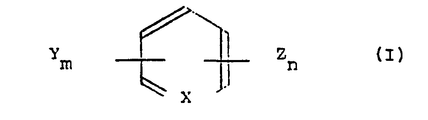
- Suitable compounds are of the general formula I. wherein X is N, CY or CZ, Y is CI or Br, Z is F, CN or N0 2 , m is an integer from 1 to 5, n an integer from 0 to 4, and the sum of m and n is 5.
- X is CCN or N are particularly advantageous.
- Typical examples include polychlorobenzenes, 3,5-dichloro-2,4,6-trifluorbenzonitrile, 3-chloro-2,4,5,6-tetrafluorobenzonitrile, pentachlorobenzonitrile, tetrachlorophthalonitrile, 5-chloro-2,4,6-trifluoroisophthalonitrile, tetrachloroisophthalonitrile, tetrachloroterephthalonitrile, 3,5-dichloro-2,4,6-trifluoropyridine, pentachloropyridine, 5-chloro-2,4,6-trifluoropyridine-3-nitrile, 2,4,5,6-tetrachloropyridine-3-nitrile, 2,3,5,6-tetrachloropyridine-4-nitrile, 3,4,5,6,-tetrachloropyridine-2-nitrile and such compounds having a bromine tom substituted for the chlorine atoms therein.
- suitable fluorinating agents include alkali metal fluorides such as cesium fluoride, potassium fluoride, sodium fluoride and lithium fluoride, and alkaline earth metal fluorides such as calcium fluoride, barium fluoride and magnesium fluoride. Fluorides of other metals such as antimony fluoride may sometimes be used.
- the fluorinating agent is used in an amount at least equivalent to the chlorine or bromine atom to be substituted.
- the amount of the fluorinating agent advantageously used is from 1 to 2 mols relative to the chlorine or bromine atoms in the organic compound treated.
- the pressure in the reaction system may be increased by addition of an inert gas such as air.
- an inert gas such as air.
- the reaction is carried out under a pressure of from 0 to 30 kg/cm 2 (gauge) (0.101 to 3.043 MPa), preferably from 1.5 to 22 kg/cm 2 (gauge) (0.248 to 2.259 MPa).
- the optimum reaction temperature depends on the starting material.
- the temperature is preferably 270° to 400°C (4 to 30 kg/cm 2. ) (0.494 to 3.043 MPa), more preferably from 300°C to 350°C (7 to 20 kg/cm2. G) (0.778 to 2.063 MPa).
- the temperature is preferably from 190°C (0 to 11 kg/c M 2. ) (0/101 to 7.180 MPa).
- the temperature is preferably from 250° to 350°C (2.5 to 18 kg/cM2.) (0.346 to 1.867 MPa).
- the temperature is preferably from 210° to 330°C (0.7 to 15 kg/cm 2. G) (0.170 to 1.572 MPa).
- the temperature is preferably from 300° to 400°C (7 to 30 kg/cm 2 ' G) (0.788 to 3.043 MPa), more preferably from 330° to 380°C (10 to 26 kg/cm 2 G) (1.082 to 2.651 MPa).
- the reaction time is generally 2 to 48 hours although it depends on the temperature and the starting material.
- the chloro- or bromo-organic compound is used in an amouunt of 5 to 50 parts by weight, preferably from 20 to 40 parts by weight, based on 100 parts by weight of benzonitrile.
- the reaction temperature is low and the reaction time is short, there may be partly formed a reaction product in which the chlorine or bromine has not been completely substituted.
- the compounds aimed at by the reaction has a lower boiling point such as the boiling point of pentafluorobenzonitrile (161°C under 760 mmHg (0.101 MPa)) or that of pentafluoropyridine (84°C under 760 mmHg (0.101 MPa)) than the boiling point of benzonitrile (191°C under 760 mmHg (0.101 MPa)), the compound produced can be separated by stripping. In the kettle, a chlorine- or bromine-containing fluorine compound of a high boiling point remains dissolved in the benzonitrile.
- the benzonitrile solvent thus remaining in the kettle may be recovered and put to use again in the reaction.
- the chlorine- or bromine-containing fluorine compound contained therein an unaltered intermediate is readily converted into the compound aimed at by the main reaction.
- the reuse of the recovered benzonitrile solution contributes to increasing the yield of the product.
- Bezonitrile lacks hygroscopicity and, therefore, is easily separated from the reaction product.
- Potassium fluoride fluorinating agent
- a phase transfer catalyst in the reaction system may prove advantageous.
- the reaction system contains the phase transfer catalyst, there is an advantage that the reaction velocity can be increased and the reaction time shotened.
- a crown compound such as dibenzo-18-crown-6- ether or polyethylene glycol having a molecular weight of 300 to 600 can be used.
- the amount of the phase transfer catalyst to be advantageously used is from 0.01 to 0.25 mol, preferably 0.05 to 0.20 mol, per mol of the organic compound raw material.
- Benzonitrile can be easily isolated from the reaction product by distillation and can be reused.
- Example 1 An autoclave having an inner volume of 500 cc was charged with the same raw materials as used in Example 1. The contents of the vessel were stirred at 350°C (under 17.0 kg/cm 2. G (1.768 MPa)) for four hours. After the reaction was terminated, the reaction mixture was treated by following the procedure of Example 1. When the mother liquid consequently obtained was analyzed by gas chromatography it was found to contain 72.5 mol% of pentaflurobenzonitrile based on the amount of pentachlorobenzonitrile first placed in the vessel.
Landscapes
- Chemical & Material Sciences (AREA)
- Organic Chemistry (AREA)
- Chemical Kinetics & Catalysis (AREA)
- Organic Low-Molecular-Weight Compounds And Preparation Thereof (AREA)
- Pyridine Compounds (AREA)
Claims (6)
Applications Claiming Priority (8)
| Application Number | Priority Date | Filing Date | Title |
|---|---|---|---|
| JP24848/83 | 1983-02-18 | ||
| JP58024848A JPS59152361A (ja) | 1983-02-18 | 1983-02-18 | ペンタフルオロベンゾニトリルの製法 |
| JP20259083A JPS6094919A (ja) | 1983-10-31 | 1983-10-31 | 有機フツ素化物の製法 |
| JP202590/83 | 1983-10-31 | ||
| JP219474/83 | 1983-11-24 | ||
| JP21947483A JPS60112751A (ja) | 1983-11-24 | 1983-11-24 | テトラフルオロフタロニトリル類の製法 |
| JP219473/83 | 1983-11-24 | ||
| JP21947383A JPS60112763A (ja) | 1983-11-24 | 1983-11-24 | ペンタフルオロピリジンの製法 |
Publications (2)
| Publication Number | Publication Date |
|---|---|
| EP0120575A1 EP0120575A1 (de) | 1984-10-03 |
| EP0120575B1 true EP0120575B1 (de) | 1989-06-14 |
Family
ID=27458206
Family Applications (1)
| Application Number | Title | Priority Date | Filing Date |
|---|---|---|---|
| EP84300911A Expired EP0120575B1 (de) | 1983-02-18 | 1984-02-14 | Fluorierte organische Verbindungen |
Country Status (3)
| Country | Link |
|---|---|
| US (1) | US4684734A (de) |
| EP (1) | EP0120575B1 (de) |
| DE (1) | DE3478681D1 (de) |
Families Citing this family (35)
| Publication number | Priority date | Publication date | Assignee | Title |
|---|---|---|---|---|
| CA1292746C (en) * | 1983-12-23 | 1991-12-03 | Charles A. Wilson | Preparation of difluoropyridine compounds |
| DE3686444T2 (de) * | 1985-06-03 | 1993-02-18 | Onoda Cement Co Ltd | N-fluorpyridiniumsalz und verfahren zur herstellung. |
| US4849552A (en) * | 1986-01-06 | 1989-07-18 | Mallinckrodt, Inc. | Preparation of fluoroaromatic compounds in dispersion of potassium fluoride |
| DE3608380A1 (de) * | 1986-03-13 | 1987-09-17 | Bayer Ag | Verfahren zur herstellung von 3-fluor-2-(fluormethyl)-propen und die neue verbindung 3-fluor-2-(chlormethyl)-propen |
| WO1987007267A1 (en) * | 1986-05-19 | 1987-12-03 | Allied Corporation | Method of synthesizing tetrafluorophthalonitrile |
| DE3827436A1 (de) * | 1988-08-12 | 1990-02-15 | Bayer Ag | Verfahren zum einfuehren von fluoratomen an aromatische kerne durch nucleophilen austausch |
| US4937396A (en) * | 1988-11-28 | 1990-06-26 | The Dow Chemical Company | Preparation of 3,4-difluorobenzotrifluoride |
| US5153350A (en) * | 1991-05-16 | 1992-10-06 | Braish Tamim F | Process for preparing 3,4,6-trifluorophithalonitrile |
| US5315043A (en) * | 1992-02-05 | 1994-05-24 | E. I. Du Pont De Nemours And Company | Aromatic nucleophilic fluorination |
| EP0556737B1 (de) * | 1992-02-20 | 2000-01-12 | Clariant GmbH | Verfahren zur Herstellung von substituierten 2,3-Difluorpyridinen |
| EP0573878B1 (de) * | 1992-06-09 | 2000-12-20 | Aventis Research & Technologies GmbH & Co. KG | 3-Fluorpyridine, Verfahren zu ihrer Herstellung und ihre Verwendung in Flüssigkristallmischungen |
| DE59401358D1 (de) * | 1993-01-23 | 1997-02-06 | Hoechst Ag | 2,3-Difluor-6-nitrobenzonitril und 2-Chlor-5,6-difluorbenzonitril, Verfahren zu deren Herstellung und ihre Verwendung zur Herstellung von 2,3,6-Trifluorbenzoesäure |
| EP0635486B1 (de) * | 1993-07-21 | 1998-12-09 | Clariant GmbH | Verfahren zur Herstellung von Fluorbenzonitrilen |
| DE4324365A1 (de) * | 1993-07-21 | 1995-01-26 | Hoechst Ag | Verfahren zur Herstellung von mehrfach fluorierten Nitrobenzolen |
| DE4324367A1 (de) * | 1993-07-21 | 1995-01-26 | Hoechst Ag | Verfahren zur Herstellung von Fluornitrobenzolen |
| US5502235A (en) * | 1994-12-28 | 1996-03-26 | Dowelanco | Solventless process for making 2,6 difluorobenzonitrile |
| WO1997031891A1 (en) * | 1996-03-01 | 1997-09-04 | Merck & Co., Inc. | Process for regioselective substitution of trifluorobenzoate or trifluorobenzonitrile |
| US5777123A (en) * | 1996-03-01 | 1998-07-07 | Merck & Co., Inc. | Process for regioselective substitution of trifluorobenzoate or trifluorobenzonitrile |
| US5824827A (en) * | 1996-11-22 | 1998-10-20 | Albemarle Corporation | Halogen exchange reactions |
| CN1122004C (zh) | 1996-11-22 | 2003-09-24 | 阿尔伯麦尔公司 | 卤素交换反应及其应用 |
| US5789631A (en) * | 1996-11-25 | 1998-08-04 | Albemarle Corporation | Production of perhalobenzenes |
| JP3731982B2 (ja) * | 1997-08-26 | 2006-01-05 | 株式会社日本触媒 | 有機フッ素化合物の製造方法 |
| US5965781A (en) * | 1997-11-21 | 1999-10-12 | Albemarle Corporation | Catalysis in halogen exchange reactions |
| RU2157800C2 (ru) * | 1999-01-18 | 2000-10-20 | Пермский филиал российского научного центра "Прикладная химия" | Способ получения полифторароматических соединений |
| FR2795718B1 (fr) * | 1999-07-02 | 2002-04-12 | Rhodia Chimie Sa | Utilisation de nitriles comme solvants aprotiques polaires |
| US20040024238A1 (en) * | 1999-07-02 | 2004-02-05 | Nathalie Laurain | Use of nitriles as polar aprotic solvents |
| RU2164508C1 (ru) | 1999-11-23 | 2001-03-27 | Игумнов Сергей Михайлович | Способ получения полифторароматических соединений |
| US6437168B1 (en) | 2000-09-05 | 2002-08-20 | Nippon Shokubai Co., Ltd. | Method for production of aromatic fluorine compound |
| HUP0301290A3 (en) * | 2000-10-04 | 2005-11-28 | Showa Denko Kk | Process for producing fluorinated dicyanobenzene |
| US7132561B2 (en) | 2000-10-04 | 2006-11-07 | Showa Denko K.K. | Process for producing fluorinated dicyanobenzene |
| JP4876355B2 (ja) * | 2000-10-04 | 2012-02-15 | 昭和電工株式会社 | フッ素化ジシアノベンゼンの製造方法 |
| US6916959B2 (en) | 2001-05-11 | 2005-07-12 | Nippon Shokubai Co., Ltd. | Halogen-containing aromatic compound |
| US6720458B2 (en) * | 2001-09-07 | 2004-04-13 | Showa Denko K.K. | Photooxidation catalyst and production process for aldehyde derivatives |
| JPWO2003022431A1 (ja) * | 2001-09-07 | 2004-12-24 | 昭和電工株式会社 | 光酸化反応触媒及びアルデヒド類の製造方法 |
| WO2004113267A2 (en) * | 2003-06-23 | 2004-12-29 | Nippon Shokubai Co., Ltd. | Method for production of fluorinated phenylenediamine |
Family Cites Families (13)
| Publication number | Priority date | Publication date | Assignee | Title |
|---|---|---|---|---|
| GB1027372A (en) * | 1964-01-17 | 1966-04-27 | Ici Ltd | Preparation of fluorochlorobenzenes |
| NL134419C (de) * | 1964-03-10 | |||
| GB1039987A (en) * | 1964-03-17 | 1966-08-24 | Pennwalt Corp | Fluoropyridines |
| US3296269A (en) * | 1964-09-21 | 1967-01-03 | Olin Mathieson | Process for providing 2-fluoropyridine |
| US3574775A (en) * | 1968-04-22 | 1971-04-13 | Imp Smelting Corp Ltd | Fluorination of perhalo compounds |
| GB1256082A (en) * | 1968-09-30 | 1971-12-08 | Ici Ltd | Manufacture of chlorofluoropyridines |
| GB1272475A (en) * | 1969-05-30 | 1972-04-26 | Ici Ltd | Manufacture of fluoropyridines |
| GB1306517A (en) * | 1970-06-08 | 1973-02-14 | Ici Ltd | Manufacture of halogenated pyridine derivatives |
| GB1340421A (en) * | 1971-01-14 | 1973-12-12 | Ici Ltd | Manufacture of chlorofluoropyridines |
| US4229365A (en) * | 1977-05-28 | 1980-10-21 | Basf Aktiengesellschaft | Manufacture of substituted fluorobenzenes |
| DE2803259A1 (de) * | 1978-01-26 | 1979-08-02 | Basf Ag | Verfahren zur herstellung von fluorbenzolen |
| DE2902877C2 (de) * | 1978-01-28 | 1983-05-05 | I.S.C. Chemicals Ltd., London | Verfahren zur Herstellung eines Fluorbenzomononitrils |
| US4174349A (en) * | 1978-10-30 | 1979-11-13 | Allied Chemical Corporation | Preparation of fluoroorganic compounds with calcium fluoride |
-
1984
- 1984-02-14 EP EP84300911A patent/EP0120575B1/de not_active Expired
- 1984-02-14 DE DE8484300911T patent/DE3478681D1/de not_active Expired
-
1985
- 1985-09-13 US US06/776,085 patent/US4684734A/en not_active Expired - Lifetime
Also Published As
| Publication number | Publication date |
|---|---|
| EP0120575A1 (de) | 1984-10-03 |
| US4684734A (en) | 1987-08-04 |
| DE3478681D1 (en) | 1989-07-20 |
Similar Documents
| Publication | Publication Date | Title |
|---|---|---|
| EP0120575A1 (de) | Fluorierte organische Verbindungen | |
| EP0180057B1 (de) | Verfahren zur Herstellung von haloaromatischen Verbindungen | |
| GB2219292A (en) | Process of preparing 1,2,2,2-tetrafluoroethyl-difluoromethyl ether | |
| US4600787A (en) | Process for the preparation of aromatic compounds which contain perfluorinated side-chains bonded via a heteroatom | |
| US4837364A (en) | Processes for preparing pentafluoroethoxy- and pentafluoroethylthiobenzene drivatives | |
| EP0899256B1 (de) | Verfahren zum Herstellen von organischen Fluorverbindungen | |
| JPH0313206B2 (de) | ||
| EP0761627B1 (de) | Verfahren zur Herstellung von p-Bromfluorobenzol | |
| JPH072751A (ja) | 2,3−ジフルオル−6− ニトロベンゾニトリル及び2−クロル−5,6− ジフルオルベンゾニトリル(2,3− ジフルオル−6− クロルベンゾニトリル) とその製造方法、及び2,3,6−トリフルオル安息香酸を製造するためのそれらの使用方法 | |
| JPH024580B2 (de) | ||
| EP0170190B1 (de) | Verfahren zur Herstellung von fluorierten Chinonen | |
| JPH0229667B2 (de) | ||
| JPS59152361A (ja) | ペンタフルオロベンゾニトリルの製法 | |
| JPS6132309B2 (de) | ||
| JPS635023B2 (de) | ||
| JPS6147426A (ja) | フツ素化環式炭化水素類の製法 | |
| JPH0149337B2 (de) | ||
| JPS59139329A (ja) | 4−フルオロベンゾトリフルオライド類の製造法 | |
| JPH0149338B2 (de) | ||
| JPS627185B2 (de) | ||
| US3154573A (en) | Process for preparing fluorinated dinitriles | |
| JPS6365058B2 (de) | ||
| JP3518605B2 (ja) | 環化およびハロ−水酸基除去によるN−(2,6−ジクロロ−3−メチルフェニル)−5−7−ジハロ[1,2,4]トリアゾロ[1,5a]ピリミジン−2−スルホンアミドの製造方法 | |
| JPS60149566A (ja) | テトラフルオロシアノピリジン類の製法 | |
| JPS63203636A (ja) | ハロゲン化芳香族化合物のフツ素化方法 |
Legal Events
| Date | Code | Title | Description |
|---|---|---|---|
| PUAI | Public reference made under article 153(3) epc to a published international application that has entered the european phase |
Free format text: ORIGINAL CODE: 0009012 |
|
| AK | Designated contracting states |
Designated state(s): CH DE FR GB LI |
|
| 17P | Request for examination filed |
Effective date: 19841106 |
|
| 17Q | First examination report despatched |
Effective date: 19860123 |
|
| D17Q | First examination report despatched (deleted) | ||
| GRAA | (expected) grant |
Free format text: ORIGINAL CODE: 0009210 |
|
| AK | Designated contracting states |
Kind code of ref document: B1 Designated state(s): CH DE FR GB LI |
|
| REF | Corresponds to: |
Ref document number: 3478681 Country of ref document: DE Date of ref document: 19890720 |
|
| ET | Fr: translation filed | ||
| PLBE | No opposition filed within time limit |
Free format text: ORIGINAL CODE: 0009261 |
|
| STAA | Information on the status of an ep patent application or granted ep patent |
Free format text: STATUS: NO OPPOSITION FILED WITHIN TIME LIMIT |
|
| 26N | No opposition filed | ||
| PGFP | Annual fee paid to national office [announced via postgrant information from national office to epo] |
Ref country code: CH Payment date: 19930226 Year of fee payment: 10 |
|
| PG25 | Lapsed in a contracting state [announced via postgrant information from national office to epo] |
Ref country code: LI Effective date: 19940228 Ref country code: CH Effective date: 19940228 |
|
| REG | Reference to a national code |
Ref country code: CH Ref legal event code: PL |
|
| REG | Reference to a national code |
Ref country code: GB Ref legal event code: IF02 |
|
| PGFP | Annual fee paid to national office [announced via postgrant information from national office to epo] |
Ref country code: FR Payment date: 20020212 Year of fee payment: 19 |
|
| PGFP | Annual fee paid to national office [announced via postgrant information from national office to epo] |
Ref country code: GB Payment date: 20020213 Year of fee payment: 19 |
|
| PGFP | Annual fee paid to national office [announced via postgrant information from national office to epo] |
Ref country code: DE Payment date: 20020227 Year of fee payment: 19 |
|
| PG25 | Lapsed in a contracting state [announced via postgrant information from national office to epo] |
Ref country code: GB Free format text: LAPSE BECAUSE OF NON-PAYMENT OF DUE FEES Effective date: 20030214 |
|
| PG25 | Lapsed in a contracting state [announced via postgrant information from national office to epo] |
Ref country code: DE Free format text: LAPSE BECAUSE OF NON-PAYMENT OF DUE FEES Effective date: 20030902 |
|
| GBPC | Gb: european patent ceased through non-payment of renewal fee | ||
| PG25 | Lapsed in a contracting state [announced via postgrant information from national office to epo] |
Ref country code: FR Free format text: LAPSE BECAUSE OF NON-PAYMENT OF DUE FEES Effective date: 20031031 |
|
| REG | Reference to a national code |
Ref country code: FR Ref legal event code: ST |