EP0635533B1 - Polyimid gegründeter Flüssigkristalle aufstellender Wirkstoff - Google Patents
Polyimid gegründeter Flüssigkristalle aufstellender Wirkstoff Download PDFInfo
- Publication number
- EP0635533B1 EP0635533B1 EP94115788A EP94115788A EP0635533B1 EP 0635533 B1 EP0635533 B1 EP 0635533B1 EP 94115788 A EP94115788 A EP 94115788A EP 94115788 A EP94115788 A EP 94115788A EP 0635533 B1 EP0635533 B1 EP 0635533B1
- Authority
- EP
- European Patent Office
- Prior art keywords
- polyimide
- liquid crystal
- group
- film
- substrate
- Prior art date
- Legal status (The legal status is an assumption and is not a legal conclusion. Google has not performed a legal analysis and makes no representation as to the accuracy of the status listed.)
- Expired - Lifetime
Links
- 229920001721 polyimide Polymers 0.000 title claims description 81
- 239000004642 Polyimide Substances 0.000 title claims description 68
- 239000004973 liquid crystal related substance Substances 0.000 title claims description 26
- 239000003795 chemical substances by application Substances 0.000 title claims description 24
- 125000001997 phenyl group Chemical group [H]C1=C([H])C([H])=C(*)C([H])=C1[H] 0.000 claims description 21
- 150000004985 diamines Chemical class 0.000 claims description 14
- 125000000962 organic group Chemical group 0.000 claims description 14
- 125000000217 alkyl group Chemical group 0.000 claims description 11
- 125000000547 substituted alkyl group Chemical group 0.000 claims description 9
- 150000000000 tetracarboxylic acids Chemical class 0.000 claims description 7
- 125000005373 siloxane group Chemical group [SiH2](O*)* 0.000 claims description 2
- -1 siloxane chain Chemical group 0.000 description 50
- 239000000758 substrate Substances 0.000 description 44
- 239000010408 film Substances 0.000 description 37
- 238000006243 chemical reaction Methods 0.000 description 28
- 239000007788 liquid Substances 0.000 description 28
- 238000000034 method Methods 0.000 description 23
- UHOVQNZJYSORNB-UHFFFAOYSA-N Benzene Chemical compound C1=CC=CC=C1 UHOVQNZJYSORNB-UHFFFAOYSA-N 0.000 description 21
- 229920000642 polymer Polymers 0.000 description 21
- 239000002904 solvent Substances 0.000 description 21
- VLKZOEOYAKHREP-UHFFFAOYSA-N n-Hexane Chemical compound CCCCCC VLKZOEOYAKHREP-UHFFFAOYSA-N 0.000 description 18
- GEYOCULIXLDCMW-UHFFFAOYSA-N 1,2-phenylenediamine Chemical compound NC1=CC=CC=C1N GEYOCULIXLDCMW-UHFFFAOYSA-N 0.000 description 16
- 210000004027 cell Anatomy 0.000 description 16
- 229920005575 poly(amic acid) Polymers 0.000 description 15
- 238000002360 preparation method Methods 0.000 description 14
- SECXISVLQFMRJM-UHFFFAOYSA-N N-Methylpyrrolidone Chemical compound CN1CCCC1=O SECXISVLQFMRJM-UHFFFAOYSA-N 0.000 description 13
- 238000000926 separation method Methods 0.000 description 13
- WFDIJRYMOXRFFG-UHFFFAOYSA-N Acetic anhydride Chemical compound CC(=O)OC(C)=O WFDIJRYMOXRFFG-UHFFFAOYSA-N 0.000 description 12
- OKKJLVBELUTLKV-UHFFFAOYSA-N Methanol Chemical compound OC OKKJLVBELUTLKV-UHFFFAOYSA-N 0.000 description 12
- WYURNTSHIVDZCO-UHFFFAOYSA-N Tetrahydrofuran Chemical compound C1CCOC1 WYURNTSHIVDZCO-UHFFFAOYSA-N 0.000 description 12
- 150000001875 compounds Chemical class 0.000 description 12
- 239000007789 gas Substances 0.000 description 11
- 238000006358 imidation reaction Methods 0.000 description 11
- XKRFYHLGVUSROY-UHFFFAOYSA-N Argon Chemical compound [Ar] XKRFYHLGVUSROY-UHFFFAOYSA-N 0.000 description 10
- RTZKZFJDLAIYFH-UHFFFAOYSA-N Diethyl ether Chemical compound CCOCC RTZKZFJDLAIYFH-UHFFFAOYSA-N 0.000 description 10
- 230000035699 permeability Effects 0.000 description 10
- ZMANZCXQSJIPKH-UHFFFAOYSA-N Triethylamine Chemical compound CCN(CC)CC ZMANZCXQSJIPKH-UHFFFAOYSA-N 0.000 description 9
- 239000003054 catalyst Substances 0.000 description 9
- 239000000203 mixture Substances 0.000 description 9
- 239000013078 crystal Substances 0.000 description 8
- 239000011521 glass Substances 0.000 description 8
- 229920001296 polysiloxane Polymers 0.000 description 8
- 239000000843 powder Substances 0.000 description 8
- YCKRFDGAMUMZLT-UHFFFAOYSA-N Fluorine atom Chemical compound [F] YCKRFDGAMUMZLT-UHFFFAOYSA-N 0.000 description 7
- YXFVVABEGXRONW-UHFFFAOYSA-N Toluene Chemical compound CC1=CC=CC=C1 YXFVVABEGXRONW-UHFFFAOYSA-N 0.000 description 7
- 238000010521 absorption reaction Methods 0.000 description 7
- 239000002253 acid Substances 0.000 description 7
- 125000003118 aryl group Chemical group 0.000 description 7
- KPUWHANPEXNPJT-UHFFFAOYSA-N disiloxane Chemical class [SiH3]O[SiH3] KPUWHANPEXNPJT-UHFFFAOYSA-N 0.000 description 7
- 229910052731 fluorine Inorganic materials 0.000 description 7
- 239000011737 fluorine Substances 0.000 description 7
- 238000005227 gel permeation chromatography Methods 0.000 description 7
- 239000000463 material Substances 0.000 description 7
- LFQSCWFLJHTTHZ-UHFFFAOYSA-N Ethanol Chemical compound CCO LFQSCWFLJHTTHZ-UHFFFAOYSA-N 0.000 description 6
- 230000000052 comparative effect Effects 0.000 description 6
- 238000004519 manufacturing process Methods 0.000 description 6
- 238000006068 polycondensation reaction Methods 0.000 description 6
- YLQBMQCUIZJEEH-UHFFFAOYSA-N tetrahydrofuran Natural products C=1C=COC=1 YLQBMQCUIZJEEH-UHFFFAOYSA-N 0.000 description 6
- UFHFLCQGNIYNRP-UHFFFAOYSA-N Hydrogen Chemical compound [H][H] UFHFLCQGNIYNRP-UHFFFAOYSA-N 0.000 description 5
- 239000002202 Polyethylene glycol Substances 0.000 description 5
- 229910052786 argon Inorganic materials 0.000 description 5
- 239000012298 atmosphere Substances 0.000 description 5
- 210000002858 crystal cell Anatomy 0.000 description 5
- 229920001223 polyethylene glycol Polymers 0.000 description 5
- 238000006116 polymerization reaction Methods 0.000 description 5
- 239000000047 product Substances 0.000 description 5
- 238000000425 proton nuclear magnetic resonance spectrum Methods 0.000 description 5
- IJGRMHOSHXDMSA-UHFFFAOYSA-N Atomic nitrogen Chemical compound N#N IJGRMHOSHXDMSA-UHFFFAOYSA-N 0.000 description 4
- 0 CC1C(S(c2cc(C)ccc2)(OC)=O)=CC=C*1 Chemical compound CC1C(S(c2cc(C)ccc2)(OC)=O)=CC=C*1 0.000 description 4
- CURLTUGMZLYLDI-UHFFFAOYSA-N Carbon dioxide Chemical compound O=C=O CURLTUGMZLYLDI-UHFFFAOYSA-N 0.000 description 4
- FXHOOIRPVKKKFG-UHFFFAOYSA-N N,N-Dimethylacetamide Chemical compound CN(C)C(C)=O FXHOOIRPVKKKFG-UHFFFAOYSA-N 0.000 description 4
- MZRVEZGGRBJDDB-UHFFFAOYSA-N N-Butyllithium Chemical compound [Li]CCCC MZRVEZGGRBJDDB-UHFFFAOYSA-N 0.000 description 4
- JUJWROOIHBZHMG-UHFFFAOYSA-N Pyridine Chemical compound C1=CC=NC=C1 JUJWROOIHBZHMG-UHFFFAOYSA-N 0.000 description 4
- VYPSYNLAJGMNEJ-UHFFFAOYSA-N Silicium dioxide Chemical compound O=[Si]=O VYPSYNLAJGMNEJ-UHFFFAOYSA-N 0.000 description 4
- HEDRZPFGACZZDS-MICDWDOJSA-N Trichloro(2H)methane Chemical compound [2H]C(Cl)(Cl)Cl HEDRZPFGACZZDS-MICDWDOJSA-N 0.000 description 4
- 235000013870 dimethyl polysiloxane Nutrition 0.000 description 4
- 238000001914 filtration Methods 0.000 description 4
- 238000002329 infrared spectrum Methods 0.000 description 4
- 229920000435 poly(dimethylsiloxane) Polymers 0.000 description 4
- 239000011347 resin Substances 0.000 description 4
- 229920005989 resin Polymers 0.000 description 4
- 238000004528 spin coating Methods 0.000 description 4
- 239000007858 starting material Substances 0.000 description 4
- 239000000126 substance Substances 0.000 description 4
- XLYOFNOQVPJJNP-UHFFFAOYSA-N water Substances O XLYOFNOQVPJJNP-UHFFFAOYSA-N 0.000 description 4
- BBXWMMQQHJETCD-UHFFFAOYSA-N 1,3-dinitro-5-(prop-2-enoxymethyl)benzene Chemical compound [O-][N+](=O)C1=CC(COCC=C)=CC([N+]([O-])=O)=C1 BBXWMMQQHJETCD-UHFFFAOYSA-N 0.000 description 3
- HLBLWEWZXPIGSM-UHFFFAOYSA-N 4-Aminophenyl ether Chemical compound C1=CC(N)=CC=C1OC1=CC=C(N)C=C1 HLBLWEWZXPIGSM-UHFFFAOYSA-N 0.000 description 3
- APXJLYIVOFARRM-UHFFFAOYSA-N 4-[2-(3,4-dicarboxyphenyl)-1,1,1,3,3,3-hexafluoropropan-2-yl]phthalic acid Chemical compound C1=C(C(O)=O)C(C(=O)O)=CC=C1C(C(F)(F)F)(C(F)(F)F)C1=CC=C(C(O)=O)C(C(O)=O)=C1 APXJLYIVOFARRM-UHFFFAOYSA-N 0.000 description 3
- CSCPPACGZOOCGX-UHFFFAOYSA-N Acetone Chemical compound CC(C)=O CSCPPACGZOOCGX-UHFFFAOYSA-N 0.000 description 3
- WVOLTBSCXRRQFR-SJORKVTESA-N Cannabidiolic acid Natural products OC1=C(C(O)=O)C(CCCCC)=CC(O)=C1[C@@H]1[C@@H](C(C)=C)CCC(C)=C1 WVOLTBSCXRRQFR-SJORKVTESA-N 0.000 description 3
- XEKOWRVHYACXOJ-UHFFFAOYSA-N Ethyl acetate Chemical compound CCOC(C)=O XEKOWRVHYACXOJ-UHFFFAOYSA-N 0.000 description 3
- OFOBLEOULBTSOW-UHFFFAOYSA-N Malonic acid Chemical compound OC(=O)CC(O)=O OFOBLEOULBTSOW-UHFFFAOYSA-N 0.000 description 3
- HEMHJVSKTPXQMS-UHFFFAOYSA-M Sodium hydroxide Chemical compound [OH-].[Na+] HEMHJVSKTPXQMS-UHFFFAOYSA-M 0.000 description 3
- GTDPSWPPOUPBNX-UHFFFAOYSA-N ac1mqpva Chemical compound CC12C(=O)OC(=O)C1(C)C1(C)C2(C)C(=O)OC1=O GTDPSWPPOUPBNX-UHFFFAOYSA-N 0.000 description 3
- 150000008065 acid anhydrides Chemical class 0.000 description 3
- 238000004458 analytical method Methods 0.000 description 3
- WVOLTBSCXRRQFR-DLBZAZTESA-M cannabidiolate Chemical compound OC1=C(C([O-])=O)C(CCCCC)=CC(O)=C1[C@H]1[C@H](C(C)=C)CCC(C)=C1 WVOLTBSCXRRQFR-DLBZAZTESA-M 0.000 description 3
- 125000004432 carbon atom Chemical group C* 0.000 description 3
- 239000011203 carbon fibre reinforced carbon Substances 0.000 description 3
- 238000004440 column chromatography Methods 0.000 description 3
- 229920001577 copolymer Polymers 0.000 description 3
- 239000012043 crude product Substances 0.000 description 3
- 125000006159 dianhydride group Chemical group 0.000 description 3
- 229960004132 diethyl ether Drugs 0.000 description 3
- 239000004205 dimethyl polysiloxane Substances 0.000 description 3
- 150000004820 halides Chemical class 0.000 description 3
- 239000001257 hydrogen Substances 0.000 description 3
- 229910052739 hydrogen Inorganic materials 0.000 description 3
- 125000000449 nitro group Chemical group [O-][N+](*)=O 0.000 description 3
- 239000002985 plastic film Substances 0.000 description 3
- 229920006255 plastic film Polymers 0.000 description 3
- BASFCYQUMIYNBI-UHFFFAOYSA-N platinum Chemical compound [Pt] BASFCYQUMIYNBI-UHFFFAOYSA-N 0.000 description 3
- 239000009719 polyimide resin Substances 0.000 description 3
- 239000002244 precipitate Substances 0.000 description 3
- 239000002243 precursor Substances 0.000 description 3
- 229910002027 silica gel Inorganic materials 0.000 description 3
- 239000000741 silica gel Substances 0.000 description 3
- AAPLIUHOKVUFCC-UHFFFAOYSA-N trimethylsilanol Chemical compound C[Si](C)(C)O AAPLIUHOKVUFCC-UHFFFAOYSA-N 0.000 description 3
- LJGHYPLBDBRCRZ-UHFFFAOYSA-N 3-(3-aminophenyl)sulfonylaniline Chemical compound NC1=CC=CC(S(=O)(=O)C=2C=C(N)C=CC=2)=C1 LJGHYPLBDBRCRZ-UHFFFAOYSA-N 0.000 description 2
- YEJRWHAVMIAJKC-UHFFFAOYSA-N 4-Butyrolactone Chemical compound O=C1CCCO1 YEJRWHAVMIAJKC-UHFFFAOYSA-N 0.000 description 2
- IAZDPXIOMUYVGZ-UHFFFAOYSA-N Dimethylsulphoxide Chemical compound CS(C)=O IAZDPXIOMUYVGZ-UHFFFAOYSA-N 0.000 description 2
- KFZMGEQAYNKOFK-UHFFFAOYSA-N Isopropanol Chemical compound CC(C)O KFZMGEQAYNKOFK-UHFFFAOYSA-N 0.000 description 2
- KDLHZDBZIXYQEI-UHFFFAOYSA-N Palladium Chemical compound [Pd] KDLHZDBZIXYQEI-UHFFFAOYSA-N 0.000 description 2
- 229910002666 PdCl2 Inorganic materials 0.000 description 2
- 239000004793 Polystyrene Substances 0.000 description 2
- ATUOYWHBWRKTHZ-UHFFFAOYSA-N Propane Chemical compound CCC ATUOYWHBWRKTHZ-UHFFFAOYSA-N 0.000 description 2
- 239000000853 adhesive Substances 0.000 description 2
- 230000001070 adhesive effect Effects 0.000 description 2
- 125000002723 alicyclic group Chemical group 0.000 description 2
- 125000001931 aliphatic group Chemical group 0.000 description 2
- 150000001450 anions Chemical class 0.000 description 2
- QVGXLLKOCUKJST-UHFFFAOYSA-N atomic oxygen Chemical compound [O] QVGXLLKOCUKJST-UHFFFAOYSA-N 0.000 description 2
- 229920001400 block copolymer Polymers 0.000 description 2
- 229910002092 carbon dioxide Inorganic materials 0.000 description 2
- 239000001569 carbon dioxide Substances 0.000 description 2
- QABCGOSYZHCPGN-UHFFFAOYSA-N chloro(dimethyl)silicon Chemical compound C[Si](C)Cl QABCGOSYZHCPGN-UHFFFAOYSA-N 0.000 description 2
- MVPPADPHJFYWMZ-UHFFFAOYSA-N chlorobenzene Chemical compound ClC1=CC=CC=C1 MVPPADPHJFYWMZ-UHFFFAOYSA-N 0.000 description 2
- 239000004035 construction material Substances 0.000 description 2
- CURBACXRQKTCKZ-UHFFFAOYSA-N cyclobutane-1,2,3,4-tetracarboxylic acid Chemical compound OC(=O)C1C(C(O)=O)C(C(O)=O)C1C(O)=O CURBACXRQKTCKZ-UHFFFAOYSA-N 0.000 description 2
- 238000000151 deposition Methods 0.000 description 2
- KZTYYGOKRVBIMI-UHFFFAOYSA-N diphenyl sulfone Chemical compound C=1C=CC=CC=1S(=O)(=O)C1=CC=CC=C1 KZTYYGOKRVBIMI-UHFFFAOYSA-N 0.000 description 2
- 238000004821 distillation Methods 0.000 description 2
- 239000004744 fabric Substances 0.000 description 2
- 239000008246 gaseous mixture Substances 0.000 description 2
- 125000005843 halogen group Chemical group 0.000 description 2
- HTDJPCNNEPUOOQ-UHFFFAOYSA-N hexamethylcyclotrisiloxane Chemical compound C[Si]1(C)O[Si](C)(C)O[Si](C)(C)O1 HTDJPCNNEPUOOQ-UHFFFAOYSA-N 0.000 description 2
- 229920001519 homopolymer Polymers 0.000 description 2
- 238000006459 hydrosilylation reaction Methods 0.000 description 2
- 229910010272 inorganic material Inorganic materials 0.000 description 2
- 239000011147 inorganic material Substances 0.000 description 2
- 239000011810 insulating material Substances 0.000 description 2
- 229910052757 nitrogen Inorganic materials 0.000 description 2
- 239000003921 oil Substances 0.000 description 2
- 239000001301 oxygen Substances 0.000 description 2
- 229910052760 oxygen Inorganic materials 0.000 description 2
- 229920002223 polystyrene Polymers 0.000 description 2
- UMJSCPRVCHMLSP-UHFFFAOYSA-N pyridine Natural products COC1=CC=CN=C1 UMJSCPRVCHMLSP-UHFFFAOYSA-N 0.000 description 2
- CYIDZMCFTVVTJO-UHFFFAOYSA-N pyromellitic acid Chemical compound OC(=O)C1=CC(C(O)=O)=C(C(O)=O)C=C1C(O)=O CYIDZMCFTVVTJO-UHFFFAOYSA-N 0.000 description 2
- 150000004819 silanols Chemical class 0.000 description 2
- 239000007787 solid Substances 0.000 description 2
- HHVIBTZHLRERCL-UHFFFAOYSA-N sulfonyldimethane Chemical compound CS(C)(=O)=O HHVIBTZHLRERCL-UHFFFAOYSA-N 0.000 description 2
- VZGDMQKNWNREIO-UHFFFAOYSA-N tetrachloromethane Chemical compound ClC(Cl)(Cl)Cl VZGDMQKNWNREIO-UHFFFAOYSA-N 0.000 description 2
- RIOQSEWOXXDEQQ-UHFFFAOYSA-N triphenylphosphine Chemical compound C1=CC=CC=C1P(C=1C=CC=CC=1)C1=CC=CC=C1 RIOQSEWOXXDEQQ-UHFFFAOYSA-N 0.000 description 2
- 238000007740 vapor deposition Methods 0.000 description 2
- GGAUUQHSCNMCAU-ZXZARUISSA-N (2s,3r)-butane-1,2,3,4-tetracarboxylic acid Chemical compound OC(=O)C[C@H](C(O)=O)[C@H](C(O)=O)CC(O)=O GGAUUQHSCNMCAU-ZXZARUISSA-N 0.000 description 1
- GPHYIQCSMDYRGJ-UHFFFAOYSA-N (3,5-dinitrophenyl)methanol Chemical compound OCC1=CC([N+]([O-])=O)=CC([N+]([O-])=O)=C1 GPHYIQCSMDYRGJ-UHFFFAOYSA-N 0.000 description 1
- AVQQQNCBBIEMEU-UHFFFAOYSA-N 1,1,3,3-tetramethylurea Chemical compound CN(C)C(=O)N(C)C AVQQQNCBBIEMEU-UHFFFAOYSA-N 0.000 description 1
- WZCQRUWWHSTZEM-UHFFFAOYSA-N 1,3-phenylenediamine Chemical compound NC1=CC=CC(N)=C1 WZCQRUWWHSTZEM-UHFFFAOYSA-N 0.000 description 1
- CBCKQZAAMUWICA-UHFFFAOYSA-N 1,4-phenylenediamine Chemical compound NC1=CC=C(N)C=C1 CBCKQZAAMUWICA-UHFFFAOYSA-N 0.000 description 1
- LXJLFVRAWOOQDR-UHFFFAOYSA-N 3-(3-aminophenoxy)aniline Chemical compound NC1=CC=CC(OC=2C=C(N)C=CC=2)=C1 LXJLFVRAWOOQDR-UHFFFAOYSA-N 0.000 description 1
- NDXGRHCEHPFUSU-UHFFFAOYSA-N 3-(3-aminophenyl)aniline Chemical group NC1=CC=CC(C=2C=C(N)C=CC=2)=C1 NDXGRHCEHPFUSU-UHFFFAOYSA-N 0.000 description 1
- CKOFBUUFHALZGK-UHFFFAOYSA-N 3-[(3-aminophenyl)methyl]aniline Chemical compound NC1=CC=CC(CC=2C=C(N)C=CC=2)=C1 CKOFBUUFHALZGK-UHFFFAOYSA-N 0.000 description 1
- DVXYMCJCMDTSQA-UHFFFAOYSA-N 3-[2-(3-aminophenyl)propan-2-yl]aniline Chemical compound C=1C=CC(N)=CC=1C(C)(C)C1=CC=CC(N)=C1 DVXYMCJCMDTSQA-UHFFFAOYSA-N 0.000 description 1
- UBVXAGNDACSETP-UHFFFAOYSA-N 3-chloropropyl-hydroxy-methylsilane Chemical compound C[SiH](O)CCCCl UBVXAGNDACSETP-UHFFFAOYSA-N 0.000 description 1
- ICNFHJVPAJKPHW-UHFFFAOYSA-N 4,4'-Thiodianiline Chemical compound C1=CC(N)=CC=C1SC1=CC=C(N)C=C1 ICNFHJVPAJKPHW-UHFFFAOYSA-N 0.000 description 1
- YBRVSVVVWCFQMG-UHFFFAOYSA-N 4,4'-diaminodiphenylmethane Chemical compound C1=CC(N)=CC=C1CC1=CC=C(N)C=C1 YBRVSVVVWCFQMG-UHFFFAOYSA-N 0.000 description 1
- ZXVONLUNISGICL-UHFFFAOYSA-N 4,6-dinitro-o-cresol Chemical group CC1=CC([N+]([O-])=O)=CC([N+]([O-])=O)=C1O ZXVONLUNISGICL-UHFFFAOYSA-N 0.000 description 1
- SQNMHJHUPDEXMS-UHFFFAOYSA-N 4-(1,2-dicarboxyethyl)-1,2,3,4-tetrahydronaphthalene-1,2-dicarboxylic acid Chemical compound C1=CC=C2C(C(CC(=O)O)C(O)=O)CC(C(O)=O)C(C(O)=O)C2=C1 SQNMHJHUPDEXMS-UHFFFAOYSA-N 0.000 description 1
- FFKSVVOWOROQIU-UHFFFAOYSA-N 4-(2,5-dioxooxolan-3-yl)-1,2,3,4-tetrahydronaphthalene-1,2-dicarboxylic acid Chemical compound C12=CC=CC=C2C(C(O)=O)C(C(=O)O)CC1C1CC(=O)OC1=O FFKSVVOWOROQIU-UHFFFAOYSA-N 0.000 description 1
- UITKHKNFVCYWNG-UHFFFAOYSA-N 4-(3,4-dicarboxybenzoyl)phthalic acid Chemical compound C1=C(C(O)=O)C(C(=O)O)=CC=C1C(=O)C1=CC=C(C(O)=O)C(C(O)=O)=C1 UITKHKNFVCYWNG-UHFFFAOYSA-N 0.000 description 1
- AIVVXPSKEVWKMY-UHFFFAOYSA-N 4-(3,4-dicarboxyphenoxy)phthalic acid Chemical compound C1=C(C(O)=O)C(C(=O)O)=CC=C1OC1=CC=C(C(O)=O)C(C(O)=O)=C1 AIVVXPSKEVWKMY-UHFFFAOYSA-N 0.000 description 1
- AVCOFPOLGHKJQB-UHFFFAOYSA-N 4-(3,4-dicarboxyphenyl)sulfonylphthalic acid Chemical compound C1=C(C(O)=O)C(C(=O)O)=CC=C1S(=O)(=O)C1=CC=C(C(O)=O)C(C(O)=O)=C1 AVCOFPOLGHKJQB-UHFFFAOYSA-N 0.000 description 1
- HNHQPIBXQALMMN-UHFFFAOYSA-N 4-[(3,4-dicarboxyphenyl)-dimethylsilyl]phthalic acid Chemical compound C=1C=C(C(O)=O)C(C(O)=O)=CC=1[Si](C)(C)C1=CC=C(C(O)=O)C(C(O)=O)=C1 HNHQPIBXQALMMN-UHFFFAOYSA-N 0.000 description 1
- MOCQGMXEHQTAEN-UHFFFAOYSA-N 4-[(3,4-dicarboxyphenyl)-diphenylsilyl]phthalic acid Chemical compound C1=C(C(O)=O)C(C(=O)O)=CC=C1[Si](C=1C=C(C(C(O)=O)=CC=1)C(O)=O)(C=1C=CC=CC=1)C1=CC=CC=C1 MOCQGMXEHQTAEN-UHFFFAOYSA-N 0.000 description 1
- IWXCYYWDGDDPAC-UHFFFAOYSA-N 4-[(3,4-dicarboxyphenyl)methyl]phthalic acid Chemical compound C1=C(C(O)=O)C(C(=O)O)=CC=C1CC1=CC=C(C(O)=O)C(C(O)=O)=C1 IWXCYYWDGDDPAC-UHFFFAOYSA-N 0.000 description 1
- GEYAGBVEAJGCFB-UHFFFAOYSA-N 4-[2-(3,4-dicarboxyphenyl)propan-2-yl]phthalic acid Chemical compound C=1C=C(C(O)=O)C(C(O)=O)=CC=1C(C)(C)C1=CC=C(C(O)=O)C(C(O)=O)=C1 GEYAGBVEAJGCFB-UHFFFAOYSA-N 0.000 description 1
- BEKFRNOZJSYWKZ-UHFFFAOYSA-N 4-[2-(4-aminophenyl)-1,1,1,3,3,3-hexafluoropropan-2-yl]aniline Chemical compound C1=CC(N)=CC=C1C(C(F)(F)F)(C(F)(F)F)C1=CC=C(N)C=C1 BEKFRNOZJSYWKZ-UHFFFAOYSA-N 0.000 description 1
- WUPRYUDHUFLKFL-UHFFFAOYSA-N 4-[3-(4-aminophenoxy)phenoxy]aniline Chemical compound C1=CC(N)=CC=C1OC1=CC=CC(OC=2C=CC(N)=CC=2)=C1 WUPRYUDHUFLKFL-UHFFFAOYSA-N 0.000 description 1
- HHLMWQDRYZAENA-UHFFFAOYSA-N 4-[4-[2-[4-(4-aminophenoxy)phenyl]-1,1,1,3,3,3-hexafluoropropan-2-yl]phenoxy]aniline Chemical compound C1=CC(N)=CC=C1OC1=CC=C(C(C=2C=CC(OC=3C=CC(N)=CC=3)=CC=2)(C(F)(F)F)C(F)(F)F)C=C1 HHLMWQDRYZAENA-UHFFFAOYSA-N 0.000 description 1
- KMKWGXGSGPYISJ-UHFFFAOYSA-N 4-[4-[2-[4-(4-aminophenoxy)phenyl]propan-2-yl]phenoxy]aniline Chemical compound C=1C=C(OC=2C=CC(N)=CC=2)C=CC=1C(C)(C)C(C=C1)=CC=C1OC1=CC=C(N)C=C1 KMKWGXGSGPYISJ-UHFFFAOYSA-N 0.000 description 1
- OYGUOZYRZNPDTN-UHFFFAOYSA-N 4-[6-(3,4-dicarboxyphenoxy)pyridin-2-yl]oxyphthalic acid Chemical compound C1=C(C(O)=O)C(C(=O)O)=CC=C1OC1=CC=CC(OC=2C=C(C(C(O)=O)=CC=2)C(O)=O)=N1 OYGUOZYRZNPDTN-UHFFFAOYSA-N 0.000 description 1
- 239000005046 Chlorosilane Substances 0.000 description 1
- XDTMQSROBMDMFD-UHFFFAOYSA-N Cyclohexane Chemical compound C1CCCCC1 XDTMQSROBMDMFD-UHFFFAOYSA-N 0.000 description 1
- MQJKPEGWNLWLTK-UHFFFAOYSA-N Dapsone Chemical compound C1=CC(N)=CC=C1S(=O)(=O)C1=CC=C(N)C=C1 MQJKPEGWNLWLTK-UHFFFAOYSA-N 0.000 description 1
- 229910003594 H2PtCl6.6H2O Inorganic materials 0.000 description 1
- 239000004988 Nematic liquid crystal Substances 0.000 description 1
- 239000004952 Polyamide Substances 0.000 description 1
- 229910018540 Si C Inorganic materials 0.000 description 1
- 229910002808 Si–O–Si Inorganic materials 0.000 description 1
- PMZURENOXWZQFD-UHFFFAOYSA-L Sodium Sulfate Chemical compound [Na+].[Na+].[O-]S([O-])(=O)=O PMZURENOXWZQFD-UHFFFAOYSA-L 0.000 description 1
- XSTXAVWGXDQKEL-UHFFFAOYSA-N Trichloroethylene Chemical group ClC=C(Cl)Cl XSTXAVWGXDQKEL-UHFFFAOYSA-N 0.000 description 1
- 150000003973 alkyl amines Chemical class 0.000 description 1
- BHELZAPQIKSEDF-UHFFFAOYSA-N allyl bromide Chemical compound BrCC=C BHELZAPQIKSEDF-UHFFFAOYSA-N 0.000 description 1
- 125000003277 amino group Chemical group 0.000 description 1
- BALIDSJNGIOVDT-UHFFFAOYSA-N anthracene-1,2,5,6-tetracarboxylic acid Chemical compound OC(=O)C1=C(C(O)=O)C=CC2=CC3=C(C(O)=O)C(C(=O)O)=CC=C3C=C21 BALIDSJNGIOVDT-UHFFFAOYSA-N 0.000 description 1
- YLZGEUWNNPEHBA-UHFFFAOYSA-N anthracene-1,8-diamine Chemical compound C1=CC(N)=C2C=C3C(N)=CC=CC3=CC2=C1 YLZGEUWNNPEHBA-UHFFFAOYSA-N 0.000 description 1
- MRSWDOKCESOYBI-UHFFFAOYSA-N anthracene-2,3,6,7-tetracarboxylic acid Chemical compound OC(=O)C1=C(C(O)=O)C=C2C=C(C=C(C(C(=O)O)=C3)C(O)=O)C3=CC2=C1 MRSWDOKCESOYBI-UHFFFAOYSA-N 0.000 description 1
- UXOSWMZHKZFJHD-UHFFFAOYSA-N anthracene-2,6-diamine Chemical compound C1=C(N)C=CC2=CC3=CC(N)=CC=C3C=C21 UXOSWMZHKZFJHD-UHFFFAOYSA-N 0.000 description 1
- SFUOZMCEWREBJE-UHFFFAOYSA-N anthracene-2,7-diamine Chemical compound C1=CC(N)=CC2=CC3=CC(N)=CC=C3C=C21 SFUOZMCEWREBJE-UHFFFAOYSA-N 0.000 description 1
- 150000004984 aromatic diamines Chemical class 0.000 description 1
- HFACYLZERDEVSX-UHFFFAOYSA-N benzidine Chemical group C1=CC(N)=CC=C1C1=CC=C(N)C=C1 HFACYLZERDEVSX-UHFFFAOYSA-N 0.000 description 1
- TUQQUUXMCKXGDI-UHFFFAOYSA-N bis(3-aminophenyl)methanone Chemical compound NC1=CC=CC(C(=O)C=2C=C(N)C=CC=2)=C1 TUQQUUXMCKXGDI-UHFFFAOYSA-N 0.000 description 1
- 125000002915 carbonyl group Chemical group [*:2]C([*:1])=O 0.000 description 1
- 239000007795 chemical reaction product Substances 0.000 description 1
- SOYVLBDERBHIME-UHFFFAOYSA-N chloro(diethyl)silicon Chemical compound CC[Si](Cl)CC SOYVLBDERBHIME-UHFFFAOYSA-N 0.000 description 1
- YCITZMJNBYYMJO-UHFFFAOYSA-N chloro(diphenyl)silicon Chemical compound C=1C=CC=CC=1[Si](Cl)C1=CC=CC=C1 YCITZMJNBYYMJO-UHFFFAOYSA-N 0.000 description 1
- JNGRQQNURVQTMW-UHFFFAOYSA-N chloro-[(2,3,4,5,6-pentafluorophenyl)methyl]silane Chemical compound FC1=C(C(=C(C(=C1C[SiH2]Cl)F)F)F)F JNGRQQNURVQTMW-UHFFFAOYSA-N 0.000 description 1
- JFTHRUMWJGTYLX-UHFFFAOYSA-N chloro-methyl-(3,3,3-trifluoropropyl)silane Chemical compound C[SiH](Cl)CCC(F)(F)F JFTHRUMWJGTYLX-UHFFFAOYSA-N 0.000 description 1
- AIESGTUSSCKUCZ-UHFFFAOYSA-N chloro-methyl-octylsilane Chemical compound CCCCCCCC[SiH](C)Cl AIESGTUSSCKUCZ-UHFFFAOYSA-N 0.000 description 1
- IPAIXTZQWAGRPZ-UHFFFAOYSA-N chloro-methyl-phenylsilicon Chemical compound C[Si](Cl)C1=CC=CC=C1 IPAIXTZQWAGRPZ-UHFFFAOYSA-N 0.000 description 1
- KOPOQZFJUQMUML-UHFFFAOYSA-N chlorosilane Chemical class Cl[SiH3] KOPOQZFJUQMUML-UHFFFAOYSA-N 0.000 description 1
- 238000009833 condensation Methods 0.000 description 1
- 230000005494 condensation Effects 0.000 description 1
- 238000007334 copolymerization reaction Methods 0.000 description 1
- RZIPTXDCNDIINL-UHFFFAOYSA-N cyclohexane-1,1,2,2-tetracarboxylic acid Chemical compound OC(=O)C1(C(O)=O)CCCCC1(C(O)=O)C(O)=O RZIPTXDCNDIINL-UHFFFAOYSA-N 0.000 description 1
- STZIXLPVKZUAMV-UHFFFAOYSA-N cyclopentane-1,1,2,2-tetracarboxylic acid Chemical compound OC(=O)C1(C(O)=O)CCCC1(C(O)=O)C(O)=O STZIXLPVKZUAMV-UHFFFAOYSA-N 0.000 description 1
- XUKFPAQLGOOCNJ-UHFFFAOYSA-N dimethyl(trimethylsilyloxy)silicon Chemical compound C[Si](C)O[Si](C)(C)C XUKFPAQLGOOCNJ-UHFFFAOYSA-N 0.000 description 1
- 230000000694 effects Effects 0.000 description 1
- BLHLJVCOVBYQQS-UHFFFAOYSA-N ethyllithium Chemical compound [Li]CC BLHLJVCOVBYQQS-UHFFFAOYSA-N 0.000 description 1
- 238000010438 heat treatment Methods 0.000 description 1
- GNOIPBMMFNIUFM-UHFFFAOYSA-N hexamethylphosphoric triamide Chemical compound CN(C)P(=O)(N(C)C)N(C)C GNOIPBMMFNIUFM-UHFFFAOYSA-N 0.000 description 1
- QAOWNCQODCNURD-UHFFFAOYSA-M hydrogensulfate Chemical compound OS([O-])(=O)=O QAOWNCQODCNURD-UHFFFAOYSA-M 0.000 description 1
- CUUJVBDPSUOTIQ-UHFFFAOYSA-N hydroxy-dimethyl-octadecylsilane Chemical compound CCCCCCCCCCCCCCCCCC[Si](C)(C)O CUUJVBDPSUOTIQ-UHFFFAOYSA-N 0.000 description 1
- MLPRTGXXQKWLDM-UHFFFAOYSA-N hydroxy-methyl-diphenylsilane Chemical compound C=1C=CC=CC=1[Si](O)(C)C1=CC=CC=C1 MLPRTGXXQKWLDM-UHFFFAOYSA-N 0.000 description 1
- 238000009776 industrial production Methods 0.000 description 1
- 239000011261 inert gas Substances 0.000 description 1
- 239000003999 initiator Substances 0.000 description 1
- UBJFKNSINUCEAL-UHFFFAOYSA-N lithium;2-methylpropane Chemical compound [Li+].C[C-](C)C UBJFKNSINUCEAL-UHFFFAOYSA-N 0.000 description 1
- WGOPGODQLGJZGL-UHFFFAOYSA-N lithium;butane Chemical compound [Li+].CC[CH-]C WGOPGODQLGJZGL-UHFFFAOYSA-N 0.000 description 1
- CETVQRFGPOGIQJ-UHFFFAOYSA-N lithium;hexane Chemical compound [Li+].CCCCC[CH2-] CETVQRFGPOGIQJ-UHFFFAOYSA-N 0.000 description 1
- 229910052751 metal Inorganic materials 0.000 description 1
- 239000002184 metal Substances 0.000 description 1
- UKVIEHSSVKSQBA-UHFFFAOYSA-N methane;palladium Chemical compound C.[Pd] UKVIEHSSVKSQBA-UHFFFAOYSA-N 0.000 description 1
- 125000001570 methylene group Chemical group [H]C([H])([*:1])[*:2] 0.000 description 1
- DVSDBMFJEQPWNO-UHFFFAOYSA-N methyllithium Chemical compound C[Li] DVSDBMFJEQPWNO-UHFFFAOYSA-N 0.000 description 1
- OBKARQMATMRWQZ-UHFFFAOYSA-N naphthalene-1,2,5,6-tetracarboxylic acid Chemical compound OC(=O)C1=C(C(O)=O)C=CC2=C(C(O)=O)C(C(=O)O)=CC=C21 OBKARQMATMRWQZ-UHFFFAOYSA-N 0.000 description 1
- OLAPPGSPBNVTRF-UHFFFAOYSA-N naphthalene-1,4,5,8-tetracarboxylic acid Chemical compound C1=CC(C(O)=O)=C2C(C(=O)O)=CC=C(C(O)=O)C2=C1C(O)=O OLAPPGSPBNVTRF-UHFFFAOYSA-N 0.000 description 1
- DOBFTMLCEYUAQC-UHFFFAOYSA-N naphthalene-2,3,6,7-tetracarboxylic acid Chemical compound OC(=O)C1=C(C(O)=O)C=C2C=C(C(O)=O)C(C(=O)O)=CC2=C1 DOBFTMLCEYUAQC-UHFFFAOYSA-N 0.000 description 1
- GOGZBMRXLADNEV-UHFFFAOYSA-N naphthalene-2,6-diamine Chemical compound C1=C(N)C=CC2=CC(N)=CC=C21 GOGZBMRXLADNEV-UHFFFAOYSA-N 0.000 description 1
- HBJPJUGOYJOSLR-UHFFFAOYSA-N naphthalene-2,7-diamine Chemical compound C1=CC(N)=CC2=CC(N)=CC=C21 HBJPJUGOYJOSLR-UHFFFAOYSA-N 0.000 description 1
- 239000012074 organic phase Substances 0.000 description 1
- 239000003960 organic solvent Substances 0.000 description 1
- 125000005375 organosiloxane group Chemical group 0.000 description 1
- 229910052763 palladium Inorganic materials 0.000 description 1
- NFHFRUOZVGFOOS-UHFFFAOYSA-N palladium;triphenylphosphane Chemical compound [Pd].C1=CC=CC=C1P(C=1C=CC=CC=1)C1=CC=CC=C1.C1=CC=CC=C1P(C=1C=CC=CC=1)C1=CC=CC=C1.C1=CC=CC=C1P(C=1C=CC=CC=1)C1=CC=CC=C1.C1=CC=CC=C1P(C=1C=CC=CC=1)C1=CC=CC=C1 NFHFRUOZVGFOOS-UHFFFAOYSA-N 0.000 description 1
- NHKJPPKXDNZFBJ-UHFFFAOYSA-N phenyllithium Chemical compound [Li]C1=CC=CC=C1 NHKJPPKXDNZFBJ-UHFFFAOYSA-N 0.000 description 1
- 229910052697 platinum Inorganic materials 0.000 description 1
- 239000002798 polar solvent Substances 0.000 description 1
- 229920002647 polyamide Polymers 0.000 description 1
- 229920006254 polymer film Polymers 0.000 description 1
- 239000001294 propane Substances 0.000 description 1
- JRDBISOHUUQXHE-UHFFFAOYSA-N pyridine-2,3,5,6-tetracarboxylic acid Chemical compound OC(=O)C1=CC(C(O)=O)=C(C(O)=O)N=C1C(O)=O JRDBISOHUUQXHE-UHFFFAOYSA-N 0.000 description 1
- 239000011541 reaction mixture Substances 0.000 description 1
- 150000003283 rhodium Chemical class 0.000 description 1
- 238000007151 ring opening polymerisation reaction Methods 0.000 description 1
- 150000003839 salts Chemical class 0.000 description 1
- 238000007493 shaping process Methods 0.000 description 1
- 229910010271 silicon carbide Inorganic materials 0.000 description 1
- 229910052814 silicon oxide Inorganic materials 0.000 description 1
- 239000010409 thin film Substances 0.000 description 1
- UBOXGVDOUJQMTN-UHFFFAOYSA-N trichloroethylene Natural products ClCC(Cl)Cl UBOXGVDOUJQMTN-UHFFFAOYSA-N 0.000 description 1
- WVMSIBFANXCZKT-UHFFFAOYSA-N triethyl(hydroxy)silane Chemical compound CC[Si](O)(CC)CC WVMSIBFANXCZKT-UHFFFAOYSA-N 0.000 description 1
- RXJKFRMDXUJTEX-UHFFFAOYSA-N triethylphosphine Chemical compound CCP(CC)CC RXJKFRMDXUJTEX-UHFFFAOYSA-N 0.000 description 1
- NLSXASIDNWDYMI-UHFFFAOYSA-N triphenylsilanol Chemical compound C=1C=CC=CC=1[Si](C=1C=CC=CC=1)(O)C1=CC=CC=C1 NLSXASIDNWDYMI-UHFFFAOYSA-N 0.000 description 1
- 230000000007 visual effect Effects 0.000 description 1
Classifications
-
- C—CHEMISTRY; METALLURGY
- C08—ORGANIC MACROMOLECULAR COMPOUNDS; THEIR PREPARATION OR CHEMICAL WORKING-UP; COMPOSITIONS BASED THEREON
- C08G—MACROMOLECULAR COMPOUNDS OBTAINED OTHERWISE THAN BY REACTIONS ONLY INVOLVING UNSATURATED CARBON-TO-CARBON BONDS
- C08G73/00—Macromolecular compounds obtained by reactions forming a linkage containing nitrogen with or without oxygen or carbon in the main chain of the macromolecule, not provided for in groups C08G12/00 - C08G71/00
- C08G73/06—Polycondensates having nitrogen-containing heterocyclic rings in the main chain of the macromolecule
- C08G73/10—Polyimides; Polyester-imides; Polyamide-imides; Polyamide acids or similar polyimide precursors
- C08G73/1039—Polyimides; Polyester-imides; Polyamide-imides; Polyamide acids or similar polyimide precursors comprising halogen-containing substituents
-
- C—CHEMISTRY; METALLURGY
- C07—ORGANIC CHEMISTRY
- C07C—ACYCLIC OR CARBOCYCLIC COMPOUNDS
- C07C217/00—Compounds containing amino and etherified hydroxy groups bound to the same carbon skeleton
- C07C217/76—Compounds containing amino and etherified hydroxy groups bound to the same carbon skeleton having amino groups bound to carbon atoms of six-membered aromatic rings and etherified hydroxy groups bound to acyclic carbon atoms or to carbon atoms of rings other than six-membered aromatic rings of the same carbon skeleton
-
- C—CHEMISTRY; METALLURGY
- C08—ORGANIC MACROMOLECULAR COMPOUNDS; THEIR PREPARATION OR CHEMICAL WORKING-UP; COMPOSITIONS BASED THEREON
- C08G—MACROMOLECULAR COMPOUNDS OBTAINED OTHERWISE THAN BY REACTIONS ONLY INVOLVING UNSATURATED CARBON-TO-CARBON BONDS
- C08G73/00—Macromolecular compounds obtained by reactions forming a linkage containing nitrogen with or without oxygen or carbon in the main chain of the macromolecule, not provided for in groups C08G12/00 - C08G71/00
- C08G73/06—Polycondensates having nitrogen-containing heterocyclic rings in the main chain of the macromolecule
- C08G73/10—Polyimides; Polyester-imides; Polyamide-imides; Polyamide acids or similar polyimide precursors
- C08G73/1042—Copolyimides derived from at least two different tetracarboxylic compounds or two different diamino compounds
-
- C—CHEMISTRY; METALLURGY
- C08—ORGANIC MACROMOLECULAR COMPOUNDS; THEIR PREPARATION OR CHEMICAL WORKING-UP; COMPOSITIONS BASED THEREON
- C08G—MACROMOLECULAR COMPOUNDS OBTAINED OTHERWISE THAN BY REACTIONS ONLY INVOLVING UNSATURATED CARBON-TO-CARBON BONDS
- C08G73/00—Macromolecular compounds obtained by reactions forming a linkage containing nitrogen with or without oxygen or carbon in the main chain of the macromolecule, not provided for in groups C08G12/00 - C08G71/00
- C08G73/06—Polycondensates having nitrogen-containing heterocyclic rings in the main chain of the macromolecule
- C08G73/10—Polyimides; Polyester-imides; Polyamide-imides; Polyamide acids or similar polyimide precursors
- C08G73/1067—Wholly aromatic polyimides, i.e. having both tetracarboxylic and diamino moieties aromatically bound
-
- G—PHYSICS
- G02—OPTICS
- G02F—OPTICAL DEVICES OR ARRANGEMENTS FOR THE CONTROL OF LIGHT BY MODIFICATION OF THE OPTICAL PROPERTIES OF THE MEDIA OF THE ELEMENTS INVOLVED THEREIN; NON-LINEAR OPTICS; FREQUENCY-CHANGING OF LIGHT; OPTICAL LOGIC ELEMENTS; OPTICAL ANALOGUE/DIGITAL CONVERTERS
- G02F1/00—Devices or arrangements for the control of the intensity, colour, phase, polarisation or direction of light arriving from an independent light source, e.g. switching, gating or modulating; Non-linear optics
- G02F1/01—Devices or arrangements for the control of the intensity, colour, phase, polarisation or direction of light arriving from an independent light source, e.g. switching, gating or modulating; Non-linear optics for the control of the intensity, phase, polarisation or colour
- G02F1/13—Devices or arrangements for the control of the intensity, colour, phase, polarisation or direction of light arriving from an independent light source, e.g. switching, gating or modulating; Non-linear optics for the control of the intensity, phase, polarisation or colour based on liquid crystals, e.g. single liquid crystal display cells
- G02F1/133—Constructional arrangements; Operation of liquid crystal cells; Circuit arrangements
- G02F1/1333—Constructional arrangements; Manufacturing methods
- G02F1/1337—Surface-induced orientation of the liquid crystal molecules, e.g. by alignment layers
- G02F1/133711—Surface-induced orientation of the liquid crystal molecules, e.g. by alignment layers by organic films, e.g. polymeric films
- G02F1/133723—Polyimide, polyamide-imide
Definitions
- the present invention relates to a polyimide having a siloxane chain in its side chain, which is produced from a diaminobenzene starting material and has excellent heat-resistance and solvent-resistance and also excellent surface characteristics. It concerns a liquid crystal-aligning agent, which contains a polyimide having a siloxane chain in its side chain.
- the polyimide is produced from a diaminobenzene starting material having a siloxane chain and having excellent heat-resistance, solvent-resistance and surface characteristics.
- liquid crystal molecules provided on the substrate are aligned to the substrate, with an elevated tilt angle.
- the polyimide of the present invention may be formed into a film which displays excellent heat-resistance, permeability and separatability when used in separation of a gaseous mixture or a liquid mixture. It may be thinned with ease to give a thin film having a sufficient film strength and a high separating capacity. The film is therefore useful as a separation film.
- aromatic polyimides have widely been used as protecting materials, insulating materials and adhesives in the filed of electronic appliances and also as films or construction materials in other various fields, because of their high mechanical strength, heat-resistance and solvent-resistance.
- conventional polyimides have various drawbacks that the shaping workability is poor, the flexibility is poor, the wet stability is poor and the adhesiveness to inorganic materials such as silicone wafer or glass is insufficient.
- modified polyimides having various chemical structures have been produced and studied in these days.
- JP-A as used herein means an "unexamined published Japanese patent application”.
- block copolymers may have improved flexibility and adhesiveness but, on the other hand, have a problem that the filming capacity is lowered with increase of the siloxane content in the copolymer.
- an aromatic polyimide as a gas-separating film material.
- the film of the kind made of such an aromatic polyimide has an excellent selective permeability especially to hydrogen gas, it has already been put to practical use. Since the gas permeability coefficient of such an aromatic polymide film is generally small, the film may well be applied to a gas having a relatively small molecular size and having a high diffusibility through the film, such as hydrogen gas. However, the film is unsuitable to separation of any other gas, such as oxygen or carbon dioxide because of such a small gas permeability coefficient. Additionally, there are few examples of using a polyimide film as a liquid-separating film.
- an organic resin film such as a polyimide resin film or the like has heretofore been used most popularly as a substrate-treating agent, which is applied to a transparent substrate such as a transparent glass or plastic film as combined with a transparent electrode so as to orient nematic liquid crystal molecules almost in parallel to the treated substrate.
- the organic resin film as formed on the substrate is rubbed with a cloth in a determined direction, whereby the liquid crystal molecules as provided on the substrate are oriented to the rubbed direction to simultaneously yield a liquid crystal tilt angle of generally from 1 to 3 degrees to the surface of the substrate.
- the present inventors earnestly investigated various polyimides so as to further improve the poor wet stability of polyimides as well as the surface and separation characteristics of siloxane-containing polyimide films.
- liquid crystal-aligning agent for liquid crystal cells can be produced from the polyimides of the present invention.
- the liquid crystal-aligning agent containing the polyimide used in the present invention yields a sufficiently large tilt angle when applied to a substrate of liquid crystal cell.
- the present inventors have achieved the present invention.
- JP-A-62-142099 has proposed a liquid crystal-aligning agent, which comprises a reaction product of a long-chain alkylamine and a polyimide resin precursor.
- JP-A-64-25126 has proposed a liquid crystal-aligning agent, which comprises a polyimide derived from an alkyl group-containing diamine.
- liquid crystal-aligning agent which comprises a polyimide having a siloxane chain in its side chain, the polyimide being obtained from a siloxane-containing diaminobenzene derivative, as in the present invention, was not known to yield liquid crystal molecules having an extremely large tilt angle.
- the object of the present invention is to provide a liquid crystal-aligning agent with an elevated tilt angle, which contains a polyimide having a siloxane chain.
- the present invention relates to a liquid crystal aligning agent which contains a polyimide comprising repeating units of general formula (VII) and optionally general formula (V): and where A 3 represents a tetravalent organic group constituting a tetracarboxylic acid, A 4 represents a divalent organic group constituting a diamine, B represents a divalent organic group, R 1 to R 5 may be the same or different and each represents an alkyl group, a substituted alkyl group, a phenyl group or a substituted phenyl group, and m represents an integer of 1 or more; provided that m, A 3 , A 4 , B, R 1 and R 2 may optionally be different in every repeating unit, and the combinations of the repeating units are:
- the tetravalent organic group constituting a tetracarboxylic acid which is represented by A 3 in formulae (V), and (VII), may include the following:
- group A 3 may further include a tetravalent alicyclic group, for example, those of the following formulae as well as a tetravalent aliphatic group.
- the divalent organic group constituting a diamine which is represented by A 4 in the above-mentioned formula (V), may include the following formulae and may further include an alicyclic or aliphatic divalent organic group:
- divalent organic group of B in the above-mentioned formula (VII) there are mentioned a substituted or unsubstituted methylene group as well as a polymethylene group, a silylene-polymethylene group, a phenylene-polymethylene group, an oxy-polymethylene group and a phenyleneoxy-polymethylene group each having 2 or more carbon atoms.
- the polyimides used in the present invention which have a siloxane chain in their side chains and have repeating units of the above-mentioned formulae (V), and (VII), are produced from a diamine of the below-mentioned formula (XXI) and/or a diaminobenzene derivative of the below-mentioned formula (XIII) by the method of condensation followed by imidation, which will be mentioned below.
- a tetracarboxylic acid formula (XX) and its derivative e.g. a tetracarboxylic acid dianhydride where A 3 represents a tetravalent organic group constituting a tetracarboxylic acid, and the four carbonyl groups bonded to A 3 are directly bonded to different carbon atoms, and derivatives thereof, is reacted and polymerized with a mixture comprising a siloxane chain-containing diaminobenzene derivative of formula (XIII) : where B represents a divalent organic group, R 1 to R 5 may be the same or different and each represents an alkyl group, a substituted alkyl group, a phenyl group or a substituted phenyl group, and m represents an integer of 1 or more, provided that R 1 and R 2 may be different in every repeating unit, and/or a diamine of formula (XXI): H 2 N - A 4 - NH 2 where A 4 represents a divalent organic group constitu
- tetracarboxylic acids of the above-mentioned formula (XX) and derivatives thereof include aromatic tetracarboxylic acids, such as pyromellitic acid, 2,3,6,7-naphthalenetetracarboxylic acid, 1,2,5,6naphthalenetetracarboxylic acid, 1,4,5,8naphthalenetetracarboxylic acid, 2,3,6,7-anthracenetetracarboxylic acid, 1,2,5,6-anthracenetetracarboxylic acid, 3,3',4,4'diphenyltetracarboxylic acid, bis(3,4-dicarboxyphenyl)ether, 3,3',4,4'-benzophenonetetracarboxylic acid, bis(3,4dicarboxyphenyl)sulfone, bis(3,4-dicarboxyphenyl)methane, 2,2bis(3,4-dicarboxyphenyl)propane, 1,1,1,3,3,3-hex
- Tetracarboxylic acids of formula (XX) and derivatives thereof may be used singly or as a mixture of two or more of them.
- diamine compounds of the above-mentioned formula (XXI) include aromatic diamines, such as m-diaminobenzene, p-diaminobenzene, 2,7-diaminonaphthalene, 2,6-diaminonaphthalene, 2,7-diaminoanthracene, 2,6-diaminoanthracene, 1,8diaminoanthracene, 3,3'-diaminobiphenyl, 4,4'-diaminobiphenyl, 3,3'-diaminodiphenyl ether, 4,4'-diaminodiphenyl ether, 3,3'diaminobenzophenone, 4,4,-diaminobenzophenone, 3,3'diaminodiphenylsulfone, 4,4'-diaminodiphenylsulfone, 3,3'diaminodiphenylsulfone, 3,3
- alicyclic diamines or aliphatic diamines may also be used.
- diamines can be used singly or as a mixture of two or more.
- Polyorganosiloxanes of the above-mentioned formula (XIII), which have a diaminophenyl group at one terminal thereof, may be produced, for example, as follows:
- an equimolar amount of an alkyl lithium compound (RLi) is added to a tri-substituted silanol to give a silanolate anion, and using the resulting anion as an initiator, a cyclosiloxane compound is polymerized by living ring-opening polymerization, whereupon the reaction is terminated with a diorganohalogenosilane compound having one Si-H bond to give the intended compound of formula (XIV).
- the mean polymerization degree (m) of polyorganosiloxanes of the above-mentioned formulae (XIII), (XIV) and (XVI) may be controlled.
- R 1 to R 5 , R 1' and R 2' may be same or different and each represents an alkyl group, a substituted alkyl group, a phenyl group or a substituted phenyl group, R represents an alkyl group or a phenyl group, X represents a halogen atom, provided that R 1 and R 2 may be different ones in every repeating unit, q represents an integer of from 3 to 6, r represents an integer of 1 or more, and (r q + 1) is equal to m in the above-mentioned formulae (XIV) and (XVI).
- alkyl lithium compounds to be used in the reaction include methyl lithium, ethyl lithium, n-butyl lithium, secbutyl lithium, t-butyl lithium, n-hexyl lithium and phenyl lithium.
- silanol compounds are commercially sold. Namely, these silanol compounds may easily be produced from the corresponding chlorosilanes.
- a mixture comprising two or more of these cyclosiloxane compounds may also be used in the present invention.
- the reaction of producing hydrogen-monoterminated polyorganosiloxanes of the above-mentioned formula (XIV) in accordance with the procedure mentioned above is Preferably effected in a solvent.
- a solvent organic solvents such as tetrahydrofuran, diethylether, hexane, cyclohexane and benzene are mentioned.
- the reaction is generally effected at a temperature near room temperature desirably in an inert atmosphere such as argon or nitrogen.
- the dinitro compound of the above-mentioned formula (XV), which is used in production of the polyorganosiloxane of the above-mentioned formula (XVI) having a dinitrophenyl group at one terminal thereof from the hydrogenmonoterminated polyorganosiloxane of the above-mentioned formula (XIV), has a carbon-carbon double bond.
- the dinitro compound the following compounds are referred to, where the nitro groups are bonded to any two carbon atoms of 2-positioned to 6positioned carbons of the benzene ring.
- a platinum catalyst such as platinum metal, chloroplatinic acid or dicyclopentadienyl platinum dichloride is most popularly used.
- any other metal complexes such as palladium or rhodium complexes may also be used as the catalyst.
- usable catalysts include (Ph 3 P) 4 Pd, (Ph 3 ) 2 PdCl 2 , (PhCN) 2 PdCl 2 , (Ph 3 P) 3 RhCl, (Ph 2 PH) 2 PhCl, (Ph 3 P) 2 (CO)PhCl, and [(C 2 H 5 ) 3 P] 2 (CO)PhCl.
- the amount of the catalyst to be used for the reaction may well be approximately from 1/100 to 1/1000 equivalent to the carbon-carbon double bond-having group.
- the reaction is desirably effected in a solvent.
- reaction temperature is generally within the range of from 40°C to 100°C, and the reaction is preferably effected in an inert gas atmosphere such as argon or nitrogen.
- the liquid crystal-aligning agent of the present invention is coated on a transparent substrate, such as a transparent glass or plastic film substrate, and combined with a transparent electrode to form a polyimide resin film thereon, and thereafter the thus coated resin film is rubbed in a predetermined direction. In this way, it is used as an aligning agent for liquid crystal cells.
- the tilt angle of liquid crystal molecules may freely be controlled or adjusted by varying the molar ratio of the repeating unit of formula (VII) in the polyimide.
- One object of the present invention is to use a certain class of polyimides as a liquid crystal-aligning agent so as to control the tilt angle of liquid crystal molecules on a substrate.
- the polyimides of the present invention are produced from starting materials of a diaminobenzene derivatives of formula (I) and/or formula (XIII), so that they may elevate the tilt angle of liquid crystal molecules on a substrate when they are applied to the substrate.
- the ratio of the number of total mols of the diamine mixture to the number of total mols of the tetracarboxylic acid dianhydride to be used in the polymerization falls within the range of from 0.5 to 1.5, more preferably from 0.8 to 1.2. In general, where the ratio is nearer to 1 (one), the molecular weight of the polymer to be obtained is larger, like an ordinary polycondensation reaction.
- the films to be formed therefrom are necessary to have a higher film strength than a determined one.
- the molecular weight of the polyimides of the present invention must substantially be 10,000 or more as a weight average molecular weight.
- the intermediate polyamic acid is dehydrated under heat at 100 to 400°C or is subjected to chemical imidation with a conventional imidating agent such as triethylamine/acetic anhydride to thereby give the intended siloxane-containing polyimide of the present invention, which has repeating units of the above-mentioned formulae (V), and (VII).
- a conventional imidating agent such as triethylamine/acetic anhydride
- polyimides of the present invention are used as a liquid crystal-aligning agent, it is necessary to form a polyimide film having a thickenss of from 200 to 3000 ⁇ on a substrate as combined with a transparent electrode.
- the method of forming such a polyimide film is not specifically defined.
- a solution of a polyamic acid intermediate is directly coated on a substrate and heated thereon for imidation to form a polyimide film on the substrate.
- the above-mentioned polymer solution may directly be used; or alternatively, a polyamic acid intermediate as produced by the process mentioned above is put in a large amount of a poor solvent such as water or methanol, this is precipitated and recovered from the solvent and thus recovered precipitate may be re-dissolved in a solvent.
- a poor solvent such as water or methanol
- the solvent to be used form forming the above-mentioned polymer solution of a polyamic acid intermediate and/or for redissolving the precipitated and recovered polyamic acid intermediate is not specifically defined, provided that it may dissolve the intended polyamic acid intermediate.
- solvents may be used either singly or as a combination of two or more of them.
- the temperature in the heating step for imidation of the polymer film as coated on a substrate may be selected from the range between 100°C and 400°C, and especially preferably it is selected from the range between 150°C and 350°C.
- the temperature for imidation is lower than 150°C, the imidation percentage would lower so that alignment of liquid crystal molecules as provided on the coated substrate would be unstable. On the other hand, if it is higher than 350°C, the coated film would color to yield a problem on display of liquid crystal cells.
- the polyamic acid intermediate to be obtained in accordance with the process mentioned above may directly be imitated in the form of its solution to give a solution of the resulting polyimide.
- the thus formed polyimide may be isolated from the solution and is again dissolved in any other pertinent solvent to give an intended polyimide solution.
- the resulting polyimide solution may be coated on a substrate, whereupon the solvent is evaporated out to finally form an intended polyimide film on the substrate.
- a polyimide film having a thickness of from 200 to 3000 ⁇ is formed on a transparent substrate, such as a transparent glass or plastic film substrate, as combined with a transparent electrode, and thereafter the film is rubbed.
- a transparent substrate such as a transparent glass or plastic film substrate
- the polyimides of the present invention can be used as an aligning agent for liquid crystal cells.
- the polyimides of the present invention having a polysiloxane chain are novel polyimides which have high mechanical strength, heat-resistance and solvent-resistance, as characteristics of aromatic polyimides, and also have a high water-repelling property they can be applied to various fields where conventional polyimides have been used and also to other broader fields where conventional polyimides have not been used up to these days.
- the novel polyimides of the present invention can be applied widely to protecting materials, insulating materials, adhesives, films, resist materials and construction materials in the field of electronic appliances and also to gas or liquid separation film materials in the other field.
- the polyimides of the present invention having a polysiloxane chain are useful as novel gas or liquid separation film materials having high film strength, heat-resistance, solvent resistance and water-repelling property and also having high permeability and separation capacity. Accordingly, using films formed from the polyimides of the present invention having a polysiloxane chain, separation of various gaseous mixtures or concentration of the separated gases, for example separation and concentration of oxygen from air or separation of hydrogen or carbon dioxide from air, as well as separation and concentration of an organic liquid from a water-containing organic liquid mixture may be effected extremely efficiently.
- the polyimides of the present invention is useful as a liquid crystal-aligning agent capable of giving a large liquid crystal tilting angle.
- the liquid crystal tilting angle may be controlled by varying the amounts of the repeating units having a siloxane chain in the polyimides.
- Trimethylsilanol of the amount as indicated in Table 1 below was dissolved in 200 ml of dry tetrahydrofuran, and a hexane solution of an equimolar amount of n-butyl lithium was added thereto in an argon stream atmosphere. After stirred for 10 minutes, a solution of hexamethylcyclotrisiloxane of the amount also indicated in Table 1, as dissolved in 200 ml of dry tetrahydrofuran, was added thereto and stirred for 21 hours at room temperature. An excessive amount of dimethylchlorosilane was added to the reaction solution as a stopper to thereby stop the polymerization reaction.
- 1,1,1,3,3,3-hexafluoro-2,2-bis(3,4-dicarboxyphenyl)propane dianhydride and 4,4'-diaminodiphenyl ether were weighed each in an equimolar amount and dissolved in 15 ml of anhydrous N,N dimethylacetamide and stirred for one hour at 60°C in an argon gas atmosphere for polycondensation.
- the reaction solution was then cooled to room temperature and 3.32 ml (23.8 mmol) of triethylamine and 2.25 ml (23.8 mmol) of acetic anhydride were added and the mixture was heated to 100°C for 30 minutes to effect imidation.
- the reaction solution was then poured into 800 ml of methanol to precipitate the polymer formed.
- a polyimide homopolymer having a repeating unit of: was obtained.
- BAPB 2,2-bis[4-(4-aminophenoxy)phenyl]propane
- CBDA 1,2,3,4cyclobutanetetracarboxylic acid dianhydride
- the molecular weight of the polymer thus obtained was measured by gel permeation chromatography. As a result, the polymer had a weight average molecular weight of 1.1 x 10 5 in polyethylene glycol conversion.
- the solution was diluted with NMP to a concentration of 4 % by weight, and the diluted solution was then coated over a transparent electrode-having glass substrate by spin-coating at 3500 rpm and heat-treated at 180°C for 60 minutes to form a uniform polyimide film on the substrate.
- the coated film was rubbed with a cloth, and two substrates thus coated and rubbed were combined via a 50 ⁇ m-spacer therebetween with the rubbing direction of the two substrates being in parallel to each other. Then, a liquid crystal (ZLI-2293, product by Merk Co.) was introduced into the combined substrates to form a cell as homogeneously aligned.
- a liquid crystal ZLI-2293, product by Merk Co.
- the cell was rotated in cross nicol, whereupon distinct light and darkness was admitted. Accordingly, it was ascertained that the liquid crystal being between the two rubbed substrates was well aligned to the rubbing direction.
- the tilt angle of the cell was measured by a crystal rotation mehtod to be 4.3 degrees.
- a solution of a different polyamic acid intermediate was prepared in the same manner as in Preparation Reference Example 1 except that 0.082 g (0.1 mmol) of a silicone chain-containing diaminobenzene derivative of the following formula: was used in place of the fluorine-containing diaminobenzene derivative of Preparation Reference Example 1, that 0.779 g (0.1 mmol) of BAPB was used as a diamine, that 0.39 g (2.0 mmol) of CBDA was used as an acid anhydride, and that 7.1 g of NMP was used as a solvent.
- the molecular weight of the polymer thus obtained was measured by gel permeation chromatography. As a result, the polymer had a weight average molecular weight of 1.0 x 10 5 in polyethylene glycol conversion.
- a cell was prepared in the same manner as in Preparation Reference Example 1 except that the polyamic acid intermediate solution prepared above was used. After this was rotated in a Cross Nicol, distinct light and darkness was admitted. Accordingly, it was ascertained that the liquid crystal being between the two rubbed substrates was well aligned to the rubbing direction.
- the tilt angle of the cell was measured by a crystal rotation method to be 8.2 degrees.
- the molecular weight of the polymer thus obtained was measured by gel permeation chromatography. As a result, the polymer had a weight average molecular weight of 8.03 x 10 4 in polystyrene conversion.
- 1.0 g of the powder was dissolved in 24 g of NMP to form a solution having a concentration of the total solid content of being 4 % by weight.
- the resulting solution was coated over a transparent electrode-having glass substrate by spin-coating at 3500 rpm and heat-treated at 180°C for 60 minutes to form a uniform polyimide coat on the substrate.
- a cell was prepared in the same manner as in Preparation Reference Example 1, using the thus coated substrates, and the tilt angle of the cell was measured by a crystal rotation method. In the case, however, the tilt angle was found to be higher than the critical limitation of 15 degrees measurable by the crystal rotation method.
- the cell was observed with a polarizing microscope, whereupon a distinct isogyre was seen in the vicinity of the center of the visual field. Accordingly, the tilt angle was found to be almost 90 degrees.
- a solution of a different polyamic acid intermediate was prepared in the same manner as in Preparation Reference Example 1, except that 0.12 g (0.2 mmol) of a fluorine-containing diaminobenzene derivative of the following formula: 0.74 g (1.8 mmol) of BAPB as a diamine, and 0.60 g (2.0 mmol) of 3,4dicarboxy-1,2,3,4-tetrahydro-1-naphthalenesuccinic acid anhydride (hereinafter referred to as TDA) as an acid anhydride were used.
- TDA 3,4dicarboxy-1,2,3,4-tetrahydro-1-naphthalenesuccinic acid anhydride
- the molecular weight of the polymer thus obtained was measured by gel permeation chromatography. As a result, the polymer had a weight average molecular weight of 5.0 x 10 4 in polyethylene glycol conversion.
- 1.0 g of the powder was dissolved in 24 g of ⁇ -butyrolactone to form a solution having a concentration of the total solid content of being 4 % by weight, and the resulting solution was coated on a transparent electrode-having glass substrate by spin-coating at 3500 rpm and heat-treated at 180°C for 60 minutes to form a uniform polyimide film on the substrate.
- the tilt angle of the cell was measured by a crystal rotation method to be 1.5 degrees.
- a solution of a comparative polyamic acid intermediate was prepared in the same manner as in Preparation Reference Example 1 except that the fluorine-containing diaminobenzene derivative was not used but 2.05 g (5.0 mmol) of BAPB, 0.97 g (4.93 mmol) of CBDA and 17.1 g of NMP were used.
- the molecular weight of the polymer thus obtained was measured by gel permeation chromatography. As a result, the polymer had a weight average molecular weight of 9.4 x 10 4 in polyethylene glycol conversion.
- a comparative white polyimide powder was prepared in the same manner as in Preparation Reference Example 2, except that the fluorine-containing diaminobenzene derivative was not used but 1.00 g (5.0 mmol) of DDE and 2.20 g (4.95 mmol) of 6FDA were dissolved in 18.1 g of N,N-dimethylacetamide.
- the molecular weight of the polymer thus obtained was measured by gel permeation chromatography. As a result, the polymer had a weight average molecular weight of 1.1 x 10 5 in polystyrene conversion.
- 1.0 g of the powder was dissolved in 24 g of NMP to form a solution having a concentration of the total sold content of 4 % by weight, and the solution was coated on a transparent electrode-having glass substrate by spin-coating at 3500 rpm and heat-treated at 180°C for 60 minutes to form a uniform polyimide coat on the substrate.
- a cell was prepared in the same manner as in Preparation Reference Example 1, using the substrate as coated above.
- the tilt angle of the cell was measured by a crystal rotation method to be 2.9 degrees.
- a comparative white polyimide powder was prepared in the same manner as in Preparation Reference Example 3, except that the fluorine-containing diaminobenzene derivative was not used but 2.05 g (5.0 mmol) of BAPB and 1.50 g (5.0 mmol) of TDA were used
- the molecular weight of the polymer thus obtained was measured by gel permeation chromatography. As a result, the polymer had a weight average molecular weight of 7.5 x 10 4 in polyethylene glycol conversion.
Landscapes
- Chemical & Material Sciences (AREA)
- Organic Chemistry (AREA)
- Physics & Mathematics (AREA)
- Health & Medical Sciences (AREA)
- Chemical Kinetics & Catalysis (AREA)
- Medicinal Chemistry (AREA)
- Polymers & Plastics (AREA)
- Nonlinear Science (AREA)
- Mathematical Physics (AREA)
- Crystallography & Structural Chemistry (AREA)
- Spectroscopy & Molecular Physics (AREA)
- General Physics & Mathematics (AREA)
- Optics & Photonics (AREA)
- Macromolecular Compounds Obtained By Forming Nitrogen-Containing Linkages In General (AREA)
- Polymers With Sulfur, Phosphorus Or Metals In The Main Chain (AREA)
- Organic Low-Molecular-Weight Compounds And Preparation Thereof (AREA)
- Liquid Crystal (AREA)
Claims (1)
- Ein Flüssigkristall-Ausrichtungsmittel, welches ein Polyimid, umfassend Struktureinheiten der allgemeinen Formel (VII) und wahlweise der allgemeinen Formel (V), enthält:und
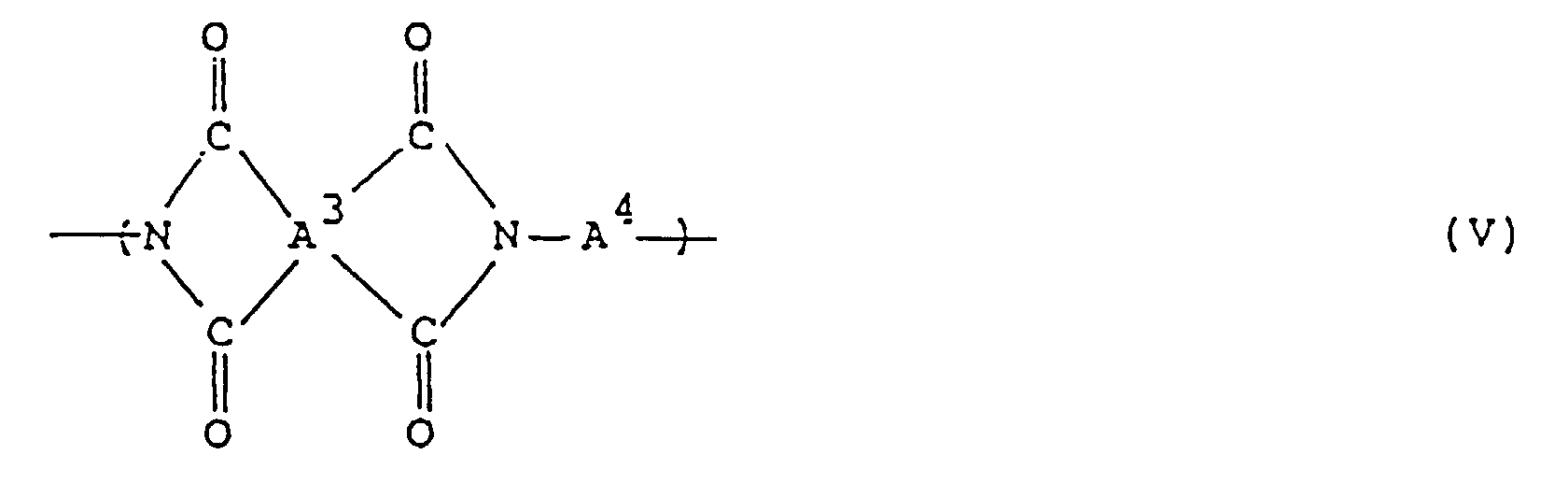 worin A3 eine tetravalente, eine Tetracarbonsäure aufbauende organische Gruppe darstellt, A4 eine divalente, ein Diamin aufbauende organische Gruppe darstellt, B eine divalente organische Gruppe darstellt, R1 bis R5 gleich oder verschieden sein können und jeweils eine Alkyl-Gruppe, eine substituierte AlkylGruppe, eine Phenyl-Gruppe oder eine substituierte Phenyl-Gruppe darstellen, und m eine ganze Zahl von 1 oder mehr darstellt; vorausgesetzt, daß m, A3, A4, B, R1 und R2 wahlweise in jeder Struktureinheit verschieden sein können, und die Kombinationen der Struktureinheiten folgende sind:
 wobei das Polyimid ein gewichtsgemitteltes Molekulargewicht von 10 000 oder mehr hat und eine Siloxan-Gruppe in seiner Seitenkette aufweist.a) eine Einheit der Formeln (V) und (VII), oderb) eine Einheit der Formel (VII),
Applications Claiming Priority (3)
| Application Number | Priority Date | Filing Date | Title |
|---|---|---|---|
| JP80855/90 | 1990-03-30 | ||
| JP2080855A JP2799217B2 (ja) | 1990-03-30 | 1990-03-30 | 含フッ素ジアミノベンゼン誘導体およびポリイミド |
| EP91105006A EP0452725B1 (de) | 1990-03-30 | 1991-03-28 | Fluorhaltige Diaminobenzolderivate und ihre Verwendung |
Related Parent Applications (2)
| Application Number | Title | Priority Date | Filing Date |
|---|---|---|---|
| EP91105006.0 Division | 1991-03-28 | ||
| EP91105006A Division EP0452725B1 (de) | 1990-03-30 | 1991-03-28 | Fluorhaltige Diaminobenzolderivate und ihre Verwendung |
Publications (2)
| Publication Number | Publication Date |
|---|---|
| EP0635533A1 EP0635533A1 (de) | 1995-01-25 |
| EP0635533B1 true EP0635533B1 (de) | 1998-06-10 |
Family
ID=13729960
Family Applications (2)
| Application Number | Title | Priority Date | Filing Date |
|---|---|---|---|
| EP94115788A Expired - Lifetime EP0635533B1 (de) | 1990-03-30 | 1991-03-28 | Polyimid gegründeter Flüssigkristalle aufstellender Wirkstoff |
| EP91105006A Expired - Lifetime EP0452725B1 (de) | 1990-03-30 | 1991-03-28 | Fluorhaltige Diaminobenzolderivate und ihre Verwendung |
Family Applications After (1)
| Application Number | Title | Priority Date | Filing Date |
|---|---|---|---|
| EP91105006A Expired - Lifetime EP0452725B1 (de) | 1990-03-30 | 1991-03-28 | Fluorhaltige Diaminobenzolderivate und ihre Verwendung |
Country Status (4)
| Country | Link |
|---|---|
| US (1) | US5144078A (de) |
| EP (2) | EP0635533B1 (de) |
| JP (1) | JP2799217B2 (de) |
| DE (2) | DE69129596T2 (de) |
Cited By (1)
| Publication number | Priority date | Publication date | Assignee | Title |
|---|---|---|---|---|
| WO2017008330A1 (zh) * | 2015-07-13 | 2017-01-19 | 深圳市华星光电技术有限公司 | 用作取向膜材料的聚合物及取向膜的制备方法 |
Families Citing this family (12)
| Publication number | Priority date | Publication date | Assignee | Title |
|---|---|---|---|---|
| JP2561565B2 (ja) * | 1991-03-22 | 1996-12-11 | 日産化学工業株式会社 | 液晶配向処理剤 |
| JP3097702B2 (ja) * | 1991-08-13 | 2000-10-10 | 日産化学工業株式会社 | 新規な液晶配向処理剤 |
| JP3117103B2 (ja) * | 1992-06-23 | 2000-12-11 | 日産化学工業株式会社 | 新規な垂直配向処理剤 |
| US5473041A (en) * | 1993-05-25 | 1995-12-05 | Dow Corning Corporation | Polyimide having organopolysiloxane side chain |
| TW293832B (en) * | 1995-10-13 | 1996-12-21 | Du Pont | Polyimide alignment film from 2,2-bis(3,4-dicarboxyphenyl)-hexafluoropropane dianhydride and ortho-substituted aromatic diamines for active matrix liquid crystal displays |
| US5731405A (en) * | 1996-03-29 | 1998-03-24 | Alliant Techsystems Inc. | Process and materials for inducing pre-tilt in liquid crystals and liquid crystal displays |
| TW523630B (en) | 1997-05-16 | 2003-03-11 | Hitachi Ltd | Active matrix type liquid crystal display device |
| JP2002162630A (ja) * | 2000-11-29 | 2002-06-07 | Chisso Corp | ジアミン化合物およびこれを用いた高分子材料、該高分子材料を用いた液晶配向膜、および該配向膜を具備した液晶表示素子 |
| EP1810963B1 (de) | 2004-10-20 | 2008-10-15 | Central Glass Company, Limited | Polymerisierbares fluor enthaltendes monomer und polymerverbindung die dieses verwendet |
| JP4900571B2 (ja) * | 2006-03-20 | 2012-03-21 | Jsr株式会社 | 垂直液晶配向剤および垂直液晶表示素子 |
| US8178209B2 (en) * | 2010-03-04 | 2012-05-15 | Xerox Corporation | Fuser member having fluorinated polyimide outer layer |
| WO2016160512A1 (en) * | 2015-03-27 | 2016-10-06 | USA, as represented by the Administrator of the National Aeronautics and Space Administration | Synthesis of copolyimides containing fluorine and silicon surface modifying agents |
Family Cites Families (8)
| Publication number | Priority date | Publication date | Assignee | Title |
|---|---|---|---|---|
| JPS59189122A (ja) * | 1983-04-11 | 1984-10-26 | Hitachi Ltd | 含フッ素ポリアミド酸及びポリイミドの製造方法 |
| EP0206951B1 (de) * | 1985-05-22 | 1990-03-21 | Rhone-Poulenc Chimie | Verfahren zur Perfluoralkylierung von aromatischen Derivaten |
| US4713438A (en) * | 1985-07-23 | 1987-12-15 | Amoco Corporation | Amide and/or imide containing polymers and monomers for the preparation thereof |
| JPS62127827A (ja) * | 1985-11-29 | 1987-06-10 | Hitachi Chem Co Ltd | 液晶配向膜用組成物 |
| EP0279096B1 (de) * | 1987-02-05 | 1993-07-07 | Kureha Kagaku Kogyo Kabushiki Kaisha | Benzylether-Verbindungen und Verfahren zu ihrer Herstellung |
| JPH02176631A (ja) * | 1988-09-28 | 1990-07-09 | Hitachi Chem Co Ltd | 液晶配向膜用組成物,液晶配向膜および液晶表示素子 |
| US5075392A (en) * | 1989-03-23 | 1991-12-24 | The Dow Chemical Company | Thermoplastic compositions containing polybenzoxazole, polybenzothiazole and polybenzimidazole moieties |
| DE69021258T2 (de) * | 1989-05-11 | 1996-02-08 | Canon Kk | Chiralsmektische Flüssigkristallvorrichtung. |
-
1990
- 1990-03-30 JP JP2080855A patent/JP2799217B2/ja not_active Expired - Fee Related
-
1991
- 1991-03-28 EP EP94115788A patent/EP0635533B1/de not_active Expired - Lifetime
- 1991-03-28 DE DE69129596T patent/DE69129596T2/de not_active Expired - Lifetime
- 1991-03-28 US US07/676,555 patent/US5144078A/en not_active Expired - Lifetime
- 1991-03-28 DE DE69114342T patent/DE69114342T2/de not_active Expired - Lifetime
- 1991-03-28 EP EP91105006A patent/EP0452725B1/de not_active Expired - Lifetime
Cited By (1)
| Publication number | Priority date | Publication date | Assignee | Title |
|---|---|---|---|---|
| WO2017008330A1 (zh) * | 2015-07-13 | 2017-01-19 | 深圳市华星光电技术有限公司 | 用作取向膜材料的聚合物及取向膜的制备方法 |
Also Published As
| Publication number | Publication date |
|---|---|
| EP0452725A3 (en) | 1992-10-28 |
| US5144078A (en) | 1992-09-01 |
| DE69129596T2 (de) | 1998-12-10 |
| DE69114342D1 (de) | 1995-12-14 |
| JPH03281631A (ja) | 1991-12-12 |
| JP2799217B2 (ja) | 1998-09-17 |
| EP0635533A1 (de) | 1995-01-25 |
| EP0452725A2 (de) | 1991-10-23 |
| DE69129596D1 (de) | 1998-07-16 |
| DE69114342T2 (de) | 1996-03-28 |
| EP0452725B1 (de) | 1995-11-08 |
Similar Documents
| Publication | Publication Date | Title |
|---|---|---|
| CN105916910B (zh) | 聚酰亚胺前体和含有其的树脂组合物 | |
| JP3257325B2 (ja) | ポリイミド系共重合体の製造方法、薄膜形成剤、並びに液晶配向膜の製造方法 | |
| EP0635533B1 (de) | Polyimid gegründeter Flüssigkristalle aufstellender Wirkstoff | |
| JPH0743726A (ja) | 液晶表示素子 | |
| CN112334511A (zh) | 聚酰亚胺树脂及其制造方法、以及聚酰亚胺薄膜及其制造方法 | |
| CN1318479C (zh) | 新颖的二氨基苯衍生物、使用了该衍生物的聚酰亚胺前体和聚酰亚胺及液晶定向处理剂 | |
| EP3176219B1 (de) | Transparente polymerfolie und elektronische vorrichtungen damit | |
| CN112194790B (zh) | 一种低热膨胀透明聚酰亚胺薄膜及其制备方法 | |
| JPH06136122A (ja) | ジアミノベンゼン誘導体及びポリイミド及び液晶配向膜 | |
| KR880000852B1 (ko) | 가용성 폴리이미드실록산 전구체의 제조방법 | |
| CN101389596B (zh) | 垂直取向模式的液晶显示装置的取向材料及其制备方法 | |
| US5670084A (en) | Alignment layer material for liquid crystal display devices | |
| US5153304A (en) | Fluorine containing diaminobenzene derivatives and its use | |
| CN103748068B (zh) | 二胺化合物及其制备方法、液晶配向剂、液晶配向膜、液晶显示元件 | |
| CN106458847A (zh) | 新型二胺合成及利用其的液晶取向剂 | |
| TW202235494A (zh) | 包括改良聚合程度的聚合物樹脂之光學膜以及包括其之顯示裝置 | |
| JP3780534B2 (ja) | ポリイミドワニス | |
| JP4236338B2 (ja) | シルフェニレン残基を有するジアミン化合物及びそれを用いたポリアミド、ポリアミド酸、ポリイミド、液晶配向処理剤並びに液晶表示素子 | |
| JP2561565B2 (ja) | 液晶配向処理剤 | |
| KR20160007427A (ko) | 투명 폴리머 필름 및 이를 포함하는 전자 소자 | |
| JPS583214B2 (ja) | 液晶挾持基板 | |
| JP5170487B2 (ja) | ポリアミド酸エステルおよびポリイミドの製造方法 | |
| EP0708149A1 (de) | Ausrichtungsschichtmaterial rür Flüssigkristallanzeigevorrichtungen | |
| JP2001228483A (ja) | ポリイミド系共重合体による液晶配向膜形成剤、液晶配向膜およびその製造方法 | |
| JP2603388B2 (ja) | 液晶配向膜 |
Legal Events
| Date | Code | Title | Description |
|---|---|---|---|
| PUAI | Public reference made under article 153(3) epc to a published international application that has entered the european phase |
Free format text: ORIGINAL CODE: 0009012 |
|
| AC | Divisional application: reference to earlier application |
Ref document number: 452725 Country of ref document: EP |
|
| AK | Designated contracting states |
Kind code of ref document: A1 Designated state(s): DE FR GB NL |
|
| RIN1 | Information on inventor provided before grant (corrected) |
Inventor name: ABE, TOYOHIKO, C/O NISSAN CHEM. IND., LTD. Inventor name: FUKURO, HIROYOSHI, C/O NISSAN CHEM. IND., LTD. Inventor name: KOHTOH, NORIAKI, C/O NISSAN CHEM. IND., LTD. Inventor name: TAKAMURA, YURIKO Inventor name: NAGASE, YU |
|
| 17P | Request for examination filed |
Effective date: 19950420 |
|
| 17Q | First examination report despatched |
Effective date: 19960813 |
|
| GRAG | Despatch of communication of intention to grant |
Free format text: ORIGINAL CODE: EPIDOS AGRA |
|
| GRAG | Despatch of communication of intention to grant |
Free format text: ORIGINAL CODE: EPIDOS AGRA |
|
| GRAG | Despatch of communication of intention to grant |
Free format text: ORIGINAL CODE: EPIDOS AGRA |
|
| GRAH | Despatch of communication of intention to grant a patent |
Free format text: ORIGINAL CODE: EPIDOS IGRA |
|
| GRAH | Despatch of communication of intention to grant a patent |
Free format text: ORIGINAL CODE: EPIDOS IGRA |
|
| GRAA | (expected) grant |
Free format text: ORIGINAL CODE: 0009210 |
|
| AC | Divisional application: reference to earlier application |
Ref document number: 452725 Country of ref document: EP |
|
| AK | Designated contracting states |
Kind code of ref document: B1 Designated state(s): DE FR GB NL |
|
| REF | Corresponds to: |
Ref document number: 69129596 Country of ref document: DE Date of ref document: 19980716 |
|
| ET | Fr: translation filed | ||
| PLBE | No opposition filed within time limit |
Free format text: ORIGINAL CODE: 0009261 |
|
| STAA | Information on the status of an ep patent application or granted ep patent |
Free format text: STATUS: NO OPPOSITION FILED WITHIN TIME LIMIT |
|
| 26N | No opposition filed | ||
| REG | Reference to a national code |
Ref country code: GB Ref legal event code: IF02 |
|
| PGFP | Annual fee paid to national office [announced via postgrant information from national office to epo] |
Ref country code: FR Payment date: 20100324 Year of fee payment: 20 |
|
| PGFP | Annual fee paid to national office [announced via postgrant information from national office to epo] |
Ref country code: GB Payment date: 20100322 Year of fee payment: 20 |
|
| PGFP | Annual fee paid to national office [announced via postgrant information from national office to epo] |
Ref country code: NL Payment date: 20100316 Year of fee payment: 20 Ref country code: DE Payment date: 20100429 Year of fee payment: 20 |
|
| REG | Reference to a national code |
Ref country code: DE Ref legal event code: R071 Ref document number: 69129596 Country of ref document: DE |
|
| REG | Reference to a national code |
Ref country code: NL Ref legal event code: V4 Effective date: 20110328 |
|
| REG | Reference to a national code |
Ref country code: GB Ref legal event code: PE20 Expiry date: 20110327 |
|
| PG25 | Lapsed in a contracting state [announced via postgrant information from national office to epo] |
Ref country code: NL Free format text: LAPSE BECAUSE OF EXPIRATION OF PROTECTION Effective date: 20110328 |
|
| PG25 | Lapsed in a contracting state [announced via postgrant information from national office to epo] |
Ref country code: GB Free format text: LAPSE BECAUSE OF EXPIRATION OF PROTECTION Effective date: 20110327 |
|
| PG25 | Lapsed in a contracting state [announced via postgrant information from national office to epo] |
Ref country code: DE Free format text: LAPSE BECAUSE OF EXPIRATION OF PROTECTION Effective date: 20110328 |