EP0639024A1 - Gerät und Verfahren zur Reproduktionsbildrasterung - Google Patents
Gerät und Verfahren zur Reproduktionsbildrasterung Download PDFInfo
- Publication number
- EP0639024A1 EP0639024A1 EP94305479A EP94305479A EP0639024A1 EP 0639024 A1 EP0639024 A1 EP 0639024A1 EP 94305479 A EP94305479 A EP 94305479A EP 94305479 A EP94305479 A EP 94305479A EP 0639024 A1 EP0639024 A1 EP 0639024A1
- Authority
- EP
- European Patent Office
- Prior art keywords
- original
- screen function
- density values
- image
- input density
- Prior art date
- Legal status (The legal status is an assumption and is not a legal conclusion. Google has not performed a legal analysis and makes no representation as to the accuracy of the status listed.)
- Granted
Links
- 238000000034 method Methods 0.000 title claims abstract description 20
- 238000012216 screening Methods 0.000 title description 4
- 230000001788 irregular Effects 0.000 claims abstract description 82
- 238000000926 separation method Methods 0.000 claims abstract description 31
- 230000006870 function Effects 0.000 description 78
- 239000011159 matrix material Substances 0.000 description 9
- 230000000007 visual effect Effects 0.000 description 9
- 230000015654 memory Effects 0.000 description 8
- 230000000737 periodic effect Effects 0.000 description 3
- 238000010586 diagram Methods 0.000 description 2
- 238000010276 construction Methods 0.000 description 1
- 230000000694 effects Effects 0.000 description 1
- 230000002452 interceptive effect Effects 0.000 description 1
- 238000012986 modification Methods 0.000 description 1
- 230000004048 modification Effects 0.000 description 1
Images




Classifications
-
- H—ELECTRICITY
- H04—ELECTRIC COMMUNICATION TECHNIQUE
- H04N—PICTORIAL COMMUNICATION, e.g. TELEVISION
- H04N1/00—Scanning, transmission or reproduction of documents or the like, e.g. facsimile transmission; Details thereof
- H04N1/40—Picture signal circuits
- H04N1/405—Halftoning, i.e. converting the picture signal of a continuous-tone original into a corresponding signal showing only two levels
- H04N1/4055—Halftoning, i.e. converting the picture signal of a continuous-tone original into a corresponding signal showing only two levels producing a clustered dots or a size modulated halftone pattern
- H04N1/4056—Halftoning, i.e. converting the picture signal of a continuous-tone original into a corresponding signal showing only two levels producing a clustered dots or a size modulated halftone pattern the pattern varying in one dimension only, e.g. dash length, pulse width modulation [PWM]
Definitions
- the present invention relates to screened image reproduction and more particularly to a method and apparatus for electronically generating a screened reproduction of an image.
- U.S. Patent 4,149,183 describes an electronic halftone generator wherein a halftone signal is generated by pulse width modulating or comparing the scanned or video signal with a periodic analog signal having two frequencies and phases to create a dot pattern output which is a function of the frequency and phase of the two combined modulating signals.
- the halftone reproduction generated has variable dot configurations that are controllable to enable both rotation of the dot pattern and geometric modifications of the dot pattern.
- U.S. Patent 5,079,721 of the present assignee/applicant describes apparatus and a technique for generating a screened reproduction of an image comprising the steps of providing a representation of an original having input density values representing the grey levels of various locations of the original for a given color separation, defining a desired screen dot arrangement for the image, writing screen dots in a line by line fashion, wherein each screen dot is made up of a plurality of lines whose length and location determines the dot configuration and whose length and location is determined by an analog operation employing the input density values of the original and the desired screen dot arrangement.
- U.S. Patent 4,040,094 describes a method and apparatus for electronic screening of a graphic image to be reproduced by printing.
- the density of the graphic image is determined repetitively during the digital generation of each dot which will form a part of the half-tone image when produced, and the dot is modified according to changes in the density.
- the structure of any halftone dot may be modified during its construction.
- the present invention seeks to provide an improved technique for generating a screened reproduction of an image.
- a method for generating a screened reproduction of an image including the steps of: providing a representation of an original having input density values representing the grey levels of various locations of the original for a given color separation; defining a desired irregular screen function for the image; and writing screen segments in a line by line fashion, wherein each screen segment is a line whose length and location is determined by employing the input density values of the original and the desired irregular screen function.
- the step of writing screen segments includes the following steps: storing the input density values of the original at a first spatial resolution; and storing the threshold values of the desired irregular screen function at a second spatial resolution different from the first resolution.
- the step of writing screen segments includes the following steps: prior to plotting, defining the irregular screen function; and thereafter comparing the input density values along the line with the irregular screen function to determine the length and location of each segment produced by the plotter.
- the step of writing screen segments includes determining the length and location of each screen segment in an analog operation by employing the input density values of the original and the desired irregular screen function.
- the analog operation includes an analog comparison of the input density values with threshold values defined by the desired irregular screen function.
- apparatus for generating a screened reproduction of an image including: apparatus for providing a representation of an original having input density values representing the grey levels of various locations of the original for a given color separation; apparatus for defining a desired irregular screen function for the image; and apparatus for writing screen segments in a line by line fashion, wherein each screen segment is a line whose length and location is determined employing the input density values of the original and the desired irregular screen function.
- each segment has generally unlimited resolution along its length.
- the apparatus for writing screen segments includes: apparatus for storing the input density values of the original at a first spatial resolution; and apparatus for storing the threshold values of the desired irregular screen function at a second spatial resolution different from the first resolution.
- the second spatial resolution corresponds to the line to line spatial resolution of a plotter used for writing the screen segments.
- the apparatus for writing screen segments includes: apparatus operative, prior to plotting, for defining the irregular screen function; and apparatus for comparing the input density values along the line with the irregular screen function to determine the length and location of each segment produced by the plotter.
- the irregular screen function is a function which is repeated along each line and from line to line.
- the irregular screen function is a one-dimensional function.
- the apparatus for writing screen segments is operative to determine the length and location of each screen segment in an analog operation by employing the input density values of the original and the desired irregular screen function.
- the analog operation includes an analog comparison of the input density values with threshold values defined by the desired irregular screen function.
- a method for halftone reproduction of an image including the steps of: providing a representation of an original having input density values at various locations of the original; defining a desired irregular screen function for the image, the irregular screen function having a minimum spatial frequency which is higher than that normally visible by the human eye; and providing output data to a plotter based on manipulation of the input density values on the basis of the irregular screen function.
- a method for halftone reproduction of an image including the steps of: providing a representation of an original having input density values at various locations of the original; defining a desired irregular screen function for the image, the irregular screen function having a spatial repeatability sufficiently small so that it is not normally visible by the human eye; and providing output data to a plotter based on manipulation of the input density values on the basis of the irregular screen function.
- apparatus for halftone reproduction of an image including: apparatus for providing a representation of an original having input density values at various locations of the original; apparatus for defining a desired irregular screen function for the image, the irregular screen function having a minimum spatial frequency which is higher than that normally visible by the human eye; and apparatus for providing output data to a plotter based on manipulation of the input density values on the basis of the irregular screen function.
- apparatus for halftone reproduction of an image including: apparatus for providing a representation of an original having input density values at various locations of the original; apparatus for defining a desired irregular screen function for the image, the irregular screen function having a spatial repeatability sufficiently small so that it is not normally visible by the human eye; and apparatus for providing output data to a plotter based on manipulation of the input density values on the basis of the irregular screen function.
- the irregular screen function has a plurality of maxima and minima and wherein the screen function displays irregularity in at least one of the spatial separation of the minima and maxima and in the values of the minima and maxima.
- the irregular screen function has a minimum spatial frequency of 6 minimum-maximum pairs per millimeter.
- Fig. 1 illustrates a system for generating a screened reproduction of an image constructed and operative in accordance with a preferred embodiment of the present invention.
- the system preferably comprises a color separation scanner 10, such as a Scitex Smart Scanner, manufactured and sold by Scitex Corporation Ltd. of Herzlia, Israel, which is adapted to provide a digital color separation output of a color original.
- a color separation scanner 10 such as a Scitex Smart Scanner, manufactured and sold by Scitex Corporation Ltd. of Herzlia, Israel, which is adapted to provide a digital color separation output of a color original.
- the digital output of scanner 10 is normally stored on a image data disc 12 or any other suitable storage medium, which is accessible by a CPU 14, such as an Intel 80386.
- a CPU 14 such as an Intel 80386.
- Interfacing with the CPU 14 is an interactive workstation 16, such as a Scitex Prisma, manufactured and sold by Scitex Corporation Ltd. of Herzlia, Israel.
- CPU 14 interfaces with screen dot generation circuitry 18, which in turn provides a control output to laser beam control circuitry 24 in a laser plotter 26, such as a Raystar, manufactured and sold by Scitex Corporation Ltd. of Herzlia, Israel.
- Laser plotter 26 produces halftone film color separations 28 which are employed in a conventional process color printing press 30, to produce process color prints.
- the halftone color separation in general is hereinafter termed the input image and is divided into a first multiplicity of pixels 34 which are arranged along coordinate axes I x and I y .
- Pixels 34 typically have a resolution of 100 - 400 pixels per inch along each of the coordinate axes of the input image.
- Each average gray level for a pixel 34 is represented digitally in Fig. 2 by an input density level. There are typically provided 256 different input density levels, 0 being the lightest and 255 being the blackest.
- an irregular screen function is employed for screening the image.
- This irregular screen function avoids undesired visual effects which sometimes occur when regular screen functions are employed, as in the prior art.
- Such undesired visual effects include periodic artifacts on a single screen color separation as well as periodic artifacts which arise when multiple screens are superimposed upon each other.
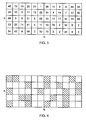
- Fig. 3 illustrates, in matrix form, part of one such typical irregular screen function.
- the irregular screen function is characterized in that it covers a relatively large area but nevertheless maintains for each of a multiplicity of relatively small multi-pixel sub-areas, desired screen density percentages.
- the irregular screen function avoids the presence of visual effects having a spatial frequency below a defined minimum. Normally this defined minimum constitutes the limit below which the human eye can discern such visual effects.
- the indicia K and N are the typical dimensions of a stored function matrix. In practice K and N will each have values equal to at least one thousand pixels. It is appreciated that this stored function matrix can be repeated any desired number of times to cover an entire image.
- Fig. 4 illustrates part of a screened color separation produced using the irregular screen function of Fig. 3.
- a uniform input density corresponding to halftone coverage of about 30% is employed. It may be appreciated from a consideration of Fig. 4, that generally for most groups of 16 adjacent pixels, a generally uniform halftone coverage is realized. This characteristic maintains the minimum spatial frequency of the black portions of the screened color separation.
- Fig. 5 illustrates, in an exaggerated form, part of another irregular screen function.
- the black pixels are grouped together for reasons of enhanced printability. This grouping also has the effect of reducing the minimum spatial frequency of the screen color separation.
- the irregular screen function is characterized in that it covers a relatively large area but nevertheless maintains for each of a multiplicity of relatively small multi-pixel sub-areas, desired screen density percentages.
- the multi-pixel sub-areas for which this is true are larger than in the example shown in Figs. 3 and 4.
- Fig. 6 illustrates part of a screened color separation produced using the irregular screen function of Fig. 5.
- a uniform input density corresponding to halftone coverage of about 30% is employed.
- Fig. 7 illustrates, in matrix form, part of a typical one-dimensional irregular screen function.
- the irregular screen function is also characterized in that it covers a relatively large elongate area but nevertheless maintains for each of a multiplicity of elongate relatively small multi-pixel sub-areas, desired screen density percentages.
- the irregular screen function avoids the presence of visual effects having a spatial frequency below a defined minimum. Normally this defined minimum constitutes the limit below which the human eye can discern such visual effects.
- the length of the function of Fig. 7 is preferably equal to at least one thousand pixels. It is appreciated that this stored function matrix can be repeated any desired number of times to cover an entire image.
- Fig. 8 illustrates part of a screened color separation produced using the one-dimensional irregular screen function of Fig. 7.
- a uniform input density corresponding to halftone coverage of about 30% is employed. It may be appreciated that generally for most lines of about 30 adjacent pixels, a generally uniform halftone coverage is realized. This characteristic maintains the minimum spatial frequency of the black portions of the screened color separation.
- Fig. 9 is an illustration of part of a screened color separation produced using one dimensional irregular screen functions of the type illustrated in Fig. 7.
- Fig. 9 is an illustration of part of a screened color separation produced using one dimensional irregular screen functions of the type illustrated in Fig. 7.
- the first two rows are produced by the same function employed in Fig. 8, with an offset shift.
- the remaining rows are produced by other one-dimensional irregular functions.
- the screened color separation of Fig. 9 may be constructed by using a single function with suitable different offset shifts from line to line or alternatively using different functions, or, a combination of both. In order to avoid visual effects from line to line, when multiple functions are employed, they may be determined in a way so as to avoid such undesired visual effects.
- Fig. 10 is another illustration of part of a screened color separation produced using one dimensional irregular screen functions of the type illustrated in Fig. 7.
- a larger area of the screened color separation is shown so as to illustrate the irregular appearance of the screened separation. It is appreciated that when sufficiently small areas are considered, the desired halftone screen density is generally maintained.
- Fig. 11 is an illustration of the thresholding of an analog one-dimensional irregular screen function 50 against input density values 52 of an original in accordance with yet another embodiment of the present invention and the resulting screen segments 53 produced thereby.
- the screen function 50 has a plurality of minima and maxima which are separated from each other by varying distances D1 - D14.
- the amplitudes of the minima and maxima may also vary as can be seen from a consideration of values A1 - A15.
- the variation in the values D1 - D14 and A1 - A15 is irregular and, in accordance with a preferred embodiment of the invention, is limited to predetermined desired ranges. These ranges ensure that visual effects are not normally sensible by the human eye.
- Comparison of the screen function 50 with an input density function 52 produces screen segments 53, which represent laser plotter on and off locations along a line.
- Fig. 12 it will be understood that digital values representing the screen function 50 are supplied to a screen memory 60, and the input density values of pixels 34 are supplied to a picture memory 62.
- Screen memory 60 and picture memory 62 are typically controlled by a read/write and timing control unit 61.
- memories 60 and 62 are supplied via respective digital to analog converters 64 and 66 to respective low pass filters 68 and 70. It is noted that under certain circumstances, low pass filter 70 may be omitted.
- low pass filter 68 is adapted to extrapolate and interpolate the values stored in memory 60 so as to provide an accurate reproduction of the irregular screen function.
- the inclusion of low pass filter 70 depends on the quality of the input image.
- the outputs of low pass filters 68 and 70 are supplied to a comparator 72, which provides an output indication to expose control circuitry 24, indicating when the laser plotter 26 is to write. It is noted that there may also be provided various additional control functions, such as intensity control, to enhance the operation of the laser plotter 26.
- the apparatus of Fig. 12 may be embodied in a full digital implementation, without requiring D-A converters and low pass filters.
Landscapes
- Engineering & Computer Science (AREA)
- Multimedia (AREA)
- Signal Processing (AREA)
- Facsimile Image Signal Circuits (AREA)
- Image Processing (AREA)
- Dot-Matrix Printers And Others (AREA)
- Color Image Communication Systems (AREA)
- Controls And Circuits For Display Device (AREA)
Applications Claiming Priority (2)
| Application Number | Priority Date | Filing Date | Title |
|---|---|---|---|
| IL10651493 | 1993-07-28 | ||
| IL10651493A IL106514A (en) | 1993-07-28 | 1993-07-28 | Apparatus and method for screening images for reproduction |
Publications (2)
| Publication Number | Publication Date |
|---|---|
| EP0639024A1 true EP0639024A1 (de) | 1995-02-15 |
| EP0639024B1 EP0639024B1 (de) | 1999-04-14 |
Family
ID=11065090
Family Applications (1)
| Application Number | Title | Priority Date | Filing Date |
|---|---|---|---|
| EP94305479A Expired - Lifetime EP0639024B1 (de) | 1993-07-28 | 1994-07-25 | Gerät und Verfahren zur Reproduktionsbildrasterung |
Country Status (6)
| Country | Link |
|---|---|
| US (1) | US5508828A (de) |
| EP (1) | EP0639024B1 (de) |
| JP (1) | JPH07123263A (de) |
| CA (1) | CA2129090C (de) |
| DE (1) | DE69417818T2 (de) |
| IL (1) | IL106514A (de) |
Cited By (1)
| Publication number | Priority date | Publication date | Assignee | Title |
|---|---|---|---|---|
| EP0667705A1 (de) * | 1994-02-14 | 1995-08-16 | Scitex Corporation Ltd. | Verfahren und Gerät zur Erzeugung einer halbtongerasterten Reproduktion eines Bildes |
Families Citing this family (2)
| Publication number | Priority date | Publication date | Assignee | Title |
|---|---|---|---|---|
| IL116123A (en) | 1995-11-23 | 1999-07-14 | Scitex Corp Ltd | System and method for printing |
| US5838462A (en) * | 1996-04-01 | 1998-11-17 | Xerox Corporation | Hybrid imaging system |
Citations (3)
| Publication number | Priority date | Publication date | Assignee | Title |
|---|---|---|---|---|
| EP0141869A1 (de) * | 1983-11-14 | 1985-05-22 | DR.-ING. RUDOLF HELL GmbH | Verfahren und Einrichtung zur Herstellung gerasterter Druckformen |
| US5111310A (en) * | 1990-12-04 | 1992-05-05 | Research Technologies Corporation, Inc. | Method and apparatus for halftone rendering of a gray scale image using a blue noise mask |
| EP0540221A1 (de) * | 1991-11-01 | 1993-05-05 | Konica Corporation | Abbildungsgerät |
Family Cites Families (19)
| Publication number | Priority date | Publication date | Assignee | Title |
|---|---|---|---|---|
| US4040094A (en) * | 1973-02-13 | 1977-08-02 | International Publishing Corporation Ltd. | Electronic screening |
| US4149183A (en) * | 1976-05-21 | 1979-04-10 | Xerox Corporation | Electronic halftone generator |
| DE2931098C2 (de) * | 1979-07-31 | 1983-01-05 | Dr.-Ing. Rudolf Hell Gmbh, 2300 Kiel | Verfahren zur Druckformherstellung |
| US4350996A (en) * | 1980-04-14 | 1982-09-21 | Scitex Corporation Ltd. | Screened image reproduction |
| US4456924A (en) * | 1980-04-14 | 1984-06-26 | Scitex Corporation Ltd. | Screened image reproduction |
| US4499489A (en) * | 1981-06-08 | 1985-02-12 | Dr. Ing. Rudolf Hell Gmbh | Production of screen printing blocks |
| JPH0657049B2 (ja) * | 1984-12-07 | 1994-07-27 | 大日本スクリ−ン製造株式会社 | 網点形成方法 |
| GB8613223D0 (en) * | 1986-05-30 | 1986-07-02 | Crosfield Electronics Ltd | Half-tone reproduction |
| US5121197A (en) * | 1989-02-23 | 1992-06-09 | Minolta Camera Kabushiki Kaisha | Method for processing half tone images to improve efficiency of data compression |
| US5187594A (en) * | 1990-02-09 | 1993-02-16 | Graphic Edge, Inc. | Method of creating and applying half tone screen patterns |
| US5079721A (en) * | 1990-05-18 | 1992-01-07 | Scitex Corporation Ltd. | Apparatus for generating a screened reproduction of an image |
| US5150225A (en) * | 1990-05-18 | 1992-09-22 | Scitex Corporation Ltd. | Apparatus for generating a screened reproduction of an image |
| US5227895A (en) * | 1990-08-03 | 1993-07-13 | Scitex Corporation Ltd. | Method and apparatus for image reproduction |
| US5258832A (en) * | 1990-09-14 | 1993-11-02 | Minnesota Mining And Manufacturing Company | Non-perpendicular, unequal frequency non-conventional screen patterns for electronic halftone generation |
| US5264926A (en) * | 1990-09-14 | 1993-11-23 | Minnesota Mining And Manufacturing Company | Perpendicular, equal frequency non-conventional screen patterns for electronic halftone generation |
| US5124803A (en) * | 1991-02-25 | 1992-06-23 | Ecrm | Method and apparatus for generating digital, angled halftone screens using pixel candidate lists and screen angle correction to prevent moire patterns |
| US5202772A (en) * | 1991-02-28 | 1993-04-13 | Volt Information Sciences, Inc. | Color halftone screen utilizing preselected halftone dots placed at preselected distance and screen angles from center halftone dots |
| US5299020A (en) * | 1991-03-08 | 1994-03-29 | Scitex Corporation Ltd. | Method and apparatus for generating a screened reproduction of an image using stored dot portions |
| US5315406A (en) * | 1991-09-03 | 1994-05-24 | Levien Raphael L | Screen generation for halftone screening of images using arbitrary distribution of transformed screen coordinates |
-
1993
- 1993-07-28 IL IL10651493A patent/IL106514A/xx not_active IP Right Cessation
- 1993-11-30 US US08/159,741 patent/US5508828A/en not_active Expired - Lifetime
-
1994
- 1994-07-25 DE DE69417818T patent/DE69417818T2/de not_active Expired - Lifetime
- 1994-07-25 EP EP94305479A patent/EP0639024B1/de not_active Expired - Lifetime
- 1994-07-28 CA CA002129090A patent/CA2129090C/en not_active Expired - Fee Related
- 1994-07-28 JP JP6177026A patent/JPH07123263A/ja active Pending
Patent Citations (3)
| Publication number | Priority date | Publication date | Assignee | Title |
|---|---|---|---|---|
| EP0141869A1 (de) * | 1983-11-14 | 1985-05-22 | DR.-ING. RUDOLF HELL GmbH | Verfahren und Einrichtung zur Herstellung gerasterter Druckformen |
| US5111310A (en) * | 1990-12-04 | 1992-05-05 | Research Technologies Corporation, Inc. | Method and apparatus for halftone rendering of a gray scale image using a blue noise mask |
| EP0540221A1 (de) * | 1991-11-01 | 1993-05-05 | Konica Corporation | Abbildungsgerät |
Non-Patent Citations (1)
| Title |
|---|
| J. P. ALLEBACH: "Random Nucleated Halftone Screen", PHOTOGRAPHIC SCIENCE AND ENGINEERING, vol. 22, no. 2, March 1978 (1978-03-01), WASHINGTON (US), pages 89 - 91, XP001392204 * |
Cited By (1)
| Publication number | Priority date | Publication date | Assignee | Title |
|---|---|---|---|---|
| EP0667705A1 (de) * | 1994-02-14 | 1995-08-16 | Scitex Corporation Ltd. | Verfahren und Gerät zur Erzeugung einer halbtongerasterten Reproduktion eines Bildes |
Also Published As
| Publication number | Publication date |
|---|---|
| CA2129090C (en) | 2004-12-14 |
| DE69417818D1 (de) | 1999-05-20 |
| EP0639024B1 (de) | 1999-04-14 |
| IL106514A0 (en) | 1993-11-15 |
| US5508828A (en) | 1996-04-16 |
| CA2129090A1 (en) | 1995-01-29 |
| JPH07123263A (ja) | 1995-05-12 |
| IL106514A (en) | 1997-08-14 |
| DE69417818T2 (de) | 1999-09-09 |
Similar Documents
| Publication | Publication Date | Title |
|---|---|---|
| US5742703A (en) | Method and apparatus for the resolution enhancement of gray-scale images that include text and line art | |
| US5249242A (en) | Method for enhancing raster pixel data | |
| US4414581A (en) | Image signal processing method and apparatus therefor | |
| WO1996031048A1 (en) | Spread spectrum digital screening | |
| JPH07184071A (ja) | 超高感度印刷システム | |
| EP0796002B1 (de) | Verfahren zum Verbessern der Druckqualität von Druckern mit wenigstens einer höheren Auflösung in einer Richtung | |
| US5721625A (en) | Method and apparatus for generating halftone image considering spatial frequencies of original image | |
| EP0366427B1 (de) | Bildverarbeitung | |
| EP0493935B1 (de) | Digitales elektronisches System zum Drucken gerasteter Halbtöne | |
| JPH0683356B2 (ja) | 画像情報記録装置 | |
| US5083210A (en) | Elimination of contouring on displayed gray level images | |
| US5150225A (en) | Apparatus for generating a screened reproduction of an image | |
| US5079721A (en) | Apparatus for generating a screened reproduction of an image | |
| JPH07123262A (ja) | イメージのスクリーン再生を生じる方法および装置 | |
| CA2129090C (en) | Apparatus and method for screening images for reproduction | |
| US5227895A (en) | Method and apparatus for image reproduction | |
| US5299020A (en) | Method and apparatus for generating a screened reproduction of an image using stored dot portions | |
| US5519792A (en) | Method and apparatus for generating a screened reproduction of an image by digital interpolation | |
| EP0588566B1 (de) | Gerät und Verfahren zur Erzeugung einer gerasterten Reproduktion eines Bildes | |
| EP0667705A1 (de) | Verfahren und Gerät zur Erzeugung einer halbtongerasterten Reproduktion eines Bildes | |
| US5600448A (en) | Apparatus and method for generating a screened reproduction of an image | |
| HK1005200B (en) | Apparatus for generating a screened reproduction of an image | |
| US5691823A (en) | Apparatus and method for random screening |
Legal Events
| Date | Code | Title | Description |
|---|---|---|---|
| PUAI | Public reference made under article 153(3) epc to a published international application that has entered the european phase |
Free format text: ORIGINAL CODE: 0009012 |
|
| AK | Designated contracting states |
Kind code of ref document: A1 Designated state(s): DE FR GB IT |
|
| 17P | Request for examination filed |
Effective date: 19950406 |
|
| 17Q | First examination report despatched |
Effective date: 19961125 |
|
| GRAG | Despatch of communication of intention to grant |
Free format text: ORIGINAL CODE: EPIDOS AGRA |
|
| GRAG | Despatch of communication of intention to grant |
Free format text: ORIGINAL CODE: EPIDOS AGRA |
|
| GRAH | Despatch of communication of intention to grant a patent |
Free format text: ORIGINAL CODE: EPIDOS IGRA |
|
| GRAH | Despatch of communication of intention to grant a patent |
Free format text: ORIGINAL CODE: EPIDOS IGRA |
|
| GRAH | Despatch of communication of intention to grant a patent |
Free format text: ORIGINAL CODE: EPIDOS IGRA |
|
| GRAA | (expected) grant |
Free format text: ORIGINAL CODE: 0009210 |
|
| AK | Designated contracting states |
Kind code of ref document: B1 Designated state(s): DE FR GB IT |
|
| PG25 | Lapsed in a contracting state [announced via postgrant information from national office to epo] |
Ref country code: IT Free format text: LAPSE BECAUSE OF FAILURE TO SUBMIT A TRANSLATION OF THE DESCRIPTION OR TO PAY THE FEE WITHIN THE PRE;WARNING: LAPSES OF ITALIAN PATENTS WITH EFFECTIVE DATE BEFORE 2007 MAY HAVE OCCURRED AT ANY TIME BEFORE 2007. THE CORRECT EFFECTIVE DATE MAY BE DIFFERENT FROM THE ONE RECORDED.SCRIBED TIME-LIMIT Effective date: 19990414 |
|
| REF | Corresponds to: |
Ref document number: 69417818 Country of ref document: DE Date of ref document: 19990520 |
|
| ET | Fr: translation filed | ||
| PLBE | No opposition filed within time limit |
Free format text: ORIGINAL CODE: 0009261 |
|
| STAA | Information on the status of an ep patent application or granted ep patent |
Free format text: STATUS: NO OPPOSITION FILED WITHIN TIME LIMIT |
|
| 26N | No opposition filed | ||
| REG | Reference to a national code |
Ref country code: GB Ref legal event code: 732E |
|
| REG | Reference to a national code |
Ref country code: GB Ref legal event code: IF02 |
|
| REG | Reference to a national code |
Ref country code: FR Ref legal event code: TP |
|
| PGFP | Annual fee paid to national office [announced via postgrant information from national office to epo] |
Ref country code: GB Payment date: 20030704 Year of fee payment: 10 |
|
| PGFP | Annual fee paid to national office [announced via postgrant information from national office to epo] |
Ref country code: FR Payment date: 20030711 Year of fee payment: 10 |
|
| PG25 | Lapsed in a contracting state [announced via postgrant information from national office to epo] |
Ref country code: GB Free format text: LAPSE BECAUSE OF NON-PAYMENT OF DUE FEES Effective date: 20040725 |
|
| GBPC | Gb: european patent ceased through non-payment of renewal fee |
Effective date: 20040725 |
|
| PG25 | Lapsed in a contracting state [announced via postgrant information from national office to epo] |
Ref country code: FR Free format text: LAPSE BECAUSE OF NON-PAYMENT OF DUE FEES Effective date: 20050331 |
|
| REG | Reference to a national code |
Ref country code: FR Ref legal event code: ST |
|
| PGFP | Annual fee paid to national office [announced via postgrant information from national office to epo] |
Ref country code: DE Payment date: 20120731 Year of fee payment: 19 |
|
| REG | Reference to a national code |
Ref country code: DE Ref legal event code: R119 Ref document number: 69417818 Country of ref document: DE Effective date: 20140201 |
|
| PG25 | Lapsed in a contracting state [announced via postgrant information from national office to epo] |
Ref country code: DE Free format text: LAPSE BECAUSE OF NON-PAYMENT OF DUE FEES Effective date: 20140201 |