EP0639083B1 - Komplexbildnermittel und zielimmunoreagenzien - Google Patents
Komplexbildnermittel und zielimmunoreagenzien Download PDFInfo
- Publication number
- EP0639083B1 EP0639083B1 EP92915130A EP92915130A EP0639083B1 EP 0639083 B1 EP0639083 B1 EP 0639083B1 EP 92915130 A EP92915130 A EP 92915130A EP 92915130 A EP92915130 A EP 92915130A EP 0639083 B1 EP0639083 B1 EP 0639083B1
- Authority
- EP
- European Patent Office
- Prior art keywords
- group
- complex
- reactive group
- protein reactive
- complexing agent
- Prior art date
- Legal status (The legal status is an assumption and is not a legal conclusion. Google has not performed a legal analysis and makes no representation as to the accuracy of the status listed.)
- Expired - Lifetime
Links
- 0 [*+]c1cccc(*)n1 Chemical compound [*+]c1cccc(*)n1 0.000 description 2
Classifications
-
- C—CHEMISTRY; METALLURGY
- C07—ORGANIC CHEMISTRY
- C07D—HETEROCYCLIC COMPOUNDS
- C07D213/00—Heterocyclic compounds containing six-membered rings, not condensed with other rings, with one nitrogen atom as the only ring hetero atom and three or more double bonds between ring members or between ring members and non-ring members
- C07D213/02—Heterocyclic compounds containing six-membered rings, not condensed with other rings, with one nitrogen atom as the only ring hetero atom and three or more double bonds between ring members or between ring members and non-ring members having three double bonds between ring members or between ring members and non-ring members
- C07D213/04—Heterocyclic compounds containing six-membered rings, not condensed with other rings, with one nitrogen atom as the only ring hetero atom and three or more double bonds between ring members or between ring members and non-ring members having three double bonds between ring members or between ring members and non-ring members having no bond between the ring nitrogen atom and a non-ring member or having only hydrogen or carbon atoms directly attached to the ring nitrogen atom
- C07D213/24—Heterocyclic compounds containing six-membered rings, not condensed with other rings, with one nitrogen atom as the only ring hetero atom and three or more double bonds between ring members or between ring members and non-ring members having three double bonds between ring members or between ring members and non-ring members having no bond between the ring nitrogen atom and a non-ring member or having only hydrogen or carbon atoms directly attached to the ring nitrogen atom with substituted hydrocarbon radicals attached to ring carbon atoms
- C07D213/36—Radicals substituted by singly-bound nitrogen atoms
- C07D213/40—Acylated substituent nitrogen atom
-
- A—HUMAN NECESSITIES
- A61—MEDICAL OR VETERINARY SCIENCE; HYGIENE
- A61K—PREPARATIONS FOR MEDICAL, DENTAL OR TOILETRY PURPOSES
- A61K47/00—Medicinal preparations characterised by the non-active ingredients used, e.g. carriers or inert additives; Targeting or modifying agents chemically bound to the active ingredient
- A61K47/50—Medicinal preparations characterised by the non-active ingredients used, e.g. carriers or inert additives; Targeting or modifying agents chemically bound to the active ingredient the non-active ingredient being chemically bound to the active ingredient, e.g. polymer-drug conjugates
- A61K47/51—Medicinal preparations characterised by the non-active ingredients used, e.g. carriers or inert additives; Targeting or modifying agents chemically bound to the active ingredient the non-active ingredient being chemically bound to the active ingredient, e.g. polymer-drug conjugates the non-active ingredient being a modifying agent
- A61K47/68—Medicinal preparations characterised by the non-active ingredients used, e.g. carriers or inert additives; Targeting or modifying agents chemically bound to the active ingredient the non-active ingredient being chemically bound to the active ingredient, e.g. polymer-drug conjugates the non-active ingredient being a modifying agent the modifying agent being an antibody, an immunoglobulin or a fragment thereof, e.g. an Fc-fragment
- A61K47/6835—Medicinal preparations characterised by the non-active ingredients used, e.g. carriers or inert additives; Targeting or modifying agents chemically bound to the active ingredient the non-active ingredient being chemically bound to the active ingredient, e.g. polymer-drug conjugates the non-active ingredient being a modifying agent the modifying agent being an antibody, an immunoglobulin or a fragment thereof, e.g. an Fc-fragment the modifying agent being an antibody or an immunoglobulin bearing at least one antigen-binding site
- A61K47/6887—Antibody-chelate conjugates using chelates for therapeutic purposes
-
- A—HUMAN NECESSITIES
- A61—MEDICAL OR VETERINARY SCIENCE; HYGIENE
- A61K—PREPARATIONS FOR MEDICAL, DENTAL OR TOILETRY PURPOSES
- A61K49/00—Preparations for testing in vivo
- A61K49/0002—General or multifunctional contrast agents, e.g. chelated agents
-
- A—HUMAN NECESSITIES
- A61—MEDICAL OR VETERINARY SCIENCE; HYGIENE
- A61K—PREPARATIONS FOR MEDICAL, DENTAL OR TOILETRY PURPOSES
- A61K49/00—Preparations for testing in vivo
- A61K49/001—Preparation for luminescence or biological staining
- A61K49/0013—Luminescence
- A61K49/0017—Fluorescence in vivo
- A61K49/0019—Fluorescence in vivo characterised by the fluorescent group, e.g. oligomeric, polymeric or dendritic molecules
-
- A—HUMAN NECESSITIES
- A61—MEDICAL OR VETERINARY SCIENCE; HYGIENE
- A61K—PREPARATIONS FOR MEDICAL, DENTAL OR TOILETRY PURPOSES
- A61K49/00—Preparations for testing in vivo
- A61K49/001—Preparation for luminescence or biological staining
- A61K49/0013—Luminescence
- A61K49/0017—Fluorescence in vivo
- A61K49/005—Fluorescence in vivo characterised by the carrier molecule carrying the fluorescent agent
- A61K49/0058—Antibodies
-
- A—HUMAN NECESSITIES
- A61—MEDICAL OR VETERINARY SCIENCE; HYGIENE
- A61K—PREPARATIONS FOR MEDICAL, DENTAL OR TOILETRY PURPOSES
- A61K51/00—Preparations containing radioactive substances for use in therapy or testing in vivo
-
- A—HUMAN NECESSITIES
- A61—MEDICAL OR VETERINARY SCIENCE; HYGIENE
- A61K—PREPARATIONS FOR MEDICAL, DENTAL OR TOILETRY PURPOSES
- A61K51/00—Preparations containing radioactive substances for use in therapy or testing in vivo
- A61K51/02—Preparations containing radioactive substances for use in therapy or testing in vivo characterised by the carrier, i.e. characterised by the agent or material covalently linked or complexing the radioactive nucleus
- A61K51/04—Organic compounds
- A61K51/08—Peptides, e.g. proteins, carriers being peptides, polyamino acids, proteins
- A61K51/10—Antibodies or immunoglobulins; Fragments thereof, the carrier being an antibody, an immunoglobulin or a fragment thereof, e.g. a camelised human single domain antibody or the Fc fragment of an antibody
-
- A—HUMAN NECESSITIES
- A61—MEDICAL OR VETERINARY SCIENCE; HYGIENE
- A61K—PREPARATIONS FOR MEDICAL, DENTAL OR TOILETRY PURPOSES
- A61K51/00—Preparations containing radioactive substances for use in therapy or testing in vivo
- A61K51/02—Preparations containing radioactive substances for use in therapy or testing in vivo characterised by the carrier, i.e. characterised by the agent or material covalently linked or complexing the radioactive nucleus
- A61K51/04—Organic compounds
- A61K51/08—Peptides, e.g. proteins, carriers being peptides, polyamino acids, proteins
- A61K51/10—Antibodies or immunoglobulins; Fragments thereof, the carrier being an antibody, an immunoglobulin or a fragment thereof, e.g. a camelised human single domain antibody or the Fc fragment of an antibody
- A61K51/1093—Antibodies or immunoglobulins; Fragments thereof, the carrier being an antibody, an immunoglobulin or a fragment thereof, e.g. a camelised human single domain antibody or the Fc fragment of an antibody conjugates with carriers being antibodies
-
- C—CHEMISTRY; METALLURGY
- C07—ORGANIC CHEMISTRY
- C07D—HETEROCYCLIC COMPOUNDS
- C07D213/00—Heterocyclic compounds containing six-membered rings, not condensed with other rings, with one nitrogen atom as the only ring hetero atom and three or more double bonds between ring members or between ring members and non-ring members
- C07D213/02—Heterocyclic compounds containing six-membered rings, not condensed with other rings, with one nitrogen atom as the only ring hetero atom and three or more double bonds between ring members or between ring members and non-ring members having three double bonds between ring members or between ring members and non-ring members
- C07D213/04—Heterocyclic compounds containing six-membered rings, not condensed with other rings, with one nitrogen atom as the only ring hetero atom and three or more double bonds between ring members or between ring members and non-ring members having three double bonds between ring members or between ring members and non-ring members having no bond between the ring nitrogen atom and a non-ring member or having only hydrogen or carbon atoms directly attached to the ring nitrogen atom
- C07D213/24—Heterocyclic compounds containing six-membered rings, not condensed with other rings, with one nitrogen atom as the only ring hetero atom and three or more double bonds between ring members or between ring members and non-ring members having three double bonds between ring members or between ring members and non-ring members having no bond between the ring nitrogen atom and a non-ring member or having only hydrogen or carbon atoms directly attached to the ring nitrogen atom with substituted hydrocarbon radicals attached to ring carbon atoms
- C07D213/36—Radicals substituted by singly-bound nitrogen atoms
-
- C—CHEMISTRY; METALLURGY
- C07—ORGANIC CHEMISTRY
- C07D—HETEROCYCLIC COMPOUNDS
- C07D213/00—Heterocyclic compounds containing six-membered rings, not condensed with other rings, with one nitrogen atom as the only ring hetero atom and three or more double bonds between ring members or between ring members and non-ring members
- C07D213/02—Heterocyclic compounds containing six-membered rings, not condensed with other rings, with one nitrogen atom as the only ring hetero atom and three or more double bonds between ring members or between ring members and non-ring members having three double bonds between ring members or between ring members and non-ring members
- C07D213/04—Heterocyclic compounds containing six-membered rings, not condensed with other rings, with one nitrogen atom as the only ring hetero atom and three or more double bonds between ring members or between ring members and non-ring members having three double bonds between ring members or between ring members and non-ring members having no bond between the ring nitrogen atom and a non-ring member or having only hydrogen or carbon atoms directly attached to the ring nitrogen atom
- C07D213/24—Heterocyclic compounds containing six-membered rings, not condensed with other rings, with one nitrogen atom as the only ring hetero atom and three or more double bonds between ring members or between ring members and non-ring members having three double bonds between ring members or between ring members and non-ring members having no bond between the ring nitrogen atom and a non-ring member or having only hydrogen or carbon atoms directly attached to the ring nitrogen atom with substituted hydrocarbon radicals attached to ring carbon atoms
- C07D213/36—Radicals substituted by singly-bound nitrogen atoms
- C07D213/38—Radicals substituted by singly-bound nitrogen atoms having only hydrogen or hydrocarbon radicals attached to the substituent nitrogen atom
-
- C—CHEMISTRY; METALLURGY
- C07—ORGANIC CHEMISTRY
- C07D—HETEROCYCLIC COMPOUNDS
- C07D213/00—Heterocyclic compounds containing six-membered rings, not condensed with other rings, with one nitrogen atom as the only ring hetero atom and three or more double bonds between ring members or between ring members and non-ring members
- C07D213/02—Heterocyclic compounds containing six-membered rings, not condensed with other rings, with one nitrogen atom as the only ring hetero atom and three or more double bonds between ring members or between ring members and non-ring members having three double bonds between ring members or between ring members and non-ring members
- C07D213/04—Heterocyclic compounds containing six-membered rings, not condensed with other rings, with one nitrogen atom as the only ring hetero atom and three or more double bonds between ring members or between ring members and non-ring members having three double bonds between ring members or between ring members and non-ring members having no bond between the ring nitrogen atom and a non-ring member or having only hydrogen or carbon atoms directly attached to the ring nitrogen atom
- C07D213/24—Heterocyclic compounds containing six-membered rings, not condensed with other rings, with one nitrogen atom as the only ring hetero atom and three or more double bonds between ring members or between ring members and non-ring members having three double bonds between ring members or between ring members and non-ring members having no bond between the ring nitrogen atom and a non-ring member or having only hydrogen or carbon atoms directly attached to the ring nitrogen atom with substituted hydrocarbon radicals attached to ring carbon atoms
- C07D213/36—Radicals substituted by singly-bound nitrogen atoms
- C07D213/42—Radicals substituted by singly-bound nitrogen atoms having hetero atoms attached to the substituent nitrogen atom
-
- C—CHEMISTRY; METALLURGY
- C07—ORGANIC CHEMISTRY
- C07D—HETEROCYCLIC COMPOUNDS
- C07D471/00—Heterocyclic compounds containing nitrogen atoms as the only ring hetero atoms in the condensed system, at least one ring being a six-membered ring with one nitrogen atom, not provided for by groups C07D451/00 - C07D463/00
- C07D471/02—Heterocyclic compounds containing nitrogen atoms as the only ring hetero atoms in the condensed system, at least one ring being a six-membered ring with one nitrogen atom, not provided for by groups C07D451/00 - C07D463/00 in which the condensed system contains two hetero rings
- C07D471/04—Ortho-condensed systems
-
- C—CHEMISTRY; METALLURGY
- C07—ORGANIC CHEMISTRY
- C07D—HETEROCYCLIC COMPOUNDS
- C07D471/00—Heterocyclic compounds containing nitrogen atoms as the only ring hetero atoms in the condensed system, at least one ring being a six-membered ring with one nitrogen atom, not provided for by groups C07D451/00 - C07D463/00
- C07D471/02—Heterocyclic compounds containing nitrogen atoms as the only ring hetero atoms in the condensed system, at least one ring being a six-membered ring with one nitrogen atom, not provided for by groups C07D451/00 - C07D463/00 in which the condensed system contains two hetero rings
- C07D471/08—Bridged systems
-
- A—HUMAN NECESSITIES
- A61—MEDICAL OR VETERINARY SCIENCE; HYGIENE
- A61K—PREPARATIONS FOR MEDICAL, DENTAL OR TOILETRY PURPOSES
- A61K2121/00—Preparations for use in therapy
Definitions
- the present invention relates to novel immunoreagents and more particularly to targeting radioactive immunoreagents which find particular utility in therapeutic and diagnostic imaging compositions and methods.
- the present invention further relates to novel complexing agents.
- 111 In can be complexed with polyaminocarboxylic acids such as ethylene diaminetetraacetic acid (EDTA) and diethylenetriaminepentaacetic acid (DTPA).
- polyaminocarboxylic acids such as ethylene diaminetetraacetic acid (EDTA) and diethylenetriaminepentaacetic acid (DTPA).
- EDTA ethylene diaminetetraacetic acid
- DTPA diethylenetriaminepentaacetic acid
- Antibodies e.g., monoclonal, specific antibodies for specific targeting, antibodies that complex or bind directly with radionuclides, preferred radionuclides and combinations thereof with antibodies and complexing agents. Some attempts have been made towards improving complexing agents.
- EDTA and especially DTPA and derivatives thereof have remained the prevalent complexing agents to covalently bind antibody and coordinately complex metallic radionuclides.
- the inadequacies of DTPA have been noted, for example, by Parker et al, "Implementation of Macrocycle Conjugated Antibodies for Tumor Targeting," Pure and Appl, Chem. , 61, No. 9, 1637-41 (1989): "Conventionally the metal radionuclide has been complexed by an acyclic chelate (e.g. EDTA or DTPA) which is covalently linked to the antibody.
- an acyclic chelate e.g. EDTA or DTPA
- chelating agents When chelating agents are covalently bonded to proteins (such as Ab's), the proteins usually are capable of accepting far more than one molecule of the chelating agent because they contain a host of amine and sulfhydryl groups through which the chelating agents are bound. It is often very important to determine how many chelating sites are bound to each protein molecule. The most convenient way to accomplish this is by spectrophotometric means.
- prior art chelating agents and chelates thereof have spectral absorptions that overlap with those of useful proteins, and an analytical determination of the number of chelating or chelated sites per molecule of protein cannot be made unequivocally by spectrophotometry since the overlapping spectral absorptions mask each other.
- the chelator must be activated by a reducing agent before forming the radionuclide chelate. If the protein conjugates are to be formed prior to formation of the radionuclide chelate, then the reducing agent employed for activating the complexing agent can degrade the protein. For example, the preferred chelating agents currently used for complexing technetium (Tc) and rhenium (Re) complex to the metals via sulfur-containing groups which must be reduced with a reducing agent (dithiothreitol) to activate the chelator before forming the radionuclide chelate. If the protein conjugate containing disulfide bonds is formed prior to reduction, then the reducing agent can degrade the protein. It would be highly desirable to have chelating agents capable of forming conjugates with proteins before complexing with radionuclides.
- the various currently available radiolabeled antibodies and chelating agents employed for making immunoreactive conjugates by covalently bonding a chelating agent to the immunoreactive protein, and radionuclide complexes thereof for use in diagnostic imaging and targeted therapeutics suffer from one or more of the following disadvantages: 1) toxicity; 2) dispersion of une reagent due to rapid metabolism; 3) inadequate emission characteristics; 4) inefficient covalent bonding with protein for conjugate preparation; 5) slow complexation with metals; 6) unstable metal complexation, e.g., with respect to temperature, time or pH; 7) inability to form conjugates and remain stable in storage until metal complexation is desired; 8) inability to spectrophotometrically analyze the radionuclide complex reagent; and 9) inability to complex without activation steps that degrade protein.
- targetting radioactive immunoreagents are described which are designed to address a number of the problems described above.
- the immunoreagents are based on pyridine or phenanthroline species
- the complexes of this invention comprise a metal radionuclide ion, a complexing agent which is a derivative of a terpyridine, and optionally an immunoreactive group covalently bonded to the complexing agent through a protein reactive group More particularly, in accordance with the invention, there is provided:
- a complex of a complexing agent of formula (where each R 2 represents a group CH 2 N(CH 2 COOH) 2 or a carboxyalkylthioalkyl group or together both R 2 groups represent a group of formula and R represents a protein reactive group optionally covalently bonded to an immuno-reactive organic compound; with the provisos that where each R 2 represents a group CH 2 N(CH 2 COOH) 2 then R is other than a p-methoxyphenyl group substituted in the 3-position by an amino, isothiocyanato or dimethylaminothiocarbonylamino group) and where both R 2 groups represent a group of formula then R represents 3-amino-4-methoxyphenyl, or a salt thereof with a metal radionuclide ion.
- This invention also provides therapeutic and diagnostic compositions comprising the above-described complexes.
- This invention further provides use of an immunoreactive group containing complex as hereinbefore described in the manufacture of a medicament for use in diagnostic imaging.
- Yet another advantageous feature of this invention is that the described complexes exhibit good emission characteristics and are readily subject to spectrophotometric analysis.
- protein conjugates of the complexing agents can be formed and stored until metal complexation is desired, and complexation can be accomplished without activation steps that degrade protein.
- the complexing agents rapidly complex with metals, and the resulting chelates exhibit excellent stability with respect to time, temperature and pH.
- the description which follows primarily concerns usage of the complexes in therapeutic and diagnostic imaging compositions and methods.
- the complexes are useful as diagnostic reagents, for example, radioimmunoelectrophoresis reagents.
- the complexes of this invention comprise a metal radionuclide ion, a complexing agent, and optionally an immunoreactive group covalently bonded to the complexing agent through a protein reactive group as described above.
- protein reactive group is meant any group which can react with any functional groups typically found on or introduced into proteins. However, it is specifically contemplated that the protein reactive group can be conjugated to nonprotein biomolecules.
- protein reactive groups useful in the practice of this invention include those groups which can react with any biological molecule (including carbohydrates, nucleic acids and lipids) containing a reactive group, or a specific receptor-ligand interactive group, to form a linking group between the complexing agent and the immunoreactive group.
- Preferred protein reactive groups can be selected from, but are not limited to: (1) A group that will react directly with the amine or sulfhydryl groups on the protein or biological molecule containing the immunoreactive group, for example, active halogen containing groups including, for example, chloromethylphenyl groups and chloroacetyl [Cl-CH 2 CO-] groups, activated 2-leaving group substituted ethylsulfonyl and ethylcarbonyl groups such as 2-chloroethylsulfonyl and 2-chloroethylcarbonyl; vinylsulfonyl; vinylcarbonyl; epoxy; isocyanato; isothiocyanato; aldehyde; aziridine; succinimidoxycarbonyl; activated acyl groups such as carboxylic acid halides; mixed anhydrides and the like; and other groups known to be useful in conventional photographic gelatin hardening agents; (2) A group that can react readily with modified proteins or biological molecules containing the
- the alkyl portions of the protein reactive group can contain from 1 to about 20 carbons atoms such as methyl, ethyl, propyl, isopropyl, butyl, s-butyl, t-butyl, 2-ethylhexyl, decyl, hexadecyl, octadecyl, etc.
- the aryl portions of the protein reactive group can contain from about 6 to about 20 carbon such as phenyl, naphthyl, phenanthryl, nitrophenyl, hydroxyphenyl, aminophenyl, hexadecylaminophenyl, octadecylaminophenyl, tolyl, xylyl, methoxyphenyl, 3-amino-4-methoxyphenyl, 4-methoxy-3-(N-methylhydrazinothioformamido)phenyl, 3-isocyanato-4-methoxyphenyl, 3-isothiocyanato-4-methoxyphenyl, methylthiophenyl, carboxyphenyl.
- a crosslinking agent such as, for example, difunctional gelatin hardeners, bisepoxides and bisisocyanates become a part of, i.e., a linking group in, the protein-complexing agent conjugate during the crosslinking reaction.
- Other useful crosslinking agents facilitate the crosslinking, for example, as consumable catalysts, and are not present in the final conjugate. Examples of such crosslinking agents are carbodiimide and carbamoylonium crosslinking agents as disclosed in U.S.
- An advantage of this approach is that crosslinking of like molecules, e.g., complexing agents with complexing agents, is avoided, whereas the reaction of difunctional crosslinking agents is nonselective so that unwanted crosslinked molecules are obtained.
- Especially preferred protein reactive groups include amino and isothiocyanato.
- polypyridine complexing agents having metal complexing sites e.g., heteroatoms and iminodiacetate groups can be prepared by techniques known in the art. Suitable reaction schemes are illustrated in U.S. Patent 4,837,169 and U.S. Patent 4,859,777, the disclosures of which are hereby incorporated herein by reference.
- the complexes of this invention includes a radionuclide ion.
- the radionuclide ion can be selected, for example, from Sc, Fe, Pb, Ga, Y, Bi, Mn, Cu, Cr, Zn, Ge, Mo, Tc, Ru, In, Sn, Sm, Sb, W, Re, Po, Ta and Tl ions.
- Preferred radionuclides include 44 Sc +++ , 64,67 Cu ++ , 111 In +++ , 212 P b ++ , 68 Ga ++ , 90 Y +++ and 212 Bi +++ ions. Of these, the most preferred are 90 Y +++ ions.
- the metal radionuclide ion and the complexing agent are easily complexed by merely mixing an aqueous solution of the complexing agent with a metal radionuclide salt in an aqueous solution preferably having a pH of 4 to 11.
- the salt can be any water soluble salt of the metal such as halogen salts.
- the chelate is generally prepared in aqueous solution at a pH of between 5 and 9 and preferably from 6 to 8.
- the complex optionally is mixed with buffers such as acetate, phosphate and borate to produce the optimum pH.
- immunosorbent group is meant to include any organic compound which is capable of covalently bonding to the complexing agent and which is found in a living organism or is useful in the diagnosis, treatment or genetic engineering of cellular material or living organisms, and which has a capacity for interaction with another component which may be found in biological fluids or associated with cells to be treated such as tumor cells.
- the immunoreactive group can be selected from a wide variety of naturally occurring or synthetically prepared materials, including, but not limited to enzymes, amino acids, peptides, polypeptides, proteins, lipoproteins, glycoproteins, hormones, drugs (for example digoxin, phenytoin, phenobarbitol, thyrozine, triiodothyronine, gentamicin, carbamazepine, and theophylline), steroids, vitamins, polysaccharides, viruses, protozoa, fungi, parasites, rickettsia, molds, and components thereof, blood components, tissue and organ components, pharmaceuticals, haptens, lectins, toxins, nucleic acids (including oligonucleotides), antibodies (including genetically engineered antibodies and fragments thereof), antibody fragments, antigenic materials (including proteins and carbohydrates), avidin and derivatives thereof, biotin and derivatives thereof, and others known to one skilled in the art.
- enzymes amino acids,
- Preferred immunoreactive groups for use in the practice of this invention are those which have a receptor molecule specific to a ligand of interest.
- a specific binding reaction involving the reagent can be used for the targeting expected.
- ligand-receptor complexes include, but are not limited to antibody-antigen, avidin-biotin, repressor (inducer) - promoter of operons and sugar-lectin complexes.
- complementary nucleic acids i.e., a hybridized product of complementary strands, are also considered specific binding materials as the term is used herein.
- Particularly preferred immunoreactive groups include (1) any substance which, when presented to an immunocompetent host, will result in the production of a specific antibody capable of binding with that substance, or (2) the antibody so produced, which participates in an antigen-antibody reaction.
- the immunoreactive group can be an antigenic material, an antibody, or an anti-antibody. Both monoclonal and polyclonal antibodies are useful.
- the antibodies can be whole molecules or various fragments thereof, as long as they contain at least one reactive site for reaction with the reactive groups on the complexing agent or with linking groups as described herein.
- Specifically contemplated as being included within these preferred immunoreactive groups are antibodies and proteins produced by the techniques of molecular biology. Such techniques are well known in the art and are described, for example, in U.S. Patent Nos. 4,816,397 and 4,816,567.
- the immunoreactive group can be an enzyme which has a reactive group for attachment to the complexing agent.
- Representative enzymes include, but are not limited to, aspartate aminotransaminase, alanine aminotransaminase, lactate dehydrogenase, creatine phosphokinase, dihydrofolate reductase, gamma glutamyl transferase, alkaline acid phosphatase, prostatic acid phosphatase, horseradish peroxidase and various esterases.
- the immunoreactive group can be modified or chemically altered to provide reactive groups for attaching to the complexing agent by techniques known to those skilled in the art.
- Such techniques include the'use of linking moieties and chemical modification such as described in WO-A-89/02931 and WO-A-89/02932, which are directed to modification of oligonucleotides, and U.S. Patent 4,719,182 the disclosures of all of which are hereby incorporated herein by reference in their entirety.
- Preferred immunological groups therefore include antibodies to tumor-associated antigens.
- Specific examples include B72.3 antibodies (described in U.S. Patents Nos.
- ING-1 and other genetically engineered antibodies, which are described in International Patent Publication WO-A-90/02569, B174 antibodies (developed at Biomira, Inc. of Edmonton, Canada, which recognize squamous cell carcinomas, B43 antibodies which are reactive with certain lymphomas and leukemias and others which may be of particular interest.
- immunoreactive group is intended to include immunological groups having complexing agent molecules bonded thereto through one or more protein reactive groups.
- an antibody or fragment thereof containing a carbohydrate region can be attached to the complexing agent through the carbohydrate region of the antibody, such as described in U.S. Patent 4,937,183, the disclosure of which is hereby incorporated herein by reference in its entirety.
- Useful methods for attaching an antibody are also described in U.S. Patents Nos. 4,671,958; 4,699,784; 4,741,900; and 4,867,973.
- protein reactive group as defined herein is intended to include such linkages.
- the complexes of this invention can contain any ratio of metal radionuclide ion to complexing agent.
- the mole ratio of metal ion to complexing agent is from about 1:100 to about 1:1.
- the ratio of the complexing agent to the immunoreactive group can vary widely from about 0.5:1 to 10:1 or more. In some embodiments, the mole ratio of complexing agent to immunoreactive groups is from about 1:1 to about 6:1.
- the organic layer is washed successively with water (2x30 mL), 0.01 N HCl solution (2x25 mL), water (1x20 mL), 5% NaHCO 3 solution (2x25 mL), and water (2x20 mL). After drying ( Na 2 SO 4 ), the solvent is distilled to yield the desired dilactam which is then purified by silica gel chromatography.
- the cyclic dilactam (a) of Part C above is reduced with diborane to provide the diamine which is reacted with ethyl bromoacetate to provide the bis(ethyl acetate). This is then nitrated with nitric acid and sulfuric acid to provide the 4'-(4-methoxy-3-nitrophenyl)-2,2':6'2"-terpyridinyl derivative.
- the nitro group is then reduced with ammonium formate in the presence of palladium on carbon, and the ester groups are saponified with sodium hydroxide to provide the desired macrocylic chelate (b).
Landscapes
- Health & Medical Sciences (AREA)
- Chemical & Material Sciences (AREA)
- Organic Chemistry (AREA)
- Life Sciences & Earth Sciences (AREA)
- Animal Behavior & Ethology (AREA)
- Public Health (AREA)
- Veterinary Medicine (AREA)
- General Health & Medical Sciences (AREA)
- Epidemiology (AREA)
- Engineering & Computer Science (AREA)
- Proteomics, Peptides & Aminoacids (AREA)
- Immunology (AREA)
- Medicinal Chemistry (AREA)
- Pharmacology & Pharmacy (AREA)
- Optics & Photonics (AREA)
- Physics & Mathematics (AREA)
- Biomedical Technology (AREA)
- Nuclear Medicine, Radiotherapy & Molecular Imaging (AREA)
- Bioinformatics & Cheminformatics (AREA)
- Medicines Containing Antibodies Or Antigens For Use As Internal Diagnostic Agents (AREA)
- Medicines That Contain Protein Lipid Enzymes And Other Medicines (AREA)
- Pyridine Compounds (AREA)
- Peptides Or Proteins (AREA)
- Investigating Or Analysing Biological Materials (AREA)
- Pharmaceuticals Containing Other Organic And Inorganic Compounds (AREA)
- Acyclic And Carbocyclic Compounds In Medicinal Compositions (AREA)
- Nitrogen Condensed Heterocyclic Rings (AREA)
Claims (10)
- Komplex aus einem Komplexierungsmittel der Formel(worin jedes R2 eine Gruppe CH2N(CH2COOH)2 oder eine Carboxyalkylthioalkylgruppe bedeutet oder zusammen beide R2-Gruppen eine Gruppe der Formel
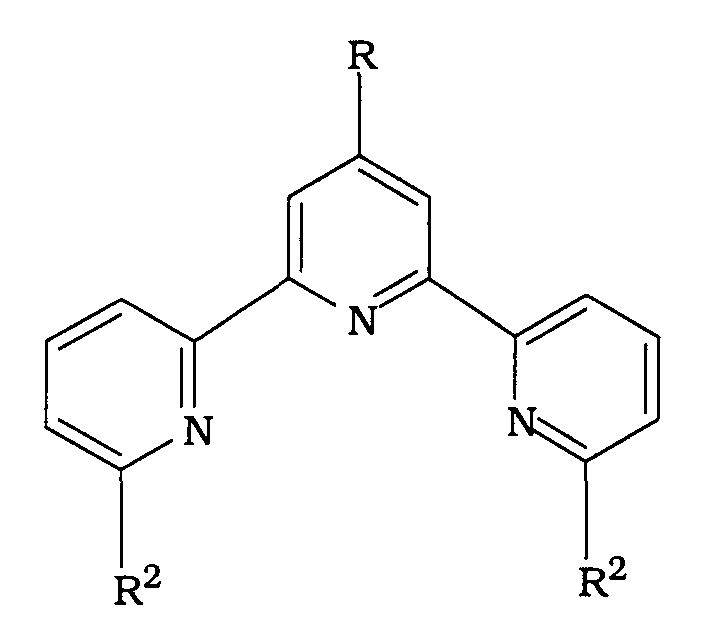 bedeuten und R eine Protein-reaktive Gruppe bedeutet, welche wahlweise kovalent an eine immonureaktive organische Verbindung gebunden ist; mit den Maßgaben, dass, wenn jedes R2 eine Gruppe CH2N(CH2COOH)2 bedeutet, dann R verschieden ist von einer p-Methoxyphenylgruppe, substituiert in der 3-Position durch eine Amino-, Isothiocyanato- oder Dimethylaminothiocarbonylaminogruppe), und wenn beide R2-Gruppen eine Gruppe der Formel
 bedeuten, dann R die Bedeutung 3-Amino-4-methoxyphenyl hat, oder ein Salz hiervon, mit einem Metallradionuclidion.
- Komplex nach Anspruch 1, wobei die Gruppe R eine reaktive Gruppe umfaßt, gewählt aus Amino, Alkylamino, Arylamino, Hydrazino, Alkylhydrazino, Arylhydrazino, Carbazido, Semicarbazido, Thiocarbazido, Thiosemicarbazido, Sulfhydryl, Sulfhydrylalkyl, Sulfhydrylaryl, Hydroxy, Carboxy, Carboxyalkyl, Carboxyaryl, aktives Halogen enthaltenden Gruppen, 2-Abspaltguppen-substituiertes Ethylcarbonyl, Vinylsulfonyl, Vinylcarbonyl, Epoxy, Isocyanato, Isothiocyanato, Aldehyd, Aziridin, Succinimidoxycarbonyl-aktivierte Acylgruppen und gemischte Anhydride, wahlweise kovalent gebunden an ein immunoreaktives organisches Material.
- Komplex nach Anspruch 1 und/oder 2, wobei die Gruppe R eine immunoreaktive Gruppe umfaßt, gewählt aus Enzymen, Aminosäuren, Polypeptiden, Proteinen, Lipoproteinen, Glycoproteinen, Hormonen, Drogen, Steroiden, Vitaminen, Polysacchariden, Pharmazeutika, Haptenen, Lectinen, Toxinen, Nucleinsäuren, Antikörpern, antigenen Materialien, Avidin und Biotin.
- Komplex nach Anspruch 3, wobei die Gruppe R einen Antikörper umfaßt.
- Komplex nach Anspruch 4, wobei die Gruppe R einen Antikörper umfaßt, gewählt aus B72.3, 9.2.27, D612, UJ13A, NRLU-10, 7E11C5, CC49, TNT, PRIA3, ING-1, B174 und B43.
- Komplex nach Anspruch 5, wobei die Gruppe R den Antikörper ING-1 umfaßt.
- Komplex nach mindestens einem der Ansprüche 1 bis 6, wobei das Metallradionuclidion 90Y3+ ist.
- Diagnostische oder therapeutische Zusammensetzung, umfassend einen eine immunoreaktive Gruppe enthaltenden Komplex nach mindestens einem der Ansprüche 1 bis 7, zusammen mit einem pharmazeutisch annehmbaren Träger.
- Verwendung eines eine immunoreaktive Gruppe enthaltenden Komplexes nach mindestens einem der Ansprüche 1 bis 7 zur Herstellung eines Arzneimittels zur Verwendung bei diagnostischen Bilderzeugungen.
Applications Claiming Priority (1)
| Application Number | Priority Date | Filing Date | Title |
|---|---|---|---|
| PCT/US1992/003858 WO1993021957A1 (en) | 1992-05-07 | 1992-05-07 | Complexing agents and targeting immunoreagents |
Publications (2)
| Publication Number | Publication Date |
|---|---|
| EP0639083A1 EP0639083A1 (de) | 1995-02-22 |
| EP0639083B1 true EP0639083B1 (de) | 2001-07-18 |
Family
ID=22231055
Family Applications (1)
| Application Number | Title | Priority Date | Filing Date |
|---|---|---|---|
| EP92915130A Expired - Lifetime EP0639083B1 (de) | 1992-05-07 | 1992-05-07 | Komplexbildnermittel und zielimmunoreagenzien |
Country Status (12)
| Country | Link |
|---|---|
| EP (1) | EP0639083B1 (de) |
| JP (1) | JP3358141B2 (de) |
| KR (1) | KR950701229A (de) |
| AT (1) | ATE203168T1 (de) |
| AU (1) | AU672951B2 (de) |
| BR (1) | BR9207126A (de) |
| CA (1) | CA2135059A1 (de) |
| DE (1) | DE69231952T2 (de) |
| FI (1) | FI945194A7 (de) |
| NO (1) | NO944182L (de) |
| RU (1) | RU2122431C1 (de) |
| WO (1) | WO1993021957A1 (de) |
Families Citing this family (15)
| Publication number | Priority date | Publication date | Assignee | Title |
|---|---|---|---|---|
| US5480970A (en) * | 1993-12-22 | 1996-01-02 | Resolution Pharmaceuticals | Metal chelators |
| US5569745A (en) * | 1994-02-25 | 1996-10-29 | Resolution Pharmaceuticals Inc. | Peptide-Chelator conjugates |
| DE19505960A1 (de) * | 1995-02-21 | 1996-08-22 | Deutsches Krebsforsch | Konjugat zur individuellen Dosierung von Arzneimitteln |
| US6004529A (en) * | 1997-04-11 | 1999-12-21 | Nycomed Imaging As | Chelating agents |
| US6844425B1 (en) * | 1999-02-24 | 2005-01-18 | Mallinckrodt Inc. | Combination of intercalating organometallic complexes and tumor seeking biomolecules for DNA cleavage and radiotherapy |
| WO2000050086A1 (en) * | 1999-02-24 | 2000-08-31 | Mallinckrodt Inc. | Molecules for the treatment and diagnosis of tumors |
| MY133346A (en) * | 1999-03-01 | 2007-11-30 | Biogen Inc | Kit for radiolabeling ligands with yttrium-90 |
| RU2200467C1 (ru) * | 2001-09-20 | 2003-03-20 | НИИ онкологии им. проф. Н.Н. Петрова | Способ определения объема опухолевого поражения костного мозга и остаточного объема гемопоэтического костного мозга у больных лимфогранулематозом |
| RU2206556C1 (ru) * | 2001-12-14 | 2003-06-20 | Институт молекулярной генетики РАН | Высокомеченный тритием тафцин и способ определения тафцина в биологических образцах |
| EP1489418A4 (de) * | 2002-03-08 | 2006-05-03 | Kazuko Matsumoto | Neue fluoreszenzmarkierungsverbindungen |
| GB0308408D0 (en) * | 2003-04-11 | 2003-05-21 | Amersham Plc | Microwave activation |
| RU2359702C2 (ru) * | 2007-05-04 | 2009-06-27 | ГУ Медицинский радиологический научный центр РАМН | Способ получения меченых радионуклидом микросфер |
| RU2344133C1 (ru) * | 2007-11-29 | 2009-01-20 | Государственное образовательное учреждение высшего профессионального образования "Уральский государственный технический университет (УПИ)" | Способ получения 2,2':6',2'':6'',2'''-тетрапиридина |
| KR101528013B1 (ko) * | 2009-08-31 | 2015-06-16 | 로슈 글리카트 아게 | 친화성-성숙된 인간화된 항-cea 단일클론 항체 |
| RU2454931C1 (ru) * | 2011-03-02 | 2012-07-10 | Федеральное государственное бюджетное учреждение "Научно-исследовательский институт онкологии имени Н.Н. Петрова" Министерства здравоохранения и социального развития Российской Федерации | Способ диагностики распространенности опухолевого процесса у больных немелкоклеточным раком легкого |
Family Cites Families (10)
| Publication number | Priority date | Publication date | Assignee | Title |
|---|---|---|---|---|
| US4837169A (en) * | 1981-07-01 | 1989-06-06 | Eastman Kodak Company | Polypyridine Fluorescent labels for immunoassay |
| EP0171978B1 (de) * | 1984-08-13 | 1990-11-07 | HSC Research Development Corporation | 1,10-Phenanthrolin-2,9-dicarbonsäure-Derivate und deren Verwendung für Fluoreszens-Immunoassay |
| DK365785A (da) * | 1984-09-17 | 1986-03-18 | Hoffmann La Roche | Metalcomplexer |
| AU8152887A (en) * | 1986-10-17 | 1988-05-06 | Cytogen Corporation | Method for preparation of protein-chelator-metal ion compositions suitable for injection |
| US5202451A (en) * | 1988-02-17 | 1993-04-13 | Neorx Corporation | Anchimeric radiometal chelating compounds |
| SE8802575D0 (sv) * | 1988-07-08 | 1988-07-08 | Wallac Oy | Terpyridine derivatives |
| GB9001245D0 (en) * | 1990-01-19 | 1990-03-21 | Salutar Inc | Compounds |
| US5367080A (en) * | 1990-11-08 | 1994-11-22 | Sterling Winthrop Inc. | Complexing agents and targeting radioactive immunoreagents useful in therapeutic and diagnostic imaging compositions and methods |
| EP0680335A1 (de) * | 1992-11-30 | 1995-11-08 | The Wellcome Foundation Limited | Aufeinanderfolgendes zielen auf tumorstellen mit hilfe von an antikörper konjugierten oligonukleotiden und komplementäre oligonukleotidkonjugate von chelatierten radionukleiden |
| JPH08512019A (ja) * | 1993-03-10 | 1996-12-17 | ザ・ウエルカム・ファウンデーション・リミテッド | 免疫反応剤およびキレート化された放射性核種からなるl−エナンチオメリックオリゴヌクレオチド複合体を用いる腫瘍ターゲッティング |
-
1992
- 1992-05-07 AU AU23161/92A patent/AU672951B2/en not_active Expired
- 1992-05-07 JP JP51920993A patent/JP3358141B2/ja not_active Expired - Lifetime
- 1992-05-07 EP EP92915130A patent/EP0639083B1/de not_active Expired - Lifetime
- 1992-05-07 KR KR1019940703965A patent/KR950701229A/ko not_active Abandoned
- 1992-05-07 DE DE69231952T patent/DE69231952T2/de not_active Expired - Lifetime
- 1992-05-07 BR BR9207126A patent/BR9207126A/pt not_active Application Discontinuation
- 1992-05-07 CA CA002135059A patent/CA2135059A1/en not_active Abandoned
- 1992-05-07 WO PCT/US1992/003858 patent/WO1993021957A1/en not_active Ceased
- 1992-05-07 RU RU94046010A patent/RU2122431C1/ru active
- 1992-05-07 AT AT92915130T patent/ATE203168T1/de not_active IP Right Cessation
-
1994
- 1994-11-02 NO NO944182A patent/NO944182L/no not_active Application Discontinuation
- 1994-11-04 FI FI945194A patent/FI945194A7/fi unknown
Also Published As
| Publication number | Publication date |
|---|---|
| JP3358141B2 (ja) | 2002-12-16 |
| RU94046010A (ru) | 1996-10-20 |
| AU2316192A (en) | 1993-11-29 |
| BR9207126A (pt) | 1995-08-29 |
| ATE203168T1 (de) | 2001-08-15 |
| FI945194A7 (fi) | 1995-01-04 |
| EP0639083A1 (de) | 1995-02-22 |
| NO944182D0 (no) | 1994-11-02 |
| DE69231952D1 (de) | 2001-08-23 |
| RU2122431C1 (ru) | 1998-11-27 |
| AU672951B2 (en) | 1996-10-24 |
| NO944182L (no) | 1994-12-21 |
| DE69231952T2 (de) | 2002-04-04 |
| FI945194A0 (fi) | 1994-11-04 |
| JPH07506667A (ja) | 1995-07-20 |
| CA2135059A1 (en) | 1993-11-11 |
| WO1993021957A1 (en) | 1993-11-11 |
| KR950701229A (ko) | 1995-03-23 |
Similar Documents
| Publication | Publication Date | Title |
|---|---|---|
| EP0624097B1 (de) | Zielgesuchte radioaktive immunoreagenzien | |
| EP0455268B1 (de) | Biologisch nützliche Konjugate | |
| US5183653A (en) | Boronic acid adducts of metal dioxime complexes useful in labelling proteins and other amine-containing compounds | |
| JP2571226B2 (ja) | 放射性標識蛋白質のためのカツプリング剤 | |
| EP0639083B1 (de) | Komplexbildnermittel und zielimmunoreagenzien | |
| EP0174853B1 (de) | Radioaktiv markierte Antikörperstücke | |
| US5162505A (en) | Proteins modified with positively charged carriers and compositions prepared therefrom | |
| EP0248506B1 (de) | Markierung von Trägermolekülen mit Metallionen | |
| EP0348261B1 (de) | Radiohalogenierte Verbindungen für Markierung von spezifischen Stellen | |
| EP0420934B1 (de) | Bifunktionelle kuppler und daraus hergestellte mit radionukleid markierte zusammensetzungen | |
| JP2865112B2 (ja) | 金属イオンをタンパク質に結合するためのキレート化剤 | |
| WO1999021587A1 (en) | Complexing agents and targeting immunoreagents | |
| GB2214507A (en) | 2,3-dithiosuccinic acid derivative and their use | |
| JPH09507488A (ja) | 新規なポリアミノカルボキシレートキレート化剤 |
Legal Events
| Date | Code | Title | Description |
|---|---|---|---|
| PUAI | Public reference made under article 153(3) epc to a published international application that has entered the european phase |
Free format text: ORIGINAL CODE: 0009012 |
|
| 17P | Request for examination filed |
Effective date: 19941103 |
|
| AK | Designated contracting states |
Kind code of ref document: A1 Designated state(s): AT BE CH DE DK ES FR GB GR IT LI LU MC NL SE |
|
| RAP1 | Party data changed (applicant data changed or rights of an application transferred) |
Owner name: NYCOMED IMAGING AS |
|
| 17Q | First examination report despatched |
Effective date: 19970516 |
|
| GRAG | Despatch of communication of intention to grant |
Free format text: ORIGINAL CODE: EPIDOS AGRA |
|
| GRAG | Despatch of communication of intention to grant |
Free format text: ORIGINAL CODE: EPIDOS AGRA |
|
| GRAG | Despatch of communication of intention to grant |
Free format text: ORIGINAL CODE: EPIDOS AGRA |
|
| GRAH | Despatch of communication of intention to grant a patent |
Free format text: ORIGINAL CODE: EPIDOS IGRA |
|
| GRAH | Despatch of communication of intention to grant a patent |
Free format text: ORIGINAL CODE: EPIDOS IGRA |
|
| GRAA | (expected) grant |
Free format text: ORIGINAL CODE: 0009210 |
|
| AK | Designated contracting states |
Kind code of ref document: B1 Designated state(s): AT BE CH DE DK ES FR GB GR IT LI LU MC NL SE |
|
| PG25 | Lapsed in a contracting state [announced via postgrant information from national office to epo] |
Ref country code: NL Free format text: LAPSE BECAUSE OF FAILURE TO SUBMIT A TRANSLATION OF THE DESCRIPTION OR TO PAY THE FEE WITHIN THE PRESCRIBED TIME-LIMIT Effective date: 20010718 Ref country code: LI Free format text: LAPSE BECAUSE OF FAILURE TO SUBMIT A TRANSLATION OF THE DESCRIPTION OR TO PAY THE FEE WITHIN THE PRESCRIBED TIME-LIMIT Effective date: 20010718 Ref country code: IT Free format text: LAPSE BECAUSE OF FAILURE TO SUBMIT A TRANSLATION OF THE DESCRIPTION OR TO PAY THE FEE WITHIN THE PRE;WARNING: LAPSES OF ITALIAN PATENTS WITH EFFECTIVE DATE BEFORE 2007 MAY HAVE OCCURRED AT ANY TIME BEFORE 2007. THE CORRECT EFFECTIVE DATE MAY BE DIFFERENT FROM THE ONE RECORDED.SCRIBED TIME-LIMIT Effective date: 20010718 Ref country code: CH Free format text: LAPSE BECAUSE OF FAILURE TO SUBMIT A TRANSLATION OF THE DESCRIPTION OR TO PAY THE FEE WITHIN THE PRESCRIBED TIME-LIMIT Effective date: 20010718 Ref country code: BE Free format text: LAPSE BECAUSE OF FAILURE TO SUBMIT A TRANSLATION OF THE DESCRIPTION OR TO PAY THE FEE WITHIN THE PRESCRIBED TIME-LIMIT Effective date: 20010718 Ref country code: AT Free format text: LAPSE BECAUSE OF FAILURE TO SUBMIT A TRANSLATION OF THE DESCRIPTION OR TO PAY THE FEE WITHIN THE PRESCRIBED TIME-LIMIT Effective date: 20010718 |
|
| REF | Corresponds to: |
Ref document number: 203168 Country of ref document: AT Date of ref document: 20010815 Kind code of ref document: T |
|
| REG | Reference to a national code |
Ref country code: CH Ref legal event code: EP |
|
| REF | Corresponds to: |
Ref document number: 69231952 Country of ref document: DE Date of ref document: 20010823 |
|
| PG25 | Lapsed in a contracting state [announced via postgrant information from national office to epo] |
Ref country code: SE Free format text: LAPSE BECAUSE OF FAILURE TO SUBMIT A TRANSLATION OF THE DESCRIPTION OR TO PAY THE FEE WITHIN THE PRESCRIBED TIME-LIMIT Effective date: 20011018 Ref country code: DK Free format text: LAPSE BECAUSE OF FAILURE TO SUBMIT A TRANSLATION OF THE DESCRIPTION OR TO PAY THE FEE WITHIN THE PRESCRIBED TIME-LIMIT Effective date: 20011018 |
|
| PG25 | Lapsed in a contracting state [announced via postgrant information from national office to epo] |
Ref country code: GR Free format text: LAPSE BECAUSE OF FAILURE TO SUBMIT A TRANSLATION OF THE DESCRIPTION OR TO PAY THE FEE WITHIN THE PRESCRIBED TIME-LIMIT Effective date: 20011019 |
|
| ET | Fr: translation filed | ||
| REG | Reference to a national code |
Ref country code: GB Ref legal event code: IF02 |
|
| NLV1 | Nl: lapsed or annulled due to failure to fulfill the requirements of art. 29p and 29m of the patents act | ||
| PG25 | Lapsed in a contracting state [announced via postgrant information from national office to epo] |
Ref country code: ES Free format text: LAPSE BECAUSE OF FAILURE TO SUBMIT A TRANSLATION OF THE DESCRIPTION OR TO PAY THE FEE WITHIN THE PRESCRIBED TIME-LIMIT Effective date: 20020131 |
|
| REG | Reference to a national code |
Ref country code: CH Ref legal event code: PL |
|
| PG25 | Lapsed in a contracting state [announced via postgrant information from national office to epo] |
Ref country code: MC Free format text: LAPSE BECAUSE OF NON-PAYMENT OF DUE FEES Effective date: 20020507 Ref country code: LU Free format text: LAPSE BECAUSE OF NON-PAYMENT OF DUE FEES Effective date: 20020507 |
|
| PLBE | No opposition filed within time limit |
Free format text: ORIGINAL CODE: 0009261 |
|
| STAA | Information on the status of an ep patent application or granted ep patent |
Free format text: STATUS: NO OPPOSITION FILED WITHIN TIME LIMIT |
|
| 26N | No opposition filed | ||
| PGFP | Annual fee paid to national office [announced via postgrant information from national office to epo] |
Ref country code: FR Payment date: 20110607 Year of fee payment: 20 |
|
| PGFP | Annual fee paid to national office [announced via postgrant information from national office to epo] |
Ref country code: GB Payment date: 20110525 Year of fee payment: 20 |
|
| PGFP | Annual fee paid to national office [announced via postgrant information from national office to epo] |
Ref country code: DE Payment date: 20110527 Year of fee payment: 20 |
|
| REG | Reference to a national code |
Ref country code: DE Ref legal event code: R071 Ref document number: 69231952 Country of ref document: DE |
|
| REG | Reference to a national code |
Ref country code: DE Ref legal event code: R071 Ref document number: 69231952 Country of ref document: DE |
|
| REG | Reference to a national code |
Ref country code: GB Ref legal event code: PE20 Expiry date: 20120506 |
|
| PG25 | Lapsed in a contracting state [announced via postgrant information from national office to epo] |
Ref country code: DE Free format text: LAPSE BECAUSE OF EXPIRATION OF PROTECTION Effective date: 20120508 |
|
| PG25 | Lapsed in a contracting state [announced via postgrant information from national office to epo] |
Ref country code: GB Free format text: LAPSE BECAUSE OF EXPIRATION OF PROTECTION Effective date: 20120506 |