EP0640135B1 - Proteines fixatrices de l'immunoglobuline derivees de la proteine l et leurs utilisations - Google Patents
Proteines fixatrices de l'immunoglobuline derivees de la proteine l et leurs utilisations Download PDFInfo
- Publication number
- EP0640135B1 EP0640135B1 EP93911930A EP93911930A EP0640135B1 EP 0640135 B1 EP0640135 B1 EP 0640135B1 EP 93911930 A EP93911930 A EP 93911930A EP 93911930 A EP93911930 A EP 93911930A EP 0640135 B1 EP0640135 B1 EP 0640135B1
- Authority
- EP
- European Patent Office
- Prior art keywords
- protein
- synthetic
- sequences
- binding
- molecule
- Prior art date
- Legal status (The legal status is an assumption and is not a legal conclusion. Google has not performed a legal analysis and makes no representation as to the accuracy of the status listed.)
- Expired - Lifetime
Links
- 108090000623 proteins and genes Proteins 0.000 title description 27
- 102000004169 proteins and genes Human genes 0.000 title description 19
- 102000028557 immunoglobulin binding proteins Human genes 0.000 title description 6
- 108091009323 immunoglobulin binding proteins Proteins 0.000 title description 6
- 230000027455 binding Effects 0.000 claims abstract description 48
- 108060003951 Immunoglobulin Proteins 0.000 claims abstract description 30
- 102000018358 immunoglobulin Human genes 0.000 claims abstract description 30
- 238000000034 method Methods 0.000 claims description 16
- 229920001184 polypeptide Polymers 0.000 claims description 7
- 108090000765 processed proteins & peptides Proteins 0.000 claims description 7
- 102000004196 processed proteins & peptides Human genes 0.000 claims description 7
- 239000002773 nucleotide Substances 0.000 claims description 6
- 125000003729 nucleotide group Chemical group 0.000 claims description 6
- 125000003275 alpha amino acid group Chemical group 0.000 claims description 5
- 230000001131 transforming effect Effects 0.000 claims description 5
- 108020004511 Recombinant DNA Proteins 0.000 claims description 4
- 239000013604 expression vector Substances 0.000 claims description 4
- 239000013598 vector Substances 0.000 claims description 4
- 108091026890 Coding region Proteins 0.000 claims description 2
- 102000053602 DNA Human genes 0.000 claims description 2
- 238000012258 culturing Methods 0.000 claims description 2
- 125000002924 primary amino group Chemical group [H]N([H])* 0.000 claims 1
- 108010026228 mRNA guanylyltransferase Proteins 0.000 description 34
- 235000018102 proteins Nutrition 0.000 description 16
- FAPWRFPIFSIZLT-UHFFFAOYSA-M Sodium chloride Chemical compound [Na+].[Cl-] FAPWRFPIFSIZLT-UHFFFAOYSA-M 0.000 description 12
- 210000004027 cell Anatomy 0.000 description 12
- 102000009027 Albumins Human genes 0.000 description 10
- 108010088751 Albumins Proteins 0.000 description 10
- 108020004414 DNA Proteins 0.000 description 10
- 239000012634 fragment Substances 0.000 description 10
- 235000001014 amino acid Nutrition 0.000 description 8
- 150000001413 amino acids Chemical class 0.000 description 8
- 229940072221 immunoglobulins Drugs 0.000 description 7
- 241000282414 Homo sapiens Species 0.000 description 6
- 239000003153 chemical reaction reagent Substances 0.000 description 6
- 239000011780 sodium chloride Substances 0.000 description 6
- 108091081062 Repeated sequence (DNA) Proteins 0.000 description 5
- 239000011701 zinc Substances 0.000 description 5
- 102000004190 Enzymes Human genes 0.000 description 4
- 108090000790 Enzymes Proteins 0.000 description 4
- 238000012217 deletion Methods 0.000 description 4
- 230000037430 deletion Effects 0.000 description 4
- 238000000746 purification Methods 0.000 description 4
- 239000000243 solution Substances 0.000 description 4
- 238000000527 sonication Methods 0.000 description 4
- 239000006228 supernatant Substances 0.000 description 4
- QTBSBXVTEAMEQO-UHFFFAOYSA-N Acetic acid Chemical compound CC(O)=O QTBSBXVTEAMEQO-UHFFFAOYSA-N 0.000 description 3
- 235000019750 Crude protein Nutrition 0.000 description 3
- 241000588724 Escherichia coli Species 0.000 description 3
- 108700026244 Open Reading Frames Proteins 0.000 description 3
- 229920002684 Sepharose Polymers 0.000 description 3
- 238000003556 assay Methods 0.000 description 3
- 239000000872 buffer Substances 0.000 description 3
- 210000002421 cell wall Anatomy 0.000 description 3
- 239000002299 complementary DNA Substances 0.000 description 3
- UQLDLKMNUJERMK-UHFFFAOYSA-L di(octadecanoyloxy)lead Chemical compound [Pb+2].CCCCCCCCCCCCCCCCCC([O-])=O.CCCCCCCCCCCCCCCCCC([O-])=O UQLDLKMNUJERMK-UHFFFAOYSA-L 0.000 description 3
- 238000001962 electrophoresis Methods 0.000 description 3
- 239000000499 gel Substances 0.000 description 3
- 230000003993 interaction Effects 0.000 description 3
- 239000000523 sample Substances 0.000 description 3
- 229910052725 zinc Inorganic materials 0.000 description 3
- QKNYBSVHEMOAJP-UHFFFAOYSA-N 2-amino-2-(hydroxymethyl)propane-1,3-diol;hydron;chloride Chemical compound Cl.OCC(N)(CO)CO QKNYBSVHEMOAJP-UHFFFAOYSA-N 0.000 description 2
- HRPVXLWXLXDGHG-UHFFFAOYSA-N Acrylamide Chemical compound NC(=O)C=C HRPVXLWXLXDGHG-UHFFFAOYSA-N 0.000 description 2
- 229920000936 Agarose Polymers 0.000 description 2
- MHAJPDPJQMAIIY-UHFFFAOYSA-N Hydrogen peroxide Chemical compound OO MHAJPDPJQMAIIY-UHFFFAOYSA-N 0.000 description 2
- CDBYLPFSWZWCQE-UHFFFAOYSA-L Sodium Carbonate Chemical compound [Na+].[Na+].[O-]C([O-])=O CDBYLPFSWZWCQE-UHFFFAOYSA-L 0.000 description 2
- 239000007983 Tris buffer Substances 0.000 description 2
- 238000004458 analytical method Methods 0.000 description 2
- 230000001580 bacterial effect Effects 0.000 description 2
- 230000003851 biochemical process Effects 0.000 description 2
- AIYUHDOJVYHVIT-UHFFFAOYSA-M caesium chloride Chemical compound [Cl-].[Cs+] AIYUHDOJVYHVIT-UHFFFAOYSA-M 0.000 description 2
- 238000006243 chemical reaction Methods 0.000 description 2
- 239000013599 cloning vector Substances 0.000 description 2
- 125000000151 cysteine group Chemical group N[C@@H](CS)C(=O)* 0.000 description 2
- 238000001514 detection method Methods 0.000 description 2
- 238000010828 elution Methods 0.000 description 2
- 238000011835 investigation Methods 0.000 description 2
- 238000004519 manufacturing process Methods 0.000 description 2
- 239000013612 plasmid Substances 0.000 description 2
- 239000008057 potassium phosphate buffer Substances 0.000 description 2
- 230000008569 process Effects 0.000 description 2
- 239000000047 product Substances 0.000 description 2
- 108091008146 restriction endonucleases Proteins 0.000 description 2
- 239000007787 solid Substances 0.000 description 2
- 239000000725 suspension Substances 0.000 description 2
- 238000005406 washing Methods 0.000 description 2
- GOJUJUVQIVIZAV-UHFFFAOYSA-N 2-amino-4,6-dichloropyrimidine-5-carbaldehyde Chemical group NC1=NC(Cl)=C(C=O)C(Cl)=N1 GOJUJUVQIVIZAV-UHFFFAOYSA-N 0.000 description 1
- 229920001817 Agar Polymers 0.000 description 1
- 241000894006 Bacteria Species 0.000 description 1
- 101100148606 Caenorhabditis elegans pst-1 gene Proteins 0.000 description 1
- 241000283707 Capra Species 0.000 description 1
- 102000012410 DNA Ligases Human genes 0.000 description 1
- 108010061982 DNA Ligases Proteins 0.000 description 1
- 241000701959 Escherichia virus Lambda Species 0.000 description 1
- 241000192016 Finegoldia magna Species 0.000 description 1
- 241000192125 Firmicutes Species 0.000 description 1
- 241000282412 Homo Species 0.000 description 1
- 108010001336 Horseradish Peroxidase Proteins 0.000 description 1
- 102000008100 Human Serum Albumin Human genes 0.000 description 1
- 108091006905 Human Serum Albumin Proteins 0.000 description 1
- 102000006496 Immunoglobulin Heavy Chains Human genes 0.000 description 1
- 108010019476 Immunoglobulin Heavy Chains Proteins 0.000 description 1
- 102100029567 Immunoglobulin kappa light chain Human genes 0.000 description 1
- 101710189008 Immunoglobulin kappa light chain Proteins 0.000 description 1
- 102000018697 Membrane Proteins Human genes 0.000 description 1
- 108010052285 Membrane Proteins Proteins 0.000 description 1
- 241000237536 Mytilus edulis Species 0.000 description 1
- 125000001429 N-terminal alpha-amino-acid group Chemical group 0.000 description 1
- 101150008132 NDE1 gene Proteins 0.000 description 1
- 108091028043 Nucleic acid sequence Proteins 0.000 description 1
- 108091034117 Oligonucleotide Proteins 0.000 description 1
- 241000283973 Oryctolagus cuniculus Species 0.000 description 1
- 101150063163 PPL gene Proteins 0.000 description 1
- 241000206591 Peptococcus Species 0.000 description 1
- 241000191992 Peptostreptococcus Species 0.000 description 1
- ISWSIDIOOBJBQZ-UHFFFAOYSA-N Phenol Chemical compound OC1=CC=CC=C1 ISWSIDIOOBJBQZ-UHFFFAOYSA-N 0.000 description 1
- 229920001213 Polysorbate 20 Polymers 0.000 description 1
- 108010076504 Protein Sorting Signals Proteins 0.000 description 1
- 239000012614 Q-Sepharose Substances 0.000 description 1
- 102000007562 Serum Albumin Human genes 0.000 description 1
- 108010071390 Serum Albumin Proteins 0.000 description 1
- 241000191940 Staphylococcus Species 0.000 description 1
- 108700011201 Streptococcus IgG Fc-binding Proteins 0.000 description 1
- QAOWNCQODCNURD-UHFFFAOYSA-N Sulfuric acid Chemical compound OS(O)(=O)=O QAOWNCQODCNURD-UHFFFAOYSA-N 0.000 description 1
- HCHKCACWOHOZIP-UHFFFAOYSA-N Zinc Chemical compound [Zn] HCHKCACWOHOZIP-UHFFFAOYSA-N 0.000 description 1
- JLCPHMBAVCMARE-UHFFFAOYSA-N [3-[[3-[[3-[[3-[[3-[[3-[[3-[[3-[[3-[[3-[[3-[[5-(2-amino-6-oxo-1H-purin-9-yl)-3-[[3-[[3-[[3-[[3-[[3-[[5-(2-amino-6-oxo-1H-purin-9-yl)-3-[[5-(2-amino-6-oxo-1H-purin-9-yl)-3-hydroxyoxolan-2-yl]methoxy-hydroxyphosphoryl]oxyoxolan-2-yl]methoxy-hydroxyphosphoryl]oxy-5-(5-methyl-2,4-dioxopyrimidin-1-yl)oxolan-2-yl]methoxy-hydroxyphosphoryl]oxy-5-(6-aminopurin-9-yl)oxolan-2-yl]methoxy-hydroxyphosphoryl]oxy-5-(6-aminopurin-9-yl)oxolan-2-yl]methoxy-hydroxyphosphoryl]oxy-5-(6-aminopurin-9-yl)oxolan-2-yl]methoxy-hydroxyphosphoryl]oxy-5-(6-aminopurin-9-yl)oxolan-2-yl]methoxy-hydroxyphosphoryl]oxyoxolan-2-yl]methoxy-hydroxyphosphoryl]oxy-5-(5-methyl-2,4-dioxopyrimidin-1-yl)oxolan-2-yl]methoxy-hydroxyphosphoryl]oxy-5-(4-amino-2-oxopyrimidin-1-yl)oxolan-2-yl]methoxy-hydroxyphosphoryl]oxy-5-(5-methyl-2,4-dioxopyrimidin-1-yl)oxolan-2-yl]methoxy-hydroxyphosphoryl]oxy-5-(5-methyl-2,4-dioxopyrimidin-1-yl)oxolan-2-yl]methoxy-hydroxyphosphoryl]oxy-5-(6-aminopurin-9-yl)oxolan-2-yl]methoxy-hydroxyphosphoryl]oxy-5-(6-aminopurin-9-yl)oxolan-2-yl]methoxy-hydroxyphosphoryl]oxy-5-(4-amino-2-oxopyrimidin-1-yl)oxolan-2-yl]methoxy-hydroxyphosphoryl]oxy-5-(4-amino-2-oxopyrimidin-1-yl)oxolan-2-yl]methoxy-hydroxyphosphoryl]oxy-5-(4-amino-2-oxopyrimidin-1-yl)oxolan-2-yl]methoxy-hydroxyphosphoryl]oxy-5-(6-aminopurin-9-yl)oxolan-2-yl]methoxy-hydroxyphosphoryl]oxy-5-(4-amino-2-oxopyrimidin-1-yl)oxolan-2-yl]methyl [5-(6-aminopurin-9-yl)-2-(hydroxymethyl)oxolan-3-yl] hydrogen phosphate Polymers Cc1cn(C2CC(OP(O)(=O)OCC3OC(CC3OP(O)(=O)OCC3OC(CC3O)n3cnc4c3nc(N)[nH]c4=O)n3cnc4c3nc(N)[nH]c4=O)C(COP(O)(=O)OC3CC(OC3COP(O)(=O)OC3CC(OC3COP(O)(=O)OC3CC(OC3COP(O)(=O)OC3CC(OC3COP(O)(=O)OC3CC(OC3COP(O)(=O)OC3CC(OC3COP(O)(=O)OC3CC(OC3COP(O)(=O)OC3CC(OC3COP(O)(=O)OC3CC(OC3COP(O)(=O)OC3CC(OC3COP(O)(=O)OC3CC(OC3COP(O)(=O)OC3CC(OC3COP(O)(=O)OC3CC(OC3COP(O)(=O)OC3CC(OC3COP(O)(=O)OC3CC(OC3COP(O)(=O)OC3CC(OC3COP(O)(=O)OC3CC(OC3CO)n3cnc4c(N)ncnc34)n3ccc(N)nc3=O)n3cnc4c(N)ncnc34)n3ccc(N)nc3=O)n3ccc(N)nc3=O)n3ccc(N)nc3=O)n3cnc4c(N)ncnc34)n3cnc4c(N)ncnc34)n3cc(C)c(=O)[nH]c3=O)n3cc(C)c(=O)[nH]c3=O)n3ccc(N)nc3=O)n3cc(C)c(=O)[nH]c3=O)n3cnc4c3nc(N)[nH]c4=O)n3cnc4c(N)ncnc34)n3cnc4c(N)ncnc34)n3cnc4c(N)ncnc34)n3cnc4c(N)ncnc34)O2)c(=O)[nH]c1=O JLCPHMBAVCMARE-UHFFFAOYSA-N 0.000 description 1
- 238000002835 absorbance Methods 0.000 description 1
- 239000008351 acetate buffer Substances 0.000 description 1
- 239000000853 adhesive Substances 0.000 description 1
- 230000001070 adhesive effect Effects 0.000 description 1
- 238000001042 affinity chromatography Methods 0.000 description 1
- 239000008272 agar Substances 0.000 description 1
- 125000000539 amino acid group Chemical group 0.000 description 1
- AVKUERGKIZMTKX-NJBDSQKTSA-N ampicillin Chemical compound C1([C@@H](N)C(=O)N[C@H]2[C@H]3SC([C@@H](N3C2=O)C(O)=O)(C)C)=CC=CC=C1 AVKUERGKIZMTKX-NJBDSQKTSA-N 0.000 description 1
- 229960000723 ampicillin Drugs 0.000 description 1
- 230000000692 anti-sense effect Effects 0.000 description 1
- 238000011091 antibody purification Methods 0.000 description 1
- 230000008901 benefit Effects 0.000 description 1
- 102000005936 beta-Galactosidase Human genes 0.000 description 1
- 108010005774 beta-Galactosidase Proteins 0.000 description 1
- 238000004166 bioassay Methods 0.000 description 1
- 239000007853 buffer solution Substances 0.000 description 1
- 229940041514 candida albicans extract Drugs 0.000 description 1
- 238000004113 cell culture Methods 0.000 description 1
- 239000006285 cell suspension Substances 0.000 description 1
- 238000012512 characterization method Methods 0.000 description 1
- 238000004587 chromatography analysis Methods 0.000 description 1
- 239000012501 chromatography medium Substances 0.000 description 1
- 238000010367 cloning Methods 0.000 description 1
- 230000009918 complex formation Effects 0.000 description 1
- 238000010276 construction Methods 0.000 description 1
- NKLPQNGYXWVELD-UHFFFAOYSA-M coomassie brilliant blue Chemical compound [Na+].C1=CC(OCC)=CC=C1NC1=CC=C(C(=C2C=CC(C=C2)=[N+](CC)CC=2C=C(C=CC=2)S([O-])(=O)=O)C=2C=CC(=CC=2)N(CC)CC=2C=C(C=CC=2)S([O-])(=O)=O)C=C1 NKLPQNGYXWVELD-UHFFFAOYSA-M 0.000 description 1
- 230000009089 cytolysis Effects 0.000 description 1
- 238000000432 density-gradient centrifugation Methods 0.000 description 1
- 238000011161 development Methods 0.000 description 1
- 238000003745 diagnosis Methods 0.000 description 1
- 238000010790 dilution Methods 0.000 description 1
- 239000012895 dilution Substances 0.000 description 1
- ZMMJGEGLRURXTF-UHFFFAOYSA-N ethidium bromide Chemical compound [Br-].C12=CC(N)=CC=C2C2=CC=C(N)C=C2[N+](CC)=C1C1=CC=CC=C1 ZMMJGEGLRURXTF-UHFFFAOYSA-N 0.000 description 1
- 229960005542 ethidium bromide Drugs 0.000 description 1
- 239000012530 fluid Substances 0.000 description 1
- 238000010353 genetic engineering Methods 0.000 description 1
- 239000011521 glass Substances 0.000 description 1
- 239000001963 growth medium Substances 0.000 description 1
- HNDVDQJCIGZPNO-UHFFFAOYSA-N histidine Natural products OC(=O)C(N)CC1=CN=CN1 HNDVDQJCIGZPNO-UHFFFAOYSA-N 0.000 description 1
- 230000036039 immunity Effects 0.000 description 1
- 238000003018 immunoassay Methods 0.000 description 1
- 230000006872 improvement Effects 0.000 description 1
- 208000015181 infectious disease Diseases 0.000 description 1
- 238000002955 isolation Methods 0.000 description 1
- BPHPUYQFMNQIOC-NXRLNHOXSA-N isopropyl beta-D-thiogalactopyranoside Chemical compound CC(C)S[C@@H]1O[C@H](CO)[C@H](O)[C@H](O)[C@H]1O BPHPUYQFMNQIOC-NXRLNHOXSA-N 0.000 description 1
- 239000000463 material Substances 0.000 description 1
- 239000011159 matrix material Substances 0.000 description 1
- 235000020638 mussel Nutrition 0.000 description 1
- ZIUHHBKFKCYYJD-UHFFFAOYSA-N n,n'-methylenebisacrylamide Chemical compound C=CC(=O)NCNC(=O)C=C ZIUHHBKFKCYYJD-UHFFFAOYSA-N 0.000 description 1
- 230000003287 optical effect Effects 0.000 description 1
- 239000008188 pellet Substances 0.000 description 1
- 102000013415 peroxidase activity proteins Human genes 0.000 description 1
- 108040007629 peroxidase activity proteins Proteins 0.000 description 1
- 239000002953 phosphate buffered saline Substances 0.000 description 1
- 229920002401 polyacrylamide Polymers 0.000 description 1
- 238000003752 polymerase chain reaction Methods 0.000 description 1
- 239000000256 polyoxyethylene sorbitan monolaurate Substances 0.000 description 1
- 235000010486 polyoxyethylene sorbitan monolaurate Nutrition 0.000 description 1
- 238000001742 protein purification Methods 0.000 description 1
- 239000012460 protein solution Substances 0.000 description 1
- 238000003127 radioimmunoassay Methods 0.000 description 1
- 238000011160 research Methods 0.000 description 1
- 239000001632 sodium acetate Substances 0.000 description 1
- 239000007974 sodium acetate buffer Substances 0.000 description 1
- 229910000029 sodium carbonate Inorganic materials 0.000 description 1
- 238000010532 solid phase synthesis reaction Methods 0.000 description 1
- 241000894007 species Species 0.000 description 1
- 230000009870 specific binding Effects 0.000 description 1
- 239000001117 sulphuric acid Substances 0.000 description 1
- 235000011149 sulphuric acid Nutrition 0.000 description 1
- 230000009466 transformation Effects 0.000 description 1
- LENZDBCJOHFCAS-UHFFFAOYSA-N tris Chemical compound OCC(N)(CO)CO LENZDBCJOHFCAS-UHFFFAOYSA-N 0.000 description 1
- PIEPQKCYPFFYMG-UHFFFAOYSA-N tris acetate Chemical compound CC(O)=O.OCC(N)(CO)CO PIEPQKCYPFFYMG-UHFFFAOYSA-N 0.000 description 1
- 239000012137 tryptone Substances 0.000 description 1
- 238000002525 ultrasonication Methods 0.000 description 1
- 238000011144 upstream manufacturing Methods 0.000 description 1
- 230000001018 virulence Effects 0.000 description 1
- 230000007923 virulence factor Effects 0.000 description 1
- 239000000304 virulence factor Substances 0.000 description 1
- 239000012138 yeast extract Substances 0.000 description 1
Images



Classifications
-
- C—CHEMISTRY; METALLURGY
- C07—ORGANIC CHEMISTRY
- C07K—PEPTIDES
- C07K14/00—Peptides having more than 20 amino acids; Gastrins; Somatostatins; Melanotropins; Derivatives thereof
- C07K14/195—Peptides having more than 20 amino acids; Gastrins; Somatostatins; Melanotropins; Derivatives thereof from bacteria
- C07K14/33—Peptides having more than 20 amino acids; Gastrins; Somatostatins; Melanotropins; Derivatives thereof from bacteria from Clostridium (G)
-
- C—CHEMISTRY; METALLURGY
- C07—ORGANIC CHEMISTRY
- C07K—PEPTIDES
- C07K2319/00—Fusion polypeptide
Definitions
- This invention relates to novel immunoglobulin binding proteins. processes for their production and recombinant DNA molecules coding therefor.
- the present invention relates to synthetic proteins containing repeated sequences derived from selected binding regions of Protein L and to recombinant DNA molecules coding therefor.
- a multitude of Gram-positive bacteria species have been isolated that express surface proteins with affinities for mammalian immunoglobulins through interaction with their heavy chains.
- the best known of these immunoglobulin binding proteins are type 1 Staphylococcus Protein A and type 2 Streptococcus Protein G which have been shown to interact principally through the C2-C3 interface on the Fc region of human immunoglobulins. In addition, both have also been shown to interact weakly to the Fab region, but again through the immunoglobulin heavy chain.
- Protein L a novel protein from Peptococcus magnus, Protein L, has been reported that was found to bind to human, rabbit, porcine, mouse and rat immunoglobulins uniquely through interaction with their light chains. In humans this interaction has been shown to occur exclusively to the kappa chains. Since both kappa and lambda light chains are shared between different classes. Protein L binds strongly to all human classes, in particular to the multi-subunited IgM, and similarly is expected to bind to all classes in species that show Protein L light chain binding.
- Protein L which binds to the Kappa light chain of human immunoglobulins. It has been proposed that Protein L is a virulence factor; non-virulent peptococci and peptostreptococci appear to neither express Protein L nor have the structural gene for it (Kastern et al 1990).
- Protein L is of particular interest since it has been reported to bind to the Kappa light chain which is present in all classes and sub classes of immunoglobulins. As such it should prove to be a useful diagnostic reagent for use in ELISA and RIA techniques.
- EP-A-0 255 497 describes the purification and attempted characterisation of Protein L by standard protein purification techniques. Subsequently, the authors of EP-A-0 255 497 have published a number of scientific papers describing further investigations into the nature and structure of Protein L, but to date, attempts fully to characterize the protein have failed. Thus recently, in a paper entitled "Protein L a Bacterial Immunoglobulin-Binding Protein and Possible Virulence Determinant" by W. Kastern et al (Infection and Immunity, May 1990, pp.
- This invention is based on a cDNA sequence comprising a cDNA insert coding for Protein L in its entirety which has now been isolated, thus enabling the above problems to be solved.
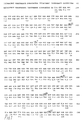
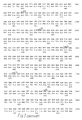
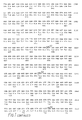
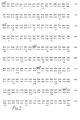
- This cDNA sequence, and the amino acid sequence corresponding to the longest open reading frame thereof, are depicted in Figure 1.
- the beginning of the signal sequence is marked as "SS” and the beginning of the mature protein is marked as "M”.
- the longest open reading frame of the sequence depicted in Figure 1 extends from TTG (103) to AAA(3183) and the depicted DNA comprises a coding region extending from nucleotide 208 to nucleotide 3183 which codes for immature Protein L.
- Protein L The specific binding properties of Protein L, including its ability to bind immunoglobulin Kappa light chains, are believed to be attributable to the presence of sequences which have a recognisably repeated character within the amino acid sequence of the molecule.
- amino acid sequence comprises at least two sequences, each of from 20 to 45 amino acids in length (or from 40 to 90 amino acids in length in the case of the D repeats), which have an at least 75%, preferably at least 90% and most preferably at least 95% homology with one another.
- the polypeptide sequence depicted in Figure 1 includes various sets of repeated sequences at least two of which are considered to be responsible for immunoglobulin Kappa light chain binding.
- Each of the repeated sequences (1) - (4) has a length of between 25 and 45 amino acids.
- the ability to bind Kappa light chains is considered to be associated with one or more of the repeated sequences A, B, C and Z (sequences (1) - (4) above).
- synthetic immunoglobulin binding molecules comprising a plurality of recognisably repeated binding domains selected from the sequences which are labelled at their N-terminal ends in Figure 1 as A1, A2 and A3; B1, and B2; C1, C2, C3, and C4; and Z1, Z2, Z3 and Z4.
- the synthetic immunoglobulin binding molecules preferably comprise from 2 to 15 of said domains.
- the selected domain or domains may be identical to the sequences which are labelled at their N-terminal ends in Figure 1 as A1, A2 and A3; B1, and B2; C1, C2, C3, and C4; Z1, Z2, Z3 and Z4, or they may vary from said sequences, provided that they have an at least 75%. preferably at least 90% and most preferably at least 95% homology therewith.
- sequences labelled at their N-terminal ends as D1, D2, D3 and D4 are believed to be resposible for albumin binding and the synthetic binding molecules provided according to the invention may include sequences selected from sequences D1, D2, D3 and D4 or related squences which vary from said sequences, provided that they have an at least 75%, preferably at least 90% and most preferably at least 95% homology therewith.
- a synthetic immunoglobulin binding molecule in which domains C1 and Z1, and/or C2 and Z2 and/or C3 and Z3 and/or C4 and Z4 are present as binding region or regions.
- Region C1Z1 begins at the first amino acid of C1 and ends at the last amino acid of Z1, etc.
- a synthetic immunoglobulin binding molecule comprises one or more immunoglobulin binding regions selected separately from:
- the synthetic molecule is substantially free of one or both of (1) protein L albumin binding activity and (2) protein L cell wall binding activity.
- regions C1Z1, C2Z2, C3Z3 and C4Z4 of protein L shown are respectively 71, 71, 74 and 75 amino acid residues in length. References in the invention to these regions are intended to encompass variants of these precise sequences. One such variant retains substantially the immunoglobulin binding activity of the precise sequence and has up to ten preferably up to 5 and very preferably no more than 2 amino acids substituted, added or deleted.
- Another variant exhibits a degree of homology with one of the C1Z1, C2Z2, C3Z3 and C4Z4 sequences of 75% or more, preferably 90% or more while retaining substantially the immunoglobulin binding activity of the precise sequence.
- binding regions of the synthetic molecule are ligated directly to one another in one embodiment of the invention.
- binding regions are separated from each other by linker polypeptides, the nature of each linker being such as not to interfere with the binding activity of the binding domain.
- Linker polypeptides if present are preferably of up to 10 amino acids in length and most preferably up to 5 amino acids in length.
- the invention includes synthetic molecules having a large number of binding regions it is convenient for the synthetic molecule to have from 1 to 4 such regions.
- the synthetic molecule has four such regions.
- the selection of a particular C n Z n or C n Z n -derived variant sequence for each of the four regions is optional.
- the synthetic molecules of the invention cover a large number of possible combinations of C n Z n and C n Z n - derived variant sequences.
- a synthetic molecule has four binding regions one each selected from C1Z1 or a variant thereof, C2Z2 or a variant thereof, C3Z3 or a variant thereof and C4Z4 or a variant thereof.
- An example of such an embodiment is shown in Fig 2 which binds to immunoglobulin as native Protein L but does not bind to albumin or cell wall as native protein L.
- the synthetic molecules of the invention can conveniently be used to form products for use in protein analysis, purification procedures and other biochemical processes according to methods well known in the art.
- the synthetic immunoglobulin binding molecules can, for example, be ligated to a "reporter” molecule, such as an enzyme so as to be suitable for enzyme linked immunoabsorbent assay (ELISA).
- ELISA enzyme linked immunoabsorbent assay
- reporter molecule is suitable for use in a chemiluminescent assay.
- the synthetic molecules of the invention can additionally be ligated to a molecule suitable for attachment to a solid support, such as a cysteine residue for attachment to a further cysteine residue on a solid matrix, or histidine for attachment to zinc on a support, or a mussel derived adhesive protein for attachment to a wide variety of surfaces including glass.
- a molecule suitable for attachment to a solid support such as a cysteine residue for attachment to a further cysteine residue on a solid matrix, or histidine for attachment to zinc on a support, or a mussel derived adhesive protein for attachment to a wide variety of surfaces including glass.
- the invention provides novel synthetic immunoglobulin binding molecules that are useful in a wide range of biochemical applications.
- the synthetic molecules are of particular advantage if they are free from regions D1, D2, D3 and D4 and as a result they do not exhibit the albumin binding and cell wall binding of native protein L,
- the synthetic molecules of the invention can conveniently be used to form products for use in protein analysis, purification procedures and other biochemical processes according to methods well known in the art.
- a recombinant DNA molecule containing an insert coding for a synthetic molecule according to any embodiment of the first aspect of the invention.
- FIG. 2 A nucleotide sequence of an embodiment of the second aspect of the invention is shown in Fig. 2.
- plasmid pPPL2 described below and which has been deposited at NCIMB, Aberdeen, Scotland, UK under accession No. 40534 on 22 December 1992.
- Fig. 3 shows 1.(a) Domain structure as determined by Kastern et al. , Infect. Immunol., 58, 1992, and 1.(b) domain structure as determined by Murphy et al., Eur J. Biochem, 168, 1992. Shaded areas between the two figures represent areas of strong homology. To determine the domains responsible for the immunoglobulin-kappa binding reported for both molecules, and the albumin-binding reported for 1.(b), the deletion clones (constructed from the gene expressing 1.(b)) are shown in 2.(a,b,c).
- X-Omat S X-ray film was from Kodak.
- DNA ligase, restriction endonucleases and other DNA-modifying enzymes were from Boehringer.
- Agarose, acrylamide, bis-acrylamide and phenol were from Bethesda Research Laboratories.
- Chromatography media was from Pharmacia LKB (Uppsala, Sweden). All immunoglobulins and serum albumin were from Sigma. All other reagents were from Sigma of BDH.
- Nunc 96 well microtitre plates were purchased from Gibco BRL Ltd.
- E.coli TG1 was cultured in 2xYT both (2% (w/v) tryptone/1% (w/v) yeast extract/1% (w/v) NaCl) overnight at 37°C. Media were solidified with 2% (w/v) Bacto-agar (Difco). Ampicillin (50 ⁇ g/ml) were used where necessary for the selection and growth of transformants. Functional ⁇ -galactosidase was detected by addition of chlorindolyl- ⁇ -D-galactoside to a final concentration of 600 ⁇ g/ml and, where necessary, isopropyl- ⁇ -D-thiogalactopyranoside to a final concentration of 200 ⁇ g/ml.
- Plasmid DNA was purified from E.coli by Brij lysis (Clewell and Helsinki, PNAS, USA, 1969) and CsCl/ ethidium bromide density-gradient centrifugation (Radloff et al.. PNAS, USA 1967).
- DNA-modifying enzymes were used in the buffer and under the conditions recommended by the supplier (Boehringer). Transformation of E.coli was essentially as described previously (Cohen et al. , PNAS, USA 1972). Electrophoresis of DNA fragments was performed on vertical 1% (w/v)-agarose slab gels in Tris-acetate buffer (40 mM-Tris/ /20mM-sodium acetate/ 2mM-EDTA, adjusted to pH 7.9 with acetic acid). DNA fragment sizes were estimated by comparison with fragments of lambda phage DNA previously digesed with the restriction endonuclease Hind III. DNA fragments were purified by electro-elution essentially as described previously (McDonnell et al.. J. Mol. Biol., 100, 1977).
- FIG. 3 A schematic representation of the deletion clones constructed are shown in Fig. 3.
- pPPL1 was constructed by amplifying the DNA fragment indicated in Fig. 3 (2a) isolating the A, B, C and Z repeats.
- an Nde 1 site (CAT ATG) was incorporated into the sense primer (5'-TTA AAT CAT ATG TCA GAA ACA-3') and to prevent read through, a stop condon was incorporated into the anti-sense primer (5'-CC TGG TTG TTA TTT TCC AGC AAA T-3').
- This fragment was cloned into the TA cloning vector (Amersham), and subsequently excised on a Nde 1-partial Hin d III (cleaving at the Hin d III site present in the TA cloning vectors polylinker) fragment, and re-cloned inframe into the Nde 1 -Hin d III cleaved expression vector pMTL1013 (Brehm et al., Appl. Microbiol. Bitechnol., 36, 1991).
- pPPL2 expressing only the C and Z repeats, was derived from pPPL1 by excision of the gene fragment shown in Fig. 3 (2b) through an Eco RV- Spe 1 (site carried over from the TA cloning vector polylinker) digest, and re-cloned inframe into Sma 1- Xba 1 cleaved pMTL1013.
- pPPL3 (Fig. 3 (2c)), expressing the D and E repeats, was obtained through a Pst 1 (present upstream of the PPL open reading frame)-partial Hin d III digest and cloned inframe into Hin d III-P st 1 cleaved pMTL23 (Chambers et al., Gene, 68, 1988).
- PCR was achieved by synthesising oligonucleotides (synthesised by solid phase synthesis using an Appied Biosystems Model 380A DNA synthesiser employing phosphoamidites) either side of the target site on the PPL gene and DNA fragments generated by the polymerase chain reaction using the method and reagents supplied in the PCR-Perking Elmer Cetus GeneAmpTM kit.
- a cell suspension was transferred to a MSE sonication tube and subjected to ultra sonication (3x30 sec bursts at 18MHz with 30 sec intervals, at 4°C using an MSE Soniprep 150 Sonicator).
- the sonication procedure was used to disrupt bacterial cells for small scale purification of immunoglobulin-binding proteins by affintity chromatography on IgG-sepharose FF. Cultures of 300ml were grown overnight then centriguted (15000g for 10 min at 4°C) and resuspended in 3ml of 100 mM Tris-HCl, pH 7.5, 250 mM NaCl.
- the suspension was sonicated, centrifuged (30000g 10 min at 4°C) and the supernatant fluid passed through a 1ml column (1.6cm x 0.90cm i.d.) of IgG-sepharose FF equilibrated and washed with 5ml of 100 mM Tris-HCl, pH 7.5, 250mM NaCl.
- the protein was eluted with 100mM gylcine-HCl, pH 2.0, and the pH raised to 7.5 using 1M Tris, pH 8.0.
- Immunoglobulin-binding proteins were detected using an Elisa procedure modified from that previously described (Warenes et al . , J. Immunol. Methods., 93, 1987).
- mice IgG 100 ul
- 50mM sodium carbonate/bicarbonate buffer, pH9.6 50mM sodium carbonate/bicarbonate buffer, pH9.6
- PBST-Phosphate buffered saline containing 0.05% (v/v) Tween 20 100 ⁇ l aliquot of the suspension of recombinant bacteria was transferred to the Maxisorp plate from overnight cultures.
- the immunoassay plate was then left at room temperature for an hour. After washing with PBST, 100 ⁇ l of human IgG at 1 ⁇ g/ml in PBST was added to each well and the plate left at room temperature for another hour.
- albumin-binding To detect albumin-binding, the above procedure was followed except different affinity reagents were used in each step of the sandwich.
- the first step bound the protein sample under investigation, which has been prepared by recovering the cell supernatant following sonication, to the Maxisorp plate.
- Albumin-binding was then detected by incubating the plate with human serum albumin (HSA, 1 ⁇ g/ml) followed by goat-anti HSA IgG-horseradish peroxidase conjugated (1:2000 dilution), and then developed as above. The following results were obtained.
- HSA human serum albumin
- pPPL1 and pPPL2 were shown by Elisa to bind to IgG, lacking any albumin binding.
- pPPL3 (Fig 2 (2c)) in contrast bound HSA. but not IgG. This shows that Kappa binding was through the C and Z repeats and that the albumin-binding was at a separate site located in the D- or E-repeats.
- a purified solution of a synthetic immunoglobulin building molecule according to the invention can be obtained using the following method.
- Host cells transformed with pPPL2 are grown, eg in a 4001 to 40001 fermenter.
- the cell culture is then removed from the fermenter and spun down to obtain a cell paste, the supernatant culture medium being discarded.
- the cell paste is washed in potassium phosphate buffer (pH 6.5) and lysosyme is added to lyse the cells over a suitable period of for example 30 to 60 minutes.
- the lysed cells are next heated to 70°C for 15 minutes and then centrifuged at 13000 rpm for 2 hours, leaving a supernatant of soluble, crude protein which is removed from the centrifuged pellet and can be stored at -20°C.
- the crude protein is eluted through a Q-Sepharose column previously equilibrated with potassium phosphate buffer (pH 6.5). Before being added to the column the crude protein solution is diluted so as to be at the same ionic strength as the buffer.
- the column is washed with buffer until no more protein is washed off, then washed with 50mM NaCl solution to remove proteins binding weakly to the column.
- the strength of NaCl solution used to elute the column is then increased in steps and the protein fractions obtained kept separate.
- the synthetic protein molecule of the invention is obtained from elution with NaCl between 270-290 mM.
- the synthetic protein molecules of the invention find advantageous use in bio-assays and other biochemical applications due to their ability to bind to Kappa light chains of immunoglobulins. They are of use for example in ELISA, RIA, diagnosis, antibody purification.
- Fig. 1 of GB 9209804.5 from which priority is claimed is reproduced as Fig. 1 of this application but with different nomenclature as set out below: GB 9209804.5
- This Application A1, A2, A3 A1, A2, A3 B1, B2 B1, B2 C1, C2, C3, C4 C1, C2, C3, C4 D1, D2, D3, D4 Z1, Z2, Z3, Z4 E1, F1 D1 E2, F2 *D2 E3, F3 *D3 E4, F4 *D4
Landscapes
- Chemical & Material Sciences (AREA)
- Organic Chemistry (AREA)
- Health & Medical Sciences (AREA)
- Medicinal Chemistry (AREA)
- Biochemistry (AREA)
- Biophysics (AREA)
- General Health & Medical Sciences (AREA)
- Genetics & Genomics (AREA)
- Life Sciences & Earth Sciences (AREA)
- Molecular Biology (AREA)
- Proteomics, Peptides & Aminoacids (AREA)
- Gastroenterology & Hepatology (AREA)
- Peptides Or Proteins (AREA)
- Preparation Of Compounds By Using Micro-Organisms (AREA)
- Micro-Organisms Or Cultivation Processes Thereof (AREA)
- Medicines Containing Antibodies Or Antigens For Use As Internal Diagnostic Agents (AREA)
Claims (10)
- Molécule synthétique se liant à une immunoglobuline, qui comprend au moins un domaine de liaison choisi parmi les séquences d'amino-acides (a) à (d) :
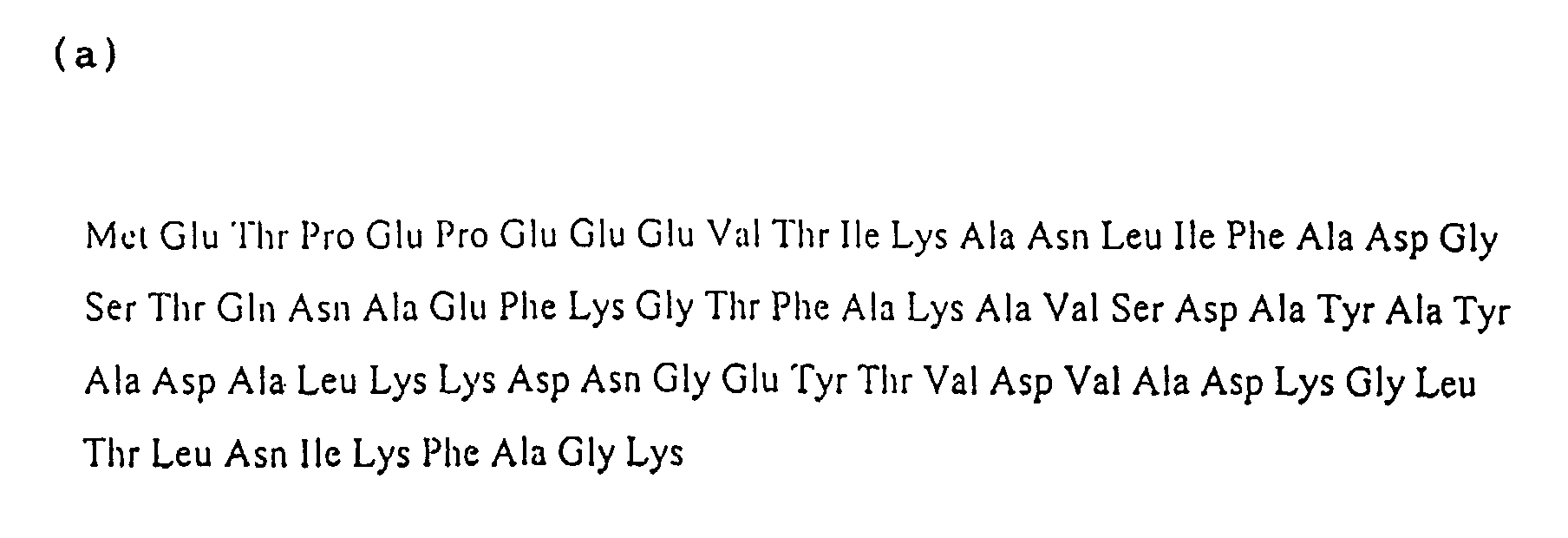


- Molécule synthétique se liant à une immunoglobuline, qui est constituée d'un ou plusieurs domaines de liaison choisis parmi les séquences d'amino-acides (a) à (d).
- Molécule synthétique se liant à une immunoglobuline selon la revendication 1 ou 2, dont le domaine choisi ou les domaines choisis diffère(nt) desdites séquences, étant entendu qu'il(s) présente(nt) avec elles un degré d'homologie d'au moins 90 % et de préférence d'au moins 95 %.
- Molécule synthétique selon la revendication 2 ou 3, qui comprend en outre au moins un domaine choisi parmi les séquences D1 à D4 :
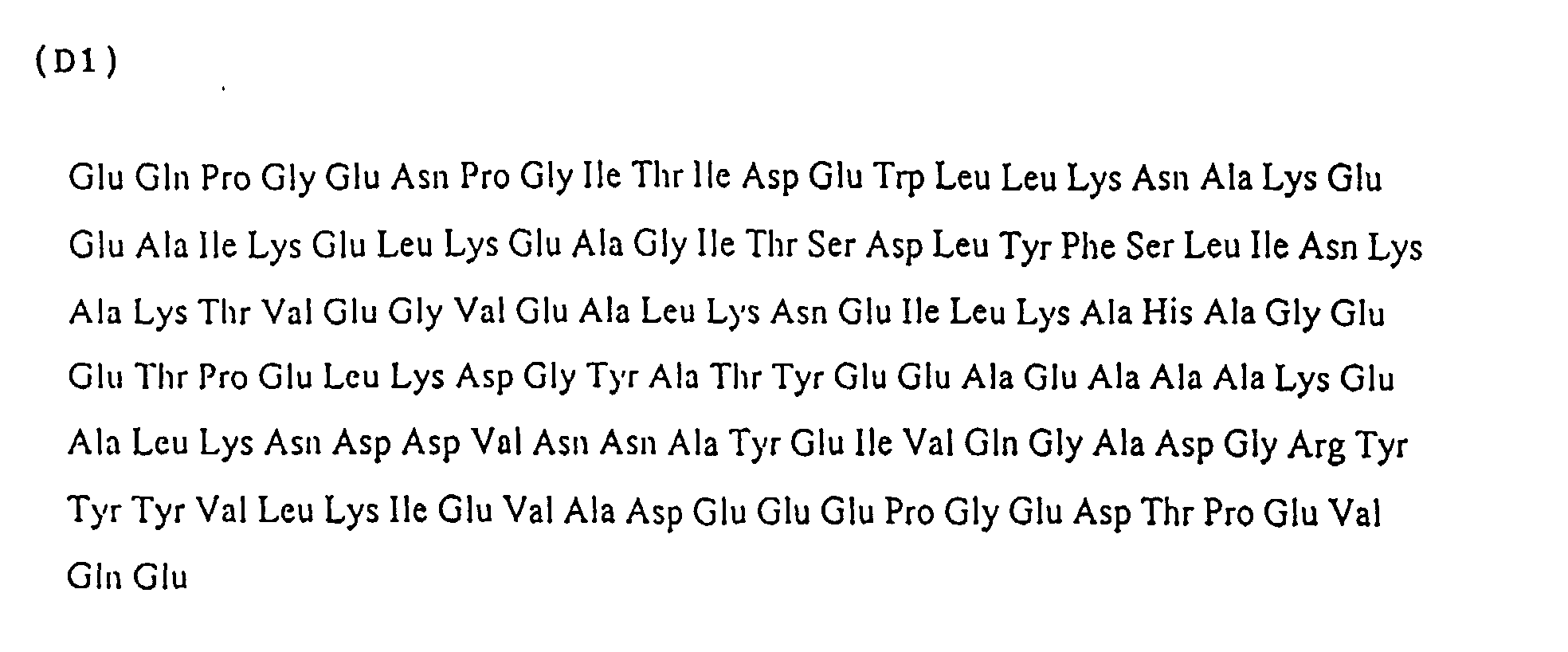
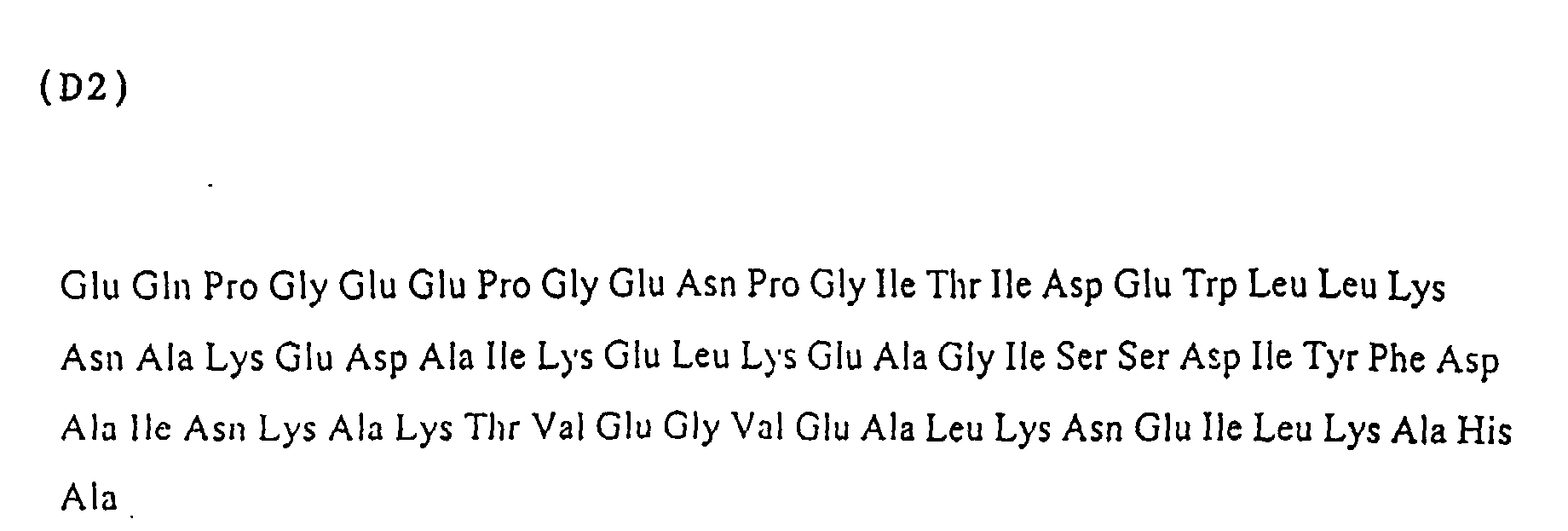
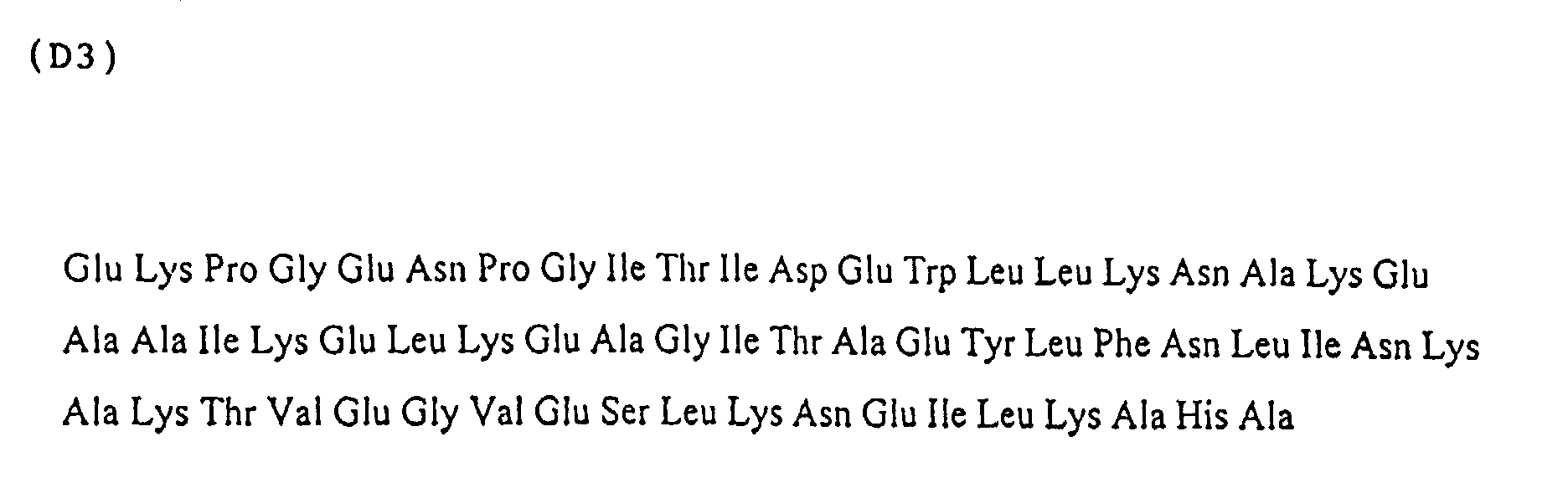 ou des séquences apparentées qui diffèrent desdites séquences, étant entendu que les séquences apparentées présentent avec lesdites séquences un degré d'homologie d'au moins 75 %, de préférence d'au moins 90 % et en particulier d'au moins 95 %.
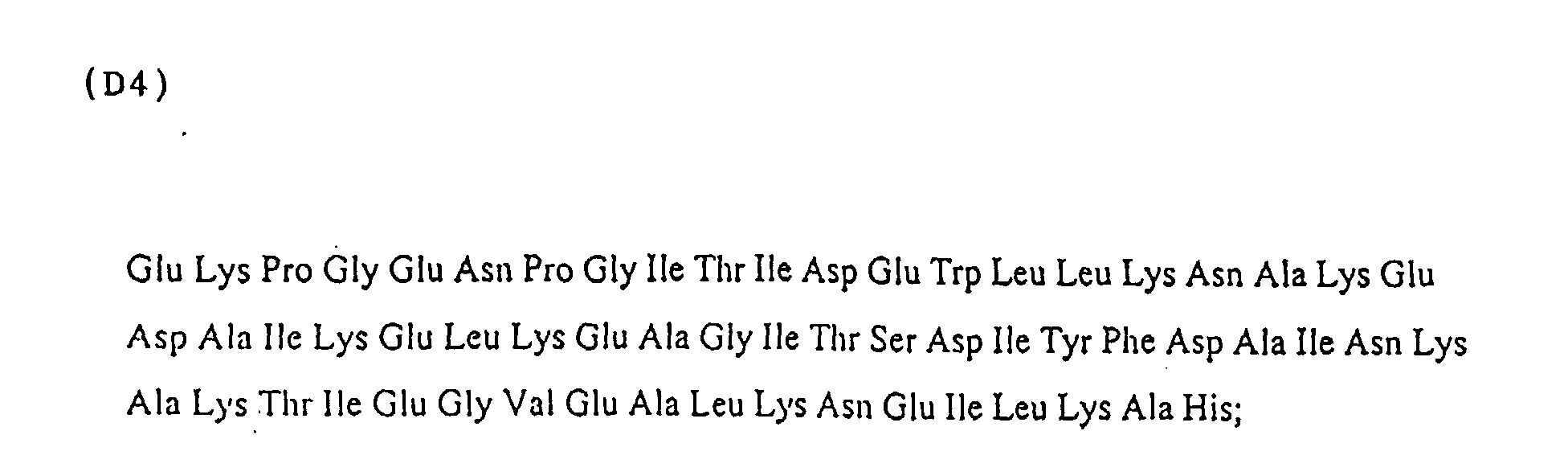
- Molécule synthétique selon l'une quelconque des revendications 1 à 3, dont tous les domaines D1, D2, D3 et D4 sont absents.
- Molécule synthétique selon l'une quelconque des revendications précédentes, qui comprend toutes les séquences (a) à (d).
- Séquence de nucléotides codant pour une molécule synthétique selon l'une quelconque des revendications précédentes.
- Molécule d'ADN recombinant, comprenant une séquence selon la revendication 7.
- Procédé de production d'une molécule synthétique se liant à une immunoglobuline, qui comprend les étapes consistant à :(1) former un vecteur d'expression capable de transformer une cellule hôte de façon à exprimer un polypeptide codé par une séquence codante d'ADN selon la revendication 8,(2) transformer une cellule hôte avec le vecteur,(3) cultiver la cellule hôte, et(4) isoler un produit pratiquement pur à partir de la cellule hôte.
- Procédé selon la revendication 9, dans lequel le vecteur est le plasmide pPPL2, n° de dépôt NCIMB 40 534.
Applications Claiming Priority (5)
| Application Number | Priority Date | Filing Date | Title |
|---|---|---|---|
| GB9209804 | 1992-05-07 | ||
| GB929209804A GB9209804D0 (en) | 1992-05-07 | 1992-05-07 | Novel immunoglobulin binding proteins process for their production and recombinant dna molecules coding therefor |
| GB9226928 | 1992-12-24 | ||
| GB929226928A GB9226928D0 (en) | 1992-12-24 | 1992-12-24 | Novel immunoglobulin binding proteins,process for their production & recombinant dna molecules coding therefor |
| PCT/GB1993/000950 WO1993022439A1 (fr) | 1992-05-07 | 1993-05-07 | Proteines fixatrices de l'immunoglobuline derivees de la proteine l et leurs utilisations |
Publications (2)
| Publication Number | Publication Date |
|---|---|
| EP0640135A1 EP0640135A1 (fr) | 1995-03-01 |
| EP0640135B1 true EP0640135B1 (fr) | 2001-01-17 |
Family
ID=26300834
Family Applications (1)
| Application Number | Title | Priority Date | Filing Date |
|---|---|---|---|
| EP93911930A Expired - Lifetime EP0640135B1 (fr) | 1992-05-07 | 1993-05-07 | Proteines fixatrices de l'immunoglobuline derivees de la proteine l et leurs utilisations |
Country Status (9)
| Country | Link |
|---|---|
| US (1) | US6162903A (fr) |
| EP (1) | EP0640135B1 (fr) |
| JP (1) | JPH07507682A (fr) |
| AT (1) | ATE198768T1 (fr) |
| AU (1) | AU672794B2 (fr) |
| CA (1) | CA2135208C (fr) |
| DE (1) | DE69329877T2 (fr) |
| DK (1) | DK0640135T3 (fr) |
| WO (1) | WO1993022439A1 (fr) |
Families Citing this family (31)
| Publication number | Priority date | Publication date | Assignee | Title |
|---|---|---|---|---|
| SE9201331D0 (sv) * | 1992-04-28 | 1992-04-28 | Hightech Receptor C O Active | Protein l och hybridproteiner daerav |
| JPH07507682A (ja) * | 1992-05-07 | 1995-08-31 | アクティノバ・リミテッド | Lプロテインに由来する免疫グロブリン結合性タンパク質およびその用途 |
| GB9209804D0 (en) * | 1992-05-07 | 1992-06-24 | Health Lab Service Board | Novel immunoglobulin binding proteins process for their production and recombinant dna molecules coding therefor |
| WO2000015803A1 (fr) * | 1998-09-14 | 2000-03-23 | Affitech As | Proteine de liaison de l'immunoglobuline |
| US7618937B2 (en) | 2001-07-20 | 2009-11-17 | Northwestern University | Peptidomimetic polymers for antifouling surfaces |
| US8815793B2 (en) | 2001-07-20 | 2014-08-26 | Northwestern University | Polymeric compositions and related methods of use |
| US7858679B2 (en) | 2001-07-20 | 2010-12-28 | Northwestern University | Polymeric compositions and related methods of use |
| US8911831B2 (en) | 2002-07-19 | 2014-12-16 | Northwestern University | Surface independent, surface-modifying, multifunctional coatings and applications thereof |
| US20070275873A1 (en) * | 2004-04-29 | 2007-11-29 | Heidner Hans W | Methods and Compositions Comprising Protein L Immunoglobulin Binding Domains for Cell-Specific Targeting |
| US7741128B2 (en) * | 2005-05-23 | 2010-06-22 | University Of Hawaii | Cooperative reporter systems, components, and methods for analyte detection |
| US7732539B2 (en) | 2006-02-16 | 2010-06-08 | National Science Foundation | Modified acrylic block copolymers for hydrogels and pressure sensitive wet adhesives |
| US8563117B2 (en) | 2006-08-04 | 2013-10-22 | Phillip B. Messersmith | Biomimetic modular adhesive complex: materials, methods and applications therefore |
| JP5597836B2 (ja) | 2006-08-04 | 2014-10-01 | ケンジー ナッシュ コーポレイション | バイオミメティック化合物およびその合成方法 |
| US8383092B2 (en) * | 2007-02-16 | 2013-02-26 | Knc Ner Acquisition Sub, Inc. | Bioadhesive constructs |
| US8673286B2 (en) | 2007-04-09 | 2014-03-18 | Northwestern University | DOPA-functionalized, branched, poly(aklylene oxide) adhesives |
| EP2637707A4 (fr) | 2010-11-09 | 2014-10-01 | Kensey Nash Corp | Composés adhésifs et leurs procédés d'utilisation pour la réparation d'hernies |
| JP2015519345A (ja) * | 2012-05-25 | 2015-07-09 | ヤンセン バイオテツク,インコーポレーテツド | 非天然コンセンサスアルブミン結合ドメイン |
| JP6663360B2 (ja) | 2015-01-26 | 2020-03-11 | 株式会社カネカ | 変異型免疫グロブリンκ鎖可変領域結合性ペプチド |
| JPWO2016121701A1 (ja) | 2015-01-26 | 2017-11-09 | 株式会社カネカ | 免疫グロブリンκ鎖可変領域含有タンパク質精製用アフィニティー分離マトリックス |
| CN108291220B (zh) | 2015-10-22 | 2022-10-28 | 普罗泰纳瓦株式会社 | 免疫球蛋白结合多肽 |
| WO2017195638A1 (fr) | 2016-05-09 | 2017-11-16 | 株式会社カネカ | Procédé de purification d'un anticorps ou d'un fragment d'anticorps comportant une région variable de chaîne κ |
| WO2018111978A1 (fr) | 2016-12-14 | 2018-06-21 | Janssen Biotech, Inc. | Domaines de fibronectine de type iii à liaison au cd137 |
| WO2018111976A1 (fr) | 2016-12-14 | 2018-06-21 | Janssen Biotech, Inc. | Domaines de fibronectine de type iii se liant à pd-l1 |
| KR102568559B1 (ko) | 2016-12-14 | 2023-08-18 | 얀센 바이오테크 인코포레이티드 | Cd8a-결합 섬유결합소 iii형 도메인 |
| WO2021076543A1 (fr) | 2019-10-14 | 2021-04-22 | Aro Biotherapeutics Company | Domaines de type iii de fibronectine de liaison à cd137 |
| US11781138B2 (en) | 2019-10-14 | 2023-10-10 | Aro Biotherapeutics Company | FN3 domain-siRNA conjugates and uses thereof |
| CN114786682B (zh) | 2019-10-14 | 2024-07-16 | Aro生物疗法公司 | 结合cd71的纤维粘连蛋白iii型结构域 |
| JP2024517610A (ja) | 2021-04-14 | 2024-04-23 | アロ・バイオセラピューティクス・カンパニー | Cd71に結合するフィブロネクチンiii型ドメイン |
| KR20240031947A (ko) | 2021-04-14 | 2024-03-08 | 에이알오 바이오테라퓨틱스 컴패니 | Fn3 도메인-시르나 접합체 및 이의 용도 |
| GB202112386D0 (en) | 2021-08-31 | 2021-10-13 | Cytiva Bioprocess R & D Ab | Modified kappa light chain-binding polypeptides |
| CN116068192A (zh) * | 2022-01-24 | 2023-05-05 | 中国农业大学 | 一种检测非洲猪瘟病毒抗体的ELISA检测试剂盒以及protein L的应用 |
Family Cites Families (4)
| Publication number | Priority date | Publication date | Assignee | Title |
|---|---|---|---|---|
| US4876194A (en) * | 1986-07-22 | 1989-10-24 | Hightech Receptor Ab | Protein L and subfragments thereof, with immunoglobulin binding activity, a process for preparing thereof, reagent kit, pharmaceutical composition and a peptococcus magnus strain |
| GB9209804D0 (en) * | 1992-05-07 | 1992-06-24 | Health Lab Service Board | Novel immunoglobulin binding proteins process for their production and recombinant dna molecules coding therefor |
| JPH07507682A (ja) * | 1992-05-07 | 1995-08-31 | アクティノバ・リミテッド | Lプロテインに由来する免疫グロブリン結合性タンパク質およびその用途 |
| US5502022A (en) * | 1994-05-16 | 1996-03-26 | Biosepra, Inc. | Chromatography adsorbents utilizing mercapto heterocyclic ligands |
-
1993
- 1993-05-07 JP JP5519106A patent/JPH07507682A/ja active Pending
- 1993-05-07 WO PCT/GB1993/000950 patent/WO1993022439A1/fr not_active Ceased
- 1993-05-07 CA CA002135208A patent/CA2135208C/fr not_active Expired - Lifetime
- 1993-05-07 DE DE69329877T patent/DE69329877T2/de not_active Expired - Lifetime
- 1993-05-07 EP EP93911930A patent/EP0640135B1/fr not_active Expired - Lifetime
- 1993-05-07 DK DK93911930T patent/DK0640135T3/da active
- 1993-05-07 AT AT93911930T patent/ATE198768T1/de not_active IP Right Cessation
- 1993-05-07 AU AU42702/93A patent/AU672794B2/en not_active Ceased
-
1995
- 1995-05-22 US US08/446,137 patent/US6162903A/en not_active Expired - Lifetime
Also Published As
| Publication number | Publication date |
|---|---|
| DE69329877D1 (de) | 2001-02-22 |
| US6162903A (en) | 2000-12-19 |
| AU4270293A (en) | 1993-11-29 |
| CA2135208C (fr) | 2009-06-30 |
| DE69329877T2 (de) | 2001-04-26 |
| EP0640135A1 (fr) | 1995-03-01 |
| ATE198768T1 (de) | 2001-02-15 |
| AU672794B2 (en) | 1996-10-17 |
| WO1993022439A1 (fr) | 1993-11-11 |
| DK0640135T3 (da) | 2001-02-05 |
| CA2135208A1 (fr) | 1993-11-11 |
| JPH07507682A (ja) | 1995-08-31 |
Similar Documents
| Publication | Publication Date | Title |
|---|---|---|
| CA2135208C (fr) | Proteines fixatrices de l'immunoglobuline, derivees de la proteine l, et leur utilisation | |
| Rosenow et al. | Contribution of novel choline‐binding proteins to adherence, colonization and immunogenicity of Streptococcus pneumoniae | |
| Rauceo et al. | Threonine-rich repeats increase fibronectin binding in the Candida albicans adhesin Als5p | |
| KR100203512B1 (ko) | 재조합 코아 스트렙트아비딘 | |
| Gallizia et al. | Production of a soluble and functional recombinant streptavidin inescherichia coli | |
| JPH08205875A (ja) | 免疫グロブリン結合性タンパク質の産生方法 | |
| Fagan et al. | Identification and characterization of a novel secreted immunoglobulin binding protein from group A Streptococcus | |
| Chia et al. | Inhibition of glucosyltransferase activities of Streptococcus mutans by a monoclonal antibody to a subsequence peptide | |
| JPH0755153B2 (ja) | 組換えdna分子及びその製造方法 | |
| US5413918A (en) | Gene and method for production of a 40-45-kDa IgA binding protein | |
| Oda et al. | Purification and characterization of perlecan fragment in urine of end-stage renal failure patients | |
| KR100257574B1 (ko) | 매독 트레포네마 융합 항원 및 그 융합 항원을 사용한 항매독 트레포네마 항체의 측정 방법 | |
| Koller et al. | Recombinant Streptomyces lividans secretes a fusion protein of tendamistat and proinsulin | |
| JP3040817B2 (ja) | IgG結合タンパク質 | |
| US5411732A (en) | Preparation of fused proteins, antibodies and processes therefore | |
| Hass et al. | Preparation of synthetic polypeptide domains of carcinoembryonic antigen and their use in epitope mapping | |
| US20120009624A1 (en) | Protein particles | |
| WO2001098349A2 (fr) | Avidine recombinante et son utilisation dans la liaison biotine | |
| Cyster et al. | Antigenic determinants encoded by alternatively spliced exons of CD45 are determined by the polypeptide but influenced by glycosylation | |
| WO1993022438A1 (fr) | La proteine l et son procede de preparation par la technologie de l'adn recombine | |
| de Carlos et al. | Purification of human alpha-L-fucosidase precursor expressed in Escherichia coli as a glutathione S-transferase fusion protein | |
| JPH10218895A (ja) | 改変タンパク質、それをコードするdna、そのdnaを含む組換えベクター、その組換えベクターを含む形質転換体、改変タンパク質の製造法、抗トレポネーマ・パリダム抗体の測定法及び測定用試薬、梅毒感染診断薬並びに抗トレポネーマ・パリダム抗体の製造法 | |
| Aitken et al. | Vectors to facilitate the creation of translational fusions to the maltose-binding protein of Escherichia coli | |
| JPH10225294A (ja) | 融合タンパク質、それをコードするdna、そのdnaを含む組換えベクター、その組換えベクターを含む形質転換体、融合タンパク質の製造法、抗トレポネーマ・パリダム抗体の測定法及び測定用試薬、梅毒感染診断薬並びに抗トレポネーマ・パリダム抗体の製造法 | |
| JP2657256B2 (ja) | 機能性ポリペプチド |
Legal Events
| Date | Code | Title | Description |
|---|---|---|---|
| PUAI | Public reference made under article 153(3) epc to a published international application that has entered the european phase |
Free format text: ORIGINAL CODE: 0009012 |
|
| 17P | Request for examination filed |
Effective date: 19941103 |
|
| AK | Designated contracting states |
Kind code of ref document: A1 Designated state(s): AT BE CH DE DK FR GB IT LI NL SE |
|
| RIN1 | Information on inventor provided before grant (corrected) |
Inventor name: LAURENCE, OLIVER S. Inventor name: DUGGLEBY, CLIVE J. Inventor name: MURPHY, JONATHAN P. Inventor name: ATKINSON, ANTHONY Inventor name: TROWERN, ANGUS R. |
|
| RAP1 | Party data changed (applicant data changed or rights of an application transferred) |
Owner name: ACTINOVA LIMITED |
|
| 17Q | First examination report despatched |
Effective date: 19990203 |
|
| GRAG | Despatch of communication of intention to grant |
Free format text: ORIGINAL CODE: EPIDOS AGRA |
|
| RIC1 | Information provided on ipc code assigned before grant |
Free format text: 6C 12N 15/31 A, 6C 07K 14/00 B, 6C 12N 15/62 B |
|
| GRAG | Despatch of communication of intention to grant |
Free format text: ORIGINAL CODE: EPIDOS AGRA |
|
| GRAH | Despatch of communication of intention to grant a patent |
Free format text: ORIGINAL CODE: EPIDOS IGRA |
|
| GRAH | Despatch of communication of intention to grant a patent |
Free format text: ORIGINAL CODE: EPIDOS IGRA |
|
| GRAA | (expected) grant |
Free format text: ORIGINAL CODE: 0009210 |
|
| RAP1 | Party data changed (applicant data changed or rights of an application transferred) |
Owner name: AFFITECH AS |
|
| AK | Designated contracting states |
Kind code of ref document: B1 Designated state(s): AT BE CH DE DK FR GB IT LI NL SE |
|
| REF | Corresponds to: |
Ref document number: 198768 Country of ref document: AT Date of ref document: 20010215 Kind code of ref document: T |
|
| RIN1 | Information on inventor provided before grant (corrected) |
Inventor name: LAURENCE, OLIVER S. Inventor name: DUGGLEBY, CLIVE J. Inventor name: MURPHY, JONATHAN P. Inventor name: ATKINSON, ANTHONY Inventor name: TROWERN, ANGUS R. |
|
| REG | Reference to a national code |
Ref country code: CH Ref legal event code: EP |
|
| REG | Reference to a national code |
Ref country code: DK Ref legal event code: T3 |
|
| REF | Corresponds to: |
Ref document number: 69329877 Country of ref document: DE Date of ref document: 20010222 |
|
| ET | Fr: translation filed | ||
| ITF | It: translation for a ep patent filed | ||
| REG | Reference to a national code |
Ref country code: CH Ref legal event code: NV Representative=s name: R. A. EGLI & CO. PATENTANWAELTE |
|
| PLBE | No opposition filed within time limit |
Free format text: ORIGINAL CODE: 0009261 |
|
| STAA | Information on the status of an ep patent application or granted ep patent |
Free format text: STATUS: NO OPPOSITION FILED WITHIN TIME LIMIT |
|
| REG | Reference to a national code |
Ref country code: GB Ref legal event code: IF02 |
|
| 26N | No opposition filed | ||
| PGFP | Annual fee paid to national office [announced via postgrant information from national office to epo] |
Ref country code: AT Payment date: 20020513 Year of fee payment: 10 |
|
| PGFP | Annual fee paid to national office [announced via postgrant information from national office to epo] |
Ref country code: DK Payment date: 20020514 Year of fee payment: 10 |
|
| PGFP | Annual fee paid to national office [announced via postgrant information from national office to epo] |
Ref country code: NL Payment date: 20020529 Year of fee payment: 10 |
|
| PGFP | Annual fee paid to national office [announced via postgrant information from national office to epo] |
Ref country code: BE Payment date: 20020717 Year of fee payment: 10 |
|
| PG25 | Lapsed in a contracting state [announced via postgrant information from national office to epo] |
Ref country code: AT Free format text: LAPSE BECAUSE OF NON-PAYMENT OF DUE FEES Effective date: 20030507 |
|
| PG25 | Lapsed in a contracting state [announced via postgrant information from national office to epo] |
Ref country code: BE Free format text: LAPSE BECAUSE OF NON-PAYMENT OF DUE FEES Effective date: 20030531 |
|
| BERE | Be: lapsed |
Owner name: *AFFITECH A/S Effective date: 20030531 |
|
| PG25 | Lapsed in a contracting state [announced via postgrant information from national office to epo] |
Ref country code: NL Free format text: LAPSE BECAUSE OF NON-PAYMENT OF DUE FEES Effective date: 20031201 Ref country code: DK Free format text: LAPSE BECAUSE OF NON-PAYMENT OF DUE FEES Effective date: 20031201 |
|
| NLV4 | Nl: lapsed or anulled due to non-payment of the annual fee |
Effective date: 20031201 |
|
| REG | Reference to a national code |
Ref country code: DK Ref legal event code: EBP |
|
| PG25 | Lapsed in a contracting state [announced via postgrant information from national office to epo] |
Ref country code: IT Free format text: LAPSE BECAUSE OF NON-PAYMENT OF DUE FEES;WARNING: LAPSES OF ITALIAN PATENTS WITH EFFECTIVE DATE BEFORE 2007 MAY HAVE OCCURRED AT ANY TIME BEFORE 2007. THE CORRECT EFFECTIVE DATE MAY BE DIFFERENT FROM THE ONE RECORDED. Effective date: 20050507 |
|
| PGFP | Annual fee paid to national office [announced via postgrant information from national office to epo] |
Ref country code: CH Payment date: 20120514 Year of fee payment: 20 Ref country code: DE Payment date: 20120502 Year of fee payment: 20 |
|
| PGFP | Annual fee paid to national office [announced via postgrant information from national office to epo] |
Ref country code: FR Payment date: 20120608 Year of fee payment: 20 Ref country code: GB Payment date: 20120502 Year of fee payment: 20 Ref country code: SE Payment date: 20120511 Year of fee payment: 20 |
|
| REG | Reference to a national code |
Ref country code: DE Ref legal event code: R071 Ref document number: 69329877 Country of ref document: DE |
|
| REG | Reference to a national code |
Ref country code: DE Ref legal event code: R071 Ref document number: 69329877 Country of ref document: DE |
|
| REG | Reference to a national code |
Ref country code: CH Ref legal event code: PL |
|
| REG | Reference to a national code |
Ref country code: GB Ref legal event code: PE20 Expiry date: 20130506 |
|
| PG25 | Lapsed in a contracting state [announced via postgrant information from national office to epo] |
Ref country code: GB Free format text: LAPSE BECAUSE OF EXPIRATION OF PROTECTION Effective date: 20130506 Ref country code: DE Free format text: LAPSE BECAUSE OF EXPIRATION OF PROTECTION Effective date: 20130508 |