EP0640644B1 - Derive de silicone modifie par le fluor, production de ce derive et cosmetique en contenant - Google Patents
Derive de silicone modifie par le fluor, production de ce derive et cosmetique en contenant Download PDFInfo
- Publication number
- EP0640644B1 EP0640644B1 EP93904340A EP93904340A EP0640644B1 EP 0640644 B1 EP0640644 B1 EP 0640644B1 EP 93904340 A EP93904340 A EP 93904340A EP 93904340 A EP93904340 A EP 93904340A EP 0640644 B1 EP0640644 B1 EP 0640644B1
- Authority
- EP
- European Patent Office
- Prior art keywords
- carbon atoms
- hydrocarbon group
- formula
- represented
- stands
- Prior art date
- Legal status (The legal status is an assumption and is not a legal conclusion. Google has not performed a legal analysis and makes no representation as to the accuracy of the status listed.)
- Expired - Lifetime
Links
- 229920001296 polysiloxane Polymers 0.000 title claims abstract description 108
- 239000002537 cosmetic Substances 0.000 title claims abstract description 39
- 150000001875 compounds Chemical class 0.000 claims abstract description 89
- -1 polysiloxane Polymers 0.000 claims abstract description 59
- XLYOFNOQVPJJNP-UHFFFAOYSA-N water Substances O XLYOFNOQVPJJNP-UHFFFAOYSA-N 0.000 claims abstract description 41
- 125000004435 hydrogen atom Chemical class [H]* 0.000 claims abstract description 14
- 238000000034 method Methods 0.000 claims abstract description 7
- 239000001257 hydrogen Substances 0.000 claims abstract description 6
- 229910052739 hydrogen Inorganic materials 0.000 claims abstract description 6
- 125000001183 hydrocarbyl group Chemical group 0.000 claims abstract 14
- 239000000203 mixture Substances 0.000 claims description 101
- 125000004432 carbon atom Chemical group C* 0.000 claims description 63
- 238000002360 preparation method Methods 0.000 claims description 56
- 239000003921 oil Substances 0.000 claims description 40
- 239000000843 powder Substances 0.000 claims description 37
- 239000002304 perfume Substances 0.000 claims description 22
- LFQSCWFLJHTTHZ-UHFFFAOYSA-N Ethanol Chemical compound CCO LFQSCWFLJHTTHZ-UHFFFAOYSA-N 0.000 claims description 20
- 125000002723 alicyclic group Chemical group 0.000 claims description 17
- 125000002029 aromatic hydrocarbon group Chemical group 0.000 claims description 17
- 125000005010 perfluoroalkyl group Chemical group 0.000 claims description 17
- 125000001931 aliphatic group Chemical group 0.000 claims description 16
- 230000002421 anti-septic effect Effects 0.000 claims description 14
- 239000000645 desinfectant Substances 0.000 claims description 13
- 239000000126 substance Substances 0.000 claims description 9
- 238000006116 polymerization reaction Methods 0.000 claims description 8
- YCKRFDGAMUMZLT-UHFFFAOYSA-N Fluorine atom Chemical compound [F] YCKRFDGAMUMZLT-UHFFFAOYSA-N 0.000 claims description 7
- 229910052731 fluorine Inorganic materials 0.000 claims description 7
- 239000011737 fluorine Substances 0.000 claims description 7
- 125000000217 alkyl group Chemical group 0.000 claims description 5
- 238000004040 coloring Methods 0.000 claims description 5
- 125000005843 halogen group Chemical group 0.000 claims description 5
- 239000002250 absorbent Substances 0.000 claims description 4
- 230000002745 absorbent Effects 0.000 claims description 4
- 239000003795 chemical substances by application Substances 0.000 claims description 4
- 239000004094 surface-active agent Substances 0.000 claims description 3
- 239000004909 Moisturizer Substances 0.000 claims description 2
- 239000012190 activator Substances 0.000 claims description 2
- 230000001166 anti-perspirative effect Effects 0.000 claims description 2
- 239000003963 antioxidant agent Substances 0.000 claims description 2
- 239000003213 antiperspirant Substances 0.000 claims description 2
- 229940064004 antiseptic throat preparations Drugs 0.000 claims description 2
- 239000008280 blood Substances 0.000 claims description 2
- 210000004369 blood Anatomy 0.000 claims description 2
- 239000004615 ingredient Substances 0.000 claims description 2
- 230000001333 moisturizer Effects 0.000 claims description 2
- 229920000642 polymer Polymers 0.000 claims description 2
- 239000007787 solid Substances 0.000 claims description 2
- 239000002562 thickening agent Substances 0.000 claims description 2
- 150000001335 aliphatic alkanes Chemical class 0.000 claims 1
- KFZMGEQAYNKOFK-UHFFFAOYSA-N Isopropanol Chemical compound CC(C)O KFZMGEQAYNKOFK-UHFFFAOYSA-N 0.000 description 63
- HEDRZPFGACZZDS-UHFFFAOYSA-N Chloroform Chemical compound ClC(Cl)Cl HEDRZPFGACZZDS-UHFFFAOYSA-N 0.000 description 50
- HEDRZPFGACZZDS-MICDWDOJSA-N Trichloro(2H)methane Chemical compound [2H]C(Cl)(Cl)Cl HEDRZPFGACZZDS-MICDWDOJSA-N 0.000 description 42
- 239000000049 pigment Substances 0.000 description 39
- UQSXHKLRYXJYBZ-UHFFFAOYSA-N iron oxide Inorganic materials [Fe]=O UQSXHKLRYXJYBZ-UHFFFAOYSA-N 0.000 description 37
- 235000019198 oils Nutrition 0.000 description 37
- YXFVVABEGXRONW-UHFFFAOYSA-N Toluene Chemical compound CC1=CC=CC=C1 YXFVVABEGXRONW-UHFFFAOYSA-N 0.000 description 30
- 239000000047 product Substances 0.000 description 29
- 239000002585 base Substances 0.000 description 28
- 230000015572 biosynthetic process Effects 0.000 description 22
- 238000003786 synthesis reaction Methods 0.000 description 22
- 238000005160 1H NMR spectroscopy Methods 0.000 description 21
- 239000000243 solution Substances 0.000 description 21
- 239000002253 acid Substances 0.000 description 20
- 238000006243 chemical reaction Methods 0.000 description 19
- 235000013980 iron oxide Nutrition 0.000 description 19
- PEDCQBHIVMGVHV-UHFFFAOYSA-N Glycerine Chemical compound OCC(O)CO PEDCQBHIVMGVHV-UHFFFAOYSA-N 0.000 description 18
- GWEVSGVZZGPLCZ-UHFFFAOYSA-N Titan oxide Chemical compound O=[Ti]=O GWEVSGVZZGPLCZ-UHFFFAOYSA-N 0.000 description 17
- XLOMVQKBTHCTTD-UHFFFAOYSA-N Zinc monoxide Chemical compound [Zn]=O XLOMVQKBTHCTTD-UHFFFAOYSA-N 0.000 description 17
- OGIDPMRJRNCKJF-UHFFFAOYSA-N titanium oxide Inorganic materials [Ti]=O OGIDPMRJRNCKJF-UHFFFAOYSA-N 0.000 description 17
- 238000003756 stirring Methods 0.000 description 15
- 239000006071 cream Substances 0.000 description 14
- 239000002904 solvent Substances 0.000 description 14
- PRAKJMSDJKAYCZ-UHFFFAOYSA-N squalane Chemical compound CC(C)CCCC(C)CCCC(C)CCCCC(C)CCCC(C)CCCC(C)C PRAKJMSDJKAYCZ-UHFFFAOYSA-N 0.000 description 14
- 239000010445 mica Substances 0.000 description 13
- 229910052618 mica group Inorganic materials 0.000 description 13
- RTAQQCXQSZGOHL-UHFFFAOYSA-N Titanium Chemical compound [Ti] RTAQQCXQSZGOHL-UHFFFAOYSA-N 0.000 description 12
- 239000008213 purified water Substances 0.000 description 12
- 229910052719 titanium Inorganic materials 0.000 description 12
- 239000010936 titanium Substances 0.000 description 12
- 0 CC**(*)(C(CC)(CC)[S+](*)*)N Chemical compound CC**(*)(C(CC)(CC)[S+](*)*)N 0.000 description 11
- PUPZLCDOIYMWBV-UHFFFAOYSA-N (+/-)-1,3-Butanediol Chemical compound CC(O)CCO PUPZLCDOIYMWBV-UHFFFAOYSA-N 0.000 description 10
- 229920003171 Poly (ethylene oxide) Polymers 0.000 description 10
- 239000010410 layer Substances 0.000 description 10
- 239000012044 organic layer Substances 0.000 description 10
- YBGZDTIWKVFICR-JLHYYAGUSA-N Octyl 4-methoxycinnamic acid Chemical compound CCCCC(CC)COC(=O)\C=C\C1=CC=C(OC)C=C1 YBGZDTIWKVFICR-JLHYYAGUSA-N 0.000 description 9
- 239000004205 dimethyl polysiloxane Substances 0.000 description 9
- 235000013870 dimethyl polysiloxane Nutrition 0.000 description 9
- 239000000839 emulsion Substances 0.000 description 9
- 150000002222 fluorine compounds Chemical class 0.000 description 9
- 235000011187 glycerol Nutrition 0.000 description 9
- 229960001679 octinoxate Drugs 0.000 description 9
- 229920000435 poly(dimethylsiloxane) Polymers 0.000 description 9
- 239000000454 talc Substances 0.000 description 9
- 229910052623 talc Inorganic materials 0.000 description 9
- 239000011787 zinc oxide Substances 0.000 description 9
- 235000014692 zinc oxide Nutrition 0.000 description 9
- CSNNHWWHGAXBCP-UHFFFAOYSA-L Magnesium sulfate Chemical compound [Mg+2].[O-][S+2]([O-])([O-])[O-] CSNNHWWHGAXBCP-UHFFFAOYSA-L 0.000 description 8
- JUJWROOIHBZHMG-UHFFFAOYSA-N Pyridine Chemical compound C1=CC=NC=C1 JUJWROOIHBZHMG-UHFFFAOYSA-N 0.000 description 8
- 229920001577 copolymer Polymers 0.000 description 8
- 150000002430 hydrocarbons Chemical group 0.000 description 8
- 238000002156 mixing Methods 0.000 description 8
- HMMGMWAXVFQUOA-UHFFFAOYSA-N octamethylcyclotetrasiloxane Chemical compound C[Si]1(C)O[Si](C)(C)O[Si](C)(C)O[Si](C)(C)O1 HMMGMWAXVFQUOA-UHFFFAOYSA-N 0.000 description 8
- 239000011541 reaction mixture Substances 0.000 description 8
- 150000001336 alkenes Chemical class 0.000 description 7
- 239000006210 lotion Substances 0.000 description 7
- JXTPJDDICSTXJX-UHFFFAOYSA-N n-Triacontane Natural products CCCCCCCCCCCCCCCCCCCCCCCCCCCCCC JXTPJDDICSTXJX-UHFFFAOYSA-N 0.000 description 7
- 239000005871 repellent Substances 0.000 description 7
- 229940032094 squalane Drugs 0.000 description 7
- 229940099259 vaseline Drugs 0.000 description 7
- XEEYBQQBJWHFJM-UHFFFAOYSA-N Iron Chemical compound [Fe] XEEYBQQBJWHFJM-UHFFFAOYSA-N 0.000 description 6
- DNIAPMSPPWPWGF-UHFFFAOYSA-N Propylene glycol Chemical compound CC(O)CO DNIAPMSPPWPWGF-UHFFFAOYSA-N 0.000 description 6
- HEMHJVSKTPXQMS-UHFFFAOYSA-M Sodium hydroxide Chemical compound [OH-].[Na+] HEMHJVSKTPXQMS-UHFFFAOYSA-M 0.000 description 6
- TZCXTZWJZNENPQ-UHFFFAOYSA-L barium sulfate Chemical compound [Ba+2].[O-]S([O-])(=O)=O TZCXTZWJZNENPQ-UHFFFAOYSA-L 0.000 description 6
- 238000001914 filtration Methods 0.000 description 6
- 239000008269 hand cream Substances 0.000 description 6
- 239000011872 intimate mixture Substances 0.000 description 6
- JEIPFZHSYJVQDO-UHFFFAOYSA-N iron(III) oxide Inorganic materials O=[Fe]O[Fe]=O JEIPFZHSYJVQDO-UHFFFAOYSA-N 0.000 description 6
- VLKZOEOYAKHREP-UHFFFAOYSA-N n-Hexane Chemical compound CCCCCC VLKZOEOYAKHREP-UHFFFAOYSA-N 0.000 description 6
- 230000000475 sunscreen effect Effects 0.000 description 6
- 239000000516 sunscreening agent Substances 0.000 description 6
- 229940058015 1,3-butylene glycol Drugs 0.000 description 5
- HIQIXEFWDLTDED-UHFFFAOYSA-N 4-hydroxy-1-piperidin-4-ylpyrrolidin-2-one Chemical compound O=C1CC(O)CN1C1CCNCC1 HIQIXEFWDLTDED-UHFFFAOYSA-N 0.000 description 5
- IYFATESGLOUGBX-YVNJGZBMSA-N Sorbitan monopalmitate Chemical compound CCCCCCCCCCCCCCCC(=O)OC[C@@H](O)[C@H]1OC[C@H](O)[C@H]1O IYFATESGLOUGBX-YVNJGZBMSA-N 0.000 description 5
- 235000019437 butane-1,3-diol Nutrition 0.000 description 5
- 239000004359 castor oil Substances 0.000 description 5
- 235000019438 castor oil Nutrition 0.000 description 5
- 239000003054 catalyst Substances 0.000 description 5
- ZEMPKEQAKRGZGQ-XOQCFJPHSA-N glycerol triricinoleate Natural products CCCCCC[C@@H](O)CC=CCCCCCCCC(=O)OC[C@@H](COC(=O)CCCCCCCC=CC[C@@H](O)CCCCCC)OC(=O)CCCCCCCC=CC[C@H](O)CCCCCC ZEMPKEQAKRGZGQ-XOQCFJPHSA-N 0.000 description 5
- 238000010438 heat treatment Methods 0.000 description 5
- 239000012299 nitrogen atmosphere Substances 0.000 description 5
- 229950003429 sorbitan palmitate Drugs 0.000 description 5
- 239000005995 Aluminium silicate Substances 0.000 description 4
- QFOHBWFCKVYLES-UHFFFAOYSA-N Butylparaben Chemical compound CCCCOC(=O)C1=CC=C(O)C=C1 QFOHBWFCKVYLES-UHFFFAOYSA-N 0.000 description 4
- OKTJSMMVPCPJKN-UHFFFAOYSA-N Carbon Chemical compound [C] OKTJSMMVPCPJKN-UHFFFAOYSA-N 0.000 description 4
- VEXZGXHMUGYJMC-UHFFFAOYSA-N Hydrochloric acid Chemical compound Cl VEXZGXHMUGYJMC-UHFFFAOYSA-N 0.000 description 4
- 239000004166 Lanolin Substances 0.000 description 4
- WYURNTSHIVDZCO-UHFFFAOYSA-N Tetrahydrofuran Chemical compound C1CCOC1 WYURNTSHIVDZCO-UHFFFAOYSA-N 0.000 description 4
- 150000008044 alkali metal hydroxides Chemical class 0.000 description 4
- 235000012211 aluminium silicate Nutrition 0.000 description 4
- VSCWAEJMTAWNJL-UHFFFAOYSA-K aluminium trichloride Chemical compound Cl[Al](Cl)Cl VSCWAEJMTAWNJL-UHFFFAOYSA-K 0.000 description 4
- IRERQBUNZFJFGC-UHFFFAOYSA-L azure blue Chemical compound [Na+].[Na+].[Na+].[Na+].[Na+].[Na+].[Na+].[Na+].[Al+3].[Al+3].[Al+3].[Al+3].[Al+3].[Al+3].[S-]S[S-].[O-][Si]([O-])([O-])[O-].[O-][Si]([O-])([O-])[O-].[O-][Si]([O-])([O-])[O-].[O-][Si]([O-])([O-])[O-].[O-][Si]([O-])([O-])[O-].[O-][Si]([O-])([O-])[O-] IRERQBUNZFJFGC-UHFFFAOYSA-L 0.000 description 4
- 229910052799 carbon Inorganic materials 0.000 description 4
- NLYAJNPCOHFWQQ-UHFFFAOYSA-N kaolin Chemical compound O.O.O=[Al]O[Si](=O)O[Si](=O)O[Al]=O NLYAJNPCOHFWQQ-UHFFFAOYSA-N 0.000 description 4
- 235000019388 lanolin Nutrition 0.000 description 4
- 229940039717 lanolin Drugs 0.000 description 4
- 239000007788 liquid Substances 0.000 description 4
- 229910052751 metal Inorganic materials 0.000 description 4
- 239000002184 metal Substances 0.000 description 4
- UMJSCPRVCHMLSP-UHFFFAOYSA-N pyridine Natural products COC1=CC=CN=C1 UMJSCPRVCHMLSP-UHFFFAOYSA-N 0.000 description 4
- 210000002374 sebum Anatomy 0.000 description 4
- WXMKPNITSTVMEF-UHFFFAOYSA-M sodium benzoate Chemical compound [Na+].[O-]C(=O)C1=CC=CC=C1 WXMKPNITSTVMEF-UHFFFAOYSA-M 0.000 description 4
- 235000010234 sodium benzoate Nutrition 0.000 description 4
- 239000004299 sodium benzoate Substances 0.000 description 4
- 235000013799 ultramarine blue Nutrition 0.000 description 4
- UHOVQNZJYSORNB-UHFFFAOYSA-N Benzene Chemical compound C1=CC=CC=C1 UHOVQNZJYSORNB-UHFFFAOYSA-N 0.000 description 3
- XMSXQFUHVRWGNA-UHFFFAOYSA-N Decamethylcyclopentasiloxane Chemical compound C[Si]1(C)O[Si](C)(C)O[Si](C)(C)O[Si](C)(C)O[Si](C)(C)O1 XMSXQFUHVRWGNA-UHFFFAOYSA-N 0.000 description 3
- RTZKZFJDLAIYFH-UHFFFAOYSA-N Diethyl ether Chemical compound CCOCC RTZKZFJDLAIYFH-UHFFFAOYSA-N 0.000 description 3
- OKKJLVBELUTLKV-UHFFFAOYSA-N Methanol Chemical compound OC OKKJLVBELUTLKV-UHFFFAOYSA-N 0.000 description 3
- ZMXDDKWLCZADIW-UHFFFAOYSA-N N,N-Dimethylformamide Chemical compound CN(C)C=O ZMXDDKWLCZADIW-UHFFFAOYSA-N 0.000 description 3
- CTQNGGLPUBDAKN-UHFFFAOYSA-N O-Xylene Chemical compound CC1=CC=CC=C1C CTQNGGLPUBDAKN-UHFFFAOYSA-N 0.000 description 3
- VYPSYNLAJGMNEJ-UHFFFAOYSA-N Silicium dioxide Chemical compound O=[Si]=O VYPSYNLAJGMNEJ-UHFFFAOYSA-N 0.000 description 3
- 239000004147 Sorbitan trioleate Substances 0.000 description 3
- PRXRUNOAOLTIEF-ADSICKODSA-N Sorbitan trioleate Chemical compound CCCCCCCC\C=C/CCCCCCCC(=O)OC[C@@H](OC(=O)CCCCCCC\C=C/CCCCCCCC)[C@H]1OC[C@H](O)[C@H]1OC(=O)CCCCCCC\C=C/CCCCCCCC PRXRUNOAOLTIEF-ADSICKODSA-N 0.000 description 3
- 229910052783 alkali metal Inorganic materials 0.000 description 3
- 229910000102 alkali metal hydride Inorganic materials 0.000 description 3
- 150000008046 alkali metal hydrides Chemical class 0.000 description 3
- 150000001340 alkali metals Chemical class 0.000 description 3
- 229910052784 alkaline earth metal Inorganic materials 0.000 description 3
- 229910001860 alkaline earth metal hydroxide Inorganic materials 0.000 description 3
- 150000001342 alkaline earth metals Chemical class 0.000 description 3
- 235000013871 bee wax Nutrition 0.000 description 3
- 229940092738 beeswax Drugs 0.000 description 3
- 239000012166 beeswax Substances 0.000 description 3
- 239000011230 binding agent Substances 0.000 description 3
- 230000000052 comparative effect Effects 0.000 description 3
- 239000002274 desiccant Substances 0.000 description 3
- 239000006185 dispersion Substances 0.000 description 3
- 230000000694 effects Effects 0.000 description 3
- SZVJSHCCFOBDDC-UHFFFAOYSA-N ferrosoferric oxide Chemical compound O=[Fe]O[Fe]O[Fe]=O SZVJSHCCFOBDDC-UHFFFAOYSA-N 0.000 description 3
- 229910052742 iron Inorganic materials 0.000 description 3
- 229940119170 jojoba wax Drugs 0.000 description 3
- 229940057995 liquid paraffin Drugs 0.000 description 3
- 229910052753 mercury Inorganic materials 0.000 description 3
- TWNQGVIAIRXVLR-UHFFFAOYSA-N oxo(oxoalumanyloxy)alumane Chemical compound O=[Al]O[Al]=O TWNQGVIAIRXVLR-UHFFFAOYSA-N 0.000 description 3
- 239000002245 particle Substances 0.000 description 3
- 230000000704 physical effect Effects 0.000 description 3
- 150000003242 quaternary ammonium salts Chemical class 0.000 description 3
- 235000019337 sorbitan trioleate Nutrition 0.000 description 3
- 229960000391 sorbitan trioleate Drugs 0.000 description 3
- 210000004243 sweat Anatomy 0.000 description 3
- 238000012360 testing method Methods 0.000 description 3
- 239000008096 xylene Substances 0.000 description 3
- BFBJPGLGXAOAHY-UHFFFAOYSA-N (2-hydroxy-3-tetradecanoyloxypropyl) 16-methylheptadecanoate Chemical compound CCCCCCCCCCCCCC(=O)OCC(O)COC(=O)CCCCCCCCCCCCCCC(C)C BFBJPGLGXAOAHY-UHFFFAOYSA-N 0.000 description 2
- STMDPCBYJCIZOD-UHFFFAOYSA-N 2-(2,4-dinitroanilino)-4-methylpentanoic acid Chemical compound CC(C)CC(C(O)=O)NC1=CC=C([N+]([O-])=O)C=C1[N+]([O-])=O STMDPCBYJCIZOD-UHFFFAOYSA-N 0.000 description 2
- GRJRKPMIRMSBNK-UHFFFAOYSA-N 3,3,4,4,5,5,6,6,7,7,8,8,8-tridecafluorooctan-1-ol Chemical compound OCCC(F)(F)C(F)(F)C(F)(F)C(F)(F)C(F)(F)C(F)(F)F GRJRKPMIRMSBNK-UHFFFAOYSA-N 0.000 description 2
- JJUBFBTUBACDHW-UHFFFAOYSA-N 3,3,4,4,5,5,6,6,7,7,8,8,9,9,10,10,10-heptadecafluoro-1-decanol Chemical compound OCCC(F)(F)C(F)(F)C(F)(F)C(F)(F)C(F)(F)C(F)(F)C(F)(F)C(F)(F)F JJUBFBTUBACDHW-UHFFFAOYSA-N 0.000 description 2
- IJGRMHOSHXDMSA-UHFFFAOYSA-N Atomic nitrogen Chemical compound N#N IJGRMHOSHXDMSA-UHFFFAOYSA-N 0.000 description 2
- FBPFZTCFMRRESA-FSIIMWSLSA-N D-Glucitol Natural products OC[C@H](O)[C@H](O)[C@@H](O)[C@H](O)CO FBPFZTCFMRRESA-FSIIMWSLSA-N 0.000 description 2
- ZAKOWWREFLAJOT-CEFNRUSXSA-N D-alpha-tocopherylacetate Chemical compound CC(=O)OC1=C(C)C(C)=C2O[C@@](CCC[C@H](C)CCC[C@H](C)CCCC(C)C)(C)CCC2=C1C ZAKOWWREFLAJOT-CEFNRUSXSA-N 0.000 description 2
- 239000011626 DL-alpha-tocopherylacetate Substances 0.000 description 2
- 235000001809 DL-alpha-tocopherylacetate Nutrition 0.000 description 2
- LRHPLDYGYMQRHN-UHFFFAOYSA-N N-Butanol Chemical compound CCCCO LRHPLDYGYMQRHN-UHFFFAOYSA-N 0.000 description 2
- KDLHZDBZIXYQEI-UHFFFAOYSA-N Palladium Chemical compound [Pd] KDLHZDBZIXYQEI-UHFFFAOYSA-N 0.000 description 2
- OFBQJSOFQDEBGM-UHFFFAOYSA-N Pentane Chemical compound CCCCC OFBQJSOFQDEBGM-UHFFFAOYSA-N 0.000 description 2
- 125000002947 alkylene group Chemical group 0.000 description 2
- CEGOLXSVJUTHNZ-UHFFFAOYSA-K aluminium tristearate Chemical compound [Al+3].CCCCCCCCCCCCCCCCCC([O-])=O.CCCCCCCCCCCCCCCCCC([O-])=O.CCCCCCCCCCCCCCCCCC([O-])=O CEGOLXSVJUTHNZ-UHFFFAOYSA-K 0.000 description 2
- 229940063655 aluminum stearate Drugs 0.000 description 2
- 239000007864 aqueous solution Substances 0.000 description 2
- 239000007810 chemical reaction solvent Substances 0.000 description 2
- 238000001816 cooling Methods 0.000 description 2
- 239000012043 crude product Substances 0.000 description 2
- 125000004122 cyclic group Chemical group 0.000 description 2
- 235000014113 dietary fatty acids Nutrition 0.000 description 2
- 238000004821 distillation Methods 0.000 description 2
- 238000004945 emulsification Methods 0.000 description 2
- 238000011156 evaluation Methods 0.000 description 2
- 230000029142 excretion Effects 0.000 description 2
- 239000000194 fatty acid Substances 0.000 description 2
- 229930195729 fatty acid Natural products 0.000 description 2
- XJNUECKWDBNFJV-UHFFFAOYSA-N hexadecyl 2-ethylhexanoate Chemical compound CCCCCCCCCCCCCCCCOC(=O)C(CC)CCCC XJNUECKWDBNFJV-UHFFFAOYSA-N 0.000 description 2
- 125000004836 hexamethylene group Chemical group [H]C([H])([*:2])C([H])([H])C([H])([H])C([H])([H])C([H])([H])C([H])([H])[*:1] 0.000 description 2
- 229930195733 hydrocarbon Natural products 0.000 description 2
- 238000006459 hydrosilylation reaction Methods 0.000 description 2
- 229910052943 magnesium sulfate Inorganic materials 0.000 description 2
- 235000019341 magnesium sulphate Nutrition 0.000 description 2
- 239000000463 material Substances 0.000 description 2
- 125000002496 methyl group Chemical group [H]C([H])([H])* 0.000 description 2
- 235000010270 methyl p-hydroxybenzoate Nutrition 0.000 description 2
- 239000004292 methyl p-hydroxybenzoate Substances 0.000 description 2
- LXCFILQKKLGQFO-UHFFFAOYSA-N methylparaben Chemical compound COC(=O)C1=CC=C(O)C=C1 LXCFILQKKLGQFO-UHFFFAOYSA-N 0.000 description 2
- 229960002216 methylparaben Drugs 0.000 description 2
- BASFCYQUMIYNBI-UHFFFAOYSA-N platinum Chemical compound [Pt] BASFCYQUMIYNBI-UHFFFAOYSA-N 0.000 description 2
- OTYBMLCTZGSZBG-UHFFFAOYSA-L potassium sulfate Chemical compound [K+].[K+].[O-]S([O-])(=O)=O OTYBMLCTZGSZBG-UHFFFAOYSA-L 0.000 description 2
- 229910052939 potassium sulfate Inorganic materials 0.000 description 2
- 235000011151 potassium sulphates Nutrition 0.000 description 2
- 238000011084 recovery Methods 0.000 description 2
- 229920002545 silicone oil Polymers 0.000 description 2
- 229920002050 silicone resin Polymers 0.000 description 2
- 239000000600 sorbitol Substances 0.000 description 2
- YLQBMQCUIZJEEH-UHFFFAOYSA-N tetrahydrofuran Natural products C=1C=COC=1 YLQBMQCUIZJEEH-UHFFFAOYSA-N 0.000 description 2
- 229940042585 tocopherol acetate Drugs 0.000 description 2
- DSEKYWAQQVUQTP-XEWMWGOFSA-N (2r,4r,4as,6as,6as,6br,8ar,12ar,14as,14bs)-2-hydroxy-4,4a,6a,6b,8a,11,11,14a-octamethyl-2,4,5,6,6a,7,8,9,10,12,12a,13,14,14b-tetradecahydro-1h-picen-3-one Chemical compound C([C@H]1[C@]2(C)CC[C@@]34C)C(C)(C)CC[C@]1(C)CC[C@]2(C)[C@H]4CC[C@@]1(C)[C@H]3C[C@@H](O)C(=O)[C@@H]1C DSEKYWAQQVUQTP-XEWMWGOFSA-N 0.000 description 1
- KWEKXPWNFQBJAY-UHFFFAOYSA-N (dimethyl-$l^{3}-silanyl)oxy-dimethylsilicon Chemical compound C[Si](C)O[Si](C)C KWEKXPWNFQBJAY-UHFFFAOYSA-N 0.000 description 1
- LEEDMQGKBNGPDN-UHFFFAOYSA-N 2-methylnonadecane Chemical compound CCCCCCCCCCCCCCCCCC(C)C LEEDMQGKBNGPDN-UHFFFAOYSA-N 0.000 description 1
- DPUYDFJBHDYVQM-UHFFFAOYSA-N CC(C)CC1CCCC1 Chemical compound CC(C)CC1CCCC1 DPUYDFJBHDYVQM-UHFFFAOYSA-N 0.000 description 1
- 239000004215 Carbon black (E152) Substances 0.000 description 1
- 229910020587 CmF2m+1 Inorganic materials 0.000 description 1
- XDTMQSROBMDMFD-UHFFFAOYSA-N Cyclohexane Chemical compound C1CCCCC1 XDTMQSROBMDMFD-UHFFFAOYSA-N 0.000 description 1
- ZAFNJMIOTHYJRJ-UHFFFAOYSA-N Diisopropyl ether Chemical compound CC(C)OC(C)C ZAFNJMIOTHYJRJ-UHFFFAOYSA-N 0.000 description 1
- IUMSDRXLFWAGNT-UHFFFAOYSA-N Dodecamethylcyclohexasiloxane Chemical compound C[Si]1(C)O[Si](C)(C)O[Si](C)(C)O[Si](C)(C)O[Si](C)(C)O[Si](C)(C)O1 IUMSDRXLFWAGNT-UHFFFAOYSA-N 0.000 description 1
- BRLQWZUYTZBJKN-UHFFFAOYSA-N Epichlorohydrin Chemical compound ClCC1CO1 BRLQWZUYTZBJKN-UHFFFAOYSA-N 0.000 description 1
- 241001465754 Metazoa Species 0.000 description 1
- 239000004677 Nylon Substances 0.000 description 1
- 235000019482 Palm oil Nutrition 0.000 description 1
- 239000004952 Polyamide Substances 0.000 description 1
- 239000004698 Polyethylene Substances 0.000 description 1
- KJTLSVCANCCWHF-UHFFFAOYSA-N Ruthenium Chemical compound [Ru] KJTLSVCANCCWHF-UHFFFAOYSA-N 0.000 description 1
- KEAYESYHFKHZAL-UHFFFAOYSA-N Sodium Chemical compound [Na] KEAYESYHFKHZAL-UHFFFAOYSA-N 0.000 description 1
- YTEISYFNYGDBRV-UHFFFAOYSA-N [(dimethyl-$l^{3}-silanyl)oxy-dimethylsilyl]oxy-dimethylsilicon Chemical compound C[Si](C)O[Si](C)(C)O[Si](C)C YTEISYFNYGDBRV-UHFFFAOYSA-N 0.000 description 1
- NRTJGTSOTDBPDE-UHFFFAOYSA-N [dimethyl(methylsilyloxy)silyl]oxy-dimethyl-trimethylsilyloxysilane Chemical compound C[SiH2]O[Si](C)(C)O[Si](C)(C)O[Si](C)(C)C NRTJGTSOTDBPDE-UHFFFAOYSA-N 0.000 description 1
- 230000001476 alcoholic effect Effects 0.000 description 1
- 150000001298 alcohols Chemical class 0.000 description 1
- BHELZAPQIKSEDF-UHFFFAOYSA-N allyl bromide Chemical compound BrCC=C BHELZAPQIKSEDF-UHFFFAOYSA-N 0.000 description 1
- PNEYBMLMFCGWSK-UHFFFAOYSA-N aluminium oxide Inorganic materials [O-2].[O-2].[O-2].[Al+3].[Al+3] PNEYBMLMFCGWSK-UHFFFAOYSA-N 0.000 description 1
- 239000010775 animal oil Substances 0.000 description 1
- 239000003945 anionic surfactant Substances 0.000 description 1
- 235000006708 antioxidants Nutrition 0.000 description 1
- 238000009835 boiling Methods 0.000 description 1
- 125000000484 butyl group Chemical group [H]C([*])([H])C([H])([H])C([H])([H])C([H])([H])[H] 0.000 description 1
- 239000004204 candelilla wax Substances 0.000 description 1
- 235000013868 candelilla wax Nutrition 0.000 description 1
- 229940073532 candelilla wax Drugs 0.000 description 1
- 239000006229 carbon black Substances 0.000 description 1
- 239000004203 carnauba wax Substances 0.000 description 1
- 235000013869 carnauba wax Nutrition 0.000 description 1
- 239000003093 cationic surfactant Substances 0.000 description 1
- 239000007795 chemical reaction product Substances 0.000 description 1
- 239000003153 chemical reaction reagent Substances 0.000 description 1
- VQWFNAGFNGABOH-UHFFFAOYSA-K chromium(iii) hydroxide Chemical compound [OH-].[OH-].[OH-].[Cr+3] VQWFNAGFNGABOH-UHFFFAOYSA-K 0.000 description 1
- 125000000113 cyclohexyl group Chemical group [H]C1([H])C([H])([H])C([H])([H])C([H])(*)C([H])([H])C1([H])[H] 0.000 description 1
- 125000001511 cyclopentyl group Chemical group [H]C1([H])C([H])([H])C([H])([H])C([H])(*)C1([H])[H] 0.000 description 1
- 125000002704 decyl group Chemical group [H]C([H])([H])C([H])([H])C([H])([H])C([H])([H])C([H])([H])C([H])([H])C([H])([H])C([H])([H])C([H])([H])C([H])([H])* 0.000 description 1
- 239000008367 deionised water Substances 0.000 description 1
- 229910021641 deionized water Inorganic materials 0.000 description 1
- 238000000151 deposition Methods 0.000 description 1
- 238000011161 development Methods 0.000 description 1
- XUKFPAQLGOOCNJ-UHFFFAOYSA-N dimethyl(trimethylsilyloxy)silicon Chemical compound C[Si](C)O[Si](C)(C)C XUKFPAQLGOOCNJ-UHFFFAOYSA-N 0.000 description 1
- 229920005645 diorganopolysiloxane polymer Polymers 0.000 description 1
- 239000000975 dye Substances 0.000 description 1
- 150000002148 esters Chemical class 0.000 description 1
- 150000002170 ethers Chemical group 0.000 description 1
- 125000001495 ethyl group Chemical group [H]C([H])([H])C([H])([H])* 0.000 description 1
- 239000003925 fat Substances 0.000 description 1
- 150000004665 fatty acids Chemical class 0.000 description 1
- 125000003709 fluoroalkyl group Chemical group 0.000 description 1
- 230000003370 grooming effect Effects 0.000 description 1
- 229940124563 hair growth stimulant Drugs 0.000 description 1
- IUJAMGNYPWYUPM-UHFFFAOYSA-N hentriacontane Chemical compound CCCCCCCCCCCCCCCCCCCCCCCCCCCCCCC IUJAMGNYPWYUPM-UHFFFAOYSA-N 0.000 description 1
- 125000003187 heptyl group Chemical group [H]C([*])([H])C([H])([H])C([H])([H])C([H])([H])C([H])([H])C([H])([H])C([H])([H])[H] 0.000 description 1
- 125000004051 hexyl group Chemical group [H]C([H])([H])C([H])([H])C([H])([H])C([H])([H])C([H])([H])C([H])([H])* 0.000 description 1
- 230000002209 hydrophobic effect Effects 0.000 description 1
- 239000003999 initiator Substances 0.000 description 1
- 239000001023 inorganic pigment Substances 0.000 description 1
- 239000000543 intermediate Substances 0.000 description 1
- 238000011835 investigation Methods 0.000 description 1
- 229910052741 iridium Inorganic materials 0.000 description 1
- GKOZUEZYRPOHIO-UHFFFAOYSA-N iridium atom Chemical compound [Ir] GKOZUEZYRPOHIO-UHFFFAOYSA-N 0.000 description 1
- VBMVTYDPPZVILR-UHFFFAOYSA-N iron(2+);oxygen(2-) Chemical class [O-2].[Fe+2] VBMVTYDPPZVILR-UHFFFAOYSA-N 0.000 description 1
- 230000007794 irritation Effects 0.000 description 1
- 125000001449 isopropyl group Chemical group [H]C([H])([H])C([H])(*)C([H])([H])[H] 0.000 description 1
- 239000000395 magnesium oxide Substances 0.000 description 1
- CPLXHLVBOLITMK-UHFFFAOYSA-N magnesium oxide Inorganic materials [Mg]=O CPLXHLVBOLITMK-UHFFFAOYSA-N 0.000 description 1
- 235000012245 magnesium oxide Nutrition 0.000 description 1
- AXZKOIWUVFPNLO-UHFFFAOYSA-N magnesium;oxygen(2-) Chemical compound [O-2].[Mg+2] AXZKOIWUVFPNLO-UHFFFAOYSA-N 0.000 description 1
- 238000002844 melting Methods 0.000 description 1
- 230000008018 melting Effects 0.000 description 1
- 150000002739 metals Chemical class 0.000 description 1
- 239000004200 microcrystalline wax Substances 0.000 description 1
- 235000019808 microcrystalline wax Nutrition 0.000 description 1
- 239000012046 mixed solvent Substances 0.000 description 1
- 125000001624 naphthyl group Chemical group 0.000 description 1
- 125000001971 neopentyl group Chemical group [H]C([*])([H])C(C([H])([H])[H])(C([H])([H])[H])C([H])([H])[H] 0.000 description 1
- 229910052757 nitrogen Inorganic materials 0.000 description 1
- 239000002736 nonionic surfactant Substances 0.000 description 1
- 125000001400 nonyl group Chemical group [H]C([*])([H])C([H])([H])C([H])([H])C([H])([H])C([H])([H])C([H])([H])C([H])([H])C([H])([H])C([H])([H])[H] 0.000 description 1
- 229920001778 nylon Polymers 0.000 description 1
- 125000002347 octyl group Chemical group [H]C([*])([H])C([H])([H])C([H])([H])C([H])([H])C([H])([H])C([H])([H])C([H])([H])C([H])([H])[H] 0.000 description 1
- 125000000962 organic group Chemical group 0.000 description 1
- 239000003960 organic solvent Substances 0.000 description 1
- 229910052762 osmium Inorganic materials 0.000 description 1
- SYQBFIAQOQZEGI-UHFFFAOYSA-N osmium atom Chemical compound [Os] SYQBFIAQOQZEGI-UHFFFAOYSA-N 0.000 description 1
- RVTZCBVAJQQJTK-UHFFFAOYSA-N oxygen(2-);zirconium(4+) Chemical compound [O-2].[O-2].[Zr+4] RVTZCBVAJQQJTK-UHFFFAOYSA-N 0.000 description 1
- 229910052763 palladium Inorganic materials 0.000 description 1
- 239000002540 palm oil Substances 0.000 description 1
- 125000003538 pentan-3-yl group Chemical group [H]C([H])([H])C([H])([H])C([H])(*)C([H])([H])C([H])([H])[H] 0.000 description 1
- 125000001147 pentyl group Chemical group C(CCCC)* 0.000 description 1
- 125000001997 phenyl group Chemical group [H]C1=C([H])C([H])=C(*)C([H])=C1[H] 0.000 description 1
- 229910052697 platinum Inorganic materials 0.000 description 1
- 229920003229 poly(methyl methacrylate) Polymers 0.000 description 1
- 229920002647 polyamide Polymers 0.000 description 1
- 229920000573 polyethylene Polymers 0.000 description 1
- 239000004926 polymethyl methacrylate Substances 0.000 description 1
- 125000001436 propyl group Chemical group [H]C([*])([H])C([H])([H])C([H])([H])[H] 0.000 description 1
- 230000035484 reaction time Effects 0.000 description 1
- 238000010992 reflux Methods 0.000 description 1
- 238000009877 rendering Methods 0.000 description 1
- 239000011347 resin Substances 0.000 description 1
- 229910052703 rhodium Inorganic materials 0.000 description 1
- 239000010948 rhodium Substances 0.000 description 1
- MHOVAHRLVXNVSD-UHFFFAOYSA-N rhodium atom Chemical compound [Rh] MHOVAHRLVXNVSD-UHFFFAOYSA-N 0.000 description 1
- 229910052707 ruthenium Inorganic materials 0.000 description 1
- 150000003839 salts Chemical class 0.000 description 1
- 125000002914 sec-butyl group Chemical group [H]C([H])([H])C([H])([H])C([H])(*)C([H])([H])[H] 0.000 description 1
- 239000002453 shampoo Substances 0.000 description 1
- 239000000741 silica gel Substances 0.000 description 1
- 229910002027 silica gel Inorganic materials 0.000 description 1
- 239000000377 silicon dioxide Substances 0.000 description 1
- 229920002379 silicone rubber Polymers 0.000 description 1
- 239000004945 silicone rubber Substances 0.000 description 1
- 239000002884 skin cream Substances 0.000 description 1
- 229910000104 sodium hydride Inorganic materials 0.000 description 1
- 239000012312 sodium hydride Substances 0.000 description 1
- 230000008961 swelling Effects 0.000 description 1
- 125000000999 tert-butyl group Chemical group [H]C([H])([H])C(*)(C([H])([H])[H])C([H])([H])[H] 0.000 description 1
- 235000015961 tonic Nutrition 0.000 description 1
- 230000001256 tonic effect Effects 0.000 description 1
- 229960000716 tonics Drugs 0.000 description 1
- UHUUYVZLXJHWDV-UHFFFAOYSA-N trimethyl(methylsilyloxy)silane Chemical compound C[SiH2]O[Si](C)(C)C UHUUYVZLXJHWDV-UHFFFAOYSA-N 0.000 description 1
- 235000015112 vegetable and seed oil Nutrition 0.000 description 1
- 235000019871 vegetable fat Nutrition 0.000 description 1
- 239000008158 vegetable oil Substances 0.000 description 1
- 239000001993 wax Substances 0.000 description 1
- 229910001928 zirconium oxide Inorganic materials 0.000 description 1
Classifications
-
- C—CHEMISTRY; METALLURGY
- C08—ORGANIC MACROMOLECULAR COMPOUNDS; THEIR PREPARATION OR CHEMICAL WORKING-UP; COMPOSITIONS BASED THEREON
- C08G—MACROMOLECULAR COMPOUNDS OBTAINED OTHERWISE THAN BY REACTIONS ONLY INVOLVING UNSATURATED CARBON-TO-CARBON BONDS
- C08G77/00—Macromolecular compounds obtained by reactions forming a linkage containing silicon with or without sulfur, nitrogen, oxygen or carbon in the main chain of the macromolecule
- C08G77/04—Polysiloxanes
- C08G77/38—Polysiloxanes modified by chemical after-treatment
- C08G77/382—Polysiloxanes modified by chemical after-treatment containing atoms other than carbon, hydrogen, oxygen or silicon
- C08G77/385—Polysiloxanes modified by chemical after-treatment containing atoms other than carbon, hydrogen, oxygen or silicon containing halogens
-
- A—HUMAN NECESSITIES
- A61—MEDICAL OR VETERINARY SCIENCE; HYGIENE
- A61K—PREPARATIONS FOR MEDICAL, DENTAL OR TOILETRY PURPOSES
- A61K8/00—Cosmetics or similar toiletry preparations
- A61K8/02—Cosmetics or similar toiletry preparations characterised by special physical form
- A61K8/03—Liquid compositions with two or more distinct layers
-
- A—HUMAN NECESSITIES
- A61—MEDICAL OR VETERINARY SCIENCE; HYGIENE
- A61K—PREPARATIONS FOR MEDICAL, DENTAL OR TOILETRY PURPOSES
- A61K8/00—Cosmetics or similar toiletry preparations
- A61K8/18—Cosmetics or similar toiletry preparations characterised by the composition
- A61K8/30—Cosmetics or similar toiletry preparations characterised by the composition containing organic compounds
- A61K8/58—Cosmetics or similar toiletry preparations characterised by the composition containing organic compounds containing atoms other than carbon, hydrogen, halogen, oxygen, nitrogen, sulfur or phosphorus
- A61K8/585—Organosilicon compounds
-
- A—HUMAN NECESSITIES
- A61—MEDICAL OR VETERINARY SCIENCE; HYGIENE
- A61K—PREPARATIONS FOR MEDICAL, DENTAL OR TOILETRY PURPOSES
- A61K8/00—Cosmetics or similar toiletry preparations
- A61K8/18—Cosmetics or similar toiletry preparations characterised by the composition
- A61K8/30—Cosmetics or similar toiletry preparations characterised by the composition containing organic compounds
- A61K8/69—Cosmetics or similar toiletry preparations characterised by the composition containing organic compounds containing fluorine
- A61K8/70—Cosmetics or similar toiletry preparations characterised by the composition containing organic compounds containing fluorine containing perfluoro groups, e.g. perfluoroethers
-
- A—HUMAN NECESSITIES
- A61—MEDICAL OR VETERINARY SCIENCE; HYGIENE
- A61K—PREPARATIONS FOR MEDICAL, DENTAL OR TOILETRY PURPOSES
- A61K8/00—Cosmetics or similar toiletry preparations
- A61K8/18—Cosmetics or similar toiletry preparations characterised by the composition
- A61K8/72—Cosmetics or similar toiletry preparations characterised by the composition containing organic macromolecular compounds
- A61K8/84—Cosmetics or similar toiletry preparations characterised by the composition containing organic macromolecular compounds obtained by reactions otherwise than those involving only carbon-carbon unsaturated bonds
- A61K8/89—Polysiloxanes
- A61K8/891—Polysiloxanes saturated, e.g. dimethicone, phenyl trimethicone, C24-C28 methicone or stearyl dimethicone
- A61K8/894—Polysiloxanes saturated, e.g. dimethicone, phenyl trimethicone, C24-C28 methicone or stearyl dimethicone modified by a polyoxyalkylene group, e.g. cetyl dimethicone copolyol
-
- A—HUMAN NECESSITIES
- A61—MEDICAL OR VETERINARY SCIENCE; HYGIENE
- A61K—PREPARATIONS FOR MEDICAL, DENTAL OR TOILETRY PURPOSES
- A61K8/00—Cosmetics or similar toiletry preparations
- A61K8/18—Cosmetics or similar toiletry preparations characterised by the composition
- A61K8/72—Cosmetics or similar toiletry preparations characterised by the composition containing organic macromolecular compounds
- A61K8/84—Cosmetics or similar toiletry preparations characterised by the composition containing organic macromolecular compounds obtained by reactions otherwise than those involving only carbon-carbon unsaturated bonds
- A61K8/89—Polysiloxanes
- A61K8/896—Polysiloxanes containing atoms other than silicon, carbon, oxygen and hydrogen, e.g. dimethicone copolyol phosphate
- A61K8/897—Polysiloxanes containing atoms other than silicon, carbon, oxygen and hydrogen, e.g. dimethicone copolyol phosphate containing halogen, e.g. fluorosilicones
-
- A—HUMAN NECESSITIES
- A61—MEDICAL OR VETERINARY SCIENCE; HYGIENE
- A61Q—SPECIFIC USE OF COSMETICS OR SIMILAR TOILETRY PREPARATIONS
- A61Q19/00—Preparations for care of the skin
-
- A—HUMAN NECESSITIES
- A61—MEDICAL OR VETERINARY SCIENCE; HYGIENE
- A61Q—SPECIFIC USE OF COSMETICS OR SIMILAR TOILETRY PREPARATIONS
- A61Q1/00—Make-up preparations; Body powders; Preparations for removing make-up
- A61Q1/02—Preparations containing skin colorants, e.g. pigments
-
- A—HUMAN NECESSITIES
- A61—MEDICAL OR VETERINARY SCIENCE; HYGIENE
- A61Q—SPECIFIC USE OF COSMETICS OR SIMILAR TOILETRY PREPARATIONS
- A61Q1/00—Make-up preparations; Body powders; Preparations for removing make-up
- A61Q1/02—Preparations containing skin colorants, e.g. pigments
- A61Q1/08—Preparations containing skin colorants, e.g. pigments for cheeks, e.g. rouge
-
- A—HUMAN NECESSITIES
- A61—MEDICAL OR VETERINARY SCIENCE; HYGIENE
- A61Q—SPECIFIC USE OF COSMETICS OR SIMILAR TOILETRY PREPARATIONS
- A61Q1/00—Make-up preparations; Body powders; Preparations for removing make-up
- A61Q1/02—Preparations containing skin colorants, e.g. pigments
- A61Q1/10—Preparations containing skin colorants, e.g. pigments for eyes, e.g. eyeliner, mascara
-
- A—HUMAN NECESSITIES
- A61—MEDICAL OR VETERINARY SCIENCE; HYGIENE
- A61Q—SPECIFIC USE OF COSMETICS OR SIMILAR TOILETRY PREPARATIONS
- A61Q1/00—Make-up preparations; Body powders; Preparations for removing make-up
- A61Q1/12—Face or body powders for grooming, adorning or absorbing
-
- A—HUMAN NECESSITIES
- A61—MEDICAL OR VETERINARY SCIENCE; HYGIENE
- A61Q—SPECIFIC USE OF COSMETICS OR SIMILAR TOILETRY PREPARATIONS
- A61Q17/00—Barrier preparations; Preparations brought into direct contact with the skin for affording protection against external influences, e.g. sunlight, X-rays or other harmful rays, corrosive materials, bacteria or insect stings
- A61Q17/005—Antimicrobial preparations
-
- A—HUMAN NECESSITIES
- A61—MEDICAL OR VETERINARY SCIENCE; HYGIENE
- A61Q—SPECIFIC USE OF COSMETICS OR SIMILAR TOILETRY PREPARATIONS
- A61Q17/00—Barrier preparations; Preparations brought into direct contact with the skin for affording protection against external influences, e.g. sunlight, X-rays or other harmful rays, corrosive materials, bacteria or insect stings
- A61Q17/04—Topical preparations for affording protection against sunlight or other radiation; Topical sun tanning preparations
Definitions
- the present invention relates to a fluorine-modified silicone derivative, a preparation process thereof, and cosmetic compositions containing such a silicone derivative, and more particularly to a novel fluorine-modified silicone derivative having excellent water and oil repellency, a preparation process thereof, and cosmetic compositions containing such a silicone derivative and having good lastingness of makeup and feeling upon use.
- Various water-repellent cosmetic compositions have heretofore been used with a view toward protecting the skin from water and sweat and preventing makeup from getting out of shape by water or sweat.
- skin care cosmetic compositions such as skin creams and skin lotions
- makeup cosmetic compositions comprise a silicone oil or silicone resin as a water-repellent component.
- these silicone oil and resin can exhibit some effect on water repellency, but has no satisfactory effect on oil repellency. Therefore, cosmetic compositions in which these components are incorporated have a problem that they can not last makeup longer due to the excretion of sebum.
- Japanese Patent Application Laid-Open No. 295912/1990 discloses that a cosmetic composition in which a specific fluorine-modified silicone compound is incorporated is excellent in water resistance and sebum resistance.
- EP-A-0 467 852 discloses perfluoroalkylpolyoxyalkylpolysiloxane surfactants which are useful for instance in rendering cellulosic and natural and synthetic polyamide materials hydrophobic and oleophobic.
- DE-1 495 859 relates to cyclic organopolysiloxanes having a CF 3 substituted ether residue and showing oil resistance and swelling resistance against organic solvents.
- EP-A-0 458 617 discloses a silicone rubber composition comprising diorganopolysiloxanes having the unit CH 2 -CH 2 Rf wherin Rf is a fluorine-containing organic group.
- Water- and oil-repellent base substances used in cosmetic compositions are required to satisfy all such conditions that (a) they have sufficient water and oil repellency for sweat and sebum, (b) they are excellent in emulsion stability and (c) they are not sticky to the touch and good in feeling upon use.
- the present invention is directed to a cosmetic composition
- Rf and Rf' mean individually a perfluoroalkyl group having 1-20 carbon atoms or a ⁇ -H-perfluoroalkyl group represented by the formula H(CF 2 ) t - in which t stands for an integer of 1-20
- R 1 , R 4 and R 5 may be identical with or different from each other and mean individually a straight-chain or branched aliphatic hydrocarbon group having 1-20 carbon atoms, or an alicyclic or aromatic hydrocarbon group having 5-10 carbon atoms
- R 2 denotes a hydrogen atom, a straight-chain or branched aliphatic hydrocarbon group having 1-20 carbon atoms, an alicyclic
- a fluorine-modified silicone derivative (B) having a polymerization degree of 2-400 and comprising polysiloxane units selected from structural units represented by the following general formulae (1), (2) and (3') and polysiloxane units represented by the following general formula (4) is a novel compound not described in any literature, and the present invention is also directed to such a compound.
- fluorine-modified silicone derivative (B) is not a cyclopolysiloxane of the following formula wherein R is hydrogen or a lower alkyl group, R' is a monovalent hydrocarbon group, b is an integer of 1 to 10, c is an integer of 0 to 9 and the sum of b and c is 3 to 10, and under the proviso that the claimed silicone derivative has not the average formula (CF 3 -CH 2 -O-CH 2 -CH 2 ) 0.83 (SiO) 0.995 (CH 3 ) 1.18 .
- the present invention provides a preparation process of such a novel compound, and intermediates useful for the preparation of the above compounds.
- a fluorine-modified silicone derivative high in water repellency and oil repellency can be provided easily and simply.
- cosmetic compositions containing such a compound can last makeup longer and give users an excellent feeling upon use.
- the hydrocarbon groups indicated by R 1 , R 2 , R 4 and R 5 include, for example, straight-chain alkyl groups such as methyl, ethyl, propyl, butyl, pentyl, hexyl, heptyl, octyl, nonyl and decyl; branched alkyl groups such as isopropyl, sec-butyl, tert-butyl, neopentyl, 1-ethylpropyl and 2-ethylhexyl; alicyclic groups such as cyclopentyl and cyclohexyl; and aromatic hydrocarbon groups such as phenyl and naphthyl.
- straight-chain groups are preferred from the viewpoint of synthesis. Examples thereof include CF 3 -, C 2 F 5 -, C 4 F 9 -, C 6 F 13 -, C 8 F 17 -, C 10 F 21 -, H(CF 2 ) 2 -, H(CF 2 ) 4 -, H(CF 2 ) 6 -, H(CF 2 ) 8 -, etc.
- Examples of the divalent hydrocarbon groups indicated by X and Y and having 1-6 carbon atoms include alkylene groups such as methylene, ethylene, trimethylene, propylene, butylene, pentamethylene and hexamethylene groups.
- examples of the divalent hydrocarbon group indicated by R 3 and having 2-6 carbon atoms include alkylene groups such as ethylene, trimethylene, propylene, butylene, pentamethylene and hexamethylene groups.
- the polymerization degree of the fluorine-modified silicone derivative according to the present invention is 2-400, in particular, 2-300.
- the fluorine-modified silicone derivative according to the present invention may be basically a silicone the organopolysiloxane chain of which is partly substituted by the siloxane chain of the general formula (1), (2) or (3). Accordingly, there are three aspects of a compound having units of the formula (1) and the formula (4), a compound having units of the formula (2) and the formula (4), and a compound having units of the formula (3) and the formula (4).
- the terminal group of the compounds according to the present invention may be any one of R 1 , R 4 , R 5 , and
- fluorine-modified silicone derivatives those represented by the following general formulae (5) and (6) are particularly preferred.
- Z 1 and Z 2 means a group selected from the general formulae (1), (2) and (3), the remainder thereof denotes a single bond
- Z 3 stands for a group selected from the general formulae (1), (2) and (3)
- R 6 is a straight-chain or branched aliphatic hydrocarbon group having 1-20 carbon atoms or an alicyclic or aromatic hydrocarbon group having 5-10 carbon atoms
- s, R 4 and R 5 have the same meaning as defined above.
- the fluorine-modified silicone derivatives according to the present invention are prepared, for example, by reacting a compound having polysiloxane units represented by the following general formulae (7) and (4): with a compound selected from compounds of the general formulae (8), (9) and (11): wherein Rf, Rf'', R 2 , R 3 , l, m, n and r have the same meaning as defined above.
- silicone derivative used in the preparation process of the present invention so far as it has at least one polysiloxane unit (7). Therefore, various kinds of known compounds may be used. Specific examples of such a silicone derivative include methylpolysiloxanes with one end terminated by hydrogen, such as pentamethyldisiloxane and tridecamethylhexasiloxane, methylpolysiloxanes with both ends terminated with hydrogen, such as tetramethyldisiloxane, hexamethyltrisiloxane, octamethyltetrasiloxane and dodecamethylhexasiloxane, and commercially-available methylhydrogenpolysiloxanes, for example, "TSF484", "TSF483” and the like produced by Toshiba Silicone Co., Ltd. and "KF99” and the like produced by Shin-Etsu Chemical Co., Ltd.
- methylpolysiloxanes with one end terminated by hydrogen such as pentamethyl
- the perfluoroalkyl compound used in the preparation process of the present invention and represented by the general formula (8) is a novel compound, and can be prepared in accordance with, for example, the following reaction path: wherein Rf, R 2 , X, Y and l have the same meaning as defined above, and Z means a halogen atom.
- a glycidyl ether compound (12) and a fluorine-containing alcohol (13) can be reacted under basic conditions, thereby obtaining a perfluoroalkyl compound (8') in which X is a single bond and R 2 is a hydrogen atom.
- This compound can be then reacted with a compound (14), thereby obtaining a perfluoroalkyl compound (8").
- the fluorine-containing alcohol (13) is used in an amount of at least 1 mol equivalent, preferably 1.5-2.5 mol equivalents based on the glycidyl ether compound (12).
- the compound (14) is used in an amount of at least 1 mol equivalent, preferably 1.1-1.5 mol equivalents based on the perfluoroalkyl compound (8').
- the base include alkali metals, alkali metal hydrides, alkali metal hydroxides, alkaline earth metal hydrides, alkaline earth metal hydroxides, quaternary ammonium salts, pyridine and the like.
- the reaction is conducted by using a solvent as needed and heating with stirring in a temperature range of from 30°C to 150°C, preferably from 40°C to 100°C.
- the compound represented by the general formula (9) is also a novel compound, and can be prepared in accordance with, for example, the following reaction scheme: wherein Z means a halogen atom, and l, m, n, Rf and Rf' have the same meaning as defined above.
- a halogenated alkene (15) and a fluorine-containing alcohol (16) can be reacted under basic conditions, thereby obtaining the compound (9).
- the compound represented by the general formula (15) is used in an amount of at least 1 mol equivalent, preferably at least 1.5 mol equivalents based on the compound represented by the general formula (16).
- the base include alkali metals, alkali metal hydrides, alkali metal hydroxides, alkaline earth metal hydrides, alkaline earth metal hydroxides, quaternary ammonium salts, pyridine and the like.
- the reaction is conducted by using a solvent as needed and heating with stirring in a temperature range of from 30°C to 150°C, preferably from 40°C to 100°C.
- the compound represented by the general formula (16) can be obtained easily and cheaply by reacting a compound of the following general formula (17): Rf(CH 2 ) m OH wherein Rf and m have the same meaning as defined above, with epichlorohydrin in the presence of an alkali metal hydroxide (Japanese Patent Application Laid-Open No. 193236/1989).
- the compound represented by the general formula (11) can be prepared in accordance with, for example, the following reaction path: wherein Z means a halogen atom, and Rf, R 3 , l, n and r have the same meaning as defined above.
- a halogenated alkene (18) and a fluorine-containing alcohol (19) can be reacted under basic conditions, thereby obtaining the compound (11).
- the compound represented by the general formula (18) is used in an amount of at least 1 mol equivalent, preferably at least 1.5 mol equivalents based on the compound represented by the general formula (19).
- the base include alkali metals, alkali metal hydrides, alkali metal hydroxides, alkaline earth metal hydrides, alkaline earth metal hydroxides, quaternary ammonium salts, pyridine and the like.
- the reaction is conducted by using a solvent as needed and heating with stirring in a temperature range of from 30°C to 150°C, preferably from 40°C to 100°C.
- the reaction of the thus-obtained compound (8), (9) or (11) with the silicone derivative having polysiloxane units represented by the general formulae (7) and (4) is conducted in the presence of a catalyst.
- a catalyst include catalysts generally used in hydrosilylation, for example, free-radical initiators; photoinitiators; complex compounds of metals such as ruthenium, rhodium, palladium, osmium, iridium and platinum; and those obtained by supporting these catalysts on silica gel or alumina.
- chloroplatinic acid, Speier reagent a solution of chloroplatinic acid in isopropyl alcohol
- the amount of the catalyst to be used is preferably within a range of 10 -6 -10 -1 mol per mol of the compound (8), (9) or (11).
- reaction solvent it is not essential to use a reaction solvent.
- the reaction may be conducted in a suitable solvent as needed.
- suitable solvent No particular limitation is imposed on the reaction solvent so far as it does not inhibit the reaction.
- hydrocarbon solvents such as pentane, hexane and cyclohexane
- benzolic solvents such as benzene, toluene and xylene
- etheric solvents such as diethyl ether and diisopropyl ether
- alcoholic solvents such as methanol, ethanol, isopropyl alcohol and butanol are particularly preferred.
- the hydrosilylation is allowed to proceed at 0-200°C. It is however preferable to conduct the reaction at 50-150°C in view of reaction rate and coloring of the reaction product.
- the reaction time is preferably within a range of from about 0.5 to about 24 hours.
- the thus-obtained fluorine-modified silicone derivative (A) according to the present invention is excellent in water and oil repellency, and its properties such as viscosity may be controlled as necessary for the end application intended. Therefore, when it is used as an oily substance in a cosmetic composition, the cosmetic composition can be provided with excellent lastingness of makeup and feeling upon use imparted thereto.
- the amount of the fluorine-modified silicone derivative (A) to be incorporated it is preferable to incorporate it within a range of generally 0.001-90 wt.% (hereinafter indicated merely by "%"), preferably 0.1-70%.
- oilsy substances employed routinely in cosmetic compositions.
- oily substances include cyclic silicones such as octamethylcyclotetrasiloxane, decamethylcyclopentasiloxane and dodecamethylcyclohexasiloxane; nonvolatile silicones such as methylpolysiloxane, dimethylpolysiloxane and methylphenylpolysiloxane; animal and vegetable oils and fats such as squalane and palm oil; and others including hydrocarbons, higher fatty acid esters, liquid paraffin and liquid isoparaffin.
- the cosmetic compositions according to the present invention may be used insoluble powders routinely used in cosmetic compositions and insoluble powders treated with silicone or a fluorine compound.
- insoluble powders routinely used in cosmetic compositions and insoluble powders treated with silicone or a fluorine compound.
- No particular limitation is imposed on the insoluble powders so far as they are substantially insoluble in water and oil like pigments and ultraviolet absorbents.
- examples thereof include inorganic pigments such as titanium oxide, iron oxides, ultramarine blue, zinc white, magnesium oxide, zirconium oxide, mica, sericite, talc, silica, kaolin, chromium hydroxide and carbon black; organic powders such as nylon powder and powders of polymethyl methacrylate, styrene-divinylbenzene copolymers and polyethylene; organic coloring matter; finely particulate titanium oxide, zinc oxide and flaky zinc oxide as ultraviolet absorbents; and the like.
- organic powders such as nylon powder and powders of polymethyl methacrylate, styrene-divinylbenzene copolymers and polyethylene
- organic coloring matter finely particulate titanium oxide, zinc oxide and flaky zinc oxide as ultraviolet absorbents; and the like.
- it is preferable to use a fluorine compound-treated insoluble powder because makeup is prevented from getting out of shape due to the excretion of sebum.
- ingredients which are mixed routinely in cosmetic compositions, for example, solid and semisolid oils such as vaseline, lanolin, ceresin, microcrystalline wax, carnauba wax, candelilla wax, higher fatty acids and higher alcohols; water-soluble and oil-soluble polymers; coloring materials such as organic dyes; surfactants such as anionic surfactants, cationic surfactants, nonionic surfactants, dimethylpolysiloxane-polyoxyalkylene copolymers and polyether-modified silicones; and others including water, antiseptics, antioxidants, coloring matter, thickeners, pH regulators, perfume bases, ultraviolet absorbents, moisturizers, blood circulation-facilitating agents, cold sensation-imparting agents, antiperspirants, disinfectants and skin activators may be incorporated suitably, as needed, so far as they do not impede the effects of the inventive silicone derivative.
- solid and semisolid oils such as vaseline, lanolin, ceresin, microcrystalline wax, carnauba wax, candelilla wax, higher
- compositions according to the present invention no particular limitation is also imposed on their forms and kinds. They can be formulated in accordance with the methods known per se in the art and are applied to, for example, oily cosmetics, emulsified cosmetics, water-based cosmetics, lip sticks, cheek rouges, foundations, skin cleaners, hair shampoos, hair tonics, hair styling preparations, hair grooming preparations, hair growth stimulants, etc.
- H a -H i indicate respectively protons situated at the following positions:
- H a -H i indicate respectively protons situated at the following positions:
- H a -H h indicate respectively protons situated at the following positions:
- H a -H i indicate respectively protons situated at the following positions:
- Example 4 The same equipment as that used in Example 4 was charged with 11.0 g (25.5 mmol) of methylhydrogenpolysiloxane ( H MD 4 M H ), 35.4 g (61.3 mmol) of the compound (8b) prepared in Example 2 and 40 ⁇ l (1.2 x 10 -3 mmol) of a 2% solution of chloroplatinic acid in isopropyl alcohol. The contents were treated in the same manner as in Example 4, thereby obtaining 38.0 g of the intended compound (A-2) in the form of colorless, transparent oil (yield: 94%).
- H MD 4 M H methylhydrogenpolysiloxane
- H a -H i indicate respectively protons situated at the following positions:
- H a -H h indicate respectively protons situated at the following positions:
- Example 4 The same equipment as that used in Example 4 was charged with 20 ml of toluene, 6.4 g (14.9 mmol) of methylhydrogenpolysiloxane (MD 2 D 2 M H , product of Toshiba Silicone Co., Ltd.), 31.2 g (35.6 mmol) of the compound (8c) prepared in Example 3 and 58.9 ⁇ l (1.8 x 10 -3 mmol) of a 2% solution of chloroplatinic acid in isopropyl alcohol. The contents were treated in the same manner as in Example 4, thereby obtaining 25.2 g of the intended compound (A-4) in the form of colorless, transparent oil (yield: 78%).
- MD 2 D 2 M H methylhydrogenpolysiloxane
- H a -H h indicate respectively protons situated at the following positions:
- Example 4 The same equipment as that used in Example 4 was charged with 13.0 g (30.2 mmol) of methylhydrogenpolysiloxane (MD 2 D 2 H M, product of Toshiba Silicone Co., Ltd.), 41.9 g (72.4 mmol) of the compound (8b) prepared in Example 2 and 59.7 ⁇ l (1.8 x 10 -3 mmol) of a 2% solution of chloroplatinic acid in isopropyl alcohol. The contents were treated in the same manner as in Example 4, thereby obtaining 38.2 g of the intended compound (A-5) in the form of colorless, transparent oil (yield: 80%).
- MD 2 D 2 H M product of Toshiba Silicone Co., Ltd.
- H a -H i indicate respectively protons situated at the following positions:
- Example 10 The same equipment as that used in Example 10 was charged with 20 ml of toluene, 6.5 g (15.1 mmol) of 1,6-dihydriododecamethylhexasiloxane ( H MD 4 M H ), 29.9 g (36.3 mmol) of the compound (9a) prepared in Example 9 and 119.6 ⁇ l (3.6 x 10 -3 mmol) of a 2% solution of chloroplatinic acid in isopropyl alcohol. The contents were treated in the same manner as in Example 10, thereby obtaining 29.9 g of the intended compound (A-7) in the form of colorless, transparent oil (yield: 95.2%).
- Example 10 The same equipment as that used in Example 10 was charged with 2.3 g (17.2 mmol) of 1,1,3,3-tetramethyldisiloxane ( H MM H ), 33.9 g (41.2 mmol) of the compound (9a) prepared in Example 9 and 81.6 ⁇ l (2.5 x 10 -3 mmol) of a 2% solution of chloroplatinic acid in isopropyl alcohol. The contents were treated in the same manner as in Example 10. thereby obtaining 27.0 g of the intended compound (A-8) in the form of colorless, transparent oil (yield: 88.2%).
- Example 10 The same equipment as that used in Example 10 was charged with 6.0 g (14.0 mmol) of methylhydrogenpolysiloxane (MD 2 D H 2 M, product of Toshiba Silicone Co., Ltd.) represented by the following formula: 27.6 g (33.5 mmol) of the compound (9a) prepared in Example 9 and 110.5 ⁇ l (4.0 x 10 -3 mmol) of a 2% solution of chloroplatinic acid in isopropyl alcohol. The contents were treated in the same manner as in Example 10, thereby obtaining 23.2 g of the intended compound (A-9) in the form of colorless, transparent oil (yield: 80.0%).
- MD 2 D H 2 M product of Toshiba Silicone Co., Ltd.
- Example 10 The same equipment as that used in Example 10 was charged with 6.0 g (10.6 mmol) of methylhydrogenpolysiloxane (MD 3 D H 3 M, product of Toshiba Silicone Co., Ltd.) represented by the following formula: 31.6 g (38.3 mmol) of the compound (9a) prepared in Example 9 and 126.0 ⁇ l (3.8 x 10 -3 mmol) of a 2% solution of chloroplatinic acid in isopropyl alcohol. The contents were treated in the same manner as in Example 10, thereby obtaining 26.1 g of the intended compound (A-10) in the form of colorless, transparent oil (yield: 80.9%).
- MD 3 D H 3 M methylhydrogenpolysiloxane
- H a -H e indicate respectively protons situated at the following positions:
- Example 15 The same equipment as that used in Example 15 was charged with 30 ml of toluene, 11.0 g (25.6 mmol) of methylhydrogenpolysiloxane ( H MD 4 M H ), 24.8 g (61.4 mmol) of Compound (11a) and 101 ⁇ l (3.1 x 10 -3 mmol) of a 2% solution of chloroplatinic acid in isopropyl alcohol. The contents were treated in the same manner as in Example 15, thereby obtaining 24.9 g of the intended compound (A-12) in the form of colorless, transparent oil (yield: 79%).
- H a -H e indicate respectively protons situated at the following positions:
- Example 15 The same equipment as that used in Example 15 was charged with 35 ml of toluene, 11.2 g (19.3 mmol) of methylhydrogenpolysiloxane ( H MD 6 M H ), 18.8 g (46.5 mmol) of Compound (11a) and 30.7 ⁇ l (0.93 x 10 -3 mmol) of a 2% solution of chloroplatinic acid in isopropyl alcohol. The contents were treated in the same manner as in Example 15, thereby obtaining 25.4 g of the intended compound (A-13) in the form of colorless, transparent oil (yield: 95%).
- H a -H e indicate respectively protons situated at the following positions:
- Example 15 The same equipment as that used in Example 15 was charged with 20 ml of toluene, 8.0 g (18.6 mmol) of methylhydrogenpolysiloxane (MD 2 D 2 M H , product of Toshiba Silicone Co., Ltd.), 18.0 g (44.7 mmol) of Compound (11a) and 29 ⁇ l (0.89 x 10 -3 mmol) of a 2% solution of chloroplatinic acid in isopropyl alcohol. The contents were treated in the same manner as in Example 15, thereby obtaining 20.3 g of the intended compound (A-14) in the form of colorless, transparent oil (yield: 87%).
- MD 2 D 2 M H methylhydrogenpolysiloxane
- H a -H e indicate respectively protons situated at the following positions:
- Example 15 The same equipment as that used in Example 15 was charged with 20 ml of toluene, 7.0 g (12.4 mmol) of methylhydrogenpolysiloxane (MD 3 D 3 M H , product of Toshiba Silicone Co., Ltd.), 18.1 g (44.7 mmol) of Compound (11a) and 29.5 ⁇ l (0.89 x 10 -3 mmol) of a 2% solution of chloroplatinic acid in isopropyl alcohol. The contents were treated in the same manner as in Example 15, thereby obtaining 19.7 g of the intended compound (A-15) in the form of colorless, transparent oil (yield: 89%).
- MD 3 D 3 M H methylhydrogenpolysiloxane
- H a -H e indicate respectively protons situated at the following positions:
- H MD 4 M H methylhydrogenpolysiloxane
- H MD 4 M H methylhydrogenpolysiloxane
- 42.1 g (83.5 mmol) of C 8 F 17 -(CH 2 ) 2 O-CH 2 CH CH 2 (11b)
- 137 ⁇ l 4.2
- H a -H e indicate respectively protons situated at the following positions:
- H a -H e indicate respectively protons situated at the following positions:
- liquid foundations according to the present invention were superior in lastingness of makeup and feeling upon use to those containing silicone heretofore in use.
- a powder foundation having the following composition was prepared in accordance with a preparation process described below.
- Pigments are mixed and ground in a mill.
- the thus-ground pigment mixture is transferred to a high-speed blender, to which an intimate mixture obtained by mixing a binder and the like under heat is added, followed by intimate mixing.
- the thus-obtained intimate mixture is treated in a mill, sifted to make its particle size even and then left over for several days. Thereafter, the mixture is compression-molded in a container such as a metal pan to obtain the powder foundation.
- Composition (wt.%) (1) Fluorine compound-treated pigments (treating the following pigments in the same manner as in Preparation Example 1) Titanium oxide 10.0 Sericite 30.0 Mica Balance Kaolin 5.0 Iron oxide red 0.8 Iron oxide yellow 2.5 Iron oxide black 0.1 (2) Fluorine-modified silicone (A-4) in Example 7 8.0 (3) Bees wax 2.0 (4) Antiseptic 0.2 (5) Perfume base Trace amount
- composition (wt.%) (1) Silicone-treated pigments (commercially available products; pigments treated with methylhydrogenpolysiloxane) Kaolin Balance Mica 13.0 Titanium oxide 12.0 Red Color No. 202 2.5 Iron oxide (red, yellow, black) 5.0 (2) Fluorine-modified silicone (A-2) in Example 5 7.0 (3) Dimethylpolysiloxane ("KF-96A", 6 cs, product of Shin-Etsu Chemical Co., Ltd.) 5.0 (4) Antiseptic 0.1 (5) Perfume base Trace amount
- a powder eye shadow having the following composition was obtained in accordance with a preparation process described below.
- the intended powder eye shadow is obtained in the same manner as in Example 25 except that other pigments than mica titanium are previously mixed and ground, and mica titanium is then mixed thereto.
- Composition wt.%
- Water- and oil-repellent powders (those treated in the same manner as in Preparation Example 1 were mixed later on)
- Mica titanium 4.9 Sericite Balance Mica 25.0 Iron oxide (red, yellow, black) 2.0 Ultramarine blue 9.0 Iron blue 12.0
- Fluorine-modified silicone (A-3) in Example 6 8.0
- Squalane 2.0 Squalane 2.0
- Vaseline 1.5 (5) Sorbitan trioleate 1.0 (6) Antiseptic 0.1 (7) Perfume base Trace amount
- Example 28 Two-way type powder foundation
- composition (wt.%) (1) Silicone-treated pigments (commercially available products; pigments treated with methylhydrogenpolysiloxane) Mica Balance Talc 4.8 Titanium oxide 14.0 Mica titanium 3.5 Iron oxide (red, yellow, black) 8.2 Zinc oxide 4.5 Aluminum oxide 10.0 Barium sulfate 5.0 (2) Fluorine-modified silicone (A-2) in Example 5 6.0 (3) Lanolin 3.0 (4) Vaseline 1.0 (5) Isopropyl myristate 1.0 (6) Antiseptic 1.5 (7) Perfume base Trace amount
- a two-layer sunscreen milky lotion having the following composition was obtained in accordance with the same preparation process as in Example 22.
- Composition (wt.%) (1) Octamethylcyclotetrasiloxane 25.0 (2) Fluorine-modified silicone (A-1) in Example 4 15.0 (3) Dimethylpolysiloxane-polyoxyalkylene copolymer 1.0 (4) Glycerin 2.0 (5) Ethanol 12.0 (6) Purified water Balance (7) Octyl methoxycinnamate 2.0 (8) Silicone-treated pigments (commercially available products; pigments treated with methylhydrogenpolysiloxane) Zinc oxide 5.5 Titanium oxide 2.0 Talc 5.0 (9) Perfume base Trace amount
- a nourishing cream having the following composition was obtained in accordance with a preparation process described below.
- Components (1) to (5) are mixed and heated to 75°C.
- a mixture obtained by mixing Components (6), (7) and (10) and heating to 70°C is added with stirring to emulsify them.
- the resulting emulsion is cooled to 60°C and added with Components (8) and (9).
- the resulting mixture is cooled further to room temperature, thereby obtained the nourishing cream.
- composition (wt.%) (1) Polyoxyethylene (50) hardened castor oil 2.0 (2) Potassium sulfate 0.5 (3) Fluorine-modified silicone (A-4) in Example 7 6.0 (4) Liquid paraffin 5.0 (5) Hexadecyl-2-ethyl hexanoate 2.0 (6) Sodium benzoate 0.3 (7) Propylene glycol 2.0 (8) dl- ⁇ -Tocopherol acetate 0.1 (9) Perfume base 0.1 (10) Purified water Balance
- a hand cream having the following composition was obtained in accordance with a preparation process described below.
- Components (1) to (5) are mixed and heated to 75°C.
- a mixture of Components (6) to (8) heated to 75°C is gradually added with stirring to emulsify them.
- the resulting emulsion is cooled to room temperature, thereby obtained the hand cream.
- composition (wt.%) (1) Polyoxyethylene (20) sorbitan palmitate 1.5 (2) Aluminum chloride 0.8 (3) Isopropyl myristate 4.5 (4) Dimethylpolysiloxane ("KF-96A", 6 cs, product of Shin-Etsu Chemical Co., Ltd.) 4.0 (5) Fluorine-modified silicone (A-3) in Example 6 6.0 (6) Methyl para-hydroxybenzoate 0.2 (7) Sorbitol 10.0 (8) Purified water Balance
- Example 32 Creamy foundation (water-in-oil type)
- a creamy foundation having the following composition was obtained in accordance with a preparation process described below.
- Components (1) to (6) are mixed and heated to 75°C.
- Component (7) is dispersed by a disperser in this mixture.
- a mixture of Components (9) to (14) heated to 75°C is gradually added to the dispersion with stirring to emulsify them. Thereafter, the resulting emulsion is cooled to 30°C and added with Components (8) and (15).
- a disinfectant cream having the following composition was obtained in accordance with a preparation process described below.
- Components (6) to (11) are intimately mixed. This mixture is added to the aqueous components of (1) to (5) under stirring to emulsify them, thereby obtaining the intended disinfectant cream.
- Composition (wt.%) (1) Polyoxyethylene (50) hardened castor oil 0.5 (2) Polyoxyethylene (20) sorbitan palmitate 1.0 (3) Glycerin 6.0 (4) 1,3-Butylene glycol 6.0 (5) Purified water Balance (6) Squalane 5.0 (7) Jojoba oil 5.0 (8) Octamethylcyclotetrasiloxane 18.0 (9) Octyl methoxycinnamate 2.0 (10) Fluorine-modified silicone (A-1) in Example 4 30.0 (11) Disinfectant ("Irgasun DP-300”) 0.2
- Pigments were mixed and ground in a mill.
- the thus-ground pigment mixture was transferred to a high-speed blender, to which an intimate mixture obtained by mixing a binder and the like under heat was added, followed by intimate mixing.
- the thus-obtained intimate mixture was treated in a mill, sifted to make its particle size even and then left over for several days. Thereafter, the mixture was compression-molded in a container such as a metal pan to obtain a powder foundation.
- a 1-liter round bottom flask (or kneader) was charged with 150 g of sericite, to which a solution with 7.5 g of an about 1:1 mixture of C 8 F 17 CH 2 OP(O)(OH) 2 and (C 8 F 17 CH 2 CH 2 O) 2 P(O)OH (O)OH dissolved under heat (50°C) in 1500 g of isopropyl alcohol in advance was added. The contents were mixed for 4 hours at 60°C. Thereafter, isopropyl alcohol was distilled off under reduced pressure at 40-55°C. The residue was dried to obtain 155 g of the intended powder.
- the intended cheek rouge was obtained in the same manner as in Example 34. (wt.%) (1) Silicone-treated pigments (commercially available products; pigments treated with methylhydrogenpolysiloxane) Kaolin Balance Mica 13.0 Titanium oxide 12.0 Red Color No. 202 2.5 Iron oxide (red, yellow, black) 5.0 (2) Fluorine-modified silicone (A-6) in Example 9 7.0 (3) Dimethylpolysiloxane ("KF-96A", 6 cs, product of Shin-Etsu Chemical Co., Ltd.) 5.0 (4) Antiseptic 0.1 (5) Perfume base Trace amount
- the intended powder eye shadow was obtained in the same manner as in Example 34 except that other pigments than mica titanium were previously mixed and ground, and mica titanium was then mixed thereto. (wt.%) (1) Water- and oil-repellent powders (those treated in the same manner as in Preparation Example 2 were mixed later on) Mica titanium 4.9 Sericite Balance Mica 25.0 Iron oxide (red, yellow, black) 2.0 Ultramarine blue 9.0 Iron blue 12.0 (2) Fluorine-modified silicone (A-8) in Example 12 8.0 (3) Squalane 2.0 (4) Vaseline 1.5 (5) Sorbitan trioleate 1.0 (6) Antiseptic 0.1 (7) Perfume base Trace amount
- Example 37 Two-way type powder foundation
- the intended sunscreen milky lotion was obtained in the same manner as in Example 22. (wt.%) (1) Octamethylcyclotetrasiloxane 25.0 (2) Fluorine-modified silicone (A-10) in Example 14 15.0 (3) Dimethylpolysiloxane-polyoxyalkylene copolymer 1.0 (4) Glycerin 2.0 (5) Ethanol 12.0 (6) Purified water Balance (7) Octyl methoxycinnamate 2.0 (8) Silicone-treated pigments (commercially available products; pigments treated with methylhydrogenpolysiloxane) Zinc oxide 5.5 Titanium oxide 2.0 Talc 5.0 (9) Perfume base Trace amount
- Components (6) to (11) were intimately mixed. This mixture was added to the aqueous components of (1) to (5) under stirring to emulsify them, thereby obtaining the intended disinfectant cream.
- (wt.%) (1) Polyoxyethylene (50) hardened castor oil 0.5 (2) Polyoxyethylene (20) sorbitan palmitate 1.0 (3) Glycerin 6.0 (4) 1,3-Butylene glycol 6.0 (5) Purified water Balance (6) Squalane 5.0 (7) Jojoba oil 5.0 (8) Octamethylcyclotetrasiloxane 18.0 (9) Octyl methoxycinnamate 2.0 (10) Fluorine-modified silicone (A-6) in Example 10 30.0 (11) Disinfectant ("Irgasun DP-300”) 0.2
- a powder foundation having the following composition was prepared in accordance with a preparation process described below.
- Pigments are mixed and ground in a mill.
- the thus-ground pigment mixture is transferred to a high-speed blender, to which an intimate mixture obtained by mixing a binder and the like under heat is added, followed by intimate mixing.
- the thus-obtained intimate mixture is treated in a mill, sifted to make its particle size even and then left over for several days. Thereafter, the mixture is compression-molded in a container such as a metal pan to obtain the powder foundation.
- Composition (wt.%) (1) Fluorine compound-treated pigments (treating the following pigments in the same manner as in Preparation Example 1) Titanium oxide 10.0 Sericite 30.0 Mica Balance Kaolin 5.0 Iron oxide red 0.8 Iron oxide yellow 2.5 Iron oxide black 0.1 (2) Fluorine-modified silicone (A-16) in Example 20 8.0 (3) Bees wax 2.0 (4) Antiseptic 0.2 (5) Perfume base Trace amount
- composition (wt.%) (1) Silicone-treated pigments (commercially available products; pigments treated with methylhydrogenpolysiloxane) Kaolin Balance Mica 13.0 Titanium oxide 12.0 Red Color No. 202 2.5 Iron oxide (red, yellow, black) 5.0 (2) Fluorine-modified silicone (A-15) in Example 19 7.0 (3) Dimethylpolysiloxane ("KF-96A", 6 cs, product of Shin-Etsu Chemical Co., Ltd.) 5.0 (4) Antiseptic 0.1 (5) Perfume base Trace amount
- a powder eye shadow having the following composition was obtained in accordance with a preparation process described below.
- the intended powder eye shadow is obtained in the same manner as in Example 40 except that other pigments than mica titanium are previously mixed and ground, and mica titanium is then mixed thereto.
- Composition wt.%
- Water- and oil-repellent powders (those treated in the same manner as in Preparation Example 1 were mixed later on) Mica titanium 4.9 Sericite Balance Mica 25.0 Iron oxide (red, yellow, black) 2.0 Ultramarine blue 9.0 Iron blue 12.0
- Fluorine-modified silicone (A-16) in Example 20 8.0
- Squalane 2.0 (4) Vaseline 1.5 (5) Sorbitan trioleate 1.0 (6) Antiseptic 0.1 (7) Perfume base Trace amount
- composition (wt.%) (1) Silicone-treated pigments (commercially available products; pigments treated with methylhydrogenpolysiloxane) Mica Balance Talc 4.8 Titanium oxide 14.0 Mica titanium 3.5 Iron oxide (red, yellow, black) 8.2 Zinc oxide 4.5 Aluminum oxide 10.0 Barium sulfate 5.0 (2) Fluorine-modified silicone (A-14) in Example 18 6.0 (3) Lanolin 3.0 (4) Vaseline 1.0 (5) Isopropyl myristate 1.0 (6) Antiseptic 1.5 (7) Perfume base Trace amount
- a two-layer sunscreen milky lotion having the following composition was obtained in accordance with the same preparation process as in Example 22.
- Composition (wt.%) (1) Octamethylcyclotetrasiloxane 25.0 (2) Fluorine-modified silicone (A-13) in Example 17 15.0 (3) Dimethylpolysiloxane-polyoxyalkylene copolymer 1.0 (4) Glycerin 2.0 (5) Ethanol 12.0 (6) Purified water Balance (7) Octyl methoxycinnamate 2.0 (8) Silicone-treated pigments (commercially available products; pigments treated with methylhydrogenpolysiloxane) Zinc oxide 5.5 Titanium oxide 2.0 Talc 5.0 (9) Perfume base Trace amount
- a nourishing cream having the following composition was obtained in accordance with a preparation process described below.
- Components (1) to (5) are mixed and heated to 75°C.
- a mixture obtained by mixing Components (6), (7) and (10) and heating to 70°C is added with stirring to emulsify them.
- the resulting emulsion is cooled to 60°C and added with Components (8) and (9).
- the resulting mixture is cooled further to room temperature, thereby obtained the nourishing cream.
- composition (wt.%) (1) Polyoxyethylene (50) hardened castor oil 2.0 (2) Potassium sulfate 0.5 (3) Fluorine-modified silicone (A-17) in Example 21 6.0 (4) Liquid paraffin 5.0 (5) Hexadecyl-2-ethyl hexanoate 2.0 (6) Sodium benzoate 0.3 (7) Propylene glycol 2.0 (8) dl- ⁇ -Tocopherol acetate 0.1 (9) Perfume base 0.1 (10) Purified water Balance
- a hand cream having the following composition was obtained in accordance with a preparation process described below.
- Components (1) to (5) are mixed and heated to 75°C.
- a mixture of Components (6) to (8) heated to 75°C is gradually added with stirring to emulsify them.
- the resulting emulsion is cooled to room temperature, thereby obtained the hand cream.
- composition (wt.%) (1) Polyoxyethylene (20) sorbitan palmitate 1.5 (2) Aluminum chloride 0.8 (3) Isopropyl myristate 4.5 (4) Dimethylpolysiloxane ("KF-96A", 6 cs, product of Shin-Etsu Chemical Co., Ltd.) 4.0 (5) Fluorine-modified silicone (A-17) in Example 21 6.0 (6) Methyl para-hydroxybenzoate 0.2 (7) Sorbitol 10.0 (8) Purified water Balance
- Example 47 Creamy foundation (water-in-oil type)
- a creamy foundation having the following composition was obtained in accordance with a preparation process described below.
- Components (1) to (6) are mixed and heated to 75°C.
- Component (7) is dispersed by a disperser in this mixture.
- a mixture of Components (9) to (14) heated to 75°C is gradually added to the dispersion with stirring to emulsify them. Thereafter, the resulting emulsion is cooled to 30°C and added with Components (8) and (15).
- a disinfectant cream having the following composition was obtained in accordance with a preparation process described below.
- Components (6) to (11) are intimately mixed. This mixture is added to the aqueous components of (1) to (5) under stirring to emulsify them, thereby obtaining the intended disinfectant cream.
- Composition (wt.%) (1) Polyoxyethylene (50) hardened castor oil 0.5 (2) Polyoxyethylene (20) sorbitan palmitate 1.0 (3) Glycerin 6.0 (4) 1,3-Butylene glycol 6.0 (5) Purified water Balance (6) Squalane 5.0 (7) Jojoba oil 5.0 (8) Octamethylcyclotetrasiloxane 18.0 (9) Octyl methoxycinnamate 2.0 (10) Fluorine-modified silicone (A-12) in Example 16 30.0 (11) Disinfectant ("Irgasun DP-300”) 0.2
- the fluorine-modified silicone derivatives (A) having such excellent features that they are (1) high in water and oil repellency, (2) good in compatibility with base substances for cosmetic compositions, (3) high in emulsion stability, (4) low in viscosity and not sticky to the touch, and (5) extremely low in irritation to the skin can be obtained easily and simply.
- the cosmetic compositions comprising the fluorine-modified silicone derivative (A) are good in lastingness of makeup and excellent in feeling upon use.
Landscapes
- Health & Medical Sciences (AREA)
- Life Sciences & Earth Sciences (AREA)
- Veterinary Medicine (AREA)
- Public Health (AREA)
- General Health & Medical Sciences (AREA)
- Animal Behavior & Ethology (AREA)
- Birds (AREA)
- Epidemiology (AREA)
- Chemical & Material Sciences (AREA)
- Organic Chemistry (AREA)
- Polymers & Plastics (AREA)
- Medicinal Chemistry (AREA)
- Chemical Kinetics & Catalysis (AREA)
- General Chemical & Material Sciences (AREA)
- Dermatology (AREA)
- Cosmetics (AREA)
- Silicon Polymers (AREA)
Claims (14)
- Dérivé de silicone modifié par le fluor (B) présentant un degré de polymérisation de 2 à 400 et comprenant des motifs polysiloxane sélectionnés parmi de motifs structurels représentés par les formules générales suivantes (1), (2) et (3') :

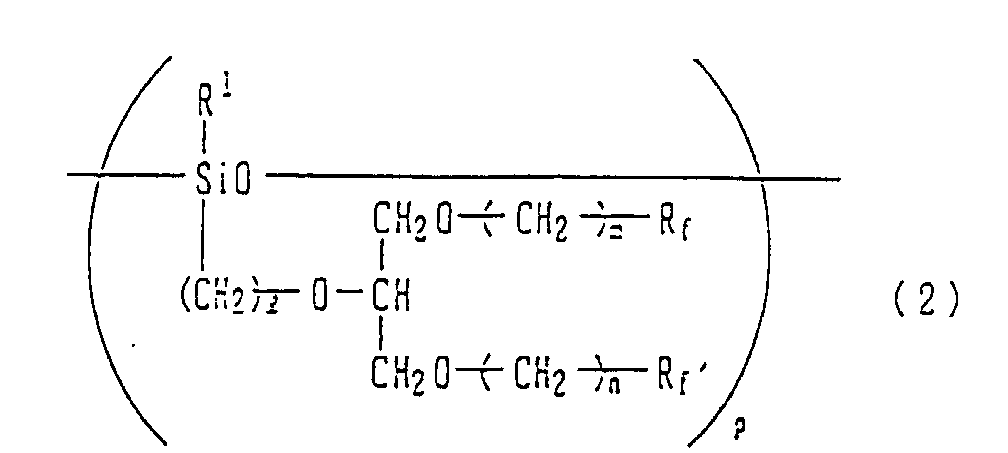 et des motifs polysiloxane représentés par la formule générale suivante (4) :
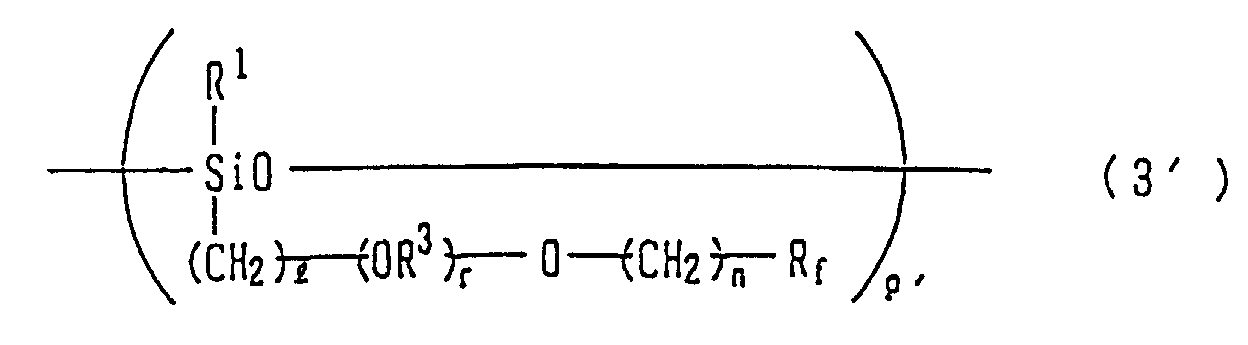 dans lesquelles Rf et Rf' représentent individuellement un groupement perfluoroalkyle comportant de 1 à 20 atomes de carbone ou un groupement ω-H-perfluoroalkyle représenté par la formule H(CF2)t- dans laquelle t désigne un nombre entier de 1 à 20, R1, R4 et R5 peuvent être identiques l'un à l'autre ou différents l'un de l'autre et représentent individuellement un groupement hydrocarbure aliphatique à chaíne droite ou ramifié comportant de 1 à 20 atomes de carbone, ou un groupement hydrocarbure alicyclique ou aromatique comportant de 5 à 10 atomes de carbone, R2 désigne un atome d'hydrogène, un groupement hydrocarbure aliphatique à chaíne droite ou ramifié comportant de 1 à 20 atomes de carbone, un groupement hydrocarbure alicyclique ou aromatique comportant de 5 à 10 atomes de carbone, un groupement perfluoroalkyle comportant de 1 à 20 atomes de carbone, ou un groupement ω-H-perfluoroalkyle représenté par la formule H(CF2)u- dans laquelle u désigne un nombre entier de 1 à 20, R3 est un groupement hydrocarbure divalent comportant de 2 à 16 atomes de carbone, X et Y représentent individuellement une liaison simple, -CO- ou un groupement hydrocarbure divalent comportant de 1 à 6 atomes de carbone, ℓ désigne un nombre de 2 à 16, m et n sont individuellement un nombre de 1 à 6, p et p' indiquent individuellement un nombre de 1 à 200, r est un nombre de 0 à 50, et s est un nombre de 0 à 200, à la première condition que p' + S ≥ 5, à la seconde condition que le dérivé de silicone modifié par le fluor (B) ne soit pas un cyclopolysiloxane de la formule suivante
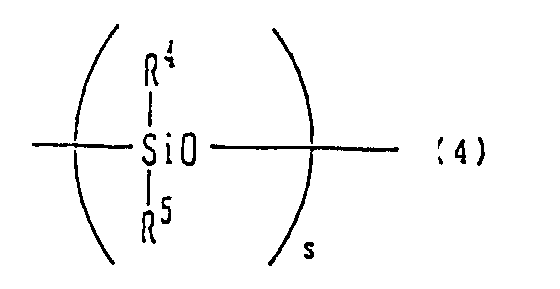 dans laquelle R est un atome d'hydrogène ou un groupement alkyle inférieur, R' est un groupement hydrocarbure monovalent, b est un nombre entier de 1 à 10, c est un nombre entier de 0 à 9, et la somme de b et c est de 3 à 10, et à la troisième condition que le dérivé de silicone revendiqué ne présente pas la formule moyenne (CF3-CH2-O-CH2-CH2)0,83 (SiO)0,995 (CH3)1.18.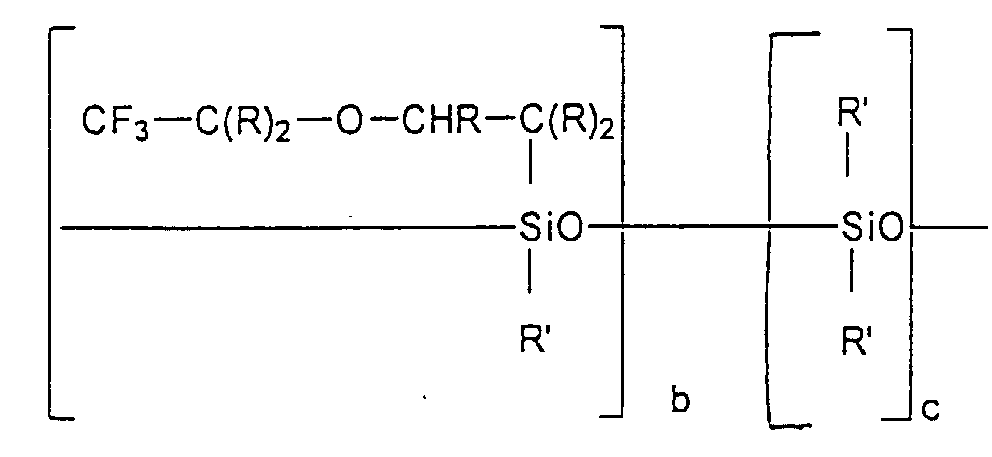
- Dérivé de silicone modifié par le fluor (B) selon la revendication 1, qui est représenté par la formule générale suivante (5) :dans laquelle au moins l'un de Z1 et Z2 représente un groupement sélectionné parmi les formules générales (1), (2) et (3'), celui quireste indique une liaison simple, et s, R4 et R5 ont la même signification que défini ci-dessus.
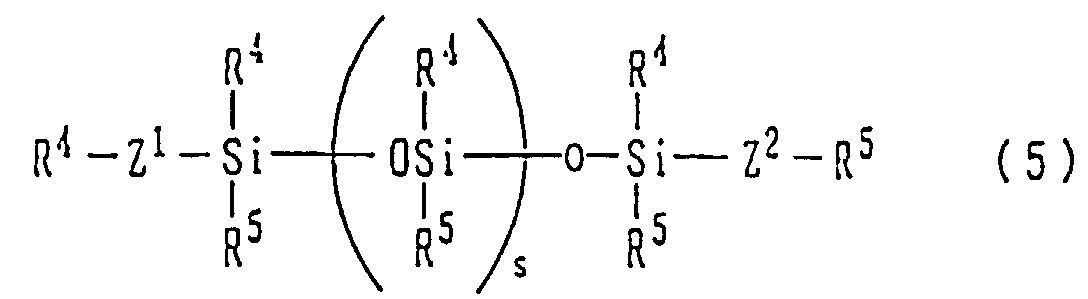
- Dérivé de silicone modifié par le fluor (B) selon la revendication 1, qui est représenté par la formule générale suivante (6) :dans laquelle Z3 représente un groupement sélectionné parmi les formules générales (1), (2) et (3'), R6 est un groupement hydrocarbure aliphatique à chaíne droite ou ramifié comportant de 1 à 20 atomes de carbone ou un groupement hydrocarbure alicyclique ou aromatique comportant de 5 à 10 atomes de carbone, et s, R4 et R5 ont la même signification que défini ci-dessus.

- Procédé de préparation d'un dérivé de silicone modifié par le fluor présentant un degré de polymérisation de 2 à 400 et comprenant des motifs polysiloxane sélectionnés parmi des motifs structurels représentés par les formules générales suivantes (1) et (2):
 et des motifs polysiloxane représentés par la formule générale suivante (4) :
 dans lesquelles Rf et Rf' représentent individuellement un groupement perfluoroalkyle comportant de 1 à 20 atomes de carbone ou un groupement ω-H-perfluoroalkyle représenté par la formule H(CF2)t- dans laquelle t désigne un nombre entier de 1 à 20, R1, R4 et R5 peuvent être identiques l'un à l'autre ou différents l'un de l'autre et représentent individuellement un groupement hydrocarbure aliphatique à chaíne droite ou ramifié comportant de 1 à 20 atomes de carbone, ou un groupement hydrocarbure alicyclique ou aromatique comportant de 5 à 10 atomes de carbone, R2 indique un atome d'hydrogène, un groupement hydrocarbure aliphatique à chaíne droite ou ramifié comportant de 1 à 20 atomes de carbone, un groupement hydrocarbure alicyclique ou aromatique comportant de 5 à 10 atomes de carbone, un groupement perfluoroalkyle comportant de 1 à 20 atomes de carbone, ou un groupement ω-H-perfluoroalkyle représenté par la formule H(CF2)u- dans laquelle u désigne un nombre entier de 1 à 20, ℓ désigne un nombre de 2 à 16, m et n sont individuellement un nombre de 1 à 6, et p indique un nombre de 1 à 200, qui comprend la mise en réaction d'un composé comportant des motifs polysiloxane représentés par les formules générales suivantes (7) et (4) :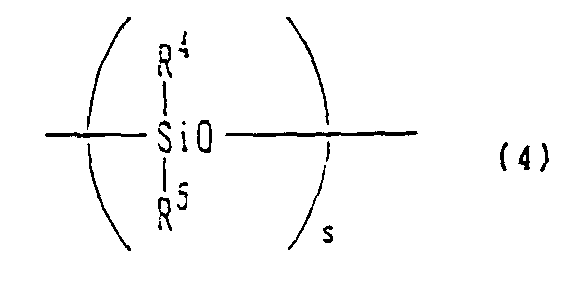
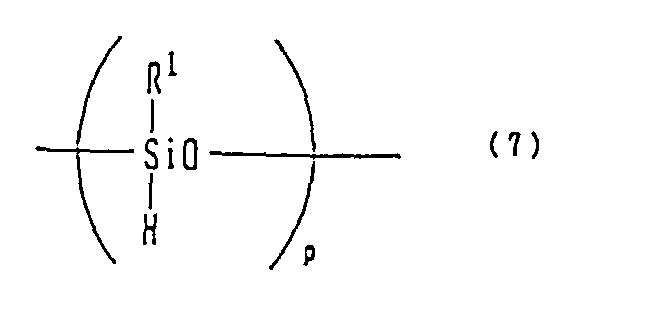 dans lesquelles s désigne un nombre de 0 à 200, et R1, R4, R5 et p ont la même signification que défini ci-dessus, avec un composé représenté par la formule générale (8) ou (9) :
 dans lesquelles X et Y représentent individuellement une liaison simple, -CO- ou un groupement hydrocarbure divalent comportant de 1 à 6 atomes de carbone, et Rf, Rf', R2, ℓ, m et n ont la même signification que défini ci-dessus.
- Procédé de préparation d'un dérivé de silicone modifié par le fluor présentant un degré de polymérisation de 2 à 400 et comprenant des motifs polysiloxane représentés par la formule générale (3') :et des motifs polysiloxane représentés par la formule générale (4) :
 dans lesquelles Rf représente un groupement perfluoroalkyle comportant de 1 à 20 atomes de carbone ou un groupement ω-H-perfluoroalkyle représenté par la formule H(CF2)t- dans laquelle t désigne un nombre entier de 1 à 20, R1, R4 et R5 peuvent être identiques l'un à l'autre ou différents l'un de l'autre et représentent individuellement un groupement hydrocarbure aliphatique à chaíne droite ou ramifié comportant de 1 à 20 atomes de carbone, ou un groupement hydrocarbure alicyclique ou aromatique comportant de 5 à 10 atomes de carbone, R3 indique un groupement hydrocarbure divalent comportant de 2 à 16 atomes de carbone, ℓ désigne un nombre de 2 à 16, n est un nombre de 1 à 6, p' indique un nombre de 1 à 200, r est un nombre de 0 à 50, et s désigne un nombre de 0 à 200, à la condition que p' + S ≥ 5, et à la condition que le dérivé de silicone modifié par le fluor (B) ne soit pas un cyclopolysiloxane de la formule suivante
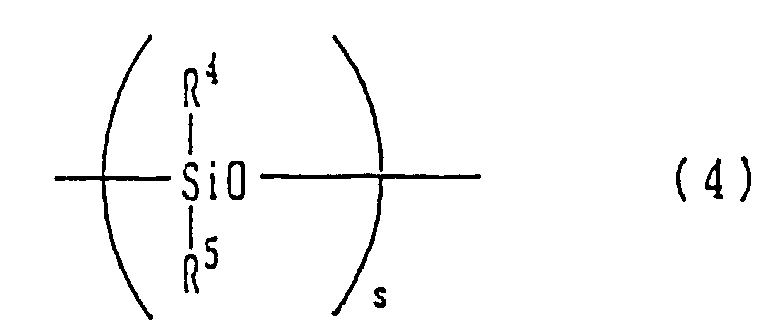 dans laquelle R est un atome d'hydrogène ou un groupement alkyle inférieur, R' est un groupement hydrocarbure monovalent, b est un nombre entier de 1 à 10, c est un nombre entier de 0 à 9, et la somme de b et c est de 3 à 10, qui comprend la mise en réaction d'un composé comportant des motifs polysiloxane représentés par les formules générales (10) et (4) :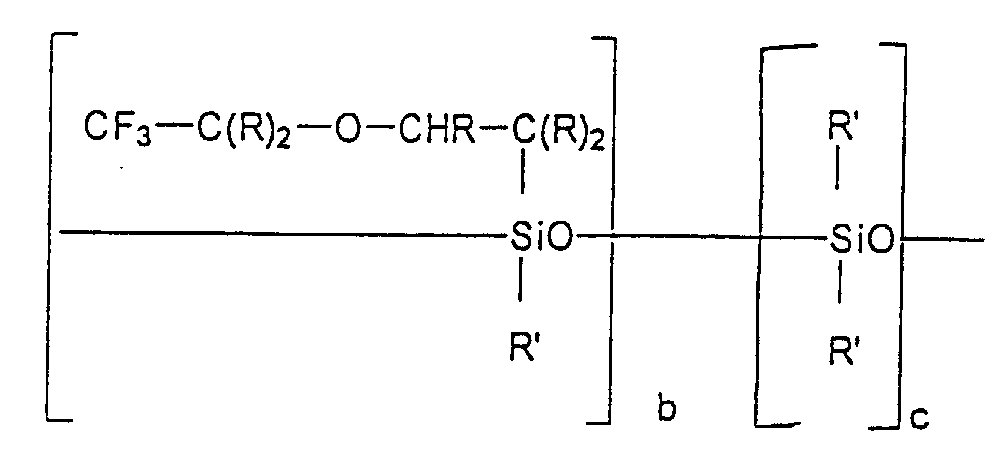
 dans lesquelles R1, R4, R5, p' et s ont la même signification que défini ci-dessus, avec un composé représenté par la formule générale (11)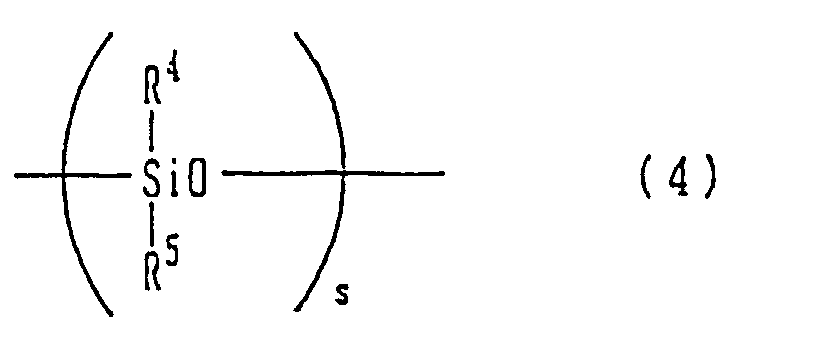
- Composé représenté par la formule générale suivante (8) :dans laquelle Rf représente un groupement perfluoroalkyle comportant de 1 à 20 atomes de carbone ou un groupement ω-H-perfluoroalkyle représenté par la formule H(CF2)t- dans laquelle t désigne un nombre entier de 1 à 20, R2 indique un atome d'hydrogène, un groupement hydrocarbure aliphatique à chaíne droite ou ramifié comportant de 1 à 20 atomes de carbone, un groupement hydrocarbure alicyclique ou aromatique comportant de 5 à 10 atomes de carbone, un groupement perfluoroalkyle comportant de 1 à 20 atomes de carbone, ou un groupement ω-H-perlfuoroalkyle représenté par la formule H(CF2)u- dans laquelle u désigne un nombre entier de 1 à 20, X et Y représentent individuellement une liaison simple, -CO- ou un groupement hydrocarbure divalent comportant de 1 à 6 atomes de carbone, et ℓ désigne un nombre de 2 à 16.
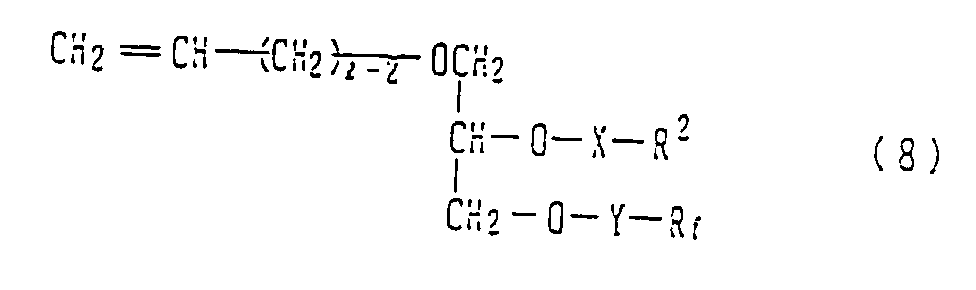
- Composé représenté par la formule générale suivante (9) :dans laquelle Rf et Rf' représentent individuellement un groupement perfluoroalkyle comportant de 1 à 20 atomes de carbone ou un groupement ω-H-perfluoroalkyle représenté par la formule H(CF2)t- dans laquelle t désigne un nombre entier de 1 à 20, ℓ désigne un nombre de 2 à 16, et m et n sont individuellement un nombre de 1 à 6.

- Composition cosmétique comprenant un dérivé de silicone modifié par le fluor (A) présentant un degré de polymérisation de 2 à 400 et comprenant des motifs polysiloxane sélectionnés parmi des motifs structurels représentés par les formules générales suivantes (1), (2) et (3) :
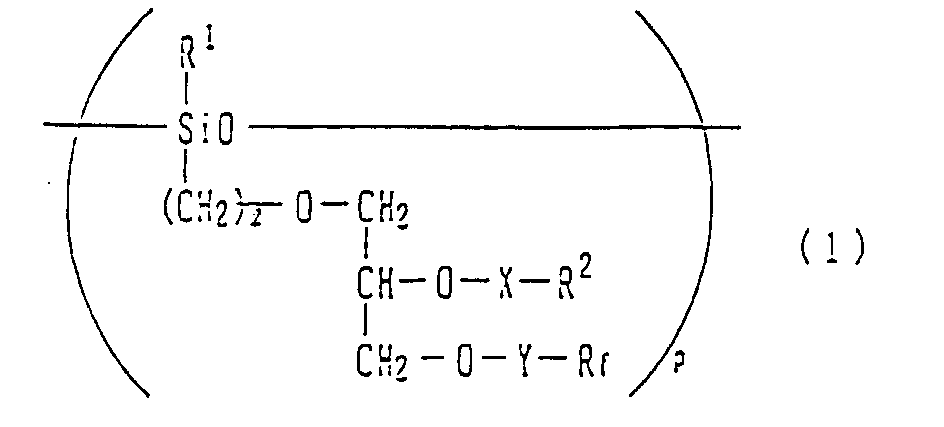
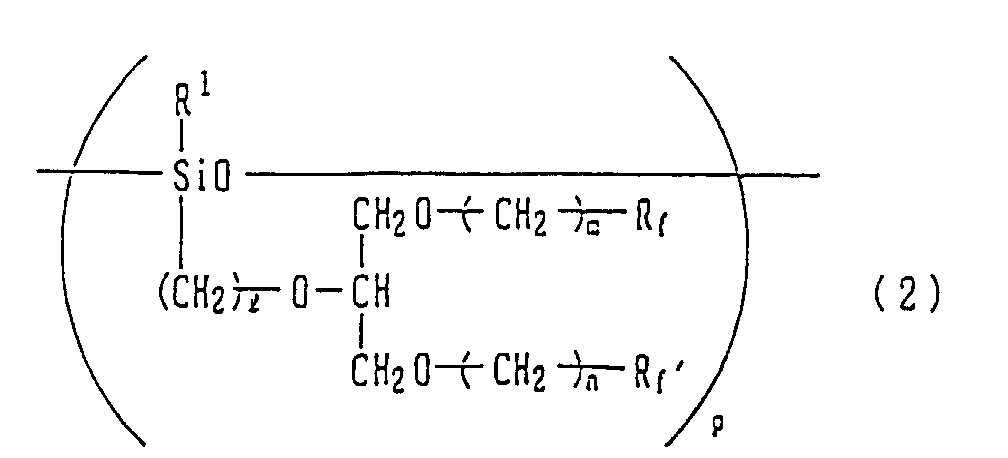 et des motifs polysiloxane représentés par la formule générale suivante (4) :
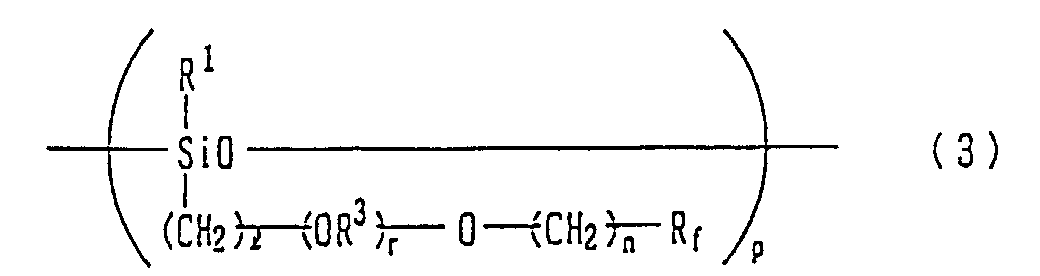 dans lesquelles Rf et Rf' représentent individuellement un groupement perfluoroalkyle comportant de 1 à 20 atomes de carbone ou un groupement ω-H-perfluoroalkyle représenté par la formule H(CF2)t- dans laquelle t désigne un nombre entier de 1 à 20, R1, R4 et R5 peuvent être identiques l'un à l'autre ou différents l'un de l'autre et représentent individuellement un groupement hydrocarbure aliphatique à chaíne droite ou ramifié comportant de 1 à 20 atomes de carbone, ou un groupement hydrocarbure alicyclique ou aromatique comportant de 5 à 10 atomes de carbone, R2 indique un atome d'hydrogène, un groupement hydrocarbure aliphatique à chaíne droite ou ramifié comportant de 1 à 20 atomes de carbone, un groupement hydrocarbure alicyclique ou aromatique comportant de 5 à 10 atomes de carbone, un groupement perfluoroalkyle comportant de 1 à 20 atomes de carbone, ou un groupement ω-H-perfluoroalkyle représenté par la formule H(CF2)u- dans laquelle u désigne un nombre entier de 1 à 20, R3 est un groupement hydrocarbure divalent comportant de 2 à 16 atomes de carbone, X et Y représentent individuellement une liaison simple, -CO- ou un groupement hydrocarbure divalent comportant de 1 à 6 atomes de carbone, ℓ désigne un nombre de 2 à 16, m et n sont individuellement un nombre de 1 à 6, p est un nombre de 1 à 200, r est un nombre de 0 à 50, et s est un nombre de 0 à 200.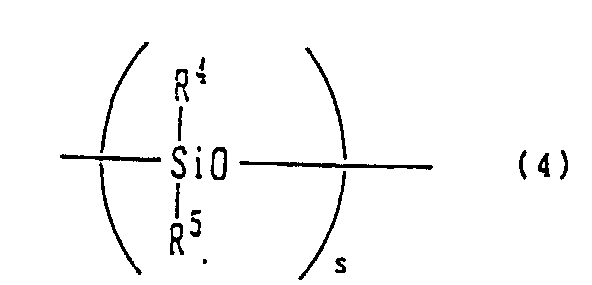
- Composition cosmétique selon la revendication 8, dans laquelle le dérivé de silicone modifié par le fluor (A) est représenté par la formule générale suivante (5) :dans laquelle au moins l'un de Z1 et Z2 représente un groupement sélectionné parmi les formules générales (1), (2) et (3), celui qui reste indique une liaison simple, et s, R4 et R5 ont la même signification que défini ci-dessus.

- Composition cosmétique selon la revendication 8, dans laquelle le dérivé de silicone modifié par le fluor (A) est représenté par la formule générale suivante (6) :dans laquelle Z3 représente un groupement sélectionné parmi les formules générales (1), (2) et (3), R6 est un groupement hydrocarbure aliphatique à chaíne droite ou ramifié comportant de 1 à 20 atomes de carbone ou un groupement hydrocarbure alicyclique ou aromatique comportant de 5 à 10 atomes de carbone, et s, R4 et R5 ont la même signification que défini ci-dessus.

Applications Claiming Priority (7)
| Application Number | Priority Date | Filing Date | Title |
|---|---|---|---|
| JP51640/92 | 1992-03-10 | ||
| JP5164092 | 1992-03-10 | ||
| JP5164092A JP2720127B2 (ja) | 1992-03-10 | 1992-03-10 | フッ素変性シリコーン、その製造法及びこれを含有する化粧料 |
| JP33414392 | 1992-12-15 | ||
| JP334143/92 | 1992-12-15 | ||
| JP4334143A JP2720134B2 (ja) | 1992-12-15 | 1992-12-15 | フッ素変性シリコーン及びその製造方法、並びにそれを含有する化粧料 |
| PCT/JP1993/000223 WO1993018085A1 (fr) | 1992-03-10 | 1993-02-23 | Derive de silicone modifie par le fluor, production de ce derive et cosmetique en contenant |
Publications (3)
| Publication Number | Publication Date |
|---|---|
| EP0640644A4 EP0640644A4 (fr) | 1994-11-09 |
| EP0640644A1 EP0640644A1 (fr) | 1995-03-01 |
| EP0640644B1 true EP0640644B1 (fr) | 1999-07-07 |
Family
ID=26392190
Family Applications (1)
| Application Number | Title | Priority Date | Filing Date |
|---|---|---|---|
| EP93904340A Expired - Lifetime EP0640644B1 (fr) | 1992-03-10 | 1993-02-23 | Derive de silicone modifie par le fluor, production de ce derive et cosmetique en contenant |
Country Status (5)
| Country | Link |
|---|---|
| US (4) | US5548054A (fr) |
| EP (1) | EP0640644B1 (fr) |
| DE (1) | DE69325580T2 (fr) |
| ES (1) | ES2136123T3 (fr) |
| WO (1) | WO1993018085A1 (fr) |
Families Citing this family (24)
| Publication number | Priority date | Publication date | Assignee | Title |
|---|---|---|---|---|
| EP0640644B1 (fr) * | 1992-03-10 | 1999-07-07 | Kao Corporation | Derive de silicone modifie par le fluor, production de ce derive et cosmetique en contenant |
| US6961442B2 (en) * | 2001-03-09 | 2005-11-01 | Digimarc Corporation | Watermarking a carrier on which an image will be placed or projected |
| CN1169812C (zh) * | 1994-05-30 | 2004-10-06 | 大金工业株式会社 | 氟硅氧烷化合物及含有该化合物的组合物 |
| FR2737214B1 (fr) | 1995-07-25 | 1997-10-24 | Rhone Poulenc Chimie | Polyorganosiloxanes perhalogenes polyfonctionnels et leurs procedes d'obtention |
| US5834612A (en) * | 1996-05-18 | 1998-11-10 | Asahi Glass Company Ltd. | Fluorine-containing organic compound |
| TW419379B (en) * | 1996-08-26 | 2001-01-21 | Shiseido Co Ltd | Lipstick composition |
| FR2765103B1 (fr) | 1997-06-26 | 2001-02-02 | Oreal | Composition cosmetique ou dermatologique contenant au moins une silicone fluoree a chaine alkyle |
| JP2001511437A (ja) * | 1997-07-31 | 2001-08-14 | ロディア・シミ | 官能化されたポリオルガノシロキサンを含む化粧品組成物 |
| FR2766704B1 (fr) * | 1997-07-31 | 1999-12-10 | Rhodia Chimie Sa | Composition parfumante et utilisation d'organotrisiloxanes a fonction polaire ou polarisable comme agents solubilisants et emollients dans les compositions parfumantes |
| US5892086A (en) * | 1998-05-29 | 1999-04-06 | Pcr, Inc. | Perfluorinated ether organo substituted cyclosiloxanes and copolymers prepared from these cyclosiloxanes |
| WO1999062916A1 (fr) * | 1998-05-29 | 1999-12-09 | Archimica (Florida) Inc. | Cyclosiloxanes a substitution organo perfluores et copolymeres prepares a partir desdits cyclosiloxanes |
| US5914420A (en) * | 1998-05-29 | 1999-06-22 | Pcr, Inc. | Perfluorinated organo substituted cyylosiloxanes and copolymers prepared from these cyclosiloxahes |
| US6551241B1 (en) * | 1999-12-17 | 2003-04-22 | Leonard S. Schultz | Instruments and methods for performing percutaneous surgery |
| US6423329B1 (en) | 1999-02-12 | 2002-07-23 | The Procter & Gamble Company | Skin sanitizing compositions |
| US6183766B1 (en) | 1999-02-12 | 2001-02-06 | The Procter & Gamble Company | Skin sanitizing compositions |
| US20010016202A1 (en) * | 2000-01-14 | 2001-08-23 | Shiseido Company, Ltd. | Silicone-treated powder, process of production thereof and composition containing the same |
| US6703378B1 (en) * | 2002-09-19 | 2004-03-09 | Bausch & Lomb Incorporated | Vitreoretinal tamponades based on fluorosilicone fluids |
| KR100925902B1 (ko) * | 2002-10-19 | 2009-11-09 | 주식회사 엘지생활건강 | 염모제 조성물 |
| US7323162B2 (en) * | 2002-12-27 | 2008-01-29 | Avon Products, Inc. | Aqueous cosmetic coloring and gloss compositions having film formers |
| WO2011123737A1 (fr) * | 2010-04-01 | 2011-10-06 | The Procter & Gamble Company | Polymères de soin |
| JP5679501B2 (ja) | 2012-02-28 | 2015-03-04 | 花王株式会社 | 化粧料 |
| CN104136001B (zh) * | 2012-02-28 | 2016-11-09 | 花王株式会社 | 化妆品 |
| JP6373363B2 (ja) * | 2013-05-31 | 2018-08-15 | スリーエム イノベイティブ プロパティズ カンパニー | フルオロアルキルシリコーン |
| JP2017517587A (ja) | 2014-03-31 | 2017-06-29 | スリーエム イノベイティブ プロパティズ カンパニー | フルオロアルキルシリコーン |
Citations (2)
| Publication number | Priority date | Publication date | Assignee | Title |
|---|---|---|---|---|
| DE1495859A1 (de) * | 1960-10-31 | 1969-05-14 | Gen Electric | Organopolysiloxane und Verfahren zur Herstellung derselben |
| EP0458617A2 (fr) * | 1990-05-22 | 1991-11-27 | Shin-Etsu Chemical Co., Ltd. | Composition de caoutchouc de silicone |
Family Cites Families (8)
| Publication number | Priority date | Publication date | Assignee | Title |
|---|---|---|---|---|
| DE3248535A1 (de) * | 1982-12-29 | 1984-07-12 | Wacker-Chemie GmbH, 8000 München | Fluoralkyloxyalkylgruppen aufweisendes diorganopolysiloxan und dessen verwendung |
| JPS6474268A (en) * | 1987-09-14 | 1989-03-20 | Shinetsu Chemical Co | Curable silicone composition |
| JP2674598B2 (ja) * | 1987-09-25 | 1997-11-12 | 旭硝子株式会社 | 機能性油剤 |
| JPH0662647B2 (ja) * | 1988-02-12 | 1994-08-17 | 信越化学工業株式会社 | 含フッ素有機ケイ素化合物 |
| US5012011A (en) * | 1989-10-20 | 1991-04-30 | Gaf Chemicals Corporation | Fluorinated vinyl ether |
| US5124467A (en) * | 1990-07-20 | 1992-06-23 | Ciba-Geigy Corporation | Perfluoroalkypolyoxyalkylpolysiloxane surfactants |
| DE69128321T2 (de) * | 1990-08-30 | 1998-05-20 | Kao Corp | Polysiloxanderivat, dessen Verwendung als Emulgator und kosmetische Präparationen |
| EP0640644B1 (fr) * | 1992-03-10 | 1999-07-07 | Kao Corporation | Derive de silicone modifie par le fluor, production de ce derive et cosmetique en contenant |
-
1993
- 1993-02-23 EP EP93904340A patent/EP0640644B1/fr not_active Expired - Lifetime
- 1993-02-23 WO PCT/JP1993/000223 patent/WO1993018085A1/fr not_active Ceased
- 1993-02-23 US US08/290,868 patent/US5548054A/en not_active Expired - Lifetime
- 1993-02-23 DE DE69325580T patent/DE69325580T2/de not_active Expired - Fee Related
- 1993-02-23 ES ES93904340T patent/ES2136123T3/es not_active Expired - Lifetime
-
1996
- 1996-02-23 US US08/606,339 patent/US5700898A/en not_active Expired - Lifetime
-
1997
- 1997-09-19 US US08/934,086 patent/US5976518A/en not_active Expired - Fee Related
- 1997-09-19 US US08/933,986 patent/US6018082A/en not_active Expired - Fee Related
Patent Citations (2)
| Publication number | Priority date | Publication date | Assignee | Title |
|---|---|---|---|---|
| DE1495859A1 (de) * | 1960-10-31 | 1969-05-14 | Gen Electric | Organopolysiloxane und Verfahren zur Herstellung derselben |
| EP0458617A2 (fr) * | 1990-05-22 | 1991-11-27 | Shin-Etsu Chemical Co., Ltd. | Composition de caoutchouc de silicone |
Also Published As
| Publication number | Publication date |
|---|---|
| EP0640644A1 (fr) | 1995-03-01 |
| DE69325580D1 (de) | 1999-08-12 |
| WO1993018085A1 (fr) | 1993-09-16 |
| US6018082A (en) | 2000-01-25 |
| US5548054A (en) | 1996-08-20 |
| US5700898A (en) | 1997-12-23 |
| DE69325580T2 (de) | 1999-11-25 |
| EP0640644A4 (fr) | 1994-11-09 |
| ES2136123T3 (es) | 1999-11-16 |
| US5976518A (en) | 1999-11-02 |
Similar Documents
| Publication | Publication Date | Title |
|---|---|---|
| US5548054A (en) | Fluorine-modified silicone derivative, production thereof and cosmetic containing the same | |
| KR101489982B1 (ko) | 겔 조성물과 화장료 | |
| US5463009A (en) | Fluorine-modified silicone, process for preparing the same, and cosmetics containing the same | |
| JP4949550B2 (ja) | 化粧料 | |
| JP3976226B2 (ja) | 多価アルコール変性シリコーン及びそれを含有する化粧料 | |
| JP3724988B2 (ja) | 新規シリコーン化合物及びそれを含有してなる化粧料 | |
| US20030158363A1 (en) | Odorless modified silicone compound,cosmetic preparation containing the same, and method of purifying modified silicone compound having branch polymer comprising hydrophilic group | |
| KR101293516B1 (ko) | 부분적으로 탄화수소 그룹차단된 (폴리)글리세롤변성된 폴리실록산, 이의 제조방법 및 이를 함유하는 화장품 조성물 | |
| JP5384788B2 (ja) | 乳化化粧料 | |
| EP0475130A2 (fr) | Produit dérivé de polysiloxane, procédé de fabrication et agents contenant ce dérivé | |
| JP4723083B2 (ja) | シリコーン分岐型ポリエーテル変性シリコーン化合物の製造方法及びこの方法によって得られた化合物を含有する化粧料 | |
| JP2720134B2 (ja) | フッ素変性シリコーン及びその製造方法、並びにそれを含有する化粧料 | |
| JPH07277914A (ja) | 化粧料 | |
| US5466442A (en) | Cholesteryl silicone derivative and cosmetic composition comprising the same | |
| JPH1192335A (ja) | 油性固形化粧料 | |
| JPH05262616A (ja) | 化粧料 | |
| JPH06234858A (ja) | フッ素変性シリコーン誘導体及びその製造方法、並びにそれを含有する化粧料 | |
| JP6546127B2 (ja) | 新規シリコーン化合物およびこれを含む化粧料 | |
| JP5570841B2 (ja) | フッ素変性シリコーンを含有する化粧料 | |
| JP2720127B2 (ja) | フッ素変性シリコーン、その製造法及びこれを含有する化粧料 | |
| JP3073885B2 (ja) | 化粧料 | |
| JPH09249518A (ja) | 変性シロキサン化合物、その製造法及びこれを含有する化粧料 | |
| JP2005097151A (ja) | 皮膚用化粧料 | |
| JPH0967240A (ja) | 乳化化粧料 | |
| JP3474932B2 (ja) | フッ素変性シリコーン、その製造方法及びこれを含有する化粧料 |
Legal Events
| Date | Code | Title | Description |
|---|---|---|---|
| A4 | Supplementary search report drawn up and despatched | ||
| AK | Designated contracting states |
Kind code of ref document: A4 Designated state(s): DE ES FR GB |
|
| PUAI | Public reference made under article 153(3) epc to a published international application that has entered the european phase |
Free format text: ORIGINAL CODE: 0009012 |
|
| 17P | Request for examination filed |
Effective date: 19940902 |
|
| AK | Designated contracting states |
Kind code of ref document: A1 Designated state(s): DE ES FR GB |
|
| 17Q | First examination report despatched |
Effective date: 19960809 |
|
| GRAG | Despatch of communication of intention to grant |
Free format text: ORIGINAL CODE: EPIDOS AGRA |
|
| GRAG | Despatch of communication of intention to grant |
Free format text: ORIGINAL CODE: EPIDOS AGRA |
|
| GRAG | Despatch of communication of intention to grant |
Free format text: ORIGINAL CODE: EPIDOS AGRA |
|
| GRAH | Despatch of communication of intention to grant a patent |
Free format text: ORIGINAL CODE: EPIDOS IGRA |
|
| GRAH | Despatch of communication of intention to grant a patent |
Free format text: ORIGINAL CODE: EPIDOS IGRA |
|
| GRAA | (expected) grant |
Free format text: ORIGINAL CODE: 0009210 |
|
| AK | Designated contracting states |
Kind code of ref document: B1 Designated state(s): DE ES FR GB |
|
| REF | Corresponds to: |
Ref document number: 69325580 Country of ref document: DE Date of ref document: 19990812 |
|
| ET | Fr: translation filed | ||
| REG | Reference to a national code |
Ref country code: ES Ref legal event code: FG2A Ref document number: 2136123 Country of ref document: ES Kind code of ref document: T3 |
|
| PLBE | No opposition filed within time limit |
Free format text: ORIGINAL CODE: 0009261 |
|
| STAA | Information on the status of an ep patent application or granted ep patent |
Free format text: STATUS: NO OPPOSITION FILED WITHIN TIME LIMIT |
|
| 26N | No opposition filed | ||
| REG | Reference to a national code |
Ref country code: GB Ref legal event code: IF02 |
|
| PGFP | Annual fee paid to national office [announced via postgrant information from national office to epo] |
Ref country code: ES Payment date: 20090302 Year of fee payment: 17 |
|
| PGFP | Annual fee paid to national office [announced via postgrant information from national office to epo] |
Ref country code: DE Payment date: 20090219 Year of fee payment: 17 |
|
| PGFP | Annual fee paid to national office [announced via postgrant information from national office to epo] |
Ref country code: GB Payment date: 20090217 Year of fee payment: 17 |
|
| PGFP | Annual fee paid to national office [announced via postgrant information from national office to epo] |
Ref country code: FR Payment date: 20090213 Year of fee payment: 17 |
|
| GBPC | Gb: european patent ceased through non-payment of renewal fee |
Effective date: 20100223 |
|
| REG | Reference to a national code |
Ref country code: FR Ref legal event code: ST Effective date: 20101029 |
|
| PG25 | Lapsed in a contracting state [announced via postgrant information from national office to epo] |
Ref country code: FR Free format text: LAPSE BECAUSE OF NON-PAYMENT OF DUE FEES Effective date: 20100301 |
|
| PG25 | Lapsed in a contracting state [announced via postgrant information from national office to epo] |
Ref country code: DE Free format text: LAPSE BECAUSE OF NON-PAYMENT OF DUE FEES Effective date: 20100901 |
|
| REG | Reference to a national code |
Ref country code: ES Ref legal event code: FD2A Effective date: 20110308 |
|
| PG25 | Lapsed in a contracting state [announced via postgrant information from national office to epo] |
Ref country code: GB Free format text: LAPSE BECAUSE OF NON-PAYMENT OF DUE FEES Effective date: 20100223 |
|
| PG25 | Lapsed in a contracting state [announced via postgrant information from national office to epo] |
Ref country code: ES Free format text: LAPSE BECAUSE OF NON-PAYMENT OF DUE FEES Effective date: 20110307 |
|
| PG25 | Lapsed in a contracting state [announced via postgrant information from national office to epo] |
Ref country code: ES Free format text: LAPSE BECAUSE OF NON-PAYMENT OF DUE FEES Effective date: 20100224 |