EP0640812A2 - Procédé pour la mesure par fluorescence de la capacité volumétrique d'une surface gravée en cellules - Google Patents
Procédé pour la mesure par fluorescence de la capacité volumétrique d'une surface gravée en cellules Download PDFInfo
- Publication number
- EP0640812A2 EP0640812A2 EP94113080A EP94113080A EP0640812A2 EP 0640812 A2 EP0640812 A2 EP 0640812A2 EP 94113080 A EP94113080 A EP 94113080A EP 94113080 A EP94113080 A EP 94113080A EP 0640812 A2 EP0640812 A2 EP 0640812A2
- Authority
- EP
- European Patent Office
- Prior art keywords
- cells
- fluorescent
- fluorescent fluid
- fluid
- volumetric capacity
- Prior art date
- Legal status (The legal status is an assumption and is not a legal conclusion. Google has not performed a legal analysis and makes no representation as to the accuracy of the status listed.)
- Granted
Links
Images


Classifications
-
- G—PHYSICS
- G01—MEASURING; TESTING
- G01F—MEASURING VOLUME, VOLUME FLOW, MASS FLOW OR LIQUID LEVEL; METERING BY VOLUME
- G01F17/00—Methods or apparatus for determining the capacity of containers or cavities, or the volume of solid bodies
Definitions
- the invention relates to a method of using fluorescent means to measure the volumetric capacity of a selected area, such as the volumetric capacity of a fluid metering roller.
- fluid metering or transfer rolls are used to transfer measured amounts of ink onto printing plates.
- the rolls are generally referred to as anilox rolls.
- liquid glue or other substances can be transferred onto surfaces of various substrates.
- the metering rolls are generally engraved with an array of closely spaced, shallow depressions referred to as cells.
- ink is fed into the cells and onto the transfer surface of an anilox roll from an ink transfer roll turning within an ink bath.
- a doctor blade is scraped against the roll so that excess ink is removed and the remaining ink on the anilox roll is contained only in the cells.
- the ink in the cells is then transferred to a substrate, such as a polymer or paper material. The design or image formed by the ink cells is thus imprinted on the substrate.
- the anilox roll is generally cylindrical and may be constructed in various diameters and lengths, containing cells of various sizes and shapes.
- the volumetric capacity of an anilox roll for a fluid such as ink is dependent upon the selection of cell size and shape, and number of cells per unit area.
- the cell pattern or design may be fine (many small cells per square inch ) or coarse (fewer larger cells per square inch).
- Anilox rolls having high cell density are used for high-quality printing and rolls having the largest cells are used in non-printing applications such as the application of glue or paint.
- BCM cubic microns per square inch
- the anilox roll is forced against a printing plate and against a doctor blade during ink transfer with the result that surface friction wear occurs. This surface wear of the anilox roll can reduce the volume of the anilox roll.
- U.S. Patent No. 4,628,728 discloses a method for measuring the volumetric capacity of an anilox roll by depositing a measured amount of ink onto the surface of an anilox roll and the area that the measured amount of ink will cover is determined.
- the ink is dispensed from a precision micro pipette directly onto the surface of the anilox roll.
- a sheet of transfer material having low absorbency is then spread over the roll and the ink deposit lying between the anilox roll and the transfer sheet is spread by the application of a scraper blade across the backside of the transfer paper.
- the engraved cells are filled by the excess ink as it is spread across the cell transfer surface.
- the transfer paper is carefully removed and allowed to dry.
- the area of the transfer paper impression is then measured by overlaying the impression area with a transparent sheet of graph paper having suitable grid lines.
- the known quantity of ink deposited upon the roll (in billions of cubic microns or microliter) is then divided by the measured area of the transfer impression (in square inches), with the quotient being the volumetric capacity of the roll in billions of cubic microns per square inch.
- the invention relates to a method for measuring the volumetric capacity of a surface containing a plurality of engraved cells comprising the steps;
- Fluorescence is the property of certain fluids which when illuminated by radiation (electromagnetic or particulate) will emit or radiate electromagnetic waves of a different wavelength only as long as the stimulus producing the emission is maintained.
- Fluorescent fluids for use in this invention can be any commercial oils or lubricants that contain fluorescence or any solvents such as oils or lubricants that have fluorescence added.
- the fluorescent property of certain fluids along with the characteristics of anilox rolls to carry or absorb a specific amount of fluid per unit surface area, are used to provide a means for measuring the volumetric capacity of anilox rolls according to this invention.
- a small amount of a controlled pre-engineered concentration of a fluorescent liquid is deposited onto an anilox roll and a doctor blade system is then used to spread the excess fluid.
- the only requirement of the spread area is that it be equal to or exceed the fixed viewing window of the fluorescent measuring instrument (typically 10-60mm2).
- the spread fluorescent fluid is then measured for total fluorescence while still in the cells on the surface of the anilox roll.
- This fluorescent fluid is excited by a electromagnetic radiation source within a fluorescent measuring instrument. After transformation within the fluid, the emitted electromagnetic radiation from the fluid is collected and measured by the instrument.
- the output voltage value of the instrument is a measured value of the total fluorescence of the excited area and, because the concentration is controlled, it is directly proportional to the volume carrying capacity of the roll.
- the measured signal is directly proportionate to the average depth of the cells.
- the volumetric capacity of the anilox roll can easily be determined. This method provides an efficient and more accurate means for measuring the volumetric (area depth) capacity of anilox rolls without going through the process of producing a stain.
- Preferable fluorescent indicator fluids for use in this invention are the rodomine group of fluorophors such as blue excited, red emitting fluorphorus liquids mixed with a compatible oil. Suitable fluorophors are coumario, floural and violet 10. For most applications, the depth of the cells would be from 5 micron to 250 microns or more.
- the engraving of the cells can be done by any beam of energy such as by the laser means, or by mechanical or chemical means with laser means being the preferred.
- the diameter or contour of the cells can be controlled by the pattern and the number of laser-formed cells per lineal inch.
- a fluorimeter can be used to measure the emitted electromagnetic radiation and the amount detected will be proportional to the volume of the cells for a specific area tested.
- the amount of emitted electromagnetic radiation emitted from a specific area will be proportionate to the average thickness of the fluorescent liquid in the cells and knowing the size of the radiated area, the volumetric capacity of the engraved cells in the selected area can be directly measured. It is therefore preferred that the area to be evaluated be equal to or larger than the area that is observed by the fluorimeter.
- the fluorescent fluid deposited in the laser-engraved cells will also be deposited on the surface area defining the cells.
- a doctor blade should be used to remove any excess fluorescent fluid from the surface of the roll so that the fluorescent fluid only remains in the cells.
- the fluorescent fluid should have a low evaporation rate, be capable of wetting the roll and give a visible fluorescence signal in the area radiated by the fluorimeter. It is also preferable that the fluorescent fluid be excited by visible blue or short ultraviolet energy and give off a visible red spectrum. Many combinations of solvents and fluorescent materials are suitable for the practice of this invention.
- Figure 1 is a side elevational view of an anilox roll showing a laser-engraved pattern on the surface of the roll comprised of cells shown greatly magnified.
- Figure 2 is a cross-sectional view of the roll of Figure 1 taken through line a-a.
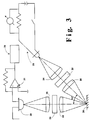
- Figure 3 is a schematic of a simple fluorescent measuring instrument.
- Figure 4 is a plot of percent of transmittance versus wavelength for the filters used in Figure 3.
- Figure 5 is a plot of fluorescence signal versus fluorescent dye concentration 7 mils thick.
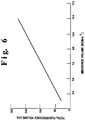
- Figure 6 is a plot of total fluorescent signal in millivolts versus measured volume for several anilox rolls.
- Figures 1 and 2 show a conventional type cylindrical 2 having a substrate 4 made of steel and having a surface coating 6 of a ceramic.
- a portion of the coated surface is shown with a plurality of cells 8 formed by a conventional laser-engraved treatment.
- the coated surface is engraved using a laser or other means to produce in the coated layer 6 a suitable pattern of cells 8 with each cell 8 having a preselected size so as to contain an amount of liquid to be transferred to a receiving surface.
- the number of cells would be significantly greater than that shown in the Figures and grouped together so that to the human eye they would not be identifiable.
- the depths of the laser-formed well 8 can vary from a few microns or less to as much as 200 microns or more.
- the coated surface 14 is finished to remove any recast and finished to a desired roughness. Because these steps reduce the cell capacity, it is desirable to accurately measure the volumetric capacity of the roll transfer surface containing the cells.
- An area 10 of the surface is selected and then a volume of a selected fluorescent fluid 12 is deposited and spread onto the surface 14 and into the cells 8.
- the fluorescent fluid can be a mixture of a fluorescent fluid and a compatible solvent such as an oil based liquid. In the solution of the fluorescent fluid, a trade-off exists between the fluorophor concentration in the oil and the detector sensitivity for typical engraved surfaces.
- the concentration should be preferably low enough that the energy entering a liquid-filled hole from the instrument does not get significantly attenuated before it reaches the bottom of the hole, but high enough to be measured with simple detection systems.
- the fluorescent material should have a low evaporation rate, wets the roll, gives a reasonable visible fluorescence signal in the red operating region and can be excited by visible blue or short ultraviolet energy.
- solvents and fluorescent fluids would work with the preferred being a light oil with a basic rodomine combination.
- tests were conducted with the use of an apparatus, shown schematically in Figure 3. Four lenses, 20, 22, 24 and 26 as shown in Figure 3, are arranged to give 1:1 image magnification.
- Cree silicon carbide blue light emitting diode 28 (LED) (peak output at 470 mn, with a wide bandwidth stretching into the yellow) is aligned with lenses 24 and 26.
- Photocell 30 is a standard silicon detector and the DC transimpedance amplifier 31 is a standard design.
- Two sets of glass filters 32 and 34 are used to separate exciting from emitted light.
- the curve shown in Figure 4 is from a filter book and, shows that one filter A favors seeing orange/red emission (34) and filter B favors seeing blue emission (32).
- the adsorption by the liquid is so great the curve goes extremely non-linear (dropping drastically instead of continuing to increase).
- the blue excited light is absorbed so strongly that the effective liquid sample thickness is no longer the full 7.5 mils (as is needed for full linear response), but is some much shorter thickness, getting worse as concentration rises.
- a diluted fluorescent dye should be used.
- a full-strength dye could be used; as the smaller the liquid thickness, the more linear will the fluorescent response be.
- the dye concentration can be tailored to any range of thickness to be used.
- Figure 6 is a signal plot of seven different engraved metering rolls, ranging from 2.7 BCM/in2 to 14.5 BCM/in2 using a 1/2 concentrated saturated solution of the preferred dye discussed above.
- the maximum depth of the cells for these tests was 85 micron (3.3 mils). This 1/2 concentration of the dye was used to optimize the signal for these shallow engravings.
- the data show that the relationship of measured total fluorescence on the meter 29 has a linear relationship with the volume of the fluorescent fluid in the engraved cells on the surface of the metering roll.
Landscapes
- Physics & Mathematics (AREA)
- Fluid Mechanics (AREA)
- General Physics & Mathematics (AREA)
- Investigating, Analyzing Materials By Fluorescence Or Luminescence (AREA)
- Inking, Control Or Cleaning Of Printing Machines (AREA)
- Spectrometry And Color Measurement (AREA)
Applications Claiming Priority (2)
| Application Number | Priority Date | Filing Date | Title |
|---|---|---|---|
| US111767 | 1993-08-25 | ||
| US08/111,767 US5438864A (en) | 1993-08-25 | 1993-08-25 | Method for fluorescent measuring the volumetric capacity of a cell-engraved surface |
Publications (3)
| Publication Number | Publication Date |
|---|---|
| EP0640812A2 true EP0640812A2 (fr) | 1995-03-01 |
| EP0640812A3 EP0640812A3 (fr) | 1996-02-07 |
| EP0640812B1 EP0640812B1 (fr) | 1999-11-10 |
Family
ID=22340344
Family Applications (1)
| Application Number | Title | Priority Date | Filing Date |
|---|---|---|---|
| EP94113080A Expired - Lifetime EP0640812B1 (fr) | 1993-08-25 | 1994-08-22 | Procédé pour la mesure par fluorescence de la capacité volumétrique d'une surface gravée en cellules |
Country Status (7)
| Country | Link |
|---|---|
| US (1) | US5438864A (fr) |
| EP (1) | EP0640812B1 (fr) |
| JP (1) | JP2767555B2 (fr) |
| CA (1) | CA2130650C (fr) |
| DE (1) | DE69421581T2 (fr) |
| ES (1) | ES2138021T3 (fr) |
| SG (1) | SG43810A1 (fr) |
Cited By (2)
| Publication number | Priority date | Publication date | Assignee | Title |
|---|---|---|---|---|
| EP0908697A1 (fr) * | 1997-10-11 | 1999-04-14 | Microspace Mess- und Sensortecknik GmbH | Procédé et appareil pour la mesure du volume des cellules sur un rouleu d'impression |
| WO2005063488A1 (fr) * | 2003-12-31 | 2005-07-14 | Perini, Fabio | Distributeur de substances liquides |
Families Citing this family (6)
| Publication number | Priority date | Publication date | Assignee | Title |
|---|---|---|---|---|
| US5831746A (en) * | 1993-02-25 | 1998-11-03 | Ohio Electronic Engravers, Inc. | Engraved area volume measurement system and method using pixel data |
| US5402246A (en) * | 1993-07-20 | 1995-03-28 | Ohio Electronic Engravers, Inc. | Method for predicting ink consumption |
| US6230548B1 (en) * | 1998-07-14 | 2001-05-15 | Chi-Neng Arthur Han | System for testing properties of materials |
| JP4722551B2 (ja) * | 2005-05-16 | 2011-07-13 | 日本電信電話株式会社 | 溶液吐出量評価装置及び方法 |
| US9925762B2 (en) | 2013-10-01 | 2018-03-27 | Laurent DE SCHOULEPNIKOFF | Method for the measurement of the volumetric capacity of a textured surface and device for performing the method |
| DE102021107098A1 (de) | 2021-03-23 | 2022-09-29 | ULMEX Industrie System GmbH & Co. KG | Verfahren und Maschine zur Prüfung einer Rasterwalze einer Druckvorrichtung |
Family Cites Families (4)
| Publication number | Priority date | Publication date | Assignee | Title |
|---|---|---|---|---|
| US4628728A (en) * | 1986-02-21 | 1986-12-16 | Wilson Engraving Company, Inc. | Method for measuring the volumetric capacity of anilox rolls |
| DE3617714A1 (de) * | 1986-05-27 | 1987-12-03 | Hell Rudolf Dr Ing Gmbh | Volumen-messverfahren fuer oberflaechenvertiefungen |
| US4994593A (en) * | 1988-11-28 | 1991-02-19 | Chesebrough-Pond's Usa Co. Division Of Conopco, Inc. | Hydroxylhydrocarbyl-modified aminoalkyl silicones |
| US5235851A (en) * | 1992-01-17 | 1993-08-17 | Pamarco Incorporated | Apparatus for the measurement of volumetric capacity of anilox rolls |
-
1993
- 1993-08-25 US US08/111,767 patent/US5438864A/en not_active Expired - Lifetime
-
1994
- 1994-08-22 CA CA002130650A patent/CA2130650C/fr not_active Expired - Fee Related
- 1994-08-22 EP EP94113080A patent/EP0640812B1/fr not_active Expired - Lifetime
- 1994-08-22 ES ES94113080T patent/ES2138021T3/es not_active Expired - Lifetime
- 1994-08-22 JP JP6218335A patent/JP2767555B2/ja not_active Expired - Fee Related
- 1994-08-22 DE DE69421581T patent/DE69421581T2/de not_active Expired - Lifetime
- 1994-08-22 SG SG1996001119A patent/SG43810A1/en unknown
Cited By (3)
| Publication number | Priority date | Publication date | Assignee | Title |
|---|---|---|---|---|
| EP0908697A1 (fr) * | 1997-10-11 | 1999-04-14 | Microspace Mess- und Sensortecknik GmbH | Procédé et appareil pour la mesure du volume des cellules sur un rouleu d'impression |
| WO2005063488A1 (fr) * | 2003-12-31 | 2005-07-14 | Perini, Fabio | Distributeur de substances liquides |
| US7571678B2 (en) | 2003-12-31 | 2009-08-11 | Fabio Perini | Distributor unit for liquid substances |
Also Published As
| Publication number | Publication date |
|---|---|
| CA2130650A1 (fr) | 1995-02-26 |
| EP0640812B1 (fr) | 1999-11-10 |
| JP2767555B2 (ja) | 1998-06-18 |
| US5438864A (en) | 1995-08-08 |
| ES2138021T3 (es) | 2000-01-01 |
| DE69421581D1 (de) | 1999-12-16 |
| CA2130650C (fr) | 1999-06-01 |
| SG43810A1 (en) | 1997-11-14 |
| DE69421581T2 (de) | 2000-05-18 |
| EP0640812A3 (fr) | 1996-02-07 |
| JPH07174605A (ja) | 1995-07-14 |
Similar Documents
| Publication | Publication Date | Title |
|---|---|---|
| DE69807089T2 (de) | Gerät zur durchführung von photometrischen untersuchungen | |
| JP3093851U (ja) | 蛍光参照プレート | |
| US7742164B1 (en) | Luminescence reference standards | |
| EP1259796B1 (fr) | Systeme de detection par resonance plasmonique de surface | |
| JP4368059B2 (ja) | 光センサおよび操作方法 | |
| US5438864A (en) | Method for fluorescent measuring the volumetric capacity of a cell-engraved surface | |
| WO2000075644A9 (fr) | Plate-forme de capteurs et procede permettant de determiner plusieurs substances a analyser | |
| EP1219951A1 (fr) | Appareil pour déterminer le volume des globules rouges | |
| US6529273B1 (en) | Monitoring oil films | |
| CN102026723A (zh) | 样品支持物及其使用方法 | |
| US4944593A (en) | Volume-measuring method for surface depressions | |
| US4800287A (en) | Measurement of image area from stored pixel data | |
| US20080038835A1 (en) | Reference Member for Fluorescence Measurements, and Method for the Production Thereof | |
| DE69900787T2 (de) | Verbesserter biomedizinischer test | |
| DE60130452T2 (de) | Referenzvorrichtung zur Evaluierung der Funktion eines konfokalen Laserscanmikroskops, sowie Verfahren und System zur Durchführung der Evaluierung | |
| Carlton et al. | Measuring spray coverage on soybean leaves | |
| MXPA01013108A (es) | Aparato para medir el volumen de celulas de sangre roja individuales. | |
| EP1223428B1 (fr) | Procédé de mesure du volume de globules rouges individuels | |
| DE3920193C2 (fr) | ||
| Häkkänen et al. | Laser-induced fluorescence imaging of paper surfaces | |
| Itaya et al. | Dynamic fluorescence microprobe method utilizing total internal reflection phenomenon | |
| Puvaravutipanich | The Study of using the banded anilox roller for color matching in flexography | |
| DE10058577C2 (de) | Verfahren und Vorrichtung für die Fluoreszenzkorrelationsspektroskopie zur Verstärkung der Fluoreszenzintensität | |
| SU896574A1 (ru) | Способ оценки качества бумаги дл печати | |
| GB2335978A (en) | Detecting the Background Noise of a Biomedical Assay |
Legal Events
| Date | Code | Title | Description |
|---|---|---|---|
| PUAI | Public reference made under article 153(3) epc to a published international application that has entered the european phase |
Free format text: ORIGINAL CODE: 0009012 |
|
| AK | Designated contracting states |
Kind code of ref document: A2 Designated state(s): CH DE ES FR GB IT LI |
|
| PUAL | Search report despatched |
Free format text: ORIGINAL CODE: 0009013 |
|
| AK | Designated contracting states |
Kind code of ref document: A3 Designated state(s): CH DE ES FR GB IT LI |
|
| 17P | Request for examination filed |
Effective date: 19960216 |
|
| 17Q | First examination report despatched |
Effective date: 19980728 |
|
| GRAG | Despatch of communication of intention to grant |
Free format text: ORIGINAL CODE: EPIDOS AGRA |
|
| GRAG | Despatch of communication of intention to grant |
Free format text: ORIGINAL CODE: EPIDOS AGRA |
|
| GRAH | Despatch of communication of intention to grant a patent |
Free format text: ORIGINAL CODE: EPIDOS IGRA |
|
| GRAH | Despatch of communication of intention to grant a patent |
Free format text: ORIGINAL CODE: EPIDOS IGRA |
|
| GRAA | (expected) grant |
Free format text: ORIGINAL CODE: 0009210 |
|
| ITF | It: translation for a ep patent filed | ||
| AK | Designated contracting states |
Kind code of ref document: B1 Designated state(s): CH DE ES FR GB IT LI |
|
| REG | Reference to a national code |
Ref country code: CH Ref legal event code: EP |
|
| REG | Reference to a national code |
Ref country code: CH Ref legal event code: NV Representative=s name: KIRKER & CIE SA |
|
| REF | Corresponds to: |
Ref document number: 69421581 Country of ref document: DE Date of ref document: 19991216 |
|
| REG | Reference to a national code |
Ref country code: ES Ref legal event code: FG2A Ref document number: 2138021 Country of ref document: ES Kind code of ref document: T3 |
|
| ET | Fr: translation filed | ||
| PLBE | No opposition filed within time limit |
Free format text: ORIGINAL CODE: 0009261 |
|
| STAA | Information on the status of an ep patent application or granted ep patent |
Free format text: STATUS: NO OPPOSITION FILED WITHIN TIME LIMIT |
|
| 26N | No opposition filed | ||
| REG | Reference to a national code |
Ref country code: GB Ref legal event code: IF02 |
|
| PGFP | Annual fee paid to national office [announced via postgrant information from national office to epo] |
Ref country code: FR Payment date: 20060831 Year of fee payment: 13 |
|
| REG | Reference to a national code |
Ref country code: FR Ref legal event code: ST Effective date: 20080430 |
|
| PG25 | Lapsed in a contracting state [announced via postgrant information from national office to epo] |
Ref country code: FR Free format text: LAPSE BECAUSE OF NON-PAYMENT OF DUE FEES Effective date: 20070831 |
|
| PGFP | Annual fee paid to national office [announced via postgrant information from national office to epo] |
Ref country code: ES Payment date: 20090826 Year of fee payment: 16 |
|
| PGFP | Annual fee paid to national office [announced via postgrant information from national office to epo] |
Ref country code: GB Payment date: 20090825 Year of fee payment: 16 Ref country code: CH Payment date: 20090825 Year of fee payment: 16 |
|
| PGFP | Annual fee paid to national office [announced via postgrant information from national office to epo] |
Ref country code: DE Payment date: 20090827 Year of fee payment: 16 |
|
| PGFP | Annual fee paid to national office [announced via postgrant information from national office to epo] |
Ref country code: IT Payment date: 20090828 Year of fee payment: 16 |
|
| REG | Reference to a national code |
Ref country code: CH Ref legal event code: PL |
|
| GBPC | Gb: european patent ceased through non-payment of renewal fee |
Effective date: 20100822 |
|
| PG25 | Lapsed in a contracting state [announced via postgrant information from national office to epo] |
Ref country code: CH Free format text: LAPSE BECAUSE OF NON-PAYMENT OF DUE FEES Effective date: 20100831 Ref country code: LI Free format text: LAPSE BECAUSE OF NON-PAYMENT OF DUE FEES Effective date: 20100831 |
|
| PG25 | Lapsed in a contracting state [announced via postgrant information from national office to epo] |
Ref country code: IT Free format text: LAPSE BECAUSE OF NON-PAYMENT OF DUE FEES Effective date: 20100822 |
|
| REG | Reference to a national code |
Ref country code: DE Ref legal event code: R119 Ref document number: 69421581 Country of ref document: DE Effective date: 20110301 |
|
| PG25 | Lapsed in a contracting state [announced via postgrant information from national office to epo] |
Ref country code: DE Free format text: LAPSE BECAUSE OF NON-PAYMENT OF DUE FEES Effective date: 20110301 |
|
| PG25 | Lapsed in a contracting state [announced via postgrant information from national office to epo] |
Ref country code: GB Free format text: LAPSE BECAUSE OF NON-PAYMENT OF DUE FEES Effective date: 20100822 |
|
| REG | Reference to a national code |
Ref country code: ES Ref legal event code: FD2A Effective date: 20111019 |
|
| PG25 | Lapsed in a contracting state [announced via postgrant information from national office to epo] |
Ref country code: ES Free format text: LAPSE BECAUSE OF NON-PAYMENT OF DUE FEES Effective date: 20100823 |