EP0640846B1 - Appareil de mesure optique - Google Patents
Appareil de mesure optique Download PDFInfo
- Publication number
- EP0640846B1 EP0640846B1 EP94306310A EP94306310A EP0640846B1 EP 0640846 B1 EP0640846 B1 EP 0640846B1 EP 94306310 A EP94306310 A EP 94306310A EP 94306310 A EP94306310 A EP 94306310A EP 0640846 B1 EP0640846 B1 EP 0640846B1
- Authority
- EP
- European Patent Office
- Prior art keywords
- signal
- light
- value
- frequency
- voltage
- Prior art date
- Legal status (The legal status is an assumption and is not a legal conclusion. Google has not performed a legal analysis and makes no representation as to the accuracy of the status listed.)
- Expired - Lifetime
Links
- 230000003287 optical effect Effects 0.000 title claims description 101
- 238000012545 processing Methods 0.000 claims description 12
- 238000012935 Averaging Methods 0.000 claims description 5
- 239000002184 metal Substances 0.000 claims description 3
- 230000000737 periodic effect Effects 0.000 claims description 3
- 238000005259 measurement Methods 0.000 description 35
- 239000000835 fiber Substances 0.000 description 27
- 230000008859 change Effects 0.000 description 14
- 239000000126 substance Substances 0.000 description 13
- 230000010355 oscillation Effects 0.000 description 11
- 238000000034 method Methods 0.000 description 7
- 238000012986 modification Methods 0.000 description 6
- 230000004048 modification Effects 0.000 description 6
- 238000006073 displacement reaction Methods 0.000 description 4
- 230000000694 effects Effects 0.000 description 3
- 239000008186 active pharmaceutical agent Substances 0.000 description 2
- 230000005540 biological transmission Effects 0.000 description 2
- 239000003990 capacitor Substances 0.000 description 2
- 238000012544 monitoring process Methods 0.000 description 2
- 230000008569 process Effects 0.000 description 2
- 206010028980 Neoplasm Diseases 0.000 description 1
- 238000006243 chemical reaction Methods 0.000 description 1
- 238000010276 construction Methods 0.000 description 1
- 238000001514 detection method Methods 0.000 description 1
- 230000006866 deterioration Effects 0.000 description 1
- 238000005286 illumination Methods 0.000 description 1
- 239000004973 liquid crystal related substance Substances 0.000 description 1
- 230000007246 mechanism Effects 0.000 description 1
- 238000002310 reflectometry Methods 0.000 description 1
- 238000011160 research Methods 0.000 description 1
- 230000004044 response Effects 0.000 description 1
- 229920006395 saturated elastomer Polymers 0.000 description 1
- 230000001052 transient effect Effects 0.000 description 1
- 238000002834 transmittance Methods 0.000 description 1
Images




Classifications
-
- G—PHYSICS
- G01—MEASURING; TESTING
- G01S—RADIO DIRECTION-FINDING; RADIO NAVIGATION; DETERMINING DISTANCE OR VELOCITY BY USE OF RADIO WAVES; LOCATING OR PRESENCE-DETECTING BY USE OF THE REFLECTION OR RERADIATION OF RADIO WAVES; ANALOGOUS ARRANGEMENTS USING OTHER WAVES
- G01S7/00—Details of systems according to groups G01S13/00, G01S15/00, G01S17/00
- G01S7/48—Details of systems according to groups G01S13/00, G01S15/00, G01S17/00 of systems according to group G01S17/00
- G01S7/481—Constructional features, e.g. arrangements of optical elements
- G01S7/4818—Constructional features, e.g. arrangements of optical elements using optical fibres
-
- G—PHYSICS
- G01—MEASURING; TESTING
- G01S—RADIO DIRECTION-FINDING; RADIO NAVIGATION; DETERMINING DISTANCE OR VELOCITY BY USE OF RADIO WAVES; LOCATING OR PRESENCE-DETECTING BY USE OF THE REFLECTION OR RERADIATION OF RADIO WAVES; ANALOGOUS ARRANGEMENTS USING OTHER WAVES
- G01S17/00—Systems using the reflection or reradiation of electromagnetic waves other than radio waves, e.g. lidar systems
- G01S17/02—Systems using the reflection of electromagnetic waves other than radio waves
- G01S17/06—Systems determining position data of a target
- G01S17/08—Systems determining position data of a target for measuring distance only
- G01S17/32—Systems determining position data of a target for measuring distance only using transmission of continuous waves, whether amplitude-, frequency-, or phase-modulated, or unmodulated
- G01S17/36—Systems determining position data of a target for measuring distance only using transmission of continuous waves, whether amplitude-, frequency-, or phase-modulated, or unmodulated with phase comparison between the received signal and the contemporaneously transmitted signal
-
- G—PHYSICS
- G01—MEASURING; TESTING
- G01S—RADIO DIRECTION-FINDING; RADIO NAVIGATION; DETERMINING DISTANCE OR VELOCITY BY USE OF RADIO WAVES; LOCATING OR PRESENCE-DETECTING BY USE OF THE REFLECTION OR RERADIATION OF RADIO WAVES; ANALOGOUS ARRANGEMENTS USING OTHER WAVES
- G01S17/00—Systems using the reflection or reradiation of electromagnetic waves other than radio waves, e.g. lidar systems
- G01S17/88—Lidar systems specially adapted for specific applications
-
- G—PHYSICS
- G01—MEASURING; TESTING
- G01S—RADIO DIRECTION-FINDING; RADIO NAVIGATION; DETERMINING DISTANCE OR VELOCITY BY USE OF RADIO WAVES; LOCATING OR PRESENCE-DETECTING BY USE OF THE REFLECTION OR RERADIATION OF RADIO WAVES; ANALOGOUS ARRANGEMENTS USING OTHER WAVES
- G01S7/00—Details of systems according to groups G01S13/00, G01S15/00, G01S17/00
- G01S7/48—Details of systems according to groups G01S13/00, G01S15/00, G01S17/00 of systems according to group G01S17/00
- G01S7/491—Details of non-pulse systems
- G01S7/4912—Receivers
- G01S7/4915—Time delay measurement, e.g. operational details for pixel components; Phase measurement
-
- G—PHYSICS
- G01—MEASURING; TESTING
- G01S—RADIO DIRECTION-FINDING; RADIO NAVIGATION; DETERMINING DISTANCE OR VELOCITY BY USE OF RADIO WAVES; LOCATING OR PRESENCE-DETECTING BY USE OF THE REFLECTION OR RERADIATION OF RADIO WAVES; ANALOGOUS ARRANGEMENTS USING OTHER WAVES
- G01S7/00—Details of systems according to groups G01S13/00, G01S15/00, G01S17/00
- G01S7/48—Details of systems according to groups G01S13/00, G01S15/00, G01S17/00 of systems according to group G01S17/00
- G01S7/491—Details of non-pulse systems
- G01S7/4912—Receivers
- G01S7/4918—Controlling received signal intensity, gain or exposure of sensor
Definitions
- the present invention relates to an optical measuring apparatus.
- a measuring apparatus can be used for example for accurately measuring a distance to a target object or a group index of an optical path, using optical techniques.
- a conventional rangefinder is an ultrasonic rangefinder, which cannot present high-accuracy results but a rough guide. That is, a problem with an ultrasonic rangefinder is that a measuring position can not be finely determined, because there are difficulties in fully converting a beam and specifying a beam-focused position. Another problem is the inability to achieve a satisfactory measurement accuracy, because the temperature dependence of the measurement was great.
- An example of an optical rangefinder is an electro-optical rangefinder that uses a phase-difference method, in which the intensity of signal light is modulated by a sine wave or the like, the signal light is projected onto a target object, a phase of the modulation signal between transmission and reception is measured from a sinusoidal intensity change of reflected light, and a distance is determined based on the phase.
- a rangefinder however, has the problem that the circuit system therefor is complex and expensive.
- An electro-optical rangefinder that uses the phase-difference method can also be used as a group index meter in which the intensity of signal light is modulated by a sine wave or the like, the signal light is projected onto a reflector grounded at a known distance, a phase of the modulation signal between transmission and reception is measured from a sinusoidal intensity change of reflected light, and a group index of a substance filling the optical path is determined based on the phase.
- This type of rangefinder however, also suffers from the problem that the circuit system therefor is complex and expensive.
- the present invention aims to solve the above problems.
- the present invention aims to provide an optical measuring apparatus for measuring a distance to a target object in a simple manner and with a high accuracy.
- the present invention also aims to provide an optical measuring apparatus for measuring a group index of an optical path in a simple manner and with a high accuracy.
- an optical measuring apparatus comprising: a light-transmitting portion for projecting light subjected to intensity modulation according to a modulation signal toward a target object; a photoconductive light-receiving element for receiving intensity modulated light reflected by said target object and generating a signal representing the same, said photoconductive light-receiving element being connected to receive the modulation signal, to calculate the product of the signal representing the received light and said modulation signal, and to output a signal representing a phase difference between the signal representing the received light and said modulation signal; frequency adjusting means connected to receive the output signal from the light receiving element for adjusting a frequency of said modulation signal so as to keep the output signal from said photoconductive light-receiving element fixed at a reference value; frequency counting means for counting the frequency of the modulation signal as adjusted by said frequency adjusting means; and processing means for obtaining a characteristic value of an optical path from said light-transmitting portion and said photoconductive light-receiving element to the target object, based on the frequency count
- a first optical measuring apparatus embodying the present invention is arranged to have (a) a light-transmitting portion for projecting modulated light obtained by intensity-modulating a light carrier toward a target object, (b) a light-receiving portion for receiving reflected, modulated light reflected at the target object and returning thereto and a voltage signal reflecting a waveform of a modulation signal used to intensity-modulate the light carrier, directly calculating a product between the reflected, modulated light and the voltage signal, time-averaging the calculation result, and outputting a signal according to a value of a phase difference between the reflected, modulated light and the voltage signal, (c) frequency adjusting means for adjusting a frequency of the modulated light so as to keep a condition for an output signal from the light-receiving portion to be fixed at a reference value, (d) frequency counting means for counting the modulation frequency fixed after adjusted by the frequency adjusting means, and (e) processing means for obtaining a distance from the light
- a second optical measuring apparatus embodying the present invention is arranged to have (a) a light-transmitting portion for projecting modulated light obtained by intensity-modulating light carrier, (b) reflecting means disposed at a position of a predetermined distance from the light-transmitting portion, for reflecting the modulated light from the light-transmitting portion, (c) a light-receiving portion for receiving reflected, modulated light reflected at the target object and returning thereto and a voltage signal reflecting a waveform of a modulation signal used to intensity-modulate the light carrier, directly calculating a product between the reflected, modulated light and the voltage signal, time-averaging the calculation result, and outputting a signal according to a value of a phase difference between the reflected, modulated light and the voltage signal, (d) frequency adjusting means for adjusting a frequency of the modulated light so as to keep a condition for an output signal from the light-receiving portion to be fixed at a reference value, (e) frequency counting means for counting the modulation frequency fixed
- an optical measuring apparatus embodying the present invention can be so arranged that the apparatus is provided with a calibration bypass optical path for removing a phase difference intrinsic to the optical measuring apparatus itself or with a delay unit for providing the modulation signal output from the frequency adjusting means with a time delay to supply the resultant to the light-transmitting portion.
- the optical measuring apparatus may comprise (1) a photoconductive light receiving element for receiving a light signal, to which a voltage reflecting a waveform of the modulation signal is applied, and (2) time-averaging means for receiving an output current from the photoconductive light receiving element and calculating a time average of values of the output current signal, and may further comprise (3) adjusting means for adjusting an offset voltage of the photoconductive light receiving element.
- the photoconductive light receiving element may be so arranged that if a quantity of the projected light is constant and a value of applied voltage is an independent variable, in a predetermined definition region including the value of applied voltage being 0 V an amount of a current flowing in the photoconductive light receiving element is an odd function of the applied voltage and the applied voltage is periodic, a value of time average thereof is approximately 0, and an amplitude thereof is an even function of time with the origin at a time of an intermediate point between two adjacent times having an amplitude of 0.
- the photoconductive light receiving element may be a metal-semiconductor-metal
- the voltage signal supplied to the light-receiving portion may be produced by phase-modulating the modulation signal with another modulation signal.
- the frequency adjusting means may be arranged to comprise (1) an error amplifier for receiving a reference voltage and an output signal from the light-receiving portion, amplifying a value of a difference between a value of the reference voltage and a value of the output signal from the light-receiving portion, and outputting an amplified voltage signal, (2) a low-pass filter for receiving the amplified voltage signal, reducing an ac component, and outputting a near dc voltage signal, and (3) a voltage control oscillator for receiving the near dc voltage signal, producing an electric signal of a frequency according to a value of the voltage signal, and outputting the electric signal to the light-transmitting portion.
- the frequency adjusting means may be arranged to comprise (1) an error amplifier for receiving a reference voltage and an output signal from the light-receiving portion, amplifying a value of a difference between a value of the reference voltage and a value of the output signal from the light-receiving portion, and outputting an amplified voltage signal, (2) a low-pass filter for receiving the amplified voltage signal, reducing an ac component, and outputting a first near dc voltage signal, (3) first signal converting means for receiving the first near dc voltage signal and a voltage range instruction signal, and outputting a first near dc electric signal having a value according to a value of a product between a value of the first near dc voltage signal and a value of the voltage range, (4) second signal converting means for receiving displacement voltage instruction signal and outputting a second near dc electric signal having a value according to a value of the displacement voltage instruction signal, (5) signal adding means for receiving the first near dc electric signal and the second near dc electric signal
- the frequency adjusting means for adjusting the frequency of the modulated light so as to maintain the condition of phase lock that a difference between the phase of the modulation signal and the phase of the reflected, modulated light in the light-receiving portion is constant
- the frequency of the modulation signal is always associated with a distance from the light-transmitting portion and light-receiving portion to the target object or a group index of the optical path. Accordingly, based on the frequency of the modulation signal at the time the frequency of the modulation signal is fixed, the distance to the target object or the group index of the optical path at this moment can be obtained in a simple manner and with a high accuracy.
- Fig. 1 shows a schematic arrangement of an optical measuring apparatus of a first type in which the present invention is embodied.
- the output from the error amplifier 310 is supplied to a low-pass filter 320.
- the low-pass filter 320 selects only a DC component from the output from the error amplifier 310 to determine transient response performance of a loop.
- An output from the low-pass filter 320 supplies a control voltage to a voltage control oscillator (VCO) 400.
- VCO voltage control oscillator
- the VCO 400 oscillates at a frequency according to the control voltage supplied from the error amplifier 310 through the low-pass filter 320.
- An electric signal from the VCO 400 is supplied to a light-transmitting portion (transmitter) 100.
- the transmitter 100 is provided with a light source such as a laser diode (LD).
- LD laser diode
- the transmitter 100 intensity-modulates output light from the light source in accordance with the electric signal output from the VCO 400 and projects the modulated light toward a reflector (reflecting plate 650) in the form of a collimated beam.
- a reflected beam of the modulated light from the reflector (reflected, modulated light) is received by a light-receiving portion (receiver) 200.
- the receiver 200 also receives a modulation signal output from the VCO 400, and calculates a phase difference between the reflected, modulated light and the modulation signal. Then the receiver 200 calculates a time average voltage value of the phase-difference signal and outputs it. The time average voltage value is supplied to the another input terminal of the error amplifier 310.
- a frequency counter 500 detects a frequency of the modulation signal output from the VCO 400.
- the frequency counter 500 may be replaced by another device which can measure the frequency.
- possibly applicable devices are a combination of a frequency-voltage converter (F/V converter) and a voltmeter, a combination of a rate meter to output a voltage proportional to a repeat cycle of pulses and a voltmeter, and a frequency discriminator as used in FM wave detector.
- the receiver 200 directly multiplies the light wave with the electric wave input thereinto, and outputs a low-frequency component of the multiplication result as a voltage value.
- Fig. 2 is a structural drawing to show layout example 1 of the receiver to achieve the function.
- the receiver is composed of a photoconductive receiver 210 for receiving the reflected, modulated light and the modulation signal and calculating a product between the reflected, modulated light as a light signal and the modulation signal as an electric signal to output an electric signal reflecting a phase difference between the reflected, modulated light and the modulation signal, junction capacitors C1, C2 for applying a voltage signal of an ac component of the modulation signal to the photoconductive receiver 210, choke coils L1, L2 for letting a dc component of a current generated in the photoconductive receiver 210 pass, an operational amplifier A2 and a resistor R2 for converting the ac component of the current signal flowing through the choke coil L1, the photoconductive receiver 210, and the choke coil L2 into a voltage,
- the photoconductive receiver 210 is constructed of a metal-semiconductor-metal (MSM) receiver.
- the bias adjuster is composed of a variable resistor VR1 for adjusting the bias voltage value, and dc power supplies E1, E2 connected in series with each other and with associated terminals of the variable resistor VR1 while a junction between the dc supply E1 and the dc supply E2 is set at the ground potential.
- the bias voltage is so adjusted through the variable resistor VR1 that the output becomes "0V" upon reception of non-modulated light.
- the ac component V a of the reflected, modulated light and the modulation signal V b which are the input signals into the receiver 200, can be expressed as follows.
- V a V A sin( ⁇ t - ⁇ )
- Fig. 3 is an explanatory drawing of the operation of the receiver to show a relation between the phase difference ( ⁇ ) in formula (1) and the output voltage (V d ).
- G gain of the error amplifier.
- cos ⁇ V I /(G ⁇ K 2 ).
- the modulation frequency value cannot be uniquely determined even if the lock condition of the PLL is established. Then, the range of oscillation frequencies of the VCO 400 is preliminarily arranged to include a period 4/3 times longer than a delay time (Td) of the go-and-return distance. If the initial modulation frequency is sufficiently low, the phase difference becomes just ⁇ /2 when the VCO 400 oscillates at the frequency, 4/3 times Td.
- the group delay time Td corresponding to the go-and-return distance can be calculated by the following formula from the oscillation frequency of the VCO 400, i.e., from a measured value f by the frequency counter 500.
- Td 3/4 ⁇ f -1
- L c ⁇ Td/(2 ⁇ n)
- the above optical rangefinder is used in the air.
- a change in quantity of received light due to fluctuations of the air causes a timing change (jitter) of the circuit system, which becomes dominant in variations of measured value.
- the effect on the change can be minimized as long as the phase difference of ⁇ /2 is kept fixed.
- the receiver 200 employed herein which is a phase comparator, works as a multiplier, so that in case of inputs of a same frequency shifted ⁇ /2 in phase to each other, the dc component (phase-difference information) of the output becomes zero irrespective of variations of amplitude.
- the reflected, modulated light V a ' as the input signal into the receiver 200 can be expressed as follows.
- V a ' (t) I 0 ⁇ V 0 (t) + V A ⁇ V 1 (t) ⁇ sin( ⁇ t - ⁇ )
- Figs. 4 to 7 are explanatory drawings to show various modulation signals.
- the above description concerned the example employing the sine wave of Fig. 4 as the modulation signal, but the modulation signal may have another waveform.
- Applicable waveforms of the modulation signal can be determined as follows in the time-amplitude coordinate system: (1) The signal is a periodic function having a constant period; (2) the time average of the amplitude is "0"; and (3) with the origin at the center between two adjacent times having the amplitude of zero, the amplitude is an even function of time. With waveforms satisfying these conditions, the output from the receiver 200 becomes "0V" when the phase difference is one-quarter period, similarly as in the above example.
- applicable waveforms are, for example, a triangular wave of Fig. 5, a trapezoidal wave of Fig. 6, and a rectangular wave of Fig. 7.
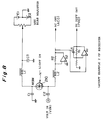
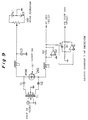
- the receiver 200 may be modified with regard to the method for applying the modulation signal in the structure of Fig. 3.
- the receiver can be arranged as in layout example 2 of receiver shown in Fig. 8 or as in layout example 3 of receiver shown in Fig. 9, forming the same phase-locked loop.
- Fig. 10 shows a schematic arrangement of an optical measuring apparatus of a second type, in which a reference optical path is provided.
- the reference optical path is for canceling a group delay change of a circuit system, which could become dominant in a drift of a measured value.
- n 3/4 ⁇ c ⁇ (f 2 -1 - f 1 -1 )/(2 ⁇ L)
- the delay is included in Tc 1 of formula (11) and Tc 2 of formula (12).
- modulation frequencies necessary for measurement of minimum and maximum distances are as follows:
- Fig. 11 shows a schematic arrangement of an optical measuring apparatus of a third type, in which a reference optical path is provided and a modulation frequency changing portion 800 is provided between the low-pass filter 320 and the VCO 400.
- the modulation frequency changing portion 800 is for determining a number of waves of an intensity-modulated component with the modulation frequency existing in the optical path (L1 + L2). As shown in Fig.
- the modulation frequency changing portion 800 is composed of (1) a multiplication-type current-output D/A converter 810 (DA1) for receiving a near dc voltage signal V1 output from the low-pass filter 320 and a standard voltage instruction signal output from a processing unit (not shown) to output a near dc current signal I1 having a value according to a product between the value of V1 and the value of standard voltage, (2) a current-output D/A converter 820 (DA2) for receiving a displacement voltage instruction signal output from the processing unit to output a dc current signal I2 having a value according to a value of the displacement voltage instruction signal, and (3) a current adder 830 for receiving I1 and I2 to output a near dc voltage signal V2 according to a sum of the value of I1 and the value of I2.
- DA1 multiplication-type current-output D/A converter 810
- DA2 for receiving a near dc voltage signal V1 output from the low-pass filter 320 and a standard voltage instruction
- the current adder 830 is composed of an operational amplifier A3 connected to the ground at the positive input terminal, to outputs of the D/A converter 810 and D/A converter 820 at the negative input terminal, and to a voltage input terminal of the VCO 400 at the output terminal, and a resistor R3 connected to the output terminal of the operational amplifier A3 at one terminal and to the negative input terminal of the operational amplifier A3 at the other terminal to effect current-voltage conversion.
- the optical measuring apparatus are arranged to measure the distance or the group index of the substance filling the optical path (L1 + L2) by detecting the value of phase-lock modulation frequency, so that they can perform higher-accuracy measurement as the value of modulation frequency increases.
- the uniqueness of the phase-lock modulation frequency cannot be maintained with the increase of the phase-lock modulation frequency.
- the apparatus of this type is thus so arranged that the standard voltage value from the processing unit is set in the D/A converter 810, whereby an output current value of D/A converter 820 is first adjusted at nearly 0 in the range of values of the modulation frequency where a sufficient measurement accuracy can be attained (for example, near 10 8 Hz), and a first phase-lock modulation frequency value f1 is then measured.
- a sufficient measurement accuracy for example, near 10 8 Hz
- a first phase-lock modulation frequency value f1 is then measured.
- m + 3/4 f1 ⁇ (2L ⁇ n/c + Td)
- the processing unit provides an increase instruction to increase the current output to the D/A converter 820.
- m can be obtained from the measured values f1 and f2. Putting the value of m into the formula (17), the distance L or the group index n to be measured is calculated.
- D/A converters 810, 820 are of the current output type to perform the current addition, but D/A converters of a voltage output type may also be employed to perform voltage addition.
- Fig. 12 is a drawing of a first embodiment of an optical measuring apparatus, in which the optical measuring apparatus of the second type shown in Fig. 10 is applied to a fiberscope.
- Laser light from a laser diode (LD) 110 is guided through a fiber 131 to be projected onto an object to be measured.
- the laser light is collimated in the form of a beam, so that it is focused at a point on the object. If the target object is far enough to spread the beam of laser light, a retroreflective reflector such as a corner cube prism is to be used as a target.
- Part of light outgoing the fiber 131 is guided via mirrors 610, 620 to a fiber 132 (calibration optical path).
- the optical filter 261 is constructed of a spectroscope or an interference filter.
- the optical filter 261 is provided for removing disturbance components such as illumination light used in observing appearance of an object to be measured.
- Light having passed the optical filter 261 is supplied to a light-variable attenuator 262.
- the light-variable attenuator 262 is provided for preventing the saturation of the photoconductive receiver 210 in the receiver 200 in receiving an excessive amount of light due to differences in reflectivity of object and in distance.
- the attenuator is constructed of a liquid crystal changing the transmittance with a change in applied voltage, PLZT, or a mechanical changeover mechanism of ND filter.
- the intensity-modulated, scattered light or the return light from the calibration optical path enters the receiver 200.
- the receiver 200 calculates a product between the received signal and the modulation signal output from the VCO 400, as described previously, and performs the time average operation to extract the dc component.
- a phase modulator 271 phase-modulates the modulation signal output from the VCO 400 with an oscillation signal of frequency f generated by an oscillator 272, and thereafter the modulated signal is supplied to the receiver 200. Since the frequency f is set to a value sufficiently larger than the band width of the loop filter in the above phase-locked loop, it does not affect the phase-lock characteristics.
- the signal in the receiver 200 before time average includes the ac component of frequency f.
- the signal is put through an ac amplifier 730 to a measurement control unit 710, whereby it can be determined whether a short of the receiving light quantity moves the lock phase to cause an error in distance measurement.
- An output signal from the receiver 200 is fed through the error amplifier 310 and the low-pass filter 320 back to the VCO 400.
- the VCO 400 produces a modulation signal oscillating at a frequency according to a voltage value of the input signal and outputs it to an LD driver 120.
- the LD driver 120 converts the output from the VCO 400 into a current to supply it to LD 110.
- An output from the LD 110 is guided through the fiber 131 to the object to be measured or via the mirrors 610, 620 for calibration optical path to the fiber 132.
- a part of the output from the receiver 200 is guided to the measurement control unit 710 in order to avoid a phase detection error due to a change of offset voltage.
- the measurement control unit 710 adjusts the offset voltage of the receiver 200 so that the output from the receiver 200 becomes "0V" upon incidence of non-modulated light.
- the measurement control unit 710 controls the optical path changeover switch and, for every changeover, reads a frequency to satisfy the phase-locking condition from the frequency counter 500 to calculate a distance to the measured object and to indicate a measured distance on a display 720.
- the operation of the apparatus in the Figure 12 embodiment is next described.
- the laser light from the LD 110 is guided through the fiber 131 to be projected onto the target object.
- the receiver 200 detects a returning beam of the laser light reflected by the object.
- the dc output component from the receiver becomes zero under the condition that a phase difference between the laser light emitted from the LD 110 and the modulation signal output from the VCO 400 is ⁇ /2. Accordingly, when the output frequency of the VCO 400 is fixed as phase-locked, the output frequency is always one corresponding to the distance from LD 110 to the target object.
- the apparatus can obtain, based on an output frequency at a certain time, a distance to the object at the moment in a simple manner and with a high accuracy. If the measurement of the phase-lock frequency is also carried out selecting the fiber 133 by changing over the optical switch 250, a distance to the object can be attained with respect to the reference point of mirror 610 as removing a phase difference arising from the apparatus itself of the first embodiment.
- Each fiber 131, 132, 133 has the length of 1.5 m and the group index of 1.5.
- the distance from the emission end of fiber 131 to the mirror 610 is 5 mm.
- the distance from the mirror 610 to the mirror 620 is 2.5 mm.
- the distance from the mirror 620 to the fiber 132 is 2.5 mm.
- the optical path to the target object has an average index of 1.0.
- a sum of group delay times of the transmitter 100 including LD 110, the receiver 200, and the amplifying unit is 5 ns.
- the speed of light in vacuum is 3 ⁇ 10 8 m/s.
- f 2 value obtained when the measurement light is projected onto the measured object
- a maximum measurement error ⁇ L is calculated as follows from formula (13).
- n 1.
- a conventional electro-optical rangefinder of the phase-difference method using a modulation wave of 15 MHz Assuming a phase resolution is 1/2000, a time resolution in the go-and-return path is as follows.
- the apparatus can accurately measure the distance to the measured object as described, it can also measure dimensions of the object from a field angle of the optical system. If such an apparatus of the first embodiment is incorporated in an endoscope, it is considered that an effective index can be supplied in determining an irradiation intensity of a laser for treatment of tumor using a laser beam. Also, a portable, simple rangefinder can be constructed.
- the optical measuring apparatus of the first type or the third type can also be applied thereto. It should be, however, noted that, utilizing the optical measuring apparatus of the first type, the measurement accuracy is lowered in the arrangement without modification as compared with the above fiberscope and, therefore, a group delay change of the circuit system intrinsic to the apparatus needs to be compensated by preliminarily measuring it. If the optical measuring apparatus of the third type is utilized, the measurement accuracy is improved but the structure of the apparatus becomes a little complex.
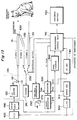
- Fig. 13 is a drawing of a second embodiment of an optical measuring apparatus in which the optical measuring apparatus of the second type shown in Fig. 10 is applied to a fiberscope.
- distal ends of fiber 131 and fiber 132 are set close to each other and a scattering body 630 is set at the distal ends to return part of light outgoing from the fiber 131 into the fiber 132.
- the distal ends of the fibers can be constructed in a small scale, and there is no need to take into consideration a distance between the fiber mirror 610 and the mirror 620 and the distance between the mirror 620 and the fiber 133 in the first embodiment of Fig. 12.
- this second embodiment is arranged with separate fibers of fiber 131 and fiber 132, they can be formed as a single fiber. In that case, reflection at the fiber end can be utilized without using the scattering body 630.
- This embodiment can also utilize the optical measuring apparatus of the first type or the third type, similarly as in the first embodiment. It should be, however, noted that, utilizing the optical measuring apparatus of the first type, the measurement accuracy is lowered in the arrangement without modification as compared with the above fiberscope and, therefore, a group delay change of the circuit system intrinsic to the apparatus needs to be compensated by preliminarily measuring it. If the optical measuring apparatus of the third type is utilized, the measurement accuracy is improved but the structure of the apparatus becomes a little complex.
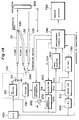
- Fig. 14 is a drawing of a third embodiment of an optical measuring apparatus in which the optical measuring apparatus of the second type shown in Fig. 10 is applied to a group index meter.
- the apparatus of this third embodiment is so arranged that a reflector 650, located at a predetermined distance L from the light exit end of fiber 131 and from the light entrance end of fiber 133, is added to the apparatus of the second embodiment.
- the processing unit 740 is so arranged that the built-in calculation function of the processing unit 710 in the second embodiment is modified into one for calculating the group index, and the display 750 indicates a value measured by the apparatus.
- the operation of the apparatus in the third embodiment is next described.
- the laser light from the LD 110 is guided through the fiber 131 to be projected onto the target object.
- the receiver 200 detects a returning beam of the laser light reflected by the object.
- the dc output component from the receiver becomes zero under the condition that a phase difference between the laser light emitted from the LD 110 and the modulation signal output from the VCO 400 is ⁇ /2. Accordingly, when the output frequency of the VCO 400 is fixed as phase-locked, the output frequency is always one corresponding to the distance from LD 110 to the target object.
- the apparatus can obtain, based on an output frequency at a certain time, a group index of the substance filling the optical path in a simple manner and with a high accuracy. If the measurement of the phase-lock frequency is also carried out selecting the fiber 133 by changing over the optical switch 250, a group index of the substance filling the optical path can be attained as removing a phase difference arising from the apparatus itself of the third embodiment.
- the group index n as a measured value can be expressed by the following empirical formulas.
- (n - 1) ⁇ 10 8 [2371.4 + 683939.7 ⁇ (130 - ⁇ 2 )/(130 - ⁇ 2 ) 2 + 4547.3 ⁇ (38.9 + ⁇ 2 )/(38.9 + ⁇ 2 ) 2 ] ⁇ D S + [6487.31 + 174.174. ⁇ 2 - 3.55750 ⁇ 4 + 0.61957 ⁇ 6 ] ⁇ D W
- D S (P S /T) ⁇ [1 + P S ⁇ (57.90 ⁇ 10 -8 - 9.3250 ⁇ 10 -4 /T + 0.25844/T)]
- D W (P W /T) ⁇ [1 + P W ⁇ (1 + (3.7 ⁇ 10 -4 ) ⁇ P W ) ⁇ (-2.37321 ⁇ 10 -3 + 2.23366/T - 710.792/T 2 + 7.
- the third embodiment can also utilize the optical measuring apparatus of the first type or the third type, similarly as in the first embodiment. It should be, however, noted that, utilizing the optical measuring apparatus of the first type, the measurement accuracy is lowered in the arrangement without modification as compared with the above fiberscope and, therefore, a group delay change of the circuit system intrinsic to the apparatus needs to be compensated by preliminarily measuring it. If the optical measuring apparatus of the third type is utilized, the measurement accuracy is improved but the structure of the apparatus becomes a little complex.
- the present invention is by no means limited to the above embodiments but can have various modifications.
- the apparatus in the above embodiments may be so modified that the LD is replaced by LED for high-speed modulation.
- another receiver may be arranged to receive reflected light or direct light from the calibration optical path and an output from the receiver may be used as a voltage applied to the photoconductive receiver.
- the first optical measuring apparatus of the present invention is so arranged that the light-receiving portion having the photoconductive receiver directly calculates a difference between the phase of the modulation signal of the transmitter and the phase of the reflected, modulated light in the receiver and that the apparatus performs a control to adjust the frequency of the modulated light so as to keep the phase-lock condition using the calculation results, whereby the frequency of the modulation signal always corresponds to the distance from the transmitter and receiver to the target object. Therefore, when the frequency is fixed, the distance to the target object at the moment can be determined in a simple manner and with a high accuracy, based on the frequency of the modulated light at the moment.
- the second optical measuring apparatus of the present invention is so arranged that a light-receiving portion having the photoconductive receiver directly calculates a difference between the phase of the modulation signal of the transmitter and the phase of the reflected, modulated light in the receiver and that the apparatus performs a control to adjust the frequency of the modulated light so as to keep the phase-lock condition using the calculation result, whereby the frequency of the modulation signal always corresponds to the group index of the substance filling the optical path from the transmitter and receiver to the reflecting means set at a predetermined position. Accordingly, when the frequency is fixed, the group index of the substance filling the optical path to the reflecting means at the moment can be determined in a simple manner and with high accuracy, based on the frequency of the modulated light at the moment.
Landscapes
- Engineering & Computer Science (AREA)
- Physics & Mathematics (AREA)
- Computer Networks & Wireless Communication (AREA)
- General Physics & Mathematics (AREA)
- Radar, Positioning & Navigation (AREA)
- Remote Sensing (AREA)
- Electromagnetism (AREA)
- Optical Radar Systems And Details Thereof (AREA)
Claims (10)
- Appareil de mesure optique comprenant :une partie émettrice de lumière (100) destinée à projeter une lumière soumise à une modulation d'intensité en fonction d'un signal de modulation en direction d'un objet cible ;un élément récepteur de lumière photoconducteur (210) destiné à recevoir la lumière modulée en intensité qui est réfléchie par le dit objet cible et à générer un signal représentant celle-ci, le dit élément récepteur de lumière photoconducteur étant connecté pour recevoir le signal de modulation, pour calculer le produit du signal représentant la lumière reçue par le dit signal de modulation, et à délivrer un signal représentant une différence de phase entre le signal représentant la lumière reçue et le dit signal de modulation ;des moyens d'ajustement de fréquence (310, 320, 400) connectés pour recevoir le signal de sortie provenant de l'élément récepteur de lumière afin d'ajuster une fréquence du dit signal de modulation de manière à conserver le signal de sortie provenant du dit élément récepteur de lumière photoconducteur fixé à une valeur de référence ;des moyens de comptage de fréquence (500) destinés à compter la fréquence du signal de modulation tel qu'il est ajusté par les dits moyens d'ajustement de fréquence ; etdes moyens de traitement (710, 740, 800) destinés à obtenir une valeur caractéristique d'un trajet optique de la dite partie émettrice de lumière et du dit élément récepteur de lumière photoconducteur jusqu'à l'objet cible, sur la base de la fréquence comptée par les dits moyens de comptage de fréquence,
caractérisé par des moyens de calcul de moyenne sur le temps (A1, R1, C4) destinés à recevoir le dit signal de sortie provenant du dit élément récepteur de lumière photoconducteur et à calculer une valeur de moyenne sur le temps du dit signal de sortie. - Appareil de mesure optique selon la revendication 1, dans lequel la dite valeur caractéristique est la longueur (L1+L2) du trajet optique depuis la dite partie émettrice de lumière (100) jusqu'audit élément récepteur de lumière photoconducteur (210), via l'objet cible.
- Appareil de mesure optique selon la revendication 1, dans lequel la dite valeur caractéristique est l'index de groupe du trajet optique depuis la dite partie émettrice de lumière (100) jusqu'audit élément récepteur de lumière photoconducteur (210), via l'objet cible.
- Appareil de mesure optique selon l'une quelconque des revendications précédentes, comprenant, en outre, un trajet optique de dérivation de calibrage (L3, L4, 131, 132 610, 620) destiné à supprimer une différence de phase intrinsèque à l'appareil de mesure optique lui-même.
- Appareil de mesure optique selon l'une quelconque des revendications précédentes, comprenant, en outre, une unité à retard (450) entre les dits moyens d'ajustement de fréquence (310, 320, 400) et la dite partie émettrice de lumière (100).
- Appareil de mesure optique selon l'une quelconque des revendications précédentes, comprenant, en outre :des moyens d'ajustement (VR1) destinés à ajuster une tension décalée appliquée audit élément récepteur de lumière photoconducteur.
- Appareil de mesure optique selon l'une quelconque des revendications précédentes, dans lequel le dit élément récepteur de lumière photoconducteur (210) fonctionne de telle sorte que si une quantité de la lumière projetée est constante et que la valeur de la tension appliquée est une variable indépendante, la quantité du courant circulant dans le dit élément récepteur de lumière photoconducteur est une fonction impaire de la tension appliquée dans une zone de définition prédéterminée incluant la valeur de la tension appliquée qui est égale à 0V, et que si la tension appliquée est périodique, sa valeur de moyenne sur le temps est approximativement de 0 et que son amplitude est une fonction paire du temps avec l'origine d'un instant d'un point intermédiaire entre deux instants adjacents ayant une amplitude de 0.
- Appareil de mesure optique selon la revendication 7, dans lequel le dit élément récepteur de lumière photoconducteur est un photodétecteur métal-semi-conducteur-métal.
- Appareil de mesure optique selon l'une quelconque des revendications précédentes, dans lequel les dits moyens d'ajustement de fréquence comprennent :un amplificateur d'erreur (310) destiné à recevoir une tension de référence (Vr) et un signal de sortie (Vd) provenant du dit élément récepteur de lumière photoconducteur, à amplifier la valeur de la différence entre la valeur de la dite tension de référence (Vr) et la valeur du signal de sortie (Vd) provenant du dit élément récepteur de lumière photoconducteur (210), et à délivrer un signal de tension amplifié ;un filtre passe-bas (320) destiné à recevoir le dit signal de tension amplifié, à réduire une composante ca du dit signal de tension amplifié et à délivrer un signal de tension sensiblement cc ; etun oscillateur commandé en tension (400) destiné à recevoir le dit signal de tension sensiblement cc, à produire un signal (Vb) ayant une fréquence en fonction d'une valeur du dit signal de tension, et à délivrer le dit signal électrique à la dite partie émettrice de lumière.
- Appareil de mesure optique selon l'une quelconque des revendications 1 à 9, dans lequel les dits moyens d'ajustement de fréquence comprennent :un amplificateur d'erreur (310) destiné à recevoir une tension de référence (Vr) et un signal de sortie (Vd) en provenance du dit élément récepteur de lumière photoconducteur, à amplifier la valeur de la différence entre la valeur de la dite tension de référence (Vr) et la valeur du signal de sortie (Vd) provenant du dit élément récepteur de lumière photoconducteur (210) et à délivrer un signal de tension amplifié ;un filtre passe-bas (320) destiné à recevoir le dit signal de tension amplifié, à réduire une composante ca du dit signal de tension amplifié et à délivrer un premier signal de tension sensiblement cc ;des premiers moyens de conversion de signal (810) destinés à délivrer le dit premier signal sensiblement cc (I1) ayant une première valeur de courant ;des seconds moyens de conversion de signal (820) destinés à délivrer un second signal sensiblement cc (I2) ayant une seconde valeur de courant ;des moyens d'addition de signaux (830) destinés à recevoir le dit premier signal sensiblement cc et le dit second signal sensiblement cc et à délivrer un second signal de tension sensiblement cc en fonction d'une valeur de courant de la somme entre la valeur de courant du dit premier signal sensiblement cc et la valeur de courant du dit second signal sensiblement cc ; etun oscillateur commandé en tension (400) destiné à recevoir le dit second signal de tension sensiblement cc délivré par les dits moyens d'addition de signaux (830), à produire un signal ayant une fréquence en fonction de la valeur du dit signal de tension, et à délivrer le dit signal audit élément d'émission de lumière photoconducteur (100).
Applications Claiming Priority (3)
| Application Number | Priority Date | Filing Date | Title |
|---|---|---|---|
| JP21419993 | 1993-08-30 | ||
| JP21419993A JP3307730B2 (ja) | 1993-08-30 | 1993-08-30 | 光学測定装置 |
| JP214199/93 | 1993-08-30 |
Publications (3)
| Publication Number | Publication Date |
|---|---|
| EP0640846A2 EP0640846A2 (fr) | 1995-03-01 |
| EP0640846A3 EP0640846A3 (fr) | 1995-04-26 |
| EP0640846B1 true EP0640846B1 (fr) | 2000-02-02 |
Family
ID=16651877
Family Applications (1)
| Application Number | Title | Priority Date | Filing Date |
|---|---|---|---|
| EP94306310A Expired - Lifetime EP0640846B1 (fr) | 1993-08-30 | 1994-08-26 | Appareil de mesure optique |
Country Status (4)
| Country | Link |
|---|---|
| US (1) | US5534992A (fr) |
| EP (1) | EP0640846B1 (fr) |
| JP (1) | JP3307730B2 (fr) |
| DE (1) | DE69422866T2 (fr) |
Cited By (1)
| Publication number | Priority date | Publication date | Assignee | Title |
|---|---|---|---|---|
| US6570646B2 (en) | 2001-03-06 | 2003-05-27 | The Regents Of The University Of California | Optical distance measurement device and method thereof |
Families Citing this family (49)
| Publication number | Priority date | Publication date | Assignee | Title |
|---|---|---|---|---|
| JP3364333B2 (ja) * | 1994-09-19 | 2003-01-08 | 浜松ホトニクス株式会社 | 減衰特性測定装置 |
| DE19521771A1 (de) * | 1995-06-20 | 1997-01-02 | Jan Michael Mrosik | FMCW-Abstandsmeßverfahren |
| JP3465434B2 (ja) * | 1995-09-06 | 2003-11-10 | ソニー・プレシジョン・テクノロジー株式会社 | レーザードップラー速度計 |
| JPH09236662A (ja) * | 1996-02-29 | 1997-09-09 | Ushikata Shokai:Kk | 光波距離計 |
| US5808743A (en) * | 1996-04-05 | 1998-09-15 | Board Of Regents Of The University Of Colorado | Laser sensor using optical feedback-induced frequency modulation |
| US5777746A (en) * | 1996-12-31 | 1998-07-07 | Pitney Bowes Inc. | Apparatus and method for dimensional weighing utilizing a mirror and/or prism |
| US5923416A (en) * | 1997-03-20 | 1999-07-13 | Hartford Hospital | Automated method and apparatus for evaluating the performance characteristics of endoscopes |
| US6052190A (en) * | 1997-09-09 | 2000-04-18 | Utoptics, Inc. | Highly accurate three-dimensional surface digitizing system and methods |
| US6459483B1 (en) * | 1998-02-10 | 2002-10-01 | Toolz, Ltd. | Level with angle and distance measurement apparatus |
| DE19902455A1 (de) * | 1999-01-22 | 2000-08-10 | Bosch Gmbh Robert | Abstandsmeßverfahren und -vorrichtung |
| EP1067361A1 (fr) * | 1999-07-06 | 2001-01-10 | Datalogic S.P.A. | Procédé et dispositif pour la mesure de la distance d' un objet |
| JP4508352B2 (ja) * | 2000-04-10 | 2010-07-21 | キヤノン株式会社 | 光空間伝送システム |
| DE10039422C2 (de) * | 2000-08-11 | 2002-08-01 | Siemens Ag | Verfahren und Vorrichtungen zum Betrieb eines PMD-System |
| DE60137447D1 (de) | 2000-11-28 | 2009-03-05 | Rosemount Inc | Einrichtung zur messung physikalischer grössen mit einem optischen sensor |
| US7330271B2 (en) | 2000-11-28 | 2008-02-12 | Rosemount, Inc. | Electromagnetic resonant sensor with dielectric body and variable gap cavity |
| JP4533582B2 (ja) * | 2000-12-11 | 2010-09-01 | カネスタ インコーポレイテッド | 量子効率変調を用いたcmosコンパチブルの三次元イメージセンシングのためのシステム |
| DE10228644A1 (de) * | 2002-01-23 | 2003-08-07 | Micro Optronic Messtechnik Gmb | Verfahren und Vorrichtung zur optischen Entfernungsmessung |
| DE10242777A1 (de) * | 2002-09-14 | 2004-04-08 | Robert Bosch Gmbh | Verfahren zum Bestimmen einer Entfernung und Entfernungsmessgerät |
| US7043115B2 (en) | 2002-12-18 | 2006-05-09 | Rosemount, Inc. | Tunable optical filter |
| JP4166083B2 (ja) * | 2002-12-26 | 2008-10-15 | 株式会社トプコン | 測距装置 |
| TWI274851B (en) * | 2004-04-09 | 2007-03-01 | Hon Hai Prec Ind Co Ltd | Laser range finder |
| US7592615B2 (en) * | 2005-10-11 | 2009-09-22 | Hong Kong Applied Science And Technology Research Institute Co., Ltd. | Optical receiver with a modulated photo-detector |
| DE102006048322A1 (de) * | 2006-10-06 | 2008-04-10 | Valeo Schalter Und Sensoren Gmbh | Verfahren zur Erfassung einer physikalischen Größe und Vorrichtung hierfür |
| DE202007018027U1 (de) * | 2007-01-31 | 2008-04-17 | Richard Wolf Gmbh | Endoskopsystem |
| DE102008018636B4 (de) * | 2008-04-11 | 2011-01-05 | Storz Endoskop Produktions Gmbh | Vorrichtung und Verfahren zur endoskopischen 3D-Datenerfassung |
| WO2012141810A1 (fr) | 2011-03-03 | 2012-10-18 | Faro Technologies, Inc. | Appareil et procédé pour cible |
| US9482755B2 (en) | 2008-11-17 | 2016-11-01 | Faro Technologies, Inc. | Measurement system having air temperature compensation between a target and a laser tracker |
| US8659749B2 (en) * | 2009-08-07 | 2014-02-25 | Faro Technologies, Inc. | Absolute distance meter with optical switch |
| JP2011069726A (ja) * | 2009-09-25 | 2011-04-07 | Hamamatsu Photonics Kk | 距離画像取得装置 |
| US9400170B2 (en) | 2010-04-21 | 2016-07-26 | Faro Technologies, Inc. | Automatic measurement of dimensional data within an acceptance region by a laser tracker |
| US8619265B2 (en) | 2011-03-14 | 2013-12-31 | Faro Technologies, Inc. | Automatic measurement of dimensional data with a laser tracker |
| US9377885B2 (en) | 2010-04-21 | 2016-06-28 | Faro Technologies, Inc. | Method and apparatus for locking onto a retroreflector with a laser tracker |
| US9772394B2 (en) | 2010-04-21 | 2017-09-26 | Faro Technologies, Inc. | Method and apparatus for following an operator and locking onto a retroreflector with a laser tracker |
| US8902408B2 (en) | 2011-02-14 | 2014-12-02 | Faro Technologies Inc. | Laser tracker used with six degree-of-freedom probe having separable spherical retroreflector |
| JP5730094B2 (ja) * | 2011-03-28 | 2015-06-03 | 株式会社トプコン | 光波距離計 |
| USD688577S1 (en) | 2012-02-21 | 2013-08-27 | Faro Technologies, Inc. | Laser tracker |
| US9686532B2 (en) | 2011-04-15 | 2017-06-20 | Faro Technologies, Inc. | System and method of acquiring three-dimensional coordinates using multiple coordinate measurement devices |
| US9482529B2 (en) | 2011-04-15 | 2016-11-01 | Faro Technologies, Inc. | Three-dimensional coordinate scanner and method of operation |
| US9164173B2 (en) | 2011-04-15 | 2015-10-20 | Faro Technologies, Inc. | Laser tracker that uses a fiber-optic coupler and an achromatic launch to align and collimate two wavelengths of light |
| GB2504890A (en) | 2011-04-15 | 2014-02-12 | Faro Tech Inc | Enhanced position detector in laser tracker |
| JP6099675B2 (ja) | 2012-01-27 | 2017-03-22 | ファロ テクノロジーズ インコーポレーテッド | バーコード識別による検査方法 |
| KR101975971B1 (ko) * | 2012-03-19 | 2019-05-08 | 삼성전자주식회사 | 깊이 카메라, 다중 깊이 카메라 시스템, 그리고 그것의 동기 방법 |
| US9041914B2 (en) | 2013-03-15 | 2015-05-26 | Faro Technologies, Inc. | Three-dimensional coordinate scanner and method of operation |
| US9584790B2 (en) | 2013-06-03 | 2017-02-28 | Microsoft Technology Licensing, Llc | Edge preserving depth filtering |
| CN105637383B (zh) * | 2013-10-11 | 2017-11-14 | 三菱电机株式会社 | 风测量雷达装置 |
| US9395174B2 (en) | 2014-06-27 | 2016-07-19 | Faro Technologies, Inc. | Determining retroreflector orientation by optimizing spatial fit |
| US10249249B2 (en) * | 2016-03-04 | 2019-04-02 | Semiconductor Energy Laboratory Co., Ltd. | Semiconductor device, display panel, and electronic device |
| WO2018154710A1 (fr) * | 2017-02-24 | 2018-08-30 | 三菱電機株式会社 | Dispositif de traitement de signal radar et dispositif radar |
| EP3492932B1 (fr) * | 2017-11-30 | 2020-07-08 | INL - International Iberian Nanotechnology Laboratory | Détecteur de fréquence |
Family Cites Families (9)
| Publication number | Priority date | Publication date | Assignee | Title |
|---|---|---|---|---|
| US3602594A (en) * | 1969-01-09 | 1971-08-31 | Holobeam | Laser calibration of large radio reflector |
| US3649123A (en) * | 1969-04-16 | 1972-03-14 | Holobeam | Variable frequency phase matching distance measuring and positioning device |
| JPS58174874A (ja) * | 1982-04-08 | 1983-10-13 | Tokyo Optical Co Ltd | 光波測距方法及びその装置 |
| JPS60195479A (ja) * | 1984-03-16 | 1985-10-03 | Toshiba Corp | 距離測定装置 |
| JPS60262081A (ja) * | 1984-06-11 | 1985-12-25 | Hitachi Ltd | レ−ザ測距装置 |
| US4715706A (en) * | 1986-10-20 | 1987-12-29 | Wang Charles P | Laser doppler displacement measuring system and apparatus |
| DE3943470A1 (de) * | 1989-05-29 | 1990-12-13 | Rainer Thiessen | Gegenstands-naeherungs und troepfchendetektor |
| US5115294A (en) * | 1989-06-29 | 1992-05-19 | At&T Bell Laboratories | Optoelectronic integrated circuit |
| JPH0462491A (ja) * | 1990-06-29 | 1992-02-27 | Omron Corp | 距離測定装置 |
-
1993
- 1993-08-30 JP JP21419993A patent/JP3307730B2/ja not_active Expired - Fee Related
-
1994
- 1994-08-26 EP EP94306310A patent/EP0640846B1/fr not_active Expired - Lifetime
- 1994-08-26 DE DE69422866T patent/DE69422866T2/de not_active Expired - Fee Related
- 1994-08-30 US US08/298,554 patent/US5534992A/en not_active Expired - Lifetime
Cited By (2)
| Publication number | Priority date | Publication date | Assignee | Title |
|---|---|---|---|---|
| US6570646B2 (en) | 2001-03-06 | 2003-05-27 | The Regents Of The University Of California | Optical distance measurement device and method thereof |
| US6750960B2 (en) | 2001-03-06 | 2004-06-15 | The Regents Of The University Of California | Optical distance measurement device and method thereof |
Also Published As
| Publication number | Publication date |
|---|---|
| EP0640846A2 (fr) | 1995-03-01 |
| JPH0763855A (ja) | 1995-03-10 |
| JP3307730B2 (ja) | 2002-07-24 |
| DE69422866T2 (de) | 2000-06-29 |
| DE69422866D1 (de) | 2000-03-09 |
| US5534992A (en) | 1996-07-09 |
| EP0640846A3 (fr) | 1995-04-26 |
Similar Documents
| Publication | Publication Date | Title |
|---|---|---|
| EP0640846B1 (fr) | Appareil de mesure optique | |
| US4403857A (en) | Distance measuring device and method | |
| US5082364A (en) | Rf modulated optical beam distance measuring system and method | |
| KR100484345B1 (ko) | 거리 측정기의 교정을 위한 장치 | |
| US5594543A (en) | Laser diode radar with extended range | |
| US6876441B2 (en) | Optical sensor for distance measurement | |
| US20210109218A1 (en) | LIDAR measuring device | |
| Nejad et al. | Comparison of TOF, FMCW and phase-shift laser range-finding methods by simulation and measurement | |
| US5260762A (en) | Device for non-contact measurement of speed, displacement travel and/or distance | |
| Bosch et al. | Crosstalk analysis of 1 m to 10 m laser phase-shift range finder | |
| US11867814B1 (en) | Techniques for driving a laser diode in a LIDAR system | |
| CN115308715A (zh) | 一种稀疏调制测风雷达的方法和系统 | |
| JPH1062549A (ja) | 距離測定装置 | |
| JP3241857B2 (ja) | 光学式距離計 | |
| US20240255642A1 (en) | Digital electro-optical phase locked loop in a lidar system | |
| JP3374392B2 (ja) | 測距レーダ | |
| JPH06186337A (ja) | レーザ測距装置 | |
| CN113721251A (zh) | 一种带动态基准反馈的调频光源及其应用 | |
| JP3236941B2 (ja) | 光波距離計における測距方法 | |
| KR101828257B1 (ko) | 거리 측정을 위한 광전자 발진기 | |
| SU1388721A1 (ru) | Способ измерени фазового сдвига световых волн | |
| JPH0875434A (ja) | 表面形状測定装置 | |
| KR970003746B1 (ko) | 레이저 세기 자동 조절 시스템 | |
| SU1034497A1 (ru) | Устройство дл измерени скорости | |
| JP3916761B2 (ja) | 障害点探査装置 |
Legal Events
| Date | Code | Title | Description |
|---|---|---|---|
| PUAI | Public reference made under article 153(3) epc to a published international application that has entered the european phase |
Free format text: ORIGINAL CODE: 0009012 |
|
| AK | Designated contracting states |
Kind code of ref document: A2 Designated state(s): CH DE FR GB IT LI SE |
|
| PUAL | Search report despatched |
Free format text: ORIGINAL CODE: 0009013 |
|
| AK | Designated contracting states |
Kind code of ref document: A3 Designated state(s): CH DE FR GB IT LI SE |
|
| 17P | Request for examination filed |
Effective date: 19951019 |
|
| 17Q | First examination report despatched |
Effective date: 19960716 |
|
| GRAG | Despatch of communication of intention to grant |
Free format text: ORIGINAL CODE: EPIDOS AGRA |
|
| GRAG | Despatch of communication of intention to grant |
Free format text: ORIGINAL CODE: EPIDOS AGRA |
|
| GRAG | Despatch of communication of intention to grant |
Free format text: ORIGINAL CODE: EPIDOS AGRA |
|
| GRAH | Despatch of communication of intention to grant a patent |
Free format text: ORIGINAL CODE: EPIDOS IGRA |
|
| GRAH | Despatch of communication of intention to grant a patent |
Free format text: ORIGINAL CODE: EPIDOS IGRA |
|
| GRAA | (expected) grant |
Free format text: ORIGINAL CODE: 0009210 |
|
| AK | Designated contracting states |
Kind code of ref document: B1 Designated state(s): CH DE FR GB IT LI SE |
|
| REG | Reference to a national code |
Ref country code: CH Ref legal event code: EP |
|
| ITF | It: translation for a ep patent filed | ||
| REF | Corresponds to: |
Ref document number: 69422866 Country of ref document: DE Date of ref document: 20000309 |
|
| ET | Fr: translation filed | ||
| REG | Reference to a national code |
Ref country code: CH Ref legal event code: NV Representative=s name: KIRKER & CIE SA |
|
| PLBE | No opposition filed within time limit |
Free format text: ORIGINAL CODE: 0009261 |
|
| STAA | Information on the status of an ep patent application or granted ep patent |
Free format text: STATUS: NO OPPOSITION FILED WITHIN TIME LIMIT |
|
| 26N | No opposition filed | ||
| REG | Reference to a national code |
Ref country code: GB Ref legal event code: IF02 |
|
| PGFP | Annual fee paid to national office [announced via postgrant information from national office to epo] |
Ref country code: DE Payment date: 20030904 Year of fee payment: 10 |
|
| PG25 | Lapsed in a contracting state [announced via postgrant information from national office to epo] |
Ref country code: DE Free format text: LAPSE BECAUSE OF NON-PAYMENT OF DUE FEES Effective date: 20050301 |
|
| PG25 | Lapsed in a contracting state [announced via postgrant information from national office to epo] |
Ref country code: IT Free format text: LAPSE BECAUSE OF NON-PAYMENT OF DUE FEES Effective date: 20050826 |
|
| PGFP | Annual fee paid to national office [announced via postgrant information from national office to epo] |
Ref country code: CH Payment date: 20080918 Year of fee payment: 15 |
|
| PGFP | Annual fee paid to national office [announced via postgrant information from national office to epo] |
Ref country code: FR Payment date: 20080818 Year of fee payment: 15 |
|
| PGFP | Annual fee paid to national office [announced via postgrant information from national office to epo] |
Ref country code: GB Payment date: 20080903 Year of fee payment: 15 |
|
| PGFP | Annual fee paid to national office [announced via postgrant information from national office to epo] |
Ref country code: SE Payment date: 20080807 Year of fee payment: 15 |
|
| REG | Reference to a national code |
Ref country code: CH Ref legal event code: PL |
|
| GBPC | Gb: european patent ceased through non-payment of renewal fee |
Effective date: 20090826 |
|
| PG25 | Lapsed in a contracting state [announced via postgrant information from national office to epo] |
Ref country code: LI Free format text: LAPSE BECAUSE OF NON-PAYMENT OF DUE FEES Effective date: 20090831 Ref country code: CH Free format text: LAPSE BECAUSE OF NON-PAYMENT OF DUE FEES Effective date: 20090831 |
|
| REG | Reference to a national code |
Ref country code: FR Ref legal event code: ST Effective date: 20100430 |
|
| PG25 | Lapsed in a contracting state [announced via postgrant information from national office to epo] |
Ref country code: FR Free format text: LAPSE BECAUSE OF NON-PAYMENT OF DUE FEES Effective date: 20090831 |
|
| PG25 | Lapsed in a contracting state [announced via postgrant information from national office to epo] |
Ref country code: GB Free format text: LAPSE BECAUSE OF NON-PAYMENT OF DUE FEES Effective date: 20090826 |
|
| PG25 | Lapsed in a contracting state [announced via postgrant information from national office to epo] |
Ref country code: SE Free format text: LAPSE BECAUSE OF NON-PAYMENT OF DUE FEES Effective date: 20090827 |