EP0641596A2 - Verfahren zur Herstellung von feinteiligen Farb- oder Wirkstoffzubereitungen - Google Patents
Verfahren zur Herstellung von feinteiligen Farb- oder Wirkstoffzubereitungen Download PDFInfo
- Publication number
- EP0641596A2 EP0641596A2 EP94113270A EP94113270A EP0641596A2 EP 0641596 A2 EP0641596 A2 EP 0641596A2 EP 94113270 A EP94113270 A EP 94113270A EP 94113270 A EP94113270 A EP 94113270A EP 0641596 A2 EP0641596 A2 EP 0641596A2
- Authority
- EP
- European Patent Office
- Prior art keywords
- water
- solution
- dispersion
- active substance
- finely divided
- Prior art date
- Legal status (The legal status is an assumption and is not a legal conclusion. Google has not performed a legal analysis and makes no representation as to the accuracy of the status listed.)
- Granted
Links
- 239000013543 active substance Substances 0.000 title claims abstract description 14
- 238000004519 manufacturing process Methods 0.000 title claims abstract description 14
- 238000004040 coloring Methods 0.000 title description 2
- 239000004150 EU approved colour Substances 0.000 title 1
- XLYOFNOQVPJJNP-UHFFFAOYSA-N water Substances O XLYOFNOQVPJJNP-UHFFFAOYSA-N 0.000 claims abstract description 38
- 239000006185 dispersion Substances 0.000 claims abstract description 24
- 239000000084 colloidal system Substances 0.000 claims abstract description 22
- 230000001681 protective effect Effects 0.000 claims abstract description 21
- 239000000839 emulsion Substances 0.000 claims abstract description 13
- 238000002844 melting Methods 0.000 claims abstract description 12
- 230000008018 melting Effects 0.000 claims abstract description 12
- 238000000034 method Methods 0.000 claims abstract description 12
- 238000002360 preparation method Methods 0.000 claims abstract description 9
- 238000001816 cooling Methods 0.000 claims abstract description 7
- 238000009826 distribution Methods 0.000 claims abstract description 7
- 239000000725 suspension Substances 0.000 claims abstract description 7
- 239000000155 melt Substances 0.000 claims abstract description 3
- 239000011362 coarse particle Substances 0.000 claims abstract 2
- 239000004480 active ingredient Substances 0.000 claims description 23
- 239000000843 powder Substances 0.000 claims description 12
- 239000003960 organic solvent Substances 0.000 claims description 4
- 239000007921 spray Substances 0.000 claims description 3
- 230000015572 biosynthetic process Effects 0.000 claims 1
- 238000007796 conventional method Methods 0.000 claims 1
- 239000012943 hotmelt Substances 0.000 claims 1
- 239000011877 solvent mixture Substances 0.000 claims 1
- 239000012736 aqueous medium Substances 0.000 abstract 1
- 239000000243 solution Substances 0.000 description 30
- 238000002156 mixing Methods 0.000 description 16
- 239000000975 dye Substances 0.000 description 14
- 239000002245 particle Substances 0.000 description 14
- 239000002904 solvent Substances 0.000 description 13
- HEMHJVSKTPXQMS-UHFFFAOYSA-M Sodium hydroxide Chemical compound [OH-].[Na+] HEMHJVSKTPXQMS-UHFFFAOYSA-M 0.000 description 12
- KFZMGEQAYNKOFK-UHFFFAOYSA-N Isopropanol Chemical compound CC(C)O KFZMGEQAYNKOFK-UHFFFAOYSA-N 0.000 description 8
- FDSDTBUPSURDBL-LOFNIBRQSA-N canthaxanthin Chemical compound CC=1C(=O)CCC(C)(C)C=1/C=C/C(/C)=C/C=C/C(/C)=C/C=C/C=C(C)C=CC=C(C)C=CC1=C(C)C(=O)CCC1(C)C FDSDTBUPSURDBL-LOFNIBRQSA-N 0.000 description 7
- 238000005086 pumping Methods 0.000 description 7
- 238000002296 dynamic light scattering Methods 0.000 description 6
- YMTINGFKWWXKFG-UHFFFAOYSA-N fenofibrate Chemical compound C1=CC(OC(C)(C)C(=O)OC(C)C)=CC=C1C(=O)C1=CC=C(Cl)C=C1 YMTINGFKWWXKFG-UHFFFAOYSA-N 0.000 description 6
- 229960002297 fenofibrate Drugs 0.000 description 6
- 239000000203 mixture Substances 0.000 description 6
- 239000002105 nanoparticle Substances 0.000 description 6
- 238000001694 spray drying Methods 0.000 description 6
- DWAWDSVKAUWFHC-QHCPKHFHSA-N (2s)-5-[methyl(2-phenylethyl)amino]-2-phenyl-2-propan-2-ylpentanenitrile Chemical compound C([C@@](C(C)C)(C#N)C=1C=CC=CC=1)CCN(C)CCC1=CC=CC=C1 DWAWDSVKAUWFHC-QHCPKHFHSA-N 0.000 description 5
- 108010010803 Gelatin Proteins 0.000 description 5
- QAQJMLQRFWZOBN-LAUBAEHRSA-N L-ascorbyl-6-palmitate Chemical compound CCCCCCCCCCCCCCCC(=O)OC[C@H](O)[C@H]1OC(=O)C(O)=C1O QAQJMLQRFWZOBN-LAUBAEHRSA-N 0.000 description 5
- 239000011786 L-ascorbyl-6-palmitate Substances 0.000 description 5
- OENHQHLEOONYIE-UKMVMLAPSA-N all-trans beta-carotene Natural products CC=1CCCC(C)(C)C=1/C=C/C(/C)=C/C=C/C(/C)=C/C=C/C=C(C)C=CC=C(C)C=CC1=C(C)CCCC1(C)C OENHQHLEOONYIE-UKMVMLAPSA-N 0.000 description 5
- PHFDAOXXIZOUIX-UHFFFAOYSA-N anipamil Chemical compound C=1C=CC(OC)=CC=1C(CCCCCCCCCCCC)(C#N)CCCN(C)CCC1=CC=CC(OC)=C1 PHFDAOXXIZOUIX-UHFFFAOYSA-N 0.000 description 5
- 229950011530 anipamil Drugs 0.000 description 5
- 235000010385 ascorbyl palmitate Nutrition 0.000 description 5
- 235000013734 beta-carotene Nutrition 0.000 description 5
- 239000011648 beta-carotene Substances 0.000 description 5
- TUPZEYHYWIEDIH-WAIFQNFQSA-N beta-carotene Natural products CC(=C/C=C/C=C(C)/C=C/C=C(C)/C=C/C1=C(C)CCCC1(C)C)C=CC=C(/C)C=CC2=CCCCC2(C)C TUPZEYHYWIEDIH-WAIFQNFQSA-N 0.000 description 5
- 229960002747 betacarotene Drugs 0.000 description 5
- 229920000159 gelatin Polymers 0.000 description 5
- 235000019322 gelatine Nutrition 0.000 description 5
- 235000011852 gelatine desserts Nutrition 0.000 description 5
- 229950000483 levemopamil Drugs 0.000 description 5
- OENHQHLEOONYIE-JLTXGRSLSA-N β-Carotene Chemical compound CC=1CCCC(C)(C)C=1\C=C\C(\C)=C\C=C\C(\C)=C\C=C\C=C(/C)\C=C\C=C(/C)\C=C\C1=C(C)CCCC1(C)C OENHQHLEOONYIE-JLTXGRSLSA-N 0.000 description 5
- FYKZHAJQLBLBJO-UHFFFAOYSA-N 1-[4-(2-methoxyphenyl)piperazin-1-yl]-3-[3-(5-methyl-1,3,4-oxadiazol-2-yl)phenoxy]propan-2-ol Chemical compound COC1=CC=CC=C1N1CCN(CC(O)COC=2C=C(C=CC=2)C=2OC(C)=NN=2)CC1 FYKZHAJQLBLBJO-UHFFFAOYSA-N 0.000 description 4
- GUBGYTABKSRVRQ-XLOQQCSPSA-N Alpha-Lactose Chemical compound O[C@@H]1[C@@H](O)[C@@H](O)[C@@H](CO)O[C@H]1O[C@@H]1[C@@H](CO)O[C@H](O)[C@H](O)[C@H]1O GUBGYTABKSRVRQ-XLOQQCSPSA-N 0.000 description 4
- GUBGYTABKSRVRQ-QKKXKWKRSA-N Lactose Natural products OC[C@H]1O[C@@H](O[C@H]2[C@H](O)[C@@H](O)C(O)O[C@@H]2CO)[C@H](O)[C@@H](O)[C@H]1O GUBGYTABKSRVRQ-QKKXKWKRSA-N 0.000 description 4
- 235000012682 canthaxanthin Nutrition 0.000 description 4
- 239000008273 gelatin Substances 0.000 description 4
- 239000008101 lactose Substances 0.000 description 4
- 229950007126 nesapidil Drugs 0.000 description 4
- ZMXDDKWLCZADIW-UHFFFAOYSA-N N,N-Dimethylformamide Chemical compound CN(C)C=O ZMXDDKWLCZADIW-UHFFFAOYSA-N 0.000 description 3
- OOUTWVMJGMVRQF-DOYZGLONSA-N Phoenicoxanthin Natural products CC(=C/C=C/C=C(C)/C=C/C=C(C)/C=C/C1=C(C)C(=O)C(O)CC1(C)C)C=CC=C(/C)C=CC2=C(C)C(=O)CCC2(C)C OOUTWVMJGMVRQF-DOYZGLONSA-N 0.000 description 3
- 239000001659 canthaxanthin Substances 0.000 description 3
- 229940008033 canthaxanthin Drugs 0.000 description 3
- 239000007795 chemical reaction product Substances 0.000 description 3
- 239000010419 fine particle Substances 0.000 description 3
- JWHAUXFOSRPERK-UHFFFAOYSA-N propafenone Chemical compound CCCNCC(O)COC1=CC=CC=C1C(=O)CCC1=CC=CC=C1 JWHAUXFOSRPERK-UHFFFAOYSA-N 0.000 description 3
- 229960000203 propafenone Drugs 0.000 description 3
- 239000007787 solid Substances 0.000 description 3
- 239000000126 substance Substances 0.000 description 3
- IAZDPXIOMUYVGZ-UHFFFAOYSA-N Dimethylsulphoxide Chemical compound CS(C)=O IAZDPXIOMUYVGZ-UHFFFAOYSA-N 0.000 description 2
- PEDCQBHIVMGVHV-UHFFFAOYSA-N Glycerine Chemical compound OCC(O)CO PEDCQBHIVMGVHV-UHFFFAOYSA-N 0.000 description 2
- 150000001875 compounds Chemical class 0.000 description 2
- 230000000694 effects Effects 0.000 description 2
- 238000009472 formulation Methods 0.000 description 2
- 239000004014 plasticizer Substances 0.000 description 2
- 230000005070 ripening Effects 0.000 description 2
- 238000003756 stirring Methods 0.000 description 2
- OBAQQQOVZUCKMH-BQAIUKQQSA-N (2s)-5-[methyl(2-phenylethyl)amino]-2-phenyl-2-propan-2-ylpentanenitrile;hydrochloride Chemical compound Cl.C([C@@](C(C)C)(C#N)C=1C=CC=CC=1)CCN(C)CCC1=CC=CC=C1 OBAQQQOVZUCKMH-BQAIUKQQSA-N 0.000 description 1
- SGTNSNPWRIOYBX-UHFFFAOYSA-N 2-(3,4-dimethoxyphenyl)-5-{[2-(3,4-dimethoxyphenyl)ethyl](methyl)amino}-2-(propan-2-yl)pentanenitrile Chemical compound C1=C(OC)C(OC)=CC=C1CCN(C)CCCC(C#N)(C(C)C)C1=CC=C(OC)C(OC)=C1 SGTNSNPWRIOYBX-UHFFFAOYSA-N 0.000 description 1
- UZVAZDQMPUOHKP-UHFFFAOYSA-N 2-(7-methyloctyl)phenol Chemical class CC(C)CCCCCCC1=CC=CC=C1O UZVAZDQMPUOHKP-UHFFFAOYSA-N 0.000 description 1
- 229920002134 Carboxymethyl cellulose Polymers 0.000 description 1
- FBPFZTCFMRRESA-FSIIMWSLSA-N D-Glucitol Natural products OC[C@H](O)[C@H](O)[C@@H](O)[C@H](O)CO FBPFZTCFMRRESA-FSIIMWSLSA-N 0.000 description 1
- FBPFZTCFMRRESA-KVTDHHQDSA-N D-Mannitol Chemical compound OC[C@@H](O)[C@@H](O)[C@H](O)[C@H](O)CO FBPFZTCFMRRESA-KVTDHHQDSA-N 0.000 description 1
- FBPFZTCFMRRESA-JGWLITMVSA-N D-glucitol Chemical compound OC[C@H](O)[C@@H](O)[C@H](O)[C@H](O)CO FBPFZTCFMRRESA-JGWLITMVSA-N 0.000 description 1
- 229920001353 Dextrin Polymers 0.000 description 1
- 239000004375 Dextrin Substances 0.000 description 1
- WQZGKKKJIJFFOK-GASJEMHNSA-N Glucose Natural products OC[C@H]1OC(O)[C@H](O)[C@@H](O)[C@@H]1O WQZGKKKJIJFFOK-GASJEMHNSA-N 0.000 description 1
- 229920000084 Gum arabic Polymers 0.000 description 1
- 229920002153 Hydroxypropyl cellulose Polymers 0.000 description 1
- 229930195725 Mannitol Natural products 0.000 description 1
- SECXISVLQFMRJM-UHFFFAOYSA-N N-Methylpyrrolidone Chemical compound CN1CCCC1=O SECXISVLQFMRJM-UHFFFAOYSA-N 0.000 description 1
- 239000004372 Polyvinyl alcohol Substances 0.000 description 1
- 241000978776 Senegalia senegal Species 0.000 description 1
- 229920002472 Starch Polymers 0.000 description 1
- CZMRCDWAGMRECN-UGDNZRGBSA-N Sucrose Chemical compound O[C@H]1[C@H](O)[C@@H](CO)O[C@@]1(CO)O[C@@H]1[C@H](O)[C@@H](O)[C@H](O)[C@@H](CO)O1 CZMRCDWAGMRECN-UGDNZRGBSA-N 0.000 description 1
- 229930006000 Sucrose Natural products 0.000 description 1
- 235000010489 acacia gum Nutrition 0.000 description 1
- 239000000205 acacia gum Substances 0.000 description 1
- 150000001241 acetals Chemical class 0.000 description 1
- 239000002253 acid Substances 0.000 description 1
- 150000001298 alcohols Chemical class 0.000 description 1
- 235000010443 alginic acid Nutrition 0.000 description 1
- 229920000615 alginic acid Polymers 0.000 description 1
- 239000003963 antioxidant agent Substances 0.000 description 1
- 235000006708 antioxidants Nutrition 0.000 description 1
- WQZGKKKJIJFFOK-VFUOTHLCSA-N beta-D-glucose Chemical compound OC[C@H]1O[C@@H](O)[C@H](O)[C@@H](O)[C@@H]1O WQZGKKKJIJFFOK-VFUOTHLCSA-N 0.000 description 1
- 238000009835 boiling Methods 0.000 description 1
- FDSDTBUPSURDBL-DKLMTRRASA-N canthaxanthin Chemical compound CC=1C(=O)CCC(C)(C)C=1\C=C\C(\C)=C\C=C\C(\C)=C\C=C\C=C(/C)\C=C\C=C(/C)\C=C\C1=C(C)C(=O)CCC1(C)C FDSDTBUPSURDBL-DKLMTRRASA-N 0.000 description 1
- 239000001768 carboxy methyl cellulose Substances 0.000 description 1
- 235000010948 carboxy methyl cellulose Nutrition 0.000 description 1
- 239000008112 carboxymethyl-cellulose Substances 0.000 description 1
- 235000021466 carotenoid Nutrition 0.000 description 1
- 150000001747 carotenoids Chemical class 0.000 description 1
- 239000005018 casein Substances 0.000 description 1
- BECPQYXYKAMYBN-UHFFFAOYSA-N casein, tech. Chemical compound NCCCCC(C(O)=O)N=C(O)C(CC(O)=O)N=C(O)C(CCC(O)=N)N=C(O)C(CC(C)C)N=C(O)C(CCC(O)=O)N=C(O)C(CC(O)=O)N=C(O)C(CCC(O)=O)N=C(O)C(C(C)O)N=C(O)C(CCC(O)=N)N=C(O)C(CCC(O)=N)N=C(O)C(CCC(O)=N)N=C(O)C(CCC(O)=O)N=C(O)C(CCC(O)=O)N=C(O)C(COP(O)(O)=O)N=C(O)C(CCC(O)=N)N=C(O)C(N)CC1=CC=CC=C1 BECPQYXYKAMYBN-UHFFFAOYSA-N 0.000 description 1
- 235000021240 caseins Nutrition 0.000 description 1
- 238000001246 colloidal dispersion Methods 0.000 description 1
- 238000000354 decomposition reaction Methods 0.000 description 1
- 230000003111 delayed effect Effects 0.000 description 1
- 235000019425 dextrin Nutrition 0.000 description 1
- 238000004821 distillation Methods 0.000 description 1
- 229940079593 drug Drugs 0.000 description 1
- 239000003814 drug Substances 0.000 description 1
- 238000001035 drying Methods 0.000 description 1
- 239000003995 emulsifying agent Substances 0.000 description 1
- 150000002148 esters Chemical class 0.000 description 1
- 150000002170 ethers Chemical class 0.000 description 1
- 238000000605 extraction Methods 0.000 description 1
- 239000000945 filler Substances 0.000 description 1
- 239000008103 glucose Substances 0.000 description 1
- 235000011187 glycerol Nutrition 0.000 description 1
- 238000005469 granulation Methods 0.000 description 1
- 230000003179 granulation Effects 0.000 description 1
- 239000001863 hydroxypropyl cellulose Substances 0.000 description 1
- 235000010977 hydroxypropyl cellulose Nutrition 0.000 description 1
- 238000002347 injection Methods 0.000 description 1
- 239000007924 injection Substances 0.000 description 1
- -1 invert sugar Chemical compound 0.000 description 1
- 229960004903 invert sugar Drugs 0.000 description 1
- 150000002576 ketones Chemical class 0.000 description 1
- 239000000594 mannitol Substances 0.000 description 1
- 235000010355 mannitol Nutrition 0.000 description 1
- 229920000609 methyl cellulose Polymers 0.000 description 1
- 239000001923 methylcellulose Substances 0.000 description 1
- 235000010981 methylcellulose Nutrition 0.000 description 1
- 239000001814 pectin Substances 0.000 description 1
- 235000010987 pectin Nutrition 0.000 description 1
- 229920001277 pectin Polymers 0.000 description 1
- 229920000058 polyacrylate Polymers 0.000 description 1
- 229920002451 polyvinyl alcohol Polymers 0.000 description 1
- 235000019422 polyvinyl alcohol Nutrition 0.000 description 1
- 239000001267 polyvinylpyrrolidone Substances 0.000 description 1
- 229920000036 polyvinylpyrrolidone Polymers 0.000 description 1
- 235000013855 polyvinylpyrrolidone Nutrition 0.000 description 1
- 239000000047 product Substances 0.000 description 1
- 239000000600 sorbitol Substances 0.000 description 1
- 235000010356 sorbitol Nutrition 0.000 description 1
- 238000013112 stability test Methods 0.000 description 1
- 239000003381 stabilizer Substances 0.000 description 1
- 239000008107 starch Substances 0.000 description 1
- 235000019698 starch Nutrition 0.000 description 1
- 239000005720 sucrose Substances 0.000 description 1
- 150000005846 sugar alcohols Chemical class 0.000 description 1
- 229960001722 verapamil Drugs 0.000 description 1
Images

Classifications
-
- C—CHEMISTRY; METALLURGY
- C09—DYES; PAINTS; POLISHES; NATURAL RESINS; ADHESIVES; COMPOSITIONS NOT OTHERWISE PROVIDED FOR; APPLICATIONS OF MATERIALS NOT OTHERWISE PROVIDED FOR
- C09B—ORGANIC DYES OR CLOSELY-RELATED COMPOUNDS FOR PRODUCING DYES, e.g. PIGMENTS; MORDANTS; LAKES
- C09B67/00—Influencing the physical, e.g. the dyeing or printing properties of dyestuffs without chemical reactions, e.g. by treating with solvents grinding or grinding assistants, coating of pigments or dyes; Process features in the making of dyestuff preparations; Dyestuff preparations of a special physical nature, e.g. tablets, films
- C09B67/0071—Process features in the making of dyestuff preparations; Dehydrating agents; Dispersing agents; Dustfree compositions
- C09B67/0092—Dyes in solid form
- C09B67/0095—Process features in the making of granulates
-
- A—HUMAN NECESSITIES
- A61—MEDICAL OR VETERINARY SCIENCE; HYGIENE
- A61K—PREPARATIONS FOR MEDICAL, DENTAL OR TOILETRY PURPOSES
- A61K9/00—Medicinal preparations characterised by special physical form
- A61K9/14—Particulate form, e.g. powders, Processes for size reducing of pure drugs or the resulting products, Pure drug nanoparticles
-
- A—HUMAN NECESSITIES
- A61—MEDICAL OR VETERINARY SCIENCE; HYGIENE
- A61K—PREPARATIONS FOR MEDICAL, DENTAL OR TOILETRY PURPOSES
- A61K9/00—Medicinal preparations characterised by special physical form
- A61K9/14—Particulate form, e.g. powders, Processes for size reducing of pure drugs or the resulting products, Pure drug nanoparticles
- A61K9/16—Agglomerates; Granulates; Microbeadlets ; Microspheres; Pellets; Solid products obtained by spray drying, spray freeze drying, spray congealing,(multiple) emulsion solvent evaporation or extraction
- A61K9/1682—Processes
- A61K9/1694—Processes resulting in granules or microspheres of the matrix type containing more than 5% of excipient
-
- B—PERFORMING OPERATIONS; TRANSPORTING
- B01—PHYSICAL OR CHEMICAL PROCESSES OR APPARATUS IN GENERAL
- B01J—CHEMICAL OR PHYSICAL PROCESSES, e.g. CATALYSIS OR COLLOID CHEMISTRY; THEIR RELEVANT APPARATUS
- B01J13/00—Colloid chemistry, e.g. the production of colloidal materials or their solutions, not otherwise provided for; Making microcapsules or microballoons
- B01J13/0004—Preparation of sols
-
- C—CHEMISTRY; METALLURGY
- C09—DYES; PAINTS; POLISHES; NATURAL RESINS; ADHESIVES; COMPOSITIONS NOT OTHERWISE PROVIDED FOR; APPLICATIONS OF MATERIALS NOT OTHERWISE PROVIDED FOR
- C09B—ORGANIC DYES OR CLOSELY-RELATED COMPOUNDS FOR PRODUCING DYES, e.g. PIGMENTS; MORDANTS; LAKES
- C09B61/00—Dyes of natural origin prepared from natural sources, e.g. vegetable sources
-
- C—CHEMISTRY; METALLURGY
- C09—DYES; PAINTS; POLISHES; NATURAL RESINS; ADHESIVES; COMPOSITIONS NOT OTHERWISE PROVIDED FOR; APPLICATIONS OF MATERIALS NOT OTHERWISE PROVIDED FOR
- C09B—ORGANIC DYES OR CLOSELY-RELATED COMPOUNDS FOR PRODUCING DYES, e.g. PIGMENTS; MORDANTS; LAKES
- C09B67/00—Influencing the physical, e.g. the dyeing or printing properties of dyestuffs without chemical reactions, e.g. by treating with solvents grinding or grinding assistants, coating of pigments or dyes; Process features in the making of dyestuff preparations; Dyestuff preparations of a special physical nature, e.g. tablets, films
- C09B67/0071—Process features in the making of dyestuff preparations; Dehydrating agents; Dispersing agents; Dustfree compositions
- C09B67/0084—Dispersions of dyes
- C09B67/0091—Process features in the making of dispersions, e.g. ultrasonics
-
- C—CHEMISTRY; METALLURGY
- C09—DYES; PAINTS; POLISHES; NATURAL RESINS; ADHESIVES; COMPOSITIONS NOT OTHERWISE PROVIDED FOR; APPLICATIONS OF MATERIALS NOT OTHERWISE PROVIDED FOR
- C09K—MATERIALS FOR MISCELLANEOUS APPLICATIONS, NOT PROVIDED FOR ELSEWHERE
- C09K23/00—Use of substances as emulsifying, wetting, dispersing, or foam-producing agents
Definitions
- the invention relates to an improved method for micronizing compounds which are sparingly soluble in water.
- the aim of the present invention was therefore to reduce the amount of solvent used as much as possible and still achieve extremely fine-particle formulations of the dyes and active ingredients.
- the avoidance or reduction of the solvent requirement during the formulation not only has the advantage of lower costs, but also enables e.g. in the case of fenofibrate, only the production of stable nanoparticles, because in the case of production using aqueous dispersions of solid particles, these immediately grow to larger particles via Ostwaldt ripening, thus nullifying the success of the micronization. Ostwaldt ripening is not observed in the emulsions temporarily produced here. It is additionally delayed by the complete or extensive avoidance of a solvent (and the consequent reduction in the residual solubility in the dispersing medium) to such an extent that no particle growth can be observed during the immediate spray drying.
- turbulence is generated when the water or the aqueous protective colloid solution is added to the suspension or solution of the dye or active ingredient.
- the turbulence is generated when the water or the aqueous protective colloid solution is added to the suspension or solution of the dye or active ingredient.
- the simplest and therefore preferred is the injection of one or better of both components in a hard jet, so that there is immediate thorough mixing without mechanical aids.
- finely divided or “colloidal distribution” is meant particle sizes below 1.5, preferably below 1 ⁇ m.
- Essentially amorphous means that more than half, preferably more than 70, in particular approximately 100% of the product produced according to the invention are X-ray amorphous.
- Active ingredients mean pharmaceutical active ingredients.
- the invention is even more important than for dyes, because in the case of dyes the invention “only” has the advantage that the same coloring effect is achieved with less dye because of the finer distribution, while it is difficult or especially for active substances to improve the absorbability insoluble active ingredients, a decisive factor for the effect.
- the temperature range that can be considered during mixing is 40 to 250, preferably 60 to 200 ° C.
- Protective colloids serve to stabilize the emulsion initially formed and the resulting dispersion when it cools down. In addition, they ensure the easy redispersibility of the powder which is optionally prepared according to the invention.
- Protective colloids are e.g. Gelatins of various origins, casein, gum arabic, lysalbic acid, starch, dextrin, pectin, methyl cellulose, carboxymethyl cellulose, hydroxypropyl cellulose, alginates, polyvinyl alcohol, polyvinyl pyrrolidone, polyacrylates.
- relative coarse is meant coarse in relation to the end product.
- the particle size is practically irrelevant and can be in the range from approximately 1 to 2,000 ⁇ m.
- any solvent that is at least 10% water-soluble is suitable as a solvent.
- it must be able to be distilled without decomposition. Examples include: alcohols, ethers, ketones, esters, acetals, dimethylformamide, N-methylpyrrolidone, dimethyl sulfoxide.
- a plasticizer or filler to the colloid, such as sugar or sugar alcohols, e.g. Sucrose, glucose, lactose, invert sugar, sorbitol, mannitol or glycerin.
- sugar or sugar alcohols e.g. Sucrose, glucose, lactose, invert sugar, sorbitol, mannitol or glycerin.
- the end product contains 0.5 to 20, preferably about 10% by weight of the sparingly soluble dye or active ingredient, 10 to 50% by weight of protective colloid and 30 to 80% by weight of a plasticizer, and if necessary, small amounts of other auxiliaries such as emulsifiers, antioxidants and other stabilizers.
- the solvent can be removed in a manner known per se, for example by distillation, if appropriate under reduced pressure, or by extraction with a water-immiscible solvent. In this case it did It has proven to be expedient and possible to use the azeotrope obtained using isopropanol directly as a solvent without removing water. However, it is preferably carried out together with the removal of the water by spray drying or spray granulation.
- a dry powder is obtained which, when using a water-soluble protective colloid, can be redissolved in water to achieve a uniform fine distribution of the active ingredient in the grain size range ⁇ 1 ⁇ m.
- the active substance hydrosol obtained in this way proves to be extraordinarily stable despite the fine distribution.
- Suitable dyes and active ingredients are, for example, carotenoids, verapamil, anipamil, propaphenone and biperides.
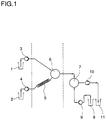
- the production of the micronisate is shown schematically in FIG. 1.
- the dye dispersion (1) was pumped by the pump (3) at a pumping rate of 230 parts / hour into the first mixing cell (6), in which it was pumped with a water flow of 4740 parts / hour from the vessel (2) via the pump (4 ) was mixed, which had previously been heated to 227 ° C via the thermostat (5). Mixing with the hot water suddenly reached a temperature of 217 ° C in the mixture and exceeded the melting point of the ⁇ -carotene (184 ° C).
- the ⁇ -carotene emulsion thus obtained was mixed in the second mixing cell (7) with the protective colloid solution (8), which was pumped (9) at a flow rate of 32,200 parts / Hour was pumped.
- the finely divided micronizate thus obtained was discharged via the pressure limiter valve (10).
- the ⁇ -carotene particles produced in this way had an average particle size of 576 nm (determined by photon correlation spectroscopy) and were in a colloidally stable dispersion.
- the production of the micronisate is shown schematically in FIG. 2.
- the drug solution (1) was kept at 50 ° C, the protective colloid solution (2) at 80 ° C.
- the active ingredient solution was pumped at 2000 parts / hour from the pump (3) via the heat exchanger in an oil bath at 120 ° C. (5) into the mixing cell (7).
- the active ingredient solution was mixed with the protective colloid solution (2), which was pumped by the pump (4) at a flow rate of 9000 parts / hour and passed through a heat exchanger (6) heated to 130.degree.
- a mixing temperature of 92 ° C was reached, which is above the melting point of the fenofibrate of 80 ° C.
- the emulsion thus obtained was discharged via the pressure relief valve (8), conveyed directly into the spray tower (10) via the heated hose (9) and dried in this at an inlet air temperature of 160 ° C. and an outlet temperature of 80 ° C.
- the production of the micronisate is shown schematically in FIG. 1.
- the active ingredient dispersion (1) was pumped at 0.55 kg / h from the pump (3) into the first mixing cell (6), in which it was pumped from the vessel (2) with a water flow of 1 kg / h via the pump (4) was mixed, which was previously heated to 210 ° C via the thermostat (5). Mixing with the hot water suddenly brought a temperature of 185 ° C, and the melting point of Levemopamil ⁇ HCl (182 ° C) was exceeded.
- the Levemopamil ⁇ HCl emulsion thus obtained was mixed in the second mixing cell (7) with the protective colloid solution (8), which was pumped (9) at a flow rate of 9 kg / h was pumped.
- the micronisate obtained was discharged via the pressure limiter valve (10). Spray drying of the micronisate gave a powder with an active ingredient content of 22.3%. After dissolving the powder in water, an average particle size of the Levemopamil ⁇ HCl nanoparticles of 580 nm was obtained (measured by means of dynamic light scattering).
- Example 3 According to Example 3, but with a pH of 11.0.
- the production of the micronizate corresponded to the micronization as described in Example 3.
- the mixing temperature in the mixing cell (6) was 177 ° C and thus above the melting point of the propafenone ⁇ HCl (174 ° C).
- Spray drying gave a powder with 23.3% of active ingredient, the particle size of the nanoparticles after redissolving the powder in water it was 350 nm (dynamic light scattering).
- Example 4 The micronization was carried out as in Example 4 with the following changes: Pumping rate dispersion: 2 kg / h Pumping rate water: 4 kg / h Pumping rate protective colloid solution: 30 kg / h Heat exchanger temperature: 100 ° C Temperature 1st mixing cell (6): 93 ° C Anipamil ⁇ HCl melting point: 63 ° C.
- the dispersion of nanoparticles of anipamil ⁇ HCl in water thus obtained had an average particle size of 220 nm (dynamic light scattering).
- the active substance content in this nanoparticulate dispersion was 0.45%.
- Example 4 The micronization was carried out as in Example 4 with the following changes: Pumping rate dispersion: 1.1 kg / h Pumping rate water: 6 kg / h Pumping rate protective colloid solution: 30 kg / h Heat exchanger temperature: 240 ° C Temperature 1st mixing cell (6): 223 ° C Melting point canthaxanthin 211 ° C.
- the dispersion of nanoparticles of canthaxanthine in water thus obtained had an average particle size of 370 nm (dynamic light scattering).
- the active substance content in the nanoparticulate dispersion was 0.21%.
- Nesapidil 3 g were dispersed with 0.6 g of ascorbyl palmitate in a mixture of 31.7 g of isopropanol and 4.3 g of water.
- Example 4 The micronization was carried out as in Example 4 with the following changes: Heat exchanger temperature: 210 ° C Temperature 1st mixing cell (6): 175 ° C Nesapidil melting point: 164 ° C.
- a powder with a Nesapidil content of 10.3% was obtained by spray drying.
- the mean particle size after redissolving the powder in water was 350 ⁇ m (dynamic light scattering).
Landscapes
- Chemical & Material Sciences (AREA)
- Organic Chemistry (AREA)
- Health & Medical Sciences (AREA)
- Engineering & Computer Science (AREA)
- Bioinformatics & Cheminformatics (AREA)
- Chemical Kinetics & Catalysis (AREA)
- Dispersion Chemistry (AREA)
- General Health & Medical Sciences (AREA)
- Medicinal Chemistry (AREA)
- Animal Behavior & Ethology (AREA)
- Epidemiology (AREA)
- Public Health (AREA)
- Veterinary Medicine (AREA)
- Pharmacology & Pharmacy (AREA)
- Life Sciences & Earth Sciences (AREA)
- Materials Engineering (AREA)
- Medicinal Preparation (AREA)
- Acyclic And Carbocyclic Compounds In Medicinal Compositions (AREA)
- Manufacturing Of Micro-Capsules (AREA)
- Pharmaceuticals Containing Other Organic And Inorganic Compounds (AREA)
- Organic Low-Molecular-Weight Compounds And Preparation Thereof (AREA)
- Colloid Chemistry (AREA)
- Agricultural Chemicals And Associated Chemicals (AREA)
Abstract
Description
- Die Erfindung betrifft ein verbessertes Verfahren zum Mikronisieren von in Wasser schwer löslichen Verbindungen.
- Es existieren verschiedene Verfahren zur Herstellung kleiner Teilchen von schwer in Wasser löslichen Verbindungen, wie sie zur Erhöhung der Bioverfügbarkeit von schwer löslichen Wirkstoffen oder der Farbstärke von schwer löslichen Farbstoffen benötigt werden. So beschreiben beispielsweise EP 65 193, EP 169 618 und US 5 133 908 Verfahren, bei denen der Wirk- oder Farbstoff in eine molekulare Lösung in einem wassermischbaren Lösungsmittel überführt und anschließend durch Zugabe der Wirkstofflösung zu Wasser oder umgekehrt in feinteiliger Form wieder ausgefällt wird. Diese Verfahren weisen jedoch den Nachteil auf, daß zur Formulierung des Wirkstoffs in feinteiliger Form Lösungsmittel in größerer Menge verwendet werden müssen, um den (oft auch in organischen Lösungsmitteln schwer löslichen) Wirk- oder Farbstoff zu lösen.
- Ziel der vorliegenden Erfindung war es daher, die Menge des verwendeten Lösungsmittels möglichst zu verringern und dennoch zu äußerst feinteiligen Formulierungen der Farb- und Wirkstoffe zu gelangen.
- Diese Verringerung der Menge des benötigten Lösungsmittels gelingt bei der erfindungsgemäßen Verfahrensweise dadurch, daß keine zwischenzeitliche molekulare Lösung des Wirk- oder Farbstoffes in einem wassermischbaren Lösungsmittel hergestellt werden muß, sondern das Verfahren so geführt wird, daß der in wäßriger oder organischer Phase dispergierte Wirk- oder Farbstoff kurzzeitig unter heftiger Turbulenz einer Temperatur über seinem Schmelzpunkt ausgesetzt und die so erhaltene feinteilige Emulsion anschließend durch schnelles Abkühlen unter den Schmelzpunkt in eine stabile Dispersion des Feststoffs in Wasser überführt wird. Diese kann anschließend in bekannter Weise aufkonzentriert und getrocknet werden, oder die Emulsion kann sofort, ohne zwischenzeitliche Abkühlung, sprühgetrocknet werden. In beiden Fallen erhält man so Pulver, die bei der Redispergierung in Wasser eine feinteilige Dispersion des Farb- oder Wirkstoffes ergeben.
- Die Vermeidung oder Verringerung des Lösungsmittelbedarfs während der Formulierung hat nicht nur den Vorteil geringerer Kosten, sondern sie ermöglicht z.B. im Falle des Fenofibrates erst die Herstellung von stabilen Nanopartikeln, weil bei der Herstellung über wäßrige Dispersionen von festen Partikeln diese sofort über Ostwaldt-Reifung zu größeren Partikeln wachsen und so der Mikronisiererfolg zunichte gemacht wird. Die Ostwaldt-Reifung wird bei den hier intermediär kurzzeitig hergestellten Emulsionen nicht beobachtet. Sie wird zusätzlich durch das vollständige oder weitgehende Vermeiden eines Lösungsmittels (und die dadurch bedingte Verminderung der Restlöslichkeit im Dispergiermedium) soweit verzögert, daß während der sofortigen Sprühtrocknung kein Partikelwachstum beobachtet werden kann.
- Es gibt allerdings Stoffe, die einer ganz lösungsmittelfreien Verarbeitung nicht zugänglich sind, weil ihre wäßrigen Dispersionen klumpen und daher nicht dosierbar sind. Ein Beispiel dafür ist Fenofibrat. Solche Stoffe werden daher erfindungsgemäß, statt in Wasser dispergiert, in möglichst wenig organischem Lösungsmittel gelöst (falls sie in dem betreffenden Lösungsmittel leicht löslich sind) oder dispergiert. Eine vollständige Lösung ist nicht erforderlich, es genügt, wenn die Suspension dosierbar ist. Zu dieser Lösung oder Suspension gibt man dann unter heftiger Turbulenz, und gegebenenfalls unter Druck, Wasser oder eine wäßrige Schutzkolloidlösung von einer Temperatur oberhalb des Schmelzpunktes des jeweiligen Stoffes und verfährt im übrigen wie vorher beschrieben, also sofortiges und unmittelbares Sprühtrocknen der Schmelzemulsion oder rasches Abkühlen der entstandenen feinteiligen Emulsion und gegebenenfalls Entwässern und Trocknen der so erhaltenen Suspension. Das rasche Abkühlen kann zweckmäßig durch Zusatz kalten Wassers erreicht werden.
- Wie die Turbulenz beim Zumischen des Wassers oder der wäßrigen Schutzkolloidlösung zur Suspension oder Lösung des Farb- oder Wirkstoffs erzeugt wird, ist nebensächlich. Es kann z.B. heftig gerührt oder geschüttelt werden. Am einfachsten und daher bevorzugt ist das Einspritzen einer oder besser beider Komponenten in hartem Strahl, so daß es ohne mechanische Hilfsmittel sofort zu einer innigen Durchmischung kommt.
- Mit "feinteilig" oder "kolloidaler Verteilung" sind Teilchengrößen unter 1,5, vorzugsweise unter 1 µm gemeint.
- "Im wesentlichen amorph" heißt, daß mehr als die Hälfte, vorzugsweise mehr als 70, insbesondere annähernd 100 % des erfindungsgemäß hergestellten Produktes röntgenamorph sind.
- Mit Wirkstoffen sind pharmazeutische Wirkstoffe gemeint. Für sie ist die Erfindung noch wichtiger als für Farbstoffe, denn bei Farbstoffen bringt die Erfindung "nur" den Vorteil, daß aufgrund der feineren Verteilung der gleiche Färbungseffekt mit weniger Farbstoff erzielt wird, während es bei Wirkstoffen vor allem um die Verbesserung der Resorbierbarkeit schwer oder unlöslicher Wirkstoffe geht, eine für die Wirkung entscheidende Größe.
- Der in Betracht kommende Temperaturbereich beim Mischen umfaßt 40 bis 250, vorzugsweise 60 bis 200°C.
- Schutzkolloide dienen der Stabilisierung der zunächst entstehenden Emulsion und der daraus beim Abkühlen entstehenden Dispersion. Außerdem gewährleisten sie die leichte Redispergierbarkeit des gegebenenfalls erfindungsgemäß hergestellten Pulvers. Schutzkolloide sind z.B. Gelatinen verschiedener Herkunft, Casein, Gummi arabicum, Lysalbinsäure, Stärke, Dextrin, Pektin, Methylcellulose, Carboxymethylcellulose, Hydroxypropylcellulose, Alginate, Polyvinylalkohol, Polyvinylpyrrolidon, Polyacrylate.
- Mit "relativ grobteilig" ist gemeint, grobteilig im Verhältnis zum Endprodukt. Die Teilchengröße ist praktisch unerheblich und kann im Bereich von etwa 1 bis 2.000 µm liegen.
- Als Lösungsmittel kommt im Prinzip jedes in Betracht, das zu mindestens 10 % wasserlöslich ist. Außerdem muß es unzersetzt destillierbar sein. Als Beispiele seien genannt: Alkohole, Äther, Ketone, Ester, Acetale, Dimethylformamid, N-Methylpyrrolidon, Dimethylsulfoxid.
- Zur Erhöhung der mechanischen Stabilität des Endproduktes ist es zweckmäßig, dem Kolloid einen Weichmacher oder Füllstoff zuzusetzen, wie Zucker oder Zuckeralkohole, z.B. Saccharose, Glukose, Lactose, Invertzucker, Sorbit, Mannit oder Glycerin.
- Das Endprodukt enthält, wenn es als trockenes Pulver vorliegt, 0,5 bis 20, vorzugsweise etwa 10 Gew.-% des schwerlöslichen Farb- oder Wirkstoffs, 10 bis 50 Gew.-% Schutzkolloid und 30 bis 80 Gew.-% eines Weichmachers sowie ggf. geringe Mengen weiterer Hilfsmittel wie Emulgatoren, Antioxidantien und andere Stabilisatoren.
- Im Fall der Verwendung eines organischen Lösungsmittels kann die Entfernung des Lösungsmittels je nach Siedepunkt in an sich bekannter Weise, z.B. durch Destillation, gegebenenfalls unter vermindertem Druck, oder durch Extraktion mit einem mit Wasser nicht mischbaren Lösungsmittel, erfolgen. In diesem Falle hat es sich als zweckmäßig und möglich erwiesen, das bei Verwendung von Isopropanol erhaltene Azeotrop ohne Wasserentfernung unmittelbar als Lösungsmittel einzusetzen. Vorzugsweise erfolgt sie jedoch gemeinsam mit der Entfernung des Wassers durch Sprühtrocknung oder Sprühgranulation.
- Man erhält ein Trockenpulver, das bei Verwendung eines wasserlöslichen Schutzkolloids erneut in Wasser unter Erzielung einer gleichmäßigen Feinverteilung des Wirkstoffes im Korngrößenbereich < 1 µm gelöst werden kann. Im photochemischen Stabilitätstest erweist sich das so erhaltene Wirkstoff-Hydrosol trotz der Feinverteilung als außerordentlich stabil.
- Geeignete Farb- und Wirkstoffe sind beispielsweise Carotinoide, Verapamil, Anipamil, Propaphenon, Biperiden.
- Die in den Beispielen genannten Teile beziehen sich auf das Gewicht.
- 21 Teile β-Carotin und 2,3 Teile Ascorbylpalmitat wurden in 240 Teilen Wasser mittels eines Magnetrührers dispergiert.
- 57,9 Teile Gelatine Typ B, 100 Bloom, und 97,5 Teile Lactose wurden in 4000 Teilen Wasser bei 70°C gelöst. Die so erhaltene Lösung wurde auf 25°C abgekühlt.
- Die Herstellung des Mikronisates ist in Fig. 1 schematisch dargestellt. Die Farbstoffdispersion (1) wurde von der Pumpe (3) mit einer Pumprate von 230 Teilen/Stunde in die erste Mischzelle (6) gepumpt, in der sie mit einem Wasserstrom von 4740 Teilen/Stunde aus Gefäß (2) über die Pumpe (4) gemischt wurde, der vorher über den Thermostat (5) auf 227°C erhitzt worden war. Durch die Vermischung mit dem heißen Wasser wurde in der Mischung schlagartig eine Temperatur von 217°C erreicht und der Schmelzpunkt des β-Carotins (184°C) überschritten. Nach einer Verweilzeit von 0,5 s bei 217°C wurde die so erhaltene Emulsion des β-Carotins in der zweiten Mischzelle (7) mit der Schutzkolloidlösung (8) vermischt, die von der Pumpe (9) mit einer Flußrate von 32.200 Teilen/Stunde gepumpt wurde. Das so erhaltene feinteilige Mikronisat wurde über das Druckbegrenzerventil (10) ausgetragen. Die so hergestellten β-Carotinpartikel hatten eine mittlere Teilchengröße von 576 nm (bestimmt über Photonenkorrelationsspektroskopie) und lagen in einer kolloidal stabilen Dispersion vor.
- 500 Teile Fenofibrat wurden bei 50°C in 1500 Teilen Isopropanol gelöst.
- 125 g Ascorbylpalmitat wurden bei pH 9 (Zugabe von Natronlauge 1 M) unter Rühren in 10.000 Teilen Wasser von 70°C gelöst. In der so erhaltenen Lösung wurden 2000 Teile Gelatine Typ B, 30 Bloom, und 2875 Teilen Lactose unter Rühren aufgelöst.
- Die Herstellung des Mikronisates ist in Fig. 2 schematisch dargestellt. Die Wirkstofflösung (1) wurde bei 50°C, die Schutzkolloidlösung (2) bei 80°C vorgehalten. Die Wirkstofflösung wurde mit 2000 Teilen/Stunde von der Pumpe (3) über den Wärmetauscher in einem Ölbad von 120°C (5) in die Mischzelle (7) gepumpt. In der Mischzelle wurde die Wirkstofflösung mit der Schutzkolloidlösung (2) gemischt, die von der Pumpe (4) mit einer Flußrate von 9000 Teilen/Stunde gepumpt wurde und einen auf 130°C geheizten Wärmetauscher (6) passierte. Es stellte sich eine Mischtemperatur von 92°C ein, die über dem Schmelzpunkt des Fenofibrates von 80°C liegt. Die so erhaltene Emulsion wurde über das Druckbegrenzungsventil (8) ausgetragen, über den beheizten Schlauch (9) direkt in den Sprühturm (10) gefördert und in diesem bei einer Zulufttemperatur von 160°C und einer Ausgangstemperatur von 80°C getrocknet. Man erhielt auf diese Weise ein frei fließendes Pulver (11), das bei der Dispergierung in Wasser eine kolloidale Dispersion von Fenofibrat mit einer Partikelgröße von 0,66 µm (Volumenmittel, bestimmt über Laserbeugung) ergab.
- 9 g Levemopamil · HCl wurden mit 1,8 g Ascorbylpalmitat in einer Mischung aus 31,7 g Isopropanol und 4,3 g Wasser dispergiert.
- Eine Lösung von 15 g Gelatine Typ B, 100 Bloom und 22,5 g Lactose in einem Liter Wasser wurde mit NaOH auf den pH-Wert 11,4 gebracht.
- Die Herstellung des Mikronisates ist in Fig. 1 schematisch dargestellt. Die Wirkstoffdispersion (1) wurde mit 0,55 kg/h von der Pumpe (3) in die erste Mischzelle (6) gepumpt, in der sie mit einem Wasserstrom von 1 kg/h aus Gefäß (2) über die Pumpe (4) gemischt wurde, der vorher über den Thermostat (5) auf 210°C erhitzt wurde. Durch die Vermischung mit dem heißen Wasser stellte sich schlagartig eine Temperatur von 185°C ein, und der Schmelzpunkt des Levemopamil · HCl (182°C) wurde überschritten. Nach einer Verweilzeit von weniger als 0,5 s bei 185°C wurde die so erhaltene Emulsion von Levemopamil · HCl in der zweiten Mischzelle (7) mit der Schutzkolloidlösung (8) vermischt, die über die Pumpe (9) mit einer Flußrate von 9 kg/h gepumpt wurde. Das erhaltene Mikronisat wurde über das Druckbegrenzerventil (10) ausgetragen. Sprühtrocknung des Mikronisates ergab ein Pulver mit einem Wirkstoffgehalt von 22,3 %. Nach Auflösen des Pulvers in Wasser erhielt man eine mittlere Teilchengröße der Levemopamil · HCl-Nanopartikel von 580 nm (gemessen über Dynamische Lichtstreuung).
- Entsprechend Levemopamil · HCl (Beispiel 3), jedoch mit Propafenon · HCl.
- Entsprechend Beispiel 3, jedoch mit pH-Wert 11,0.
- Die Herstellung des Mikronisates entsprach der Mikronisierung wie unter Beispiel 3 beschrieben. Die Mischtemperatur in der Mischzelle (6) war 177°C und damit über dem Schmelzpunkt des Propafenon · HCl (174°C). Durch Sprühtrocknung wurde ein Pulver mit 23,3 % Wirkstoff erhalten, die Teilchengröße der Nanopartikel nach Wiederauflösung des Pulvers in Wasser lag bei 350 nm (Dynamische Lichtstreuung).
- 21 g Anipamil · HCl wurden mit 0,24 g 10fach oxethylierten Isononylphenols in 240 g Wasser dispergiert.
- Eine Lösung von 15 g/l Gelatine Typ B, 100 Bloom wurde mit NaOH auf pH 9 gebracht.
- Die Durchführung der Mikronisierung entsprach der unter Beispiel 4 mit folgenden Änderungen:
Pumprate Dispersion: 2 kg/h Pumprate Wasser: 4 kg/h Pumprate Schutzkolloidlösung: 30 kg/h Temperatur Wärmetauscher: 100°C Temperatur 1. Mischzelle (6): 93°C Schmelzpunkt Anipamil · HCl: 63°C. - Die so erhaltene Dispersion von Nanopartikeln des Anipamil · HCl in Wasser wies eine mittlere Teilchengröße von 220 nm (Dynamische Lichtstreuung) auf. Der Wirkstoffgehalt in dieser nanopartikulären Dispersion betrug 0,45 %.
- 21 g Canthaxanthin wurden mit 4,6 g Ascorbylpalmitat in einer Mischung von 223 g Wasser und 12 g 1 M NaOH dispergiert.
- Herstellung der Schutzkolloidlösung entsprechend Beispiel 5.
- Die Durchführung der Mikronisierung entsprach der unter Beispiel 4 mit folgenden Änderungen:
Pumprate Dispersion: 1,1 kg/h Pumprate Wasser: 6 kg/h Pumprate Schutzkolloidlösung: 30 kg/h Temperatur Wärmetauscher: 240°C Temperatur 1. Mischzelle (6): 223°C Schmelzpunkt Canthaxanthin 211°C. - Die so erhaltene Dispersion von Nanopartikeln des Canthaxanthins in Wasser wies eine mittlere Teilchengröße von 370 nm (Dynamische Lichtstreuung) auf. Der Wirkstoffgehalt in der nanopartikulären Dispersion lag bei 0,21 %.
- 3 g Nesapidil wurden mit 0,6 g Ascorbylpalmitat in einer Mischung aus 31,7 g Isopropanol und 4,3 g Wasser dispergiert.
- Herstellung der Schutzkolloidlösung entsprechend Beispiel 5.
- Die Durchführung der Mikronisierung entsprach der unter Beispiel 4 mit folgenden Änderungen:
Temperatur Wärmetauscher: 210°C Temperatur 1. Mischzelle (6): 175°C Schmelzpunkt Nesapidil: 164°C. - Durch Sprühtrocknung wurde ein Pulver mit einem Nesapidilgehalt von 10,3 % erhalten. Die mittlere Teilchengröße nach Wiederauflösung des Pulvers in Wasser lag bei 350 um (Dynamische Lichtstreuung).
Claims (4)
- Verfahren zur Herstellung von feinteiligen, im wesentlichen amorphen Farb- oder Wirkstoffzubereitungen durch Überführen einer relativ grobteiligen Dispersion oder einer organischen Lösung in einen kolloidalen Verteilungszustand in Wasser, dadurch gekennzeichnet, daß die Dispersion oder organische Lösung des Farb- oder Wirkstoffs bei einer Temperatur oberhalb des Schmelzpunktes des Farb- oder Wirkstoffs (gegebenenfalls unter Druck) mit Wasser oder einer wäßrigen Schutzkolloidlösung turbulent vermischt und die so erhaltene Schmelzemulsion sofort sprühgetrocknet oder durch Abkühlen in eine Suspension umgewandelt wird.
- Verfahren nach Anspruch 1, dadurch gekennzeichnet, daß man ohne organische Lösungsmittel arbeitet.
- Verfahren nach Anspruch 1 bis 2, dadurch gekennzeichnet, daß das Abkühlen möglichst rasch nach der Bildung der heißen Schmelz-Emulsion erfolgt.
- Verfahren nach einem der Ansprüche 1 bis 3, dadurch gekennzeichnet, daß man die erhaltene Suspension nach an sich üblichen Methoden vom Wasser oder Wasser/Lösungsmittel-Gemisch befreit und so ein leicht redispergierbares Pulver gewinnt.
Applications Claiming Priority (2)
| Application Number | Priority Date | Filing Date | Title |
|---|---|---|---|
| DE4329446 | 1993-09-01 | ||
| DE4329446A DE4329446A1 (de) | 1993-09-01 | 1993-09-01 | Verfahren zur Herstellung von feinteiligen Farb- oder Wirkstoffzubereitungen |
Publications (3)
| Publication Number | Publication Date |
|---|---|
| EP0641596A2 true EP0641596A2 (de) | 1995-03-08 |
| EP0641596A3 EP0641596A3 (de) | 1995-11-15 |
| EP0641596B1 EP0641596B1 (de) | 1998-12-16 |
Family
ID=6496540
Family Applications (1)
| Application Number | Title | Priority Date | Filing Date |
|---|---|---|---|
| EP94113270A Expired - Lifetime EP0641596B1 (de) | 1993-09-01 | 1994-08-25 | Verfahren zur Herstellung von feinteiligen Farb- oder Wirkstoffzubereitungen |
Country Status (12)
| Country | Link |
|---|---|
| US (1) | US5700471A (de) |
| EP (1) | EP0641596B1 (de) |
| JP (1) | JP3773275B2 (de) |
| CN (1) | CN1067915C (de) |
| AT (1) | ATE174529T1 (de) |
| AU (1) | AU678840B2 (de) |
| CA (1) | CA2130857A1 (de) |
| DE (2) | DE4329446A1 (de) |
| DK (1) | DK0641596T3 (de) |
| ES (1) | ES2125384T3 (de) |
| IL (1) | IL110759A0 (de) |
| MX (1) | MX195052B (de) |
Cited By (1)
| Publication number | Priority date | Publication date | Assignee | Title |
|---|---|---|---|---|
| DE19750679A1 (de) * | 1997-11-15 | 1999-05-27 | Inst Lebensmittelwissenschaft | Verfahren zum Erzeugen von wasserhaltigen, gefrorenen bzw. erstarrten, lagerstabilen, rieselfähigen Pulvermikrokapseln und daraus bestehenden wasserhaltigen, gefrorenen bzw. erstarrten, lagerstabilen, rieselfähigen Pulvermikrokapselsystemen und Einrichtung zum Durchführen des Verfahrens |
Families Citing this family (28)
| Publication number | Priority date | Publication date | Assignee | Title |
|---|---|---|---|---|
| US20030133955A1 (en) * | 1993-02-22 | 2003-07-17 | American Bioscience, Inc. | Methods and compositions useful for administration of chemotherapeutic agents |
| DK0807431T3 (da) * | 1996-05-14 | 2004-07-26 | Dsm Ip Assets Bv | Fremgangsmåde til fremstilling af carotenoidpræparater |
| IL143197A0 (en) | 1998-11-20 | 2002-04-21 | Rtp Pharma Inc | Dispersible phospholipid stabilized microparticles |
| US7029700B2 (en) * | 2000-01-14 | 2006-04-18 | Brown University Research Foundation | Micronized freeze-dried particles |
| US7833549B2 (en) * | 2000-01-19 | 2010-11-16 | Mannkind Corporation | Dry powder formulations of antihistamine for nasal administration |
| US6953593B2 (en) * | 2000-02-01 | 2005-10-11 | Lipoprotein Technologies, Inc. | Sustained-release microencapsulated delivery system |
| EP1276465B1 (de) * | 2000-04-20 | 2014-03-12 | Jagotec AG | Verbessertes verfahren zur herstellung wasserunlöslicher arzneistoffpartikel |
| JP4763957B2 (ja) | 2000-05-10 | 2011-08-31 | オバン・エナジー・リミテッド | メディアミリング |
| DE10027948A1 (de) * | 2000-06-08 | 2001-12-20 | Henkel Kgaa | Verfahren zur Herstellung von Nanopartikel-Suspensionen |
| JP4969761B2 (ja) | 2000-08-31 | 2012-07-04 | オバン・エナジー・リミテッド | 所望粒度を持つ固体基材の小粒子および第一材料の小粒状物を含む相乗作用性混合物を製造する方法 |
| US8586094B2 (en) | 2000-09-20 | 2013-11-19 | Jagotec Ag | Coated tablets |
| ATE367802T1 (de) | 2000-09-20 | 2007-08-15 | Jagotec Ag | Verfahren zur sprühtrocknung von zusammensetzungen enthaltend fenofibrat |
| US20040015519A1 (en) * | 2001-10-15 | 2004-01-22 | Yukitoshi Maeda | Content delivery server and content delivery system having the same |
| EP1530457B1 (de) * | 2002-08-12 | 2009-09-09 | Bend Research, Inc. | Arzneizubereitungen bestehend aus arzneimitteln in halb-geordneter form und polymeren |
| AU2004277419B2 (en) * | 2003-09-30 | 2007-10-11 | Brown University Research Foundation | Nanoparticulate therapeutic biologically active agents |
| DE102005026755A1 (de) * | 2005-06-09 | 2006-12-14 | Basf Ag | Herstellung von festen Lösungen schwerlöslicher Wirkstoffe durch Kurzzeitüberhitzung und schnelle Trocknung |
| AU2006280511A1 (en) * | 2005-08-12 | 2007-02-22 | Astrazeneca Ab | Process |
| US20070286814A1 (en) * | 2006-06-12 | 2007-12-13 | Medispray Laboratories Pvt. Ltd. | Stable aerosol pharmaceutical formulations |
| BRPI0713533A2 (pt) * | 2006-06-26 | 2012-04-17 | Mutual Pharmaceutical Co | formulações de agente ativo, métodos de fabricação, e métodos de uso |
| GB0613925D0 (en) * | 2006-07-13 | 2006-08-23 | Unilever Plc | Improvements relating to nanodispersions |
| EA016100B1 (ru) * | 2006-12-01 | 2012-02-28 | Басф Се | Получение твердых растворов пестицидов путем кратковременного нагревания и быстрого высушивания |
| TW200848039A (en) * | 2007-02-09 | 2008-12-16 | Astrazeneca Ab | Pharmaceutical compositions |
| US20100068287A1 (en) * | 2007-02-09 | 2010-03-18 | Astrazeneca Ab | Process for Preparation of a Stable Dispersion of Solid Amorphous Submicron Particles in an Aqueous Medium |
| US20100151037A1 (en) * | 2008-08-07 | 2010-06-17 | Yivan Jiang | Method for the preparation of nanoparticles containing a poorly water-soluble pharmaceutically active compound |
| US20100159010A1 (en) * | 2008-12-24 | 2010-06-24 | Mutual Pharmaceutical Company, Inc. | Active Agent Formulations, Methods of Making, and Methods of Use |
| DE102009009060B3 (de) * | 2009-02-16 | 2010-05-12 | Karlsruher Institut für Technologie | Verfahren zur Herstellung einer Dispersion und Vorrichtung hierzu |
| WO2015023770A1 (en) * | 2013-08-14 | 2015-02-19 | Board Of Regents, The University Of Texas System | Methods for fine particle manufacture |
| CN106582429B (zh) * | 2016-10-28 | 2018-08-14 | 浙江大学 | 水凝胶-疏水Janus颗粒及其制备方法 |
Family Cites Families (17)
| Publication number | Priority date | Publication date | Assignee | Title |
|---|---|---|---|---|
| US2021143A (en) * | 1932-09-30 | 1935-11-19 | Du Pont | Production of dispersions |
| US2332934A (en) * | 1941-05-03 | 1943-10-26 | Cooper Mcdougall & Robertson | Process for the production of dispersible sulphur |
| NL113394C (de) * | 1960-04-07 | |||
| US3461080A (en) * | 1966-05-31 | 1969-08-12 | Olin Mathieson | Method of manufacture of sulfur formulations |
| US3998753A (en) * | 1974-08-13 | 1976-12-21 | Hoffmann-La Roche Inc. | Water dispersible carotenoid preparations and processes thereof |
| US4144025A (en) * | 1977-05-02 | 1979-03-13 | Polaroid Corporation | Process for making dispersions comprising spherical particles |
| DE3013839A1 (de) * | 1979-04-13 | 1980-10-30 | Freunt Ind Co Ltd | Verfahren zur herstellung einer aktivierten pharmazeutischen zusammensetzung |
| DE3119383A1 (de) * | 1981-05-15 | 1982-12-02 | Basf Ag, 6700 Ludwigshafen | Verfahren zur herstellung von feinverteilten, pulverfoermigen carotinodpraeparaten |
| CH658066A5 (de) * | 1984-03-15 | 1986-10-15 | Ciba Geigy Ag | Verfahren zur herstellung von granulaten wasserloeslicher farbstoffe. |
| CA1282405C (en) * | 1984-05-21 | 1991-04-02 | Michael R. Violante | Method for making uniformly sized particles from water-insoluble organic compounds |
| DE3610191A1 (de) * | 1986-03-26 | 1987-10-01 | Basf Ag | Verfahren zur herstellung von feinteiligen, wasserdispergierbaren carotinoid-praeparationen |
| FR2634397B2 (fr) * | 1986-12-31 | 1991-04-19 | Centre Nat Rech Scient | Procede de preparation de systemes colloidaux dispersibles d'une proteine sous forme de nanoparticules |
| FR2608988B1 (fr) * | 1986-12-31 | 1991-01-11 | Centre Nat Rech Scient | Procede de preparation de systemes colloidaux dispersibles d'une substance, sous forme de nanoparticules |
| DE3702030A1 (de) * | 1987-01-24 | 1988-08-04 | Basf Ag | Pulverfoermige, wasserdispergierbare carotinoid-zubereitungen und verfahren zu ihrer herstellung |
| ATE96312T1 (de) * | 1989-07-25 | 1993-11-15 | Hoffmann La Roche | Verfahren zur herstellung von carotinoidpraeparaten. |
| AU668679B2 (en) * | 1991-02-18 | 1996-05-16 | Transdermal Technologies Pty Limited | Composition for use in transdermal administration |
| WO1993016031A1 (en) * | 1992-02-11 | 1993-08-19 | Glaxo Group Limited | Benzenedimethanol derivative suitable for micronisation |
-
1993
- 1993-09-01 DE DE4329446A patent/DE4329446A1/de not_active Withdrawn
-
1994
- 1994-08-23 IL IL11075994A patent/IL110759A0/xx not_active IP Right Cessation
- 1994-08-25 DK DK94113270T patent/DK0641596T3/da active
- 1994-08-25 EP EP94113270A patent/EP0641596B1/de not_active Expired - Lifetime
- 1994-08-25 DE DE59407483T patent/DE59407483D1/de not_active Expired - Lifetime
- 1994-08-25 AT AT94113270T patent/ATE174529T1/de not_active IP Right Cessation
- 1994-08-25 CA CA002130857A patent/CA2130857A1/en not_active Abandoned
- 1994-08-25 ES ES94113270T patent/ES2125384T3/es not_active Expired - Lifetime
- 1994-08-30 AU AU71582/94A patent/AU678840B2/en not_active Ceased
- 1994-08-31 JP JP20723994A patent/JP3773275B2/ja not_active Expired - Lifetime
- 1994-08-31 MX MX9406643A patent/MX195052B/es not_active IP Right Cessation
- 1994-09-01 CN CN94113697A patent/CN1067915C/zh not_active Expired - Lifetime
-
1995
- 1995-12-18 US US08/573,876 patent/US5700471A/en not_active Expired - Lifetime
Cited By (2)
| Publication number | Priority date | Publication date | Assignee | Title |
|---|---|---|---|---|
| DE19750679A1 (de) * | 1997-11-15 | 1999-05-27 | Inst Lebensmittelwissenschaft | Verfahren zum Erzeugen von wasserhaltigen, gefrorenen bzw. erstarrten, lagerstabilen, rieselfähigen Pulvermikrokapseln und daraus bestehenden wasserhaltigen, gefrorenen bzw. erstarrten, lagerstabilen, rieselfähigen Pulvermikrokapselsystemen und Einrichtung zum Durchführen des Verfahrens |
| DE19750679B4 (de) * | 1997-11-15 | 2004-10-21 | Institut für Lebensmittelwissenschaft, Lehrstuhl für Lebensmittelverfahrenstechnik | Verfahren zum Erzeugen von kaltgesprühten, verfestigten, lagerstabilen und rieselfähigen Mikrokapselsystemen sowie deren Verwendung |
Also Published As
| Publication number | Publication date |
|---|---|
| ES2125384T3 (es) | 1999-03-01 |
| DE4329446A1 (de) | 1995-03-02 |
| CN1067915C (zh) | 2001-07-04 |
| JPH07163862A (ja) | 1995-06-27 |
| AU678840B2 (en) | 1997-06-12 |
| CA2130857A1 (en) | 1995-03-02 |
| DK0641596T3 (da) | 1999-08-23 |
| US5700471A (en) | 1997-12-23 |
| ATE174529T1 (de) | 1999-01-15 |
| JP3773275B2 (ja) | 2006-05-10 |
| EP0641596B1 (de) | 1998-12-16 |
| DE59407483D1 (de) | 1999-01-28 |
| CN1105902A (zh) | 1995-08-02 |
| MX195052B (en) | 2000-01-21 |
| IL110759A0 (en) | 1994-11-11 |
| EP0641596A3 (de) | 1995-11-15 |
| AU7158294A (en) | 1995-03-16 |
Similar Documents
| Publication | Publication Date | Title |
|---|---|---|
| EP0641596B1 (de) | Verfahren zur Herstellung von feinteiligen Farb- oder Wirkstoffzubereitungen | |
| EP0065193B1 (de) | Verfahren zur Herstellung von feinverteilten, pulverförmigen Carotinoid- bzw. Retinoidpräparaten | |
| DE69929641T2 (de) | Herstellung eines fein verteilten, pulverförmigen Carotinoidpräparats | |
| DE60214012T2 (de) | Verfahren zur herstellung kristalliner arzneimittelteilchen durch ausfällung | |
| EP0239949B1 (de) | Verfahren zur Herstellung von feinverteilten, pulverförmigen Carotinoidpräparaten | |
| DE3702030A1 (de) | Pulverfoermige, wasserdispergierbare carotinoid-zubereitungen und verfahren zu ihrer herstellung | |
| DE19530509C2 (de) | Verfahren zur Herstellung eines festen, magensaftresistenten pharmazeutischen Präparats | |
| DE10214031A1 (de) | Verfahren zur Herstellung und Anwendung von Mikro- und Nanoteilchen durch aufbauende Mikronisation | |
| EP0019800B1 (de) | Verfahren zur Einarbeitung photographischer Zusatzstoffe in hydrophile Kolloidzubereitungen, so hergestellte Zubereitungen, unter Verwendung dieser Zubereitungen hergestellte photographische Schichten, und diese Schichten enthaltendes photographisches Material | |
| DE2237206A1 (de) | Verfahren zur herstellung von mikrokapseln | |
| DE1181160B (de) | Verfahren zur Herstellung feindisperser Farbstoffe oder Pigmente | |
| EP1066355B1 (de) | Präzipitierte, wasserunlösliche farbstoffe in kolloid-disperser form | |
| EP0410236A2 (de) | Verfahren zur Herstellung von Carotinoidpräparaten | |
| DE3515797A1 (de) | Verfahren zur herstellung von farbstoffgranulaten | |
| EP0118394B1 (de) | Dispersfarbstoffpräparate | |
| EP0014503A1 (de) | Verfahren zur Herstellung von in wässrigen Medien dispergierbaren, hochkonzentrierten, feindispersen, dispergiermittelarmen oder dispergiermittelfreien Präparaten von in Wasser schwer löslichen bis unlöslichen Wirksubstanzen in fester Form | |
| DE60130900T2 (de) | Verfahren zur fällung fein verteilter feststoffpartikel | |
| WO2003090786A1 (de) | Verfahren zum herstellen von kristallen von arzneimittelhilfsstoffen, danach erhältliche kristalle und deren pharmazeutische verwendung | |
| DE2553594A1 (de) | Verfahren zur herstellung von jodid enthaltenden poly-n-vinylpyrrolidon-granulaten | |
| DE69102143T2 (de) | Spiramycin enthaltende arzneimittel und verfahren zu deren herstellung. | |
| DE2459895C3 (de) | Zerstäubungsgetrocknete niedrigschmelzende basische Farbstoffe und Verfahren zu ihrer Herstellung | |
| EP3580263A1 (de) | Verfahren zur herstellung sphärischer polysilsesquioxanpartikel | |
| DE202023102757U1 (de) | Ein System zur Herstellung einer festen Dispersion von Nalidixinsäure | |
| DE2653434A1 (de) | Verfahren zur herstellung von praeparaten aus einem zweiphasensystem | |
| EP0139294A2 (de) | Neue Modifikation des Farbstoffs C.I. Acid Blue 324 |
Legal Events
| Date | Code | Title | Description |
|---|---|---|---|
| PUAI | Public reference made under article 153(3) epc to a published international application that has entered the european phase |
Free format text: ORIGINAL CODE: 0009012 |
|
| AK | Designated contracting states |
Kind code of ref document: A2 Designated state(s): AT BE CH DE DK ES FR GB IT LI NL SE |
|
| PUAL | Search report despatched |
Free format text: ORIGINAL CODE: 0009013 |
|
| AK | Designated contracting states |
Kind code of ref document: A3 Designated state(s): AT BE CH DE DK ES FR GB IT LI NL SE |
|
| 17P | Request for examination filed |
Effective date: 19951025 |
|
| 17Q | First examination report despatched |
Effective date: 19970611 |
|
| GRAG | Despatch of communication of intention to grant |
Free format text: ORIGINAL CODE: EPIDOS AGRA |
|
| GRAG | Despatch of communication of intention to grant |
Free format text: ORIGINAL CODE: EPIDOS AGRA |
|
| GRAH | Despatch of communication of intention to grant a patent |
Free format text: ORIGINAL CODE: EPIDOS IGRA |
|
| GRAH | Despatch of communication of intention to grant a patent |
Free format text: ORIGINAL CODE: EPIDOS IGRA |
|
| GRAA | (expected) grant |
Free format text: ORIGINAL CODE: 0009210 |
|
| AK | Designated contracting states |
Kind code of ref document: B1 Designated state(s): AT BE CH DE DK ES FR GB IT LI NL SE |
|
| REF | Corresponds to: |
Ref document number: 174529 Country of ref document: AT Date of ref document: 19990115 Kind code of ref document: T |
|
| REG | Reference to a national code |
Ref country code: CH Ref legal event code: EP |
|
| GBT | Gb: translation of ep patent filed (gb section 77(6)(a)/1977) |
Effective date: 19990106 |
|
| REF | Corresponds to: |
Ref document number: 59407483 Country of ref document: DE Date of ref document: 19990128 |
|
| ITF | It: translation for a ep patent filed | ||
| REG | Reference to a national code |
Ref country code: ES Ref legal event code: FG2A Ref document number: 2125384 Country of ref document: ES Kind code of ref document: T3 |
|
| ET | Fr: translation filed | ||
| REG | Reference to a national code |
Ref country code: DK Ref legal event code: T3 |
|
| PLBE | No opposition filed within time limit |
Free format text: ORIGINAL CODE: 0009261 |
|
| STAA | Information on the status of an ep patent application or granted ep patent |
Free format text: STATUS: NO OPPOSITION FILED WITHIN TIME LIMIT |
|
| 26N | No opposition filed | ||
| PGFP | Annual fee paid to national office [announced via postgrant information from national office to epo] |
Ref country code: SE Payment date: 20010716 Year of fee payment: 8 |
|
| PGFP | Annual fee paid to national office [announced via postgrant information from national office to epo] |
Ref country code: NL Payment date: 20010719 Year of fee payment: 8 |
|
| PGFP | Annual fee paid to national office [announced via postgrant information from national office to epo] |
Ref country code: AT Payment date: 20010720 Year of fee payment: 8 |
|
| PGFP | Annual fee paid to national office [announced via postgrant information from national office to epo] |
Ref country code: BE Payment date: 20010912 Year of fee payment: 8 |
|
| REG | Reference to a national code |
Ref country code: GB Ref legal event code: IF02 |
|
| PG25 | Lapsed in a contracting state [announced via postgrant information from national office to epo] |
Ref country code: AT Free format text: LAPSE BECAUSE OF NON-PAYMENT OF DUE FEES Effective date: 20020825 |
|
| PG25 | Lapsed in a contracting state [announced via postgrant information from national office to epo] |
Ref country code: SE Free format text: LAPSE BECAUSE OF NON-PAYMENT OF DUE FEES Effective date: 20020826 |
|
| PG25 | Lapsed in a contracting state [announced via postgrant information from national office to epo] |
Ref country code: BE Free format text: LAPSE BECAUSE OF NON-PAYMENT OF DUE FEES Effective date: 20020831 |
|
| BERE | Be: lapsed |
Owner name: *BASF A.G. Effective date: 20020831 |
|
| PG25 | Lapsed in a contracting state [announced via postgrant information from national office to epo] |
Ref country code: NL Free format text: LAPSE BECAUSE OF NON-PAYMENT OF DUE FEES Effective date: 20030301 |
|
| EUG | Se: european patent has lapsed | ||
| NLV4 | Nl: lapsed or anulled due to non-payment of the annual fee |
Effective date: 20030301 |
|
| PGFP | Annual fee paid to national office [announced via postgrant information from national office to epo] |
Ref country code: DK Payment date: 20070815 Year of fee payment: 14 |
|
| REG | Reference to a national code |
Ref country code: DK Ref legal event code: EBP |
|
| REG | Reference to a national code |
Ref country code: CH Ref legal event code: PUE Owner name: ABBOTT GMBH & CO. KG Free format text: BASF SE#CARL-BOSCH-STRASSE 38#67063 LUDWIGSHAFEN (DE) -TRANSFER TO- ABBOTT GMBH & CO. KG#MAX-PLANCK-RING 2#65205 WIESBADEN (DE) Ref country code: CH Ref legal event code: PFA Owner name: BASF SE Free format text: BASF AKTIENGESELLSCHAFT#CARL-BOSCH-STRASSE 38#67063 LUDWIGSHAFEN (DE) -TRANSFER TO- BASF SE#CARL-BOSCH-STRASSE 38#67063 LUDWIGSHAFEN (DE) Ref country code: CH Ref legal event code: NV Representative=s name: SCHMAUDER & PARTNER AG PATENTANWALTSBUERO |
|
| REG | Reference to a national code |
Ref country code: GB Ref legal event code: 732E Free format text: REGISTERED BETWEEN 20090528 AND 20090603 |
|
| PG25 | Lapsed in a contracting state [announced via postgrant information from national office to epo] |
Ref country code: DK Free format text: LAPSE BECAUSE OF NON-PAYMENT OF DUE FEES Effective date: 20080831 |
|
| REG | Reference to a national code |
Ref country code: CH Ref legal event code: PCAR Free format text: SCHMAUDER & PARTNER AG PATENT- UND MARKENANWAELTE VSP;ZWAENGIWEG 7;8038 ZUERICH (CH) |
|
| REG | Reference to a national code |
Ref country code: ES Ref legal event code: PC2A |
|
| REG | Reference to a national code |
Ref country code: FR Ref legal event code: TP |
|
| REG | Reference to a national code |
Ref country code: DE Ref legal event code: R082 Ref document number: 59407483 Country of ref document: DE Representative=s name: REITSTOETTER, KINZEBACH & PARTNER GBR, DE |
|
| REG | Reference to a national code |
Ref country code: CH Ref legal event code: PUE Owner name: ABBVIE DEUTSCHLAND GMBH AND CO. KG, DE Free format text: FORMER OWNER: ABBOTT GMBH AND CO. KG, DE |
|
| REG | Reference to a national code |
Ref country code: DE Ref legal event code: R082 Ref document number: 59407483 Country of ref document: DE Representative=s name: REITSTOETTER - KINZEBACH, DE Effective date: 20130813 Ref country code: DE Ref legal event code: R082 Ref document number: 59407483 Country of ref document: DE Representative=s name: REITSTOETTER, KINZEBACH & PARTNER GBR, DE Effective date: 20130813 Ref country code: DE Ref legal event code: R081 Ref document number: 59407483 Country of ref document: DE Owner name: ABBVIE DEUTSCHLAND GMBH & CO. KG, DE Free format text: FORMER OWNER: ABBOTT GMBH & CO. KG, 65205 WIESBADEN, DE Effective date: 20130813 |
|
| REG | Reference to a national code |
Ref country code: FR Ref legal event code: TP Owner name: ABBVIE DEUTSCHLAND GMBH & CO KG, DE Effective date: 20130925 |
|
| REG | Reference to a national code |
Ref country code: GB Ref legal event code: 732E Free format text: REGISTERED BETWEEN 20131003 AND 20131009 |
|
| PGFP | Annual fee paid to national office [announced via postgrant information from national office to epo] |
Ref country code: ES Payment date: 20130729 Year of fee payment: 20 Ref country code: CH Payment date: 20130813 Year of fee payment: 20 Ref country code: DE Payment date: 20130830 Year of fee payment: 20 |
|
| PGFP | Annual fee paid to national office [announced via postgrant information from national office to epo] |
Ref country code: GB Payment date: 20130821 Year of fee payment: 20 Ref country code: FR Payment date: 20130808 Year of fee payment: 20 |
|
| REG | Reference to a national code |
Ref country code: ES Ref legal event code: PC2A Owner name: ABBVIE DEUTSCHLAND GMBH & CO. KG Effective date: 20131121 |
|
| PGFP | Annual fee paid to national office [announced via postgrant information from national office to epo] |
Ref country code: IT Payment date: 20130809 Year of fee payment: 20 |
|
| REG | Reference to a national code |
Ref country code: DE Ref legal event code: R071 Ref document number: 59407483 Country of ref document: DE |
|
| REG | Reference to a national code |
Ref country code: DE Ref legal event code: R071 Ref document number: 59407483 Country of ref document: DE |
|
| REG | Reference to a national code |
Ref country code: CH Ref legal event code: PL |
|
| REG | Reference to a national code |
Ref country code: GB Ref legal event code: PE20 Expiry date: 20140824 |
|
| PG25 | Lapsed in a contracting state [announced via postgrant information from national office to epo] |
Ref country code: DE Free format text: LAPSE BECAUSE OF EXPIRATION OF PROTECTION Effective date: 20140826 |
|
| PG25 | Lapsed in a contracting state [announced via postgrant information from national office to epo] |
Ref country code: GB Free format text: LAPSE BECAUSE OF EXPIRATION OF PROTECTION Effective date: 20140824 |
|
| REG | Reference to a national code |
Ref country code: ES Ref legal event code: FD2A Effective date: 20150108 |
|
| PG25 | Lapsed in a contracting state [announced via postgrant information from national office to epo] |
Ref country code: ES Free format text: LAPSE BECAUSE OF EXPIRATION OF PROTECTION Effective date: 20140826 |