EP0641765B1 - Procede de production d'aminophenol a double substitution n,n - Google Patents
Procede de production d'aminophenol a double substitution n,n Download PDFInfo
- Publication number
- EP0641765B1 EP0641765B1 EP94910026A EP94910026A EP0641765B1 EP 0641765 B1 EP0641765 B1 EP 0641765B1 EP 94910026 A EP94910026 A EP 94910026A EP 94910026 A EP94910026 A EP 94910026A EP 0641765 B1 EP0641765 B1 EP 0641765B1
- Authority
- EP
- European Patent Office
- Prior art keywords
- aminophenol
- formula
- reaction
- reaction mixture
- represented
- Prior art date
- Legal status (The legal status is an assumption and is not a legal conclusion. Google has not performed a legal analysis and makes no representation as to the accuracy of the status listed.)
- Expired - Lifetime
Links
Classifications
-
- C—CHEMISTRY; METALLURGY
- C07—ORGANIC CHEMISTRY
- C07C—ACYCLIC OR CARBOCYCLIC COMPOUNDS
- C07C215/00—Compounds containing amino and hydroxy groups bound to the same carbon skeleton
- C07C215/74—Compounds containing amino and hydroxy groups bound to the same carbon skeleton having hydroxy groups and amino groups bound to carbon atoms of six-membered aromatic rings of the same carbon skeleton
- C07C215/76—Compounds containing amino and hydroxy groups bound to the same carbon skeleton having hydroxy groups and amino groups bound to carbon atoms of six-membered aromatic rings of the same carbon skeleton of the same non-condensed six-membered aromatic ring
-
- C—CHEMISTRY; METALLURGY
- C07—ORGANIC CHEMISTRY
- C07C—ACYCLIC OR CARBOCYCLIC COMPOUNDS
- C07C213/00—Preparation of compounds containing amino and hydroxy, amino and etherified hydroxy or amino and esterified hydroxy groups bound to the same carbon skeleton
- C07C213/02—Preparation of compounds containing amino and hydroxy, amino and etherified hydroxy or amino and esterified hydroxy groups bound to the same carbon skeleton by reactions involving the formation of amino groups from compounds containing hydroxy groups or etherified or esterified hydroxy groups
-
- C—CHEMISTRY; METALLURGY
- C07—ORGANIC CHEMISTRY
- C07C—ACYCLIC OR CARBOCYCLIC COMPOUNDS
- C07C213/00—Preparation of compounds containing amino and hydroxy, amino and etherified hydroxy or amino and esterified hydroxy groups bound to the same carbon skeleton
- C07C213/08—Preparation of compounds containing amino and hydroxy, amino and etherified hydroxy or amino and esterified hydroxy groups bound to the same carbon skeleton by reactions not involving the formation of amino groups, hydroxy groups or etherified or esterified hydroxy groups
-
- C—CHEMISTRY; METALLURGY
- C07—ORGANIC CHEMISTRY
- C07C—ACYCLIC OR CARBOCYCLIC COMPOUNDS
- C07C213/00—Preparation of compounds containing amino and hydroxy, amino and etherified hydroxy or amino and esterified hydroxy groups bound to the same carbon skeleton
- C07C213/10—Separation; Purification; Stabilisation; Use of additives
Definitions
- This invention relates to a process for producing N,N-disubstituted aminophenol and, more specifically, to a process for producing high-purity N,N-disubstituted aminophenol at a high yield by aminating and alkylating a dihydric phenol.
- N,N-disubstituted aminophenol is a valuable compound as an intermediate for producing dyes for heat-sensitive recording papers and fluorescent dyes.
- a process for producing N-substituted aminophenol by reacting a dihydric phenol with ammonia, primary amine or secondary amine in the absence of a catalyst is disclosed in Japanese Patent Laid-Open Publication Nos.5416/1987 and 99042/1991.
- N,N-disubstituted aminophenol by a reduction alkylation reaction between N-substituted aminophenol and aldehyde in an organic solvent in the presence of hydrogen and a reduction catalyst is disclosed in Japanese Patent Laid-Open Publication Nos.258346/1977 and 292747/1987. According to this process, there can be separated N,N-disubstituted aminophenol purified by distillation after the reduction catalyst has been separated from the reaction mixture after the reaction. With this process, N,N-disubstituted aminophenol can be obtained at high conversion and at high selectivity as far as high-purity N-substituted aminophenol is used as a source material.
- the step I is a step in which a dihydric phenol is reacted with a primary amine.
- the dihydric phenol include resorcinol and hydroquinone.
- the primary amine is a compound represented by the formula (1).
- R 1 is an alkyl group having 1 to 6 carbon atoms or a cycloalkyl group having 4 to 8 carbon atoms.
- the alkyl group having 1 to 6 carbon atoms may be of straight-chain or branched-chain.
- Examples of the primary amine include methylamine, ethylamine, n-propylamine, isopropylamine, n-butylamine, sec-butylamine, tert-butylamine, amylamine, isoamylamine, hexylamine, cyclobutylamine, cyclopentylamine, cyclohexylamine, cycloheptylamine, cyclooctylamine and the like.
- the primary amine is used in a proportion of 0.4 to 1.8 mols, preferably 0.7 to 1.5 mols, based on one mol of the dihydric phenol.
- the amination reaction in the step I can be carried out in either the presence or absence of a reaction medium.
- a reaction medium examples include inert media such as water; aromatic hydrocarbon such as benzene, toluene and xylene; alicyclic hydrocarbon such as cyclohexane; and polar media such as N,N-dimethylformamide, phenol, P-chlorophenol, O,O'-biphenol and P,P'-biphenol.
- the reaction is carried out in an inert gas atmosphere such as argon, helium or nitrogen, preferably in a nitrogen gas atmosphere. Further, the reaction is suitably carried out at a temperature of 150 to 250°C, preferably 160 to 220°C under an initial pressure (gauge pressure) of normal pressures to 4 kg/cm 2 .
- an inert gas atmosphere such as argon, helium or nitrogen
- the reaction is suitably carried out at a temperature of 150 to 250°C, preferably 160 to 220°C under an initial pressure (gauge pressure) of normal pressures to 4 kg/cm 2 .
- step II of the process of the present invention it is important to thermally decompose the quaternary ammonia salt of the formula (3) in the reaction mixture obtained in the step I to convert it into a dihydric phenol and a primary amine of the formula (1).
- the inclusion of the primary amine can be minimized.
- the distillation separation of N-substituted aminophenols represented by the formula (2) from the reaction mixture in the step I is generally carried out in a continuous twin column and in a batch manner, but it is difficult to separate the quaternary ammonia salt of the formula (3) from N-substituted aminophenols of the formula (2) in the distillation step. Since the quaternary ammonia salt is partly decomposed in the distillation step to produce a primary amine, it is also contained in N-substituted aminophenol of the formula (2).
- the quaternary ammonia salt and primary amine contained in N-substituted aminophenol poisons a reduction catalyst to lower its activity in the reduction alkylation step (step IV), and reduces the reaction yield of the object compound and increases the formation of impurities in the reduction alkylation reaction.
- the catalyst is used repeatedly, deterioration in the activity of the catalyst proceeds and yield lowers, thus shortening the life of the catalyst. As a result, industrially stable operation cannot be attained and catalyst costs increase.
- step II it is advantageous that the operation of thermally decomposing the quaternary ammonia salt of the formula (3) into a dihydric phenol and a primary amine is carried out while distilling out the produced primary amine together with low-boiling impurities produced by the reaction, or the low-boiling impurities produced by the reaction and the organic solvent.
- This thermal decomposition operation can be carried out at either an increased or reduced pressure and in either a batch or continuous manner.
- a heating can or a distillation column is used as an apparatus for thermal decomposition.
- the thermal decomposition operation is usually carried out at a pressure of 0.13 bars (100 mmHg) or less, preferably 50 mmHg or less, at a column bottom temperature of 100 to 200°C, preferably 120 to 180°C. With a rise in the column bottom temperature the thermal composition reaction is accelerated, but this also invites an increase in the weight of a reaction product and the decomposition of the product, which is not desirable.
- the thermal decomposition of the step II is carried out under the condition that the presence of quaternary ammonia salt is substantially recognizable.
- N-substituted aminophenols represented by the formula (2) are separated from the reaction mixture by distillation.
- This distillation can be carried out at either an increased or reduced pressure and in either a continuous or batch manner.
- the distillation operation of the step III is usually carried out at a column top pressure of 0.04 bars (30 mmHg) or less, preferably 0.027 bars (20 mmHg) or less, more preferably 0.013 bars (10 mmHg) or less.
- the N-substituted aminophenols obtained in the step III are subjected to a reduction alkylation reaction, together with the aldehyde compound of the formula (4) in the step IV.
- This reduction alkylation reaction allows the N-substituted aminophenols of the formula (2) and the aldehyde compound to react in an organic solvent in a hydrogen gas atmosphere in the presence of a reduction catalyst.
- the aldehyde compound of the formula (4) used in the present invention is selected from compounds corresponding to the compound of the formula (4) in which R 2 is an alkyl group having 1 to 5 carbon atoms or a cycloalkyl group having 4 to 8 carbon atoms.
- aldehyde compound examples include acetaldehyde, propionaldehyde, n-butylaldehyde, isobutylaldehyde, isoamylaldehyde, hexylaldehyde, cyclobutylaldehyde, cyclopentylaldehyde, cyclohexylaldehyde, cycloheptylaldehyde, cyclooctylaldehyde and the like.
- aldehyde compounds are used in a proportion of 0.7 to 1.5 mols, preferably 0.9 to 1.3 mols, based on one mol of N-substituted aminophenol.
- Examples of the reduction catalyst used in the step IV include ones in which metals of the group VIII of the periodic table such as Pd, Pt, Rh, Co, Ni and Ru are carried on inert carriers, such as active carbon and alumina. Among them, a reduction catalyst in which Pt is carried on active carbon is preferably used.
- Examples of the organic solvent used in the present invention include lower aliphatic alcohols such as methanol, ethanol, propanol and butanol. Among them, methanol and ethanol are especially preferred.
- the reduction catalyst is separated from the reaction mixture containing N,N-disubstituted aminophenol of the general formula (5) by filtration, and then N,N-disubstituted aminophenol purified by distillation can be isolated.
- the separated reduction catalyst can be used again as a reduction catalyst because it maintains sufficient activity. According to the process of the present invention, even after the reduction catalyst is used repeatedly at least ten times, it retains enough activity to be used for industrial application.
- N-substituted aminophenol which is obtained by in advance thermally decomposing a quaternary ammonia salt contained in the reaction mixture obtained by the amination reaction between a dihydric phenol and a primary amine, and removing the primary amine by distillation, and then separating high-boiling impurities by distillation operation, is used in a reduction alkylation reaction thereby to increase yield from the reduction alkylation reaction and suppress the formation of impurities. Consequently, a high-purity product containing little impurities can be obtained at a high yield and industrially stably. Moreover, as the activity of the reduction catalyst hardly deteriorates and is maintained at a high level even after repeated use, the process of the present invention is industrially advantageous.
- the yield and selectivity of N,N-disubstituted aminophenol are calculated from the equations below, respectively.
- Yield (%) of N,N-disubstituted aminophenol number of mols of N,N-disubstituted aminophenol produced by reaction number of mols of N-substituted aminophenol before reaction x 100
- Selectivity (%) of N,N-disubstituted aminophenol number of mols of N,N-disubstituted aminophenol produced by reaction number of mols of N-substituted aminophenol after reaction x 100
- An autoclave made of SUS316 was charged with 110 parts by weight of resorcinol in a nitrogen atmosphere and closed up tight, and the temperature was elevated to 130°C to melt resorcinol.
- the inner temperature reached 130°C 36 parts by weight of monoethylamine was supplied to the autoclave over one hour while it was stirred. Thereafter, the temperature was elevated to 170°C and stirring was continued for 7 hours while maintaining this temperature.
- the reaction mixture was then transferred to an evaporation can and the pressure and temperature were maintained at 0.13 bars (100 mmHg) and 140°C, respectively, while the mixture was stirred, so as to carry out 1 hour of thermal decomposition and removal of low-boiling impurities.
- the low-boiling impurities in the system were removed at a pressure of 0.02 bars (15 mmHg), and then the reaction product was removed at a temperature of 190°C to separate high-boiling impurities.
- the temperature was 200°C when recovery of the reaction product was completed.
- the concentration of monoethylamine contained in the reaction product was 0.2% and the yield of N-ethyl-m-aminophenol was 87.0 wt%.
- An autoclave made of SUS316 was charged with 26 parts by weight of N-ethyl-m-aminophenol contained in the reaction product, 72 parts by weight of methanol as an organic solvent, and 2 parts by weight of a Pt catalyst as a reduction catalyst in which 2 wt% of Pt was carried on active carbon in a nitrogen atmosphere, and the inside was replaced with hydrogen under stirring, and then the pressure was elevated to 7 kg/cm 2 G.
- 18 Parts by weight of isoamylaldehyde was supplied to the autoclave over 3 hours while the hydrogen pressure and temperature were maintained at a constant level and 30 to 35°C, respectively. Thereafter, while the above pressure and temperature were maintained, stirring was continued for 3 hours.
- Example 2 An amination reaction was carried out in the same manner as in Example 1. After low-boiling impurities and high-boiling impurities contained in the reaction mixture were removed by distillation without carrying out thermal decomposition and removal of quaternary ammonia salt, the resulting reaction product was used to carry out a reduction alkylation reaction. Thin-film distillation was first carried out at an evaporation surface temperature of 130°C under a pressure of 0.13 bars (100 mmHg) to remove low-boiling impurities. Thereafter, distillation was carried out in a distillation column at a column bottom temperature of 200°C under a pressure of 0.013 bars (10 mmHg) to remove high-boiling impurities to obtain a reaction product. The reaction product obtained by distillation was analyzed by gas chromatography. The results show that the concentration of monoethylamine contained in the reaction product was 0.6 wt%.
- An autoclave made of SUS316 was charged with 26 parts by weight of N-ethyl-m-aminophenol in the reaction product obtained in Example 1, 72 parts by weight of methanol as an organic solvent, and the filtered and separated catalyst used in Example 1 and 0.2 parts by weight of a new Pt catalyst in which 2 wt% of Pt was carried on active carbon as reduction catalysts in a nitrogen atmosphere.
- the inside of the autoclave was replaced with hydrogen under stirring, and the pressure was elevated to 7 kg/cm 2 G. While the hydrogen pressure and temperature were maintained at a constant level and 30 to 35°C, respectively, 18 parts by weight of isoamylaldehyde was fed to the autoclave over 6 hours.
- Example 2 A reaction was carried out in the same manner as in Example 2 using the reaction product obtained in Comparative Example 1, and the reaction mixture obtained as a filtrate was analyzed by gas chromatography. When this operation was repeated and the catalyst was recycled 8 times, the yield of N-ethyl-N-isoamyl-m-aminophenol was 64 to 70 mol% and its selectivity was 80 to 82 mol%.
- a test tube was charged with 2.75g of resorcinol and 1.8g of ethylamine was added to the tube at 15°C and stirred with a stirrer chip. The temperature of the mixture rose to 35°C and the mixture became an emulsion.
- a nitrogen gas was blown onto this mixture through a capillary tube to remove ethylamine.
- the mixture was solidified.
- the solidified mixture was pulverized using a mortar to prepare a sample for structure analysis.
- Resorcinol has a melting point of 116°C ( ⁇ -type) or 110.5°C and a boiling point of 281.4°C.
- Ethylamine has a melting point of -81°C and a boiling point of 16.6°C.
Landscapes
- Chemical & Material Sciences (AREA)
- Organic Chemistry (AREA)
- Chemical Kinetics & Catalysis (AREA)
- Organic Low-Molecular-Weight Compounds And Preparation Thereof (AREA)
- Low-Molecular Organic Synthesis Reactions Using Catalysts (AREA)
- Catalysts (AREA)
Claims (3)
- Procédé de préparation d'aminophénols N,N-disubstitués, qui comporte :1) une étape I dans laquelle on obtient un mélange réactionnel contenant un aminophénol N-substitué, représenté par la formule (2) suivante :dans laquelle R1 représente un groupe alkyle comportant de 1 à 6 atomes de carbone ou un groupe cycloalkyle comportant de 4 à 8 atomes de carbone,
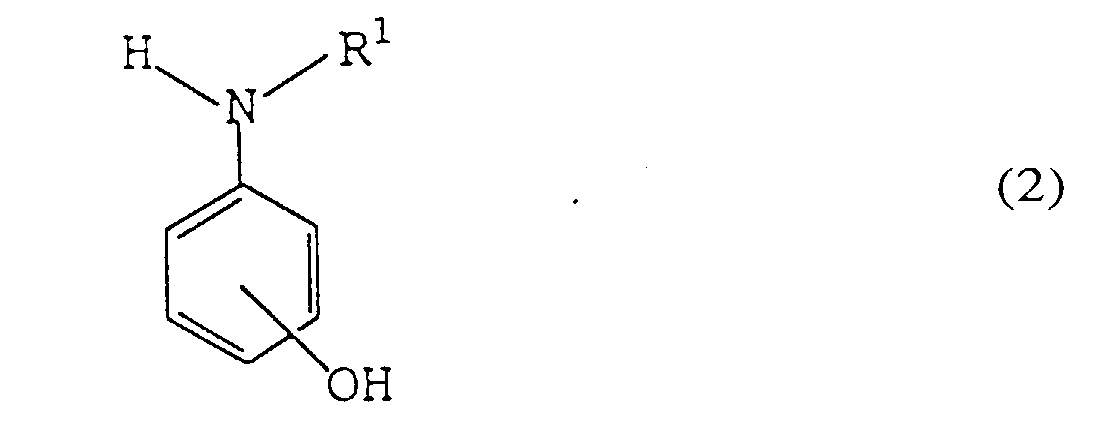
en faisant réagir un diphénol avec une amine primaire représentée par la formule (1) suivante :2) une étape II dans laquelle on soumet à un traitement thermique un sel d'ammonium quaternaire inévitablement présent dans le mélange réactionnel obtenu au cours de l'étape I précédente, représenté par la formule (3) suivante :dans laquelle R1 a la même signification que dans la formule (2),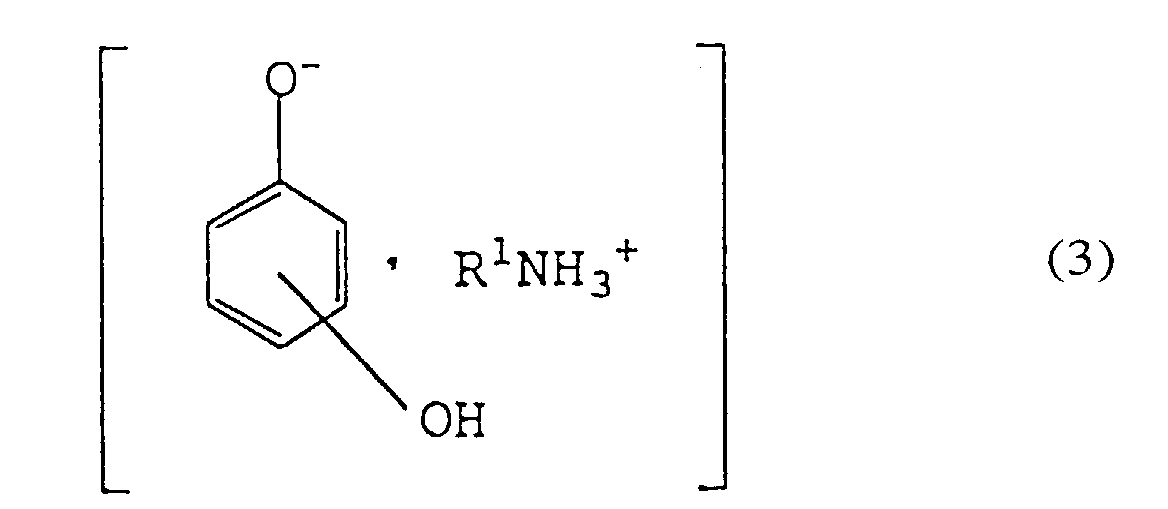
afin de décomposer ce sel d'ammonium quaternaire en diphénol et amine primaire de formule (1), et l'on chasse du mélange réactionnel au moins une quantité importante de cette amine primaire ;3) une étape III dans laquelle on sépare du mélange réactionnel obtenu au cours de l'étape II précédente, par distillation, l'aminophénol N-substitué représenté par la formule (2) ;4) une étape IV dans laquelle on obtient un aminophénol N,N-disubstitué représenté par la formule (5) suivante :dans laquelle R1 a la même signification que dans la formule (1) et R2 représente un groupe alkyle comportant de 1 à 5 atomes de carbone ou un groupe cycloalkyle comportant de 4 à 8 atomes de carbone,
en faisant réagir l'aminophénol N-substitué, obtenu au cours de l'étape III précédente, avec un aldéhyde représenté par la formule (4) suivante :
dans un solvant organique, sous atmosphère d'hydrogène et en présence d'un catalyseur de réduction ; et5) une étape V dans laquelle on isole l'aminophénol N,N-disubstitué du mélange réactionnel obtenu au cours de l'étape IV précédente. - Procédé de préparation conforme à la revendication 1, dans lequel la réaction de l'étape IV est effectuée en présence d'un catalyseur de réduction où il y a, supporté par un support inerte, un métal du groupe VIII du Tableau Périodique.
- Procédé de préparation conforme à la revendication 1, dans lequel le catalyseur de réduction employé pour la réaction de l'étape IV est séparé du mélange réactionnel et récupéré pour être recyclé comme catalyseur de réduction dans la réaction de l'étape IV.
Applications Claiming Priority (3)
| Application Number | Priority Date | Filing Date | Title |
|---|---|---|---|
| JP06007593A JP3174425B2 (ja) | 1993-03-19 | 1993-03-19 | N,n−二置換アミノフェノール類の製造法 |
| JP60075/93 | 1993-03-19 | ||
| PCT/JP1994/000424 WO1994021594A1 (fr) | 1993-03-19 | 1994-03-17 | Procede de production d'aminophenol a double substitution n,n |
Publications (3)
| Publication Number | Publication Date |
|---|---|
| EP0641765A1 EP0641765A1 (fr) | 1995-03-08 |
| EP0641765A4 EP0641765A4 (fr) | 1995-06-14 |
| EP0641765B1 true EP0641765B1 (fr) | 1998-06-10 |
Family
ID=13131610
Family Applications (1)
| Application Number | Title | Priority Date | Filing Date |
|---|---|---|---|
| EP94910026A Expired - Lifetime EP0641765B1 (fr) | 1993-03-19 | 1994-03-17 | Procede de production d'aminophenol a double substitution n,n |
Country Status (8)
| Country | Link |
|---|---|
| US (1) | US5442121A (fr) |
| EP (1) | EP0641765B1 (fr) |
| JP (1) | JP3174425B2 (fr) |
| KR (1) | KR100271564B1 (fr) |
| CA (1) | CA2136102C (fr) |
| DE (1) | DE69410898T2 (fr) |
| FI (1) | FI106956B (fr) |
| WO (1) | WO1994021594A1 (fr) |
Families Citing this family (3)
| Publication number | Priority date | Publication date | Assignee | Title |
|---|---|---|---|---|
| US7122207B2 (en) * | 1998-05-22 | 2006-10-17 | Bristol-Myers Squibb Company | High drug load acid labile pharmaceutical composition |
| CN101486658B (zh) * | 2009-02-27 | 2011-11-16 | 康爱特维迅(蓬莱)化学有限公司 | 3-(n-乙基-n-异戊基)氨基苯酚的制备方法 |
| CN102976958A (zh) * | 2012-12-01 | 2013-03-20 | 张家港市大伟助剂有限公司 | 一种4-甲氧基-β-苯乙胺的制备方法 |
Family Cites Families (12)
| Publication number | Priority date | Publication date | Assignee | Title |
|---|---|---|---|---|
| US2776313A (en) * | 1955-02-02 | 1957-01-01 | Eastman Kodak Co | Process for making n, n-dialkyl-p-aminophenol |
| JPS55105648A (en) * | 1979-02-08 | 1980-08-13 | Mitsui Petrochem Ind Ltd | Preparation of aminophenol |
| JPS5673048A (en) * | 1979-11-20 | 1981-06-17 | Mitsui Petrochem Ind Ltd | Amination of dihydric phenol |
| FR2548179B1 (fr) * | 1983-06-29 | 1986-06-20 | Ugine Kuhlmann | Procede de preparation d'amino-phenols par hydroxylation d'anilines en milieu superacide au moyen du peroxyde d'hydrogene |
| JPS60130551A (ja) * | 1983-12-16 | 1985-07-12 | Kao Corp | 第3級アミンの製造方法 |
| JPS617239A (ja) * | 1984-06-20 | 1986-01-13 | Mitsui Petrochem Ind Ltd | アミノフエノ−ル類の製造法 |
| JPS625416A (ja) * | 1985-07-01 | 1987-01-12 | Toshiba Corp | 有線移動車両の制御装置 |
| JPS62258346A (ja) * | 1986-04-30 | 1987-11-10 | Sumitomo Chem Co Ltd | N,n−ジアルキルアミノフエノ−ル類の製造方法 |
| JPH0739378B2 (ja) * | 1986-06-11 | 1995-05-01 | 住友化学工業株式会社 | N,n−ジアルキル置換アミノフエノ−ル類の製造方法 |
| JPS63253056A (ja) * | 1987-04-09 | 1988-10-20 | Sumitomo Chem Co Ltd | N,n−ジエチルアミノフエノ−ル類の製造方法 |
| LU86905A1 (fr) * | 1987-05-29 | 1989-01-19 | Oreal | Nouvelles metaphenylenediamines,leur procede de preparation,composes intermediaires et utilisation de ces metaphenylenediamines en tant que coupleurs pour la teinture d'oxydation des fibres keratiniques et en particulier des cheveux humains |
| JP2705239B2 (ja) * | 1989-09-13 | 1998-01-28 | 三井石油化学工業株式会社 | N―置換アミノフェノール類の製造方法 |
-
1993
- 1993-03-19 JP JP06007593A patent/JP3174425B2/ja not_active Expired - Fee Related
-
1994
- 1994-03-17 KR KR1019940704148A patent/KR100271564B1/ko not_active Expired - Lifetime
- 1994-03-17 CA CA002136102A patent/CA2136102C/fr not_active Expired - Lifetime
- 1994-03-17 WO PCT/JP1994/000424 patent/WO1994021594A1/fr not_active Ceased
- 1994-03-17 DE DE69410898T patent/DE69410898T2/de not_active Expired - Lifetime
- 1994-03-17 US US08/335,744 patent/US5442121A/en not_active Expired - Lifetime
- 1994-03-17 EP EP94910026A patent/EP0641765B1/fr not_active Expired - Lifetime
- 1994-11-17 FI FI945414A patent/FI106956B/fi not_active IP Right Cessation
Also Published As
| Publication number | Publication date |
|---|---|
| DE69410898D1 (de) | 1998-07-16 |
| FI106956B (fi) | 2001-05-15 |
| EP0641765A1 (fr) | 1995-03-08 |
| KR950701614A (ko) | 1995-04-28 |
| KR100271564B1 (ko) | 2000-11-15 |
| EP0641765A4 (fr) | 1995-06-14 |
| DE69410898T2 (de) | 1998-10-22 |
| CA2136102A1 (fr) | 1994-09-20 |
| JP3174425B2 (ja) | 2001-06-11 |
| CA2136102C (fr) | 2003-12-02 |
| WO1994021594A1 (fr) | 1994-09-29 |
| JPH06271515A (ja) | 1994-09-27 |
| US5442121A (en) | 1995-08-15 |
| FI945414L (fi) | 1994-11-17 |
| FI945414A0 (fi) | 1994-11-17 |
Similar Documents
| Publication | Publication Date | Title |
|---|---|---|
| EP0641308B1 (fr) | Procede de preparation de p-phenylenediamines n-aliphatiques substituees | |
| KR870001998B1 (ko) | 디페닐아민 또는 n, n'-디페닐-페닐렌디아민의 제조방법 | |
| US5840982A (en) | Process for preparing para-phenylenediamine derivatives | |
| US5442121A (en) | Process for producing N,N-disubstituted aminophenol | |
| US5980445A (en) | Process for producing diaryl carbonate | |
| US4067905A (en) | Preparation of 2-amino-n-butanol | |
| US5225597A (en) | Selective, high purity preparation of N-monoalkyl alkylenediamines | |
| US5760247A (en) | Process for the preparation of carbazole | |
| EP0086018B1 (fr) | Procédé de préparation de carbamates | |
| JPH0533215B2 (fr) | ||
| KR940003066B1 (ko) | 방향족 우레탄의 제조방법 | |
| JP4709352B2 (ja) | 3−アミノプロパノールの精製方法 | |
| US5629449A (en) | Controlled feed process for making 3, 5-diaminobenzotrifluoride | |
| CA1216862A (fr) | Preparation d'aminobenzylamine | |
| US5306842A (en) | Method of manufacturing aromatic urethanes | |
| EP0803496B1 (fr) | Procédé de préparation de diphénylamine ou de ses dérivés substitués au noyau | |
| JP3234655B2 (ja) | ジフェニルアミンまたはその核置換体の製造法 | |
| EP0659736B1 (fr) | Procédé pour la préparation de la 4-méthoxy-2,2',6'-triméthyl-diphénylamine | |
| JP2001172230A (ja) | ジアリールアミン類の製造方法 | |
| EP0027004A1 (fr) | Procédé de préparation de diphénylamines dissymétriques | |
| JP3159522B2 (ja) | 高純度m−フェニレンジアミンの製造方法 | |
| JPS61183250A (ja) | トリフエニルアミンまたはその核置換体の製造方法 | |
| JPH0770000A (ja) | N−(4’−ノニルシクロヘキシル)−4−ノニルアニリン及びその製造方法 | |
| JPH08176077A (ja) | トリフェニルアミン類の製造方法 | |
| JP2001089413A (ja) | トランス−4−(4’−オキソシクロヘキシル)シクロヘキサノール類の製造方法 |
Legal Events
| Date | Code | Title | Description |
|---|---|---|---|
| PUAI | Public reference made under article 153(3) epc to a published international application that has entered the european phase |
Free format text: ORIGINAL CODE: 0009012 |
|
| 17P | Request for examination filed |
Effective date: 19941117 |
|
| AK | Designated contracting states |
Kind code of ref document: A1 Designated state(s): DE FR GB IT NL |
|
| A4 | Supplementary search report drawn up and despatched | ||
| AK | Designated contracting states |
Kind code of ref document: A4 Designated state(s): DE FR GB IT NL |
|
| GRAG | Despatch of communication of intention to grant |
Free format text: ORIGINAL CODE: EPIDOS AGRA |
|
| 17Q | First examination report despatched |
Effective date: 19970314 |
|
| GRAG | Despatch of communication of intention to grant |
Free format text: ORIGINAL CODE: EPIDOS AGRA |
|
| GRAH | Despatch of communication of intention to grant a patent |
Free format text: ORIGINAL CODE: EPIDOS IGRA |
|
| GRAH | Despatch of communication of intention to grant a patent |
Free format text: ORIGINAL CODE: EPIDOS IGRA |
|
| GRAA | (expected) grant |
Free format text: ORIGINAL CODE: 0009210 |
|
| RAP1 | Party data changed (applicant data changed or rights of an application transferred) |
Owner name: MITSUI CHEMICALS, INC. |
|
| AK | Designated contracting states |
Kind code of ref document: B1 Designated state(s): DE FR GB IT NL |
|
| REF | Corresponds to: |
Ref document number: 69410898 Country of ref document: DE Date of ref document: 19980716 |
|
| ET | Fr: translation filed | ||
| ITF | It: translation for a ep patent filed | ||
| PLBE | No opposition filed within time limit |
Free format text: ORIGINAL CODE: 0009261 |
|
| 26N | No opposition filed | ||
| REG | Reference to a national code |
Ref country code: GB Ref legal event code: IF02 |
|
| PGFP | Annual fee paid to national office [announced via postgrant information from national office to epo] |
Ref country code: IT Payment date: 20120320 Year of fee payment: 19 |
|
| PGFP | Annual fee paid to national office [announced via postgrant information from national office to epo] |
Ref country code: GB Payment date: 20130313 Year of fee payment: 20 Ref country code: FR Payment date: 20130325 Year of fee payment: 20 Ref country code: DE Payment date: 20130314 Year of fee payment: 20 |
|
| PGFP | Annual fee paid to national office [announced via postgrant information from national office to epo] |
Ref country code: NL Payment date: 20130316 Year of fee payment: 20 |
|
| REG | Reference to a national code |
Ref country code: DE Ref legal event code: R071 Ref document number: 69410898 Country of ref document: DE |
|
| REG | Reference to a national code |
Ref country code: DE Ref legal event code: R071 Ref document number: 69410898 Country of ref document: DE |
|
| REG | Reference to a national code |
Ref country code: NL Ref legal event code: V4 Effective date: 20140317 |
|
| REG | Reference to a national code |
Ref country code: GB Ref legal event code: PE20 Expiry date: 20140316 |
|
| PG25 | Lapsed in a contracting state [announced via postgrant information from national office to epo] |
Ref country code: GB Free format text: LAPSE BECAUSE OF EXPIRATION OF PROTECTION Effective date: 20140316 Ref country code: DE Free format text: LAPSE BECAUSE OF EXPIRATION OF PROTECTION Effective date: 20140318 |