EP0641867A1 - Piece mince moule en acier au carbone ordinaire contenant des quantites importantes de cuivre et d'etain, tole mince en acier et procede de fabrication - Google Patents
Piece mince moule en acier au carbone ordinaire contenant des quantites importantes de cuivre et d'etain, tole mince en acier et procede de fabrication Download PDFInfo
- Publication number
- EP0641867A1 EP0641867A1 EP94907693A EP94907693A EP0641867A1 EP 0641867 A1 EP0641867 A1 EP 0641867A1 EP 94907693 A EP94907693 A EP 94907693A EP 94907693 A EP94907693 A EP 94907693A EP 0641867 A1 EP0641867 A1 EP 0641867A1
- Authority
- EP
- European Patent Office
- Prior art keywords
- cast strip
- thin
- thin cast
- steel
- steel sheet
- Prior art date
- Legal status (The legal status is an assumption and is not a legal conclusion. Google has not performed a legal analysis and makes no representation as to the accuracy of the status listed.)
- Ceased
Links
Images

Classifications
-
- C—CHEMISTRY; METALLURGY
- C22—METALLURGY; FERROUS OR NON-FERROUS ALLOYS; TREATMENT OF ALLOYS OR NON-FERROUS METALS
- C22C—ALLOYS
- C22C38/00—Ferrous alloys, e.g. steel alloys
- C22C38/16—Ferrous alloys, e.g. steel alloys containing copper
Definitions
- the present invention relates to a thin cast strip and a thin steel sheet of a common carbon steel produced by using as a raw material molten steel containing large amounts of copper and tin obtained by melting and refining scrap iron or tin plate scrap generated, for example, by dismantling of automobiles or electric appliances, and a process for producing the same.
- the red-shortness occurs as follows.
- copper (Cu) and tin (Sn) are less likely to scale, they are enriched on the surface layer portion of the cast strip without being removed as a scale.
- the enriched Cu and Sn form a low-melting liquid film and, at the same time, are unevenly distributed at grain boundaries, which renders the grain boundaries fragile at a hot rolling temperature, so that red shortness occurs.
- Cu and Sn are ingredients which are difficult to remove from molten steel by refining.
- scrap iron and the like containing large amounts of Cu and Sn are blended little by little in many divided charges for use in lowered Cu and Sn concentrations.
- the necessary Ni concentration amounts to 0.8 to 21% by weight, which is a large problem from the viewpoint of cost and also from the viewpoint of properties due to occurrence of uneven surface plating and poor descaling derived from internal oxidation.
- the present invention has been made with a view to solving the above problems, and an object of the present invention is to provide a thin cast strip and a thin steel sheet having a desired thickness and no surface cracking from a molten metal comprising common carbon steel ingredients, with scrap iron and tin plate scrap containing a large amount of Cu being added thereto.
- Another object of the present invention is to efficiently provide a thin cast strip and a thin steel sheet having a desired thickness and no surface cracking without conducting troublesome control and work wherein scrap iron or tin plate scrap containing a large amount of Cu is blended little by little.
- a further object of the present invention is to provide a thin cast strip and a thin steel sheet having a desired thickness and no surface cracking from a molten steel comprising common carbon steel ingredients not containing Ni and, added thereto, scrap iron and tin plate scrap containing a large amount of Cu being added thereto.
- a further object of the present invention is to provide common carbon steel thin cast strip and thin steel sheet which contain large amounts of Cu and Sn and have excellent mechanical properties and surface quality.
- the present inventors have made various studies on cast strips comprising common carbon steel ingredients and, added thereto, scrap iron containing Cu and Sn and, as a result, have found that when the microstructure of the cast strip is brought to a fine dendrite structure having a primary dendrite spacing in the range of from 5 to 100 ⁇ m, a cast strip having no significant variation in strength and elongation and a surface cracking depth of not more than 30 ⁇ m, i.e., and a very excellent surface appearance, can be prepared without adding Ni.
- a cast strip having the above-described dendrite structure can be prepared by rapidly cooling molten steel containing large amounts of Cu and Sn at a cooling rate of 1 to 104°C/sec (heat removal rate (Q) of casting roll: 5,000,000 to 15,000,000 kcal/m2/hr) to prepare a thin cast strip having a sheet thickness in the range of from 0.1 to 15 mm and, if necessary, conveying the cast strip so as not to hold the cast strip at a temperature of 1000°C or above for 10 sec or longer.
- Q heat removal rate
- iron scrap is charged and dissolved in molten steel to homogeneously disperse the elements as ingredients, such as Cu and Sn, and in this state, the molten steel is rapidly cooled. Since the cast strip is rapidly solidified to form a thin sheet, there is substantially no flow time for the molten metal in the massy zone at the center portion of the cast strip, so that macrosegregation does not occur in the center portion of the cast strip.
- the diffusion rate of Cu and Sn is inversely proportional to the second power of the primary dendrite spacing
- the formation of a structure having a small primary dendrite spacing by rapid solidification of molten steel can increase the diffusion rate of Cu and Sn in the primary dendrite spacing, thereby enabling the degree of segregation between dendrites to be remarkably lowered.
- a thin cast strip having a fine dendrite structure free from segregation can be provided.
- the temperature of the cast strip after emergence from the casting device reaches or exceeds 1000°C due to recuperation, and if it is held at that temperature for 10 sec or longer, surface segregation of Cu or the like may occur. For this reason, in order to more stably provide a thin cast strip, it is preferred to water-cool the cast strip in the course of conveying to lower the cast strip temperature to 1000°C or below.
- the thin cast strip having a thickness of 0.1 to 15 mm thus obtained has a fine dendrite structure having a primary dendrite spacing of 5 to 100 ⁇ m, preferably 5 to 70 ⁇ m, at least at its surface layer portion.
- the primary dendrite spacing at the center portion of a thin cast strip having a sheet thickness of 15 mm is about 300 ⁇ m.
- the formation of a primary dendrite spacing of 5 to 100 ⁇ m on the surface portion thereof, that is, at a depth of about 2 mm from the surface of one side thereof enables the rate of diffusion of Cu and Sn into the matrix during solidification or immediately after the solidification to be sufficiently accelerated, which contributes to a reduction in microsegregation between dendrites.
- the object of the present invention can be attained.
- the as-cast thin cast strip or the thin cast strip, which has been pickled after casting, is used as a product corresponding to a hot-rolled steel sheet.
- the thin cast strip can also be pickled, cold-rolled and then annealed to produce a cold-rolled steel sheet product.
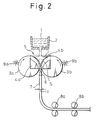
- Fig. 1 is a diagram showing the relationship between the depth (mm) from the surface of a cast strip and the primary dendrite spacing ( ⁇ m); and Fig. 2 is a schematic partially sectional front view of a twin roll continuous casting machine.
- the fundamental chemical ingredients thereof are those of common carbon steel sheets of steel product designation "SPHC" specified in JIS G3131 (corresponding to a hot-rolled soft steel sheet for a general structure: ASTM A621-82), steel product designation "SS41" specified in JIS G3101 (corresponding to a hot-rolled soft steel sheet for a general structure: ASTM A569-72), steel product designation "SPH3” specified in JIS G3132 (corresponding to a hot-rolled carbon steel strip for a steel pipe: SAE 1026) and steel product designation "S48C” specified in JIS G4051 (corresponding to a carbon material for machine structural use; ASTM A446-85).
- SPHC steel product designation
- SS41 specified in JIS G3101
- SPH3 steel product designation
- S48C specified in JIS G4051
- the fundamental chemical ingredients of the cold-rolled steel sheet are those of a common carbon steel sheet of steel product designation "SPCC" specified in JIS (corresponding to a cold-rolled steel sheet for a general structure: ASTM A619-82).
- compositions of a material corresponding to a hot-rolled steel sheet and a cold-rolled steel sheet are as follows. (Material corresponding to hot-rolled steel sheet) C Si Mn P 0.03-0.5 0.01-0.3 0.1-2 0.001-0.05 S Fe 0.001-0.05 Balance (Cold-rolled steel sheet) C Si Mn P 0.03-0.05 0.005-0.015 0.1-0.2 0.005-0.02 S Fe 0.002-0.01 Balance
- Molten steel with scrap iron, tin plate or the like being charged and dissolved therein in an early stage of refining of steel is refined and cast into a thin cast strip, for example, by a twin roll continuous machine shown in Fig. 2.
- numeral 2 designates a tundish which serves as a reservoir for the molten steel 1 and, at the same time, to pour the molten steel through a nozzle (not shown) provided at a lower part of the tundish into a molten steel pouring basin 5 comprising cooling rolls 3a, 3b and side weirs 4a, 4b.
- the cooling rolls 3a, 3b are each a roll having an internal cooling portion in the inside thereof and comprising a material having a high heat transfer coefficient, for example, copper, and provided horizontally and parallelly and further rotatably in the direction of an arrow while leaving a space there between corresponding to a desired cast strip.
- the molten steel 1 poured into the pouring basin 5 is cooled with the cooling rolls 3a, 3b to form a solidified shell S on the cooling rolls 3a, 3b.
- the thickness of the solidified shells S is increased with the rotation of the cooling rolls, and the solidified shells S are integrated with each other at a kissing point 6 to form a cast strip 7.
- the cast strip 7 is drawn downward and conveyed to a coiler (not shown) by means of conveying rolls 8a, 8b.
- Numerals 9a, 9b represent cleaners for cleaning the surface of the cooling rolls.
- the cooling solidification rate of the molten steel which governs this spacing that is, the average rate of cooling (heat removal rate Q of casting roll) from the liquidus line temperature to the solidus line temperature.
- This cooling rate is the rate of cooling of the molten metal from the time it is located in the vicinity of the surface of the pouring basin 5, where the molten steel first comes into contact with the cooling rolls, until the molten metal reaches the kissing point 6.
- the cooling rate defined above is in the range of from 1 to 104°C/sec (heat removal rate Q of casting roll: 5,000,000 to 15,000,000 kcal/m2/hr) when the sheet thickness of the cast strip is in the range of from 0.1 to 15 mm.
- the average cooling rate of the center portion of a cast strip having a sheet thickness of 15 mm is specified to about 1°C/sec, and the average cooling rate of the surface of the cast strip is specified to about 102 to 104°C/sec.
- the primary dendrite spacing is a function of the cooling rate and, at the same time, related to the chemical composition of the molten steel, particularly its C content. In the chemical composition range of a common carbon steel contemplated in the present invention, the primary dendrite spacing is in the range of from 5 to 300 ⁇ m when the sheet thickness of the cast strip and the cooling rate are in the above respective ranges.
- At least the primary dendrite spacing in a depth of 2 mm from the surface layer (surface layer portion) may be 5 to 100 ⁇ m to reduce the microsegregation between the dendrites during solidification. Also when the sheet thickness of the cast strip is 15 mm, the above cooling rate brings the primary dendrite spacing on the surface layer portion to 5 to 100 ⁇ m, so that the object of the present invention can be sufficiently attained.
- the sheet thickness of 0.1 mm is the lower limit of the sheet thickness of a cast strip which can be produced on a commercial scale, and a cast strip having such a thickness can be, of course, cooled at a high cooling rate and, therefore, can have a primary dendrite spacing of about 5 ⁇ m.
- the surface layer portion of the thin cast strip having a thickness in the range of from 0.1 to 15 mm thus obtained has a fine dendrite structure having a primary dendrite spacing in the range of from 5 to 100 ⁇ m, and the center portion of the cast strip is also free from macrosegregation and has a very homogeneous quality.
- the as-cast product corresponding to a hot-rolled material or the cold-rolled steel sheet according to the present invention has excellent mechanical properties and, at the same time, a good surface appearance despite the fact that it contains large amounts of Cu and Sn.
- Ni serves to raise the melting point of the Cu-enriched layer at the grain boundary or to increase the solubility of Cu in the matrix. Also in the present invention, Ni may be added in an amount in the range of from 0.02 to 0.7%.
- Molten steels (labeled A to E) having compositions specified in Table 1 (comprising ingredients constituting a hot-rolled mild steel sheet for a general structure (corresponding to JIS ⁇ G3131: ASTM A621-82) and, added thereto, Cu and Sn) were cast into thin cast strips having a sheet thickness of 3 mm and a sheet width of 350 mm and were produced at a heat removal rate (Q) of a casting roll of 7,700,000 kcal/m2/hr by using a twin roll continuous casting machine (comprising an internal water cooled copper alloy casting roll (diameter: 400 mm, width: 350 mm) shown in Fig. 2.
- Q heat removal rate
- Conventional Process means a process wherein molten steels labeled A to E are cast by the conventional continuous casting process into slabs having a thickness of 250 mm and a width of 1800 mm, which were then hot-rolled into hot-rolled sheets having a sheet thickness of 3 mm.
- “Bending” represents the results of a 180° close-contact bending test, and "Corrosion resistance” is expressed in corrosion resistance scores (corrosion rate (mm/Y): c: >0.05, b: 0.01 to 0.05, a: ⁇ 0.01).
- “Cracking of Cast Strip: None” means cracking having a depth of not more than 30 ⁇ m on the surface layer of the cast strip.
- the thin cast strips (sample Nos. 2 to 5) of the present invention were excellent in both cast strip quality and mechanical properties, whereas the comparative thin cast strip (sample No. 1) had poor corrosion resistance due to a low Cu content.
- a surface crack having a thickness of not less than 30 ⁇ m was observed for sample No. 1, the Cu and Sn contents were so low that even the hot-rolled sheet produced by the conventional process gave rise to neither red shortness nor surface cracking.
- Fig. 1 The relationship between the depth (mm) from the surface of a cast strip in each example and the primary dendrite spacing ( ⁇ m) is shown in Fig. 1. In the figure, data for the present examples are indicated by the mark ⁇ . When the depth from the surface of the cast strip was 0.1 mm, the primary dendrite spacing was 13 ⁇ m, while when the depth from the cast strip was 1.5 mm (center portion), the primary dendrite spacing was 50 ⁇ m.
- the thin cast strips (products corresponding to hot-rolled materials) produced by the above passes of the present invention were pickled, and 6 passes of cold rolling (tandem) were carried out to prepare 0.8 mm-thick cold-rolled sheets. Thereafter, the cold-rolled sheets were subjected to box annealing in such a manner that they were heated to 650°C at a temperature increase rate of 50°C/hr, held at that temperature for 12 hr and then cooled to room temperature over a period of 48 hr.
- the as-annealed steel sheets were subjected to temper rolling with a reduction ratio of 1% to prepare cold-rolled steel sheets for a general structure (JIS-steel product designation SPCC (ASTM A619-82)) containing Cu and Sn.
- JIS-steel product designation SPCC ASTM A619-82
- Molten steels comprising ingredients specified in Table 4, that is, ingredients constituting a hot-rolled steel sheet for a general structure (corresponding to steel product designation SS41 specified in JIS G3101: corresponding to ASTM A569-72) and, added thereto, Cu and Sn were cast into thin cast strips having a sheet thickness of 3 mm and a sheet width of 350 mm in the same manner as in Example 1, except that the heat removal rate (Q) of the casting roll was 8,000,000 kcal/m2/hr.
- the primary dendrite spacing of each thin cast strip (sample Nos. 11 to 15) was 17 to 55 ⁇ m on the average, as indicated by the mark "t" in Fig. 2.
- the quality (cracking) and the mechanical properties of each thin cast strip are given in Table 5.
- the thin cast strips (sample Nos. 12 to 15) were excellent in both the cast strip quality and mechanical properties despite the fact that they contained large amounts of Cu and Sn.
- molten steels comprising C and Si in the same respective contents as the molten steels specified in Table 4 and, added thereto, minor amounts of Ti, Nb, B, Cr, Mo, V, etc.
- molten steels comprising ingredients constituting a high-tensile, low-alloy, hot-rolled thin sheet having an improved workability (corresponding to steel product designation SPFC45 specified in JIS G3135: ASTM A715-85) and, added thereto, Cu and Sn)
- molten steels specified in Table 6 were cast into thin cast strips having a sheet thickness of 3 mm and a sheet width of 350 mm in the same manner as described above in connection with the steels having compositions specified in Table 4.
- Molten steels (steels D to S) having compositions specified in Table 8 (comprising chemical ingredients constituting a hot-rolled carbon steel strip for a steel pipe (corresponding to steel product No. SPHT3 specified in JIS G3132: SAE1026) and, added thereto, Cu and Sn) were cast into thin cast strips having a sheet thickness of 3.5 mm and a sheet width of 350 mm in the same manner as in Example 1, except that the heat removal rate (Q) of the cast roll was 6,700,000 kcal/m2/hr.
- the primary dendrite spacing of each thin cast strip (sample Nos. 20 to 24) was 8 to 60 ⁇ m on the average, as indicated by the mark " ⁇ " in Fig. 2.
- the thin cast strips (sample Nos. 21 to 24) of the present invention were excellent in both the cast strip quality and mechanical properties despite the fact that they contained large amounts of Cu and Sn.
- Molten steels (steels T to X) having compositions specified in Table 10 (comprising chemical ingredients constituting a carbon steel material for machine structural use (corresponding to steel product No. S48C specified in JIS G4051: ASTM A446-85) and, added thereto, Cu and Sn) were cast into thin cast strips having a sheet thickness of 3 mm and a sheet width of 350 mm in the same manner as in Example 1, except that the heat removal rate (Q) of the casting rolls was 8,200,000 kcal4/m2/hr.
- the primary dendrite spacing of each thin cast strip (sample Nos. 25 to 29) was 5 to 70 ⁇ m on the average, as indicated by the mark " ⁇ " in Fig. 2.
- the thin cast strips (sample Nos. 26 to 29) were excellent in both the cast strip quality and mechanical properties despite the fact that they contained large amounts of Cu and Sn.
- common carbon thin cast strips and thin steel sheets having a good surface appearance and excellent mechanical properties can be produced using iron scrap and tin plate scrap containing a large amount of Cu without adding Ni. Therefore, since the above cast strip and steel sheet can be used at a low cost in corrosion-resisting steel sheet, for example, steel sheets for automobiles, the present invention is very valuable from an industrial viewpoint.
Landscapes
- Chemical & Material Sciences (AREA)
- Engineering & Computer Science (AREA)
- Materials Engineering (AREA)
- Mechanical Engineering (AREA)
- Metallurgy (AREA)
- Organic Chemistry (AREA)
- Continuous Casting (AREA)
- Heat Treatment Of Sheet Steel (AREA)
- Manufacture And Refinement Of Metals (AREA)
- Metal Rolling (AREA)
- Coating With Molten Metal (AREA)
Applications Claiming Priority (3)
| Application Number | Priority Date | Filing Date | Title |
|---|---|---|---|
| JP37164/93 | 1993-02-26 | ||
| JP3716493 | 1993-02-26 | ||
| PCT/JP1994/000313 WO1994019503A1 (fr) | 1993-02-26 | 1994-02-25 | Piece mince moule en acier au carbone ordinaire contenant des quantites importantes de cuivre et d'etain, tole mince en acier et procede de fabrication |
Publications (2)
| Publication Number | Publication Date |
|---|---|
| EP0641867A1 true EP0641867A1 (fr) | 1995-03-08 |
| EP0641867A4 EP0641867A4 (fr) | 1995-06-07 |
Family
ID=12489962
Family Applications (1)
| Application Number | Title | Priority Date | Filing Date |
|---|---|---|---|
| EP94907693A Ceased EP0641867A4 (fr) | 1993-02-26 | 1994-02-25 | Piece mince moule en acier au carbone ordinaire contenant des quantites importantes de cuivre et d'etain, tole mince en acier et procede de fabrication. |
Country Status (11)
| Country | Link |
|---|---|
| US (1) | US5662748B1 (fr) |
| EP (1) | EP0641867A4 (fr) |
| JP (1) | JP3372953B2 (fr) |
| KR (2) | KR0139370B1 (fr) |
| CN (1) | CN1038049C (fr) |
| AU (1) | AU1781597A (fr) |
| BR (1) | BR9406641A (fr) |
| CA (1) | CA2134342C (fr) |
| SG (1) | SG44618A1 (fr) |
| TW (1) | TW372248B (fr) |
| WO (2) | WO1994019503A1 (fr) |
Cited By (6)
| Publication number | Priority date | Publication date | Assignee | Title |
|---|---|---|---|---|
| EP0875874A3 (fr) * | 1997-04-30 | 2000-04-12 | Hitachi Metals, Ltd. | Matériau à polarisation magnétique et procédé pour sa fabrication pour marqueur magnétique |
| WO2003057928A1 (fr) * | 2002-01-14 | 2003-07-17 | Usinor | Procede de fabrication d'un produit siderurgique en acier au carbone riche en cuivre, et produit siderurgique ainsi obtenu |
| EP1337362A4 (fr) * | 2000-10-02 | 2004-11-03 | Nucor Corp | Procede de production de bandes d'acier |
| EP1727918A4 (fr) * | 2004-03-22 | 2007-08-29 | Nucor Corp | Feuille d'acier faiblement allie a forte teneur en cuivre |
| US7591917B2 (en) | 2000-10-02 | 2009-09-22 | Nucor Corporation | Method of producing steel strip |
| WO2016174020A1 (fr) * | 2015-04-30 | 2016-11-03 | Salzgitter Flachstahl Gmbh | Procédé de fabrication d'une bande à chaud ou à froid à partir d'un acier à teneur en cuivre élevée |
Families Citing this family (10)
| Publication number | Priority date | Publication date | Assignee | Title |
|---|---|---|---|---|
| US20050019325A1 (en) * | 1996-01-08 | 2005-01-27 | Carter Paul J. | WSX receptor agonist antibodies |
| IT1302582B1 (it) * | 1998-10-01 | 2000-09-29 | Giovanni Arvedi | Processo e relativa linea di produzione per la fabbricazione direttadi pezzi finiti stampati o imbutiti da nastro a caldo ultrasottile |
| JP4171379B2 (ja) * | 2002-09-27 | 2008-10-22 | 新日本製鐵株式会社 | 表面性状に優れたCu含有鋼材およびその製造方法 |
| US20080264525A1 (en) * | 2004-03-22 | 2008-10-30 | Nucor Corporation | High copper low alloy steel sheet |
| US20050205169A1 (en) * | 2004-03-22 | 2005-09-22 | Alwin Mary E | High copper low alloy steel sheet |
| US20080041499A1 (en) * | 2006-08-16 | 2008-02-21 | Alotech Ltd. Llc | Solidification microstructure of aggregate molded shaped castings |
| US20100215981A1 (en) * | 2009-02-20 | 2010-08-26 | Nucor Corporation | Hot rolled thin cast strip product and method for making the same |
| TWI462783B (zh) * | 2011-09-08 | 2014-12-01 | China Steel Corp | Steel surface rusting device |
| CN108057862A (zh) * | 2017-12-28 | 2018-05-22 | 安徽东升精密铸钢件有限公司 | 一种双辊带坯的铸造方法 |
| CN112522573B (zh) * | 2019-09-19 | 2022-06-21 | 宝山钢铁股份有限公司 | 一种含b马氏体钢带及其制造方法 |
Citations (2)
| Publication number | Priority date | Publication date | Assignee | Title |
|---|---|---|---|---|
| JPH04162943A (ja) | 1990-10-25 | 1992-06-08 | Nippon Steel Corp | 連続鋳造鋳片の熱間加工割れ防止方法 |
| JPH04289136A (ja) | 1991-03-18 | 1992-10-14 | Sumitomo Metal Ind Ltd | 鋼製品の製造方法 |
Family Cites Families (7)
| Publication number | Priority date | Publication date | Assignee | Title |
|---|---|---|---|---|
| US3960610A (en) * | 1966-06-01 | 1976-06-01 | Amchem Products, Inc. | Process for coating metals |
| JPS5132568B1 (fr) * | 1970-04-17 | 1976-09-13 | ||
| JPS5126891B2 (fr) * | 1971-12-08 | 1976-08-09 | ||
| US4204888A (en) * | 1975-05-19 | 1980-05-27 | The Foundation: The Research Institute Of Electric And Magnetic Alloys | High damping capacity alloy |
| US4244757A (en) * | 1979-05-21 | 1981-01-13 | Allegheny Ludlum Steel Corporation | Processing for cube-on-edge oriented silicon steel |
| JPS62146238A (ja) * | 1985-12-19 | 1987-06-30 | チヤンバ−・オブ・マインズ・サ−ビシズ・(プロプライアタリ−・)リミテツド | 新規な鋼の製造法 |
| JPH0717959B2 (ja) * | 1989-03-30 | 1995-03-01 | 新日本製鐵株式会社 | 一方向性高磁束密度電磁鋼板の製造方法 |
-
1994
- 1994-02-25 KR KR1019940703817A patent/KR0139370B1/ko not_active Expired - Lifetime
- 1994-02-25 CN CN94190088A patent/CN1038049C/zh not_active Expired - Lifetime
- 1994-02-25 WO PCT/JP1994/000313 patent/WO1994019503A1/fr not_active Ceased
- 1994-02-25 CA CA002134342A patent/CA2134342C/fr not_active Expired - Lifetime
- 1994-02-25 JP JP51883194A patent/JP3372953B2/ja not_active Expired - Fee Related
- 1994-02-25 SG SG1996004190A patent/SG44618A1/en unknown
- 1994-02-25 KR KR1019940703817A patent/KR950701395A/ko active Granted
- 1994-02-25 EP EP94907693A patent/EP0641867A4/fr not_active Ceased
- 1994-09-01 TW TW083108063A patent/TW372248B/zh not_active IP Right Cessation
- 1994-09-01 WO PCT/JP1994/001444 patent/WO1995023242A1/fr not_active Ceased
- 1994-09-01 BR BR9406641A patent/BR9406641A/pt not_active IP Right Cessation
- 1994-11-25 US US08325321 patent/US5662748B1/en not_active Expired - Lifetime
-
1997
- 1997-04-09 AU AU17815/97A patent/AU1781597A/en not_active Abandoned
Patent Citations (2)
| Publication number | Priority date | Publication date | Assignee | Title |
|---|---|---|---|---|
| JPH04162943A (ja) | 1990-10-25 | 1992-06-08 | Nippon Steel Corp | 連続鋳造鋳片の熱間加工割れ防止方法 |
| JPH04289136A (ja) | 1991-03-18 | 1992-10-14 | Sumitomo Metal Ind Ltd | 鋼製品の製造方法 |
Non-Patent Citations (2)
| Title |
|---|
| L.-T.SHIANG, P.J.WRAY: "The Microstructures of Strip-Cast Low-Carbon Steels and Thier Response to Thermal Processing", METALLURGICAL TRANSACTIONS, vol. 20A, July 1989 (1989-07-01), pages 1191 - 1198, XP009030387 |
| See also references of WO9419503A1 |
Cited By (8)
| Publication number | Priority date | Publication date | Assignee | Title |
|---|---|---|---|---|
| EP0875874A3 (fr) * | 1997-04-30 | 2000-04-12 | Hitachi Metals, Ltd. | Matériau à polarisation magnétique et procédé pour sa fabrication pour marqueur magnétique |
| EP1337362A4 (fr) * | 2000-10-02 | 2004-11-03 | Nucor Corp | Procede de production de bandes d'acier |
| US7591917B2 (en) | 2000-10-02 | 2009-09-22 | Nucor Corporation | Method of producing steel strip |
| WO2003057928A1 (fr) * | 2002-01-14 | 2003-07-17 | Usinor | Procede de fabrication d'un produit siderurgique en acier au carbone riche en cuivre, et produit siderurgique ainsi obtenu |
| FR2834722A1 (fr) * | 2002-01-14 | 2003-07-18 | Usinor | Procede de fabrication d'un produit siderurgique en acier au carbone riche en cuivre, et produit siderurgique ainsi obtenu |
| US7425240B2 (en) | 2002-01-14 | 2008-09-16 | Usinor | Method for the production of a siderurgical product made of carbon steel with a high copper content |
| EP1727918A4 (fr) * | 2004-03-22 | 2007-08-29 | Nucor Corp | Feuille d'acier faiblement allie a forte teneur en cuivre |
| WO2016174020A1 (fr) * | 2015-04-30 | 2016-11-03 | Salzgitter Flachstahl Gmbh | Procédé de fabrication d'une bande à chaud ou à froid à partir d'un acier à teneur en cuivre élevée |
Also Published As
| Publication number | Publication date |
|---|---|
| WO1994019503A1 (fr) | 1994-09-01 |
| US5662748A (en) | 1997-09-02 |
| AU7546194A (en) | 1995-09-11 |
| WO1995023242A1 (fr) | 1995-08-31 |
| EP0641867A4 (fr) | 1995-06-07 |
| CN1038049C (zh) | 1998-04-15 |
| US5662748B1 (en) | 1999-11-02 |
| KR0139370B1 (ko) | 1998-07-15 |
| KR950701395A (ko) | 1995-03-23 |
| TW372248B (en) | 1999-10-21 |
| CA2134342A1 (fr) | 1994-08-27 |
| CN1102932A (zh) | 1995-05-24 |
| BR9406641A (pt) | 1996-03-12 |
| JP3372953B2 (ja) | 2003-02-04 |
| AU674783B2 (en) | 1997-01-09 |
| CA2134342C (fr) | 1999-06-01 |
| AU1781597A (en) | 1997-06-12 |
| SG44618A1 (en) | 1997-12-19 |
Similar Documents
| Publication | Publication Date | Title |
|---|---|---|
| US5662748A (en) | Thin cast strip and thin steel sheet of common carbon steel containing large amounts of copper and tin and process for producing the same | |
| EP1846584B2 (fr) | Acier austénitique à haute résistance et procédé pour sa fabrication et son utilisation | |
| EP1811054B1 (fr) | Canalisation pour oleoducs et gazoducs, et procede de fabrication associe | |
| EP1157138B9 (fr) | Acier lamine a froid | |
| JPWO1994019503A1 (ja) | 銅及び錫を多量に含有する普通炭素鋼薄鋳片及び薄鋼板並びにその製造方法 | |
| US20080264525A1 (en) | High copper low alloy steel sheet | |
| CA1190835A (fr) | Methode de production d'acier haute tenacite en direct au laminoir | |
| US20050205170A1 (en) | High copper low alloy steel sheet | |
| EP0058837B1 (fr) | Procédé pour la fabrication d'aciers austénitiques inoxydables, moins susceptibles aux défauts de laminage | |
| JP4222964B2 (ja) | 自動車外板用アルミニウム合金板とその製造方法および自動車外板 | |
| JPS619554A (ja) | 冷間圧延用鍛鋼ロ−ル | |
| JPS626616B2 (fr) | ||
| JP3679221B2 (ja) | 耐摩耗性に優れた製鉄圧延設備用複合ロール及びその製造方法 | |
| JP3775178B2 (ja) | 薄鋼板およびその製造方法 | |
| JPH05247577A (ja) | 成形性に優れたアルミニウム合金とその製造法 | |
| JP2000158020A (ja) | 耐衝撃性及び耐食性に優れた製鉄圧延設備用複合ロール | |
| AU757362B2 (en) | Cold rolled steel | |
| JPS619558A (ja) | 冷間圧延用鍛鋼ロ−ル | |
| JPH07150288A (ja) | 表面性状の良好なSn含有高強度熱延鋼板およびその製造方法 | |
| JPH0615412A (ja) | 表面疵の少ないNi系熱延鋼材の製造方法 | |
| JPS5910861B2 (ja) | 圧延による疵発生の少ないオ−ステナイト系ステンレス鋼の製造法 | |
| JPH02232339A (ja) | 耐摩耗性および耐肌荒性に優れた黒鉛を有する高クロム鋳鉄材 | |
| JPS6129818B2 (fr) | ||
| JPH0813080A (ja) | 熱間圧延仕上げ前段用ロール外層材及び熱間圧延仕上げ前段用ロールの製造方法 | |
| JPS61194150A (ja) | 高耐食性ブリキ鋼板向けキルド溶鋼の溶製方法 |
Legal Events
| Date | Code | Title | Description |
|---|---|---|---|
| PUAI | Public reference made under article 153(3) epc to a published international application that has entered the european phase |
Free format text: ORIGINAL CODE: 0009012 |
|
| 17P | Request for examination filed |
Effective date: 19941125 |
|
| AK | Designated contracting states |
Kind code of ref document: A1 Designated state(s): DE FR GB IT |
|
| A4 | Supplementary search report drawn up and despatched | ||
| AK | Designated contracting states |
Kind code of ref document: A4 Designated state(s): DE FR GB IT |
|
| 17Q | First examination report despatched |
Effective date: 19981012 |
|
| APAB | Appeal dossier modified |
Free format text: ORIGINAL CODE: EPIDOS NOAPE |
|
| APAB | Appeal dossier modified |
Free format text: ORIGINAL CODE: EPIDOS NOAPE |
|
| APAD | Appeal reference recorded |
Free format text: ORIGINAL CODE: EPIDOS REFNE |
|
| APBT | Appeal procedure closed |
Free format text: ORIGINAL CODE: EPIDOSNNOA9E |
|
| STAA | Information on the status of an ep patent application or granted ep patent |
Free format text: STATUS: THE APPLICATION HAS BEEN REFUSED |
|
| 18R | Application refused |
Effective date: 20031114 |
|
| APAF | Appeal reference modified |
Free format text: ORIGINAL CODE: EPIDOSCREFNE |