EP0643133A2 - Rekombinante D-Hydantoinase, Verfahren zur Herstellung und Verwendung - Google Patents
Rekombinante D-Hydantoinase, Verfahren zur Herstellung und Verwendung Download PDFInfo
- Publication number
- EP0643133A2 EP0643133A2 EP94113110A EP94113110A EP0643133A2 EP 0643133 A2 EP0643133 A2 EP 0643133A2 EP 94113110 A EP94113110 A EP 94113110A EP 94113110 A EP94113110 A EP 94113110A EP 0643133 A2 EP0643133 A2 EP 0643133A2
- Authority
- EP
- European Patent Office
- Prior art keywords
- hydantoinase
- dna
- protein
- sequence
- recombinant
- Prior art date
- Legal status (The legal status is an assumption and is not a legal conclusion. Google has not performed a legal analysis and makes no representation as to the accuracy of the status listed.)
- Granted
Links
Images
Classifications
-
- C—CHEMISTRY; METALLURGY
- C12—BIOCHEMISTRY; BEER; SPIRITS; WINE; VINEGAR; MICROBIOLOGY; ENZYMOLOGY; MUTATION OR GENETIC ENGINEERING
- C12N—MICROORGANISMS OR ENZYMES; COMPOSITIONS THEREOF; PROPAGATING, PRESERVING, OR MAINTAINING MICROORGANISMS; MUTATION OR GENETIC ENGINEERING; CULTURE MEDIA
- C12N9/00—Enzymes; Proenzymes; Compositions thereof; Processes for preparing, activating, inhibiting, separating or purifying enzymes
- C12N9/14—Hydrolases (3)
- C12N9/78—Hydrolases (3) acting on carbon to nitrogen bonds other than peptide bonds (3.5)
- C12N9/86—Hydrolases (3) acting on carbon to nitrogen bonds other than peptide bonds (3.5) acting on amide bonds in cyclic amides, e.g. penicillinase (3.5.2)
-
- C—CHEMISTRY; METALLURGY
- C12—BIOCHEMISTRY; BEER; SPIRITS; WINE; VINEGAR; MICROBIOLOGY; ENZYMOLOGY; MUTATION OR GENETIC ENGINEERING
- C12N—MICROORGANISMS OR ENZYMES; COMPOSITIONS THEREOF; PROPAGATING, PRESERVING, OR MAINTAINING MICROORGANISMS; MUTATION OR GENETIC ENGINEERING; CULTURE MEDIA
- C12N9/00—Enzymes; Proenzymes; Compositions thereof; Processes for preparing, activating, inhibiting, separating or purifying enzymes
- C12N9/14—Hydrolases (3)
- C12N9/78—Hydrolases (3) acting on carbon to nitrogen bonds other than peptide bonds (3.5)
-
- C—CHEMISTRY; METALLURGY
- C12—BIOCHEMISTRY; BEER; SPIRITS; WINE; VINEGAR; MICROBIOLOGY; ENZYMOLOGY; MUTATION OR GENETIC ENGINEERING
- C12P—FERMENTATION OR ENZYME-USING PROCESSES TO SYNTHESISE A DESIRED CHEMICAL COMPOUND OR COMPOSITION OR TO SEPARATE OPTICAL ISOMERS FROM A RACEMIC MIXTURE
- C12P13/00—Preparation of nitrogen-containing organic compounds
- C12P13/04—Alpha- or beta- amino acids
Definitions
- the invention relates to a new recombinant D-hydantoinase, a process for its preparation and its use.
- D-hydantoinases (dihydropyrimidinases, EC.3.5.2.2) are used to produce D-N-carbamoyl-alpha-amino acids. These compounds are important intermediates for the preparation of D-amino acids (Morin et al., Appl. Microbiol. 35, 536-540 (1991), EP-B 0 219 034). D-amino acids are valuable starting materials for the synthesis of the side chains of penicillins and semi-synthetic cephalosporins.
- D-N-carbamoyl-alpha-amino acids are advantageously produced at higher temperatures, since then the hydantoins are more soluble, the racemization takes place more quickly and the reaction is also accelerated. For this reason there is a need for thermostable D-hydantoinases.
- a D-hydantoinase which is active at high temperatures (40-90 ° C.) can be obtained from thermophilic microorganisms (DE-A 30 31 151).
- thermophilic microorganisms are difficult to cultivate and grow poorly.
- the D-hydantoinase is only produced in very small quantities by these microorganisms.
- a recombinant D-hydantoinase is described in EP-B 0 219 034.
- D-hydantoinase activity is obtained only in a small amount.
- the object of the present invention was to provide a recombinant D-hydantoinase with further improved temperature stability in large quantities.
- the enzyme according to the invention can be produced recombinantly in prokaryotes in large quantities, is readily soluble and has high activity and good temperature stability.
- the recombinant D-hydantoinase according to the invention differs from the native enzyme (wild-type enzyme) from, for example, thermophilic Bacillus (DE-OS 30 31 151) and from the enzyme described in EP-B 0 219 034 in the amino acid sequence at the C-terminus.
- the enzyme according to the invention is 12 amino acids shorter than the wild-type enzyme and differs in the sequence of the last 6 amino acids. Compared to the enzyme described in EP-B 0 219 034, the enzyme according to the invention is 8 amino acids longer and differs in the sequence of the last 30 amino acids.
- D-hydantoinases according to the invention are also to be understood as proteins which differ slightly in their amino acid sequence from SEQ ID NO 1. Amino acids can be exchanged, deleted, derivatized or added.
- a DNA sequence of sequence ID NO 2 is preferably used.
- the DNA sequences can be slightly modified in a manner familiar to the person skilled in the art. For example, degenerate codons can be replaced by other codons which code for the same amino acid. In addition, additional codons can be inserted at the 5 'and 3' ends or also within the sequences, or deletions of individual codons or codon groups can be carried out as long as the DNA variants obtained in this way differ only slightly from the sequences according to the invention, with these sequences under conventional ones Conditions (Sambrook et al., Molecular Cloning, A Laboratory Manual, Cold Spring Harbor Laboratory Press, New York 1989) hybridize and the encoded protein has D-hydantoinase activity.
- Another object of the invention is a method for producing a recombinant D-hydantoinase by transforming a suitable prokaryotic host cell (e.g. BEcoli, Saccharomyces cerevisiae) with a DNA according to the invention which is present in a suitable expression system, culturing the transformed host cells and isolating the formed ones D-hydantoinase from the cells or the cell supernatant.
- a suitable prokaryotic host cell e.g. BEcoli, Saccharomyces cerevisiae
- the transformation of recombinant production The host cells used are carried out by known methods (Sambrook et al. 1989). The transformed host cells are cultivated under conditions which allow expression of the D-hydantoinase gene. Depending on the expression vector used, it may be necessary to add an inducer (e.g. lactose or isopropyl- ⁇ -D-thiogalactopyranoside (IPTG)) to the culture medium in a known manner.
- an inducer e.g. lactose or isopropyl- ⁇ -D-thiogalactopyranoside (IPTG)
- IPTG isopropyl- ⁇ -D-thiogalactopyranoside
- Digestion and purification of the recombinantly produced D-hydantoinase can be carried out according to the methods familiar to the person skilled in the art.
- the biomass obtained after fermentation is preferably digested in a high-pressure homogenizer, the crude extract is fractionated with ammonium sulfate and incubated at about 60 ° C. (heat step).
- Another object of the invention is a method for cleaving a racemic hydantoin into the corresponding DN-carbamoyl-alpha-amino acid, which is characterized in that the racemic hydantoin is incubated with a D-hydantoinase according to the invention at a temperature of 50-80 ° C. and the resulting DN-carbamoyl-alpha-amino acid is then isolated from the reaction mixture and, if necessary, purified by methods familiar to the person skilled in the art.
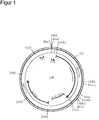
- Hyd1 and Hyd2 a D-hydantoinase gene from Bacillus thermoglucodasius (wild type) is isolated and, after restriction with the restriction enzymes EcoRI and HindIII, into an expression vector suitable for expression in E. coli (pKK177-3, DSM 3062 ) inserted. If a base is deleted from the HindIII cleavage site (AAGCTT -> AAGCT), a reading frame is created which can be translated into a protein with SEQ ID 1 (FIG. 1).
- the resulting plasmid pD8 contains SEQ ID NO 2 as a protein coding sequence under the control of an IPTG-inducible promoter.
- the promoter can be replaced by other promoters such as e.g. by the lac promoter, mgl promoter (EP-A 0 316 370) or by the promoters described in EP-A 0 186 069 and EP-A 0 303 925.
- E.coli HB 101 (DSM 1607), which contains pD8 and the lacI gene on a compatible plasmid, is used as the host organism.
- the precultures were grown starting from sequins stored in liquid nitrogen in LB medium with double selection pressure (kanamycin and ampicillin).
- the inoculation volume for the main culture is 1 - 10 vol%.
- the main components of the HK medium are yeast extract and glucose.
- the medium is adjusted to pH 7.6-7.8 with K2HPO4 before inoculation.
- Mn and Mg salts are necessary for the activity and stability of the hydantoinase.
- the salts are sterilized separately and added separately to the medium. Only a small proportion (approx. 20%) is presented, the main proportion is added via a glucose dosage, which is used as an acidity regulator.
- the fermentation temperature is 32 ° C.
- the pH is regulated at 7.0 - 7.2.
- the supply air regulation, the metering speed and / or the pressure of the dissolved oxygen value pO2> 10% is maintained via the stirrer speed.
- hydantoinase activity is> 1 MU / l, which is with a spec.
- Activity of approximately 100 U / mg corresponds to an expression of> 10 g / l of active, soluble hydantoinase.
Landscapes
- Chemical & Material Sciences (AREA)
- Life Sciences & Earth Sciences (AREA)
- Organic Chemistry (AREA)
- Health & Medical Sciences (AREA)
- Engineering & Computer Science (AREA)
- Zoology (AREA)
- Wood Science & Technology (AREA)
- Genetics & Genomics (AREA)
- Bioinformatics & Cheminformatics (AREA)
- General Health & Medical Sciences (AREA)
- Microbiology (AREA)
- Biochemistry (AREA)
- Biotechnology (AREA)
- General Engineering & Computer Science (AREA)
- Medicinal Chemistry (AREA)
- Molecular Biology (AREA)
- Biomedical Technology (AREA)
- General Chemical & Material Sciences (AREA)
- Chemical Kinetics & Catalysis (AREA)
- Enzymes And Modification Thereof (AREA)
- Micro-Organisms Or Cultivation Processes Thereof (AREA)
- Preparation Of Compounds By Using Micro-Organisms (AREA)
- Medicines That Contain Protein Lipid Enzymes And Other Medicines (AREA)
Abstract
Description
- Gegenstand der Erfindung ist eine neue rekombinante D-Hydantoinase, ein Verfahren zu ihrer Herstellung und ihre Verwendung.
- D-Hydantoinasen (Dihydropyrimidinasen, EC.3.5.2.2) werden zur Herstellung von D-N-Carbamoyl-alpha-aminosäuren verwendet. Diese Verbindungen sind wichtige Zwischenprodukte zur Herstellung von D-Aminosäuren (Morin et al., Appl. Microbiol. 35, 536 - 540 (1991), EP-B 0 219 034). D-Aminosäuren wiederum sind wertvolle Ausgangsstoffe für die Synthese der Seitenketten von Penicillinen und halbsynthetischen Cephalosporinen. Die Herstellung von D-N-Carbamoyl-alpha-aminosäuren erfolgt vorteilhaft bei höheren Temperaturen, da dann die Hydantoine besser löslich sind, die Racemisierung schneller erfolgt und auch die Umsetzung beschleunigt wird. Aus diesem Grund besteht ein Bedarf an thermostabilen D-Hydantoinasen.
- Eine D-Hydantoinase, welche bei hohen Temperaturen (40 - 90°C) aktiv ist, kann aus thermophilen Mikroorganismen erhalten werden (DE-A 30 31 151). Diese thermophilen Mikroorganismen sind jedoch schwer kultivierbar und wachsen schlecht. Außerdem wird die D-Hydantoinase von diesen Mikroorganismen nur in sehr geringen Mengen produziert.
- In der EP-B 0 219 034 ist eine rekombinante D-Hydantoinase beschrieben. Bei der Expression der in der EP-B 0 219 034 beschriebenen DNA-Sequenzen wird jedoch D-Hydantoinaseaktivität nur in geringer Menge erhalten.
- Aufgabe der vorliegenden Erfindung war es, eine rekombinante D-Hydantoinase mit weiter verbesserter Temperaturstabilität in großen Mengen zur Verfügung zu stellen.
- Diese Aufgabe wird gelöst durch ein Protein, welches D-Hydantoinasenaktivität besitzt und gekennzeichnet ist durch die Aminosäuresequenz SEQ ID NO 1.
- Das Protein
- a) besitzt ein pH-Optimum bei ca. 8,2,
ein Optimum der pH-Stabilität zwischen ca. 6,5 und 9,0, - b) weist in 50 mmol/l Trispuffer, pH 7,8, bei einer Konzentration von 15 mg/ml nach 20 Minuten bei 60°C noch ca. 100 % der Ausgangsaktivität und nach 20 Minuten bei 65°C noch ca. 80 % der Ausgangsaktivität auf,
- c) ist ein nicht natürlich vorkommendes Polypeptid,
- d) ist das Produkt einer prokaryontischen Expression einer exogenen DNA.
- Es hat sich überraschenderweise gezeigt, daß das erfindungsgemäße Enzym rekombinant in Prokaryonten in großen Mengen herstellbar ist, gut löslich ist und eine hohe Aktivität und gute Temperaturstabilität besitzt.
- Die erfindungsgemäße rekombinante D-Hydantoinase unterscheidet sich von dem nativen Enzym (Wildtyp-Enzym) aus beispielsweise thermophilem Bacillus (DE-OS 30 31 151) und von dem in der EP-B 0 219 034 beschriebenen Enzym in der Aminosäuresequenz am C-Terminus.
- Das erfindungsgemäße Enzym ist 12 Aminosäuren kürzer als das Wildtyp-Enzym und unterscheidet sich in der Sequenz der letzten 6 Aminosäuren. Gegenüber dem in der EP-B 0 219 034 beschriebenen Enzym ist das erfindungsgemäße Enzym 8 Aminosäuren länger und unterscheidet sich in der Sequenz der letzten 30 Aminosäuren.
- Als erfindungsgemäße D-Hydantoinasen sind auch solche Proteine zu verstehen, welche sich in ihrer Aminosäuresequenz geringfügig von SEQ ID NO 1 unterscheiden. Dabei können Aminosäuren ausgetauscht, deletiert, derivatisiert oder addiert werden.
- Zur rekombinanten Herstellung der erfindungsgemäßen D-Hydantoinase wird eine DNA verwendet, welche für ein Protein mit D-Hydantoinasenaktivität codiert und ausgewählt ist aus der Gruppe
- a) der in Sequenz ID NO 2 gezeigten DNA-Sequenz oder der dazu komplementären DNA-Sequenz,
- b) DNA-Sequenzen, die aufgrund der Degeneration des genetischen Codes für ein Protein codieren, welches auch von einer der in a) definierten Sequenzen codiert wird.
- Vorzugsweise wird eine DNA-Sequenz der Sequenz ID NO 2 verwendet.
- Die DNA-Sequenzen können in einer dem Fachmann geläufigen Weise geringfügig modifiziert werden. Beispielsweise können degenerierte Codons durch andere Codons, welche für die gleiche Aminosäure codieren, ersetzt werden. Außerdem können zusätzliche Codons am 5'- und am 3'-Ende oder auch innerhalb der Sequenzen eingefügt werden oder Deletionen einzelner Codons oder Codongruppen erfolgen, solange sich die so erhaltenen DNA-Varianten von den erfindungsgemäßen Sequenzen nur geringfügig unterscheiden, mit diesen Sequenzen unter üblichen Bedingungen (Sambrook et al., Molecular Cloning, A Laboratory Manual, Cold Spring Harbor Laboratory Press, New York 1989) hybridisieren und das codierte Protein D-Hydantoinasen-Aktivität besitzt.
- Ein weiterer Gegenstand der Erfindung ist ein Verfahren zur Herstellung einer rekombinanten D-Hydantoinase durch Transformation einer geeigneten prokaryontischen Wirtszelle (z. B. E.coli, Saccharomyces cerevisiae) mit einer erfindungsgemäßen DNA, welche in einem geeigneten Expressionssystem vorliegt, Kultivierung der transformierten Wirtszellen und Isolierung der gebildeten D-Hydantoinase aus den Zellen oder dem Zellüberstand.
- Die Transformation der für die rekombinante Herstellung verwendeten Wirtszellen erfolgt nach bekannten Verfahren (Sambrook et al. 1989) Die transformierten Wirtszellen werden unter Bedingungen kultiviert, die eine Expression des D-Hydantoinasegens erlauben. Je nach verwendetem Expressionsvektor ist hierfür in bekannter Weise ggf. die Zugabe eines Induktors (z. B. Lactose oder Isopropyl-β-D-Thiogalactopyranosid (IPTG)) zum Kulturmedium erforderlich. Die Isolierung der rekombinanten D-Hydantoinase aus dem Zellüberstand oder den Zellen erfolgt in bekannter Weise.
- Mit diesem Verfahren ist es möglich, rekombinante, aktive D-Hydantoinase in einer Ausbeute von bis zu 10⁶ U/1,5 kg Biomasse zu erhalten.
- Aufschluß und Aufreinigung der rekombinant hergestellten D-Hydantoinase können nach den dem Fachmann geläufigen Methoden durchgeführt werden. Vorzugsweise wird die nach Fermentation erhaltene Biomasse in einem Hochdruckhomogenisator aufgeschlossen, der rohe Extrakt mit Ammonsulfat und einer Inkubation bei ca. 60°C fraktioniert (Hitzeschritt).
- Ein weiterer Gegenstand der Erfindung ist ein Verfahren zur Spaltung eines racemischen Hydantoins in die entsprechenden D-N-Carbamoyl-alpha-aminosäure, welches dadurch gekennzeichnet ist, daß das racemische Hydantoin mit einer erfindungsgemäßen D-Hydantoinase bei einer Temperatur von 50 - 80°C inkubiert wird und die entstandene D-N-Carbamoyl-alpha-aminosäure anschließend nach dem Fachmann geläufigen Methoden aus dem Reaktionsgemisch isoliert und ggf. gereinigt wird.
- Sämtliche gentechnologische Verfahren wie z.B. Expression, DNA-Modifikation, Klonierung und Gewinnung des rekombinanten Proteins können nach den dem Fachmann geläufigen Methoden wie sie z.B. in Ausubel, F.M., et al., Current Protocols in Molecular Biology, Wiley, New York 1992; Sambrook et al. (1989) oder Davis, L.G., Methods in Molecular Biology, Elsevier, Amsterdam, NL, 1986 beschrieben sind durchgeführt werden.
- Die nachfolgenden Beispiele, das Sequenzprotokoll und die Abbildung erläutern die Erfindung weiter:
- Mit Hilfe zweier Primer (Hyd1 und Hyd2) wird ein D-Hydantoinase-Gen aus Bacillus thermoglucodasius (Wildtyp) isoliert und nach Restriktion mit den Restriktionsenzymen EcoRI und HindIII in einen für die Expression in E. coli geeigneten Expressionsvektor (pKK177-3, DSM 3062) insertiert.

Deletiert man eine Base aus der HindIII-Schnittstelle (AAGCTT -> AAGCT), so entsteht ein Leserahmen, der in ein Protein mit SEQ ID 1 übersetzt werden kann (Fig. 1). - Das resultierende Plasmid pD8 enthält SEQ ID NO 2 als proteinkodierende Sequenz unter der Kontrolle eines IPTG-induzierbaren Promotors. In diesem Plasmid kann der Promotor durch andere Promotoren wie z.B. durch den lac-Promotor, mgl-Promotor (EP-A 0 316 370) oder durch die in EP-A 0 186 069 und EP-A 0 303 925 beschriebenen Promotoren ersetzt werden.
- Als Wirtsorganismus wird E.coli HB 101 (DSM 1607) verwendet, der pD8 sowie auf einem kompatiblen Plasmid das lacI-Gen enthält.
- Die Anzucht der Vorkulturen erfolgte ausgehend von in Flüssig-Stickstoff gelagerten Pailletten in LB Medium mit doppeltem Selektionsdruck (Kanamycin und Ampicillin).
- Das Animpfvolumen für die Hauptkultur beträgt 1 - 10 Vol %. Hauptbestandteile des HK-Mediums sind Hefeextrakt und Glucose. Das Medium wird vor dem Beimpfen mit K₂HPO₄ auf pH 7,6 - 7,8 eingestellt.
- Weitere essentielle Medienbestandteile sind Mn- und Mg-Salze. Sie sind notwendig für die Aktivität und Stabilität der Hydantoinase. Die Salze werden getrennt sterilisiert und separat zum Medium zugegeben. Ein nur geringer Anteil (ca. 20 %) wird vorgelegt, der Hauptanteil wird über eine Glucosedosage, die als Säureregulans eingesetzt wird, zugegeben.
- Zur Vermeidung der Bildung von Inclusion Bodies (IBs) wird erst bei einer OD₅₇₈ = 10 mit wenig IPTG (<1 mmol) induziert. Die Fermentationstemperatur beträgt 32°C. Zusätzlich erfolgt ab einer OD₅₇₈ = 30 eine limitierende Dosage von Hefeextrakt zur Begrenzung der Wachstumsgeschwindigkeit.
- Durch die Regulierung und Limitierung der spez. Wachstumsrate über die Dosagegeschwindigkeit läßt sich die IB-Bildung nahezu vollständig unterdrücken, und trotzdem kann ein hoher Biomasseertrag erzielt werden.
Der pH Wert wird bei 7,0 - 7,2 reguliert. Um unerwünschte Säurebildung zu unterdrücken, wird über die Rührerdrehzahl die Zuluftregulierung, die Dosagegeschwindigkeit und/oder Druck der gelöst-Sauerstoffwert pO₂ > 10 % gehalten. - Nach ca. 40 Std. Fermentationszeit wird eine OD₅₇₈ von 120 - 140 erreicht. Dies bedeutet eine Biomasseausbeute von 45 - 50 g TG/l. Die Hydantoinaseaktivität liegt dabei > 1 MU/l, was bei einer spez. Aktivität von ca. 100 U/mg einer Expressionsleistung von > 10 g/l an aktiver, löslicher Hydantoinase entspricht.
-
- 3.1 Aufschluß
1,5 kg Biofeuchtmasse werden mit 6 Liter kaltem 50 mmol/l TRIS/HCl - Puffer pH 8,5 suspendiert und mit einem Hochdruckhomogenisator der Firma APV Gaulin GmbH bei 1200 bar aufgeschlossen.
Die Suspension wird anschließend auf +4°C abgekühlt und hochtourig bei ca. 25 000 x g in einer Sorvallzentrifuge zentrifugiert. - 3.2 Ammoniumsulfat-Fraktionierung
Der Rohextrakt wird mit festem Ammoniumsulfat bis zu einer Konzentration von 1,3 mol/l versetzt, der ausgefallene Niederschlag hochtourig abzentrifugiert verworfen. Der Überstand wird weiter mit Ammoniumsulfat bis zu einer Konzentration von 2,5 mol/l ausgefällt und der Niederschlag wiederum hochtourig abzentrifugiert. - 3.3 Hitzeschritt
Der Niederschlag der Ammoniumsulfatfällung wird mit 50 mmol/l TRIS/HCl-Puffer pH 8,5 gelöst und auf eine Proteinkonzentration von 10 mg/ml eingestellt. Die Enzymlösung wird auf 56°C erwärmt und 30 Minuten bei dieser Temperatur gehalten; anschließend wird auf +4°C abgekühlt und der ausgefallene Niederschlag abzentrifugiert.
Die Ausbeute beträgt ca. 1 x 10⁶ Units mit einer spezifischen Aktivität von 35 U/mg Protein. - 3.4 Vergleich mit dem Stand der Technik
Tabelle 1 zeigt einen Vergleich der Literaktivitäten für die bekannten D-Hydantoinasen und das erfindungsgemäße Enzym. -
Tabelle 1 D-Hydantoinase Aktivität in kU/l nach DE-A 30 31 151 (Wildtyp) 0,10 nach EP-B 0 219 034 0,56 erfindungsgemäß 1000 


Claims (8)
- Rekombinantes Protein mit D-Hydantoinasenaktivität, das gekennzeichnet ist durch die Aminosäuresequenz SEQ ID NO 1.
- DNA, welche für ein Protein mit D-Hydantoinasenaktivität codiert und ausgewählt ist aus der Gruppea) der in Sequenz ID NO 2 gezeigten DNA-Sequenz oder der dazu komplementären DNA-Sequenz,b) DNA-Sequenzen, die aufgrund der Degeneration des genetischen Codes für ein Protein gemäß SEQ ID NO 1 codieren, welches auch von einer der in a) definierten Sequenzen codiert wird.
- DNA Sequenz SEQ ID NO 2.
- Prokaryontische oder eukaryontische Wirtszelle, die mit einer DNA-Sequenz nach den Ansprüchen 2 oder 3 so transformiert ist, daß die Wirtszelle das von dieser DNA-Sequenz codierte Protein exprimieren kann.
- Wirtszelle nach Anspruch 4, dadurch gekennzeichnet, daß diese eine E.coli-Zelle oder eine Saccharomyces-Zelle ist.
- DNA-Vektor, enthaltend eine Sequenz nach den Ansprüchen 2 oder 3.
- Verfahren zur Herstellung einer rekombinanten D-Hydantoinase durch Transformation einer geeigneten Wirtszelle mit einer DNA nach den Ansprüchen 2 oder 3 in einem geeigneten Expressionssystem, Kultivierung der transformierten Wirtszellen und Isolierung der gebildeten D-Hydantoinase aus den Zellen oder dem Zellüberstand.
- Verfahren zur Spaltung racemischer Hydantoine in D-N- und L-N-Carbamoyl-alpha-aminosäuren, dadurch gekennzeichnet, daß das racemische Hydantoin mit einer D-Hydantoinase gemäß Anspruch 1 bei einer Temperatur von 50 - 80°C inkubiert wird und die entstandene D-N-Carbamoyl-alpha-aminosäure aus dem Reaktionsgemisch isoliert und ggf. gereinigt wird.
Applications Claiming Priority (2)
| Application Number | Priority Date | Filing Date | Title |
|---|---|---|---|
| DE4328829A DE4328829A1 (de) | 1993-08-27 | 1993-08-27 | Rekombinante D-Hydantoinase, Verfahren zur Herstellung und Verwendung |
| DE4328829 | 1993-08-27 |
Publications (3)
| Publication Number | Publication Date |
|---|---|
| EP0643133A2 true EP0643133A2 (de) | 1995-03-15 |
| EP0643133A3 EP0643133A3 (de) | 1995-05-24 |
| EP0643133B1 EP0643133B1 (de) | 2001-11-21 |
Family
ID=6496152
Family Applications (1)
| Application Number | Title | Priority Date | Filing Date |
|---|---|---|---|
| EP94113110A Expired - Lifetime EP0643133B1 (de) | 1993-08-27 | 1994-08-23 | Rekombinante D-Hydantoinase, Verfahren zur Herstellung und Verwendung |
Country Status (6)
| Country | Link |
|---|---|
| US (2) | US5523224A (de) |
| EP (1) | EP0643133B1 (de) |
| JP (1) | JP2546979B2 (de) |
| AT (1) | ATE209252T1 (de) |
| DE (2) | DE4328829A1 (de) |
| ES (1) | ES2168282T3 (de) |
Cited By (2)
| Publication number | Priority date | Publication date | Assignee | Title |
|---|---|---|---|---|
| EP0801131A4 (de) * | 1994-12-28 | 2000-03-22 | Kanegafuchi Chemical Ind | Verfahren zur herstellung einer d-n-carbamoyl-alpha-aminosäure |
| EP1165763A4 (de) * | 1999-03-29 | 2003-05-28 | California Inst Of Techn | HYDANTOINASE-VARIANTEN MIT VERBESSERTEN EIGENSCHAFTEN UND IHRE ANWENDUNG ZUR PRODUKTION VON AMINOSäUREN |
Families Citing this family (9)
| Publication number | Priority date | Publication date | Assignee | Title |
|---|---|---|---|---|
| DE4328829A1 (de) * | 1993-08-27 | 1995-03-02 | Boehringer Mannheim Gmbh | Rekombinante D-Hydantoinase, Verfahren zur Herstellung und Verwendung |
| US6403357B1 (en) | 2000-08-24 | 2002-06-11 | National Science Council | Thermostable D-hydantoinase and the application thereof |
| EP1258532A1 (de) * | 2001-04-26 | 2002-11-20 | National Science Council | Thermostabile D-hydantoinase aus Bacillus Circulans und deren verwendung |
| JP4561010B2 (ja) * | 2001-07-10 | 2010-10-13 | 味の素株式会社 | D−ヒダントインハイドロラーゼをコードするdna、n−カルバミル−d−アミノ酸ハイドロラーゼをコードするdna、該遺伝子を含む組み換えdna、該組み換えdnaにより形質転換された細胞、該形質転換細胞を用いるタンパク質の製造方法、および、d−アミノ酸の製造方法 |
| JP4561009B2 (ja) * | 2001-07-10 | 2010-10-13 | 味の素株式会社 | D−ヒダントインハイドロラーゼをコードするdna、n−カルバミル−d−アミノ酸ハイドロラーゼをコードするdna、該遺伝子を含む組み換えdna、該組み換えdnaにより形質転換された細胞、該形質転換細胞を用いるタンパク質の製造方法、および、d−アミノ酸の製造方法 |
| US7247465B2 (en) * | 2003-06-06 | 2007-07-24 | Degussa Ag | Screening process for hydantoin racemases |
| WO2007069509A1 (ja) * | 2005-12-12 | 2007-06-21 | Kaneka Corporation | 新規ヒダントイナーゼ及びn-カルバモイル-d-アミノ酸の製造方法 |
| WO2022032178A1 (en) | 2020-08-06 | 2022-02-10 | Mate Precision Technologies Inc. | Vise assembly |
| WO2022032148A1 (en) | 2020-08-06 | 2022-02-10 | Mate Precision Technologies Inc. | Tooling base assembly |
Family Cites Families (6)
| Publication number | Priority date | Publication date | Assignee | Title |
|---|---|---|---|---|
| DE3031151A1 (de) * | 1980-08-18 | 1982-04-15 | Basf Ag, 6700 Ludwigshafen | Verfahren zur herstellung von d-n-carbamoyl-(alpha)-aminosaeuren und mikroorganismen dafuer |
| IT1209495B (it) * | 1984-02-02 | 1989-08-30 | A San Donato Milanese Milano | Procedimento per la preparazione di l-alfa-amminoacidi. |
| DE3535987A1 (de) * | 1985-10-09 | 1987-04-23 | Basf Ag | Verfahren zur herstellung von meophilen mikroorganismen, die eine bei hoeherer temperatur aktive d-hydantoinase enthalten |
| US5565344A (en) * | 1990-12-07 | 1996-10-15 | Kanegafuchi Kagaku Kogyo Kabushiki Kaisha | Process for production of D-α-amino acids |
| JPH04325093A (ja) * | 1991-04-23 | 1992-11-13 | Nippon Soda Co Ltd | 耐熱性ヒダントイナーゼ、及びそれをコードする遺伝子 |
| DE4328829A1 (de) * | 1993-08-27 | 1995-03-02 | Boehringer Mannheim Gmbh | Rekombinante D-Hydantoinase, Verfahren zur Herstellung und Verwendung |
-
1993
- 1993-08-27 DE DE4328829A patent/DE4328829A1/de not_active Withdrawn
-
1994
- 1994-08-12 US US08/289,709 patent/US5523224A/en not_active Expired - Fee Related
- 1994-08-23 AT AT94113110T patent/ATE209252T1/de not_active IP Right Cessation
- 1994-08-23 EP EP94113110A patent/EP0643133B1/de not_active Expired - Lifetime
- 1994-08-23 ES ES94113110T patent/ES2168282T3/es not_active Expired - Lifetime
- 1994-08-23 DE DE59409964T patent/DE59409964D1/de not_active Expired - Fee Related
- 1994-08-26 JP JP6202004A patent/JP2546979B2/ja not_active Expired - Fee Related
-
1996
- 1996-02-16 US US08/602,656 patent/US5679571A/en not_active Expired - Fee Related
Cited By (3)
| Publication number | Priority date | Publication date | Assignee | Title |
|---|---|---|---|---|
| EP0801131A4 (de) * | 1994-12-28 | 2000-03-22 | Kanegafuchi Chemical Ind | Verfahren zur herstellung einer d-n-carbamoyl-alpha-aminosäure |
| EP1165763A4 (de) * | 1999-03-29 | 2003-05-28 | California Inst Of Techn | HYDANTOINASE-VARIANTEN MIT VERBESSERTEN EIGENSCHAFTEN UND IHRE ANWENDUNG ZUR PRODUKTION VON AMINOSäUREN |
| EP1586636A1 (de) * | 1999-03-29 | 2005-10-19 | Degussa AG | Hydantoinase-Varianten mit verbesserten Eigenschaften und ihre Anwendung zur Produktion von Aminosäuren |
Also Published As
| Publication number | Publication date |
|---|---|
| ATE209252T1 (de) | 2001-12-15 |
| US5523224A (en) | 1996-06-04 |
| EP0643133A3 (de) | 1995-05-24 |
| DE59409964D1 (de) | 2002-01-03 |
| ES2168282T3 (es) | 2002-06-16 |
| JPH07163347A (ja) | 1995-06-27 |
| DE4328829A1 (de) | 1995-03-02 |
| US5679571A (en) | 1997-10-21 |
| EP0643133B1 (de) | 2001-11-21 |
| JP2546979B2 (ja) | 1996-10-23 |
Similar Documents
| Publication | Publication Date | Title |
|---|---|---|
| EP1897939B1 (de) | Mikroorganismenstamm zur Produktion von rekombinanten Proteinen | |
| EP0643133A2 (de) | Rekombinante D-Hydantoinase, Verfahren zur Herstellung und Verwendung | |
| DE102020205703A1 (de) | Expression von Kollagenpeptid-Komponenten in prokaryotischen Systemen | |
| EP1903115A1 (de) | Verfahren zur fermentativen Herstellung von Antikörpern | |
| DE60209883T2 (de) | Übersekretierte peptide, deren herstellung, und gleichzeitige verbesserung der sekretierten form eines oder mehrerer anderer polypeptide | |
| US20220389072A1 (en) | Process for production of soluble recombinant peptides | |
| DE69225009T2 (de) | Eine asymmetrisch aktive Esterase kodierendes Gen | |
| US20210032307A1 (en) | Codon optimized precursor gene and signal peptide gene of human insulin analogue | |
| EP4269597A1 (de) | L-histidinexportprotein und verfahren zur herstellung von l-histidin damit | |
| EP0495398B1 (de) | Verfahren zur Herstellung von rekombinanter IgA-protease. | |
| EP0504798B1 (de) | Verfahren zur Herstellung von Glutarylacylase in grossen Mengen | |
| EP0300425B1 (de) | Verfahren zur Herstellung von Proteinen in löslicher Form | |
| DE102004030938A1 (de) | Neue, Polyaminosäuren bildende oder abbauende Genprodukte von Bacillus licheniformis und darauf aufbauende verbesserte biotechnologische Produktionsverfahren | |
| EP0427035B1 (de) | Überexpression von Proteinen in rekombinanten Wirtszellen | |
| EP1169461B1 (de) | Verwendung von pankreatischer Procarboxypeptidase B zur Herstellung von Insulin | |
| DE3886250T2 (de) | Herstellung von menschlichem Somatomedin C mit hohem Titer. | |
| DE19935268A1 (de) | N-Acetylaminosäureracemase | |
| EP0180225B1 (de) | Plasmide zur erhöhten Produktion von Penicillin G-Amidase | |
| DE10251547C5 (de) | Rekombinante (R)-Hydroxynitrillyase | |
| EP0284185B1 (de) | Verfahren zur Herstellung von L-Phenylalanin durch rekombinantes E.coli | |
| KR20160119331A (ko) | 신규 프로모터 및 이의 용도 | |
| US20220251621A1 (en) | Process for production of soluble recombinant peptides | |
| EP0652288A1 (de) | Sauerstoffabhängige Fermentation von Mikroorganismen | |
| DE3889143T2 (de) | Verfahren zur Herstellung von L-Phenylalanin durch rekombinantes E.coli. | |
| DE10130169A1 (de) | Aktivierte rec-D-Hydantoinasen |
Legal Events
| Date | Code | Title | Description |
|---|---|---|---|
| PUAI | Public reference made under article 153(3) epc to a published international application that has entered the european phase |
Free format text: ORIGINAL CODE: 0009012 |
|
| 17P | Request for examination filed |
Effective date: 19940823 |
|
| AK | Designated contracting states |
Kind code of ref document: A2 Designated state(s): AT BE CH DE DK ES FR GB GR IE IT LI LU NL PT SE |
|
| PUAL | Search report despatched |
Free format text: ORIGINAL CODE: 0009013 |
|
| RHK1 | Main classification (correction) |
Ipc: C12N 15/55 |
|
| AK | Designated contracting states |
Kind code of ref document: A3 Designated state(s): AT BE CH DE DK ES FR GB GR IE IT LI LU NL PT SE |
|
| RAP3 | Party data changed (applicant data changed or rights of an application transferred) |
Owner name: ROCHE DIAGNOSTICS GMBH |
|
| 17Q | First examination report despatched |
Effective date: 19990914 |
|
| GRAG | Despatch of communication of intention to grant |
Free format text: ORIGINAL CODE: EPIDOS AGRA |
|
| GRAG | Despatch of communication of intention to grant |
Free format text: ORIGINAL CODE: EPIDOS AGRA |
|
| GRAH | Despatch of communication of intention to grant a patent |
Free format text: ORIGINAL CODE: EPIDOS IGRA |
|
| GRAH | Despatch of communication of intention to grant a patent |
Free format text: ORIGINAL CODE: EPIDOS IGRA |
|
| GRAA | (expected) grant |
Free format text: ORIGINAL CODE: 0009210 |
|
| AK | Designated contracting states |
Kind code of ref document: B1 Designated state(s): AT BE CH DE DK ES FR GB GR IE IT LI LU NL PT SE |
|
| PG25 | Lapsed in a contracting state [announced via postgrant information from national office to epo] |
Ref country code: IE Free format text: LAPSE BECAUSE OF FAILURE TO SUBMIT A TRANSLATION OF THE DESCRIPTION OR TO PAY THE FEE WITHIN THE PRESCRIBED TIME-LIMIT Effective date: 20011121 Ref country code: GR Free format text: LAPSE BECAUSE OF FAILURE TO SUBMIT A TRANSLATION OF THE DESCRIPTION OR TO PAY THE FEE WITHIN THE PRESCRIBED TIME-LIMIT Effective date: 20011121 |
|
| REF | Corresponds to: |
Ref document number: 209252 Country of ref document: AT Date of ref document: 20011215 Kind code of ref document: T |
|
| REG | Reference to a national code |
Ref country code: CH Ref legal event code: EP |
|
| REG | Reference to a national code |
Ref country code: IE Ref legal event code: FG4D Free format text: GERMAN |
|
| REG | Reference to a national code |
Ref country code: GB Ref legal event code: IF02 |
|
| REF | Corresponds to: |
Ref document number: 59409964 Country of ref document: DE Date of ref document: 20020103 |
|
| REG | Reference to a national code |
Ref country code: CH Ref legal event code: NV Representative=s name: F. HOFFMANN-LA ROCHE AG |
|
| PG25 | Lapsed in a contracting state [announced via postgrant information from national office to epo] |
Ref country code: SE Free format text: LAPSE BECAUSE OF FAILURE TO SUBMIT A TRANSLATION OF THE DESCRIPTION OR TO PAY THE FEE WITHIN THE PRESCRIBED TIME-LIMIT Effective date: 20020221 Ref country code: PT Free format text: LAPSE BECAUSE OF FAILURE TO SUBMIT A TRANSLATION OF THE DESCRIPTION OR TO PAY THE FEE WITHIN THE PRESCRIBED TIME-LIMIT Effective date: 20020221 Ref country code: DK Free format text: LAPSE BECAUSE OF FAILURE TO SUBMIT A TRANSLATION OF THE DESCRIPTION OR TO PAY THE FEE WITHIN THE PRESCRIBED TIME-LIMIT Effective date: 20020221 |
|
| GBT | Gb: translation of ep patent filed (gb section 77(6)(a)/1977) |
Effective date: 20020216 |
|
| ET | Fr: translation filed | ||
| REG | Reference to a national code |
Ref country code: ES Ref legal event code: FG2A Ref document number: 2168282 Country of ref document: ES Kind code of ref document: T3 |
|
| REG | Reference to a national code |
Ref country code: IE Ref legal event code: FD4D |
|
| PGFP | Annual fee paid to national office [announced via postgrant information from national office to epo] |
Ref country code: AT Payment date: 20020813 Year of fee payment: 9 |
|
| PG25 | Lapsed in a contracting state [announced via postgrant information from national office to epo] |
Ref country code: LU Free format text: LAPSE BECAUSE OF NON-PAYMENT OF DUE FEES Effective date: 20020823 |
|
| PGFP | Annual fee paid to national office [announced via postgrant information from national office to epo] |
Ref country code: ES Payment date: 20020826 Year of fee payment: 9 |
|
| PGFP | Annual fee paid to national office [announced via postgrant information from national office to epo] |
Ref country code: NL Payment date: 20020829 Year of fee payment: 9 |
|
| PLBE | No opposition filed within time limit |
Free format text: ORIGINAL CODE: 0009261 |
|
| STAA | Information on the status of an ep patent application or granted ep patent |
Free format text: STATUS: NO OPPOSITION FILED WITHIN TIME LIMIT |
|
| PGFP | Annual fee paid to national office [announced via postgrant information from national office to epo] |
Ref country code: BE Payment date: 20021017 Year of fee payment: 9 |
|
| 26N | No opposition filed | ||
| PG25 | Lapsed in a contracting state [announced via postgrant information from national office to epo] |
Ref country code: AT Free format text: LAPSE BECAUSE OF NON-PAYMENT OF DUE FEES Effective date: 20030823 |
|
| PG25 | Lapsed in a contracting state [announced via postgrant information from national office to epo] |
Ref country code: ES Free format text: LAPSE BECAUSE OF NON-PAYMENT OF DUE FEES Effective date: 20030825 |
|
| PG25 | Lapsed in a contracting state [announced via postgrant information from national office to epo] |
Ref country code: BE Free format text: LAPSE BECAUSE OF NON-PAYMENT OF DUE FEES Effective date: 20030831 |
|
| BERE | Be: lapsed |
Owner name: *ROCHE DIAGNOSTICS G.M.B.H. Effective date: 20030831 |
|
| PG25 | Lapsed in a contracting state [announced via postgrant information from national office to epo] |
Ref country code: NL Free format text: LAPSE BECAUSE OF NON-PAYMENT OF DUE FEES Effective date: 20040301 |
|
| NLV4 | Nl: lapsed or anulled due to non-payment of the annual fee |
Effective date: 20040301 |
|
| REG | Reference to a national code |
Ref country code: ES Ref legal event code: FD2A Effective date: 20030825 |
|
| PGFP | Annual fee paid to national office [announced via postgrant information from national office to epo] |
Ref country code: GB Payment date: 20050707 Year of fee payment: 12 |
|
| PGFP | Annual fee paid to national office [announced via postgrant information from national office to epo] |
Ref country code: FR Payment date: 20050804 Year of fee payment: 12 |
|
| PG25 | Lapsed in a contracting state [announced via postgrant information from national office to epo] |
Ref country code: IT Free format text: LAPSE BECAUSE OF NON-PAYMENT OF DUE FEES;WARNING: LAPSES OF ITALIAN PATENTS WITH EFFECTIVE DATE BEFORE 2007 MAY HAVE OCCURRED AT ANY TIME BEFORE 2007. THE CORRECT EFFECTIVE DATE MAY BE DIFFERENT FROM THE ONE RECORDED. Effective date: 20050823 |
|
| PGFP | Annual fee paid to national office [announced via postgrant information from national office to epo] |
Ref country code: DE Payment date: 20050831 Year of fee payment: 12 |
|
| PGFP | Annual fee paid to national office [announced via postgrant information from national office to epo] |
Ref country code: CH Payment date: 20050927 Year of fee payment: 12 |
|
| PG25 | Lapsed in a contracting state [announced via postgrant information from national office to epo] |
Ref country code: LI Free format text: LAPSE BECAUSE OF NON-PAYMENT OF DUE FEES Effective date: 20060831 Ref country code: CH Free format text: LAPSE BECAUSE OF NON-PAYMENT OF DUE FEES Effective date: 20060831 |
|
| PG25 | Lapsed in a contracting state [announced via postgrant information from national office to epo] |
Ref country code: DE Free format text: LAPSE BECAUSE OF NON-PAYMENT OF DUE FEES Effective date: 20070301 |
|
| REG | Reference to a national code |
Ref country code: CH Ref legal event code: PL |
|
| GBPC | Gb: european patent ceased through non-payment of renewal fee |
Effective date: 20060823 |
|
| REG | Reference to a national code |
Ref country code: FR Ref legal event code: ST Effective date: 20070430 |
|
| PG25 | Lapsed in a contracting state [announced via postgrant information from national office to epo] |
Ref country code: GB Free format text: LAPSE BECAUSE OF NON-PAYMENT OF DUE FEES Effective date: 20060823 |
|
| PG25 | Lapsed in a contracting state [announced via postgrant information from national office to epo] |
Ref country code: FR Free format text: LAPSE BECAUSE OF NON-PAYMENT OF DUE FEES Effective date: 20060831 |