EP0644202B1 - Antigènes synthétiques pour la détection des anticorps contre le virus de l'hépatite C - Google Patents
Antigènes synthétiques pour la détection des anticorps contre le virus de l'hépatite C Download PDFInfo
- Publication number
- EP0644202B1 EP0644202B1 EP94108611A EP94108611A EP0644202B1 EP 0644202 B1 EP0644202 B1 EP 0644202B1 EP 94108611 A EP94108611 A EP 94108611A EP 94108611 A EP94108611 A EP 94108611A EP 0644202 B1 EP0644202 B1 EP 0644202B1
- Authority
- EP
- European Patent Office
- Prior art keywords
- peptides
- peptide
- amino acid
- seq
- hcv
- Prior art date
- Legal status (The legal status is an assumption and is not a legal conclusion. Google has not performed a legal analysis and makes no representation as to the accuracy of the status listed.)
- Revoked
Links
Images


Classifications
-
- C—CHEMISTRY; METALLURGY
- C07—ORGANIC CHEMISTRY
- C07K—PEPTIDES
- C07K14/00—Peptides having more than 20 amino acids; Gastrins; Somatostatins; Melanotropins; Derivatives thereof
- C07K14/005—Peptides having more than 20 amino acids; Gastrins; Somatostatins; Melanotropins; Derivatives thereof from viruses
-
- C—CHEMISTRY; METALLURGY
- C07—ORGANIC CHEMISTRY
- C07K—PEPTIDES
- C07K14/00—Peptides having more than 20 amino acids; Gastrins; Somatostatins; Melanotropins; Derivatives thereof
- C07K14/435—Peptides having more than 20 amino acids; Gastrins; Somatostatins; Melanotropins; Derivatives thereof from animals; from humans
- C07K14/575—Hormones
- C07K14/655—Somatostatins
-
- A—HUMAN NECESSITIES
- A61—MEDICAL OR VETERINARY SCIENCE; HYGIENE
- A61K—PREPARATIONS FOR MEDICAL, DENTAL OR TOILETRY PURPOSES
- A61K39/00—Medicinal preparations containing antigens or antibodies
-
- C—CHEMISTRY; METALLURGY
- C12—BIOCHEMISTRY; BEER; SPIRITS; WINE; VINEGAR; MICROBIOLOGY; ENZYMOLOGY; MUTATION OR GENETIC ENGINEERING
- C12N—MICROORGANISMS OR ENZYMES; COMPOSITIONS THEREOF; PROPAGATING, PRESERVING, OR MAINTAINING MICROORGANISMS; MUTATION OR GENETIC ENGINEERING; CULTURE MEDIA
- C12N2770/00—MICROORGANISMS OR ENZYMES; COMPOSITIONS THEREOF; PROPAGATING, PRESERVING, OR MAINTAINING MICROORGANISMS; MUTATION OR GENETIC ENGINEERING; CULTURE MEDIA ssRNA viruses positive-sense
- C12N2770/00011—Details
- C12N2770/24011—Flaviviridae
- C12N2770/24211—Hepacivirus, e.g. hepatitis C virus, hepatitis G virus
- C12N2770/24222—New viral proteins or individual genes, new structural or functional aspects of known viral proteins or genes
-
- Y—GENERAL TAGGING OF NEW TECHNOLOGICAL DEVELOPMENTS; GENERAL TAGGING OF CROSS-SECTIONAL TECHNOLOGIES SPANNING OVER SEVERAL SECTIONS OF THE IPC; TECHNICAL SUBJECTS COVERED BY FORMER USPC CROSS-REFERENCE ART COLLECTIONS [XRACs] AND DIGESTS
- Y10—TECHNICAL SUBJECTS COVERED BY FORMER USPC
- Y10S—TECHNICAL SUBJECTS COVERED BY FORMER USPC CROSS-REFERENCE ART COLLECTIONS [XRACs] AND DIGESTS
- Y10S436/00—Chemistry: analytical and immunological testing
- Y10S436/82—Hepatitis associated antigens and antibodies
Definitions
- HBV hepatitis B virus
- PTH post-transfusion hepatitis
- HCV hepatitis C virus
- the coding sequences disclosed in this document do not include sequences originating from the 5'-end of the viral genome which code for putative structural proteins. Recently however, sequences derived from this region of the HCV genome have been published (Okamoto, H. et al., Japan J. Exp. Med. 60:167-177, 1990.).
- the amino acid sequences encoded by the Japanese clone HC-J1 were combined with the HCV CDC/CHI sequences in a region where the two sequences overlap to generate the composite sequence depicted in Figure 1. Specifically, the two sequences were joined at glycine 451 .
- HCV amino acid sequence is not intended to be absolute since the existence of variant HCV strains harboring deletions or insertions is highly probable. Sequences corresponding to the 5' end of the HCV genome have also recently been disclosed in EPO 90302866.0.
- HCV genome The seeming similarity between the HCV genome and that of flaviviruses makes it possible to predict the location of epitopes which are likely to be of diagnostic value.
- An analysis of the HCV genome reveals the presence of a continuous long open reading frame. Viral RNA is presumably translated into a long polyprotein which is subsequently cleaved by cellular and/or viral proteases.
- the viral structural proteins are presumed to be derived from the amino-terminal third of the viral polyprotein At the present time, the precise sites at which the polyprotein is cleaved can only be surmised.
- the structural proteins are likely to contain epitopes which would be useful for diagnostic purposes, both for the detection of antibodies as well as for raising antibodies which could subsequently be used for the detection of viral antigens.
- domains of nonstructural proteins are also expected to contain epitopes of diagnostic value, even though these proteins are not found as structural components of virus particles.
- RNA viruses frequently exhibit a high rate of spontaneous mutation and, as such, it is to be expected that no two HCV isolates will be completely identical, even when derived from the same individual.
- a virus is considered to be the same or equivalent to HCV if it exhibits a global homology of 60 percent or more with the HCV HC-J1/CDC/CHI composite sequence at the nucleic acid level and 70 percent at the amino acid level.
- Peptides which immunologically mimic proteins encoded by HCV. In order to accommodate strain-to-strain variations in sequence, conservative as well as non-conservative amino acid substitutions may be made. These will generally account for less than 35 percent of a specific sequence. It may be desirable in cases where a peptide corresponds to a region in the HCV polypeptide which is highly polymorphic, to vary one or more of the amino acids so as to better mimic the different epitopes of different viral strains.
- the peptides of interest will include at least six, sometimes eight, sometimes twelve, usually fewer than about fifty, more usually fewer than about thirty-five, and preferably fewer than about twenty-five amino acids included within the sequence encoded by the HCV genome. In each instance, the peptide will preferably be as small as possible while still maintaining substantially all of the sensitivity of the larger peptide. It may also be desirable in certain instances to join two or more peptides together in one peptide structure.
- the present invention particularly relates to a peptide composition
- a peptide composition comprising at least one peptide containing fewer than 50 amino acids, with said peptide being selected from:
- Substitutions which are considered conservative are those in which the chemical nature of the substitute is similar to that of the original amino acid.
- Combinations of amino acids which could be considered conservative are Gly, Ala; Asp, Glu; Asn, Gln; Val, Ile, Leu; Ser, Thr; Lys, Arg; and Phe, Tyr.
- Natural amino acids such as cysteine, lysine, tyrosine, glutamic acid, or aspartic acid may be added as a linker arm to either the amino- or carboxyl terminus to provide functional groups for coupling to a solid phase or a carrier.
- other chemical groups such as, for example, biotin and thioglycolic acid, may be added as a linker arm to the termini which will endow the peptides with desired chemical or physical properties.
- the termini of the peptides may also be modified, for example, by N-terminal acetylation or terminal carboxyamidation.
- the peptides of interest are described in relation to the composite amino acid sequence shown in Figure 1. The amino acid sequences are given in the conventional and universally accepted three-letter code.
- the present invention further relates to a peptide composition according to the invention, further characterized in that it also comprises at least one peptide selected from:
- mercapto-group of cysteines or thioglycolic acids used for acylating terminal amino groups for cyclizing the peptides or coupling two peptides together.
- the cyclization or coupling may occur via a single bond or may be accomplished using thiol-specific reagents to form a molecular bridge.
- the peptides may be coupled to a soluble carrier for the purpose of either raising antibodies or facilitating the adsorption of the peptides to a solid phase.
- the nature of the carrier should be such that it has a molecular weight greater than 5000 and should not be recognized by antibodies in human serum.
- the carrier will be a protein. Proteins which are frequently used as carriers are keyhole limpet hemocyanin, bovine gamma globulin, bovine serum albumin, and poly-L-lysine.
- the linkage may occur at the N-terminus, C-terminus or at an internal site in the peptide.
- the peptide may also be derivatized for coupling.
- Detailed descriptions of a wide variety of coupling procedures are given, for example, in Van Regenmortel, M.H.V., Briand, J.P., Muller, S., and Plaué, S., Laboratory Techniques in Biochemistry and Molecular Biology, Vol. 19, Synthetic Polypeptides as Antigens, Elsevier Press, Amsterdam, New York, Oxford, 1988.
- the peptides may also be synthesized directly on an oligo-lysine core in which both the alpha as well as the epsilon-amino groups of lysines are used as growth points for the peptides.
- the number of lysines comprising the core is preferably 3 or 7.
- a cysteine may be included near or at the C-terminus of the complex to facilitate the formation of homo- or heterodimers. The use of this technique has been amply illustrated for hepatitis B antigens (Tam, J.P., and Lu, Y-A., Proc. Natl. Acad. Sci.
- the peptides may be either labeled or unlabeled. Labels which may be employed may be of any type, such as enzymatic, chemical, fluorescent, luminescent, or radioactive.
- the peptides may be modified for binding to surfaces or solid phases, such as, for example, microtiter plates, nylon membranes, glass or plastic beads, and chromatographic supports such as cellulose, silica, or agarose. The methods by which peptides can be attached or bound to solid support or surface are well known to those versed in the art.
- mixtures of peptides for the detection of antibodies specific for hepatitis C virus.
- Mixtures of peptides which are considered particularly advantageous are: F. VIII (SEQ ID NO 9), IX (SEQ ID NO 10), XI (SEQ ID NO 12), XIII (SEQ ID NO 14), and XIX (SEQ ID NO 15), G. XV (SEQ ID NO 16), XVI (SEQ ID NO 17), XVII (SEQ ID NO 18), XVIII (SEQ ID NO 19), and XIX (SEQ ID NO 20).
- Antibodies which recognize the peptides can be detected in a variety of ways.
- a preferred method of detection is the enzyme-linked immunosorbant assay (ELISA) in which a peptide or mixture of peptides is bound to a solid support. In most cases, this will be a microtiter plate but may in principle be any sort of insoluble solid phase.
- ELISA enzyme-linked immunosorbant assay
- a suitable dilution or dilutions of serum or other body fluid to be tested is brought into contact with the solid phase to which the peptide is bound. The incubation is carried out for a time necessary to allow the binding reaction to occur. Subsequently, unbound components are removed by washing the solid phase.
- the detection of immune complexes is achieved using antibodies which specifically bind to human immunoglobulins, and which have been labeled with an enzyme, preferably but not limited to either horseradish peroxidase, alkaline phosphatase, or beta-galactosidase, which is capable of converting a colorless or nearly colorless substrate or co-substrate into a highly colored product or a product capable of forming a colored complex with a chromogen.
- an enzyme preferably but not limited to either horseradish peroxidase, alkaline phosphatase, or beta-galactosidase, which is capable of converting a colorless or nearly colorless substrate or co-substrate into a highly colored product or a product capable of forming a colored complex with a chromogen.
- the detection system may employ an enzyme which, in the presence of the proper substrate(s), emits light. The amount of product formed is detected either visually, spectrophotometrically, electrochemically, or
- the detection system may also employ radioactively labeled antibodies, in which case the amount of immune complex is quantified by scintillation counting or gamma counting.
- Other detection systems which may be used include those based on the use of protein A derived from Staphylococcus aureus Cowan strain I, protein G from group C Staphylococcus sp. (strain 26RP66), or systems which make use of the high affinity biotin-avidin or streptavidin binding reaction.
- Antibodies raised to carrier-bound peptides can also be used in conjunction with labeled peptides for the detection of antibodies present in serum or other body fluids by competition assay.
- antibodies raised to carrier-bound peptides are attached to a solid support which may be, for example, a plastic bead or a plastic tube. Labeled peptide is then mixed with suitable dilutions of the fluid to be tested and this mixture is subsequently brought into contact with the antibody bound to the solid support. After a suitable incubation period, the solid support is washed and the amount of labeled peptide is quantified. A reduction in the amount of label bound to the solid support is indicative of the presence of antibodies in the original sample.
- the peptide may also be bound to the solid support.
- Labeled antibody may then be allowed to compete with antibody present in the sample under conditions in which the amount of peptide is limiting. As in the previous example, a reduction in the measured signal is indicative of the presence of antibodies in the sample tested.
- Another preferred method of antibody detection is the homogeneous immunoassay.
- homogeneous immunoassay There are many possible variations in the design of such assays. By way of example, numerous possible configurations for homogeneous enzyme immunoassays and methods by which they may be performed are given in Tijssen, P., Practice and Theory of Enzyme Immunoassays, Elsevier Press, Amersham, Oxford, New York, 1985. Detection systems which may be employed include those based on enzyme channeling, bioluminescence, allosteric activation and allosteric inhibition. Methods employing liposome-entrapped enzymes or coenzymes may also be used (see Pinnaduwage, P. and Huang, L., Clin. Chem. (1988) 34/2: 268-272, and Ullman, E.F. et al., Clin. Chem. (1987) 33/9: 1579-1584 for examples).
- the synthesis of the peptides can be achieved in solution or on a solid support.
- Synthesis protocols generally employ the use t-butyloxycarbonyl- or 9-fluorenylmethoxycarbonyl-protected activated amino acids.
- the procedures for carrying out the syntheses, the types of side-chain protection, and the cleavage methods are amply described in, for example, Stewart and Young, Solid Phase Peptide Synthesis, 2nd Edition, Pierce Chemical Company, 1984; and Atherton and Sheppard, Solid Phase Peptide Synthesis, IRL Press, 1989.
- the invention also relates to a kit for the detection of anti-hepatitis C virus antibodies in a body fluid, comprising at least the following components:
- the imidazole group of histidine was protected by either t-Boc or trityl and the sulfhydryl group of cysteine was protected by a trityl group.
- Couplings were carried out using performed O-pentafluorophenyl esters except in the case of arginine where diisopropylcarbodiimide-mediated hydroxybenzotriazole ester formation was employed. Except for peptide I, all peptides were N-acetylated using acetic anhydride. All syntheses were carried out on a Milligen 9050 PepSynthesizer (Novato, California) using continuous flow procedures. Following cleavage with trifluoroacetic acid in the presence of scavengers and extraction with diethylether, all peptides were analyzed by C 18 -reverse phase chromatography.
Landscapes
- Chemical & Material Sciences (AREA)
- Health & Medical Sciences (AREA)
- Organic Chemistry (AREA)
- Life Sciences & Earth Sciences (AREA)
- Molecular Biology (AREA)
- Medicinal Chemistry (AREA)
- Proteomics, Peptides & Aminoacids (AREA)
- Biochemistry (AREA)
- Biophysics (AREA)
- General Health & Medical Sciences (AREA)
- Genetics & Genomics (AREA)
- Gastroenterology & Hepatology (AREA)
- Virology (AREA)
- Toxicology (AREA)
- Zoology (AREA)
- Endocrinology (AREA)
- Peptides Or Proteins (AREA)
- Medicines Containing Antibodies Or Antigens For Use As Internal Diagnostic Agents (AREA)
- Micro-Organisms Or Cultivation Processes Thereof (AREA)
Claims (27)
- Composition peptidique comprenant au moins un peptide contenant moins de 50 acides aminés, ledit peptide étant choisi parmi :(a) le groupe de peptides comprenant la séquence d'acides aminés constituée par :où Y est H ou un bras de liaison ("linker") par lequel le peptide peut être fixé à un support ou à une phase solide comprenant au moins `un acide aminé et jusqu'à 60 acides aminés, le plus fréquemment de 1 à 10 acides aminés, tel que la cystéine, la lysine, la tyrosine, l'acide glutamique ou l'acide aspartique, ou des groupes chimiques tels que la biotine ou l'acide thioglycolique, Y pouvant être modifié par exemple par acétylation N-terminale ; Z est une liaison ou un bras de liaison par lequel le peptide peut être fixé au support ou à la phase solide comprenant au moins `un acide aminé et jusqu'à 60 acides aminés, le plus fréquemment de à 10 acides aminés, tel que la cystéine, la lysine, la tyrosine, l'acide glutamique ou l'acide aspartique, ou des groupes chimiques tels que la biotine ou l'acide thioglycolique ;

et X est NH2, OH ou une liaison impliquant l'un de ces deux groupes;
et sous réserve que lorsque Y ou Z-X représente(nt) un (des) acide(s) aminé(s), il(s) soi(en)t différent(s) de toutes les régions flanquantes d'HCV d'origine naturelle,
ou,(b) les variants de chacun des peptides ci-dessus (XV) à (XIX), lesdits variants présentant des substitutions conservatrices ainsi que non conservatrices correspondant à moins de 35% de variations d'une souche à l'autre dans les séquences HCV vis-à-vis de chacune des séquences d'acides aminés (XV) à (XIX) sous réserve que lesdits variants peptidiques soient aptes à entrer en compétition immunologique avec au moins une souche d'HCV ;
ou,(c) les fragments des peptides (XV) à (XIX) ayant au moins 6 acides aminés issus de l'une quelconque des séquences peptidiques 2263-2282, 2275-2294, 2287-2306, 2299-2318 et 2311-2330 telles que définies ci-dessus ; et lesdits fragments conservant sensiblement toute la réactivité desdites séquences peptidiques dont ils dérivent, et sous réserve que lesdits peptides soient différents des peptides de la liste suivante :
Glu-Arg-Glu-Ile-Ser-Val-Pro-Ala-Glu-Ile-Leu-Arg-Lys-Ser-Arg-Arg (2265-2280)
Arg-Phe-Ala-Gln-Ala-Leu-Pro-Val-Trp-Ala-Arg (2280-2290). - Composition peptidique selon la revendication 1, caractérisée en outre en ce qu'elle comprend également au moins un peptide choisi dans(a) le groupe de séquences d'acides aminés constitué par:

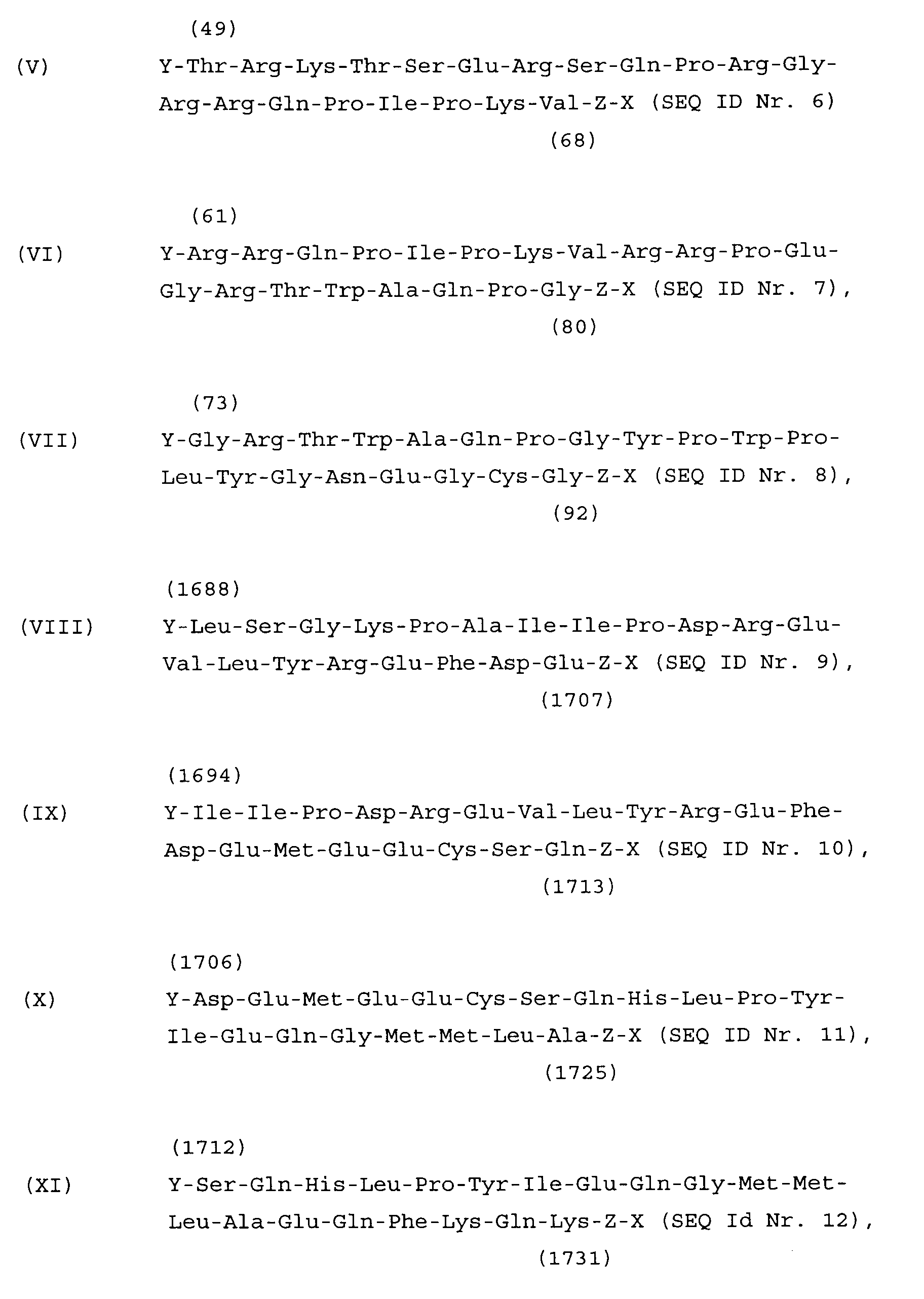 où Y est H ou un bras de liaison par lequel le peptide peut être fixé à un support ou à une phase solide comprenant au moins un acide aminé et jusqu'à 60 acides aminés, le plus fréquemment de 1 à 10 acides aminés, tel que la cystéine, la lysine, la tyrosine, l'acide glutamique ou l'acide aspartique, ou des groupes chimiques tels que la biotine ou l'acide thioglycolique, Y pouvant être modifié par exemple par acétylation N-terminale ; Z est une liaison ou un bras de liaison par lequel le peptide peut être fixé au support ou à la phase solide comprenant au moins un acide aminé et jusqu'à 60 acides aminés, le plus fréquemment de 1 à 10 acides aminés, tel que la cystéine, la lysine, la tyrosine, l'acide glutamique ou l'acide aspartique, ou des groupes chimiques tels que la biotine ou l'acide thioglycolique;
et X est NH2, OH ou une liaison impliquant l'un de ces deux groupes;
et sous réserve que lorsque Y ou Z-X représente(nt) un (des) acide(s) aminé(s), il(s) soi(en)t différent(s) de toutes les régions flanquantes d'HCV d'origine naturelle,
ou,(b) les variants de chacun des peptides ci-dessus (I) à (XIV), lesdits variants présentant des substitutions conservatrices ainsi que non conservatrices correspondant à moins de 35% de variations d'une souche à l'autre dans les séquences HCV, vis-à-vis de chacune des séquences d'acides aminés (I) à (XIV) sous réserve que lesdits variants peptidiques soient aptes à entrer en compétition immunologique avec au moins une souche d'HCV ;
ou,(c) les fragments des peptides (I) à (XIV) ayant au moins 6 acides aminés issus de l'une quelconque des séquences peptidiques 1-20, 7-26, 8-18, 13-32, 37-56, 49-68, 61-80, 73-92, 1688-1707, 1694-1713, 1706-1725, 1712-1731, 1718-1737, 1724-1743 et 1730-1749, telles que définies ci-dessus, et lesdits fragments conservant sensiblement toute la réactivité des séquences peptidiques dont ils dérivent, sous réserve que les combinaisons contenant au moins un peptide choisi parmi le groupe de séquences d'acides aminés consistant en I, II, IIA, III, IV, V, VI, VII et au moins un peptide choisi parmi le groupe de séquences d'acides aminés consistant en VIII, IX, X, XI, XII, XIII, XIV, XV, XVI, XVII, XVIII, XIX soient exclues. - Composition peptidique selon l'une quelconque des revendications 1 ou 2, caractérisée en outre en ce qu'elle contient au moins l'un des mélanges suivants de peptides tels que définis dans l'une quelconque des revendications 1 ou 2 :
F.VIII (SEQ ID Nr. 9), IX (SEQ ID Nr. 10), XI (SEQ ID Nr. 12), XIII (SEQ ID Nr. 14) et XIX (SEQ ID Nr. 15),
G.XV (SEQ ID Nr. 16), XVI (SEQ ID Nr. 17), XVII (SEQ ID Nr. 18), XVIII (SEQ ID Nr. 19) et XIX (SEQ ID Nr. 20). - Composition peptidique selon l'une quelconque des revendications 1 à 3, caractérisée en outre en ce que lesdits peptides sont couplés de manière N-terminale, C-terminale, ou interne, à une molécule support en vue de produire des anticorps ou de faciliter l'adsorption desdits peptides sur une phase solide.
- Composition peptidique selon l'une quelconque des revendications 1 à 4, caractérisée en outre en ce que lesdits peptides contiennent un marqueur détectable.
- Utilisation d'une composition peptidique selon l'une quelconque des revendications 1 à 5, en vue de l'incorporation dans un immunoessai destin, à détecter la présence d'anticorps anti-virus de l'hépatite C présents dans un fluide corporel.
- Méthode de détection in vitro d'anticorps anti-virus de l'hépatite C présents dans un fluide corporel tel que le sérum ou le plasma, comprenant au moins les étapes consistant à(a) mettre en contact le fluide corporel d'une personne devant être
analysée avec une composition peptidique selon l'une quelconque des
revendications 1 à 5, et(b) détecter le complexe immunologique formé entre lesdits anticorps et le(s) peptide(s) utilisé(s). - Trousse de diagnostic d'anticorps anti-virus de l'hépatite C dans un fluide corporel, comprenant au moins les composés suivants:- une composition peptidique selon l'une quelconque des revendications 1 à 5,- des moyens de détection d'un complexe immunologique formé entre lesdits peptides et lesdits anticorps.
- Méthode selon la revendication 7, caractérisée en outre en ce que lesdits peptides sont appliqués en lignes sur une membrane de nylon, la membrane de nylon étant de préférence coupée en bandes perpendiculaires à la direction des lignes de peptides, permettant ainsi d' incuber chaque bande avec un échantillon de sérum d'un individu dilué de manière appropriée.
- Trousse selon la revendication 8, caractérisé en outre en ce que lesdits peptides sont appliqués en lignes sur une membrane de nylon, la membrane de nylon étant de préférence coupée en bandes perpendiculaires à la direction des lignes de peptides, permettant ainsi d'incuber chaque bande avec un échantillon de sérum d'un individu dilué de manière appropriée.
- Trousse selon l'une quelconque des revendications 8 à 10,
caractérisé en outre en ce que lesdits peptides sont utilisés, séparément ou en association, pour revêtir les puits des plaques de microtitration. - Utilisation d'une composition peptidique selon l'une quelconque des revendications 1 à 5, pour l'incorporer dans une composition de vaccin contre HCV.
- Composition peptidique selon l'une quelconque des revendications 1 à 5, pour produire des anticorps anti-HCV.
- Composition peptidique selon l'une quelconque des revendications 1 à 5, dans laquelle lesdits peptides sont tels qu'obtenus en cyclisant l'un quelconque des peptides des revendications 1 à 2, ou en couplant ensemble deux peptides des revendications 1 à 2.
- Composition peptidique selon l'une quelconque des revendications 1 à 5, dans laquelle lesdits peptides sont tels qu'obtenus par synthèse de peptides des revendications 1 ou 2 directement sur un noyau d'oligo-lysine dans lequel les groupes alpha-amino ainsi qu'epsilon-amino des lysines sont utilisés comme point de croissance pour les peptides.
- Procédé de préparation d'une composition peptidique comprenant au moins un peptide contenant moins de 50 acides aminés, ledit peptide étant choisi parmi(a) le groupe de peptides comprenant la séquence d'acides aminés constituée par :
 où Y est H ou un bras de liaison ("linker") par lequel le peptide peut être fixé à un support ou à une phase solide comprenant au moins un acide aminé et jusqu'à 60 acides aminés, le plus fréquemment de 1 à 10 acides aminés, tel que la cystéine, la lysine, la tyrosine, l'acide glutamique ou l'acide aspartique, ou des groupes chimiques tels que la biotine ou l'acide thioglycolique, Y pouvant être modifié par exemple par acétylation N-terminale ; Z est une liaison ou un bras de liaison par lequel le peptide peut être fixé au support ou à la phase solide comprenant au moins un acide aminé et jusqu'à 60 acides aminés, le plus fréquemment de à 10 acides aminés, tel que la cystéine, la lysine, la tyrosine, l'acide glutamique ou l'acide aspartique, ou des groupes chimiques tels que la biotine ou l'acide thioglycolique :
et X est NH2, OH ou une liaison impliquant l'un de ces deux groupes;
et sous réserve que lorsque Y ou Z-X représente(nt) un (des) acide(s) aminé(s), il(s) soi(en)t différent(s) de toutes les régions flanquantes d'HCV d'origine naturelle,
ou,(b) les variants de chacun des peptides ci-dessus (XV) à (XIX), lesdits variants présentant des substitutions conservatrices ainsi que non conservatrices correspondant à moins de 35% de variations d'une souche à l'autre dans les séquences HCV vis-à-vis de chacune des séquences d'acides aminés (XV) à (XIX) sous réserve que lesdits variants peptidiques soient aptes à entrer en compétition immunologique avec au moins une souche d'HCV ;
ou,(c) les fragments des peptides (XV) à (XIX) ayant au moins 6 acides aminés issus de l'une quelconque des séquences peptidiques 2263-2282, 2275-2294, 2287-2306, 2299-2318 et 2311-2330 telles que définies ci-dessus ; et lesdits fragments conservant sensiblement toute la réactivité desdites séquences peptidiques dont ils dérivent,
et sous réserve que lesdits peptides soient différents des peptides de la liste suivante :
Glu-Arg-Glu-Ile-Ser-Val-Pro-Ala-Glu-Ile-Leu-Arg-Lys-Ser-Arg-Arg
Arg-Phe-Ala-Gln-Ala-Leu-Pro-Val-Trp-Ala-Arg,
ledits peptides étant synthétisés en solution ou sur un support solide à l'aide d'acides aminés activés protégés par t-butoxycarbonyle ou 9-fluorénylméthoxycarbonyle comme décrit dans, par exemple, Stewart and Young, Solide Phase Peptide Synthesis, 2ème édition, Pierce Chemical Company, 1984; et Atherton et Sheppard, Solid Phase Peptide Synthesis, IRL Press, 1989 et lesdits peptides étant mélangés dans le cas où différents peptides sont compris dans ladite composition. - Procédé selon la revendication 16, pour préparer une composition peptidique comprenant au moins un peptide selon la revendication 16 et au moins un peptide choisi dans :(a) le groupe de séquences d'acides aminés constitué par:

 où Y est H ou un bras de liaison par lequel le peptide peut être fixé à un support ou à une phase solide comprenant au moins un acide aminé et jusqu'à 60 acides aminés, le plus fréquemment de 1 à 10 acides aminés, tel que la cystéine, la lysine, la tyrosine, l'acide glutamique ou l'acide aspartique, ou des groupes chimiques tels que la biotine ou l'acide thioglycolique, Y pouvant être modifié par exemple par acétylation N-terminale ; Z est une liaison ou un bras de liaison par lequel le peptide peut être fixé au support ou à la phase solide comprenant au moins un acide aminé et jusqu'à 60 acides aminés, le plus fréquemment de 1 à 10 acides aminés, tel que la cystéine, la lysine, la tyrosine, l'acide glutamique ou l'acide aspartique, ou des groupes chimiques tels que la biotine ou l'acide thioglycolique;
et X est NH2, OH ou une liaison impliquant l'un de ces deux groupes;
et sous réserve que lorsque Y ou Z-X représente(nt) un (des) acide(s) aminé(s), il(s) soi(en)t différent(s) de toutes les régions flanquantes d'HCV d'origine naturelle,
ou,(b) les variants de chacun des peptides ci-dessus (I) à (XIV), lesdits variants présentant des substitutions conservatrices ainsi que non conservatrices correspondant à moins de 35% de variations d'une souche à l'autre dans les séquences HCV, vis-à-vis de chacune des séquences d'acides aminés (I) à (XIV) sous réserve que lesdits variants peptidiques soient aptes à entrer en compétition immunologique avec au moins une souche d'HCV ;
ou,(c) les fragments des peptides (I) à (XIV) ayant au moins 6 acides aminés issus de l'une quelconque des séquences peptidiques 1-20, 7-26, 8-18, 13-32, 37-56, 49-68, 61-80, 73-92, 1688-1707, 1694-1713, 1706-1725, 1712-1731, 1718-1737, 1724-1743 et 1730-1749, telles que définies ci-dessus, et lesdits fragments conservant sensiblement toute la réactivité des séquences peptidiques dont ils dérivent,
sous réserve que les combinaisons contenant au moins un peptide choisi parmi le groupe de séquences d'acides aminés consistant en I, II, IIA, III, IV, V, VI, VII et au moins un peptide choisi parmi le groupe de séquences d'acides aminés consistant en VIII, IX, X, XI, XII, XIII, XIV, XV, XVI, XVII, XVIII, XIX soient exclues. - Procédé selon l'une quelconque des revendications 16 ou 17 pour préparer au moins l'un des mélanges suivants de peptides tels que définis dans la revendication 16 ou 17 :
F.VIII (SEQ ID Nr. 9), IX (SEQ ID Nr. 10), XI (SEQ ID Nr. 12), XIII (SEQ ID Nr. 14) et XIX (SEQ ID Nr. 15),
G.XV (SEQ ID Nr. 16), XVI (SEQ ID Nr. 17), XVII (SEQ ID Nr. 18), XVIII (SEQ ID Nr. 19) et XIX (SEQ ID Nr. 20). - Procédé selon l'une quelconque des revendications 16 à 18, caractérisé en outre en ce que lesdits peptides sont couplés de manière N-terminale, C-terminale ou interne à une molécule support en vue de produire des anticorps ou de faciliter l'adsorption desdits peptides sur la phase solide, l'étape de couplage étant réalisée comme décrit dans, par exemple, Van Regenmortel et al., 1988, Laboratory techniques in biochemistry and molecular biology, vol. 19, Synthetic polypeptides as Antigens, Elsevier Press, Amsterdam, New York, Oxford.
- Procédé selon l'une quelconque des revendications 16 à 19, caractérisé en ce que lesdits peptides contiennent un marqueur détectable ajout, audit peptide.
- Procédé de préparation d'une trousse de diagnostic d'anticorps anti-virus de l'hépatite C dans un fluide corporel, comprenant l'association d'au moins les composés suivants :- une composition peptidique selon l'une quelconque des revendications 1 à 5,- des moyens de détecter un complexe immunologique formé entre lesdits peptides et lesdits anticorps.
- Procédé de préparation d'une trousse selon la revendication 21, caractérisé en outre en ce que lesdits peptides sont appliqués en lignes sur une membrane de nylon, la membrane de nylon étant de préférence coupée en bandes perpendiculaires à la direction des lignes de peptides, permettant ainsi d'incuber chaque bande avec un échantillon de sérum d'un individu dilué de manière appropriée.
- Procédé de préparation d'une trousse selon la revendication 21 ou 22, caractérisé en outre en ce que lesdits peptides sont utilisés séparément ou associés les uns aux autres, pour revêtir les puits de plaques de microtitration.
- Procédé de préparation d'une composition peptidique selon l'une quelconque des revendications 16 à 20, en vue de l'incorporer dans une composition de vaccin anti-HCV.
- Procédé de préparation d'une composition peptidique selon l'une quelconque des revendications 16 à 20 pour produire des anticorps anti-HCV.
- Procédé de préparation d'une composition peptidique selon l'une quelconque des revendications 16 à 20, dans lequel lesdits peptides sont tels qu'obtenus par cyclisation de l'un quelconque des peptides des revendications 1 à 2, ou par couplage de deux peptides des revendications 1 à 2.
- Procédé de préparation d'une composition peptidique selon l'une quelconque des revendications 16 à 20, dans lequel lesdits peptides sont tels qu'obtenus par synthèse de peptides des revendications 1 ou 2 directement sur un noyau d'oligolysine dans lequel les deux groupes alpha-amino ainsi qu'epsilon-amino des lysines sont utilisés comme points de croissance pour les peptides.
Priority Applications (5)
| Application Number | Priority Date | Filing Date | Title |
|---|---|---|---|
| SG1996005024A SG47062A1 (en) | 1990-12-14 | 1990-12-14 | Synthetic antigens for the detection of antibodies to hepatitis virus |
| EP94108611A EP0644202B1 (fr) | 1990-12-14 | 1990-12-14 | Antigènes synthétiques pour la détection des anticorps contre le virus de l'hépatite C |
| SG9604879-8A SG145521A1 (en) | 1990-12-14 | 1994-06-06 | Synthetic antigens for the detection of antibodies to hepatitis c virus |
| HK57497A HK57497A (en) | 1990-12-14 | 1997-05-01 | Synthetic antigens for the detection of antibodies to hepatitis C virus |
| CY9802053A CY2053B1 (en) | 1990-12-14 | 1998-04-30 | Synthetic antigens for the detection of antibodies to hepatitis c virus |
Applications Claiming Priority (3)
| Application Number | Priority Date | Filing Date | Title |
|---|---|---|---|
| SG1996005024A SG47062A1 (en) | 1990-12-14 | 1990-12-14 | Synthetic antigens for the detection of antibodies to hepatitis virus |
| EP90124241A EP0489968B1 (fr) | 1990-12-14 | 1990-12-14 | Antigènes synthétiques pour la détection des anticorps contre le virus de l'hépatite C |
| EP94108611A EP0644202B1 (fr) | 1990-12-14 | 1990-12-14 | Antigènes synthétiques pour la détection des anticorps contre le virus de l'hépatite C |
Related Parent Applications (1)
| Application Number | Title | Priority Date | Filing Date |
|---|---|---|---|
| EP90124241.2 Division | 1990-12-14 |
Publications (2)
| Publication Number | Publication Date |
|---|---|
| EP0644202A1 EP0644202A1 (fr) | 1995-03-22 |
| EP0644202B1 true EP0644202B1 (fr) | 1997-03-05 |
Family
ID=26125651
Family Applications (3)
| Application Number | Title | Priority Date | Filing Date |
|---|---|---|---|
| EP90124241A Revoked EP0489968B1 (fr) | 1990-12-14 | 1990-12-14 | Antigènes synthétiques pour la détection des anticorps contre le virus de l'hépatite C |
| EP96201157A Expired - Lifetime EP0754704B1 (fr) | 1990-12-14 | 1990-12-14 | Antigènes synthétiques pour la détection des anticorps contre le virus l'hépatite C |
| EP94108611A Revoked EP0644202B1 (fr) | 1990-12-14 | 1990-12-14 | Antigènes synthétiques pour la détection des anticorps contre le virus de l'hépatite C |
Family Applications Before (2)
| Application Number | Title | Priority Date | Filing Date |
|---|---|---|---|
| EP90124241A Revoked EP0489968B1 (fr) | 1990-12-14 | 1990-12-14 | Antigènes synthétiques pour la détection des anticorps contre le virus de l'hépatite C |
| EP96201157A Expired - Lifetime EP0754704B1 (fr) | 1990-12-14 | 1990-12-14 | Antigènes synthétiques pour la détection des anticorps contre le virus l'hépatite C |
Country Status (18)
| Country | Link |
|---|---|
| US (1) | US5922532A (fr) |
| EP (3) | EP0489968B1 (fr) |
| JP (1) | JP2995216B2 (fr) |
| KR (3) | KR0181343B1 (fr) |
| AT (3) | ATE144993T1 (fr) |
| AU (1) | AU652013B2 (fr) |
| BR (1) | BR9106220A (fr) |
| CY (2) | CY2043A (fr) |
| DE (2) | DE69030124T2 (fr) |
| DK (3) | DK0644202T3 (fr) |
| ES (3) | ES2095852T3 (fr) |
| GR (3) | GR3022089T3 (fr) |
| HK (1) | HK57597A (fr) |
| HU (1) | HU218357B (fr) |
| IL (1) | IL100158A (fr) |
| NZ (1) | NZ240964A (fr) |
| SG (1) | SG47062A1 (fr) |
| WO (1) | WO1992010514A2 (fr) |
Families Citing this family (31)
| Publication number | Priority date | Publication date | Assignee | Title |
|---|---|---|---|---|
| US5683864A (en) * | 1987-11-18 | 1997-11-04 | Chiron Corporation | Combinations of hepatitis C virus (HCV) antigens for use in immunoassays for anti-HCV antibodies |
| US5350671A (en) * | 1987-11-18 | 1994-09-27 | Chiron Corporation | HCV immunoassays employing C domain antigens |
| US5712087A (en) * | 1990-04-04 | 1998-01-27 | Chiron Corporation | Immunoassays for anti-HCV antibodies employing combinations of hepatitis C virus (HCV) antigens |
| ES2161682T3 (es) * | 1990-11-03 | 2001-12-16 | Dade Behring Marburg Gmbh | Peptidos especificos a hcv, agentes adecuados para ellos y su utilizacion. |
| US5910404A (en) | 1990-12-14 | 1999-06-08 | Innogenetics N.V. | Synthetic antigens for the detection of antibodies to hepatitis C virus |
| AU1459792A (en) * | 1991-01-14 | 1992-08-27 | James N. Gamble Institute Of Medical Research | Basic structural immunogenic polypeptides having epitopes for hcv, antibodies, polynucleotide sequences, vaccines and methods |
| KR0185426B1 (ko) * | 1991-06-24 | 1999-04-01 | 로버트 피. 블랙버언 | 씨형 간염 바이러스 폴리펩티드 |
| DE4209215A1 (de) | 1991-07-04 | 1993-01-07 | Boehringer Mannheim Gmbh | Hcv peptidantigene und verfahren zur bestimmung von hcv |
| US5811246A (en) * | 1991-12-17 | 1998-09-22 | The Research Foundation Of State University Of New York | Process for immobilization onto the surfaces of ELISA plates of a compound carrier complex and for immunization |
| ZA928954B (en) * | 1991-12-24 | 1993-05-19 | Akzo Nv | Peptides immunochemically reactive with antibodies directed against hepatitis non-A, non-B virus. |
| KR100257941B1 (ko) * | 1992-03-06 | 2000-06-01 | 휴버스윗 에이치. 밴 | 면역학적으로 중요한 에피토프에 상응하는 펩티드의 측정 방법 및 면역학적으로 중요한 에피토프에 상응하는 항체 또는 비오티닐화된 펩티드의 측정 방법에 상기 펩티드를 사용하는 방법, 상기 펩티드의 제조 방법 및 상기 펩티드를 함유하는 조성물 |
| US6709828B1 (en) | 1992-03-06 | 2004-03-23 | N.V. Innogenetics S.A. | Process for the determination of peptides corresponding to immunologically important epitopes and their use in a process for determination of antibodies or biotinylated peptides corresponding to immunologically important epitopes, a process for preparing them and compositions containing them |
| US6667387B1 (en) | 1996-09-30 | 2003-12-23 | N.V. Innogenetics S.A. | HCV core peptides |
| EP1878797B1 (fr) * | 1992-07-16 | 2010-04-28 | Advanced Life Science Institute, Inc | Peptides antigéniques pour le groupage du virus de l'hépatite C, kit comprenant ceux-ci et procédé de groupage les utilisant |
| DE4240980A1 (de) * | 1992-08-07 | 1994-02-10 | Boehringer Mannheim Gmbh | HCV Peptidantigene und Verfahren zur Bestimmung von HCV |
| ATE551423T1 (de) | 1993-04-27 | 2012-04-15 | Innogenetics Nv | Sequenzen von hepatitis c virus-genotypen sowie ihre verwendungen als therapeutika und diagnostika |
| IT1270941B (it) * | 1993-05-12 | 1997-05-26 | Sorin Biomedica Spa | Peptidi di hcv e loro usi. |
| US7070790B1 (en) * | 1993-06-29 | 2006-07-04 | The United States Of America As Represented By The Department Of Health And Human Services | Nucleotide and deduced amino acid sequences of the envelope 1 and core genes of isolates of hepatitis C virus and the use of reagents derived from these sequences in diagnostic methods and vaccines |
| EP0829488A4 (fr) * | 1995-04-28 | 1999-04-07 | Srl Inc | Compose peptidique antigenique et methode de dosage immunologique |
| FR2775690B1 (fr) * | 1998-03-09 | 2001-12-14 | Bio Merieux | Anticorps monoclonal et utilisations pour detecter des antigenes de la proteine core de vhc |
| WO1999058561A1 (fr) * | 1998-05-14 | 1999-11-18 | Pasteur Merieux Serums & Vaccins | Mimotopes du virus de l'hepatite c |
| US7052830B1 (en) * | 1998-06-09 | 2006-05-30 | Branch Andrea D | Hepatitis C virus peptides and uses thereof |
| WO2002004484A2 (fr) * | 2000-07-07 | 2002-01-17 | Medmira Inc. | Composition d'antigene mosaique du virus de l'hepatite c (vhc) |
| AUPQ899400A0 (en) * | 2000-07-26 | 2000-08-17 | Csl Limited | A method of stabilisation and compositions for use therein |
| JP4975600B2 (ja) * | 2007-03-16 | 2012-07-11 | シスメックス株式会社 | Hcv抗体測定用試薬キット及びhcv抗体測定方法 |
| JP4975601B2 (ja) * | 2007-03-16 | 2012-07-11 | シスメックス株式会社 | Hcv抗体測定用試薬キット及びhcv抗体測定方法 |
| EP1978365B1 (fr) | 2007-03-16 | 2010-08-25 | Sysmex Corporation | Kit de réactif et procédé de mesure d'anti-corps HCV |
| ES2303496B1 (es) * | 2008-02-21 | 2009-07-07 | Fundacion Para El Estudio De Las Hepatitis Virales | Metodo analitico perfeccionado para la deteccion de hepatitis c oculta, aplicaciones del mismo y su correspondiente kit de diagnostico. |
| US20100104555A1 (en) * | 2008-10-24 | 2010-04-29 | The Scripps Research Institute | HCV neutralizing epitopes |
| FR2987836A1 (fr) * | 2012-03-09 | 2013-09-13 | Biomerieux Sa | Peptides d'interference et procede de detection de microorganismes |
| CN114858907B (zh) * | 2021-02-04 | 2025-02-18 | 北京毅新博创生物科技有限公司 | 用于诊断新冠病毒感染的质谱模型的构建方法 |
Family Cites Families (28)
| Publication number | Priority date | Publication date | Assignee | Title |
|---|---|---|---|---|
| US505611A (en) * | 1893-09-26 | Henry v | ||
| US594854A (en) * | 1897-12-07 | Territory | ||
| JP2702911B2 (ja) * | 1985-09-11 | 1998-01-26 | ユナイテツド・バイオメデイカル・インコ−ポレ−テツド | 合成ペプチド、並びにそれを用いたエイズおよびプリ・エイズの検出方法 |
| US4879212A (en) * | 1986-04-02 | 1989-11-07 | United Biomedical Inc. | Peptide composition and method for the detection of antibodies to HTLV-III |
| US4749259A (en) * | 1987-05-15 | 1988-06-07 | Hughes Aircraft Company | Liquid crystal image projection with multicolor prepolarizing system |
| BR8807310A (pt) * | 1987-11-18 | 1990-03-13 | Chiron Corp | Polinucleotidio,polinucleotidio recombinante,vetor recombinante,celula hospedeira,sistema de expressao recombinante,celula transformada,polipeptidio,hcv,preparacao de polipeptidio,polipeptidio de hcv,polipeptidio purificado,polipeptidio recombinante,polipeptidio de fusao,anticorpo monoclonal,preparacao purificada de anticorpos policlonais,particula,sonda de polinucleotidio,kit anticorpo para epetopo de hcv,metodo para producao de polipeptidio,metodo para deteccao de acidos nucleicos de hcv,imunoensaio para detectar antigeno de hcv,imunoensaio para detectar anticorpos dirigidos contra antigeno de hcv,vacina para tratamento de infeccao de hcv,celula,celula infectada com hcv,metodo para producao de anticorpos para hcv e metodo para isolar cdna derivado do genoma de um agente infeccioso nao identificado |
| US5350671A (en) * | 1987-11-18 | 1994-09-27 | Chiron Corporation | HCV immunoassays employing C domain antigens |
| HU225068B1 (en) * | 1989-03-17 | 2006-05-29 | Chiron Corp | Process for producing diagnostics and vaccine of nanbh |
| AU638304B2 (en) * | 1989-12-22 | 1993-06-24 | Abbott Laboratories | Hepatitis c assay |
| US5106726A (en) * | 1990-02-16 | 1992-04-21 | United Biomedical, Inc. | Synthetic peptides specific for the detection of antibodies to HCV |
| KR940000755B1 (ko) * | 1990-02-16 | 1994-01-29 | 유나이티드 바이오메디칼 인코오포레이티드 | Hcv에 대한 항체 검출, hcv 감염의 진단 및 백신으로서의 그 예방에 특히 적합한 합성 펩티드 |
| EP0445801A3 (en) * | 1990-03-08 | 1992-07-01 | Kuraray Co., Ltd. | Peptide and its use |
| ZA912040B (en) * | 1990-03-30 | 1991-12-24 | Akzo Nv | Peptides immunochemically reactive with antibodies directed against hepatitis non-a,non-b virus |
| WO1991015771A1 (fr) * | 1990-04-04 | 1991-10-17 | Chiron Corporation | Combinaisons d'antigenes du virus de l'hepatite c (vhc) utilisees dans des immunoanalyses visant a detecter la presence d'anticorps anti-vhc |
| ES2152922T3 (es) * | 1990-04-06 | 2001-02-16 | Genelabs Tech Inc | Epitopos del virus de la hepatitis c. |
| AU635124B2 (en) * | 1990-04-16 | 1993-03-11 | United Biomedical Inc. | Synthetic peptides specific for the detection of antibodies to HCV, diagnosis of HCV infection and prevention thereof as vaccines |
| WO1992001714A1 (fr) * | 1990-07-24 | 1992-02-06 | Yamanouchi Pharmaceutical Co., Ltd. | Antigene du virus de l'hepatite non a, non b |
| CA2047792C (fr) * | 1990-07-26 | 2002-07-02 | Chang Y. Wang | Peptides synthetiques specifiques pour la detection des anticorps diriges contre le vhc, diagnostic de l'infection a vhc et sa prevention grace a des vaccins |
| JP3114731B2 (ja) * | 1990-08-14 | 2000-12-04 | 国立感染症研究所長 | C型肝炎ウイルス抗体検出用ペプチド抗原及びその使用方法 |
| EP1227323B2 (fr) * | 1990-08-25 | 2011-01-19 | Bioprocess Pty Ltd | Antigène du virus de l'hépatite non-A, non B et procédé diagnostique |
| JP2949822B2 (ja) * | 1990-10-03 | 1999-09-20 | 住友化学工業株式会社 | 熱可塑性樹脂組成物 |
| ES2161682T3 (es) * | 1990-11-03 | 2001-12-16 | Dade Behring Marburg Gmbh | Peptidos especificos a hcv, agentes adecuados para ellos y su utilizacion. |
| CA2055149A1 (fr) * | 1990-11-08 | 1992-05-09 | Hiroaki Okamoto | Antigene, anticorps, systemes de detection, polynucleotides et polypeptides lies au virus de l'hepatite non a, non b |
| WO1992009634A1 (fr) * | 1990-11-29 | 1992-06-11 | Toray Industries, Incorporated | Proteine anti-genique du virus de l'hepatite non a et non b |
| ATE112782T1 (de) * | 1991-03-01 | 1994-10-15 | Akzo Nobel Nv | Mit antikörper gegen hepatitis non-a, non-b-virus immunochemische reaktive peptide. |
| EP0525910A1 (fr) * | 1991-08-02 | 1993-02-03 | Akzo Nobel N.V. | Peptide non-A, non-B |
| ZA927243B (en) * | 1991-10-07 | 1994-01-26 | Akzo Nv | Non-A, Non-B peptides |
| KR100257941B1 (ko) * | 1992-03-06 | 2000-06-01 | 휴버스윗 에이치. 밴 | 면역학적으로 중요한 에피토프에 상응하는 펩티드의 측정 방법 및 면역학적으로 중요한 에피토프에 상응하는 항체 또는 비오티닐화된 펩티드의 측정 방법에 상기 펩티드를 사용하는 방법, 상기 펩티드의 제조 방법 및 상기 펩티드를 함유하는 조성물 |
-
1990
- 1990-12-14 AT AT90124241T patent/ATE144993T1/de not_active IP Right Cessation
- 1990-12-14 DE DE69030124T patent/DE69030124T2/de not_active Expired - Fee Related
- 1990-12-14 AT AT94108611T patent/ATE149522T1/de not_active IP Right Cessation
- 1990-12-14 AT AT96201157T patent/ATE185350T1/de not_active IP Right Cessation
- 1990-12-14 DK DK94108611.8T patent/DK0644202T3/da active
- 1990-12-14 EP EP90124241A patent/EP0489968B1/fr not_active Revoked
- 1990-12-14 ES ES90124241T patent/ES2095852T3/es not_active Expired - Lifetime
- 1990-12-14 DK DK96201157T patent/DK0754704T3/da active
- 1990-12-14 EP EP96201157A patent/EP0754704B1/fr not_active Expired - Lifetime
- 1990-12-14 ES ES96201157T patent/ES2138784T3/es not_active Expired - Lifetime
- 1990-12-14 ES ES94108611T patent/ES2101388T3/es not_active Expired - Lifetime
- 1990-12-14 EP EP94108611A patent/EP0644202B1/fr not_active Revoked
- 1990-12-14 SG SG1996005024A patent/SG47062A1/en unknown
- 1990-12-14 DE DE69029092T patent/DE69029092T2/de not_active Expired - Fee Related
- 1990-12-14 DK DK90124241.2T patent/DK0489968T3/da active
-
1991
- 1991-11-26 IL IL100158A patent/IL100158A/en not_active IP Right Cessation
- 1991-12-12 NZ NZ240964A patent/NZ240964A/en not_active IP Right Cessation
- 1991-12-13 KR KR1019920701932A patent/KR0181343B1/ko not_active Expired - Fee Related
- 1991-12-13 HU HU9202645A patent/HU218357B/hu not_active IP Right Cessation
- 1991-12-13 WO PCT/EP1991/002409 patent/WO1992010514A2/fr not_active Ceased
- 1991-12-13 KR KR1019970708500A patent/KR0181344B1/ko not_active Expired - Fee Related
- 1991-12-13 AU AU90689/91A patent/AU652013B2/en not_active Expired
- 1991-12-13 KR KR1019970708501A patent/KR0181345B1/ko not_active Expired - Fee Related
- 1991-12-13 BR BR919106220A patent/BR9106220A/pt not_active IP Right Cessation
- 1991-12-13 JP JP4500998A patent/JP2995216B2/ja not_active Expired - Lifetime
-
1995
- 1995-02-21 US US08/391,671 patent/US5922532A/en not_active Expired - Lifetime
-
1996
- 1996-12-18 GR GR960403535T patent/GR3022089T3/el unknown
-
1997
- 1997-05-01 HK HK57597A patent/HK57597A/en not_active IP Right Cessation
- 1997-06-04 GR GR970401308T patent/GR3023664T3/el unknown
-
1998
- 1998-02-20 CY CY204398A patent/CY2043A/xx unknown
- 1998-04-30 CY CY9802053A patent/CY2053B1/xx unknown
-
1999
- 1999-12-15 GR GR990403236T patent/GR3032150T3/el unknown
Also Published As
Similar Documents
| Publication | Publication Date | Title |
|---|---|---|
| EP0489968B1 (fr) | Antigènes synthétiques pour la détection des anticorps contre le virus de l'hépatite C | |
| KR930008092B1 (ko) | Hcv에 대한 항체의 검출, hcv 감염의 진단, 및 백신으로서의 그 예방에 특이적인 합성펩티드 | |
| EP0589004B1 (fr) | Procede de determination de peptides correspondant a des epitopes hcv importants d'un point de vue immunologique | |
| US20120270208A1 (en) | Synthetic antigens for the detection of antibodies to hepatitis c virus | |
| US6592871B1 (en) | HCV peptide antigens and methods for the determination of HCV | |
| US5229491A (en) | Peptides immunochemically reactive with antibodies directed against hepatitis non-a, non-b virus | |
| EP0642666B2 (fr) | Analyse de detection de l'hepatite c | |
| CA2103533A1 (fr) | Antigenes peptidiques du vhc et methode de depistage du vhc | |
| US20070014813A1 (en) | Conserved motif of hepatitis C virus E2/NS1 region | |
| CA2074370C (fr) | Antigenes synthetiques pour le depistage d'anticorps du virus de l'hepatite c | |
| HK57497A (en) | Synthetic antigens for the detection of antibodies to hepatitis C virus | |
| US5885771A (en) | Antigenic peptide compound and immunoassay | |
| JPH05320192A (ja) | 非a非b型肝炎ウイルスに対する抗体に免疫化学反応性を示すペプチド | |
| AU640569B2 (en) | Assay for non-a non-b hepatitis | |
| WO1993017111A1 (fr) | Peptides du virus de l'hepatite c | |
| DE69033316T2 (de) | Synthetische Antigene zum Nachweis von Antikörpern gegen Hepatitis C Virus | |
| JPH04221398A (ja) | 非a非b型肝炎ウイルスに対する抗体と免疫化学反応するペプチド |
Legal Events
| Date | Code | Title | Description |
|---|---|---|---|
| PUAI | Public reference made under article 153(3) epc to a published international application that has entered the european phase |
Free format text: ORIGINAL CODE: 0009012 |
|
| AC | Divisional application: reference to earlier application |
Ref document number: 489968 Country of ref document: EP |
|
| AK | Designated contracting states |
Kind code of ref document: A1 Designated state(s): AT BE CH DE DK ES FR GB GR IT LI LU NL SE |
|
| 17P | Request for examination filed |
Effective date: 19950425 |
|
| 17Q | First examination report despatched |
Effective date: 19950608 |
|
| GRAG | Despatch of communication of intention to grant |
Free format text: ORIGINAL CODE: EPIDOS AGRA |
|
| GRAH | Despatch of communication of intention to grant a patent |
Free format text: ORIGINAL CODE: EPIDOS IGRA |
|
| GRAH | Despatch of communication of intention to grant a patent |
Free format text: ORIGINAL CODE: EPIDOS IGRA |
|
| GRAA | (expected) grant |
Free format text: ORIGINAL CODE: 0009210 |
|
| AC | Divisional application: reference to earlier application |
Ref document number: 489968 Country of ref document: EP |
|
| AK | Designated contracting states |
Kind code of ref document: B1 Designated state(s): AT BE CH DE DK ES FR GB GR IT LI LU NL SE |
|
| REF | Corresponds to: |
Ref document number: 149522 Country of ref document: AT Date of ref document: 19970315 Kind code of ref document: T |
|
| REG | Reference to a national code |
Ref country code: CH Ref legal event code: EP |
|
| ITF | It: translation for a ep patent filed | ||
| REF | Corresponds to: |
Ref document number: 69030124 Country of ref document: DE Date of ref document: 19970410 |
|
| REG | Reference to a national code |
Ref country code: CH Ref legal event code: NV Representative=s name: ABREMA AGENCE BREVETS & MARQUES GANGUILLET & HUMPH |
|
| ET | Fr: translation filed | ||
| REG | Reference to a national code |
Ref country code: ES Ref legal event code: FG2A Ref document number: 2101388 Country of ref document: ES Kind code of ref document: T3 |
|
| REG | Reference to a national code |
Ref country code: CH Ref legal event code: NV Representative=s name: ABREMA AGENCE BREVETS ET MARQUES GANGUILLET & HUMP |
|
| REG | Reference to a national code |
Ref country code: GR Ref legal event code: FG4A Free format text: 3023664 |
|
| REG | Reference to a national code |
Ref country code: DK Ref legal event code: T3 |
|
| PLBQ | Unpublished change to opponent data |
Free format text: ORIGINAL CODE: EPIDOS OPPO |
|
| PLBI | Opposition filed |
Free format text: ORIGINAL CODE: 0009260 |
|
| PLBF | Reply of patent proprietor to notice(s) of opposition |
Free format text: ORIGINAL CODE: EPIDOS OBSO |
|
| 26 | Opposition filed |
Opponent name: CHIRON CORPORATION Effective date: 19971204 |
|
| NLR1 | Nl: opposition has been filed with the epo |
Opponent name: CHIRON CORPORATION |
|
| PLBF | Reply of patent proprietor to notice(s) of opposition |
Free format text: ORIGINAL CODE: EPIDOS OBSO |
|
| PLBF | Reply of patent proprietor to notice(s) of opposition |
Free format text: ORIGINAL CODE: EPIDOS OBSO |
|
| APAC | Appeal dossier modified |
Free format text: ORIGINAL CODE: EPIDOS NOAPO |
|
| REG | Reference to a national code |
Ref country code: GB Ref legal event code: IF02 |
|
| PLAW | Interlocutory decision in opposition |
Free format text: ORIGINAL CODE: EPIDOS IDOP |
|
| APAE | Appeal reference modified |
Free format text: ORIGINAL CODE: EPIDOS REFNO |
|
| APAC | Appeal dossier modified |
Free format text: ORIGINAL CODE: EPIDOS NOAPO |
|
| APAC | Appeal dossier modified |
Free format text: ORIGINAL CODE: EPIDOS NOAPO |
|
| PLBQ | Unpublished change to opponent data |
Free format text: ORIGINAL CODE: EPIDOS OPPO |
|
| PLAB | Opposition data, opponent's data or that of the opponent's representative modified |
Free format text: ORIGINAL CODE: 0009299OPPO |
|
| R26 | Opposition filed (corrected) |
Opponent name: CHIRON CORPORATION Effective date: 19971204 |
|
| NLR1 | Nl: opposition has been filed with the epo |
Opponent name: CHIRON CORPORATION |
|
| PLBQ | Unpublished change to opponent data |
Free format text: ORIGINAL CODE: EPIDOS OPPO |
|
| PLAB | Opposition data, opponent's data or that of the opponent's representative modified |
Free format text: ORIGINAL CODE: 0009299OPPO |
|
| PGFP | Annual fee paid to national office [announced via postgrant information from national office to epo] |
Ref country code: GB Payment date: 20041206 Year of fee payment: 15 |
|
| PGFP | Annual fee paid to national office [announced via postgrant information from national office to epo] |
Ref country code: SE Payment date: 20041209 Year of fee payment: 15 |
|
| PGFP | Annual fee paid to national office [announced via postgrant information from national office to epo] |
Ref country code: CH Payment date: 20041210 Year of fee payment: 15 Ref country code: NL Payment date: 20041210 Year of fee payment: 15 Ref country code: LU Payment date: 20041210 Year of fee payment: 15 Ref country code: DK Payment date: 20041210 Year of fee payment: 15 |
|
| PGFP | Annual fee paid to national office [announced via postgrant information from national office to epo] |
Ref country code: FR Payment date: 20041213 Year of fee payment: 15 Ref country code: DE Payment date: 20041213 Year of fee payment: 15 Ref country code: AT Payment date: 20041213 Year of fee payment: 15 |
|
| PGFP | Annual fee paid to national office [announced via postgrant information from national office to epo] |
Ref country code: ES Payment date: 20041215 Year of fee payment: 15 |
|
| PGFP | Annual fee paid to national office [announced via postgrant information from national office to epo] |
Ref country code: GR Payment date: 20041223 Year of fee payment: 15 |
|
| R26 | Opposition filed (corrected) |
Opponent name: CHIRON CORPORATION Effective date: 19971204 |
|
| PGFP | Annual fee paid to national office [announced via postgrant information from national office to epo] |
Ref country code: BE Payment date: 20050118 Year of fee payment: 15 |
|
| APBU | Appeal procedure closed |
Free format text: ORIGINAL CODE: EPIDOSNNOA9O |
|
| NLR1 | Nl: opposition has been filed with the epo |
Opponent name: CHIRON CORPORATION |
|
| RAP2 | Party data changed (patent owner data changed or rights of a patent transferred) |
Owner name: INNOGENETICS N.V. |
|
| NLT2 | Nl: modifications (of names), taken from the european patent patent bulletin |
Owner name: INNOGENETICS N.V. |
|
| APAH | Appeal reference modified |
Free format text: ORIGINAL CODE: EPIDOSCREFNO |
|
| RDAF | Communication despatched that patent is revoked |
Free format text: ORIGINAL CODE: EPIDOSNREV1 |
|
| RDAG | Patent revoked |
Free format text: ORIGINAL CODE: 0009271 |
|
| STAA | Information on the status of an ep patent application or granted ep patent |
Free format text: STATUS: PATENT REVOKED |
|
| 27W | Patent revoked |
Effective date: 20050216 |
|
| GBPR | Gb: patent revoked under art. 102 of the ep convention designating the uk as contracting state |
Free format text: 20050216 |
|
| REG | Reference to a national code |
Ref country code: CH Ref legal event code: PL |
|
| NLR2 | Nl: decision of opposition |
Effective date: 20050216 |
|
| REG | Reference to a national code |
Ref country code: SE Ref legal event code: ECNC |
|
| PLAB | Opposition data, opponent's data or that of the opponent's representative modified |
Free format text: ORIGINAL CODE: 0009299OPPO |
|
| R26 | Opposition filed (corrected) |
Opponent name: CHIRON CORPORATION Effective date: 19971204 |
|
| PLAB | Opposition data, opponent's data or that of the opponent's representative modified |
Free format text: ORIGINAL CODE: 0009299OPPO |