EP0644237A1 - Polypropylen-Formmasse mit durch Polyvinylbutysal verbesserten Oberflächeneigenschaften - Google Patents
Polypropylen-Formmasse mit durch Polyvinylbutysal verbesserten Oberflächeneigenschaften Download PDFInfo
- Publication number
- EP0644237A1 EP0644237A1 EP94113882A EP94113882A EP0644237A1 EP 0644237 A1 EP0644237 A1 EP 0644237A1 EP 94113882 A EP94113882 A EP 94113882A EP 94113882 A EP94113882 A EP 94113882A EP 0644237 A1 EP0644237 A1 EP 0644237A1
- Authority
- EP
- European Patent Office
- Prior art keywords
- weight
- molding composition
- propylene
- units
- composition according
- Prior art date
- Legal status (The legal status is an assumption and is not a legal conclusion. Google has not performed a legal analysis and makes no representation as to the accuracy of the status listed.)
- Withdrawn
Links
Classifications
-
- C—CHEMISTRY; METALLURGY
- C08—ORGANIC MACROMOLECULAR COMPOUNDS; THEIR PREPARATION OR CHEMICAL WORKING-UP; COMPOSITIONS BASED THEREON
- C08L—COMPOSITIONS OF MACROMOLECULAR COMPOUNDS
- C08L23/00—Compositions of homopolymers or copolymers of unsaturated aliphatic hydrocarbons having only one carbon-to-carbon double bond; Compositions of derivatives of such polymers
- C08L23/02—Compositions of homopolymers or copolymers of unsaturated aliphatic hydrocarbons having only one carbon-to-carbon double bond; Compositions of derivatives of such polymers not modified by chemical after-treatment
- C08L23/10—Homopolymers or copolymers of propene
-
- C—CHEMISTRY; METALLURGY
- C08—ORGANIC MACROMOLECULAR COMPOUNDS; THEIR PREPARATION OR CHEMICAL WORKING-UP; COMPOSITIONS BASED THEREON
- C08L—COMPOSITIONS OF MACROMOLECULAR COMPOUNDS
- C08L29/00—Compositions of homopolymers or copolymers of compounds having one or more unsaturated aliphatic radicals, each having only one carbon-to-carbon double bond, and at least one being terminated by an alcohol, ether, aldehydo, ketonic, acetal or ketal radical; Compositions of hydrolysed polymers of esters of unsaturated alcohols with saturated carboxylic acids; Compositions of derivatives of such polymers
- C08L29/14—Homopolymers or copolymers of acetals or ketals obtained by polymerisation of unsaturated acetals or ketals or by after-treatment of polymers of unsaturated alcohols
Definitions
- the invention relates to a polypropylene molding composition of high hardness with improved paintability, printability, writability, laminatability and / or high impact strength even at low temperature, consisting of an isotactic polymer of propylene or a mixture thereof with a suitable ethylene-propylene rubber optionally contains polyethylene, and polyvinyl butyral.
- Impact-resistant polypropylene molding compounds are known in principle. They are made by melt blending polypropylene and a rubber, such as ethylene propylene rubber (EPM) or ethylene propylene diene rubber (EPDM).
- EPM ethylene propylene rubber
- EPDM ethylene propylene diene rubber
- polypropylene copolymer is used as the polypropylene component which, in addition to APP, polypropylene chains and polymer chains of the comonomer with the structure described above, also contains propylene copolymer chains which have different copolymer contents and also different chain lengths.
- reactor blends consist of APP, polypropylene and polymers of the comonomer of different chain lengths as well as propylene-comonomer chains of different chain lengths and comonomer units. They are produced in one or more reaction steps directly in the polymerization reactor.
- the object was therefore to find a molding composition which does not have the known disadvantageous properties.
- thermoplastic forming which contain polypropylene or ethylene-propylene copolymers and polyvinyl butyral, have a higher surface tension of the molded component than a polypropylene molding composition without PVB and therefore do not require any further pretreatment of the surface paint, print, label and laminate properly.
- the invention thus relates to a polypropylene molding composition containing 1 to 99% by weight, based on the molding composition, of an isotactic propylene polymer, 0 to 60% by weight, based on the molding composition, of a rubber with a glass transition temperature below ⁇ 20 ° C. , 0.01 to 99 wt .-%, based on the molding compound, of a polyvinyl butyral and 0 to 10% by weight, based on the molding composition, of a phase mediator.
- the polypropylene to be used to produce the polypropylene molding composition according to the invention is either a homopolymer with a melt index MFI 230/5 of 1 to 40 g / 10 min or a copolymer with a melt index of 5 to 100 g / 10 min.
- Ethylene and 1-butene, 4-methyl-1-pentene, 1-hexene, 1-pentene and norbornene are preferred. Ethylene is particularly preferred.
- the comonomer is built in with high regularity.
- the propylene copolymer consists of 20 to 90% by weight, preferably 40 to 90% by weight, of units of propylene and 80 to 10% by weight, preferably 60 to 10 % By weight of units of ethylene and / or at least one 1-olefin as defined above.
- the comonomer is preferably incorporated statistically.
- the proportion of the propylene homopolymer in the total polypropylene molding composition in this case is 1 to 99% by weight, preferably 10% by weight, the proportion of propylene copolymers is 80 to 1% by weight, preferably 60 to 5% by weight .
- the propylene polymer to be used according to the invention is particularly preferably composed of 40 to 95% by weight of polypropylene (based on the total amount of propylene polymer) with an isotaxic index of at least 85% and 60 to 5% by weight of propylene units and 60 to 10% by weight of ethylene units (in each case based on the total amount of propylene copolymer).
- the isotactic propylene copolymer is contained in the molding composition according to the invention in an amount of 20 to 99% by weight, preferably 40 to 95% by weight.
- 0 to 60, preferably 15 to 45% by weight of the molding composition according to the invention is a rubber with a glass transition temperature below -20 ° C.
- Suitable rubbers are, for example, styrene-butadiene rubbers, silicone rubbers, ethylene-propylene rubbers (EPM) or ethylene-propylene-diene rubbers (EPDM).
- EPM and EPDM rubbers can additionally contain up to 40% polyethylene.
- As a diene component 1,4-hexadiene, norbornadiene or cyclopentadiene can be contained in an amount of up to 10% by weight, based on the total amount of rubber.
- the content of ethylene and propylene is not limited as long as a glass transition temperature of the amorphous component of less than -20 ° C is reached.
- a typical composition for commercially available EPM rubbers is, for example, 10 to 60% by weight of propylene units and 90 to 40% by weight of ethylene units. 0 to 40% by weight of the ethylene units are accounted for by a pure polyethylene component, the rest together with the propylene form the copolymer component.
- EPDM rubbers are composed accordingly, but in addition to propylene and ethylene, 1 to 10% by weight of a diene of the type mentioned above is additionally incorporated in the copolymer fraction.
- the melt viscosity of typical EPM and EPDM rubbers is in the range from 0.5 to 300 g / 10 min (MFI 230/5).
- the Mooney viscosity (measured at 121 ° C, ML) is 20 to 80.
- Rubbers which can be used advantageously are, for example, on the market under the trade names Vistalon, Exxelor (Exxon Chemicals), Dutral (Dutral S.A.), Nordel (Du Pont) or Buna (Veba).
- the molding composition according to the invention is a polyvinyl butyral of the formula I. where the weight ratio of the unitspar x : rigid y : rigid z is in the range from 40 to 90%: 5 to 50%: ⁇ 10%.
- polyvinyl butyral with weight ratios of 60 to 85% flexible x : 10 to 40%
- polyvinyl butyral has a viscosity, measured according to Höppler (DIN 53015), of up to 500 mPa.s, in particular polyvinyl butyral, whose viscosity range is 10 to 200 mPa.s, is preferred.
- phase mediators are, for example, polypropylenes grafted with maleic anhydride.
- Phase mediators which can be used advantageously are, for example, on the market under the trade names ®Hostaprime and ®Hostamont (both Hoechst AG) or ®Jeffamine (Texaco Chem. Co.).
- the molding composition according to the invention can also contain the usual additives, for example stabilizers, antioxidants, UV absorbers, light stabilizers, metal deactivators, radical scavengers, fillers and reinforcing agents, compatibilizers, plasticizers, lubricants, emulsifiers, Pigments, optical brighteners, flame retardants, antistatic agents, blowing agents, flow aids.
- additives for example stabilizers, antioxidants, UV absorbers, light stabilizers, metal deactivators, radical scavengers, fillers and reinforcing agents, compatibilizers, plasticizers, lubricants, emulsifiers, Pigments, optical brighteners, flame retardants, antistatic agents, blowing agents, flow aids.
- the molding composition according to the invention can be produced by the methods customary in plastics processing for mixing polymers and additives.
- Kneaders such as those used in the rubber and rubber industry are also suitable mixing machines.
- the mixing temperature depends on the particular composition of the molding compound and can be determined by simple routine tests.
- the molding composition according to the invention results in moldings which are characterized by good paintability (without the customary pretreatment) in combination with high hardness and impact strength, in particular also at temperatures below 0 ° C.
- this molding compound can be used everywhere for the production of extruded, injection molded, foamed or blown molded articles, where high rigidity, hardness, tear and bending strength, dimensional stability and scratch resistance in combination with high impact strength, and at the same time a partial or complete coating, lettering, printing or lamination is desired.
- automotive engineering it can be used, for example, for partially or fully paintable front and rear bumpers, exterior mirrors, radiator grills, side protection strips, spoilers, seals, fender linings, truck and tractor fenders, scratch-resistant vehicle interiors or hubcaps.
- the molding composition according to the invention is also suitable, for example, for producing tear-resistant films, membrane filters, fibers and filaments which can be labeled, laminated or printed.
- the panels were coated with a water-based primer without further pretreatment, and then coated with a water-based topcoat.
- a molding composition was produced by extrusion, consisting of 89% by weight of isotactic polypropylene, based on the total molding composition, and 10% by weight of a polyvinyl butyral containing 84.8% by weight of vinyl acetal units (x), 12.3% by weight. % Vinyl alcohol units (y) and 2.9% by weight vinyl acetate units (z).
- the Höppler viscosity (DIN 53015) of a 10% solution in n-butanol was 125 mPa.s.
- the DSC glass temperature was 70 ° C.
- the surface tension of injection-molded plates was now 33 mN / m instead of 20 mN / m for pure polypropylene.
- Example 1 was repeated, but instead of 4500 g of isotactic polypropylene only 4450 g and additionally 50 g of the phase mediator, a maleic anhydride grafted onto short-chain polypropylene, were used.
- the surface tension of injection-molded plates was 35 mN / m instead of 20 mN / m for pure polypropylene.
- Example 2 Under the same conditions as in Example 2, 50 g of a medium chain length polypropylene was grafted instead of the phase mediator used there Maleic anhydride used.
- This propylene block copolymer had the following composition: 75% by weight of propylene units and 25% by weight of ethylene units; 30% by weight of the rubber phase was polyethylene and 70% by weight was an ethylene-propylene copolymer (EPM) consisting of 60% by weight of propylene units and 40% by weight of ethylene units.
- EPM ethylene-propylene copolymer
- Example 5 Under the same conditions as in Example 5, another type of PVB was used instead of the polyvinyl butyral used there, with the following composition: 71.9% by weight of vinyl acetal units (x), 25.3% by weight of vinyl alcohol units (y) and 2, 8% by weight vinyl acetate units (z).
- the Höppler viscosity (DIN 53015) of a 10% solution in n-butanol was 125 mPa.s.
- the DSC glass temperature was 73 ° C.
- the surface tension measured on a molded part produced from this molding compound was now 39 mN / m instead of 20 mN / m for the pure propylene block copolymer.
- the quality of the dispersion can be seen in the phase contrast and in the melt.
- the influence of the phase mediator can be clearly seen.
- the mixture of the propylene homopolymer with PVB without a phase mediator still has a particle size of 10 microns, under the influence of the phase mediator the average particle size has dropped to at least 2 microns. A quantity of 1% by weight was completely sufficient here.
- the amount of 5% of the phase mediator experimentally added in Example 10 brought no further refinement of the morphology.
Landscapes
- Chemical & Material Sciences (AREA)
- Health & Medical Sciences (AREA)
- Chemical Kinetics & Catalysis (AREA)
- Medicinal Chemistry (AREA)
- Polymers & Plastics (AREA)
- Organic Chemistry (AREA)
- Compositions Of Macromolecular Compounds (AREA)
- Laminated Bodies (AREA)
Abstract
Description
- Die Erfindung bezieht sich auf eine Polypropylen-Formmasse hoher Härte mit verbesserter Lackierbarkeit, Bedruckbarkeit, Beschriftbarkeit, Kaschierbarkeit und/oder hoher Schlagzähigkeit auch bei tiefer Temperatur, bestehend aus einem isotaktischen Polymer des Propylens oder dessen Mischungen mit einem geeigneten Ethylen-Propylen-Kautschuk, der gegebenenfalls Polyethylen enthält, und Polyvinylbutyral.
- Schlagzähe Polypropylen-Formmassen sind im Prinzip bekannt. Sie werden hergestellt durch Schmelzmischen von Polypropylen und einem Kautschuk, wie beispielsweise Ethylen-Propylen-Kautschuk (EPM) oder Ethylen-Propylen-Dien-Kautschuk (EPDM).
- Entsprechend dem Stand der Technik besteht das verwendete Polypropylen zu mindestens 2 - 10 Gew.-% aus ataktischem Polypropylenketten (APP) und zu 90 - 98 % aus isotaktischen Polypropylenketten (IPP) stark unterschiedlicher Kettenlänge (Mw/Mn = 5 bis 10).
- Alternativ wird als Polypropylenkomponente auch ein Polypropylencopolymer verwendet, das neben APP, Polypropylenketten und Polymerketten des Comonomers mit oben beschriebenem Aufbau noch Propylen-Copolymer-Ketten enthält, die unterschiedliche Copolymergehalte und ebenfalls unterschiedliche Kettenlängen aufweisen.
- Darüberhinaus sind auch sogenannte Reaktorblends bekannt. Diese setzen sich aus APP, Polypropylen und Polymeren des Comonomers unterschiedlicher Kettenlänge sowie aus Propylen-Comonomeren-Ketten unterschiedlicher Kettenlänge und Comonomereinheiten zusammen. Ihre Herstellung erfolgt in einem oder mehreren Reaktionsschritten direkt im Polymerisationsreaktor.
- Allen diesen Formmassen ist gemeinsam, daβ die aus ihnen thermoplastisch hergestellten Formteile eine nur unbefriedigende Haftung für die unterschiedlichsten Beschichtungs massen aufweisen. So können entsprechende Formteile ohne vorhergehende Oberflächenbehandlung nicht mit befriedigendem Ergebnis lackiert, bedruckt, beschriftet oder kaschiert werden. Die arbeits- und kostenintensive Vorbehandlung, beispielsweise Coronarentladung, Beflammen, Plasmabehandlung, etc., verhindert oft aus wirtschaftlichen Gründen für zahlreiche Anwendungen die Verwendung von Polypropylen-Formmassen.
- Es bestand somit die Aufgabe, eine Formmasse zu finden, die die bekannten nachteiligen Eigenschaften nicht aufweist.
- Es wurde nun gefunden, daβ Formteile, die aus Formmassen durch thermoplastische Umformung hergestellt wurden, welche Polypropylen oder Ethylen-Propylen-Copolymere und Polyvinylbutyral enthalten, gegenüber einer Polypropylen-Formmasse ohne PVB eine höhere Oberflächenspannung des Formteils aufweisen und sich daher ohne weitere Vorbehandlung der Oberfläche einwandfrei lackieren, bedrucken, beschriften und kaschieren lassen.
- Die Erfindung betrifft somit eine Polypropylen-Formmasse, enthaltend 1 bis 99 Gew.-%, bezogen auf die Formmasse, eines isotaktischen Propylenpolymers, 0 bis 60 Gew.-%, bezogen auf die Formmasse, eines Kautschuks mit einer Glastemperatur unter - 20 °C, 0,01 bis 99 Gew.-%, bezogen auf die Formmasse, eines Polyvinylbutyrals und
0 bis 10 Gew.-%, bezogen auf die Formmasse, eines Phasenvermittlers. - Das zur Herstellung der erfindungsgemäßen Polypropylen-Formmasse zu verwendende Polypropylen ist entweder ein Homopolymer mit einem Schmelzindex MFI 230/5 von 1 bis 40 g/10 min oder ein Copolymer mit einem Schmelzindex von 5 bis 100 g/10 min.
Das Propylencopolymer besteht zu 99,5 bis 50, vorzugsweise 99 bis 70 Gew.-%, aus Propyleneinheiten mit einem Isotaxieindex von mindestens 85% und zu 0,5 bis 50, vorzugsweise 1 bis 30 Gew.-%, aus Einheiten von Ethylen und/oder aus Einheiten eines 1-Olefins mit mindestens 4 C-Atomen der Formel R¹-CH=CH-R², worin R¹ und R² gleich oder verschieden sind und ein Wasserstoffatom oder einen Alkylrest mit 1 bis 10, vorzugsweise 1 bis 6 C-Atomen bedeuten oder R¹ und R² mit den sie verbindenden Atomen einen Ring mit 4 bis 22 C-Atomen bilden. Bevorzugt sind Ethylen und Buten-1, 4-Methyl-1-penten, Hexen-1, Penten-1 und Norbornen. Besonders bevorzugt ist Ethylen. Das Comonomer ist statistisch mit hoher Regelmäßigkeit eingebaut. - Besteht das Polypropylenpoylmer aus einem Gemisch aus Propylenhomopolymer und Propylencopolymer, so besteht das Propylencopolymer zu 20 bis 90 Gew.-%, bevorzugt 40 bis 90 Gew.-%, aus Einheiten von Propylen und 80 bis 10 Gew.-%, bevorzugt 60 bis 10 Gew.-%, aus Einheiten von Ethylen und/oder mindestens einem 1-Olefn, wie es obenstehend definiert ist. Das Comonomer wird bevorzugt statistisch eingebaut. Der Anteil des Propylenhomopolymeren an der gesamten Polypropylen-Formmasse beträgt in diesem Fall 1 bis 99 Gew.-%, vorzugsweise 10 Gew.-%, der Anteil an Propylencopolymeren beträgt 80 bis 1 Gew.-%, bevorzugt 60 bis 5 Gew.-%.
- Besonders bevorzugt setzt sich das erfindungsgemäß zu verwendende Propylenpolymer, wenn es aus zwei verschiedenen Polymerkomponenten besteht, aus 40 bis 95 Gew.-% Polypropylen (bezogen auf die Gesamtmenge Propylenpolymer) mit einem Isotaxieindex von mindestens 85% und 60 bis 5 Gew.-% Propyleneinheiten und 60 bis 10 Gew.-% Ethyleneinheiten (jeweils bezogen auf die Gesamtmenge Propylencopolymer), zusammen.
Das isotaktische Propylencopolymer ist in der erfindungsgemäßen Formmasse in einer Menge von 20 bis 99 Gew.-%, vorzugsweise 40 bis 95 Gew.-% enthalten. - 0 bis 60, vorzugsweise 15 bis 45 Gew.-% der erfindungsgemäßen Formmasse ist ein Kautschuk mit einer Glastemperatur unter -20 °C. Geeignete Kautschuke sind bespielsweise Styrol-Butadien-Kautschuke, Silikonkautschuke, Ethylen-Propylen-Kautschuke (EPM) oder Ethylen-Propylen-Dien-Kautschuke(EPDM). EPM- und EPDM-Kautschuke können zusätzlich noch bis zu 40 % Polyethylen enthalten. Als Dien-Komponente kann 1,4-Hexadien, Norbornadien oder Cyclopentadien in einer Menge bis zu 10 Gew.-%, bezogen auf die Gesamtkautschukmenge, enthalten sein.
- Der Gehalt an Ethylen und Propylen ist nicht begrenzt, solange eine Glastemperatur der amorphen Komponente von weniger als -20 °C erreicht wird.
- Eine typische Zusammensetzung für handelsübliche EPM-Kautschuke ist beispielsweise 10 bis 60 Gew.-% Propyleneinheiten und 90 bis 40 Gew.-% Ethyleneinheiten. Von den Ethyleneinheiten entfallen dabei 0 bis 40 Gew.-% auf einen reinen Polyethylenanteil, der Rest bildet zusammen mit dem Propylen den Copolymeranteil.
- Entsprechend zusammengesetzt sind EPDM-Kautschuke, im Copolymeranteil sind neben Propylen und Ethylen jedoch zusätzlich noch 1 bis 10 Gew.-% eines Diens vom oben erwähnten Typ eingebaut. Die Schmelzeviskosität typischer EPM- und EPDM-Kautschuke liegt im Bereich von 0,5 bis 300 g/10 min (MFI 230/5).
- Die Mooney-Viskosität (gemessen bei 121 °C, ML) beträgt 20 bis 80. Die Streckspannnung bei 60 % Dehnung beträgt typisch 10 bis 300 psi (pounds/sq inch, 1 psi = 6894,8 kg/m.sec² = 1 Pa).
- Vorteilhaft verwendbare Kautschuke sind beispielsweise unter den Handelsnamen Vistalon, Exxelor (Exxon Chemicals), Dutral (Dutral S.A.), Nordel (Du Pont) oder Buna (Veba) auf dem Markt.
- 0,01 bis 99 Gew.-%, vorzugsweise 1 - 30 Gew.-%, insbesondere bevorzugt 5 - 15 Gew.-% der erfindungsmäßigen Formmasse ist ein Polyvinylbutyral gemäß Formel I
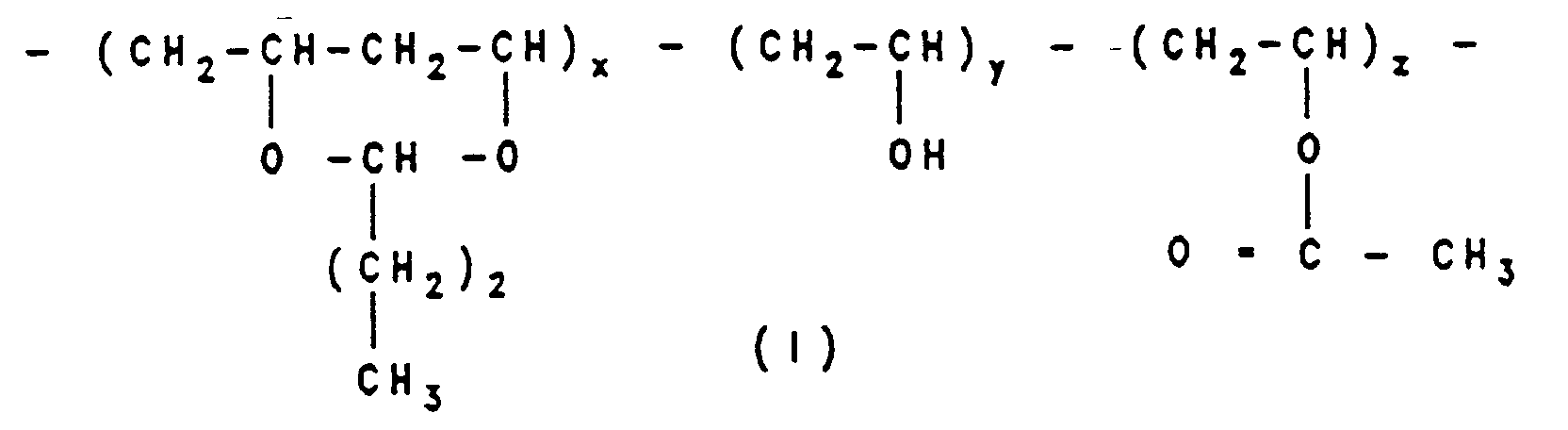
wobei das Gewichtsverhältnis der Einheiten (...)x : (...)y : (...)z im Bereich von 40 bis 90 % : 5 bis 50 % : < 10 % liegt. Bevorzugt ist jedoch Polyvinylbutyral mit Gewichtsverhältnissen von 60 bis 85 % (...)x : 10 bis 40 % (...)y : < 5 % (...)z. - Polyvinylbutyral weist als 10 %ige Lösung in n-Butanol eine Viskosität, gemessen nach Höppler (DIN 53015), von bis zu 500 mPa.s auf, insbesondere wird Polyvinylbutyral bevorzugt, dessen Viskositätsbereich 10 bis 200 mPa.s beträgt.
- 0 bis 10 Gew.-% der erfindungsmäßigen Formmasse sind ein geeigneter Phasenvermittler. Geeignete Phasenvermittler sind bespielsweise mit Maleinsäureanhydrid gepfropfte Polypropylene. Vorteilhaft verwendbare Phasenvermittler sind beispielsweise unter den Handelsnamen ®Hostaprime und ®Hostamont (beide Hoechst AG) oder ®Jeffamine (Texaco Chem. Co.) auf dem Markt.
- Außer dem isotaktischen Propylenpolymer, dem Kautschuk, dem Polyvinylbutyral und dem Phasenvermittler kann die erfindungsgemäße Formmasse noch die üblichen Zusatzstoffe enthalten, beispielsweise Stabilisatoren, Antioxidantien, UV-Absorber, Lichtschutzmittel, Metalldesaktivatoren, Radikalfänger, Füllstoffe und Verstärkungsmittel, Compatibilizer, Weichmacher, Gleitmittel, Emulgatoren, Pigmente, optische Aufheller, Flammschutzmittel, Antistatika, Treibmittel, Fließhilfsmittel.
- Die Herstellung der erfindungsgemäßen Formmasse kann nach den in der Kunststoffverarbeitung für das Mischen von Polymeren und Zusatzstoffen üblichen Methoden erfolgen.
- Eine Möglichkeit ist der Einsatz eines Extruders mit Misch- und Knetorganen auf der Schnecke. Weiterhin sind auch Kneter, wie sie in der Gummi- und Kautschukindustrie eingesetzt werden, geeignete Mischmaschinen.
- Die Mischtemperatur ist abhängig von der jeweiligen Zusammensetzung der Formmasse und läßt sich durch einfache Routineversuche ermitteln.
- Die erfindungsgemäße Formmasse ergibt Formteile, die sich durch eine gute Lackierbarkeit (ohne die übliche Vorbehandlung) in Kombination mit hoher Härte und Schlagzähigkeit, insbesondere auch bei Temperaturen unter 0 °C, auszeichnen. Generell ist diese Formmasse überall dort zur Herstellung von extrudierten, gespritzten, geschäumten oder geblasenen Formkörpern verwendbar, wo hohe Steifigkeit, Härte, Reiß- und Biegefestigkeit, Maßhaltigkeit und Kratzfestigkeit in Kombination mit hoher Schlagzähigkeit, und gleichzeitig eine teilweise oder vollständige Lackierung, Beschriftung, Bedruckung oder Kaschierung erwünscht ist.
- Im Automobilbau ist sie beispielsweise für teilweise oder vollständig lackierbare Front- und Heckstoßfänger, Außenspiegel, Kühlergrills, Seitenschutzleisten, Spoiler, Dichtungen, Kotflügelauskleidungen, LKW- und Traktorenkotflügel, kratzfeste KFZ-Innenausstattung oder Radkappen einsetzbar.
- Ferner eignet sich die erfindungsgemäße Formmasse beispielsweise auch zur Herstellung von beschrift-, kaschier- oder bedruckbaren reißfesten Folien, Membranfiltern, Fasern und Filamenten.
- Die folgenden Beispiele sollen die Erfindung näher erläutern.
- MFI 230/2,16
- = Schmelzindex bei 230 °C, 2,16 kg Belastung, nach DIN 53735
- E-Modul
- = Zugmodul nach 150 R 527, gemessen am großen Normzugstab

- acN
- = Charpy-Kerbschlagzähigkeit nach ISO 179, gemessen an gespritzten Izodstäben (80 X 10 X 4 mm) mit V-Kerbe
(Flankenwinkel 45°, Kerbtiefe 1,3 mm, Kerbradius 1 mm). - Die Platten wurden ohne weitere Vorbehandlung mit einem Primer auf Wasserbasis beschichtet, anschließend mit einem Decklack auf Wasserbasis lackiert.
- Es wurde ein Gitterschnitt durchgeführt.
- Für die Herstellung der Formmassen wurde ein Pulvertrockenmischer der Fa. Henschel und ein Doppelschneckenextruder ZSK 28 (Fa. Werner & Pfleiderer) verwendet.
- Durch Extrusion wurde eine Formmasse hergestellt, bestehend aus 89 Gew.-% isotaktischem Polypropylen, bezogen auf die gesamte Formmasse, und 10 Gew.-% eines Polyvinylbutyrals enthaltend 84,8 Gew.-% Vinylacetaleinheiten (x), 12,3 Gew.-% Vinylalkoholeinheiten (y) und 2,9 Gew.-% Vinylacetateinheiten (z). Die Viskosität nach Höppler (DIN 53015) einer 10 %igen Lösung in n-Butanol betrug 125 mPa.s. Die DSC-Glastemperatur betrug 70 °C. Das verwendete isotaktische Polypropylen hatte einen MFI 230/2,16 von 5 g/10 min, einen Schmelzpunkt von 161 °C; weitere Daten waren Mw = 300.000 g/mol, Mw/Mn = 4,5, VZ = 230 cm³/g.
- 4500 g des isotaktischen Polypropylenpulvers wurden mit 500 g des PVBs gemischt und die Mischung mit 5 g Pentaerithityl-tetrakis-[3-(3,5-di-t-butyl-4-hydroxyphenyl)propionat], 2,5 g Tris-(2,4-di-t-butylphenyl)-phosphit und 5 g Calciumstearat gegen chemischen Abbau unter Extrusionsbedingungen stabilisiert. In den fünf Heizzonen des Extruders wurden Temperaturten von 170 °C (Einzug), 190 °C, 210 °C, 230 °C und 230 °C (Düsenplatte) eingestellt. Die Extruderschnecke wurde mit 200 Upm betrieben, die Massetemperatur der Mischung im Extruder betrug 240 °C.
- An der so hergestellten Formmasse wurden die folgenden Daten gemessen: MFI 230/2,16 = 5,74 g/10 min; VZ = 168 cm³/g; acN = 3,1 mJ/mm² (23 °C); Schmelzpunkt (DSC) = 161 °C, Glastemperatur Tg = 10 °C.
- Die Oberflächenspannung von spritzgegossenen Formplatten betrug nun 33 mN/m statt 20 mN/m für das reine Polypropylen.
- Beispiel 1 wurde wiederholt, jedoch wurden statt 4500 g isotaktischem Polypropylen nur 4450 g und zusätzlich 50 g des Phasenvermittlers, ein auf kurzkettiges Polypropylen gepfropftes Maleinsäureanhydrid eingesetzt.
- An der so hergestellten Formmasse wurden die folgenden Daten gemessen: MFI 230/2,16 = 5,11 g/10 min; acN = 3,1 mJ/mm² (23 °C); Schmelzpunkt (DSC) = 161 °C, Glastemperatur Tg = 10 °C.
- Die Oberflächenspannung von spritzgegossenen Formplatten betrug 35 mN/m statt 20 mN/m für das reine Polypropylen.
- Unter den gleichen Bedingungen wie in Beispiel 2 wurde statt des dort verwendeten Phasenvermittlers 50 g eines auf Polypropylen mittlerer Kettenlänge gepfropftes Maleinsäureanhydrid eingesetzt.
- Die Prüfungsergebnisse sind in der Tabelle zusammengestellt.
- Es wurde analog zu den Beispielen 1 - 3 verfahren, statt des Propylenhomopolymeren wurde hier jedoch ein Propylenblockcopolymer verwendet. Dieses Propylenblockcopolymer hatte die folgende Zusammensetzung: 75 Gew.-% Propyleneinheiten und 25 Gew.-% Ethyleneinheiten; 30 Gew.-% der Kautschukphase war Polyethylen und 70 Gew.-% ein Ethylen-Propylen-Copolymer (EPM) bestehend aus 60 Gew.-% Propyleneinheiten und 40 Gew.-% Ethyleneinheiten. Der MFI 230/5 des Kautschuks betrug 2 g/10 min, die Viskositätszahl (VZ) 236 cm³/g, der DSC-Schmelzpunkt 161 °C und die DSC-Glastemperatur -56 °C.
- Es wurde analog zu den Beispielen 4 bis 6 verfahren, statt des reinen Blockcopolymers wurden hier nur 90 Teile desselben und zusätzlich 10 Teile einer Kautschukzubereitung verwendet. Diese Kautschukzubereitung hatte die folgende Zusammensetzung: 35,8 Gew.-% Propyleneinheiten und 64,2 Gew.-% Ethyleneinheiten; 40,4 Gew.-% der Kautschukphase war Polyethylen und 59,6 Gew.-% ein Ethylen-Propylen-Copolymer (EPM) bestehend aus 60,0 Gew.-% Propyleneinheiten und 40,0 Gew.-% Ethyleneinheiten. Der MFI 230/5 der Kautschukzubereitung betrug 2 g/10 min, die Viskositätszahl (VZ) 236 cm³/g, der DSC-Schmelzpunkt 131 °C und die DSC-Glastemperatur -56 °C.
- Die Ergebnisse der Prüfung sind in der Tabelle zusammengestellt.
- Unter den gleichen Bedingungen wie in Beispiel 2 wurden statt der dort verwendeten 1 % des Phasenvermittlers hier 5 Gew.-% eingesetzt.
- Die Ergebnisse der Prüfung sind in der Tabelle zusammengestellt.
- Unter den gleichen Bedingungen wie in Beispiel 5 wurde statt des dort verwendeten Polyvinylbutyrals ein anderer PVB - Typ mit folgender Zusammmensetzung verwendet: 71,9 Gew.-% Vinylacetaleinheiten (x), 25,3 Gew.-% Vinylalkoholeinheiten (y) und 2,8 Gew.-% Vinylacetateinheiten (z). Die Viskosität nach Höppler (DIN 53015) einer 10 %igen Lösung in n-Butanol betrug 125 mPa.s. Die DSC-Glastemperatur betrug 73 °C.
- Die an einem aus dieser Formmasse hergestellten Formteil gemessene Oberflächenspannung betrug nun 39 mN/m statt 20 mN/m für das reine Propylenblockcopolymer.
- Zum Vergleich wurde das reine Propylenhomopolymer aus Beispiel 1 untersucht.
- Zum Vergleich wurde das reine Propylenblockcopolymer aus Beispiel 4 untersucht.
- Die Ergebnisse sind in Tabelle 1 zusammengefaßt.
- Im Phasenkontrast und in der Schmelze erkennt man die Güte der Dispergierung. Der Einfluß des Phasenvermittlers ist klar zu erkennen. Die Mischung des Propylenhomopolymers mit PVB ohne Phasenvermittler weist noch eine Teilchengröße von 10 µm auf, unter dem Einfluß des Phasenvermittlers ist die mittlere Teilchengröße auf immerhin 2 µm abgesunken. Dabei genügte hier eine Menge von 1 Gew.-% völlig. Die in Beispiel 10 versuchsweise zugegebene Menge von 5 % des Phasenvermittlers brachte keine weitere Verfeinerung der Morphologie.

Die Streckspannung und die Dehnung bei Streckspannung wurden bestimmt. Außerdem wurde die Durchstoßarbeit im elektronischen Durchstoßversuch nach ISO 6603/2 gemessen.
Claims (10)
- Polypropylen-Formmasse, enthaltend
1 bis 99 Gew.-%, bezogen auf die Formmasse, eines isotaktischen Propylenpolymers,
0 bis 60 Gew.-%, bezogen auf die Formmasse, eines Kautschuks mit einer Glastemperatur unter -20 °C,
0,01 bis 99 Gew.-%, bezogen auf die Formmasse, eines Polyvinylbutyrales und
0 bis 10 Gew.-%, bezogen auf die Formmasse, eines Phasenvermittlers. - Formmasse nach Anspruch 1, dadurch gekennzeichnet, daß das isotaktische Propylenpolymer ein Propylenhomopolymer mit einem Isotaxieindex von mindestens 85 % ist.
- Formmasse nach Anspruch 1, dadurch gekennzeichnet, daß das isotaktische Propylenpolymer ein Propylencopolymer ist, welches zu 99,5 bis 50 Gew.-% aus Propyleneinheiten mit einem Isotaxieindex von mindestens 85% und zu 0,5 bis 50 Gew.-% aus Einheiten von Ethylen und/oder aus Einheiten eines 1-Olefins mit mindestens 4 C-Atomen der Formel R¹-CH=CH-R², worin R¹ und R² gleich oder verschieden sind und ein Wasserstoffatom oder einen Alkylrest mit 1 bis 10 C-Atomen bedeuten oder R¹ und R² mit den sie verbindenden Atomen einen Ring mit 4 bis 22 C-Atomen bilden , besteht.
- Formmasse nach Anspruch 3, dadurch gekennzeichnet, daß das Propylencopolymer ein Ethylen/Propylen-Copolymer ist.
- Formmasse nach Anspruch 1, dadurch gekennzeichnet, daß das isotaktische Propylenpolymer ein Gemisch ist ausa) 20 bis 99 Gew.-% eines Propylenhomopolymers mit einem Isotaxieindex von mindestens 85% undb) 80 bis 1 Gew.-% eines Propylencopolymers, welches zu 20 bis 90 Gew.-% aus Propyleneinheiten mit einem Isotaxieindex von mindestens 85% und zu 80 bis 10 Gew.-% aus Einheiten von Ethylen und/oder aus Einheiten eines 1-Olefins mit mindestens 4 C-Atomen der Formel R¹-CH=CH-R², worin R¹ und R² gleich oder verschieden sind und ein Wasserstoffatom oder einen Alkylrest mit 1 bis 10 C-Atomen bedeuten oder R¹ und R² mit den sie verbindenden Atomen einen Ring mit 4 bis 22 C-Atomen bilden, besteht.
- Formmasse nach Anspruch 1, dadurch gekennzeichnet, daß sie Polyvinylbutyral der Formel I

- Formmasse nach Anspruch 1, dadurch gekennzeichnet, daß der Phasenvermittler ein mit Maleinsäureanhydrid gepfropftes Polypropylen ist.
- Formmasse nach Anspruch 1, dadurch gekennzeichnet, daß sie zusätzlich Stabilisatoren, Antioxidantien, UV-Absorber, Lichtschutzmittel, Metalldesaktivatoren, Radikalfänger, Füllstoffe und Verstärkungsmittel, Compatibilizer, Weichmacher, Gleitmittel, Emulgatoren, Pigmente, optische Aufheller, Flammschutzmittel, Antistatika, Treibmittel oder Fließhilfsmittel enthält.
- Verwendung der Formmasse nach Anspruch 1 zur Herstellung von Formkörpern.
- Formkörper, herstellbar aus der Formmasse nach Anspruch 1.
Applications Claiming Priority (2)
| Application Number | Priority Date | Filing Date | Title |
|---|---|---|---|
| DE4332114 | 1993-09-22 | ||
| DE4332114A DE4332114A1 (de) | 1993-09-22 | 1993-09-22 | Polypropylen-Formmasse mit verbesserten Oberflächeneigenschaften |
Publications (1)
| Publication Number | Publication Date |
|---|---|
| EP0644237A1 true EP0644237A1 (de) | 1995-03-22 |
Family
ID=6498243
Family Applications (1)
| Application Number | Title | Priority Date | Filing Date |
|---|---|---|---|
| EP94113882A Withdrawn EP0644237A1 (de) | 1993-09-22 | 1994-09-05 | Polypropylen-Formmasse mit durch Polyvinylbutysal verbesserten Oberflächeneigenschaften |
Country Status (5)
| Country | Link |
|---|---|
| US (1) | US5514752A (de) |
| EP (1) | EP0644237A1 (de) |
| JP (1) | JPH07149976A (de) |
| DE (1) | DE4332114A1 (de) |
| FI (1) | FI944360L (de) |
Cited By (1)
| Publication number | Priority date | Publication date | Assignee | Title |
|---|---|---|---|---|
| EP2223965A4 (de) * | 2007-12-20 | 2010-12-08 | Kuraray Co | Thermoplastische polymerzusammensetzung und daraus hergestellter formartikel |
Families Citing this family (15)
| Publication number | Priority date | Publication date | Assignee | Title |
|---|---|---|---|---|
| US6225402B1 (en) | 1998-09-25 | 2001-05-01 | Mcwhorter Technologies, Inc. | Aqueous based dispersions for polyolefinic substrates |
| US20020099107A1 (en) * | 2000-10-27 | 2002-07-25 | Tucker John David | Textile fibers made from strengthened polypropylene |
| US20040147675A1 (en) * | 2002-11-27 | 2004-07-29 | Hofmann George H | Thermoplastic elastomers from crosslinked polyvinylbutyral |
| US20050027072A1 (en) * | 2003-01-24 | 2005-02-03 | Hofmann George Henry | Process for conversion of polyvinyl butyral (PVB) scrap into processable pellets |
| KR20050111356A (ko) * | 2003-03-14 | 2005-11-24 | 이 아이 듀폰 디 네모아 앤드 캄파니 | 폴리아미드, 폴리비닐부티랄 및 광물질 충전제를 포함하는조성물 및 그로부터 제조된 물품 |
| US20050004308A1 (en) * | 2003-03-14 | 2005-01-06 | Win-Chung Lee | Polyamide and polyvinylbutyral compositions and blends having enhanced surface properties and articles made therefrom |
| US7834090B2 (en) * | 2007-08-03 | 2010-11-16 | The Gates Corporation | Rubber composition and vibration damper using the rubber composition |
| FR2939234A1 (fr) * | 2008-12-03 | 2010-06-04 | Nexans | Composition reticulable pour cable d'energie a moyenne et haute tension |
| US9505920B2 (en) * | 2011-03-30 | 2016-11-29 | Fina Technology, Inc. | Polymer compositions for injection stretch blow molded articles |
| KR101481218B1 (ko) * | 2012-06-01 | 2015-01-09 | 현대자동차주식회사 | 압출-사출 일체 성형공법을 이용한 직접 유리 장섬유 강화폴리올레핀계 수지 조성물의 제조 방법 |
| US20160237256A1 (en) * | 2015-02-12 | 2016-08-18 | Eastman Chemical Company | Elastomeric compositions comprising vinyl acetal polymers |
| WO2016130880A1 (en) * | 2015-02-12 | 2016-08-18 | Eastman Chemical Company | Elastomeric compositions comprising vinyl acetal polymers |
| EP3540009A1 (de) * | 2018-03-15 | 2019-09-18 | Shark Solutions ApS | Modifizierung von neuen und/oder recycelten baupolymeren unter verwendung von polyvinylbutyral (pvb) oder recyceltem pvb aus industrieabfallströmen und legierungscopolymer |
| JP7429900B2 (ja) * | 2019-03-28 | 2024-02-09 | 株式会社 ガラステクノシナジー | 樹脂組成物 |
| CN113956571B (zh) * | 2021-11-22 | 2023-09-05 | 广东美的白色家电技术创新中心有限公司 | 一种聚丙烯复合材料及其制备方法和用途 |
Citations (3)
| Publication number | Priority date | Publication date | Assignee | Title |
|---|---|---|---|---|
| EP0167455A2 (de) * | 1984-06-29 | 1986-01-08 | Kawasaki Steel Corporation | Schwingungsdämpfender zusammengesetzter Plattenverbund |
| EP0471079A1 (de) * | 1990-01-23 | 1992-02-19 | Japan as represented by Director-General, Agency of Industrial Science and Technology | Oberflächenaktivierung thermoplastischer harz-formkörper |
| WO1993002141A1 (en) * | 1991-07-23 | 1993-02-04 | E.I. Du Pont De Nemours And Company | Recycling of polyvinylbutyral |
-
1993
- 1993-09-22 DE DE4332114A patent/DE4332114A1/de not_active Withdrawn
-
1994
- 1994-09-05 EP EP94113882A patent/EP0644237A1/de not_active Withdrawn
- 1994-09-20 US US08/309,127 patent/US5514752A/en not_active Expired - Fee Related
- 1994-09-20 FI FI944360A patent/FI944360L/fi unknown
- 1994-09-21 JP JP6226970A patent/JPH07149976A/ja not_active Withdrawn
Patent Citations (3)
| Publication number | Priority date | Publication date | Assignee | Title |
|---|---|---|---|---|
| EP0167455A2 (de) * | 1984-06-29 | 1986-01-08 | Kawasaki Steel Corporation | Schwingungsdämpfender zusammengesetzter Plattenverbund |
| EP0471079A1 (de) * | 1990-01-23 | 1992-02-19 | Japan as represented by Director-General, Agency of Industrial Science and Technology | Oberflächenaktivierung thermoplastischer harz-formkörper |
| WO1993002141A1 (en) * | 1991-07-23 | 1993-02-04 | E.I. Du Pont De Nemours And Company | Recycling of polyvinylbutyral |
Cited By (2)
| Publication number | Priority date | Publication date | Assignee | Title |
|---|---|---|---|---|
| EP2223965A4 (de) * | 2007-12-20 | 2010-12-08 | Kuraray Co | Thermoplastische polymerzusammensetzung und daraus hergestellter formartikel |
| US10385202B2 (en) | 2007-12-20 | 2019-08-20 | Kuraray Co., Ltd. | Thermoplastic polymer composition and shaped article composed of the same |
Also Published As
| Publication number | Publication date |
|---|---|
| US5514752A (en) | 1996-05-07 |
| FI944360A7 (fi) | 1995-03-23 |
| DE4332114A1 (de) | 1995-03-23 |
| JPH07149976A (ja) | 1995-06-13 |
| FI944360L (fi) | 1995-03-23 |
| FI944360A0 (fi) | 1994-09-20 |
Similar Documents
| Publication | Publication Date | Title |
|---|---|---|
| DE69221784T2 (de) | Thermoplastische Polymermischung | |
| DE3689861T2 (de) | Polypropylenzusammensetzungen. | |
| DE69320135T2 (de) | Polypropylen Zusammensetzungen | |
| DE69226055T4 (de) | Polypropylenharzzusammensetzung | |
| DE19982218B3 (de) | Polypropylenharzmasse und spritzgeformter Gegenstand daraus | |
| DE69401803T2 (de) | Polypropylene Harzzusammensetzung | |
| EP0644237A1 (de) | Polypropylen-Formmasse mit durch Polyvinylbutysal verbesserten Oberflächeneigenschaften | |
| DE3884144T2 (de) | Modifiziertes Polyolefinharz. | |
| DE69511446T2 (de) | Kompatibilisierte Polycarbonat/Polyolefin-Harzzusammensetzungen | |
| DE69614750T2 (de) | Thermoplastische Harzzusammensetzung und Spritzgussformteil daraus | |
| DE69609115T2 (de) | Thermoplastische Harzzusammensetzung | |
| DE69319315T2 (de) | Polypropylenharzzusammensetzung mit verbesserter Kompatibilität mit Anstrichen und Gegenstand mit Anstrich daraus | |
| DE69609551T2 (de) | Thermoplastische Harzmasse und daraus hergestellter Spritzgussartikel | |
| DE69813963T2 (de) | Weiche, elastomere thermoplastische polyolefin zusammensetzungen | |
| DE3785016T2 (de) | Polypropylen-zusammensetzung. | |
| DE69220096T2 (de) | Thermoplastische Polymermasse | |
| DE69118662T2 (de) | Thermoplastische elastomerzusammensetzung | |
| DE2714193A1 (de) | Thermoplastische elastomere | |
| DE10156057B4 (de) | Polypropylenharz-Zusammensetzung | |
| DE69811769T2 (de) | Thermoplastische Harzmischung | |
| DE3851825T2 (de) | Modifiziertes Polyolefinharz. | |
| DE69911684T2 (de) | Propylenharzzusammensetzung | |
| DE69029959T2 (de) | Beschichtete Harzformstücke | |
| DE69700297T2 (de) | Thermoplastharzzusammensetzung mit verringerter Neigung zur Giessformverschmutzung | |
| DE69214249T2 (de) | Polypropylenharz-zusammensetzung, verfahren zur beschichtung von daraus hergestellten geformten gegenständen und so beschichtete geformte gegenstände |
Legal Events
| Date | Code | Title | Description |
|---|---|---|---|
| PUAI | Public reference made under article 153(3) epc to a published international application that has entered the european phase |
Free format text: ORIGINAL CODE: 0009012 |
|
| AK | Designated contracting states |
Kind code of ref document: A1 Designated state(s): BE DE ES FR GB IT NL SE |
|
| RIN1 | Information on inventor provided before grant (corrected) |
Inventor name: ZIMMERMANN, HANS-JUERGEN, DR. Inventor name: GUTWEILER, MATTHIAS, DR. |
|
| 17P | Request for examination filed |
Effective date: 19950922 |
|
| 17Q | First examination report despatched |
Effective date: 19960319 |
|
| GRAG | Despatch of communication of intention to grant |
Free format text: ORIGINAL CODE: EPIDOS AGRA |
|
| RAP1 | Party data changed (applicant data changed or rights of an application transferred) |
Owner name: TARGOR GMBH |
|
| STAA | Information on the status of an ep patent application or granted ep patent |
Free format text: STATUS: THE APPLICATION HAS BEEN WITHDRAWN |
|
| 18W | Application withdrawn |
Withdrawal date: 19971230 |