EP0644660B1 - Encodeur de codes à longueur variable - Google Patents
Encodeur de codes à longueur variable Download PDFInfo
- Publication number
- EP0644660B1 EP0644660B1 EP94114375A EP94114375A EP0644660B1 EP 0644660 B1 EP0644660 B1 EP 0644660B1 EP 94114375 A EP94114375 A EP 94114375A EP 94114375 A EP94114375 A EP 94114375A EP 0644660 B1 EP0644660 B1 EP 0644660B1
- Authority
- EP
- European Patent Office
- Prior art keywords
- codetable
- length
- variable length
- codeword
- variable
- Prior art date
- Legal status (The legal status is an assumption and is not a legal conclusion. Google has not performed a legal analysis and makes no representation as to the accuracy of the status listed.)
- Expired - Lifetime
Links
Images

Classifications
-
- H—ELECTRICITY
- H03—ELECTRONIC CIRCUITRY
- H03M—CODING; DECODING; CODE CONVERSION IN GENERAL
- H03M7/00—Conversion of a code where information is represented by a given sequence or number of digits to a code where the same, similar or subset of information is represented by a different sequence or number of digits
- H03M7/30—Compression; Expansion; Suppression of unnecessary data, e.g. redundancy reduction
- H03M7/40—Conversion to or from variable length codes, e.g. Shannon-Fano code, Huffman code, Morse code
- H03M7/42—Conversion to or from variable length codes, e.g. Shannon-Fano code, Huffman code, Morse code using table look-up for the coding or decoding process, e.g. using read-only memory
Definitions
- variable length coder also known as "Huffman coder” or “entropy coder” for use in digital audio/video coders and the like.
- DCT discrete cosine transform
- VLC variable length coding
- the transform coefficients are run-levelled and entropy coded, in which the most common run-level combinations are given the shortest codes and the less common combinations longer codes.
- a run-level represents a group of 1 or more transform coefficients as a number of 0 coefficients (run) followed by a single coefficient value (level).
- run-level combination to codes is disclosed in Tables 1 to 4. For example,
- H.261 (see “Recommendation H.261 - Video Codec for Audio-visual Services at px64 kbits/s" by International York and Telephone Consultative Committee, Study Group XV, CCITT Subgroup XV Document, Report R 37, August 1990) and MPEG-1 (see “CD 11172 - Coding of Moving Pictures and Associated Audio for Digital Storage Media at up to about 1.5 Mbps" by international Organization for Standardization, ISO MPEG Document, ISO-IEC/JTC1/SC2/WG8, 1992) describe audio/video codecs which require variable length coders. Emerging standard HDTV codecs will also require variable length coders.
- variable length coder has typically been accomplished by the use of a look-up table (LUT) to translate the fixed length data to variable length data.
- LUT is usually implemented using memory (for example RAM or PROM), or logic (for example PLA).
- Lei and Sun (see “An Entropy Coding System for Digital HDTV Applications", Shaw-Min Lei & Ming-Ting Sun, IEEE Transactions on Circuits and Systems for Video Technology, Vol.1, March 1991) implemented a LUT using a PLA.
- the PLA containes the codeword bitsequence and the length of the bitsequence.
- the input to the PLA is the fixed length data from a run-leveller, and the output is the codeword bitsequence and the length of the bitsequence.
- US-A-4 295 124 discloses a text compression method in which input sequences comprising two ASCII characters are converted into an address of a ROM storing the codetable by using a hasking technique.
- Reference US-A-4,899,149 relates to a decoding method and apparatus for Huffman of variable/length codes.
- the described apparatus generates a certain variable length code which comprises a prefix portion and a reminder portion.
- the new codeword comprises a number of leading ones as a prefix followed by the particular codeword to be transmitted.
- EP-A2-0 286 719 describes a text compression method and apparatus. For compressing and decompressing text, specific dictionaries are used having entries of words which are ranked in accordance with a weighted frequency of usage. The ranking of the entries is based on statistical studies of the areas of use employed.
- the Huffman tables contain patterns in the variable length bit sequences which can be identified and used to shrink the codetable.
- the longest bitsequence in the DCT coefficients Huffman table is 16 bits (disregarding the sign of the level).
- all of the longer bitsequence consist of a string of 0s, followed by several 1s. This pattern can be recognised and used to reduce the codetable size.
- the object of this invention is to eliminate the wastage of codetable space caused by storing redundant information in the codetable.
- a codetable is used for storing codewords each of which define a codeword bitsequence and length of said bitsequence.
- a bitmap is used to indicate the presence of a codeword in the codetable for a particular fixed length code input.
- An addresser is used to convert the fixed length code input to an address which is then used to index the codetable.
- the bitmap and addresser are used as means to eliminate the holes in the Huffman table which occur as the result of non-contiguous codewords.
- a codeword translator can be used to eliminate some of the redundant information in the storage of the bitsequence codewords in the codetable.
- the resulting output from the bitmap is an indication of whether or not the codetable contains a huffman codeword for that fixed length input data. If the bitmap indicates the codeword is missing, the bitsequence output from this variable length coder is invalid. In this case an alternate method is needed to code the fixed length data, such as coding the data as a fixed length bitsequence.
- the resulting output from the addresser is an address which is used to index the codetable for that fixed length input data.
- the addresser allows the codewords to be stored in the codetable contiguously, so that there is no wasted space in the codetable due to invalid data. If the fixed length input data was used directly to index the codetable, many of the fixed length input data words may result in invalid bitsequence outputs from this variable length coder because there is no variable length codeword for that fixed length input data. In this case there may be contiguous groups of valid codewords separated by groups of invalid codewords. Thus, the addresser removes these holes in the huffman table. If the codetable contains the variable length codeword information as encoded data, the codeword translator is used to convert the output from the codetable into a bitsequence and length of bitsequence variable length codeword. By storing encoded data instead of lengths and bitsequence, the word width of the codetable, and therefore the overall size of the codetable is reduced.
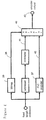
- the input 1 is fixed length data comprising a 6 bit run and an 8 bit absolute value level.
- An example of such data are the run-level combinations which result in a digital video encoder after the run-level coding of DCT coefficients.
- the run represents the number of 0 coefficients and the level represents the absolute value of the non-zero coefficient following the 0s.
- the bitmap input 2 are the 14 input bits of run and level.
- the bitmap output 3 is a single bit which is 1 if the codeword data is present in the codetable, and 0 otherwise.
- the bitmap 4 can be implemented using a 2 14 x 1 bit memory.
- the addresser 5 comprises a base table 6 and an adder 7.
- the base table 6 can be implemented using a 2 6 x 6 RAM whose input address lines 8 are the 6 bits of the run.
- the contents of the vase table 6 indicate the base address 9 of a contiguous group of codeword data with the specified run in the codetable.
- the offset 10 from this starting address are the 8 bits of the level.
- the offset 10 from this base is the level value, 2.
- the codetable 12 contains words comprising a "bitsequence" stored as 23 bits and "length of bitsequence” stored as 5 bits, for a total of 28 bits for each codetable entry. For example, to store the bitsequence "001101", the "length of bitsequence" is 6 and the "bitsequence" is "001101". Unused bits of the bitsequence are set to 0. This represents the variable length codeword 13 corresponding to the run and level fixed length input data. The maximum codelength is 23 bits.
- a codetable with up to 128 codewords can be implemented using a 128 x 28 bit memory.
- the benefit can be seen by comparing the size of memory and logic required for this embodiment with the size of memory required by a variable length coder implemented by a simple LUT.
- variable length coder removes the space in the memory where these codewords do not exist.
- the effect is the huge reduction in memory storage requirements for variable length coding.
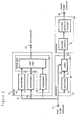
- FIG. 2 An example embodiment of this invention is shown in Figure 2.
- the input to this example embodiment is fixed length data 14 comprising a 6 bit run and an 8 bit absolute value level.
- the bitmap 15 comprises of 2 sub-bitmaps 16,17, some comparators 18 and a valid logic 19.
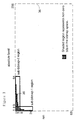
- Figure 3 represents how the 2 sub-bitmaps 16,17 are used.
- the dotted line 36 represents the bitmap address space in 2-dimensions.
- the horizontal axis is the absolute value of the level ranging from 1 to 256, represented by 8 bits because the representation is (level-1), or 0 to 255.
- the vertical axis is the run ranging from 0 to 63, represented by 6 bits.
- the shaded region 20 represents those combinations of run-levels for which the codeword is present in the encoded codetable 21.
- bitmap inside the dotted line was implemented using a memory, it could be implemented using the same bitmap as in the first embodiment, namely a 2 14 x 1 memory. However, in this embodiment the large memory space outside of sub-bitmap-1 and sub-bitmap-2 where there are no non-zero bits is not implemented using memory. Instead, only the sub-bitmap-1 region and sub-bitmap-2 region are implemented using memories.
- the input to sub-bitmap-1 22 for this embodiment are the 5 LSbits (Least Significant Bits) of run for an input range of 0 to 31, and the 3 LSbits of (level-1) for an effective input range of level of 1 to 8.
- the output 23 is a single bit hereafter called valid-map-1.
- Sub-bitmap-1 16 can be implemented using a 2 8 x 1 RAM.
- the input to sub-bitmap-2 24 for this embodiment are the 3 LSbits of run for an input range of 0 to 7, and the 6 LSbits of (level-1) for an effective input range of level of 1 to 64.
- the output 25 is a single bit hereafter called valid-map-2.
- Sub-bitmap-2 17 can be implemented using a 2 9 x 1 RAM.
- the contents of the sub-bitmap RAMs are 1 if the run/level codeword is present in the codetable, and 0 otherwise.
- the selection of the bits used as inputs to the sub-bitmaps was made in order to minimize the total memory size required to cover the shaded region 20 in the bitmap address space 36.
- the valid logic 19 determines the following: ((valid-map-1 && inrange-map-1)
- the valid-codeword output 26 is 1 if the codeword data is present in the encoded codetable 21.
- the addresser 27 for the embodiment of Figure 2 comprises a base table 28 and an adder 29.
- the base table can be implemented using a 2 5 x 6 RAM whose input address lines 30 are the 5 LSbits of the run.
- the contents of the base table indicate the base address 31 of a contiguous group of codeword data with the specified run in the codetable.
- the offset 32 from this base address are the 8 bits of the level.
- the base address and offset are added to determine the encoded codetable address 33 where the codeword data is located.
- the encoded codetable contains words comprising a 4 bit “length of 0s”, 4 bit “length of code”, and an 8 bit "bitsequence code”.
- the translator 34 converts these values to a bitsequence of the specified number of 0s followed by the specified number of bits of the code.
- the output of the translator 35 is a bitsequence and length of bitsequence.
- bitsequence "0000001101” is represented as 6 0s followed by a 4 bit code with a bitsequence "1101".
- "6” can be represented by the 4 bit " length of 0s”
- "4" can be represented by the 4 bit “length of code”
- the "1101” can be represented by the 8 bits of "bitsequence code", where 4 of these bits are not used.
- the output from the translator for this example is the bitsequence length of 10 ("0000001101”is 10 bits long) represented by 5 bits, and the bitsequence "0000001101” represented by 23 bits, 10 of which are meaningful for this example.
- the maximum codelength for this embodiment is 23 bits because there can be up to 15 0s (the range of "length of 0s" is 0 to 15) followed by up to 8 (the range of "length of code” is 1 to 8) "bitsequence code” bits.
- the simple table contains a 2 14 x 1 bitmap, whereas for this embodiment the bitmap is implemented with 2 small sub-bitmaps and some logic.
- the simple table uses 28 bits to represent the codewords, whereas for this embodiment the codewords are represented by 16 bits each and the translator is used to expand them. The effect of this invention is the huge reduction in memory storage requirements for variable length coding.
- Figure 4 shows one way in which the previous 2 embodiments can be used in combination with a fixed length data encoder 37 to encode bitsequences of data.
- the valid codeword output 38 from the bitmap 39 is used by the selector 40 to select either the variable length codeword 41 or the fixed length encoded codeword 42.
- the output of the selector 43 is an encoded bitsequence. This arrangement can be used to encode any fixed length codeword because if a variable length code does not exist, as indicated by the valid codeword output 38, a fixed length encoded codeword will result instead.
- bitmaps both in number and size, as well as different comparators and valid logic. It is also possible to change the size of the base table and codetable, and the function of the encoded codeword translator. The choice of these items will affect the size of the coder at the expense of versatility and programmability of the coder.
- the effect of this invention is the dramatic decrease in size of the variable length coder, whilst maintaining significant programmability so that support of various hufman codetables is possible with the same implementation.
- the effect of using an addresser and bitmap is to decrease the size of the codetable by not occupying memory space for the holes in the huffman table.
- the effect of using sub-bitmaps plus associated comparators and some additional logic is to decrease the size of the bitmap by determining the codes presence in the codetabie for a range of the fixed length input data.
- the effect of using a translator is to decrease the size of the codetable by not occupying memory with redundant information common for many or all the codewords in the codetable.
Landscapes
- Engineering & Computer Science (AREA)
- Theoretical Computer Science (AREA)
- Compression, Expansion, Code Conversion, And Decoders (AREA)
Claims (3)
- Codeur à longueur variable pour convertir des données à longueur de bit fixe en un mot de code à longueur de bit variable, ledit codeur à longueur variable comprenant :caractérisé parune table des codes (12) pour mémoriser lesdits mots de code à longueur variable , lesdits mots de code à longueur variable sont mémorisés dans ladite table des codes (12) sous une forme codée ayant une partie représentant une longueur d'un code de séquence de bits et une partie représentant ledit code de la séquence de bits,
une mémoire binaire (4) pour indiquer si ladite table des codes (12) contient un mot de code à longueur variable pour lesdites données à longueur de bits fixe d'entrée en sortant une valeur binaire,un dispositif d'adressage (5) pour convertir les données à longueur de bit fixe entrée en une adresse des tables des codes, ladite adresse de tables des codes étant utilisée pour indexer lesdits mots de code à longueur variable mémorisés de ladite table des codes (12),un transcodeur de mot de code codé (34) pour transcoder ledit mot de code codé qui est en outre codé en réduisant un nombre de zéros au commencement dudit mot de code à longueur variable en une séquence de bits à longueur variable et une longueur de ladite séquence de bits à longueur variable. - Codeur à longueur variable selon la revendication 1,
caractérisé en ce que
ladite mémoire binaire (4) comprend :des sous-tables de correspondance de bits (16,17) indiquant chacune seulement des parties de toutes les données à longueur de bit fixe possibles,un comparateur (18) pour déterminer si les données à longueur de bit fixe entrée sont mémorisées dans une des sous-tables de correspondance de bits (16,17) etune logique de validité (19) pour indiquer si un mot de code à longueur de bit variable est contenu dans ladite table des codes (12) en fonction de la sortie desdites sous-tables de correspondance de bits (16,17) et dudit comparateur (18). - Codeur à longueur variable selon l'une quelconque des revendications précédentes,
caractérisé en ce que
ledit dispositif d'adressage (5) comprend :dans lequel ladite table de base (6) est adressée par un ou plusieurs bits des données à longueur de bit fixe d'entrée et le décalage est formé par les bits restants des données à longueur de bit fixe d'entrée.une table de base (6) pour mémoriser des adresses de base (9), lesdites adresses de base (9) sont utilisées pour indexer l'emplacement d'un groupe contigu d'un ou plusieurs mots de code à longueur de bits variable dans ladite table des codes (12), etun additionneur (7) pour additionner un décalage (10) à ladite adresse de base (9), le résultat (11) déterminant l'emplacement des mots de code à longueur de bit variable dans ladite table des codes (12),
Applications Claiming Priority (3)
| Application Number | Priority Date | Filing Date | Title |
|---|---|---|---|
| JP5227694A JP3025827B2 (ja) | 1993-09-14 | 1993-09-14 | 可変長コード化装置 |
| JP227694/93 | 1993-09-14 | ||
| JP22769493 | 1993-09-14 |
Publications (2)
| Publication Number | Publication Date |
|---|---|
| EP0644660A1 EP0644660A1 (fr) | 1995-03-22 |
| EP0644660B1 true EP0644660B1 (fr) | 2001-12-12 |
Family
ID=16864886
Family Applications (1)
| Application Number | Title | Priority Date | Filing Date |
|---|---|---|---|
| EP94114375A Expired - Lifetime EP0644660B1 (fr) | 1993-09-14 | 1994-09-13 | Encodeur de codes à longueur variable |
Country Status (4)
| Country | Link |
|---|---|
| US (1) | US5638067A (fr) |
| EP (1) | EP0644660B1 (fr) |
| JP (1) | JP3025827B2 (fr) |
| DE (1) | DE69429403T2 (fr) |
Cited By (1)
| Publication number | Priority date | Publication date | Assignee | Title |
|---|---|---|---|---|
| WO2005112269A1 (fr) * | 2004-05-14 | 2005-11-24 | Adams Platform Pty Ltd | Systeme et procede pour codage et decodage audio sans perte |
Families Citing this family (4)
| Publication number | Priority date | Publication date | Assignee | Title |
|---|---|---|---|---|
| JP3484310B2 (ja) * | 1997-01-17 | 2004-01-06 | 松下電器産業株式会社 | 可変長符号器 |
| JP3415481B2 (ja) * | 1999-05-27 | 2003-06-09 | Necエレクトロニクス株式会社 | 可変長符号の復号装置 |
| US7439887B2 (en) | 2007-02-13 | 2008-10-21 | Seiko Epson Corporation | Method and apparatus for GIF decompression using fixed-size codeword table |
| US10761841B2 (en) | 2018-10-17 | 2020-09-01 | Denso International America, Inc. | Systems and methods for identifying source code from binaries using machine learning |
Citations (5)
| Publication number | Priority date | Publication date | Assignee | Title |
|---|---|---|---|---|
| US3717851A (en) * | 1971-03-03 | 1973-02-20 | Ibm | Processing of compacted data |
| US4295124A (en) * | 1979-08-13 | 1981-10-13 | National Semiconductor Corporation | Communication method and system |
| EP0286719A2 (fr) * | 1986-12-04 | 1988-10-19 | International Business Machines Corporation | Méthode et dispositif pour la compression et l'expansion de textes |
| US4899149A (en) * | 1986-02-28 | 1990-02-06 | Gary Kahan | Method of and apparatus for decoding Huffman or variable-length coees |
| EP0609835A1 (fr) * | 1993-02-03 | 1994-08-10 | Nec Corporation | Circuit de génération d'adresse pour une table de codage à deux dimensions |
Family Cites Families (7)
| Publication number | Priority date | Publication date | Assignee | Title |
|---|---|---|---|---|
| US4506325A (en) * | 1980-03-24 | 1985-03-19 | Sperry Corporation | Reflexive utilization of descriptors to reconstitute computer instructions which are Huffman-like encoded |
| US4670851A (en) * | 1984-01-09 | 1987-06-02 | Mitsubishi Denki Kabushiki Kaisha | Vector quantizer |
| ATE108587T1 (de) * | 1986-09-13 | 1994-07-15 | Philips Nv | Verfahren und schaltungsanordung zur bitratenreduktion. |
| FR2608806B1 (fr) * | 1986-12-23 | 1989-03-17 | Valero Robert | Procede et appareil programmable pour le transcodage de chaines de caracteres |
| JPH0799812B2 (ja) * | 1990-03-26 | 1995-10-25 | 株式会社グラフイックス・コミュニケーション・テクノロジーズ | 信号符号化装置および信号復号化装置、並びに信号符号化復号化装置 |
| JPH04337926A (ja) * | 1991-05-15 | 1992-11-25 | Fujitsu Ltd | 可変長符号テーブル制御方式 |
| JPH0541862A (ja) * | 1991-08-03 | 1993-02-19 | Sony Corp | 動きベクトルの可変長符号化方式 |
-
1993
- 1993-09-14 JP JP5227694A patent/JP3025827B2/ja not_active Expired - Fee Related
-
1994
- 1994-09-13 EP EP94114375A patent/EP0644660B1/fr not_active Expired - Lifetime
- 1994-09-13 US US08/305,688 patent/US5638067A/en not_active Expired - Fee Related
- 1994-09-13 DE DE69429403T patent/DE69429403T2/de not_active Expired - Fee Related
Patent Citations (5)
| Publication number | Priority date | Publication date | Assignee | Title |
|---|---|---|---|---|
| US3717851A (en) * | 1971-03-03 | 1973-02-20 | Ibm | Processing of compacted data |
| US4295124A (en) * | 1979-08-13 | 1981-10-13 | National Semiconductor Corporation | Communication method and system |
| US4899149A (en) * | 1986-02-28 | 1990-02-06 | Gary Kahan | Method of and apparatus for decoding Huffman or variable-length coees |
| EP0286719A2 (fr) * | 1986-12-04 | 1988-10-19 | International Business Machines Corporation | Méthode et dispositif pour la compression et l'expansion de textes |
| EP0609835A1 (fr) * | 1993-02-03 | 1994-08-10 | Nec Corporation | Circuit de génération d'adresse pour une table de codage à deux dimensions |
Non-Patent Citations (1)
| Title |
|---|
| "Recommendation H.261. Line transmission of non-telephone signals. Video codec for audiovisual services at p x 64 kbits.", ITU-T RECOMMENDATION H.261. TELECOMMUNICATION STANDARDIZATION SECTOR OF ITU., vol. H.261, HELSINKI, pages 1 - 25 * |
Cited By (1)
| Publication number | Priority date | Publication date | Assignee | Title |
|---|---|---|---|---|
| WO2005112269A1 (fr) * | 2004-05-14 | 2005-11-24 | Adams Platform Pty Ltd | Systeme et procede pour codage et decodage audio sans perte |
Also Published As
| Publication number | Publication date |
|---|---|
| JP3025827B2 (ja) | 2000-03-27 |
| EP0644660A1 (fr) | 1995-03-22 |
| DE69429403T2 (de) | 2002-04-11 |
| JPH0786957A (ja) | 1995-03-31 |
| DE69429403D1 (de) | 2002-01-24 |
| US5638067A (en) | 1997-06-10 |
Similar Documents
| Publication | Publication Date | Title |
|---|---|---|
| US5969650A (en) | Variable length coder with a small table size | |
| US5604498A (en) | Huffman decoder | |
| US6219457B1 (en) | Method and system for decoding data encoded in a variable length code word | |
| KR100188427B1 (ko) | 디지탈 통신시스템용 가변길이 코드워드디코더 및 그 디코딩 방법 | |
| US5818877A (en) | Method for reducing storage requirements for grouped data values | |
| US5973626A (en) | Byte-based prefix encoding | |
| US5541595A (en) | Variable length code decoder for simultaneous decoding the most significant bits and the least significant bits of a variable length code | |
| EP0683568B1 (fr) | Décodage de code de Huffman avec tables pour MSBs et LSBs | |
| US6943710B2 (en) | Method and arrangement for arithmetic encoding and decoding binary states and a corresponding computer program and a corresponding computer-readable storage medium | |
| WO1993013603A1 (fr) | Circuits de decodage des codes huffman | |
| US5648774A (en) | Variable length coding with three-field codes | |
| Fogg | Survey of software and hardware VLC architectures | |
| CN1113473C (zh) | 使用相对地址的可变长译码装置 | |
| JPH10322223A (ja) | 可変長符号化回路 | |
| US5825312A (en) | DX JPEG Huffman decoder | |
| JP3990464B2 (ja) | ディジタルビデオ信号プロセッサのためのデータ効率のよい量子化テーブル | |
| EP0644660B1 (fr) | Encodeur de codes à longueur variable | |
| WO2000035187B1 (fr) | Amelioration de la variete dimensionnelle de granularite fine par codage de plan de bits de coefficients de transformation | |
| KR20010087269A (ko) | 가변 길이 복호 시스템 및 방법 | |
| US5561422A (en) | Method and apparatus for variable length coding with reduced memory requirement | |
| KR0123729B1 (ko) | 허프만 디코더 | |
| KR0148148B1 (ko) | 가변장부호화테이블 및 이를 이용한 영상신호의 가변장부호화방법 | |
| JP2988825B2 (ja) | 少ないメモリを用いた可変長さ符号化方法および装置 | |
| JPH0629861A (ja) | データ圧縮方法 | |
| KR960016012B1 (ko) | 부분적 코드 변환을 이용한 가변 길이 디코딩 장치 |
Legal Events
| Date | Code | Title | Description |
|---|---|---|---|
| PUAI | Public reference made under article 153(3) epc to a published international application that has entered the european phase |
Free format text: ORIGINAL CODE: 0009012 |
|
| AK | Designated contracting states |
Kind code of ref document: A1 Designated state(s): DE FR GB IT NL |
|
| 17P | Request for examination filed |
Effective date: 19950803 |
|
| 17Q | First examination report despatched |
Effective date: 19980331 |
|
| GRAG | Despatch of communication of intention to grant |
Free format text: ORIGINAL CODE: EPIDOS AGRA |
|
| GRAG | Despatch of communication of intention to grant |
Free format text: ORIGINAL CODE: EPIDOS AGRA |
|
| GRAG | Despatch of communication of intention to grant |
Free format text: ORIGINAL CODE: EPIDOS AGRA |
|
| GRAH | Despatch of communication of intention to grant a patent |
Free format text: ORIGINAL CODE: EPIDOS IGRA |
|
| GRAH | Despatch of communication of intention to grant a patent |
Free format text: ORIGINAL CODE: EPIDOS IGRA |
|
| GRAA | (expected) grant |
Free format text: ORIGINAL CODE: 0009210 |
|
| AK | Designated contracting states |
Kind code of ref document: B1 Designated state(s): DE FR GB IT NL |
|
| PG25 | Lapsed in a contracting state [announced via postgrant information from national office to epo] |
Ref country code: NL Free format text: LAPSE BECAUSE OF FAILURE TO SUBMIT A TRANSLATION OF THE DESCRIPTION OR TO PAY THE FEE WITHIN THE PRESCRIBED TIME-LIMIT Effective date: 20011212 |
|
| REG | Reference to a national code |
Ref country code: GB Ref legal event code: IF02 |
|
| REF | Corresponds to: |
Ref document number: 69429403 Country of ref document: DE Date of ref document: 20020124 |
|
| ET | Fr: translation filed | ||
| NLV1 | Nl: lapsed or annulled due to failure to fulfill the requirements of art. 29p and 29m of the patents act | ||
| PLBE | No opposition filed within time limit |
Free format text: ORIGINAL CODE: 0009261 |
|
| STAA | Information on the status of an ep patent application or granted ep patent |
Free format text: STATUS: NO OPPOSITION FILED WITHIN TIME LIMIT |
|
| 26N | No opposition filed | ||
| NLV1 | Nl: lapsed or annulled due to failure to fulfill the requirements of art. 29p and 29m of the patents act | ||
| PGFP | Annual fee paid to national office [announced via postgrant information from national office to epo] |
Ref country code: DE Payment date: 20060907 Year of fee payment: 13 |
|
| PGFP | Annual fee paid to national office [announced via postgrant information from national office to epo] |
Ref country code: FR Payment date: 20060908 Year of fee payment: 13 |
|
| PGFP | Annual fee paid to national office [announced via postgrant information from national office to epo] |
Ref country code: GB Payment date: 20060913 Year of fee payment: 13 |
|
| PGFP | Annual fee paid to national office [announced via postgrant information from national office to epo] |
Ref country code: IT Payment date: 20060930 Year of fee payment: 13 |
|
| GBPC | Gb: european patent ceased through non-payment of renewal fee |
Effective date: 20070913 |
|
| PG25 | Lapsed in a contracting state [announced via postgrant information from national office to epo] |
Ref country code: DE Free format text: LAPSE BECAUSE OF NON-PAYMENT OF DUE FEES Effective date: 20080401 |
|
| REG | Reference to a national code |
Ref country code: FR Ref legal event code: ST Effective date: 20080531 |
|
| PG25 | Lapsed in a contracting state [announced via postgrant information from national office to epo] |
Ref country code: FR Free format text: LAPSE BECAUSE OF NON-PAYMENT OF DUE FEES Effective date: 20071001 |
|
| PG25 | Lapsed in a contracting state [announced via postgrant information from national office to epo] |
Ref country code: GB Free format text: LAPSE BECAUSE OF NON-PAYMENT OF DUE FEES Effective date: 20070913 |
|
| PG25 | Lapsed in a contracting state [announced via postgrant information from national office to epo] |
Ref country code: IT Free format text: LAPSE BECAUSE OF NON-PAYMENT OF DUE FEES Effective date: 20070913 |