EP0645733A2 - Drucker mit einer universellen Schnittstelle - Google Patents
Drucker mit einer universellen Schnittstelle Download PDFInfo
- Publication number
- EP0645733A2 EP0645733A2 EP94111343A EP94111343A EP0645733A2 EP 0645733 A2 EP0645733 A2 EP 0645733A2 EP 94111343 A EP94111343 A EP 94111343A EP 94111343 A EP94111343 A EP 94111343A EP 0645733 A2 EP0645733 A2 EP 0645733A2
- Authority
- EP
- European Patent Office
- Prior art keywords
- processor
- interface
- signal line
- printer
- printer according
- Prior art date
- Legal status (The legal status is an assumption and is not a legal conclusion. Google has not performed a legal analysis and makes no representation as to the accuracy of the status listed.)
- Granted
Links
Images
Classifications
-
- G—PHYSICS
- G06—COMPUTING OR CALCULATING; COUNTING
- G06K—GRAPHICAL DATA READING; PRESENTATION OF DATA; RECORD CARRIERS; HANDLING RECORD CARRIERS
- G06K15/00—Arrangements for producing a permanent visual presentation of the output data, e.g. computer output printers
-
- G—PHYSICS
- G06—COMPUTING OR CALCULATING; COUNTING
- G06K—GRAPHICAL DATA READING; PRESENTATION OF DATA; RECORD CARRIERS; HANDLING RECORD CARRIERS
- G06K2215/00—Arrangements for producing a permanent visual presentation of the output data
- G06K2215/0082—Architecture adapted for a particular function
Definitions
- the invention relates to a printer with a universal interface, with a processor which can be connected to a storage medium and data input and output connections for external devices.
- a printer of the generic type has become known from GB 2 211 971 A.
- the processor controlling the entire printing mechanism is connected via a bus to an input and output port as well as to a read-only memory (ROM) and a variable memory (RAM).
- ROM read-only memory
- RAM variable memory
- an interface for an external device, for example a computer, and - separately - a read-only memory (ROM) for font fonts are connected to the input and output port.
- a disadvantage is that the simple printer interface offers only very limited data input and output options.
- external storage media such as electronic memory cards
- Such memory cards can contain data which enable the printer to write with different fonts and must be inserted into the specially provided plug socket on the previously known printer.
- the problem of the present invention is to expand the data input and output options of printers in such a way that data from external storage media, such as e.g. from memory cards into which printers can be read and which can be output to the storage medium.
- the object is achieved by a common interface controlled by the processor, to which both the storage medium and the data input and output connections for external devices can be connected.
- the main idea is to equip the printer with a universal interface to which cards with data input and output connections for external devices as well as storage media can be connected.
- Memory cards can be used, for example, to increase the memory capacity of the printer or to reproduce different fonts based on data stored permanently (in a ROM).
- a graphics card enables the print image to be output to be checked on a screen before it is printed out on the print medium in order to be able to optically identify and remedy any errors.
- the universal interface can be used to connect any input and output cards. The latter can be used in addition to - as a rule, standard - connections for data sources, such as computers, which are not linked to the processor via the interface, but in another way.
- the advantages of the invention consist primarily in the universal expandability of the printer, since any plug-in cards that are already commercially and inexpensively available can be used.
- Cards of this type generally have a write signal line and a read signal line for data input and output connections for external devices, and a write signal line and a read signal line for storage media, so that the interface of the printer is obviously equipped with such lines.
- RISC processors for printers such as an AMD 29200
- a multiplexer recognizes the type of device to be controlled based on the output signal of an address decoder linked to the address bus of the processor and controls the four lines (the write signal line and the read signal line for data input and output connections for external devices as well as the write signal line and the read signal line for storage media) of the interface corresponding.
- the processor can therefore switch between the external device types on the basis of its address bus using the address decoder and the multiplexer.
- plug-in cards with data buses of different widths
- 8 and 16-bit plug-in cards can be used.
- the switchover can be carried out in terms of hardware by a buffer inserted into the bidirectional data bus of the processor, which is controlled by a separate output of the processor and can prevent the transmission of the higher order bits of the data bus (ie switch the latter to high impedance).
- the interface be equipped with a separate baud rate generator as a clock generator in order to be able to operate the processor with any (in particular higher) clock frequency of its own clock generator.
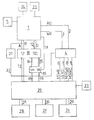
- the basic structure of the circuit consists of a processor (1) which on the one hand controls the actual printing mechanism (25), on the other hand is supplied with the data to be printed by an address bus (11) and a data bus (12) and an interface (20 ), to which different plug-in cards with storage media (26, 27) and data input and output connections (28) for external devices are connected.
- the printing mechanism (25) comprises the mechanical and electronic elements required for printing, that is, as a rule, at least one print head and a motor for feeding the printing medium, which can be, for example, paper or labels applied to a carrier tape.
- the printing mechanism (25) is not shown in the drawing because it is sufficiently well known to the person skilled in the art. If it is a thermal printer, the processor (1) also controls the heating elements of the thermal print head.
- the timing of the processor (1) is defined by a clock (5).
- a data input device (24) which can be designed as a keyboard and / or as an operating panel, is used by the operator to control the processor (1) and thus the printer.
- the decisive innovation of the invention is the use of the interface (20) to which different plug-in cards can be connected by a bus (29 - 31) in a printer.
- the interface (20) enables known and commercially available cards with storage media (26, 27), cards with data input and output connections (28) for external devices (I / O cards, such as, for example, Centronics, RS 232, RS 485 , Network (Ethernet), coaxial or twinax interfaces) or graphics cards with the processor (1).
- I / O cards such as, for example, Centronics, RS 232, RS 485 , Network (Ethernet), coaxial or twinax interfaces
- graphics cards with the processor (1).
- the address bus (11) of the processor (1) is connected to the address bus (13) of the interface (11) via a unidirectional part of a buffer (10), while the data bus (12) of the processor (1) is connected by means of a bidirectional part of the Buffer (10) and another switchable buffer (16) is connected to the interface (20).
- the address of a memory read out by the processor (1) is thus transmitted to the interface (11) via the unidirectional part of the buffer (10); an address transfer in the opposite direction is obvious.
- the data bus (12) of the processor (1) is divided into two on the opposite side of the buffer (10) halves of equal size (generally each comprising 8 bits) are split up and are each transmitted in a separate bus (14, 15) in order to be able to vary the data word width by means of the switchable, also bidirectional buffer (16) (17) switchable buffers (16) controlled by the processor (1) enables the data buses (18, 19) connected to the interface (20) to be looped through to the data buses (14, 15) connected to the buffer (10) to transmit the width of the data bus (usually 16 bits) Alternatively, it is possible to loop through only the bits of the lower order data buses (15, 19) and the higher order data buses (14, 18) to switch off, that is to say to separate them, in order to be able to use plug-in cards (26-28) with less wide data buses at the interface (20).
- the information present on line (17) thus corresponds to
- RISC processor a relatively fast embodiment
- a multiplexer (4) proves to be necessary to control the interface (20).
- the read signal line (2) of the processor (1) is labeled RD ("read") in the drawing, while the write signal line is labeled WR ("write"). If the processor (1) reads in data, a logical one is present on the read signal line (2), whereas a one is present on the write signal line (3) as soon as the processor (1) transmits data to the interface (20).
- the interface itself has four signal lines (6 - 9), one of which can be connected to one.
- the write signal line (6) labeled I / O WR must be connected to one; If the processor (1) reads data from an external device via the interface, the read signal line marked I / O RD must be set to one. Similarly, the write signal line for external storage media (8) is set to one if a memory card connected to the interface (20) is to be written to. Finally, the read signal line MEMRD (9) for external memory cards becomes one as soon as the processor (1) intends to read data from an external memory card.
- the fast processor (1) In order to be able to operate the fast processor (1) with the interface, it controls the address decoder (21) via the address bus (11), which recognizes on the basis of the address present thereon whether the processor (1) has an input or output operation performs peripheral device or on the other hand describes or reads a storage element of an external storage medium.
- the multiplexer (4) controls the four signal lines (6-9) connected to the interface (20) on the basis of the output (22) of the address decoder (21) and the read signal line (2) and the write signal line (3) of the processor (1). If the read signal line (2) of the processor (1) is one and the output (22) of the address decoder (21) shows that a memory operation is being carried out, the multiplexer (4) only connects the MEMRD read signal line (9) for external storage media One.
- the output of the address decoder (21) changes to the opposite logical state and only the I / O RD signal line (7) is set to one.
- the I / O WR or the MEM WR signal lines (6, 8) are set to one, if the Write signal line (3) of the processor (1) is at one. It should be noted that instead of the respective read or write signals, their logical complements can also be present on the lines (2, 3, 6 - 9).
- the interface (20) also has a separate clock generator, the baud rate generator (23).
- the result is a printer that is characterized by its universal applicability and its high processor speed due to its fast processor.
Landscapes
- Engineering & Computer Science (AREA)
- General Engineering & Computer Science (AREA)
- Physics & Mathematics (AREA)
- General Physics & Mathematics (AREA)
- Theoretical Computer Science (AREA)
- Record Information Processing For Printing (AREA)
- Accessory Devices And Overall Control Thereof (AREA)
- Information Transfer Systems (AREA)
- Bus Control (AREA)
Abstract
Description
- Die Erfindung bezieht sich auf einen Drucker mit einer universellen Schnittstelle, mit einem Prozessor, der mit einem Speichermedium sowie Datenein- und -ausgabeanschlüssen für externe Geräte verbindbar ist.
- Ein Drucker gattungsgemäßer Art ist aus der GB 2 211 971 A bekannt geworden. Der den gesamten Druckmechanismus steuernde Prozessor steht über einen Bus mit einem Ein- und Ausgabeport sowie mit einem Festwertspeicher (ROM) und einem variablen Speicher (RAM) in Verbindung. Am Ein- und Ausgabeport ist neben den Motoren für die Druckmechanik und dem Druckkopf eine Schnittstelle für ein externes Gerät, beispielsweise ein Computer, und - separat - ein Festwertspeicher (ROM) für Schriftfonts angeschlossen.
- Als nachteilig ist dabei anzusehen, daß die einfache Druckerschnittstelle nur sehr beschränkte Datenein- und ausgabemöglichkeiten bietet. Insbesondere ist es nicht möglich, externe Speichermedien, wie beispielsweise elektronische Speicherkarten, an die Schnittstelle anzuschließen. Derartige Speicherkarten können Daten enthalten, die den Drucker in die Lage versetzen, mit verschiedenen Schrifttypen zu schreiben und müssen bei dem vorbekannten Drucker in die eigens dafür vorgesehene Steckerbuchse eingeschoben werden.
- Das Problem der vorliegenden Erfindung besteht darin, die Datenein- und -ausgabemöglichkeiten von Druckern dahingehend zu erweitern, daß auch Daten von externen Speichermedien, wie z.B. von Speicherkarten, in den Drucker einlesbar sind und auf das Speichermedium ausgegeben werden können.
- Erfindungsgemäß wird die Aufgabe gelöst durch eine vom Prozessor angesteuerte, gemeinsame Schnittstelle, an der sowohl das Speichermedium als auch die Datenein- und áausgabeanschlüsse für externe Geräte anschließbar sind.
- Der Kerngedanke besteht darin, den Drucker mit einer universellen Schnittstelle auszustatten, an der sowohl Karten mit Datenein- und -ausgabeanschlüsse für externe Geräte als auch Speichermedien anschließbar sind. Durch Speicherkarten kann beispielsweise die Speicherkapazität des Druckers vergrößert oder unterschiedliche Schrifttypen (Fonts) anhand permanent (in einem ROM) gespeicherter Daten wiedergegeben werden. Eine Grafikkarte ermöglicht, das auszugebende Druckbild auf einem Bildschirm zu kontrollieren, bevor es auf dem Druckmedium ausgedruckt wird, um eventuelle Fehler optisch erkennen und beheben zu können. Schließlich kann die universelle Schnittstelle zum Anschluß beliebiger Ein- und Ausgabekarten dienen. Letztere können zusätzlich zu - im Regelfall standardmäßig vorhandenen - Anschlüssen für Datenquellen, wie Computern, verwendet werden, die nicht über die Schnittstelle, sondern anderweitig mit dem Prozessor verknüpft sind.
- Die Vorteile der Erfindung bestehen vornehmlich in der universellen Erweiterbarkeit des Druckers, da beliebige, bereits kommerziell und preiswert verfügbare Einsteckkarten zur Verwendung kommen können.
- Derartige Karten weisen im Regelfall eine Schreibsignalleitung und eine Lesesignalleitung für Datenein- und -ausgabeanschlüsse für externe Geräte sowie eine Schreibsignalleitung und eine Lesesignalleitung für Speichermedien auf, so daß naheliegenderweise auch die Schnittstelle des Druckers mit derartigen Leitungen ausgestattet wird.
- Sollen besonders schnelle sogenannte RISC-Prozessoren für Drucker (wie z.B ein AMD 29200) mit gegenüber konventionellen Prozessoren reduziertem Befehlssatz zur Verwendung kommen, um die Geschwindigkeit des Druckers zu steigern, erweist sich die Verwendung eines Multiplexers als notwendig, da derartige Prozessoren lediglich eine Lesesignalleitung und eine Schreibsignalleitung aufweisen, jedoch keinen Ausgang zur Unterscheidung zwischen externen Speichermedien und sonstigen Geräten aufweisen. Der Multiplexer erkennt die Art des anzusteuernden Gerätes anhand des Ausgangssignales eines mit dem Adressbus des Prozessors verknüpften Adressdekoders und steuert die vier Leitungen (die Schreibsignalleitung und die Lesesignalleitung für Datenein- und -ausgabeanschlüsse für externe Geräte sowie die Schreibsignalleitung und die Lesesignalleitung für Speichermedien) der Schnittstelle entsprechend. Der Prozessor kann also anhand seines Adressbusses mittels des Adressdekoders und des Multiplexers zwischen den externen Gerätearten umschalten.
- Um Einsteckkarten mit unterschiedlich breiten Datenbussen verwenden zu können, ist weiterhin vorgeschlagen, die Breite des Datenbusses durch den Prozessor umschaltbar zu gestalten. Es können so beispielsweise 8- und 16-Bit-Einsteckkarten zum Einsatz kommen. Die Umschaltung kann im konkreten hardwaremäßig durch einen in den bidirektionalen Datenbus des Prozessors eingefügten Puffer erfolgen, der durch einen separaten Ausgang des Prozessors gesteuert wird und die Übertragung der höherwertigen Bits des Datenbusses unterbinden (d.h. letztere hochohmig schalten) kann.
- Schließlich ist empfohlen, die Schnittstelle mit einem separaten Baudratengenerator als Taktgeber auszustatten, um den Prozessor mit einer beliebigen (insbesondere höheren) Taktfrequenz seines eigenen Taktgebers betreiben zu können.
- Im folgenden wird eine Ausführungsform der Erfindung anhand der Zeichnung näher erläutert. Sie zeigt in schematischer Darstellung eine Schaltung zur Dateneingabe und -ausgabe eines Druckers.
- Die Schaltung besteht in ihrem grundsätzlichen Aufbau aus einem Prozessor (1), der einerseits den eigentlichen Druckmechanismus (25) steuert, andererseits durch einen Adressbus (11) und einen Datenbus (12) mit den zu druckenden Daten versorgt wird, sowie einer Schnittstelle (20), an der unterschiedliche Einsteckkarten mit Speichermedien (26, 27) und Datenein- und ausgabeanschlüsse (28) für externe Geräte angeschlossen sind.
- Der Druckmechanismus (25) umfasst die zum Drucken notwendigen mechanischen und elektronischen Elemente, also in der Regel zumindest einen Druckkopf und einen Motor zum Vorschub des Druckmediums, welches beispielsweise Papier oder auf einem Trägerband aufgebrachte Etiketten sein kann. Der Druckmechanismus (25) ist in der Zeichnung nicht näher dargestellt, da er dem Fachmann hinreichend gut bekannt ist. Handelt es sich um einen Thermodrucker, steuert der Prozessor (1) auch die Heizelemente des Thermodruckkopfes.
- Der Zeittakt des Prozessors (1) wird durch einen Taktgeber (5) definiert. Eine Dateneingabevorrichtung (24), die als Tastatur und/oder als Bedienungspanel ausgebildet sein kann, dient dem Bediener zur Steuerung des Prozessors (1) und somit des Druckers.
- Die entscheidende Neuerung der Erfindung besteht in der Verwendung der Schnittstelle (20), an der unterschiedliche Einsteckkarten durch jeweils einen Bus (29 - 31) angeschlossen werden können, in einem Drucker. Die Schnittstelle (20) ermöglicht, bekannte und kommerziell verfügbare Karten mit Speichermedien (26, 27), Karten mit Datenein- und -ausgabeanschlüssen (28) für externe Geräte (I/O-Karten, wie z.B. Centronics-, RS 232, RS 485, Netzwerk (Ethernet), Koaxial- oder Twinax-Schnittstellen) oder Grafikkarten mit dem Prozessor (1) zu verbinden. Selbstverständlich besteht die Möglichkeit, an der Schnittstelle (20) mehr als nur die drei eingezeichneten Einsteckkarten anzuschließen.
- Der Adressbus (11) des Prozessors (1) ist über einen unidirektional arbeitenden Teil eines Puffers (10) mit dem Adressbus (13) der Schnittstelle (11) verbunden, während der Datenbus (12) des Prozessors (1) mittels eines bidirektionalen Teils des Puffers (10) und einen weiteren umschaltbaren Puffer (16) an der Schnittstelle (20) angeschlossen ist. Die vom Prozessor (1) ausgelesene Adresse eines Speichers wird somit über den unidirektionalen Teil des Puffers (10) auf die Schnittstelle (11) übertragen; eine Adressübertragung in der umgekehrten Richtung erürigt sich naheliegenderweise.
- Daten können hingegen in beiden Richtungen (vom und zum Prozessor (1) übertragen werden; beispielsweise eine Speicherkarte ist somit bescheib- und lesbar. Der Datenbus (12) des Prozessors (1) wird auf der letzerem gegenüberliegenden Seite des Puffers (10) in zwei gleich große Hälften (in der Regel jeweils 8 Bit umfassend) aufgespalten, die in jeweils einem separaten Bus (14, 15) übertragen werden, um mittels des umschaltbaren, ebenfalls bidirektional arbeitenden Puffers (16) die Datenwortbreite variieren zu können. Der durch die Leitung (17) durch den Prozessor (1) gesteuerte umschaltbare Puffer (16) ermöglicht, die mit der Schnittstelle (20) verbundenen Datenbusse (18, 19) entweder jeweils auf die am Puffer (10) angeschlossenen Datenbusse (14, 15) durchzuschleifen, um die Breite des Datenbusses (in der Regel somit 16 Bit) zu übertragen. Alternativ besteht die Möglichkeit, nur die Bits der niederwertigeren Datenbusse (15, 19) durchzuschleifen und die höherwertigen Datenbusse (14, 18) abzuschalten, also voneinander zu trennen, um an der Schnittstelle (20) Einsteckkarten (26 - 28) mit weniger breiten Datenbussen verwenden zu können. Die an der Leitung (17) anliegende Information entspricht somit einem die höherwertigen Bits ein- und ausschaltenden Steuersignal.
- Da als Prozessor (1) eine relativ schnelle Ausführungsform (RISC-Prozessor) zur Verwendung kommt, die lediglich zwei Ausgangssteuerleitungen (2, 3) aufweist, erweist sich zur Ansteuerung der Schnittstelle (20) ein Multiplexer (4) als notwendig. Die Lesesignalleitung (2) des Prozessors (1) ist in der Zeichnung mit RD ("read") bezeichnet, während die Schreibsignalleitung mit WR ("write") gekennzeichnet ist. Falls der Prozessor (1) Daten einliest, liegt an der Lesesignalleitung (2) eine logische Eins an, während hingegen eine Eins an der Schreibsignalleitung (3) anliegt, sobald der Prozessor (1) Daten an die Schnittstelle (20) überträgt. Die Schnittstelle ihrerseits weist jedoch vier Signalleitungen (6 - 9) auf, von denen jeweils eine auf Eins gelegt werden kann. Falls der Prozessor (1) auf ein externes Gerät über die Schnittstelle Daten überträgt, ist die mit I/O WR bezeichnete Schreibsignalleitung (6) auf Eins zu legen; liest der Prozessor (1) Daten von einem externen Gerät über die Schnittstelle ein, ist die mit I/O RD gekennzeichnete Lesesignalleitung mit Eins zu legen. Analog wird die Schreibsignalleitung für externe Speichermedien (8) auf Eins gelegt, falls eine an der Schnittstelle (20) angeschlossene Speicherkarte beschrieben werden soll. Schließlich wird die Lesesignalleitung MEMRD (9) für externe Speicherkarten Eins, sobald der Prozessor (1) aus einer externen Speicherkarte Daten auszulesen beabsichtigt. Um den schnellen Prozessor (1) mit der Schnittstelle betreiben zu können, steuert er über den Adressbus (11) den Adressdekoder (21), der anhand der darauf vorliegenden Adresse erkennt, ob der Prozessor (1) einerseits eine Ein- oder Ausgabeoperation in ein peripheres Gerät durchführt oder andererseits ein Speicherelement eines externen Speichermediums beschreibt oder ausliest. Der Multiplexer (4) steuert anhand des Ausganges (22) des Adressdekoders (21) sowie der Lesesignalleitung (2) und der Schreibsignalleitung (3) des Prozessors (1) die vier an der Schnittstelle (20) angeschlossenen Signalleitungen (6 - 9). Ist die Lesesignalleitung (2) des Prozessors (1) auf Eins und anhand des Ausgangs (22) des Adressdekoders (21) erkennbar, daß eine Speicheroperation durchgeführt wird, legt der Multiplexer (4) nur die MEMRD Lesesignalleitung (9) für externe Speichermedien auf Eins. Beabsichtigt der Prozessor (1), Daten aus einem externen Gerät auszulesen, geht der Ausgang des Adressdekoders (21) in den entgegengesetzten logischen Zustand über und nur die I/O RD Signalleitung (7) wird auf Eins gesetzt. Entsprechend werden- abhängig vom Ausgang (22) des Adressdekoders (21) die I/O WR bzw. die MEM WR Signalleitungen (6, 8) auf Eins gesetzt, falls die Schreibsignalleitung (3) des Prozessors (1) auf Eins steht. Anzumerken bleibt, daß an den Leitungen (2, 3, 6 - 9) anstelle der jeweiligen Lese- bzw. Schreibsignale auch ihre logischen Komplemente anliegen können.
- Die Schnittstelle (20) weist weiterhin einen separaten Taktgeber, den Baudratengenerator (23) auf.
- Im Ergebnis erhält man einen Drucker, der sich durch universelle Verwendbarkeit und aufgrund des schnellen Prozessors durch hohe Arbeitsgeschwindigkeit auszeichnet.
Claims (10)
- Drucker mit einer universellen Schnittstelle, mit einem Prozessor (1), der mit einem Speichermedium (26, 27) sowie Datenein- und -ausgabeanschlüssen (28) für externe Geräte verbindbar ist, gekennzeichnet durch eine vom Prozessor (1) angesteuerte, gemeinsame Schnittstelle (20), an der sowohl das Speichermedium (26,27) als auch die Datenein- und -ausgabeanschlüsse (28) für externe Geräte anschließbar sind.
- Drucker nach Anspruch 1, dadurch gekennzeichnet, daß die Schnittstelle (20) eine Schreibsignalleitung (6) und eine Lesesignalleitung (7) für Datenein- und ausgabeanschlüsse (28) für externe Geräte sowie eine Schreibsignalleitung (8) und eine Lesesignalleitung (9) für Speichermedien (26, 27) aufweist.
- Drucker nach Anspruch 2, gekennzeichnet durch einen Multiplexer (4), der anhand einer Lesesignalleitung (2), einer Schreibsignalleitung (3) und des Adressbusses (11) des Prozessors (1) die Schreib- und Lesesignalleitungen (6 - 9) der Schnittstelle (20) steuert.
- Drucker nach Anspruch 3, gekennzeichnet durch einen Adressdekoder (21), der den Multiplexer (4) anhand des Adressbusses (11) des Prozessors (1) steuert.
- Drucker nach einem der Ansprüche 1 bis 4, dadurch gekennzeichnet, daß die Breite des Datenbusses (18, 19) der Schnittstelle (20) durch den Prozessor (1) umschaltbar ist.
- Drucker nach einem der Ansprüche 1 bis 5, gekennzeichnet durch einen Baudratengenerator (23) als Taktgeber der Schnittstelle (20), wobei der Prozessor (1) einen eigenen Taktgeber (5) aufweist.
- Drucker nach einem der Ansprüche 1 bis 6, dadurch gekennzeichnet, daß der Prozessor (1) einen Druckmechanismus (25) steuert.
- Drucker nach einem der Ansprüche 1 bis 7, dadurch gekennzeichnet, daß er ein Thermodrucker ist, mit dem Etikettenstreifen bedruckbar sind.
- Drucker nach einem der Ansprüche 1 bis 8, gekennzeichnet durch eine an der Schnittstelle (20) anschließbare Grafikkarte.
- Drucker nach einem der Ansprüche 1 bis 9, dadurch gekennzeichnet, daß der Prozessor (1) ein RISC-Prozessor ist.
Priority Applications (1)
| Application Number | Priority Date | Filing Date | Title |
|---|---|---|---|
| EP98121136A EP0901095A3 (de) | 1993-09-24 | 1994-07-21 | Drucker mit einer universellen Schnittstelle |
Applications Claiming Priority (2)
| Application Number | Priority Date | Filing Date | Title |
|---|---|---|---|
| DE4332609 | 1993-09-24 | ||
| DE4332609A DE4332609A1 (de) | 1993-09-24 | 1993-09-24 | Schaltungsanordnung zur Dateneingabe und Datenausgabe für einen Drucker |
Related Child Applications (1)
| Application Number | Title | Priority Date | Filing Date |
|---|---|---|---|
| EP98121136A Division EP0901095A3 (de) | 1993-09-24 | 1994-07-21 | Drucker mit einer universellen Schnittstelle |
Publications (3)
| Publication Number | Publication Date |
|---|---|
| EP0645733A2 true EP0645733A2 (de) | 1995-03-29 |
| EP0645733A3 EP0645733A3 (de) | 1995-06-28 |
| EP0645733B1 EP0645733B1 (de) | 1999-06-09 |
Family
ID=6498569
Family Applications (2)
| Application Number | Title | Priority Date | Filing Date |
|---|---|---|---|
| EP98121136A Withdrawn EP0901095A3 (de) | 1993-09-24 | 1994-07-21 | Drucker mit einer universellen Schnittstelle |
| EP94111343A Expired - Lifetime EP0645733B1 (de) | 1993-09-24 | 1994-07-21 | Drucker mit einer universellen Schnittstelle |
Family Applications Before (1)
| Application Number | Title | Priority Date | Filing Date |
|---|---|---|---|
| EP98121136A Withdrawn EP0901095A3 (de) | 1993-09-24 | 1994-07-21 | Drucker mit einer universellen Schnittstelle |
Country Status (6)
| Country | Link |
|---|---|
| US (1) | US5684931A (de) |
| EP (2) | EP0901095A3 (de) |
| JP (1) | JPH07210342A (de) |
| AU (1) | AU669816B2 (de) |
| DE (2) | DE4332609A1 (de) |
| SG (1) | SG47103A1 (de) |
Families Citing this family (10)
| Publication number | Priority date | Publication date | Assignee | Title |
|---|---|---|---|---|
| US6027265A (en) * | 1997-10-14 | 2000-02-22 | Powis Parker, Inc. | Printer having improved print head mechanism and method |
| GB2343658B (en) * | 1998-11-13 | 2002-07-31 | Esselte Nv | A printer with variable friction between printer and a medium |
| US20020138558A1 (en) * | 2001-01-11 | 2002-09-26 | Ferlitsch Andrew R. | Managing and processing print jobs in a networked computer environment |
| US7128236B2 (en) * | 2002-09-13 | 2006-10-31 | Avery Dennison Corporation | Versatile label sheet and dispenser |
| US6991130B2 (en) * | 2002-09-13 | 2006-01-31 | Avery Dennison Corporation | Versatile label sheet and dispenser |
| JP4405223B2 (ja) * | 2003-09-30 | 2010-01-27 | 株式会社キングジム | 文字情報処理システム、文字情報処理装置及び文字情報処理プログラム |
| JP4599827B2 (ja) * | 2003-10-31 | 2010-12-15 | セイコーエプソン株式会社 | テープ印刷装置およびテープ印刷装置のデータ処理方法 |
| JP2008049563A (ja) * | 2006-08-23 | 2008-03-06 | Canon Inc | 画像処理装置、画像記録装置および記録データ生成方法 |
| DE102010009229A1 (de) * | 2010-02-25 | 2011-02-17 | Wavelight Ag | Ärztliche Praxis, insbesondere für augenchirurgische Behandlungen |
| US10350905B2 (en) | 2017-01-26 | 2019-07-16 | Datamax-O'neil Corporation | Detecting printing ribbon orientation |
Family Cites Families (14)
| Publication number | Priority date | Publication date | Assignee | Title |
|---|---|---|---|---|
| DE3680569D1 (de) * | 1985-04-26 | 1991-09-05 | Sato Kk | Thermischer etikettendrucker. |
| US4807177A (en) * | 1986-06-06 | 1989-02-21 | Ward Richard J | Multiple format hand held label printer |
| JPH01118454A (ja) * | 1987-10-30 | 1989-05-10 | Brother Ind Ltd | 印字装置 |
| JPH01187627A (ja) * | 1988-01-22 | 1989-07-27 | Toshiba Corp | 情報処理装置 |
| DE58909413D1 (de) * | 1989-05-31 | 1995-10-05 | Siemens Ag | Adaptereinrichtung zum störungsfreien Anschluss von peripheren Rechnereinrichtungen an eine von Rechnersystemen gesteuerte Peripherieschnittstelle. |
| DE69108443T2 (de) * | 1990-05-17 | 1995-09-21 | Seiko Epson Corp | Streifendrucker. |
| US5150456A (en) * | 1990-08-06 | 1992-09-22 | Elite High Technology, Inc. | Graphic image printing system and method |
| US5110226A (en) * | 1990-10-19 | 1992-05-05 | Norand Corporation | Battery operated data entry terminal device and printer attachment |
| JPH05189104A (ja) * | 1990-10-31 | 1993-07-30 | Ricoh Co Ltd | 並列インタフェース |
| US5195176A (en) * | 1991-09-09 | 1993-03-16 | Destiny Technology Corporation | Method and apparatus to enhance laser printer speed and functionality |
| DE4133998A1 (de) * | 1991-10-14 | 1993-04-15 | Schmidt Anita | Druckerumschalter |
| CA2080608A1 (en) * | 1992-01-02 | 1993-07-03 | Nader Amini | Bus control logic for computer system having dual bus architecture |
| GB2267984A (en) * | 1992-06-16 | 1993-12-22 | Thorn Emi Electronics Ltd | Multiplexing bus interface. |
| US5358351A (en) * | 1992-09-30 | 1994-10-25 | Casio Computer Co., Ltd. | Printing apparatus and printing tape cassette used therefor |
-
1993
- 1993-09-24 DE DE4332609A patent/DE4332609A1/de not_active Withdrawn
-
1994
- 1994-07-21 SG SG1996007514A patent/SG47103A1/en unknown
- 1994-07-21 EP EP98121136A patent/EP0901095A3/de not_active Withdrawn
- 1994-07-21 EP EP94111343A patent/EP0645733B1/de not_active Expired - Lifetime
- 1994-07-21 DE DE59408384T patent/DE59408384D1/de not_active Expired - Fee Related
- 1994-08-16 AU AU70289/94A patent/AU669816B2/en not_active Ceased
- 1994-09-14 JP JP6220283A patent/JPH07210342A/ja active Pending
- 1994-09-22 US US08/310,634 patent/US5684931A/en not_active Expired - Fee Related
Also Published As
| Publication number | Publication date |
|---|---|
| AU669816B2 (en) | 1996-06-20 |
| AU7028994A (en) | 1995-04-06 |
| EP0645733B1 (de) | 1999-06-09 |
| DE59408384D1 (de) | 1999-07-15 |
| EP0901095A2 (de) | 1999-03-10 |
| SG47103A1 (en) | 1998-03-20 |
| US5684931A (en) | 1997-11-04 |
| JPH07210342A (ja) | 1995-08-11 |
| EP0645733A3 (de) | 1995-06-28 |
| DE4332609A1 (de) | 1995-03-30 |
| EP0901095A3 (de) | 2002-06-12 |
Similar Documents
| Publication | Publication Date | Title |
|---|---|---|
| DE69623607T2 (de) | Vorrichtung und verfahren zur steuerung von peripheriegeräten mit interierter datenkompression | |
| DE69322998T2 (de) | Verfahren und Vorrichtung für die Umwandlung von Bilddaten in einem Printer | |
| DE68927396T2 (de) | Schriftzeichendaten-Steuerung | |
| DE3805573C2 (de) | ||
| DE69301927T2 (de) | Automatische Bestimmung der Druckerdatenstromsprache | |
| EP0645733B1 (de) | Drucker mit einer universellen Schnittstelle | |
| DE4135830C2 (de) | Parallelinterface | |
| EP0056948A1 (de) | Bürokommunikationssystem | |
| DE69737717T2 (de) | Bildprozessor | |
| DE3716752C2 (de) | ||
| DE3209187C2 (de) | Verfahren zur Darstellung eines Textes auf einer einzeiligen Anzeigevorrichtung eines Texterstellungsgerätes | |
| DE19525660A1 (de) | Schaltvorrichtung für periphere Komponenten eines Computers | |
| DE3506592C2 (de) | Aufzeichnungsgerät | |
| EP0784901B1 (de) | Verfahren und vorrichtung zum optischen einlesen einer dokumentvorlage mit einem scanner und zum bedrucken eines aufzeichnungsträgers mit einem drucker | |
| DE4316278C2 (de) | Einstellsystem für das Betriebsumfeld eines Aufzeichnungsgeräts und Betriebsverfahren für ein Aufzeichnungsgerät | |
| DE3046037A1 (de) | Textbearbeitungsgeraet | |
| DE69634653T2 (de) | Abbildungsausgabegerät und entspechendes Steuerverfahren | |
| DE69428645T2 (de) | Datenbussteuerung mit Pegeleinstellungsschaltung | |
| DE19547995C2 (de) | Seitendrucker-Regelvorrichtung | |
| DE69126259T2 (de) | Druckvorrichtung | |
| EP0895199B1 (de) | Fahrtschreiber mit einer Schnittstelle für seinen Anschluss an einen Datenbus | |
| DE69222635T2 (de) | Anordnung zum treiben von differentiellen und unsymmetrischen rechnerbussen | |
| EP0338290A2 (de) | Verfahren zum Laden einer für den Betrieb einer mikroprozessorgesteuerten elektrischen Einrichtung erforderlichen Betriebs-Steuerbefehlsfolge | |
| DE69128011T2 (de) | Bilderzeugungsgerät | |
| DE4030324A1 (de) | Ausgabegeraet |
Legal Events
| Date | Code | Title | Description |
|---|---|---|---|
| PUAI | Public reference made under article 153(3) epc to a published international application that has entered the european phase |
Free format text: ORIGINAL CODE: 0009012 |
|
| AK | Designated contracting states |
Kind code of ref document: A2 Designated state(s): DE DK ES FR GB IT NL SE |
|
| PUAL | Search report despatched |
Free format text: ORIGINAL CODE: 0009013 |
|
| AK | Designated contracting states |
Kind code of ref document: A3 Designated state(s): DE DK ES FR GB IT NL SE |
|
| 17P | Request for examination filed |
Effective date: 19950714 |
|
| 17Q | First examination report despatched |
Effective date: 19971216 |
|
| RAP1 | Party data changed (applicant data changed or rights of an application transferred) |
Owner name: METO INTERNATIONAL GMBH |
|
| GRAG | Despatch of communication of intention to grant |
Free format text: ORIGINAL CODE: EPIDOS AGRA |
|
| GRAG | Despatch of communication of intention to grant |
Free format text: ORIGINAL CODE: EPIDOS AGRA |
|
| GRAH | Despatch of communication of intention to grant a patent |
Free format text: ORIGINAL CODE: EPIDOS IGRA |
|
| GRAH | Despatch of communication of intention to grant a patent |
Free format text: ORIGINAL CODE: EPIDOS IGRA |
|
| GRAA | (expected) grant |
Free format text: ORIGINAL CODE: 0009210 |
|
| AK | Designated contracting states |
Kind code of ref document: B1 Designated state(s): DE DK ES FR GB IT NL SE |
|
| PG25 | Lapsed in a contracting state [announced via postgrant information from national office to epo] |
Ref country code: SE Free format text: THE PATENT HAS BEEN ANNULLED BY A DECISION OF A NATIONAL AUTHORITY Effective date: 19990609 Ref country code: IT Free format text: LAPSE BECAUSE OF FAILURE TO SUBMIT A TRANSLATION OF THE DESCRIPTION OR TO PAY THE FEE WITHIN THE PRESCRIBED TIME-LIMIT;WARNING: LAPSES OF ITALIAN PATENTS WITH EFFECTIVE DATE BEFORE 2007 MAY HAVE OCCURRED AT ANY TIME BEFORE 2007. THE CORRECT EFFECTIVE DATE MAY BE DIFFERENT FROM THE ONE RECORDED. Effective date: 19990609 Ref country code: ES Free format text: THE PATENT HAS BEEN ANNULLED BY A DECISION OF A NATIONAL AUTHORITY Effective date: 19990609 |
|
| REF | Corresponds to: |
Ref document number: 59408384 Country of ref document: DE Date of ref document: 19990715 |
|
| ET | Fr: translation filed | ||
| PG25 | Lapsed in a contracting state [announced via postgrant information from national office to epo] |
Ref country code: DK Free format text: LAPSE BECAUSE OF FAILURE TO SUBMIT A TRANSLATION OF THE DESCRIPTION OR TO PAY THE FEE WITHIN THE PRESCRIBED TIME-LIMIT Effective date: 19990909 |
|
| GBT | Gb: translation of ep patent filed (gb section 77(6)(a)/1977) |
Effective date: 19991020 |
|
| PLBE | No opposition filed within time limit |
Free format text: ORIGINAL CODE: 0009261 |
|
| STAA | Information on the status of an ep patent application or granted ep patent |
Free format text: STATUS: NO OPPOSITION FILED WITHIN TIME LIMIT |
|
| 26N | No opposition filed | ||
| REG | Reference to a national code |
Ref country code: GB Ref legal event code: IF02 |
|
| PGFP | Annual fee paid to national office [announced via postgrant information from national office to epo] |
Ref country code: FR Payment date: 20020709 Year of fee payment: 9 |
|
| PGFP | Annual fee paid to national office [announced via postgrant information from national office to epo] |
Ref country code: GB Payment date: 20020717 Year of fee payment: 9 |
|
| PGFP | Annual fee paid to national office [announced via postgrant information from national office to epo] |
Ref country code: DE Payment date: 20020724 Year of fee payment: 9 |
|
| PGFP | Annual fee paid to national office [announced via postgrant information from national office to epo] |
Ref country code: NL Payment date: 20020730 Year of fee payment: 9 |
|
| PG25 | Lapsed in a contracting state [announced via postgrant information from national office to epo] |
Ref country code: GB Free format text: LAPSE BECAUSE OF NON-PAYMENT OF DUE FEES Effective date: 20030721 |
|
| PG25 | Lapsed in a contracting state [announced via postgrant information from national office to epo] |
Ref country code: NL Free format text: LAPSE BECAUSE OF NON-PAYMENT OF DUE FEES Effective date: 20040201 |
|
| PG25 | Lapsed in a contracting state [announced via postgrant information from national office to epo] |
Ref country code: DE Free format text: LAPSE BECAUSE OF NON-PAYMENT OF DUE FEES Effective date: 20040203 |
|
| GBPC | Gb: european patent ceased through non-payment of renewal fee |
Effective date: 20030721 |
|
| PG25 | Lapsed in a contracting state [announced via postgrant information from national office to epo] |
Ref country code: FR Free format text: LAPSE BECAUSE OF NON-PAYMENT OF DUE FEES Effective date: 20040331 |
|
| NLV4 | Nl: lapsed or anulled due to non-payment of the annual fee |
Effective date: 20040201 |
|
| REG | Reference to a national code |
Ref country code: FR Ref legal event code: ST |