EP0646574A1 - Dérivés d'indane cétoniques, leur procédé d'obtention, leur application thérapeutique - Google Patents
Dérivés d'indane cétoniques, leur procédé d'obtention, leur application thérapeutique Download PDFInfo
- Publication number
- EP0646574A1 EP0646574A1 EP94402168A EP94402168A EP0646574A1 EP 0646574 A1 EP0646574 A1 EP 0646574A1 EP 94402168 A EP94402168 A EP 94402168A EP 94402168 A EP94402168 A EP 94402168A EP 0646574 A1 EP0646574 A1 EP 0646574A1
- Authority
- EP
- European Patent Office
- Prior art keywords
- radical
- dmso
- mhz
- ppm
- hydrogen atom
- Prior art date
- Legal status (The legal status is an assumption and is not a legal conclusion. Google has not performed a legal analysis and makes no representation as to the accuracy of the status listed.)
- Granted
Links
- 125000003392 indanyl group Chemical class C1(CCC2=CC=CC=C12)* 0.000 title claims abstract 7
- 238000002360 preparation method Methods 0.000 title description 3
- 230000001225 therapeutic effect Effects 0.000 title description 3
- 125000004435 hydrogen atom Chemical group [H]* 0.000 claims abstract description 42
- 125000004430 oxygen atom Chemical group O* 0.000 claims abstract description 28
- 229910052760 oxygen Inorganic materials 0.000 claims abstract description 27
- 125000005843 halogen group Chemical group 0.000 claims abstract description 14
- CIUQDSCDWFSTQR-UHFFFAOYSA-N [C]1=CC=CC=C1 Chemical group [C]1=CC=CC=C1 CIUQDSCDWFSTQR-UHFFFAOYSA-N 0.000 claims abstract description 10
- 125000001072 heteroaryl group Chemical group 0.000 claims abstract description 10
- 125000003118 aryl group Chemical group 0.000 claims abstract description 9
- 239000001257 hydrogen Substances 0.000 claims abstract description 8
- 229910052739 hydrogen Inorganic materials 0.000 claims abstract description 8
- QVGXLLKOCUKJST-UHFFFAOYSA-N atomic oxygen Chemical compound [O] QVGXLLKOCUKJST-UHFFFAOYSA-N 0.000 claims abstract description 7
- 239000001301 oxygen Substances 0.000 claims abstract description 7
- 125000005842 heteroatom Chemical group 0.000 claims abstract description 4
- 125000002887 hydroxy group Chemical group [H]O* 0.000 claims abstract description 4
- 125000003545 alkoxy group Chemical group 0.000 claims abstract description 3
- 150000003254 radicals Chemical class 0.000 claims description 51
- -1 Ketone indane derivatives Chemical class 0.000 claims description 49
- 150000001875 compounds Chemical class 0.000 claims description 44
- VEXZGXHMUGYJMC-UHFFFAOYSA-N Hydrochloric acid Chemical compound Cl VEXZGXHMUGYJMC-UHFFFAOYSA-N 0.000 claims description 34
- QAOWNCQODCNURD-UHFFFAOYSA-N Sulfuric acid Chemical compound OS(O)(=O)=O QAOWNCQODCNURD-UHFFFAOYSA-N 0.000 claims description 18
- 238000000034 method Methods 0.000 claims description 11
- 150000003839 salts Chemical class 0.000 claims description 11
- QTBSBXVTEAMEQO-UHFFFAOYSA-N Acetic acid Chemical compound CC(O)=O QTBSBXVTEAMEQO-UHFFFAOYSA-N 0.000 claims description 9
- 239000003814 drug Substances 0.000 claims description 8
- OAKJQQAXSVQMHS-UHFFFAOYSA-N hydrazine Substances NN OAKJQQAXSVQMHS-UHFFFAOYSA-N 0.000 claims description 8
- WCYWZMWISLQXQU-UHFFFAOYSA-N methyl Chemical group [CH3] WCYWZMWISLQXQU-UHFFFAOYSA-N 0.000 claims description 8
- YCKCHOCLHWUEIU-UHFFFAOYSA-N 1-amino-3-pyridin-3-ylurea Chemical compound NNC(=O)NC1=CC=CN=C1 YCKCHOCLHWUEIU-UHFFFAOYSA-N 0.000 claims description 7
- MJTBMALRTPNOQB-UHFFFAOYSA-N 1-amino-3-pyridin-4-ylurea Chemical compound NNC(=O)NC1=CC=NC=C1 MJTBMALRTPNOQB-UHFFFAOYSA-N 0.000 claims description 6
- MUBZPKHOEPUJKR-UHFFFAOYSA-N Oxalic acid Chemical compound OC(=O)C(O)=O MUBZPKHOEPUJKR-UHFFFAOYSA-N 0.000 claims description 6
- 239000013067 intermediate product Substances 0.000 claims description 6
- QJGQUHMNIGDVPM-UHFFFAOYSA-N nitrogen group Chemical group [N] QJGQUHMNIGDVPM-UHFFFAOYSA-N 0.000 claims description 6
- 230000008569 process Effects 0.000 claims description 6
- 206010040070 Septic Shock Diseases 0.000 claims description 5
- KRKNYBCHXYNGOX-UHFFFAOYSA-N citric acid Chemical compound OC(=O)CC(O)(C(O)=O)CC(O)=O KRKNYBCHXYNGOX-UHFFFAOYSA-N 0.000 claims description 5
- 230000002757 inflammatory effect Effects 0.000 claims description 5
- 230000007170 pathology Effects 0.000 claims description 5
- 230000036303 septic shock Effects 0.000 claims description 5
- KDYFGRWQOYBRFD-UHFFFAOYSA-N succinic acid Chemical compound OC(=O)CCC(O)=O KDYFGRWQOYBRFD-UHFFFAOYSA-N 0.000 claims description 5
- 201000002282 venous insufficiency Diseases 0.000 claims description 5
- IIVWHGMLFGNMOW-UHFFFAOYSA-N 2-methylpropane Chemical group C[C](C)C IIVWHGMLFGNMOW-UHFFFAOYSA-N 0.000 claims description 4
- FEWJPZIEWOKRBE-JCYAYHJZSA-N Dextrotartaric acid Chemical compound OC(=O)[C@H](O)[C@@H](O)C(O)=O FEWJPZIEWOKRBE-JCYAYHJZSA-N 0.000 claims description 4
- 239000002253 acid Substances 0.000 claims description 4
- VZCYOOQTPOCHFL-UHFFFAOYSA-N trans-butenedioic acid Natural products OC(=O)C=CC(O)=O VZCYOOQTPOCHFL-UHFFFAOYSA-N 0.000 claims description 4
- BGCDDMALTCVQBP-UHFFFAOYSA-N 1-amino-3-pyridin-2-ylurea Chemical compound NNC(=O)NC1=CC=CC=N1 BGCDDMALTCVQBP-UHFFFAOYSA-N 0.000 claims description 3
- VZCYOOQTPOCHFL-OWOJBTEDSA-N Fumaric acid Chemical compound OC(=O)\C=C\C(O)=O VZCYOOQTPOCHFL-OWOJBTEDSA-N 0.000 claims description 3
- 125000004429 atom Chemical group 0.000 claims description 3
- 230000036772 blood pressure Effects 0.000 claims description 3
- 230000035939 shock Effects 0.000 claims description 3
- 239000001384 succinic acid Substances 0.000 claims description 3
- 239000011975 tartaric acid Substances 0.000 claims description 3
- 208000004672 Cardiovascular Infections Diseases 0.000 claims description 2
- 101100134925 Gallus gallus COR6 gene Proteins 0.000 claims description 2
- OFOBLEOULBTSOW-UHFFFAOYSA-N Propanedioic acid Natural products OC(=O)CC(O)=O OFOBLEOULBTSOW-UHFFFAOYSA-N 0.000 claims description 2
- FEWJPZIEWOKRBE-UHFFFAOYSA-N Tartaric acid Natural products [H+].[H+].[O-]C(=O)C(O)C(O)C([O-])=O FEWJPZIEWOKRBE-UHFFFAOYSA-N 0.000 claims description 2
- 150000007513 acids Chemical class 0.000 claims description 2
- 125000003282 alkyl amino group Chemical group 0.000 claims description 2
- 150000001412 amines Chemical class 0.000 claims description 2
- 238000003776 cleavage reaction Methods 0.000 claims description 2
- 125000000532 dioxanyl group Chemical group 0.000 claims description 2
- 150000004862 dioxolanes Chemical class 0.000 claims description 2
- 239000001530 fumaric acid Substances 0.000 claims description 2
- 229910052500 inorganic mineral Inorganic materials 0.000 claims description 2
- VZCYOOQTPOCHFL-UPHRSURJSA-N maleic acid Chemical compound OC(=O)\C=C/C(O)=O VZCYOOQTPOCHFL-UPHRSURJSA-N 0.000 claims description 2
- 239000011976 maleic acid Substances 0.000 claims description 2
- 239000011707 mineral Substances 0.000 claims description 2
- 150000002828 nitro derivatives Chemical class 0.000 claims description 2
- 150000007524 organic acids Chemical class 0.000 claims description 2
- 235000005985 organic acids Nutrition 0.000 claims description 2
- 125000001997 phenyl group Chemical group [H]C1=C([H])C([H])=C(*)C([H])=C1[H] 0.000 claims description 2
- 230000007017 scission Effects 0.000 claims description 2
- 235000002906 tartaric acid Nutrition 0.000 claims description 2
- 125000000999 tert-butyl group Chemical group [H]C([H])([H])C(*)(C([H])([H])[H])C([H])([H])[H] 0.000 claims description 2
- NBIIXXVUZAFLBC-UHFFFAOYSA-N Phosphoric acid Chemical compound OP(O)(O)=O NBIIXXVUZAFLBC-UHFFFAOYSA-N 0.000 claims 2
- BMYNFMYTOJXKLE-UHFFFAOYSA-N 3-azaniumyl-2-hydroxypropanoate Chemical compound NCC(O)C(O)=O BMYNFMYTOJXKLE-UHFFFAOYSA-N 0.000 claims 1
- GRYLNZFGIOXLOG-UHFFFAOYSA-N Nitric acid Chemical compound O[N+]([O-])=O GRYLNZFGIOXLOG-UHFFFAOYSA-N 0.000 claims 1
- 229910000147 aluminium phosphate Inorganic materials 0.000 claims 1
- 229910017604 nitric acid Inorganic materials 0.000 claims 1
- 235000006408 oxalic acid Nutrition 0.000 claims 1
- IAZDPXIOMUYVGZ-UHFFFAOYSA-N Dimethylsulphoxide Chemical compound CS(C)=O IAZDPXIOMUYVGZ-UHFFFAOYSA-N 0.000 description 409
- YMWUJEATGCHHMB-UHFFFAOYSA-N Dichloromethane Chemical compound ClCCl YMWUJEATGCHHMB-UHFFFAOYSA-N 0.000 description 149
- OKKJLVBELUTLKV-UHFFFAOYSA-N Methanol Chemical compound OC OKKJLVBELUTLKV-UHFFFAOYSA-N 0.000 description 135
- LFQSCWFLJHTTHZ-UHFFFAOYSA-N Ethanol Chemical compound CCO LFQSCWFLJHTTHZ-UHFFFAOYSA-N 0.000 description 112
- 239000013078 crystal Substances 0.000 description 60
- 239000000243 solution Substances 0.000 description 57
- WGLUMOCWFMKWIL-UHFFFAOYSA-N dichloromethane;methanol Chemical compound OC.ClCCl WGLUMOCWFMKWIL-UHFFFAOYSA-N 0.000 description 48
- 238000005160 1H NMR spectroscopy Methods 0.000 description 47
- 239000011541 reaction mixture Substances 0.000 description 44
- 239000002244 precipitate Substances 0.000 description 43
- 238000001644 13C nuclear magnetic resonance spectroscopy Methods 0.000 description 40
- RTZKZFJDLAIYFH-UHFFFAOYSA-N Diethyl ether Chemical compound CCOCC RTZKZFJDLAIYFH-UHFFFAOYSA-N 0.000 description 40
- VYPSYNLAJGMNEJ-UHFFFAOYSA-N Silicium dioxide Chemical compound O=[Si]=O VYPSYNLAJGMNEJ-UHFFFAOYSA-N 0.000 description 34
- OKTJSMMVPCPJKN-UHFFFAOYSA-N Carbon Chemical compound [C] OKTJSMMVPCPJKN-UHFFFAOYSA-N 0.000 description 24
- 239000000203 mixture Substances 0.000 description 22
- OFBQJSOFQDEBGM-UHFFFAOYSA-N Pentane Chemical compound CCCCC OFBQJSOFQDEBGM-UHFFFAOYSA-N 0.000 description 20
- 239000011521 glass Substances 0.000 description 18
- QAOWNCQODCNURD-UHFFFAOYSA-L Sulfate Chemical compound [O-]S([O-])(=O)=O QAOWNCQODCNURD-UHFFFAOYSA-L 0.000 description 17
- 239000000377 silicon dioxide Substances 0.000 description 17
- XLYOFNOQVPJJNP-UHFFFAOYSA-N water Substances O XLYOFNOQVPJJNP-UHFFFAOYSA-N 0.000 description 16
- XEKOWRVHYACXOJ-UHFFFAOYSA-N Ethyl acetate Chemical compound CCOC(C)=O XEKOWRVHYACXOJ-UHFFFAOYSA-N 0.000 description 15
- 238000003756 stirring Methods 0.000 description 14
- 230000015556 catabolic process Effects 0.000 description 13
- 238000006731 degradation reaction Methods 0.000 description 13
- 239000000725 suspension Substances 0.000 description 11
- 239000007864 aqueous solution Substances 0.000 description 10
- 239000003480 eluent Substances 0.000 description 7
- 238000010992 reflux Methods 0.000 description 7
- 230000002792 vascular Effects 0.000 description 7
- BAVYZALUXZFZLV-UHFFFAOYSA-N Methylamine Chemical compound NC BAVYZALUXZFZLV-UHFFFAOYSA-N 0.000 description 6
- IMNFDUFMRHMDMM-UHFFFAOYSA-N N-Heptane Chemical compound CCCCCCC IMNFDUFMRHMDMM-UHFFFAOYSA-N 0.000 description 6
- 239000013543 active substance Substances 0.000 description 6
- 238000001816 cooling Methods 0.000 description 6
- 238000001704 evaporation Methods 0.000 description 6
- 230000008020 evaporation Effects 0.000 description 6
- 238000000338 in vitro Methods 0.000 description 6
- 239000002904 solvent Substances 0.000 description 6
- RZVAJINKPMORJF-UHFFFAOYSA-N Acetaminophen Chemical compound CC(=O)NC1=CC=C(O)C=C1 RZVAJINKPMORJF-UHFFFAOYSA-N 0.000 description 5
- 241000700159 Rattus Species 0.000 description 5
- 230000008602 contraction Effects 0.000 description 5
- 230000000694 effects Effects 0.000 description 5
- 238000001727 in vivo Methods 0.000 description 5
- 239000003795 chemical substances by application Substances 0.000 description 4
- LLCKUIVCRFXZAK-UHFFFAOYSA-N 1-[(1,3-dioxoinden-2-ylidene)amino]-3-pyridin-4-ylurea Chemical compound O=C1C2=CC=CC=C2C(=O)C1=NNC(=O)NC1=CC=NC=C1 LLCKUIVCRFXZAK-UHFFFAOYSA-N 0.000 description 3
- 125000001255 4-fluorophenyl group Chemical group [H]C1=C([H])C(*)=C([H])C([H])=C1F 0.000 description 3
- PEDCQBHIVMGVHV-UHFFFAOYSA-N Glycerine Chemical compound OCC(O)CO PEDCQBHIVMGVHV-UHFFFAOYSA-N 0.000 description 3
- 206010030113 Oedema Diseases 0.000 description 3
- 241000283973 Oryctolagus cuniculus Species 0.000 description 3
- 230000003110 anti-inflammatory effect Effects 0.000 description 3
- 238000002347 injection Methods 0.000 description 3
- 239000007924 injection Substances 0.000 description 3
- JEIPFZHSYJVQDO-UHFFFAOYSA-N iron(III) oxide Inorganic materials O=[Fe]O[Fe]=O JEIPFZHSYJVQDO-UHFFFAOYSA-N 0.000 description 3
- 230000000144 pharmacologic effect Effects 0.000 description 3
- 210000003752 saphenous vein Anatomy 0.000 description 3
- 239000012265 solid product Substances 0.000 description 3
- SFLSHLFXELFNJZ-QMMMGPOBSA-N (-)-norepinephrine Chemical compound NC[C@H](O)C1=CC=C(O)C(O)=C1 SFLSHLFXELFNJZ-QMMMGPOBSA-N 0.000 description 2
- UHKAJLSKXBADFT-UHFFFAOYSA-N 1,3-indandione Chemical compound C1=CC=C2C(=O)CC(=O)C2=C1 UHKAJLSKXBADFT-UHFFFAOYSA-N 0.000 description 2
- YBYIRNPNPLQARY-UHFFFAOYSA-N 1H-indene Natural products C1=CC=C2CC=CC2=C1 YBYIRNPNPLQARY-UHFFFAOYSA-N 0.000 description 2
- LJGHYPLBDBRCRZ-UHFFFAOYSA-N 3-(3-aminophenyl)sulfonylaniline Chemical group NC1=CC=CC(S(=O)(=O)C=2C=C(N)C=CC=2)=C1 LJGHYPLBDBRCRZ-UHFFFAOYSA-N 0.000 description 2
- ZYOWGKVMQVHSGM-UHFFFAOYSA-N 4-fluoro-2,2-dihydroxyindene-1,3-dione Chemical compound C1=CC(F)=C2C(=O)C(O)(O)C(=O)C2=C1 ZYOWGKVMQVHSGM-UHFFFAOYSA-N 0.000 description 2
- 125000000339 4-pyridyl group Chemical group N1=C([H])C([H])=C([*])C([H])=C1[H] 0.000 description 2
- QTBSBXVTEAMEQO-UHFFFAOYSA-M Acetate Chemical compound CC([O-])=O QTBSBXVTEAMEQO-UHFFFAOYSA-M 0.000 description 2
- 102000009027 Albumins Human genes 0.000 description 2
- 108010088751 Albumins Proteins 0.000 description 2
- FBPFZTCFMRRESA-FSIIMWSLSA-N D-Glucitol Natural products OC[C@H](O)[C@H](O)[C@@H](O)[C@H](O)CO FBPFZTCFMRRESA-FSIIMWSLSA-N 0.000 description 2
- FBPFZTCFMRRESA-KVTDHHQDSA-N D-Mannitol Chemical compound OC[C@@H](O)[C@@H](O)[C@H](O)[C@H](O)CO FBPFZTCFMRRESA-KVTDHHQDSA-N 0.000 description 2
- 206010015866 Extravasation Diseases 0.000 description 2
- 208000010496 Heart Arrest Diseases 0.000 description 2
- NTYJJOPFIAHURM-UHFFFAOYSA-N Histamine Chemical compound NCCC1=CN=CN1 NTYJJOPFIAHURM-UHFFFAOYSA-N 0.000 description 2
- XEEYBQQBJWHFJM-UHFFFAOYSA-N Iron Chemical compound [Fe] XEEYBQQBJWHFJM-UHFFFAOYSA-N 0.000 description 2
- KFZMGEQAYNKOFK-UHFFFAOYSA-N Isopropanol Chemical compound CC(C)O KFZMGEQAYNKOFK-UHFFFAOYSA-N 0.000 description 2
- 229930195725 Mannitol Natural products 0.000 description 2
- XBDQKXXYIPTUBI-UHFFFAOYSA-N Propionic acid Substances CCC(O)=O XBDQKXXYIPTUBI-UHFFFAOYSA-N 0.000 description 2
- 229920000392 Zymosan Polymers 0.000 description 2
- PNEYBMLMFCGWSK-UHFFFAOYSA-N aluminium oxide Inorganic materials [O-2].[O-2].[O-2].[Al+3].[Al+3] PNEYBMLMFCGWSK-UHFFFAOYSA-N 0.000 description 2
- 239000002775 capsule Substances 0.000 description 2
- 235000010418 carrageenan Nutrition 0.000 description 2
- 239000000679 carrageenan Substances 0.000 description 2
- 229920001525 carrageenan Polymers 0.000 description 2
- 229940113118 carrageenan Drugs 0.000 description 2
- 238000006243 chemical reaction Methods 0.000 description 2
- MOCKWYUCPREFCZ-UHFFFAOYSA-N chondroitin sulfate E (GalNAc4,6diS-GlcA), precursor 5a Chemical compound NNC(=O)NC1=CC=CC=C1 MOCKWYUCPREFCZ-UHFFFAOYSA-N 0.000 description 2
- 239000003085 diluting agent Substances 0.000 description 2
- HHEAADYXPMHMCT-UHFFFAOYSA-N dpph Chemical compound [O-][N+](=O)C1=CC([N+](=O)[O-])=CC([N+]([O-])=O)=C1[N]N(C=1C=CC=CC=1)C1=CC=CC=C1 HHEAADYXPMHMCT-UHFFFAOYSA-N 0.000 description 2
- 239000000839 emulsion Substances 0.000 description 2
- 239000002158 endotoxin Substances 0.000 description 2
- QRKMGCXMJZJTGC-UHFFFAOYSA-N ethyl n-pyridin-2-ylcarbamate Chemical compound CCOC(=O)NC1=CC=CC=N1 QRKMGCXMJZJTGC-UHFFFAOYSA-N 0.000 description 2
- 230000036251 extravasation Effects 0.000 description 2
- 230000006698 induction Effects 0.000 description 2
- 210000000265 leukocyte Anatomy 0.000 description 2
- HQKMJHAJHXVSDF-UHFFFAOYSA-L magnesium stearate Chemical compound [Mg+2].CCCCCCCCCCCCCCCCCC([O-])=O.CCCCCCCCCCCCCCCCCC([O-])=O HQKMJHAJHXVSDF-UHFFFAOYSA-L 0.000 description 2
- 239000000594 mannitol Substances 0.000 description 2
- 235000010355 mannitol Nutrition 0.000 description 2
- 230000005012 migration Effects 0.000 description 2
- 238000013508 migration Methods 0.000 description 2
- 125000000896 monocarboxylic acid group Chemical group 0.000 description 2
- 229960002748 norepinephrine Drugs 0.000 description 2
- SFLSHLFXELFNJZ-UHFFFAOYSA-N norepinephrine Natural products NCC(O)C1=CC=C(O)C(O)=C1 SFLSHLFXELFNJZ-UHFFFAOYSA-N 0.000 description 2
- 239000003208 petroleum Substances 0.000 description 2
- 239000008194 pharmaceutical composition Substances 0.000 description 2
- 210000003281 pleural cavity Anatomy 0.000 description 2
- 208000008423 pleurisy Diseases 0.000 description 2
- 239000012429 reaction media Substances 0.000 description 2
- 239000000600 sorbitol Substances 0.000 description 2
- KDYFGRWQOYBRFD-UHFFFAOYSA-L succinate(2-) Chemical compound [O-]C(=O)CCC([O-])=O KDYFGRWQOYBRFD-UHFFFAOYSA-L 0.000 description 2
- 239000006188 syrup Substances 0.000 description 2
- 235000020357 syrup Nutrition 0.000 description 2
- 239000003826 tablet Substances 0.000 description 2
- UHVMMEOXYDMDKI-JKYCWFKZSA-L zinc;1-(5-cyanopyridin-2-yl)-3-[(1s,2s)-2-(6-fluoro-2-hydroxy-3-propanoylphenyl)cyclopropyl]urea;diacetate Chemical compound [Zn+2].CC([O-])=O.CC([O-])=O.CCC(=O)C1=CC=C(F)C([C@H]2[C@H](C2)NC(=O)NC=2N=CC(=CC=2)C#N)=C1O UHVMMEOXYDMDKI-JKYCWFKZSA-L 0.000 description 2
- HFVMEOPYDLEHBR-UHFFFAOYSA-N (2-fluorophenyl)-phenylmethanol Chemical compound C=1C=CC=C(F)C=1C(O)C1=CC=CC=C1 HFVMEOPYDLEHBR-UHFFFAOYSA-N 0.000 description 1
- XSWKPGWHKCNAJH-UHFFFAOYSA-N 1-[(1,3-dioxoinden-2-ylidene)amino]-3-phenylurea Chemical compound O=C1C2=CC=CC=C2C(=O)C1=NNC(=O)NC1=CC=CC=C1 XSWKPGWHKCNAJH-UHFFFAOYSA-N 0.000 description 1
- AZPDYTUGGXFLEF-UHFFFAOYSA-N 1-[(1,3-dioxoinden-2-ylidene)amino]-3-pyridin-2-ylurea Chemical compound O=C1C2=CC=CC=C2C(=O)C1=NNC(=O)NC1=CC=CC=N1 AZPDYTUGGXFLEF-UHFFFAOYSA-N 0.000 description 1
- KDFMYCQHJSSPHQ-UHFFFAOYSA-N 1-amino-1-(2-nitrophenyl)urea Chemical compound NC(=O)N(N)C1=CC=CC=C1[N+]([O-])=O KDFMYCQHJSSPHQ-UHFFFAOYSA-N 0.000 description 1
- YSLVFIOHQNHLNY-UHFFFAOYSA-N 1-amino-1-(3-nitrophenyl)urea Chemical compound NC(=O)N(N)C1=CC=CC([N+]([O-])=O)=C1 YSLVFIOHQNHLNY-UHFFFAOYSA-N 0.000 description 1
- OCGMJZVKRIUGFS-UHFFFAOYSA-N 1-amino-1-(4-aminophenyl)urea Chemical compound NC(=O)N(N)C1=CC=C(N)C=C1 OCGMJZVKRIUGFS-UHFFFAOYSA-N 0.000 description 1
- YMAJEWFGVBKEGC-UHFFFAOYSA-N 1-amino-1-(4-fluorophenyl)urea Chemical compound NC(=O)N(N)C1=CC=C(F)C=C1 YMAJEWFGVBKEGC-UHFFFAOYSA-N 0.000 description 1
- HYGHIOLNQJSLBB-UHFFFAOYSA-N 1-amino-1-pyridin-2-ylurea Chemical compound NC(=O)N(N)C1=CC=CC=N1 HYGHIOLNQJSLBB-UHFFFAOYSA-N 0.000 description 1
- WOCZUHJGGAUJSD-UHFFFAOYSA-N 1-amino-1-pyridin-3-ylurea Chemical compound NC(=O)N(N)C1=CC=CN=C1 WOCZUHJGGAUJSD-UHFFFAOYSA-N 0.000 description 1
- GCELZDPJPOKSEA-UHFFFAOYSA-N 1-amino-3-(4-fluorophenyl)urea Chemical compound NNC(=O)NC1=CC=C(F)C=C1 GCELZDPJPOKSEA-UHFFFAOYSA-N 0.000 description 1
- IXPNQXFRVYWDDI-UHFFFAOYSA-N 1-methyl-2,4-dioxo-1,3-diazinane-5-carboximidamide Chemical compound CN1CC(C(N)=N)C(=O)NC1=O IXPNQXFRVYWDDI-UHFFFAOYSA-N 0.000 description 1
- RMPGMPJXDHPYTP-UHFFFAOYSA-N 2-hydrazinylidene-1-n,3-n-dimethylindene-1,3-diimine Chemical compound C1=CC=C2C(=NC)C(=NN)C(=NC)C2=C1 RMPGMPJXDHPYTP-UHFFFAOYSA-N 0.000 description 1
- QISOBCMNUJQOJU-UHFFFAOYSA-N 4-bromo-1h-pyrazole-5-carboxylic acid Chemical compound OC(=O)C=1NN=CC=1Br QISOBCMNUJQOJU-UHFFFAOYSA-N 0.000 description 1
- PXRKCOCTEMYUEG-UHFFFAOYSA-N 5-aminoisoindole-1,3-dione Chemical compound NC1=CC=C2C(=O)NC(=O)C2=C1 PXRKCOCTEMYUEG-UHFFFAOYSA-N 0.000 description 1
- FGEXOKDSGCWVPT-UHFFFAOYSA-N 5-fluoro-2,2-dihydroxyindene-1,3-dione Chemical compound C1=C(F)C=C2C(=O)C(O)(O)C(=O)C2=C1 FGEXOKDSGCWVPT-UHFFFAOYSA-N 0.000 description 1
- FHVDTGUDJYJELY-UHFFFAOYSA-N 6-{[2-carboxy-4,5-dihydroxy-6-(phosphanyloxy)oxan-3-yl]oxy}-4,5-dihydroxy-3-phosphanyloxane-2-carboxylic acid Chemical compound O1C(C(O)=O)C(P)C(O)C(O)C1OC1C(C(O)=O)OC(OP)C(O)C1O FHVDTGUDJYJELY-UHFFFAOYSA-N 0.000 description 1
- 244000215068 Acacia senegal Species 0.000 description 1
- 229920001817 Agar Polymers 0.000 description 1
- GUBGYTABKSRVRQ-XLOQQCSPSA-N Alpha-Lactose Chemical compound O[C@@H]1[C@@H](O)[C@@H](O)[C@@H](CO)O[C@H]1O[C@@H]1[C@@H](CO)O[C@H](O)[C@H](O)[C@H]1O GUBGYTABKSRVRQ-XLOQQCSPSA-N 0.000 description 1
- 101800004538 Bradykinin Proteins 0.000 description 1
- 0 C[C@@](C(*)C(C1*)=*)C2=C1C=C[C@](C)(*)C=C2 Chemical compound C[C@@](C(*)C(C1*)=*)C2=C1C=C[C@](C)(*)C=C2 0.000 description 1
- 229920002134 Carboxymethyl cellulose Polymers 0.000 description 1
- 241000700198 Cavia Species 0.000 description 1
- UJIYCTQRGULSSZ-UHFFFAOYSA-N Cl.O=C1C(C(C2=CC=CC=C12)=O)=NNC(=O)NC=1C=NC=CC1 Chemical compound Cl.O=C1C(C(C2=CC=CC=C12)=O)=NNC(=O)NC=1C=NC=CC1 UJIYCTQRGULSSZ-UHFFFAOYSA-N 0.000 description 1
- FBPFZTCFMRRESA-JGWLITMVSA-N D-glucitol Chemical compound OC[C@H](O)[C@@H](O)[C@H](O)[C@H](O)CO FBPFZTCFMRRESA-JGWLITMVSA-N 0.000 description 1
- 206010012735 Diarrhoea Diseases 0.000 description 1
- 241000196324 Embryophyta Species 0.000 description 1
- 229940123457 Free radical scavenger Drugs 0.000 description 1
- WQZGKKKJIJFFOK-GASJEMHNSA-N Glucose Natural products OC[C@H]1OC(O)[C@H](O)[C@@H](O)[C@@H]1O WQZGKKKJIJFFOK-GASJEMHNSA-N 0.000 description 1
- 229920000084 Gum arabic Polymers 0.000 description 1
- QXZGBUJJYSLZLT-UHFFFAOYSA-N H-Arg-Pro-Pro-Gly-Phe-Ser-Pro-Phe-Arg-OH Natural products NC(N)=NCCCC(N)C(=O)N1CCCC1C(=O)N1C(C(=O)NCC(=O)NC(CC=2C=CC=CC=2)C(=O)NC(CO)C(=O)N2C(CCC2)C(=O)NC(CC=2C=CC=CC=2)C(=O)NC(CCCN=C(N)N)C(O)=O)CCC1 QXZGBUJJYSLZLT-UHFFFAOYSA-N 0.000 description 1
- UFHFLCQGNIYNRP-UHFFFAOYSA-N Hydrogen Chemical compound [H][H] UFHFLCQGNIYNRP-UHFFFAOYSA-N 0.000 description 1
- 206010021639 Incontinence Diseases 0.000 description 1
- 102100035792 Kininogen-1 Human genes 0.000 description 1
- GUBGYTABKSRVRQ-QKKXKWKRSA-N Lactose Natural products OC[C@H]1O[C@@H](O[C@H]2[C@H](O)[C@@H](O)C(O)O[C@@H]2CO)[C@H](O)[C@@H](O)[C@H]1O GUBGYTABKSRVRQ-QKKXKWKRSA-N 0.000 description 1
- OYHQOLUKZRVURQ-HZJYTTRNSA-N Linoleic acid Chemical compound CCCCC\C=C/C\C=C/CCCCCCCC(O)=O OYHQOLUKZRVURQ-HZJYTTRNSA-N 0.000 description 1
- 241000124008 Mammalia Species 0.000 description 1
- 241001465754 Metazoa Species 0.000 description 1
- 241000699670 Mus sp. Species 0.000 description 1
- 239000002202 Polyethylene glycol Substances 0.000 description 1
- 239000004372 Polyvinyl alcohol Substances 0.000 description 1
- 241000287531 Psittacidae Species 0.000 description 1
- 206010038743 Restlessness Diseases 0.000 description 1
- FAPWRFPIFSIZLT-UHFFFAOYSA-M Sodium chloride Chemical compound [Na+].[Cl-] FAPWRFPIFSIZLT-UHFFFAOYSA-M 0.000 description 1
- 229920002472 Starch Polymers 0.000 description 1
- 229930006000 Sucrose Natural products 0.000 description 1
- CZMRCDWAGMRECN-UGDNZRGBSA-N Sucrose Chemical compound O[C@H]1[C@H](O)[C@@H](CO)O[C@@]1(CO)O[C@@H]1[C@H](O)[C@@H](O)[C@H](O)[C@@H](CO)O1 CZMRCDWAGMRECN-UGDNZRGBSA-N 0.000 description 1
- 241000906446 Theraps Species 0.000 description 1
- 208000025865 Ulcer Diseases 0.000 description 1
- 206010046996 Varicose vein Diseases 0.000 description 1
- 208000006906 Vascular Ring Diseases 0.000 description 1
- 206010047249 Venous thrombosis Diseases 0.000 description 1
- NASNLDZIYPMQQK-UHFFFAOYSA-N [(3-oxoinden-1-ylidene)amino]thiourea Chemical class C1=CC=C2C(=NNC(=S)N)CC(=O)C2=C1 NASNLDZIYPMQQK-UHFFFAOYSA-N 0.000 description 1
- 238000010521 absorption reaction Methods 0.000 description 1
- 235000010489 acacia gum Nutrition 0.000 description 1
- 239000000205 acacia gum Substances 0.000 description 1
- 239000008272 agar Substances 0.000 description 1
- 229940072056 alginate Drugs 0.000 description 1
- 235000010443 alginic acid Nutrition 0.000 description 1
- 229920000615 alginic acid Polymers 0.000 description 1
- 238000005830 amidoalkylation reaction Methods 0.000 description 1
- 230000002225 anti-radical effect Effects 0.000 description 1
- 230000003078 antioxidant effect Effects 0.000 description 1
- 230000004872 arterial blood pressure Effects 0.000 description 1
- 125000001769 aryl amino group Chemical group 0.000 description 1
- WQZGKKKJIJFFOK-VFUOTHLCSA-N beta-D-glucose Chemical compound OC[C@H]1O[C@@H](O)[C@H](O)[C@@H](O)[C@@H]1O WQZGKKKJIJFFOK-VFUOTHLCSA-N 0.000 description 1
- 239000011230 binding agent Substances 0.000 description 1
- 230000015572 biosynthetic process Effects 0.000 description 1
- 238000004061 bleaching Methods 0.000 description 1
- QXZGBUJJYSLZLT-FDISYFBBSA-N bradykinin Chemical compound NC(=N)NCCC[C@H](N)C(=O)N1CCC[C@H]1C(=O)N1[C@H](C(=O)NCC(=O)N[C@@H](CC=2C=CC=CC=2)C(=O)N[C@@H](CO)C(=O)N2[C@@H](CCC2)C(=O)N[C@@H](CC=2C=CC=CC=2)C(=O)N[C@@H](CCCNC(N)=N)C(O)=O)CCC1 QXZGBUJJYSLZLT-FDISYFBBSA-N 0.000 description 1
- 239000001768 carboxy methyl cellulose Substances 0.000 description 1
- 235000010948 carboxy methyl cellulose Nutrition 0.000 description 1
- 239000008112 carboxymethyl-cellulose Substances 0.000 description 1
- 239000000969 carrier Substances 0.000 description 1
- 239000001913 cellulose Substances 0.000 description 1
- 229920002678 cellulose Polymers 0.000 description 1
- IJOOHPMOJXWVHK-UHFFFAOYSA-N chlorotrimethylsilane Chemical compound C[Si](C)(C)Cl IJOOHPMOJXWVHK-UHFFFAOYSA-N 0.000 description 1
- 238000004587 chromatography analysis Methods 0.000 description 1
- 239000011248 coating agent Substances 0.000 description 1
- 238000000576 coating method Methods 0.000 description 1
- 229940110456 cocoa butter Drugs 0.000 description 1
- 235000019868 cocoa butter Nutrition 0.000 description 1
- 230000009989 contractile response Effects 0.000 description 1
- 230000001595 contractor effect Effects 0.000 description 1
- 238000007796 conventional method Methods 0.000 description 1
- 239000008121 dextrose Substances 0.000 description 1
- 230000010339 dilation Effects 0.000 description 1
- 229940042396 direct acting antivirals thiosemicarbazones Drugs 0.000 description 1
- 229940079593 drug Drugs 0.000 description 1
- 230000002526 effect on cardiovascular system Effects 0.000 description 1
- 231100000284 endotoxic Toxicity 0.000 description 1
- 230000002346 endotoxic effect Effects 0.000 description 1
- 210000003743 erythrocyte Anatomy 0.000 description 1
- YLRSARVOZNPQKX-UHFFFAOYSA-N ethyl n-pyridin-3-ylcarbamate Chemical compound CCOC(=O)NC1=CC=CN=C1 YLRSARVOZNPQKX-UHFFFAOYSA-N 0.000 description 1
- 239000000706 filtrate Substances 0.000 description 1
- 230000003179 granulation Effects 0.000 description 1
- 238000005469 granulation Methods 0.000 description 1
- 229960001340 histamine Drugs 0.000 description 1
- 238000010874 in vitro model Methods 0.000 description 1
- 230000001939 inductive effect Effects 0.000 description 1
- 230000004968 inflammatory condition Effects 0.000 description 1
- 230000005764 inhibitory process Effects 0.000 description 1
- 229910052742 iron Inorganic materials 0.000 description 1
- 239000008101 lactose Substances 0.000 description 1
- 230000003902 lesion Effects 0.000 description 1
- OYHQOLUKZRVURQ-IXWMQOLASA-N linoleic acid Natural products CCCCC\C=C/C\C=C\CCCCCCCC(O)=O OYHQOLUKZRVURQ-IXWMQOLASA-N 0.000 description 1
- 235000020778 linoleic acid Nutrition 0.000 description 1
- 230000003859 lipid peroxidation Effects 0.000 description 1
- 229920006008 lipopolysaccharide Polymers 0.000 description 1
- 210000003141 lower extremity Anatomy 0.000 description 1
- 239000000314 lubricant Substances 0.000 description 1
- 235000019359 magnesium stearate Nutrition 0.000 description 1
- 230000028161 membrane depolarization Effects 0.000 description 1
- 229920000609 methyl cellulose Polymers 0.000 description 1
- 239000001923 methylcellulose Substances 0.000 description 1
- 235000010981 methylcellulose Nutrition 0.000 description 1
- 238000002156 mixing Methods 0.000 description 1
- 230000004048 modification Effects 0.000 description 1
- 238000012986 modification Methods 0.000 description 1
- 229920001206 natural gum Polymers 0.000 description 1
- QIQXTHQIDYTFRH-UHFFFAOYSA-N octadecanoic acid Chemical compound CCCCCCCCCCCCCCCCCC(O)=O QIQXTHQIDYTFRH-UHFFFAOYSA-N 0.000 description 1
- 238000007911 parenteral administration Methods 0.000 description 1
- 208000035824 paresthesia Diseases 0.000 description 1
- 238000005453 pelletization Methods 0.000 description 1
- 238000005502 peroxidation Methods 0.000 description 1
- 238000009160 phytotherapy Methods 0.000 description 1
- 229920001223 polyethylene glycol Polymers 0.000 description 1
- 229920000136 polysorbate Polymers 0.000 description 1
- 229920002451 polyvinyl alcohol Polymers 0.000 description 1
- 239000000047 product Substances 0.000 description 1
- 230000001681 protective effect Effects 0.000 description 1
- IUVKMZGDUIUOCP-BTNSXGMBSA-N quinbolone Chemical compound O([C@H]1CC[C@H]2[C@H]3[C@@H]([C@]4(C=CC(=O)C=C4CC3)C)CC[C@@]21C)C1=CCCC1 IUVKMZGDUIUOCP-BTNSXGMBSA-N 0.000 description 1
- 239000002516 radical scavenger Substances 0.000 description 1
- 239000002994 raw material Substances 0.000 description 1
- 230000004044 response Effects 0.000 description 1
- DUIOPKIIICUYRZ-UHFFFAOYSA-N semicarbazide Chemical compound NNC(N)=O DUIOPKIIICUYRZ-UHFFFAOYSA-N 0.000 description 1
- 235000010413 sodium alginate Nutrition 0.000 description 1
- 239000000661 sodium alginate Substances 0.000 description 1
- 229940005550 sodium alginate Drugs 0.000 description 1
- 239000008107 starch Substances 0.000 description 1
- 235000019698 starch Nutrition 0.000 description 1
- 239000008223 sterile water Substances 0.000 description 1
- 239000000126 substance Substances 0.000 description 1
- 239000005720 sucrose Substances 0.000 description 1
- 239000000829 suppository Substances 0.000 description 1
- 238000003786 synthesis reaction Methods 0.000 description 1
- 239000000454 talc Substances 0.000 description 1
- 229910052623 talc Inorganic materials 0.000 description 1
- MMTQAABAYXPOGS-UHFFFAOYSA-N tert-butyl n-[[1,3-bis(methylimino)inden-2-ylidene]amino]carbamate Chemical compound C1=CC=C2C(=NC)C(=NNC(=O)OC(C)(C)C)C(=NC)C2=C1 MMTQAABAYXPOGS-UHFFFAOYSA-N 0.000 description 1
- 238000011287 therapeutic dose Methods 0.000 description 1
- 238000002560 therapeutic procedure Methods 0.000 description 1
- 150000003584 thiosemicarbazones Chemical class 0.000 description 1
- 231100000331 toxic Toxicity 0.000 description 1
- 230000002588 toxic effect Effects 0.000 description 1
- 230000001988 toxicity Effects 0.000 description 1
- 231100000419 toxicity Toxicity 0.000 description 1
- 230000017105 transposition Effects 0.000 description 1
- 210000002700 urine Anatomy 0.000 description 1
- 208000027185 varicose disease Diseases 0.000 description 1
- 230000008728 vascular permeability Effects 0.000 description 1
- 210000003462 vein Anatomy 0.000 description 1
- 230000001643 venotonic effect Effects 0.000 description 1
Classifications
-
- C—CHEMISTRY; METALLURGY
- C07—ORGANIC CHEMISTRY
- C07D—HETEROCYCLIC COMPOUNDS
- C07D213/00—Heterocyclic compounds containing six-membered rings, not condensed with other rings, with one nitrogen atom as the only ring hetero atom and three or more double bonds between ring members or between ring members and non-ring members
- C07D213/02—Heterocyclic compounds containing six-membered rings, not condensed with other rings, with one nitrogen atom as the only ring hetero atom and three or more double bonds between ring members or between ring members and non-ring members having three double bonds between ring members or between ring members and non-ring members
- C07D213/04—Heterocyclic compounds containing six-membered rings, not condensed with other rings, with one nitrogen atom as the only ring hetero atom and three or more double bonds between ring members or between ring members and non-ring members having three double bonds between ring members or between ring members and non-ring members having no bond between the ring nitrogen atom and a non-ring member or having only hydrogen or carbon atoms directly attached to the ring nitrogen atom
- C07D213/60—Heterocyclic compounds containing six-membered rings, not condensed with other rings, with one nitrogen atom as the only ring hetero atom and three or more double bonds between ring members or between ring members and non-ring members having three double bonds between ring members or between ring members and non-ring members having no bond between the ring nitrogen atom and a non-ring member or having only hydrogen or carbon atoms directly attached to the ring nitrogen atom with hetero atoms or with carbon atoms having three bonds to hetero atoms with at the most one bond to halogen, e.g. ester or nitrile radicals, directly attached to ring carbon atoms
- C07D213/72—Nitrogen atoms
- C07D213/75—Amino or imino radicals, acylated by carboxylic or carbonic acids, or by sulfur or nitrogen analogues thereof, e.g. carbamates
-
- C—CHEMISTRY; METALLURGY
- C07—ORGANIC CHEMISTRY
- C07C—ACYCLIC OR CARBOCYCLIC COMPOUNDS
- C07C281/00—Derivatives of carbonic acid containing functional groups covered by groups C07C269/00 - C07C279/00 in which at least one nitrogen atom of these functional groups is further bound to another nitrogen atom not being part of a nitro or nitroso group
- C07C281/02—Compounds containing any of the groups, e.g. carbazates
- C07C281/04—Compounds containing any of the groups, e.g. carbazates the other nitrogen atom being further doubly-bound to a carbon atom
-
- C—CHEMISTRY; METALLURGY
- C07—ORGANIC CHEMISTRY
- C07C—ACYCLIC OR CARBOCYCLIC COMPOUNDS
- C07C281/00—Derivatives of carbonic acid containing functional groups covered by groups C07C269/00 - C07C279/00 in which at least one nitrogen atom of these functional groups is further bound to another nitrogen atom not being part of a nitro or nitroso group
- C07C281/06—Compounds containing any of the groups, e.g. semicarbazides
- C07C281/08—Compounds containing any of the groups, e.g. semicarbazides the other nitrogen atom being further doubly-bound to a carbon atom, e.g. semicarbazones
- C07C281/12—Compounds containing any of the groups, e.g. semicarbazides the other nitrogen atom being further doubly-bound to a carbon atom, e.g. semicarbazones the carbon atom being part of a ring other than a six-membered aromatic ring
-
- C—CHEMISTRY; METALLURGY
- C07—ORGANIC CHEMISTRY
- C07C—ACYCLIC OR CARBOCYCLIC COMPOUNDS
- C07C2602/00—Systems containing two condensed rings
- C07C2602/02—Systems containing two condensed rings the rings having only two atoms in common
- C07C2602/04—One of the condensed rings being a six-membered aromatic ring
- C07C2602/08—One of the condensed rings being a six-membered aromatic ring the other ring being five-membered, e.g. indane
Definitions
- the present invention relates to new ketone indane derivatives, their process for obtaining and their therapeutic application.
- the subject of the present invention is new ketone indane derivatives which correspond to the formula: in which R1 represents a hydrogen or halogen atom, a radical of formula N X R3R3, where x is an integer from 1 to 2, R3 and R3, are hydrogenated or oxygenated monovalent C1 to C en organic radicals, X and Y are independently chosen from oxygen, a radical N y R4 where y is an integer from 1 to 2 and R4 is a C1 to C4 alkyl radical or a hydroxylated or alkoxylated radical, A is an oxygen atom, a radical NR5 where R5 is a hydrogen atom, an organic radical in C1 to C5 linear or branched, R2 is a linear or branched Coval to C6 monovalent organic radical or an aromatic or heteroaromatic ring having one or more substituted or unsubstituted heteroatoms, R2 having the definition above, excluding the phenyl or phenyl radical substituted by an alkoxy or
- the present invention also relates to a process for obtaining ketone indane derivatives which consists in reacting a compound of formula (I) in which R1 represents a hydrogen or halogen atom, a radical of formula N X R3R 3 ' where x is an integer from 1 to 2, R3 and R 3' are hydrogenated or oxygenated monovalent organic radicals in C1 to C5 with a compound of formula NH2-NH-COR6 where R6 is chosen from substituted or unsubstituted amines, linear or branched alkoxy radicals, alkyl-amino, aryl-amino substituted or unsubstituted radicals to obtain a compound of formula (III ).
- R7 is a substituted or unsubstituted dioxolane or dioxane group, a substituted or unsubstituted imine radical, a substituted or unsubstituted oxime radical, a substituted or unsubstituted hydrazine radical, to effect the cleavage of the COR6 radical of the compound of formula ( IV) to obtain the compound of formula: on which a compound of formula is reacted: or R2NCO in which R2 is a linear or branched Coval to C6 monovalent organic radical or an aroamic or heteroaromatic ring having one or more substituted or unsubstituted heteroatoms, A is an oxygen atom, a radical NR5 where R5 is a hydrogen atom , a linear or branched C1 to C5 organic radical, R8 is an alkoxy radical to obtain a compound of formula: in which R1, R2, R7 and A
- R1 is a radical N x R3R3, where x is equal to 1, R3 is equivalent to R 3 ' and represents oxygen, X and Y represent an oxygen atom, A is a radical NR5 where R5 represents a hydrogen atom and R2 is a phenyl radical.
- R1 is a hydrogen atom
- X and Y are equivalent and each represents an oxygen atom
- A is a radical NR5 where R5 represents a hydrogen atom and R2 is a aromatic ring substituted by a nitro derivative.
- R1 represents a hydrogen atom
- X and Y are equivalent and represent an oxygen atom
- A is a radical NR5 where R5 is a hydrogen atom
- R2 is a ring heteroaromatic having a nitrogen heteroatom.
- R1 is a halogen atom
- X and Y are equivalent and each represents an oxygen atom
- A is a radical NR5 where R5 represents a hydrogen atom and R2 is a phenyl radical.
- R1 is a halogen atom
- X and Y are equivalent and each represents an oxygen atom
- A is a radical NR5 where R5 represents a hydrogen atom and R2 is a aromatic ring substituted by a halogen atom.
- R1 is a halogen atom
- X and Y are equivalent and each represents an oxygen atom
- A is a radical NR5 where R5 is a hydrogen atom and R2 is a heteroaromatic ring having a nitrogen heteroatom.
- R1 is a radical NxR3R3, where x has the value 1, R3 is equivalent to R 3 ' and represents an oxygen atom, X and Y are equivalent and represent an oxygen atom , A is a radical NR5 where R5 represents an atom of hydrogen and R2 is an aromatic ring substituted by a halogen atom.
- R1 is a radical NxR3R 3 ' where x is equivalent to 1, R3 is analogous to R 3' and represents an oxygen atom, X is analogous to Y and each represents an atom of oxygen, A is a NR5 radical where R5 represents a hydrogen atom and R2 is a heteroaromatic ring having a nitrogen heteroatom.
- R1 represents a hydrogen atom
- X and Y are analogous and each represents an oxygen atom
- A represents an oxygen atom
- R2 is a tert-butyl radical.
- R1 represents a hydrogen atom
- X and Y are analogous and each represents an N y R4 radical where y is 1 and R4 is a methyl radical
- A represents an oxygen atom
- R2 is a tert-butyl radical.
- R1 represents a hydrogen atom
- X and Y are analogous and each represents an N y R4 radical where y is 1, and R4 is a methyl radical
- A is an NR5 radical where R5 represents a hydrogen atom and R2 is a methyl radical.
- R1 represents a hydrogen atom
- X and Y are analogous and each represent a radical N y R4 where y is 1 and R4 is a methyl radical
- A is a radical NR5 where R5 represents a hydrogen atom and R2 is a phenyl radical.
- the present invention also includes the salts of the salifiable compounds mentioned above.
- These salts are the addition salts of mineral acids such as hydrochloric, hydrobromic, sulfuric acid, phosphoric or nitric and addition salts of organic acids such as acetic, propionic, oxalic, citric, maleic, fumaric, succinic and tartaric acid.
- the present invention also relates to the use of the above compounds for obtaining a medicament intended for the treatment of functional, organic venous insufficiency, hemorrhoidal pathologies, inflammatory osteoarticular, dermatological and cardiovascular infections, shock consisting of a significant drop in blood pressure, particularly in septic shock states.
- the present invention also relates, as intermediate products, to the following compounds, namely 2-pyridyl-amino-carbonyl-hydrazine, 3-pyridyl-amino-carbonylhydrazine and 4-pyridyl-amino-carbonyl-hydrazine.
- reaction mixture is stirred at 40 ° C for 15 minutes and the light brown precipitate which appears is drained, dried, then purified on a silica column (eluent: CH2Cl2 / MeOH: 99/1). The orange crystals obtained after evaporation of the solvent are discolored and recrystallized from a (v / v) dichloromethane / methanol mixture.
- the reaction mixture is stirred at 60 ° C for three hours, and the brown precipitate which appears is drained, dried and then purified on a flash column (eluent: CH2Cl2 / MeOH: 99/1).
- the rust crystals obtained after evaporation of the solvent are discolored with activated charcoal and recritallized in a large volume of dichloromethane.
- reaction mixture is brought to 80 ° C. for 30 minutes and the orange precipitate which appears is drained, washed with water, dried and then purified on a Buchi column at medium pressure on silica (eluent: CH2Cl2).
- silica eluent: CH2Cl2
- the yellow crystals obtained after evaporation of the solvent are bleached with activated charcoal and recrystallized from dichloromethane.
- reaction mixture is brought to 80 ° C. for 30 minutes and the orange precipitate which appears is drained, washed with water, dried and then purified on a Buchi column at medium pressure on silica (eluent: CH2Cl2 / AcEt: 96/4). yellow crystals obtained after evaporation of the solvent are bleached with activated charcoal and recritallized in methanol.
- reaction mixture is brought to 80 ° C. for 30 minutes and the orange precipitate which appears is drained, washed with water and dried. The crystals are discolored with activated charcoal and then recrystallized from a large volume of ethyl acetate.
- reaction mixture is stirred overnight at room temperature and the orange-red solid product obtained is purified on an alumina column (CH2Cl2 / MeOH: 99/1), then recrystallized after bleaching with activated charcoal in a mixture (V / V dichloromethane / ethyl acetate).
- reaction mixture is brought to reflux for one hour and the orange precipitate which appears is drained at ambient temperature, dried and purified on a column of silica Eluent (CH2Cl2 / Hept.: 99/1) Yellow crystals. Yid: 80% F: > 260 ° C Rf: 0.5 (CH2Cl2 / MeOH: 98/2).
- Vascular permeability is studied in vivo and in vitro by measuring the extravasation of albumin or albumin-binding dye (Evans Blue). In vivo, hyperpermeability is induced by the injection of a solution of histamine, bradykinin or zymosan. In vitro models make it possible to produce hyperpressures (on an isolated vascular territory) and / or inflammatory vascular reactions.
- the antioxidant activity is studied in vitro by a lipid peroxidation model based on the peroxidation of an emulsion of linoleic acid by iron, method modified compared to that described by Sutherland et al., Arch. Biochem. Biophys., 1982, 214, 1-11.
- the compounds of Examples 11, 14, 22 increase at their maximum concentration from 30 to 200% the contraction of the saphenous veins of rabbit in response to norepinephrine 0.3 micromolar.
- the compounds of Examples 7, 33, 29 increase the basic capillary resistance from 10 to 100%, when this is measured one hour to two hours after administration of 1-20 mg / kg / ip and up to four to six hours after oral administration of 1-20 mg / kg in rats.
- the compounds of formula (1) and their possible salts can be used in human and animal therapy. They are particularly indicated in functional, organic venous insufficiency and hemorrhoidal pathologies by their vascular and anti-inflammatory components, as well as in typically inflammatory conditions (osteoarticular, dermatological or cardiovascular) and in shock states constituted by a significant fall in blood pressure, especially in septic shock (endotoxic) states.
- the functional venous insufficiency is characterized by a dilation and a hyperdistensibility of the superficial veins of the lower limbs, edemas, paresthesias like impatince, restless leg. This type of pathology can progress to organic venous insufficiency (varicose veins, deep valve incontinence ...) or even to phlebothrombosis and ulcerative lesions.
- the present invention therefore comprises the use of the compounds of formula (1) described above and their possible salts, as active substances for the preparation of medicaments and pharmaceutical compositions, for human and veterinary use, comprising at least one of said compounds and salts in combination with a physiologically acceptable carrier or diluent.
- these drugs and pharmaceutical compositions will obviously depend on the desired route of administration, in particular oral, parenteral and rectal, and they can be formulated according to conventional techniques with the use of the usual carriers and vehicles.
- oral administration they may be in the form of tablets, tablets, capsules, solutions, syrups and suspensions.
- Tablets, tablets and capsules contain the active substance together with a diluent (e.g. lactose, dextrose, sucrose, mannitol, sorbitol or cellulose), a lubricant (e.g. silica, talc or stearate like magnesium stearate), a binder (for example starch, methylcellulose or gum arabic), a disintegrating agent (alginate for example) and they are manufactured by known techniques for example of mixing, granulation, pelletizing, coating, etc.
- a diluent e.g. lactose, dextrose, sucrose, mannitol, sorbitol or cellulose
- a lubricant e.g. silica, talc or stearate like magnesium stearate
- a binder for example starch, methylcellulose or gum arabic
- a disintegrating agent alginate for example
- the syrups may contain, as a support, glycerol, mannitol and / or sorbitol. Solutions and suspensions can include water and a carrier such as natural gum, agar, sodium alginate or polyvinyl alcohol.
- the medicaments and compositions may take the form of solutions, emulsions or suspensions comprising the active substance and an appropriate carrier such as sterile water or sterile aqueous isotonic saline solutions.
Landscapes
- Chemical & Material Sciences (AREA)
- Organic Chemistry (AREA)
- Organic Low-Molecular-Weight Compounds And Preparation Thereof (AREA)
- Steroid Compounds (AREA)
- Acyclic And Carbocyclic Compounds In Medicinal Compositions (AREA)
- Cephalosporin Compounds (AREA)
Abstract

dans laquelle R₁ représente un atome d'hydrogène, d'halogène, un radical de formule NxR₃R3' où x est un entier de 1 à 2, R₃ et R3' sont des radicaux organiques monovalents en C₁ à C₅ hydrogénés ou oxygénés. X et Y sont choisis indépendamment parmi l'oxygène, un radical NyR₄ où y est un entier de 1 à 2 et R₄ est un radical alkyle en C₁ à C₄ ou un radical hydroxylé ou alcoxylé, A est un atome d'oxygène, un radical NR₅ où R₅ est un atome d'hydrogène, un radical organique en C₁ à C₅ linéaire ou ramifié, R₂ est un radical organique monovalent en C₁ à C₆ linéaire ou ramifié ou un cycle aromatique ou hétéroaromatique ayant un ou plusieurs hétéroatomes substitués ou non substitués, R₂ ayant la définition ci-dessus à l'exclusion du radical phényle ou phényle substitué par un groupement alcoxy ou hydroxy lorsque R₁ est de l'hydrogène.
Description
- La présente invention concerne de nouveaux dérivés d'indane cétoniques, leur procédé d'obtention et leur application thérapeutique.
- Il est décrit dans le "Journal of Organic Chemistry, vol. 38, N°12, 15 juin 1973, Easton US p. 2251-2", la transposition dans les systèmes d'indane 1,3-dione.
- Le document Synthesis, N°3, mars 1973, Stuttgart, Allemagne Fédérale, pages 154-5, concerne l'amidoalkylation de dérivés de ninhydrines.
- Le document Journal of Pharmaceutical Sciences, vol. 56, N°6, 6 juin 1967, Washington US, p. 775-6, décrit des thiosemicarbazones dérivées d'indane dione-1,3'.
- Le document "Chemical Abstracts, vol. 72, N°11, 16 mars 1970", Columbus, Ohio, US, décrit de nouveaux dérivés de 1,3-indanedione thiosemicarbazone.
- La présente invention a pour objet de nouveaux dérivés d'indane cétoniques qui répondent à la formule:

dans laquelle R₁ représente un atome d'hydrogène, d'halogène, un radical de formule NXR₃R₃, où x est un entier de 1 à 2, R₃ et R₃, sont des radicaux organiques monovalents en C₁ à C₅ hydrogénés ou oxygénés,
X et Y sont choisis indépendamment parmi l'oxygène, un radical NyR₄ où y est un entier de 1 à 2 et R₄ est un radical alkyle en C₁ à C₄ ou un radical hydroxylé ou alcoxylé,
A est un atome d'oxygène, un radical NR₅ où R₅ est un atome d'hydrogène, un radical organique en C₁ à C₅ linéaire ou ramifié,
R₂ est un radical organique monovalent en C₁ à C₆ linéaire ou ramifié ou un cycle aromatique ou hétéroaromatique ayant un ou plusieurs hétéroatomes substitués ou non substitués,
R₂ ayant la définition ci-dessus à l'exclusion du radical phényle ou phényle substitué par un groupement alcoxy ou hydroxy lorsque R₁ est de l'hydrogène. - La présente invention a également pour objet un procédé d'obtention de dérivés d'indane cétoniques qui consiste à faire réagir un composé de formule (I)
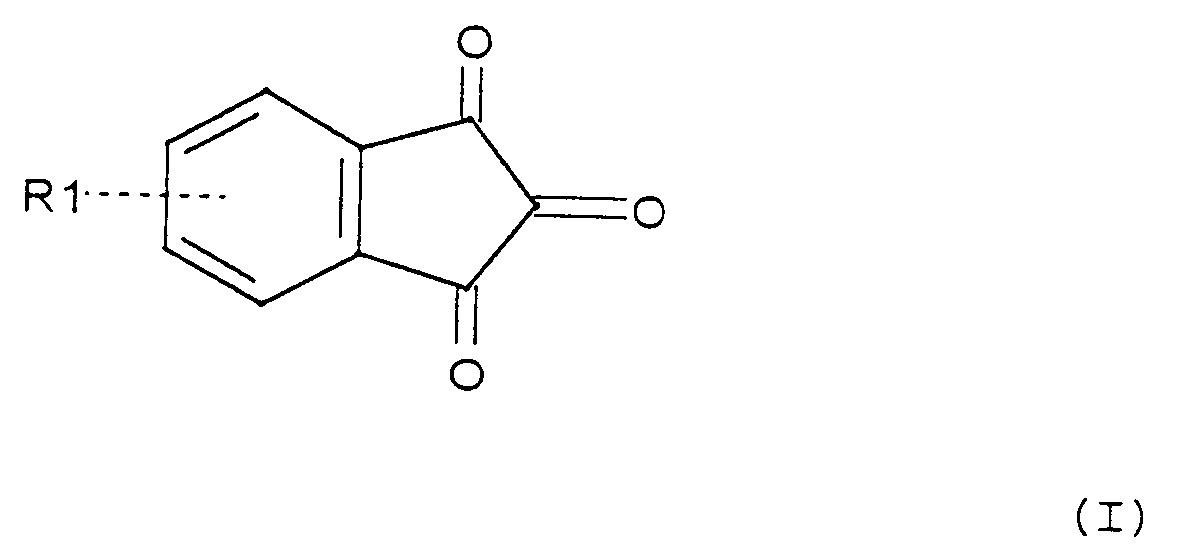
dans laquelle R₁ représente un atome d'hydrogène, d'halogène, un radical de formule NXR₃R3' où x est un entier de 1 à 2, R₃ et R3' sont des radicaux organiques monovalents en C₁ à C₅ hydrogénés ou oxygénés avec un composé de formule NH₂-NH-COR₆ où R₆ est choisi parmi les amines substituées ou non substituées, les radiaux alcoxy linéaires ou ramifiés, les radicaux alkyl-amino, aryl-amino substitués ou non substitués pour obtenir un composé de formule (III).
lequel composé de formule (III) est transformé en un composé de formule :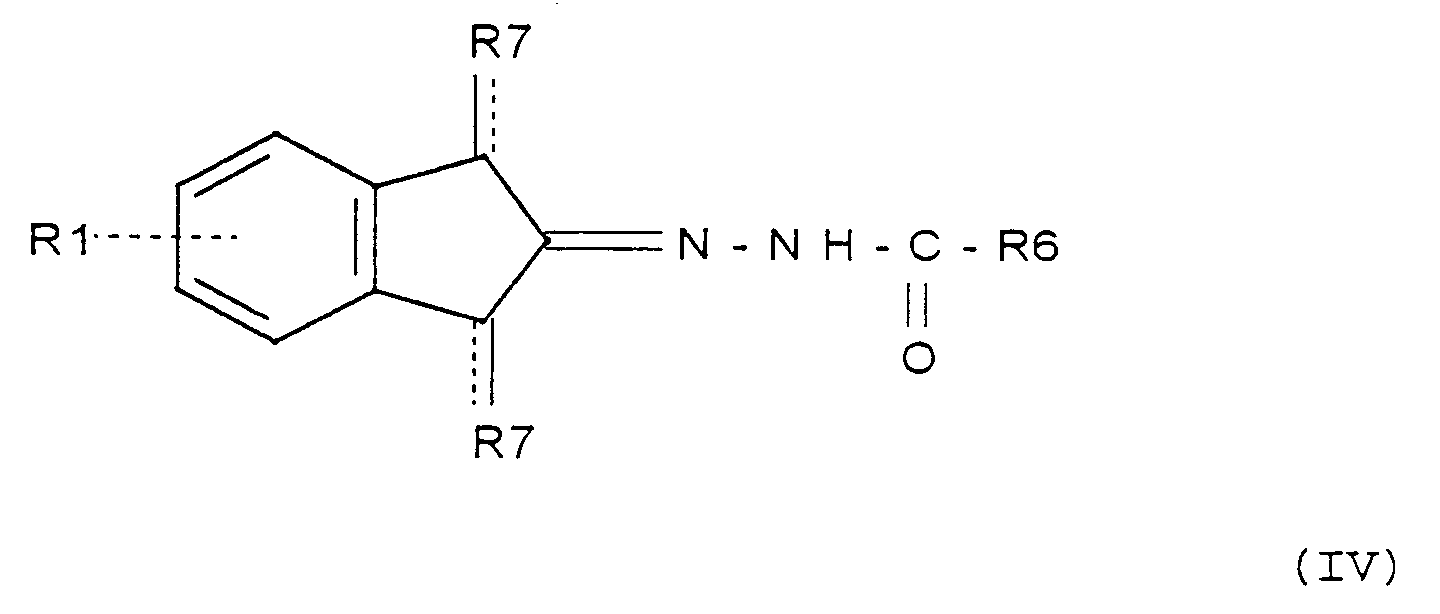
dans laquelle R₇ est un groupement dioxolane ou dioxanne substitué ou non substitué, un radical imine substitué ou non substitué, un radical oxime substitué ou non substitué, un radical hydrazine substitué ou non substitué, à effectuer le clivage du radical COR₆ du composé de formule (IV) pour obtenir le composé de formule :
sur lequel on fait réagir un composé de formule :
ou R₂NCO
dans laquelle R₂ est un radical organique monovalent en C₁ à C₆ linéaire ou ramifié ou un cycle aroamtique ou hétéroaromatique ayant un ou plusieurs hétéroatomes substitués ou non substitués, A est un atome d'oxygène, un radical NR₅ où R₅ est un atome d'hydrogène, un radical organique en C₁ à C₅ linéaire ou ramifié, R₈ est un radical alcoxy pour obtenir un composé de formule :
dans laquelle R₁, R₂, R₇ et A ont la même signification que celle indiquée plus haut pour obtenir le composé de formule :
dans laquelle R₁, A et R₂ ont la même signification que mentionnée ci-dessus. - Selon un mode de réalisation de l'invention R₁ est un radical NxR₃R₃, où x est égal à 1, R₃ est équivalent à R3' et représente l'oxygène, X et Y représentent un atome d'oxygène, A est un radical NR₅ où R₅ représente un atome d'hydrogène et R₂ est un radical phényle.
- Selon un autre mode de réalisation de l'invention, R₁ est un atome d'hydrogène, X et Y sont équivalents et représentent chacun un atome d'oxygène, A est un radical NR₅ où R₅ représente un atome d'hydrogène et R₂ est un cycle aromatique substitué par un dérivé nitro.
- Selon un autre mode de réalisation de l'invention, R₁ représente un atome d'hydrogène, X et Y sont équivalents et représentent un atome d'oxygène, A est un radical NR₅ où R₅ est un atome d'hydrogène, R₂ est un cycle hétéroaromatique ayant un hétéroatome azoté.
- Selon un autre mode de réalisation de l'invention, R₁ est un atome d'halogène, X et Y sont équivalents et représentent chacun un atome d'oxygène, A est un radical NR₅ où R₅ représente un atome d'hydrogène et R₂ est un radical phényle.
- Selon un autre mode de réalisation de l'invention, R₁ est un atome d'halogène, X et Y sont équivalents et représentent chacun un atome d'oxygène, A est un radical NR₅ où R₅ représente un atome d'hydrogène et R₂ est un cycle aromatique substitué par un atome d'halogène.
- Selon un autre mode de réalisation de l'invention, R₁ est un atome d'halogène, X et Y sont équivalents et représentent chacun un atome d'oxygène, A est un radical NR₅ où R₅ est un atome d'hydrogène et R₂ est un cycle hétéroaromatique ayant un hétéroatome azoté.
- Selon un autre mode de réalisation de l'invention, R₁ est un radical NxR₃R₃, où x a pour valeur 1, R₃ est équivalent à R3' et représente un atome d'oxygène, X et Y sont équivalents et représentent un atome d'oxygène, A est un radical NR₅ où R₅ représente un atome d'hydrogène et R₂ est un cycle aromatique substitué par un atome d'halogène.
- Selon un autre mode de réalisation de l'invention, R₁ est un radical NxR₃R3' où x est équivalent à 1, R₃ est analogue à R3' et représente un atome d'oxygène, X est analogue à Y et chacun représente un atome d'oxygène, A est un radical NR₅ où R₅ représente un atome d'hydrogène et R₂ est un cycle hétéroaromatique ayant un hétéroatome azoté.
- Selon un autre mode de réalisation de l'invention, R₁ représente un atome d'hydrogène, X et Y sont analogues et représentent chacun un atome d'oxygène, A représente un atome d'oxygène et R₂ est un radical tertiobutyle.
- Selon un autre mode de réalisation de l'invention, R₁ représente un atome d'hydrogène, X et Y sont analogues et représentent chacun un radical NyR₄ où y vaut 1 et R₄ est un radical méthyle, A représente un atome d'oxygène et R₂ est un radical tertiobutyle.
- Selon un autre mode de réalisation de l'invention, R₁ représente un atome d'hydrogène, X et Y sont analogues et représentent chacun un radical NyR₄ où y vaut 1, et R₄ est un radical méthyle, A est un radical NR₅ où R₅ représente un atome d'hydrogène et R₂ est un radical méthyle.
- Selon un autre mode de réalisation de l'invention R₁ représente un atome d'hydrogène, X et Y sont analogues et représentent chacun un radical NyR₄ où y vaut 1 et R₄ est un radical méthyle, A est un radical NR₅ où R₅ représente un atome d'hydrogène et R₂ est un radical phényle.
- La présente invention comprend également les sels des composés salifiables mentionnés plus haut. Ces sels sont les sels d'addition d'acides minéraux tels que l'acide chlorhydrique, bromhydrique, sulfurique, phosphorique ou nitrique et les sels d'addition d'acides organiques tels que l'acide acétique, propionique, oxalique, citrique, maléique, fumarique, succinique et tartrique.
- La présente invention vise également un procédé d'obtention d'un dérivé de formule

dans laquelle R₆ est un radical o-tertiobutyle et R₇ est un radical =NOH ou =NCH₃. - La présente invention a également pour objet l'utilisation des composés ci-dessus pour l'obtention d'un médicament destiné au traitement de l'insuffisance veineuse fonctionnelle, organique, des pathologies hémorroïdaires, des infections inflammatoires ostéoarticulaires, dermatologiques et cardiovasculaires, des états de chocs constitués par une chute importante de la pression artérielle plus particulièrement dans les états de chocs septiques.
- L'invention vise également l'obtention comme produit intermédiaire du composé de formule
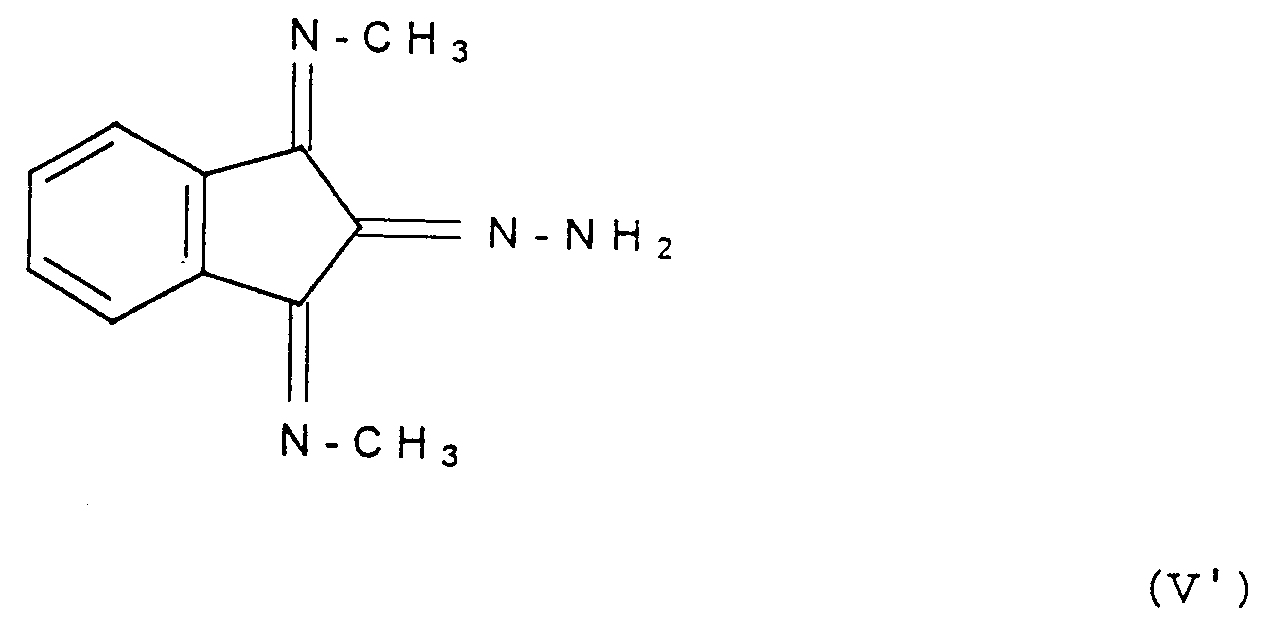
dans laquelle R₇ est =NCH₃. - La présente invention vise aussi à titre de produits intermédiaires les composés ci-après, à savoir la 2-pyridyl-amino-carbonyl-hydrazine, la 3-pyridyl-amino-carbonylhydrazine et la 4-pyridyl-amino-carbonyl-hydrazine.
- On indique ci-après la préparation des matières premières.
- 2-Pyridylaminocarbonyhydrazine
- A 2.89g (17.14 mmoles) de 2-ethoxycarbonylaminopyridine, on ajoute à température ambiante 20 ml (411.5mmoles) d'une solution d'hydrazine à 98%, le mélange réactionnel est alors porté au reflux pendant 1h. Après complet refroidissement, le précipité obtenu est filtré sur verre fritté, lavé à l'éther puis au pentane pour fournir 2.6g de 2-Pyridylaminocarbonylhydrazine sous forme de cristaux blancs.
- Rdt : 100%
- F : 98°C
- Rf : 0.5 (CH₂Cl₂-MeOH, 98 : 2)
- RMN du ¹H (60 MHz, DMSO d₆) : d (ppm)
8.90 (m, 1H, NH)
8.25 (d, 1H, H-6, J5-6=5.5Hz)
7.60 (m, 2H, H-3, H-4)
6.75 (m, 1H, H-5)
4.00 (ls, 3H, NH et NH₂) - IR (KBr)
NH₂ : 3345cm⁻¹, NH : 3205cm⁻¹, C=O : 1677cm⁻¹
- 3-Pyridylaminocarbonylhydrazine
- A 32g (193 mmoles) de 3-ethoxycarbonylaminopyridine, on ajoute à température ambiante 37.5 ml (773mmoles) d'une solution d'hydrazine à 98%, le mélange réactionnel est alors porté au reflux pendant 30 minutes. Après complet refroidissement le milieu réactionnel est évaporé à sec puis chromatographié sur colonne de silice avec un mélange CH₂Cl₂/MeOH, 96/4 pour fournir 15g de 3-Pyridylaminocarbonylhydrazine sous forme de cristaux beiges.
- Rdt : 96%
- F :138°C
- Rf : 0.5 (CH₂Cl₂-MeOH, 91 : 9)
- RMN du ¹H (60 MHz, DMSO d₆) : d (ppm)
8.8 (m, 2H, H-2, NH)
8.0 (m, 2H, H-4, H-6)
7.5 (ls, 1H, NH)
7.2 (m, 1H, H-5)
4.3 (ls, 2H, NH₂) - IR (KBr)
NH₂ : 3345cm⁻¹, NH : 3205cm⁻¹, C=O : 1677cm⁻¹
- 4-Pyridylaminocarbonylhydrazine
- A 12 g (72 mmoles) de 2-éthoxycarbonylaminopyridine, on ajoute à température ambiante 40 ml (820 mmoles) d'une solution d'hydrazine à 98%, le mélange réactionnel est alors porté au reflux pendant 30 minutes. Après complet refroidissement, le précipité formé est essoré sur verre fritté rincé à l'eau glacée à l'éther et au pentane pour fournir 10,5 g de 4-pyridylaminocarbonylhydrazine sous forme de cristaux blancs.
- Rdt: 96%
- F: 98°C
- Rf: 0,2 (CH₂Cl₂-MeOH, 90:10)
- RMN du ¹H (60 MHz, DMSO d₆) : δ (ppm)
9,0 (ls, 1H, NH)
8,2 (m, 2H, H-3, H-5)
7,6 (m, 3H, H-2, H-6, NH)
4,3 (ls, 2H, NH₂) - JR (KBr)
NH₂ : cm⁻¹, NH: cm⁻¹, C=O : cm₋₁
- L'invention est illustrée par les exemples non limitatifs ci-après :
- 2-[(2-Aminophenyl)aminocarbonylhydrazono]-2.3-dihydro-1.3-dioxo-1H-indène
- A une solution de 6g (0.03 mole) de 2.3-dihydro-2.2-dihydroxy-1.3-dioxo-1H-indène dans 100ml d'éthanol,on ajoute à chaud une solution fraîchement préparée contenant 5.6g (0.03 mole) de (2-aminophenyl) aminocarbonylhydrazine, 130ml d'éthanol, 50ml d'eau.
Le mélange réactionnel est agité à 80°C pendant cinq heures,et le précipité marron qui apparait est filtré. Le filtrat est évaporé sous pression réduite et le produit solide obtenu est purifié sur colonne flash (éluant : CH₂Cl₂/ MeOH : 98/2).
Cristaux orange
Rdt : 73%
F : >260°C
Rf : 0.45 (CH₂Cl₂/ MeOH :95/5)
RMN du ¹H (270 MHz, DMSO d₆) : d (ppm)
12.58 (ls, 1H, NH)
9.41 (ls, 1H, NH)
7.98 (s, 4H, H-4, H-5, H-6, H-7)
7.21 (d, 1H, H-6', J H5'-6' = 7.63Hz)
6.95 (t, 1H, H-5', J H4'-5' = J H5'-6'=7.63Hz)
6.77 (d, 1H, H-3', J H3'-4' = 7.63Hz)
6.59 (t, 1H, H-4', J H3'-4' = 7.63Hz)
5.00 (ls, 2H, NH2)
RMN du ¹³C (270 MHz, DMSO d₆) : d (ppm)
186.32 (C=O), 185.62 (C=O), 151.15 (C=O), 140.83 (C-2, C-3a, C-7a), 136.10 (C-5, C-6), 135.92 (C-2'), 126.1 (C-1'), 125.28 (C-4'), 123.24 (C-4, C-7) , 122.33 (C-6'), 116.39 (C-5'), 115.84 ( C-3')
SM (I.E) : m/z 308 (M+.)
IR (KBr)
NH, NH₂ : 3400, 3270 et 3240 cm⁻¹, C=O : 1740, 1700 et 1640 cm⁻¹.
- 2-[(2-Aminophenyl)aminocarbonylhydrazono]-2.3-dihydro-1.3-dioxo-1H-indène, sulfate
- A une solution de 220mg (0.7 mmoles) de 2-[(2-aminophenyl)aminocarbonylhydrazono]-2.3-dihydro-1.3-dioxo-1H-indène dans 200ml de dichlorométhane, on ajoute 0.04ml d'acide sulfurique à température ambiante.
- Le mélange réactionnel est agité pendant 30 minutes et les cristaux jaunes obtenus après évaporation du solvant sous pression réduite sont essorés puis lavés successivement avec très peu d'isopropanol puis d'éther de pétrole.
Cristaux jaunes
Rdt : 98%
F : >260°C
Rf : 0.44 (CH₂Cl₂/ MeOH : 97/3)
RMN du ¹H (270 MHz, DMSO d₆) : d (ppm)
12.58 (ls, 1H, NH)
9.80 (ls, 1H, NH)
8.00 (s, 4H, H-4, H-5, H-6, H-7)
7.50 (d, 1H, H-6', J H6'-5' = 7.5Hz)
7.30 (m, 3H, H-3', H-4', H-5')
5.75 (ls ,3H, NH₃⁺)
RMN du ¹³C (270 MHz, DMSO d₆) : d (ppm)
186.36 (C=O), 185.56 (C=O), 150.52 (C=O), 139.62 (C-2, C-3a, C-7a), 136.30 (C-5, C-6), 135.99 (C-1'), 132.70 (C-3'), 130.46 (C-5'), 123.30 (C-4, C-7), 117.95 (C-4', C-2), 113.18 (C-6')
-IR (KBr)
NH, NH₃⁺: 3254 à 2840 cm⁻¹, C=O : 1731 et 1704 cm-1.
- 2-[(3-Aminophenyl)aminocarbonylhydrazono]-2.3-dihydro1.3-dioxo-1H-indène
- A une solution de 6.4g (0.036 mole) de 2.3-dihydro-2.2-dihydroxy-1.3-dioxo-1H-indène dans 90ml d'éthanol, on ajoute une solution fraîchement préparée contenant 6g (0.036 mole) de (3-aminophenyl)amino-carbonyl-hydrazine,130ml d'éthanol, 50ml d'eau.
- Le mélange réactionnel est agité à 40°C pendant 15 minutes et le précipité marron-clair qui apparait est essoré, séché, puis purifié sur colonne de silice(éluant : CH₂Cl₂/ MeOH : 99/1). Les cristaux orange obtenus après évaporation du solvant sont décolorés et recristallisés dans un mélange (v/v) dichlorométhane/méthanol.
Cristaux orange
Rdt : 40%
F : 254°C
Rf : 0.45 (CH₂Cl₂/ MeOH : 95/5)
RMN du ¹H (270 MHz, DMSO d₆) : d (ppm)
12.50 (ls, 1H, NH)
10.10 (s, 1H, NH)
7.97 (s, 4H, H-4, H-5, H-6, H-7)
6.96 (dd, 1H, H-5', J H5'-4' = J H5'-6' = 8.85Hz)
6.89 (s, 1H, H-2')
6.70 (d, 1H, H-6', J H6'-5' = 8.85Hz)
6.70 (d, 1H, H-4', J H4'-5' = 8.85Hz)
5.23 (ls, 2H, NH₂)
RMN du ¹³C (270 MHz, DMSO d₆) : d (ppm)
186.16 (C=O), 185.69 (C=O), 150.08 (C=O), 149.29 (C-3'), 139.22 (C-2, C-3a, C-7a), 136.05 (C-5, C-6), 134.91 (C-1'), 129.19 (C-5'), 123.02 (C-4, C-7), 106.73 (C-4', C-2', C-6')
SM (I.E) : m/z 308 (M+.)
IR (KBr)
NH, NH₂ : 3411,3327 et 3213 cm⁻¹, C=O : 1724, 1689 et 1640 cm-1.
- 2-[(3-Aminophenyl)aminocarbonylhydrazono]-2.3-dihydro-1.3-dioxo-1H-indène, sulfate
- A une solution de 220mg (0.7 mmole) de 2-[(3-aminophenyl)aminocarbonylhydrazono]-2.3-dihydro-1.3-dioxo-1H-indène dans 800ml de dichlorométhane, on ajoute 0.04ml d'acide sulfurique à température ambiante.
- Le mélange réactionnel est agité pendant 30 minutes et les cristaux orange obtenus après évaporation du solvant sous pression réduite sont essorés puis lavés à l'éther de pétrole.
Cristaux orange
Rdt : 90%
F : >260°C
Rf : 0.41 (CH₂Cl₂/ MeOH : 98/2)
RMN du ¹H (270 MHz, DMSO d₆) : d (ppm)
12.55 (ls, 1H, NH)
10.67 (s, 1H, NH)
8.00 (s, 4H, H-4, H-5, H-6, H-7)
7.86 (s, 1H, H-2')
7.45 (m, 2H, H-4', H-6')
7.08 (m, 1H, H-5')
3.83 (ls, 3H, NH₃⁺)
RMN du ¹³C (270 MHz, DMSO d₆) : d (ppm)
186.36 (C=O), 185.56 (C=O), 150.52 (C=O), 139.62 (C-2, C-3a, C-7a), 136.30 (C-5, C-6), 135.99 (C-1'), 132.70 (C-3'), 130.46 (C-5'), 123.30 (C-4, C-7), 117.95 (C-4', C-2), 113.18 (C-6')
IR (KBr)
NH, NH₃⁺: 3254 à 2840 cm⁻¹, C=O : 1731 et 1704 cm-1.
- 2-[(4-Aminophenyl)aminocarbonylhydrazono]-2.3-dihydro-1.3-dioxo-1H-indène
- A une solution de 6g (0.03 mole) de 2.3-dihydro-2.2-dihydroxy-1.3-dioxo-1H-indène dans 100ml d'éthanol,on ajoute à chaud une solution fraîchement préparée contenant 5.6g (0.03 moles) de (4-aminophenyl) aminocarbonylhydrazine, 100ml d'éthanol et 50ml d'eau.
- Le mélange réactionnel est agité à 60°C pendant trois heures,et le précipité marron qui apparait est essoré, séché puis purifié sur colonne flash (éluant : CH₂Cl₂/ MeOH : 99/1).Les cristaux rouille obtenus après évaporation du solvant sont décolorés au charbon activé et recritallisés dans un grand volume de dichlorométhane.
Cristaux rouille
Rdt : 77%
F : >260°C
Rf : 0.32 (CH₂Cl₂/ MeOH :97/3)
RMN du ¹H (270 MHz, DMSO d₆) : d (ppm)
9.95 (s, 2H, NH)
7.96 (s, 4H, H-4, H-5, H-6, H-7)
7.21 (d, 2H, H-2', H-6', J H2'-3' = 8.85Hz)
6.55 (d, 2H, H-3', H-5', J H5'-6' = 8.85Hz)
3.35 (s, 2H, NH₂)
RMN du ¹³C (270 MHz, DMSO d₆) : d (ppm)
185.75 (C=O), 184.85 (C=O), 150.44 (C=O), 145.27 (C-4'), 140.67 (C-2), 138.98 (C-3a ou C-7a), 136.10 (C-7a ou C-3a, C-5, C-6), 134.28 (C-3', C-5'), 126.74 (C-2', C-6'), 123.15 (C-4, C-7), 120.95 (C-1')
SM (I.E) : m/z 308 (M+.)
IR (KBr)
NH, NH₂ : 3336 et 3205 cm⁻¹, C=O : 1727, 1716 et 1687 cm-1.
- 2-[(4-Aminophenyl)aminocarbonylhydrazono]-2.3-dihydro-1.3-dioxo-1H-indène, sulfate
- A une solution de 100mg (0.32 mmole) de 2-[(4-aminophenyl)aminocarbonylhydrazono]-2.3-dihydro-1.3-dioxo-1H-indène dans 400ml de dichlorométhane, on ajoute 18 l d'acide sulfurique concentré (95%)
- Le mélange réactionnel est agité pendant une heure à température ambiante, puis l'excès de dichlorométhane est évaporé à sec. Les cristaux marrons obtenus sont lavés à l'éther éthylique.
Cristaux marrons
Rdt : 77%
F : >260°C
Rf : 0.5 (CH₂Cl₂/ MeOH : 96/4)
RMN du ¹H (270 MHz, DMSO d₆) : d (ppm)
10.17 (s, 2H, NH)
8.00 (s, 4H, H-4, H-5, H-6, H-7)
7.58 (d, 2H, H-3', H-5', J H2'-3' = 8.01Hz)
6.94 (d, 2H, H-2', H-6', J H5'-6' = 8.01Hz) 3.47 (ls, 3H, NH₃⁺)
RMN du ¹³C (270 MHz, DMSO d₆) : d (ppm)
162.41 (C=O), 185.61 (C=O), 150.33 (C=O), 140.85 (C-2, C-3a, C-7a), 136.15 (C-5, C-6), 134.99 (C-1'), 131.15 (C-4'), 123.35 (C-4, C-7), 120.86 (C-2', C-6'), 117.73 (C-3', C-5')
-IR (KBr)
NH, NH₃⁺ : 3336 à 2963 cm⁻¹, C=O : 1728, 1718 et 1686 cm-1.
- 2.3-Dihydro-1.3-dioxo-2-[(2-nitrophenyl)aminocarbonylhydrazono]-1H-indène
- A une solution de 6.21g (0.03 mole) de 2.3-dihydro-2.2-dihydroxy-1.3-dioxo-1H-indène dans 50ml d'éthanol on ajoute 5.34g (0.03 mole) de (2-nitrophényl) aminocarbonylhydrazine et 0.5ml d'acide chlorhydrique concentré.
- Le mélange réactionnel est porté à 80°C pendant 30 minutes et le précipité orange qui apparait est essoré, lavé à l'eau, séché puis purifié sur colonne Buchi moyenne pression sur silice (éluant : CH₂Cl₂).Les cristaux jaunes obtenus après évaporation du solvant sont décolorés au charbon activé et recritallisés dans du dichlorométhane.
Cristaux jaunes
Rdt : 80%
F : >260°C
Rf : 0.34 (CH₂Cl₂)
RMN du ¹H (270 MHz, DMSO d₆) : d (ppm)
12.37 (ls, 1H, NH)
11.92 (ls, 1H, NH)
8.13 (d, 1H, H-3', JH3'-4'=8.41Hz)
7.99 (m, 5H, H-4, H-5, H-6, H-7, H-6')
7.83 (m, 1H, H-5')
7.38 (dd, 1H, H-4', J H3'-4' = 8.41Hz, JH4'-5'=7.71Hz)
RMN du ¹³C (270 MHz, DMSO d₆) : d (ppm)
186.22 (C=O), 185.61 (C=O), 151.25 (C=O), 140.13 (C-2, C-3a, C-7a), 136.40 (C-5, C-6), 135.85 (C-2'), 134.94 (C-1'), 132.12 (C-3') , 125.51 (C-6'), 124.71 (C-5'), 123.96 (C-4'), 123.45 (C-4, C-7),
SM (I.E) : m/z 338 (M+.)
-IR (KBr)
NH : 3288, 3198 cm⁻¹, C=O : 1727 et 1687 cm-1.
- 2.3-Dihydro-1.3-dioxo-2-[(3-nitrophenyl)aminocarbonylhydrazono]-1H-indène
- A une solution de 6.21g (0.03 mole) de 2.3-dihydro-2.2-dihydroxy-1.3-dioxo-1H-indène dans 50ml d'éthanol,on ajoute 5.34g (0.03 mole) de (3-nitrophényl) aminocarbonylhydrazine et 0.5ml d'acide chlorhydrique concentré.
- Le mélange réactionnel est porté à 80°C pendant 30 minutes et le précipité orange qui apparait est essoré, lavé à l'eau, séché puis purifié sur colonne Buchi moyenne pression sur silice (éluant : CH₂Cl₂/AcEt : 96/4).Les cristaux jaunes obtenus après évaporation du solvant sont décolorés au charbon activé et recritallisés dans le méthanol.
Cristaux jaunes
Rdt : 60%
F : >260°C
Rf : 0.34 (CH₂Cl₂)
RMN du ¹H (270 MHz, DMSO d₆) : d (ppm)
12.50 (ls, 1H, NH)
10.83 (ls, 1H, NH)
8.66 (s, 1H, H-2')
8.00 (m, 6H, H-4, H-5, H-6, H-7, H-4', H-6') 7.67 (t, 1H, H-5', JH5'-4' = 7.62Hz)
RMN du ¹³C (270 MHz, DMSO d₆) : d (ppm)
186.22 (C=O), 185.61 (C=O), 151.25 (C=O), 148.11 (C-3'), 143.26 (C-2, C-3a, C-7a), 136.22 (C-5, C-6, C-1'), 130.43 (C-2', C-4'), 125.32 (C-5', C-6'), 123.45 (C-4, C-7),
SM (I.E) : m/z 338 (M+.)
IR (KBr)
NH : 3288, 3198 cm⁻¹, C=O : 1727 et 1687 cm-1.
- 2.3-Dihydro-1.3-dioxo-2-(4-nitrophenylaminocarbonylhydrazono)-1H-indène
- A une solution de 8g (0.04 mole) de 2.3-dihydro-2.2-dihydroxy-1.3-dioxo-1H-indène dans 50ml d'éthanol, on ajoute 150ml d'une solution aqueuse fraîchement préparée contenant 7.12g (0.04 mole) de 4-nitrophenylaminocarbonylhydrazine et 0.5ml d'acide chlorhydrique concentré.
- Le mélange réactionnel est porté à 80°C pendant 30 minutes et le précipité orange qui apparait est essoré, lavé à l'eau et séché. Les cristaux sont décolorés au charbon activé puis recritallisés dans un grand volume d'acétate d'éthyle.
Cristaux jaunes
Rdt : 73%
F : >170°C
Rf : 0.46 (CH₂Cl₂/AcEt : 90/10)
RMN du ¹H (270 MHz, DMSO d₆) : d (ppm)
12.58 (s, 1H, NH)
11.00 (s, 1H, NH)
8.00 (s, 4H, H-4, H-5, H-6, H-7)
7.84 (d, 2H, H-3', H-5', J H3'-2' = 7.62Hz)
6.78 (d, 2H, H-2', H-6', J H6'-5' = 7.62Hz)
RMN du ¹³C (270 MHz, DMSO d₆) : d (ppm)
186.22 (C=O), 185.61 (C=O), 155.71 (C=O), 150.49 (C-4'), 144.83 (C-1'), 141.04 (C-2, C-3a, C-7a), 136.35 (C-5, C-6), 135.29 (C-2', C-6'), 125.80 (C-3', C-5'), 123.48 (C-4, C-7),
SM (I.E) : m/z 338 (M+.)
-IR (KBr)
NH : 3433, 3232 cm⁻¹, C=O : 1748, 1718 et 1685 cm⁻ 1.
- 2.3-Dihydro-1.3-dioxo-2-[(2-pyridyl)aminocarbonylhydrazono]-1H-indène
- A 4.1g (23 mmoles) de 2.3-dihydro-2,2-dihydroxy-1,3-dioxo-1H-indène en solution dans 50 ml de THF on ajoute à température ambiante 3.5g (23 mmoles) de 2-pyridylaminocarbonylhydrazine en suspension dans 50 ml de THF. Le mélange réactionnel qui prend une coloration jaune est maintenu sous agitation à température ambiante pendant une nuit. Le précipité obtenu est filtré sur verre fritté, lavé à l'éther et purifié sur colonne de silice moyenne pression avec un mélange Heptane/Aceteate d'ethyle, 50/50 pour fournir 4g de 2.3-Dihydro-1.3-dioxo-2-[(2-pyridyl)aminocarbonylhydrazono]-1H-indène sous forme de cristaux jaunes.
- Rdt : 59%
- F : dégradation
- Rf : 0.4 (CH₂Cl₂-MeOH, 98 : 2)
- RMN du ¹H (270 MHz, DMSO d₆) : d (ppm)
14.50 (ls, 1H, NH)
10.71 (ls, 1H, NH)
8.44 (d, 1H, H-6', JH-5'-6'=5.5Hz)
7.97 (m, 5H, H-4, H-5, H-6, H-7, H-3')
7.83 (dd, 1H, H-4', JH-4'-5'=7.02Hz, JH-3'-4'=7.9Hz)
7.13 (dd, 1H, H-5', JH-4'-5'=7.02Hz, JH5'-6'=5.19Hz) - RMN du ¹³C (270 MHz, DMSO d₆) : d (ppm)
185.83 (C=O), 185.19 (C=O), 151.65 (C=O, C-2'), 146.99 (C-6'), 139.59 (C-2, C3a, C-7a), 137.21 (C-4'), 136.15 (C-5, C-6), 123,30 (C-4, C-5), 118.72 (C-5'), 112.41 (C-3'), - SM (I.E.) : m/z 294 (M+.)
- IR (KBr)
NH : 3254 cm⁻¹, C=O : 1732 et 1695cm⁻¹
- 2.3-Dihydro-1.3-dioxo-2-[(2-pyridyl)aminocarbonylhydrazono]-1H-indène, chlorhydrate
- A 260mg (0.88 mmoles) de 2.3-dihydro-1.3-dioxo-2-[(2-pyridyl)aminocarbonylhydrazono]-1H-indène en solution dans 50 ml de méthanol on ajoute à 0°C 25 litres d'acide chlorhydrique en solution dans l'éther (0.9M). Le mélange réactionnel est évaporé sous pression réduite pour fournir 292mg de 2.3-dihydro-1.3-dioxo-2-[(2-pyridyl)aminocarbonylhydrazono]-1H-indène, chlorhydrate sous forme de cristaux jaunes.
- Rdt : 100%
- F : dégradation
- Rf : 0.4 (CH₂Cl₂-MeOH, 98 : 2)
- RMN du ¹H (270 MHz, DMSO d₆) : d (ppm)
14.50 (ls, 1H, NH)
10.72 (ls, 1H, NH)
8.44 (d, 1H, H-6', JH5'-6'=5.19Hz),
7.98 (m, 5H, H-4, H-5, H-6, H-7, H-3')
7.84 (dd, 1H, H-4', JH4'-5'=7.93Hz, JH3'-4'=7.33Hz,)
7.14 (dd, 1H, H-5', JH4'-5'=7.93Hz, JH5'-6'=5.19Hz),
3.61 (ls, 1H, NH+) - RMN du ¹³C (270 MHz, DMSO d₆) : d (ppm)
185.89 (C=O), 185.19 (C=O), 151.69 (C=O, C-2'), 147.11 (C-4', C-6'), 139.63, (C-2, C3a, C-7a), 136.95 (C-5, C-6), 123,30 (C-4, C-7), 118.74 (C-5'), 112.44 (C-3') - IR (KBr)
NH : 3235cm⁻¹, C=O : 1729 et 1691cm⁻¹
- 2.3-Dihydro-1.3-dioxo-2-[(2-pyridyl)aminocarbonylhydrazono]-1H-indène, sulfate
- A 180mg (0.6 mmole) de 2.3-dihydro-1.3-dioxo-2-[(2-pyridyl)aminocarbonylhydrazono]-1H-indène en solution dans 50 ml de dichlorométhane, on ajoute à 0°C 50.4 litre d'acide sulfurique concentré. Le mélange réactionnel s'eclairci immédiatement et précipite après 5 minutes sous agitation à cette température. Le précipité obtenu est filtré sur verre fritté, lavé à l'éther et séché au pentane pour fournir 784mg de 2.3-dihydro-1.3-dioxo-2-[(2-pyridyl)aminocarbonylhydrazono]-1H-indène, sulfate sous forme de cristaux jaunes.
- Rdt : 100%
- F : dégradation
- Rf : 0.47 (CH₂Cl₂-MeOH, 98 : 2)
- RMN du ¹H (270 MHz, DMSO d₆) : d (ppm)
14.50 (ls, 1H, NH)
10.80 (ls, 1H, NH)
8.45 (d, 1H, H-6', JH5'-6'=5.19Hz)
7.96 (m, 5H, H-4, H-5, H-6, H-7, H-3')
7.89 (dd, 1H, H-4', JH4'-5'=7.63Hz, JH3'-4'=7.93Hz)
7.18 (dd, 1H, H-5', JH5'-6'=5.19HZ, JH4'-5'=7.63Hz)
4.25 (ls, 1H, NH+) - RMN du ¹³C (270 MHz, DMSO d₆) : d (ppm)
185.31 (C=O), 183.05 (C=O), 151.37 (C=O, C-2'), 148.89 (C-6'), 146.51 (C-4'), 140.96 (C-2, C3a, C-7a), 136.25 (C-5, C-6), 123.50 (C-4, C-7), 118 .85 (C-5', C3') - IR (KBr)
NH : 3162cm⁻¹, C=O : 1733 et 1698cm⁻¹
- 2.3-Dihydro-1.3-dioxo-2-[(3-pyridyl)aminocarbonylhydrazono]-1H-indène
- A 5.8g (32.9 mmoles) de 2.3-dihydro-2,2-dihydroxy-1,3-dioxo-1H-indène en solution dans 50 ml d'éthanol on ajoute à température ambiante 5g (32.9 mmoles) de 3-pyridylaminocarbonylhydrazine en suspension dans 50 ml d'éthanol. Le mélange réactionnel qui prend une coloration jaune est maintenu sous agitation à température ambiante pendant 1h30 minutes. Le précipité obtenu est filtré sur verre fritté, lavé à l'éther et rincé au pentane pour fournir 5g de 2.3-dihydro-1.3-dioxo-2-[(3-pyridyl)aminocarbonylhydrazono]-1H-indène sous forme de cristaux jaunes.
- Rdt : 51.6%
- F : dégradation
- Rf : 0.35 (CH₂Cl₂-MeOH, 97 : 3)
- RMN du ¹H (270 MHz, DMSO d₆) : d (ppm)
12.51 (ls, 1H, NH)
10.54 (ls, 1H, NH)
8.72 (s, 1H, H-2')
8.29 (d, 1H, H-6', JH5'-6'=3.51Hz)
8.00 (ls, 5H, H-4, H-5, H-6, H-7, H-4')
7.40 (dd, 1H, H-5', JH4'-5'=5Hz, JH5'-6'=3.51Hz) - RMN du ¹³C (270 MHz, DMSO d₆) : d (ppm)
186.59 (C=O), 185.95 (C=O), 151.29 (C=O), 141.2 (C-2, C3a, C-7a), 136.13 (C-5, C-6, C-2', C-3'), 135.33 (C-6'), 131.27 (C-4'), 126.96(C-5'), 123,70 (C-4, C-7) - SM (I.E.) : m/z 294 (M+.)
- IR (KBr)
NH : 3550 cm⁻¹, C=O : 1724 et 1686 cm⁻¹
- 2.3-Dihydro-1.3-dioxo-2-[(3-pyridyl)aminocarbonylhydrazono]-1H-indène, chlorhydrate
- A 430mg (1.46 mmoles) de 2.3-dihydro-1.3-dioxo-2-[(3-pyridyl)aminocarbonylhydrazono]-1H-indène en solution dans 200 ml de dichlorométhane on ajoute à 0°C 146 litres d'acide chlorhydrique en solution dans l'éther (0.9M). Le mélange réactionnel qui s'eclairci immédiatement est évaporé sous pression réduite pour fournir 482mg de 2.3-dihydro-1.3-dioxo-2-[(3-pyridyl)aminocarbonylhydrazono]-1H-indène, chlorhydrate sous forme de cristaux jaunes.
- Rdt : 100%
- F : dégradation
- Rf : 0.54 (CH₂Cl₂-MeOH, 95 : 5)
- RMN du ¹H (270 MHz, DMSO d₆) : d (ppm)
12.54 (ls, 1H, NH)
11.11 (ls, 1H, NH)
9.04 (s, 1H, H-2')
8.54 (d, 1H, H6', JH5'-6'=4.58Hz)
8.43 (d, 1H, H4', JH4'-5'=8.24Hz)
8.00 (s, 4H, H-4, H-5, H-6, H-7)
7.82 (m, 1H, H-5')
3.61 (ls, 1H, NH+) - RMN du ¹³C (270 MHz, DMSO d₆) : d (ppm)
186.38 (C=O) , 185.30 (C=O), 151.07 (C=O) , 139.46 (C-2, C3a, C-7a), 137.16 (C-2', C-3'), 136.63 (C-5, C-6), 133.50 (C-4', C-6'), 127.67 (C-5'), 123.50 (C-4, C-7) - IR (KBr)
NH : 3209 et 3450cm⁻¹, C=O : 1736 et 1687cm⁻¹
- 2.3-Dihydro-1.3-dioxo-2-[(3-pyridyl)aminocarbonylhydrazono]-1H-indène, sulfate
- A 600mg (2 mmoles) de 2.3-dihydro-1.3-dioxo-2-[(3-pyridyl)aminocarbonylhydrazono]-1H-indène en solution dans 800 ml d'un mélange 1/1 dichlorométhane/méthanol, on ajoute à 0°C 160 l d'acide sulfurique concentré. Le mélange réactionnel s'eclairci immédiatement et précipite après 5 minutes sous agitation à cette température. Le précipité obtenu est filtré sur verre fritté, lavé à l'éther et rincé au pentane pour fournir 784mg de 2.3-dihydro-1.3-dioxo-2-[(3-pyridyl)aminocarbonylhydrazono]-1H-indène, sulfate sous forme de cristaux jaunes.
- Rdt : 100%
- F : dégradation
- Rf : 0.62 (CH₂Cl₂-MeOH, 95 : 5)
- RMN du ¹H (270 MHz, DMSO d₆) : d (ppm)
12.52 (ls, 1H, NH)
11.16 (ls, 1H, NH)
9.17 (s, 1H, H-2')
8.64 (d, 1H, H-6', JH5'-6'=4.58Hz)
8.55 (d, 1H, H-4', JH5'-6'=8.24Hz)
8.00 (s, 5H, H-4, H-5, H-6, H-7, H-5')
6.00 (ls,1H, NH+) - RMN du ¹³C (270 MHz, DMSO d₆) : d (ppm)
186.38 (C=O), 185.30 (C=O), 151.07 (C=O), 139.46 (C-2, C3a, C-7a), 137.16 (C-2', C-3'), 136.63 (C-5, C-6), 133.50 (C-4', C-6'), 127.67 (C-5'), 123.50 (C-4, C-7) - IR (KBr)
NH : 3329 3132 et 3092cm⁻¹, C=O : 1732 et 1674cm⁻¹
- 2.3-Dihydro-1.3-dioxo-2-[(4-pyridyl)aminocarbonylhydrazono]-1H-indène, chlorhydrate
- A 1.5g (5.1 mmoles) de 2.3-dihydro-1.3-dioxo-2-[(4-pyridyl)aminocarbonylhydrazono]-1H-indène en solution dans 800 ml d'un mélange 1/1 dichlorométhane/méthanol on ajoute à 0°C 4.6ml d'acide chlorhydrique en solution dans l'éther (0.9M). Le mélange réactionnel s'eclairci immédiatement et précipite après 5 minutes sous agitation à cette température. Le précipité obtenu est filtré sur verre fritté, lavé à l'éther et rincé au pentane pour fournir 1.68g de 2.3-dihydro-1.3-dioxo-2-[(4-pyridyl)aminocarbonylhydrazono]-1H-indène, chlorhydrate sous forme de cristaux jaunes.
- Rdt : 100%
- F : 236.5°C
- Rf : 0.57 (CH₂Cl₂-MeOH, 93 : 7)
- RMN du ¹H (270 MHz, DMSO d₆) : d (ppm)
12.65 (ls, 1H, NH)
11.53 (ls, 1H, NH)
8.66 (d, 2H, H-2', H6', JH2'-3' et 5'-6'=7.17Hz)
8.00 (s, 4H, H-4, H-5, H-6, H-7)
7.95 (d, 2H, H-3', H-5', JH2'-3' et 5'-6'=7.17Hz)
3.35 (ls, 1H, NH+) - RMN du ¹³C (270 MHz, DMSO d₆) : d (ppm)
186.08 (C=O), 185.18 (C=O), 153.04 (C=O), 150.57 (C-4'), 142.62 (C-2', C-6'), 139.50(C-2, C3a, C-7a), 136.73 (C-5), 136.63 (C-6), 123.60 (C-4, C-7), 114.39 (C-3', C-5') - IR (KBr)
NH : 3209 et 3450cm⁻¹, C=O : 1750 et 1687cm⁻¹
- 2.3-Dihydro-1.3-dioxo-2-[(4-pyridyl)aminocarbonylhydrazono]-1H-indène, sulfate
- A 1.5g (5.1 mmoles) de 2.3-dihydro-1.3-dioxo-2-[(4-pyridyl)aminocarbonylhydrazono]-1H-indène en solution dans 800 ml d'un mélange 1/1 dichlorométhane/méthanol on ajoute à 0°C 420 l d'acide sulfurique concentré. Le mélange réactionnel s'eclairci immédiatement et précipite après 5 minutes sous agitation à cette température. Le précipité obtenu est filtré sur verre fritté, lavé à l'éther et rincé au pentane pour fournir 2g de 2.3-dihydro-1.3-dioxo-2-[(4-pyridyl)aminocarbonylhydrazono]-1H-indène, sulfate sous forme de cristaux jaunes.
- Rdt : 100%
- F : >260°C
- Rf : 0.48 (CH₂Cl₂-MeOH, 93 : 7)
- RMN du ¹H (270 MHz, DMSO d₆) : d (ppm)
12.65 (ls, 1H, NH)
11.74 (ls, 1H, NH)
8.35 (d, 2H, H-2', H-6', JH2'-3' et 5'-6'=7.17Hz)
8.05 (d, 2H, H-3', H-5', JH2'-3' et 5'-6'=7.17Hz)
8.00 (s, 4H, H-4, H-5, H-6, H-7)
5.05 (ls, 1H, NH+) - RMN du ¹³C (270 MHz, DMSO d₆) : d (ppm)
186.08 (C=O), 185.18 (C=O), 153.04 (C=O), 150.57 (C-4'), 142.62 (C-2', C-6'), 139.50 (C-2, C3a, C-7a), 136.73 (C-5), 136.63 (C-67), 123.60 (C-4, C-7), 114.39 (C-3', C-5') - IR (KBr)
NH : 3300 et 3399cm⁻¹, C=O : 1730 et 1693cm⁻¹
- 2.3-Dihydro-1.3-dioxo-2-[(4-pyridyl)aminocarbonylhydrazono]-1H-indène, acétate
- A 400mg (1.36 mmoles) de 2.3-dihydro-1.3-dioxo-2-[(4-pyridyl)aminocarbonylhydrazono]-1H-indène en solution dans 300 ml d'un mélange 1/1 dichlorométhane/méthanol, on ajoute à 0°C 77 l d'acide acétique. Le mélange réactionnel est évaporé sous pression réduite pour fournir 481mg de 2.3-dihydro-1.3-dioxo-2-[(4-pyridyl)aminocarbonylhydrazono]-1H-indène, acetate sous forme de cristaux oranges.
- Rdt : 100%
- F : dégradation
- Rf : 0.54 (CH₂Cl₂-MeOH, 93 : 7)
- RMN du ¹H (270 MHz, DMSO d₆) : d (ppm)
13.00 (ls, 1H, NH)
11.25 (ls, 1H, NH)
8.46 (d, 2H, H-2', H6', JH2'-3' et 5'-6'=6.7Hz)
7.94 (ls, 4H, H-4, H-5, H-6, H-7)
7.55 (d, 2H, H-3', H-5', JH2'-3' et 5'-6'=6.7Hz)
3.34 (ls, 1H, NH+)
2.08 (s, 3H, CH3) - RMN du ¹³C (270 MHz, DMSO d₆) : d (ppm)
186.08 (C=O), 185.18 (C=O), 161.41 (COO-), 150.24 (C=O, C-4', C-2', C-6'),145.62 (C-2, C3a, C-7a), 136.44 (C-5, C-6), 123.35 (C-4, C-7), 113.18 (C-3', C-5'), 30.73 (CH3) - IR (KBr)
NH : 3507 et 3195cm⁻¹, C=O : 1731et 1690cm⁻¹
- 2.3-Dihydro-1.3-dioxo-2-[(4-pyridyl)aminocarbonylhydrazono]-1H-indène, (L)-tartrate
- A 400mg (1.36 mmoles) de 2.3-dihydro-1.3-dioxo-2-[(4-pyridyl)aminocarbonylhydrazono]-1H-indène en solution dans 300 ml d'un mélange 1/1 dichlorométhane/méthanol on ajoute à 0°C 200mg d'acide (L)-tartrique. Le mélange réactionnel qui prend une coloration rouge est évaporé sous pression réduite pour fournir 604mg de 2.3-dihydro-1.3-dioxo 2-[(4-pyridyl)aminocarbonylhydrazono]-1H-indène, (L)-tartrate sous forme de cristaux rouge.
- Rdt : 100%
- F : dégradation
- Rf : 0.54 (CH₂Cl₂-MeOH, 93 : 7)
- RMN du ¹H (270 MHz, DMSO d₆) : d (ppm)
10.85 (ls, 2H, NH)
8.47 (d, 2H, H-2', H6', J2'-3' et 5'-6'=5.1Hz)
7.99 (s, 4H, H-4, H-5, H-6, H-7)
7.59 (d, 2H, H-3', H-5', J2'-3' et 5'-6'=5.1Hz)
4.31 (ls, 4H, 2xCHOH, 2xOH)
2.5 (ls, 1H, NH+) - RMN du ¹³C (270 MHz, DMSO d₆) : d (ppm)
186.08 (C=O), 185.18 (C=O), 173.18 (2XCOOH), 150.08 (C=O, C-4'),139.96 (C-2, C3a, C-7a), 136.35 (C-4, C-7), 130.53 (C-2', C-6'), 123.45 (C-5, C-6), 113.23 (C-3', C-5'), 72.18 (2XCHOH) - IR (KBr)
NH : 3220, 3129, 3089, 2955 et 2925cm⁻¹, C=O 1736 et 1692cm⁻¹
- 2.3-Dihydro-1.3-dioxo-2-[(4-pyridyl)aminocarbonylhydrazono]-1H-indène, succinate
- A 400mg (1.36 mmoles) de 2.3-dihydro-1.3-dioxo-2-[(4-pyridyl)aminocarbonylhydrazono]-1H-indène en solution dans 300 ml d'un mélange 1/1 dichlorométhane/méthanol on ajoute à 0°C 161mg d'acide succinique. Le mélange réactionnel qui prend une coloration orangée est évaporé sous pression réduite pour fournir 560mg de 2.3-dihydro-1.3-dioxo-2-[(4-pyridyl)aminocarbonylhydrazono]-1H-indène, succinate sous forme de cristaux orange.
- Rdt : 100%
- F : dégradation
- Rf : 0.56 (CH₂Cl₂-MeOH, 93 : 7)
- RMN du ¹H (270 MHz, DMSO d₆) : d (ppm)
12.39 (ls, 2H, NH, COOH)
11.45 (ls, 1H, NH)
8.63 (d, 2H, H-2', H6', JH2'-3' et 5'-6'=7.1Hz)
8.08 (s, 4H, H-4, H-5, H-6, H-7)
7.82 (d, 2H, H-3', H-5', JH2'-3' et 5'-6'=7.1Hz)
5.84 (ls, 1H, NH)
2.58 et 2.50 (2s, 4H, 2xCH2) - RMN du ¹³C (270 MHz, DMSO d₆) : d (ppm)
186.85 (C=O), 185.65 (C=O), 173.66 (2XCOOH), 150.57 (C=O), 147.12 (C4'), 141.62 (C-2', C-6'), 139.50 (C-2, C3a, C-7a), 136.36 (C-5, C-6), 123.65 (C-4, C-7), 113.67 (C-3', C-5'), 28.77 (2XCH2) - IR (KBr)
NH : 3100 et 2932cm⁻¹, C=O : 1731et 1695cm⁻¹
- 2.3-Dihydro-1.3-dioxo-4-fluoro-2-(phenylaminocarbonylhydrazono)-1H-indène
- A une solution de 0.900g (4.6 mmoles) de 2.3-dihydro-2,2-dihydroxy-1,3-dioxo-4-fluoro-1H-indène dans 5ml d'éthanol,on ajoute à chaud 3ml d'une solution aqueuse fraîchement préparée contenant 0.86g (4.6mmoles) de phenylaminocarbonylhydrazine et 0.5ml d'acide chlorhydrique concentré.
- Le mélange réactionnel est porté au reflux pendant 2h30minutes et le précipité jaune qui apparait est essoré à température ambiante puis séché. Les cristaux jaunes obtenus sont décolorés au charbon activé puis recristallisés dans un grand volume de dichlorométhane.
Cristaux jaunes. - Rdt : 85%
- F : 204°C
- Rf : 0.5 (CH₂Cl₂/AcEt : 88/12)
SM (I.E) : m/z 311 (M+.)
RMN du ¹H (270 MHz, DMSO d₆) : d (ppm)
12.54 (ls, 1H, NH)
10.40 (ls, 1H, NH)
7.97 (m, 1H, H-6)
7.82 (m, 2H, H-5, H-7)
7.56 (d, 2H, H-2', H-6', J H2'-3' = J H5'-6'=7.63Hz)
7.36 (m, 2H, H-3', H-5')
7.09 (m, 1H, H-4')
RMN du ¹³C (270 MHz, DMSO d₆) : d (ppm)
185.62 (C=O),185.14 (C=O) , 165.09 (C-4) , 151.90 (C=O), 150.30 (C-1'), 138.26 (C-2, C-7a), 134.70 (C-3a), 129.02 (C-3', C-5'), 123.51 (C-6, C-7, C-4'), 119.14 (C-5, C-2', C-6')
IR (KBr)
NH : 3295, 3240 cm⁻¹, C=O : 1740 et 1690 cm-1.
- 2.3-Dihydro-1.3-dioxo-4-fluoro-2-(4-fluorophenylaminocarbonylhydrazono)-1H-indène
- A une solution de 0.600g (3.0 mmoles) de 2,3-dihydro-2,2-dihydroxy-1,3-dioxo-4-fluoro-1H-indène dans 5ml d'éthanol,on ajoute à chaud 3ml d'une solution aqueuse fraîchement préparée contenant 0.616g (3.0mmoles) de 4-fluorophenylaminocarbonylhydrazine. Le mélange réactionnel est porté au reflux pendant 30 minutes et le précipité jaune qui apparait est essoré à température ambiante, séché, décoloré au charbon activé puis recristallisé dans un grand volume de dichlorométhane.
Cristaux jaunes.
Rdt : 68%
F : 215°C
Rf : 0.5 (CH₂Cl₂/AcEt : 88/12)
RMN du ¹H (270 MHz, DMSO d₆) : d (ppm)
12.49 (ls, 1H, NH)
10.44 (ls, 1H, NH)
7.99 (m, 1H, H-6)
7.81 (m ,2H, H-5, H-7)
7.56 (m ,2H, H-3', H-5')
7.22 (m, 2H, H-2', H-6')
RMN du ¹³C (270 MHz, DMSO d₆) : d (ppm)
186.19 (C=O), 184.69 (C=O), 159.05 (C-4, C-4'), 151.83 (C=O), 148.25 (C-1'), 141.97 (C-7a) , 136.65 (C-2, C-3a), 134.56 (C-7), 123.54 (C-6), 121.05 (C-2', C-6'), 119.80 (C-5), 115.56 (C-3', C-5')
SM (I.E) : m/z 311 (M+.)
IR (KBr)
NH : 3290, 3205 cm⁻¹, C=O : 1700 et 1620 cm-1.
- 2.3-Dihydro-1.3-dioxo-4-fluoro-2-[(3-pyridyl)aminocarbonylhydrazono]-1H-indène
- A une solution de 0.500g (2.5 mmoles) de 2.3-dihydro-2,2-dihydroxy-1,3-dioxo-4-fluoro-1H-indène dans 10ml d'éthanol, on ajoute une solution aqueuse fraîchement préparée contenant 0.380g (2.5mmoles) de 3-pyridylaminocarbonylhydrazine et 5ml d'eau.
- Le mélange réactionnel est agité à température ambiante pendant deux heures et le précipité rouille qui apparait est essoré, séché, décoloré puis purifié sur colonne de silice (CH₂Cl₂/MeOH : 99/1).
Cristaux jaunes
Rdt : 40%
F : déc. 215°C
Rf : 0.6 (CH₂Cl₂/MeOH : 96/4)
RMN du ¹H (270 MHz, DMSO d₆) : d (ppm)
12.52 (ls, 1H, NH)
10.57 (ls, 1H, NH)
8.73 (s, 1H, H-2')
8.31 (d, 1H, H-6', J H6'-5' = 4.2 Hz)
8.05 (m, 2H, H-7, H-4')
7.80 (m, 2H, H-5, H-6)
7.41 (m ,1H, H-5')
RMN du ¹³C (270 MHz, DMSO d₆) : d (ppm)
185.62 (C=O), 185.14 (C=O), 165.09 (C-4), 151.05 (C=O), 144.45 (C-3'), 140.80 (C-2, C-7a), 138.49 (C-2', C-6'), 135.17 (C-3a), 126.39 (C-5'), 123.70 (C-6, C-7), 119.92 (C-5), 119.48 (C-4')
SM (I.E) : m/z 312 (M+.)
IR (KBr)
NH : 3290 et 3184 cm⁻¹, C=O : 1740, 1730 et 1620 cm-1.
- 2.3-Dihydro-1.3-dioxo-4-fluoro-2-[(3-pyridyl)aminocarbonylhydrazono]-1H-indène, chlorhydrate.
- A une solution de 0.200g (0.6 mmole) de 2.3-dihydro-1.3-dioxo-4-fluoro-2-(3-pyridylaminocarbonylhydrazono)-1H-indène dans 60ml de méthanol, on ajoute 0.6ml d'une solution méthanolique d'acide chlorhydrique 1M.
- Le mélange réactionnel est agité à température ambiante pendant 15minutes et le précipité beige obtenu est essoré.
Cristaux beiges
Rdt : 96%
F : >215°C
Rf : 0.6 (CH₂CL₂/MeOH : 95/5)
RMN du ¹H (270 MHz, DMSO d₆) : d (ppm)
12.52 (ls, 1H, NH)
10.85 (ls, 1H, NH)
8.95 (s, 1H, H-2')
8.48 (d, 1H, H-6', J H6'-5' = 4.58 Hz)
8.35 (d, 1H, H-4', JH4'-5'=8.24Hz)
8.04 (m, 1H, H-7)
7.82 (m, 2H, H-5, H-6)
7.75 (m ,1H, H-5')
3.41 (ls, 1H, NH+)
RMN du ¹³C (270 MHz, DMSO d₆) : d (ppm)
186.19 (C=O), 184.69 (C=O), 159.05 (C-4, C-4'), 151.83 (C=O), 148.25 (C-1'), 141.97 (C-7a) , 136.65 (C-2, C-3a), 134.56 (C-7), 123.54 (C-6), 121.05 (C-2', C-6'), 119.80 (C-5), 115.56 (C-3', C-5')
IR (KBr)
NH : 2694, 2635 cm⁻¹, C=O : 1737 et 1687 cm-1.
- 2.3-Dihydro-1.3-dioxo-4-fluoro-2-[(4-pyridyl)aminocarbonylhydrazono]-1H-indène
- A une solution de 1g (5.1 mmoles) de 2,3-dihydro-2,2-dihydroxy-1,3-dioxo-4-fluoro-1H-indène dans 10ml d'éthanol, on ajoute une solution aqueuse fraîchement préparée contenant 0.71g (5.1 mmoles) de 4-pyridylaminocarbonylhydrazine et 10ml d'eau.
- Le mélange réactionnel est agité pendant une nuit à température ambiante et le produit solide rouge-orangé obtenu est purifié sur colonne d'alumine (CH₂Cl₂/MeOH : 99/1),puis recristallisé après décoloration au charbon activé dans un mélange (V/V dichlorométhane/ acétate d'éthyle).
Cristaux jaunes
Rdt : 40%
F : 254°C
Rf : 0.6 (CH₂Cl₂/MeOH : 96/4)
RMN du ¹H (270 MHz, DMSO d₆) : d (ppm)
12.50 (ls, 1H, NH)
10.58 (ls, 1H, NH)
8.42 (d, 2H, H-2', H-6', J H2'-3' = 5.8 Hz)
7.89 (m, 1H, H-7)
7.69 (m, 2H, H-5, H-6)
7.61 (d, 2H, H-3', H-5', J H5'-6' = 5.8 Hz)
RMN du ¹³C (270 MHz, DMSO d₆) : d (ppm)
185.62 (C=O), 185.14 (C=O), 161.64 (C-4), 151.02 (C=O), 150.41 (C-2', C-6'), 145.39 (C-4'), 138.46 (C-2, C-7a), 135.48 (C-3a), 123.24 (C-6, C-7), 119.37 (C-5), 113.10 (C-3', C-5'),
SM (I.E) : m/z 312 (M+.)
IR (KBr)
NH : 3211 cm⁻¹, C=O : 1750, 1728 et 1690 cm-1.
- 2.3-Dihydro-1.3-dioxo-4-fluoro-2-[(4-pyridyl)aminocarbonylhydrazono]-1H-indène, sulfate
- A une solution de 0.100g (0.03 mmole) 2.3-Dihydro-1.3-dioxo-4-fluoro-2-(4-pyridylaminocarbonylhydrazono)-1H-indène dans 8ml de méthanol, on ajoute 0.6ml d'une solution méthanolique d'acide sulfurique 1M.
- Le mélange réactionnel est agité à 40°C pendant 10 minutes, et le précipité jaune obtenu est essoré après refroidissement.
Cristaux jaunes
Rdt : 84%
F : 216°C
Rf : . 0.5 (CH₂Cl₂/MeOH : 94/6)
RMN du ¹H (270 MHz, DMSO d₆) : d (ppm)
12.65 (ls, 1H, NH)
11.65 (ls, 1H, NH)
8.70 (d, 2H, H-2', H-6', J H2'-3' =JH4'-5'= 6.71 Hz)
8.01 (m, 2H, H-3',H-5', H-7)
7.83 (m, 2H, H-5, H-6)
3.48 (ls , 1H, NH+)
RMN du ¹³C (270 MHz, DMSO d₆) : d (ppm)
186.19 (C=O), 184.69 (C=O) , 152.42 (C=O) , 150.49 (C-4, C-4'), 143.25 (C-2', C-6'), 141.05 (C-2), 140.52 (C-7a), 140.15 (C-3a), 138.56 (C-7), 123.54 (C-6), 120.05 (C-5), 114.30 (C-3', C-5')
IR (KBr)
NH et NH⁺ : 3222 à 2800 cm⁻¹, C=O : 1733 et 1690 cm-1.
- 2.3-Dihydro-1.3-dioxo-5-fluoro-2-(phenylaminocarbonylhydrazono)-1H-indène
- A une solution de 1g (5.0 mmoles) de 2.3-dihydro-2,2-dihydroxy-1,3-dioxo-5-fluoro-1H-indène dans 10ml d'éthanol, on ajoute une solution fraîchement préparée contenant 0.94g (5.0 mmoles) de phenylaminocarbonylhydrazine 5ml d'eau et 0.3ml d'acide chlorhydrique concentré.
- Le mélange réactionnel est porté une heure au reflux et le précipité orange qui apparait est essoré à température ambiante, séché et purifié sur colonne de silice Eluant (CH₂Cl₂/Hept. : 99/1)
Cristaux jaunes.
Rdt : 80%
F : >260°C
Rf : 0.5 (CH₂Cl₂/MeOH : 98/2).
RMN du ¹H (270 MHz, DMSO d₆) : d (ppm)
12.50 (ls, 1H, NH)
10.40 (s, 1H, NH)
8.00 (m, 1H, H-7)
7.83 (m, 2H, H-4, H-6)
7.58 (d, 2H, H-2', H-6', J H2'-6' = 7.62Hz)
7.36 (m, 2H, H-3', H-5')
7.09 (m, 1H, H-4')
RMN du ¹³C (270 MHz, DMSO d₆) : d (ppm)
186.53 (C=O), 185.67 (C=O), 150.33 (C=O), 144.50 (C-1'), 138.26 (C-5), 137.57 (C-2, C-3a, C-7a), 129.04 (C-3', C-5'), 125.55 (C-7), 123.55 (C-4'), 119.21 (C-2', C-6'), 110.50 (C-4, C-6)
SM (I.E) : m/z 311 (M+.)
-IR (KBr)
NH : 3390, 3330 cm⁻¹, C=O : 1745, 1725 et 1690 cm⁻ 1.
- 2.3-Dihydro-1.3-dioxo-5-fluoro-2-[(4-fluorophenyl)aminocarbonylhydrazono)]-1H-indène
- A une solution de 1g (5.0 mmoles) de 2.3-dihydro-2,2-dihydroxy-1,3-dioxo-5-fluoro-1H-indène dans 10ml d'éthanol,on ajoute une solution fraîchement préparée contenant 0.94g (5.0mmoles) de (4-fluorophenyl)aminocarbonylhydrazine, 5ml d'eau et 0.3ml d'acide chlorhydrique concentré.
- Le mélange réactionnel est porté une heure au reflux et le précipité orange qui apparait est essoré à température ambiante, séché et purifié sur colonne de silice Eluant (CH₂Cl₂/Hept. : 98/2)
Cristaux jaunes
Rdt : 60%
F : >260°C
Rf : 0.5 (CH₂Cl₂/MeOH : 98/2)
RMN du ¹H (270 MHz, DMSO d₆) : d (ppm)
12.45 (ls, 1H, NH)
10.41 (s, 1H, NH)
8.07 (m ,1H, H-7)
7.80 (m ,2H, H-4, H-6)
7.60 (m, 2H, H-3', H-5')
7.58 (t, 2H, H-2', H-6' , J H-5',6' = 9.00 Hz)
RMN du ¹³C (270 MHz, DMSO d₆) : d (ppm)
186.53(C=O), 185.67 (C=O), 162.45 (C-4'), 150.86 (C=O), 145.50 (C-1'), 134.89 (C-2, C-5, C-3a, C-7a), 128.50 (C-7), 121.54 (C-2', C-6'), 116.12 (C-3', C-5'), 110.35 (C-4, C-6)
SM (I.E) : m/z 329 (M+.)
-IR (KBr)
NH : 3240 cm⁻¹, C=O : 1740 et 1700 cm-1.
- 2.3-Dihydro-1.3-dioxo-5-fluoro-2-[(3-pyridyl)aminocarbonylhydrazono]-1H-indène
- A 1g (5.6 mmoles) de 2.3-dihydro-2.2-dihydroxy-1.3-dioxo-5-fluoro-1H-indène en solution dans 50 ml d'éthanol on ajoute à température ambiante 0.85g (5.6 mmoles) de 3-pyridylaminocarbonylhydrazine en suspension dans 50 ml d'éthanol. Le mélange réactionnel qui prend une coloration jaune est maintenu sous agitation à température ambiante pendant 1h30minutes. Le précipité obtenu est filtré sur verre fritté, lavé à l'éther et purifié sur colonne de silice moyenne pression avec un mélange Heptane/Acetate d'éthyle 50/50 pour fournir 1.2g de 2.3-Dihydro-1.3-dioxo-5-fluoro-2-[(3-pyridyl)aminocarbonylhydrazono]-1H-indène sous forme de cristaux jaunes.
- Rdt : 69%
- F : dégradation
- Rf : 0.59 (CH₂Cl₂-MeOH, 95 : 5)
- RMN du ¹H (270 MHz, DMSO d₆) : d (ppm)
12.47 (ls, 1H, NH)
10.54 (ls, 1H, NH)
8.72 (s, 1H, H-2')
8.30 (d, 1H, H-6', JH5'-6'=3.51Hz)
8.04 (m, 2H, H-7, H-4')
7.80 (m, 2H, H-4, H-6)
7.39 (m, 1H, H-5') - RMN du ¹³C (270 MHz, DMSO d₆) : d (ppm)
186.59 (C=O), 185.95 (C=O), 151.29 (C=O), 144.32 (C-5), 140.96 (C-2, C-3', C-3a, C-7a), 135.29 (C-2', C-6'), 126.28 (C-4', C-5'), 123.80 (C-7), 110.04 (C-4, C-6) - SM (I.E.) : m/z 313 (MH+)
- IR (KBr)
NH : 3554, 3250 cm⁻¹, C=O : 1730 et 1691 cm⁻¹
- 2.3-Dihydro-1.3-dioxo-5-fluoro-2-[(3-pyridyl)aminocarbonylhydrazono]-1H-indène, sulfate
- A 250mg (0.8 mmole) de 2.3-Dihydro-1.3-dioxo-5-fluoro-2-[(3-pyridyl)aminocarbonylhydrazono]-1H-indène en solution dans 50 ml d'un mélange 1/1 dichlorométhane/méthanol on ajoute à 0°C 66 l d'acide sulfurique concentré. Le mélange réactionnel s'eclairci immédiatement et précipite après 5 minutes sous agitation à cette température. Le précipité obtenu est filtré sur verre fritté, lavé à l'éther et séché au pentane pour fournir 328mg de 2.3-Dihydro-1.3-dioxo-5-fluoro-2-[(3-pyridyl)aminocarbonylhydrazono]-1H-indène, sulfate sous forme de cristaux jaunes.
- Rdt : 100%
- F : 250°C
- Rf : 0.65 (CH₂Cl₂-MeOH, 95 : 5)
- RMN du ¹H (270 MHz, DMSO d₆) : d (ppm)
12.49 (ls, 1H, NH)
11.04 (ls, 1H, NH)
9.08 (s, 1H, H-2')
8.56 (d, 1H, H-6', JH5'-6'=4.4Hz)
8.46 (d, 1H, H-4', JH4'-5'=8.26Hz)
8.43 (m, 1H, H-7)
7.86 (m, 3H, H-4, H-6, H-5')
4.48 (ls, 1H, NH+) - RMN du ¹³C (270 MHz, DMSO d₆) : d (ppm)
173.10 (C=O), 165.10 (C=O), 160.05 (C-5), 151.02 (C=O), 144.82 (C-4'), 140.05 (C-6'), 138.25 (C-2, C-7a), 137.22 (C-2', C 3'), 133.03 (C-2), 127.23 (C-5'), 123.78 (C-7), 111.12 (C-4, C-6) - IR (KBr)
NH : 3351 et 3207cm⁻¹, C=O : 1732 et 1690cm⁻¹
- 2.3-Dihydro-1.3-dioxo-5-fluoro-2-[(4-pyridyl)aminocarbonylhydrazono]-1H-indène
- A une solution de 1g (5.1 mmoles) de 2,3-dihydro-2,2-dihydroxy-1,3-dioxo-5-fluoro-1H-indène dans 10ml d'éthanol, on ajoute une solution aqueuse fraîchement préparée contenant 0.71g (5.1 mmoles) de 4-pyridylaminocarbonylhydrazine et 10ml d'eau.
- Le mélange réactionnel est agité pendant une nuit à température ambiante et le produit solide rouge-orangé obtenu est purifié sur colonne d' alumine (CH₂Cl₂/MeOH : 99/1), puis recristallisé dans l'acétate d'éthyle.
Cristaux jaunes
Rdt : 40%
F : 245°C
Rf : 0.6 (CH₂Cl₂/MeOH : 96/4)
RMN du ¹H (270 MHz, DMSO d₆) : d (ppm)
11.41 (ls, 1H, NH)
10.50 (ls, 1H, NH)
8.42 (d, 2H, H-2',H-6', J H2'-3' = 6.26 Hz)
8.07 (d, 2H, H-3',H-5', J H5'-6' = 6.26 Hz)
7.91 (m, 1H, H-7)
7.64 (m, 2H, H-4, H-6)
RMN du ¹³C (270 MHz, DMSO d₆) : d (ppm)
186.53 (C=O), 185.67 (C=O), 151.02 (C=O, C-2', C-6'), 145.50 (C-4'), 134.89 (C-2, C-5, C-3a, C-7a), 128.50 (C-7), 113.10(C-3', C-5'), 110.35 (C-4, C-6)
SM (I.E) : m/z 312 (M+.)
IR (KBr)
NH : 3209 cm⁻¹, C=O : 1750, 1720 et 1678 cm-1.
- 2.3-Dihydro-1.3-dioxo-5-fluoro-2-[(4-pyridyl)aminocarbonylhydrazono]-1H-indène, sulfate
- A une solution de 0.100 g (0.03 mmole) 2.3-Dihydro-1.3-dioxo-5-fluoro-2-[(4-pyridyl)aminocarbonylhydrazono]-1H-indène dans 8ml de méthanol, on ajoute 0.6ml d'une solution méthanolique d'acide sulfurique 1M.
- Le mélange réactionnel est agité à 40°C pendant 10 minutes, et le précipité orange obtenu est essoré après refroidissement puis séché.
Cristaux jaunes
Rdt : 50%
F : 249°C
Rf : 0.5 (CH₂Cl₂/MeOH : 95/5)
RMN du ¹H (270 MHz, DMSO d₆) : d (ppm)
12.53 (ls, 1H, NH)
10.76 (ls, 1H, NH)
8.46 (d, 2H, H-2', H-6', J H2'-3' =JH5'-6'= 6.71 Hz)
8.08 (m, 1H, H-7)
7.83 (m, 2H, H-4, H-6)
7.57 (d, 2H, H-3', H-5', J H2'-3' =JH5'-6'= 6.71 Hz)
3.48 (ls, 1H, NH+)
RMN du ¹³C (270 MHz, DMSO d₆) : d (ppm)
186.53(C=O), 185.67 (C=O), 151.02 (C=O, C-2', C-6'), 145.50 (C-4'), 134.89 (C-2, C-5, C-3a, C-7a), 128.50 (C-7), 113.10(C-3', C-5'), 110.35 (C-4, C-6)
IR (KBr)
NH et NH⁺ : 3222 à 2800 cm⁻¹, C=O : 1733 et 1690 cm-1.
- 2.3-Dihydro-1.3-dioxo-4-nitro-2-(4-phenylaminocarbonylhydrazono)-1H-indène
- A 2g (9.76 mmoles) de 2.3-Dihydro-2.2-dihydroxy-1.3-dioxo-4-nitro-1H-indène en solution dans 100 ml d'éthanol on ajoute à température ambiante 1.47g (9.76 mmoles) de 4-Phenylaminocarbonylhydrazine en suspension dans 50 ml d'éthanol et quelques gouttes acide chlorhydrique. Le mélange réactionnel qui prend une coloration orangée est maintenu sous agitation à température ambiante pendant 2h. Le précipité obtenu est filtré sur verre fritté et purifié sur colonne de silice moyenne pression avec un mélange CH₂Cl₂/MeOH, 99.5/0.5 pour fournir 2g de 2.3-Dihydro-1.3-dioxo-4-nitro-2-(4-phenylaminocarbonylhydrazono)-1H-indène sous forme de cristaux jaunes.
- Rdt : 61%
- F : 236°C
- Rf : 0.54 (CH₂Cl₂-MeOH, 99 : 1)
- RMN du ¹H (270 MHz, DMSO d₆) : d (ppm)
12.61 (ls, 1H, NH)
10.45 (ls, 1H, NH)
8.33 (d, 1H, H-5, JH5-6=7.32Hz)
8.23 (d, 1H, H-7, JH6-7=7.48Hz)
8.16 (m, 1H, H-6)
7.57 (d, 2H, H-2', H-6', JH2'-3'=JH5'-6'=8.24Hz)
7.36 (dd, 2H, H-3', H-5', JH2'-3' et JH5'-6'=8.24Hz,
JH3'-4' et JH4'-5'=7.33Hz)
7.09 (m, 1H, H-4') - RMN du ¹³C (270 MHz, DMSO d₆) : d (ppm)
185.75 (C=O), 182.50 (C=O), 150.05 (C-4), 150.27 (C=O, C-2', C-6'), 145.86 (C-4'), 137.33 (C-2, C-7a), 129.40 (C-7), 126.46 (C-6, C-3a), 123.52 (C-5), 113.81 (C-3', C-5') - SM (I.E.) : m/z 338 (M+.)
- IR (KBr)
NH : 3416 et 3324 cm⁻¹, C=O : 1742 1725et 1696 cm⁻ 1, NO2 : 1535 cm⁻¹
- 2.3-Dihydro-1.3-dioxo-4-nitro-2-[4-(4-fluorophenyl)aminocarbonylhydrazono]-1H-indène
- A 0.8g (3.90 mmoles) de 2.3-Dihydro-2.2-dihydroxy-1.3-dioxo-4-nitro-1H-indène en solution dans 50 ml d'éthanol on ajoute à température ambiante 0.6g (3.90 mmoles) de 4-(4-Fluorophenyl) aminocarbonylhydrazine en suspension dans 50 ml d'éthanol et quelques gouttes d' acide chlorhydrique. Le mélange réactionnel qui prend une coloration orangée est maintenu sous agitation à température ambiante pendant 15mn. Le précipité obtenu est filtré sur verre fritté et purifié sur colonne de silice moyenne pression avec du CH₂Cl₂ pour fournir 1g de 2.3-Dihydro-1.3-dioxo-4-nitro-2-[4-(4-fluorophenyl) aminocarbonylhydrazono]-1H-indène sous forme de cristaux jaunes.
- Rdt : 72%
- F : >260°C
- Rf : 0.54 (CH₂Cl₂-MeOH, 98 : 2)
- RMN du ¹H (270 MHz, DMSO d₆) : d (ppm)
12.56 (ls, 1H, NH)
10.47 (ls, 1H, NH)
8.33 (d, 1H, H-5, JH5-6=7.94Hz)
8.21 (d, 1H, H-7, JH6-7=7.78Hz)
8.16 (m, 1H, H-6)
7.58 (m, 2H, H-3', H-5')
7.20 (m, 2H, H-2', H-6') - RMN du ¹³C (270 MHz, DMSO d₆) : d (ppm)
185.98 (C=O), 182.50 (C=O), 159.05 (C-4'), 150.32 (C=O, C-4), 148.25 (C-1'), 137.33 (C-2, C-7a) , 134.95 (C-2', C-6'), 129.35 (C-7), 126.76 (C-6, C-3a), 123.52 (C-5), 114.90 (C-3', C-5') - SM (I.E.) : m/z 356 (M+.)
- IR (KBr)
NH : 3351 et 3212 cm⁻¹, C=O : 1736 1725et 1699 cm⁻ 1, NO2 : 1509 cm⁻¹
- 2.3-Dihydro-1.3-dioxo-4-nitro-2-[(3-pyridyl)aminocarbonylhydrazono]-1H-indène
- A 3g (14.6 mmoles) de 2.3-Dihydro-2.2-dihydroxy-1.3-dioxo-4-nitro-1H-indène en solution dans 50 ml d'éthanol on ajoute à température ambiante 2.2g (14.6 mmoles) de 3-pyridylaminocarbonylhydrazine en solution dans 50 ml d'éthanol. Le mélange réactionnel qui prend une coloration jaune est maintenu sous agitation à température ambiante pendant 15minutes. Le précipité obtenu est filtré sur verre fritté, purifié sur colonne de silice moyenne pression avec un mélange CH₂Cl₂/MeOH, 98/21 pour fournir 3g de 2.3-Dihydro-1.3-dioxo-4-nitro-2-[(3-pyridyl)aminocarbonylhydrazono]-1H-indène sous forme de cristaux jaunes.
- Rdt : 60.6%
- F : dégradation
- Rf : 0.46 (CH₂Cl₂-MeOH, 96 : 4)
- RMN du ¹H (270 MHz, DMSO d₆) : d (ppm)
12.75 (ls, 1H, NH)
10.85 (ls, 1H, NH)
8.84 (ls, 1H, H-2')
8.29 (m, 2H, H-5, H-6')
8.11 (m, 3H, H-6, H-7, H-4')
7.39 (m, 1H, H-5') - RMN du ¹³C (270 MHz, DMSO d₆) : d (ppm)
181.90 (C=O), 179.55 (C=O), 151.84 (C=O), 145.40 (C-4), 142.50 (C-3'), 139.35 (C-2'), 138.95 (C-7a), 138.26 (C-2), 137.50 (C-6'), 129.90 (C-7), 127.27 (C-6, C-3a), 125.35 (C-5, C-4', C-5') - SM (I.E.) : m/z 339
- IR (KBr)
NH : 3550 cm⁻¹, C=O: 1698 cm⁻¹
- 2.3-Dihydro-1.3-dioxo-4-nitro-2-[(3-pyridyl)aminocarbonylhydrazono]-1H-indène, sulfate
- A 108mg (0.3 mmole) de 2.3-Dihydro-1.3-dioxo-4-nitro-2-[(3-pyridyl)aminocarbonylhydrazono]-1H-indène en solution dans 50 ml d'éthanol on ajoute à température ambiante 26 l (0.3 mmole) d'acide sulfurique. Le milieu réactionnel qui prend une coloration jaune est maintenu sous agitation à 0°C pendant 10minutes. Le précipité obtenu est filtré sur verre fritté, lavé à l'éther et rincé au pentane pour fournir 139mg de 2.3-Dihydro-1.3-dioxo-4-nitro-2-[(3-pyridyl)aminocarbonylhydrazono]-1H-indène, sulfate sous forme de cristaux jaunes
- Rdt : 100%
- F : dégradation
- Rf : 0.46 (CH₂Cl₂-MeOH, 96 : 4)
- RMN du ¹H (270 MHz, DMSO d₆) : d (ppm)
12.65 (ls, 1H, NH)
10.89 (ls, 1H, NH)
8.93 (ls, 1H, H-2')
8.35 (d, 1H, H-6', JH5'-6'=4.58Hz)
8.27 (m, 1H, H-4')
8.24 (m, 1H, H-5)
8.16 (m, 2H, H-6, H-7)
7.70 (m, 1H, H-5)
5.75 (ls, 1H, NH+) - RMN du ¹³C (270 MHz, DMSO d₆) : d (ppm)
182.55 (C=O), 181.65 (C=O), 150.59 (C=O), 145.95(C-4), 145.85(C-4'), 142.25 (C-2), 140.05 (C-6'), 139.77 (C-2, C-7a), 137.57 (C-7), 135.55 (C-3'), 130.15 (C-3a), 129.45 (C-6), 126.85 (C-5, C-5') - IR (KBr)
NH : 3550 et 2917cm⁻¹, C=O : 1750, 1696 cm⁻¹, NO2: 1541 cm⁻¹
- 2.3-Dihydro-1.3-dioxo-4-nitro-2-[(4-pyridyl)aminocarbonylhydrazono]-1H-indène
- A 3g (14.6 mmoles) de 2.3-dihydro-2.2-dihydroxy-1.3-dioxo-4-nitro-1H-indène en solution dans 50 ml d'éthanol on ajoute à température ambiante 2.2g (14.6 mmoles) de 4-pyridylaminocarbonylhydrazine en suspension dans 50 ml d'éthanol. Le mélange réactionnel qui prend une coloration orangée est maintenu sous agitation à température ambiante pendant deux heures. Le précipité obtenu est filtré sur verre fritté et purifié sur colonne de silice moyenne pression avec un mélange CH₂Cl₂/MeOH, 98/2 pour fournir 4g de 2.3-dihydro-1.3-dioxo-4-nitro-2-[(4-pyridyl)aminocarbonylhydrazono]-1H-indène sous forme de cristaux jaunes.
- Rdt : 81%
- F : >260°C
- Rf : 0.46 (CH₂Cl₂-MeOH, 90 : 10)
- RMN du ¹H (270 MHz, DMSO d₆) : d (ppm)
12.75 (ls, 1H, NH)
10.80 (ls, 1H, NH)
8.45 (d, 2H, H-2', H6', JH2'-3' et JH5'-6'=6.4Hz)
8.31 (m, 1H, H-5)
8.20 (m, 1H, H-7)
8.12 (m, 1H, H-6)
7.58 (d, 2H, H-3', H-5', JH2'-3' et JH5'-6'=6.4Hz) - RMN du ¹³C (270 MHz, DMSO d₆) : d (ppm)
185.75 (C=O), 182.50 (C=O), 150.05 (C-4), 150.27 (C=O, C-2', C-6'), 145.86 (C-4'), 137.33 (C-2, C-7a), 129.40 (C-7), 126.46 (C-6, C-3a) , 123.52 (C-5), 113.81(C-3', C-5') - SM (I.E.) : m/z 339 (M+.)
- IR (KBr)
NH : 3422 et 2962 cm⁻¹, C=O : 1678 et 1665 cm⁻¹, NO2 : 1505 cm⁻¹
- 2.3-Dihydro-1.3-dioxo-4-nitro-2-[(4-pyridyl)aminocarbonylhydrazono]-1H-indène, sulfate
- A 160mg (0.47 mmole) de 2.3-dihydro-1.3-dioxo-4-nitro-2-[(4-pyridyl)aminocarbonylhydrazono]-1H-indène en solution dans 30 ml d'un mélange 1/1 dichlorométhane/méthanol on ajoute à 0°C 39 l d'acide sulfurique concentré. Le mélange réactionnel s'eclairci immédiatement et précipite après 5 minutes sous agitation à cette température. Le précipité obtenu est filtré sur verre fritté, lavé à l'éther et rincé au pentane pour fournir 205mg de 2.3-dihydro-1.3-dioxo-4-nitro-2-[(4-pyridyl)aminocarbonylhydrazono]-1H-indène, sulfate sous forme de cristaux jaunes.
- Rdt : 100%
- F : >260°C
- Rf : 0.46 (CH₂Cl₂-MeOH, 90 : 10)
- RMN du ¹H (270 MHz, DMSO d₆) : d (ppm)
12.75 (ls, 1H, NH)
11.73 (ls, 1H, NH)
8.73 (d, 2H, H-2', H6', JH2'-3' et JH5'-6'=6.4Hz)
8.38 (m, 1H, H-5)
8.30 (m, 1H, H-7)
8.19 (m, 1H, H-6)
8.05 (d, 2H, H-3', H-5', JH2'-3' et JH5'-6'=6.4Hz)
4.72 (ls, 1H, NH+) - RMN du ¹³C (270 MHz, DMSO d₆) : d (ppm)
185.75(C=O), 181.28 (C=O), 152.98 (C-4), 150.30 (C=O), 144.79 (C-2', C-6'), 142.59 (C-4'), 137.76 (C-2, C-7a), 127.50 (C-7, C-5), 126.93 (C-6, C-3a), 114.37 (C-3', C-5') - IR (KBr)
NH : 3301, 3091 cm⁻¹, C=O : 1749, 1696 cm⁻¹, NO2 : 1507 cm⁻¹
- 2.3-Dihydro-1.3-dioxo-5-nitro-2-(phenylaminocarbonylhydrazono)-1H-indène
- A 1g (4.9 mmoles) de 2.3 dihydro-2,2-dihydroxy-1,3-dioxo-5-nitro-1H-indène en solution dans 50 ml d'éthanol on ajoute à température ambiante 2.2g (14.6 mmoles) de 4-phenylaminocarbonylhydrazine en suspension dans 50 ml d'éthanol et quelques gouttes d'acide chlorhyrique. Le mélange réactionnel qui prend alors une coloration orangée est maintenu sous agitation à température ambiante pendant 1h30 minutes. Le précipité obtenu est filtré sur verre fritté et purifié sur colonne de silice moyenne pression avec un mélange CH₂Cl₂/MeOH, 98/2 pour fournir 1g de 2.3-dihydro-1.3-dioxo-5-nitro-2-(phenylaminocarbonylhydrazono)-1H-indène sous forme de cristaux jaunes.
- Rdt : 60%
- F : >260°C
- Rf : 0.46 (CH₂Cl₂-MeOH, 96 : 4)
- RMN du ¹H (270 MHz, DMSO d₆) : d (ppm)
12.59 (ls, 1H, NH)
10.50 (ls, 1H, NH)
8.67 (d, 1H, H-6, JH6-7=8.55Hz)
8.56 (s, 1H, H-4)
8.20 (d, 1H, H-7, JH6-7=8.55Hz)
7.57 (d, 2H, H-2', H-6', JH2'-3' et JH5'-6'=7.94Hz
7.37 (dd, 2H, H-3', H-5', JH2'-3' =JH5'-6'=7.94Hz,
JH3'-4' =JH4'-5'=6.41Hz)
7.11 (m, 1H, H-4') - RMN du ¹³C (270 MHz, DMSO d₆) : d (ppm)
185.75 (C=O), 182.50 (C=O), 151.73 (C=O), 150.08 (C-5), 148.50 (C-1'), 138.18 (C-2), 135.75 (C-3a, C-7a), 131.60 (C-7), 129.08 (C-3', C-5'), 125.40 (C-4'), 123.63 (C-4, C-6), 119.10 (C-2', C-6') - SM (I.E.) : m/z 338 (M+.)
- IR (KBr)
NH : 3422 et 3217 cm⁻¹, C=O : 1731 et 1693 cm⁻¹, NO2 : 1529 cm⁻¹
- 2.3-Dihydro-1.3-dioxo-5-nitro-2-[(4-pyridyl)aminocarbonylhydrazono)-1H-indène
- A 2g (9.7 mmoles) de 2.3 dihydro-2.2-dihydroxy-1.3-dioxo-5-nitro-1H-indène en solution dans 60 ml d'éthanol on ajoute à température ambiante 1.48g (9.7 mmoles) de 4-(pyridyl)aminocarbonylhydrazine en suspension dans 100 ml d'éthanol. Le mélange réactionnel qui prend alors une coloration orangée est maintenu sous agitation à température ambiante pendant 5 minutes. Le précipité obtenu est filtré sur verre fritté et purifié sur colonne de silice moyenne pression avec un mélange CH₂Cl₂/MeOH, 90/10 pour fournir 1.38g de 2.3-dihydro-1.3-dioxo-5-nitro-2-[(4-pyridyl)aminocarbonylhydrazono)-1H-indène sous forme de cristaux jaunes.
- Rdt : 42%
- F : dégradation
- Rf : 0.46 (CH₂Cl₂-MeOH, 93 : 7)
- RMN du ¹H (270 MHz, DMSO d₆) : d (ppm)
12.59 (ls, 1H, NH)
10.84 (ls, 1H, NH)
8.63 (d, 1H, H-6, JH6-7=8.24Hz)
8.52 (s, 1H, H-4)
8.50 (m, 2H, H-2', H-6')
8.17 (d, 1H, H-7, JH6-7=8.24Hz)
7.60 (d, 2H, H-3', H-5', JH2'-3' =JH5'-6'=7.94Hz) - RMN du ¹³C (270 MHz, DMSO d₆) : d (ppm)
185.75 (C=O), 182.50 (C=O), 151.64 (C-5), 149.99 (C=O, C-2', C-6'), 145.84 (C-4'), 138.18 (C-2), 135.75 (C-3a, C-7a),130.31 (C-7), 125.73 (C-6), 117.55 (C-4), 113.17 (C-2', C-6') - SM (I.E.) : m/z 339 (M+.)
- IR (KBr)
NH : 3424, 3089 cm⁻¹, C=O : 1695 et 1671 cm⁻¹
- 2.3-Dihydro-1.3-dioxo-2-(t-butyloxycarbonylhydrazono)-1H-indène
- A une solution de 5.34g (0.03 mole) de 2.3-dihydro-2.2-dihydroxy-1.3-dioxo-1H-indène dans 50ml d'éthanol, on ajoute 3.96g (0.03 mole)de terbutylcarbazate en solution dans l'éthanol.
- Le mélange réactionnel est porté à 80°C pendant trois heures. Le précipité jaune qui apparait après refroidissement à température ambiante est essoré, séché, décoloré au charbon activé puis recritallisé dans un mélange éther éthylique/méthanol(40/4ml).
Cristaux jaunes
Rdt : 71%
F : 170°C
Rf : 0.5 (CH₂Cl₂/MeOH : 98/2)
RMN du ¹H (270 MHz, DMSO d₆) : d (ppm)
12.06 (s, 1H, NH)
8.00 (s, 4H, H-4, H-5, H-6, H-7)
1.53 (ls, 9H, CH₃)
SM (I.E) : m/z 274 (M+.)
- IR (KBr)
NH : 3230 cm⁻¹, C=O : 1770,1740 et 1700 cm-1.
- 2.3-Dihydro-1.3-dimethylimino-2-(t-butyloxycarbonylhydrazono)-1H-indène
- A une suspension de 0.400g (1.4 mmoles) de 2.3-dihydro-1.3-dioxo-2-(t-butyloxycarbonylhydrazono)-1H-indène dans 5ml d'éthanol,on ajoute 1ml d'une solution aqueuse de méthylamine à 40%.
- Le mélange réactionnel est agité à température ambiante pendant une nuit et le précipité jaune-clair qui apparait est filtré, lavé à l'eau et séché. Les cristaux blancs obtenus sont décolorés au charbon activé puis recritallisés dans le dichlorométhane.
Cristaux jaunes
Rdt : 57%
F : 174°C
Rf : 0.5 (CH₂Cl₂/MeOH : 98/2)
RMN du ¹H (270 MHz, DMSO d₆) : d (ppm)
12.00 (ls, 1H, NH)
8.00 (s ,4H, H-4, H-5, H-6, H-7)
1.53 (ls, 9H, CH₃)
SM (I.E) : m/z 300 (M+.)
- IR (KBr)
CH₃, = 2990 cm-1., C=O : 1740 et 1660 cm-1.
- 2.3-Dihydro-1.3-dimethylimino-2-(methylaminocarbonylhydrazono)-1H-indène
- Une suspension de 5.80g (21mmoles) de 2.3-dihydro-1.3-dioxo-2-(t-butyloxycarbonylhydrazono)-1H-indène dans 300 ml d'une solution aqueuse de méthylamine à 40% est agitée à température ambiante pendant cinq heures et le précipité gris-vert qui apparait est filtré, lavé à l'éther éthylique et séché. Les cristaux obtenus sont décolorés au charbon activé puis recritallisés dans le dichlorométhane.
Cristaux gris-vert
Rdt : 55%
F : 220°C
Rf : 0.6 (CH₂Cl₂/MeOH : 98/2)
RMN du ¹H (270 MHz, DMSO d₆) : d (ppm)
11.44 (s, 2H, NH)
8.23 (m, 2H, H-4, H-7)
8.00 (m, 2H, H-5, H-6)
4.20 (s, 3H, CH₃)
3.76 (s, 3H, CH₃)
2.50 (d, 3H, CH₃)
SM (I.E) : m/z 257(M+.)
-IR (KBr)
NH : 3220; CH₃, = 2990 cm-1, C=O : 1675 cm-1.
- 2.3-Dihydro-1.3-dimethylimino-2-(phenylaminocarbonylhydrazono)-1H-indène
- 1g (3.4 mmoles) de 2,3-dihydro-1,3-dioxo-2-(phenylaminocarbonylhydrazono)-1H-indène est mis en suspension dans 75ml d'une solution aqueuse de méthylamine à 40%.
- Le mélange réactionnel est agité à température ambiante pendant 24 heures et le précipité rouge orangé qui apparait est filtré, lavé à l'eau et séché. Les cristaux roses obtenus sont décolorés au charbon activé puis recritallisés dans l'éthanol.
Cristaux jaunes
Rf : 0.2 (CH₂Cl₂/MeOH : 96/4)
Rdt : 61%
F : 180°C
RMN du ¹H (270 MHz, DMSO d₆) : d (ppm)
12.50 (s, 1H, NH)
9.71 (s, 1H, NH)
8.47 (d, 1H, H-7, J H7-6 = 8Hz)
8.27 (d, 1H, H-4', J H4-5 = 8Hz)
8.02 (t, 2H, H-5, H-6, J H5-6 = 8Hz)
7.93 (d, 2H, H-2', H-6' ,J H2'-3' = 8Hz)
7.68 (t, 2H, H-3', H-5', J H5'-6' = 8Hz)
7.41 (t ,1H, H-4', J H4'-6' = 8Hz)
4.25 (ls, 3H, CH₃)
4.19 (ls, 3H, CH₃)
SM (I.E) : m/z 319 (M+.)
-IR (KBr)
C=0 : 1660 ; C=N : 1630 et 1600cm-1.
- 2,3-dihydro-1,3-diméthylimino-2-hydrazono-1H indène
- A une mole de 2,3-dihydro-1,3-diméthylimino-2-(t-butyloxycarbonylhydrazono)-1H-indène en solution dans 50 ml de dichlorométhane, on ajoute 2 moles de chlorure de triméthylsilyle, on laisse agiter à température ambiante pendant 24 heures. Le précipité qui apparaît est filtré. On recueille des cristaux qui sont lavés plusieurs fois à l'heptane et qui sont décolorés au charbon activé. Après chromatographie sur colonne de silice, le rendement obtenu est de 80%.
- L'étude des composés de la présente invention et de leurs sels éventuels a montré qu'ils possèdent diverses propriétés pharmacologiques. Ainsi, ils sont veinotoniques et n'affectent pas dans la plupart des cas le système artériel ; par ailleurs, ils augmentent la résistance capillaire, diminuent l'hyperperméabilité vasculaire induite par certains agents inflammatoires et présentent des propriétés antilipoperoxydantes, antiradicalaires et antiinflammatoires, ainsi qu'une activité protectrice dans le choc septique.
- Ces propriétés sont démontrées chez les mammifères tels que les rats, cobayes et lapins, dans des conditions in vitro (vaisseaux ou réseaux vasculaires isolés) et in vivo.
- Pour l'étude in vitro, les composés sont solubilisés en solution aqueuse pure ou contenant du DMSO ou de l'alcool.
Pour l'étude in vivo, ils sont administrés par voie intra-veineuse sous forme de solution aqueuse pure, par voie intrapéritonéale sous forme de solution aqueuse contenant ou non du DMSO ou par voie orale en solution ou en suspension dans la carboxyméthylcellulose ou dans une solution aqueuse composée contenant du Tween(R) et dans certains cas du DMSO (diméthylsulfoxyde). - L'effet contractile est mesuré in vitro :
- par la force de contraction développée par des anneaux vasculaires quiescents ou stimulés (soit électriquement soit par des agents physiologiques) et maintenus dans des conditions isométriques,
- par la pression développée par des réseaux vasculaires perfusés à débit constant.
- In vivo, les pressions artérielles et veineuses sont mesurées dans des conditions normales et après arrêt cardiaque. Lors de l'arrêt cardiaque, le tonus veineux est calculé à partir des pressions veineuses et artérielles mesurées à l'équilibre et corrigées en fonction des différences relatives de compliance entre ces deux réseaux (Samar et Coleman, Am. J. Physiol., 1978, 234 : H94-100 ; Yamamoto et col., Am. J; Physiol., 1980, 238 : H823-828).
- L'augmentation de la résistance capillaire est appréciée par la modification de l'index pétéchial (pression négative induisant l'extravasation d'érythrocytes), mesuré par une méthode dérivée de l'angiosterromètre de Parrot.
- La perméabilité vasculaire est étudiée in vivo et in vitro par la mesure de l'extravasation d'albumine ou de colorant liant l'albumine (Bleu Evans). In vivo, l'hyperperméabilité est induite par l'injection d'une solution d'histamine, de bradykinine ou de zymosan. Les modèles in vitro permettent de réaliser des hyperpressions (sur un territoire vasculaire isolé) et/ou des réactions vasculaires inflammatoires.
- L'activité antiinflammatoire est démontrée par la mesure de l'inhibition de l'oedème et de la migration leucocytaire après induction d'une pleurésie chez le rat par injection de carragénine dans la cavité pleurale (Almeida et col., J. Pharmacol. Exp. Therap., 1980, 214 : 74).
- L'effet "piégeur de radicaux libres" global est étudié in vitro par un modèle utilisant le 1,1-diphényl-2-picrylhydrazyl (DPPH) comme radical libre stable, méthode dérivée de celle décrite par Lamaison et col., Plantes Médic. et Phytothérapie, XXII, 1988, 231-234.
- L'activité antioxydante est étudiée in vitro par un modèle de peroxydation lipidique basée sur la peroxydation d'une émulsion d'acide linoléique par le fer, méthode modifiée par rapport à celle décrite par Sutherland et col., Arch. Biochem. Biophys., 1982, 214, 1-11.
- L'activité dans le choc septique est étudiée chez le rat après induction par une endotoxine lipopolysaccharidique (15 mg/kg), méthode voisine de celle décrite par Terashita et col., Eur. J. Pharmacol., 109, 257-261, 1985.
- Les composés de formule (1) et leurs sels éventuels augmentent la contraction des veines saphènes animales produite par la noradrénaline et la dépolarisation (solution hyperpotassique) sans affecter, dans la majorité des cas, les réponses contractiles artérielles. A titre illustratif, les composés des exemples 3, 5, 8, 11, 13, 15, 31 (10 nM à 30 mM) augmentent de plus de 40 % (DE50 ± 0,3 microM) les contractions des veines saphènes de lapin produites par le KCl (40 mM).
- Les composés des exemples 11, 14, 22 augmentent à leur concentration maximale de 30 à 200 % la contraction des veines saphènes de lapin en réponse à la noradrénaline 0,3 micromolaire.
- A titre illustratif, les composés des exemples 7, 33, 29 augmentent la résistance capillaire de base de 10 à 100 %, lorsque celle-ci est mesurée une heure à deux heures après administration de 1-20 mg/kg/i.p. et jusqu'à quatre à six heures après administration orale de 1-20 mg/kg chez le rat.
- A titre illustratif, les composés des exemples 28, 27, 25 diminuent l'hyperperméabilité vasculaire induite par le zymosan lorsque celle-ci est mesurée 2 et 4 heures après administration per os de 1 à 20 mg/kg.
- A titre illustratif, les composés des exemples 21, 23 administrés deux fois en i.p. à la dose de 5 mg/kg inhibent l'oedème et la migration leucocytaire dans la cavité pleurale, 6 heures après injection de carragénine dans le modèle de la pleurésie chez le rat.
- A titre illustratif, les composés des exemples 9 et 7 présentent un effet antiradicalaire dans le modèle utilisant le DPPH.
- Par ailleurs, les composés de formule (1) et leurs sels éventuels sont très peu toxiques. Par exemple, après administration unique per os chez la souris, aucune mortalité n'est observée à la dose de 1 g/kg dans la majorité des cas. Les seuls effets observés sont dans certains cas des diarrhées colorées et des urines colorées, ces dernières étant le témoin d'une résorption du produit.
- Ce qui précède montre que les composés de formule (1) et leurs sels éventuels peuvent être utilisés en thérapeutique humaine et animale. Ils sont en particulier indiqués dans l'insuffisance veineuse fonctionnelle, organique et les pathologies hémorroïdaires par leurs composantes vasculaires et antiinflammatoires, ainsi que dans les affections typiquement inflammatoires (ostéoarticulaires, dermatologiques ou cardiovasculaires) et dans les états de chocs constitués par une chute importante de la pression artérielle, en particulier dans les états de chocs septiques (endotoxiques).
L'insuffisance veineuse fonctionnelle se caractérise par une dilatation et une hyperdistensibilité des veines superficielles des membres inférieurs, oedèmes, paresthésies à type d'impatince, de jambe sans repos. Ce type de pathologie peut évoluer vers l'insuffisance veineuse organique (varices, incontinence valvulaire profonde ...) voire vers la phlébothrombose et les lésions ulcéreuses. - Dans cette pathologie veineuse, une composante inflammatoire s'installe dans les premiers stades et se manifeste plus clairement dans les stades avancés.
- La présente invention comprend donc l'utilisation des composés de formule (1) ci-dessus décrits et de leurs sels éventuels, comme substances actives pour la préparation de médicaments et compositions pharmaceutiques, à usage humain et vétérinaire, comprenant au moins un desdits composés et sels en association avec un support ou diluant physiologiquement acceptable.
- La forme de ces médicaments et compositions pharmaceutiques dépendra bien évidemment de la voie d'administration souhaitée notamment orale, parentérale et rectale et ils peuvent être formulés selon les techniques classiques avec mise en oeuvre des supports et véhicules usuels.
- Ainsi, dans le cas d'une administration par voie orale, ils peuvent se présenter sous la forme de comprimés, tablettes, gélules, solutions, sirops et suspensions.
- Les comprimés, tablettes et gélules contiennent la substance active conjointement avec un diluant (par exemple lactose, dextrose, sucrose, mannitol, sorbitol ou cellulose), un lubrifiant (par exemple silice, talc ou stéarate comme le stéarate de magnésium), un liant (par exemple amidon, méthylcellulose ou gomme arabique), un agent de désintégration (alginate par exemple) et ils sont fabriqués par des techniques connues par exemple de mélange, de granulation, de pastillage, d'enrobage, etc ...
- Les sirops peuvent contenir, à titre de support, glycérol, mannitol et/ou sorbitol. Les solutions et suspensions peuvent comprendre de l'eau et un support tel qu'une gomme naturelle, de la gélose, de l'alginate de sodium ou de l'alcool polyvinylique.
- Pour l'administration par voie parentérale, les médicaments et compositions peuvent prendre la forme de solutions, d'émulsions ou de suspensions comprenant la substance active et un support approprié tel que l'eau stérile ou des solutions salines isotoniques aqueuses stériles.
- Pour l'administration par voie rectale, ils peuvent prendre la forme de suppositoires comprenant la substance active et un support approprié tel que le beurre de cacao ou du polyéthylène glycol.
- La dose thérapeutique des substances actives pourra atteindre 2000 mg/jour suivant la voie d'administration, l'âge, le poids et l'état du sujet à traiter et la puissance thérapeutique de la substance active mise en oeuvre.
Claims (24)
- Dérivés d'indane cétoniques caractérisés en ce qu'ils répondent à la formule :
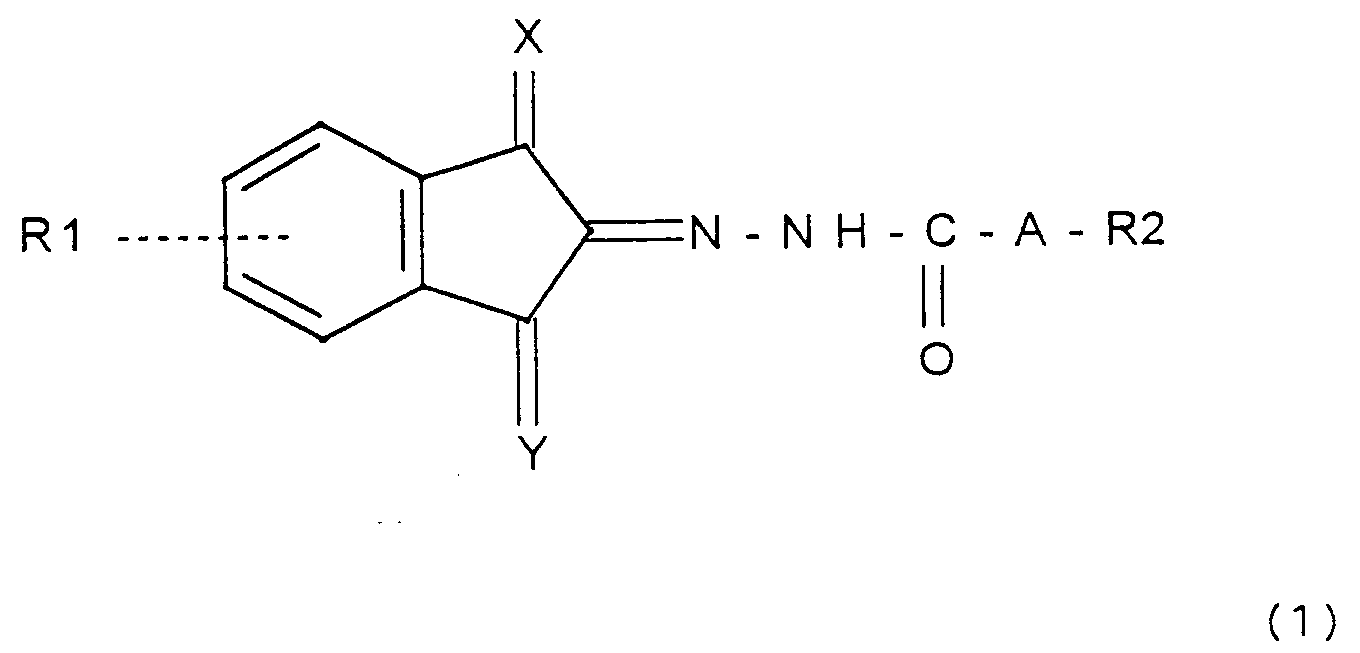
X et Y sont choisis indépendamment parmi l'oxygène, un radical NyR₄ où y est un entier de 1 à 2 et R₄ est un radical alkyle en C₁ à C₄ ou un radical hydroxylé ou alcoxylé,
A est un atome d'oxygène, un radical NR₅ où R₅ est un atome d'hydrogène, un radical organique en C₁ à C₅ linéaire ou ramifié,
R₂ est un radical organique monovalent en C₁ à C₆ linéaire ou ramifié ou un cycle aromatique ou hétéroaromatique ayant un ou plusieurs hétéroatomes substitués ou non substitués,
R₂ ayant la définition ci-dessus à l'exclusion du radical phényle ou phényle substitué par un groupement alcoxy ou hydroxy lorsque R₁ est de l'hydrogène. - Dérivés d'indane cétoniques selon la revendication 1, caractérisés en ce que R₁ est un radical NxR₃R3' où x est égal à 1, R₃ est équivalent à R3' et représente l'oxygène, X et Y représentent un atome d'oxygène, A est un radical NR₅ où R₅ représente un atome d'hydrogène et R₂ est un radical phényle.
- Dérivés d'indane cétoniques selon la revendication 1, caractérisés en ce que R₁ est un atome d'hydrogène, X et Y sont équivalents et représentent chacun un atome d'oxygène, A est un radical NR₅ où R₅ représente un atome d'hydrogène et R₂ est un cycle aromatique substitué par un dérivé nitro.
- Dérivés d'indane cétoniques selon la revendication 1, caractérisés en ce que R₁ représente un atome d'hydrogène, X et Y sont équivalents et représentent un atome d'oxygène, A est un radical NR₅ où R₅ est un atome d'hydrogène, R₂ est un cycle hétéroaromatique ayant un hétéroatome azoté.
- Dérivés d'indane cétoniques selon la revendication 1, caractérisés en ce que R₁ est un atome d'halogène, X et Y sont équivalents et représentent chacun un atome d'oxygène, A est un radical NR₅ où R₅ représente un atome d'hydrogène et R₂ est un radical phényle.
- Dérivés d'indane cétoniques selon la revendication 1, caractérisés en ce que R₁ est un atome d'halogène, X et Y sont équivalents et représentent chacun un atome d'oxygène, A est un radical NR₅ où R₅ représente un atome d'hydrogène et R₂ est un cycle aromatique substitué par un atome d'halogène.
- Dérivés d'indane cétoniques selon la revendication 1, caractérisés en ce que R₁ est un atome d'halogène, X et Y sont équivalents et représentent chacun un atome d'oxygène, A est un radical NR₅ où R₅ est un atome d'hydrogène et R₂ est un cycle hétéroaromatique ayant un hétéroatome azoté.
- Dérivés d'indane cétoniques selon la revendication 1, caractérisés en ce que R₁ est un radical NxR₃R3' où x a pour valeur 1, R₃ est équivalent à R3' et représente un atome d'oxygène, X et Y sont équivalents et représentent un atome d'oxygène, A est un radical NR₅ où R₅ représente un atome d'hydrogène et R₂ est un cycle aromatique substitué par un atome d'halogène.
- Dérivés d'indane cétoniques selon la revendication 1, caractérisés en ce que R₁ est un radical NxR₃R3' où x est équivalent à 1, R₃ est analogue à R3' et représente un atome d'oxygène, X est analogue à Y et chacun représente un atome d'oxygène, A est un radical NR₅ où R₅ représente un atome d'hydrogène et R₂ est un cycle hétéroaromatique ayant un hétéroatome azoté.
- Dérivés d'indane cétoniques selon la revendication 1, caractérisés en ce que R₁ représente un atome d'hydrogène, X et Y sont analogues et représentent chacun un atome d'oxygène, A représente un atome d'oxygène et R₂ est un radical tertiobutyle.
- Dérivés d'indane cétoniques selon la revendication 1, caractérisés en ce que R₁ représente un atome d'hydrogène, X et Y sont analogues et représentent chacun un radical NyR₄ où y vaut 1 et R₄ est un radical méthyle, A représente un atome d'oxygène et R₂ est un radical tertiobutyle.
- Dérivés d'indane cétoniques selon la revendication 1, caractérisés en ce que R₁ représente un atome d'hydrogène, X et Y sont analogues et représentent chacun un radical NyR₄ où y vaut 1, et R₄ est un radical méthyle, A est un radical NR₅ où R₅ représente un atome d'hydrogène et R₂ est un radical méthyle.
- Dérivés d'indane cétoniques selon la revendication 1, caractérisés en ce que R₁ représente un atome d'hydrogène, X et Y sont analogues et représentent chacun un radical NyR₄ où y vaut 1 et R₄ est un radical méthyle, A est un radical NR₅ où R₅ représente un atome d'hydrogène et R₂ est un radical phényle.
- Les sels d'addition d'acides minéraux choisis parmi l'acide chlorhydrique, l'acide bromhydrique, l'acide sulfurique, l'acide phosphorique et l'acide nitrique et d'acides organiques choisis parmi l'acide acétique, l'acide propionique, l'acide oxalique, l'acide citrique, l'acide maléique, l'acide fumarique, l'acide succinique et l'acide tartrique des composés selon l'une quelconque des revendications 1 à 13.
- Procédé d'obtention de dérivés d'indane cétoniques caractérisé en ce qu'il consiste à faire réagir un composé de formule (I)


ou R₂NCO
dans laquelle R₂ et A ont la signification mentionnée dans la revendication 1 et R₈ est un radical alcoxy pour obtenir un composé de formule :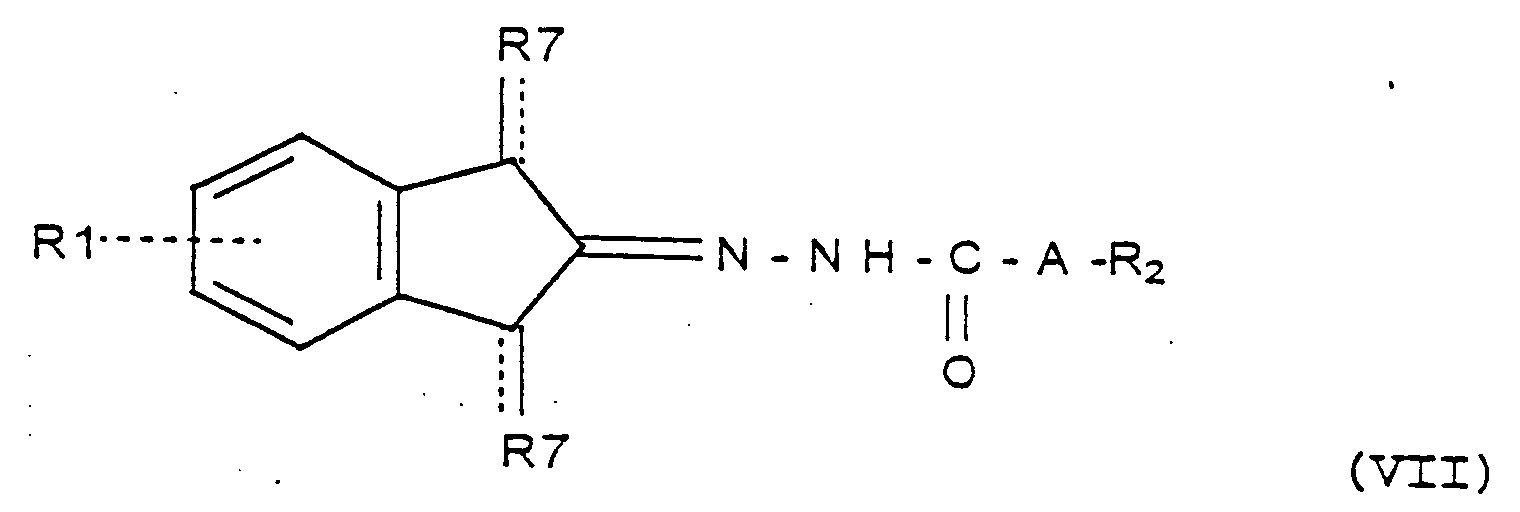

- Procédé d'obtention de dérivés d'indane cétoniques selon la revendication 15, caractérisé en ce que le radical R₆ est un radical o-tertiobutyle tandis que le radical R₇ est un radical =NOH ou =NCH₃.
- Procédé d'obtention de dérivés d'indane cétoniques selon la revendication 16, caractérisé en ce qu'on obtient comme produit intermédiaire le composé de formule

- Utilisation des composés selon l'une quelconque des revendications 1 à 14 pour l'obtention d'un médicament destiné au traitement de l'insuffisance veineuse fonctionnelle organique.
- Utilisation des composés selon l'une quelconque des revendications 1 à 14 pour l'obtention d'un médicament destiné au traitement des pathologies hémorroïdaires.
- Utilisation des composés selon l'une quelconque des revendications 1 à 14 pour l'obtention d'un médicament destiné au traitement des infections inflammatoires ostéoarticulaires, dermatologiques et cardiovasculaires.
- Utilisation des composés selon l'une quelconque des revendications 1 à 14 pour l'obtention d'un médicament destiné au traitement des états de chocs constitués par une chute importante de la pression artérielle plus particulièrement dans les états de chocs septiques.
- A titre de produit intermédiaire la 2-pyridylaminocarbonylhydrazine.
- A titre de produit intermédiaire la 3-pyridylaminocarbonylhydrazine.
- A titre de produit intermédiaire la 4-pyridylaminocarbonylhydrazine.
Applications Claiming Priority (2)
| Application Number | Priority Date | Filing Date | Title |
|---|---|---|---|
| FR9311719 | 1993-10-01 | ||
| FR9311719A FR2710639B1 (fr) | 1993-10-01 | 1993-10-01 | Dérivés d'indane cétoniques, leur procédé d'obtention, leur application thérapeutique. |
Publications (2)
| Publication Number | Publication Date |
|---|---|
| EP0646574A1 true EP0646574A1 (fr) | 1995-04-05 |
| EP0646574B1 EP0646574B1 (fr) | 1998-12-09 |
Family
ID=9451457
Family Applications (1)
| Application Number | Title | Priority Date | Filing Date |
|---|---|---|---|
| EP94402168A Expired - Lifetime EP0646574B1 (fr) | 1993-10-01 | 1994-09-29 | Dérivés d'indane cétoniques, leur procédé d'obtention, leur application thérapeutique |
Country Status (5)
| Country | Link |
|---|---|
| EP (1) | EP0646574B1 (fr) |
| AT (1) | ATE174328T1 (fr) |
| DE (1) | DE69415118T2 (fr) |
| ES (1) | ES2127902T3 (fr) |
| FR (1) | FR2710639B1 (fr) |
Citations (3)
| Publication number | Priority date | Publication date | Assignee | Title |
|---|---|---|---|---|
| DE2127982A1 (en) * | 1971-06-05 | 1972-12-14 | Boehringer Mannheim Gmbh, 6800 Mannheim | Virustatic indane-1,3-dione-2,2-derivs - from indanedione and two reagents or from diethylphthalate and methylsulphones |
| EP0456133A1 (fr) * | 1990-05-07 | 1991-11-13 | Ciba-Geigy Ag | Hydrazones |
| EP0566445A1 (fr) * | 1992-04-03 | 1993-10-20 | Innothera | Dérivés d'indane-1,3-dione et d'indane-1,2,3-trione, leurs procédés de préparation et leur application en thérapeutique |
-
1993
- 1993-10-01 FR FR9311719A patent/FR2710639B1/fr not_active Expired - Fee Related
-
1994
- 1994-09-29 AT AT94402168T patent/ATE174328T1/de not_active IP Right Cessation
- 1994-09-29 ES ES94402168T patent/ES2127902T3/es not_active Expired - Lifetime
- 1994-09-29 EP EP94402168A patent/EP0646574B1/fr not_active Expired - Lifetime
- 1994-09-29 DE DE69415118T patent/DE69415118T2/de not_active Expired - Fee Related
Patent Citations (3)
| Publication number | Priority date | Publication date | Assignee | Title |
|---|---|---|---|---|
| DE2127982A1 (en) * | 1971-06-05 | 1972-12-14 | Boehringer Mannheim Gmbh, 6800 Mannheim | Virustatic indane-1,3-dione-2,2-derivs - from indanedione and two reagents or from diethylphthalate and methylsulphones |
| EP0456133A1 (fr) * | 1990-05-07 | 1991-11-13 | Ciba-Geigy Ag | Hydrazones |
| EP0566445A1 (fr) * | 1992-04-03 | 1993-10-20 | Innothera | Dérivés d'indane-1,3-dione et d'indane-1,2,3-trione, leurs procédés de préparation et leur application en thérapeutique |
Non-Patent Citations (2)
| Title |
|---|
| CHEMICAL ABSTRACTS, vol. 108, no. 24, 1988, Columbus, Ohio, US; abstract no. 215426c * |
| K.G. REDDY ET AL, J. INDIAN INST. SCI., vol. 66, no. 5, 1986, pages 317 - 323 * |
Also Published As
| Publication number | Publication date |
|---|---|
| FR2710639B1 (fr) | 1995-12-22 |
| EP0646574B1 (fr) | 1998-12-09 |
| FR2710639A1 (fr) | 1995-04-07 |
| DE69415118T2 (de) | 1999-07-29 |
| DE69415118D1 (de) | 1999-01-21 |
| ES2127902T3 (es) | 1999-05-01 |
| ATE174328T1 (de) | 1998-12-15 |
Similar Documents
| Publication | Publication Date | Title |
|---|---|---|
| EP0399856B1 (fr) | Pteridin-4 (3H)-ones, procédés de préparation et médicaments les contenant | |
| CA1213595A (fr) | Acides ¬oxo-4-4h-(|-benzopyran-8-yl| alcanoique sels et derives, preparation | |
| FR2476088A2 (fr) | Nouveaux derives du nor-tropane, leur procede de preparation et leur application en therapeutique | |
| EP0370901A1 (fr) | Nouveaux dérivés du chromanne actifs sur le système nerveux central, leur procédé de préparation et les compositions pharmaceutiques en contenant | |
| EP0051023A1 (fr) | Nouveaux composés appartenant à la famille des benzoyl- et alpha-hydroxybenzyl-phényl-osides, leur procédé de préparation et leur application en thérapeutique | |
| EP0566445B1 (fr) | Dérivés d'indane-1,3-dione et d'indane-1,2,3-trione, leurs procédés de préparation et leur application en thérapeutique | |
| EP0624575A1 (fr) | Indoles substitués et les compositions pharmaceutiques qui les contiennent | |
| EP0576619B1 (fr) | Compositions therapeutiques a base de derives de 1,2-dithiole-3-thione | |
| EP0021940B1 (fr) | Nouveaux dérivés aminés du benzothiazole, leur procédé de préparation et leur application en thérapeutique | |
| EP0709383A1 (fr) | Dérivés de la diosmétine, leur procédé de préparation et les compositions pharmaceutiques les contenant | |
| EP0125195A1 (fr) | Nouveaux acides flavonecarboxyliques-4', leur méthode de préparation et leur application thérapeutique | |
| EP0364350B1 (fr) | Dérivés de méthyl-4[(phényl-4 pipérazinyl-1)-2 éthyl]-5 thiazole, leur procédé de préparation et les compositions pharmaceutiques en contenant | |
| FR2522658A1 (fr) | Application a titre de medicaments de derives du trans 4-amino benz (c,d) indol-5-ol ainsi que de leurs sels, compositions les renfermant, nouveaux derives et leur procede de preparation | |
| EP0646579A1 (fr) | Dérivés d'indane cétoniques et de leurs analogues hétérocycliques et leur utilisation thérapeutique | |
| EP0008259A1 (fr) | Nouveaux dérivés de la pipéridylbenzimidazolinone, leurs procédés de préparation et les compositions pharmaceutiques les renfermant | |
| BE779775A (fr) | Derives de l'uree, procede pour les preparer et leurs applications | |
| EP0646574B1 (fr) | Dérivés d'indane cétoniques, leur procédé d'obtention, leur application thérapeutique | |
| EP0427606A1 (fr) | Dérivés d'amidino-4 chromanne et d'amidino-4 pyranno (3,2-c) pyridine, procédé d'obtention et compositions pharmaceutiques les contenant | |
| EP0866692A1 (fr) | Utilisation de derives de bicycles mono- ou dicetoniques, composes obtenus et leur application comme medicament destine au traitement des inflammations, de la migraine et des etats de chocs | |
| EP0209435B1 (fr) | Dérivés de l'hydroxy alkoxy 4-phénylpropyl indole, leurs sels, procédé et intermédiaires de préparation, application à titre de médicaments et compositions les renfermant | |
| CH496693A (fr) | Procédé de préparation des nouveaux dérivés de l'isoindolino-sulfonylurée | |
| FR2701261A1 (fr) | Nouveaux composés glucuronides de la diosmétine, leur procédé de préparation et les compositions pharmaceutiques les renfermant. | |
| EP0347305B1 (fr) | [(Aryl-4-pipérazinyl-1)-2 éthoxy]-3 p-cymène, les dérivés ortho, méta, para monosubstitués ou disubstitués sur le noyau phényle dudit produit, le procédé de préparation desdits dérivés, et les médicaments contenant lesdits composés comme principe actif | |
| CA1200554A (fr) | Procede de preparation de nouveaux derives de l'aminomethyl 14-indole-4-methanol et de leurs sels | |
| EP0650958B1 (fr) | Dérivés d'indane triones et d'hydrazides et leur application thérapeutique |
Legal Events
| Date | Code | Title | Description |
|---|---|---|---|
| PUAI | Public reference made under article 153(3) epc to a published international application that has entered the european phase |
Free format text: ORIGINAL CODE: 0009012 |
|
| AK | Designated contracting states |
Kind code of ref document: A1 Designated state(s): AT BE CH DE DK ES FR GB GR IE IT LI LU MC NL PT SE |
|
| RAX | Requested extension states of the european patent have changed |
Free format text: SI PAYMENT 941021 |
|
| 17P | Request for examination filed |
Effective date: 19950915 |
|
| 17Q | First examination report despatched |
Effective date: 19961015 |
|
| GRAG | Despatch of communication of intention to grant |
Free format text: ORIGINAL CODE: EPIDOS AGRA |
|
| GRAG | Despatch of communication of intention to grant |
Free format text: ORIGINAL CODE: EPIDOS AGRA |
|
| GRAH | Despatch of communication of intention to grant a patent |
Free format text: ORIGINAL CODE: EPIDOS IGRA |
|
| GRAH | Despatch of communication of intention to grant a patent |
Free format text: ORIGINAL CODE: EPIDOS IGRA |
|
| GRAA | (expected) grant |
Free format text: ORIGINAL CODE: 0009210 |
|
| AK | Designated contracting states |
Kind code of ref document: B1 Designated state(s): AT BE CH DE DK ES FR GB GR IE IT LI LU MC NL PT SE |
|
| AX | Request for extension of the european patent |
Free format text: SI PAYMENT 941021 |
|
| PG25 | Lapsed in a contracting state [announced via postgrant information from national office to epo] |
Ref country code: GR Free format text: LAPSE BECAUSE OF NON-PAYMENT OF DUE FEES Effective date: 19981209 |
|
| REF | Corresponds to: |
Ref document number: 174328 Country of ref document: AT Date of ref document: 19981215 Kind code of ref document: T |
|
| REG | Reference to a national code |
Ref country code: CH Ref legal event code: EP |
|
| REF | Corresponds to: |
Ref document number: 69415118 Country of ref document: DE Date of ref document: 19990121 |
|
| REG | Reference to a national code |
Ref country code: IE Ref legal event code: FG4D Free format text: FRENCH |
|
| ITF | It: translation for a ep patent filed | ||
| PG25 | Lapsed in a contracting state [announced via postgrant information from national office to epo] |
Ref country code: SE Free format text: LAPSE BECAUSE OF FAILURE TO SUBMIT A TRANSLATION OF THE DESCRIPTION OR TO PAY THE FEE WITHIN THE PRESCRIBED TIME-LIMIT Effective date: 19990309 Ref country code: DK Free format text: LAPSE BECAUSE OF FAILURE TO SUBMIT A TRANSLATION OF THE DESCRIPTION OR TO PAY THE FEE WITHIN THE PRESCRIBED TIME-LIMIT Effective date: 19990309 |
|
| GBT | Gb: translation of ep patent filed (gb section 77(6)(a)/1977) |
Effective date: 19990301 |
|
| REG | Reference to a national code |
Ref country code: CH Ref legal event code: NV Representative=s name: MOINAS SAVOYE & CRONIN |
|
| REG | Reference to a national code |
Ref country code: ES Ref legal event code: FG2A Ref document number: 2127902 Country of ref document: ES Kind code of ref document: T3 |
|
| REG | Reference to a national code |
Ref country code: PT Ref legal event code: SC4A Free format text: AVAILABILITY OF NATIONAL TRANSLATION Effective date: 19990302 |
|
| PG25 | Lapsed in a contracting state [announced via postgrant information from national office to epo] |
Ref country code: LU Free format text: LAPSE BECAUSE OF NON-PAYMENT OF DUE FEES Effective date: 19990929 |
|
| PLBE | No opposition filed within time limit |
Free format text: ORIGINAL CODE: 0009261 |
|
| STAA | Information on the status of an ep patent application or granted ep patent |
Free format text: STATUS: NO OPPOSITION FILED WITHIN TIME LIMIT |
|
| 26N | No opposition filed | ||
| PGFP | Annual fee paid to national office [announced via postgrant information from national office to epo] |
Ref country code: PT Payment date: 20000712 Year of fee payment: 7 |
|
| PGFP | Annual fee paid to national office [announced via postgrant information from national office to epo] |
Ref country code: ES Payment date: 20000718 Year of fee payment: 7 |
|
| PGFP | Annual fee paid to national office [announced via postgrant information from national office to epo] |
Ref country code: GB Payment date: 20000725 Year of fee payment: 7 Ref country code: BE Payment date: 20000725 Year of fee payment: 7 |
|
| PGFP | Annual fee paid to national office [announced via postgrant information from national office to epo] |
Ref country code: IE Payment date: 20000801 Year of fee payment: 7 |
|
| PGFP | Annual fee paid to national office [announced via postgrant information from national office to epo] |
Ref country code: MC Payment date: 20000918 Year of fee payment: 7 |
|
| PGFP | Annual fee paid to national office [announced via postgrant information from national office to epo] |
Ref country code: AT Payment date: 20000925 Year of fee payment: 7 |
|
| PGFP | Annual fee paid to national office [announced via postgrant information from national office to epo] |
Ref country code: CH Payment date: 20000927 Year of fee payment: 7 |
|
| PGFP | Annual fee paid to national office [announced via postgrant information from national office to epo] |
Ref country code: FR Payment date: 20000928 Year of fee payment: 7 |
|
| PGFP | Annual fee paid to national office [announced via postgrant information from national office to epo] |
Ref country code: NL Payment date: 20000930 Year of fee payment: 7 |
|
| PGFP | Annual fee paid to national office [announced via postgrant information from national office to epo] |
Ref country code: DE Payment date: 20001025 Year of fee payment: 7 |
|
| PG25 | Lapsed in a contracting state [announced via postgrant information from national office to epo] |
Ref country code: MC Free format text: LAPSE BECAUSE OF NON-PAYMENT OF DUE FEES Effective date: 20010221 |
|
| PG25 | Lapsed in a contracting state [announced via postgrant information from national office to epo] |
Ref country code: GB Free format text: LAPSE BECAUSE OF NON-PAYMENT OF DUE FEES Effective date: 20010929 Ref country code: AT Free format text: LAPSE BECAUSE OF NON-PAYMENT OF DUE FEES Effective date: 20010929 |
|
| PG25 | Lapsed in a contracting state [announced via postgrant information from national office to epo] |
Ref country code: LI Free format text: LAPSE BECAUSE OF NON-PAYMENT OF DUE FEES Effective date: 20010930 Ref country code: ES Free format text: LAPSE BECAUSE OF NON-PAYMENT OF DUE FEES Effective date: 20010930 Ref country code: CH Free format text: LAPSE BECAUSE OF NON-PAYMENT OF DUE FEES Effective date: 20010930 Ref country code: BE Free format text: LAPSE BECAUSE OF NON-PAYMENT OF DUE FEES Effective date: 20010930 |
|
| PG25 | Lapsed in a contracting state [announced via postgrant information from national office to epo] |
Ref country code: IE Free format text: LAPSE BECAUSE OF FAILURE TO SUBMIT A TRANSLATION OF THE DESCRIPTION OR TO PAY THE FEE WITHIN THE PRESCRIBED TIME-LIMIT Effective date: 20011001 |
|
| REG | Reference to a national code |
Ref country code: GB Ref legal event code: IF02 |
|
| BERE | Be: lapsed |
Owner name: LABORATOIRE INNOTHERA S.A. Effective date: 20010930 |
|
| PG25 | Lapsed in a contracting state [announced via postgrant information from national office to epo] |
Ref country code: PT Free format text: LAPSE BECAUSE OF NON-PAYMENT OF DUE FEES Effective date: 20020331 |
|
| PG25 | Lapsed in a contracting state [announced via postgrant information from national office to epo] |
Ref country code: NL Free format text: LAPSE BECAUSE OF NON-PAYMENT OF DUE FEES Effective date: 20020401 |
|
| PG25 | Lapsed in a contracting state [announced via postgrant information from national office to epo] |
Ref country code: DE Free format text: LAPSE BECAUSE OF NON-PAYMENT OF DUE FEES Effective date: 20020501 |
|
| REG | Reference to a national code |
Ref country code: CH Ref legal event code: PL |
|
| GBPC | Gb: european patent ceased through non-payment of renewal fee |
Effective date: 20010929 |
|
| PG25 | Lapsed in a contracting state [announced via postgrant information from national office to epo] |
Ref country code: FR Free format text: LAPSE BECAUSE OF NON-PAYMENT OF DUE FEES Effective date: 20020531 |
|
| NLV4 | Nl: lapsed or anulled due to non-payment of the annual fee |
Effective date: 20020401 |
|
| REG | Reference to a national code |
Ref country code: FR Ref legal event code: ST |
|
| REG | Reference to a national code |
Ref country code: PT Ref legal event code: MM4A Free format text: LAPSE DUE TO NON-PAYMENT OF FEES Effective date: 20020331 |
|
| REG | Reference to a national code |
Ref country code: IE Ref legal event code: MM4A |
|
| NLV4 | Nl: lapsed or anulled due to non-payment of the annual fee |
Effective date: 20020401 |
|
| REG | Reference to a national code |
Ref country code: ES Ref legal event code: FD2A Effective date: 20021011 |
|
| PG25 | Lapsed in a contracting state [announced via postgrant information from national office to epo] |
Ref country code: IT Free format text: LAPSE BECAUSE OF NON-PAYMENT OF DUE FEES;WARNING: LAPSES OF ITALIAN PATENTS WITH EFFECTIVE DATE BEFORE 2007 MAY HAVE OCCURRED AT ANY TIME BEFORE 2007. THE CORRECT EFFECTIVE DATE MAY BE DIFFERENT FROM THE ONE RECORDED. Effective date: 20050929 |