EP0051023A1 - Nouveaux composés appartenant à la famille des benzoyl- et alpha-hydroxybenzyl-phényl-osides, leur procédé de préparation et leur application en thérapeutique - Google Patents
Nouveaux composés appartenant à la famille des benzoyl- et alpha-hydroxybenzyl-phényl-osides, leur procédé de préparation et leur application en thérapeutique Download PDFInfo
- Publication number
- EP0051023A1 EP0051023A1 EP81401654A EP81401654A EP0051023A1 EP 0051023 A1 EP0051023 A1 EP 0051023A1 EP 81401654 A EP81401654 A EP 81401654A EP 81401654 A EP81401654 A EP 81401654A EP 0051023 A1 EP0051023 A1 EP 0051023A1
- Authority
- EP
- European Patent Office
- Prior art keywords
- group
- phenyl
- formula
- substituted
- derivative
- Prior art date
- Legal status (The legal status is an assumption and is not a legal conclusion. Google has not performed a legal analysis and makes no representation as to the accuracy of the status listed.)
- Granted
Links
- -1 alpha hydroxybenzyl-phenyl Chemical group 0.000 title claims abstract description 24
- 238000000034 method Methods 0.000 title claims abstract description 23
- 238000002360 preparation method Methods 0.000 title claims description 19
- 230000001225 therapeutic effect Effects 0.000 title claims description 5
- 125000003236 benzoyl group Chemical group [H]C1=C([H])C([H])=C(C([H])=C1[H])C(*)=O 0.000 title description 2
- 125000004435 hydrogen atom Chemical class [H]* 0.000 claims abstract description 12
- 125000002887 hydroxy group Chemical group [H]O* 0.000 claims abstract description 12
- 125000003545 alkoxy group Chemical group 0.000 claims abstract description 5
- 125000004093 cyano group Chemical group *C#N 0.000 claims abstract description 4
- 125000000449 nitro group Chemical group [O-][N+](*)=O 0.000 claims abstract description 4
- 125000005031 thiocyano group Chemical group S(C#N)* 0.000 claims abstract description 4
- 125000001449 isopropyl group Chemical group [H]C([H])([H])C([H])(*)C([H])([H])[H] 0.000 claims abstract description 3
- OKKJLVBELUTLKV-UHFFFAOYSA-N Methanol Chemical compound OC OKKJLVBELUTLKV-UHFFFAOYSA-N 0.000 claims description 69
- 239000000203 mixture Substances 0.000 claims description 26
- 150000001875 compounds Chemical class 0.000 claims description 24
- WEVYAHXRMPXWCK-UHFFFAOYSA-N Acetonitrile Chemical compound CC#N WEVYAHXRMPXWCK-UHFFFAOYSA-N 0.000 claims description 15
- 125000005843 halogen group Chemical group 0.000 claims description 15
- ZMXDDKWLCZADIW-UHFFFAOYSA-N N,N-Dimethylformamide Chemical compound CN(C)C=O ZMXDDKWLCZADIW-UHFFFAOYSA-N 0.000 claims description 14
- 125000004178 (C1-C4) alkyl group Chemical group 0.000 claims description 13
- LFQSCWFLJHTTHZ-UHFFFAOYSA-N Ethanol Chemical compound CCO LFQSCWFLJHTTHZ-UHFFFAOYSA-N 0.000 claims description 11
- IAZDPXIOMUYVGZ-UHFFFAOYSA-N Dimethylsulphoxide Chemical compound CS(C)=O IAZDPXIOMUYVGZ-UHFFFAOYSA-N 0.000 claims description 10
- 125000003232 p-nitrobenzoyl group Chemical group [N+](=O)([O-])C1=CC=C(C(=O)*)C=C1 0.000 claims description 10
- 238000001953 recrystallisation Methods 0.000 claims description 10
- 239000011734 sodium Substances 0.000 claims description 10
- LLEMOWNGBBNAJR-UHFFFAOYSA-N biphenyl-2-ol Chemical class OC1=CC=CC=C1C1=CC=CC=C1 LLEMOWNGBBNAJR-UHFFFAOYSA-N 0.000 claims description 9
- 238000010992 reflux Methods 0.000 claims description 9
- 229910052794 bromium Inorganic materials 0.000 claims description 8
- 230000008569 process Effects 0.000 claims description 8
- 229910052801 chlorine Inorganic materials 0.000 claims description 7
- 229910052708 sodium Inorganic materials 0.000 claims description 7
- WYURNTSHIVDZCO-UHFFFAOYSA-N Tetrahydrofuran Chemical compound C1CCOC1 WYURNTSHIVDZCO-UHFFFAOYSA-N 0.000 claims description 6
- 150000001412 amines Chemical group 0.000 claims description 6
- 239000012442 inert solvent Substances 0.000 claims description 6
- GBMDVOWEEQVZKZ-UHFFFAOYSA-N methanol;hydrate Chemical compound O.OC GBMDVOWEEQVZKZ-UHFFFAOYSA-N 0.000 claims description 6
- 239000000706 filtrate Substances 0.000 claims description 5
- 239000012429 reaction media Substances 0.000 claims description 5
- 238000006243 chemical reaction Methods 0.000 claims description 4
- 238000006722 reduction reaction Methods 0.000 claims description 4
- 125000000242 4-chlorobenzoyl group Chemical group ClC1=CC=C(C(=O)*)C=C1 0.000 claims description 3
- 125000001488 beta-D-galactosyl group Chemical group C1([C@H](O)[C@@H](O)[C@@H](O)[C@H](O1)CO)* 0.000 claims description 3
- 125000000188 beta-D-glucosyl group Chemical group C1([C@H](O)[C@@H](O)[C@H](O)[C@H](O1)CO)* 0.000 claims description 3
- 238000005947 deacylation reaction Methods 0.000 claims description 3
- 238000010438 heat treatment Methods 0.000 claims description 3
- CRGZYKWWYNQGEC-UHFFFAOYSA-N magnesium;methanolate Chemical compound [Mg+2].[O-]C.[O-]C CRGZYKWWYNQGEC-UHFFFAOYSA-N 0.000 claims description 3
- 229910052751 metal Inorganic materials 0.000 claims description 3
- 239000002184 metal Substances 0.000 claims description 3
- YLQBMQCUIZJEEH-UHFFFAOYSA-N tetrahydrofuran Natural products C=1C=COC=1 YLQBMQCUIZJEEH-UHFFFAOYSA-N 0.000 claims description 3
- RYHBNJHYFVUHQT-UHFFFAOYSA-N 1,4-Dioxane Chemical compound C1COCCO1 RYHBNJHYFVUHQT-UHFFFAOYSA-N 0.000 claims description 2
- DGAQECJNVWCQMB-PUAWFVPOSA-M Ilexoside XXIX Chemical compound C[C@@H]1CC[C@@]2(CC[C@@]3(C(=CC[C@H]4[C@]3(CC[C@@H]5[C@@]4(CC[C@@H](C5(C)C)OS(=O)(=O)[O-])C)C)[C@@H]2[C@]1(C)O)C)C(=O)O[C@H]6[C@@H]([C@H]([C@@H]([C@H](O6)CO)O)O)O.[Na+] DGAQECJNVWCQMB-PUAWFVPOSA-M 0.000 claims description 2
- 229910010082 LiAlH Inorganic materials 0.000 claims description 2
- 150000001350 alkyl halides Chemical class 0.000 claims description 2
- BFNBIHQBYMNNAN-UHFFFAOYSA-N ammonium sulfate Chemical compound N.N.OS(O)(=O)=O BFNBIHQBYMNNAN-UHFFFAOYSA-N 0.000 claims description 2
- 229910052921 ammonium sulfate Inorganic materials 0.000 claims description 2
- 235000011130 ammonium sulphate Nutrition 0.000 claims description 2
- 125000003404 beta-D-xylosyl group Chemical group C1([C@H](O)[C@@H](O)[C@H](O)CO1)* 0.000 claims description 2
- 238000010575 fractional recrystallization Methods 0.000 claims description 2
- 229910052740 iodine Inorganic materials 0.000 claims description 2
- LYGJENNIWJXYER-UHFFFAOYSA-N nitromethane Chemical compound C[N+]([O-])=O LYGJENNIWJXYER-UHFFFAOYSA-N 0.000 claims description 2
- 239000012454 non-polar solvent Substances 0.000 claims description 2
- 239000000546 pharmaceutical excipient Substances 0.000 claims description 2
- 239000002798 polar solvent Substances 0.000 claims description 2
- 229940044197 ammonium sulfate Drugs 0.000 claims 1
- 239000003638 chemical reducing agent Substances 0.000 claims 1
- 125000004432 carbon atom Chemical group C* 0.000 abstract description 7
- 125000000217 alkyl group Chemical group 0.000 abstract description 6
- 229910052736 halogen Inorganic materials 0.000 abstract description 5
- 150000002367 halogens Chemical class 0.000 abstract description 5
- 125000002252 acyl group Chemical group 0.000 abstract description 3
- 229910052739 hydrogen Inorganic materials 0.000 abstract description 3
- QAOWNCQODCNURD-UHFFFAOYSA-L sulfate group Chemical group S(=O)(=O)([O-])[O-] QAOWNCQODCNURD-UHFFFAOYSA-L 0.000 abstract description 2
- 125000004429 atom Chemical group 0.000 abstract 5
- 239000001257 hydrogen Substances 0.000 abstract 2
- UFHFLCQGNIYNRP-UHFFFAOYSA-N Hydrogen Chemical compound [H][H] UFHFLCQGNIYNRP-UHFFFAOYSA-N 0.000 abstract 1
- 125000003277 amino group Chemical group 0.000 abstract 1
- 239000003814 drug Substances 0.000 abstract 1
- 239000000047 product Substances 0.000 description 29
- XEKOWRVHYACXOJ-UHFFFAOYSA-N Ethyl acetate Chemical compound CCOC(C)=O XEKOWRVHYACXOJ-UHFFFAOYSA-N 0.000 description 18
- HEMHJVSKTPXQMS-UHFFFAOYSA-M Sodium hydroxide Chemical compound [OH-].[Na+] HEMHJVSKTPXQMS-UHFFFAOYSA-M 0.000 description 12
- 239000002904 solvent Substances 0.000 description 10
- XLYOFNOQVPJJNP-UHFFFAOYSA-N water Substances O XLYOFNOQVPJJNP-UHFFFAOYSA-N 0.000 description 10
- RTZKZFJDLAIYFH-UHFFFAOYSA-N Diethyl ether Chemical compound CCOCC RTZKZFJDLAIYFH-UHFFFAOYSA-N 0.000 description 9
- 239000000460 chlorine Substances 0.000 description 9
- 238000001704 evaporation Methods 0.000 description 7
- 230000008020 evaporation Effects 0.000 description 7
- WQDUMFSSJAZKTM-UHFFFAOYSA-N Sodium methoxide Chemical compound [Na+].[O-]C WQDUMFSSJAZKTM-UHFFFAOYSA-N 0.000 description 6
- 208000025865 Ulcer Diseases 0.000 description 6
- 239000003146 anticoagulant agent Substances 0.000 description 6
- 231100000397 ulcer Toxicity 0.000 description 6
- 241000699670 Mus sp. Species 0.000 description 5
- 238000000605 extraction Methods 0.000 description 5
- 150000003254 radicals Chemical class 0.000 description 5
- VYPSYNLAJGMNEJ-UHFFFAOYSA-N Silicium dioxide Chemical compound O=[Si]=O VYPSYNLAJGMNEJ-UHFFFAOYSA-N 0.000 description 4
- 150000001720 carbohydrates Chemical class 0.000 description 4
- 125000002915 carbonyl group Chemical group [*:2]C([*:1])=O 0.000 description 4
- 239000003795 chemical substances by application Substances 0.000 description 4
- 238000009833 condensation Methods 0.000 description 4
- 230000005494 condensation Effects 0.000 description 4
- 230000007062 hydrolysis Effects 0.000 description 4
- 238000006460 hydrolysis reaction Methods 0.000 description 4
- NDVLTYZPCACLMA-UHFFFAOYSA-N silver oxide Chemical compound [O-2].[Ag+].[Ag+] NDVLTYZPCACLMA-UHFFFAOYSA-N 0.000 description 4
- OFQCQIGMURIECL-UHFFFAOYSA-N 2-[2-(diethylamino)ethyl]-2',6'-dimethylspiro[isoquinoline-4,4'-oxane]-1,3-dione;phosphoric acid Chemical compound OP(O)(O)=O.O=C1N(CCN(CC)CC)C(=O)C2=CC=CC=C2C21CC(C)OC(C)C2 OFQCQIGMURIECL-UHFFFAOYSA-N 0.000 description 3
- WKBOTKDWSSQWDR-UHFFFAOYSA-N Bromine atom Chemical compound [Br] WKBOTKDWSSQWDR-UHFFFAOYSA-N 0.000 description 3
- ZAMOUSCENKQFHK-UHFFFAOYSA-N Chlorine atom Chemical compound [Cl] ZAMOUSCENKQFHK-UHFFFAOYSA-N 0.000 description 3
- 241001465754 Metazoa Species 0.000 description 3
- 241000700159 Rattus Species 0.000 description 3
- 230000009471 action Effects 0.000 description 3
- 230000000141 anti-hypoxic effect Effects 0.000 description 3
- 230000000702 anti-platelet effect Effects 0.000 description 3
- 229960004676 antithrombotic agent Drugs 0.000 description 3
- GDTBXPJZTBHREO-UHFFFAOYSA-N bromine Substances BrBr GDTBXPJZTBHREO-UHFFFAOYSA-N 0.000 description 3
- 235000014633 carbohydrates Nutrition 0.000 description 3
- 230000002490 cerebral effect Effects 0.000 description 3
- 229910052731 fluorine Inorganic materials 0.000 description 3
- 208000010110 spontaneous platelet aggregation Diseases 0.000 description 3
- 238000005406 washing Methods 0.000 description 3
- BSYNRYMUTXBXSQ-UHFFFAOYSA-N Aspirin Chemical compound CC(=O)OC1=CC=CC=C1C(O)=O BSYNRYMUTXBXSQ-UHFFFAOYSA-N 0.000 description 2
- PXGOKWXKJXAPGV-UHFFFAOYSA-N Fluorine Chemical compound FF PXGOKWXKJXAPGV-UHFFFAOYSA-N 0.000 description 2
- CSNNHWWHGAXBCP-UHFFFAOYSA-L Magnesium sulfate Chemical compound [Mg+2].[O-][S+2]([O-])([O-])[O-] CSNNHWWHGAXBCP-UHFFFAOYSA-L 0.000 description 2
- ISWSIDIOOBJBQZ-UHFFFAOYSA-N Phenol Chemical compound OC1=CC=CC=C1 ISWSIDIOOBJBQZ-UHFFFAOYSA-N 0.000 description 2
- JUJWROOIHBZHMG-UHFFFAOYSA-N Pyridine Chemical compound C1=CC=NC=C1 JUJWROOIHBZHMG-UHFFFAOYSA-N 0.000 description 2
- UIIMBOGNXHQVGW-UHFFFAOYSA-M Sodium bicarbonate Chemical compound [Na+].OC([O-])=O UIIMBOGNXHQVGW-UHFFFAOYSA-M 0.000 description 2
- AVNRQUICFRHQDY-YTWAJWBKSA-N [(3r,4s,5r,6r)-4,5-diacetyloxy-6-bromooxan-3-yl] acetate Chemical compound CC(=O)O[C@@H]1CO[C@H](Br)[C@H](OC(C)=O)[C@H]1OC(C)=O AVNRQUICFRHQDY-YTWAJWBKSA-N 0.000 description 2
- 229960001138 acetylsalicylic acid Drugs 0.000 description 2
- 230000007059 acute toxicity Effects 0.000 description 2
- 231100000403 acute toxicity Toxicity 0.000 description 2
- 230000002776 aggregation Effects 0.000 description 2
- 238000004220 aggregation Methods 0.000 description 2
- HOPRXXXSABQWAV-UHFFFAOYSA-N anhydrous collidine Natural products CC1=CC=NC(C)=C1C HOPRXXXSABQWAV-UHFFFAOYSA-N 0.000 description 2
- 230000002785 anti-thrombosis Effects 0.000 description 2
- 230000000767 anti-ulcer Effects 0.000 description 2
- 239000003699 antiulcer agent Substances 0.000 description 2
- 229910052799 carbon Inorganic materials 0.000 description 2
- 239000003054 catalyst Substances 0.000 description 2
- UTBIMNXEDGNJFE-UHFFFAOYSA-N collidine Natural products CC1=CC=C(C)C(C)=N1 UTBIMNXEDGNJFE-UHFFFAOYSA-N 0.000 description 2
- 208000037265 diseases, disorders, signs and symptoms Diseases 0.000 description 2
- 230000000694 effects Effects 0.000 description 2
- 239000003480 eluent Substances 0.000 description 2
- OAMZXMDZZWGPMH-UHFFFAOYSA-N ethyl acetate;toluene Chemical compound CCOC(C)=O.CC1=CC=CC=C1 OAMZXMDZZWGPMH-UHFFFAOYSA-N 0.000 description 2
- 238000002474 experimental method Methods 0.000 description 2
- 238000001914 filtration Methods 0.000 description 2
- 239000011737 fluorine Substances 0.000 description 2
- 239000012299 nitrogen atmosphere Substances 0.000 description 2
- 239000012074 organic phase Substances 0.000 description 2
- 150000002905 orthoesters Chemical class 0.000 description 2
- 239000012071 phase Substances 0.000 description 2
- 229920005989 resin Polymers 0.000 description 2
- 239000011347 resin Substances 0.000 description 2
- 150000003839 salts Chemical class 0.000 description 2
- 239000000377 silicon dioxide Substances 0.000 description 2
- 229910001923 silver oxide Inorganic materials 0.000 description 2
- SQGYOTSLMSWVJD-UHFFFAOYSA-N silver(1+) nitrate Chemical compound [Ag+].[O-]N(=O)=O SQGYOTSLMSWVJD-UHFFFAOYSA-N 0.000 description 2
- 239000001509 sodium citrate Substances 0.000 description 2
- NLJMYIDDQXHKNR-UHFFFAOYSA-K sodium citrate Chemical compound O.O.[Na+].[Na+].[Na+].[O-]C(=O)CC(O)(CC([O-])=O)C([O-])=O NLJMYIDDQXHKNR-UHFFFAOYSA-K 0.000 description 2
- 230000002269 spontaneous effect Effects 0.000 description 2
- 230000004083 survival effect Effects 0.000 description 2
- GFYHSKONPJXCDE-UHFFFAOYSA-N sym-collidine Natural products CC1=CN=C(C)C(C)=C1 GFYHSKONPJXCDE-UHFFFAOYSA-N 0.000 description 2
- 238000002560 therapeutic procedure Methods 0.000 description 2
- 238000005303 weighing Methods 0.000 description 2
- XPNGNIFUDRPBFJ-UHFFFAOYSA-N (2-methylphenyl)methanol Chemical compound CC1=CC=CC=C1CO XPNGNIFUDRPBFJ-UHFFFAOYSA-N 0.000 description 1
- KKWCPKGIYOZPTF-UHFFFAOYSA-N (3-hydroxyphenyl)-[4-(trifluoromethyl)phenyl]methanone Chemical compound OC1=CC=CC(C(=O)C=2C=CC(=CC=2)C(F)(F)F)=C1 KKWCPKGIYOZPTF-UHFFFAOYSA-N 0.000 description 1
- SCYULBFZEHDVBN-UHFFFAOYSA-N 1,1-Dichloroethane Chemical compound CC(Cl)Cl SCYULBFZEHDVBN-UHFFFAOYSA-N 0.000 description 1
- WSLDOOZREJYCGB-UHFFFAOYSA-N 1,2-Dichloroethane Chemical compound ClCCCl WSLDOOZREJYCGB-UHFFFAOYSA-N 0.000 description 1
- RTKMFQOHBDVEBC-UHFFFAOYSA-N 3-bromo-3-buten-1-ol Chemical compound OCCC(Br)=C RTKMFQOHBDVEBC-UHFFFAOYSA-N 0.000 description 1
- RADVRRGHIZRXRT-UHFFFAOYSA-N 4-[hydroxy-(4-nitrophenyl)methyl]phenol Chemical compound C=1C=C([N+]([O-])=O)C=CC=1C(O)C1=CC=C(O)C=C1 RADVRRGHIZRXRT-UHFFFAOYSA-N 0.000 description 1
- ZCYVEMRRCGMTRW-UHFFFAOYSA-N 7553-56-2 Chemical group [I] ZCYVEMRRCGMTRW-UHFFFAOYSA-N 0.000 description 1
- QTBSBXVTEAMEQO-UHFFFAOYSA-M Acetate Chemical compound CC([O-])=O QTBSBXVTEAMEQO-UHFFFAOYSA-M 0.000 description 1
- 241001424309 Arita Species 0.000 description 1
- XFXPMWWXUTWYJX-UHFFFAOYSA-N Cyanide Chemical compound N#[C-] XFXPMWWXUTWYJX-UHFFFAOYSA-N 0.000 description 1
- 206010021143 Hypoxia Diseases 0.000 description 1
- 239000002841 Lewis acid Substances 0.000 description 1
- FYYHWMGAXLPEAU-UHFFFAOYSA-N Magnesium Chemical compound [Mg] FYYHWMGAXLPEAU-UHFFFAOYSA-N 0.000 description 1
- 125000003047 N-acetyl group Chemical group 0.000 description 1
- 241000700157 Rattus norvegicus Species 0.000 description 1
- CDBYLPFSWZWCQE-UHFFFAOYSA-L Sodium Carbonate Chemical compound [Na+].[Na+].[O-]C([O-])=O CDBYLPFSWZWCQE-UHFFFAOYSA-L 0.000 description 1
- 241001080024 Telles Species 0.000 description 1
- 208000007536 Thrombosis Diseases 0.000 description 1
- 206010047249 Venous thrombosis Diseases 0.000 description 1
- 239000002253 acid Substances 0.000 description 1
- 230000004931 aggregating effect Effects 0.000 description 1
- GRTOGORTSDXSFK-XJTZBENFSA-N ajmalicine Chemical compound C1=CC=C2C(CCN3C[C@@H]4[C@H](C)OC=C([C@H]4C[C@H]33)C(=O)OC)=C3NC2=C1 GRTOGORTSDXSFK-XJTZBENFSA-N 0.000 description 1
- 230000001476 alcoholic effect Effects 0.000 description 1
- 150000001298 alcohols Chemical class 0.000 description 1
- 229960005039 almitrine Drugs 0.000 description 1
- MRDBGMJEPGXQHJ-UHFFFAOYSA-N almitrine dimesylate Chemical compound CS(O)(=O)=O.CS(O)(=O)=O.C1=CC(F)=CC=C1C(C=1C=CC(F)=CC=1)N1CCN(C=2N=C(NCC=C)N=C(NCC=C)N=2)CC1 MRDBGMJEPGXQHJ-UHFFFAOYSA-N 0.000 description 1
- LWKZCNVWFBSPKH-FVLLGJNOSA-N almitrine-raubasine Chemical compound C1=CC=C2C(CCN3C[C@@H]4[C@H](C)OC=C([C@H]4C[C@H]33)C(=O)OC)=C3NC2=C1.C1=CC(F)=CC=C1C(C=1C=CC(F)=CC=1)N1CCN(C=2N=C(NCC=C)N=C(NCC=C)N=2)CC1 LWKZCNVWFBSPKH-FVLLGJNOSA-N 0.000 description 1
- PNEYBMLMFCGWSK-UHFFFAOYSA-N aluminium oxide Inorganic materials [O-2].[O-2].[O-2].[Al+3].[Al+3] PNEYBMLMFCGWSK-UHFFFAOYSA-N 0.000 description 1
- 239000001166 ammonium sulphate Substances 0.000 description 1
- 238000010171 animal model Methods 0.000 description 1
- 230000000840 anti-viral effect Effects 0.000 description 1
- 239000008346 aqueous phase Substances 0.000 description 1
- 239000012298 atmosphere Substances 0.000 description 1
- ZYPMTNZLJAHPPY-UHFFFAOYSA-N azane butan-1-ol ethanol hydrate Chemical compound N.O.CCO.CCCCO ZYPMTNZLJAHPPY-UHFFFAOYSA-N 0.000 description 1
- 230000015572 biosynthetic process Effects 0.000 description 1
- 239000008280 blood Substances 0.000 description 1
- 210000004369 blood Anatomy 0.000 description 1
- 229910000011 cadmium carbonate Inorganic materials 0.000 description 1
- 239000002775 capsule Substances 0.000 description 1
- 238000005119 centrifugation Methods 0.000 description 1
- 229920001429 chelating resin Polymers 0.000 description 1
- CCGSUNCLSOWKJO-UHFFFAOYSA-N cimetidine Chemical compound N#CNC(=N/C)\NCCSCC1=NC=N[C]1C CCGSUNCLSOWKJO-UHFFFAOYSA-N 0.000 description 1
- 229960001380 cimetidine Drugs 0.000 description 1
- GKTWGGQPFAXNFI-HNNXBMFYSA-N clopidogrel Chemical compound C1([C@H](N2CC=3C=CSC=3CC2)C(=O)OC)=CC=CC=C1Cl GKTWGGQPFAXNFI-HNNXBMFYSA-N 0.000 description 1
- 238000003381 deacetylation reaction Methods 0.000 description 1
- 238000000354 decomposition reaction Methods 0.000 description 1
- 201000010099 disease Diseases 0.000 description 1
- 208000035475 disorder Diseases 0.000 description 1
- 238000004090 dissolution Methods 0.000 description 1
- 239000012153 distilled water Substances 0.000 description 1
- 239000002552 dosage form Substances 0.000 description 1
- 230000003511 endothelial effect Effects 0.000 description 1
- 239000011521 glass Substances 0.000 description 1
- 230000007954 hypoxia Effects 0.000 description 1
- 230000005764 inhibitory process Effects 0.000 description 1
- 231100000636 lethal dose Toxicity 0.000 description 1
- 150000007517 lewis acids Chemical class 0.000 description 1
- 239000011777 magnesium Substances 0.000 description 1
- 229910052943 magnesium sulfate Inorganic materials 0.000 description 1
- 235000019341 magnesium sulphate Nutrition 0.000 description 1
- 230000007246 mechanism Effects 0.000 description 1
- 230000008018 melting Effects 0.000 description 1
- 238000002844 melting Methods 0.000 description 1
- 229940075610 mercuric cyanide Drugs 0.000 description 1
- 229910052987 metal hydride Inorganic materials 0.000 description 1
- 150000004681 metal hydrides Chemical class 0.000 description 1
- DOTMOQHOJINYBL-UHFFFAOYSA-N molecular nitrogen;molecular oxygen Chemical compound N#N.O=O DOTMOQHOJINYBL-UHFFFAOYSA-N 0.000 description 1
- 230000007935 neutral effect Effects 0.000 description 1
- 231100001160 nonlethal Toxicity 0.000 description 1
- 231100000252 nontoxic Toxicity 0.000 description 1
- 230000003000 nontoxic effect Effects 0.000 description 1
- ISWSIDIOOBJBQZ-UHFFFAOYSA-M phenolate Chemical compound [O-]C1=CC=CC=C1 ISWSIDIOOBJBQZ-UHFFFAOYSA-M 0.000 description 1
- 125000001997 phenyl group Chemical group [H]C1=C([H])C([H])=C(*)C([H])=C1[H] 0.000 description 1
- 230000000704 physical effect Effects 0.000 description 1
- 239000002244 precipitate Substances 0.000 description 1
- UMJSCPRVCHMLSP-UHFFFAOYSA-N pyridine Natural products COC1=CC=CN=C1 UMJSCPRVCHMLSP-UHFFFAOYSA-N 0.000 description 1
- ZLQMRLSBXKQKMG-UHFFFAOYSA-N rauniticine Natural products COC(=O)C1=CC2CC3N(CCc4c3[nH]c5ccccc45)CC2C(C)O1 ZLQMRLSBXKQKMG-UHFFFAOYSA-N 0.000 description 1
- 239000011541 reaction mixture Substances 0.000 description 1
- 230000009467 reduction Effects 0.000 description 1
- 230000001850 reproductive effect Effects 0.000 description 1
- 230000009758 senescence Effects 0.000 description 1
- 238000000926 separation method Methods 0.000 description 1
- 229910001961 silver nitrate Inorganic materials 0.000 description 1
- 235000017557 sodium bicarbonate Nutrition 0.000 description 1
- 229910000030 sodium bicarbonate Inorganic materials 0.000 description 1
- 238000003756 stirring Methods 0.000 description 1
- 125000001424 substituent group Chemical group 0.000 description 1
- YBBRCQOCSYXUOC-UHFFFAOYSA-N sulfuryl dichloride Chemical compound ClS(Cl)(=O)=O YBBRCQOCSYXUOC-UHFFFAOYSA-N 0.000 description 1
- 239000006228 supernatant Substances 0.000 description 1
- 239000000725 suspension Substances 0.000 description 1
- 238000003786 synthesis reaction Methods 0.000 description 1
- 150000003512 tertiary amines Chemical class 0.000 description 1
- 231100000419 toxicity Toxicity 0.000 description 1
- 230000001988 toxicity Effects 0.000 description 1
- 230000001562 ulcerogenic effect Effects 0.000 description 1
- 201000002282 venous insufficiency Diseases 0.000 description 1
Classifications
-
- C—CHEMISTRY; METALLURGY
- C07—ORGANIC CHEMISTRY
- C07H—SUGARS; DERIVATIVES THEREOF; NUCLEOSIDES; NUCLEOTIDES; NUCLEIC ACIDS
- C07H15/00—Compounds containing hydrocarbon or substituted hydrocarbon radicals directly attached to hetero atoms of saccharide radicals
- C07H15/20—Carbocyclic rings
-
- C—CHEMISTRY; METALLURGY
- C07—ORGANIC CHEMISTRY
- C07H—SUGARS; DERIVATIVES THEREOF; NUCLEOSIDES; NUCLEOTIDES; NUCLEIC ACIDS
- C07H15/00—Compounds containing hydrocarbon or substituted hydrocarbon radicals directly attached to hetero atoms of saccharide radicals
- C07H15/20—Carbocyclic rings
- C07H15/203—Monocyclic carbocyclic rings other than cyclohexane rings; Bicyclic carbocyclic ring systems
-
- A—HUMAN NECESSITIES
- A61—MEDICAL OR VETERINARY SCIENCE; HYGIENE
- A61P—SPECIFIC THERAPEUTIC ACTIVITY OF CHEMICAL COMPOUNDS OR MEDICINAL PREPARATIONS
- A61P1/00—Drugs for disorders of the alimentary tract or the digestive system
- A61P1/04—Drugs for disorders of the alimentary tract or the digestive system for ulcers, gastritis or reflux esophagitis, e.g. antacids, inhibitors of acid secretion, mucosal protectants
-
- A—HUMAN NECESSITIES
- A61—MEDICAL OR VETERINARY SCIENCE; HYGIENE
- A61P—SPECIFIC THERAPEUTIC ACTIVITY OF CHEMICAL COMPOUNDS OR MEDICINAL PREPARATIONS
- A61P25/00—Drugs for disorders of the nervous system
- A61P25/28—Drugs for disorders of the nervous system for treating neurodegenerative disorders of the central nervous system, e.g. nootropic agents, cognition enhancers, drugs for treating Alzheimer's disease or other forms of dementia
-
- A—HUMAN NECESSITIES
- A61—MEDICAL OR VETERINARY SCIENCE; HYGIENE
- A61P—SPECIFIC THERAPEUTIC ACTIVITY OF CHEMICAL COMPOUNDS OR MEDICINAL PREPARATIONS
- A61P7/00—Drugs for disorders of the blood or the extracellular fluid
- A61P7/02—Antithrombotic agents; Anticoagulants; Platelet aggregation inhibitors
Definitions
- the present invention relates, as new industrial products, to the benzoyl-phenyl-oside and ⁇ -hydroxybenzyl-phenyl-oside derivatives of formula (I) below. It also relates to their preparation process and their therapeutic application, in particular as anti-ulcer agents, anti-platelet aggregating agents, antithrombotic agents, and cerebral oxygenators.
- the compounds according to the invention are characterized in that they are chosen from the group consisting of (i) the compounds of general formula in which: - Z represents CO or CHOH; - X 2 , X 33 X 4 and X 5 , identical or different, each represent a hydrogen atom, a halogen atom, a C 1 -C 4 alkyl group, a substituted C 1 -C 4 alkyl group by one or more halogen atoms (in particular a CF 3 group), an OH group, a C 1 -C 4 alkoxy group, a C 1 -C 4 alkoxy group substituted by one or more halogen atoms, a nitro group, a cyano group, a thiocyano group, an isothiocyano group, a NR'R "group (where R 'and R", identical or different, each represent the hydrogen atom or a C 1 - alkyl group C 4 ); - X 1 represents a hydrogen atom,
- the invention also includes the acid addition salts of the compounds of formula (I) when at least one of the groups X 1 , X 2 , X3, X4, X5 and R has a basic group.
- the group -O-R taking into account the structure of formula (I) given above, can be in the ortho, meta or para position relative to the group Z.
- each hydroxyl function of the dare radical can be acylated (in particular by COCH 3 ), alkylated (in particular by CH 3 or CH 2 C 6 H 5 ) or sulfated (in particular by SO 3 NH 4 , SO 3 Na or SO 3 K), and the hydroxyl function of the carbon atom in position 2 can be replaced by an amine function, itself capable of being acylated (in particular by COCH 3 ), alkylated (in particular by CH 3 or CH 2 C 6 H 5 ) or sulfated (in particular by SO 3 NH 4 , SO 3 Na or SO 3 K).
- R represents in particular a glycosyl radical such as ⁇ -D-glucosyl, ⁇ -D-xyloxyl, ⁇ -D-galactosyl, ⁇ -D-glucosaminyl or aL-rhamnosyl, the hydroxyl and amine functions possibly, if appropriate , be substituted by acyl, alkyl or sulfate groups.
- X 1 represents a group -NH-CS-0-CH 3 or -OC (CH 3 ) 2 CO 2 -R '''
- a group is in the para position relative to the group Z and, in in this case, each of the groups X 2 , X 3 , X 4 and X 5 represents the hydrogen atom.
- Halogen atom is understood here to mean fluorine, chlorine, bromine and iodine atoms, the preferred halogens being fluorine, chlorine and bromine, among these the most advantageous halogens from the point of view therapeutic are chlorine and bromine.
- phenylphenol derivative (II) (where A is Na or K) with 1.1 to 1, 2 moles of a haloacylose of formula: (where H al is a halogen atom F, Cl, Br, I, preferably Cl or Br to have an optimal yield, and Ro represents a dare residue where the OH and NH 2 functions are preferably protected by an acyl group ), in an inert solvent chosen from polar or apolar solvents (in particular such as dimethylformamide, tetrahydrofuran, dioxane, methanol, ethanol, acetonitrile, nitromethane, dimethylsulfoxide, and their mixtures with each other or with haloalkanes, in particular DMF mixtures- CH 2 Cl 2 , DMF-CHCl 3 , DMF-ClCH 2 CH 2 Cl).
- polar or apolar solvents in particular such as dimethylformamide, tetrahydrofuran, dioxane, methanol,
- the derivative obtained according to this technique is subjected, where appropriate, to a deacylation reaction.
- the compounds of formula I where Z is CHOH can be split into their 2 diastereoisomers according to a method known per se, in particular by fractional recrystallization.
- the mixture of the diastereoisomers can be resolved a) by dissolving said mixture in CH 3 OH-H 2 O (1: 1) v / v and recrystallization until constant rotary power in CH 3 OH-H 2 O (1: 1) -v / v, to obtain the dextrorotatory, then b) by resumption of recrystallization filtrates in CH 3 OH-H 2 O (1: 2) v / v and recrystallization until constant rotary power in CH 3 OH-H 2 O (1: 2) v / v to obtain the levorotatory.
- a therapeutic composition is proposed, characterized in that it contains, in association with a physiologically acceptable excipient, at least one compound chosen from the group consisting of the products of formula I, their diastereoisomers and their non-toxic salts. .
- the compounds of formula (I) are useful in therapy as anti-ulcer agents, anti-platelet aggregation agents, antithrombotics or cerebral oxygenators.
- the most interesting compounds relevant in therapy are the products of Examples 1 (code No. 163), 97 (code No. 265), 98 (code No. 390) and 99 (code No. 391) which are particularly indicated as venous antithrombotic agents, the preferred compound being the product of Example 97.
- the dry phenate is suspended, obtained by the action of 0.540 g of NaH on 5 g of 4'-paranitro-benzoylphenol, in a mixture of 25 ml of DMF and 25 ml of dichloroethane. 8.3 g of acetochloroglucosamine are added to the reaction medium and the mixture is stirred for 3 h at 40 ° C. After hydrolysis, extraction is carried out with ethyl acetate, washing with sodium hydroxide at 40 g / l and finally with water.
- Acute toxicity has been studied in mice by the IP route. It is expressed in the form of DL-50 (lethal dose causing the death of half of the animals) or DL-0 (maximum non-lethal doae). The results are given in Table III.
- the spontaneous aggregation index according to WU and HOOK Stroke 6, 521-524 (1975) is expressed by the relation.
- An occlusive thrombus is created in the inferior rat vena cava by the combined action of endothelial damage and venous stasis for 15 min and 4 to 5 h after administration of the product to be tested (100 mg / kg I.P.). The results are reported in Table VI below.
- the experiment is carried out on male WISTAR rats weighing 180 to 200 g.
- the test products are administered at 100 mg / kg I.P. (unless otherwise indicated in Table IV).
- the rats are fasted and a first administration of the product to be tested is carried out.
- This rating is normalized with respect to a control lot and to cimetidine (a reference product) to which index 1 has been assigned.
- the experiment is carried out on batches of 20 male SWISS mice weighing 20 to 30 g.
- the mice are administered each product to be tested intraperitoneally at a dose corresponding to 1 / 10th of the DL-50 or at a dose of 100 mg / kg when the DL-0 is greater than or equal to 800 mg / kg.
- the mice are placed in a nitrogen-oxygen (95: 5) v / v atmosphere. The survival time of the mice is then measured up to 15 minutes maximum.
- Table VII The results recorded in Table VII are expressed as a percentage of survival compared to an untreated control batch and a batch treated with an anti-hypoxic reference product [specialty known under the brand name of "DUXIL" and which consists of a mixture of Almitrine bis-methanesulfonate and Raubasine in the weight ratio 3: 1], the anti-hypoxic reference product being administered at a dose of 18 mg / kg IP
- the products of formula (I) can be administered in particular orally, in the form of capsules or coated tablets or not each containing 0.05 to 1 g of at least one compound of formula (I) as active principle, and preferably 0.1 to 0.5 g, on the one hand, and by injectable route, in the form of solutions containing from 0.05 to 0.3 g of active principle in 2 to 10 cm 3 of distilled water, on the other hand.
- These dosage forms can be administered at a rate of 1 to 3 taken per day.
Landscapes
- Chemical & Material Sciences (AREA)
- Health & Medical Sciences (AREA)
- Organic Chemistry (AREA)
- Engineering & Computer Science (AREA)
- Life Sciences & Earth Sciences (AREA)
- General Health & Medical Sciences (AREA)
- Bioinformatics & Cheminformatics (AREA)
- General Chemical & Material Sciences (AREA)
- Animal Behavior & Ethology (AREA)
- Genetics & Genomics (AREA)
- Biotechnology (AREA)
- Veterinary Medicine (AREA)
- Public Health (AREA)
- Chemical Kinetics & Catalysis (AREA)
- Biochemistry (AREA)
- Medicinal Chemistry (AREA)
- Nuclear Medicine, Radiotherapy & Molecular Imaging (AREA)
- Pharmacology & Pharmacy (AREA)
- Molecular Biology (AREA)
- Biomedical Technology (AREA)
- Neurology (AREA)
- Neurosurgery (AREA)
- Hematology (AREA)
- Diabetes (AREA)
- Hospice & Palliative Care (AREA)
- Psychiatry (AREA)
- Pharmaceuticals Containing Other Organic And Inorganic Compounds (AREA)
- Organic Low-Molecular-Weight Compounds And Preparation Thereof (AREA)
- Saccharide Compounds (AREA)
- Acyclic And Carbocyclic Compounds In Medicinal Compositions (AREA)
Abstract
Description
- La présente invention concerne, en tant que produits industriels nouveaux, les dérivés de benzoyl-phényl-osides et d'a-hydroxybenzyl-phényl-osides de formule (I) ci-dessous. Elle concerne également leur procédé de préparation et leur application en thérapeutique, notamment en tant qu'agents anti-ulcéreux, anti-agrégants plaquettaires, antithrombotiques, et oxygénateurs cérébraux.
- On sait que, dans le passé, on a proposé d'utiliser des phényl-glycosides comme agents doués de propriétés antivirales, voir à cet effet l'article de HITOSHI ARITA, Carbohydrate Research 62, 143-154 (1978).
- On vient de trouver, de façon surprenante, que des composés structurellement différents, car présentant en particulier un groupe benzoyle ou a-hydroxybenzyle supplémentaire par rapport aux phényl-glycosides, sont particulièrement intéressants dans le traitement des ulcères et des maladies liées aux troubles circulatoires, et notamment dans le traitement de la sénescence cérébrale.
- Les composés selon l'invention sont caractérisés en ce qu'ils sont choisis parmi l'ensemble constitué par (i) les composés de formule générale
 CO ou
CO ou CHOH ; - X2, X33 X4 et X5, identiques ou différents, représentent chacun un atome d'hydrogène, un atome d'halogène, un groupe alkyle en C1-C4, un groupe alkyle en C1-C4 substitué par un ou plusieurs atomes d'halogène (notamment un groupe CF3), un groupe OH, un groupe alkoxy en C1-C4, un groupe alkoxy en C1-C4 substitué par un ou plusieurs atomes d'halogène,, un groupe nitro, un groupe cyano, un groupe thiocyano, un groupe isothiocyano, un groupe NR'R" (où R' et R", identiques ou différents, représentent chacun l'atome d'hydrogène ou un groupe alkyle en C1-C4) ; - X1 représente un atome d'hydrogène, un atome d'halogène, un groupe alkyle en C1-C4, un groupe alkyle en C1-C4 substitué par un ou plusieurs atomes d'halogène (notamment un groupe CF3), un groupe OH, un groupe alkoxy en C1-C4, un groupe alkoxy en C1-C4 substitué par un ou plusieurs atomes d'halogène, un groupe nitro, un groupe cyano, un groupe thiocyano, un groupe isothiocyano, un groupe NR'R" (où R' et R", identiques ou différents, représentent chacun l'atome d'hydrogène ou un groupe alkyle en C1-C4), un groupe -NH-CS-0-CH3 ou un groupe -O-C(CH3)2CO2-R''' (où R''' est un groupe alkyle en C1-C4 et, de préférence, un groupe isopropyle) ; - R représente un radical ose éventuellement substitué ; et (ii) leurs diastéréoisomères quand Z est CHOH.
 - L'invention comprend également les sels d'addition d'acide des composés de formule (I) lorsque au moins un des groupes X1, X2, X3, X4, X5 et R comporte un groupe basique.
- Le groupe -O-R, compte tenu de la structure de la formule (I) donnée ci-dessus, peut être en position ortho, méta ou para par rapport au groupe Z.
- Le terme "ose" qui intervient dans la définition du radical R désigne ici toute unité élémentaire glucidique non hydrolysable de formule brute (CH2O)n. Selon l'invention chaque fonction hydroxyle du radical ose peut être acylée (notamment par COCH3), alkylée (notamment par CH3 ou CH2C6H5) ou sulfatée (notamment par SO3NH4, SO3Na ou SO3K), et la fonction hydroxyle de l'atome de carbone en position 2 peut être remplacée par une fonction amine, elle-même susceptible d'être acylée (notamment par COCH3), alkylée (notamment par CH3 ou CH2C6H5) ou sulfatée (notamment par SO3NH4, SO3Na ou SO3K).
- Par suite R représente notamment un radical glycosyle tel que β-D-glucosyle, β-D-xyloxyle, β-D-galactosyle, β-D-glucosami- nyle ou a-L-rhamnosyle, les fonctions hydroxyle et amine pouvant, le cas échéant, être substituées par des groupes acyle, alkyle ou sulfate.
- De façon avantageuse, quand X1 représente un groupe -NH-CS-0-CH3 ou -O-C(CH3)2CO2-R''', un tel groupe est en position para par rapport au groupe Z et, dans ce cas, chacun des groupes X2, X3, X4 et X5 représente l'atome d'hydrogène.
- Par atome d'halogène, on entend ici les atomes de fluor, de chlore, de brome et d'iode, les halogènes préférés étant le fluor, le chlore et le brome, parmi ceux-ci les halogènes les plus intéressants du point de vue thérapeutique sont le chlore et le brome.
- Compte tenu des définitions données ci-dessus, l'invention englobe donc les dérivés carbonyle (Z = CO) du type benzoyl-phényl-oside et les dérivés carbinols (Z = CHOH) du type a-hydroxybenzyl-phényl-oside.
- Parmi les composés de formule (I) qui sont préférés selon l'invention, on peut notamment mentionner les dérivés osides où Z est CO ou CHOH ; X1, X2, X31 X4 et X5, identiques ou différents, représentent chacun H, Cl, Br, CH3' CF3' OH, OCH3, NO2, NH2, N(CH3)2, NCS, X1 représentant également en position para, par rapport au groupe Z, un groupe -OC(CH3)2CO2-CH(CH3)2 ou un groupe -NH-CS-OCH3 quand X2 = X3 = X4 = X5 = H ; et R représente un radical ose tel que β-D-glucosyle, β-D-xylosyle, β-D-galactosyle, a-L-rhamnosyle, β-D-glucosaminyle, l'atome d'hydrogène des groupes OH du radical oside pouvant être, le cas échéant, remplacé par un reste COCH3' CH3, CH2C6H5, SO3NH4, SO3Na, SO3K, et la fonction amine du groupe oside pouvant être substituée par un groupe COCH3.
- Les composés de formule (I) peuvent être préparés selon une méthode connue en soi selon un mécanisme réactionnel classique. On peut ainsi procéder à l'osidation d'un phényl-phénol de formule :

- - la méthode de KOENIG-KNORR [décrite dans l'ouvrage "The Carbohydrates, Chemistry and Biochemistry" (2e édition, Academic Press, New York et Londres 1972) tome IA, pages 295-301] par condensation d'un phénol (IIa) avec un haloacylose en présence d'un catalyseur tel que le cyanure mercurique, Ag20, AgCO3, CdC03 ou d'une amine tertiaire telle que la collidine ;
- - la méthode de HELFERICH (ibidem, pages 292-294) par condensation d'un acyloside avec un phénol (IIa) en présence d'un acide de Lewis ; ou
- - la méthode dite à l'ortho-ester (ibidem, pages 300-304).
- Le procédé préféré que l'on préconise est caractérisé en ce que :
- (i) on fait réagir un dérivé en phényl-phénol de formule :

- (ii) et, si nécessaire, on procède à une réaction de désacétylation par chauffage à reflux dans un alcool inférieur en C1-C4 (de préférence le méthanol) en présence d'un alcoolate métallique de préférence le méthylate de magnésium ou le méthylate de sodium.
- Selon un mode préféré de mise en oeuvre du procédé que l'on préconise, on fait réagir au stade (i) 1 mole de dérivé de phényl-phénol (II) (où A est Na ou K) avec 1,1 à 1,2 mole d'un halogénoacylose de formule :

- Quand A représente H on recommande d'utiliser un catalyseur tel que mentionné ci-dessus, notamment Ag20. r
- Outre ce procédé qui convient pour la synthèse des composés I du type "carbonyle" et du type "carbinol", on peut mettre en oeuvre un autre procédé pour l'obtention des composés du type "carbinol" par réduction du dérivé "carbonyle" correspondant. Cette réaction de réduction est mise en oeuvre en faisant réagir un composé de formule I où Z= CO avec un agent choisi parmi l'ensemble constitué par les hydrures métalliques complexes tels que LiAlH4 et KBH4, dans un solvant inerte tel que l'éther, le tétrahydrofuranne et les alcools inférieurs notamment le méthanol et l'éthanol, à une température comprise entre 0°C et 50°C (de préférence entre 0°C et 25°C, notamment à la température ambiante).
- Les composés de formule I où Z est CHOH peuvent être dédoublés en leurs 2 diastéréoisomères selon une méthode connue en soi, notamment par recristallisation fractionnée, De façon avantageuse, la résolution du mélange des diastéréoisomères peut être effectuée a) par dissolution dudit mélange dans CH3OH-H2O (1:1) v/v et recristallisation jusqu'à pouvoir rotatoire constant dans CH3OH-H2O (1:1)-v/v, pour obtenir le dextrogyre, puis b) par reprise des filtrats de recristallisation dans CH3OH-H2O (1:2) v/v et recristallisation jusqu'à pouvoir rotatoire constant dans CH3OH-H2O (1:2) v/v pour obtenir le lévogyre.
- Selon l'invention, on propose une composition thérapeutique caractérisée en ce qu'elle renferme, en association avec un excipient physiologiquement acceptable, au moins un composé choisi parmi l'ensemble constitué par les produits de formule I, leurs diastéréoisomères et leurs sels non toxiques.
- Les composés de formule (I) sont utiles en thérapeutique en tant qu'agents anti-ulcéreux, anti-agrégants plaquettaires, antithrombotiques ou oxygénateurs cérébraux. Les composés les plus intéressants en thérapeutique sont les produits des exemples 1 (N° de code 163), 97 (N° de code 265), 98 (N° de code 390) et 99 (N° de code 391) qui sont particulièrement indiqués en tant qu'agents antithrombotiques veineux, le composé préféré étant le produit de l'exemple 97.
- D'autres caractéristiques et avantages de l'invention seront mieux compris à la lecture qui va suivre d'exemples de préparation nullement limitatifs mais donnés à titre d'illustration.
- Dans un ballon de 500 ml, on met en suspension le phénate sec obtenu par action de 4,1 g de soude sur 25 g de 41-para- nitrobenzoyl-phénol dans un mélange de 65 ml de DMF et 200 ml de dichloro-1,2-éthane.
- On porte le mélange à reflux et on additionne rapidement 45 g de 2,3,4-tri-(0-acétyl)-1-bromo-α-D-xylopyranose. On chauffe ensuite 3 h à reflux. Après hydrolyse, on extrait à l'acétate d'éthyle et on lave la phase organique à la soude à 40 g/1. On évapore à sec et on obtient une huile jaune qui cristallise dans l'éther anhydre. On recristallise enfin dans le méthanol. On obtient ainsi 22 g de produit attendu. F = 150°C. α20°C D = - 33,3° (c = 0,9 g/1 ; ClCH2CH2Cl).
- 20 g de produit acétylé obtenu selon la Préparation I sont dissous à chaud dans 300 ml de méthanol et 2 g de Mg(OCH3)2. Le mélange est porté à reflux pendant 2 h. On additionne ensuite 1 litre de méthanol et on réchauffe jusqu'à dissolution complète. On filtre la solution jaune obtenue. Après évaporation du solvant, on obtient le produit attendu avec un rendement de 90 %. F = 200°C. α20°C D = - 26,6° (c = 0,6 g/1 ; méthanol).
- Dans un ballon de 500 ml, on met en suspension le phénate sec, obtenu par action de 0,540 g de NaH sur 5 g de 4'-paranitro- benzoylphénol, dans un mélange de 25 ml de DMF et 25 ml de dichlor- éthane. On ajoute au milieu réactionnel 8,3 g d'acétochloroglucosamine et on agite 3 h à 40°C. Après hydrolyse, on extrait à l'acétate d'éthyle, lave à la soude à 40 g/1 et enfin à l'eau.
- Après évaporation du solvant, on obtient une huile qui précipite dans l'éther. Le dérivé acétylé obtenu est recristallisé dans l'acétate d'éthyle. (Rendement = 59 % ; F = 238°C).
- Ce dérivé acétylé est mis en suspension dans 150 ml de méthanol avec 0,150 g de méthylate de sodium. On agite le milieu réactionnel pendant 2 h à température ambiante puis on hydrolyse sur de la glace. Après filtration, lavage à l'eau et recristallisation dans le méthanol, on obtient 4,4 g (rendement = 80 %) du produit attendu. F = 204°C.

- Dans un ballon de 250 ml, on additionne dans l'ordre : 9,4 g de 3-(paratrifluorométhylbenzoyl)-phénol, 15 g d'acétobromoxylose, la quantité d'oxyde d'argent sec (fraichement préparé par action de la soude à 40 g/1 sur 14 g de nitrate d'argent) et 100 ml d'acétonitrile. On agite 10-20 min sous atmosphère d'azote et à l'abri de la lumière.
- Après filtfation puis hydrolyse, on extrait à l'acétate d'éthyle, lave à la soude à 40 g/1 puis à l'eau. Après évaporation du solvant on recristallise dans le mélange méthanol-eau (1:1) v/v. On obtient ainsi 10 g (rendement = 55 %) du dérivé acétylé (F = 90°C) que l'on reprend dans 100 ml de méthanol avec 0,1 g de méthylate de sodium. On agite pendant 1 h puis passe sur résine Amberlite IR 120 H, filtre puis évapore le solvant. Après recristallisation dans le méthanol, on obtient 5 g (rendement = 65 %) du produit attendu. F = 120 °C. α20°C D = - 38° (c 0,5 g/1 ; méthanol).
- Sous atmosphère d'azote et à -10°C, on mélange 15 g de (4-(parachlorobenzoyl)-phényl]-2-N-acétyl-β-D-glucosaminide, 29,6 ml de pyridine et 150 ml de DMF. On ajoute goutte à goutte 12,3 ml de chlorure de sulfonyle. Après agitation du milieu réactionnel à température ambiante (15-25°C) pendant 12 h, on amène la solution à pH 9 par addition de bicarbonate de sodium. Après extraction à l'acétate d'éthyle, on évapore la phase aqueuse à 35°C maximum. On reprend alors par 400 ml d'eau et on filtre. Le filtrat est passé trois fois sur résine OC1031. On évapore ensuite les phases alcooliques. Le résidu est repris dans un mélange butanol-éthanol-eau-ammoniaque (40:12:10:1) v/v et la solution passée sur colonne d'alumine neutre. Après évaporation du solvant, on obtient 16,5 g du produit attendu. F = 200°C (avec décomposition).

- On met en suspension 10 g (26,6 millimoles) de [4-(4-nitrobenzoyl)-phényl]-p-D-xylopyranoside (N° de code 163 ; exemple 1 ; cf. Préparation II) dans 200 ml de méthanol puis on ajoute 1,56 g (26,6 millimoles) de KBH4. Le milieu réactionnel ainsi obtenu est agité pendant 2 h à la température ambiante (15-25°C). - Le déroulement de la réaction de réduction est contrôlé par CCM [solvant : toluène - méthanol (3:1) v/v] -. Après évaporation sous vide du méthanol, on reprend à l'acétate d'éthyle puis lave à l'eau (3 x 50 ml). On sèche sur sulfate de magnésium puis après évaporation du solvant on recristallise dans le mélange méthanol - eau (3:7) v/v. On obtient 6,5 g (rendement = 65 %) de produit attendu. F = 142°C

- Dans un ballon protégé de la lumière et muni d'un tube à CaCl2 on met 2,45 g de 4-(4-nitro-α-hydroxy-benzyl)-phénol, 3,4 g d'acétobromoxylose, 2,4 g d'oxyde d'argent fraîchement préparés et 200 ml d'acétonitrile. On agite 1/2 heure à température ambiante, puis on filtre sur verre fritté. Après hydrolyse du filtrat, on extrait à l'acétate d'éthyle puis lave à l'eau. On sèche la phase organique, filtre puis évapore le solvant. On obtient une huile qui est purifiée sur colonne de silice [éluant : toluène - acétate d'éthyle (4:1) v/v]. On obtient ainsi 2 g (rendement = 40 %) de produit attendu. F = 80°C.

- En désacylant le produit qui a été obtenu selon la Préparation VII, par chauffage au reflux'dans CH3OH en présence de méthylate de magnésium, on obtient le [4-(4-nitro-a-hydroxy-benzyl- phényl]-β-D-xylopyranoside (qui fait l'objet de la Préparation VI ci-dessus).
- Séparation des diastéréoisomères dextrogyre (N° de code 390 ; exemple 98) et lévogyre (N° de code 391 exemple 99) de [4-(4-nitro-α-hydroxybenzyl)-phényl]-β-D-xylopyranoside.
- On dissout 40 g du produit de l'exemple 97 (N° de code 265) dans 400 ml du mélange méthanol - eau (1:1) v/v et on recristallise jusqu'à pouvoir rotatoire constant. On obtient 16 g du diastéréoisomère dextrogyre. F = 162°C.

- Les filtrats des recristallisations précédentes sont repris dans 300 ml du mélange méthanol - eau (1:2) v/v et on recristallise jusqu'à pouvoir rotatoire constant. On obtient 15 g du diastéréoisomère lévogyre. F = 158°C.

- Dans un ballon de 100 ml, on introduit 120 mg de NaH et 10 cm3 de DMSO. Après 15 minutes on ajoute 2 x 10⁻³ mole (486 mg) de 2'-paranitrobenzylphénol puis 4 x 10⁻³ mole (1,3 g) d'acétobromoxy- lose et 5 ml de DMSO. On agite pendant 1 heure à la température ambiante (15 - 20°C). On extrait à l'éther et lave à l'eau la phase éthérée. Après évaporation de l'éther on obtient 1,57 g de produit attendu brut que l'on chromatographie sur colonne de silice [éluant : toluène - acétate d'éthyle (4:1) v/v] pour recueillir 400 mg (rendement = 40 %) de produit pur attendu. F = 142°C.
- Selon le mode opératoire décrit dans la Préparation II ci-dessus, et à partir de 50 mg de [2-(4-nitrobenzoyl)-phényl]-2,3,4-tri-(0-acétyl)-β-D-xylopyranoside obtenu selon la Préparation X, on obtient le produit attendu avec un rendement de 90 %.
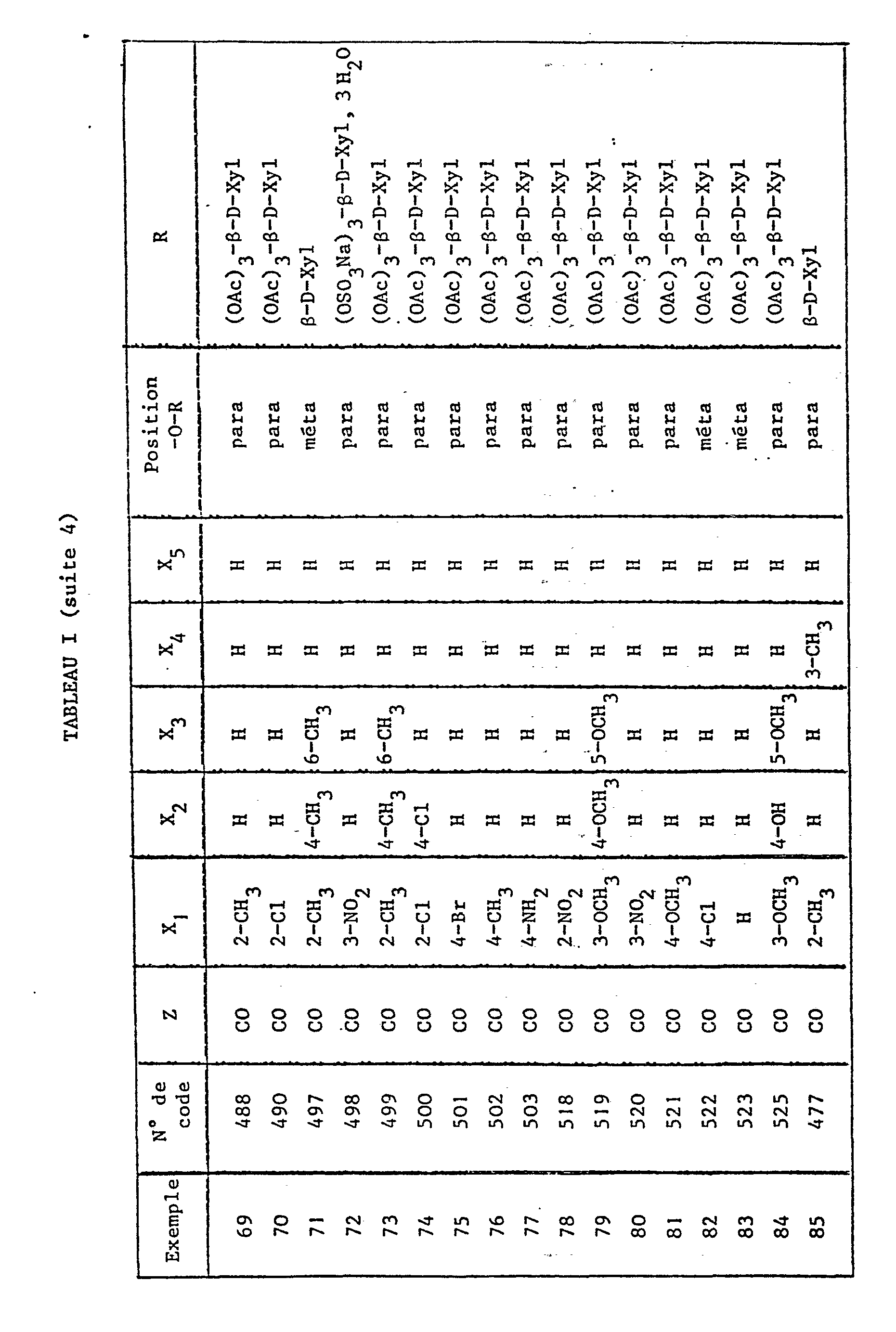
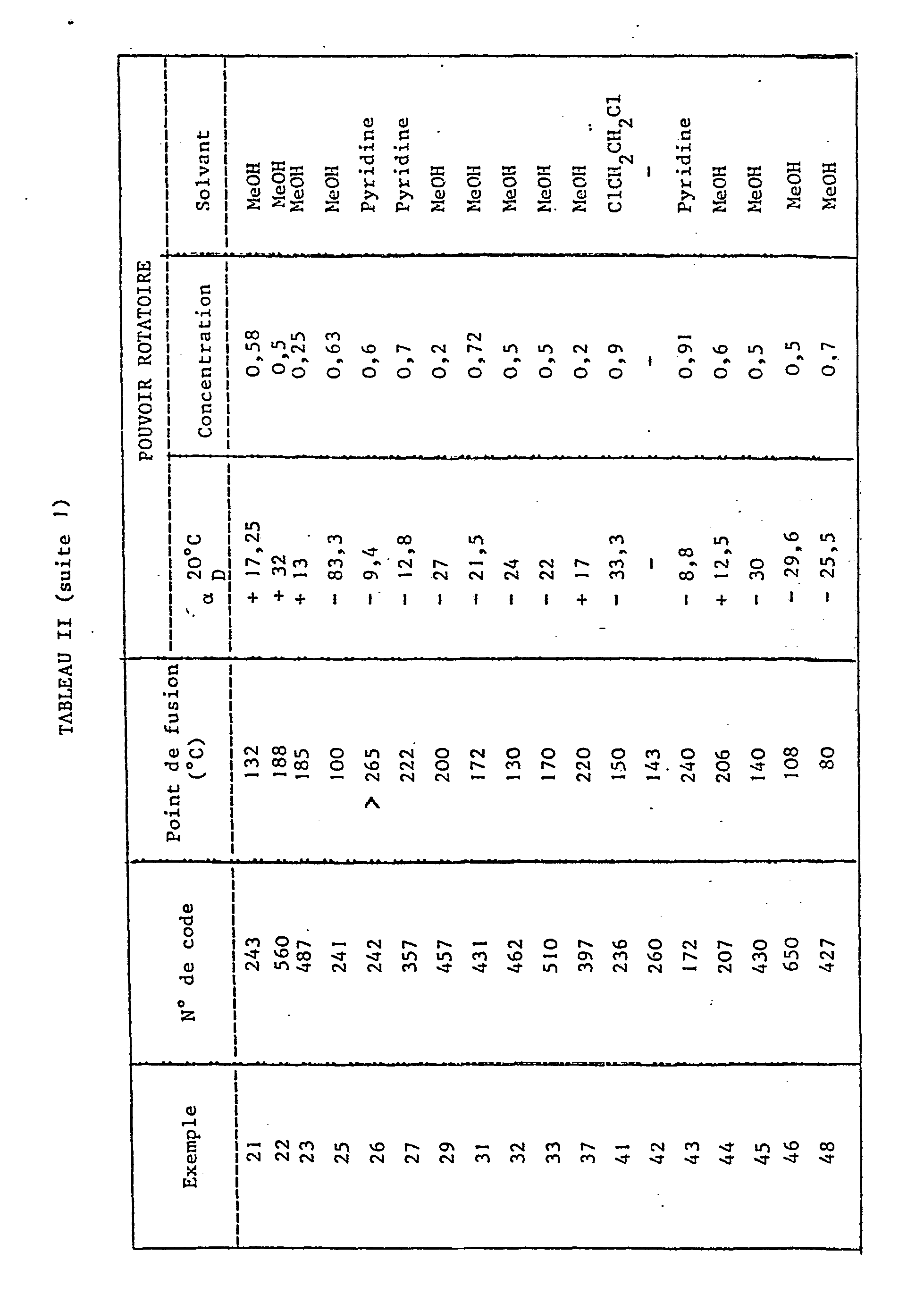
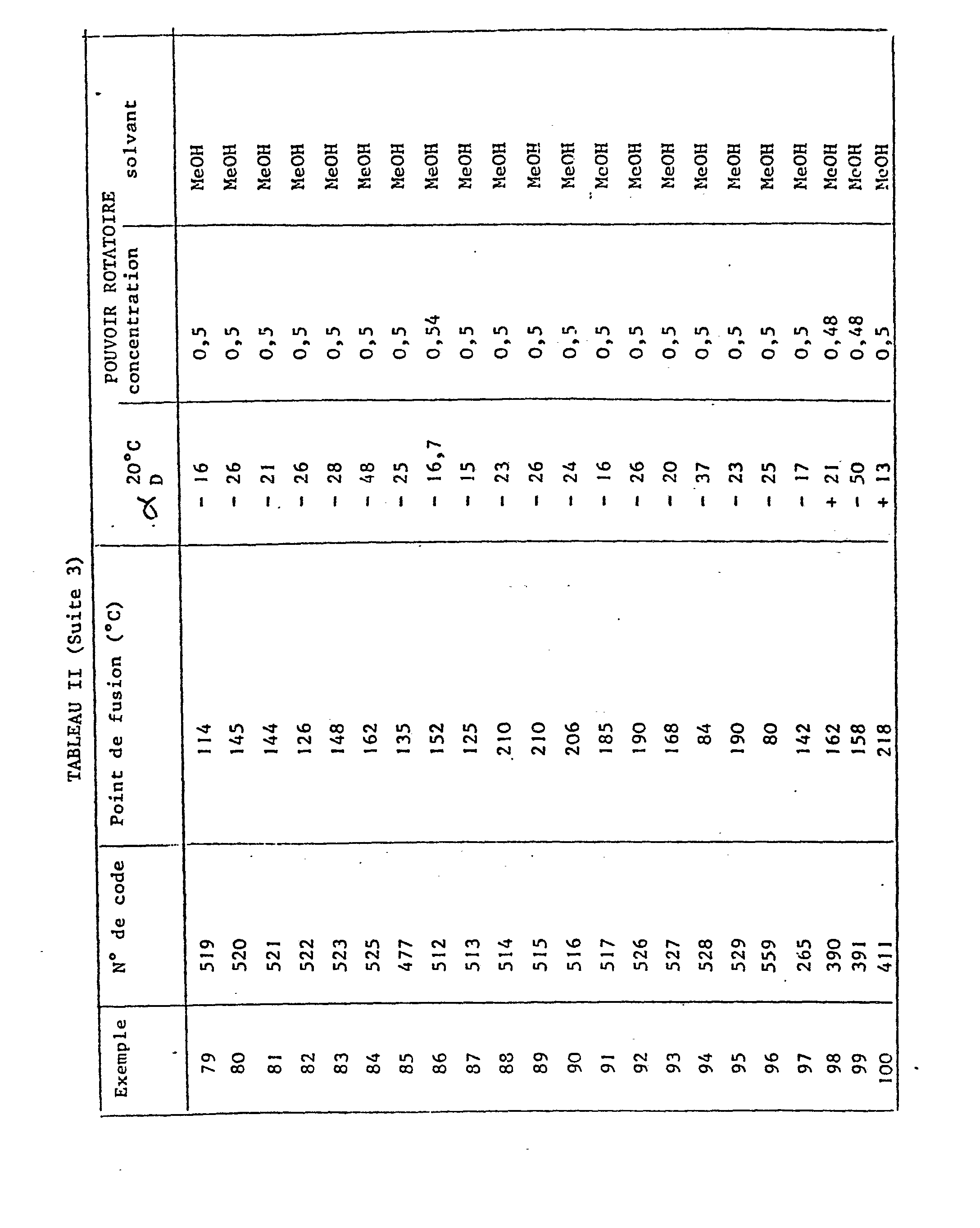
F = 164°C. - De façon non limitative, on a consigné dans le Tableau I ci-après (où la position des substituants a été donnée arbitrairement, la numérotation des sommets des noyaux phényle étant effectuée à partir du groupe Z central) un certain nombre de composés de formule (I) selon l'invention. Dans le Tableau II ci-après, on a également consigné les propriétés physiques d'une partie de ces composés, à savoir le point de fusion (F) et le pouvoir rotatoire (α20°C D), pour ce dernier ont été précisées la nature du solvant et la concentration (en g/1).
- On a résumé dans les Tableaux III à VII ci-après les résultats des essais (toxicité, activités anti-ulcéreuse, anti-agré- gante plaquettaire, antithrombotique veineuse et anti-hypoxique) entrepris sur un certain nombre de produits selon l'invention. Les protocoles opératoires qui ont été utilisés sont les suivants.
- La toxicité aiguë a été étudiée chez la souris par voie I.P. Elle est exprimée sous forme de DL-50 (dose létale entraînant la mort de la moitié des animaux) ou de DL-0 (doae maximale non létale). Les résultats sont donnés dans le Tableau III.
- La technique utilisée est celle de SANDERS décrite dans Laboratory Animal Science 27 (n° 5), pages 757-761 (1977).
- Après administration à 100 mg/kg I.P. (sauf précision contraire donnée dans le Tableau V ci-après) du produit à tester à des rats males anciens reproducteurs, on effectue deux prélèvements sanguins, l'un sur citrate de sodium et l'autre sur citrate de sodium formolé à l'instant t = 5 h.
- Après centrifugation des prélèvements, une numération plaquettaire est réalisée sur le surnageant. L'index d'agrégation spontanée selon WU et HOOK Stroke 6, 521-524 (1975) est exprimé par la relation.

- Les résultats relatifs au pourcentage de l'inhibition de l'agrégation plaquettaire sont consignés dans le Tableau V.
- La technique utilisée est voisine de celle décrite par PETERSON-ZUCKER dans Thrombo.Diath. Haemorh. 23, 1, (1970).
- On crée un thrombus occlusif au niveau de la veine cave inférieure de rat par action combinée d'une altération endothéliale et d'une stase veineuse pendant 15 min et 4 à 5 h après administration du produit à tester (100 mg/kg I.P.). Les résultats sont consignés dans le Tableau VI ci-après.
- L'expérimentation est réalisée sur des rats mâles WISTAR de 180 à 200 g. Les produits à tester sont administrés à 100 mg/kg I.P. (sauf indication contraire donnée dans le Tableau IV).
- A t = 0, les rats sont mis à jeun et on pratique une première administration du produit à tester.
- A t = 18 heures, on administre per os 2 ml d'une suspension ulcérigène à 192 mg d'aspirine/kg puis on pratique une deuxième administration du produit à tester.
- A t = 22 heures, les animaux sont sacrifiés et on cote les ulcères :
- . petits ulcères punctiformes : note 1
- . ulcères plus étendus : note 3
- . ulcères très étendus ou très profonds : note 9.
- Cette cotation est normalisée par rapport à un lot témoin et à la cimétidine (un produit de référence) à laquelle l'index 1 a été attribué.
- L'expérimentation est réalisée sur des lots de 20 souris SWISS mâles pesant de 20 à 30 g. On administre aux souris chaque produit à tester par voie intrapéritonéale à une dose correspondant au 1/10e de la DL-50 ou à une dose de 100 mg/kg quand la DL-0 est supérieure ou égale à 800 mg/kg. Les souris sont placées dans une atmosphère azote-oxygène (95:5) v/v. On mesure ensuite le temps de survie des souris jusqu'à 15 minutes maximum.
- Les résultats consignés dans le Tableau VII sont exprimés en pourcentage de survie par rapport à un lot témoin non traité et un lot traité par un produit de référence anti-hypoxique [spécialité connue sous le nom de marque de "DUXIL" et qui est constituée par un mélange d'Almitrine bis-méthanesulfonate et de Raubasine dans le rapport pondéral 3:1], le produit de référence anti-hypoxique étant administré à la dose de 18 mg/kg I.P.
- Les résultats concernant l'activité anti-ulcéreuse des produits de formule I sont consignés dans le Tableau IV ci-après.
- Les produits de formule (I) peuvent être administrés notamment par voie orale, sous forme de gélules ou de comprimés dragéifiés ou non renfermant chacun 0,05 à 1 g d'au moins un composé de formule (I) en tant que principe actif, et de préférence 0,1 à 0,5 g, d'une part, et par voie injectable, sous forme de solutions renfermant de 0,05 à 0,3 g de principe actif dans 2 à 10 cm 3 d'eau distillée, d'autre part. Ces formes galéniques pourront être administrées à raison de 1 à 3 prises par jour.
-







Claims (17)



Priority Applications (1)
| Application Number | Priority Date | Filing Date | Title |
|---|---|---|---|
| AT81401654T ATE7701T1 (de) | 1980-10-29 | 1981-10-21 | Derivate der benzoyl- und alpha-hydroxybenzylphenyl-osid-familie, verfahren zu ihrer herstellung und ihre therapeutische verwendung. |
Applications Claiming Priority (2)
| Application Number | Priority Date | Filing Date | Title |
|---|---|---|---|
| FR8023133A FR2492830A1 (fr) | 1980-10-29 | 1980-10-29 | Nouveaux composes appartenant a la famille des benzoyl- et a-hydroxybenzyl-phenyl-osides, leur procede de preparation et leur application en therapeutique |
| FR8023133 | 1980-10-29 |
Publications (2)
| Publication Number | Publication Date |
|---|---|
| EP0051023A1 true EP0051023A1 (fr) | 1982-05-05 |
| EP0051023B1 EP0051023B1 (fr) | 1984-05-30 |
Family
ID=9247461
Family Applications (1)
| Application Number | Title | Priority Date | Filing Date |
|---|---|---|---|
| EP81401654A Expired EP0051023B1 (fr) | 1980-10-29 | 1981-10-21 | Nouveaux composés appartenant à la famille des benzoyl- et alpha-hydroxybenzyl-phényl-osides, leur procédé de préparation et leur application en thérapeutique |
Country Status (14)
| Country | Link |
|---|---|
| US (1) | US4432973A (fr) |
| EP (1) | EP0051023B1 (fr) |
| JP (1) | JPS57102899A (fr) |
| KR (1) | KR870001926B1 (fr) |
| AT (1) | ATE7701T1 (fr) |
| CA (1) | CA1181745A (fr) |
| CS (1) | CS224629B2 (fr) |
| DD (1) | DD202157A5 (fr) |
| DE (1) | DE3163912D1 (fr) |
| ES (1) | ES506660A0 (fr) |
| FR (1) | FR2492830A1 (fr) |
| GR (1) | GR75759B (fr) |
| HU (1) | HU191341B (fr) |
| ZA (1) | ZA817314B (fr) |
Cited By (16)
| Publication number | Priority date | Publication date | Assignee | Title |
|---|---|---|---|---|
| FR2549476A1 (fr) * | 1983-07-20 | 1985-01-25 | Rech Ind | Benzyl-phenyl-osides, procede de preparation et utilisation en therapeutique |
| EP0290321A1 (fr) * | 1987-05-04 | 1988-11-09 | Fournier Industrie Et Sante | Nouveaux beta-D-phényl-thioxylosides, leur procédé de préparation et leur application en thérapeutique |
| FR2614894A1 (fr) * | 1987-05-06 | 1988-11-10 | Adir | Nouvelles oximes derivees de la tylosine, leur procede de preparation et les compositions pharmaceutiques les contenant |
| US4960758A (en) * | 1987-05-04 | 1990-10-02 | Fournier Innovation Et Synergie | Novel β-D-phenylthioxylosides, their method of preparation and their use as pharmaceuticals |
| FR2652353A1 (fr) * | 1989-09-22 | 1991-03-29 | Fournier Ind & Sante | Nouveaux benzopyran-2-one-beta-d-thioxylosides, leur procede de preparation et leur utilisation en therapeutique. |
| EP0421829A1 (fr) * | 1989-09-22 | 1991-04-10 | Fournier Industrie Et Sante | Nouveaux benzopyranone-beta-D-thioxylosides, leur procédé de préparation et leur utilisation en thérapeutique |
| EP0365397B1 (fr) * | 1988-10-18 | 1994-09-28 | Fournier Industrie Et Sante | Nouveaux beta-D-phényl-thioxylosides, leur procédé de préparation et leur utilisation en thérapeutique |
| WO1999067261A1 (fr) * | 1998-06-24 | 1999-12-29 | Fournier Industrie Et Sante | NOUVEAUX COMPOSES DERIVES DE α-D-XYLOSE, PREPARATION ET UTILISATION EN THERAPEUTIQUE |
| US6291433B1 (en) | 1999-06-11 | 2001-09-18 | Fournier Industrie Et Sante | Derivatives of α-D-Thioxyloside and their use against atheroma |
| FR2826367A1 (fr) * | 2001-06-21 | 2002-12-27 | Fournier Lab Sa | Nouveaux derives de [4-(4-cyanobenzoyl)phenyl] glycopyranoside, utilisation en tant que medicamment, procede d'obtention et compositions pharmaceutiques les contenant |
| WO2003002586A1 (fr) * | 2001-06-21 | 2003-01-09 | Laboratoires Fournier Sa | Derives de [4-(4-cyanobenzoyl)phenyl]glycofuranoside, utilisation en tant que medicament, procede d'obtention et compositions pharmaceutiques les contenant |
| US6525094B1 (en) | 1999-06-01 | 2003-02-25 | The University Of Texas Southwestern Medical Center | Method of treating hair loss using diphenylether derivatives |
| US6646005B1 (en) | 1999-06-01 | 2003-11-11 | The University Of Texas Southwestern Medical Center | Method of treating hair loss using sulfonyl thyromimetic compounds |
| US6680344B1 (en) | 1999-06-01 | 2004-01-20 | The University Of Texas Southwestern Medical Center | Method of treating hair loss using diphenylmethane derivatives |
| FR2906247A1 (fr) * | 2006-09-27 | 2008-03-28 | Fournier S A Sa Lab | Nouveaux derives de 5-thioxylopyranose |
| US7470671B2 (en) | 2003-09-25 | 2008-12-30 | Laboratoire Fournier | Thioxylose compounds, preparation method thereof, pharmaceutical compositions containing same and use thereof in therapeutics |
Families Citing this family (8)
| Publication number | Priority date | Publication date | Assignee | Title |
|---|---|---|---|---|
| JPS63215688A (ja) * | 1987-03-04 | 1988-09-08 | Jujo Paper Co Ltd | フェノ−ル配糖体の製造法 |
| FR2802930B1 (fr) * | 1999-12-23 | 2003-10-10 | Fournier Ind & Sante | Benzophenone glycopyranosides, preparation et utilisation en therapeutique |
| FR2802929B1 (fr) * | 1999-12-23 | 2003-06-06 | Fournier Ind & Sante | Benzophenone alpha-d-glycopyranosides, preparation et utilisation en therapeutique |
| EP1286984A2 (fr) * | 2000-03-10 | 2003-03-05 | Pharmacia Corporation | Procede de preparation de tetrahydrobenzothiepines |
| JP4753022B2 (ja) * | 2004-02-17 | 2011-08-17 | 独立行政法人産業技術総合研究所 | プリオン増殖抑制剤 |
| US20090054435A1 (en) * | 2005-07-29 | 2009-02-26 | Hiroshi Imoto | Phenoxyalkanoic Acid Compound |
| FR2903698B1 (fr) | 2006-07-13 | 2009-01-30 | Fournier S A Sa Lab | Nouveaux derives de 5-thioxylopyranose. |
| FR2906248B1 (fr) | 2006-09-27 | 2008-12-26 | Fournier S A Sa Lab | Nouveaux derives de 5-thioxylopyranose |
Citations (2)
| Publication number | Priority date | Publication date | Assignee | Title |
|---|---|---|---|---|
| FR2141532A1 (fr) * | 1971-06-14 | 1973-01-26 | Anvar | |
| FR2375248A1 (fr) * | 1976-12-23 | 1978-07-21 | Bayer Ag | Nouveaux derives de sucres amines, leur procede de preparation et medicament les contenant |
Family Cites Families (6)
| Publication number | Priority date | Publication date | Assignee | Title |
|---|---|---|---|---|
| US2218569A (en) * | 1939-09-13 | 1940-10-22 | Dow Chemical Co | Glycosides of pentose ethers |
| US2798079A (en) * | 1953-12-29 | 1957-07-02 | Universal Oil Prod Co | Condensation of aromatic hydrocarbon derivatives with carbohydrates and related materials |
| US3152115A (en) * | 1960-11-17 | 1964-10-06 | Geigy Chem Corp | New aryl glucosaminides |
| US3356674A (en) * | 1961-07-07 | 1967-12-05 | Rikagaku Kenkyusho | 3-c-hydroxymethyl-3, 5-didesoxy-l-lyxofuranose and its derivatives, and a process for the production thereof |
| US3496196A (en) * | 1965-10-02 | 1970-02-17 | Tanabe Pharm Co Ltd | 4,6-diazido-4,6-dideoxy-myo-inositol tetraacylates |
| US3960835A (en) * | 1974-01-18 | 1976-06-01 | Commercial Solvents Corporation | Zearaline glycoside compounds |
-
1980
- 1980-10-29 FR FR8023133A patent/FR2492830A1/fr active Granted
-
1981
- 1981-10-21 DE DE8181401654T patent/DE3163912D1/de not_active Expired
- 1981-10-21 AT AT81401654T patent/ATE7701T1/de not_active IP Right Cessation
- 1981-10-21 EP EP81401654A patent/EP0051023B1/fr not_active Expired
- 1981-10-22 ZA ZA817314A patent/ZA817314B/xx unknown
- 1981-10-22 US US06/314,032 patent/US4432973A/en not_active Expired - Fee Related
- 1981-10-23 GR GR66343A patent/GR75759B/el unknown
- 1981-10-28 HU HU813167A patent/HU191341B/hu not_active IP Right Cessation
- 1981-10-28 ES ES506660A patent/ES506660A0/es active Granted
- 1981-10-29 JP JP56172183A patent/JPS57102899A/ja active Granted
- 1981-10-29 CS CS817961A patent/CS224629B2/cs unknown
- 1981-10-29 DD DD81234458A patent/DD202157A5/de not_active IP Right Cessation
- 1981-10-29 KR KR1019810004143A patent/KR870001926B1/ko not_active Expired
- 1981-10-29 CA CA000389050A patent/CA1181745A/fr not_active Expired
Patent Citations (2)
| Publication number | Priority date | Publication date | Assignee | Title |
|---|---|---|---|---|
| FR2141532A1 (fr) * | 1971-06-14 | 1973-01-26 | Anvar | |
| FR2375248A1 (fr) * | 1976-12-23 | 1978-07-21 | Bayer Ag | Nouveaux derives de sucres amines, leur procede de preparation et medicament les contenant |
Non-Patent Citations (2)
| Title |
|---|
| ARYNEIMITTEL FROSCHUNG, vol. 21, no. 6, (1971) Editeur Cantor K.G. Aulendorf/Württ, DE A.M. DE ROOS et al.: "Investigation into the stability of the ether bond in a series of benzhydryl ethers", pages 818-820 * |
| CHEMICAL ABSTRACTS, vol. 78, no. 13, 2 avril 1973, page 7, abrégé 79547a Columbus, Ohio, US L.W. BROWN et al.: "In vitro and in vivo hydrolysis of 4-benzoyl-phenyl N-methylcarbamate" & J.Pharm. Sci. 1973, 62 (1), 145-6 * |
Cited By (25)
| Publication number | Priority date | Publication date | Assignee | Title |
|---|---|---|---|---|
| FR2549476A1 (fr) * | 1983-07-20 | 1985-01-25 | Rech Ind | Benzyl-phenyl-osides, procede de preparation et utilisation en therapeutique |
| EP0133103A1 (fr) * | 1983-07-20 | 1985-02-13 | Fournier Innovation Et Synergie | Benzyl-phényl-osides, procédé de préparation et utilisation |
| US4598068A (en) * | 1983-07-20 | 1986-07-01 | Societe de Recheres Industrielles | Benzylphenyl osides, method of preparation and use therefor |
| EP0290321A1 (fr) * | 1987-05-04 | 1988-11-09 | Fournier Industrie Et Sante | Nouveaux beta-D-phényl-thioxylosides, leur procédé de préparation et leur application en thérapeutique |
| US4877808A (en) * | 1987-05-04 | 1989-10-31 | Fournier Innovation Et Synergie | Novel β-D-phenylthioxylosides, their method of preparation and their use as therapeutics |
| US4960758A (en) * | 1987-05-04 | 1990-10-02 | Fournier Innovation Et Synergie | Novel β-D-phenylthioxylosides, their method of preparation and their use as pharmaceuticals |
| FR2614894A1 (fr) * | 1987-05-06 | 1988-11-10 | Adir | Nouvelles oximes derivees de la tylosine, leur procede de preparation et les compositions pharmaceutiques les contenant |
| EP0365397B1 (fr) * | 1988-10-18 | 1994-09-28 | Fournier Industrie Et Sante | Nouveaux beta-D-phényl-thioxylosides, leur procédé de préparation et leur utilisation en thérapeutique |
| FR2652353A1 (fr) * | 1989-09-22 | 1991-03-29 | Fournier Ind & Sante | Nouveaux benzopyran-2-one-beta-d-thioxylosides, leur procede de preparation et leur utilisation en therapeutique. |
| EP0421829A1 (fr) * | 1989-09-22 | 1991-04-10 | Fournier Industrie Et Sante | Nouveaux benzopyranone-beta-D-thioxylosides, leur procédé de préparation et leur utilisation en thérapeutique |
| US5169838A (en) * | 1989-09-22 | 1992-12-08 | Fournier Industrie Et Sante | Benzopyranone-β-D-thioxylosides and their use in therapy |
| WO1999067261A1 (fr) * | 1998-06-24 | 1999-12-29 | Fournier Industrie Et Sante | NOUVEAUX COMPOSES DERIVES DE α-D-XYLOSE, PREPARATION ET UTILISATION EN THERAPEUTIQUE |
| US6680344B1 (en) | 1999-06-01 | 2004-01-20 | The University Of Texas Southwestern Medical Center | Method of treating hair loss using diphenylmethane derivatives |
| US6525094B1 (en) | 1999-06-01 | 2003-02-25 | The University Of Texas Southwestern Medical Center | Method of treating hair loss using diphenylether derivatives |
| US6646005B1 (en) | 1999-06-01 | 2003-11-11 | The University Of Texas Southwestern Medical Center | Method of treating hair loss using sulfonyl thyromimetic compounds |
| US6291433B1 (en) | 1999-06-11 | 2001-09-18 | Fournier Industrie Et Sante | Derivatives of α-D-Thioxyloside and their use against atheroma |
| FR2826367A1 (fr) * | 2001-06-21 | 2002-12-27 | Fournier Lab Sa | Nouveaux derives de [4-(4-cyanobenzoyl)phenyl] glycopyranoside, utilisation en tant que medicamment, procede d'obtention et compositions pharmaceutiques les contenant |
| WO2003002585A1 (fr) * | 2001-06-21 | 2003-01-09 | Laboratoires Fournier Sa | Derives de [4-(4-cyanobenzoyl)phenyl]glycopyranoside, utilisation en tant que medicament, procede d'obtention et compositions |
| WO2003002586A1 (fr) * | 2001-06-21 | 2003-01-09 | Laboratoires Fournier Sa | Derives de [4-(4-cyanobenzoyl)phenyl]glycofuranoside, utilisation en tant que medicament, procede d'obtention et compositions pharmaceutiques les contenant |
| US7470671B2 (en) | 2003-09-25 | 2008-12-30 | Laboratoire Fournier | Thioxylose compounds, preparation method thereof, pharmaceutical compositions containing same and use thereof in therapeutics |
| FR2906247A1 (fr) * | 2006-09-27 | 2008-03-28 | Fournier S A Sa Lab | Nouveaux derives de 5-thioxylopyranose |
| WO2008037923A1 (fr) * | 2006-09-27 | 2008-04-03 | Laboratoires Fournier S.A. | Nouveaux derives de 5-thioxylopyranose |
| US8013010B2 (en) | 2006-09-27 | 2011-09-06 | Laboratoires Fournier S.A. | 5-thioxylopyranose compounds |
| EA016044B1 (ru) * | 2006-09-27 | 2012-01-30 | Лабораториз Фурнье С.А. | Производные 5-тиоксилопиранозы |
| CN101535328B (zh) * | 2006-09-27 | 2013-06-05 | 实验室富尼耶公司 | 5-硫代吡喃木糖的新型衍生物 |
Also Published As
| Publication number | Publication date |
|---|---|
| DE3163912D1 (en) | 1984-07-05 |
| CA1181745A (fr) | 1985-01-29 |
| KR870001926B1 (ko) | 1987-10-22 |
| EP0051023B1 (fr) | 1984-05-30 |
| DD202157A5 (de) | 1983-08-31 |
| US4432973A (en) | 1984-02-21 |
| GR75759B (fr) | 1984-08-02 |
| FR2492830A1 (fr) | 1982-04-30 |
| KR830007485A (ko) | 1983-10-21 |
| FR2492830B1 (fr) | 1983-10-07 |
| ATE7701T1 (de) | 1984-06-15 |
| ES8302019A1 (es) | 1983-01-01 |
| JPS57102899A (en) | 1982-06-26 |
| ZA817314B (en) | 1982-10-27 |
| ES506660A0 (es) | 1983-01-01 |
| CS224629B2 (en) | 1984-01-16 |
| HU191341B (en) | 1987-02-27 |
| JPH024235B2 (fr) | 1990-01-26 |
Similar Documents
| Publication | Publication Date | Title |
|---|---|---|
| EP0051023B1 (fr) | Nouveaux composés appartenant à la famille des benzoyl- et alpha-hydroxybenzyl-phényl-osides, leur procédé de préparation et leur application en thérapeutique | |
| EP0399856B1 (fr) | Pteridin-4 (3H)-ones, procédés de préparation et médicaments les contenant | |
| CH643546A5 (fr) | Procede pour la preparation de derives d'hydantoine. | |
| EP0290321B1 (fr) | Nouveaux beta-D-phényl-thioxylosides, leur procédé de préparation et leur application en thérapeutique | |
| EP0133103B1 (fr) | Benzyl-phényl-osides, procédé de préparation et utilisation | |
| BE897516A (fr) | Nouveaux derives de la desoxyuridine leur preparation et leur utilisation comme medicaments | |
| JPH01503786A (ja) | プロスタグランジン誘導体,それらの製法及びそれらを含有する医薬組成物 | |
| EP0709383B1 (fr) | Dérivés de la diosmétine, leur procédé de préparation et les compositions pharmaceutiques les contenant | |
| EP0117771B1 (fr) | Imino-2 pyrrolidines, leur procédé de préparation et leurs applications en thérapeutique | |
| BE897617A (fr) | Thioesters d'acide acetylsalicylique procede pour les preparer et compositions pharmaceutiques qui en renferment | |
| WO1990003972A1 (fr) | Derives de methyl-4 ((phenyl-4 piperazinyl-1)-2 ethyl)-5 thiazole | |
| BE779775A (fr) | Derives de l'uree, procede pour les preparer et leurs applications | |
| EP0008259A1 (fr) | Nouveaux dérivés de la pipéridylbenzimidazolinone, leurs procédés de préparation et les compositions pharmaceutiques les renfermant | |
| EP0002401B1 (fr) | Dérivés de naphtalène, leur préparation et leur application en thérapeutique | |
| EP0071500B1 (fr) | Procédé de préparation d'amino-4 butyramide | |
| FR2701261A1 (fr) | Nouveaux composés glucuronides de la diosmétine, leur procédé de préparation et les compositions pharmaceutiques les renfermant. | |
| EP0123605B1 (fr) | N-Cyclopropylméthyl-2 oxo-3 diparaméthoxyphenyl 5-6 as triazine, son procédé de fabrication et son utilisation en tant que médicament | |
| EP0076713B1 (fr) | Nouveaux dérivés de l'aminométhyl 1H-indole 4-méthanol et leurs sels, leur procédé et les intermédiaires de préparation, leur application à titre de médicaments, les compositions les renfermant | |
| CH439271A (fr) | Procédé de préparation de nouvelles 4-dédiméthylamino-4-amino substitué-6-déméthyl-tétracyclines | |
| EP0210885B1 (fr) | Dérivés d'alcools primaires halogéno biphényles utiles en thérapeutique dans le traitement de l'athérosclérose | |
| EP1240177B1 (fr) | Benzophenone alpha-d-glycopyranosides, preparation et utilisation en therapeutique | |
| EP0254611A1 (fr) | Dérivés 8-phénylthiotétrahydroquinoléines substitués et leurs sels, leur préparation à titre de médicaments et les compositions les renfermant | |
| WO2001047940A1 (fr) | Benzophenone glycopyranosides, preparation et utilisation en therapeutique | |
| FR2459242A1 (fr) | Derives du benzimidazole portant en position 1 une chaine aralkyle substituee, leur procede de preparation et leur application en therapeutique | |
| BE837320A (fr) | Derives ethers de 3-amino-1,2-propanodiol |
Legal Events
| Date | Code | Title | Description |
|---|---|---|---|
| PUAI | Public reference made under article 153(3) epc to a published international application that has entered the european phase |
Free format text: ORIGINAL CODE: 0009012 |
|
| AK | Designated contracting states |
Designated state(s): AT BE CH DE FR GB IT LU NL SE |
|
| 17P | Request for examination filed |
Effective date: 19820525 |
|
| ITF | It: translation for a ep patent filed | ||
| GRAA | (expected) grant |
Free format text: ORIGINAL CODE: 0009210 |
|
| AK | Designated contracting states |
Designated state(s): AT BE CH DE FR GB IT LI LU NL SE |
|
| REF | Corresponds to: |
Ref document number: 7701 Country of ref document: AT Date of ref document: 19840615 Kind code of ref document: T |
|
| REF | Corresponds to: |
Ref document number: 3163912 Country of ref document: DE Date of ref document: 19840705 |
|
| PLBE | No opposition filed within time limit |
Free format text: ORIGINAL CODE: 0009261 |
|
| STAA | Information on the status of an ep patent application or granted ep patent |
Free format text: STATUS: NO OPPOSITION FILED WITHIN TIME LIMIT |
|
| 26N | No opposition filed | ||
| REG | Reference to a national code |
Ref country code: FR Ref legal event code: TP |
|
| REG | Reference to a national code |
Ref country code: GB Ref legal event code: 732 |
|
| ITPR | It: changes in ownership of a european patent |
Owner name: CESSIONE;FOURNIER INNOVATION ET SYNERGIE |
|
| NLS | Nl: assignments of ep-patents |
Owner name: FOURNIER INNOVATION ET SYNERGIE TE PARIJS, FRANKRI |
|
| REG | Reference to a national code |
Ref country code: CH Ref legal event code: PUE Owner name: FOURNIER INNOVATION ET SYNERGIE |
|
| PGFP | Annual fee paid to national office [announced via postgrant information from national office to epo] |
Ref country code: AT Payment date: 19920925 Year of fee payment: 12 |
|
| PGFP | Annual fee paid to national office [announced via postgrant information from national office to epo] |
Ref country code: GB Payment date: 19921013 Year of fee payment: 12 |
|
| PGFP | Annual fee paid to national office [announced via postgrant information from national office to epo] |
Ref country code: CH Payment date: 19921021 Year of fee payment: 12 |
|
| PGFP | Annual fee paid to national office [announced via postgrant information from national office to epo] |
Ref country code: DE Payment date: 19921023 Year of fee payment: 12 |
|
| PGFP | Annual fee paid to national office [announced via postgrant information from national office to epo] |
Ref country code: SE Payment date: 19921028 Year of fee payment: 12 Ref country code: FR Payment date: 19921028 Year of fee payment: 12 |
|
| PGFP | Annual fee paid to national office [announced via postgrant information from national office to epo] |
Ref country code: LU Payment date: 19921030 Year of fee payment: 12 |
|
| ITTA | It: last paid annual fee | ||
| PGFP | Annual fee paid to national office [announced via postgrant information from national office to epo] |
Ref country code: NL Payment date: 19921031 Year of fee payment: 12 |
|
| PGFP | Annual fee paid to national office [announced via postgrant information from national office to epo] |
Ref country code: BE Payment date: 19921116 Year of fee payment: 12 |
|
| EPTA | Lu: last paid annual fee | ||
| PG25 | Lapsed in a contracting state [announced via postgrant information from national office to epo] |
Ref country code: LU Free format text: LAPSE BECAUSE OF NON-PAYMENT OF DUE FEES Effective date: 19931021 Ref country code: GB Effective date: 19931021 Ref country code: AT Effective date: 19931021 |
|
| PG25 | Lapsed in a contracting state [announced via postgrant information from national office to epo] |
Ref country code: SE Effective date: 19931022 |
|
| PG25 | Lapsed in a contracting state [announced via postgrant information from national office to epo] |
Ref country code: LI Effective date: 19931031 Ref country code: CH Effective date: 19931031 Ref country code: BE Effective date: 19931031 |
|
| BERE | Be: lapsed |
Owner name: FOURNIER INNOVATION ET SYNERGIE Effective date: 19931031 |
|
| PG25 | Lapsed in a contracting state [announced via postgrant information from national office to epo] |
Ref country code: NL Effective date: 19940501 |
|
| GBPC | Gb: european patent ceased through non-payment of renewal fee |
Effective date: 19931021 |
|
| NLV4 | Nl: lapsed or anulled due to non-payment of the annual fee | ||
| PG25 | Lapsed in a contracting state [announced via postgrant information from national office to epo] |
Ref country code: FR Effective date: 19940630 |
|
| REG | Reference to a national code |
Ref country code: CH Ref legal event code: PL |
|
| PG25 | Lapsed in a contracting state [announced via postgrant information from national office to epo] |
Ref country code: DE Effective date: 19940701 |
|
| REG | Reference to a national code |
Ref country code: FR Ref legal event code: ST |
|
| EUG | Se: european patent has lapsed |
Ref document number: 81401654.9 Effective date: 19940510 |