EP0647623B1 - Nouveaux intermédiaires de préparation de la vitamine A et des caroténoides et leur procédé de préparation - Google Patents
Nouveaux intermédiaires de préparation de la vitamine A et des caroténoides et leur procédé de préparation Download PDFInfo
- Publication number
- EP0647623B1 EP0647623B1 EP94402224A EP94402224A EP0647623B1 EP 0647623 B1 EP0647623 B1 EP 0647623B1 EP 94402224 A EP94402224 A EP 94402224A EP 94402224 A EP94402224 A EP 94402224A EP 0647623 B1 EP0647623 B1 EP 0647623B1
- Authority
- EP
- European Patent Office
- Prior art keywords
- preparation
- carbon atoms
- formula
- represent
- represent hydrogen
- Prior art date
- Legal status (The legal status is an assumption and is not a legal conclusion. Google has not performed a legal analysis and makes no representation as to the accuracy of the status listed.)
- Expired - Lifetime
Links
Classifications
-
- C—CHEMISTRY; METALLURGY
- C07—ORGANIC CHEMISTRY
- C07C—ACYCLIC OR CARBOCYCLIC COMPOUNDS
- C07C403/00—Derivatives of cyclohexane or of a cyclohexene or of cyclohexadiene, having a side-chain containing an acyclic unsaturated part of at least four carbon atoms, this part being directly attached to the cyclohexane or cyclohexene or cyclohexadiene rings, e.g. vitamin A, beta-carotene, beta-ionone
- C07C403/14—Derivatives of cyclohexane or of a cyclohexene or of cyclohexadiene, having a side-chain containing an acyclic unsaturated part of at least four carbon atoms, this part being directly attached to the cyclohexane or cyclohexene or cyclohexadiene rings, e.g. vitamin A, beta-carotene, beta-ionone having side-chains substituted by doubly-bound oxygen atoms
-
- C—CHEMISTRY; METALLURGY
- C07—ORGANIC CHEMISTRY
- C07C—ACYCLIC OR CARBOCYCLIC COMPOUNDS
- C07C403/00—Derivatives of cyclohexane or of a cyclohexene or of cyclohexadiene, having a side-chain containing an acyclic unsaturated part of at least four carbon atoms, this part being directly attached to the cyclohexane or cyclohexene or cyclohexadiene rings, e.g. vitamin A, beta-carotene, beta-ionone
- C07C403/02—Derivatives of cyclohexane or of a cyclohexene or of cyclohexadiene, having a side-chain containing an acyclic unsaturated part of at least four carbon atoms, this part being directly attached to the cyclohexane or cyclohexene or cyclohexadiene rings, e.g. vitamin A, beta-carotene, beta-ionone having side-chains containing only carbon and hydrogen atoms
-
- C—CHEMISTRY; METALLURGY
- C07—ORGANIC CHEMISTRY
- C07C—ACYCLIC OR CARBOCYCLIC COMPOUNDS
- C07C403/00—Derivatives of cyclohexane or of a cyclohexene or of cyclohexadiene, having a side-chain containing an acyclic unsaturated part of at least four carbon atoms, this part being directly attached to the cyclohexane or cyclohexene or cyclohexadiene rings, e.g. vitamin A, beta-carotene, beta-ionone
- C07C403/06—Derivatives of cyclohexane or of a cyclohexene or of cyclohexadiene, having a side-chain containing an acyclic unsaturated part of at least four carbon atoms, this part being directly attached to the cyclohexane or cyclohexene or cyclohexadiene rings, e.g. vitamin A, beta-carotene, beta-ionone having side-chains substituted by singly-bound oxygen atoms
- C07C403/12—Derivatives of cyclohexane or of a cyclohexene or of cyclohexadiene, having a side-chain containing an acyclic unsaturated part of at least four carbon atoms, this part being directly attached to the cyclohexane or cyclohexene or cyclohexadiene rings, e.g. vitamin A, beta-carotene, beta-ionone having side-chains substituted by singly-bound oxygen atoms by esterified hydroxy groups
-
- C—CHEMISTRY; METALLURGY
- C07—ORGANIC CHEMISTRY
- C07C—ACYCLIC OR CARBOCYCLIC COMPOUNDS
- C07C45/00—Preparation of compounds having >C = O groups bound only to carbon or hydrogen atoms; Preparation of chelates of such compounds
- C07C45/51—Preparation of compounds having >C = O groups bound only to carbon or hydrogen atoms; Preparation of chelates of such compounds by pyrolysis, rearrangement or decomposition
- C07C45/54—Preparation of compounds having >C = O groups bound only to carbon or hydrogen atoms; Preparation of chelates of such compounds by pyrolysis, rearrangement or decomposition of compounds containing doubly bound oxygen atoms, e.g. esters
-
- C—CHEMISTRY; METALLURGY
- C07—ORGANIC CHEMISTRY
- C07C—ACYCLIC OR CARBOCYCLIC COMPOUNDS
- C07C45/00—Preparation of compounds having >C = O groups bound only to carbon or hydrogen atoms; Preparation of chelates of such compounds
- C07C45/61—Preparation of compounds having >C = O groups bound only to carbon or hydrogen atoms; Preparation of chelates of such compounds by reactions not involving the formation of >C = O groups
- C07C45/67—Preparation of compounds having >C = O groups bound only to carbon or hydrogen atoms; Preparation of chelates of such compounds by reactions not involving the formation of >C = O groups by isomerisation; by change of size of the carbon skeleton
-
- C—CHEMISTRY; METALLURGY
- C07—ORGANIC CHEMISTRY
- C07C—ACYCLIC OR CARBOCYCLIC COMPOUNDS
- C07C47/00—Compounds having —CHO groups
- C07C47/20—Unsaturated compounds having —CHO groups bound to acyclic carbon atoms
-
- C—CHEMISTRY; METALLURGY
- C07—ORGANIC CHEMISTRY
- C07C—ACYCLIC OR CARBOCYCLIC COMPOUNDS
- C07C47/00—Compounds having —CHO groups
- C07C47/20—Unsaturated compounds having —CHO groups bound to acyclic carbon atoms
- C07C47/21—Unsaturated compounds having —CHO groups bound to acyclic carbon atoms with only carbon-to-carbon double bonds as unsaturation
-
- C—CHEMISTRY; METALLURGY
- C07—ORGANIC CHEMISTRY
- C07C—ACYCLIC OR CARBOCYCLIC COMPOUNDS
- C07C47/00—Compounds having —CHO groups
- C07C47/20—Unsaturated compounds having —CHO groups bound to acyclic carbon atoms
- C07C47/228—Unsaturated compounds having —CHO groups bound to acyclic carbon atoms containing six-membered aromatic rings, e.g. phenylacetaldehyde
- C07C47/232—Unsaturated compounds having —CHO groups bound to acyclic carbon atoms containing six-membered aromatic rings, e.g. phenylacetaldehyde having unsaturation outside the aromatic rings
-
- C—CHEMISTRY; METALLURGY
- C07—ORGANIC CHEMISTRY
- C07C—ACYCLIC OR CARBOCYCLIC COMPOUNDS
- C07C49/00—Ketones; Ketenes; Dimeric ketenes; Ketonic chelates
- C07C49/20—Unsaturated compounds containing keto groups bound to acyclic carbon atoms
- C07C49/213—Unsaturated compounds containing keto groups bound to acyclic carbon atoms containing six-membered aromatic rings
- C07C49/217—Unsaturated compounds containing keto groups bound to acyclic carbon atoms containing six-membered aromatic rings having unsaturation outside the aromatic rings
-
- C—CHEMISTRY; METALLURGY
- C07—ORGANIC CHEMISTRY
- C07C—ACYCLIC OR CARBOCYCLIC COMPOUNDS
- C07C49/00—Ketones; Ketenes; Dimeric ketenes; Ketonic chelates
- C07C49/587—Unsaturated compounds containing a keto groups being part of a ring
- C07C49/657—Unsaturated compounds containing a keto groups being part of a ring containing six-membered aromatic rings
- C07C49/683—Unsaturated compounds containing a keto groups being part of a ring containing six-membered aromatic rings having unsaturation outside the aromatic rings
-
- C—CHEMISTRY; METALLURGY
- C07—ORGANIC CHEMISTRY
- C07C—ACYCLIC OR CARBOCYCLIC COMPOUNDS
- C07C49/00—Ketones; Ketenes; Dimeric ketenes; Ketonic chelates
- C07C49/76—Ketones containing a keto group bound to a six-membered aromatic ring
- C07C49/794—Ketones containing a keto group bound to a six-membered aromatic ring having unsaturation outside an aromatic ring
- C07C49/796—Ketones containing a keto group bound to a six-membered aromatic ring having unsaturation outside an aromatic ring polycyclic
-
- C—CHEMISTRY; METALLURGY
- C07—ORGANIC CHEMISTRY
- C07C—ACYCLIC OR CARBOCYCLIC COMPOUNDS
- C07C69/00—Esters of carboxylic acids; Esters of carbonic or haloformic acids
- C07C69/96—Esters of carbonic or haloformic acids
-
- C—CHEMISTRY; METALLURGY
- C07—ORGANIC CHEMISTRY
- C07B—GENERAL METHODS OF ORGANIC CHEMISTRY; APPARATUS THEREFOR
- C07B2200/00—Indexing scheme relating to specific properties of organic compounds
- C07B2200/09—Geometrical isomers
-
- C—CHEMISTRY; METALLURGY
- C07—ORGANIC CHEMISTRY
- C07C—ACYCLIC OR CARBOCYCLIC COMPOUNDS
- C07C2601/00—Systems containing only non-condensed rings
- C07C2601/12—Systems containing only non-condensed rings with a six-membered ring
- C07C2601/16—Systems containing only non-condensed rings with a six-membered ring the ring being unsaturated
Definitions
- the present invention relates to new intermediates for the preparation of vitamin A and carotenoids.
- Preferred among the compounds of formula (I) are those for which R 4 , R 5 , R 7 and R 8 represent hydrogen and R 6 a methyl group.
- Particularly preferred among the compounds of formula (I) are those for which R 1 represents the following unit: R 2 a methyl group and R 3 hydrogen.
- Document FR 1 313 362 describes the preparation of an aldehyde carrying an allenic motif by reaction of an acetylenic alcohol with an aldehyde in the presence of an acid catalyst; this reaction is not applicable to the compounds according to the invention which comprises vinyl units.
- the transition metal is chosen in particular from the metals of columns VIII, I B and II B of the periodic table. It is preferred to use nickel or palladium.
- the transition metal can be used in the presence of a ligand chosen from phosphorus compounds such as bisdiphenylphosphinoethane, triphenylphosphine, trimethoxyphenylphosphine, triisopropylphosphite, trifluorophenylphosphine, trithiophenylphosphine, tritolylphosphine, tritolylphosphine.
- a ligand chosen from phosphorus compounds such as bisdiphenylphosphinoethane, triphenylphosphine, trimethoxyphenylphosphine, triisopropylphosphite, trifluorophenylphosphine, trithiophenylphosphine, tritolylphosphine, tritolylphosphine.
- the reaction preferably takes place in an aprotic solvent.
- the amount of catalyst introduced advantageously varies between 1 and 20% calculated in equivalent of metal atom relative to the compound of formula (II).
- the compounds of formula (I) are advantageously transformed into intermediates of vitamin A or of terpene aldehydes by the action of a base chosen from carbonates, the alcoholates of alkali or alkaline earth metals or by the action of an acid such as hydrobromic acid.
- Examples 1 to 9 are carried out according to the same procedure as Example 2, the results are shown in Table 1.
- Examples 10 to 13 are carried out according to the same procedure as Examples 1 to 9 with different catalysts and different ligands, the results are shown in Table 2.
- Example 16 is reproduced using as rearrangement catalyst Ni (COD) 2 at 20%, PPh 3 40% in THF at room temperature for 3 hours. The following compound is obtained with a yield of 62%.
- the yield is 54%.
- Example 21 The same procedure as in Example 21 is reproduced from the product obtained in Example 8.
- the product obtained is dehydrofarnesal which is obtained with a yield of 75%.
- Example 20 The same procedure as in Example 20 is reproduced from the product obtained in Example 2.
- the product obtained is dehydrocitral. It is obtained with a yield of 54%.
Landscapes
- Chemical & Material Sciences (AREA)
- Organic Chemistry (AREA)
- Chemical Kinetics & Catalysis (AREA)
- Organic Low-Molecular-Weight Compounds And Preparation Thereof (AREA)
- Low-Molecular Organic Synthesis Reactions Using Catalysts (AREA)
- Steroid Compounds (AREA)
Description
- La présente invention concerne des nouveaux intermédiaires pour la préparation de la vitamine A et des caroténoïdes.
- Elle concerne plus particulièrement des intermédiaires répondant à la fomule (I) suivante :

- R1, R2, R3 identiques ou différents représentent chacun indépendamment l'un de l'autre l'hydrogène, un motif alkyle contenant 1 à 4 atomes de carbone, alkényle contenant 2 à 10 atomes de carbone, aryle, chaque motif alkyle et/ou alkényle pouvant être linéaire, ramifié ou cyclique, deux groupes peuvent former ensemble un motif alkylidène contenant de 2 à 12 atomes de carbone.
- R4, R5, R6, R7, R8 identiques ou différents représentent chacun indépendemment l'un de l'autre l'hydrogène, un groupe alkyle contenant 1 à 4 atomes de carbone, alkenyle contenant 2 à 10 atomes de carbone, chaque motif alkyle, alkényle étant linéaire, ramifiée ou cyclique, aryle contenant 6 à 10 atomes de carbone ; deux groupes peuvent former ensemble un motif alkylidene contenant 2 à 10 atomes de carbone.
- On préfère parmi les composés de formule (I) ceux pour lesquels R4, R5, R7 et R8 représentent l'hydrogène et R6 un groupe méthyle.
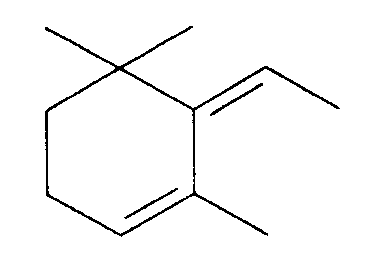
- On préfère tout particulièrement parmi les composés de formule (I) ceux pour lesquels R1 représente le motif suivant :

- Le document FR 1 313 362 décrit la préparation d'aldéhyde porteur d'un motif allénique par réaction d'un alcool acétylénique avec un aldéhyde en présence d'un catalyseur acide ; cette réaction n'est pas applicable aux composés selon l'invention qui comporte des motifs vinyles.
- Le document US 3 057 888 décrit la préparation d'aldéhyde porteur d'un motif allénique par hydrolyse d'un diester d'un aldéhyde allylique obtenu lui même à partir d'un ester acétylénique, ce type de réaction comme la précédente ne s'applique pas aux composés acétyléniques porteurs d'un motif vinyl.
- Le document publié dans le Chemical Abstract Vol. 103, No. 15 abstract No. 113059d décrit la préparation de carbonates à partir de composés allyliques et de platine, ces carbonates sont ensuite traités avec du palladium pour former un aldéhyde allylique.
- Aucun de ces documents ne décrit d'aldéhydes porteur d'un motif allénique et d'un motif vinylique.
- Ces composés sont préparés par action d'un catalyseur à base d'un métal de transition sur un composé de fomule (II) suivante :

- On préfère tout particulièrement les composés de formule (II) suivants :

- Le métal de transition est choisi notamment parmi les métaux des colonnes VIII, IB et IIB de la classification périodique. On préfère utiliser le nickel ou le palladium.
- Le métal de transition peut être utilisé en présence d'un ligand choisi parmi les les composés du phosphore telles que le bisdiphénylphosphinoéthane, la triphénylphosphine, la triméthoxyphénylphosphine, le triisopropylphosphite, la trifluorophénylphosphine, la trithiophènylphosphine, la tritolylphosphine, la trinaphtylphosphine. La réaction a lieu de préférence dans un solvant aprotique.
- La quantité de catalyseur introduite varie avantageusement entre 1 et 20 % calculé en équivalent d'atome de métal par rapport au composé de formule (II).
- Les composés de formule (I) sont avantageusement transformés en intermédiaires de la vitamine A ou d'aldéhydes terpéniques par action d'une base choisie parmi les carbonates, les alcoolates de métaux alcalins ou alcalinoterreux ou par action d'un acide tel que l'acide bromhydrique.
- La présente invention sera plus complètement décrite à l'aide des exemples suivants qui ne doivent pas être considérés comme limitatifs de l'invention.
-
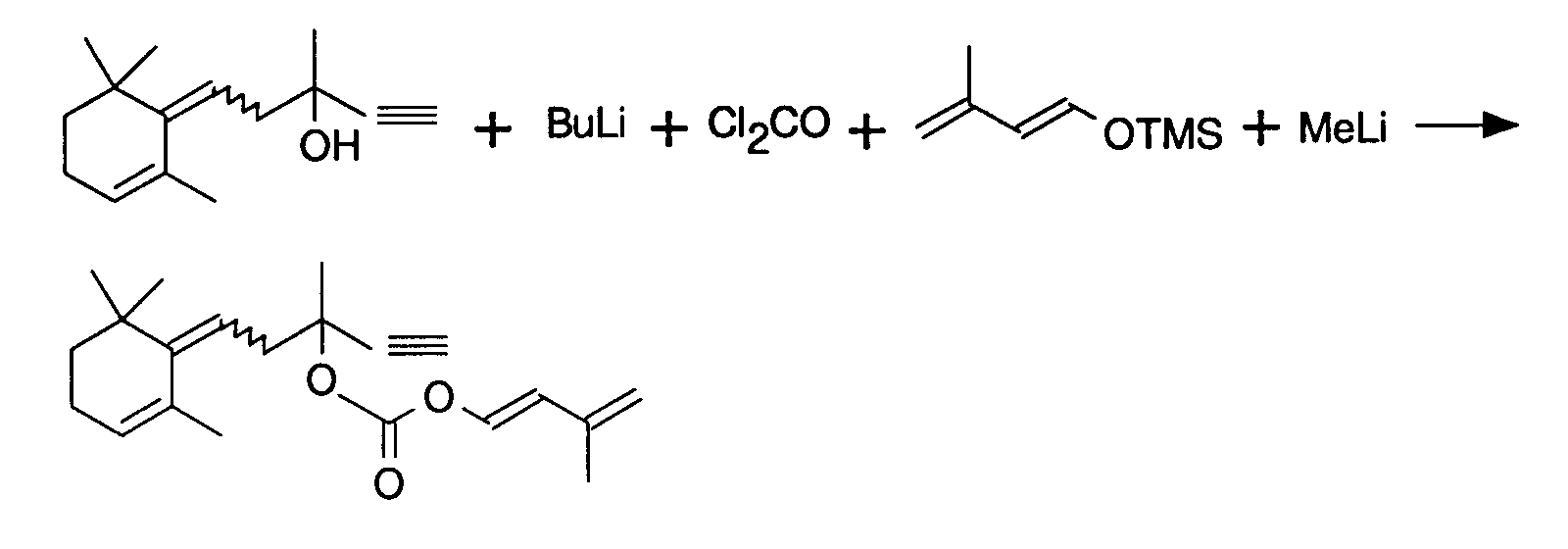
- I) Dans 10 ml de THF anhydre contenant 1 g d'éthynyl rétroαionol (4,58 10-3 mole) sous argon, maintenu à -20°C, on ajoute 2,86 ml de butyllithium dans l'hexane (4,58 10-3 mole). A la fin de l'addition, on laisse reposer environ 10 minutes puis on ajoute à une solution de phosgène dans le toluène (2,36 ml, 4,57 mmole) à -40°C.
A la fin de l'addition, la solution se colore en jaune orangé. - II) Dans 10 ml de THF contenant 6,46 10-3 mole d'éther d'énolsilylé du prénal, on ajoute à -40°C, 3,75 ml de méthyltithium (6 10-3 mole) en solution dans l'éther. On laisse 15 minutes puis on l'ajoute à -40°C, au chloroformiate préparé en I.
On laisse 30 minutes à -40°C puis on dilue par l'éther éthylique, on lave avec une solution aqueuse de chlorure de sodium saturée. On réextrait à l'éther.
On obtient après chromatographie 1,176 g (rendement 78%) de produit dont les analyses RMN infrarouge et de masse confirment la structure attendue. - De la même manière qu'à l'exemple 1, on prépare selon la réaction suivante, les carbonates dont les rendements de préparation sont indiqués dans le tableau 1.

-
- I) Préparation du chloroformiate de prényle

On ajoute à de l'acétoxyisoprène fraîchement distillé (3,26g, 25,8 mmol) à 0°C, le méthoxytributylétain (7 ml, 24,3 mmol) sous argon. on agite à température ambiante pendant 30 minutes puis on dilue par 20 ml de chlorure de méthylène et on ajoute à 0°C à une solution toluénique de phosgène ( 12,5ml, 24mmol).
On laisse sous agitation à 0°C pendant 15 minutes puis on évapore le chlorure de méthylène, on distille ensuite le toluène et le produit sous pression réduite (100°C, 90-100mm de mercure).
On récupère 1,32g d'un liquide jaune clair contenant 74% en masse de chloroformiate attendu (RMN), le rendement est de 28%. - II) Préparation du carbonate

Le 2-phényl 3-butyne 2-ol (0,664g, 4,54mmol) est dissout dans 5ml de tétrahydrofurane anhydre sous argon. On refroidit à -40°C et on ajoute le butyllithium (solution 1,6 molaire dans l'hexane, 3ml, 4,8mmol). On laisse sous agitation à - 40°C pendant 10 minutes puis on ajoute le chloroformiate préparé en I (1,20g, 6mmol) dans 1,5ml de tétrahydrofurane.
Après 30 minutes à -40°C, on dilue par une solution de triéthylamine dans l'éther éthylique, on lave à l'eau à -20°C, on sèche sur sulfate de magnésium, on évapore sous pression réduite puis on chromatographie et on récupère le produit attendu (0,911g). Le rendement est de 78%. -

- Le carbonate de l'exemple 2 R1=R2=CH3 et R3=H (0,343g, 1,77 mmol) est dissous dans 6 ml de tétrahydrofurane anhydre sous argon. On ajoute à température ambiante le catalyseur (0,100 g, 0,086 mmol, 5 %) puis on porte à 65°C.
- La réaction est suivie par chromatographie couche mince (éluant pentane/éther 10/1). Au bout de 1 heure 30 minutes, le carbonate a disparu. On évapore puis on chromatographie sur silice (éluant pentane/éther 10/1).
- On sépare deux fractions :
- fraction a: masse 0,0568 g; produit Ia; rendement = 21 %
- fraction b: masse 0,1019 g; produit Ib; rendement = 38 %
- Les exemples 1 à 9 sont réalisés selon le même mode opératoire que l'exemple 2, les résultats sont indiqués dans le tableau 1. Les exemples 10 à 13 sont réalisés selon le même mode opératoire que les exemples 1 à 9 avec différents catalyseurs et différents ligands, les résultats sont indiqués dans le tableau 2.
-
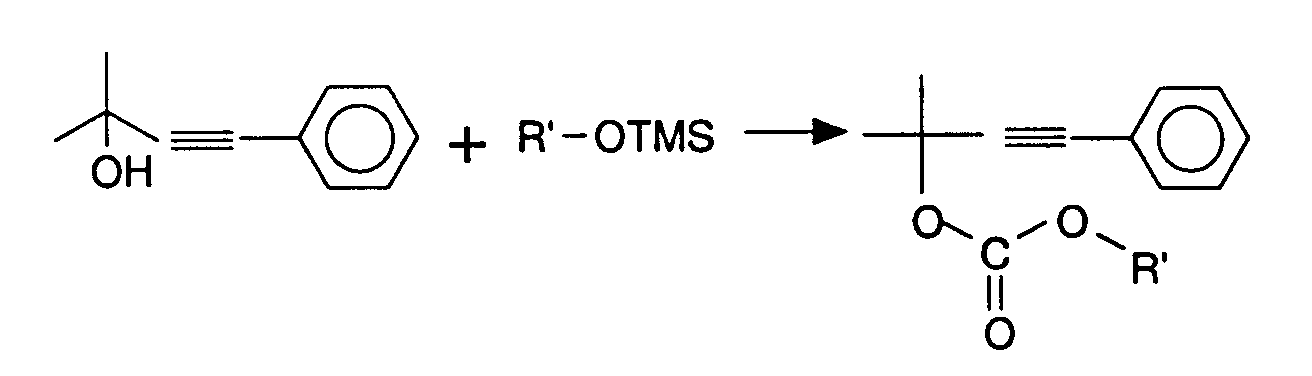
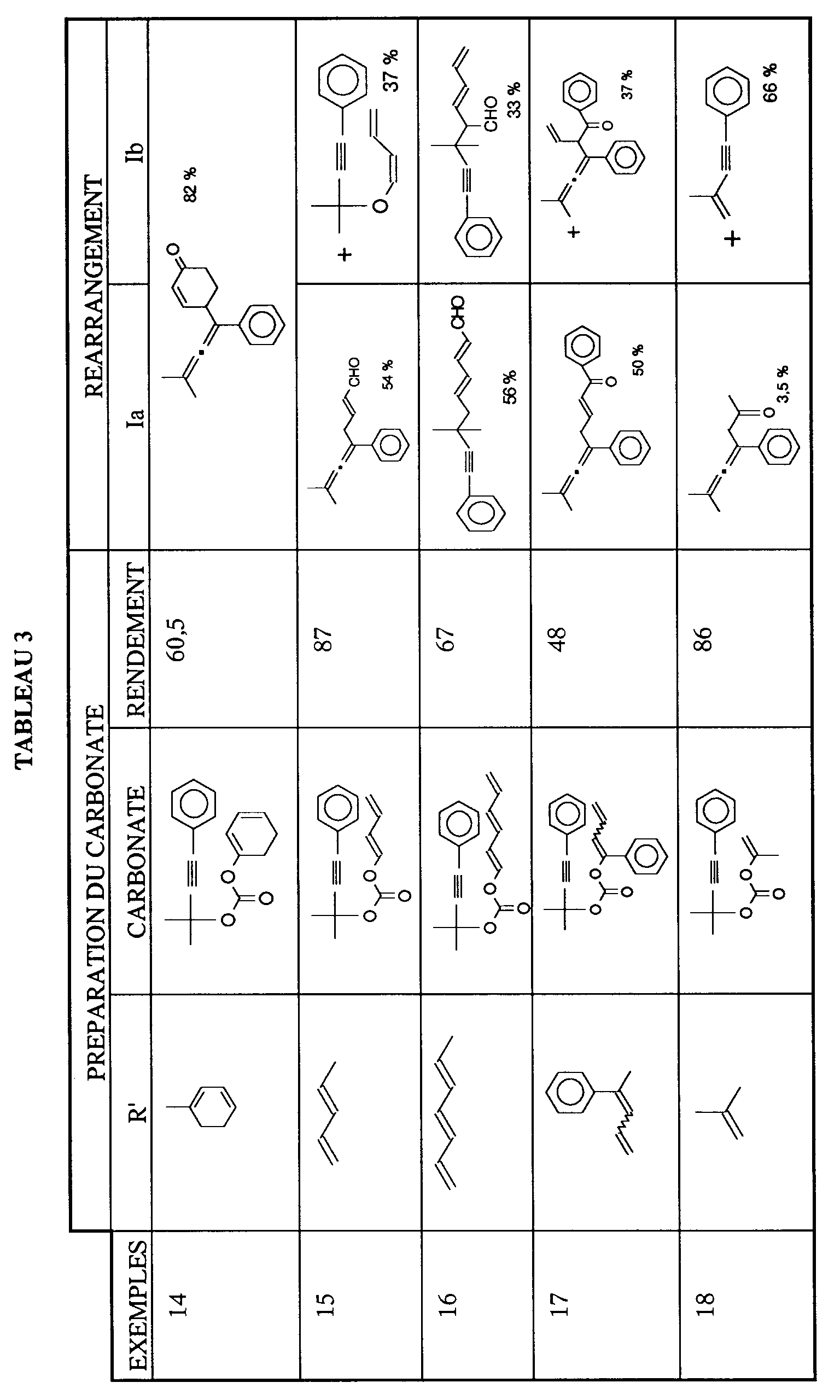
- Le carbonate est réarrangé en présence d'une catalyse avec Pd(PPh3)4 5 % dans du THF (Conc = 0,2) à 55-60°C.
- Les composés obtenus ainsi que leur rendement respectif sont indiqués dans le tableau 3.
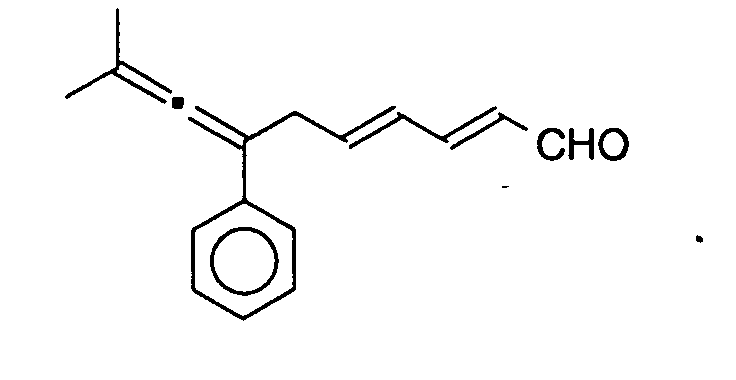
- On reproduit l'exemple 16 en utilisant comme catalyseur de réarrangement Ni(COD)2 à 20 %, PPh3 40 % dans le THF à température ambiante pendant 3 heures. On obtient le composé suivant avec un rendement de 62 %.
-

- On introduit 0,069 g (0,244 10-3 mole) du dérivé obtenu à l'exemple 1 (Tableau I) (R1 =

- La solution se colore vite en orange. On laisse 25 minutes, on filtre sur colone de silice (éluant pentane/éther éthylique). On récupère 0,037 g d'un produit correspondant à la structure attendue dont le système polyénique n'est que partiellement reconjugué.
- La rendement est de 54 %.
-

- La chromatographie sur silice donne 0,072 g de rétinal (57 %).
-

- On reproduit le même mode opératoire qu à l'exemple 21 à partir du produit obtenu à l'exemple 8. Le produit obtenu est le déhydrofarnesal qui est obtenu avec un rendement de 75 %.
-

- On reproduit le même mode opératoire que l'exemple 20 à partir du produit obtenu à l'exemple 2. Le produit obtenu est le déhydrocitral. Il est obtenu avec un rendement de 54 %.


Claims (11)
- intermédiaires de préparation de la vitamine A et des caroténoïdes caractérisés en ce qu'ils répondent à la formule (I) suivante :
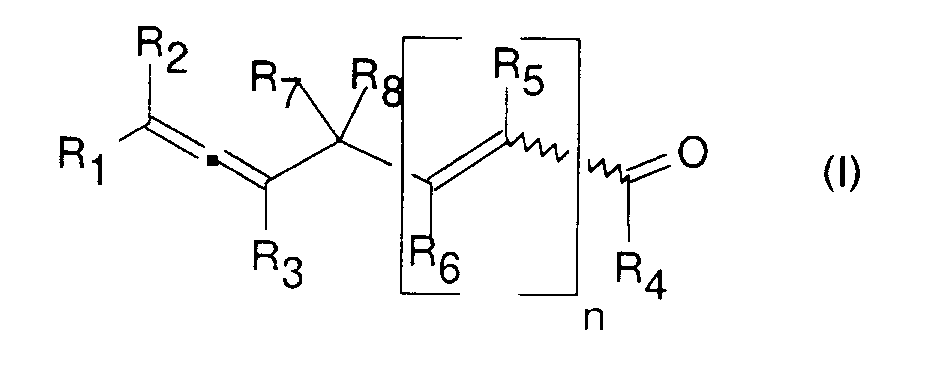 - R1, R2 et R3 représentent chacun indépendamment l'un de l'autre l'hydrogène, un motif alkyle contenant 1 à 4 atomes de carbone, un motif alkényle contenant 2 à 10 atomes de carbone, aryle, cycloalkyle, cycloalkényle, chaque motif alkyle et/ou alkényle pouvant être linéaire ou ramifié, deux groupes peuvent former ensemble un motif alkylidène contenant de 2 à 12 atomes de carbone,- quand R1, R2 et R6 représentent un groupe méthyle R4, R5, R7 et R8 représentent l'hydrogène et n est 1 R3 peut représenter un groupe triméthylsilyl,- R4, R5, R6, R7 et R8 représentent chacun indépendamment l'un de l'autre l'hydrogène, un motif alkyle contenant 1 à 4 atomes de carbone ou alkényle contenant 2 à 10 atomes de carbone, chaque motif alkyle, alkényle étant linéaire, ramifié ou cyclique et aryle contenant 6 à 10 atomes de carbone; deux groupes peuvent former ensemble un motif alkylidene contenant 2 à 10 atomes de carbone.
 - intermédiaires selon la revendication 1 caractérisés en ce que R4, R5, R7, R8 représentent l'hydrogène et R6 un groupe méthyle.
- intermédiaires selon les revendications 1 et 2 caractérisés en ce que R1 représente le motif suivant :
- Procédé de préparation des intermédiaires de formule (I) caractérisé en ce qu'on fait réagir un intermédiaire de formule (II) suivante :

- Procédé selon la revendication 4 caractérisé en ce que le métal est choisi parmi les métaux des colonnes VIII, IB et IIB de la classification périodique.
- Procédé selon la revendication 4 caractérisé en ce que le métal est choisi parmi le nickel et le palladium.
- Procédé selon la revendication 4 caractérisé en ce que le ligand est une phosphine.
- Procédé selon la revendication 4 caractérisé en ce que la quantité de catalyseur utilisée varie entre 1 et 20 % en mole par rapport au dérivé de formule (II).
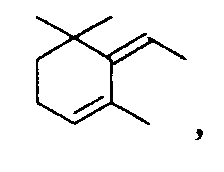
- Procédé de préparation du rétinal caractérisé en ce qu'on traite le dérivé de formule (I) dans lequel R1 représente le groupe
- Procédé de préparation du déhydrocitral caractérisé en ce qu'on traite le dérivé de formule (I) dans lequel R1, R2, R6 représentent un groupe méthyle, R3, R4, R5 et R7 l'hydrogène par la carbonate de potassium.
- Procédé de préparation du déhydrofarnesal caractérisé en ce qu'on traite le dérivé de formule (I) dans lequel R1 représente le motif

Applications Claiming Priority (2)
| Application Number | Priority Date | Filing Date | Title |
|---|---|---|---|
| FR9311943A FR2710912B1 (fr) | 1993-10-07 | 1993-10-07 | Nouveaux intermédiaires de préparation de la vitamine A et des caroténoïdes et leur procédé de préparation. |
| FR9311943 | 1993-10-07 |
Publications (2)
| Publication Number | Publication Date |
|---|---|
| EP0647623A1 EP0647623A1 (fr) | 1995-04-12 |
| EP0647623B1 true EP0647623B1 (fr) | 1997-09-10 |
Family
ID=9451617
Family Applications (1)
| Application Number | Title | Priority Date | Filing Date |
|---|---|---|---|
| EP94402224A Expired - Lifetime EP0647623B1 (fr) | 1993-10-07 | 1994-10-05 | Nouveaux intermédiaires de préparation de la vitamine A et des caroténoides et leur procédé de préparation |
Country Status (10)
| Country | Link |
|---|---|
| US (2) | US5563297A (fr) |
| EP (1) | EP0647623B1 (fr) |
| JP (1) | JP2701133B2 (fr) |
| AT (1) | ATE157967T1 (fr) |
| CA (1) | CA2131592C (fr) |
| DE (1) | DE69405507T2 (fr) |
| DK (1) | DK0647623T3 (fr) |
| ES (1) | ES2106476T3 (fr) |
| FR (1) | FR2710912B1 (fr) |
| GR (1) | GR3024697T3 (fr) |
Families Citing this family (3)
| Publication number | Priority date | Publication date | Assignee | Title |
|---|---|---|---|---|
| US20030008919A1 (en) * | 1999-06-03 | 2003-01-09 | Jean-Baptiste Roullet | Use of retinoids to treat high blood pressure and other cardiovascular disease |
| FR2780970B1 (fr) * | 1998-07-10 | 2000-08-18 | Rhone Poulenc Nutrition Animal | Procede de preparation de la vitamine a |
| CN114907246B (zh) * | 2021-02-08 | 2024-02-06 | 复旦大学 | 一种维生素a及其衍生物与其氘代化合物的全合成方法 |
Family Cites Families (6)
| Publication number | Priority date | Publication date | Assignee | Title |
|---|---|---|---|---|
| US3057888A (en) * | 1957-04-05 | 1962-10-09 | Hoffmann La Roche | Processes for and intermediates in the manufacture of unsaturated aldehydes and ketones |
| US3225102A (en) * | 1960-12-13 | 1965-12-21 | Eastman Kodak Co | Allenic aldehydes |
| US3236869A (en) * | 1959-12-24 | 1966-02-22 | Eastman Kodak Co | Allenic acids |
| FR1313362A (fr) * | 1959-12-24 | 1962-12-28 | Eastman Kodak Co | Composés alléniques et procédé pour leur préparation |
| US4362670A (en) * | 1981-09-03 | 1982-12-07 | The Dow Chemical Company | Allylation of carbon compounds |
| JPS6032742A (ja) * | 1983-08-03 | 1985-02-19 | Nippon Zeon Co Ltd | α,β−不飽和カルボニル化合物の製造法 |
-
1993
- 1993-10-07 FR FR9311943A patent/FR2710912B1/fr not_active Expired - Fee Related
-
1994
- 1994-09-07 CA CA002131592A patent/CA2131592C/fr not_active Expired - Fee Related
- 1994-10-05 DE DE69405507T patent/DE69405507T2/de not_active Expired - Fee Related
- 1994-10-05 EP EP94402224A patent/EP0647623B1/fr not_active Expired - Lifetime
- 1994-10-05 AT AT94402224T patent/ATE157967T1/de not_active IP Right Cessation
- 1994-10-05 DK DK94402224.3T patent/DK0647623T3/da active
- 1994-10-05 JP JP6264381A patent/JP2701133B2/ja not_active Expired - Lifetime
- 1994-10-05 ES ES94402224T patent/ES2106476T3/es not_active Expired - Lifetime
- 1994-10-07 US US08/320,150 patent/US5563297A/en not_active Expired - Fee Related
-
1995
- 1995-06-07 US US08/475,646 patent/US5639919A/en not_active Expired - Fee Related
-
1997
- 1997-09-11 GR GR970401161T patent/GR3024697T3/el unknown
Also Published As
| Publication number | Publication date |
|---|---|
| ATE157967T1 (de) | 1997-09-15 |
| US5639919A (en) | 1997-06-17 |
| GR3024697T3 (en) | 1997-12-31 |
| EP0647623A1 (fr) | 1995-04-12 |
| JPH07188090A (ja) | 1995-07-25 |
| US5563297A (en) | 1996-10-08 |
| DE69405507T2 (de) | 1998-02-12 |
| FR2710912A1 (fr) | 1995-04-14 |
| DK0647623T3 (da) | 1998-04-14 |
| DE69405507D1 (de) | 1997-10-16 |
| JP2701133B2 (ja) | 1998-01-21 |
| ES2106476T3 (es) | 1997-11-01 |
| FR2710912B1 (fr) | 1995-12-01 |
| CA2131592A1 (fr) | 1995-04-08 |
| CA2131592C (fr) | 1998-12-01 |
Similar Documents
| Publication | Publication Date | Title |
|---|---|---|
| EP0805800B1 (fr) | Procede de preparation de composes a groupement beta-hydroxy-delta-lactone analogues de la (+) compactine et de la (+) mevinoline | |
| EP0004493B1 (fr) | Nouveaux éthers dont les restes organiques comportent des atomes chiraux, leur procédé de préparation et leur application au dédoublement des alcools, des phénols ou de certains composés de structure lactonique | |
| EP0647623B1 (fr) | Nouveaux intermédiaires de préparation de la vitamine A et des caroténoides et leur procédé de préparation | |
| EP0171320B1 (fr) | Procédé de préparation de composés insaturés chlorés en alpha de deux groupements électroattracteurs en position bêta | |
| EP0601918A1 (fr) | Procédé de préparation de la vitamine A et composés intermédiaires utiles pour ce procédé | |
| EP0647624B1 (fr) | Nouveaux intermédiaires de préparation de la vitamine A et des caroténoides et leur procédé de préparation | |
| EP0685473B1 (fr) | Composés benzohétérocycliques, en tant qu'antioxydants | |
| EP0012390B1 (fr) | Procédé pour la préparation de la muscone et composés pyranniques intermédiaires | |
| EP0037327A1 (fr) | Nouveaux dérivés substitués de l'acide 3-formyl 4-méthyl pentanoique, leur préparation et leur application à la préparation d'acide 3-formyl but-3-èn-1-oique substitué | |
| EP0801639B1 (fr) | Procede de preparation d'anthraquinones substituees et application a la preparation de rheines | |
| EP0025383B1 (fr) | Nouveaux dérivés substitués du cyclopropène, leur préparation et leur application dans la synthèse de précurseurs de l'acide dl cis chrysanthémique | |
| CH648821A5 (fr) | Procedes de preparation de derives cyclopropaniques tetra-substitues. | |
| EP0579991B1 (fr) | Procédé pour la préparation d'une cétone bicyclique décalinique | |
| EP0802180A1 (fr) | Bèta-méthylène aldéhydes utiles notamment pour la préparation de composés d'intérêt tels que les rétinoides ou les caroténoides et préparation de composés d'intérêt au moyen desdits bèta-méthylène aldéhydes | |
| EP0216659A1 (fr) | Nouveaux halogénoformiates de dihalogéno-2,2 vinyle, leur procédé de préparation et leurs applications | |
| EP0145554A2 (fr) | Procédé de préparation de dérivés éthyléniques chlorés | |
| FR2634203A1 (fr) | Dihydro-2,3-benzofurannes a odeur musquee et parfums et produits parfumes les contenant | |
| EP0069010B1 (fr) | Procédé de préparation de composés carbonyles delta-éthyléniques | |
| FR2558833A1 (fr) | Nouveaux derives de la 4,4-dimethyl tetrahydro-2-pyran-2-one, leur procede de preparation et leur application a la synthese de derives cyclopropaniques | |
| BE864791A (fr) | Procede de preparation de derives de l'acide phenylacetique | |
| EP0058591A1 (fr) | Procédé d'épimérisation d'acides trans chrysanthémiques et nouveaux intermédiaires obtenus | |
| CA2031249A1 (fr) | Procede de preparation d'halogenoacetals a partir d'enamines | |
| EP0146439A1 (fr) | Procédé de préparation de dérivés acétyléniques, nouveaux dérivés obtenus et leur emploi | |
| EP0060767A1 (fr) | Procédé de préparation de composés carbonylés delta-éthyléniques | |
| FR2503166A1 (fr) | Nouveaux derives organometalliques d'ethers d'enols trialkylsilyles, leur preparation et leur application |
Legal Events
| Date | Code | Title | Description |
|---|---|---|---|
| PUAI | Public reference made under article 153(3) epc to a published international application that has entered the european phase |
Free format text: ORIGINAL CODE: 0009012 |
|
| AK | Designated contracting states |
Kind code of ref document: A1 Designated state(s): AT BE CH DE DK ES FR GB GR IE IT LI LU NL PT SE |
|
| 17P | Request for examination filed |
Effective date: 19950511 |
|
| 17Q | First examination report despatched |
Effective date: 19960911 |
|
| GRAG | Despatch of communication of intention to grant |
Free format text: ORIGINAL CODE: EPIDOS AGRA |
|
| GRAH | Despatch of communication of intention to grant a patent |
Free format text: ORIGINAL CODE: EPIDOS IGRA |
|
| GRAH | Despatch of communication of intention to grant a patent |
Free format text: ORIGINAL CODE: EPIDOS IGRA |
|
| GRAA | (expected) grant |
Free format text: ORIGINAL CODE: 0009210 |
|
| ITF | It: translation for a ep patent filed | ||
| AK | Designated contracting states |
Kind code of ref document: B1 Designated state(s): AT BE CH DE DK ES FR GB GR IE IT LI LU NL PT SE |
|
| REF | Corresponds to: |
Ref document number: 157967 Country of ref document: AT Date of ref document: 19970915 Kind code of ref document: T |
|
| REG | Reference to a national code |
Ref country code: CH Ref legal event code: EP |
|
| GBT | Gb: translation of ep patent filed (gb section 77(6)(a)/1977) |
Effective date: 19970912 |
|
| REF | Corresponds to: |
Ref document number: 69405507 Country of ref document: DE Date of ref document: 19971016 |
|
| REG | Reference to a national code |
Ref country code: ES Ref legal event code: FG2A Ref document number: 2106476 Country of ref document: ES Kind code of ref document: T3 |
|
| REG | Reference to a national code |
Ref country code: CH Ref legal event code: NV Representative=s name: KIRKER & CIE SA Ref country code: GR Ref legal event code: FG4A Free format text: 3024697 |
|
| REG | Reference to a national code |
Ref country code: PT Ref legal event code: SC4A Free format text: AVAILABILITY OF NATIONAL TRANSLATION Effective date: 19970918 |
|
| REG | Reference to a national code |
Ref country code: IE Ref legal event code: FG4D Free format text: 76401 |
|
| REG | Reference to a national code |
Ref country code: DK Ref legal event code: T3 |
|
| PLBE | No opposition filed within time limit |
Free format text: ORIGINAL CODE: 0009261 |
|
| STAA | Information on the status of an ep patent application or granted ep patent |
Free format text: STATUS: NO OPPOSITION FILED WITHIN TIME LIMIT |
|
| 26N | No opposition filed | ||
| PGFP | Annual fee paid to national office [announced via postgrant information from national office to epo] |
Ref country code: PT Payment date: 19980930 Year of fee payment: 5 |
|
| PGFP | Annual fee paid to national office [announced via postgrant information from national office to epo] |
Ref country code: GR Payment date: 19981020 Year of fee payment: 5 |
|
| PGFP | Annual fee paid to national office [announced via postgrant information from national office to epo] |
Ref country code: DK Payment date: 19981221 Year of fee payment: 5 |
|
| PG25 | Lapsed in a contracting state [announced via postgrant information from national office to epo] |
Ref country code: DK Free format text: LAPSE BECAUSE OF NON-PAYMENT OF DUE FEES Effective date: 19991005 |
|
| PG25 | Lapsed in a contracting state [announced via postgrant information from national office to epo] |
Ref country code: GR Free format text: LAPSE BECAUSE OF NON-PAYMENT OF DUE FEES Effective date: 19991031 |
|
| PG25 | Lapsed in a contracting state [announced via postgrant information from national office to epo] |
Ref country code: PT Free format text: LAPSE BECAUSE OF NON-PAYMENT OF DUE FEES Effective date: 20000430 |
|
| REG | Reference to a national code |
Ref country code: PT Ref legal event code: MM4A Free format text: LAPSE DUE TO NON-PAYMENT OF FEES Effective date: 20000430 |
|
| PGFP | Annual fee paid to national office [announced via postgrant information from national office to epo] |
Ref country code: LU Payment date: 20011002 Year of fee payment: 8 |
|
| PGFP | Annual fee paid to national office [announced via postgrant information from national office to epo] |
Ref country code: GB Payment date: 20011003 Year of fee payment: 8 |
|
| PGFP | Annual fee paid to national office [announced via postgrant information from national office to epo] |
Ref country code: FR Payment date: 20011010 Year of fee payment: 8 Ref country code: ES Payment date: 20011010 Year of fee payment: 8 |
|
| PGFP | Annual fee paid to national office [announced via postgrant information from national office to epo] |
Ref country code: SE Payment date: 20011016 Year of fee payment: 8 |
|
| PGFP | Annual fee paid to national office [announced via postgrant information from national office to epo] |
Ref country code: IE Payment date: 20011026 Year of fee payment: 8 |
|
| PGFP | Annual fee paid to national office [announced via postgrant information from national office to epo] |
Ref country code: NL Payment date: 20011031 Year of fee payment: 8 Ref country code: AT Payment date: 20011031 Year of fee payment: 8 |
|
| PGFP | Annual fee paid to national office [announced via postgrant information from national office to epo] |
Ref country code: BE Payment date: 20011116 Year of fee payment: 8 |
|
| PGFP | Annual fee paid to national office [announced via postgrant information from national office to epo] |
Ref country code: DE Payment date: 20011220 Year of fee payment: 8 |
|
| REG | Reference to a national code |
Ref country code: GB Ref legal event code: IF02 |
|
| PGFP | Annual fee paid to national office [announced via postgrant information from national office to epo] |
Ref country code: CH Payment date: 20020110 Year of fee payment: 8 |
|
| REG | Reference to a national code |
Ref country code: FR Ref legal event code: GC |
|
| PG25 | Lapsed in a contracting state [announced via postgrant information from national office to epo] |
Ref country code: LU Free format text: LAPSE BECAUSE OF NON-PAYMENT OF DUE FEES Effective date: 20021005 Ref country code: GB Free format text: LAPSE BECAUSE OF NON-PAYMENT OF DUE FEES Effective date: 20021005 Ref country code: AT Free format text: LAPSE BECAUSE OF NON-PAYMENT OF DUE FEES Effective date: 20021005 |
|
| PG25 | Lapsed in a contracting state [announced via postgrant information from national office to epo] |
Ref country code: SE Free format text: LAPSE BECAUSE OF NON-PAYMENT OF DUE FEES Effective date: 20021006 Ref country code: ES Free format text: LAPSE BECAUSE OF NON-PAYMENT OF DUE FEES Effective date: 20021006 |
|
| PG25 | Lapsed in a contracting state [announced via postgrant information from national office to epo] |
Ref country code: IE Free format text: LAPSE BECAUSE OF NON-PAYMENT OF DUE FEES Effective date: 20021007 |
|
| PG25 | Lapsed in a contracting state [announced via postgrant information from national office to epo] |
Ref country code: LI Free format text: LAPSE BECAUSE OF NON-PAYMENT OF DUE FEES Effective date: 20021031 Ref country code: CH Free format text: LAPSE BECAUSE OF NON-PAYMENT OF DUE FEES Effective date: 20021031 Ref country code: BE Free format text: LAPSE BECAUSE OF NON-PAYMENT OF DUE FEES Effective date: 20021031 |
|
| BERE | Be: lapsed |
Owner name: *RHONE-POULENC NUTRITION ANIMALE Effective date: 20021031 |
|
| PG25 | Lapsed in a contracting state [announced via postgrant information from national office to epo] |
Ref country code: NL Free format text: LAPSE BECAUSE OF NON-PAYMENT OF DUE FEES Effective date: 20030501 Ref country code: DE Free format text: LAPSE BECAUSE OF NON-PAYMENT OF DUE FEES Effective date: 20030501 |
|
| GBPC | Gb: european patent ceased through non-payment of renewal fee |
Effective date: 20021005 |
|
| EUG | Se: european patent has lapsed | ||
| REG | Reference to a national code |
Ref country code: CH Ref legal event code: PL |
|
| PG25 | Lapsed in a contracting state [announced via postgrant information from national office to epo] |
Ref country code: FR Free format text: LAPSE BECAUSE OF NON-PAYMENT OF DUE FEES Effective date: 20030630 |
|
| NLV4 | Nl: lapsed or anulled due to non-payment of the annual fee |
Effective date: 20030501 |
|
| REG | Reference to a national code |
Ref country code: IE Ref legal event code: MM4A |
|
| REG | Reference to a national code |
Ref country code: FR Ref legal event code: ST |
|
| REG | Reference to a national code |
Ref country code: ES Ref legal event code: FD2A Effective date: 20031112 |
|
| REG | Reference to a national code |
Ref country code: FR Ref legal event code: DG |
|
| PG25 | Lapsed in a contracting state [announced via postgrant information from national office to epo] |
Ref country code: IT Free format text: LAPSE BECAUSE OF NON-PAYMENT OF DUE FEES;WARNING: LAPSES OF ITALIAN PATENTS WITH EFFECTIVE DATE BEFORE 2007 MAY HAVE OCCURRED AT ANY TIME BEFORE 2007. THE CORRECT EFFECTIVE DATE MAY BE DIFFERENT FROM THE ONE RECORDED. Effective date: 20051005 |