EP0647740A1 - Procédé et appareil pour la réalisation des tranchées revêtues dans le sol; ainsi que tranchées revêtues - Google Patents
Procédé et appareil pour la réalisation des tranchées revêtues dans le sol; ainsi que tranchées revêtues Download PDFInfo
- Publication number
- EP0647740A1 EP0647740A1 EP94202765A EP94202765A EP0647740A1 EP 0647740 A1 EP0647740 A1 EP 0647740A1 EP 94202765 A EP94202765 A EP 94202765A EP 94202765 A EP94202765 A EP 94202765A EP 0647740 A1 EP0647740 A1 EP 0647740A1
- Authority
- EP
- European Patent Office
- Prior art keywords
- shell
- elements
- trench
- shells
- ground
- Prior art date
- Legal status (The legal status is an assumption and is not a legal conclusion. Google has not performed a legal analysis and makes no representation as to the accuracy of the status listed.)
- Granted
Links
- 238000000034 method Methods 0.000 title claims abstract description 20
- 239000002689 soil Substances 0.000 title description 6
- 238000004873 anchoring Methods 0.000 claims abstract description 16
- 238000004519 manufacturing process Methods 0.000 claims abstract 2
- 238000007789 sealing Methods 0.000 claims description 9
- 239000012528 membrane Substances 0.000 description 10
- 239000003673 groundwater Substances 0.000 description 8
- 238000010276 construction Methods 0.000 description 7
- XLYOFNOQVPJJNP-UHFFFAOYSA-N water Substances O XLYOFNOQVPJJNP-UHFFFAOYSA-N 0.000 description 5
- 239000004567 concrete Substances 0.000 description 4
- 238000009412 basement excavation Methods 0.000 description 3
- 229920001971 elastomer Polymers 0.000 description 3
- 239000000806 elastomer Substances 0.000 description 3
- 230000002706 hydrostatic effect Effects 0.000 description 2
- 239000011150 reinforced concrete Substances 0.000 description 2
- 229910001294 Reinforcing steel Inorganic materials 0.000 description 1
- 238000010521 absorption reaction Methods 0.000 description 1
- 238000006243 chemical reaction Methods 0.000 description 1
- 230000008878 coupling Effects 0.000 description 1
- 238000010168 coupling process Methods 0.000 description 1
- 238000005859 coupling reaction Methods 0.000 description 1
- 238000006073 displacement reaction Methods 0.000 description 1
- 239000003651 drinking water Substances 0.000 description 1
- 235000020188 drinking water Nutrition 0.000 description 1
- 230000003628 erosive effect Effects 0.000 description 1
- 230000002349 favourable effect Effects 0.000 description 1
- 238000009434 installation Methods 0.000 description 1
- 239000007788 liquid Substances 0.000 description 1
- 230000005923 long-lasting effect Effects 0.000 description 1
- 239000000463 material Substances 0.000 description 1
- 239000010865 sewage Substances 0.000 description 1
- 239000000126 substance Substances 0.000 description 1
Images

Classifications
-
- E—FIXED CONSTRUCTIONS
- E02—HYDRAULIC ENGINEERING; FOUNDATIONS; SOIL SHIFTING
- E02D—FOUNDATIONS; EXCAVATIONS; EMBANKMENTS; UNDERGROUND OR UNDERWATER STRUCTURES
- E02D29/00—Independent underground or underwater structures; Retaining walls
- E02D29/045—Underground structures, e.g. tunnels or galleries, built in the open air or by methods involving disturbance of the ground surface all along the location line; Methods of making them
- E02D29/05—Underground structures, e.g. tunnels or galleries, built in the open air or by methods involving disturbance of the ground surface all along the location line; Methods of making them at least part of the cross-section being constructed in an open excavation or from the ground surface, e.g. assembled in a trench
Definitions
- the present invention concerns a method and an apparatus for making a lined trench in the ground; as well as such a lined trench.
- the present invention now aims to provide a method enabling a fast and continuous construction of a lined trench which does not require drainage by well points.
- the method according to the invention is characterized in that, first of all, a trench is dug into the ground and that, immediately after that, shells are placed consecutively and in sealed adjoining relation in the trench, being supported and anchored by anchoring elements.
- the groundwater level does not have to be lowered.
- the upward pressure exerted on the trench lining by the surrounding ground and any groundwater present therein can be made useful, said lining preferably having a semicircular shape in order to advantageously convert all ground forces exerted thereon primarily into pressure forces in the circular walls of the trench lining.
- the shells are preferably composed of engaging shell segments, around which or inside which a prestressing element is provided, said shells being supported and anchored by the anchoring elements at the upper ends thereof.
- the shell elements can be easily prefabricated and transferred to the work concerned, where they are linked to each other by a slightly "pivoting" joint and are held under pressure tension, and thus in place, by the prestressing elements.
- the said prestressing elements may consist of prestressing cables which pass through aligned cavities in the shell elements and are given a certain tension at the ends thereof.
- Individual sealing elements between or around the shell elements provide the sealing of the trench lining. It is also possible to combine these prestressing elements and seals to a watertight membrane which is placed around the shell elements under prestressing tension during the mounting of the shell elements.
- the anchoring elements can be formed by girders or head beams placed on piles on both sides of the trench to be formed, which girders are positioned prior to digging the trench to guide the apparatus for implementing the method.
- the girder or head beam placed on foundation piles has various functions. First of all, it serves as a support and guide for the digging machine, simultaneously being able to absorb the reaction forces of the forward drive. Secondly, the pressure and/or tensile forces on the concrete shell elements and the prestressing elements are diverted, the tensile force on the prestressing element being adjustable, for example, via a tensioning nut by means of a threaded rod extending through the head beam. Thirdly, the head beam has to transfer the possible vertical resultant of the upward force to the surrounding ground via the foundation piles.
- a fourth function of the embodiment is that it can serve as a foundation for possible noise-protection walls, masts for overhead wires and even for lightweight footbridges over the road or railway passing under these. It is also possible to support the head beams only by means of a vertical pile and to fasten parallel head beams to each other by means of a cross connection.
- a continuous digging machine For the purpose of digging the trench, a continuous digging machine is used. A rotating digging arm at the front of this machine continuously digs out the ground in front of the machine and removes this via an apparatus which is provided on the digging machine. Under normal circumstances, this machine will be provided with the traditional "cutter head” as used in dredging, in which a rotating head with water jets squirts the ground away and digs. This ground is then pumped away to a dumping site by means of a dredging pump. A “dry” digging method is also possible.
- the digging machine is provided with a shell-mounting device immediately behind the digging part, which also contains the drive for the digging head, dredging pump and motor.
- the shell-mounting device may comprise, in one embodiment, a mounting wheel, onto which the shell elements can be fed in order to position the shell elements, by rotation, in the right place in the trench.
- This independently rotating, entirely circular mounting wheel has a smaller diameter than the circular body or shield of the first part of the digging machine, in order to allow the shell elements to be moved between the mounting wheel and the shield when they are positioned in the trench.
- the shell elements are disposed in the circumferential rim of the mounting wheel by an automatic stacking apparatus, the orientation of disposition being such that the shell elements automatically slide, by their own weight, into the right position.
- the membrane In the case of sealing by means of a membrane, the membrane is simultaneously tensioned across the shell element, linking up with the previously placed membrane via a groove joint. As soon as this position is reached, the forward displacement of the digging machine will be interrupted, allowing the coupling of the membranes and the positioning of the concrete shell elements to take place.
- One half of the wheel may be provided with a progressively increasing diameter, in order to push the ground and groundwater aside.
- the shield may extend as far as, under and even slightly beyond the mounting wheel.
- the shell segments are combined to a shell and moved to the right level, in order to be connected to a preceding shell.
- the shell-mounting device of the apparatus may comprise a mould for constructing a shell from shell elements, which mould is adjustable in height and preferably consists of a segmented inflatable pillow.
- the trench lining thus placed can be provided with a continuously applied inner lining, for example of reinforced concrete.
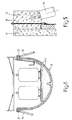
- Fig. 1 is a very schematic longitudinal section of the embodiment of the invention for making a lined trench in the ground.
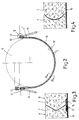
- Fig. 2 is a transverse section of the open excavation which remains after the passage of the digging machine and the mounting wheel for the shell elements.
- Fig. 3 is a partial section on a larger scale according to the line III-III in Fig. 2.
- Fig. 4 shows detail IV of Fig. 2 on a larger scale.
- Fig. 5 shows detail V of Fig. 2 on a larger scale.
- Fig. 6 is a transverse section of the lined trench used as a deepened railway.
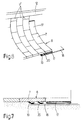
- Fig. 7 is the detail VII of Fig. 1 of an alternative embodiment of the shell-mounting device of the apparatus according to the invention, represented on a larger scale.
- Fig. 8 shows in a very schematic perspective partial view of the apparatus of Fig. 7 the principal of the shell-mounting device.
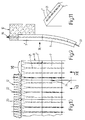
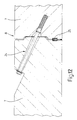
- Fig. 9 is a section of an alternative embodiment of the trench lining according to the invention, corresponding to Fig. 5.
- Fig. 10 is a view according to the arrow X in Fig. 9.
- Fig. 11 is a perspective view according to the arrow XI in Fig. 10.
- Fig. 12 is a section according to the line XII-XII in Fig. 10, represented on a larger scale.
- Fig. 1 of the drawings shows that the apparatus for making a lined trench in the ground comprises a digging wheel 1 in the form of a cutter-suction dredge.
- the digging wheel 1 is driven by a motor 2.
- the detached ground A is removed together with water by a dredging pump 3 which is driven by the motor 4.
- a mounting wheel is provided, which is preferably adjustable in upward and longitudinal direction, and which is driven by a motor 6.
- this mounting wheel 5 By means of this mounting wheel 5, the axis of which is parallel to the longitudinal direction of the apparatus, each shell 8 composed of separate shell elements 7 is moved by rotation into the trench. Any leak water is removed by a vacuum pump 18.
- Fig. 2 shows in a transverse section the open excavation after digging the trench and applying the shells 8 consisting of shell segments 7. It can be seen that the shells are supported at the ends in upward direction via the straight shell elements 7' by horizontally extending concrete head beams 12 which also have the function to support the wheels 13 of the apparatus for making a lined trench in the ground.
- the head beams 12 are anchored to the ground by foundation piles 14 provided at regular intervals.
- Figs. 2 to 5 show that a membrane 15 has been tensioned around each shell. The tension of the membranes 15 is maintained by tensioning pins 16 which are guided through the head beams 12, as can be seen in detail in Fig. 5.
- the membranes 15 have been installed by means of the mounting wheel 5. Adjacent membranes are interconnected in an autosealing fashion and are resistant to tensile strain by a groove joint 17.
- Fig. 6 shows the final lined trench, in which a two-track railway has been constructed in a deepened fashion.
- Figs. 7 and 8 show an alternative method of combining the shell elements 7 to the shell 8.
- the shell elements 7 are moved, by means not shown, to the right places in the shell on a hydraulic or pneumatic pillow 17 which is part of a shell-mounting device provided close to the rear end of an at least semicircular lower shield 18 of the apparatus.
- the pillow 17 can be inflated with a gas, such as air, or with a liquid, and preferably the pillow 17 is divided circumferentially into sections or segments, so that the height of the supported shell 8 can be locally adjusted, in order to align the shell elements 7 with the shell elements 7 of a preceding shell.
- Fig. 7 further shows that the shield 18 is provided at the rear end with a seal with two elastomer sealing lips 19, 20 which are held in sealing engagement with the lower side of the shell 8 which has already been placed by the pressure of the ground and groundwater, as a result of which the space within the lower shield 18 remains dry.
- This seal 19, 20 is, of course, also applicable to the invention according to Fig. 1.
- Figs. 9 to 11 show an alternative embodiment of the trench lining, in which the shell elements comprise a number of parallel, circumferentially extending, adjoining cavities 21, through which prestressing cables 22 serving as prestressing elements are guided.
- prestressing cables 22 do not only pass through the cavities 21 in the shell elements 7, but also through the cavities 23 in the head beams 12.
- the cavities 21 in the closing, straight upper shell elements 7' and the cavities 23 in the head beams 12 diverge at the ends facing each other, which makes it easier to guide a prestressing cable 22 through them.
- the cavities 23 in the head beams 12 are provided at shorter intervals than the cavities 21 in the shell elements 7, so that in each relative position still an adjoining cavity 23 can be found.
- Fig. 12 shows another possible way of linking the shell elements 7 of adjacent shells 8.
- This consists of a screwed joint 24, which is also known from tunnel construction.
- the sealing of the adjacent shells is realized in this case by means of sealing elements 25 which are positioned between the adjacent shells 8 and located close to the inner and/or outer side of the shell 8.
- the seal is not only useful in preventing a leak of groundwater from the exterior to the interior, but also in preventing a leak from the interior to the exterior, for example in the case of calamities, such as the derailment of a train transporting chemicals.
- the trench lining according to Figs. 7 to 12 can be made as follows. First of all, a shell is composed of shell elements on the pillow 17 and after all the shell elements 7 have been positioned, the entire shell 8 is pressed upwards against the head beams 12 by inflating the pillow 17. Subsequently, the prestressing cables 22 are guided through the head beams 12 and the shell elements 7 and tensioned by tensioning nuts at the ends of the prestressing cables. Then, the screwed joints 24 can be realized, after which the pressure of the pillow 17 can be lowered and the apparatus can be moved forward over the length of one shell.
- the apparatus can then be locked in the new position, for example secured by means of hydraulic clamps on the head beams 12. As a result of this, it is able to resist the hydraulic forces exerted by the semicircular water front on the shield of the apparatus.
- the forward movement of the apparatus can be realized by means of hydraulic cylinders which, during this forward movement, react against the shell 8 which has already been mounted.
- the invention concerns the continuous digging of a trench and the immediate, subsequent construction of a substantially semi-circular tunnel basin, both "in wet conditions” by means of a cutter-suction dredge, and "in dry conditions” by means of a digging wheel.
- the invention is particularly suitable for application in a slack soil with a high groundwater level, where the traditional methods with drainage by well points involve great disadvantages. This applies to many different types of soil, varying from sandy to peaty soils, but of course preferably a fairly level soil.
- the lined trench is not only suitable for the construction of roads, railways, tramtracks and the like, but also for the installation therein of pipes, such as sewage pipes and drinking water pipes. Other applications are conceivable as well.
- the nose of the apparatus is controllable to take bends, and slant shell elements can be used for providing bends in the trench lining.
- slant shell elements can be used for providing bends in the trench lining.
- the hydrostatic pressure of the groundwater and the forces of the surrounding ground stabilize the inverse vault construction of the trench lining in the ground.
- a traditionally designed semicircular reinforced concrete basin can be cast, but it is also possible to leave the cast inner lining out, or to use only an elastomer membrane or a lining of another material.
Landscapes
- Engineering & Computer Science (AREA)
- Mining & Mineral Resources (AREA)
- Environmental & Geological Engineering (AREA)
- Life Sciences & Earth Sciences (AREA)
- General Life Sciences & Earth Sciences (AREA)
- Paleontology (AREA)
- Civil Engineering (AREA)
- General Engineering & Computer Science (AREA)
- Structural Engineering (AREA)
- Lining And Supports For Tunnels (AREA)
- Excavating Of Shafts Or Tunnels (AREA)
- Underground Structures, Protecting, Testing And Restoring Foundations (AREA)
Applications Claiming Priority (2)
| Application Number | Priority Date | Filing Date | Title |
|---|---|---|---|
| NL9301758 | 1993-10-11 | ||
| NL9301758A NL9301758A (nl) | 1993-10-11 | 1993-10-11 | Werkwijze en inrichting voor het in de grond aanbrengen van een beklede sleuf; alsmede een dergelijke beklede sleuf. |
Publications (2)
| Publication Number | Publication Date |
|---|---|
| EP0647740A1 true EP0647740A1 (fr) | 1995-04-12 |
| EP0647740B1 EP0647740B1 (fr) | 1999-06-23 |
Family
ID=19862999
Family Applications (1)
| Application Number | Title | Priority Date | Filing Date |
|---|---|---|---|
| EP19940202765 Expired - Lifetime EP0647740B1 (fr) | 1993-10-11 | 1994-09-26 | Procédé et appareil pour la réalisation des tranchées revêtues dans le sol; ainsi que tranchées revêtues |
Country Status (5)
| Country | Link |
|---|---|
| EP (1) | EP0647740B1 (fr) |
| JP (1) | JPH07233697A (fr) |
| DE (1) | DE69419220T2 (fr) |
| DK (1) | DK0647740T3 (fr) |
| NL (1) | NL9301758A (fr) |
Cited By (1)
| Publication number | Priority date | Publication date | Assignee | Title |
|---|---|---|---|---|
| CN115324107A (zh) * | 2022-08-24 | 2022-11-11 | 中交(临沂)建筑科技有限公司 | 一种预制箱涵安装设备 |
Families Citing this family (1)
| Publication number | Priority date | Publication date | Assignee | Title |
|---|---|---|---|---|
| JP5101050B2 (ja) * | 2006-06-22 | 2012-12-19 | 株式会社大林組 | セグメントユニット |
Citations (5)
| Publication number | Priority date | Publication date | Assignee | Title |
|---|---|---|---|---|
| US1869265A (en) * | 1931-03-28 | 1932-07-26 | Cement Gun Contracting Company | Lining ditches and the like |
| US1924560A (en) * | 1931-07-14 | 1933-08-29 | Cement Gun Company | Method of forming ditch linings |
| GB427743A (en) * | 1933-10-25 | 1935-04-25 | Nofrango Ltd | Improvements in and relating to the building and constructing of canals, channels, dykes, ditches and the like |
| BE894870A (fr) * | 1982-10-29 | 1983-02-14 | Franki N V Sa | Procede et dispositif de construction d'ouvrages souterrains, tel qu'un tunnel, une galerie, notamment dans un sol aquifere, et ouvrages ainsi obtenus |
| DE3446679A1 (de) * | 1984-12-21 | 1986-06-26 | Hochtief Ag Vorm. Gebr. Helfmann, 4300 Essen | Verfahren zum vortrieb und zum ausbau eines tunnels mit hilfe einer schildvortriebsmaschine |
-
1993
- 1993-10-11 NL NL9301758A patent/NL9301758A/nl not_active Application Discontinuation
-
1994
- 1994-09-26 DK DK94202765T patent/DK0647740T3/da active
- 1994-09-26 DE DE1994619220 patent/DE69419220T2/de not_active Expired - Fee Related
- 1994-09-26 EP EP19940202765 patent/EP0647740B1/fr not_active Expired - Lifetime
- 1994-10-11 JP JP6245112A patent/JPH07233697A/ja active Pending
Patent Citations (5)
| Publication number | Priority date | Publication date | Assignee | Title |
|---|---|---|---|---|
| US1869265A (en) * | 1931-03-28 | 1932-07-26 | Cement Gun Contracting Company | Lining ditches and the like |
| US1924560A (en) * | 1931-07-14 | 1933-08-29 | Cement Gun Company | Method of forming ditch linings |
| GB427743A (en) * | 1933-10-25 | 1935-04-25 | Nofrango Ltd | Improvements in and relating to the building and constructing of canals, channels, dykes, ditches and the like |
| BE894870A (fr) * | 1982-10-29 | 1983-02-14 | Franki N V Sa | Procede et dispositif de construction d'ouvrages souterrains, tel qu'un tunnel, une galerie, notamment dans un sol aquifere, et ouvrages ainsi obtenus |
| DE3446679A1 (de) * | 1984-12-21 | 1986-06-26 | Hochtief Ag Vorm. Gebr. Helfmann, 4300 Essen | Verfahren zum vortrieb und zum ausbau eines tunnels mit hilfe einer schildvortriebsmaschine |
Cited By (1)
| Publication number | Priority date | Publication date | Assignee | Title |
|---|---|---|---|---|
| CN115324107A (zh) * | 2022-08-24 | 2022-11-11 | 中交(临沂)建筑科技有限公司 | 一种预制箱涵安装设备 |
Also Published As
| Publication number | Publication date |
|---|---|
| NL9301758A (nl) | 1995-05-01 |
| DE69419220D1 (de) | 1999-07-29 |
| JPH07233697A (ja) | 1995-09-05 |
| DK0647740T3 (da) | 1999-11-22 |
| EP0647740B1 (fr) | 1999-06-23 |
| DE69419220T2 (de) | 1999-12-23 |
Similar Documents
| Publication | Publication Date | Title |
|---|---|---|
| AU2005243406B2 (en) | Process and device for building a tunnel immersed on a sub-sea soil | |
| CN111424716B (zh) | 一种人工岛接力延伸的斜拉锚碇式悬浮隧道结构 | |
| JP3135833B2 (ja) | 水中構造物の構築方法 | |
| EP0647740B1 (fr) | Procédé et appareil pour la réalisation des tranchées revêtues dans le sol; ainsi que tranchées revêtues | |
| US4889448A (en) | Tunnel construction | |
| Gursoy | Immersed steel tube tunnels: An American experience | |
| DE10156950A1 (de) | Tunnelbauverfahren für die Gewässerquerung durch Einschwimmen von statisch tragenden, nutzergerecht nachbetonierten Stahlröhren in tunnelartige Verbaukonstruktionen, deren Ausführung Einschwemmungen unterbindet und die umgebenden Bodenmassen auftriebsverhindernd wirken | |
| US413384A (en) | Tunneling-ram | |
| JP3401177B2 (ja) | 管渠更新シールド掘削機 | |
| JP2004060266A (ja) | 地下構造物の非開削構築工法 | |
| JP3221895B2 (ja) | 大口径地下壁体の構築方法および管埋設用掘削装置 | |
| KR20100120326A (ko) | 선형의 변곡점 또는 환기구가 있는 물속다리(水中橋梁) | |
| KR100443819B1 (ko) | 아치형 삼각 파이프 루프공법에 의한 지하 통로 구축 공법및 그 장치 | |
| US730135A (en) | Method of building subaqueous tunnels. | |
| KR102755909B1 (ko) | 지중 압입월 구조체를 포함하는 수직구 굴착시스템과 이를 이용한 추진공법 | |
| EP1674657A1 (fr) | Procédé de construction d'un tunnel | |
| Koerner et al. | Geotextiles used as flexible forms | |
| JP3698505B2 (ja) | 地中筒体引き抜き工法および該工法に用いられる分割リング | |
| JP2617418B2 (ja) | 地下大空間構造物の築造方法 | |
| Black | Performance of trenchless techniques for sewer construction in Hong Kong | |
| JPH03191198A (ja) | 管の刃口開放式推進工法 | |
| JPH08269935A (ja) | 地中管の埋設工法と支保工 | |
| CN115874579A (zh) | 一种导流河结构及其施工方法 | |
| JPH09316860A (ja) | 地中埋設管の敷設工法における掘削溝土留め方法 | |
| JP2777540B2 (ja) | トンネルの連結工法およびトンネル連結用セグメント |
Legal Events
| Date | Code | Title | Description |
|---|---|---|---|
| PUAI | Public reference made under article 153(3) epc to a published international application that has entered the european phase |
Free format text: ORIGINAL CODE: 0009012 |
|
| AK | Designated contracting states |
Kind code of ref document: A1 Designated state(s): BE DE DK FR GB IT NL |
|
| 17P | Request for examination filed |
Effective date: 19950928 |
|
| 17Q | First examination report despatched |
Effective date: 19970520 |
|
| RAP1 | Party data changed (applicant data changed or rights of an application transferred) |
Owner name: NEDLAND B.V. |
|
| RIN1 | Information on inventor provided before grant (corrected) |
Inventor name: KETEL, JACOB HERMEN |
|
| GRAG | Despatch of communication of intention to grant |
Free format text: ORIGINAL CODE: EPIDOS AGRA |
|
| GRAG | Despatch of communication of intention to grant |
Free format text: ORIGINAL CODE: EPIDOS AGRA |
|
| GRAH | Despatch of communication of intention to grant a patent |
Free format text: ORIGINAL CODE: EPIDOS IGRA |
|
| GRAH | Despatch of communication of intention to grant a patent |
Free format text: ORIGINAL CODE: EPIDOS IGRA |
|
| GRAA | (expected) grant |
Free format text: ORIGINAL CODE: 0009210 |
|
| AK | Designated contracting states |
Kind code of ref document: B1 Designated state(s): BE DE DK FR GB IT NL |
|
| REF | Corresponds to: |
Ref document number: 69419220 Country of ref document: DE Date of ref document: 19990729 |
|
| ET | Fr: translation filed | ||
| ITF | It: translation for a ep patent filed | ||
| REG | Reference to a national code |
Ref country code: DK Ref legal event code: T3 |
|
| PLBE | No opposition filed within time limit |
Free format text: ORIGINAL CODE: 0009261 |
|
| STAA | Information on the status of an ep patent application or granted ep patent |
Free format text: STATUS: NO OPPOSITION FILED WITHIN TIME LIMIT |
|
| 26N | No opposition filed | ||
| PGFP | Annual fee paid to national office [announced via postgrant information from national office to epo] |
Ref country code: FR Payment date: 20010530 Year of fee payment: 8 |
|
| PGFP | Annual fee paid to national office [announced via postgrant information from national office to epo] |
Ref country code: BE Payment date: 20010605 Year of fee payment: 8 |
|
| PGFP | Annual fee paid to national office [announced via postgrant information from national office to epo] |
Ref country code: DK Payment date: 20010904 Year of fee payment: 8 |
|
| PGFP | Annual fee paid to national office [announced via postgrant information from national office to epo] |
Ref country code: GB Payment date: 20010918 Year of fee payment: 8 |
|
| PGFP | Annual fee paid to national office [announced via postgrant information from national office to epo] |
Ref country code: NL Payment date: 20010927 Year of fee payment: 8 |
|
| REG | Reference to a national code |
Ref country code: GB Ref legal event code: IF02 |
|
| PG25 | Lapsed in a contracting state [announced via postgrant information from national office to epo] |
Ref country code: GB Free format text: LAPSE BECAUSE OF NON-PAYMENT OF DUE FEES Effective date: 20020926 |
|
| PG25 | Lapsed in a contracting state [announced via postgrant information from national office to epo] |
Ref country code: DK Free format text: LAPSE BECAUSE OF NON-PAYMENT OF DUE FEES Effective date: 20020930 Ref country code: BE Free format text: LAPSE BECAUSE OF NON-PAYMENT OF DUE FEES Effective date: 20020930 |
|
| PGFP | Annual fee paid to national office [announced via postgrant information from national office to epo] |
Ref country code: DE Payment date: 20030310 Year of fee payment: 9 |
|
| BERE | Be: lapsed |
Owner name: *NEDLAND B.V. Effective date: 20020930 |
|
| PG25 | Lapsed in a contracting state [announced via postgrant information from national office to epo] |
Ref country code: NL Free format text: LAPSE BECAUSE OF NON-PAYMENT OF DUE FEES Effective date: 20030401 |
|
| REG | Reference to a national code |
Ref country code: DK Ref legal event code: EBP |
|
| GBPC | Gb: european patent ceased through non-payment of renewal fee |
Effective date: 20020926 |
|
| PG25 | Lapsed in a contracting state [announced via postgrant information from national office to epo] |
Ref country code: FR Free format text: LAPSE BECAUSE OF NON-PAYMENT OF DUE FEES Effective date: 20030603 |
|
| REG | Reference to a national code |
Ref country code: FR Ref legal event code: ST |
|
| PG25 | Lapsed in a contracting state [announced via postgrant information from national office to epo] |
Ref country code: DE Free format text: LAPSE BECAUSE OF NON-PAYMENT OF DUE FEES Effective date: 20040401 |
|
| PG25 | Lapsed in a contracting state [announced via postgrant information from national office to epo] |
Ref country code: IT Free format text: LAPSE BECAUSE OF NON-PAYMENT OF DUE FEES;WARNING: LAPSES OF ITALIAN PATENTS WITH EFFECTIVE DATE BEFORE 2007 MAY HAVE OCCURRED AT ANY TIME BEFORE 2007. THE CORRECT EFFECTIVE DATE MAY BE DIFFERENT FROM THE ONE RECORDED. Effective date: 20050926 |