EP0647903A1 - Planification adaptive de travail à l'aide des fonctions de priorité sur des réseaux neuronaux - Google Patents
Planification adaptive de travail à l'aide des fonctions de priorité sur des réseaux neuronaux Download PDFInfo
- Publication number
- EP0647903A1 EP0647903A1 EP94480082A EP94480082A EP0647903A1 EP 0647903 A1 EP0647903 A1 EP 0647903A1 EP 94480082 A EP94480082 A EP 94480082A EP 94480082 A EP94480082 A EP 94480082A EP 0647903 A1 EP0647903 A1 EP 0647903A1
- Authority
- EP
- European Patent Office
- Prior art keywords
- job
- neural network
- delay cost
- delay
- service
- Prior art date
- Legal status (The legal status is an assumption and is not a legal conclusion. Google has not performed a legal analysis and makes no representation as to the accuracy of the status listed.)
- Withdrawn
Links
Images



Classifications
-
- G—PHYSICS
- G06—COMPUTING OR CALCULATING; COUNTING
- G06F—ELECTRIC DIGITAL DATA PROCESSING
- G06F9/00—Arrangements for program control, e.g. control units
- G06F9/06—Arrangements for program control, e.g. control units using stored programs, i.e. using an internal store of processing equipment to receive or retain programs
- G06F9/46—Multiprogramming arrangements
- G06F9/48—Program initiating; Program switching, e.g. by interrupt
- G06F9/4806—Task transfer initiation or dispatching
- G06F9/4843—Task transfer initiation or dispatching by program, e.g. task dispatcher, supervisor, operating system
- G06F9/4881—Scheduling strategies for dispatcher, e.g. round robin, multi-level priority queues
Definitions
- the present invention relates to resource scheduling, and in particular to computer operating system functions which schedule resources for jobs executing on the system.
- the operating system's task to maximize the amount of work that a set of users can perform on a given computer system.
- the set of user jobs submitted to a computer system for processing is called the workload.
- Job scheduling involves giving user jobs access to the computer system resources, especially the central processing unit (CPU). All jobs are not treated equally in most operating systems. Just as there are different categories of customers at a bank with differing importance and priorities, there are different classes of users on a computer system.
- Another job scheduling algorithm is shortest job first.
- this approach continuously the bank analogy
- each customer is asked how many transactions he needs to make, and the one with the least number of transactions is served first.
- this algorithm gives the best performance.
- He may have only one transaction, but it may be extremely complicated and take 15 minutes.
- Another customer may have two transactions which will only take one minute each.
- This difficulty in knowing ahead of time how long the customer is going to take has prevented the shortest job first algorithm from being used in computers.
- Another problem is that a customer with a large number of transactions may never get served! If new customers keep coming in the bank, they will get served ahead of him. This is called starvation. For this reason, it is desirable to introduce the concept of "fairness" in a job scheduler.
- a good scheduling algorithm is both efficient and fair.
- priorities can be assigned to various classes of customers.
- customers would be served in first come first served order.
- the delay cost scheduler has the potential for providing efficient service to a set of job classes, yielding good average response times, and avoiding job starvation.
- the appropriate delay cost (priority) functions must be determined. Unfortunately, this is not a straightforward or easy process. Initial efforts have used linear (straight-line) delay-cost curves of arbitrary slope. Without a systematic and reliable method for constructing an appropriate delay cost function, the full potential of a delay cost scheduler can not be realized.
- Another object of this invention is to provide an enhanced method and apparatus for determining a respective delay cost associated with each of a plurality of jobs.
- Another object of this invention to provide a more efficient technique for determining the delay cost priority functions for a set of job classes.
- Another object of this invention is to increase the performance of a computer system which schedules jobs from multiple users.
- Another object of this invention is to provide a technique for translating user specified performance goals into the necessary delay cost functions needed to reach those performance goals.
- Another object of the invention is to use neural networks to serve as delay cost functions.
- a job scheduler makes decisions concerning the order and frequency of access to a resource according to a substantially optimum delay cost function.
- the delay cost function is a single value function of one or more inputs, where at least one of the inputs is a delay time which increases as a job waits for service.
- the delay cost function may assume an arbitrary profile and can be dynamically adjusted to produce an optimum delay cost for a given set of user defined performance goals, system configuration and/or workload.
- the job scheduler is part of the operating system of a multi-user computer system, which is responsible for scheduling access to computer system resources, particularly the central processing unit (CPU).
- a set of delay cost priority functions one for each class of jobs in the system, is defined. These delay cost functions take a single input value (time-in-system) and produce a single output value (delay cost or priority).
- the delay cost functions are implemented by multilayer neural networks.
- the neural networks are initially set to identical linear functions.
- the user specifies the desired performance objectives for each job class by setting a value indicating response times or other relevant performance measure.
- the computer system runs for a specified period of time, and a performance monitor collects data on the system performance.
- the differences between the actual and desired performance objectives are computed, along with the average time in system for jobs in each job class. This information is then used to adapt the delay cost neural network functions. This process repeats continually.
- the neural networks delay cost functions will stabilize near optimum value, and adaptation will cease. However, if the system configuration, workload, or desired performance objectives change, the neural network will again start to adapt.
- a user is able to specify the desired performance objectives for the various job classes in a system and then have the job scheduler meet those objectives. This involves translating user objectives into associated delay-cost priority functions.
- Neural networks have proven effective in nonlinear function approximation.
- the present invention employs neural networks to define the slope and shape of the delay-cost curves so that high-level end-user specified performance objectives can be translated into an appropriate low-level scheduling discipline.
- the present invention allows system specific delay cost curves to be learned, taking into account differences in hardware and software configurations, and differences in the system workloads.
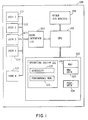
- FIG. 1 shows a high level block diagram of the computer system according to the preferred embodiment of the present invention.
- Computer system 100 comprises central processing unit or units (CPU) 101 connected to storage 102, to user interface I/O 103 and to other I/O devices 104.
- User interface I/O 103 allows multiple developers and users to communicate with other parts of computer system 100, normally through a plurality of programmable workstations 111-115.
- Other I/O devices 104 may include communications lines to local area networks or telecommunications networks.
- storage 102 is shown in high level FIG.
- storage typically comprises multiple levels, having at least a primary random access semiconductor memory (RAM) and a secondary memory such as magnetic disk drive or optical storage, and may also include high-speed caches, registers, etc.
- RAM random access semiconductor memory
- secondary memory such as magnetic disk drive or optical storage
- Operating system 121 resident in storage 102, performs functions typical of a computer operating system as are known in the art. Additionally, operating system 121 contains job scheduler 122 and performance monitor 123. Job scheduler 122 determines the order in which user jobs are serviced by CPU 101. Performance monitor 123 gathers statistics relevant to the performance of computer system 100, and in particular gathers statistics showing the average time required for computer system 100 to service jobs of different classes. Statistics gathered by performance monitor 123 are stored in performance data files 126 in storage 102. Neural network utility 124 and associated data files 125 are also resident in storage 102; these are used to construct, train and execute neural networks for establishing the delay cost functions.
- computer system 100 is an IBM Application System/400 midrange computer, although any computer system could be used.
- CPU 101 is a single or uniprocessor, however, multiple CPUs could be used.
- job scheduler and neural network delay cost functions run on the CPU. However, the neural network functions could be performed on a specialized coprocessor.
- FIG. 2 shows in greater detail the structure of job scheduler 122.
- Each job queue 201-205 has an associated delay cost priority function 206-209. Each delay cost priority function 201-205 takes a single input (time-in-system) and produces a single output (delay cost or priority).
- User performance objectives 211 contain the desired performance objectives for each job class.
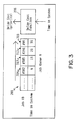
- FIG. 3 shows the structure of a typical job queue 201, and the associated delay cost function 206.
- the job queue holds the set of current jobs 311-315 of a particular job class waiting for access to the CPU, along with information on the amount of time that each job has been in the system.
- the jobs in the queue are ordered according to time in the system, with the oldest job 311 at the head of the queue.
- the delay cost value (priority) is computed for each job queue by taking the time-in-system of the job 311 at the head of the queue and passing it through the delay cost function. Because job 311 is the oldest, and the delay cost function is a single variable monotonically increasing function of time-in-system, job 311 will have a higher delay cost than any other job in queue 201.
- the output of the delay cost function for job 311 is therefore the delay cost value for the associated job class.
- delay cost functions 206-209 are piece-wise linear approximations to the substantially optimum delay cost functions produced by a neural network as described below.
- the coefficients of these linear approximations are stored in a delay cost function table.
- the time-in-system of a job is used to index an entry in the table containing the appropriate coefficients, from which the linear approximation for the relevant function segment is computed.
- These linear approximations are used in place of the actual neural network to reduce the computational overhead involved in determining delay cost. Depending on the hardware architecture, this computational overhead could be so significant as to destroy any performance benefits that would otherwise accrue from using the present invention. However, it would be possible to use the actual neural network to determine delay cost, particularly where a separate slave processor or coprocessor is available to perform the required calculations.
- Neural network utility 124 is a program for execution on CPU 101 which simulates a neural network.
- Neural network data structures 125 define the type of network to be simulated, the topology of the nodes, the adaptive weights to be assigned to the data paths, and other parameters.
- utility 124 is the IBM Neural Network Utility and data structures 125 are those data structures defined and used by the IBM Neural Network Utility. The operation of the IBM Neural Network Utility and its associated data structures is described in U.S. Patent 5,142,665 to Bigus, issued August 25, 1992, in U.S. Patent 5,235,673 to Austvold et al., issued August 10, 1993, and in commonly assigned U.S. Patent application serial number 07/986,889, filed December 3, 1992, entitled “Apparatus and Method for Facilitating Use of a Neural Network", all of which are incorporated herein by reference.
- the IBM Neural Network Utility used in the preferred embodiment supports simulation of several different types of neural networks on a single processor.
- a data structure representing the type and topology of the network is stored. For example, the number of inputs, number of outputs, data types of input and output, number of hidden nodes, connections between nodes, etc., are defined in the data structure.
- a data conversion template may define a data type conversion and scaling function for data entering and leaving the network. This data structure is shown in FIG. 1 as element 125.
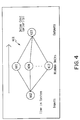
- FIG. 4 is a conceptual diagram of a typical neural network 401 used to construct a delay cost function in accordance with the preferred embodiment.
- a separate neural network 401 is used for each separate delay cost function (one for each job class).
- a neural network comprises a set of processing elements and adaptive weighted connections.
- Neural network 401 is a feedforward neural network with a single input value and a single output value.
- the network comprises a single input node 402, ten hidden nodes 403-412, and a single output node 413.
- FIG. 4 represents the neural network of the preferred embodiment in a conceptual sense only. In physical reality, this network is simulated by neural network utility 124 executing on CPU 101 in accordance with parameters stored in data structures 125. However, the network could be constructed as physical hardware processors and data links, or using a custom a custom neural network processing chip.
- the neural network operates in 2 distinct phases, training and execution.
- the input(s) and the desired output values are presented to the neural network.
- the input(s) are multiplied by the connection weights to the first layer of hidden units, and summed by each hidden unit.
- Each hidden unit then passes the sum through a nonlinear activation function. This process is repeated for any additional hidden layers, until the output of the neural network is computed at the final or output layer.
- the difference between the desired and actual output values is used by a learning algorithm to adjust the connection weights.
- the backward error propagation algorithm (Rumelhart, Williams, and Zipser, 1986) is used to adjust the values of the connection weights.
- the goal in the training phase is to adjust the weights in the neural network so that it produces the desired delay cost function.
- the neural network weights are not adjusted. Only the forward pass is performed (as described in the preceding paragraph), resulting in the computation of the delay cost value on the output unit.
- execution of the neural network is used as an intermediate phase to obtain values at a plurality of different time-in-system inputs for use in constructing the linear approximation delay cost function.
- a plurality of pre-determined time-in-system values is input to the neural network, the corresponding delay costs are received as output, and the slopes and intercepts of a piece-wise linear approximation are constructed from these values.
- FIG. 5 is a flowchart showing the steps required for operation of the delay cost job scheduler according to the preferred embodiment.
- the job scheduler has the multiple queue structure shown in FIG. 2. However, any job scheduler which uses a priority function to determine scheduling order can be used.
- a resource which in the preferred embodiment is CPU 101
- the delay cost job scheduler is called in block 500.
- the job scheduler computes the delay cost or priority of the job at the head of each job class. Only the job at the head of the queue needs to be examined because jobs are queued in order based on their length of time in the system. The oldest job (longest time-in-system) is at the head of each job queue.
- the delay cost is computed by first fetching an entry in the delay cost function table corresponding to the time-in-system of the job at block 502.
- This table entry contains the slope and intercept of a linear approximation to the optimum delay cost curve (previously computed by the neural network) in the neighborhood of the input parameter (time-in-system).
- the slope and intercept from the table and the time-in-system of the job are used to obtain the delay cost value by solving the linear equation.
- job scheduler 122 selects the job with the largest delay cost value.
- job scheduler 122 dequeues the job and places it in on the free CPU.
- This job then executes until it yields the CPU due to an I/O wait, to a preemption by a higher priority job, or when it completes. In the preferred embodiment there is no preemption of jobs once they are placed on CPU 101. When CPU 101 becomes free, control goes back to block 500.
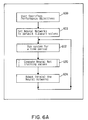
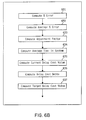
- FIG. 6A and FIG. 6B are flowcharts showing the steps required to construct a delay cost function according to the preferred embodiment.
- the user specifies the desired performance values for each job class, e.g. by interactively inputting these values from one of workstations 111-115.
- this value is the average response time for jobs of a class, although other performance objectives, such as throughput, may be specified.
- the neural networks used to construct delay cost functions are initialized to their default values. In the preferred embodiment, this is a linear function with a domain of 0 to 100 seconds, and a range of 0.0 to 1.0.
- Block 602 represents the normal running of the computer system for some period of time to gather performance feedback.
- the delay cost scheduler makes the job scheduling decisions using the current neural network delay cost functions as described in FIG. 5.
- performance monitor 123 gathers performance statistics showing how close actual system performance is to the performance objectives.
- monitor 123 obtains data concerning the average time required to complete jobs in the various classes. This data is stored in performance data files 126.
- neural network utilty 124 is used to compute the target values for training the neural networks for each job class in the system. This process is described in greater detail below and depicted in FIG. 6B.
- the average percentage error (%ErrorAvg) is computed by summing the %Error values for each job class and dividing by the number of job classes.
- Utility 124 then computes the adjustment factor used to adapt the neural networks, at block 633.
- the adjustment factor is the difference between the %Error term for each job class and %ErrorAvg. Using this method, the adjustment factors always sum to 0. For example if one job class's %Error is greater than the %ErrorAvg, it results in a positive change to its delay cost curve (yielding higher relative priority).
- the utility computes the average dispatch time (tavg) for each job class by summing the time-in-system for each delay cost function invocation and dividing by the number of delay cost function invocations.
- Utility 124 calls the neural network delay cost function for each job class, passing the average time-in-system as an input and getting the current delay cost value as the output, at block 635.
- utility 124 computes the delay cost delta for each job class by taking the job class adjustment factor and multiplying by the current delay cost.
- the new target delay cost value is computed by taking the current delay cost value and adding the delay cost delta.
- a single training update is made to each delay cost neural network after each period of operation.
- the training data pair (tavg,target) is presented to the neural network and the neural network connection weights are adjusted using the learning algorithm. This process repeats a variable number of times by returning to Block 602, normal running of the system.
- training may be deferred to a time when computer system 100 is not busy. After some number of training iterations, the coefficients of the delay cost function will converge to some optimum value, and thereafter very little change will be observed. At that point, the system operator may wish to discontinue training, or may continue training at less frequent intervals to adjust to subtle changes in system workload and/or configuration occurring over time.
- Neural Network Utility/400 User's Guide (IBM Publication No. SC41-8202) and in Neural Network Utility/400: Programmer's Reference (IBM Publication No. SC41-0032), herein incorporated by reference.
- Additional background information concerning the operation of performance monitor 123 and the interpretation of performance data 126 can be found in Programming: Performance Tools Guide (IBM Publication No. SC21-8084) and Programming: Work Management Guide (IBM Publication No. SC21-8078), herein incorporated by reference. All of these publications are available from IBM Corporation.
- FIG. 7 through FIG. 10 show examples of the results obtained by adjusting of the delay cost curves using neural networks as described herein.
- job classes are defined for the example system. They include terminal and batch closed classes, and transaction and distributed open classes.
- jobs arrive at the CPU for service they are queued based on the length of time in the system. This is calculated as the current time minus the job arrival time.
- the delay-cost scheduler examines the first job on the queue (longest in the system) for each job class.
- Each job class has an associated delay-cost curve or function which takes as input a single parameter, the time-in-system, and produces a single output, the delay-cost. The job with the largest delay-cost value is selected to run on the CPU.
- the delay-cost functions are implemented using feedforward neural networks with a 1-10-1 architecture ( 1 input, 10 hidden units, and 1 output).
- a sigmoid activation function was used, resulting in delay-cost values ranging from 0.0 to 1.0.
- the 4 delay-cost neural networks were initialized with a training set mapping input values ranging from 0 to 8 (in 0.1 increments) to output values of 0.1 to 0.9. This mapping was designed to keep the delay-cost neural networks out of their saturation region.
- Target response times were specified for each of the 4 job classes.
- the goal is to have the neural networks adapt the delay cost curves (and the low-level scheduling of jobs) in order to meet the target response times.
- Each system was run for 10 days of the standard daily workload, which consists of a 12 hour workday and 24 separate workloads.
- the neural networks were updated after each 60 second period.
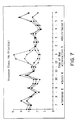
- FIG. 7 shows the response times for the system with the standard workload and a fixed system configuration used.
- the delay cost curves were in their initialized (linear) states.
- the average daily response times for the 4 job classes are 2.4, 2.7, 2.3, and 2.7 respectively. These are the response times achieved for a strictly first come first served queueing discipline at the CPU.
- Each example has different desired response times.
- the systems were run for 10 days of the standard 12 hour workload. A tolerance of 0.25 seconds was used (if the actual response time was within 0.25 seconds of the target, then the error was set to 0 for that job class).
- FIG. 8 is a table showing three examples of desired performance goals specified by the user, and actual performance achieved after training a neural network as described herein. In all three cases, the job class with the lowest desired response time has the lowest actual response time. Also, the actual response times for the Batch jobs were lower than desired (this will be discussed in more detail later). In example 1, the desired response times for the transactions and distributed jobs was set to 1.5, and the actual times were less than 0.02 seconds apart.
- Examples 2 and 3 are identical, except that the desired response times for transaction and distributed jobs are inverted.
- the transaction response times are very close to the desired, as are the distributed response times in example 3.
- the neural network delay-cost functions which were learned produced very good average response times (relative to the desired response times).
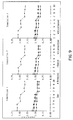
- FIG. 9 shows the average daily response times for the job classes during ten work days used to train the network. Performance data was gathered each day, and the network was retrained with the new performance data at the end of the day. In all three cases, the average response times decrease and then stabilize after approximately seven days. They then remain stable once they are near their desired settings. This make sense, since once the average response times are within 0.25 seconds of the desired times, the errors will go to 0, and no weight changes will be made.
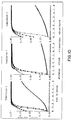
- FIG. 10 shows the resulting delay cost curves for each example.
- the input values range from 0 to 8 and the resulting response of the delay-cost neural networks are shown. In all cases, the curves are monotonic increasing and nonlinear.
- the delay-cost curves are priority functions (which is what they are), then the functions learned by the neural networks match our intuition. For example, in each simulation, the job class with the lowest desired response times has the highest initial delay cost (priority) values (terminals in simulation 1, transactions in 2, and distributed in 3). Also, in all three cases, the batch jobs always have the lowest priority (and the response times were still below the desired). It is also interesting to note that the delay cost functions overlap in several places. This means that depending on the time in the system, the neural networks learned to assign a higher(lower) priority to some job classes. In essence, the neural networks learned to develop a dynamic priority assignment scheme based on the length of time that a job is in the system in order to meet the declared response time goals.
- the job scheduler is used to schedule jobs for service on a CPU of a computer system.
- a job scheduler according to the present invention could be used for many other types of resources in many other environments.
- the job scheduler could be used to schedule other resources within the computer system, such as access to secondary storage devices, communications links to servers and other computer systems, etc.
- the job scheduler of the present invention could be used to schedule a non-computer resource. For example, it might be used to schedule critical stations of an assembly line within a factory, the "jobs" in this case being work required on assemblies in progress.
- job should therefore be understood to broadly encompass any form of work to be performed.
- job has been used here because that is the terminology commonly used in the context of computer operating systems. However, in other environments, it may be referred to as a "task”, “procedure”, “assembly”, “work order”, etc.
- job when used in this specification and claims, encompasses all of these.
- the delay cost function takes a single input parameter (time-in-system).
- the delay cost function could be a function of multiple variables.
- the use multiple delay cost functions, one for each job class is equivalent to a single delay cost function having two parameters, time and job class.
- These functions could have been constructed using a single neural network having two inputs. Additional parameters might be relevant to a delay cost function. For example, relative job priorities (hence delay cost function value) could vary with time of day or system configuration.
- the input parameter time-in-system may take on different forms.
- a delay cost function must produce a delay cost as a function of some delay time parameter, where delay time is related to the time a job has been waiting and therefore increases as a job waits in the queue.
- a job may require different resources within a system, each of which may have its own queue. A job may therefore move from one queue to another as it receives service from the different resources.
- Delay time may be measured as the total elapsed time since a user submitted a job, or as the total elapsed time since a job entered the system, or as the total time spent waiting on all queues, or as the time spent waiting on the queue which the job currently occupies.
- the "time-in-system" of the preferred embodiment which is the total time elapsed since a job entered the system, is but one possible measure of a delay time parameter.
- an artificial neural network simulated on a single general purpose processor is used to generate the delay cost functions.
- the neural network could alternatively be a real neural network comprising a plurality of hardware nodes, or could be executed on a dedicated special purpose neural network processor. It should further be understood that the network may assume a topology, training strategy, or other characteristics different from those shown in FIG. 4 and described above.
- an optimum or substantially optimum delay cost function is automatically determined by repetitively training a neural network with data obtained from actual performance results.
- the present invention encompasses a job scheduler utilizing a substantially optimum delay cost function which is automatically constructed by a computer system. While a neural network appears to be the most practical method of automatically constructing such a function at the present time, it would not necessarily be the only method of doing so. As computer technology improves, other mechanisms for constructing such a delay cost function may become feasible. For example, it may be possible to construct such a delay cost function using rule-based expert systems or spline functions.
Landscapes
- Engineering & Computer Science (AREA)
- Software Systems (AREA)
- Theoretical Computer Science (AREA)
- Physics & Mathematics (AREA)
- General Engineering & Computer Science (AREA)
- General Physics & Mathematics (AREA)
- Management, Administration, Business Operations System, And Electronic Commerce (AREA)
Applications Claiming Priority (2)
| Application Number | Priority Date | Filing Date | Title |
|---|---|---|---|
| US134764 | 1993-10-08 | ||
| US08/134,764 US5442730A (en) | 1993-10-08 | 1993-10-08 | Adaptive job scheduling using neural network priority functions |
Publications (1)
| Publication Number | Publication Date |
|---|---|
| EP0647903A1 true EP0647903A1 (fr) | 1995-04-12 |
Family
ID=22464883
Family Applications (1)
| Application Number | Title | Priority Date | Filing Date |
|---|---|---|---|
| EP94480082A Withdrawn EP0647903A1 (fr) | 1993-10-08 | 1994-09-06 | Planification adaptive de travail à l'aide des fonctions de priorité sur des réseaux neuronaux |
Country Status (3)
| Country | Link |
|---|---|
| US (1) | US5442730A (fr) |
| EP (1) | EP0647903A1 (fr) |
| JP (1) | JP3248657B2 (fr) |
Cited By (30)
| Publication number | Priority date | Publication date | Assignee | Title |
|---|---|---|---|---|
| GB2300284A (en) * | 1995-04-24 | 1996-10-30 | Fujitsu Ltd | Priority management in a data processing system |
| WO1998032085A1 (fr) * | 1997-01-21 | 1998-07-23 | Northern Telecom Limited | Capacite de traitement generique |
| WO1998032086A1 (fr) * | 1997-01-21 | 1998-07-23 | Northern Telecom Limited | Controle et nouvel apprentissage d'un reseau neuronal |
| EP0880095A3 (fr) * | 1997-05-22 | 1999-08-04 | International Business Machines Corporation | Planificateur de resources |
| WO2002039696A3 (fr) * | 2000-11-03 | 2003-04-24 | Univ Nebraska | Planification des demandes visant a assurer la qualite de service |
| EP0992903A3 (fr) * | 1998-10-08 | 2004-09-01 | Alcatel | Méthode pour l'implémentation de traitement multitâche coopératif dans un réseau de transmission de messages et élément de réseau associé |
| WO2004084066A1 (fr) * | 2003-03-19 | 2004-09-30 | Siemens Aktiengesellschaft | Dispositif et procede de commande d'un ou plusieurs systemes partiels d'un systeme technique global |
| WO2004102388A1 (fr) * | 2003-05-09 | 2004-11-25 | Sap Aktiengesellschaft | Gestion de taches dans un environnement de traitement de donnees |
| EP1715421A1 (fr) * | 2005-04-21 | 2006-10-25 | International Business Machines Corporation | Procédé et système de programmation d'une charge de travail avec schéma de mise à jour de la durée de tâche planifiée amélioré |
| US7386465B1 (en) | 1999-05-07 | 2008-06-10 | Medco Health Solutions, Inc. | Computer implemented resource allocation model and process to dynamically and optimally schedule an arbitrary number of resources subject to an arbitrary number of constraints in the managed care, health care and/or pharmacy industry |
| WO2008092412A1 (fr) * | 2007-01-31 | 2008-08-07 | Siemens Aktiengesellschaft | Régulation du comportement de processus en cours d'exploitation |
| CN100576176C (zh) * | 2005-04-21 | 2009-12-30 | 国际商业机器公司 | 调度工作单元执行的方法和系统 |
| FR2935818A1 (fr) * | 2008-09-05 | 2010-03-12 | Thales Sa | Systeme d'ordonnancement de taches pour controler l'execution de procedures d'alerte sur un aeronef |
| US7958509B2 (en) | 2005-12-21 | 2011-06-07 | International Business Machines Corporation | Method and system for scheduling of jobs |
| US8700232B2 (en) | 2009-12-30 | 2014-04-15 | Thales | Method and device for centralized management of tasks to be carried out by a crew of an aircraft during flight |
| US10331481B2 (en) | 2017-03-08 | 2019-06-25 | International Business Machines Corporation | Automatic reconfiguration of high performance computing job schedulers based on user behavior, user feedback, and job performance monitoring |
| US10846623B2 (en) | 2014-10-15 | 2020-11-24 | Brighterion, Inc. | Data clean-up method for improving predictive model training |
| US10896421B2 (en) | 2014-04-02 | 2021-01-19 | Brighterion, Inc. | Smart retail analytics and commercial messaging |
| US10929777B2 (en) | 2014-08-08 | 2021-02-23 | Brighterion, Inc. | Method of automating data science services |
| US10977655B2 (en) | 2014-10-15 | 2021-04-13 | Brighterion, Inc. | Method for improving operating profits with better automated decision making with artificial intelligence |
| US10984423B2 (en) | 2014-10-15 | 2021-04-20 | Brighterion, Inc. | Method of operating artificial intelligence machines to improve predictive model training and performance |
| US10997599B2 (en) | 2014-10-28 | 2021-05-04 | Brighterion, Inc. | Method for detecting merchant data breaches with a computer network server |
| US11023894B2 (en) | 2014-08-08 | 2021-06-01 | Brighterion, Inc. | Fast access vectors in real-time behavioral profiling in fraudulent financial transactions |
| US11030527B2 (en) | 2015-07-31 | 2021-06-08 | Brighterion, Inc. | Method for calling for preemptive maintenance and for equipment failure prevention |
| US11062317B2 (en) | 2014-10-28 | 2021-07-13 | Brighterion, Inc. | Data breach detection |
| US11080709B2 (en) | 2014-10-15 | 2021-08-03 | Brighterion, Inc. | Method of reducing financial losses in multiple payment channels upon a recognition of fraud first appearing in any one payment channel |
| US11080793B2 (en) | 2014-10-15 | 2021-08-03 | Brighterion, Inc. | Method of personalizing, individualizing, and automating the management of healthcare fraud-waste-abuse to unique individual healthcare providers |
| US11348110B2 (en) | 2014-08-08 | 2022-05-31 | Brighterion, Inc. | Artificial intelligence fraud management solution |
| US11496480B2 (en) | 2018-05-01 | 2022-11-08 | Brighterion, Inc. | Securing internet-of-things with smart-agent technology |
| US11948048B2 (en) | 2014-04-02 | 2024-04-02 | Brighterion, Inc. | Artificial intelligence for context classifier |
Families Citing this family (87)
| Publication number | Priority date | Publication date | Assignee | Title |
|---|---|---|---|---|
| US5963911A (en) * | 1994-03-25 | 1999-10-05 | British Telecommunications Public Limited Company | Resource allocation |
| US5537542A (en) * | 1994-04-04 | 1996-07-16 | International Business Machines Corporation | Apparatus and method for managing a server workload according to client performance goals in a client/server data processing system |
| GB9414951D0 (en) * | 1994-07-25 | 1994-09-14 | British Telecomm | Computer system having client-server architecture |
| US5696689A (en) * | 1994-11-25 | 1997-12-09 | Nippondenso Co., Ltd. | Dispatch and conveyer control system for a production control system of a semiconductor substrate |
| US5926745A (en) | 1995-11-30 | 1999-07-20 | Amsc Subsidiary Corporation | Network operations center for mobile earth terminal satellite communications system |
| US5890134A (en) * | 1996-02-16 | 1999-03-30 | Mcdonnell Douglas Corporation | Scheduling optimizer |
| GB9606194D0 (en) * | 1996-03-23 | 1996-05-29 | Int Computers Ltd | Appointment booking and scheduling system |
| JP3175620B2 (ja) * | 1996-06-21 | 2001-06-11 | セイコーエプソン株式会社 | 印刷装置 |
| US6049774A (en) * | 1996-07-08 | 2000-04-11 | At&T Corp. | Machine, method and medium for dynamic optimization for resource allocation |
| US6714960B1 (en) * | 1996-11-20 | 2004-03-30 | Silicon Graphics, Inc. | Earnings-based time-share scheduling |
| US5893905A (en) * | 1996-12-24 | 1999-04-13 | Mci Communications Corporation | Automated SLA performance analysis monitor with impact alerts on downstream jobs |
| US6341301B1 (en) | 1997-01-10 | 2002-01-22 | Lsi Logic Corporation | Exclusive multiple queue handling using a common processing algorithm |
| US5966547A (en) * | 1997-01-10 | 1999-10-12 | Lsi Logic Corporation | System for fast posting to shared queues in multi-processor environments utilizing interrupt state checking |
| US5922057A (en) * | 1997-01-10 | 1999-07-13 | Lsi Logic Corporation | Method for multiprocessor system of controlling a dynamically expandable shared queue in which ownership of a queue entry by a processor is indicated by a semaphore |
| US6604124B1 (en) * | 1997-03-13 | 2003-08-05 | A:\Scribes Corporation | Systems and methods for automatically managing work flow based on tracking job step completion status |
| US6988076B2 (en) * | 1997-05-21 | 2006-01-17 | Khimetrics, Inc. | Strategic planning and optimization system |
| JP2002513489A (ja) * | 1997-05-21 | 2002-05-08 | カイメトリクス・インコーポレーテッド | 企業企画モデルの被制御最適化の方法 |
| US5907490A (en) * | 1997-06-10 | 1999-05-25 | Electronic Data Systems Corporation | System and method for project management and assessment |
| JP3537356B2 (ja) * | 1998-12-09 | 2004-06-14 | 株式会社日立製作所 | ジョブシステムにおける遅延要因解析方法 |
| US6490298B1 (en) | 1999-02-26 | 2002-12-03 | Harmonic Inc. | Apparatus and methods of multiplexing data to a communication channel |
| JP3382176B2 (ja) * | 1999-03-26 | 2003-03-04 | 株式会社東芝 | 要求処理方法および要求処理装置 |
| US6853921B2 (en) | 1999-07-20 | 2005-02-08 | Halliburton Energy Services, Inc. | System and method for real time reservoir management |
| US7418506B1 (en) * | 1999-11-12 | 2008-08-26 | International Business Machines Corporation | Apparatus for connection management and the method therefor |
| US7426551B1 (en) * | 2000-05-31 | 2008-09-16 | Mcafee, Inc. | System, method and computer program product for dynamic system adaptation using contracts |
| US6591262B1 (en) * | 2000-08-01 | 2003-07-08 | International Business Machines Corporation | Collaborative workload management incorporating work unit attributes in resource allocation |
| US20020077877A1 (en) * | 2000-12-20 | 2002-06-20 | Electronic Data Systems Corporation | System and method for project management and assessment |
| US20020082889A1 (en) * | 2000-12-20 | 2002-06-27 | Electronic Data Systems Corporation | System and method for project management and assessment |
| US7096209B2 (en) * | 2001-05-10 | 2006-08-22 | Hewlett-Packard Development Company, L.P. | Generalized segmentation method for estimation/optimization problem |
| US7509671B1 (en) * | 2001-06-20 | 2009-03-24 | Microstrategy Incorporated | Systems and methods for assigning priority to jobs in a reporting system |
| CA2455494A1 (fr) * | 2001-09-13 | 2003-03-20 | British Telecommunications Public Limited Company | Procede et appareil de gestion de ressources |
| US7584165B2 (en) * | 2003-01-30 | 2009-09-01 | Landmark Graphics Corporation | Support apparatus, method and system for real time operations and maintenance |
| KR100556858B1 (ko) * | 2003-06-20 | 2006-03-10 | 엘지전자 주식회사 | 이동 통신 단말기의 자동 제어 방법 |
| JP3861868B2 (ja) * | 2003-09-22 | 2006-12-27 | ブラザー工業株式会社 | ジョブ管理装置、ジョブ管理プログラム、およびそれらを備えた画像形成装置 |
| US7500241B1 (en) * | 2003-10-10 | 2009-03-03 | Avaya Inc. | Method and apparatus for scheduling tasks |
| US20050086657A1 (en) * | 2003-10-21 | 2005-04-21 | Intel Corporation | Service scheduling |
| US20070269297A1 (en) | 2003-11-10 | 2007-11-22 | Meulen Peter V D | Semiconductor wafer handling and transport |
| US10086511B2 (en) | 2003-11-10 | 2018-10-02 | Brooks Automation, Inc. | Semiconductor manufacturing systems |
| US20070282480A1 (en) * | 2003-11-10 | 2007-12-06 | Pannese Patrick D | Methods and systems for controlling a semiconductor fabrication process |
| US8639365B2 (en) * | 2003-11-10 | 2014-01-28 | Brooks Automation, Inc. | Methods and systems for controlling a semiconductor fabrication process |
| US8639489B2 (en) * | 2003-11-10 | 2014-01-28 | Brooks Automation, Inc. | Methods and systems for controlling a semiconductor fabrication process |
| US7403560B2 (en) * | 2004-02-09 | 2008-07-22 | Lecroy Corporation | Simultaneous physical and protocol layer analysis |
| US7607132B2 (en) * | 2004-04-08 | 2009-10-20 | Taiwan Semiconductor Manufacturing Co., Ltd. | Process scheduling system and method |
| CA2481060A1 (fr) * | 2004-09-07 | 2006-03-07 | Alphaglobal It Inc. | Outil de planification dynamique permettant de gerer des rendez- vous administratifs |
| US20100037234A1 (en) * | 2005-01-13 | 2010-02-11 | Koninklijke Philips Electronics, N.V. | Data processing system and method of task scheduling |
| US7401012B1 (en) * | 2005-04-20 | 2008-07-15 | Sun Microsystems, Inc. | Method and apparatus for characterizing computer system workloads |
| US8301751B2 (en) * | 2005-06-30 | 2012-10-30 | International Business Machines Corporation | Generation of a master schedule for a resource from a plurality of user created schedules for the resource |
| BRPI0706580A2 (pt) * | 2006-01-20 | 2011-03-29 | Landmark Graphics Corp | gerenciamento dinámico de sistema de produção |
| US8027857B2 (en) * | 2006-03-14 | 2011-09-27 | Sap Ag | Rough-cut manufacturing operations for use in planning |
| US20070219929A1 (en) * | 2006-03-14 | 2007-09-20 | Jochen Steinbach | Planning granularity in manufacturing computing systems |
| US8112755B2 (en) * | 2006-06-30 | 2012-02-07 | Microsoft Corporation | Reducing latencies in computing systems using probabilistic and/or decision-theoretic reasoning under scarce memory resources |
| GB0616646D0 (en) * | 2006-08-22 | 2006-10-04 | Infrared Integrated Syst Ltd | Queuing system |
| US7894922B2 (en) * | 2006-12-21 | 2011-02-22 | Sap Ag | Structural transformation of execution-level manufacturing process routings into planning-level routings |
| US7617015B2 (en) * | 2006-12-21 | 2009-11-10 | Sap Ag | Generating planning-level time and capacity requirement formulas for manufacturing processes |
| US7551975B2 (en) * | 2006-12-21 | 2009-06-23 | Sap Ag | Consistency checking and repair of manufacturing operation groupings to be aggregated for use in planning |
| US8286170B2 (en) * | 2007-01-31 | 2012-10-09 | International Business Machines Corporation | System and method for processor thread allocation using delay-costs |
| US8950998B2 (en) * | 2007-02-27 | 2015-02-10 | Brooks Automation, Inc. | Batch substrate handling |
| US20090070762A1 (en) * | 2007-09-06 | 2009-03-12 | Franaszek Peter A | System and method for event-driven scheduling of computing jobs on a multi-threaded machine using delay-costs |
| EP2208137A1 (fr) * | 2007-10-31 | 2010-07-21 | International Business Machines Corporation | Procédé, système et programme d'ordinateur pour distribuer une pluralité de tâches à une pluralité d'ordinateurs |
| JP4448163B2 (ja) | 2007-11-21 | 2010-04-07 | レノボ・シンガポール・プライベート・リミテッド | コンピュータ・システムおよびプロセスに対するデバイスの管理方法 |
| US20090133027A1 (en) * | 2007-11-21 | 2009-05-21 | Gunning Mark B | Systems and Methods for Project Management Task Prioritization |
| US8566835B2 (en) * | 2007-12-13 | 2013-10-22 | Hewlett-Packard Development Company, L.P. | Dynamically resizing a virtual machine container |
| US20100010859A1 (en) * | 2008-07-08 | 2010-01-14 | International Business Machines Corporation | Method and system for allocating dependent tasks to teams through multi-variate optimization |
| US8195309B2 (en) | 2009-07-21 | 2012-06-05 | Honeywell International Inc. | System for scheduling using an external calendaring service |
| US8260648B2 (en) * | 2009-09-09 | 2012-09-04 | King Fahd University Of Petroleum And Minerals | Process scheduling optimization method |
| US8676721B2 (en) * | 2009-09-18 | 2014-03-18 | Apo Offshore, Inc. | Method, system and apparatus for intelligent management of oil and gas platform surface equipment |
| US8340942B2 (en) | 2010-04-26 | 2012-12-25 | International Business Machines Corporation | Identifying opportunities to improve multiprocess system performance |
| US20120290347A1 (en) * | 2010-08-10 | 2012-11-15 | King Fahd University Of Petroleum And Minerals | Progress monitoring method |
| CN103203958B (zh) * | 2012-01-16 | 2017-06-13 | 昆山允升吉光电科技有限公司 | 一种电铸模板的制作工艺 |
| US9477239B2 (en) | 2012-07-26 | 2016-10-25 | Honeywell International Inc. | HVAC controller with wireless network based occupancy detection and control |
| US9594384B2 (en) | 2012-07-26 | 2017-03-14 | Honeywell International Inc. | Method of associating an HVAC controller with an external web service |
| US9657957B2 (en) | 2012-07-26 | 2017-05-23 | Honeywell International Inc. | HVAC controller having a network-based scheduling feature |
| EP2894564A1 (fr) | 2014-01-10 | 2015-07-15 | Fujitsu Limited | Planification de tâches basée sur les données historiques d'une tâche |
| US10162683B2 (en) | 2014-06-05 | 2018-12-25 | International Business Machines Corporation | Weighted stealing of resources |
| US10878318B2 (en) * | 2016-03-28 | 2020-12-29 | Google Llc | Adaptive artificial neural network selection techniques |
| US10579751B2 (en) * | 2016-10-14 | 2020-03-03 | International Business Machines Corporation | System and method for conducting computing experiments |
| US10796273B2 (en) | 2016-11-18 | 2020-10-06 | Livible, Inc. | Platform for management and organization of personal property |
| US20180374021A1 (en) * | 2017-06-26 | 2018-12-27 | Livible, Inc. | Transfer routing and appointment offering based on scheduled or dynamic routes |
| US10261837B2 (en) | 2017-06-30 | 2019-04-16 | Sas Institute Inc. | Two-part job scheduling with capacity constraints and preferences |
| CN109992404B (zh) * | 2017-12-31 | 2022-06-10 | 中国移动通信集团湖北有限公司 | 集群计算资源调度方法、装置、设备及介质 |
| US10310896B1 (en) | 2018-03-15 | 2019-06-04 | Sas Institute Inc. | Techniques for job flow processing |
| US10747596B2 (en) | 2018-07-31 | 2020-08-18 | International Business Machines Corporation | Determining when to send message to a computing node to process items using a machine learning module |
| US10628241B2 (en) | 2018-07-31 | 2020-04-21 | International Business Machines Corporation | Determining when to send message to computing node to process items by training a machine learning module |
| US10824815B2 (en) * | 2019-01-02 | 2020-11-03 | Netapp, Inc. | Document classification using attention networks |
| US11443285B2 (en) | 2020-01-16 | 2022-09-13 | International Business Machines Corporation | Artificial intelligence enabled scheduler and planner |
| US20230141624A1 (en) * | 2020-04-14 | 2023-05-11 | Synchrony Bank | Dynamic time-dependent asynchronous analysis |
| CN113419830B (zh) * | 2021-06-23 | 2023-02-03 | 鹤壁国立光电科技股份有限公司 | 一种基于神经网络的多维度调度方法及系统 |
| CN114579281B (zh) * | 2022-03-10 | 2025-05-30 | 广东石油化工学院 | 一种基于探索利用分离的联合神经网络的云作业调度方法及系统 |
Family Cites Families (14)
| Publication number | Priority date | Publication date | Assignee | Title |
|---|---|---|---|---|
| JPS58151644A (ja) * | 1982-03-04 | 1983-09-08 | Matsushita Electric Ind Co Ltd | デイジタル演算装置 |
| JPS58217057A (ja) * | 1982-06-11 | 1983-12-16 | Fujitsu Ltd | 計算機システムの性能評価方法 |
| GB8801628D0 (en) * | 1988-01-26 | 1988-02-24 | British Telecomm | Evaluation system |
| US5067107A (en) * | 1988-08-05 | 1991-11-19 | Hewlett-Packard Company | Continuous computer performance measurement tool that reduces operating system produced performance data for logging into global, process, and workload files |
| US5109475A (en) * | 1988-09-19 | 1992-04-28 | Hitachi, Ltd. | Method and a system for selection of time series data |
| US5067099A (en) * | 1988-11-03 | 1991-11-19 | Allied-Signal Inc. | Methods and apparatus for monitoring system performance |
| JPH02216532A (ja) * | 1989-02-17 | 1990-08-29 | Hitachi Ltd | コンピュータの性能調整方式 |
| US5113500A (en) * | 1989-08-23 | 1992-05-12 | Unisys Corporation | Multiple cooperating and concurrently operating processors using individually dedicated memories |
| US5142665A (en) * | 1990-02-20 | 1992-08-25 | International Business Machines Corporation | Neural network shell for application programs |
| US5144642A (en) * | 1990-06-07 | 1992-09-01 | Stanford Telecommunications, Inc | Interference detection and characterization method and apparatus |
| JPH0476660A (ja) * | 1990-07-13 | 1992-03-11 | Nippon Telegr & Teleph Corp <Ntt> | ニューラルネットの学習方式 |
| JPH04112338A (ja) * | 1990-09-03 | 1992-04-14 | Matsushita Electric Ind Co Ltd | 計算機性能評価装置およびこの装置に用いる制御装置 |
| JPH04319784A (ja) * | 1991-04-19 | 1992-11-10 | Hitachi Ltd | 組合わせ最適解を求める方法及び装置 |
| US5164969A (en) * | 1991-07-12 | 1992-11-17 | Hewlett-Packard Company | Programmable max/min counter for performance analysis of computer systems |
-
1993
- 1993-10-08 US US08/134,764 patent/US5442730A/en not_active Expired - Fee Related
-
1994
- 1994-09-06 EP EP94480082A patent/EP0647903A1/fr not_active Withdrawn
- 1994-09-12 JP JP21709094A patent/JP3248657B2/ja not_active Expired - Fee Related
Non-Patent Citations (4)
| Title |
|---|
| C.DAGLI ET AL.: "A Neural Network Architecture for Faster Dynamic Scheduling in Manufacturing Systems", PROCEEDINGS OF THE 1991 IEEE INTERNATIONAL CONFERENCE ON ROBOTICS AND AUTOMATATION, April 1991 (1991-04-01), SACRAMENTO, CA, pages 2408 - 2413, XP000220933 * |
| M.H.ROTHKOPF ET AL.: "There are no Undicovered Priority Index Sequencing Rules for Minimizing Total Delay Costs", OPERATIONS RESEARCH, vol. 32, no. 2, March 1984 (1984-03-01), US, pages 451 - 456 * |
| R.THAWONMAS ET AL.: "A Real-Time Scheduler Using Neural Networks for Scheduling Independent and Nonpreemptable Tasks with Deadlines and Resources Requirements", IEICE TRANSACTIONS ON INFORMATION AND SYSTEMS, vol. E76-D, no. 8, August 1993 (1993-08-01), TOKYO JP, pages 947 - 955, XP000397309 * |
| ZHEN-PING LO ET B.BAVARIAN: "Multiple Job Scheduling with Artificial Neural Networks", COMPUTERS ELECTRICAL ENGINEERING, vol. 19, no. 2, March 1993 (1993-03-01), SACRAMENTO, CA, US, pages 87 - 101 * |
Cited By (37)
| Publication number | Priority date | Publication date | Assignee | Title |
|---|---|---|---|---|
| US5933810A (en) * | 1995-04-24 | 1999-08-03 | Fujitsu Limited | Reservation management apparatus and method for making arrangements according to degrees of importance of reservations |
| GB2300284A (en) * | 1995-04-24 | 1996-10-30 | Fujitsu Ltd | Priority management in a data processing system |
| WO1998032085A1 (fr) * | 1997-01-21 | 1998-07-23 | Northern Telecom Limited | Capacite de traitement generique |
| WO1998032086A1 (fr) * | 1997-01-21 | 1998-07-23 | Northern Telecom Limited | Controle et nouvel apprentissage d'un reseau neuronal |
| EP0880095A3 (fr) * | 1997-05-22 | 1999-08-04 | International Business Machines Corporation | Planificateur de resources |
| US6263359B1 (en) | 1997-05-22 | 2001-07-17 | International Business Machines Corporation | Computer resource proportional utilization and response time scheduling |
| EP0992903A3 (fr) * | 1998-10-08 | 2004-09-01 | Alcatel | Méthode pour l'implémentation de traitement multitâche coopératif dans un réseau de transmission de messages et élément de réseau associé |
| US7386465B1 (en) | 1999-05-07 | 2008-06-10 | Medco Health Solutions, Inc. | Computer implemented resource allocation model and process to dynamically and optimally schedule an arbitrary number of resources subject to an arbitrary number of constraints in the managed care, health care and/or pharmacy industry |
| WO2002039696A3 (fr) * | 2000-11-03 | 2003-04-24 | Univ Nebraska | Planification des demandes visant a assurer la qualite de service |
| WO2004084066A1 (fr) * | 2003-03-19 | 2004-09-30 | Siemens Aktiengesellschaft | Dispositif et procede de commande d'un ou plusieurs systemes partiels d'un systeme technique global |
| WO2004102388A1 (fr) * | 2003-05-09 | 2004-11-25 | Sap Aktiengesellschaft | Gestion de taches dans un environnement de traitement de donnees |
| US7945909B2 (en) | 2003-05-09 | 2011-05-17 | Sap Aktiengesellschaft | Initiating recovery of an executing task using historical information and task information |
| EP1715421A1 (fr) * | 2005-04-21 | 2006-10-25 | International Business Machines Corporation | Procédé et système de programmation d'une charge de travail avec schéma de mise à jour de la durée de tâche planifiée amélioré |
| CN100576176C (zh) * | 2005-04-21 | 2009-12-30 | 国际商业机器公司 | 调度工作单元执行的方法和系统 |
| US7958509B2 (en) | 2005-12-21 | 2011-06-07 | International Business Machines Corporation | Method and system for scheduling of jobs |
| US8667492B2 (en) | 2007-01-31 | 2014-03-04 | Siemens Aktiengesellschaft | Control of the runtime behavior of processes |
| WO2008092412A1 (fr) * | 2007-01-31 | 2008-08-07 | Siemens Aktiengesellschaft | Régulation du comportement de processus en cours d'exploitation |
| US8659447B2 (en) | 2008-09-05 | 2014-02-25 | Thales | System for scheduling tasks to control the execution of warning procedures on an aircraft |
| FR2935818A1 (fr) * | 2008-09-05 | 2010-03-12 | Thales Sa | Systeme d'ordonnancement de taches pour controler l'execution de procedures d'alerte sur un aeronef |
| US8700232B2 (en) | 2009-12-30 | 2014-04-15 | Thales | Method and device for centralized management of tasks to be carried out by a crew of an aircraft during flight |
| US11948048B2 (en) | 2014-04-02 | 2024-04-02 | Brighterion, Inc. | Artificial intelligence for context classifier |
| US10896421B2 (en) | 2014-04-02 | 2021-01-19 | Brighterion, Inc. | Smart retail analytics and commercial messaging |
| US11023894B2 (en) | 2014-08-08 | 2021-06-01 | Brighterion, Inc. | Fast access vectors in real-time behavioral profiling in fraudulent financial transactions |
| US11348110B2 (en) | 2014-08-08 | 2022-05-31 | Brighterion, Inc. | Artificial intelligence fraud management solution |
| US10929777B2 (en) | 2014-08-08 | 2021-02-23 | Brighterion, Inc. | Method of automating data science services |
| US11080709B2 (en) | 2014-10-15 | 2021-08-03 | Brighterion, Inc. | Method of reducing financial losses in multiple payment channels upon a recognition of fraud first appearing in any one payment channel |
| US10984423B2 (en) | 2014-10-15 | 2021-04-20 | Brighterion, Inc. | Method of operating artificial intelligence machines to improve predictive model training and performance |
| US10977655B2 (en) | 2014-10-15 | 2021-04-13 | Brighterion, Inc. | Method for improving operating profits with better automated decision making with artificial intelligence |
| US10846623B2 (en) | 2014-10-15 | 2020-11-24 | Brighterion, Inc. | Data clean-up method for improving predictive model training |
| US11080793B2 (en) | 2014-10-15 | 2021-08-03 | Brighterion, Inc. | Method of personalizing, individualizing, and automating the management of healthcare fraud-waste-abuse to unique individual healthcare providers |
| US10997599B2 (en) | 2014-10-28 | 2021-05-04 | Brighterion, Inc. | Method for detecting merchant data breaches with a computer network server |
| US11062317B2 (en) | 2014-10-28 | 2021-07-13 | Brighterion, Inc. | Data breach detection |
| US11030527B2 (en) | 2015-07-31 | 2021-06-08 | Brighterion, Inc. | Method for calling for preemptive maintenance and for equipment failure prevention |
| US11093280B2 (en) | 2017-03-08 | 2021-08-17 | International Business Machines Corporation | Automatic reconfiguration of high performance computing job schedulers based on user behavior, user feedback, and job performance monitoring |
| US10331482B2 (en) | 2017-03-08 | 2019-06-25 | International Business Machines Corporation | Automatic reconfiguration of high performance computing job schedulers based on user behavior, user feedback, and job performance monitoring |
| US10331481B2 (en) | 2017-03-08 | 2019-06-25 | International Business Machines Corporation | Automatic reconfiguration of high performance computing job schedulers based on user behavior, user feedback, and job performance monitoring |
| US11496480B2 (en) | 2018-05-01 | 2022-11-08 | Brighterion, Inc. | Securing internet-of-things with smart-agent technology |
Also Published As
| Publication number | Publication date |
|---|---|
| JP3248657B2 (ja) | 2002-01-21 |
| US5442730A (en) | 1995-08-15 |
| JPH07175669A (ja) | 1995-07-14 |
Similar Documents
| Publication | Publication Date | Title |
|---|---|---|
| US5442730A (en) | Adaptive job scheduling using neural network priority functions | |
| US5704012A (en) | Adaptive resource allocation using neural networks | |
| Stankovic et al. | The case for feedback control real-time scheduling | |
| Alarifi et al. | Energy-efficient hybrid framework for green cloud computing | |
| Quattrocchi et al. | Autoscaling solutions for cloud applications under dynamic workloads | |
| US8352951B2 (en) | Method and apparatus for utility-based dynamic resource allocation in a distributed computing system | |
| US6009452A (en) | Apparatus and methods for optimally using available computer resources for task execution during idle-time based on probabilistic assessment of future task instances | |
| US20060218551A1 (en) | Jobstream planner considering network contention & resource availability | |
| Hemasian-Etefagh et al. | Dynamic scheduling applying new population grouping of whales meta-heuristic in cloud computing: F. Hemasian-Etefagh, F. Safi-Esfahani | |
| Pan et al. | A deep reinforcement learning-based scheduling framework for real-time workflows in the cloud environment | |
| Chakrabarti et al. | Randomized load balancing for tree-structured computation | |
| Braun et al. | Static mapping heuristics for tasks with dependencies, priorities, deadlines, and multiple versions in heterogeneous environments | |
| Rizvi et al. | Intelligent salp swarm scheduler with fitness based quasi-reflection method for scientific workflows in hybrid cloud-fog environment | |
| Deceuninck et al. | An efficient control variate method for appointment scheduling with patient unpunctuality | |
| Karatza | A comparative analysis of scheduling policies in a distributed system using simulation | |
| Badr et al. | Multi-objective improved particle swarm optimization for efficient offloading algorithm in Fog-Cloud collaboration | |
| Lim et al. | Intelligent OS process scheduling using fuzzy inference with user models | |
| Kusic et al. | Approximation modeling for the online performance management of distributed computing systems | |
| Khan et al. | Enhancing cloud resource management through predictive neural networks and reinforcement learning | |
| Mehra et al. | Adaptive load-balancing strategies for distributed systems | |
| Yang et al. | Research on service composition based on DQN in multiple clouds | |
| Abulkhair et al. | Automated negotiation using parallel particle swarm optimization for cloud computing applications | |
| Emek | Optimization of Agent-Based Queuing System Model: A Case Study Through Inventory Systems | |
| Matani et al. | A novel critical-path based scheduling algorithm for stochastic workflow in distributed computing systems | |
| Peng et al. | Research Article Genetic Algorithm-Based Task Scheduling in Cloud Computing Using MapReduce Framework |
Legal Events
| Date | Code | Title | Description |
|---|---|---|---|
| PUAI | Public reference made under article 153(3) epc to a published international application that has entered the european phase |
Free format text: ORIGINAL CODE: 0009012 |
|
| AK | Designated contracting states |
Kind code of ref document: A1 Designated state(s): DE FR GB |
|
| 17P | Request for examination filed |
Effective date: 19950810 |
|
| STAA | Information on the status of an ep patent application or granted ep patent |
Free format text: STATUS: THE APPLICATION HAS BEEN WITHDRAWN |
|
| 18W | Application withdrawn |
Withdrawal date: 19971118 |