EP0648053A2 - Teletextsignalempfänger mit Rastersynchronisation Codewort-Lagedetektor - Google Patents
Teletextsignalempfänger mit Rastersynchronisation Codewort-Lagedetektor Download PDFInfo
- Publication number
- EP0648053A2 EP0648053A2 EP94115935A EP94115935A EP0648053A2 EP 0648053 A2 EP0648053 A2 EP 0648053A2 EP 94115935 A EP94115935 A EP 94115935A EP 94115935 A EP94115935 A EP 94115935A EP 0648053 A2 EP0648053 A2 EP 0648053A2
- Authority
- EP
- European Patent Office
- Prior art keywords
- signals receiver
- teletext
- framing code
- teletext signals
- window
- Prior art date
- Legal status (The legal status is an assumption and is not a legal conclusion. Google has not performed a legal analysis and makes no representation as to the accuracy of the status listed.)
- Withdrawn
Links
- 238000009432 framing Methods 0.000 title claims abstract description 27
- 230000002123 temporal effect Effects 0.000 claims description 3
- 230000005540 biological transmission Effects 0.000 description 4
- 238000010586 diagram Methods 0.000 description 2
- 230000032258 transport Effects 0.000 description 1
Images


Classifications
-
- H—ELECTRICITY
- H04—ELECTRIC COMMUNICATION TECHNIQUE
- H04N—PICTORIAL COMMUNICATION, e.g. TELEVISION
- H04N7/00—Television systems
- H04N7/025—Systems for the transmission of digital non-picture data, e.g. of text during the active part of a television frame
- H04N7/035—Circuits for the digital non-picture data signal, e.g. for slicing of the data signal, for regeneration of the data-clock signal, for error detection or correction of the data signal
Definitions
- the present invention refers to a teletext signals receiver, in particular incorporated within a television signals receiver.
- teletext signals i.e. the transmission of data in a digital form , inserted in a television signal.
- the teletext transmission is realised in packets of 42 "byte" each, inserted in some of the television lines during the frame return; for simplicity for herein on such lines shall be indicated with the term "teletext lines".
- Every teletext line transports the information of 42 "byte”; this information is preceded by 3 byte, more precisely constituted by 2 "run-in” byte and by 1 "framing code” byte.
- the "run-in” constitutes the information for the correct synchronisation of the "clock" of the receiver; the "framing code” constitutes the key for understanding whether a line is transporting teletext information or not; it is therefore extremely important that this is detected without errors.
- the aim of the present invention is that of indicating how it is possible to reduce such error probability and as a result improve the correct reception characteristics of the signals.
- the present invention has as its subject a teletext signals receiver, in particular incorporated within a television signals receiver, characterised in that it provides a detecting circuit of the position of the "Framing code".
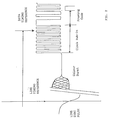
- Figure 1 represents in a schematic manner a line of the television signal within which the teletext signal is inserted; as is seen in such figure, the teletext signal is transmitted in the useful space (SU) of the line, after the line synchronism signal (S) and the colour synchronism signal (B, the so-called "burst").
- SU useful space
- S line synchronism signal
- B colour synchronism signal
- FIG 2 an enlarged view of the beginning of the teletext signal is represented; in which the "run-in” signal and the successive "framing code” signal are visible.
- FIG 3 the block diagram of the relevant part of the circuit of the teletext signals receiver according to the invention is represented.
- the block indicated with reference number 1 represents an interface of a personal computer, not represented in the figure, such interface has an 8 bit bus and permits the exchange of the information and the programming of the position of the window on the "framing code".
- the block indicated with reference number 2 represents an 8 bit memory register, containing the initial/final values of the "framing code" window; such values are written in the register of the personal computer, after having read the value of block 3 and calculated, by way of appropriate routine software, the new values of block 2.
- the block indicated with reference number 3 represents a 4 bit memory register which contains the instant of time, generated by block 4, in which the decoding event of the "framing code" by block 7 is verified; more precisely the instant is identified by block 7 in which the final bit of the "Framing code” is read and such instant is stored in the register 3; more precisely that which is stored is the number of microseconds passed from the initial front of the line synchronism signal and the instant in which the final bit of the framing code is read.
- the block indicated with reference number 4 represents a generator of time base locked to the line frequency (64 microseconds); 4 bit are utilised, to be sent to block 5, that determines the maximum size of the window, equal to 8 microseconds (16x2 MHz).
- the block indicated with reference number 5 represents a comparator that compares the initial/final window values and the time base; two start/stop impulses are in this way generated that are sent to block 6.
- the block indicated with reference number 6 represents a set/reset register that generates the window impulse placed exactly on the "framing code” (or, more precisely, on the final bit of the "framing code”); such impulse normally has the dimension of only 1,5 microseconds.
- the block indicated with reference number 7 represents a register of decoding teletext data and of acknowledgement the "framing code" sequence; it generates an impulse for block 3; the temporal value is memorised within the line duration to then recalculate the values to supply to block 2.
- the window position is determined by steps of 500 nanoseconds each, obtaining in this way a considerable positioning precision; as mentioned the maximum dimensions of the window is of 8 microseconds (16 steps).
- the "framing code" position detecting circuit is preferably activated a certain number of times (for example 3 or 5) from the moment of the beginning of the teletext reception; it is then switched off by the personal computer, to be then be reactivated the moment in which a different broadcaster is selected.
- the decoding of the "framing code” is carried out in optimal conditions, independently from the aforementioned position tolerances.
- the described circuit has been realised by means of a ASIC (Application Specific Integrated Circuit) component and can easily be inserted in a board to be inserted in a personal computer.
- ASIC Application Specific Integrated Circuit
- the teletext signals receiver allows for determining with considerable precision the position of the "framing code” and to open a window of a dimension equal to the "framing code” signal itself; in such way a considerable reduction of the probability of errors in the actual decoding is obtained.
- the circuit according to the invention can be realised in union with a television signals receiver, such as a television set or video recorder, and controlled by a microprocessor contained within.
Landscapes
- Engineering & Computer Science (AREA)
- Multimedia (AREA)
- Signal Processing (AREA)
- Television Systems (AREA)
- Circuits Of Receivers In General (AREA)
Applications Claiming Priority (2)
| Application Number | Priority Date | Filing Date | Title |
|---|---|---|---|
| ITTO930739 | 1993-10-12 | ||
| ITTO930739A IT1261606B (it) | 1993-10-12 | 1993-10-12 | Ricevitore di segnali teletext con rilevatore di posizione del segnaledi framing code. |
Publications (2)
| Publication Number | Publication Date |
|---|---|
| EP0648053A2 true EP0648053A2 (de) | 1995-04-12 |
| EP0648053A3 EP0648053A3 (de) | 1995-04-19 |
Family
ID=11411780
Family Applications (1)
| Application Number | Title | Priority Date | Filing Date |
|---|---|---|---|
| EP94115935A Withdrawn EP0648053A3 (de) | 1993-10-12 | 1994-10-10 | Teletextsignalempfänger mit Rastersynchronisation Codewort-Lagedetektor |
Country Status (2)
| Country | Link |
|---|---|
| EP (1) | EP0648053A3 (de) |
| IT (1) | IT1261606B (de) |
Family Cites Families (5)
| Publication number | Priority date | Publication date | Assignee | Title |
|---|---|---|---|---|
| JPS6068787A (ja) * | 1983-09-26 | 1985-04-19 | Hitachi Ltd | フレ−ミングコ−ド検出回路 |
| FR2608873B1 (fr) * | 1986-12-23 | 1989-03-24 | Radiotechnique Compelec | Dispositif de reception de donnees numeriques comportant un circuit de reconnaissance de debut de paquet |
| GB2233192A (en) * | 1989-06-16 | 1991-01-02 | Philips Electronic Associated | Teletext decoders |
| FR2652472B1 (fr) * | 1989-09-22 | 1992-01-03 | Sgs Thomson Microelectronics | Procede de synchronisation du recepteur d'un signal de television de type mac. |
| US5003390A (en) * | 1990-03-26 | 1991-03-26 | Pbse Enterprises, Inc. | Search and lock technique for reliable acquisition of data transmitted via television signals |
-
1993
- 1993-10-12 IT ITTO930739A patent/IT1261606B/it active IP Right Grant
-
1994
- 1994-10-10 EP EP94115935A patent/EP0648053A3/de not_active Withdrawn
Also Published As
| Publication number | Publication date |
|---|---|
| EP0648053A3 (de) | 1995-04-19 |
| ITTO930739A1 (it) | 1995-04-12 |
| IT1261606B (it) | 1996-05-23 |
| ITTO930739A0 (it) | 1993-10-12 |
Similar Documents
| Publication | Publication Date | Title |
|---|---|---|
| US4338628A (en) | Scrambled video communication system | |
| JP3289106B2 (ja) | 補助ビデオ・データ・デコーダ装置 | |
| US5486865A (en) | Data decoder adapted to decode data of different rates and/or encoded formats | |
| US4620227A (en) | Data decoder | |
| US4745476A (en) | Television sound signal processing apparatus | |
| US4841365A (en) | Arrangement for receiving numerical data, comprising a circuit for recognizing the start of packets | |
| CA2224786C (en) | Method and device for transmitting additional data in television channels | |
| EP0056649B1 (de) | Empfänger für digitale Signale | |
| US5163164A (en) | Microprocessor controlled digital aft unit | |
| JP3283092B2 (ja) | データデコーダ | |
| US5453795A (en) | Horizontal line counter insensitive to large phase shifts of video | |
| US5045941A (en) | Framing code windows repositioning apparatus and method for teletext decoder | |
| JP2684133B2 (ja) | 中間周波数信号の周波数測定装置 | |
| US5861925A (en) | Multiplexed text data sampling circuit | |
| EP0592518B1 (de) | Gegen grosse Videosignalphasenverschiebungen unempfindlicher Horizontalzeilenzähler | |
| EP0141459B1 (de) | Fernsehempfänger | |
| JP3586916B2 (ja) | データ復調装置 | |
| JPH09271000A (ja) | 文字放送用のデータ探索回路 | |
| JPH09145866A (ja) | 時刻設定装置及び電子機器 | |
| JPS639784B2 (de) | ||
| JPH0423877B2 (de) | ||
| JPH02132985A (ja) | 文字放送信号の伝送方式 | |
| JPS6243634B2 (de) | ||
| JPH0498983A (ja) | 文字多重受信装置 | |
| JPS63314085A (ja) | ファクシミリ放送受信装置 |
Legal Events
| Date | Code | Title | Description |
|---|---|---|---|
| PUAI | Public reference made under article 153(3) epc to a published international application that has entered the european phase |
Free format text: ORIGINAL CODE: 0009012 |
|
| PUAL | Search report despatched |
Free format text: ORIGINAL CODE: 0009013 |
|
| AK | Designated contracting states |
Kind code of ref document: A2 Designated state(s): DE ES FR GB IT NL PT |
|
| AK | Designated contracting states |
Kind code of ref document: A3 Designated state(s): DE ES FR GB IT NL PT |
|
| 17P | Request for examination filed |
Effective date: 19950725 |
|
| 17Q | First examination report despatched |
Effective date: 19970613 |
|
| STAA | Information on the status of an ep patent application or granted ep patent |
Free format text: STATUS: THE APPLICATION IS DEEMED TO BE WITHDRAWN |
|
| 18D | Application deemed to be withdrawn |
Effective date: 19980501 |