EP0648733B1 - Procédé pour la préparation des produits intermédiaires dans la synthèse de quinacridone - Google Patents
Procédé pour la préparation des produits intermédiaires dans la synthèse de quinacridone Download PDFInfo
- Publication number
- EP0648733B1 EP0648733B1 EP94115808A EP94115808A EP0648733B1 EP 0648733 B1 EP0648733 B1 EP 0648733B1 EP 94115808 A EP94115808 A EP 94115808A EP 94115808 A EP94115808 A EP 94115808A EP 0648733 B1 EP0648733 B1 EP 0648733B1
- Authority
- EP
- European Patent Office
- Prior art keywords
- formula
- reaction
- diluent
- unsubstituted
- alcohol
- Prior art date
- Legal status (The legal status is an assumption and is not a legal conclusion. Google has not performed a legal analysis and makes no representation as to the accuracy of the status listed.)
- Expired - Lifetime
Links
- 238000000034 method Methods 0.000 title claims abstract description 28
- 238000002360 preparation method Methods 0.000 title claims abstract description 6
- 238000003786 synthesis reaction Methods 0.000 title description 6
- 230000015572 biosynthetic process Effects 0.000 title description 5
- NRCMAYZCPIVABH-UHFFFAOYSA-N Quinacridone Chemical compound N1C2=CC=CC=C2C(=O)C2=C1C=C1C(=O)C3=CC=CC=C3NC1=C2 NRCMAYZCPIVABH-UHFFFAOYSA-N 0.000 title description 3
- 239000000543 intermediate Substances 0.000 title 1
- 238000006243 chemical reaction Methods 0.000 claims abstract description 52
- LFQSCWFLJHTTHZ-UHFFFAOYSA-N Ethanol Chemical compound CCO LFQSCWFLJHTTHZ-UHFFFAOYSA-N 0.000 claims abstract description 34
- WIWJFWANKMRGGS-UHFFFAOYSA-N 3,4-dimethyl-1,6-dioxecane-2,5,7,10-tetrone Chemical compound C1(CCC(=O)OC(C(C(C(=O)O1)C)C)=O)=O WIWJFWANKMRGGS-UHFFFAOYSA-N 0.000 claims abstract description 23
- 239000003085 diluting agent Substances 0.000 claims abstract description 22
- 125000004432 carbon atom Chemical group C* 0.000 claims abstract description 19
- KKEYFWRCBNTPAC-UHFFFAOYSA-N Terephthalic acid Chemical compound OC(=O)C1=CC=C(C(O)=O)C=C1 KKEYFWRCBNTPAC-UHFFFAOYSA-N 0.000 claims abstract description 12
- 230000002378 acidificating effect Effects 0.000 claims abstract description 12
- 239000003054 catalyst Substances 0.000 claims abstract description 8
- -1 aliphatic alcohols Chemical class 0.000 claims abstract description 6
- QVGXLLKOCUKJST-UHFFFAOYSA-N atomic oxygen Chemical compound [O] QVGXLLKOCUKJST-UHFFFAOYSA-N 0.000 claims abstract description 6
- 239000001301 oxygen Substances 0.000 claims abstract description 6
- 229910052760 oxygen Inorganic materials 0.000 claims abstract description 6
- 230000007717 exclusion Effects 0.000 claims abstract description 5
- 125000000956 methoxy group Chemical group [H]C([H])([H])O* 0.000 claims abstract description 4
- 238000005809 transesterification reaction Methods 0.000 claims abstract description 4
- 125000001820 oxy group Chemical group [*:1]O[*:2] 0.000 claims abstract description 3
- 239000011541 reaction mixture Substances 0.000 claims description 19
- 239000002253 acid Substances 0.000 claims description 15
- 125000001997 phenyl group Chemical group [H]C1=C([H])C([H])=C(*)C([H])=C1[H] 0.000 claims description 11
- 125000000217 alkyl group Chemical group 0.000 claims description 10
- 150000001875 compounds Chemical class 0.000 claims description 10
- 238000002955 isolation Methods 0.000 claims description 10
- 150000001298 alcohols Chemical class 0.000 claims description 9
- 239000007795 chemical reaction product Substances 0.000 claims description 8
- XLYOFNOQVPJJNP-UHFFFAOYSA-N water Substances O XLYOFNOQVPJJNP-UHFFFAOYSA-N 0.000 claims description 8
- ZJQZWNLKRBUEKX-UHFFFAOYSA-N 2,5-dianilinoterephthalic acid Chemical class OC(=O)C=1C=C(NC=2C=CC=CC=2)C(C(=O)O)=CC=1NC1=CC=CC=C1 ZJQZWNLKRBUEKX-UHFFFAOYSA-N 0.000 claims description 7
- 125000001931 aliphatic group Chemical group 0.000 claims description 7
- 150000001412 amines Chemical class 0.000 claims description 6
- 229910052500 inorganic mineral Inorganic materials 0.000 claims description 6
- 239000011707 mineral Substances 0.000 claims description 6
- 125000003545 alkoxy group Chemical group 0.000 claims description 5
- 125000003277 amino group Chemical group 0.000 claims description 4
- 125000000449 nitro group Chemical group [O-][N+](*)=O 0.000 claims description 4
- 229910052736 halogen Inorganic materials 0.000 claims description 3
- 229910052751 metal Inorganic materials 0.000 claims description 3
- 239000002184 metal Substances 0.000 claims description 3
- 125000002496 methyl group Chemical group [H]C([H])([H])* 0.000 claims description 3
- 125000003917 carbamoyl group Chemical class [H]N([H])C(*)=O 0.000 claims description 2
- 150000001768 cations Chemical class 0.000 claims description 2
- 125000004122 cyclic group Chemical group 0.000 claims description 2
- 238000010438 heat treatment Methods 0.000 claims description 2
- 125000001624 naphthyl group Chemical group 0.000 claims description 2
- 238000005580 one pot reaction Methods 0.000 claims description 2
- 125000000951 phenoxy group Chemical group [H]C1=C([H])C([H])=C(O*)C([H])=C1[H] 0.000 claims description 2
- 125000002023 trifluoromethyl group Chemical group FC(F)(F)* 0.000 claims description 2
- 125000005843 halogen group Chemical group 0.000 claims 2
- 239000000203 mixture Substances 0.000 description 13
- 239000000047 product Substances 0.000 description 9
- IJGRMHOSHXDMSA-UHFFFAOYSA-N Atomic nitrogen Chemical compound N#N IJGRMHOSHXDMSA-UHFFFAOYSA-N 0.000 description 8
- QAOWNCQODCNURD-UHFFFAOYSA-N Sulfuric acid Chemical compound OS(O)(=O)=O QAOWNCQODCNURD-UHFFFAOYSA-N 0.000 description 8
- MUXOBHXGJLMRAB-UHFFFAOYSA-N Dimethyl succinate Chemical compound COC(=O)CCC(=O)OC MUXOBHXGJLMRAB-UHFFFAOYSA-N 0.000 description 7
- 239000002904 solvent Substances 0.000 description 7
- 239000003701 inert diluent Substances 0.000 description 6
- LRHPLDYGYMQRHN-UHFFFAOYSA-N N-Butanol Chemical compound CCCCO LRHPLDYGYMQRHN-UHFFFAOYSA-N 0.000 description 5
- ZUOUZKKEUPVFJK-UHFFFAOYSA-N diphenyl Chemical compound C1=CC=CC=C1C1=CC=CC=C1 ZUOUZKKEUPVFJK-UHFFFAOYSA-N 0.000 description 4
- 229910052757 nitrogen Inorganic materials 0.000 description 4
- 230000003647 oxidation Effects 0.000 description 4
- 238000007254 oxidation reaction Methods 0.000 description 4
- 238000010992 reflux Methods 0.000 description 4
- QTBSBXVTEAMEQO-UHFFFAOYSA-N Acetic acid Chemical compound CC(O)=O QTBSBXVTEAMEQO-UHFFFAOYSA-N 0.000 description 3
- PAYRUJLWNCNPSJ-UHFFFAOYSA-N Aniline Chemical compound NC1=CC=CC=C1 PAYRUJLWNCNPSJ-UHFFFAOYSA-N 0.000 description 3
- WVDDGKGOMKODPV-UHFFFAOYSA-N Benzyl alcohol Chemical group OCC1=CC=CC=C1 WVDDGKGOMKODPV-UHFFFAOYSA-N 0.000 description 3
- OKKJLVBELUTLKV-UHFFFAOYSA-N Methanol Chemical compound OC OKKJLVBELUTLKV-UHFFFAOYSA-N 0.000 description 3
- KWYUFKZDYYNOTN-UHFFFAOYSA-M Potassium hydroxide Chemical compound [OH-].[K+] KWYUFKZDYYNOTN-UHFFFAOYSA-M 0.000 description 3
- 230000005494 condensation Effects 0.000 description 3
- 238000001816 cooling Methods 0.000 description 3
- 239000011261 inert gas Substances 0.000 description 3
- VLKZOEOYAKHREP-UHFFFAOYSA-N n-Hexane Chemical compound CCCCCC VLKZOEOYAKHREP-UHFFFAOYSA-N 0.000 description 3
- 239000003960 organic solvent Substances 0.000 description 3
- 231100000331 toxic Toxicity 0.000 description 3
- 230000002588 toxic effect Effects 0.000 description 3
- MHCVCKDNQYMGEX-UHFFFAOYSA-N 1,1'-biphenyl;phenoxybenzene Chemical compound C1=CC=CC=C1C1=CC=CC=C1.C=1C=CC=CC=1OC1=CC=CC=C1 MHCVCKDNQYMGEX-UHFFFAOYSA-N 0.000 description 2
- KBPLFHHGFOOTCA-UHFFFAOYSA-N 1-Octanol Chemical compound CCCCCCCCO KBPLFHHGFOOTCA-UHFFFAOYSA-N 0.000 description 2
- XKRFYHLGVUSROY-UHFFFAOYSA-N Argon Chemical compound [Ar] XKRFYHLGVUSROY-UHFFFAOYSA-N 0.000 description 2
- RGSFGYAAUTVSQA-UHFFFAOYSA-N Cyclopentane Chemical compound C1CCCC1 RGSFGYAAUTVSQA-UHFFFAOYSA-N 0.000 description 2
- DKMROQRQHGEIOW-UHFFFAOYSA-N Diethyl succinate Chemical compound CCOC(=O)CCC(=O)OCC DKMROQRQHGEIOW-UHFFFAOYSA-N 0.000 description 2
- VEXZGXHMUGYJMC-UHFFFAOYSA-N Hydrochloric acid Chemical compound Cl VEXZGXHMUGYJMC-UHFFFAOYSA-N 0.000 description 2
- KFZMGEQAYNKOFK-UHFFFAOYSA-N Isopropanol Chemical compound CC(C)O KFZMGEQAYNKOFK-UHFFFAOYSA-N 0.000 description 2
- OFBQJSOFQDEBGM-UHFFFAOYSA-N Pentane Chemical compound CCCCC OFBQJSOFQDEBGM-UHFFFAOYSA-N 0.000 description 2
- JUJWROOIHBZHMG-UHFFFAOYSA-N Pyridine Chemical compound C1=CC=NC=C1 JUJWROOIHBZHMG-UHFFFAOYSA-N 0.000 description 2
- WYURNTSHIVDZCO-UHFFFAOYSA-N Tetrahydrofuran Chemical compound C1CCOC1 WYURNTSHIVDZCO-UHFFFAOYSA-N 0.000 description 2
- 150000007513 acids Chemical class 0.000 description 2
- 239000008346 aqueous phase Substances 0.000 description 2
- 239000004305 biphenyl Substances 0.000 description 2
- 235000010290 biphenyl Nutrition 0.000 description 2
- 229910052799 carbon Inorganic materials 0.000 description 2
- 238000009833 condensation Methods 0.000 description 2
- KSKWGMNRWCYVAT-UHFFFAOYSA-N diethyl 2,5-dioxocyclohexane-1,4-dicarboxylate Chemical compound CCOC(=O)C1CC(=O)C(C(=O)OCC)CC1=O KSKWGMNRWCYVAT-UHFFFAOYSA-N 0.000 description 2
- USIUVYZYUHIAEV-UHFFFAOYSA-N diphenyl ether Chemical compound C=1C=CC=CC=1OC1=CC=CC=C1 USIUVYZYUHIAEV-UHFFFAOYSA-N 0.000 description 2
- LQZZUXJYWNFBMV-UHFFFAOYSA-N dodecan-1-ol Chemical compound CCCCCCCCCCCCO LQZZUXJYWNFBMV-UHFFFAOYSA-N 0.000 description 2
- 150000002367 halogens Chemical group 0.000 description 2
- ZSIAUFGUXNUGDI-UHFFFAOYSA-N hexan-1-ol Chemical compound CCCCCCO ZSIAUFGUXNUGDI-UHFFFAOYSA-N 0.000 description 2
- 238000004128 high performance liquid chromatography Methods 0.000 description 2
- ZXEKIIBDNHEJCQ-UHFFFAOYSA-N isobutanol Chemical compound CC(C)CO ZXEKIIBDNHEJCQ-UHFFFAOYSA-N 0.000 description 2
- 239000007788 liquid Substances 0.000 description 2
- RZXMPPFPUUCRFN-UHFFFAOYSA-N p-toluidine Chemical compound CC1=CC=C(N)C=C1 RZXMPPFPUUCRFN-UHFFFAOYSA-N 0.000 description 2
- 239000002244 precipitate Substances 0.000 description 2
- 238000007127 saponification reaction Methods 0.000 description 2
- 150000003504 terephthalic acids Chemical class 0.000 description 2
- JOXIMZWYDAKGHI-UHFFFAOYSA-N toluene-4-sulfonic acid Chemical compound CC1=CC=C(S(O)(=O)=O)C=C1 JOXIMZWYDAKGHI-UHFFFAOYSA-N 0.000 description 2
- PBBXJBOFMIHTSC-UHFFFAOYSA-N 1,6-dioxecane-2,5,7,10-tetrone Chemical class O=C1CCC(=O)OC(=O)CCC(=O)O1 PBBXJBOFMIHTSC-UHFFFAOYSA-N 0.000 description 1
- OERSSJHLKKAUHT-UHFFFAOYSA-N 2,3-dianilino-5,6-dimethylterephthalic acid Chemical compound C=1C=CC=CC=1NC1=C(C(O)=O)C(C)=C(C)C(C(O)=O)=C1NC1=CC=CC=C1 OERSSJHLKKAUHT-UHFFFAOYSA-N 0.000 description 1
- LCFKURIJYIJNRU-UHFFFAOYSA-N 2-methylhexan-1-ol Chemical compound CCCCC(C)CO LCFKURIJYIJNRU-UHFFFAOYSA-N 0.000 description 1
- BSKHPKMHTQYZBB-UHFFFAOYSA-N 2-methylpyridine Chemical class CC1=CC=CC=N1 BSKHPKMHTQYZBB-UHFFFAOYSA-N 0.000 description 1
- MMNWSHJJPDXKCH-UHFFFAOYSA-N 9,10-dioxoanthracene-2-sulfonic acid Chemical compound C1=CC=C2C(=O)C3=CC(S(=O)(=O)O)=CC=C3C(=O)C2=C1 MMNWSHJJPDXKCH-UHFFFAOYSA-N 0.000 description 1
- XDTMQSROBMDMFD-UHFFFAOYSA-N Cyclohexane Chemical compound C1CCCCC1 XDTMQSROBMDMFD-UHFFFAOYSA-N 0.000 description 1
- ZOKXTWBITQBERF-UHFFFAOYSA-N Molybdenum Chemical compound [Mo] ZOKXTWBITQBERF-UHFFFAOYSA-N 0.000 description 1
- AFBPFSWMIHJQDM-UHFFFAOYSA-N N-methyl-N-phenylamine Natural products CNC1=CC=CC=C1 AFBPFSWMIHJQDM-UHFFFAOYSA-N 0.000 description 1
- GRYLNZFGIOXLOG-UHFFFAOYSA-N Nitric acid Chemical compound O[N+]([O-])=O GRYLNZFGIOXLOG-UHFFFAOYSA-N 0.000 description 1
- CTQNGGLPUBDAKN-UHFFFAOYSA-N O-Xylene Chemical compound CC1=CC=CC=C1C CTQNGGLPUBDAKN-UHFFFAOYSA-N 0.000 description 1
- 239000003377 acid catalyst Substances 0.000 description 1
- 230000001476 alcoholic effect Effects 0.000 description 1
- 150000001338 aliphatic hydrocarbons Chemical class 0.000 description 1
- 150000008044 alkali metal hydroxides Chemical class 0.000 description 1
- BTFJIXJJCSYFAL-UHFFFAOYSA-N arachidyl alcohol Natural products CCCCCCCCCCCCCCCCCCCCO BTFJIXJJCSYFAL-UHFFFAOYSA-N 0.000 description 1
- 229910052786 argon Inorganic materials 0.000 description 1
- 125000003118 aryl group Chemical group 0.000 description 1
- 235000019445 benzyl alcohol Nutrition 0.000 description 1
- 230000003197 catalytic effect Effects 0.000 description 1
- 238000005119 centrifugation Methods 0.000 description 1
- 239000003153 chemical reaction reagent Substances 0.000 description 1
- 239000003795 chemical substances by application Substances 0.000 description 1
- 238000004587 chromatography analysis Methods 0.000 description 1
- 238000004140 cleaning Methods 0.000 description 1
- HPXRVTGHNJAIIH-UHFFFAOYSA-N cyclohexanol Chemical compound OC1CCCCC1 HPXRVTGHNJAIIH-UHFFFAOYSA-N 0.000 description 1
- FHADSMKORVFYOS-UHFFFAOYSA-N cyclooctanol Chemical compound OC1CCCCCCC1 FHADSMKORVFYOS-UHFFFAOYSA-N 0.000 description 1
- XCIXKGXIYUWCLL-UHFFFAOYSA-N cyclopentanol Chemical compound OC1CCCC1 XCIXKGXIYUWCLL-UHFFFAOYSA-N 0.000 description 1
- FVXKBIAYJSJUBJ-UHFFFAOYSA-N diethyl 2,5-dianilinobenzene-1,4-dicarboxylate Chemical compound CCOC(=O)C=1C=C(NC=2C=CC=CC=2)C(C(=O)OCC)=CC=1NC1=CC=CC=C1 FVXKBIAYJSJUBJ-UHFFFAOYSA-N 0.000 description 1
- ZJXBEXRSXKGGHS-UHFFFAOYSA-N diethyl 2,5-dianilinocyclohexa-1,4-diene-1,4-dicarboxylate Chemical compound C1C(C(=O)OCC)=C(NC=2C=CC=CC=2)CC(C(=O)OCC)=C1NC1=CC=CC=C1 ZJXBEXRSXKGGHS-UHFFFAOYSA-N 0.000 description 1
- 230000007613 environmental effect Effects 0.000 description 1
- 150000002148 esters Chemical class 0.000 description 1
- 150000002170 ethers Chemical class 0.000 description 1
- 238000001914 filtration Methods 0.000 description 1
- 239000007789 gas Substances 0.000 description 1
- 239000001307 helium Substances 0.000 description 1
- 229910052734 helium Inorganic materials 0.000 description 1
- SWQJXJOGLNCZEY-UHFFFAOYSA-N helium atom Chemical compound [He] SWQJXJOGLNCZEY-UHFFFAOYSA-N 0.000 description 1
- DMEGYFMYUHOHGS-UHFFFAOYSA-N heptamethylene Natural products C1CCCCCC1 DMEGYFMYUHOHGS-UHFFFAOYSA-N 0.000 description 1
- 230000002209 hydrophobic effect Effects 0.000 description 1
- 229960004592 isopropanol Drugs 0.000 description 1
- 238000004519 manufacturing process Methods 0.000 description 1
- 150000004702 methyl esters Chemical class 0.000 description 1
- 229910052750 molybdenum Inorganic materials 0.000 description 1
- 239000011733 molybdenum Substances 0.000 description 1
- 229910017604 nitric acid Inorganic materials 0.000 description 1
- 150000005181 nitrobenzenes Chemical class 0.000 description 1
- 239000012071 phase Substances 0.000 description 1
- 125000003884 phenylalkyl group Chemical group 0.000 description 1
- 239000000049 pigment Substances 0.000 description 1
- 238000001556 precipitation Methods 0.000 description 1
- 239000002243 precursor Substances 0.000 description 1
- BDERNNFJNOPAEC-UHFFFAOYSA-N propan-1-ol Chemical compound CCCO BDERNNFJNOPAEC-UHFFFAOYSA-N 0.000 description 1
- 238000010926 purge Methods 0.000 description 1
- UMJSCPRVCHMLSP-UHFFFAOYSA-N pyridine Natural products COC1=CC=CN=C1 UMJSCPRVCHMLSP-UHFFFAOYSA-N 0.000 description 1
- 150000003856 quaternary ammonium compounds Chemical class 0.000 description 1
- 230000035484 reaction time Effects 0.000 description 1
- 238000001953 recrystallisation Methods 0.000 description 1
- 239000007787 solid Substances 0.000 description 1
- 239000007858 starting material Substances 0.000 description 1
- 239000000126 substance Substances 0.000 description 1
- 150000003900 succinic acid esters Chemical class 0.000 description 1
- 150000003460 sulfonic acids Chemical class 0.000 description 1
- KKEYFWRCBNTPAC-UHFFFAOYSA-L terephthalate(2-) Chemical compound [O-]C(=O)C1=CC=C(C([O-])=O)C=C1 KKEYFWRCBNTPAC-UHFFFAOYSA-L 0.000 description 1
- 150000003503 terephthalic acid derivatives Chemical class 0.000 description 1
- YLQBMQCUIZJEEH-UHFFFAOYSA-N tetrahydrofuran Natural products C=1C=COC=1 YLQBMQCUIZJEEH-UHFFFAOYSA-N 0.000 description 1
- 238000004809 thin layer chromatography Methods 0.000 description 1
- 239000008096 xylene Substances 0.000 description 1
Classifications
-
- C—CHEMISTRY; METALLURGY
- C07—ORGANIC CHEMISTRY
- C07D—HETEROCYCLIC COMPOUNDS
- C07D471/00—Heterocyclic compounds containing nitrogen atoms as the only ring hetero atoms in the condensed system, at least one ring being a six-membered ring with one nitrogen atom, not provided for by groups C07D451/00 - C07D463/00
- C07D471/02—Heterocyclic compounds containing nitrogen atoms as the only ring hetero atoms in the condensed system, at least one ring being a six-membered ring with one nitrogen atom, not provided for by groups C07D451/00 - C07D463/00 in which the condensed system contains two hetero rings
- C07D471/04—Ortho-condensed systems
-
- C—CHEMISTRY; METALLURGY
- C07—ORGANIC CHEMISTRY
- C07C—ACYCLIC OR CARBOCYCLIC COMPOUNDS
- C07C227/00—Preparation of compounds containing amino and carboxyl groups bound to the same carbon skeleton
- C07C227/14—Preparation of compounds containing amino and carboxyl groups bound to the same carbon skeleton from compounds containing already amino and carboxyl groups or derivatives thereof
- C07C227/18—Preparation of compounds containing amino and carboxyl groups bound to the same carbon skeleton from compounds containing already amino and carboxyl groups or derivatives thereof by reactions involving amino or carboxyl groups, e.g. hydrolysis of esters or amides, by formation of halides, salts or esters
-
- C—CHEMISTRY; METALLURGY
- C07—ORGANIC CHEMISTRY
- C07C—ACYCLIC OR CARBOCYCLIC COMPOUNDS
- C07C229/00—Compounds containing amino and carboxyl groups bound to the same carbon skeleton
- C07C229/52—Compounds containing amino and carboxyl groups bound to the same carbon skeleton having amino and carboxyl groups bound to carbon atoms of six-membered aromatic rings of the same carbon skeleton
- C07C229/54—Compounds containing amino and carboxyl groups bound to the same carbon skeleton having amino and carboxyl groups bound to carbon atoms of six-membered aromatic rings of the same carbon skeleton with amino and carboxyl groups bound to carbon atoms of the same non-condensed six-membered aromatic ring
- C07C229/62—Compounds containing amino and carboxyl groups bound to the same carbon skeleton having amino and carboxyl groups bound to carbon atoms of six-membered aromatic rings of the same carbon skeleton with amino and carboxyl groups bound to carbon atoms of the same non-condensed six-membered aromatic ring with amino groups and at least two carboxyl groups bound to carbon atoms of the same six-membered aromatic ring
-
- C—CHEMISTRY; METALLURGY
- C07—ORGANIC CHEMISTRY
- C07C—ACYCLIC OR CARBOCYCLIC COMPOUNDS
- C07C67/00—Preparation of carboxylic acid esters
- C07C67/03—Preparation of carboxylic acid esters by reacting an ester group with a hydroxy group
-
- C—CHEMISTRY; METALLURGY
- C09—DYES; PAINTS; POLISHES; NATURAL RESINS; ADHESIVES; COMPOSITIONS NOT OTHERWISE PROVIDED FOR; APPLICATIONS OF MATERIALS NOT OTHERWISE PROVIDED FOR
- C09B—ORGANIC DYES OR CLOSELY-RELATED COMPOUNDS FOR PRODUCING DYES, e.g. PIGMENTS; MORDANTS; LAKES
- C09B48/00—Quinacridones
Definitions
- EP-A1-0 536 083 is therefore proposed to dimethyl succinate with the help of aliphatic To transesterify alcohols which have 2 to 6 carbon atoms and the transesterification products, which, due to the longer hydrophobic side chains, has a higher solubility in have organic solvents for the production of quinacridones according to use the reaction scheme described. According to the examples, however Under no circumstances reaction carried out in the presence of metal alcoholate complete, so that the reaction mixture always considerable amounts of unreacted Contains dimethyl succinate.
- dimethylsuccinylsuccinate can be transesterified with an alcohol which has at least 2 carbon atoms, with virtually no dimethylsuccinylsuccinate remaining unreacted. This was completely unexpected, because from Helvetica Chimica Acta, Vol. 62, Fasc. 5 (1979), pp. 1682 to 1687 it is known that, in contrast to diethylsuccinylsuccinate, dimethylsuccinylsuccinate cannot be transesterified due to the exceptional stability of the methyl ester linkages.
- the succinylsuccinates transesterified according to the invention and their secondary products according to the above reaction scheme have better solubility than dimethylsuccinyl succinate and its secondary products in environmentally friendly organic solvents, such as alcohols, and can therefore be used in an environmentally friendly process for the preparation of 2,5-dianilinoterephthalic acid in an alcoholic solvent.
- the yields are unexpectedly high.
- the 2,5-dianilinoterephthalic acids produced in this way in environmentally friendly solvents in accordance with the reaction scheme described are ring-closed as usual to form the quinacridones.
- the invention therefore relates to a process for the transesterification of dimethylsuccinylsuccinate, which is characterized in that dimethylsuccinylsuccinate with one or more unsubstituted or substituted by phenyl groups, aliphatic, straight-chain, branched or cyclic monoalcohols, each having 2 to 22 carbon atoms, in the presence of a acidic catalyst with or without the presence of a diluent which is inert under the reaction conditions under exclusion of oxygen and under pressure, at least one of the two methoxy groups being replaced by the oxy group corresponding to the alcohol used.
- Dimethylsuccinylsuccinate can by condensation of 2 moles of dimethylsuccinate, the one Easily available, large-scale product represents, as usual manufactured will.
- Alcohol is a straight chain, branched or cyclic aliphatic Monoalcohol containing 2 to 22, preferably 2 to 16, particularly preferably 3 to 8 carbon atoms has, for example ethanol, propanol, butanol, hexanol, octanol, dodecanol, Eicosanol or its isomers such as iso-propanol, iso-butanol, 2-methylhexanol, Cyclopentanol, cyclohexanol, cyclooctanol or a mixture of such alcohols understand, the alcohol being unsubstituted or by aryl groups, preferred Phenyl groups such as benzyl alcohol can be substituted. Is preferred an unsubstituted, aliphatic, straight-chain or branched alcohol with 3 to 8 C atoms used. Preferably only one alcohol is used and not several Alcohols.
- Mineral acids for example sulfuric acid, hydrochloric acid, Nitric acid, preferably sulfuric acid, strongly acidic cation exchanger or organic sulfonic acids, such as p-toluenesulfonic acid, preferably mineral acids.
- the reaction can take place directly in the desired alcohol, provided that this under the Reaction conditions is liquid, or it becomes one under the reaction conditions inert diluent added.
- inert diluent for example aliphatic hydrocarbons, such as pentane, hexane, cyclopentane, Cyclohexane, ethers such as tetrahydrofuran or mixtures of such diluents in Consideration.
- dimethylsuccinylsuccinate is used the desired alcohol, acid catalyst and, if desired, diluent mixed and heated under exclusion of oxygen under pressure.
- At least 2 moles of alcohol, but generally an excess of at least 5 moles of alcohol per mole of dimethylsuccinylsuccinate are used per mole of dimethylsuccinylsuccinate.
- the reaction can be carried out directly in the desired alcohol, in which case at least four times the molar amount of alcohol, based on dimethylsuccinylsuccinate, is used.
- the optimal amount of the diluent can be easily determined by simple preliminary tests with different amounts.
- the acidic catalyst is used in catalytic amounts, ie in amounts of about 0.1 to 10 mole percent based on dimethylsuccinylsuccinate.
- the reaction mixture is in a pressure-safe vessel with the exclusion of oxygen heated.
- an inert gas atmosphere for example with the help of nitrogen, Helium, argon, constructed as usual.
- the reaction temperatures are around 60 to 220 ° C, preferably from 80 to 210 ° C, particularly preferably from 90 to 160 ° C.
- the Reaction is carried out under the resulting pressure, with regulation using With the help of inert gas pressure is possible.
- the pressure is generally from about 1 to 20 bar, preferably 2 to 6 bar.
- At least one of the two Methoxy groups of dimethylsuccinylsuccinate through the corresponding alkoxy group of the alcohol used replaced with virtually no unreacted starting product remains.
- a mixture of dialkyl and Alkylmethylsuccinylsuccinat, wherein the alkyl part of the alkyl part of the reaction alcohol used corresponds.
- the proportion of dialkylsuccinylsuccinate in the product mixture the higher the reaction temperature and the longer the reaction time is scheduled. If an alcohol mixture is used, mixtures are created alcohols used corresponding succinylsuccinates.
- the course of the reaction is advantageously followed by chromatography.
- the reaction was stopped and the reaction mixture cooled.
- the reaction products fall generally crystalline. As usual, they are filtered, Centrifugation isolated. In special cases, cleaning, for example by Recrystallization can be connected.
- the process according to the invention provides methyl alkyl and dialkyl succinyl succinates in which the alkyl groups correspond to those of the alcohols used for the reaction.
- Such succinylsuccinates can be used in a wide variety of chemical syntheses.
- the products are primarily used for the environmentally friendly synthesis of 2,5-dianilinoterephthalic acids, which are a precursor in quinacridone synthesis, used. It does not matter in this synthesis that according to Processes according to the invention in general mixtures of methylalkyl and Dialkylsuccinylsuccinates arise because the esters on the later synthesis stage 4th of The above reaction schemes are saponified to acid, so that at least from the saponification stage uniform products are created.
- stage a is carried out according to the invention, the alcohol of the formula R 3 OH, in which R 3 has the abovementioned meaning, preferably being used simultaneously as a diluent.
- R 3 is preferably a straight-chain or branched alkyl group having 3 to 8 carbon atoms. Preferably only one alcohol is used and not several alcohols.
- Reaction stage b) is preferred according to US Pat. No.
- the reaction stages c) and d) preferably according to WO 92/09558, but preferably using a compound of the formula III or the formula V and without using a molybdenum catalyst, without isolating the terephthalic acid ester and in the alcohol of the formula II or in the inert diluent of stage a carried out in the alcohol of formula II as a diluent.
- reaction stage e) is preferably carried out by adding water and a mineral acid to the reaction mixture consisting of the terephthalate of the formula VII in the alcohol of the formula II or in the inert diluent of stage a., Preferably in the alcohol of the formula II, as diluent.
- dimethylsuccinylsuccinate is heated with an unsubstituted, aliphatic, straight-chain or branched alcohol which has 3-8 C atoms and with a mineral acid in a pressure-proof vessel in an inert gas atmosphere to temperatures of 90 to 160 ° C.
- the reactor is depressurized and the reaction mixture is reacted with an amine of the formula R 1 -NH 2 , in which R 1 is a phenyl group substituted by one or more alkyl groups, at least one of the alpha positions of the C atom to which the amino group is unsubstituted, heated to temperatures from 60 to 100 ° C, whereupon the reaction mixture is acidified and heated to temperatures from 60 to 90 ° C. Air is then blown into the reaction mixture until the reaction to the terephthalic acid ester of the formula VI is complete. An alkali metal hydroxide is then added to the reaction mixture until the reaction is alkaline and the mixture is heated to reflux.
- R 1 is a phenyl group substituted by one or more alkyl groups, at least one of the alpha positions of the C atom to which the amino group is unsubstituted
- a 0.5 l autoclave with stirrer and gas inlet tube was 46 g Dimethylsuccinylsuccinate (0.2 mol), 250 ml 1-butanol and 0.52 ml more concentrated Filled and sealed sulfuric acid.
- the reaction mixture was with for 15 minutes Flushed with nitrogen and heated to 140 ° C for 2 hours. After cooling, it occurred Precipitation from, the thin layer chromatography as a mixture Dibutyl succinyl succinate and methyl butyl succinyl succinate was identified. Only traces of dimethylsuccinylsuccinate were found.
- the reaction mixture was mixed with 26 g of p-toluidine, flushed with nitrogen and under no pressure another nitrogen purge heated to about 75 ° C for 1 hour.
Landscapes
- Chemical & Material Sciences (AREA)
- Organic Chemistry (AREA)
- Chemical Kinetics & Catalysis (AREA)
- Organic Low-Molecular-Weight Compounds And Preparation Thereof (AREA)
- Nitrogen Condensed Heterocyclic Rings (AREA)
- Low-Molecular Organic Synthesis Reactions Using Catalysts (AREA)
Claims (9)
- Procédé de transestérification de succinate de diméthylsuccinyle, caractérisé en ce qu'on fait réagir un succinate de diméthylsuccinyle avec un ou plusieurs monools aliphatiques, linéaires, ramifiés ou cycliques, contenant chacun de 2 à 22 atomes de carbone, non substitués ou substitués par des groupes phényle, en présence d'un catalyseur acide, en présence ou en l'absence d'un diluant inerte dans les conditions de réaction, à l'abri de l'oxygène et sous pression, au moins un des deux groupes méthoxy étant remplacé par le groupe oxy correspondant à l'alcool utilisé.
- Procédé selon la revendication 1, caractérisé en ce qu'on utilise, comme alcool, un monool aliphatique non substitué, linéaire ou ramifié, contenant de 2 à 16 atomes de carbone.
- Procédé selon la revendication 2, caractérisé en ce qu'on utilise, comme alcool, un monool aliphatique non substitué, linéaire ou ramifié, contenant de 3 à 8 atomes de carbone.
- Procédé selon l'une des revendications 1 à 3, caractérisé en ce que l'alcool sert en même temps de diluant.
- Procédé selon l'une des revendications 1 à 4, caractérisé en ce qu'on utilise, comme catalyseur acide, un acide minéral ou un échangeur de cations fortement acide.
- Procédé de préparation d'acides 2,5-dianilinotéréphtaliques répondant à la formuleoù R1 et R2 sont identiques ou différents et signifient chacun un groupe phényle ou naphtyle non substitué ou mono- ou polysubstitué par un halogène ou par un groupe nitro, alkyle, alcoxy, phényle, phénoxy ou trifluorométhyle ou substitué par des groupes carbamoyles eux-mêmes substitués par un groupe alkyle, au moins une des positions alpha de l'atome de carbone auquel le groupe amino est lié étant non substituée, caractérisé en ce que
 a) on chauffe du succinate de diméthylsuccinyle avec un ou plusieurs alcools répondant à la formuleoù R3 a la signification indiquée ci-dessus, et R4 a la signification de R3 et signifie, en plus, le groupe méthyle, R3 et R4 étant interchangeables dans la formule III, b) après isolement ou sans isolement, éventuellement avec addition d'un diluant inerte dans les conditions de réaction, on chauffe le produit de réaction obtenu dans l'étape a) avec une quantité molaire au moins double d'une ou plusieurs amines répondant à la formule
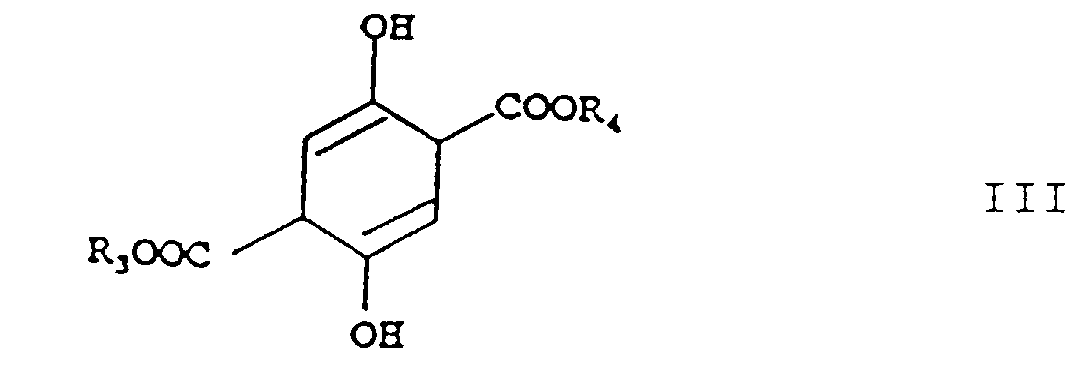 où R1, R2, R3 et R4 ont les significations indiquées ci-dessus,
 c) après un isolement ou sans isolement, éventuellement avec addition d'un diluant inerte dans les conditions de réaction, on mélange le produit de réaction obtenu dans l'étape b) avec un acide jusqu'à l'obtention d'une réaction acide et on chauffe le mélange résultant à des températures de 50 à 100°C, après quoi on fait barboter de l'air dans le mélange de réaction et on obtient l'ester téréphtalique répondant à la formuleoù R1, R2, R3 et R4 ont les significations indiquées ci-dessus,
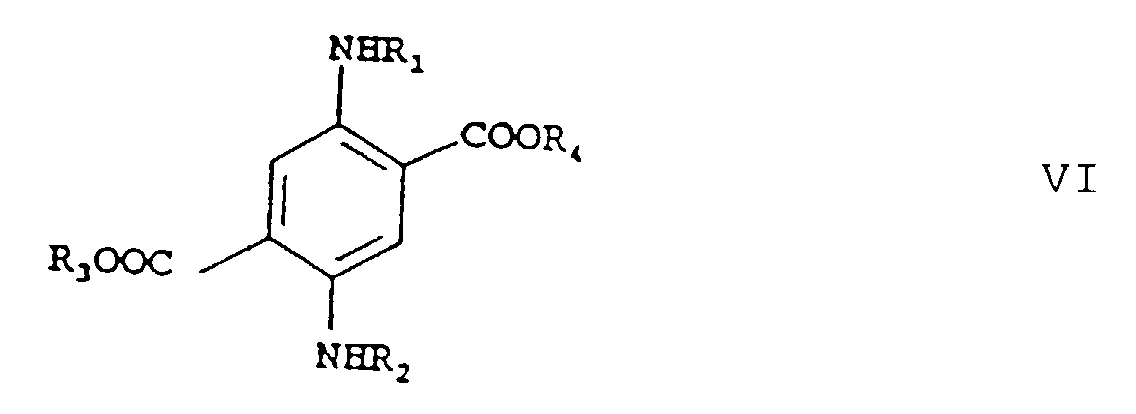 d) qu'on transforme, après un isolement ou sans isolement. éventuellement avec addition d'un diluant inerte dans les conditions de réaction, par réaction avec un composé de formule M-OH, où M signifie un métal, avec chauffage, en un composé répondant à la formule
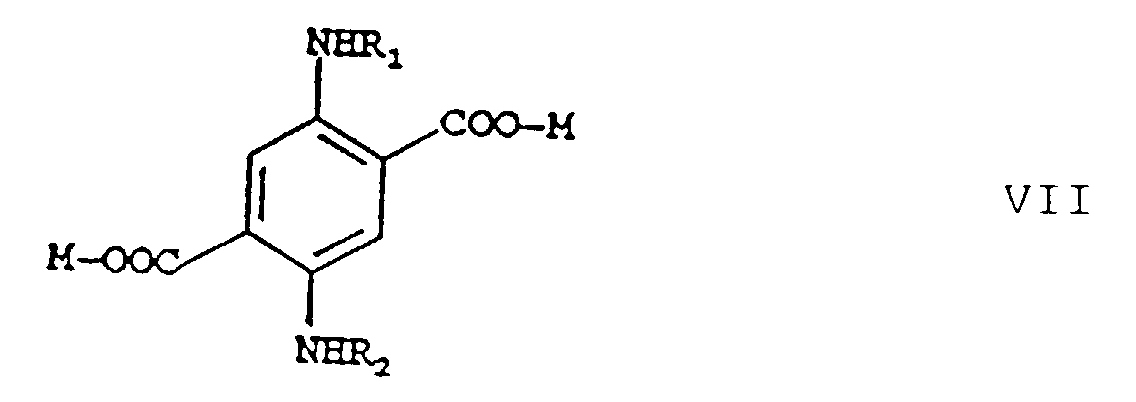 e) auquel on ajoute de l'eau et un acide jusqu'à l'obtention d'une réaction acide, après un isolement ou sans isolement, éventuellement avec addition d'un diluant inerte dans les conditions de réaction, et on le laisse réagir pour donner l'acide téréphtalique de formule I qu'on isole du mélange de réaction.
 - Procédé selon la revendication 6, caractérisé en ce qu'on utilise une amine de formule IV où R1 et R2 sont identiques et signifient un groupe phényle non substitué ou substitué par des atomes d'halogène, par des groupes alkyles ou alcoxy ayant chacun de 1 à 4 atomes de carbone ou par des groupes nitro.
- Procédé selon la revendication 6 ou 7, caractérisé en ce qu'on le met en oeuvre-dans un alcool de formule II selon la revendication 6 comme diluant.
- Procédé selon l'une des revendications 6 à 8, caractérisé en ce qu'on le met en oeuvre sous la forme d'une réaction dans un récipient unique.
Applications Claiming Priority (2)
| Application Number | Priority Date | Filing Date | Title |
|---|---|---|---|
| AT0209693A AT401515B (de) | 1993-10-19 | 1993-10-19 | Verfahren zur umesterung von dimethylsuccinylsuccinat |
| AT2096/93 | 1993-10-19 |
Publications (3)
| Publication Number | Publication Date |
|---|---|
| EP0648733A2 EP0648733A2 (fr) | 1995-04-19 |
| EP0648733A3 EP0648733A3 (fr) | 1995-08-16 |
| EP0648733B1 true EP0648733B1 (fr) | 1998-01-21 |
Family
ID=3527662
Family Applications (1)
| Application Number | Title | Priority Date | Filing Date |
|---|---|---|---|
| EP94115808A Expired - Lifetime EP0648733B1 (fr) | 1993-10-19 | 1994-10-07 | Procédé pour la préparation des produits intermédiaires dans la synthèse de quinacridone |
Country Status (6)
| Country | Link |
|---|---|
| US (2) | US5491255A (fr) |
| EP (1) | EP0648733B1 (fr) |
| JP (1) | JPH07179774A (fr) |
| AT (2) | AT401515B (fr) |
| DE (1) | DE59405079D1 (fr) |
| ES (1) | ES2111229T3 (fr) |
Families Citing this family (5)
| Publication number | Priority date | Publication date | Assignee | Title |
|---|---|---|---|---|
| EP1725619A1 (fr) * | 2004-02-20 | 2006-11-29 | MCA Technologies GMBH | Procede de preparation de pigments organiques |
| US7407544B2 (en) * | 2006-10-17 | 2008-08-05 | Sun Chemical Corporation | Polymeric dispersants based on addition of amines to dialkylsuccinyl succinate or its derivatives |
| CN101823978B (zh) * | 2010-05-17 | 2013-08-21 | 淮安苏瑞精细化工有限公司 | 制备2,5-二苯胺基对苯二甲酸data的方法 |
| BR112013017150A2 (pt) | 2011-03-14 | 2016-09-20 | Dow Global Technologies Llc | processo condensado para preparação de um tereftalato de dialquila, processo quimiosseletivo, ciclohexano-2, 5-diol-1, 4-dicarboxilato de dialquila e ciclohexano-2, 5-diona-1, 4-dicarboxilato de dialquila |
| CN118724736A (zh) * | 2024-07-16 | 2024-10-01 | 杭州恺乐润化工有限公司 | 一种喹吖啶酮颜料中间体2,5-二芳胺基-对苯二甲酸的制备方法 |
Family Cites Families (16)
| Publication number | Priority date | Publication date | Assignee | Title |
|---|---|---|---|---|
| US2821541A (en) * | 1955-07-22 | 1958-01-28 | Du Pont | Production of dialkyl 2, 5-diarylamino-3, 6-dihydroterephthalates |
| BE579621A (fr) * | 1958-06-16 | |||
| GB891640A (en) * | 1959-06-19 | 1962-03-14 | Ciba Ltd | Process for the manufacture of esters of dianilidoterephthalic acid |
| DE1118215B (de) * | 1959-06-19 | 1961-11-30 | Ciba Geigy | Verfahren zur Herstellung von 2, 5-Dianilino-terephthalsaeureestern |
| NL255441A (fr) * | 1959-09-02 | |||
| DE1140300B (de) * | 1960-06-25 | 1962-11-29 | Basf Ag | Verfahren zur Herstellung von 1,4,9,4-Tetraoxo-1,4,9,10,1,4'-hexa-hydrochinolino-(2,3,2,3)-acridinen |
| DE1199906B (de) * | 1960-09-10 | 1965-09-02 | Hoechst Ag | Verfahren zur Herstellung von linearen Chinacridonen |
| US3388149A (en) * | 1964-01-30 | 1968-06-11 | Allied Chem | Oxidation of 2, 5-diarylamino-3, 6-dihydroterephthalic esters |
| DE1768049B2 (de) * | 1968-03-26 | 1974-06-20 | Farbwerke Hoechst Ag, Vormals Meister Lucius & Bruening, 6000 Frankfurt | Verfahren zur Herstellung von 2,5-(Di-arylamino)-terephthalsäuren |
| US3674814A (en) * | 1970-01-19 | 1972-07-04 | Du Pont | Preparation of dihydroterephthalates |
| DE2542494C3 (de) * | 1975-09-24 | 1981-04-30 | Hoechst Ag, 6000 Frankfurt | Verfahren zur Herstellung reiner substituierter 2,5 Diarylaminoterephthalsäureester und der entsprechenden freien Säuren |
| DE3104644A1 (de) * | 1981-02-10 | 1982-08-19 | Bayer Ag, 5090 Leverkusen | Verfahren zur herstellung von dimethylsuccinylosuccinat, dessen dinatriumsalz, dianilinodihydroterephthalsaeuren, deren dimethylestern und salzen sowie von dianilinoterephthalsaeuren, deren dimethylestern und salzen |
| DE3888443D1 (de) * | 1987-10-27 | 1994-04-21 | Basf Ag | Verfahren zur Herstellung von Dihydrochinacridonen, Chinacridonen und Chinacridonchinonen. |
| DE3834747A1 (de) * | 1988-10-12 | 1990-05-03 | Bayer Ag | Verfahren zur herstellung von 2,5-diarylaminoterephthalsaeuren |
| JPH0791245B2 (ja) * | 1990-11-23 | 1995-10-04 | ヘキスト・アクチェンゲゼルシャフト | 高純度の2,5−ジ−フェニルアミノ−テレフタル酸およびそれのジアルキルエステルの製造方法 |
| ATE134987T1 (de) * | 1991-09-30 | 1996-03-15 | Ciba Geigy Ag | Verfahren zur synthese von succinylobernsternsäuredialkylestern und ihre umwandlung in dialkyl 2,5-diarylamino-3,6- dihydroterephthalsäureester |
-
1993
- 1993-10-19 AT AT0209693A patent/AT401515B/de not_active IP Right Cessation
-
1994
- 1994-10-07 AT AT94115808T patent/ATE162513T1/de not_active IP Right Cessation
- 1994-10-07 ES ES94115808T patent/ES2111229T3/es not_active Expired - Lifetime
- 1994-10-07 DE DE59405079T patent/DE59405079D1/de not_active Expired - Fee Related
- 1994-10-07 EP EP94115808A patent/EP0648733B1/fr not_active Expired - Lifetime
- 1994-10-18 JP JP6252485A patent/JPH07179774A/ja not_active Withdrawn
- 1994-10-18 US US08/324,709 patent/US5491255A/en not_active Expired - Fee Related
-
1995
- 1995-08-25 US US08/519,350 patent/US5659076A/en not_active Expired - Fee Related
Also Published As
| Publication number | Publication date |
|---|---|
| ATE162513T1 (de) | 1998-02-15 |
| EP0648733A3 (fr) | 1995-08-16 |
| US5491255A (en) | 1996-02-13 |
| ATA209693A (de) | 1996-02-15 |
| DE59405079D1 (de) | 1998-02-26 |
| AT401515B (de) | 1996-09-25 |
| ES2111229T3 (es) | 1998-03-01 |
| EP0648733A2 (fr) | 1995-04-19 |
| US5659076A (en) | 1997-08-19 |
| JPH07179774A (ja) | 1995-07-18 |
Similar Documents
| Publication | Publication Date | Title |
|---|---|---|
| DE69132892T2 (de) | Verfahren zur Herstellung von 4-Hydroxystyrol | |
| DE19711762A1 (de) | Verfahren zur Herstellung von Bishydroxymethylverbindungen | |
| EP0569823B1 (fr) | Procédé de préparation de l'acide 2,5-di-phénylamino-térephtalique et ses esters dialcoyliques | |
| EP0648733B1 (fr) | Procédé pour la préparation des produits intermédiaires dans la synthèse de quinacridone | |
| DE2363458C3 (de) | Aminobenzaldehydverbindungen und ein Verfahren zu ihrer Herstellung | |
| EP0089417B1 (fr) | Procédé pour la préparation du phtalide | |
| EP0013956B1 (fr) | Procédé de préparation d'alcanediol bis esters d'acide aminobenzoique | |
| CH627733A5 (de) | Verfahren zur herstellung reiner substituierter 2,5-diarylaminoterephthalsaeureester. | |
| DE2061709A1 (en) | N-methylaniline production | |
| DE4339994A1 (de) | Chinacridonsynthese und Verfahren zur Herstellung von Zwischenprodukten | |
| DE4403829A1 (de) | Verfahren zur Herstellung von N-substituierten Glycinestern und Verwendung des Verfahrens zur Indigosynthese | |
| DE69309728T2 (de) | Verfahren zur Herstellung von Arylacrylsäuren und ihrer Ester | |
| CH631146A5 (de) | Verfahren zur herstellung von 2,6-dimethoxy-4-(quaternaeren-alkyl)phenolen. | |
| AT398199B (de) | Verfahren zur herstellung von arylhydantoinen | |
| DE69014683T2 (de) | Verfahren zur Herstellung von Lithium-Diphenylphosphino-phenyl-m-sulfonat. | |
| DE4128351A1 (de) | Verfahren zur herstellung von nitrobenzoesaeuren und anthranilsaeuren | |
| EP0751116B1 (fr) | Procédé pour la fabrication de 1,4-diaminoanthraquinones N',N'-disubstituées | |
| CH678056A5 (fr) | ||
| EP0310944B1 (fr) | Anilines bis-oxéthylsulfonylméthyl et procédé de leur préparation | |
| EP0297391A1 (fr) | Procédé de préparation d'alcénylphénols monomères à partir de dihydroxydiphénylalcanes | |
| DE2621431B2 (de) | Verfahren zur Herstellung von Phloroglucin | |
| CH637103A5 (de) | Verfahren zur herstellung von alkyliden-bis-beta-ketocarbonsaeureestern aus niederen alkanoylessigsaeurealkylestern und aldehyden. | |
| EP0057665B1 (fr) | Procédé pour la préparation de 1-acylamino-3,4-phthaloyl-acridones | |
| DE69907189T2 (de) | Herstellung von chinondiiminen aus phenylendiaminen mit sauerstoff und einem metall- oder metallsalz-katalysator | |
| DE2659147C2 (de) | Verfahren zur Herstellung von Halogenbenzoesäureverbindungen |
Legal Events
| Date | Code | Title | Description |
|---|---|---|---|
| PUAI | Public reference made under article 153(3) epc to a published international application that has entered the european phase |
Free format text: ORIGINAL CODE: 0009012 |
|
| AK | Designated contracting states |
Kind code of ref document: A2 Designated state(s): AT CH DE ES FR GB IT LI |
|
| PUAL | Search report despatched |
Free format text: ORIGINAL CODE: 0009013 |
|
| AK | Designated contracting states |
Kind code of ref document: A3 Designated state(s): AT CH DE ES FR GB IT LI |
|
| 17P | Request for examination filed |
Effective date: 19951221 |
|
| RAP1 | Party data changed (applicant data changed or rights of an application transferred) |
Owner name: DSM CHEMIE LINZ GMBH |
|
| 17Q | First examination report despatched |
Effective date: 19961121 |
|
| GRAG | Despatch of communication of intention to grant |
Free format text: ORIGINAL CODE: EPIDOS AGRA |
|
| GRAG | Despatch of communication of intention to grant |
Free format text: ORIGINAL CODE: EPIDOS AGRA |
|
| GRAH | Despatch of communication of intention to grant a patent |
Free format text: ORIGINAL CODE: EPIDOS IGRA |
|
| GRAH | Despatch of communication of intention to grant a patent |
Free format text: ORIGINAL CODE: EPIDOS IGRA |
|
| GRAA | (expected) grant |
Free format text: ORIGINAL CODE: 0009210 |
|
| AK | Designated contracting states |
Kind code of ref document: B1 Designated state(s): AT CH DE ES FR GB IT LI |
|
| REF | Corresponds to: |
Ref document number: 162513 Country of ref document: AT Date of ref document: 19980215 Kind code of ref document: T |
|
| ITF | It: translation for a ep patent filed | ||
| REG | Reference to a national code |
Ref country code: CH Ref legal event code: NV Representative=s name: BOVARD AG PATENTANWAELTE Ref country code: CH Ref legal event code: EP |
|
| REF | Corresponds to: |
Ref document number: 59405079 Country of ref document: DE Date of ref document: 19980226 |
|
| REG | Reference to a national code |
Ref country code: ES Ref legal event code: FG2A Ref document number: 2111229 Country of ref document: ES Kind code of ref document: T3 |
|
| GBT | Gb: translation of ep patent filed (gb section 77(6)(a)/1977) |
Effective date: 19980205 |
|
| ET | Fr: translation filed | ||
| PG25 | Lapsed in a contracting state [announced via postgrant information from national office to epo] |
Ref country code: GB Free format text: LAPSE BECAUSE OF NON-PAYMENT OF DUE FEES Effective date: 19981007 Ref country code: AT Free format text: LAPSE BECAUSE OF NON-PAYMENT OF DUE FEES Effective date: 19981007 |
|
| PG25 | Lapsed in a contracting state [announced via postgrant information from national office to epo] |
Ref country code: ES Free format text: LAPSE BECAUSE OF NON-PAYMENT OF DUE FEES Effective date: 19981008 |
|
| PG25 | Lapsed in a contracting state [announced via postgrant information from national office to epo] |
Ref country code: LI Free format text: LAPSE BECAUSE OF NON-PAYMENT OF DUE FEES Effective date: 19981031 Ref country code: CH Free format text: LAPSE BECAUSE OF NON-PAYMENT OF DUE FEES Effective date: 19981031 |
|
| PLBE | No opposition filed within time limit |
Free format text: ORIGINAL CODE: 0009261 |
|
| STAA | Information on the status of an ep patent application or granted ep patent |
Free format text: STATUS: NO OPPOSITION FILED WITHIN TIME LIMIT |
|
| 26N | No opposition filed | ||
| GBPC | Gb: european patent ceased through non-payment of renewal fee |
Effective date: 19981007 |
|
| REG | Reference to a national code |
Ref country code: CH Ref legal event code: PL |
|
| PG25 | Lapsed in a contracting state [announced via postgrant information from national office to epo] |
Ref country code: FR Free format text: LAPSE BECAUSE OF NON-PAYMENT OF DUE FEES Effective date: 19990630 |
|
| REG | Reference to a national code |
Ref country code: FR Ref legal event code: ST |
|
| PG25 | Lapsed in a contracting state [announced via postgrant information from national office to epo] |
Ref country code: DE Free format text: LAPSE BECAUSE OF NON-PAYMENT OF DUE FEES Effective date: 19990803 |
|
| REG | Reference to a national code |
Ref country code: ES Ref legal event code: FD2A Effective date: 19991113 |
|
| PG25 | Lapsed in a contracting state [announced via postgrant information from national office to epo] |
Ref country code: IT Free format text: LAPSE BECAUSE OF NON-PAYMENT OF DUE FEES;WARNING: LAPSES OF ITALIAN PATENTS WITH EFFECTIVE DATE BEFORE 2007 MAY HAVE OCCURRED AT ANY TIME BEFORE 2007. THE CORRECT EFFECTIVE DATE MAY BE DIFFERENT FROM THE ONE RECORDED. Effective date: 20051007 |