EP0649663A1 - Einnadel-Rezirkulationssystem zur Sammlung von Blutkomponenten - Google Patents
Einnadel-Rezirkulationssystem zur Sammlung von Blutkomponenten Download PDFInfo
- Publication number
- EP0649663A1 EP0649663A1 EP94305976A EP94305976A EP0649663A1 EP 0649663 A1 EP0649663 A1 EP 0649663A1 EP 94305976 A EP94305976 A EP 94305976A EP 94305976 A EP94305976 A EP 94305976A EP 0649663 A1 EP0649663 A1 EP 0649663A1
- Authority
- EP
- European Patent Office
- Prior art keywords
- blood
- return
- cycle
- during
- bag
- Prior art date
- Legal status (The legal status is an assumption and is not a legal conclusion. Google has not performed a legal analysis and makes no representation as to the accuracy of the status listed.)
- Ceased
Links
- 239000012503 blood component Substances 0.000 title claims abstract description 27
- 238000003306 harvesting Methods 0.000 title claims abstract description 6
- 210000004369 blood Anatomy 0.000 claims abstract description 128
- 239000008280 blood Substances 0.000 claims abstract description 128
- 238000012545 processing Methods 0.000 claims abstract description 16
- 239000000306 component Substances 0.000 claims abstract description 10
- 238000000034 method Methods 0.000 claims description 51
- 238000000926 separation method Methods 0.000 claims description 32
- 238000005534 hematocrit Methods 0.000 claims description 20
- FAPWRFPIFSIZLT-UHFFFAOYSA-M Sodium chloride Chemical compound [Na+].[Cl-] FAPWRFPIFSIZLT-UHFFFAOYSA-M 0.000 claims description 15
- 230000003134 recirculating effect Effects 0.000 claims description 10
- 239000012530 fluid Substances 0.000 claims description 7
- 238000013459 approach Methods 0.000 claims description 5
- 230000003247 decreasing effect Effects 0.000 claims description 5
- 239000002699 waste material Substances 0.000 claims description 5
- 238000003780 insertion Methods 0.000 claims description 3
- 230000037431 insertion Effects 0.000 claims description 3
- 238000012958 reprocessing Methods 0.000 claims description 3
- 238000003825 pressing Methods 0.000 claims 2
- 210000001772 blood platelet Anatomy 0.000 abstract description 53
- 210000003743 erythrocyte Anatomy 0.000 abstract description 25
- 210000000265 leukocyte Anatomy 0.000 abstract description 11
- 230000017531 blood circulation Effects 0.000 abstract description 2
- 239000003146 anticoagulant agent Substances 0.000 description 17
- 229940127219 anticoagulant drug Drugs 0.000 description 17
- 230000008569 process Effects 0.000 description 11
- 238000011109 contamination Methods 0.000 description 8
- 239000011780 sodium chloride Substances 0.000 description 8
- 230000001105 regulatory effect Effects 0.000 description 7
- 238000001802 infusion Methods 0.000 description 5
- 230000008901 benefit Effects 0.000 description 4
- 230000000694 effects Effects 0.000 description 3
- 230000007246 mechanism Effects 0.000 description 3
- 238000010586 diagram Methods 0.000 description 2
- 230000009977 dual effect Effects 0.000 description 2
- 208000033748 Device issues Diseases 0.000 description 1
- 230000002411 adverse Effects 0.000 description 1
- 238000004458 analytical method Methods 0.000 description 1
- 238000004364 calculation method Methods 0.000 description 1
- 210000004027 cell Anatomy 0.000 description 1
- 230000008859 change Effects 0.000 description 1
- 230000005574 cross-species transmission Effects 0.000 description 1
- 230000007423 decrease Effects 0.000 description 1
- 230000001934 delay Effects 0.000 description 1
- 230000000779 depleting effect Effects 0.000 description 1
- 238000013461 design Methods 0.000 description 1
- 238000001514 detection method Methods 0.000 description 1
- 230000006872 improvement Effects 0.000 description 1
- 210000003127 knee Anatomy 0.000 description 1
- 238000012886 linear function Methods 0.000 description 1
- 239000007788 liquid Substances 0.000 description 1
- 230000037452 priming Effects 0.000 description 1
- 230000011664 signaling Effects 0.000 description 1
Images

Classifications
-
- A—HUMAN NECESSITIES
- A61—MEDICAL OR VETERINARY SCIENCE; HYGIENE
- A61M—DEVICES FOR INTRODUCING MEDIA INTO, OR ONTO, THE BODY; DEVICES FOR TRANSDUCING BODY MEDIA OR FOR TAKING MEDIA FROM THE BODY; DEVICES FOR PRODUCING OR ENDING SLEEP OR STUPOR
- A61M1/00—Suction or pumping devices for medical purposes; Devices for carrying-off, for treatment of, or for carrying-over, body-liquids; Drainage systems
- A61M1/14—Dialysis systems; Artificial kidneys; Blood oxygenators ; Reciprocating systems for treatment of body fluids, e.g. single needle systems for hemofiltration or pheresis
- A61M1/30—Single needle dialysis ; Reciprocating systems, alternately withdrawing blood from and returning it to the patient, e.g. single-lumen-needle dialysis or single needle systems for hemofiltration or pheresis
-
- A—HUMAN NECESSITIES
- A61—MEDICAL OR VETERINARY SCIENCE; HYGIENE
- A61M—DEVICES FOR INTRODUCING MEDIA INTO, OR ONTO, THE BODY; DEVICES FOR TRANSDUCING BODY MEDIA OR FOR TAKING MEDIA FROM THE BODY; DEVICES FOR PRODUCING OR ENDING SLEEP OR STUPOR
- A61M1/00—Suction or pumping devices for medical purposes; Devices for carrying-off, for treatment of, or for carrying-over, body-liquids; Drainage systems
- A61M1/02—Blood transfusion apparatus
- A61M1/0209—Multiple bag systems for separating or storing blood components
-
- A—HUMAN NECESSITIES
- A61—MEDICAL OR VETERINARY SCIENCE; HYGIENE
- A61M—DEVICES FOR INTRODUCING MEDIA INTO, OR ONTO, THE BODY; DEVICES FOR TRANSDUCING BODY MEDIA OR FOR TAKING MEDIA FROM THE BODY; DEVICES FOR PRODUCING OR ENDING SLEEP OR STUPOR
- A61M1/00—Suction or pumping devices for medical purposes; Devices for carrying-off, for treatment of, or for carrying-over, body-liquids; Drainage systems
- A61M1/14—Dialysis systems; Artificial kidneys; Blood oxygenators ; Reciprocating systems for treatment of body fluids, e.g. single needle systems for hemofiltration or pheresis
- A61M1/30—Single needle dialysis ; Reciprocating systems, alternately withdrawing blood from and returning it to the patient, e.g. single-lumen-needle dialysis or single needle systems for hemofiltration or pheresis
- A61M1/301—Details
-
- A—HUMAN NECESSITIES
- A61—MEDICAL OR VETERINARY SCIENCE; HYGIENE
- A61M—DEVICES FOR INTRODUCING MEDIA INTO, OR ONTO, THE BODY; DEVICES FOR TRANSDUCING BODY MEDIA OR FOR TAKING MEDIA FROM THE BODY; DEVICES FOR PRODUCING OR ENDING SLEEP OR STUPOR
- A61M1/00—Suction or pumping devices for medical purposes; Devices for carrying-off, for treatment of, or for carrying-over, body-liquids; Drainage systems
- A61M1/14—Dialysis systems; Artificial kidneys; Blood oxygenators ; Reciprocating systems for treatment of body fluids, e.g. single needle systems for hemofiltration or pheresis
- A61M1/30—Single needle dialysis ; Reciprocating systems, alternately withdrawing blood from and returning it to the patient, e.g. single-lumen-needle dialysis or single needle systems for hemofiltration or pheresis
- A61M1/301—Details
- A61M1/303—Details having a reservoir for treated blood to be returned
-
- A—HUMAN NECESSITIES
- A61—MEDICAL OR VETERINARY SCIENCE; HYGIENE
- A61M—DEVICES FOR INTRODUCING MEDIA INTO, OR ONTO, THE BODY; DEVICES FOR TRANSDUCING BODY MEDIA OR FOR TAKING MEDIA FROM THE BODY; DEVICES FOR PRODUCING OR ENDING SLEEP OR STUPOR
- A61M1/00—Suction or pumping devices for medical purposes; Devices for carrying-off, for treatment of, or for carrying-over, body-liquids; Drainage systems
- A61M1/14—Dialysis systems; Artificial kidneys; Blood oxygenators ; Reciprocating systems for treatment of body fluids, e.g. single needle systems for hemofiltration or pheresis
- A61M1/30—Single needle dialysis ; Reciprocating systems, alternately withdrawing blood from and returning it to the patient, e.g. single-lumen-needle dialysis or single needle systems for hemofiltration or pheresis
- A61M1/301—Details
- A61M1/305—Control of inversion point between collection and re-infusion phase
- A61M1/306—Pressure control, e.g. using substantially rigid closed or gas buffered or elastic reservoirs
-
- A—HUMAN NECESSITIES
- A61—MEDICAL OR VETERINARY SCIENCE; HYGIENE
- A61M—DEVICES FOR INTRODUCING MEDIA INTO, OR ONTO, THE BODY; DEVICES FOR TRANSDUCING BODY MEDIA OR FOR TAKING MEDIA FROM THE BODY; DEVICES FOR PRODUCING OR ENDING SLEEP OR STUPOR
- A61M1/00—Suction or pumping devices for medical purposes; Devices for carrying-off, for treatment of, or for carrying-over, body-liquids; Drainage systems
- A61M1/36—Other treatment of blood in a by-pass of the natural circulatory system, e.g. temperature adaptation, irradiation ; Extra-corporeal blood circuits
- A61M1/3601—Extra-corporeal circuits in which the blood fluid passes more than once through the treatment unit
- A61M1/3603—Extra-corporeal circuits in which the blood fluid passes more than once through the treatment unit in the same direction
-
- A—HUMAN NECESSITIES
- A61—MEDICAL OR VETERINARY SCIENCE; HYGIENE
- A61M—DEVICES FOR INTRODUCING MEDIA INTO, OR ONTO, THE BODY; DEVICES FOR TRANSDUCING BODY MEDIA OR FOR TAKING MEDIA FROM THE BODY; DEVICES FOR PRODUCING OR ENDING SLEEP OR STUPOR
- A61M1/00—Suction or pumping devices for medical purposes; Devices for carrying-off, for treatment of, or for carrying-over, body-liquids; Drainage systems
- A61M1/36—Other treatment of blood in a by-pass of the natural circulatory system, e.g. temperature adaptation, irradiation ; Extra-corporeal blood circuits
- A61M1/3621—Extra-corporeal blood circuits
- A61M1/3643—Priming, rinsing before or after use
- A61M1/3644—Mode of operation
-
- A—HUMAN NECESSITIES
- A61—MEDICAL OR VETERINARY SCIENCE; HYGIENE
- A61M—DEVICES FOR INTRODUCING MEDIA INTO, OR ONTO, THE BODY; DEVICES FOR TRANSDUCING BODY MEDIA OR FOR TAKING MEDIA FROM THE BODY; DEVICES FOR PRODUCING OR ENDING SLEEP OR STUPOR
- A61M1/00—Suction or pumping devices for medical purposes; Devices for carrying-off, for treatment of, or for carrying-over, body-liquids; Drainage systems
- A61M1/36—Other treatment of blood in a by-pass of the natural circulatory system, e.g. temperature adaptation, irradiation ; Extra-corporeal blood circuits
- A61M1/3693—Other treatment of blood in a by-pass of the natural circulatory system, e.g. temperature adaptation, irradiation ; Extra-corporeal blood circuits using separation based on different densities of components, e.g. centrifuging
- A61M1/3696—Other treatment of blood in a by-pass of the natural circulatory system, e.g. temperature adaptation, irradiation ; Extra-corporeal blood circuits using separation based on different densities of components, e.g. centrifuging with means for adding or withdrawing liquid substances during the centrifugation, e.g. continuous centrifugation
-
- A—HUMAN NECESSITIES
- A61—MEDICAL OR VETERINARY SCIENCE; HYGIENE
- A61M—DEVICES FOR INTRODUCING MEDIA INTO, OR ONTO, THE BODY; DEVICES FOR TRANSDUCING BODY MEDIA OR FOR TAKING MEDIA FROM THE BODY; DEVICES FOR PRODUCING OR ENDING SLEEP OR STUPOR
- A61M1/00—Suction or pumping devices for medical purposes; Devices for carrying-off, for treatment of, or for carrying-over, body-liquids; Drainage systems
- A61M1/36—Other treatment of blood in a by-pass of the natural circulatory system, e.g. temperature adaptation, irradiation ; Extra-corporeal blood circuits
- A61M1/3621—Extra-corporeal blood circuits
- A61M1/3643—Priming, rinsing before or after use
-
- A—HUMAN NECESSITIES
- A61—MEDICAL OR VETERINARY SCIENCE; HYGIENE
- A61M—DEVICES FOR INTRODUCING MEDIA INTO, OR ONTO, THE BODY; DEVICES FOR TRANSDUCING BODY MEDIA OR FOR TAKING MEDIA FROM THE BODY; DEVICES FOR PRODUCING OR ENDING SLEEP OR STUPOR
- A61M2202/00—Special media to be introduced, removed or treated
- A61M2202/04—Liquids
- A61M2202/0413—Blood
- A61M2202/0415—Plasma
-
- A—HUMAN NECESSITIES
- A61—MEDICAL OR VETERINARY SCIENCE; HYGIENE
- A61M—DEVICES FOR INTRODUCING MEDIA INTO, OR ONTO, THE BODY; DEVICES FOR TRANSDUCING BODY MEDIA OR FOR TAKING MEDIA FROM THE BODY; DEVICES FOR PRODUCING OR ENDING SLEEP OR STUPOR
- A61M2202/00—Special media to be introduced, removed or treated
- A61M2202/04—Liquids
- A61M2202/0413—Blood
- A61M2202/0427—Platelets; Thrombocytes
-
- A—HUMAN NECESSITIES
- A61—MEDICAL OR VETERINARY SCIENCE; HYGIENE
- A61M—DEVICES FOR INTRODUCING MEDIA INTO, OR ONTO, THE BODY; DEVICES FOR TRANSDUCING BODY MEDIA OR FOR TAKING MEDIA FROM THE BODY; DEVICES FOR PRODUCING OR ENDING SLEEP OR STUPOR
- A61M2205/00—General characteristics of the apparatus
- A61M2205/12—General characteristics of the apparatus with interchangeable cassettes forming partially or totally the fluid circuit
Definitions
- This invention relates to harvesting blood components from a donor by processing the donated blood and returning it to the donor through the same needle from which it was withdrawn.
- Donated blood is typically processed by withdrawing it through a needle and sending it through a disposable tubing set to a centrifuge in order to separate the blood into its various components.
- the centrifugal apparatus is fitted with a disposable plastic vessel through which the blood is circulated.
- the vessel is fitted into a centrifuge bowl that is driven by a motor.
- An exemplary vessel is a circumferential separation channel having several outlets positioned at different radial positions within the channel in order to remove blood components separated into stratified layers of differing density by the centrifuge.
- Red blood cells (RBC) being the most dense of the components, are packed within the channel at the most radially outward location, whereas the stratified layer of plasma is at the most radially inward location.
- a relatively thin, yellowish layer contains white blood cells and platelets and is located between the red blood cell layer and the plasma layer. Within the buffy coat, the platelets are stratified toward the plasma, while the white blood cells are stratified toward the red blood cells.
- U.S. Patent No. 4,708,712 incorporated herein by reference, describes a two-stage separation channel for collecting platelets separately from white blood cells and also having an outlet for collecting source plasma. The red and white blood cells are returned to the donor, along with most of the plasma.
- blood is removed from the donor, processed to collect platelets, and the whole blood, minus the collected platelets and perhaps also minus collected source plasma, is returned to the donor through the same single needle.
- Platelets are stored in a platelet collection bag, and the plasma is separately collected and stored in a plasma collection bag.
- Processed blood from which the harvested components have been removed is stored in a separate blood storage return bag during the draw cycle.
- a squeezing mechanism places pressure on the external sides of the blood storage bag in order to squeeze the blood from the bag for return to the donor through the single needle.
- a suitable blood storage bag and pressure mechanism is described in U.S. Patent No. 4,991,743 which is incorporated herein by reference.
- a recirculating loop system In order to improve the efficiency of the single-needle procedure and remove the contamination problem, a recirculating loop system has been developed in which the inlet pump is not stopped during the return cycle. Instead, the inlet pump, which pumps whole blood into the separation channel during the draw cycle, continues to operate during the return cycle to recirculate and reprocess blood already in the system. The recirculated blood, together with blood stored in the storage bag, are combined to provide both the recirculation flow to the inlet pump and the return flow to the donor.
- the draw cycle is operated for a period sufficient to withdraw and process a specific volume of whole blood from the donor. Once that volume has been obtained, the system is switched to a return cycle by opening a valve in the return line and putting pressure on the storage bag. Blood squeezed from the bag is returned in the reverse direction through the needle into the donor until the bag is essentially emptied, at which time the valve is closed and blood is once again drawn from the donor to the inlet pump.
- the instantaneous flow of blood to the donor in the return cycle is regulated in order to limit the amount of anticoagulant solution returned to the donor. To accomplish that end, the speed of the inlet pump is reduced during the return cycle and a programmable restriction valve is placed in the return line.
- the recirculation flow is related to the re-infusion flow in order to regulate the re-infusion flow to a desired instantaneous level.
- the time duration of the return cycle is lengthened to accommodate the need to regulate re-infusion flow and also to improve the efficiency of the process since additional platelets are harvested by reprocessing blood in the return cycle. A lengthy return cycle will reprocess more blood for a given recirculation flow.
- the current invention seeks to maintain undisturbed the RBC interface of the buffy coat in the centrifuge throughout both the draw and return cycles while minimizing the length of time for the return cycle. It has been determined that it is not necessary to regulate the instantaneous flow of anticoagulant back to the donor as long as the average flow of anticoagulant returned over a complete single needle cycle is kept within the tolerance of the donor. As a consequence, a system has been developed in which the recirculation flow and the re-infusion flow are essentially independent during the return cycle. Instead, the recirculation flow is desirably established at as small a fraction as possible of the inlet flow during the draw cycle in order to minimize the duration of the return cycle and still maintain the stability of the interface. The re-infusion flow is regulated primarily by needle size; no restrictions are placed in the return flow line and the return line flow resistance is deliberately minimized.
- the prior art standard single-needle non-recirculation procedure is comfortable for the donor, the previous procedures can be used efficiently with only about 70% of the donor population.
- the speed of the pump during the draw cycle is established according to those considerations. Since the total time for the procedure may be approximately an hour and 30 minutes, it is desirable to operate at the maximum practical flow rate for the specific donor. For the largest of donors, that may be about 90 milliliters per minute for the double-needle procedure.
- flow rate corresponds to an average blood processing rate of only about 50 milliliters per minute for the standard non-recirculating single-needle procedure.
- the ratio, 5/9 is approximately the ratio of the duration of the draw cycle to the total cycle time for draw and return.
- a prior art single-needle recirculating procedure desires long return cycles of perhaps even greater duration than 5/9 in order to control the return of anticoagulant.
- the invention achieves the minimization of return cycle time by lowering the speed of the inlet pump during the return cycle, by minimizing flow resistance in the return path, and by instituting a volume/pressure control system.
- a pressure gauge is placed in the return line and, as blood is squeezed into the return line from the storage bag, pressure is maintained in the return line at a relatively high level. However, as soon as the bag is emptied, the pressure in the return line drops precipitously, indicating that the bag is empty. At that point the system is switched back to a draw cycle.
- Another aspect of the invention is to limit the maximum allowable plasma fraction that can be collected in accordance with the blood processing rate.
- the recirculation system of the invention requires the recirculation of high-hematocrit blood. Because the separation channel processing efficiency is lowered for high-hematocrit blood, the target hematocrit level in the packed red blood cell (RBC) return line and the allowable plasma collection fraction, are designed as a decreasing function as the blood processing rate increases rather than a constant target and fraction that are independent of the blood processing rate.
- RBC red blood cell
- recirculation is not performed during the return cycle because the recirculation of saline in the tubing set prolongs the start-up and delays the beginning of platelet collection.
- recirculation can begin as soon as the tubing set is filled with blood.
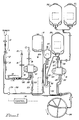
- Figure 1 is a diagram of the recirculation flow in an embodiment of the single-needle recirculation system of the invention.
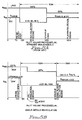
- Figure 2 shows flow profiles within the draw and return cycles for the embodiment of Fig. 1.
- Figure 3 shows the flow profiles for the previous volume/time standard single needle system with no recirculation.
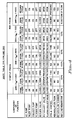
- Figure 4 shows a state table for the start-up phase and the run phase of the recirculating system of the embodiment of Fig. 1.
- Figures 5A and 5B are illustrations of start-up protocol.
- Fig. 5A shows the protocol for a standard single needle system while
- Fig. 5B shows the protocol for the single needle recirculation system of the embodiment of Fig. 1.
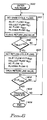
- FIG. 6 is a flowchart of the control system used with the embodiment of Fig. 1.
- Figure 1 shows the recirculation flow within an exemplary system embodying the invention.
- a single lumen needle 10 is inserted into a donor for obtaining platelets or both plasma and platelets from the blood of the donor.
- the needle is connected to a first branch of a Y connector 11 .
- a second branch of the Y connector is connected to the inlet line 12 which passes through a line clamp 13 to a manifold 14 .
- a connector 15 is attached to a saline bag (not shown) for introduction of saline liquid through line 16 to manifold 14 .
- a connector 17 is attached to an anti-coagulant bag (not shown) for introduction of anti-coagulant solution through line 18 to anti-coagulant pump 19 .
- the outlet of pump 19 is connected to the manifold 14 for insertion of a controlled amount of anti-coagulant solution to blood drawn from the donor. It is desirable to minimize the distance between manifold 14 and the single needle 10 in order that the anti-coagulant solution can be mixed with the donor's blood as soon as possible in the tubing set of the recirculation system.
- Blood from manifold 14 is presented to the inlet side of inlet pump 21 through line 20 and access pressure sensor 28 .
- the outlet side of inlet pump 21 is connected through line 22 and a drip chamber 23 to at least one separation vessel.
- the separation vessel is a separation channel 24 .
- plastic separation channel 24 is inserted into the bowl of a centrifuge for separating out the various components of the blood.
- Plasma is drawn out of the separation channel by the plasma pump 25 over the plasma collect line 26 .
- the plasma is passed through a Y connector 27 and is either sent to blood storage bag 37 via lines 27' and 37' or is collected in plasma collect bag 29 .
- Platelets are drawn from the separation channel 24 over line 30 to the collect pump 31 and are pumped through Y connector 32 into one or the other of platelet collect bags 33 and 34 . Valves or tube clamps, not shown, control the direction of flow through Y connectors 27 and 32 .
- High-hematocrit blood is drawn from the separation channel through line 35 , Y connector 36 , and line 37' to the storage bag 37 . If source plasma is not collected, the plasma in line 27' is combined with the blood in line 35 for storage in bag 37 .
- the return line 38 runs from the storage bag 37 through the return valve 39 to a third branch of the Y connector 11 .
- the return valve 39 is closed so that the processed blood is accumulated in the storage bag 37 .
- Platelets are collected in the platelet collect bags 33 and 34 and, if desired, plasma is collected in the bag 29 . If it is not desired to collect plasma, the plasma is directed to the storage bag 37 .
- the return valve 39 is opened and pressure is exerted on the storage bag 37 to squeeze blood therefrom through line 38 to the Y connector 11 and from there through the needle 10 to the donor.
- a portion of the blood in return line 38 is passed through Y connector 11 to the inlet line 12 for presentation to the inlet pump 21 .
- inlet pump 21 continues to provide a flow of blood into the separation channel 24 , whether in the draw cycle or in the return cycle.
- a return pressure sensor 40 located in return line 27' senses the pressure being exerted on the fluid in bag 37 .
- Sensor 40 can be located at any convenient place in the return system such as in line 38 or associated with storage bag 37. Once the bag 37 is emptied, the sensor 40 shows a sudden drop in pressure signalling that the bag 37 is empty and that the return cycle can be terminated and the draw cycle begun again.
- the pressure sensor 40 is connected to a microprocessor-based control system 41 for switching return valve 39 to a closed position and resuming the draw cycle as soon as the sudden drop in pressure is sensed.
- two of the significant advantages of the invention are minimizing instantaneous flow rates in order to accommodate a greater percentage of the donor population with the single needle procedure and minimizing the length of time for the donor to be attached to the system.
- the minimizing of return cycle time accomplishes these ends and is furthered by utilizing the pressure sensing approach. It is also valuable to increase the size of the tubing set in the return path relative to the remainder of the tubing set in order to minimize the resistance to the flow of blood through the return path.
- the total return flow resistance in the return path includes the flow resistance through the needle, summed with the flow resistance through the remainder of the return path, i.e., the flow resistance associated with the storage bag 37 , the flow resistance associated with the Y connector 11 , and the flow resistance of the return line 38 , it is desirable to provide 80% or more of the total return flow resistance in the needle. In that manner, the return cycle duration is minimized, thus achieving a lower instantaneous flow rate for the same blood processing rate.
- Lowering the flow rate of blood through the recirculating system also reduces the duration of the return cycle. To minimize return cycle time, it is desirable to reduce the recirculated flow as low as possible while still maintaining the stability of the interface position between the RBC and the buffy coat. Maintaining stability keeps collected platelet purity high. A low recirculated flow rate improves the efficiency of collecting platelets from the donated blood as well as minimizing return cycle time.
- the spring actuated flow controller which squeezes blood from the storage bag must overcome the resistance of the return line to recirculate blood to the inlet pump.
- a lower percentage of the spring force is used for recirculation leaving a higher percentage of spring force available for returning blood to the donor. In that manner, return cycle duration is minimized by a low recirculation flow rate.
- saline solution is drawn from a saline bag (not shown) through inlet 15 into the manifold 14 . From there, inlet pump 21 pumps the solution throughout the lines and bags of the system so that air is removed.
- inlet pump 21 pumps the solution throughout the lines and bags of the system so that air is removed.
- the saline solution is directed to the waste bag 9 until a sensor 8 detects the presence of blood in the entry line to bag 9 .
- the system is switched to return fluid to the donor rather than continuing the flow into the waste bag 9. Collection of blood components, however, does not commence until the system is essentially free of saline solution. At that point, the start-up phase ends and the recirculating collection phase begins.
- FIG. 2 is a diagram of preferred flow profiles within each cycle of the recirculating single-needle procedure according to the invention.
- Inlet flow 100 is shown as advancing to a steady state, constant profile throughout the draw cycle and dropping to a lower steady state condition during the return cycle. It has been found that when the inlet pump is operated during the return cycle at about one-half the draw cycle speed, the RBC interface is maintained and platelet collection efficiency is improved. The RBC interface can be maintained at greater inlet pump speeds during the return cycle, but platelet collection efficiency is not as good as at lowered speeds. If the inlet pump speed is either too great or too small during the return cycle, the RBC interface will be disturbed and, at excessively high speeds, the buffy coat will be depleted.
- platelet collection efficiency is the number of platelets collected divided by the number of platelets processed during the collection period.
- a blood sample is taken before donation begins for laboratory analysis of the number of platelets per milliliter.
- the volume of blood drawn and processed from the donor is known, thus enabling a calculation of the total number of platelets processed.
- a sample of collected platelets is analyzed to determine the total number of platelets collected. In that manner, the values for obtaining platelet collection efficiency are determined.
- Profile 101 shows that the flow through the collect pump is also a constant value throughout the draw and return cycles, showing that platelets are collected during both cycles.
- Flow profile 102 shows that the flow of anti-coagulant during the draw cycle is halted during the return cycle.
- Flow profile 103 shows that the plasma flow is also halted during the return cycle.
- Flow profile 104 shows the return flow in line 38 .
- the sloping linear portion of flow profile 104 during the return cycle represents the return flow occurring during the period in which pressure is placed on the flexible storage bag 37 to squeeze blood from the bag into the return line.
- the return flow suddenly drops off, indicating that the bag is substantially empty and that the return cycle can end.
- the pressure sensing device 40 triggers the end of the return cycle, and the beginning of the next following draw cycle.
- Flow profile 104 shows a time period, T4, together with a time period, T3, making up the return cycle with time period T4 approaching zero.
- Figure 3 shows flow profiles within the prior art standard single-needle approach in which there was no recirculation during the return cycle. Instead, the bag 37 was filled during a draw cycle and emptied during a return cycle without the recirculation of blood through the inlet pump and centrifuge.
- the flow through the inlet pump and centrifuge is shown with flow profile 200
- the anti-coagulant flow is shown with profile 201
- the collect flow with profile 202 the collect flow with profile 202
- the plasma flow with profile 203 Note that the inlet flow falls to zero during the return cycle, as does the anti-coagulant flow, the collect flow and the plasma flow.
- the return flow profile 204 is similar to the return flow profile 104 shown in Figure 2, except that a significant dead time period, T4, is needed to provide a safety factor for emptying the storage bag, as discussed above.
- Figure 4 shows a state table for an embodiment of the prior art standard single-needle (SSN) intermittent flow process for comparison with the state table for an embodiment of the single-needle recirculation (SNR) constant flow process of the invention.
- SSN standard single-needle
- SNR single-needle recirculation
- the chart shown in Figure 4 shows that the start-up phase for single-needle recirculation is the same as for the standard single-needle intermittent flow procedure; that is, there is no recirculation during the start-up phase.
- the reason is that if blood is recirculated with a saline component, the start-up phase would lengthen and thereby delay entry of the system into the collect phase.
- the platelets may be collected prior to entry into the collect phase; however, plasma is not collected until essentially all saline is removed.
- the start-up phase runs for 320 milliliters volume, while in the recirculation procedure the start-up phase continues for 400 milliliters before switching to the run phase.
- plasma collect begins at 400 ml in SNR while it must wait for 500 ml in SSN.
- the target hematocrit in the RBC line is 100% in the SNR procedure.
- the meaning of a 100% hematocrit target is that the combined flow of the plasma pump and collect pump is equal to the inlet plasma flow plus the anti-coagulant flow. As a consequence, most of the red blood cells accumulate in the separation channel during the prime divert period.
- the hematocrit target is a function of the inlet flow rate in the SNR process with the flow rate being determined by the size, weight, sex and hematocrit of the donor.
- the hematocrit target is designed to be a linear function of inlet flow rate, decreasing as the flow rate increases. By relating the hematocrit target to flow rate, the volume of plasma available for collection is maximized without contamination from red blood cells. Basically, the relationship is C1 - C2Q IN , where the constants are determined by the physical parameters of the system.
- centrifugal separator to separate blood components is limited by its design.
- the fraction of the processed plasma that can be separated generally decreases as inlet flow increases, especially for a speed-limited centrifuge.
- the recirculation of high hematocrit blood exacerbates this limitation.
- the maximum hematocrit target reflects this limitation and is chosen to maximize the volume of separated plasma available for collection without risking RBC contamination by attempting to remove from the separation channel more plasma than is separated from the processed blood.
- Figure 5A illustrates the hematocrit target 500 during the start-up phase and the run phase of the SSN process for a particular centrifugal separator.
- Figure 5A also shows the average flow profile 501 in the inlet pump and separation channel during the start-up phase and the run phase. Note that while platelet collection can begin after processing 200 milliliters during the start-up cycle, the plasma collection does not begin until 500 milliliters have been processed.
- Figure 5B for the same centrifugal separator shows the single-needle recirculation process of the invention with the target hematocrit levels shown by profile 503 .
- the flow profile for the inlet pump and separation channel is shown by profile 504 .
- the target hematocrit during the run phase is related to the inlet flow, Q IN , according to the relationship (65-0.3Q IN )%.
- Figure 6 illustrates the control operation for the embodiment of Fig. 1 performed by the microprocessor-based control device 41 during the run phase.
- the control operation of Fig. 6 may be performed by any suitable control mechanism, but easily changeable control devices such as a programmable microprocessor are advantageous for optimizing system performance.
- the control device 41 at step 601 directs the establishment of draw cycle flows as illustrated in Fig. 2 and Fig. 6. That is, the inlet pump speed is regulated to produce the desired instantaneous steady-state inlet flow, Q IN1 .
- the collect pump speed is regulated to produce the desired steady-state collect platelet flow, Q C1 .
- the anti-coagulant (AC) pump is regulated to produce the desired steady-state anti-coagulant flow, Q AC1 .
- the plasma pump is regulated to produce the desired steady-state plasma flow, Q P1 . All pumps are conveniently regulated to ramp to the desired steady-state level at the same rate.
- control device upon entering a draw cycle at step 601, issues a signal to close the return line by closing the return valve 39.
- the control device 41 continually checks the volume of fluid pumped by the inlet pump to determine if it equals the desired stroke volume SV, at step 602. When the desired draw volume, V INLET , has been pumped, V INLET equals SV, and the control device 41 issues signals to end the draw cycle and commence the return cycle. These signals are produced at step 603 and include a signal to open the return line valve 39, a signal to set the inlet flow, Q IN2 , at one-half Q IN1 , signals to drop the AC flow and the plasma flow to zero, and maintaining the signal to keep the collect flow at the same steady-state level that existed on the draw cycle.
- control device 41 continually checks at step 604 for a signal from pressure sensor 40. When the signal, P TRIGGER , arrives, it indicates a detection of a precipitous drop in pressure in return line 38, thereby indicating an empty storage bag 37. Control device 41 then checks at step 605 to determine whether a desired total inlet volume has been processed over a multitude of draw cycles to determine whether processing of the donor's blood is complete. If it is, control device 41 directs entry at step 606 into a shut-down operation to halt the machine; otherwise, return is made to repeat step 601 and begin another draw cycle.
- P TRIGGER a signal from pressure sensor 40.
Landscapes
- Health & Medical Sciences (AREA)
- Heart & Thoracic Surgery (AREA)
- Vascular Medicine (AREA)
- Hematology (AREA)
- Engineering & Computer Science (AREA)
- Anesthesiology (AREA)
- Biomedical Technology (AREA)
- Urology & Nephrology (AREA)
- Life Sciences & Earth Sciences (AREA)
- Animal Behavior & Ethology (AREA)
- General Health & Medical Sciences (AREA)
- Public Health (AREA)
- Veterinary Medicine (AREA)
- Emergency Medicine (AREA)
- Cardiology (AREA)
- External Artificial Organs (AREA)
Applications Claiming Priority (2)
| Application Number | Priority Date | Filing Date | Title |
|---|---|---|---|
| US110432 | 1993-08-23 | ||
| US08/110,432 US5437624A (en) | 1993-08-23 | 1993-08-23 | Single needle recirculation system for harvesting blood components |
Publications (1)
| Publication Number | Publication Date |
|---|---|
| EP0649663A1 true EP0649663A1 (de) | 1995-04-26 |
Family
ID=22332974
Family Applications (1)
| Application Number | Title | Priority Date | Filing Date |
|---|---|---|---|
| EP94305976A Ceased EP0649663A1 (de) | 1993-08-23 | 1994-08-12 | Einnadel-Rezirkulationssystem zur Sammlung von Blutkomponenten |
Country Status (5)
| Country | Link |
|---|---|
| US (1) | US5437624A (de) |
| EP (1) | EP0649663A1 (de) |
| JP (1) | JP2909390B2 (de) |
| AU (1) | AU675547B2 (de) |
| CA (1) | CA2129167C (de) |
Cited By (3)
| Publication number | Priority date | Publication date | Assignee | Title |
|---|---|---|---|---|
| EP0784496A4 (de) * | 1995-08-09 | 2000-07-26 | Baxter Travenol Lab | Systeme und methoden zur trennung von erythrocyten |
| EP1671665A1 (de) * | 1995-06-07 | 2006-06-21 | Gambro, Inc., | Apheresesystem |
| EP1126897A4 (de) * | 1999-09-03 | 2011-04-27 | Fenwal Inc | Systeme und verfahren zur blutbehandlung unter anwendung von auf flüssigkeitsdruck ansprechenden pumpen und ventilen |
Families Citing this family (103)
| Publication number | Priority date | Publication date | Assignee | Title |
|---|---|---|---|---|
| US5573678A (en) * | 1987-01-30 | 1996-11-12 | Baxter International Inc. | Blood processing systems and methods for collecting mono nuclear cells |
| US5833866A (en) * | 1991-12-23 | 1998-11-10 | Baxter International Inc. | Blood collection systems and methods which derive instantaneous blood component yield information during blood processing |
| US5681273A (en) * | 1991-12-23 | 1997-10-28 | Baxter International Inc. | Systems and methods for predicting blood processing parameters |
| US5639382A (en) * | 1991-12-23 | 1997-06-17 | Baxter International Inc. | Systems and methods for deriving recommended storage parameters for collected blood components |
| US5730883A (en) * | 1991-12-23 | 1998-03-24 | Baxter International Inc. | Blood processing systems and methods using apparent hematocrit as a process control parameter |
| US5676841A (en) * | 1991-12-23 | 1997-10-14 | Baxter International Inc. | Blood processing systems and methods which monitor citrate return to the donor |
| US5690835A (en) | 1991-12-23 | 1997-11-25 | Baxter International Inc. | Systems and methods for on line collection of cellular blood components that assure donor comfort |
| US6319471B1 (en) * | 1992-07-10 | 2001-11-20 | Gambro, Inc. | Apparatus for producing blood component products |
| US5630946A (en) * | 1995-02-15 | 1997-05-20 | Pall Corporation | Method for processing a biological fluid including leukocyte removal in an extracorporeal circuit |
| US6053856A (en) * | 1995-04-18 | 2000-04-25 | Cobe Laboratories | Tubing set apparatus and method for separation of fluid components |
| US6022306A (en) | 1995-04-18 | 2000-02-08 | Cobe Laboratories, Inc. | Method and apparatus for collecting hyperconcentrated platelets |
| US5913768A (en) * | 1995-04-18 | 1999-06-22 | Cobe Laboratories, Inc. | Particle filter apparatus |
| WO1996040401A1 (en) * | 1995-06-07 | 1996-12-19 | Baxter International Inc. | Blood collection system deriving instantaneous component yield |
| US5961842A (en) * | 1995-06-07 | 1999-10-05 | Baxter International Inc. | Systems and methods for collecting mononuclear cells employing control of packed red blood cell hematocrit |
| AU714650B2 (en) * | 1995-06-07 | 2000-01-06 | Baxalta GmbH | Blood processing systems and methods for collecting mono nuclear cells |
| US6251284B1 (en) | 1995-08-09 | 2001-06-26 | Baxter International Inc. | Systems and methods which obtain a uniform targeted volume of concentrated red blood cells in diverse donor populations |
| US6527957B1 (en) | 1995-08-09 | 2003-03-04 | Baxter International Inc. | Methods for separating, collecting and storing red blood cells |
| USD377685S (en) * | 1995-09-26 | 1997-01-28 | Haemonetics Corp. | Blood withdrawal and separation set |
| US5964724A (en) * | 1996-01-31 | 1999-10-12 | Medtronic Electromedics, Inc. | Apparatus and method for blood separation |
| US5906589A (en) * | 1996-11-13 | 1999-05-25 | Cobe Laboratories, Inc. | Method and apparatus for occlusion monitoring using pressure waveform analysis |
| US6752777B1 (en) * | 1997-06-16 | 2004-06-22 | Terumo Kabushiki Kaisha | Blood component collecting apparatus |
| US5980760A (en) * | 1997-07-01 | 1999-11-09 | Baxter International Inc. | System and methods for harvesting mononuclear cells by recirculation of packed red blood cells |
| US6027441A (en) * | 1997-07-01 | 2000-02-22 | Baxter International Inc. | Systems and methods providing a liquid-primed, single flow access chamber |
| US6027657A (en) * | 1997-07-01 | 2000-02-22 | Baxter International Inc. | Systems and methods for collecting diluted mononuclear cells |
| US6695803B1 (en) | 1998-10-16 | 2004-02-24 | Mission Medical, Inc. | Blood processing system |
| US6334842B1 (en) | 1999-03-16 | 2002-01-01 | Gambro, Inc. | Centrifugal separation apparatus and method for separating fluid components |
| US6261065B1 (en) | 1999-09-03 | 2001-07-17 | Baxter International Inc. | System and methods for control of pumps employing electrical field sensing |
| US6709412B2 (en) * | 1999-09-03 | 2004-03-23 | Baxter International Inc. | Blood processing systems and methods that employ an in-line leukofilter mounted in a restraining fixture |
| US7041076B1 (en) * | 1999-09-03 | 2006-05-09 | Baxter International Inc. | Blood separation systems and methods using a multiple function pump station to perform different on-line processing tasks |
| US6723062B1 (en) | 1999-09-03 | 2004-04-20 | Baxter International Inc. | Fluid pressure actuated blood pumping systems and methods with continuous inflow and pulsatile outflow conditions |
| US6296450B1 (en) | 1999-09-03 | 2001-10-02 | Baxter International Inc. | Systems and methods for control of pumps employing gravimetric sensing |
| US20060178612A9 (en) * | 1999-09-03 | 2006-08-10 | Baxter International Inc. | Blood processing systems with fluid flow cassette with a pressure actuated pump chamber and in-line air trap |
| US6270673B1 (en) | 1999-09-03 | 2001-08-07 | Baxter International Inc. | Door latching assembly for holding a fluid pressure actuated cassette during use |
| US6481980B1 (en) | 1999-09-03 | 2002-11-19 | Baxter International Inc. | Fluid flow cassette with pressure actuated pump and valve stations |
| US6325775B1 (en) | 1999-09-03 | 2001-12-04 | Baxter International Inc. | Self-contained, transportable blood processsing device |
| US6949079B1 (en) * | 1999-09-03 | 2005-09-27 | Baxter International Inc. | Programmable, fluid pressure actuated blood processing systems and methods |
| US6875191B2 (en) | 1999-09-03 | 2005-04-05 | Baxter International Inc. | Blood processing systems and methods that alternate flow of blood component and additive solution through an in-line leukofilter |
| US6730054B2 (en) * | 1999-10-16 | 2004-05-04 | Baxter International Inc. | Blood collection systems and methods that derive estimated effects upon the donor's blood volume and hematocrit |
| US7169352B1 (en) * | 1999-12-22 | 2007-01-30 | Gambro, Inc. | Extracorporeal blood processing methods and apparatus |
| DE60035474T2 (de) | 1999-12-22 | 2008-03-13 | Gambro Inc., Lakewood | Vorrichtung zur extrakorporalen Blutbehandlung |
| EP1738784B1 (de) | 1999-12-22 | 2015-07-15 | Terumo BCT, Inc. | Kontrollverfahren für ein System zur extrakorporalen Blutbehandlung |
| US7608053B2 (en) * | 2000-01-10 | 2009-10-27 | Caridianbct, Inc. | Extracorporeal blood processing methods with return-flow alarm |
| US6354986B1 (en) | 2000-02-16 | 2002-03-12 | Gambro, Inc. | Reverse-flow chamber purging during centrifugal separation |
| US6706008B2 (en) | 2001-03-06 | 2004-03-16 | Baxter International Inc. | Automated system and method for withdrawing compounds from blood |
| US6884228B2 (en) | 2001-03-06 | 2005-04-26 | Baxter International Inc. | Automated system adaptable for use with different fluid circuits |
| US6582386B2 (en) | 2001-03-06 | 2003-06-24 | Baxter International Inc. | Multi-purpose, automated blood and fluid processing systems and methods |
| US6808503B2 (en) * | 2001-03-06 | 2004-10-26 | Baxter International Inc. | Automated system and method for pre-surgical blood donation and fluid replacement |
| US6579219B2 (en) * | 2001-04-09 | 2003-06-17 | Medtronic, Inc. | Centrifuge bag and methods of use |
| US20030040938A1 (en) * | 2001-04-28 | 2003-02-27 | Baxter International Inc. | A system and method for managing inventory of blood component collection soft goods in a blood component collection facility |
| US6890291B2 (en) | 2001-06-25 | 2005-05-10 | Mission Medical, Inc. | Integrated automatic blood collection and processing unit |
| JP3997890B2 (ja) * | 2001-11-13 | 2007-10-24 | 松下電器産業株式会社 | 送信方法及び送信装置 |
| WO2003050536A2 (en) * | 2001-12-05 | 2003-06-19 | Gambro, Inc. | Methods and apparatus for separation of blood components |
| US20030134067A1 (en) * | 2002-01-17 | 2003-07-17 | Garelli Stephen T. | Method and mold for molding flexible polymeric envelopes |
| US7279107B2 (en) | 2002-04-16 | 2007-10-09 | Gambro, Inc. | Blood component processing system, apparatus, and method |
| US7037428B1 (en) | 2002-04-19 | 2006-05-02 | Mission Medical, Inc. | Integrated automatic blood processing unit |
| US20050148991A1 (en) * | 2002-05-21 | 2005-07-07 | Johnson Douglas G. | Device for using patient blood as diluent in administering pharmaceuticals |
| US6846161B2 (en) * | 2002-10-24 | 2005-01-25 | Baxter International Inc. | Blood component processing systems and methods using fluid-actuated pumping elements that are integrity tested prior to use |
| US7704454B1 (en) * | 2003-10-08 | 2010-04-27 | Caridianbct, Inc. | Methods and devices for processing blood |
| US7087177B2 (en) * | 2004-04-16 | 2006-08-08 | Baxter International Inc. | Methods for determining flow rates of biological fluids |
| JP4848143B2 (ja) * | 2005-06-17 | 2011-12-28 | テルモ株式会社 | 血液成分採取装置 |
| WO2008021623A1 (en) * | 2006-08-10 | 2008-02-21 | Gambro Bct, Inc. | Method and apparatus for recirculating elutriation fluids |
| US8747662B2 (en) | 2007-08-02 | 2014-06-10 | B. Braun Avitum Ag | Modular hemofiltration apparatus with removable panels for multiple and alternate blood therapy |
| US7905853B2 (en) | 2007-10-30 | 2011-03-15 | Baxter International Inc. | Dialysis system having integrated pneumatic manifold |
| US8517990B2 (en) | 2007-12-18 | 2013-08-27 | Hospira, Inc. | User interface improvements for medical devices |
| US8702637B2 (en) | 2008-04-14 | 2014-04-22 | Haemonetics Corporation | System and method for optimized apheresis draw and return |
| US8454548B2 (en) | 2008-04-14 | 2013-06-04 | Haemonetics Corporation | System and method for plasma reduced platelet collection |
| US8628489B2 (en) | 2008-04-14 | 2014-01-14 | Haemonetics Corporation | Three-line apheresis system and method |
| US8834402B2 (en) * | 2009-03-12 | 2014-09-16 | Haemonetics Corporation | System and method for the re-anticoagulation of platelet rich plasma |
| US8808978B2 (en) | 2010-11-05 | 2014-08-19 | Haemonetics Corporation | System and method for automated platelet wash |
| US9302042B2 (en) | 2010-12-30 | 2016-04-05 | Haemonetics Corporation | System and method for collecting platelets and anticipating plasma return |
| US8469916B2 (en) | 2011-02-28 | 2013-06-25 | Fenwal, Inc. | Systems and methods for single needle continuous plasma processing |
| US11386993B2 (en) | 2011-05-18 | 2022-07-12 | Fenwal, Inc. | Plasma collection with remote programming |
| AU2012299169B2 (en) | 2011-08-19 | 2017-08-24 | Icu Medical, Inc. | Systems and methods for a graphical interface including a graphical representation of medical data |
| WO2013090709A1 (en) | 2011-12-16 | 2013-06-20 | Hospira, Inc. | System for monitoring and delivering medication to a patient and method of using the same to minimize the risks associated with automated therapy |
| WO2013148798A1 (en) | 2012-03-30 | 2013-10-03 | Hospira, Inc. | Air detection system and method for detecting air in a pump of an infusion system |
| EP3586891B1 (de) | 2012-07-31 | 2025-04-09 | ICU Medical, Inc. | Patientenbehandlungssystem für kritische medikamente |
| US9248446B2 (en) | 2013-02-18 | 2016-02-02 | Terumo Bct, Inc. | System for blood separation with a separation chamber having an internal gravity valve |
| US10046112B2 (en) | 2013-05-24 | 2018-08-14 | Icu Medical, Inc. | Multi-sensor infusion system for detecting air or an occlusion in the infusion system |
| US10166328B2 (en) | 2013-05-29 | 2019-01-01 | Icu Medical, Inc. | Infusion system which utilizes one or more sensors and additional information to make an air determination regarding the infusion system |
| AU2014274122A1 (en) | 2013-05-29 | 2016-01-21 | Icu Medical, Inc. | Infusion system and method of use which prevents over-saturation of an analog-to-digital converter |
| JP6636442B2 (ja) | 2014-02-28 | 2020-01-29 | アイシーユー・メディカル・インコーポレーテッド | 2波長の光学的な管路内空気検出を利用する輸液システムおよび方法 |
| CA2947045C (en) | 2014-05-29 | 2022-10-18 | Hospira, Inc. | Infusion system and pump with configurable closed loop delivery rate catch-up |
| US11344668B2 (en) | 2014-12-19 | 2022-05-31 | Icu Medical, Inc. | Infusion system with concurrent TPN/insulin infusion |
| US10850024B2 (en) | 2015-03-02 | 2020-12-01 | Icu Medical, Inc. | Infusion system, device, and method having advanced infusion features |
| EP3386561B1 (de) | 2015-12-11 | 2023-05-03 | NxStage Medical, Inc. | Fluidleitungsanschlussvorrichtungen, -verfahren und -systeme |
| AU2017264784B2 (en) | 2016-05-13 | 2022-04-21 | Icu Medical, Inc. | Infusion pump system and method with common line auto flush |
| CA3027176A1 (en) | 2016-06-10 | 2017-12-14 | Icu Medical, Inc. | Acoustic flow sensor for continuous medication flow measurements and feedback control of infusion |
| EP3348291B1 (de) * | 2017-01-12 | 2019-12-04 | Gambro Lundia AB | Extrakorporale blutbehandlungsvorrichtung und verfahren zur überprüfung der verbindung eines weichen beutels in einer extrakorporalen blutbehandlungsvorrichtung |
| US10758652B2 (en) | 2017-05-30 | 2020-09-01 | Haemonetics Corporation | System and method for collecting plasma |
| US10792416B2 (en) | 2017-05-30 | 2020-10-06 | Haemonetics Corporation | System and method for collecting plasma |
| US10089055B1 (en) | 2017-12-27 | 2018-10-02 | Icu Medical, Inc. | Synchronized display of screen content on networked devices |
| JP6660641B2 (ja) * | 2018-02-01 | 2020-03-11 | ヴェニタス リサーチ センター インコーポレーテッドVenitas Research Center Inc. | 血液磁気刺激装置 |
| JP7061509B2 (ja) * | 2018-04-26 | 2022-04-28 | 日機装株式会社 | 血液浄化装置 |
| US12033750B2 (en) | 2018-05-21 | 2024-07-09 | Fenwal, Inc. | Plasma collection |
| CA3099428C (en) | 2018-05-21 | 2023-09-19 | Fenwal, Inc. | Systems and methods for optimization of plasma collection volumes |
| US11412967B2 (en) | 2018-05-21 | 2022-08-16 | Fenwal, Inc. | Systems and methods for plasma collection |
| US11278671B2 (en) | 2019-12-04 | 2022-03-22 | Icu Medical, Inc. | Infusion pump with safety sequence keypad |
| WO2022020184A1 (en) | 2020-07-21 | 2022-01-27 | Icu Medical, Inc. | Fluid transfer devices and methods of use |
| US11135360B1 (en) | 2020-12-07 | 2021-10-05 | Icu Medical, Inc. | Concurrent infusion with common line auto flush |
| US12599716B2 (en) | 2021-10-12 | 2026-04-14 | Icu Medical, Inc. | Intravenous infusion pump with cassette insertion and pump control user interface |
| USD1091564S1 (en) | 2021-10-13 | 2025-09-02 | Icu Medical, Inc. | Display screen or portion thereof with graphical user interface for a medical device |
| EP4444472A4 (de) | 2021-12-10 | 2025-11-19 | Icu Medical Inc | Medizinische flüssigkeitscompoundierungssysteme mit koordinierter flusssteuerung |
| JP2026031246A (ja) * | 2024-08-09 | 2026-02-24 | 日機装株式会社 | 血液浄化装置及び血液浄化回路 |
Citations (4)
| Publication number | Priority date | Publication date | Assignee | Title |
|---|---|---|---|---|
| US4776964A (en) * | 1984-08-24 | 1988-10-11 | William F. McLaughlin | Closed hemapheresis system and method |
| US4851126A (en) * | 1987-11-25 | 1989-07-25 | Baxter International Inc. | Apparatus and methods for generating platelet concentrate |
| US4911703A (en) * | 1986-10-15 | 1990-03-27 | Baxter International Inc. | Mobile, self-contained blood collection system and method |
| WO1992002264A1 (en) * | 1990-07-24 | 1992-02-20 | Baxter International Inc. | Blood extraction and reinfusion flow control system and method |
Family Cites Families (11)
| Publication number | Priority date | Publication date | Assignee | Title |
|---|---|---|---|---|
| US4098275A (en) * | 1975-11-28 | 1978-07-04 | Dante Vincent Consalvo | Dual flow cannula set |
| US4086924A (en) * | 1976-10-06 | 1978-05-02 | Haemonetics Corporation | Plasmapheresis apparatus |
| US4094461A (en) * | 1977-06-27 | 1978-06-13 | International Business Machines Corporation | Centrifuge collecting chamber |
| US4285464A (en) * | 1979-01-22 | 1981-08-25 | Haemonetics Corporation | Apparatus for separation of blood into components thereof |
| US4223672A (en) * | 1979-02-08 | 1980-09-23 | Baxter Travenol Laboratories, Inc. | Variable volume plasma treatment chamber for an apparatus for the extracorporeal treatment of disease |
| FR2519555A1 (fr) * | 1982-01-11 | 1983-07-18 | Rhone Poulenc Sa | Appareillage et procede de plasmapherese alternative avec appareil a membrane |
| FR2548541B1 (fr) * | 1983-07-07 | 1986-09-12 | Rhone Poulenc Sa | Procede de plasmapherese et appareillage utilisable notamment pour ce procede |
| FR2548907B1 (fr) * | 1983-07-13 | 1985-11-08 | Rhone Poulenc Sa | Procede de plasmapherese et appareillage utilisable notamment pour ce procede |
| US4643714A (en) * | 1985-08-05 | 1987-02-17 | Cobe Laboratories, Inc. | Single needle apparatus |
| US4708712A (en) * | 1986-03-28 | 1987-11-24 | Cobe Laboratories, Inc. | Continuous-loop centrifugal separator |
| US4991743A (en) * | 1989-11-06 | 1991-02-12 | Cobe Laboratories, Inc. | Controlled flow accumulator |
-
1993
- 1993-08-23 US US08/110,432 patent/US5437624A/en not_active Expired - Lifetime
-
1994
- 1994-07-29 CA CA002129167A patent/CA2129167C/en not_active Expired - Fee Related
- 1994-08-03 AU AU68861/94A patent/AU675547B2/en not_active Ceased
- 1994-08-12 EP EP94305976A patent/EP0649663A1/de not_active Ceased
- 1994-08-22 JP JP6196946A patent/JP2909390B2/ja not_active Expired - Fee Related
Patent Citations (4)
| Publication number | Priority date | Publication date | Assignee | Title |
|---|---|---|---|---|
| US4776964A (en) * | 1984-08-24 | 1988-10-11 | William F. McLaughlin | Closed hemapheresis system and method |
| US4911703A (en) * | 1986-10-15 | 1990-03-27 | Baxter International Inc. | Mobile, self-contained blood collection system and method |
| US4851126A (en) * | 1987-11-25 | 1989-07-25 | Baxter International Inc. | Apparatus and methods for generating platelet concentrate |
| WO1992002264A1 (en) * | 1990-07-24 | 1992-02-20 | Baxter International Inc. | Blood extraction and reinfusion flow control system and method |
Cited By (3)
| Publication number | Priority date | Publication date | Assignee | Title |
|---|---|---|---|---|
| EP1671665A1 (de) * | 1995-06-07 | 2006-06-21 | Gambro, Inc., | Apheresesystem |
| EP0784496A4 (de) * | 1995-08-09 | 2000-07-26 | Baxter Travenol Lab | Systeme und methoden zur trennung von erythrocyten |
| EP1126897A4 (de) * | 1999-09-03 | 2011-04-27 | Fenwal Inc | Systeme und verfahren zur blutbehandlung unter anwendung von auf flüssigkeitsdruck ansprechenden pumpen und ventilen |
Also Published As
| Publication number | Publication date |
|---|---|
| US5437624A (en) | 1995-08-01 |
| JPH07163656A (ja) | 1995-06-27 |
| JP2909390B2 (ja) | 1999-06-23 |
| AU6886194A (en) | 1995-03-02 |
| AU675547B2 (en) | 1997-02-06 |
| CA2129167C (en) | 1999-06-08 |
| CA2129167A1 (en) | 1995-02-24 |
Similar Documents
| Publication | Publication Date | Title |
|---|---|---|
| US5437624A (en) | Single needle recirculation system for harvesting blood components | |
| US7789847B2 (en) | Methods and apparatus for leukoreduction of red blood cells | |
| US10806847B2 (en) | System and method for collecting platelets and anticipating plasma return | |
| EP0664135B1 (de) | Verfahren zur Abtrennung von Blutkomponenten aus Vollblut | |
| CN102046223B (zh) | 少血浆的血小板采集系统和方法 | |
| US5348533A (en) | Pheresis apparatus | |
| EP0486675B1 (de) | Automatisiertes verfahren und gerät zur blutkomponententrennung mit stimulierung verschiedener funktionaler charakteristiken der blutkomponenten | |
| CA1318864C (en) | Apparatus and methods for generating platelet concentrate | |
| US9248227B2 (en) | System and method for the re-anticoagulation of platelet rich plasma | |
| JPH06154307A (ja) | 血液の成分分離用遠心機装置 | |
| JP2013514863A (ja) | 低血漿キャリーオーバーを有する血小板を抽出するための方法及び装置 | |
| WO2012091720A1 (en) | System and method for collecting platelets and anticipating plasma return | |
| EP1933899A1 (de) | Verfahren und gerät für die leukoreduktion von roten blutkörperchen | |
| JP2023024955A (ja) | 血液からの血小板の分離および単核細胞の返還のためのシステムおよび方法 | |
| EP3943132A1 (de) | Systeme und verfahren zum sammeln grösserer mengen von igg während plasmasammelverfahren |
Legal Events
| Date | Code | Title | Description |
|---|---|---|---|
| PUAI | Public reference made under article 153(3) epc to a published international application that has entered the european phase |
Free format text: ORIGINAL CODE: 0009012 |
|
| AK | Designated contracting states |
Kind code of ref document: A1 Designated state(s): AT BE DE ES FR GB IT NL |
|
| 17P | Request for examination filed |
Effective date: 19950925 |
|
| 17Q | First examination report despatched |
Effective date: 19980129 |
|
| STAA | Information on the status of an ep patent application or granted ep patent |
Free format text: STATUS: THE APPLICATION HAS BEEN REFUSED |
|
| 18R | Application refused |
Effective date: 20000716 |