EP0650163A2 - Plattenantrieb - Google Patents
Plattenantrieb Download PDFInfo
- Publication number
- EP0650163A2 EP0650163A2 EP94116467A EP94116467A EP0650163A2 EP 0650163 A2 EP0650163 A2 EP 0650163A2 EP 94116467 A EP94116467 A EP 94116467A EP 94116467 A EP94116467 A EP 94116467A EP 0650163 A2 EP0650163 A2 EP 0650163A2
- Authority
- EP
- European Patent Office
- Prior art keywords
- disk
- drive
- chucking
- spindle
- drive pin
- Prior art date
- Legal status (The legal status is an assumption and is not a legal conclusion. Google has not performed a legal analysis and makes no representation as to the accuracy of the status listed.)
- Withdrawn
Links
Images






Classifications
-
- G—PHYSICS
- G11—INFORMATION STORAGE
- G11B—INFORMATION STORAGE BASED ON RELATIVE MOVEMENT BETWEEN RECORD CARRIER AND TRANSDUCER
- G11B17/00—Guiding record carriers not specifically of filamentary or web form, or of supports therefor
- G11B17/02—Details
- G11B17/022—Positioning or locking of single discs
- G11B17/028—Positioning or locking of single discs of discs rotating during transducing operation
- G11B17/0282—Positioning or locking of single discs of discs rotating during transducing operation by means provided on the turntable
-
- G—PHYSICS
- G11—INFORMATION STORAGE
- G11B—INFORMATION STORAGE BASED ON RELATIVE MOVEMENT BETWEEN RECORD CARRIER AND TRANSDUCER
- G11B19/00—Driving, starting, stopping record carriers not specifically of filamentary or web form, or of supports therefor; Control thereof; Control of operating function ; Driving both disc and head
- G11B19/20—Driving; Starting; Stopping; Control thereof
-
- G—PHYSICS
- G11—INFORMATION STORAGE
- G11B—INFORMATION STORAGE BASED ON RELATIVE MOVEMENT BETWEEN RECORD CARRIER AND TRANSDUCER
- G11B19/00—Driving, starting, stopping record carriers not specifically of filamentary or web form, or of supports therefor; Control thereof; Control of operating function ; Driving both disc and head
- G11B19/20—Driving; Starting; Stopping; Control thereof
- G11B19/2009—Turntables, hubs and motors for disk drives; Mounting of motors in the drive
Definitions
- the present invention is generally directed to disk drives for removable storage media disk means such as those corresponding to the Japanese Industrial Standard 90 mm flexible disk cartridges or the commonly used so-called 3.5" floppy disks. More particularly, the invention relates to the chucking mechanism of the disk drive.
- the disk cartridge comprises, within a housing or jacket, a storage medium disk with a disk hub in the center of the disk.
- the disk hub has a first centrally located center hole and a second eccentrically located drive hole.
- the center hole receives a spindle fixed to the rotor of a drive motor of the disk drive.
- the diameter of the spindle is smaller than the center hole so that engagement of the spindle with the center hole alone does ensure a definite centered position of the disk in the disk drive.
- the chucking mechanism of the disk drive includes a drive roller or drive pin arranged to rotate together with the spindle.
- the drive pin is adapted to be received in the drive hole of the disk hub in order to apply both a rotational force and a centering force to the disk hub.
- the centering force causes a portion of the edge of the center hole to be urged into abutment against the spindle thereby holding the disk in a definite centered position relative to the spindle axis.
- the disk hub is typically made from a magnetic material and the disk drive includes a chucking magnet for attracting and holding the disk hub which has the disk attached to it, to a support member of the disk drive, typically a spindle hub fixed to the spindle or integral with it.
- US-A-5,121,272 discloses such disk drive in which a spindle hub for supporting the disk hub is fixed to the spindle.
- a drive roller is mounted to one end of a chucking lever which is disposed below the spindle hub.
- the drive roller extends through a hole provided in the spindle hub and protrudes from the upper surface of the spindle hub so as to be able to enter into to the drive hole of the disk hub when the latter is inserted into the disk drive.
- Another end of the chucking lever is pivotally connected to the spindle hub.
- the pivot between the spring biased chucking lever and the spindle hub is structured such as to allow movement of the drive roller both, in a direction parallel to the spindle axis and a direction perpendicular thereto.
- Fig. 16 is a cross-sectional view of the disk drive and Figs. 15 and 17 are a plan view and a bottom view, respectively, of its disk chucking mechanism.
- Fig. 18 is a simplified cross-section of the drive roller area.
- the disk drive has a frame 13 mounting a drive motor 10 whose rotor 11 is fixed to a spindle 3 rotatable supported in the frame.
- a spindle hub 3a is fixed to an upper portion of spindle 3 and a rotary plate 4 is fixed to the spindle hub.
- a chucking lever 8 is disposed below rotary plate 4 and coupled to the latter by means of a pivot pin 16.
- a spring 14 biases the chucking lever 8 in the direction of the spindle axis (upwardly in Fig. 16).
- Mounted to the chucking lever 8 is a drive roller 5 which extends through a hole 4' (Fig.
- a disk hub 2 in the rotary plate 4 to the upper side of the rotary plate so as to be able to engage with a disk hub 2 as will be explained.
- the disk 1 and the disk hub 2 are shown in broken lines in Fig. 16.
- Pivot pin 16 and the hole in chucking lever 8 through which the pin 16 extends are sized so that chucking lever 8 can pivot slightly in the axial direction as well as in a plane parallel to that defined by the rotary plate 4.
- a spring 15 biases chucking lever 8 with respect to rotary plate 4 in the circumferential direction.
- Reference numeral 9 in Figs. 15 and 16 denotes a chucking magnet provided for attracting and holding disk hub 2 to the upper surface of the spindle hub functioning as a support member.
- Fig. 15 the substantially square shaped center hole 2a and the roughly rectangular drive hole 2b of the disk hub 2 are shown in broken lines.
- the tapered upper portion of spindle 3 which extends beyond spindle hub 3a enters into center hole 2a of disk hub 2.
- drive roller 5 is unlikely to be in a position where it can be received within drive hole 2b. If it is not in such position, drive roller 5 will be urged downwardly in the direction of arrow 6 (see Fig. 18), against the biasing force of spring 14.
- the total height of the disk drive is, inter alia, determined by the space required for the disk chucking mechanism.
- the drive roller is arranged to be moveable in the axial direction and space for accommodating this movement is necessary.
- space must be provided for the chucking lever which is disposed below the rotary plate.
- JP-A-5-144168 discloses a disk drive having a chucking mechanism with a drive pin which is fixed in the axial direction.
- Figs. 19, 20 and 21 for a more detailed explanation of this prior art.
- Figs. 19 to 21 the same reference signs as in Figs. 15 to 18 are used for denoting same or corresponding elements.
- Fig. 19 is a perspective view only showing the disk hub 2 with its holes 2a and 2b, the spindle 3 and the drive pin 5 of the disk drive.
- Figs. 20 and 21 are cross-sectional views of the chucking mechanism illustrating different relative positions between the disk hub 2 and the drive pin 5 with the relative position illustrated in Fig. 20 being the same as that shown in Fig. 19.
- the probability is low that the drive pin 5 of the chucking mechanism of the disk drive is at a position in registration with the drive hole 2b of the disk hub.
- the drive pin 5 and the drive hole 2b will be completely misaligned so that the lower side of the disk hub 2 comes to lie on the end face of the drive pin 5.
- the relative position between the disk hub 2 and the drive pin 5 upon insertion of the disk cartridge into the disk drive may be such as illustrated in Fig. 19 where due to a slight misalignment an edge of the drive hole 2b lies on a marginal portion 5a of the end face 5b of the drive pin 5.
- the invention as claimed is intended to remedy the drawbacks of the prior art. Its object is to design a disk drive having a chucking mechanism that requires less space than the prior art chucking mechanisms, has a simple structure and an improved reliability.
- the chucking lever can freely move in the planar direction of the rotary plate, which may be the rotor itself, it does not move in the axial direction of the drive pin. Consequently, the space requirement of the chucking mechanism in the thickness direction can be reduced, making it possible to obtain thin-profile disk drives. Furthermore, the number of components can be reduced because no spring means are required for biasing the chucking lever in order to obtain the centering force for the disk hub, and no adjustment of spring forces is needed.
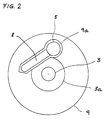
- FIG. 1 A first embodiment of the present invention will now be explained with reference to Figs. 1 to 6. Since the invention is concerned with the disk chucking mechanism of a disk drive, only the elements related to the disk chucking are shown in the Figures.
- Fig. 1 is a perspective exploded view of the disk chucking mechanism illustrating a rotary member or rotary plate 4, a spindle 3, a spindle hub 3a, a chucking magnet 9 and a chucking lever 8 carrying a drive pin 5.
- the spindle hub 3a is fixed to the spindle and provides a support for the disk hub which is not shown in Fig. 1.
- the rotary plate 4 is part of the rotor in this embodiment and is fixed to the spindle hub 3a such as by caulking.
- the chucking magnet 9, which is preferably a plastic magnet, is fixed to the spindle hub 3a, for instance it is glued to the perimeter of the spindle hub.
- the chucking magnet 9 has a center hole 9b for receiving the spindle hub 3a and a hole 9a for receiving the chucking lever 8.
- the chucking magnet 9 is disposed on the upper surface of rotary plate 4 with the spindle hub 3a received in its center hole 9b.
- the chucking lever 8 is also disposed on the upper surface of rotary plate 4 inside hole 9a of chucking magnet 8.
- Hole 9a and chucking lever 8 are sized such that chucking lever 8 is slidable on the upper surface of rotary plate 4 within a restricted range defined by the hole 9a.
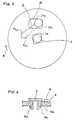
- Latch claws 8a are provided on the lower surface of chucking lever 8 to engage a hole 4a provided in the rotary plate 4 as is best shown in Fig. 6.
- the latch claws 8a prevent the chucking lever 8 from disengaging from rotary plate 4, the hole 4a and the latch claws 8a being sized to allow the above mentioned movement of the chucking lever 8 in the plane defined by the upper surface of rotary plate 4 (indicated by arrow G).
- the chucking lever 8 is substantially immovable in the axial direction, it is moveable within the said plane, this movement being restricted to the area defined by the hole 9a of the chucking magnet.
- the latch means comprising the latch claws 8a in cooperation with the lower surface of the rotary plate 4 surrounding hole 4a, some clearance in the axial direction will be inevitable. It is preferable to keep this clearance to the minimum possible.
- Fig. 6 illustrates one example for the latch means and it will be understood by those skilled in the art that other configurations of the latch means may be employed that provide the intended function.
- the spindle 3 When a disk cartridge is inserted into the disk drive, the spindle 3 will enter into the center hole 2a of the disk hub 2 (note that in Figs. 3 to 5 only the disk hub 2 of the disk cartridge is shown). However, in this initial state, the probability is low that the drive pin 5 fixed to the chucking lever 8 will be in a position to enter the drive hole 2b of the disk hub 2. Thus, when the spindle 3, the spindle hub 3a, the chucking magnet 9 and the chucking lever 8 start rotating together with rotary plate 4, the upper end face of the drive pin 5 will first slide on the lower side of the disk hub 2 prior to achieving the state shown in Fig. 3 where the drive pin 5 reached a position allowing it to enter the drive hole 2b.
- the force applied by the drive pin is composed of two components, one in the circumferential direction and another one in the radial direction.
- the end face of the chucking lever is shown to be convex and a pivot is formed when the convex surface is made to contact the two edge faces 9a1 and 9a2, i.e. by a two-point contact.
- the structure may be modified, for instance, in such a way that a one-point contact is established between the end face of the chucking lever and the chucking magnet to serve as said pivot.
- a pivot is formed between the chucking lever and the chucking magnet about which the chucking lever is made to turn thereby creating the centering force without requiring a biasing spring.
- no pivot pin is necessary since the pivot is formed by urging an end of the chucking lever into engagement with a portion of the edge of the hole 9a. This simplifies the structure and, in particular, the assembly.
- Figs. 7 and 8 illustrate a second embodiment of the present invention.
- Fig. 7 is a plan view corresponding to that of Fig. 2, and
- Fig. 8 is a partial cross-sectional view.
- This second embodiment is similar to the first embodiment and differs only with respect to the configuration of the chucking lever and its drive pin.
- the chucking 8 of the second embodiment is substantially shorter than the chucking lever 8 of the first embodiment.
- a hole 4b is provided in the rotary plate 4 at a position below the drive pin 5.
- An abutment plate 8c is arranged below the rotary plate 4 and connected, via an intermediate part 8b received in the hole 4b, to the chucking lever 8 (or the drive pin 5).
- the abutment plate 8c may for instance be the head of a screw whose shaft 8b is threadingly engaged with the drive pin 5.
- elements 8c and 8b may be integral with the drive pin 5 and/or the chucking lever 8.
- the elements 8b and 8c on the one hand and the hole 4b on the other hand are sized in such a way as to allow movement of the chucking lever 8 and the drive pin 5 in the plane defined by the upper surface of the rotary plate 4 while restricting an axial movement of the drive pin 5 and preventing the chucking lever 8 from disengaging from the rotary plate 4. Since the abutment plate 8c in the second embodiment provides the function of the latch claws 8a of the first embodiment, it goes without saying that the latch claws 8a are not required in this second embodiment.
- the chucking lever 8 and the drive pin 5 of the second embodiment are arranged to move in substantially the same way as the chucking lever 8 and the drive pin 5 of the first embodiment, the operation of the second embodiment is the same as that of the first embodiment.
- FIG. 9 A modification applicable to the first and the second embodiment is illustrated in Fig. 9 showing a plan view corresponding to Fig. 5. While in the first and second embodiments the drive pin is shown to be substantially cylindrical, it has a roughly triangular cross-sectional shape in the modification shown in Fig. 9. Two corners of the triangular shape are cut-off to provide abutment faces for abutting against the edge faces 2b1 and 2b2, respectively, of the drive hole 2b. Thus, with this modification the contact area between the drive pin 5 and the disk hub 2 is increased whereas the general operation is the same as that of the first and second embodiments.
- the drive pin 5 is shown to be an integral part of the chucking lever 8, it will be understood that the drive pin may be a separate element fixed to the chucking lever and may even be a drive roller as it is used in the prior art explained above.
- Figs. 10 and 11 illustrate a third embodiment of the present invention with Fig. 10 being a plan view corresponding to Figs. 2 and 7 and Fig. 11 being a partial cross-sectional view along line A-A in Fig. 10.
- This third embodiment of the invention differs from the previously explained embodiments in that, even though the chucking lever 8 and the drive pin 5 are disposed within a hole 9a of the chucking magnet 9, the range of movement of the chucking lever 8, in the plane defined by the rotary plate 4, is restricted by direct engagement of the chucking lever or members fixed to it with the metallic rotary plate 4 rather than by engagement with the chucking magnet.
- the hole 9a in the chucking magnet 9 is sized such that, in none of their possible positions, the chucking lever 8 and the drive pin 5 get into contact with the chucking magnet 9.
- a protrusion 8d extends from the lower side of the chucking lever and is received in a hole 4b provided in the rotary plate 4.
- the size and shape of the hole 4a as well as the size and shape of the hole 4b are such as to enable the chucking lever 8 to perform substantially the same movement as in the first embodiment.
- the chucking lever since the chucking lever is in direct engagement with the metallic rotary plate 4, the wear in areas 4d and 4e, which are edge faces of the substantially square shaped hole 4b, is smaller than that experienced at the edge faces 9a1 and 9a2 in the first embodiment where the chucking lever 8 engages the chucking magnet 9.
- the chucking magnet preferably is a plastic magnet whose wear resistance is smaller than that of the metallic material of the rotary plate, the durability of the chucking mechanism according to the third embodiment is improved compared to that of the first embodiment.
- the third embodiment achieves the same advantage in that the chucking lever is positioned within a hole of the chucking magnet 9 and, thus, does not require any additional space in the axial direction of the disk drive.
- the rotary plate 4 is equipped with an index detector (not shown in the drawing) for detecting the revolution of the spindle 3, it is possible to achieve a very high positional accuracy of the index detector and the drive pin 5 in the rotational direction. This is made possible because the positions of both, the index detector and the chucking lever 8 in the rotational direction are determined only by the accuracy of the rotary plate 4.
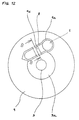
- Figs. 12 and 13 illustrate a fourth embodiment of the invention.
- Fig. 12 is a plan view of the disk chucking mechanism and
- Fig. 13 is a cross-sectional view along the line B-B in Fig. 12.
- the fourth embodiment is similar to the first embodiment and differs only in the means employed to prevent the chucking lever 8 from disengaging from the rotary plate 4.
- the hole 9a is formed in such a way as to leave a bridge portion 9c overlying the chucking lever 8 and thereby preventing it from becoming disengaged from the rotary plate 4.
- the bridge portion 9c is preferably designed to restrict the axial movement of the chucking lever 8 to a minimum.
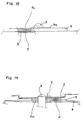
- the plane defined by the most upper portion of the drive pin 5 is oblique. Where the plane declines toward the spindle 3, the angle formed between this plane and the axis of the spindle is preferably set to be substantially equal to the angle formed between the disk hub 2 and the axis of the spindle in a case where the disk cartridge is inserted into the disk drive, the spindle 3 is received in the center hole 2a of the disk hub 2 but the drive pin 5 and the drive hole 2b are misaligned.
- Fig. 14 is a cross-sectional view which illustrates this condition.
- the oblique plane mentioned above is made to decline toward the direction of the movement of the drive pin 5 rather than the spindle, the above mentioned problem of the prior art may be overcome. If the top surface of the drive pin is inclined in this way, the edge of the drive hole will gradually slide up the oblique end face of the drive pin thereby gradually lifting the disk hub. This is advantageous and allows a smaller motor torque compared to the prior art where the edge of the drive hole has to slide up the relatively steep bevel causing a sudden increase in the motor load. Therefore, the oblique surface is set so that it is lower either on the side of the spindle 3, in the advancing direction of the drive pin 5, or in the middle of these two positions. In this way, incomplete chucking can be prevented and a good chucking device can be obtained.
- top surface of the drive pin 5 may be made flat, as shown in Figs. 8 and 14, alternatively, the top surface can be convex or concave.
- the slope which the disk hub 2 assumes as long as the drive pin 5 does not enter the drive hole is smallest when the top surface of the drive pin 5 is flat.
- the inclination of the disk hub 2 increases because the lower side of the disk hub 2 will lie on the protruding area of the convex surface.
- the configuration is preferably such that the outermost peripheral line of the convex or concave portion defines a base plane of the convex or concave portion, which is inclined in the same way as the flat surface of Figs. 8 and 14.
- the amount by which the drive pin 5 protrudes from the surface of the spindle hub 3a must be controlled to 0.7 mm or less. Otherwise, the incline of the disk hub 2 will increase when the disk hub 2 sits on the top surface of the drive pin 5, resulting in a situation in which the jacket (not shown in the drawing) presses hard on the disk hub 2, increasing the frictional force in this area. This will result in insufficient rotational torque of the spindle motor, making it impossible to drive and rotate the disk hub 2, as explained in the section discussing conventional technologies.
- the spatial requirement of the disk drive can be reduced by restricting the movement of the chucking lever, which is installed on the rotating plate which in turn is installed on the spindle, in the axial direction of the drive pin.
- the chucking mechanism can be configured using a unit chucking lever by installing an anti-disengagement device in the rotational support area, thus reducing the component count, improving assembly efficiency, and achieving small size and thin profile for the motor. These improvements ultimately result in great benefit in terms of achieving ultra-small size and ultra-thin profile for the disk drive.
- the shape of the drive pin is an important element in configuring a chucking device that can offer this benefit.
- the chucking lever is slidably supported on the surface of the rotary plate within a hole provided in the chucking magnet.
- the space required for the chucking magnet in the axial direction is effectively used also to accommodate the chucking lever, i.e. no extra space is required for the chucking lever.
- the chucking lever need not necessarily be supported directly on the rotary plate but may for instance be slidably supported on the chucking magnet or another intermediate member rotating together with the rotary plate.
- a recess could be provided and the chucking lever slidably supported on the bottom of the recess. In such case the chucking lever would have the same degree of freedom of movement as in the embodiments above and yet received in the chucking magnet such as not to increase the total height.
Landscapes
- Holding Or Fastening Of Disk On Rotational Shaft (AREA)
Applications Claiming Priority (2)
| Application Number | Priority Date | Filing Date | Title |
|---|---|---|---|
| JP26267793A JP3324232B2 (ja) | 1993-10-20 | 1993-10-20 | ディスクチャッキング機構及びそれを備えたディスク装置 |
| JP262677/93 | 1993-10-20 |
Publications (2)
| Publication Number | Publication Date |
|---|---|
| EP0650163A2 true EP0650163A2 (de) | 1995-04-26 |
| EP0650163A3 EP0650163A3 (de) | 1995-10-04 |
Family
ID=17379064
Family Applications (1)
| Application Number | Title | Priority Date | Filing Date |
|---|---|---|---|
| EP94116467A Withdrawn EP0650163A3 (de) | 1993-10-20 | 1994-10-19 | Plattenantrieb. |
Country Status (3)
| Country | Link |
|---|---|
| US (1) | US5701217A (de) |
| EP (1) | EP0650163A3 (de) |
| JP (1) | JP3324232B2 (de) |
Families Citing this family (8)
| Publication number | Priority date | Publication date | Assignee | Title |
|---|---|---|---|---|
| JP3638444B2 (ja) * | 1998-09-01 | 2005-04-13 | アルプス電気株式会社 | Fddチャッキング装置 |
| JP3607818B2 (ja) * | 1998-09-03 | 2005-01-05 | アルプス電気株式会社 | Fddチャッキング装置 |
| JP2000339807A (ja) * | 1999-05-28 | 2000-12-08 | Sankyo Seiki Mfg Co Ltd | ディスク回転駆動機構 |
| JP2003059148A (ja) | 2001-08-15 | 2003-02-28 | Alps Electric Co Ltd | ディスク回転駆動装置 |
| JP2003068001A (ja) * | 2001-08-24 | 2003-03-07 | Alps Electric Co Ltd | 磁気ディスク用チャッキング装置 |
| CN101661769B (zh) * | 2008-08-27 | 2011-05-04 | 广明光电股份有限公司 | 盘片夹持装置 |
| US11359079B2 (en) | 2013-09-20 | 2022-06-14 | 3M Innovative Properties Company | Polymer processing additive, compositions, and methods |
| RU2018141773A (ru) | 2018-11-27 | 2020-05-27 | 3М Инновейтив Пропертиз Компани | Композиции полимерных процессинговых добавок и изделия, полученные с использованием указанных композиций |
Family Cites Families (17)
| Publication number | Priority date | Publication date | Assignee | Title |
|---|---|---|---|---|
| JPS619866A (ja) * | 1984-06-22 | 1986-01-17 | Seiko Epson Corp | 回転駆動装置 |
| IT1179839B (it) * | 1984-11-30 | 1987-09-16 | Olivetti & Co Spa | Dispositivo per portare in rotazione un disco magnetico |
| JPS62257659A (ja) * | 1986-04-30 | 1987-11-10 | Toshiba Corp | メデイアチヤツキング機構 |
| JPS62293554A (ja) * | 1986-06-12 | 1987-12-21 | Alps Electric Co Ltd | デイスク駆動装置 |
| JPS6356621A (ja) * | 1986-08-27 | 1988-03-11 | Agency Of Ind Science & Technol | 微動装置 |
| US4855850A (en) * | 1986-12-27 | 1989-08-08 | Copal Company Limited | Disk drive apparatus with disk rotating means |
| JPS6478462A (en) * | 1987-06-16 | 1989-03-23 | Seiko Epson Corp | Disk rotation driving device |
| JPH01227281A (ja) * | 1988-03-08 | 1989-09-11 | Hitachi Maxell Ltd | デイスクカートリツジ及びデイスク駆動装置 |
| JPH0244562A (ja) * | 1988-08-03 | 1990-02-14 | Matsushita Electric Ind Co Ltd | 磁気ディスク回転駆動装置 |
| JP2664995B2 (ja) * | 1989-06-22 | 1997-10-22 | アルプス電気株式会社 | デイスクチヤツキング装置 |
| JP2811824B2 (ja) * | 1989-11-08 | 1998-10-15 | ソニー株式会社 | デイスクチヤツキング装置 |
| US5121273A (en) * | 1990-04-12 | 1992-06-09 | Micropolis Corporation | Computer disk head interconnect assembly |
| JPH0416653U (de) * | 1990-05-31 | 1992-02-12 | ||
| US5303102A (en) * | 1991-04-24 | 1994-04-12 | Seiko Epson Corporation | Disk drive apparatus having head guard |
| JPH05159483A (ja) * | 1991-06-10 | 1993-06-25 | Seiko Epson Corp | ディスク装置 |
| JP3278701B2 (ja) * | 1991-06-24 | 2002-04-30 | セイコーエプソン株式会社 | ディスク装置 |
| US5357387A (en) * | 1991-09-11 | 1994-10-18 | Matsushita Electric Industrial Co., Ltd. | Disk driving apparatus with inclined surface on engaging pin and with protector plate over motor |
-
1993
- 1993-10-20 JP JP26267793A patent/JP3324232B2/ja not_active Expired - Lifetime
-
1994
- 1994-10-19 EP EP94116467A patent/EP0650163A3/de not_active Withdrawn
-
1996
- 1996-07-31 US US08/690,940 patent/US5701217A/en not_active Expired - Lifetime
Also Published As
| Publication number | Publication date |
|---|---|
| JP3324232B2 (ja) | 2002-09-17 |
| US5701217A (en) | 1997-12-23 |
| EP0650163A3 (de) | 1995-10-04 |
| JPH07121961A (ja) | 1995-05-12 |
Similar Documents
| Publication | Publication Date | Title |
|---|---|---|
| JP4113522B2 (ja) | 記録ディスク駆動用モータ及びこの記録ディスク駆動用モータを用いた記録ディスク駆動装置 | |
| KR950001829B1 (ko) | 디스크 구동 장치 | |
| KR930003874B1 (ko) | 디스크의 회전구동장치 | |
| KR20030009041A (ko) | 디스크 유지 장치 | |
| EP0650163A2 (de) | Plattenantrieb | |
| US4747002A (en) | Disk clamping mechanism | |
| EP0099005A1 (de) | Magnetplattenspeicher | |
| KR100195380B1 (ko) | 디스크 파지 장치 | |
| US5138606A (en) | Disk drive device having a swingable lever carrying pin and positioned in a space between a rotary plate and a magnetic member mounted on the rotary plate | |
| US4669008A (en) | Disk support device | |
| JPS6341645Y2 (de) | ||
| US4649444A (en) | Disk support device having deformation limiting member | |
| US6259582B1 (en) | Chucking device in FDD | |
| JPH04188458A (ja) | ディスクチャツチング機構及びこれを備えたフレキシブルディスクドライブ装置 | |
| EP1267351B1 (de) | Plattenkassette | |
| JPH0438751A (ja) | ディスクチャッキング機構及びこれを備えたフレキシブルディスクドライブ装置 | |
| JPH0561848U (ja) | ディスク装置 | |
| JP3405390B2 (ja) | 光ディスクのチャッキング機構 | |
| JP2000113545A (ja) | スピンドルモ―タ | |
| US6259581B1 (en) | Chucking device in FDD | |
| JP2516158Y2 (ja) | ディスク装置 | |
| JPH039164Y2 (de) | ||
| KR930007039B1 (ko) | 디스크의 회전구동장치 | |
| JPH0418104Y2 (de) | ||
| JPH07240056A (ja) | ディスク装置の媒体昇降機構 |
Legal Events
| Date | Code | Title | Description |
|---|---|---|---|
| PUAI | Public reference made under article 153(3) epc to a published international application that has entered the european phase |
Free format text: ORIGINAL CODE: 0009012 |
|
| 17P | Request for examination filed |
Effective date: 19941019 |
|
| AK | Designated contracting states |
Kind code of ref document: A2 Designated state(s): DE FR GB IT |
|
| PUAL | Search report despatched |
Free format text: ORIGINAL CODE: 0009013 |
|
| AK | Designated contracting states |
Kind code of ref document: A3 Designated state(s): DE FR GB IT |
|
| STAA | Information on the status of an ep patent application or granted ep patent |
Free format text: STATUS: THE APPLICATION HAS BEEN WITHDRAWN |
|
| 18W | Application withdrawn |
Withdrawal date: 19951010 |
|
| R18W | Application withdrawn (corrected) |
Effective date: 19951010 |