EP0651060B1 - Verfahren zum Herstellen von hochfestem Stahl mit ausgezeichneter Beständigkeit gegen Spannungsrisskorrosion - Google Patents
Verfahren zum Herstellen von hochfestem Stahl mit ausgezeichneter Beständigkeit gegen Spannungsrisskorrosion Download PDFInfo
- Publication number
- EP0651060B1 EP0651060B1 EP93117726A EP93117726A EP0651060B1 EP 0651060 B1 EP0651060 B1 EP 0651060B1 EP 93117726 A EP93117726 A EP 93117726A EP 93117726 A EP93117726 A EP 93117726A EP 0651060 B1 EP0651060 B1 EP 0651060B1
- Authority
- EP
- European Patent Office
- Prior art keywords
- grains
- temperature
- steel
- diffusion type
- type reverse
- Prior art date
- Legal status (The legal status is an assumption and is not a legal conclusion. Google has not performed a legal analysis and makes no representation as to the accuracy of the status listed.)
- Expired - Lifetime
Links
Images



Classifications
-
- C—CHEMISTRY; METALLURGY
- C22—METALLURGY; FERROUS OR NON-FERROUS ALLOYS; TREATMENT OF ALLOYS OR NON-FERROUS METALS
- C22C—ALLOYS
- C22C38/00—Ferrous alloys, e.g. steel alloys
- C22C38/18—Ferrous alloys, e.g. steel alloys containing chromium
- C22C38/40—Ferrous alloys, e.g. steel alloys containing chromium with nickel
- C22C38/44—Ferrous alloys, e.g. steel alloys containing chromium with nickel with molybdenum or tungsten
-
- C—CHEMISTRY; METALLURGY
- C21—METALLURGY OF IRON
- C21D—MODIFYING THE PHYSICAL STRUCTURE OF FERROUS METALS; GENERAL DEVICES FOR HEAT TREATMENT OF FERROUS OR NON-FERROUS METALS OR ALLOYS; MAKING METAL MALLEABLE, e.g. BY DECARBURISATION OR TEMPERING
- C21D6/00—Heat treatment of ferrous alloys
- C21D6/001—Heat treatment of ferrous alloys containing Ni
-
- C—CHEMISTRY; METALLURGY
- C21—METALLURGY OF IRON
- C21D—MODIFYING THE PHYSICAL STRUCTURE OF FERROUS METALS; GENERAL DEVICES FOR HEAT TREATMENT OF FERROUS OR NON-FERROUS METALS OR ALLOYS; MAKING METAL MALLEABLE, e.g. BY DECARBURISATION OR TEMPERING
- C21D8/00—Modifying the physical properties of ferrous metals or ferrous alloys by deformation combined with, or followed by, heat treatment
- C21D8/02—Modifying the physical properties of ferrous metals or ferrous alloys by deformation combined with, or followed by, heat treatment during manufacturing of plates or strips
-
- C—CHEMISTRY; METALLURGY
- C22—METALLURGY; FERROUS OR NON-FERROUS ALLOYS; TREATMENT OF ALLOYS OR NON-FERROUS METALS
- C22C—ALLOYS
- C22C38/00—Ferrous alloys, e.g. steel alloys
- C22C38/18—Ferrous alloys, e.g. steel alloys containing chromium
- C22C38/40—Ferrous alloys, e.g. steel alloys containing chromium with nickel
- C22C38/46—Ferrous alloys, e.g. steel alloys containing chromium with nickel with vanadium
-
- C—CHEMISTRY; METALLURGY
- C21—METALLURGY OF IRON
- C21D—MODIFYING THE PHYSICAL STRUCTURE OF FERROUS METALS; GENERAL DEVICES FOR HEAT TREATMENT OF FERROUS OR NON-FERROUS METALS OR ALLOYS; MAKING METAL MALLEABLE, e.g. BY DECARBURISATION OR TEMPERING
- C21D1/00—General methods or devices for heat treatment, e.g. annealing, hardening, quenching or tempering
- C21D1/18—Hardening; Quenching with or without subsequent tempering
-
- C—CHEMISTRY; METALLURGY
- C21—METALLURGY OF IRON
- C21D—MODIFYING THE PHYSICAL STRUCTURE OF FERROUS METALS; GENERAL DEVICES FOR HEAT TREATMENT OF FERROUS OR NON-FERROUS METALS OR ALLOYS; MAKING METAL MALLEABLE, e.g. BY DECARBURISATION OR TEMPERING
- C21D2211/00—Microstructure comprising significant phases
- C21D2211/008—Martensite
Definitions
- the present invention relates to a process for producing an extra high tensile steel having a yield strength of 1080 MPa or more that has a high strength despite a low carbon content and is excellent in low temperature toughness and stress corrosion resistance in a stress corrosive environment, such as sea water and salt water.
- Examples of extra high tensile steel products having a high reliability underwater include a Ni-Cr-Mo-V-based high-toughness and extra-high-tensile steel proposed in Japanese Examined Patent Publication (Kokoku) No. 64-11105, characterized by comprising a Ni-containing steel having lowered N and O contents and capable of satisfying a requirement of Al (%) x N (%) x 10 4 ⁇ 1.5, which high-toughness and extra-high-tensile steel has a significant effect.
- the stress corrosion cracking resistance at the welding-heat affected zone in sea water is inferior to that in the air as compared with the base material, which requires further study regarding improvement in safety and reliability.
- Japanese Examined Patent Publication (Kokoku) No. 1-51526 proposes a process for producing an extra high tensile steel having an excellent stress corrosion cracking resistance, which comprises subjecting a Ni-Mo-Nb-based steel having a Ni content of 5 to 8% to direct quenching-and-tempering.
- the strength of the steel product is lower than that contemplated in the present invention.
- close control is necessary from the viewpoint of the homogeneity and anisotropy of the quality in the direction of the plate thickness. Further, there is a possibility that the stability of the quality is deteriorated in the widthwise direction and longitudinal direction within the steel plate.
- the conventional extra high tensile steel products have lower stress corrosion cracking resistance particularly at the welding-heat affected zone in sea water than in the air and are produced by processes that are disadvantageous in the homogeneity of the quality in the thicknesswise direction of the thick steel plate and the stability of the quality within the steel plate. That is, a further improvement in both the steel products and production processes has been desired in the art.
- US-A- 4 814 141 (Table 1 : Steel N)
- US-A- 4 946 516 deals with parameters relating to temperature and reduction in hot working and to parameters of heat treatment following hot working with respect to steel of similar composition, however denying any combination with the aforementioned US-A.
- US-A-4 946 516 corresponding to Japanese Unexamined Patent Publication (Kokai) No. 1-230713 proposes a process for producing a high-strength and high-toughness steel having an excellent stress corrosion cracking resistance. Although the stress corrosion cracking resistance has reached a high level through a lowering in the carbon content, the development of an extra high tensile steel product having a higher strength and a high toughness has been desired in the art.
- An object of the present invention is to provide a high tensile steel that has a good resistance to stress corrosion cracking in sea water or salt water, a high strength and a high toughness.
- the subject matter of the present invention is as follows.
- a process for producing an extra high tensile steel having an excellent stress corrosion cracking resistance comprises the steps of: heating a slab comprising, in terms of % by weight, 0.03 to 0.08% of C, 0.01 to 0.10% of Si, 0.05 to 0.65% of Mn, 8.0 to 11.0% of Ni, 0.5 to 1.5% of Mo, 0.2 to 1.5% of Cr, 0.02 to 0.20% of V and 0.01 to 0.08% of Al with the balance consisting of iron and unavoidable impurities or a slab comprising the above-described ingredients and further comprising at least one member selected from the group consisting of 0.2 to 1.5% of Cu, 0.005 to 0.10% of Nb and 0.005 to 0.03% of Ti as strength improving elements and 0.0005 to 0.005% of Ca as an element having a capability of regulating the form of inclusions to a temperature between 1000°C and 1250°C, hot-rolling the slab in an austenite recrystallization temperature region with a reduction ratio of 30 to 70%, subsequently rolling the rolled
- C is an element useful for improving the quenchability and easily increasing the strength. On the other hand, it has the greatest effect on an improvement in the stress corrosion cracking resistance of the welding-heat affected zone of the extra high tensile steel. When the content exceeds 0.08%, a significant lowering in the stress corrosion cracking resistance of the welding-heat affected zone occurs. On the other hand, when it is lower than 0.03%, the strength is unsatisfactory. For this reason, the C content is limited to 0.03 to 0.08%.
- Si is useful for improving the strength. It is also indispensable for steel making. Si is contained in an amount of 0.01% at the smallest. In the case of a Ni-containing steel, when the Si content exceeds 0.10%, the temper brittleness becomes so great that the low-temperature toughness is lowered. For this reason, the Si content is limited to 0.01 to 0.10%.
- Mn is necessary for improving the quenchability and hot workability.
- the Mn content is less than 0.05%, the improvement effect cannot be attained.
- the addition of Mn increases the susceptibility to temper brittleness and deteriorates the stress corrosion cracking resistance of the welding-heat affected zone, so that the Mn content should be 0.65% or less. For this reason, the Mn content is limited to 0.05 to 0.65%.
- Ni is useful for enhancing the stacking fault energy, increasing the cross slip, facilitating the occurrence of stress relaxation, increasing the impact absorption energy and improving the low-temperature toughness.
- Ni exhibits the best effect when it is present together with Mo, Cr, V and other elements contained in the steel of the present invention.
- a grain mixture of diffusion type reverse transformed ⁇ grains comprising a massive austenite formed by dissolution of carbides with non-diffusion type reverse transformed ⁇ grains comprising a group of acicular austenites not involving the dissolution of carbides is formed at the reheating temperature in the step of reheating and quenching of the steel after controlled rolling and water cooling, and the non-diffusion type reverse transformed ⁇ grains have a higher dislocation density than the diffusion type reverse transformed ⁇ grains and very effectively contributes to an increase in the strength.
- Ni serves to delay the dissolution of carbides of Mo, V, Cr and other elements, which enables the group of acicular austenites to be stably maintained up to a high temperature. For this reason, Ni should be added in an amount of 8.0% or more for the purpose of ensuring the strength by taking advantage of stabilization of the non-diffusion type reverse transformed ⁇ grains at a high temperature. On the other hand, when the amount of addition of Ni exceeds 11.0%, austenite is precipitated during tempering, which deteriorates the strength and toughness. For this reason, the Ni content is limited to 8.0 to 11.0%.
- Mo is an element useful for the precipitation hardening by tempering and the inhibition of temper brittleness and, at the same time, important to the present invention as with Ni. Specifically, since a fine carbide composed mainly of Mo precipitated in the course of heating in the step of reheating and quenching remains as an undissolved carbide up to a high temperature, the group of acicular austenites having a high dislocation density can be maintained at a high temperature, so that Mo is necessary for ensuring the strength.
- the Mo content is less than 0.6%, the dissolution of the Mo carbide occurs in the reheating and quenching, which causes the non-diffusion type transformed ⁇ grains to be rapidly attacked by the diffusion type reverse transformed ⁇ grains, so that a contemplated strength cannot be obtained.
- the Mo content exceeds 1.5%, the effect of improving the strength is saturated, so that the amount of coarse alloy carbides is increased to lower the toughness. For this reason, the Mo content is limited to 0.5 to 1.5%.
- the Cr serves to improve the quenchability and is useful for ensuring the strength.
- the Cr content should be 0.2% at the lowest. When it exceeds 1.5%, the increase in the strength is saturated and the toughness is lowered. For this reason, the Cr content is limited to 0.2 to 1.5%.
- V is useful for forming a carbonitride in the tempering that is precipitation-hardened to ensure the strength. Further, as with Mo, V is finely precipitated during heating in the reheating and quenching to increase the stability of non-diffusion type reverse transformed ⁇ grains comprising a group of acicular austenites, which is useful for ensuring the strength.
- V content is less than 0.02%, no contemplated strength cannot be attained, while when it exceeds 0.20%, the toughness is lowered. For this reason, the V content is limited to 0.02 to 0.20%.
- Al is necessary for deoxidation and, at the same time, serves to form a nitride during heating of the slab, which is useful for refining austenite grains.
- the Al content is less than 0.01%, this effect is small.
- it exceeds 0.08% the amount of inclusions comprising alumina becomes so large that the toughness is inhibited. For this reason, the Al content is limited to 0.01 to 0.08%.
- At least one member selected from (Cu, Nb, Ti) and Ca is added besides the above-described ingredients.
- Cu, Nb and Ti exhibit an equalizing action, that is, serve to improve the strength of the steel.
- Nb and Ti are useful also for the refinement of austenite grains.
- the Cu, Nb and Ti contents exceed 1.5%, 0.05% and 0.03%, respectively, not only the low-temperature toughness is lowered but also the susceptibility to stress corrosion cracking is enhanced. For this reason, the Cu, Nb and Ti contents are limited to the above-described respective ranges.
- Ca is very useful for spheroidizing nonmetallic inclusions and has the effect of improving the low-temperature toughness and reducing the anisotropy of the toughness.
- the Ca content should be 0.0005% at the lowest.
- the toughness is lowered due to an increase in the amount of inclusions.
- the Ca content is limited to 0.0005 to 0.005%.
- the steel of the present invention contains, besides the above-described ingredients, P, S, N, O and other elements as unavoidable impurities that are detrimental to the toughness and stress corrosion cracking resistance characteristic of the steel of the present invention and, therefore, the amount of these unavoidable impurities is as small as possible.
- the contents of P, S, N and O are preferably regulated to 0.005% or less, 0.003% or less, 0.0050% and 0.0030%, respectively.
- the production process should be proper for attaining the strength, toughness and stress corrosion cracking resistance contemplated in the present invention. Accordingly, in the process of the present invention, the rolling, cooling and reheating-quenching-tempering conditions were limited for the following reasons.
- a slab comprising the above-described ingredients is heated to 1000 to 1250°C.
- the slab in order to attain, besides the refinement of heated austenite grains, utilization of the strengthening by taking advantage of the above-described non-diffusion type reverse transformed ⁇ and fine precipitation in the reheating-quenching-tempering after the hot rolling, the slab should be heated to 1000°C or above to sufficiently dissolve Mo, Cr, V, etc., in a solid solution form.
- heated austenite grains are coarsened, and it becomes difficult to refine the austenite grains in the subsequent rolling, which is causative of a lowering in the toughness.
- the heating temperature of the slab is limited to 1000 to 1250°C.
- the heated steel is then hot-rolled in such a manner that it is rolled in an austenite recrystallization temperature region with a reduction ratio of 30 to 70% and then in austenite nonrecrystallization temperature region with a reduction ratio of 20 to 60%.
- This is effect as a pretreatment for the refinement of non-diffusion type reverse transformed ⁇ grains in a grain mixture of diffusion type reverse transformed ⁇ grains with non-diffusion type reverse transformed ⁇ grains formed during reheating and quenching after the rolling.
- the austenite grains should be sufficiently refined by rolling.
- the austenite grains should be refined as much as possible in the rolling recrystallization, and a deformation band should be introduced into the austenite grains by nonrecrystallization rolling to further refine the grains.
- the reduction ratio should be in the range of 30 to 70% in the recrystallization temperature region and in the range of from 20 to 60% in the nonrecrystallization temperature region, and in these respective ranges, the reduction ratio in the recrystallization temperature region should be higher than that in the nonrecrystallization temperature region.
- the hot-rolled steel is cooled with water from a temperature of 600°C or above after the completion of roll finishing.
- the water cooling is effected for the purpose of freezing the work strain introduced in the hot rolling to provide a single phase martensite structure including a work dislocation.
- a carbonitride can be preferentially precipitated, so that the non-diffusion type reverse transformed ⁇ grains are stably maintained.
- fine grained diffusion type reverse transformed ⁇ grains are formed from old austenite grain boundaries and deformation band, and after the completion of roll finishing, the strength and toughness are higher than those attained by the air cooling.
- the water cooling is effected from a temperature of 600°C or below, the work strain disappears and the stability of the non-diffusion type reverse transformed ⁇ grains is lowered, which is causative of a lowering in the strength.
- the steel after hot rolling and water cooling is then reheated to such a proper temperature that the area ratio of the non-diffusion type reverse transformed ⁇ grains and the area ratio of the diffusion type reverse transformed ⁇ grains become 40 to 80% and 20 to 60%, respectively, followed by quenching.
- reheating is effected with the fine grained martensite having a deformation band formed within austenite grains used as a precursor structure
- diffusion type reverse transformed ⁇ grains comprising an ordinary massive austenite are formed from old austenite grain boundaries and intragranular deformation band while a group of acicular austenites are formed from the intragranular martensite. They coexist together with carbides and ferrite. Since the acicular austenite is produced by non-diffusion type (martensitic) reverse transformation, it has a large amount of dislocation that contributes to an increase in the strength.
- the quenching of this steel provides no martensitic structure having a high dislocation density, so that an increase in the strength cannot be attained.
- the group of acicular austenites increase their area to form non-diffusion type reverse transformed ⁇ grains that are stably maintained up to a high temperature and become fine austenite grains comprising a mixture thereof with diffusion type reverse transformed ⁇ grains, which mixture can be quenched to form a martensitic structure into which further dislocation has been introduced, so that an increase in the strength, an increase in the toughness and stress corrosion cracking resistance can be attained.
- the temperature region is such that the area ratio of the non-diffusion type reverse transformed ⁇ grains is 40% or less with the area ratio of the diffusion type reverse transformed ⁇ grains being dominant, the dissolution and aggregation coarsening of carbonitrides of Mo, V, etc., cause the non-diffusion type reverse transformed ⁇ grains contributing to strengthening after quenching to be converted to ordinary diffusion type reverse transformed ⁇ grains, which gives rise to a rapid lowering in the dislocation density and a lowering in the quench hardness. As a result, the strength is lowered, and the stress corrosion cracking resistance is somewhat lowered due to coarsening of precipitates at grain boundaries.
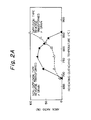
- Fig. 1 is a diagram showing a change in the area ratio of non-diffusion type reverse transformed ⁇ grains and the area ratio of diffusion type reverse transformed ⁇ grains with an increase in the reheating-quenching temperature after controlled rolling-water cooling.
- the steel B of the present invention (a steel comprising a composition of 0.06% C - 9.7% Ni - 1.2% Mo - 0.1% V) listed in Table 1 was subjected to controlled rolling-water cooling and quenched with the reheating-quenching temperature being varied (the change in the area ratio of non-diffusion type reverse transformed ⁇ grains and the area ratio of diffusion type reverse transformed ⁇ grains with the reheating-quenching temperature being shown in Fig. 2 (A)) and then tempered. In this case, the strength and stress corrosion cracking resistance (limit of K lSCC value) after the tempering are shown in Fig. 2 (C) and Fig. 2 (B), respectively.
- the steel of the present invention in the step of reheating and quenching, when the steel is reheated to such a temperature region that the area ratio of the non-diffusion type reverse transformed ⁇ grains and the area ratio of the diffusion type reverse transformed ⁇ grains become in the range of from 40 to 80% and in the range of from 20 to 60%, respectively, a strength increasing phenomenon occurs and the resultant steel has an intended high strength and is satisfactory also in stress corrosion cracking resistance.
- the steel after reheating and quenching is then tempered at a temperature of an Ac l point or below.
- the temperature exceeds the Ac l point, the strength and toughness are lowered due to the formation of unstable austenite.
- the tempering temperature is limited to Ac l point or below for the purpose of sufficiently precipitation-strengthening alloy carbides of Mo, Cr, V, etc., to provide a high strength and a high toughness.
- the steel provided by the above-described production process has a high strength and a high toughness despite a low carbon content and an remarkably improved stress corrosion cracking resistance.
- Steels having compositions specified in Table 1 were produced by the melt process to provide slabs that were then used to produce steel plates having a thickness of 20 to 80 mm under production conditions according to the process of the present invention or comparative process specified in Table 2.
- the mechanical properties of these base materials and the K lSCC value (limiting fracture toughness value relative to stress corrosion cracking resistance) of the base material portion and welding-heat affected zone were examined.
- the welding was effected at a heat input of 25 kJ/cm by TIG welding,
- the stress corrosion cracking resistance is evaluated by effecting a constant load test under this environment at a K value (a coefficient of stress necessary for preventing the occurrence of cracking at the tip of the notch) on various levels to determine a limit of K lSCC value that does not cause a fracture at a certain K value or less.
- K value a coefficient of stress necessary for preventing the occurrence of cracking at the tip of the notch
- a limit of K lSCC value that does not cause a fracture at a certain K value or less.
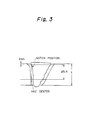
- a notch is provided at the center of HAZ as shown in Fig. 3.
- the thick underlined portion is outside the scope of the present invention and unsatisfactory in the properties thereof.
- the base materials had good mechanical properties, i.e., a high strength and a high toughness, and with respect to the stress corrosion cracking resistance as well, both the base material and welding-heat affected zone had a sufficiently high K lSCC value.
- the reheating temperature for quenching is high, non-diffusion type reverse transformed ⁇ grains are not formed with diffusion type reverse transformed ⁇ grains alone being left, so that the strength of the base material is unsatisfactory. Further, there is a tendency that precipitates at grains boundaries are coarsened to lower the limit of K lSCC value of the base material.
- the reheating temperature for quenching is low, a large amount of ferrite is mixed into between the group of acicular austenites, which makes it impossible to form non-diffusion type reverse transformed ⁇ grains having a high hardness, so that the strength and toughness are unsatisfactory.
- composition range and process according to the present invention have made it possible to produce an extra high tensile steel having a yield strength of 1080 MPa or more that has a high strength and a high toughness and an excellent stress corrosion cracking resistance. This has enabled satisfactory safety to be ensured under service environmental conditions.
Landscapes
- Chemical & Material Sciences (AREA)
- Engineering & Computer Science (AREA)
- Mechanical Engineering (AREA)
- Materials Engineering (AREA)
- Metallurgy (AREA)
- Organic Chemistry (AREA)
- Physics & Mathematics (AREA)
- Thermal Sciences (AREA)
- Crystallography & Structural Chemistry (AREA)
- Heat Treatment Of Steel (AREA)
Claims (3)
- Verfahren zur Herstellung eines Stahls von außergewöhnlich hoher Zugfestigkeit mit hervorragender Spannungsrißkorrosionsbeständigkeit, mit den folgenden Schritten: Erwärmen einer Bramme mit den folgenden Bestandteilen in Gew.-%: 0,03 bis 0,08% C, 0,01 bis 0,10% Si, 0,05 bis 0,65% Mn, 8,0 bis 11,0% Ni, 0,5 bis 1,5% Mo, 0,2 bis 1,5% Cr, 0,02 bis 0,20% V und 0,01 bis 0,08% Al, wobei der Rest aus Eisen und unvermeidlichen Verunreinigungen besteht, auf eine Temperatur zwischen 1000°C und 1250°C, Warmwalzen der Bramme in einem austenitischen Rekristallisations-Temperaturbereich mit einem Reduktionsgrad von 30 bis 70%, anschließendes Walzen des gewalzten Blechs in einem austenitischen Nichtrekristallisations-Temperaturbereich mit einem Reduktionsgrad von 20 bis 60%, Fertigwalzen des gewalzten Blechs, Wasserkühlung des fertiggewalzten Stahlblechs von einer Temperatur von 600°C oder darüber, dann Wiedererwärmen des abgekühlten Stahlblechs, so daß es einen Flächenanteil von 40 bis 80% an rückumgewandelten austenitischen Körnern vom Nichtdiffusionstyp und einen Flächenanteil von 20 bis 60% an rückumgewandelten austenitischen Körnern vom Diffusionstyp aufweist, Abschrecken des wiedererwärmten Stahlblechs und anschließendes Glühen des abgeschreckten Stahlblechs bei einer Temperatur am Ac1-Punkt oder darunter.
- Verfahren zur Herstellung eines Stahls von außergewöhnlich hoher Zugfestigkeit mit hervorragender Spannungsrißkorrosionsbeständigkeit, mit den folgenden Schritten: Erwärmen einer Bramme mit den folgenden Bestandteilen in Gew.-%: 0,03 bis 0,08% C, 0,01 bis 0,10% Si, 0,05 bis 0,65% Mn, 8,0 bis 11,0% Ni, 0,5 bis 1,5% Mo, 0,2 bis 1,5% Cr, 0,02 bis 0,20% V und 0,01 bis 0,08% Al, und ferner mit mindestens einem Element, ausgewählt aus der Gruppe, die aus 0,2 bis 1,5% Cu, 0,005 bis 0,10% Nb und 0,005 bis 0,03% Ti als festigkeitsverbessernden Elementen sowie aus 0,0005 bis 0,005% Ca als einem Element mit der Fähigkeit zur Regulierung der Form von Einschlüssen besteht, wobei der Rest aus Eisen und unvermeidlichen Verunreinigungen besteht, auf eine Temperatur zwischen 1000°C und 1250°C, Warmwalzen der Bramme in einem austenitischen Rekristallisations-Temperaturbereich mit einem Reduktionsgrad von 30 bis 70%, anschließendes Walzen des gewalzten Blechs in einem austenitischen Nichtrekristallisations-Temperaturbereich mit einem Reduktionsgrad von 20 bis 60%, Fertigwalzen des gewalzten Blechs, Wasserkühlung des fertiggewalzten Stahlblechs von einer Temperatur von 600°C oder darüber, dann Wiedererwärmen des abgekühlten Stahlblechs, so daß es einen Flächenanteil von 40 bis 80% an rückumgewandelten austenitischen Körnern vom Nichtdiffusionstyp und einen Flächenanteil von 20 bis 60% an rückumgewandelten austenitischen Körnern vom Diffusionstyp aufweist, Abschrecken des wiedererwärmten Stahlblechs und anschließendes Glühen des abgeschreckten Stahlblechs bei einer Temperatur am Ac1-Punkt oder darunter.
- Stahlblech von außergewöhnlich hoher Zugfestigkeit, herstellbar mit dem Verfahren nach Anspruch 1 oder 2.
Priority Applications (4)
| Application Number | Priority Date | Filing Date | Title |
|---|---|---|---|
| JP4268376A JP2537118B2 (ja) | 1992-10-07 | 1992-10-07 | 耐応力腐食割れ性超高張力鋼の製造方法 |
| US08/144,927 US5447581A (en) | 1992-10-07 | 1993-10-28 | Process for producing extra high tensile steel in 1080 MPa yield strength class having excellent stress corrosion cracking resistance |
| EP93117726A EP0651060B1 (de) | 1992-10-07 | 1993-11-02 | Verfahren zum Herstellen von hochfestem Stahl mit ausgezeichneter Beständigkeit gegen Spannungsrisskorrosion |
| DE1993626068 DE69326068T2 (de) | 1993-11-02 | 1993-11-02 | Verfahren zum Herstellen von hochfestem Stahl mit ausgezeichneter Beständigkeit gegen Spannungsrisskorrosion |
Applications Claiming Priority (3)
| Application Number | Priority Date | Filing Date | Title |
|---|---|---|---|
| JP4268376A JP2537118B2 (ja) | 1992-10-07 | 1992-10-07 | 耐応力腐食割れ性超高張力鋼の製造方法 |
| US08/144,927 US5447581A (en) | 1992-10-07 | 1993-10-28 | Process for producing extra high tensile steel in 1080 MPa yield strength class having excellent stress corrosion cracking resistance |
| EP93117726A EP0651060B1 (de) | 1992-10-07 | 1993-11-02 | Verfahren zum Herstellen von hochfestem Stahl mit ausgezeichneter Beständigkeit gegen Spannungsrisskorrosion |
Publications (2)
| Publication Number | Publication Date |
|---|---|
| EP0651060A1 EP0651060A1 (de) | 1995-05-03 |
| EP0651060B1 true EP0651060B1 (de) | 1999-08-18 |
Family
ID=27235238
Family Applications (1)
| Application Number | Title | Priority Date | Filing Date |
|---|---|---|---|
| EP93117726A Expired - Lifetime EP0651060B1 (de) | 1992-10-07 | 1993-11-02 | Verfahren zum Herstellen von hochfestem Stahl mit ausgezeichneter Beständigkeit gegen Spannungsrisskorrosion |
Country Status (3)
| Country | Link |
|---|---|
| US (1) | US5447581A (de) |
| EP (1) | EP0651060B1 (de) |
| JP (1) | JP2537118B2 (de) |
Families Citing this family (7)
| Publication number | Priority date | Publication date | Assignee | Title |
|---|---|---|---|---|
| JP2537118B2 (ja) * | 1992-10-07 | 1996-09-25 | 新日本製鐵株式会社 | 耐応力腐食割れ性超高張力鋼の製造方法 |
| DE19755409A1 (de) * | 1997-12-12 | 1999-06-17 | Econsult Unternehmensberatung | Nichtrostender Baustahl und Verfahren zu seiner Herstellung |
| JP4189133B2 (ja) * | 2001-03-27 | 2008-12-03 | 独立行政法人科学技術振興機構 | 普通低炭素鋼を低ひずみ加工・焼鈍して得られる超微細結晶粒組織を有する高強度・高延性鋼板およびその製造方法 |
| KR100843844B1 (ko) * | 2006-11-10 | 2008-07-03 | 주식회사 포스코 | 균열성장 저항성이 우수한 초고강도 라인파이프용 강판 및그 제조방법 |
| CN114231700A (zh) * | 2021-11-25 | 2022-03-25 | 大连透平机械技术发展有限公司 | 一种9%Ni材料的热处理及冷冻处理方法 |
| CN115637372A (zh) * | 2022-11-12 | 2023-01-24 | 南阳汉冶特钢有限公司 | 具有屈服平台性能q460gjdz35钢板的生产方法 |
| CN118880173B (zh) * | 2022-12-05 | 2025-10-03 | 江苏省沙钢钢铁研究院有限公司 | 海洋工程用低温钢及其生产方法 |
Family Cites Families (9)
| Publication number | Priority date | Publication date | Assignee | Title |
|---|---|---|---|---|
| FR2307879A1 (fr) * | 1975-04-18 | 1976-11-12 | Siderurgie Fse Inst Rech | Toles en acier au nickel pour utilisation a basse temperature |
| JPS569358A (en) * | 1979-07-03 | 1981-01-30 | Nippon Steel Corp | High strength high toughness steel |
| JPS57188655A (en) * | 1981-05-16 | 1982-11-19 | Kawasaki Steel Corp | Superhigh tensile steel with superior toughness at low temperature |
| JPS61127815A (ja) * | 1984-11-26 | 1986-06-16 | Nippon Steel Corp | 高アレスト性含Ni鋼の製造法 |
| JPS61130462A (ja) * | 1984-11-28 | 1986-06-18 | Tech Res & Dev Inst Of Japan Def Agency | 降伏応力110kgf/mm↑2以上の耐応力腐蝕割れ性のすぐれた高靭性超高張力鋼 |
| JPS63241114A (ja) * | 1986-11-14 | 1988-10-06 | Nippon Steel Corp | 耐応力腐食割れ性の優れた高靭性高張力鋼の製造法 |
| JPS6451526A (en) * | 1987-08-21 | 1989-02-27 | Nec Corp | Fair copy processing system for program by designating range |
| JPH01230713A (ja) * | 1988-03-08 | 1989-09-14 | Nippon Steel Corp | 耐応力腐食割れ性の優れた高強度高靭性鋼の製造法 |
| JP2537118B2 (ja) * | 1992-10-07 | 1996-09-25 | 新日本製鐵株式会社 | 耐応力腐食割れ性超高張力鋼の製造方法 |
-
1992
- 1992-10-07 JP JP4268376A patent/JP2537118B2/ja not_active Expired - Fee Related
-
1993
- 1993-10-28 US US08/144,927 patent/US5447581A/en not_active Expired - Lifetime
- 1993-11-02 EP EP93117726A patent/EP0651060B1/de not_active Expired - Lifetime
Also Published As
| Publication number | Publication date |
|---|---|
| JP2537118B2 (ja) | 1996-09-25 |
| EP0651060A1 (de) | 1995-05-03 |
| JPH06116639A (ja) | 1994-04-26 |
| US5447581A (en) | 1995-09-05 |
Similar Documents
| Publication | Publication Date | Title |
|---|---|---|
| US5876521A (en) | Ultra high strength, secondary hardening steels with superior toughness and weldability | |
| CA2295582C (en) | Ultra-high strength, weldable steels with excellent ultra-low temperature toughness | |
| US4946516A (en) | Process for producing high toughness, high strength steel having excellent resistance to stress corrosion cracking | |
| EP1025271B1 (de) | Ultrahochfeste, schweissbare, im wesentlichen bor-freie stähle mit überragender zähigkeit | |
| EP1015651B1 (de) | Ultra-hochfeste, schweissbare, borenthaltende stähle mit ausgezeichneter zähigkeit | |
| US5900075A (en) | Ultra high strength, secondary hardening steels with superior toughness and weldability | |
| EP0320003B1 (de) | Verfahren zur Herstellung von Stahl mit niedrigem Verhältnis der Elastizitätsgrenze zur Bruchfestigkeit | |
| US4826543A (en) | Process for producing high toughness, high strength steel having excellent resistance to stress corrosion cracking | |
| US5061325A (en) | Method of producing high tension steel superior in weldability and low-temperature toughness | |
| JP4344073B2 (ja) | 高温強度に優れた高張力鋼およびその製造方法 | |
| CN115216685A (zh) | 一种具有高止裂性能的大厚度钢板及其制造方法 | |
| JP2002129281A (ja) | 溶接部の疲労特性に優れた溶接構造用高張力鋼およびその製造方法 | |
| US5447581A (en) | Process for producing extra high tensile steel in 1080 MPa yield strength class having excellent stress corrosion cracking resistance | |
| JP2662409B2 (ja) | 低温靭性の優れた極厚調質高張力鋼板の製造方法 | |
| US12037667B2 (en) | High-strength steel having excellent resistance to sulfide stress cracking, and method for manufacturing same | |
| JPH09137253A (ja) | 耐応力腐食割れ性および低温靱性に優れた超高張力鋼およびその製造方法 | |
| US5827379A (en) | Process for producing extra high tensile steel having excellent stress corrosion cracking resistance | |
| JPH0413406B2 (de) | ||
| EP0651059B1 (de) | Verfahren zum Herstellen von hochfestem Stahl mit ausgezeichneter Beständigkeit gegen Spannungsrisskorrosion | |
| JPS625986B2 (de) | ||
| JPH03236420A (ja) | 耐水素誘起割れ性、耐硫化物応力腐食割れ性および低温靭性に優れた鋼板の製造方法 | |
| JP7197699B2 (ja) | 水素誘起割れ抵抗性に優れた圧力容器用鋼材及びその製造方法 | |
| JPS6358906B2 (de) | ||
| JP2562771B2 (ja) | 耐応力腐食割れ性に優れた超高張力鋼の製造方法 | |
| JPS6338518A (ja) | 耐水素誘起割れ性に優れた鋼板の製造方法 |
Legal Events
| Date | Code | Title | Description |
|---|---|---|---|
| PUAI | Public reference made under article 153(3) epc to a published international application that has entered the european phase |
Free format text: ORIGINAL CODE: 0009012 |
|
| 17P | Request for examination filed |
Effective date: 19931202 |
|
| AK | Designated contracting states |
Kind code of ref document: A1 Designated state(s): DE FR IT SE |
|
| GRAG | Despatch of communication of intention to grant |
Free format text: ORIGINAL CODE: EPIDOS AGRA |
|
| 17Q | First examination report despatched |
Effective date: 19981125 |
|
| GRAG | Despatch of communication of intention to grant |
Free format text: ORIGINAL CODE: EPIDOS AGRA |
|
| GRAH | Despatch of communication of intention to grant a patent |
Free format text: ORIGINAL CODE: EPIDOS IGRA |
|
| GRAH | Despatch of communication of intention to grant a patent |
Free format text: ORIGINAL CODE: EPIDOS IGRA |
|
| GRAA | (expected) grant |
Free format text: ORIGINAL CODE: 0009210 |
|
| AK | Designated contracting states |
Kind code of ref document: B1 Designated state(s): DE FR IT SE |
|
| REF | Corresponds to: |
Ref document number: 69326068 Country of ref document: DE Date of ref document: 19990923 |
|
| ITF | It: translation for a ep patent filed | ||
| ET | Fr: translation filed | ||
| PLBE | No opposition filed within time limit |
Free format text: ORIGINAL CODE: 0009261 |
|
| STAA | Information on the status of an ep patent application or granted ep patent |
Free format text: STATUS: NO OPPOSITION FILED WITHIN TIME LIMIT |
|
| 26N | No opposition filed | ||
| PGFP | Annual fee paid to national office [announced via postgrant information from national office to epo] |
Ref country code: FR Payment date: 20121130 Year of fee payment: 20 Ref country code: DE Payment date: 20121031 Year of fee payment: 20 |
|
| PGFP | Annual fee paid to national office [announced via postgrant information from national office to epo] |
Ref country code: SE Payment date: 20121113 Year of fee payment: 20 Ref country code: IT Payment date: 20121110 Year of fee payment: 20 |
|
| REG | Reference to a national code |
Ref country code: DE Ref legal event code: R082 Ref document number: 69326068 Country of ref document: DE Representative=s name: VOSSIUS & PARTNER, DE Effective date: 20130227 Ref country code: DE Ref legal event code: R081 Ref document number: 69326068 Country of ref document: DE Owner name: NIPPON STEEL & SUMITOMO METAL CORPORATION, JP Free format text: FORMER OWNER: NIPPON STEEL CORP., TOKIO/TOKYO, JP Effective date: 20130227 |
|
| REG | Reference to a national code |
Ref country code: DE Ref legal event code: R071 Ref document number: 69326068 Country of ref document: DE |
|
| REG | Reference to a national code |
Ref country code: SE Ref legal event code: EUG |
|
| PG25 | Lapsed in a contracting state [announced via postgrant information from national office to epo] |
Ref country code: DE Free format text: LAPSE BECAUSE OF EXPIRATION OF PROTECTION Effective date: 20131105 |