EP0652430B1 - Verfahren und Vorrichtung zur Bestimmung des Russgehaltes von Kautschukmischungen - Google Patents
Verfahren und Vorrichtung zur Bestimmung des Russgehaltes von Kautschukmischungen Download PDFInfo
- Publication number
- EP0652430B1 EP0652430B1 EP93113036A EP93113036A EP0652430B1 EP 0652430 B1 EP0652430 B1 EP 0652430B1 EP 93113036 A EP93113036 A EP 93113036A EP 93113036 A EP93113036 A EP 93113036A EP 0652430 B1 EP0652430 B1 EP 0652430B1
- Authority
- EP
- European Patent Office
- Prior art keywords
- concentration
- carbon black
- measurement
- carbon
- measurements
- Prior art date
- Legal status (The legal status is an assumption and is not a legal conclusion. Google has not performed a legal analysis and makes no representation as to the accuracy of the status listed.)
- Expired - Lifetime
Links
Images


Classifications
-
- G—PHYSICS
- G01—MEASURING; TESTING
- G01N—INVESTIGATING OR ANALYSING MATERIALS BY DETERMINING THEIR CHEMICAL OR PHYSICAL PROPERTIES
- G01N21/00—Investigating or analysing materials by the use of optical means, i.e. using sub-millimetre waves, infrared, visible or ultraviolet light
- G01N21/62—Systems in which the material investigated is excited whereby it emits light or causes a change in wavelength of the incident light
- G01N21/71—Systems in which the material investigated is excited whereby it emits light or causes a change in wavelength of the incident light thermally excited
- G01N21/718—Laser microanalysis, i.e. with formation of sample plasma
-
- G—PHYSICS
- G01—MEASURING; TESTING
- G01N—INVESTIGATING OR ANALYSING MATERIALS BY DETERMINING THEIR CHEMICAL OR PHYSICAL PROPERTIES
- G01N33/00—Investigating or analysing materials by specific methods not covered by groups G01N1/00 - G01N31/00
- G01N33/44—Resins; Plastics; Rubber; Leather
- G01N33/445—Rubber
Definitions
- the invention concerns a process for determining the carbon black concentration and distribution in rubber compounds and other carbon black-containing materials using pulsed laser beams focused on the material surface each of which produce a plasma with a radiation characteristic of the elements or molecules contained therein and divide the surface with their end regions into grid areas in which are located measuring points formed by the laser beam focuses, whereby the characteristic radiation, spectrally dispersed in the form of spectral lines or molecule bands, is measured by a detector unit and whereby from the concentration values calculated by reference to numerical ratios from the radiation intensities of selected elements/molecules with subsequent storage and allocated to the relevant measuring points, the concentration value curve at least over a section of the surface is established.
- the present invention lies in having perceived, as an essential part of a tyre manufacturing process, the technical problem of measuring the carbon (C) associated with the carbon black separate from the carbon of the rubber material, particularly and preferably based on different responses to ignition.
- the invention also concerns a process for manufacturing a pneumatic tyre for vehicle wheels, substantially comprising the steps of preparing a rubber compound for a plurality of semi-finished components, of preparing semi-finished components from said compounds and of assembling together said components in a raw carcass, according to which the elemental carbon from carbon black contained in at least one of said compounds, or semi-finished components, is quantitatively detected on-line, thus monitoring in real time the dispersion degree and the homogeneity of the carbon black in said at least one rubber compound, so as to control and, if needed, to vary, on the basis of said detected information, the quantity of carbon black which is to be mixed with polymeric materials and other ingredients for preparing said at least one rubber compound.
- the invention relates further to a suitable device to perform the process for determining the carbon black concentration and distribution in rubber compounds and other carbon black-containing materials, comprising means for producing pulsed laser beams, a first optical assembly lying in the optical axis of the laser beams comprising a first lens arrangement and a first deflector unit for aligning the laser beam end regions - whose laser beam focuses in each case form a measuring point - relative to the material surface, a second optical assembly with a second lens arrangement, by which second lens arrangement the radiation from the plasma produced in the laser beam focus is supplied to a spectrograph with detector unit to identify the radiation constituents, and a computer serving as evaluator connected with the detector unit, whereby the plasma is evaluated before the next laser pulse is actuated and from the concentration values stored in the computer - which have been calculated by comparison with corresponding ratios from specimens of known composition by reference to numerical ratios from the measured radiation intensities of selected elements/molecules and are assigned to various measuring points - the concentration value curve at least over a section of the
- a process and a device of the above mentioned kind are known from DE-A1-40 04 627; there, the surface to be examined is divided by a relative movement between itself and the end region of the laser beam into grid areas which are each assigned to a measuring point formed by the laser beam focus.
- the number of measuring points in one section of the surface can be adjusted in several gradations by altering in a suitable way the pulse frequency of the laser unit and/or the movement of the measuring point.
- the spacing between the measuring points assigned to the grid areas is relatively large or relatively small; this difference is due to the fact that the aim of investigating the degree of dispersion is to gain information on fine, small-area constituents such as for example salt crystals.
- Underlying the invention is the task of configuring the known process and the known device - which are based on the TRELIBS principle (Time-Resolved Laser-Induced Breakdown Spectroscopy) - in such a way that the concentration and distribution of carbon black in rubber compounds and other carbon black-containing materials, particularly in tyre compounds, can also be determined.
- TRELIBS principle Time-Resolved Laser-Induced Breakdown Spectroscopy
- the main components include a so-called "liner", that is a layer of elastomeric air-proof material, a carcass ply, a pair of annular metal elements, commonly referred to as bead cores, around which the opposite ends of the carcass ply are folded, as well as a pair of side pieces made of elastomeric material, which will constitute the sidewalls of the tire, extending over the carcass ply at laterally opposite positions.
- a so-called "liner” that is a layer of elastomeric air-proof material
- a carcass ply a pair of annular metal elements, commonly referred to as bead cores, around which the opposite ends of the carcass ply are folded, as well as a pair of side pieces made of elastomeric material, which will constitute the sidewalls of the tire, extending over the carcass ply at laterally opposite positions.
- the process to make the raw carcass substantially starts with the step, made in a so-called bambury, of preparing a rubber compound by mixing together at least a polymeric material with other ingredients, including carbon black, according to a prefixed quantitative ratios between said ingredients established in a given recipe; subsequently, from said compound at least a semi-finished component for said tyre is formed, like the tread band or the sidewalls or other rubber components.
- the forming devices like the extruders or calenders and so on, quite conveniently, are directly feeding the tyre building apparatus, on which a plurality of said semi-finished components are assembled together to build up a raw carcass, subsequently moulded and vulcanized in a curing mold.
- the advantage of this kind of process is that to minimize the need to store and manage a lot of semi-finished components, thus avoiding storage costs and possible problems in respect of feeding the requested components to the tyre building apparatus. It is then easy to appreciate the importance to check and measure, as soon as possible, and in real time during said building process, the composition of the corresponding compounds, i.e. the concentration and the degree of dispersion of the various ingredients, including the carbon black, in said compounds.
- the preferable time and place at which to have said check done is just when and where the compound is coming out of the bambury: by this way it is possible to immediately vary, on the basis of said detected information, the quantity of carbon black and other ingredients which are going to be loaded in the bambury to be mixed with said polymeric materials so as to fit the established composition for said compounds according to the prefixed quantitative ratios of ingredients of the given recipe, thus avoiding the preparation of possible batches of rubber compounds and/or a lot of semi-finished components not respondent to the prescribed provision.
- on-line process a manufacturing process in which the control on the product is made during the process.
- on-line process it has been proved to be of the greatest importance to check the concentration and distribution of the carbon black content in said tyre rubber compounds.
- the carbon black content influences above all the material hardness of such rubber compounds and therefore provides information on certain properties and the quality of the rubber compound to be examined. Determining the carbon black content has hitherto proved difficult insofar as this constituent can only be measured indirectly and only through laboratory tests, not allowed in an on-line process.
- the invention is based on the hypothesis that the carbon black in the rubber compounds of interest here is only very weakly bound and is therefore immediately liberated by laser beam bombardment, heated in the plasma of the ambient amosphere and stimulated to radiate.
- the other evaporated constituents of the surface serving as specimen reach the plasma only relatively late, i.e. after around 1 ⁇ s; the carbon radiation resulting therefrom is weakened by absorption in the already existing carbon black cloud in front of the material surface, the weakening being the more pronounced the denser the carbon black cloud (i.e. the greater the carbon black concentration in the surface) is.
- the two aforementioned radiation processes can be separated from one another.
- the basic idea of the invention consists in determining the carbon black concentration by means of two laser pulses or laser pulse groups via two measurements of spectral intensities, namely a first measurement for a first plasma or a first plasma group and a second measurement for a second plasma or a second plasma group; related to the actuation of the respective laser pulse these two measurements will be carried out each with a fixed, different time delay relative to the respective time of actuation.
- the time delay is adjustable within the framework of the invention; however, from the point of view of maintaining consistent process conditions for the measurements of a specific measurement series it is fixed.
- the intensities of the spectral lines of carbon as reference element (I C ) and at least approximately all other analysis elements (I A.n ) in the relevant surface section are determined and from these the appurtenant intensity ratios (I A.n /I C ) of the spectral line of each analysis element to the spectral line of the reference element are determined.
- the intensities of the spectral lines of the reference element (I C' ) and at least one of the other analysis elements (I A.n' ) are determined and from these the appurtenant intensity ratio in each case is determined, this measurement being carried out with a shorter delay time than the appurtenant first measurement.
- this measurement being carried out with a shorter delay time than the appurtenant first measurement.
- the intensity ratio values from the first measurement determine the values of the appurtenant concentration ratios of at least approximately all analysis elements in the particular surface section and from these the value for the concentration of the reference element, from which the magnitude of the concentration of individual analysis elements can also be derived. Determining the concentration of the reference element requires that the concentration of all constituents in the surface amounts to 100% or differs only negligibly from this value or the balance of the concentration is sufficiently precisely known.
- the value of the concentration ratio between carbon black (c R ) and the particular analysis element (c A.n ) is determined and taking into account the previously calculated magnitude of the concentration of this analysis element the magnitude of the carbon black concentration is derived.
- the result of the second measurement is thus in each case evaluated taking into account the result of the appurtenant first measurement - which permits determination of the magnitude of the concentration of total carbon as well as that of selected or all other analysis elements in the surface - in such a way that the magnitude of the carbon black concentration (c R ) is derived from at least one intensity ratio value obtained by the second measurement, the concentration ratio value resulting from the appurtenant calibration curve and knowledge of the concentration of the analysis element, which concentration forms part of the aforementioned concentration ratio value.
- the calibration curves are obtained using standard specimens, i.e. specimens of known composition, with carbon being used as reference element (i.e. as internal standard) for rubber compounds, particularly for tyre compounds.
- reference element i.e. as internal standard
- the invention can fundamentally also be used to determine other constituents which are present in different forms and under laser beam bombardment behave differently like carbon black and the carbon assigned to the other constituents of the material.
- Rubber compounds for tyres consist of 70% to 85% carbon; up to 50% of the carbon can be assigned to the added carbon black.
- the carbon black-carbon can be distinguished from the total carbon by optical means (e.g. by means of a multichannel analyzer) and its concentration in the surface to be examined can thus be determined.
- the process is preferably configured such that the delay time after which the second measurement is carried out in each case is between 0.1 and 0.5 ⁇ s and/or the delay time for the first measurement is more than 0.5 to 5.0 ⁇ s (Claims 2, 3).
- the exposure time for identifying the produced plasma during the second measurement should be between 0.1 and 0.3 ⁇ s (Claim 4) and the exposure time for identifying the produced plasma during the first measurement should be between 0.2 and 10 ⁇ s Claim 5).
- the aforementioned exposure times show that the exposure time assigned to the first measurement should generally be greater (where necessary also considerably greater) than the exposure time assigned to the second measurement.
- the process is preferably carried out such that with both measurements - to the extent necessary for determining the carbon black concentration - the intensities of the same spectral lines of the reference element and the analysis elements are measured in each case (Claim 6).
- the carbon black concentration is determined by reference to the evaluation of the appurtenant first measurement, a multiple calculation can also be carried out on the basis of the known concentration values of different analysis elements and a mean value for the carbon black concentration can be derived in each case which is used as a basis for determining the concentration value curve (Claim 7).
- the invention can be configured in different ways, i.e. the plasmas for the first and the second measurements can be produced separately from one another in space and/or time (Claim 8). Separation in time can be effected - as for example in the case of the object of the previously cited DE-A1-40 04 627 - by such means that the plasmas for the first and the second measurements are produced consecutively in time by one and the same laser unit.
- Spatially separate plasmas can be produced by for example two laser pulses being actuated simultaneously in each case by two laser units; the two laser units can however also be switched such that the two laser pulses are produced at different times.
- two laser units for producing lasers pulses for the first and second measurements can also be arranged and switched in such a way that the two connected laser beam focuses impinge consecutively on one measuring point.
- the process can further be configured in such a way that several plasmas are produced for the first and second measurements in each measuring point. From the intensity values of the plasmas of each plasma group a mean value for the intensity value can be formed which is used as a basis for determining the concentration values for the reference element, the selected or other analysis elements and the carbon black (Claim 9).
- the device is characterized by comprising control means for controlling each detector unit with an adjustable time delay such that two measurements of the spectral intensities of separately produced plasmas are carried out each with a fixed, different time delay relative to the actuation time of the particular laser pulse; the time delay for the second measurement - by means of which the spectral line intensities of the reference element carbon (I C' ) and at least one of the other analysis elements (I A n' ) in the surface section can be ascertained - is smaller than that of the first measurement for determining the spectral line intensities of the reference element (I C ) and at least approximately all other analysis elements (I A.n ).
- the computer connected with the at least one detector unit stores calibration information which is based on reference measurements carried out with the time delay of both the first and the second measurement on specimens of known composition and which shows the magnitude of the concentration ratio of the other analysis elements or the at least one analysis element to the reference element as a function of the appurtenant intensity ratio values.
- the computer is configured such that from the intensity values of the first and second measurements ratio values corresponding to the calibration information are formed, and by comparison with the latter first the concentration of total carbon (c C ) and that of the at least one selected analysis element (c A.n ) and then by reference to the known concentration value (c A.n ) of at least one analysis element the magnitude of the carbon black concentration (c R ) are determined, the latter being used to establish the concentration value curve.
- the device can further be arranged to actuate the laser pulses relative to the surface such that the appurtenant plasmas for the first and the second measurements are produced separately from each other in space and/or in time (Claim 11).
- the facility to produce the laser beams may also exhibit several laser units (Claim 12).
- an embodiment is suitable by means of which several laser pulses can be accumulated.
- several laser pulses can be actuated in each case and from the intensity values of the first and the second plasma groups a mean value is formed in each case which forms the starting value for determining the concentration values (Claim 13).
- the device is preferably configured and designed such that the time delay for performing the first and the second measurements and the appurtenant exposure time for registering the produced plasma during the performance of the first and the second measurements are steplessly variable. It has proved advantageous to set the delay time for the two measurements between more than 0.5 and 5.0 ⁇ s and 0.1 and 0.5 ⁇ s respectively and the exposure time between 0.2 and 10 ⁇ s and 0.1 and 0.3 ⁇ s respectively.
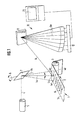
- Fig. 1 shows a so-called rubber slab 1 being examined to determine also the carbon black concentration contained in its surface, which rubber slab in the shape of a 1 m wide and 10 mm thick strip leaves the unshown extruder of a rubber mixing plant at a speed of 20 m/min in the direction of arrow 2 and bears on a deflector drum 3.
- Such rubber slabs which are used as semifinished products in the manufacture of vehicle tyres, are generally composed of the following constituents:
- a deflector mirror 7 The movement of the end region 4a transverse to the longitudinal extension of the rubber slab 1 - indicated by a broken zigzag line 6 - is actuated by a deflector mirror 7; the latter performs a swivelling movement in the direction of the double arrow 8 about a swivel axis 7a.
- the plasma 4c occurring in each measuring point produces a radiation 9 characteristic of the elements or molecules contained in the plasma, which radiation is supplied to a spectrograph 10 in a way to be described.
- the plasma radiation is spectrally dispersed by means of a grating 11 and is identified in the form of individual spectral lines 9a (or possibly in the form of molecular bands) in time-staggered manner by a detector unit 12 configured as a diode array.
- the digitized spectrum is then transferred to a computer 13 for storage and evaluation.
- the intensity values obtained from the plasma radiation of each examined measuring point 4b are used to determine the concentration of carbon and selected analysis elements in the surface and from that the appurtenant carbon black concentration.
- the intensities of the spectral lines of carbon as reference element (I C ) and those of all other analysis elements (I A.n ) in the particular surface section are determined and from these the appurtenant intensity ratios (I A.n /I C ) of the spectral line of each analysis element to the spectral line of the reference element are determined.
- the intensities of the spectral lines of the reference element (I C' ) and at least one of the other analysis elements (I A.n' ) are determined and from them in each case the appurtenant intensity ratio is determined.
- the exposure times t B1 and t B2 of the detector, during which the produced plasma is observed and analyzed in the performance of the first and second measurements, are 10 ⁇ s and 0.2 ⁇ s respectively.
- the quantitative evaluation of the results of the first and the second measurements is carried out by reference to the calibration information in calibration curves obtained from standard specimens, i.e. from specimens of known composition, using the delay times t V1 and t V2 and the exposure times t B1 , t B2 of the first and second measurements.
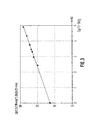
- the calibration curves show the magnitude of the previously mentioned intensity ratios I A.n /I C of the spectral line of each analysis element to the spectral line of the reference element and the intensity ratio I C' /I A.n' of the spectral line of the reference element to the spectral line of the at least one selected analysis element as a function of the appurtenant concentration ratio values c A.n /c C and C R (for the carbon black concentration)/c A.n .
- I A.n /I C f(c A.n /c C )
- the appurtenant concentration ratio values can be determined and from these, subject to the condition that the concentration values of all analysis elements and the reference element amount to 100%, the concentration value c C of carbon and where applicable also the concentration values of selected or of all other analysis elements c A.n can be derived.
- the intensity ratio I and the concentration ratio KV are defined as reciprocals of the relevant ratio according to Fig. 2.
- the concentration values of further analysis elements can also be calculated from the values of the first measurement including the appurtenant calibration information
- the second measurement - insofar as it extends to further analysis elements and corresponding appurtenant calibration curves are available for evaluation - can be used to determine the carbon black concentration from the corresponding ratio values for the other analysis elements as it were in a different way as verification.
- the plasmas for the first and the second measurements can in particular also be actuated simultaneously; this requires the use of two laser units, whose laser beams impinge on separate measuring points; the appurtenant plasmas - as already mentioned - are measured and analyzed with different, fixed time delays t V1 and t V2 .
- the embodiment under consideration also requires that each of the two laser units is equipped with the facilities which permit the detection and analysis of the produced plasmas; therefore, as well as the required optical assemblies and deflector units for each laser beam there also have to be available in particular two spectrographs and two multichannel analyzers connected jointly with a computer serving as evaluator.
- a mean value can in each case be formed which can be used as a basis for determining the concentration values of the reference element, the analysis elements under consideration and the carbon black concentration.
- the surface of the rubber slab 1 is scanned by such means that the end region 4a of a laser beam 4 is reciprocated in the direction of double arrow 14 (parallel to the drawing plane) during the measuring processes; while this is taking place the rubber slab 1 (as also indicated in Fig. 1) performs a continuous movement vertical to the drawing plane.
- the laser beam 4 emerging with variable pulse frequency from the laser unit 5 passes through an attenuating element 15, with which the laser beam intensity can be adjustable attenuated, and a beam aperture 16 with adjustable cross section and is focused by deflector mirrors 17 and 18 and a plane-convex lens 19 onto the surface 1a of the rubber slab where it produces the plasma 4c.
- the characteristic radiation 9 emitted by the latter is focused by means of two plane-convex lenses 20, 21 onto the entry surface 22a of an optical fibre bundle 22.
- the optical elements 18 to 21 are mounted on a support frame 23 which in turn is guided - movably in the direction of the double arrow 14 - on a support 24.
- a gas-tight housing 25 accommodating the optical elements 18 to 21 and exhibiting a shutter window 26 in the area between the plane-convex lens 19 and the surface 1a permits the performance of the measuring processes under protective gas (for example argon or compressed air); the latter can be introduced into the housing 25 through a supply connection 27 below the shutter window 26 and permits the performance of undistorted measurements even in dusty environments.
- protective gas for example argon or compressed air
- the radiation emanating from the plasma 4c passes through the optical fibre bundle 22 into the inlet opening of the spectrograph 10 , where it is spectrally dispersed and imaged onto the array detector of a multichannel analyzer 28 arranged in front of the focal plane of the spectrograph.
- the array detector (cf the detector unit 12 in Fig. 1) permits the simultaneous measurement of a spectral region of the radiation from the plasma and thus allows multielement analysis.
- the measurements to determine the intensity values of the constituents of interest in the surface 1a are carried out resolved in time. For this, the array detector of the multichannel analyzer 28 is actuated with a time delay relative to the particular laser pulse and is exposed for a short period of time.
- control unit 29 which controls the multichannel analyzer 28 via a control line 30.
- Control of the time sequences and evaluation of the measured spectra is effected by the computer 13. The latter also permits the time delay and the exposure time to be adjusted electronically to new values.
Landscapes
- Health & Medical Sciences (AREA)
- Physics & Mathematics (AREA)
- Chemical & Material Sciences (AREA)
- Life Sciences & Earth Sciences (AREA)
- Analytical Chemistry (AREA)
- Engineering & Computer Science (AREA)
- Biochemistry (AREA)
- General Health & Medical Sciences (AREA)
- General Physics & Mathematics (AREA)
- Immunology (AREA)
- Pathology (AREA)
- Nuclear Medicine, Radiotherapy & Molecular Imaging (AREA)
- Plasma & Fusion (AREA)
- Optics & Photonics (AREA)
- Food Science & Technology (AREA)
- Medicinal Chemistry (AREA)
- Investigating, Analyzing Materials By Fluorescence Or Luminescence (AREA)
Claims (15)
- Verfahren zum Bestimmen der Rußschwarzverteilung und -konzentration in Gummimischungen und anderen Rußschwarz enthaltenden Werkstoffen unter Verwendung gepulster Laserstrahlen, die auf die Werkstoffoberfläche fokussiert sind und von denen jeder ein Plasma erzeugt mit einer Strahlung, die für die darin enthaltenen Elemente oder Moleküle charakteristisch ist, und welche die Oberfläche mit ihren Endbereichen in Rasterbereiche aufteilen, in denen Meßpunkte liegen, die durch Laserstrahlbrennpunkte erzeugt werden, wobei die charakteristische Strahlung, die spektral in Form von Spektrallinien oder Molekülbanden aufgeteilt ist, durch eine Detektoreinheit identifiziert wird, wobei aus Konzentrationswerten, die bezüglich numerischer Verhältnisse von den Strahlungsintensitäten ausgewählter Elemente/Moleküle berechnet, nachfolgend gespeichert und auf die entsprechenden Meßpunkte zugeteilt werden, die Konzentrationswertkurve mindestens über einen Teil der Oberfläche erstellt wird, gekennzeichnet durch die folgenden Merkmale:die Plasmen oder Plasmagruppen, die durch zwei Laserimpulse oder Laserimpulsgruppen erzeugt werden, werden durch zwei Messungen spektraler Intensitäten ausgewertet, nämlich durch eine erste Messung für das erste Plasma oder die erste Plasmagruppe und eine zweite Messung für das zweite Plasma oder die zweite Plasmagruppe, wobei die beiden mit der Aktivierung der entsprechenden Laserimpulse zusammenhängenden Messungen jeweils nach einer festen eigenen Zeitverzögerung (tV1, tV2) bezüglich der Aktivierungszeit vorgenommen werden,durch die erste Messung werden die Intensitäten der Spektrallinien von Kohlenstoff als Referenzelement (IC) und mindestens ungefähr aller anderen Analyseelmente (IA.n) in dem Oberflächenabschnitt bestimmt, und aus diesen werden die entsprechenden Intensitätsverhältnisse (IA.n/IC) der Spektrallinie des jeweiligen Analyseelements zur Spektrallinie des Referenzelements bestimmt,durch die zweite Messung werden die Intensitäten der Spektrallinien des Referenzelements (IC') und mindestens eines der anderen Analyseelemente (IA.n') bestimmt, und aus diesen wird das entsprechende Intensitätsverhältnis berechnet, wobei diese Messung mit einer kürzeren Zeitverzögerung durchgeführt wird als die entsprechende erste Messung,durch Eichkurven, die durch Messung von Proben mit bekannter Zusammensetzung und durch Messungen mit der Zeitverzögerung der ersten Messung erstellt werden, werden die Intensitätsverhältniswerte (IA.n/IC) der ersten Messung zum Bestimmen der Werte der entsprechenden Konzentrationsverhältnisse (cA.n/cC') von mindestens ungefähr allen Analyseelementen in dem bestimmten Oberflächenabschnitt verwendet, und von diesen wird der Wert für die Konzentration des Referenzelements (cC) bestimmt, aus dem die Konzentration (cA.n) einzelner Analyseelemente abgeleitet werden kann,durch mindestens eine weitere Eichkurve, die durch Messung von Proben mit bekannter Zusammensetzung und durch Messung mit der gleichen Zeitverzögerung wie die zweite Messung erstellt wird, wird der entsprechende Intensitätsverhältniswert (IA.n'/IC') von der zweiten Messung zum Bestimmen des Werts des Konzentrationsverhältnisses zwischen Rußschwarz (cR) und dem bestimmten Analyseelement (cA.n) verwendet, wobei unter Berücksichtigung der zuvor berechneten Konzentration des Analyseelements die Rußschwarzkonzentration abgeleitet wird.
- Verfahren nach Anspruch 1, dadurch gekennzeichnet, daß die Verzögerungszeit (tV2), nach deren Ablauf jeweils die zweite Messung durchgeführt wird, zwischen 0,1 und 0,5 µs beträgt.
- Verfahren nach Anspruch 1 und/oder 2, dadurch gekennzeichnet, daß die Verzögerungszeit (tV2), nach deren Ablauf jeweils die erste Messung durchgeführt wird, mehr als 0,5 bis 5,0 µs beträgt.
- Verfahren nach mindestens einem der vorangehenden Ansprüche, dadurch gekennzeichnet, daß die Belichtungszeit (tB2), während der das erzeugte Plasma bei der Durchführung der zweiten Messung gemessen wird, zwischen 0,1 und 0,3 µs ist.
- Verfahren nach mindestens einem der vorangehenden Ansprüche, dadurch gekennzeichnet, daß die Belichtungszeit (tB1), während der das erzeugte Plasma bei der Durchführung der ersten Messung gemessen wird, zwischen 0,2 und 10 µs ist.
- Verfahren nach mindestens einem der vorangehenden Ansprüche, dadurch gekennzeichnet, daß bei beiden Messungen - zu dem Grad, der zum Bestimmen der Rußschwarzkonzentration nötig ist - jeweils die Intensitäten der gleichen Spektrallinien des Referenzelements (IC) und des Analyseelements (IA.n) gemessen werden.
- Verfahren nach mindestens einem der vorangehenden Ansprüche, dadurch gekennzeichnet, daß durch Bezugnahme auf mehrere Eichkurven, die verschiedene Analyseelemente (IAn.'/IC' = f (cA.n/cC)) betreffen, für die zweite Messung jeweils die Rußschwarzkonzentration (cR) mehrere Male berechnet wird und jeweils ein Mittelwert daraus abgeleitet wird, der als Grundlage für die Bestimmung der örtlichen Verteilung der Konzentrationswertkurve verwendet wird.
- Verfahren nach mindestens einem der vorangehenden Ansprüche, dadurch gekennzeichnet, daß die Laserimpulse im Verhältnis zur Oberfläche auf solche Art und Weise aktiviert werden, daß die Plasmen für die erste und zweite Messung räumlich und/oder zeitlich getrennt voneinander erzeugt werden.
- Verfahren nach mindestens einem der vorangehenden Ansprüche, dadurch gekennzeichnet, daß aus den Intensitätswerten (IA.n, IA.n') der Plasmen der ersten und der zweiten Plasmagruppe jeweils ein Mittelwert gebildet wird, der als Grundlage zur Bestimmung der Konzentrationswerte (cC, cA.n, cR) verwendet wird.
- Vorrichtung zum Durchführen des Verfahrens nach mindestens einem der vorhergehenden Ansprüche, mit einer Einrichtung (5) zum Erzeugen gepulster Laserstrahlen (4), einer ersten optischen Anordnung, die in der optischen Achse der Laserstrahlen (6) liegt, mit einer ersten Linsenanordnung (15, 19) und einer ersten Deflektoreinheit (17, 18) zum Ausrichten des Laserstahl-Endbereiche - deren Laserstrahlbrennpunkte jeweils einen Meßpunkt bilden - im Verhältnis zur Werkstoffoberfläche, mit einer zweiten optischen Anordnung mit einer zweiten Linsenanordnung (21), durch die die Strahlung des im Laserstrahlbrennpunkt erzeugten Plasmas zum Messen der Strahlungsbestandteile an einen Spektrographen mit einer Detektoreinheit geleitet wird, und mit einem als Auswerter dienenden Computer, der mit der Detektoreinheit verbunden ist, wodurch das Plasma ausgewertet wird, bevor der nächste Laserimpuls aktiviert wird, und aus den im Computer gespeicherten Konzentrationswerten - die durch Vergleich mit entsprechenden Verhältniswerten von Proben mit bekannter Zusammensetzung durch Bezugnahme auf numerische Verhältniswerte von den gemessenen Strahlungsintensitäten ausgewählter Elemente/Moleküle bestimmt und verschiedenen Meßpunkten zugeteilt werden - die Konzentrationswertkurve mindestens über einen Abschnitt der Oberfläche erstellt wird,
dadurch gekennzeichnet, daß die Vorrichtung weiter die folgenden Elemente aufweist:- eine Steuereinrichtung zum Steuern jeder Detektoreinheit (12) mit einer einstellbaren Zeitverzögerung (tV1, tV2) in solcher Art und Weise, daß zwei Messungen der Spektralintensitäten voneinander getrennt erzeugter Plasmen mit einer festen, unterschiedlichen Zeitverzögerung im Verhältnis zur Aktivierungszeit des bestimmten Laserimpulses durchgeführt werden, wobei die Zeitverzögerung (tV2) für die zweite Messung, durch die die Spektrallinienintensitäten des Referenzelements Kohlenstoff (IC') und mindestens eines der anderen Analyseelemente (IA.n') im jeweiligen Oberflächenabschnitt zu ermitteln sind, kleiner ist als diejenige der ersten Messung (tV1) zum Bestimmen der Spektrallinienintensitäten des Referenzelements (IC) und mindestens ungefähr aller anderen Analyseelemente (IA.n'), wobeider Computer (13) Eichinformation speichert, die auf Referenzmessungen beruht, die mit der Zeitverzögerung (tV1 und tV12) einerseits der ersten und andererseits der zweiten Messung an Proben bekannter Zusammensetzung durchgeführt wurden, die das Konzentrationsverhältnis der anderen Analyseelemente (cA.n) oder des mindestens einen Analyseelements (cA.n) zum Referenzelement (cC) in Abhängigkeit von den entsprechenden Intensitätsverhältniswerten zeigen, undder Computer (13) so konfiguriert ist, daß jeweils von den Intensitätswerten der ersten und der zweiten Messung Verhältniswerte, die der Eichinformation entsprechen, gebildet werden, und durch einen Vergleich mit der letzteren zuerst die Konzentration des gesamten Kohlenstoffs (cC) und diejenige des mindestens einen ausgewählten Analyseelements (cA.n) und dann durch Bezugnahme auf den bekannten Konzentrationswert (cA.n) mindestens eines Analyseelements die Rußschwarzkonzentration (cR) bestimmt wird, wobei die letztere zum Erstellen der Konzentrationswertkurve verwendet wird. - Vorrichtung nach Anspruch 10, die so konfiguriert ist, daß sie die Laserimpulse im Verhältnis zur Oberfläche (1a) so aktiviert, daß die entsprechenden Plasmen (4c) für die erste und die zweite Messung räumlich und/oder zeitlich getrennt voneinander erzeugt werden.
- Vorrichtung nach mindestens entweder Anspruch 10 oder Anspruch 11, dadurch gekennzeichnet, daß die Einrichtung zum Erzeugen der Laserstrahlen mehrere Lasereinheiten (5) aufweist.
- Vorrichtung nach mindestens einem der Ansprüche 10 bis 12, dadurch gekennzeichnet, daß für die erste und die zweite Messung mehrere Laserimpulse in einem entsprechenden ersten und zweiten Meßpunkt jeweils aktiviert werden können und daß von den Intensitätswerten der ersten und der zweiten Plasmagruppe jeweils ein Mittelwert gebildet wird, der den Startwert zum Bestimmen der Konzentrationswerte darstellt.
- Verfahren zum Herstellen eines Luftreifens für Fahrzeugräder mit den folgenden Schritten:wobei das Verfahren durch die folgenden Schritte gekennzeichnet ist:Herstellen mindestens einer Gummimischung durch Zusammenmischen mindestens eines Polymermaterials mit anderen Bestandteilen, wie zum Beispiel Rußschwarz, je nach den vorbestimmten Mengenverhältnissen zwischen den Bestandteilen nach einer vorgegebenen Rezeptur,Bilden mindestens einer halbfertigen Komponente für den Reifen aus der Mischung,Zusammensetzen mehrerer halbfertiger Komponenten zum Aufbauen eines zu formenden und in einer Vulkanisierungsform zu vulkanisierenden Karkassenrohlings,verfahrenszeitgleiches Erfassen der in der mindestens eine Gummimischung enthaltenen Rußschwarzmenge zum Überwachen des Dispersionsgrades und der Homogenität des Rußschwarz in der Gummimischung in Echtzeit, wobei die Erfassung durch mindestens zwei aufeinanderfolgende Messungen des in der Gummimischung enthaltenen Kohlenstoffs geschieht, wobei die mindestens zwei Messungen durch herkömmliche Fern-Laser-Mikroanalyseverfahren zu unterschiedlichen Verzögerungszeiten durchgeführt werden, indem die Menge des Rußschwarz in Abhängigkeit von der Gesamt-Kohlenstoffmenge durch Vergleich der erfaßten Gesamtkohlenstoffmenge mit gespeicherten Werten gemessen wird, wodurch die Gesamt-Kohlenstoffmenge mit der entsprechenden Rußschwarzmenge, die von der Analyse bekannter Gummimischungsproben im Verhältnis zur Mengenzusammensetzung der Bestandteile bekannt sind, in Beziehung gesetzt wird, um so die Zusammensetzung der Mischung im Verhältnis zu der in der Rezeptur festgelegten Mischung zu überprüfen, undSteuern der Menge des Rußschwarz, das mit den Polymermaterialien und den Bestandteilen während des Mischschritts vermischt werden soll, aufgrund der erfaßten Information, um so die festgelegte Zusammensetzung für die Mischung nach den vorbestimmten Mengenverhältnissen der Bestandteile abzustimmen.
- Verfahren nach Anspruch 14, dadurch gekennzeichnet, daß der Schritt des Erfassens des Kohlenstoffs des Rußschwarz in der mindestens einen Gummimischung durchgeführt wird, indem der Kohlenstoff des Rußschwarz vom Gesamtkohlenstoff unterschieden wird, der durch Aufschließen des Rußschwarz des Polymermaterials und anderer Kohlenstoff enthaltender Elemente entsteht, wie folgt:(i) ein erster Laserimpuls wird auf die Gummimischung gerichtet, und das Spektrallinienintensitätenverhältnis zwischen einem Referenzbestandteil und dem Gesamt-Elementkohlenstoff wird bei einer Verzögerungszeit TV1 und einer Belichtungszeit TB1 aufgezeichnet(ii) ein zweiter Laserimpuls wird auf die Gummimischung gerichtet und das Spektrallinienintensitätenverhältnis zwischen dem Referenzbestandteil und dem Elementkohlenstoff des Rußschwarz wird bei einer Verzögerungszeit TV2 und einer Belichtungszeit TB2 aufgezeichnet, wobei mindestens TV2 sich von TV1 unterscheidet, wobei TV2 einen geringeren Wert hat als TV1,(iii) die erste Messung wird verglichen mit einer Eichkurve des Konzentrationsverhältnisses zwischen dem Referenzbestandteil und dem Gesamtkohlenstoff gegenüber dem Spektrallinienintensitätenverhältnis zwischen dem Referenzbestandteil und dem Gesamt-Elementkohlenstoff, der vorher aufgezeichnet wurde, indem das Konzentrationsverhältnis zwischen dem Referenzbestandteil und dem Gesamt-Elementkohlenstoff bestimmt wurde, was bei der gleichen Verzögerungszeit TV1 und Belichtungszeit TB1 wie in (i) an einer Anzahl von Proben mit bekannten Zusammensetzungs-Mengenverhältnissen geschieht, wobei dieser Vergleich ein Ermitteln der Konzentration des Referenzbestandteils in der Gummimischung der Komponente erlaubt,(iv) die zweite Messung wird verglichen mit einer Eichkurve des Konzentrationsverhältnisses zwischen dem Referenzbestandteil und dem Kohlenstoff des Rußschwarz gegenüber dem Spektrallinienintensitätenverhältnis zwischen dem Referenzbestandteil und dem Elementkohlenstoff des Rußschwarz, das zuvor durch Bestimmen des Spektrallinienintensitätenverhältnisses zwischen dem Referenzbestandteil und dem Elementkohlenstoff des Rußschwarz gemessen wurde, was bei der gleichen Verzögerungszeit TV2 und Belichtungszeit TB2 wie in (ii) an einer Anzahl von Proben einer Gummimischung mit bekannten Mengenverhältnissen der Bestandteile geschieht, wobei der Vergleich ein Ermitteln der Konzentration des Rußschwarz in der Gummimischung der Komponente erlaubt.
Priority Applications (6)
| Application Number | Priority Date | Filing Date | Title |
|---|---|---|---|
| EP93113036A EP0652430B1 (de) | 1993-08-13 | 1993-08-13 | Verfahren und Vorrichtung zur Bestimmung des Russgehaltes von Kautschukmischungen |
| ES93113036T ES2142839T3 (es) | 1993-08-13 | 1993-08-13 | Proceso para determinar la concentracion y distribucion de negro de carbon en compuestos de caucho y en otros materiales que contienen negro de carbon y dispositivo para realizar dicho proceso. |
| DE69327463T DE69327463T2 (de) | 1993-08-13 | 1993-08-13 | Verfahren und Vorrichtung zur Bestimmung des Russgehaltes von Kautschukmischungen |
| US08/288,254 US5537207A (en) | 1993-08-13 | 1994-08-11 | Process for determining carbon black concentration and distribution in rubber compounds and other carbon black containing materials and device to carry out the process |
| JP18960694A JP3662953B2 (ja) | 1993-08-13 | 1994-08-11 | ゴム化合物およびカーボンブラックを含む他の材料中のカーボンブラックの濃度と分布を測定する方法およびこの方法を実行する装置 |
| US08/619,411 US5702550A (en) | 1993-08-13 | 1996-03-21 | Process for tire manufacture with on-line determining of carbon black concentration and distribution in rubber compounds and other carbon black containing materials |
Applications Claiming Priority (1)
| Application Number | Priority Date | Filing Date | Title |
|---|---|---|---|
| EP93113036A EP0652430B1 (de) | 1993-08-13 | 1993-08-13 | Verfahren und Vorrichtung zur Bestimmung des Russgehaltes von Kautschukmischungen |
Publications (2)
| Publication Number | Publication Date |
|---|---|
| EP0652430A1 EP0652430A1 (de) | 1995-05-10 |
| EP0652430B1 true EP0652430B1 (de) | 1999-12-29 |
Family
ID=8213179
Family Applications (1)
| Application Number | Title | Priority Date | Filing Date |
|---|---|---|---|
| EP93113036A Expired - Lifetime EP0652430B1 (de) | 1993-08-13 | 1993-08-13 | Verfahren und Vorrichtung zur Bestimmung des Russgehaltes von Kautschukmischungen |
Country Status (5)
| Country | Link |
|---|---|
| US (2) | US5537207A (de) |
| EP (1) | EP0652430B1 (de) |
| JP (1) | JP3662953B2 (de) |
| DE (1) | DE69327463T2 (de) |
| ES (1) | ES2142839T3 (de) |
Cited By (1)
| Publication number | Priority date | Publication date | Assignee | Title |
|---|---|---|---|---|
| CN101726562A (zh) * | 2008-10-16 | 2010-06-09 | 莱茵化学有限公司 | 用于质量分析的柱式压机 |
Families Citing this family (32)
| Publication number | Priority date | Publication date | Assignee | Title |
|---|---|---|---|---|
| US5167808A (en) * | 1990-08-16 | 1992-12-01 | S&K Products International, Inc. | Deionized water purification system |
| US6545240B2 (en) | 1996-02-16 | 2003-04-08 | Huron Valley Steel Corporation | Metal scrap sorting system |
| US6034768A (en) * | 1997-09-26 | 2000-03-07 | Physical Sciences Inc. | Induced breakdown spectroscopy detector system with controllable delay time |
| US6002478A (en) * | 1998-03-20 | 1999-12-14 | Transgenomic Inc. | System and method of determining trace elements in high viscosity liquids, and powders, utilizing laser-ablation |
| US6008897A (en) * | 1999-01-19 | 1999-12-28 | National Research Council Of Canada | Method and apparatus for materials analysis by enhanced laser induced plasma spectroscopy |
| FR2800466B1 (fr) * | 1999-11-03 | 2001-11-23 | Commissariat Energie Atomique | Dispositif d'analyse element par spectrometrie d'emission optique sur plasma produit par laser |
| US6741345B2 (en) * | 2001-02-08 | 2004-05-25 | National Research Council Of Canada | Method and apparatus for in-process liquid analysis by laser induced plasma spectroscopy |
| DE10229498A1 (de) * | 2002-07-01 | 2004-01-22 | Fraunhofer-Gesellschaft zur Förderung der angewandten Forschung e.V. | Verfahren und Vorrichtung zur Durchführung der Plasmaemissionsspektrometrie |
| ATE443857T1 (de) * | 2002-11-01 | 2009-10-15 | Huron Valley Steel Corp | Abtastvorrichtung für verwendung in einer metallschrottsortiervorrichtung |
| DE10304337A1 (de) * | 2003-02-03 | 2004-08-19 | Luk Laser-Und Umweltmesstechnik Kiel Gmbh | Verfahren und Sensorkopf zur berührungslosen Klassifizierung von Materialien |
| DE102005027260B4 (de) * | 2005-06-13 | 2007-03-29 | Daimlerchrysler Ag | Verfahren und Vorrichtung zur Qualitätsbestimmung einer Schweißnaht oder einer thermischen Spritzschicht und Verwendung |
| JP2007010371A (ja) * | 2005-06-28 | 2007-01-18 | Kenji Yasuda | 有害物検出システム、有害木材の検出方法及び廃棄木材処理システム |
| US8582113B2 (en) | 2007-02-13 | 2013-11-12 | Kla-Tencor Mie Gmbh | Device for determining the position of at least one structure on an object, use of an illumination apparatus with the device and use of protective gas with the device |
| DE102007049133A1 (de) * | 2007-02-13 | 2008-08-21 | Vistec Semiconductor Systems Gmbh | Vorrichtung zur Bestimmung der Position mindestens einer Struktur auf einem Objekt, Verwendung einer Beleuchtungseinrichtung für die Vorrichtung und Verwendung von Schutzgas für die Vorrichtung |
| US20100330805A1 (en) * | 2007-11-02 | 2010-12-30 | Kenny Linh Doan | Methods for forming high aspect ratio features on a substrate |
| JP5220481B2 (ja) * | 2008-05-30 | 2013-06-26 | 独立行政法人森林総合研究所 | レーザ誘起プラズマ発光分析による木材密度の測定方法 |
| CN101738399B (zh) * | 2008-11-26 | 2014-08-27 | 软控股份有限公司 | 轮胎激光散斑检验机及其检验方法 |
| RU2502057C2 (ru) * | 2009-05-07 | 2013-12-20 | Сименс Фаи Металз Текнолоджиз Сас | Способ и устройство спектрального анализа слоя металлического покрытия, наносимого на поверхность стальной полосы |
| FR2964458B1 (fr) * | 2010-09-06 | 2012-09-07 | Commissariat Energie Atomique | Dispositif de cartographie et d'analyse a haute resolution d'elements dans des solides |
| CN102680436B (zh) * | 2012-06-16 | 2014-04-09 | 山西大学 | 测定煤灰含碳量的方法及装置 |
| CN102830063A (zh) * | 2012-08-13 | 2012-12-19 | 青岛科技大学 | 一种检测橡胶中炭黑的方法 |
| US11248961B2 (en) * | 2013-03-15 | 2022-02-15 | Mat International Holdings, Llc | Methods and systems for analyzing samples |
| CZ2013314A3 (cs) * | 2013-04-26 | 2014-07-16 | Univerzita Tomáše Bati ve Zlíně | Etalon k hodnocení topografie materiálů |
| DE102013009962B3 (de) | 2013-06-14 | 2014-11-06 | K+S Aktiengesellschaft | LIBS-Messtubus |
| CN105572102B (zh) * | 2016-01-15 | 2017-03-08 | 清华大学深圳研究生院 | 一种硅橡胶复合绝缘材料老化状态检测方法 |
| NL2016124B1 (en) | 2016-01-20 | 2017-07-25 | Black Bear Carbon B V | A method for sorting tires |
| US9785851B1 (en) | 2016-06-30 | 2017-10-10 | Huron Valley Steel Corporation | Scrap sorting system |
| EP3640626A1 (de) * | 2018-10-18 | 2020-04-22 | Kraiburg Austria GmbH & Co. KG | Laserinduzierte breakdown-spektroskopievorrichtung und deren verwendung zur analyse chemischer elemente in gummi |
| CN115078334B (zh) * | 2022-07-18 | 2025-11-04 | 昆山宝锦激光拼焊有限公司 | 一种改进的不对称等离子体光谱分析方法 |
| FR3146521B1 (fr) * | 2023-03-10 | 2025-02-14 | Michelin & Cie | Procédé et système de contrôle de fabrication de produits caoutchouteux en réponse aux propriétés physico-chimiques d’un mélange caoutchouteux |
| CN118169107B (zh) * | 2024-02-22 | 2025-01-03 | 西北师范大学 | 一种标准曲线辅助的免定标libs实现中药材及其产地环境多元素同步精准联测方法 |
| CN118794940B (zh) * | 2024-06-21 | 2025-01-28 | 中煤宣城发电有限公司 | 一种自适应聚焦激光诱导击穿光谱的煤质在线检测方法 |
Family Cites Families (4)
| Publication number | Priority date | Publication date | Assignee | Title |
|---|---|---|---|---|
| US4076220A (en) * | 1976-02-10 | 1978-02-28 | Bridgestone Tire Company Limited | Method of mixing and kneading control of a rubber kneader |
| IE47808B1 (en) * | 1979-02-01 | 1984-06-27 | Trinity College Dublin | Nmr test method for measuring the homogeneity of dispersions of carbon black in rubber compositions |
| US4641968A (en) * | 1984-12-17 | 1987-02-10 | Baird Corporation | Mobile spectrometric apparatus |
| DE4004627C2 (de) * | 1990-02-15 | 1994-03-31 | Krupp Ag Hoesch Krupp | Verfahren zur Bestimmung von Materialeigenschaften polymerer Werkstoffe und Vorrichtung zur Durchführung des Verfahrens |
-
1993
- 1993-08-13 EP EP93113036A patent/EP0652430B1/de not_active Expired - Lifetime
- 1993-08-13 DE DE69327463T patent/DE69327463T2/de not_active Expired - Fee Related
- 1993-08-13 ES ES93113036T patent/ES2142839T3/es not_active Expired - Lifetime
-
1994
- 1994-08-11 US US08/288,254 patent/US5537207A/en not_active Expired - Fee Related
- 1994-08-11 JP JP18960694A patent/JP3662953B2/ja not_active Expired - Fee Related
-
1996
- 1996-03-21 US US08/619,411 patent/US5702550A/en not_active Expired - Fee Related
Cited By (2)
| Publication number | Priority date | Publication date | Assignee | Title |
|---|---|---|---|---|
| CN101726562A (zh) * | 2008-10-16 | 2010-06-09 | 莱茵化学有限公司 | 用于质量分析的柱式压机 |
| CN101726562B (zh) * | 2008-10-16 | 2014-04-02 | 莱茵化学莱瑙有限公司 | 用于质量分析的柱式压机 |
Also Published As
| Publication number | Publication date |
|---|---|
| JP3662953B2 (ja) | 2005-06-22 |
| DE69327463T2 (de) | 2000-07-20 |
| US5702550A (en) | 1997-12-30 |
| ES2142839T3 (es) | 2000-05-01 |
| DE69327463D1 (de) | 2000-02-03 |
| US5537207A (en) | 1996-07-16 |
| JPH07167785A (ja) | 1995-07-04 |
| EP0652430A1 (de) | 1995-05-10 |
Similar Documents
| Publication | Publication Date | Title |
|---|---|---|
| US5702550A (en) | Process for tire manufacture with on-line determining of carbon black concentration and distribution in rubber compounds and other carbon black containing materials | |
| DE4004627C2 (de) | Verfahren zur Bestimmung von Materialeigenschaften polymerer Werkstoffe und Vorrichtung zur Durchführung des Verfahrens | |
| CA1138218A (en) | Material-testing method and apparatus | |
| US4907875A (en) | Diamond separation process | |
| US4875771A (en) | Method for assessing diamond quality | |
| CN112461877A (zh) | 一种x射线荧光光谱法定量检测铈元素的方法 | |
| DE10033645A1 (de) | Spektralellipsometer mit einer refraktiven Beleuchtungsoptik | |
| DE112008004262T5 (de) | Sauerstoffkonzentrations-Messvorrichtung | |
| US20030223065A1 (en) | Method and a device for determining the radiation-damage resistance of an optical material | |
| DE102019105377A1 (de) | Verfahren zur Beurteilung von Abriebfestigkeit und Bruchfestigkeit | |
| DE10033457A1 (de) | Transmissionsspektroskopische Vorrichtung für Behälter | |
| EP2237025A2 (de) | Verfahren und Vorrichtung zur Charakterisierung einer dünnen Siliziumschicht auf einem lichtdurchlässigen Substrat | |
| EP4133258A1 (de) | Verfahren und vorrichtung zum bestimmen frequenzabhängiger brechungsindizes | |
| DE2546565C3 (de) | Verfahren und Vorrichtung zur Bestimmung der Konzentration von Schwefeldioxid | |
| Etz et al. | Development and certification of NIST standard reference materials for relative Raman intensity calibration | |
| DE19848120C2 (de) | Einrichtung zur Messung der Strahlungsabsorption von Gasen | |
| WO2006136281A1 (de) | Raman-spektroskopisches analyseverfahren sowie vorrichtung dafür | |
| DE19515664A1 (de) | Spektroskopievorrichtung | |
| CH697534B1 (de) | Vorrichtung zur Erfassung von Kenngrössen organischer Substanzen. | |
| EP0676639B1 (de) | Verfahren und Vorrichtung zur quantitativen Bewertung des Alterungsverhaltens eines polymeren Werkstoffes | |
| TWI863177B (zh) | 金屬材料中Sb之光放射光譜分析法、精煉中熔鋼之Sb濃度測定方法及鋼材之製造方法 | |
| WO2001044788A2 (de) | Verfahren und einrichtung zur messung von kenngrössen einer probe | |
| JPH0370176B2 (de) | ||
| CH666749A5 (de) | Anordnung zur mehrelementenanalyse und verfahren zu deren betrieb. | |
| Zwinkels et al. | Development of a new reference spectrofluorimeter |
Legal Events
| Date | Code | Title | Description |
|---|---|---|---|
| PUAI | Public reference made under article 153(3) epc to a published international application that has entered the european phase |
Free format text: ORIGINAL CODE: 0009012 |
|
| AK | Designated contracting states |
Kind code of ref document: A1 Designated state(s): DE ES FR GB IT NL |
|
| 17P | Request for examination filed |
Effective date: 19951024 |
|
| 17Q | First examination report despatched |
Effective date: 19970326 |
|
| RAP1 | Party data changed (applicant data changed or rights of an application transferred) |
Owner name: PIRELLI COORDINAMENTO PNEUMATICI S.P.A. |
|
| GRAG | Despatch of communication of intention to grant |
Free format text: ORIGINAL CODE: EPIDOS AGRA |
|
| RAP1 | Party data changed (applicant data changed or rights of an application transferred) |
Owner name: PIRELLI PNEUMATICI S.P.A. |
|
| GRAG | Despatch of communication of intention to grant |
Free format text: ORIGINAL CODE: EPIDOS AGRA |
|
| GRAH | Despatch of communication of intention to grant a patent |
Free format text: ORIGINAL CODE: EPIDOS IGRA |
|
| GRAH | Despatch of communication of intention to grant a patent |
Free format text: ORIGINAL CODE: EPIDOS IGRA |
|
| GRAA | (expected) grant |
Free format text: ORIGINAL CODE: 0009210 |
|
| AK | Designated contracting states |
Kind code of ref document: B1 Designated state(s): DE ES FR GB IT NL |
|
| REF | Corresponds to: |
Ref document number: 69327463 Country of ref document: DE Date of ref document: 20000203 |
|
| ITF | It: translation for a ep patent filed | ||
| ET | Fr: translation filed | ||
| REG | Reference to a national code |
Ref country code: ES Ref legal event code: FG2A Ref document number: 2142839 Country of ref document: ES Kind code of ref document: T3 |
|
| PLBE | No opposition filed within time limit |
Free format text: ORIGINAL CODE: 0009261 |
|
| STAA | Information on the status of an ep patent application or granted ep patent |
Free format text: STATUS: NO OPPOSITION FILED WITHIN TIME LIMIT |
|
| 26N | No opposition filed | ||
| REG | Reference to a national code |
Ref country code: GB Ref legal event code: IF02 |
|
| PGFP | Annual fee paid to national office [announced via postgrant information from national office to epo] |
Ref country code: NL Payment date: 20060824 Year of fee payment: 14 |
|
| PGFP | Annual fee paid to national office [announced via postgrant information from national office to epo] |
Ref country code: GB Payment date: 20060825 Year of fee payment: 14 |
|
| PGFP | Annual fee paid to national office [announced via postgrant information from national office to epo] |
Ref country code: ES Payment date: 20060828 Year of fee payment: 14 |
|
| PGFP | Annual fee paid to national office [announced via postgrant information from national office to epo] |
Ref country code: IT Payment date: 20060831 Year of fee payment: 14 Ref country code: FR Payment date: 20060831 Year of fee payment: 14 |
|
| PGFP | Annual fee paid to national office [announced via postgrant information from national office to epo] |
Ref country code: DE Payment date: 20061002 Year of fee payment: 14 |
|
| GBPC | Gb: european patent ceased through non-payment of renewal fee |
Effective date: 20070813 |
|
| PG25 | Lapsed in a contracting state [announced via postgrant information from national office to epo] |
Ref country code: NL Free format text: LAPSE BECAUSE OF NON-PAYMENT OF DUE FEES Effective date: 20080301 |
|
| NLV4 | Nl: lapsed or anulled due to non-payment of the annual fee |
Effective date: 20080301 |
|
| REG | Reference to a national code |
Ref country code: FR Ref legal event code: ST Effective date: 20080430 |
|
| PG25 | Lapsed in a contracting state [announced via postgrant information from national office to epo] |
Ref country code: DE Free format text: LAPSE BECAUSE OF NON-PAYMENT OF DUE FEES Effective date: 20080301 |
|
| PG25 | Lapsed in a contracting state [announced via postgrant information from national office to epo] |
Ref country code: FR Free format text: LAPSE BECAUSE OF NON-PAYMENT OF DUE FEES Effective date: 20070831 |
|
| REG | Reference to a national code |
Ref country code: ES Ref legal event code: FD2A Effective date: 20070814 |
|
| PG25 | Lapsed in a contracting state [announced via postgrant information from national office to epo] |
Ref country code: GB Free format text: LAPSE BECAUSE OF NON-PAYMENT OF DUE FEES Effective date: 20070813 |
|
| PG25 | Lapsed in a contracting state [announced via postgrant information from national office to epo] |
Ref country code: ES Free format text: LAPSE BECAUSE OF NON-PAYMENT OF DUE FEES Effective date: 20070814 |
|
| PG25 | Lapsed in a contracting state [announced via postgrant information from national office to epo] |
Ref country code: IT Free format text: LAPSE BECAUSE OF NON-PAYMENT OF DUE FEES Effective date: 20070813 |