EP0652496B1 - Cadran de chronographe et chronographe - Google Patents
Cadran de chronographe et chronographe Download PDFInfo
- Publication number
- EP0652496B1 EP0652496B1 EP94915278A EP94915278A EP0652496B1 EP 0652496 B1 EP0652496 B1 EP 0652496B1 EP 94915278 A EP94915278 A EP 94915278A EP 94915278 A EP94915278 A EP 94915278A EP 0652496 B1 EP0652496 B1 EP 0652496B1
- Authority
- EP
- European Patent Office
- Prior art keywords
- time
- watch
- display
- panel
- displaying
- Prior art date
- Legal status (The legal status is an assumption and is not a legal conclusion. Google has not performed a legal analysis and makes no representation as to the accuracy of the status listed.)
- Expired - Lifetime
Links
- 230000033764 rhythmic process Effects 0.000 claims description 40
- 230000000694 effects Effects 0.000 claims description 18
- 240000004246 Agave americana Species 0.000 claims description 10
- 235000008754 Agave americana Nutrition 0.000 claims description 10
- 239000003086 colorant Substances 0.000 claims description 10
- 230000033001 locomotion Effects 0.000 claims description 9
- 239000004973 liquid crystal related substance Substances 0.000 claims description 7
- 206010042434 Sudden death Diseases 0.000 description 16
- 230000002354 daily effect Effects 0.000 description 16
- 210000004204 blood vessel Anatomy 0.000 description 7
- 210000004247 hand Anatomy 0.000 description 7
- 239000008280 blood Substances 0.000 description 5
- 210000004369 blood Anatomy 0.000 description 5
- 230000036772 blood pressure Effects 0.000 description 5
- 238000010586 diagram Methods 0.000 description 5
- 230000007246 mechanism Effects 0.000 description 5
- 238000013459 approach Methods 0.000 description 4
- 239000000203 mixture Substances 0.000 description 4
- 230000004048 modification Effects 0.000 description 4
- 238000012986 modification Methods 0.000 description 4
- 241000282412 Homo Species 0.000 description 3
- 230000004913 activation Effects 0.000 description 3
- 230000008859 change Effects 0.000 description 3
- 210000003414 extremity Anatomy 0.000 description 3
- 238000000034 method Methods 0.000 description 3
- 238000004321 preservation Methods 0.000 description 3
- 230000036385 rapid eye movement (rem) sleep Effects 0.000 description 3
- 230000005061 slumber Effects 0.000 description 3
- 208000019888 Circadian rhythm sleep disease Diseases 0.000 description 2
- 208000001456 Jet Lag Syndrome Diseases 0.000 description 2
- 230000034994 death Effects 0.000 description 2
- 231100000517 death Toxicity 0.000 description 2
- 230000029087 digestion Effects 0.000 description 2
- 208000033915 jet lag type circadian rhythm sleep disease Diseases 0.000 description 2
- 208000010125 myocardial infarction Diseases 0.000 description 2
- 210000000707 wrist Anatomy 0.000 description 2
- WHXSMMKQMYFTQS-UHFFFAOYSA-N Lithium Chemical compound [Li] WHXSMMKQMYFTQS-UHFFFAOYSA-N 0.000 description 1
- 230000017531 blood circulation Effects 0.000 description 1
- 210000005252 bulbus oculi Anatomy 0.000 description 1
- 239000003990 capacitor Substances 0.000 description 1
- 230000004087 circulation Effects 0.000 description 1
- 125000004122 cyclic group Chemical group 0.000 description 1
- 230000035487 diastolic blood pressure Effects 0.000 description 1
- 230000001079 digestive effect Effects 0.000 description 1
- 239000006185 dispersion Substances 0.000 description 1
- 230000003203 everyday effect Effects 0.000 description 1
- 210000001508 eye Anatomy 0.000 description 1
- 229910052744 lithium Inorganic materials 0.000 description 1
- 239000003550 marker Substances 0.000 description 1
- 230000002503 metabolic effect Effects 0.000 description 1
- 230000008452 non REM sleep Effects 0.000 description 1
- 230000010355 oscillation Effects 0.000 description 1
- 230000027758 ovulation cycle Effects 0.000 description 1
- 239000003973 paint Substances 0.000 description 1
- 238000010422 painting Methods 0.000 description 1
- 230000001681 protective effect Effects 0.000 description 1
- 239000010453 quartz Substances 0.000 description 1
- 210000002321 radial artery Anatomy 0.000 description 1
- 230000000630 rising effect Effects 0.000 description 1
- 230000001932 seasonal effect Effects 0.000 description 1
- VYPSYNLAJGMNEJ-UHFFFAOYSA-N silicon dioxide Inorganic materials O=[Si]=O VYPSYNLAJGMNEJ-UHFFFAOYSA-N 0.000 description 1
- 230000007958 sleep Effects 0.000 description 1
- 230000035488 systolic blood pressure Effects 0.000 description 1
Images






Classifications
-
- G—PHYSICS
- G04—HOROLOGY
- G04B—MECHANICALLY-DRIVEN CLOCKS OR WATCHES; MECHANICAL PARTS OF CLOCKS OR WATCHES IN GENERAL; TIME PIECES USING THE POSITION OF THE SUN, MOON OR STARS
- G04B19/00—Indicating the time by visual means
- G04B19/26—Clocks or watches with indicators for tides, for the phases of the moon, or the like
- G04B19/264—Clocks or watches with indicators for tides, for the phases of the moon, or the like with indicators for biological cycles
Definitions
- the present invention relates to watches, more specifically to a character panel for watches having the capability to display information besides the time, such as life rhythms.
- Kapha (K) referring to the quality of stability/peacefulness in the body.
- Kapha (K) is symbolized by "green”.
- the time periods from 10 a.m.-2 p.m. and 10 p.m.-2 a.m. are the time periods for digestion and change, and are called Pitta (P) referring to the quality of activity. That is, the daytime period is an appropriate time period for eating, and is suited to digestive/metabolic activity. During the nighttime period, the matter absorbed through digestion is converted into flesh, particularly that of the extremities. Pitta (P) is symbolized by "red”.
- the time periods from 2 a.m.-6 a.m. and 2 p.m.-6p.m. are the time periods for activity and exercise, and are called Vata (V) referring to the quality of freshness/lightness. That is, the daytime Vata (V) is suitable for moving the body including comparatively heavy exercise. Additionally, regarding the early morning Vata (V), such phenomena as the bringing about of a good awakening due to the quality of freshness/lightness are able to be seen. Furthermore, as states of slumber, there are REM sleep and non-REM sleep.
- REM sleep is a state of slumber which is accompanied by bodily activity such as movement of the eyeballs, and the fact that REM sleep becomes longer during the Vata (V) from 2 to 3 o'clock has been made clinically clear.
- the daily bodily quality, activity quality, and seasonal quality are described by the three qualities of the Vata (V), the Pitta (P), and the Kapha (K).
- Slumber is taken in the time period from 10p.m. to a.m., and in the time periods of the Pitta (P) and the Vata (V) the decay of the dosha which is the bodily balance is undone. For example, the changing of one's position during sleep may be seen as such a phenomenon.
- Ayurveda time The above division of time is given the name "Ayurveda time".
- the above example is for the case in which sunrise occurs at 6 a.m. and sundown occurs at 6 p.m., but generally, the Kapha (K), Pitta (P), and Vata (V) are determined by respectfully splitting into three equal parts the time periods from sunrise to sundown and from sundown to sunrise.
- the "time” referred to here is not the standard time, but rather the time for the case in which noon is taken as the time at which the sun lies directly south of the region in which the relevant person is living.
- Ayurveda time changes with respect to the location, the season, and day and night.
- a watch able to display biorhythms of the PSI type is shown in Japanese Patent Publication No. JP57-196182. This describes a watch able to operate in a time indicating mode where time is indicated conventionally by hour, minute and second hands and also able to operate in a biorhythm indicating mode in which the hour, minute and second hands respectively indicate the current values of the P,S and I biorhythms. Such a watch is not capable of displaying biorhythm values and the time simultaneously.
- a watch able to display biorhythms of PSI type is shown in Japanese Patent Publication No. JP58-108486 in which a conventional watch time display is surrounded by three concentric scales, each of which includes a moving marker which indicates the current value of the P,S or I rhythm respectively.
- Neither of these watches are able to display a time period of a daily varying life rhythm corresponding to the present time.
- German Patent Publication No. 4038369 which describes a watch having a convention time display and a rotating multicoloured sector display to indicate the current state of a female users' menstrual cycle.
- European Patent Publication No. 0165381 describes a watch including a time display and a compass so that when provided with data identifying a users geographical location, the watch can calculate sunrise, sunset and appropriate prayer times for Moslems and indicate the direction of Mecca.
- European Patent Publication No. 0492027 describes a watch able to display the current time and the time remaining to a preset time, such as the end of a journey.
- the present invention takes account of the above circumstances, and has as an objective the presentation of a watch and a character panel for a watch which can automatically display life rhythms.
- the character panel for a watch features a plurality of display regions each of which stretch outward from the centre of the watch face and are arranged in the direction of rotation of the watch hands, and a multiple colour display section for dividing each of the display regions by colour.
- this invention provides a watch having a time display means for displaying the present time and a rhythm display means for displaying a position within a time period of a daily varying life rhythm corresponding to the present time, characterised in that on said rhythm display means each day comprises a fixed number of time periods (V,K,P) in which different activities are appropriate, and in that said present time and said position within a time period of a daily varying life rhythm are displayed simultaneously in accordance with the position of said time display means.
- this invention provides a watch characterised by having a circular panel separated by colour into a plurality of wedge-shaped regions corresponding to time periods of a daily varying life rhythm, wherein each day comprises a fixed number of time periods in which different activities are appropriate, and displaying the present time period of said life rhythm by rotating said circular panel with the passage of time.
- this invention provides a watch characterised in that it displays the standard time corresponding to a designated geographical region and displays the time period of a life rhythm corresponding to the present time, such that when a geographical region is designated a standard time display is given corresponding to said designated region, and the display of the time period of a life rhythm corresponding to the present time is gradually over a set time interval shifted to a display corresponding to the designated region.
- the current division of the daily rhythm is able to be easily determined from the hands and the display panel.
- Figure 1 is a block diagram of the first embodiment of the present invention
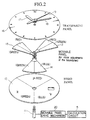
- Figure 2 is an exploded view of the principal parts of the second embodiment
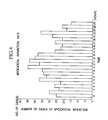
- Figure 3 is a graph showing the daily variation in the number of occurrences of sudden death
- Figure 4 is a graph showing the daily variation in the number of occurrences of myocardial infarction
- Figure 5 is a circuit diagram showing the Four Element Concentration Constant Model
- Figure 6 is a graph showing the blood pressure waveform at the aortal origin
- Figure 7 is a graph showing the hypothetical blood pressure waveform at the aortal origin for determining the Four Element Concentration Constant Model
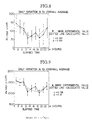
- Figures 8-11 are graphs showing the daily variations of the circulatory system parameters
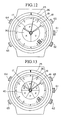
- Figures 12 and 13 show the sixth embodiment of the present invention
- Figure 14 is a cross-sectional view of the same embodiment
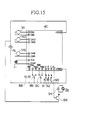
- Figure 15 is a circuit wiring diagram of the same embodiment
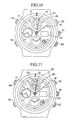
- Figures 16 and 17 show the seventh embodiment of the present invention
- Figures 18-20 show the eighth embodiment of the present invention.
- 1 is a character panel for a wristwatch, provided with a circular color LCD display device 2 in its central portion.
- the LCD display device 2 is able to, according to the control of the LCD control circuit 3, generate light of the appropriate color red, green, or blue, and to separate the colors with borders formed in the radial direction.
- a watch hand axis is passed through the hole 2 of the LCD display device 2, and it moves the hands (not shown) which are provided above the character panel 1.
- 6 is a memory device which stores latitude information indicating the latitude, longitude information indicating the longitude, and the deviation from standard time.
- the deviation from standard time is information indicating the difference between the noon of standard time and the time at which the sun is actually positioned directly south.
- 4 is a date mechanism which outputs information on the date.
- the calculation circuit 5 is a calculation circuit, and when the above-mentioned date information, latitude information, longitude, and deviation from standard time are supplied, it calculates the times for sunrise and sundown based on these, and then calculates the Kapha (K), the Pitta (P), and the Vata (V) by respectively dividing into three equal parts the time period from sunrise to sundown (hereinafter referred to as daytime), and the time period from sundown to sunrise (hereinafter referred to as nighttime). Then, the calculation circuit 5, as appropriate to the present time, delivers a control signal to the LCD control circuit 3 so that a a display as explained below may be given by the LCD display device 2.
- a control signal such that the positions which correspond to the daytime Kapha (K), Pitta (P), and Vata (V) turn respectively green, red, and blue, is sent from the calculation circuit 5 to the LCD control circuit 3.
- a control signal such that the positions which correspond to the nighttime Kapha (K), Pitta (P), and Vata (V) turn respectively green, red, and blue, is sent from the calculation circuit 5 to the LCD control circuit 3.
- 7 is an input device, through which the latitude information, the longitude information, and the deviation from standard time are entered and written into the memory device 6. Additionally, when the first and second set times are entered through the input device 7, they are then sent to the calculation circuit 5.
- 8 is a region-based data memory, in which are stored the names of various geographical regions and their corresponding latitude information, longitude information, and deviation from standard time.
- the region names stored in region-based data memory 8 may be, for example, the names of the Japanese prefectures, and the names of major Japanese and world cities.
- the input device 7 is able to set a certain regional name stored in the region-based data memory 8, and when such a regional name is set, the latitude information, longitude information, and deviation from standard time corresponding to the region are sent from the region-based data memory to the memory device 6.
- the entered data are stored in the memory device 6.
- the region is set by the input device 7, the information which corresponds to that region is sent from the region-based data memory 8 to the memory device 6.
- the first set time is noon and the second set time is midnight, but if the user changes these, the information is stored in the calculation circuit 5.
- the display face of the LCD display device 2 is divided into three colors.
- the user can easily tell the Ayurveda time by simply determining by eye in which of the three color-separated regions the short hand of the watch (not shown) is.
- the latitude and longitude information in the memory device 6 may be set at constant vales.
- 11 is a coaxial watch hand axis which passes through, in order, the fixed panel 12, the movable panels 14, 15 and 13, the transparent panel 16, the short hand 17, the long hand 18, and the second hand 19.
- the fixed panel 12 and the transparent panel 16 are fixed to the body of the wrist watch (not shown), and the movable panels 13, 14, and 15, the short hand 17, the long hand 18, and the second hand 19 move due to the rotation of the various parts of the axis 11.
- the wrist watch of the present embodiment identical to the first embodiment, is provided with the respect compositional elements 4-8 shown in Figure 1, but instead of the LCD circuit 3, it is provided with the movable panel activation mechanism 20 which moves the movable panels 13, 14 and 15 through the axis 11.
- the fixed panel 12 is made by dividing a circular panel into three equal sections in a circumferential direction and painting these red, blue, and green, and the movable panels 13, 14 and 15 are positioned above the boundary lines.
- the movable panels 13, 14, and 15 are thin panels designed in an approximate wedge shape, and they are divided by paint, with the center line as the boundary line, into red and blue, blue and green, and green and red.
- the movable panels 13, 14, and 15, due to the calculation circuit 5 and the movable panel activation mechanism 20, are controlled so that the center lines of these movable panels are each positioned at the boundary times between the Vata (V), the Kapha (K), and the Pitta (P).
- the displayable life rhythms are obviously not limited to the Ayurveda time an embodiment of the present invention which displays something other than the Ayurveda time will be explained below.
- the inventors of the present invention as a result of a series of experimental activities, have been able to determine that the circulatory activity state parameters which represent the conditions of the circulatory system fluctuate cyclically with a single day as one cycle. Below, the daily variations in the circulatory system determined by the present inventors is explained.
- This Four Element Concentration Constant Model out of the circulatory activity state parameters which determine the activity of the circulatory system of the human body, observes the four parameters given by the inertia of the blood in the central portion of the arterial system, the blood vessel resistance due to the blood viscosity in the central portion (viscous resistance), the compliance of the blood vessels in the central portion (viscoelasticity), and the blood vessel resistance in the extremities (viscous resistance), and models them on an electrical circuit.
- the relationship between the above-given parameters and the respective elements composing the Four Element Concentration Constant Model are shown below.
- compliance is an amount representing the flexibility of a blood vessel, and it refers to the viscoelasticity.
- the electric currents i, i p , and i c flowing through the various sections of the electric circuit correspond to the blood flow [cm 3 /s] in the corresponding sections.
- the input voltage e supplied to the electric circuit corresponds to the pressure (N/cm 2 ) [dyn/cm 2 ] of the aortal origin.
- the voltage v p across the capacitance C corresponds to the pressure (N/cm 2 ) [dyn/cm 2 ] at the radial artery.
- E o is the minimum blood pressure (diastolic pressure)
- E o + E m is the maximum blood pressure (systolic pressure)
- t p is the time required for a single beat
- t p1 is the time from the rising of the aortal pressure to when the pressure reaches its minimum value.
- the present inventors measured the radial pulse wave and the output amount for one beat from 13 male subjects with normal blood pressure every two hours, and determined the circulatory activity parameters corresponding to each radial pulse waveform , that is, they determined the values of each of the four elements L, C, R c , and R p of the Four Element Concentration Constant Model needed to obtain a waveform on both sides of the capacitance C which is identical to the radial pulse wave when a triangular wave as shown in Figure 7 is applied to the Four Element Concentration Constant Model.
- Figures 8-11 show the daily variation in the respective elements L, C, R c , and R p determined in this manner, and in each graph is shown the average value of the L, C, R c , and R p values of the 13 subjects and the range of dispersion (standard deviation). Additionally, in each graph, the dotted lines represent the basic waveform obtained by performing a rhythm analysis on the changes in the L, C, R c , and R p values. From these graphs, it is known that the circulatory activity parameters of the human body change according to cyclic waveforms which have a single day as one cycle.
- the daily variation in the number of occurrences of sudden death ia treated as a life rhythm is displayed in a watch character panel.
- the following are ways to display the occurrence rate of sudden death in a watch character display.
- world watches that is watches which, when the name of a major region of the world is given, display the time in that region.
- the present embodiment is not the type which uses a bezel ring in order to allow for changing between regions, but the application of the present invention is an example in which a world watch changes the position of an indicator hand to correspond to the positions of the regions.
- the position of the indicator hand moves to the position corresponding to the set region. Then, the latitude information, longitude information, and deviation from standard time of the set region is read from the region-based data memory 8, and stored in the memory device 6.
- the latitude information, longitude information, and deviation from standard time in the memory device 6 are referred by the calculation circuit 5, and a display identical to the Ayurveda time of the above first embodiment is made.
- jet lag Such phenomena in which one's life rhythm cannot adjust to a change in the time period are known generally as jet lag.
- the world watch described in the above-mentioned fourth embodiment may also become easier to use if consideration is made of jet lag. That is, since time is needed in order for a user of a world watch to adjust to the Ayurveda time at his destination, the present embodiment makes use of display control of Ayurveda time which takes such an adjustment into consideration.
- the specifics are as follows.
- a preservation area is prepared in the memory device 6 for storing more latitude information, longitude information and deviation from standard time. Then, when a region is set, after storing the latitude information, longitude information, and deviation from standard time of the new region, the previously stored latitude information, longitude information, and deviation from standard time are sent to the preservation area.
- the calculation circuit 5 first determines the boundary lines for displaying by color the Ayurveda time corresponding to the latitude information, longitude information, and deviation from standard time inside the preservation area (hereinafter referred to as the first boundary lines), then calculates the boundary lines for displaying by color the Ayurveda time corresponding to the new latitude information, longitude information, and deviation from standard time (hereinafter referred to as the second boundary lines), and at first, a control signal is sent to the LCD control circuit 3 such that a color-separated display of the Ayurveda time according to the first boundary lines is made.
- the first boundary lines are rotated by a certain angle, so that the boundary lines of the color-separated display of the Ayurveda time approach the above-mentioned second boundary lines little by little.
- an hour hand 17, minute hand 18, and second hand 19 are provided so as to be able to turn about the same axis.
- a character panel 30 for Ayurveda time display is attached to the same axis.
- a moveable bezel ring 25 is provided around the circumference of the watch face, the inside portion to which is attached a ring 26 on which is displayed the names of major cities.
- the bezel ring 25 is provided with an encoder (not shown), which is able to measure its rotation angle.
- 61 and 62 are crowns, 63, 64 and 65 are push-buttons.
- FIG 14. 51 is rotor which is driven by a step motor with forward and reverse rotation capabilities. The rotation of this rotor 51 is transmitted to the second gear 55 through the third gear 54, the fourth gear 53, and the fifth gear 52, and it rotates the second hand 19 which is attached to the second gear. Additionally, cylindrical gears 56, 57, and 58 are attached to the minute hand 18, the hour hand 17, and the Ayurveda display panel 30 respectively.
- This Ayurveda display panel 30 is three wedge-shaped sections having a central angle of 120 degrees as shown in figure 12, and each section is given a color corresponding to P, V, or K.
- the P-V boundary line, the V-K boundary line, and the K-P boundary line point respectively to 2 o'clock, 6 o'clock, and 10 o'clock.
- Cylindrical gears 56 and 57 are attached to the gear sequence of the second hand system through another gear sequence not shown, and they turn the minute hand 18 and the hour hand 17. Rotational motion is transmitted from a step motor not shown in the drawing to the cylindrical gear 58.
- 61 is a base board
- 62 is a gear sequence receiver.
- FIG. 15 shows a circuit diagram of the present embodiment.
- 40 is the CPU-IC, a microcomputer for analog electrical watches which integrates such elements as a core CPU, a program memory, a motor driver, and a motor drive control circuit into a single chip.
- 74 is a lithium battery
- M1 through M6 are coil blocks for the step motor.
- the CPU-IC 40 activates each motor through such mechanisms as a motor drive, and rotates the hands 17 and 18, and the character panel 30 of Figure 12.
- 87 is the tuning fork-shaped quartz oscillator inside of the CPU-IC 40 which serves as the oscillation source for the oscillator circuit
- 88 is a 0.1 ⁇ F capacitor for controlling voltage fluctuations in the constant voltage circuits within the CPU-IC 40.
- 89 and 90 are switches which are set due to the pulling out of the 3 o'clock crown 16
- 91-93 are switches which are closed by the 2 o'clock button 63, the 10 o'clock button 64, and the 8 o'clock button 65 respectively.
- 94 and 96 are elements for the activation of a buzzer
- 94 is a pressure increase coil
- 96 is a transistor equipped with a protective diode.
- 95 is a piezoelectric buzzer provided on the back cover of the watch case.
- the switches 91. 92, and 93 are push-button type switches, and are only activated when a button is pushed.
- the switch 90 is composed so that the first coil (not shown) attached to the 3 o'clock crown moves it into contact with the electrode RA1 in the first setting, moves it into contact with the electrode RA2 in the second setting, and is left open in the normal setting.
- the switch 90 is composed so that the second coil (not shown) attached to the 4 o'clock crown moves it into contact with the electrode RB1 in the first setting, moves it into contact with the electrode RB2 in the second setting, and is left open in the normal setting.
- the character panel 30 is rotated in the opposite direction of the hour hand at the same speed as the hour hand (i.e. one complete rotation every 12 hours). Then, the P, V, and K on the display panel may be indicated by the "I" shaped mark on the bezel ring 25.
- the bezel ring 25 When changing the geographical region for which a time is to be displayed, the bezel ring 25 is rotated to the position in which the "I" mark points to the appropriate geographical region shown on the ring 26.
- the amount of rotation is measured by the encoder, and read into the CPU-IC 40.
- the CPU-IC 40 rotates the character panel 30 in the opposite direction to the rotation of the bezel ring 25 through the same angle of rotation as that of the bezel ring.
- the CPU-IC 40 rotates the character panel 30 in the same direction and through the same angle of rotation as the rotation of the above-mentioned bezel ring. In this way the display of the Ayurveda time according to the character panel 30 and the "I" mark gradually approaches the Ayurveda time of the geographical region set by the bezel ring.
- Figure 13 is a modification of the present embodiment which uses a six-sectioned color separated character display 40 in place of the character display 30 of the above embodiment, and this display panel 40 completes a rotation once every 24 hours. Furthermore, the daytime P, V, and K are given different colors from the nighttime P, V, and K.
- the seventh embodiment is shown in figure 16.
- the present embodiment attaches the character panel 31 to a different axis from that of the hour, minute, and second hands.
- This character panel 31 is rotated due to a motion conveyance system (not shown) composed of a step motor and gear sequence as has already been shown in figure 14.
- Figure 17 shows a modification example of the present embodiment.
- the character panel 31 in Figure 16 is of three colors, and completes one rotation every 12 hours, whereas the character panel 31a of Figure 17 is of six colors and completes one rotation every 24 hours.
- FIG. 18 An outside view of the present embodiment is shown in Figure 18.
- the present embodiment uses a liquid crystal display device 66 with a two layer structure in order to display the standard time and the Ayurveda time.
- a triangular mark 67 is provided above the liquid crystal display device, the mark being used to display the Ayurveda time.
- the switching between a time display as a normal watch and a display of the Ayurveda time is done by pulling out the crown 61.
- Figure 19 shows the normal time display.
- a circle separated into three colors corresponding to V, P, and K is displayed on the liquid crystal display device 66 as shown in Figure 20(a).
- the present Ayurveda time is P as indicated by the mark 67.
- the display of this circle rotates toward the left side of the drawing with the passage of time.
- an Ayurveda time display such as the one shown in Figure 20(b) in which P, V, and K are separated by color into three zones on the liquid crystal display 66 is also possible.
- the present Ayurveda time is P as indicated by the mark 67. The display of these zones moves toward the left side of the drawing with the passage of time.
Landscapes
- Physics & Mathematics (AREA)
- Health & Medical Sciences (AREA)
- Life Sciences & Earth Sciences (AREA)
- Engineering & Computer Science (AREA)
- Biomedical Technology (AREA)
- General Health & Medical Sciences (AREA)
- Molecular Biology (AREA)
- Astronomy & Astrophysics (AREA)
- General Physics & Mathematics (AREA)
- Electric Clocks (AREA)
- Electromechanical Clocks (AREA)
Claims (14)
- Montre comprenant un moyen d'affichage de l'heure (17, 18, 19) pour afficher l'heure présente et un moyen d'affichage de rythme (12, 13, 14, 15) pour afficher une position dans une période de temps d'un rythme vital variant dans la journée qui correspond à l'heure présente, caractérisée en ce que, sur ledit moyen d'affichage de rythme (12, 13, 14, 15), chaque jour comprend un nombre fixe de périodes de temps (V, K, P) dans lesquelles différentes activités sont appropriées et en ce que ladite heure présente et ladite position dans une période de temps d'un rythme vital variant dans la journée sont affichées simultanément en fonction de la position dudit moyen d'affichage de l'heure.
- Montre selon la revendication 1, dans laquelle ledit moyen d'affichage de l'heure et ledit moyen d'affichage de rythme sont tous deux composés d'un unique dispositif d'affichage à cristaux liquides (66), et l'affichage est commuté par la manoeuvre d'un élément opérationnel (61).
- Montre selon la revendication 1 et caractérisée en outre en ce qu'elle possède des aiguilles (17, 18, 19) pour afficher l'heure ;des moyens (51, 57) d'entraínement des aiguilles servant à entraíner lesdites aiguilles ;un panneau de caractères (12) pour la montre, divisé par des lignes limites qui rayonnent vers l'extérieur à partir de l'axe desdites aiguilles et possédant une pluralité de régions d'affichage arrangées dans le sens de la rotation desdites aiguilles ; etun moyen de commande (3) pour afficher séparément par la couleur dans ladite pluralité de régions d'affichage des périodes de temps dudit rythme vital variant dans la journée.
- Montre selon la revendication 3, dans laquelle ledit rythme vital est le temps Ayurveda et lesdites périodes de temps sont Kapha, Pitta et Vata.
- Montre selon la revendication 3 ou la revendication 4, caractérisée en ce que ledit moyen de commande comprendun moyen de datage (4) pour fournir une information de date ;un moyen (6) de sortie d'information de position pour fournir une information de position ; etun moyen (5) pour calculer l'heure du lever du soleil et l'heure du coucher du soleil sur la base de ladite information de date et de ladite information de position, en déterminant trois secteurs en séparant en trois sections égales un secteur compris entre une position de l'aiguille des heures correspondant à l'heure calculée du lever du soleil et une position de l'aiguille des heures correspondant à l'heure calculée du coucher du soleil, et en formant un affichage séparé en couleur sur ledit panneau de caractères correspondant auxdits trois secteurs.
- Montre selon une quelconque des revendications 3 à 5, caractérisée en ce que ledit moyen de commande possèdeun moyen de datage (4) pour fournir une information de date ;un moyen (7) de sélection de la région géographique pour sélectionner une région géographique ;un moyen (8) de mémoire géographique pour stocker une latitude, une longitude et un écart par rapport au temps standard séparément pour chaque région ;un moyen (40) de commande des aiguilles pour commander ledit moyen d'entraínement des aiguilles de façon à afficher l'heure dans la région géographique concernée sur la base de l'écart par rapport à l'heure standard de la région géographique sélectionnée par ledit moyen de sélection de la région géographique ; etun moyen (5) pour calculer l'heure du lever du soleil et l'heure du coucher du soleil sur la base de ladite information de date et de l'information de latitude mentionnée plus haut, en déterminant trois secteurs, ce qu'on obtient en divisant en trois sections égales un secteur compris entre la position de l'aiguille des heures qui correspond à l'heure calculée du lever du soleil et la position de l'aiguille des heures qui correspond à l'heure calculée du coucher du soleil, et en formant un affichage séparé par la couleur dudit panneau de caractères et qui correspond auxdits trois secteurs.
- Montre selon une quelconque des revendications 3 à 6, dans laquelle ledit panneau de caractères pour une montre est composé d'un panneau de caractères (1) pour afficher l'heure et un panneau d'affichage en couleur (2) possédant une pluralité de régions d'affichage arrangées dans le sens de rotation des aiguilles.
- Montre selon la revendication 1 et caractérisée en outre, en ce qu'elle possède des aiguilles (17, 18, 19) pour afficher l'heure ; et caractérisée en ce qu'elle possède en outre :un panneau de caractères (1) pour une montre, qui possède une unique région d'affichage (2) qui affiche une pluralité de couleurs ; etun moyen de commande (5) pour afficher dans la région d'affichage, en les séparant par la couleur, des états d'un rythme vital variant dans la journée.
- Montre possédant un moyen d'affichage pour afficher l'heure présente et un moyen d'affichage de rythme pour afficher une position dans une période de temps dudit rythme vital variant dans la journée qui correspond à l'heure présente, caractérisée en ce qu'elle comprend un panneau circulaire (30) divisé par la couleur en une pluralité de régions en forme de secteurs qui correspondent à des périodes de temps d'un rythme vital variant dans la journée, dans laquelle chaque jour comprend un nombre fixe de périodes de temps dans lesquelles différentes activités sont appropriées et en ce qu'elle affiche la période de temps présente dudit rythme vital en faisant tourner ledit panneau circulaire avec le passage du temps.
- Montre selon la revendication 9, caractérisée en ce que ledit panneau circulaire est prévu coaxialement à la montre et tourne avec la même période que la montre.
- Montre selon la revendication 10, dans laquelle ledit panneau circulaire est solidaire d'une roue dentée cylindrique (53) prévue de manière à entourer l'axe de la montre, et ledit panneau circulaire est entraíné en rotation par la transmission de l'activité de rotation d'un moteur pas à pas à ladite roue dentée cylindrique par l'intermédiaire d'une série de roues dentées.
- Montre selon la revendication 9, caractérisée en ce que ledit panneau circulaire (31) est solidaire d'un axe séparé de la montre, et tourne dans la même période que la montre.
- Montre selon une des revendications 1 et 9, caractérisée en outre en ce qu'elle affiche l'heure du temps standard correspondant à une région géographique désignée et affiche la période de temps d'un rythme vital qui correspond à l'heure présente, de sorte que, lorsqu'une région géographique est désignée, on obtient un affichage de l'heure du temps standard correspondant à ladite région désignée, et l'affichage de la période de temps d'un rythme vital correspondant à l'heure présente est décalé progressivement, d'intervalle de temps sélectionné, sur un affichage correspondant à la région désignée.
- Montre selon la revendication 13, et caractérisée en outre en ce qu'elle est munie d'une bague en biseau (25) fixée de façon rotative à la circonférence de la face de la montre, un codeur pour mesurer un angle de rotation de ladite bague en biseau et un panneau circulaire (30) pour afficher la période de temps d'un rythme vital qui correspond à l'heure présente en fonction de son mouvement de rotation ; de sorte que, lorsqu'une région géographique est désignée par la commande en rotation dudit biseau, l'affichage de la période de temps d'un rythme vital qui correspond à l'heure présente est décalé progressivement, d'un intervalle de temps sélectionné, sur un affichage qui correspond à la région désignée par le décalage progressif, d'un intervalle de temps sélectionné, dudit panneau circulaire sur l'angle de rotation mesuré par ledit codeur.
Applications Claiming Priority (4)
| Application Number | Priority Date | Filing Date | Title |
|---|---|---|---|
| JP12023693 | 1993-05-21 | ||
| JP120236/93 | 1993-05-21 | ||
| JP12023693 | 1993-05-21 | ||
| PCT/JP1994/000818 WO1994028468A1 (fr) | 1993-05-21 | 1994-05-20 | Cadran de chronographe et chronographe |
Publications (3)
| Publication Number | Publication Date |
|---|---|
| EP0652496A1 EP0652496A1 (fr) | 1995-05-10 |
| EP0652496A4 EP0652496A4 (fr) | 1995-07-19 |
| EP0652496B1 true EP0652496B1 (fr) | 1999-07-21 |
Family
ID=14781217
Family Applications (1)
| Application Number | Title | Priority Date | Filing Date |
|---|---|---|---|
| EP94915278A Expired - Lifetime EP0652496B1 (fr) | 1993-05-21 | 1994-05-20 | Cadran de chronographe et chronographe |
Country Status (4)
| Country | Link |
|---|---|
| US (1) | US5638341A (fr) |
| EP (1) | EP0652496B1 (fr) |
| DE (1) | DE69419580T2 (fr) |
| WO (1) | WO1994028468A1 (fr) |
Cited By (1)
| Publication number | Priority date | Publication date | Assignee | Title |
|---|---|---|---|---|
| US7170994B2 (en) | 2003-10-15 | 2007-01-30 | Motorola, Inc. | Method and apparatus for selecting an alert mode based on user biometrics |
Families Citing this family (13)
| Publication number | Priority date | Publication date | Assignee | Title |
|---|---|---|---|---|
| ITCH980004A1 (it) | 1998-04-30 | 1999-10-30 | Giuseppe Ricci | Rivoluzione. evoluzione. selezione dei tempi |
| US6269054B1 (en) * | 1998-05-05 | 2001-07-31 | Stefano A. Truini | Bio-rhythm wrist watch |
| US6198698B1 (en) | 1999-07-08 | 2001-03-06 | Anthony Graves | Illuminating, visual, time indicating device |
| GB0025962D0 (en) * | 2000-10-21 | 2000-12-13 | Freemantle Mark | Young childs clock |
| US20030179654A1 (en) * | 2002-03-20 | 2003-09-25 | Deborah Latzke | Wellness alarm watch |
| US7274375B1 (en) | 2002-11-19 | 2007-09-25 | Peter David | Timekeeping system and method for graphically tracking and representing activities |
| FR2877479B1 (fr) * | 2004-10-28 | 2007-01-26 | Du Roscoat Brieuc Rolland | Afficheur et dispositif de commande associe |
| US20060221017A1 (en) * | 2005-03-29 | 2006-10-05 | Ming Fang | Apparatus and a method for displaying colors or color patterns based on time and other information sources |
| DE602006001574D1 (de) * | 2006-03-29 | 2008-08-07 | Grisogono S A De | Uhrmodul, das ein verstellbares drehbares Zifferblatt auf einem Uhrwerk umfasst |
| KR100770830B1 (ko) * | 2006-05-10 | 2007-10-26 | 삼성전자주식회사 | 와치 타입 휴대 단말기 |
| WO2009053775A1 (fr) * | 2007-10-23 | 2009-04-30 | Mitchell Foy | Système et appareil pour afficher l'heure locale sans numération |
| US9244439B1 (en) * | 2009-04-14 | 2016-01-26 | Charles Allison | Color changing wrist watch device and associated method |
| RU171885U1 (ru) * | 2017-01-23 | 2017-06-20 | Борис Янович Мишкинис | Наручные часы |
Citations (1)
| Publication number | Priority date | Publication date | Assignee | Title |
|---|---|---|---|---|
| EP0366610A1 (fr) * | 1988-10-26 | 1990-05-02 | Ronda Ag | Montre, notamment montre-bracelet, à affichage multiple par aiguilles |
Family Cites Families (21)
| Publication number | Priority date | Publication date | Assignee | Title |
|---|---|---|---|---|
| USRE22570E (en) * | 1944-11-28 | Timer | ||
| US2794314A (en) * | 1955-07-14 | 1957-06-04 | Hamilton Watch Co | Watch time zone hour indicator |
| US3156990A (en) * | 1961-07-07 | 1964-11-17 | Amy J Dock | Time and weather indicator |
| FR1502690A (fr) * | 1966-06-30 | 1967-11-24 | Yema Sa | Montre de yachting et plongée |
| US3777475A (en) * | 1973-01-29 | 1973-12-11 | M Grossan | Watch mounted counter |
| JPS5015578A (fr) * | 1973-06-07 | 1975-02-19 | ||
| JPS5377675A (en) * | 1976-12-21 | 1978-07-10 | Seiko Epson Corp | Watch |
| JPS54115977U (fr) * | 1978-02-02 | 1979-08-14 | ||
| JPS54115977A (en) * | 1978-02-28 | 1979-09-08 | Shirou Mizutani | Highhtemperature heat treatment |
| EP0165381A2 (fr) * | 1981-03-04 | 1985-12-27 | Romm Doulton | Dispositif d'information portable |
| JPS57196182A (en) * | 1981-05-28 | 1982-12-02 | Seiko Epson Corp | Electronic watch with bio-rhythm function |
| JPS58108486A (ja) * | 1981-08-18 | 1983-06-28 | Citizen Watch Co Ltd | バイオリズム付電子時計 |
| JPS60163391A (ja) * | 1984-02-01 | 1985-08-26 | 和泉電気株式会社 | コネクタ |
| JPS60163391U (ja) * | 1984-04-07 | 1985-10-30 | 東亜株式会社 | 時計の文字盤の針 |
| JPS615489U (ja) * | 1984-06-15 | 1986-01-13 | セイコーインスツルメンツ株式会社 | ワ−ルドタイム付アナログ電子時計 |
| JPS615489A (ja) * | 1984-06-18 | 1986-01-11 | Mitsubishi Electric Corp | Pcm録音再生装置 |
| DE3600291A1 (de) * | 1986-01-08 | 1987-07-09 | Rosemarie Mueller | Zeituhr |
| GB8720477D0 (en) * | 1987-08-29 | 1987-10-07 | Bick P A | Resynchronisation of body clock |
| JPH032592A (ja) * | 1989-05-30 | 1991-01-08 | Wataru Yamamoto | 時計 |
| DE4038369A1 (de) * | 1990-08-31 | 1992-03-05 | Leumas Uhren Ernst Samuel Gmbh | Armbanduhr mit mechanischem oder elektrischem antrieb |
| EP0492027A1 (fr) * | 1990-12-21 | 1992-07-01 | Archimedia Creation | Dispositif d'affichage du temps |
-
1994
- 1994-05-20 EP EP94915278A patent/EP0652496B1/fr not_active Expired - Lifetime
- 1994-05-20 DE DE69419580T patent/DE69419580T2/de not_active Expired - Fee Related
- 1994-05-20 WO PCT/JP1994/000818 patent/WO1994028468A1/fr not_active Ceased
- 1994-05-20 US US08/374,553 patent/US5638341A/en not_active Expired - Lifetime
Patent Citations (1)
| Publication number | Priority date | Publication date | Assignee | Title |
|---|---|---|---|---|
| EP0366610A1 (fr) * | 1988-10-26 | 1990-05-02 | Ronda Ag | Montre, notamment montre-bracelet, à affichage multiple par aiguilles |
Cited By (1)
| Publication number | Priority date | Publication date | Assignee | Title |
|---|---|---|---|---|
| US7170994B2 (en) | 2003-10-15 | 2007-01-30 | Motorola, Inc. | Method and apparatus for selecting an alert mode based on user biometrics |
Also Published As
| Publication number | Publication date |
|---|---|
| DE69419580D1 (de) | 1999-08-26 |
| EP0652496A1 (fr) | 1995-05-10 |
| WO1994028468A1 (fr) | 1994-12-08 |
| EP0652496A4 (fr) | 1995-07-19 |
| US5638341A (en) | 1997-06-10 |
| DE69419580T2 (de) | 1999-11-18 |
Similar Documents
| Publication | Publication Date | Title |
|---|---|---|
| US5638341A (en) | Watch character panel and watch | |
| RU2243583C2 (ru) | Наручные часы (варианты) | |
| US4905213A (en) | Medication reminder | |
| US9310780B2 (en) | Wearable electronic device | |
| US5751663A (en) | Timepiece having disks of graduated design density | |
| US5379281A (en) | Analog timepiece including means for signalling a change of mode | |
| US6842402B2 (en) | Electronic diving watch with analog display | |
| US2177234A (en) | Touch readable timepiece | |
| JP2000509499A (ja) | アラビア数字及びグラフィックスを添える時計表示 | |
| JP2008175800A (ja) | 指針式表示装置 | |
| JPH03502727A (ja) | ボディークロックの再同期調整の補助装置 | |
| US5220539A (en) | Biblical timepiece having improved display characteristics | |
| RU2124749C1 (ru) | Отображение изменения фаз луны на часовом циферблате | |
| JP2000065958A (ja) | 天文時計 | |
| US6269054B1 (en) | Bio-rhythm wrist watch | |
| JPS62201390A (ja) | 電子式デ−タインプツト装置付きの時計 | |
| US6430112B1 (en) | Watch character panel and watch | |
| US20090040879A1 (en) | Wearable electronic device with multiple display functionality | |
| EP0652498A1 (fr) | Montre electronique a affichage multifonctions | |
| JPH08211167A (ja) | 時 計 | |
| JP2998205B2 (ja) | 時計用文字板および時計 | |
| JPH06249974A (ja) | 時 計 | |
| US4280207A (en) | Electronic timepiece and digital display therefor | |
| RU221141U1 (ru) | Механизм двойной индикации с плавным и дискретным положением индикаторов на циферблате часов | |
| JPWO1994028468A1 (ja) | 時計用文字板および時計 |
Legal Events
| Date | Code | Title | Description |
|---|---|---|---|
| PUAI | Public reference made under article 153(3) epc to a published international application that has entered the european phase |
Free format text: ORIGINAL CODE: 0009012 |
|
| 17P | Request for examination filed |
Effective date: 19950117 |
|
| AK | Designated contracting states |
Kind code of ref document: A1 Designated state(s): CH DE GB LI |
|
| A4 | Supplementary search report drawn up and despatched | ||
| AK | Designated contracting states |
Kind code of ref document: A4 Designated state(s): CH DE GB LI |
|
| 17Q | First examination report despatched |
Effective date: 19960619 |
|
| GRAG | Despatch of communication of intention to grant |
Free format text: ORIGINAL CODE: EPIDOS AGRA |
|
| GRAG | Despatch of communication of intention to grant |
Free format text: ORIGINAL CODE: EPIDOS AGRA |
|
| GRAH | Despatch of communication of intention to grant a patent |
Free format text: ORIGINAL CODE: EPIDOS IGRA |
|
| GRAH | Despatch of communication of intention to grant a patent |
Free format text: ORIGINAL CODE: EPIDOS IGRA |
|
| GRAA | (expected) grant |
Free format text: ORIGINAL CODE: 0009210 |
|
| AK | Designated contracting states |
Kind code of ref document: B1 Designated state(s): CH DE GB LI |
|
| REG | Reference to a national code |
Ref country code: CH Ref legal event code: EP |
|
| REF | Corresponds to: |
Ref document number: 69419580 Country of ref document: DE Date of ref document: 19990826 |
|
| REG | Reference to a national code |
Ref country code: CH Ref legal event code: NV Representative=s name: PATENTANWAELTE SCHAAD, BALASS, MENZL & PARTNER AG |
|
| PLBE | No opposition filed within time limit |
Free format text: ORIGINAL CODE: 0009261 |
|
| STAA | Information on the status of an ep patent application or granted ep patent |
Free format text: STATUS: NO OPPOSITION FILED WITHIN TIME LIMIT |
|
| 26N | No opposition filed | ||
| REG | Reference to a national code |
Ref country code: GB Ref legal event code: IF02 |
|
| PGFP | Annual fee paid to national office [announced via postgrant information from national office to epo] |
Ref country code: DE Payment date: 20080529 Year of fee payment: 15 Ref country code: CH Payment date: 20080527 Year of fee payment: 15 |
|
| PGFP | Annual fee paid to national office [announced via postgrant information from national office to epo] |
Ref country code: GB Payment date: 20080521 Year of fee payment: 15 |
|
| REG | Reference to a national code |
Ref country code: CH Ref legal event code: PL |
|
| GBPC | Gb: european patent ceased through non-payment of renewal fee |
Effective date: 20090520 |
|
| PG25 | Lapsed in a contracting state [announced via postgrant information from national office to epo] |
Ref country code: LI Free format text: LAPSE BECAUSE OF NON-PAYMENT OF DUE FEES Effective date: 20090531 Ref country code: CH Free format text: LAPSE BECAUSE OF NON-PAYMENT OF DUE FEES Effective date: 20090531 |
|
| PG25 | Lapsed in a contracting state [announced via postgrant information from national office to epo] |
Ref country code: GB Free format text: LAPSE BECAUSE OF NON-PAYMENT OF DUE FEES Effective date: 20090520 |
|
| PG25 | Lapsed in a contracting state [announced via postgrant information from national office to epo] |
Ref country code: DE Free format text: LAPSE BECAUSE OF NON-PAYMENT OF DUE FEES Effective date: 20091201 |