EP0652532A2 - Zeichenerkennungsgerät - Google Patents
Zeichenerkennungsgerät Download PDFInfo
- Publication number
- EP0652532A2 EP0652532A2 EP94117452A EP94117452A EP0652532A2 EP 0652532 A2 EP0652532 A2 EP 0652532A2 EP 94117452 A EP94117452 A EP 94117452A EP 94117452 A EP94117452 A EP 94117452A EP 0652532 A2 EP0652532 A2 EP 0652532A2
- Authority
- EP
- European Patent Office
- Prior art keywords
- contouring
- character
- contouring direction
- codes
- code
- Prior art date
- Legal status (The legal status is an assumption and is not a legal conclusion. Google has not performed a legal analysis and makes no representation as to the accuracy of the status listed.)
- Granted
Links
Images




Classifications
-
- G—PHYSICS
- G06—COMPUTING OR CALCULATING; COUNTING
- G06V—IMAGE OR VIDEO RECOGNITION OR UNDERSTANDING
- G06V30/00—Character recognition; Recognising digital ink; Document-oriented image-based pattern recognition
- G06V30/10—Character recognition
- G06V30/18—Extraction of features or characteristics of the image
- G06V30/182—Extraction of features or characteristics of the image by coding the contour of the pattern
-
- G—PHYSICS
- G06—COMPUTING OR CALCULATING; COUNTING
- G06V—IMAGE OR VIDEO RECOGNITION OR UNDERSTANDING
- G06V30/00—Character recognition; Recognising digital ink; Document-oriented image-based pattern recognition
- G06V30/10—Character recognition
Definitions
- the invention relates to a character recognition apparatus which recognizes printed characters of a newspaper, a magazine or the like, and hand-written characters.
- a character recognition apparatus of the prior art is disclosed in, for example, Japanese patent publication (Kokai) No. SHO61-125688.
- Fig. 16 is a diagram showing the configuration of the prior art character recognition apparatus.
- 101 designates an image input unit through which an image including a recognition object character is input
- 102 designates a character segmentation unit which separates a rectangular segment of a character image of the recognition object from the image input to the image input unit 101.
- the reference numeral 103 designates a contouring direction feature extraction unit which obtains a contouring direction feature vector for detecting a character from the rectangular character image segment obtained by the character segmentation unit 102.
- a contouring direction feature vector indicates a feature of a character by means of the directionality of a contour line of the character.
- the reference numeral 104 designates a recognition dictionary which stores contouring direction feature vectors for all character categories of recognition objects
- 105 designates a character recognition unit which checks the contouring direction feature vector obtained by the contouring direction feature extraction unit 103 with the contouring direction feature vectors stored in the recognition dictionary 104, to extract recognition candidate characters.
- the contouring direction feature extraction unit 103 consists of a contouring direction code imparting unit 106, and a contouring direction code frequency calculation unit 106 .
- the contouring direction code imparting unit 106 determines contouring direction codes (including four kinds of codes respectively indicative of horizontal, vertical, upper right, and lower right directions) of contour points of the character image of the recognition object separated by the character segmentation unit 102.
- the contouring direction code frequency calculation unit 107 calculates the frequencies of the contouring direction codes obtained by the contouring direction code imparting unit 106, in each of subregions obtained by dividing the rectangle which is separated by the character segmentation unit 102 into M and N sections in horizontal and vertical directions (where M and N are arbitrary natural numbers).
- the image input unit 101 receives an image including a recognition object character and binarizes the image.
- the character segmentation unit 102 then separates a rectangular pattern circumscribing the character from the binarized input image, as a character image.
- the contouring direction feature extraction unit 103 then obtains contouring direction feature vector which is required for character recognition in the character recognition unit 105.
- the contouring direction feature extraction unit 103 operates in the following manner: First the contouring direction code imparting unit 106 compares the polarity of each pixel point of the character image separated by the character segmentation unit 102 (i.e., whether the pixel point is a black pixel or a white pixel) with the polarities of 8 pixel points adjacent to the pixel point. When at least one of these pixel points has a different polarity, this pixel point is regarded as a contour point, and determines the contouring direction code of each of the contour points of the character image in accordance with the relationship between the contour point and the eight adjacent pixel points such as shown in Fig. 3.
- the contouring direction code frequency calculation unit 107 calculates the contouring direction codes of the contour points obtained by the contouring direction code imparting unit 106, and obtains the frequencies of the contouring direction codes of the four kinds.
- the frequencies are used as a contouring direction feature vector.
- the contouring direction feature vector has 4 (M) ⁇ 4 (N) ⁇ 4, or 64 dimensions.
- the character recognition unit 105 checks the contouring direction feature vector obtained by the contouring direction feature extraction unit 103 with typical contouring direction feature vectors of character categories which have been obtained by feature extraction in the same manner as described above and stored in the recognition dictionary 104, and extracts recognition candidate characters.
- the above-mentioned character recognition apparatus of the prior art is configured on the basis of the effectiveness of a directional feature, and uses a local directional feature of a character contour line as a feature amount of the character.
- the invention has an object of providing a character recognition apparatus which, even when there occurs a local positional deviation of a character to be recognized, can stably recognize the character with high accuracy.
- the character recognition apparatus of the invention comprises: contouring direction code imparting means for obtaining, for each of contour points of an input character image, contouring direction codes in which a direction of a contour line of a character is quantized in at least four directions, from at least a pattern of pixels adjacent to the contour point; contouring direction code frequency calculation means for obtaining a frequency of each of the obtained contouring direction codes, for each of subregions obtained by dividing the character image into M sections in a horizontal direction and N sections in a vertical direction; contouring direction code space blurring means for, on the basis of the obtained frequency or information relating to the frequency, such as a density in the subregion, conducting, for each of the contouring direction codes, a weighted addition on the frequency or the information relating to the frequency of each subregion (A) by adding, with a predetermined weight coefficient, the frequency or the information relating to the frequency of a subregion in the vicinity of the subregion (A); and character recognition means for, on the basis of the obtained result, extracting recognition candidate characters.
- the contouring direction code imparting means obtains contouring direction codes in which a direction of a contour line of a character is quantized in at least four directions, from at least a pattern of pixels adjacent to the contour point.
- the contouring direction code frequency calculation means obtains a frequency of each of the obtained contouring direction codes, for each of subregions obtained by dividing the character image into M sections in a horizontal direction and N sections in a vertical direction.
- the contouring direction code space blurring means conducts, for each of the contouring direction codes, a weighted addition on the frequency or the information relating to the frequency of each subregion (A) by adding, with a predetermined weight coefficient, the frequency or the information relating to the frequency of a subregion in the vicinity of the subregion (A).
- the character recognition means extracts recognition candidate characters on the basis of the obtained result.
- Fig. 1 is a block diagram of a character recognition apparatus of a first embodiment of the invention.
- Fig. 2 is a diagram showing a character image in which a recognition object character is binarized.
- Fig. 3 is a diagram showing mask patterns for determining a contouring direction code of a contour point in the character recognition apparatus of the first embodiment.
- Fig. 4 is a diagram showing an example in which contour points of the recognition object character are respectively provided with contouring direction codes in the first embodiment.
- Fig. 5 is a diagram showing contouring direction code frequency matrices of the recognition object character in the first embodiment.
- Fig. 6 is a diagram showing contouring direction code density matrices of the recognition object character in the first embodiment.
- Fig. 7 is a diagram showing direction blurring process masks used in a contouring direction code space blurring unit of the first embodiment.
- Fig. 8 is a diagram showing contouring direction code density matrices of the recognition object character obtained from the contouring direction code space blurring unit of the first embodiment.
- Fig. 9 is a block diagram of a contouring direction feature extraction unit of a second embodiment of the invention.
- Fig. 10 is a diagram showing 3 ⁇ 3 mask patterns for determining a contouring direction code of a contour point in the second embodiment.
- Fig. 11 is a diagram showing an example in which contour points of the recognition object character are respectively provided with contouring direction codes in the second embodiment.
- Fig. 12 is a diagram showing contouring direction code frequency matrices of the recognition object character in the second embodiment.
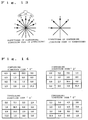
- Fig. 13 is a diagram showing direction blurring filters used in a contouring direction code space blurring unit of the second embodiment.
- Fig. 14 is a diagram showing contouring direction code frequency matrices of the recognition object character obtained from the contouring direction code direction blurring unit of the second embodiment.
- Fig. 15 is a block diagram showing a contouring direction feature extraction unit of a third embodiment of the invention.
- Fig. 16 is a block diagram showing a character recognition apparatus of the prior art.
- Fig. 1 is a block diagram of a character recognition apparatus of a first embodiment of the invention.
- 10 designates an image input unit such as an image scanner through which an image including a recognition object character is input
- 11 designates a character segmentation unit which separates a rectangular segment of a character image of the recognition object from the image input to the image input unit 10.
- the reference numeral 12 designates a contouring direction feature extraction unit which obtains a contouring direction feature vector for detecting a character from the rectangular character image segment obtained by the character segmentation unit 11.
- a contouring direction feature vector indicates a feature of a character by means of the directionality of a contour line of the character.
- the reference numeral 13 designates a recognition dictionary which stores contouring direction feature vectors for all character categories of recognition objects.
- the reference numeral 14 designates a character recognition unit which checks the contouring direction feature vector obtained by the contouring direction feature extraction unit 12 with the contouring direction feature vectors stored in the recognition dictionary 13, to extract recognition candidate characters.
- contouring direction feature extraction unit 12 designates a contouring direction code imparting unit which determines contouring direction codes for four directions (respectively indicative of horizontal, vertical, upper right, and lower right directions) of contour points of the character image of the recognition object separated by the character segmentation unit 11.
- the reference numeral 16 designates a contouring direction code frequency calculation unit which calculates the frequencies of the contouring directions obtained by the contouring direction code imparting unit 15, in each of subregions obtained by dividing the rectangle which is separated by the character segmentation unit 11, into M and N sections in horizontal and vertical directions (where M and N are arbitrary natural numbers).
- the reference numeral 17 designates a contouring direction code density calculation unit which calculates the density of the contouring direction codes of each of the subregions, by using the frequencies of the direction codes obtained by the contouring direction code frequency calculation unit 16, and the size of the respective subregion.
- the reference numeral 18 designates a contouring direction code space blurring unit which conducts a weighted addition on each of the contouring direction codes of the subregions by adding, with an arbitrary weight coefficient, the contouring direction code densities of neighbor subregions which are adjacent to the respective subregion with the subregion as the center and in a direction perpendicular to that of each of the contouring direction codes, thereby obtaining a contouring direction feature vector of (M ⁇ N ⁇ 4) dimensions.
- the image input unit 10 receives an image including the recognition object character and digitizes it. As shown in Fig. 2, the character segmentation unit 11 then separates a rectangular pattern circumscribing the character from the binarised input image, as a character image. Thereafter, the contouring direction feature extraction unit 12 obtains a contouring direction feature vector which is required for character recognition in the character recognition unit 14.
- the contouring direction feature extraction unit 12 operates in the following manner: First the contouring direction code imparting unit 15 extracts contour points existing on a contour line of the character image separated by the character segmentation unit 11, and determines contouring direction codes of the extracted contour points. In this determination, the judgment on a contour point is conducted by using a mask of, for example, 3 ⁇ 3. More specifically, the polarity of each pixel point (i.e., whether the pixel point is a black pixel or a white pixel) is compared with the polarities of 8 pixel points adjacent to the pixel point. When at least one of these pixel points has a different polarity, this pixel point is judged to be a contour point.
- the contouring direction code of each contour point is determined by scanning the character image by using a mask of 2 ⁇ 2, and checking whether the character image coincides with one of mask patterns such as shown in Fig. 3, thereby providing each contour point with a contouring direction code in which a contour line direction of the character is quantized in the four directions.
- a mask of 2 ⁇ 2 wherein a certain contour point is used as a point of attention coincides with a mask pattern M1 or M2 shown in Fig. 3, for example, the contour point in attention is provided with a horizontal contouring direction code "H".
- the contour point is provided with a vertical contouring direction code "V" when the mask coincides with a mask pattern M5 or M6, with an upper left contouring direction code “L” when the mask coincides with a mask pattern M7 or M8, and with an upper right contouring direction code “R” when the mask coincides with a mask pattern M3 or M4.
- Fig. 4 shows an example in which the contour points of the recognition object character " " of Fig. 2 are provided with such contouring direction codes in the manner described above.
- Fig. 5 shows the frequencies of the contouring direction codes of the subregions of the recognition object character in the form of 4 ⁇ 4 matrices of contouring direction code frequency with respect to the four directions of "H", "V", "L”, and "R".
- the character image is divided into the subregions by barycentric division on the basis of the marginal distribution of the character (the distribution of the numbers of black pixel points in the case where the character image is projected to horizontal and vertical sides of a frame circumscribing the image).
- the division may be conducted by another method.
- a simple division method in which the width and height of a character are equally divided may be employed.
- the contouring direction codes of the four directions are obtained.
- contouring direction codes of eight directions may be obtained.
- the contouring direction code density calculation unit 17 calculates the density of the contouring direction codes (hereinafter, referred to as "contouring direction code density") of each subregion by normalizing (dividing) the frequencies of the contouring direction codes obtained by the contouring direction code frequency calculation unit 16, by the size of the respective subregions (e.g., the area, horizontal width, or vertical width of the subregion).
- Fig. 6 shows the contouring direction code densities of the subregions of the recognition object character in the form of matrices in the same manner as Fig. 5. In Fig.
- contouring direction codes "H” were normalized by the horizontal width of the respective subregions, the contouring direction codes “V” by the vertical width of the respective subregions, and the contouring direction codes “L” and “R” by the horizontal width or vertical width of the respective subregions whichever is smaller than the other.
- the contouring direction code space blurring unit 18 then conducts a weighted addition on the contouring direction code density of each subregion by adding, with a predetermined weight coefficient, the contouring direction code densities of neighbor subregions which are adjacent to the subregion with the subregion as the center and in a direction perpendicular to that of each of the contouring direction codes.
- the contouring direction code densities are spatially blurred.
- contouring direction code density matrices F k (i, j) (where i and j indicate the subregions, k indicates the direction of a direction code, and, in the embodiment, 0 ⁇ i, j, and k ⁇ 3) for the directions of each contouring direction code shown in Fig.
- the contouring direction code density matrices G k (i, j) of the recognition object character " " which has been subjected to the blurring process are as shown in Fig. 8.
- a collection of the thus obtained contouring direction code density matrices G k (i, j) constitutes a contouring direction feature vector.
- the contouring direction feature vector has 4 (M) ⁇ 4 (N) ⁇ 4 or 64 dimensions.
- the character recognition unit 14 checks the contouring direction feature vector for the recognition object character and obtained in the contouring direction feature extraction unit 12, with contouring direction feature vectors of character categories which have been obtained by feature extraction in the same manner as described above and stored in the recognition dictionary 13, to obtain similarities between the recognition object character and the character categories.
- a plurality of characters having a larger similarity are extracted as recognition candidate characters.
- the embodiment attained a recognition rate of 93.0 %, and the prior art character recognition apparatus a recognition rate of 91.1 %, showing that the embodiment can improve the recognition performance.
- the contouring direction code space blurring unit 18 conducts the blurring process in a direction perpendicular to the direction of the direction code, on the character feature amount obtained as the density of directional components of a contour line of a character of each local region.
- a feature amount which has been subjected to such a blurring process has a very small variation amount or is stable even when a character line is positionally deviated into a neighbor subregion by a local variation in position or thickness of the character line. It is often that such a positional deviation of a character line independently occurs for each character line.
- the blurring process perpendicular to a directional component is very effective. Namely, the blurring process causes the variation of a feature amount to be insensitive to a positional deviation of a certain degree of a character line, with the result that a stable feature amount is obtained. Even when the recognition object is a character such as a hand-written kanji which has a complex structure and in which positions of character lines locally vary in a very large degree, therefore, the embodiment can attain a highly accurate and stable recognition performance.
- Fig. 9 is a block diagram of the contouring direction feature extraction unit 12 of a second embodiment of the invention.
- 21 designates a contouring direction code imparting unit which determines contouring direction codes for eight directions (respectively indicative of horizontal, vertical, upper right, and lower right directions, and four directions which equally divide two adjacent ones of the directions) of contour points of the character image of the recognition object separated by the character segmentation unit 11.
- the reference numeral 22 designates a contouring direction code frequency calculation unit which calculates the frequencies of the contouring directions obtained by the contouring direction code imparting unit 21, in each of subregions obtained by dividing the rectangle which is separated by the character segmentation unit 11, into M and N sections in horizontal and vertical directions (where M and N are arbitrary natural numbers).
- the reference numeral 23 designates a contouring direction code direction blurring unit which, for each of the subregions, conducts a weighted addition with an arbitrary weight coefficient on the frequency of contouring direction codes which are adjacent in direction to the respective contouring direction code with using the four directions of horizontal, vertical, upper right, and lower right directions as the center, thereby compressing the frequencies of the contouring direction codes of the eight directions into the frequencies of the contouring direction codes of the four directions.
- the reference numeral 24 designates a contouring direction code density calculation unit which calculates the density of the contouring direction codes of each of the subregions, by using the frequencies of the four direction codes obtained by the contouring direction code direction blurring unit 23, and the size of the respective subregion.
- the reference numeral 25 designates a contouring direction code space blurring unit which conducts a weighted addition with an arbitrary weight coefficient on each of the contouring direction codes of the subregions by adding the contouring direction code densities of neighbor subregions which are adjacent to the respective subregion with the subregion as the center and in a direction perpendicular to that of each of the contouring direction codes, thereby obtaining a contouring direction feature vector of (M ⁇ N ⁇ 4) dimensions.
- the contouring direction code imparting unit 21 extracts contour points existing on a contour line of the character image separated by the character segmentation unit 11, and determines contouring direction codes of the extracted contour points. In this determination, the judgment on a contour point is conducted by using a mask of 3 ⁇ 3. More specifically, when at least one of pixel points which are adjacent to one black pixel point of the character area in the upper, lower, left, and right directions is a white pixel point, this black pixel point is judged to be a contour point.
- the contouring direction code of each contour point is determined by scanning the character image which has been subjected to the contour point extraction, by using a mask of 3 ⁇ 3 which is centered at the respective contour point, and checking whether the character image coincides with one of mask patterns such as shown in Fig. 10, thereby providing each contour points with a contouring direction code in which a contour line direction of the character is quantized in eight directions.
- a mask of 3 ⁇ 3 centered at a certain contour point coincides with a mask pattern M1 shown in Fig. 10, for example, the contour point in attention is provided with a horizontal contouring direction code "0".
- the contour point is provided with a vertical contouring direction code "4" when the mask coincides with a mask pattern M3, with a lower right contouring direction code “2" when the mask coincides with a mask pattern M2, and with a upper right contouring direction code “6” when the mask coincides with a mask pattern M4.
- the contour points are provided with contouring direction codes "1", “3", "5", or "7” by using mask patterns M5 to M12.
- Fig. 11 shows an example in which the contour points of the recognition object character are provided with these contouring direction codes in the manner described above.
- Fig. 12 shows the frequencies of the contouring direction codes of the subregions of the recognition object character shown in Fig. 11, in the form of 4 ⁇ 4 matrices of contouring direction code frequency with respect to the eight directions of "0" to "7".
- the character image was divided into the subregions by barycentric division.
- the contouring direction code direction blurring unit 23 then conducts a weighted addition with a predetermined weight coefficient on the frequencies of contouring direction codes which are adjacent in direction to the respective contouring direction code with using "0" (horizontal), “4" (vertical), “6” (upper right), and “2" (lower right) directions as the center, thereby compressing the frequencies of the contouring direction codes of the eight directions into the frequencies of the contouring direction codes of the above-mentioned four directions of "0", “2", “4", and "6".
- the frequencies of the contouring direction codes of the eight directions are compressed into those of the four directions by aggregating the frequencies by using a filter having weight coefficients shown in Fig.
- Fig. 14 shows the frequencies of the contouring direction codes compressed into the four directions in the subregions of the recognition object character shown in Fig. 11, in the form of matrices in the same manner as Fig. 12.
- the contouring direction code density calculation unit 24 calculates the density of the contouring direction codes (hereinafter, referred to as "contouring direction code density") of each subregion by normalizing (dividing) the frequencies of the contouring direction codes obtained by the contouring direction code direction blurring unit 23, by the size of the respective subregion (e.g., the area, horizontal width, or vertical width of the subregion).
- the contouring direction code space blurring unit 25 then conducts a weighted addition on the contouring direction code density of each of the subregions by adding, with a predetermined weight coefficient, the contouring direction code densities of neighbor subregions which are adjacent to the respective subregion with the subregion as the center and in a direction perpendicular to that of each of the contouring direction codes, thereby spatially blurring the contouring direction code density.
- the specific operation of the unit is the same as that of the first embodiment, and therefore its description is omitted.
- a collection of the thus obtained contouring direction code density matrices constitutes a contouring direction feature vector which has 4 (M) ⁇ 4 (N) ⁇ 4, or 64 dimensions.
- the contouring direction code direction blurring unit 23 is added to the configuration of the contouring direction feature extraction unit 12 of the first embodiment.
- a positional deviation of a character line into a neighbor subregion can be absorbed by spatially blurring a character feature amount obtained as directional components of a character contour line in each local area.
- the contouring direction code direction blurring unit 23 conducts also the direction blurring process, and therefore also a slant variation of a character line in each local area can be absorbed.
- Fig. 15 is a block diagram of the contouring direction feature extraction unit 12 of a third embodiment of the invention.
- portions indicated by 21 to 25 are the same as those used in the contouring direction feature extraction unit 12 of the second embodiment.
- the reference numeral 26 designates a contouring direction code density weighted average unit which, for each of the directions of the contouring direction codes, conducts a weighted average operation on the contouring direction code density of each subregion obtained by the contouring direction code space blurring unit 25 in neighbor subregions adjacent to the subregion, whereby an (M ⁇ N) number of contouring direction code densities are spatially compressed into a (P ⁇ Q) number of contouring direction code densities (M > P, and N > Q) to obtain a contouring direction feature vector.
- the contouring direction code density weighted average unit 26 is added to the configuration of the contouring direction feature extraction unit 12 of the second embodiment shown in Fig. 9, and the series of operations of the portions 21 to 25 starting from the input of a character image separated by the character segmentation unit 11 to the contouring direction code imparting unit 21, and ending at the obtainment of the contouring direction code densities for the subregions of the character image in the contouring direction code space blurring unit 25 are the same as those of the second embodiment. In the following, therefore, the description of these portions is omitted and the operation of the contouring direction code density weighted average unit 26 will be described.
- the contouring direction code density weighted average unit 26 conducts a weighted average operation on the contouring direction code density of each subregion obtained by the contouring direction code space blurring unit 25 in neighbor subregions of, for example, 2 ⁇ 2 adjacent to the subregion, whereby an (8 ⁇ 8) number of contouring direction code densities are spatially compressed into a (4 ⁇ 4) number of contouring direction code densities.
- contouring direction code density matrices G k (i, j) (i and j indicate subregions, k indicates the direction of each contouring direction code, and, in the embodiment, 0 ⁇ i and j ⁇ 7, and 0 ⁇ k ⁇ 3) obtained by the contouring direction code space blurring unit 25 are converted into spatially compressed contouring direction code density matrices A k (i, j) (0 ⁇ i, j, and k ⁇ 3), by using an average filter of 2 ⁇ 2.
- this can be indicated by (Ex. 3) as follows:
- a k (i, j) G k (i, j) + G k (i+1, j) + G k (i+1, j) + G k (i+1, j+1)
- a collection of the thus obtained contouring direction code density matrices A k (i, j) constitutes a contouring direction feature vector which has 4 ⁇ 4 ⁇ 4, or 64 dimensions.
- a kanji has a complex shape and there are many characters similar to the kanji.
- a character image In order to discriminate these kanjis from each other, therefore, a character image must be divided into subregions in a certain fine degree. As the number of subregions is larger, a feature vector has a larger number of dimensions. When the dimension number of a feature vector is increased, therefore, a recognition rate of kanjis or the like can be improved, but the period required for checking an input character with the recognition dictionary 13 is usually prolonged and also the capacity of the recognition dictionary 13 is increased. Consequently, a character recognition apparatus requires a character feature amount in which a feature vector has a small number of dimensions and which has an excellent recognition performance.
- the contouring direction code density weighted average unit 26 is added to the configuration of the contouring direction feature extraction unit 12 of the second embodiment.
- a 64-dimensional feature vector obtained by the embodiment has a lower recognition performance than that of a 256-dimensional feature vector which is obtained by the contouring direction feature extraction unit 12 described in conjunction with the first and second embodiments, with setting the region division number to be 8 ⁇ 8.
- a 64-dimensional feature vector obtained by the embodiment has the highest recognition performance because a contouring direction feature vector which is obtained by the second embodiment and in which a local positional variation and a slant variation of a character line are absorbed is further spatially compressed in an efficient manner by spatially and directionally blurring directional components of a character contour line in each local area.
- the embodiment attained a recognition rate of 87.2 %.
- the comparison experiments on the character recognition apparatuses of the prior art example, and the first and second embodiments show results of 85.1 %, 80.5 %, and 81.1 %, respectively.
- the contouring direction code space blurring unit conducts a blurring process in a direction perpendicular to the direction of the direction code, on the character feature amount obtained as the density of directional components of a contour line of a character of each local region.
- the feature amount has a very small variation amount or is stable even when a character line is positionally deviated into a neighbor subregion by a local variation in position or thickness of the character line.
- the apparatus of the invention can attain a highly accurate and stable recognition performance.
- the region division number of a character image, the direction blurring process masks, and the weight coefficient of the filter for direction blurring are not restricted to those used in the embodiments, and may be set to be various values.
- the density of frequency is used as information relating to the frequency.
- the invention is not restricted to this, and other kinds of information relating to the frequency may be used.
- the frequency may be used as it is.
- the contour lines of four or eight directions are used.
- the invention is not restricted to this.
- the processing units are configured by dedicated hardware. In place of the hardware, the same functions may be realized in a software manner by using a computer.
- the apparatus of the invention comprises the contouring direction code space blurring means for, on the basis of a frequency of contouring direction codes for each subregion or information relating to the frequency, such as a density in the subregion, conducting, for each of the contouring direction codes, a weighted addition on a frequency or information relating to the frequency of each subregion (A) by adding, with a predetermined weight coefficient, a frequency or information relating to the frequency of a subregion in the vicinity of the subregion (A). Therefore, the invention has an advantage that a character can stably be recognized with high accuracy.
Landscapes
- Engineering & Computer Science (AREA)
- Computer Vision & Pattern Recognition (AREA)
- Physics & Mathematics (AREA)
- General Physics & Mathematics (AREA)
- Multimedia (AREA)
- Theoretical Computer Science (AREA)
- Character Discrimination (AREA)
Applications Claiming Priority (3)
| Application Number | Priority Date | Filing Date | Title |
|---|---|---|---|
| JP27572693 | 1993-11-04 | ||
| JP5275726A JPH07129720A (ja) | 1993-11-04 | 1993-11-04 | 文字認識装置 |
| JP275726/93 | 1993-11-04 |
Publications (3)
| Publication Number | Publication Date |
|---|---|
| EP0652532A2 true EP0652532A2 (de) | 1995-05-10 |
| EP0652532A3 EP0652532A3 (de) | 1996-04-24 |
| EP0652532B1 EP0652532B1 (de) | 2001-07-18 |
Family
ID=17559530
Family Applications (1)
| Application Number | Title | Priority Date | Filing Date |
|---|---|---|---|
| EP94117452A Expired - Lifetime EP0652532B1 (de) | 1993-11-04 | 1994-11-04 | Zeichenerkennungsgerät |
Country Status (4)
| Country | Link |
|---|---|
| US (1) | US5703963A (de) |
| EP (1) | EP0652532B1 (de) |
| JP (1) | JPH07129720A (de) |
| DE (1) | DE69427735T2 (de) |
Families Citing this family (11)
| Publication number | Priority date | Publication date | Assignee | Title |
|---|---|---|---|---|
| US6356656B1 (en) * | 1994-06-17 | 2002-03-12 | Canon Kabushiki Kaisha | Contour-information extraction apparatus and method |
| JPH08194780A (ja) * | 1994-11-18 | 1996-07-30 | Ricoh Co Ltd | 特徴抽出方法 |
| US5940534A (en) * | 1995-07-17 | 1999-08-17 | Nippon Telegraph And Telephone Corporation | On-line handwritten character recognition using affine transformation to maximize overlapping of corresponding input and reference pattern strokes |
| US6018593A (en) * | 1996-09-11 | 2000-01-25 | Ricoh Company, Ltd. | Method and system for correcting image position based upon predetermined pattern portions |
| US5995115A (en) * | 1997-04-04 | 1999-11-30 | Avid Technology, Inc. | Computer system process and user interface for providing intelligent scissors for image composition |
| JP3580670B2 (ja) * | 1997-06-10 | 2004-10-27 | 富士通株式会社 | 入力画像を基準画像に対応付ける方法、そのための装置、及びその方法を実現するプログラムを記憶した記憶媒体 |
| FR2788873B1 (fr) * | 1999-01-22 | 2001-03-09 | Intermec Scanner Technology Ct | Procede et dispositif de detection de segments de droites dans un flot de donnees numeriques representatives d'une image, dans lequel sont identifies les points contours de ladite image |
| US7010166B2 (en) * | 2000-11-22 | 2006-03-07 | Lockheed Martin Corporation | Character recognition system and method using spatial and structural feature extraction |
| CA2375355A1 (en) * | 2002-03-11 | 2003-09-11 | Neo Systems Inc. | Character recognition system and method |
| JP2006048180A (ja) * | 2004-07-30 | 2006-02-16 | Tkc Corp | 画像処理装置、画像処理方法および画像処理プログラム |
| CN113127637B (zh) * | 2019-12-31 | 2025-09-02 | 中兴通讯股份有限公司 | 一种字符的还原方法及装置、存储介质、电子装置 |
Family Cites Families (7)
| Publication number | Priority date | Publication date | Assignee | Title |
|---|---|---|---|---|
| JPS58123175A (ja) * | 1982-01-18 | 1983-07-22 | Oki Electric Ind Co Ltd | 文字認識方式 |
| JPS6279582A (ja) * | 1985-10-03 | 1987-04-11 | Ricoh Co Ltd | 文字認識用辞書作成方式 |
| JPS62192886A (ja) * | 1986-02-20 | 1987-08-24 | Ricoh Co Ltd | 文字認識装置における特徴量生成方法 |
| DE3716787A1 (de) * | 1986-05-19 | 1987-11-26 | Ricoh Kk | Zeichenerkennungsverfahren |
| US4903313A (en) * | 1986-07-03 | 1990-02-20 | Ricoh Company, Ltd. | Character recognition method |
| JPH0766417B2 (ja) * | 1986-07-29 | 1995-07-19 | 松下電器産業株式会社 | 文字認識装置 |
| US4959870A (en) * | 1987-05-26 | 1990-09-25 | Ricoh Company, Ltd. | Character recognition apparatus having means for compressing feature data |
-
1993
- 1993-11-04 JP JP5275726A patent/JPH07129720A/ja active Pending
-
1994
- 1994-10-31 US US08/332,120 patent/US5703963A/en not_active Expired - Fee Related
- 1994-11-04 DE DE69427735T patent/DE69427735T2/de not_active Expired - Fee Related
- 1994-11-04 EP EP94117452A patent/EP0652532B1/de not_active Expired - Lifetime
Also Published As
| Publication number | Publication date |
|---|---|
| EP0652532A3 (de) | 1996-04-24 |
| US5703963A (en) | 1997-12-30 |
| DE69427735T2 (de) | 2001-10-31 |
| EP0652532B1 (de) | 2001-07-18 |
| DE69427735D1 (de) | 2001-08-23 |
| JPH07129720A (ja) | 1995-05-19 |
Similar Documents
| Publication | Publication Date | Title |
|---|---|---|
| US4903312A (en) | Character recognition with variable subdivisions of a character region | |
| EP0288266B1 (de) | Unterscheidungsvorrichtung für handgeschriebene und maschinengedruckte Buchstaben | |
| US6249604B1 (en) | Method for determining boundaries of words in text | |
| US6687401B2 (en) | Pattern recognizing apparatus and method | |
| US5640466A (en) | Method of deriving wordshapes for subsequent comparison | |
| EP0436819B1 (de) | Handschrifterkennung mit Verwendung von jeweils zwischen zwei Klassen unterscheidenden Massnahmen | |
| JPH07152867A (ja) | パターン認識方法および装置 | |
| US5703963A (en) | Character recognition apparatus that subdivides a character into subregions to obtain feature vectors | |
| KR100582039B1 (ko) | 문자 인식 장치 | |
| Lehal et al. | Feature extraction and classification for OCR of Gurmukhi script | |
| Nomura et al. | Detection and segmentation of touching characters in mathematical expressions | |
| EP0680005A2 (de) | Schnellheits- und Erkennungsverbesserung für OCR mittels normalisierter Höhen-/Breitenposition | |
| EP0432937B1 (de) | Gerät zur Erkennung handgeschriebener Zeichen | |
| Goto et al. | Extracting curved text lines using local linearity of the text line | |
| US5228095A (en) | Apparatus for recognizing printed characters | |
| Le et al. | Automated borders detection and adaptive segmentation for binary document images | |
| Baird | Global-to-local layout analysis | |
| CN113537216B (zh) | 一种点阵字体文本行倾斜校正方法及装置 | |
| EP0602955B1 (de) | Texterkennung | |
| JP3372005B2 (ja) | 文字認識装置 | |
| JP2917427B2 (ja) | 図面読取装置 | |
| Gatos et al. | A segmentation-free recognition technique to assist old Greek handwritten manuscript OCR | |
| Chen et al. | Detection and location of multicharacter sequences in lines of imaged text | |
| JPH0652358A (ja) | 文字認識方法 | |
| JP2576350B2 (ja) | 文字列抽出装置 |
Legal Events
| Date | Code | Title | Description |
|---|---|---|---|
| PUAI | Public reference made under article 153(3) epc to a published international application that has entered the european phase |
Free format text: ORIGINAL CODE: 0009012 |
|
| AK | Designated contracting states |
Kind code of ref document: A2 Designated state(s): DE FR GB IT NL |
|
| PUAL | Search report despatched |
Free format text: ORIGINAL CODE: 0009013 |
|
| AK | Designated contracting states |
Kind code of ref document: A3 Designated state(s): DE FR GB IT NL |
|
| 17P | Request for examination filed |
Effective date: 19960823 |
|
| 17Q | First examination report despatched |
Effective date: 19990304 |
|
| RIC1 | Information provided on ipc code assigned before grant |
Free format text: 6G 06K 9/48 A |
|
| RTI1 | Title (correction) |
Free format text: CHARACTER RECOGNITION APPARATUS |
|
| GRAG | Despatch of communication of intention to grant |
Free format text: ORIGINAL CODE: EPIDOS AGRA |
|
| GRAG | Despatch of communication of intention to grant |
Free format text: ORIGINAL CODE: EPIDOS AGRA |
|
| GRAG | Despatch of communication of intention to grant |
Free format text: ORIGINAL CODE: EPIDOS AGRA |
|
| GRAH | Despatch of communication of intention to grant a patent |
Free format text: ORIGINAL CODE: EPIDOS IGRA |
|
| GRAH | Despatch of communication of intention to grant a patent |
Free format text: ORIGINAL CODE: EPIDOS IGRA |
|
| GRAA | (expected) grant |
Free format text: ORIGINAL CODE: 0009210 |
|
| AK | Designated contracting states |
Kind code of ref document: B1 Designated state(s): DE FR GB IT NL |
|
| REF | Corresponds to: |
Ref document number: 69427735 Country of ref document: DE Date of ref document: 20010823 |
|
| ET | Fr: translation filed | ||
| REG | Reference to a national code |
Ref country code: GB Ref legal event code: IF02 |
|
| PLBE | No opposition filed within time limit |
Free format text: ORIGINAL CODE: 0009261 |
|
| STAA | Information on the status of an ep patent application or granted ep patent |
Free format text: STATUS: NO OPPOSITION FILED WITHIN TIME LIMIT |
|
| 26N | No opposition filed | ||
| PGFP | Annual fee paid to national office [announced via postgrant information from national office to epo] |
Ref country code: GB Payment date: 20031029 Year of fee payment: 10 |
|
| PGFP | Annual fee paid to national office [announced via postgrant information from national office to epo] |
Ref country code: FR Payment date: 20031110 Year of fee payment: 10 |
|
| PGFP | Annual fee paid to national office [announced via postgrant information from national office to epo] |
Ref country code: DE Payment date: 20031113 Year of fee payment: 10 |
|
| PG25 | Lapsed in a contracting state [announced via postgrant information from national office to epo] |
Ref country code: GB Free format text: LAPSE BECAUSE OF NON-PAYMENT OF DUE FEES Effective date: 20041104 |
|
| PG25 | Lapsed in a contracting state [announced via postgrant information from national office to epo] |
Ref country code: DE Free format text: LAPSE BECAUSE OF NON-PAYMENT OF DUE FEES Effective date: 20050601 |
|
| GBPC | Gb: european patent ceased through non-payment of renewal fee |
Effective date: 20041104 |
|
| PG25 | Lapsed in a contracting state [announced via postgrant information from national office to epo] |
Ref country code: FR Free format text: LAPSE BECAUSE OF NON-PAYMENT OF DUE FEES Effective date: 20050729 |
|
| REG | Reference to a national code |
Ref country code: FR Ref legal event code: ST |
|
| PG25 | Lapsed in a contracting state [announced via postgrant information from national office to epo] |
Ref country code: IT Free format text: LAPSE BECAUSE OF NON-PAYMENT OF DUE FEES Effective date: 20051104 |
|
| PGFP | Annual fee paid to national office [announced via postgrant information from national office to epo] |
Ref country code: NL Payment date: 20061115 Year of fee payment: 13 |
|
| NLV4 | Nl: lapsed or anulled due to non-payment of the annual fee |
Effective date: 20080601 |
|
| PG25 | Lapsed in a contracting state [announced via postgrant information from national office to epo] |
Ref country code: NL Free format text: LAPSE BECAUSE OF NON-PAYMENT OF DUE FEES Effective date: 20080601 |