EP0652592A2 - Halbleiter-Speicheranordnung und Verfahren zu ihrer Herstellung - Google Patents
Halbleiter-Speicheranordnung und Verfahren zu ihrer Herstellung Download PDFInfo
- Publication number
- EP0652592A2 EP0652592A2 EP94117434A EP94117434A EP0652592A2 EP 0652592 A2 EP0652592 A2 EP 0652592A2 EP 94117434 A EP94117434 A EP 94117434A EP 94117434 A EP94117434 A EP 94117434A EP 0652592 A2 EP0652592 A2 EP 0652592A2
- Authority
- EP
- European Patent Office
- Prior art keywords
- element separation
- separation oxide
- trenches
- oxide film
- memory device
- Prior art date
- Legal status (The legal status is an assumption and is not a legal conclusion. Google has not performed a legal analysis and makes no representation as to the accuracy of the status listed.)
- Withdrawn
Links
Images



Classifications
-
- H—ELECTRICITY
- H10—SEMICONDUCTOR DEVICES; ELECTRIC SOLID-STATE DEVICES NOT OTHERWISE PROVIDED FOR
- H10B—ELECTRONIC MEMORY DEVICES
- H10B12/00—Dynamic random access memory [DRAM] devices
- H10B12/01—Manufacture or treatment
-
- H—ELECTRICITY
- H10—SEMICONDUCTOR DEVICES; ELECTRIC SOLID-STATE DEVICES NOT OTHERWISE PROVIDED FOR
- H10B—ELECTRONIC MEMORY DEVICES
- H10B12/00—Dynamic random access memory [DRAM] devices
- H10B12/30—DRAM devices comprising one-transistor - one-capacitor [1T-1C] memory cells
- H10B12/37—DRAM devices comprising one-transistor - one-capacitor [1T-1C] memory cells the capacitor being at least partially in a trench in the substrate
-
- H—ELECTRICITY
- H10—SEMICONDUCTOR DEVICES; ELECTRIC SOLID-STATE DEVICES NOT OTHERWISE PROVIDED FOR
- H10B—ELECTRONIC MEMORY DEVICES
- H10B12/00—Dynamic random access memory [DRAM] devices
- H10B12/01—Manufacture or treatment
- H10B12/02—Manufacture or treatment for one transistor one-capacitor [1T-1C] memory cells
- H10B12/03—Making the capacitor or connections thereto
- H10B12/038—Making the capacitor or connections thereto the capacitor being in a trench in the substrate
-
- H—ELECTRICITY
- H10—SEMICONDUCTOR DEVICES; ELECTRIC SOLID-STATE DEVICES NOT OTHERWISE PROVIDED FOR
- H10B—ELECTRONIC MEMORY DEVICES
- H10B12/00—Dynamic random access memory [DRAM] devices
- H10B12/30—DRAM devices comprising one-transistor - one-capacitor [1T-1C] memory cells
-
- H—ELECTRICITY
- H10—SEMICONDUCTOR DEVICES; ELECTRIC SOLID-STATE DEVICES NOT OTHERWISE PROVIDED FOR
- H10B—ELECTRONIC MEMORY DEVICES
- H10B12/00—Dynamic random access memory [DRAM] devices
- H10B12/30—DRAM devices comprising one-transistor - one-capacitor [1T-1C] memory cells
- H10B12/31—DRAM devices comprising one-transistor - one-capacitor [1T-1C] memory cells having a storage electrode stacked over the transistor
Definitions
- the present invention relates to a semiconductor memory device and a method of manufacturing the device, and particularly, to a pattern layout of a high-integration and large-capacity dynamic RAM (random access read/write memory).
- FIG. 1 is a plan view showing a layout of the main layer of a conventional semiconductor memory device.
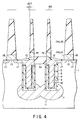
- FIGS. 2 to 4 illustrate a method of manufacturing the conventional semiconductor memory device.
- FIG. 2 illustrates the first step, and is a cross section of the section taken along the line 2-2 in FIG. 1, after the completion of the first step.
- FIG. 3 illustrates the first step, and is a cross section of the section taken along the line 3-3 in FIG. 1, after the completion of the first step.
- FIG. 4 illustrates the second step, and is a cross section of the section taken along the line 4-4 in FIG. 1, after the completion of the second step.
- an element separation oxide film 3a is formed on the surface of a P-type silicon substrate 1 by the LOCOS (local oxidation of silicon) method using a mask 2b having to the element separation pattern 2a.
- LOCOS local oxidation of silicon
- a silicon nitride film (not shown) is formed on the surface of a P-type silicon substrate 1, and the silicon nitride film is etched using the mask 2b having the element separation pattern 2a.
- the surface of the portion of the P-type silicon substrate 1, which is exposed by the etching is thermally oxidized, thus forming an element separation oxide film 3a.
- the transfer error between the mask 2b having the element separation pattern 2a and the element separation oxide film 3a varies in accordance with the pattern shape of the element separation oxide film 3a.
- the transfer error ⁇ L1 with regard to the element separation oxide film 3a shown in FIG. 2 is larger than the conversion error ⁇ L2 with regard to the element separation oxide film 3a shown in FIG. 3.
- HSPC sheath plate capacitor
- a trench 5 having a depth of about 3 ⁇ m is formed on the P-type silicon substrate 1 by use of a mask (not shown) corresponding to a trench pattern 4a shown in FIG. 1.
- the trench 5 goes through a part of the element separation oxide film 3a.
- an SiO2 film 6 is formed on only a side wall of the trench 5.
- a diffusion layer plate 7 is formed on a bottom portion of the trench 5, and a plate electrode 8 made by processing polysilicon into a sheath shape, is formed in the trench 5.
- a capacitor insulation film 9 is formed in and on the plate electrode 8.
- the trench 5 is filled with polysilicon, and a storage node electrode 10 is formed in the trench 5.
- a sheath plate capacitor 11 consisting of the plate electrode 8, capacitor insulation film 9 and storage node electrode 10, is formed.
- An oxide film 12 is formed selectively on the storage node electrode 10, and a gate insulation film 13 is formed on the surface of the P-type silicon substrate 1.
- a polysilicon film 14a is deposited on the gate insulation film 13, the oxide film 12 and the element separation oxide film 3a.
- a resist 15a is applied on the polysilicon film 14a.
- the resist 15a is patterned by a mask 16a corresponding to a word line pattern 16 shown in FIG. 1, a resist pattern 15 is formed on the polysilicon film 14a.
- the polysilicon film 14a is etched with the resist pattern 15 serving as a mask, thus forming a gate electrode 14 made of the polysilicon film 14a.
- an ion implantation is carried out using the gate electrode 14 as a mask, and therefore a diffusion layer 17 of the source-drain region is formed on the P-type silicon substrate 1.
- the resist pattern 15 is removed, and bit lines and a wiring portion are formed, thus completing a dynamic RAM.
- the element separation oxide film 3a is formed on the surface of the P-type silicon substrate 1 with the mask 2b having the element separation pattern 2a shown in FIG. 1.
- the transfer error between the element separation oxide film 3a and the mask 2b varies, as indicated by ⁇ L1 and ⁇ L2. More specifically, the transfer error ⁇ L1 indicated by the cross section of the element separation oxide film 3a taken along with the line 2-2 of FIG. 1 differs from the transfer error ⁇ L2 indicated by the cross section taken along with the line 3-3 of FIG. 1, which is vertical to the line 2-2.
- the conventional manufacturing method is not appropriate for the downsizing of devices, and the controllability of the manufacturing step is low, thus significantly degrading the yield of the product.
- the continuous surface of all of the element separation oxide film 3a, the oxide film 12 and the gate insulation film 13 cannot be flattened. Therefore, a difference in level is created in that portion of the polysilicon film 14a formed on the element separation film 3a, the oxide film 12 and the gate insulation film 13, which is situated on the boundary between the oxide film 12 and the insulation film 13. Consequently, the transfer error ⁇ L3 with respect to the mask 16a occurs only in pass word lines 19, such that the pass word lines 19 are made narrower than the designed value. As a result, the performance of the product device may be degraded, i.e. an increase in the wiring resistance.
- the purpose of the present invention is to provide a semiconductor memory device having an enhanced performance and suitable for downsizing, as well as a method of manufacturing a semiconductor memory device, having an improved controllability in its manufacture steps, and an improved yield of the product.
- the object of the invention is achieved by the following structure.
- the method of manufacturing a semiconductor memory device comprising the steps of: forming a first element separation oxide film having a structure of a plurality of lines parallel to each other, on a surface of a semiconductor substrate having a memory cell region; and forming a second element separation oxide film having a thickness less than that of the first element separation oxide film, on a portion of the surface of the semiconductor substrate, which is located each adjacent pair of lines of the first element separation oxide film.
- the semiconductor memory device comprising: a semiconductor substrate; a plurality of first element separation oxide films formed on an surface of the semiconductor substrate, the plurality of first element separation oxide films are arranged in lines parallel to each other; first and second trenches formed on the semiconductor substrate at a position between adjacent ones of the first element separation oxide films; and a second element separation oxide film formed on a portion of the surface of the semiconductor substrate, which is located between the first and second trenches, a thickness of the second element separation oxide film being less than that of the first element separation oxide film.
- a plurality of line-shaped first element separation oxide films parallel to each other, are formed on the surface of the semiconductor substrate having a memory cell region. Since the first element separation oxide films has such an arrangement, the transfer error with regard to the element separation pattern can be made constant. Consequently, the semiconductor memory device can be downsized, and the controllability during the manufacture of the device can be improved. Therefore, the yield of the product can be improved. Further, the phase shift mask of the element separation pattern for the first element separation oxide films can be easily manufactured, enabling a further downsizing of the device.
- First and second trenches are formed in the semiconductor substrate between adjacent ones of the first element separation oxide films.
- the second element separation oxide film which is thinner than the first element separation oxide films is formed on the surface of the semiconductor substrate and between adjacent lines of the first element separation oxide films. More specifically, the second element separation oxide film thinner than the first element separation oxide films is formed in the element separation regions between the lines of the first element separation oxide film.
- FIG. 5 is a plan view showing the layout of the main layer of the semiconductor memory device according to the present invention.
- FIGS. 6 to 8 illustrate the method of manufacturing the semiconductor memory device, according to the present invention.
- FIG. 6 depicts the first step of the method, and is a cross section of the device after the first step, taken along the line 6-6 of FIG. 5.
- FIG. 7 depicts the first step of the method, and is a cross section of the device after the first step, taken along the line 7-7 of FIG. 5.
- FIG. 8 depicts the second step of the method, and is a cross section of the device after the second step, taken along the line 8-8 of FIG. 5.
- first element separation oxide films 23 are formed on the surface of a P-type silicon substrate 21 by the LOCOS method, using a mask (not shown) of an element separation pattern 22 arranged in a line/space manner as shown in FIG. 5.
- a silicon nitride film (not shown) is formed on the surface of the P-type silicon substrate, and the silicon nitride film is etched via the mask (not shown) having the element separation pattern 22. Then, that portion of the surface of the P-type silicon substrate 21 which is exposed by the etching is thermally oxidized, thus forming the line-shaped first element separation oxide films 23 parallel to a bit line (not shown), which is formed in a latter step. Then, the silicon nitride film is removed.
- a sheath plate capacitor (HSPC) 31 is formed on the P-type silicon substrate 21.
- the first and second trenches 25a and 25b having a depth of about 3 ⁇ m are formed on the P-type silicon substrate 21 using a mask (not shown) having a trench pattern 24 shown in FIG. 5.
- the trenches 25a and 25b are situated at such positions that they come in contact with the first element separation oxide films 23 on both sides, and the trenches 25a and 25b run through a part of the first element separation oxide films 23.
- an SiO2 film 26 is formed on only side walls of the trenches 25a and 25b.
- a diffusion layer plate 27 is formed on bottom portions of the trenches 25a and 25b, and a plate electrode 28, formed by processing polysilicon into a sheath shape, is formed in each of the trenches 25a and 25b.
- a capacitor insulation film 29 is formed on an inner surface and a top surface of each plate electrode 28. Then, the trenches 25a and 25b are filled with polysilicon, thus forming a storage node electrode 30 in each of the trenches 25a and 25b. Thus, a sheath plate capacitor 31 consisting of the plate electrode 28, the capacitor insulation film 29 and the storage node electrode 30 is formed.
- an oxide film 32 is selectively formed on each storage node electrode 30.
- a gate insulation film 33 is formed on the surface of the P-type silicon substrate 21.
- a second element separation oxide film 40 is formed between the trenches 25a and 25b.
- the second element separation oxide film 40 can be formed without removing the oxide film which was formed before the formation of the trenches. In either case, the second element separation oxide film 40 can be formed thinner than the first element separation oxide films 23.
- a polysilicon film 34a is deposited on the second element separation oxide film 40, the gate insulation film 33 and the oxide film 32, and a resist 35a is applied on the polysilicon film 34a.
- the resist 35a is patterned with a mask (not shown) of a word line pattern 36 shown in FIG. 5, thus forming a resist pattern 35 on the polysilicon film 34a.
- the polysilicon film 34a is etched with the resist pattern 35 serving as a mask, thus forming a gate electrode 34, a word line 38 and a pass word line 39, all made of the polysilicon film.
- the pass word line 39 is situated on the oxide film 32, and the word line 38 is situated on the gate insulation film 33.
- a diffusion layer 37 for the source-drain region is formed on the P-type silicon substrate 21.
- a memory cell consisting of one transistor having the gate electrode 34 and the diffusion layer 37 of the source-drain region, and one capacitor, which is the sheath plate capacitor 31 in the trenches 24a and 25b, is formed on the P-type silicon substrate 21.
- a diffusion layer 37a is formed between trenches 25a and 25b of two memory cells adjacent to each other in a direction parallel to a bit line (not shown) formed in a later step.
- the diffusion layer 37a should be a P-type and have a higher concentration than the impurity concentration of the channel directly below the word line 38, the diffusion layer may not be formed. Further, in the case where the diffusion layer 37a is formed at the same time as the diffusion layer 37 of the source-drain region, the diffusion layer 37a should be N-type. In this case, it only suffices if the N-type diffusion layer 37a electrically floats. More specifically, the leak pass formed between diffusion layers 37 in the direction along the line 8-8 shown in FIG. 5, has a structure in which the first parasitic MOS, the diffusion layer 37a and the second parasitic MOS are connected in series.
- the first parasitic MOS has a structure in which the pass word line 39 corresponds to a gate, and the oxide film 26 of the inner wall of the first trench 25a corresponds to a gate insulation film.
- the second parasitic MOS has a structure in which the pass word line 39 corresponds to a gate, and the oxide film 26 of the inner wall of the second trench 25b corresponds to a gate insulation film. Therefore, with the operation voltage of the dynamic RAM, it only suffices if the leak current flowing the path of the above series is sufficiently small. In view of this, the thickness of the second element separation oxide film 40 can be set arbitrary regardless if the concentration of the diffusion layer 37a directly underneath the oxide film 40.
- FIG. 9 is a cross section taken along line 9-9 of FIG. 5.
- first to three trenches 25a to 25c are formed.
- the second element separation oxide film 40 is formed on the surface of the P-type silicon substrate 21 and between the first and second trenches 25a and 25b.
- the first element separation oxide films 23, which are thicker than the second element separation oxide film 40, is formed on the surface of the P-type silicon substrate 21 and between the second and third trenches 25b and 25c.
- the sheath plate capacitor 31 consisting of the plate electrode 28, the capacitor insulation film 29 and the storage node electrode 30, is formed.
- the first element separation oxide films 23 are formed on the surface of the P-type silicon substrate 21 such that the line structure of the film 23 is in parallel with the bit line.
- the pattern of the first element separation oxide films 23 is formed to have a structure of an arrangement of line-shaped portions, the transfer error which may vary from one element separation pattern to another, can be made constant.
- the problem of the conventional technique i.e. the transfer error of the mask may vary from one pattern to another, can be solved.
- the semiconductor memory device can be downsized, and the controllability in the manufacturing procedure can be enhanced. Consequently, the yield of the product can be increased. Further, the manufacture of the phase shift mask of the element separation pattern 22 can be facilitated, thus making it possible to achieve a further downsizing of the product.
- the first to third trenches 25a to 25c are formed in the P-type silicon substrate 21 located between lines of the first element separation oxide films 23, and the second element separation oxide film 40, which is thinner than the first element separation oxide films 23, is formed between the first and second trenches 25a and 25b.
- the second element separation oxide film 40, which is thinner than the first element separation oxide films 23, is formed between the lines of the first element separation oxide films 23.
- the present invention is applied to a semiconductor memory device having a trench capacitor; however, the invention can be applied to a dynamic RAM having a stack capacitor.
- element separation oxide films (not shown) arranged in a line/space manner are formed on the surface of a P-type silicon substrate 41.
- a gate oxide film 42 and a second element separation oxide film 43 are formed on the surface of a P-type silicon substrate 41.
- the second element separation oxide film 43 is thinner than the first element separation oxide film.
- high-concentration P-type regions 44a and 44c are formed on the surface of the P-type silicon substrate 41.
- first and second gate electrodes 45a and 45b are formed on the gate oxide film 42, and first and second pass word lines 46a and 46b are formed on the second element separation oxide film 43.
- the ion-implantation of impurities is carried out using the gate electrode 45a and 45b and the pass word lines 46a and 46b as a mask, thus forming diffusion layers 47a and 47b of the first and second source-drain regions in the surface portion of the P-type silicon substrate 41.
- a high-concentration P-type region 44b is formed on the surface of the P-type silicon substrate 41.
- an interlayer insulation film 48 is formed on the gate electrodes 45a and 45b, the pass word lines 46a and 46b, the gate oxide film 42 and the second element separation oxide film 43.
- a storage node electrode 49 is formed on the interlayer insulation film 48 and the diffusion layers 47a, 47b of the source-drain regions, and a capacitor insulation film 50 is formed on the storage node electrode 49.
- a plate electrode 51 is formed on the capacitor insulation film 50. After that, a bit line and a wiring layer (not shown) are formed on the plate electrode 51.
- the leak pass running from the diffusion layer 47a of the first source-drain region to the diffusion layer 47b of the second source-drain region in the direction along the cross section shown in FIG. 10 has a structure in which the first parasitic MOS, the high-concentration P-type regions 44b, and the second parasitic MOS are connected in series.
- the first parasitic MOS has a structure in which the first pass word line 46a corresponds to a gate, and the second element separation oxide film 43 corresponds to a gate insulation film.
- the second parasitic MOS has a structure in which the second pass word line 46b corresponds to a gate, and the second element separation oxide film 43 corresponds to a gate insulation film.
- the impurity concentration of the P-type regions 44a and 44c should be higher than that of the channel formed underneath the gate electrodes 45a and 45b. Further, it is preferable that the region 44b should be P-type and have a high impurity concentration; however if the leak current flowing through the first and second parasitic MOSes can be suppressed to a sufficiently low level, the region 44b may not be a high-impurity concentration P-type region.
Landscapes
- Engineering & Computer Science (AREA)
- Manufacturing & Machinery (AREA)
- Semiconductor Memories (AREA)
- Element Separation (AREA)
Applications Claiming Priority (2)
| Application Number | Priority Date | Filing Date | Title |
|---|---|---|---|
| JP278149/93 | 1993-11-08 | ||
| JP5278149A JP2974561B2 (ja) | 1993-11-08 | 1993-11-08 | 半導体記憶装置及びその製造方法 |
Publications (2)
| Publication Number | Publication Date |
|---|---|
| EP0652592A2 true EP0652592A2 (de) | 1995-05-10 |
| EP0652592A3 EP0652592A3 (de) | 1995-07-12 |
Family
ID=17593279
Family Applications (1)
| Application Number | Title | Priority Date | Filing Date |
|---|---|---|---|
| EP94117434A Withdrawn EP0652592A3 (de) | 1993-11-08 | 1994-11-04 | Halbleiter-Speicheranordnung und Verfahren zu ihrer Herstellung. |
Country Status (4)
| Country | Link |
|---|---|
| US (2) | US5521407A (de) |
| EP (1) | EP0652592A3 (de) |
| JP (1) | JP2974561B2 (de) |
| KR (1) | KR950015787A (de) |
Families Citing this family (11)
| Publication number | Priority date | Publication date | Assignee | Title |
|---|---|---|---|---|
| JP3512936B2 (ja) * | 1996-02-23 | 2004-03-31 | 株式会社東芝 | 半導体記憶装置およびその製造方法 |
| US5770875A (en) * | 1996-09-16 | 1998-06-23 | International Business Machines Corporation | Large value capacitor for SOI |
| JP3749776B2 (ja) * | 1997-02-28 | 2006-03-01 | 株式会社東芝 | 半導体装置 |
| JP3455097B2 (ja) * | 1997-12-04 | 2003-10-06 | 株式会社東芝 | ダイナミック型半導体記憶装置及びその製造方法 |
| US6034877A (en) | 1998-06-08 | 2000-03-07 | International Business Machines Corporation | Semiconductor memory array having sublithographic spacing between adjacement trenches and method for making the same |
| US6358791B1 (en) * | 1999-06-04 | 2002-03-19 | International Business Machines Corporation | Method for increasing a very-large-scale-integrated (VLSI) capacitor size on bulk silicon and silicon-on-insulator (SOI) wafers and structure formed thereby |
| JP2001036034A (ja) * | 1999-07-19 | 2001-02-09 | Hitachi Ltd | 半導体装置およびその製造方法 |
| US6693320B1 (en) | 1999-08-30 | 2004-02-17 | Micron Technology, Inc. | Capacitor structures with recessed hemispherical grain silicon |
| US6326277B1 (en) | 1999-08-30 | 2001-12-04 | Micron Technology, Inc. | Methods of forming recessed hemispherical grain silicon capacitor structures |
| TW426947B (en) * | 1999-12-09 | 2001-03-21 | Mosel Vitelic Inc | Method of producing trench capacitor |
| JP4301227B2 (ja) * | 2005-09-15 | 2009-07-22 | セイコーエプソン株式会社 | 電気光学装置及びその製造方法、電子機器並びにコンデンサー |
Family Cites Families (12)
| Publication number | Priority date | Publication date | Assignee | Title |
|---|---|---|---|---|
| US4384399A (en) * | 1978-03-20 | 1983-05-24 | Texas Instruments Incorporated | Method of making a metal programmable MOS read only memory device |
| US4422092A (en) * | 1979-09-17 | 1983-12-20 | Texas Instruments Incorporated | High coupling ratio electrically programmable ROM |
| US5237528A (en) * | 1982-11-04 | 1993-08-17 | Hitachi, Ltd. | Semiconductor memory |
| US5170234A (en) * | 1984-07-03 | 1992-12-08 | Texas Instruments Incorporated | High density dynamic RAM with trench capacitor |
| US4918502A (en) * | 1986-11-28 | 1990-04-17 | Hitachi, Ltd. | Semiconductor memory having trench capacitor formed with sheath electrode |
| US4855953A (en) * | 1987-02-25 | 1989-08-08 | Mitsubishi Denki Kabushiki Kaisha | Semiconductor memory device having stacked memory capacitors and method for manufacturing the same |
| US5258321A (en) * | 1988-01-14 | 1993-11-02 | Mitsubishi Denki Kabushiki Kaisha | Manufacturing method for semiconductor memory device having stacked trench capacitors and improved intercell isolation |
| JPH01274457A (ja) * | 1988-04-26 | 1989-11-02 | Seiko Instr Inc | 半導体装置の製造方法 |
| US4894697A (en) * | 1988-10-31 | 1990-01-16 | International Business Machines Corporation | Ultra dense dram cell and its method of fabrication |
| US5045489A (en) * | 1989-06-30 | 1991-09-03 | Texas Instruments Incorporated | Method of making a high-speed 2-transistor cell for programmable/EEPROM devices with separate read and write transistors |
| JPH0783066B2 (ja) * | 1989-08-11 | 1995-09-06 | 株式会社東芝 | 半導体装置の製造方法 |
| JPH04348070A (ja) * | 1991-05-24 | 1992-12-03 | Texas Instr Japan Ltd | 半導体装置及びその製造方法 |
-
1993
- 1993-11-08 JP JP5278149A patent/JP2974561B2/ja not_active Expired - Fee Related
-
1994
- 1994-11-02 KR KR1019940028610A patent/KR950015787A/ko not_active Abandoned
- 1994-11-03 US US08/334,396 patent/US5521407A/en not_active Expired - Lifetime
- 1994-11-04 EP EP94117434A patent/EP0652592A3/de not_active Withdrawn
-
1997
- 1997-09-04 US US08/923,735 patent/US6015731A/en not_active Expired - Lifetime
Also Published As
| Publication number | Publication date |
|---|---|
| JPH07130874A (ja) | 1995-05-19 |
| US6015731A (en) | 2000-01-18 |
| KR950015787A (ko) | 1995-06-17 |
| EP0652592A3 (de) | 1995-07-12 |
| JP2974561B2 (ja) | 1999-11-10 |
| US5521407A (en) | 1996-05-28 |
Similar Documents
| Publication | Publication Date | Title |
|---|---|---|
| JP2606857B2 (ja) | 半導体記憶装置の製造方法 | |
| US8330246B2 (en) | Intermediate structures for forming circuits | |
| US5523542A (en) | Method for making dynamic random access memory cell capacitor | |
| KR100673673B1 (ko) | Dram 셀 장치 및 그 제조 방법 | |
| US5156993A (en) | Fabricating a memory cell with an improved capacitor | |
| JPH05110017A (ja) | 半導体装置とその製造方法 | |
| EP0652592A2 (de) | Halbleiter-Speicheranordnung und Verfahren zu ihrer Herstellung | |
| US5488242A (en) | Semiconductor memory device | |
| KR20020062590A (ko) | 반도체메모리장치 및 그 제조방법 | |
| US4921815A (en) | Method of producing a semiconductor memory device having trench capacitors | |
| US5216267A (en) | Stacked capacitor dynamic random access memory with a sloped lower electrode | |
| US5049518A (en) | Method of making a trench dram cell | |
| JPH0793372B2 (ja) | 半導体記憶装置 | |
| JP2669364B2 (ja) | 半導体記憶装置及びその製造方法 | |
| JPH0294561A (ja) | 半導体記憶装置およびその製造方法 | |
| KR100356776B1 (ko) | 반도체소자의 자기정렬 콘택 구조체를 형성하는 방법 | |
| JPH0834303B2 (ja) | 半導体記憶装置の製造方法 | |
| JPH05291528A (ja) | 半導体記憶装置およびその製造方法 | |
| JPH0795585B2 (ja) | 半導体記憶装置およびその製造方法 | |
| KR100328599B1 (ko) | 반도체 메모리소자의 커패시터 및 그 제조방법 | |
| JPH05226603A (ja) | 半導体装置および半導体装置の製造方法 | |
| JPH1084091A (ja) | 半導体集積回路装置およびその製造方法 | |
| JPH0286165A (ja) | 半導体記憶装置およびその製造方法 | |
| JP3288371B2 (ja) | ランダム・アクセス・メモリまたは電子装置及び、その製造方法 | |
| JPH05175452A (ja) | 半導体記憶装置およびその製造方法 |
Legal Events
| Date | Code | Title | Description |
|---|---|---|---|
| PUAI | Public reference made under article 153(3) epc to a published international application that has entered the european phase |
Free format text: ORIGINAL CODE: 0009012 |
|
| 17P | Request for examination filed |
Effective date: 19941104 |
|
| AK | Designated contracting states |
Kind code of ref document: A2 Designated state(s): DE FR GB |
|
| PUAL | Search report despatched |
Free format text: ORIGINAL CODE: 0009013 |
|
| AK | Designated contracting states |
Kind code of ref document: A3 Designated state(s): DE FR GB |
|
| STAA | Information on the status of an ep patent application or granted ep patent |
Free format text: STATUS: THE APPLICATION HAS BEEN WITHDRAWN |
|
| 18W | Application withdrawn |
Withdrawal date: 19980603 |