EP0654291A2 - Verfahren zur Kristallisierung organischer Chemikalien - Google Patents
Verfahren zur Kristallisierung organischer Chemikalien Download PDFInfo
- Publication number
- EP0654291A2 EP0654291A2 EP94118369A EP94118369A EP0654291A2 EP 0654291 A2 EP0654291 A2 EP 0654291A2 EP 94118369 A EP94118369 A EP 94118369A EP 94118369 A EP94118369 A EP 94118369A EP 0654291 A2 EP0654291 A2 EP 0654291A2
- Authority
- EP
- European Patent Office
- Prior art keywords
- organic chemical
- crystallization
- solution
- crystals
- crystallizing
- Prior art date
- Legal status (The legal status is an assumption and is not a legal conclusion. Google has not performed a legal analysis and makes no representation as to the accuracy of the status listed.)
- Granted
Links
Images


Classifications
-
- G—PHYSICS
- G03—PHOTOGRAPHY; CINEMATOGRAPHY; ANALOGOUS TECHNIQUES USING WAVES OTHER THAN OPTICAL WAVES; ELECTROGRAPHY; HOLOGRAPHY
- G03C—PHOTOSENSITIVE MATERIALS FOR PHOTOGRAPHIC PURPOSES; PHOTOGRAPHIC PROCESSES, e.g. CINE, X-RAY, COLOUR, STEREO-PHOTOGRAPHIC PROCESSES; AUXILIARY PROCESSES IN PHOTOGRAPHY
- G03C1/00—Photosensitive materials
- G03C1/005—Silver halide emulsions; Preparation thereof; Physical treatment thereof; Incorporation of additives therein
- G03C1/06—Silver halide emulsions; Preparation thereof; Physical treatment thereof; Incorporation of additives therein with non-macromolecular additives
- G03C1/34—Fog-inhibitors; Stabilisers; Agents inhibiting latent image regression
-
- G—PHYSICS
- G03—PHOTOGRAPHY; CINEMATOGRAPHY; ANALOGOUS TECHNIQUES USING WAVES OTHER THAN OPTICAL WAVES; ELECTROGRAPHY; HOLOGRAPHY
- G03C—PHOTOSENSITIVE MATERIALS FOR PHOTOGRAPHIC PURPOSES; PHOTOGRAPHIC PROCESSES, e.g. CINE, X-RAY, COLOUR, STEREO-PHOTOGRAPHIC PROCESSES; AUXILIARY PROCESSES IN PHOTOGRAPHY
- G03C7/00—Multicolour photographic processes or agents therefor; Regeneration of such processing agents; Photosensitive materials for multicolour processes
- G03C7/30—Colour processes using colour-coupling substances; Materials therefor; Preparing or processing such materials
- G03C7/32—Colour coupling substances
Definitions
- the present invention relates to a method of crystallizing an organic chemical by cooling a solution of the organic chemical and crystallizing crystals of the organic chemical dissolved in the solution of the organic chemical.
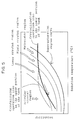
- Fig. 3 shows a method of crystallization in the prior art adopted for the crystallization step in the form of a graph of a solubility curve.
- a crystallizing operation line is schematically illustrated in Fig. 3.
- an organic chemical is dissolved in a good solvent to form a solution of the organic chemical, the solution is cooled to lower the liquid temperature, the solution passes through a metastable region and a platy crystal region to form lumpy crystals, and then the solution of the organic chemical is cooled so as to pass through a lumpy crystal region as it is thereby crystallizes out lumpy crystals.
- the lumpy crystals have a crystal structure suitable for production since they can easily be put to solid/liquid separation in succeeding steps and have a high crystallization rate.
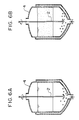
- crystals since the crystals are heavy, crystallized lumpy crystals can not be kept suspended in the solution, for example, by a small Phaudla type stirring blade 2 as shown in Fig. 6. Therefore, the degree of supersaturation in a tank 4 loses uniformity as shown in Fig. 6(A), and a great amount of fine acicular crystals of a poor filtering property are crystallized finally in an upper portion of the tank 4 in which the degree of supersaturation is higher, thereby resulting in a slurry of extremely poor flowability (Fig. 6B).
- the present invention has been accomplished in view of the aforementioned, and it is an object thereof to provide a method of crystallization capable of obtaining crystals of a good filtering property and a slurry of a good flowability even at a low stirring efficiency, thereby permitting crystallization which is superbly suited to production, even when a general-purpose device is used.
- Another object of the present invention is to provide a method of obtaining crystals which can be easily recovered without using an anchor type blade having high stirring efficiency but by using a general-purpose vessel having a Phaudla type blade which can be used both for reaction and concentration.
- a method of crystallizing an organic chemical which comprises a step of starting crystallization that controls the degree of supersaturation of a solution of an organic chemical so as to crystallize platy crystals predominantly, and a step of crystallization which is carried out immediately after the step of starting crystallization, the step of crystallization lowering the temperature of the solution of the organic chemical while changing the composition of solvents so as to lower the degree of supersaturation of the solution of the organic chemical thereby continuing crystallization predominantly of the platy crystals, wherein the crystals of the organic chemical are crystallized by stirring the solution of the organic chemical such that the flow of the crystallized platy crystals is kept in a completely suspended state throughout the step of starting crystallization and the step of crystallization.
- the present invention provides a method extremely effective for purifying a produced organic chemical in the final step of production thereof.
- the method of the present invention is applicable to organic chemicals, for example, color couplers for usual photography typically represented by cyan coupler, magenta coupler and yellow coupler, colorants for instant photography and anti-fogging agents.
- organic chemicals for example, color couplers for usual photography typically represented by cyan coupler, magenta coupler and yellow coupler, colorants for instant photography and anti-fogging agents.
- the present invention is not limited to these examples and may be applied to any organic compounds having a low melting point (suitably a melting point from about 0 to 50 O C).
- the degree of supersaturation of the solution of the organic chemical is at first controlled such that platy crystals are predominantly crystallized (step of starting crystallization).
- the control can be conducted by any of various methods, for example, a method of dissolving an organic chemical into a good solvent to form a solution of the organic chemical, then adding a poor solvent to the solution of the organic chemical to control the degree of supersaturation of the solution of the organic chemical so as to crystallize the platy crystals predominantly.
- Crystallizing the platy crystals predominantly or “continuing crystallization predominantly of the platy crystals” mean that the platy crystals are contained by more than 60%, preferably, by more than 80% in the crystallized crystals.
- good solvent and “poor solvent” are also well-known to those skilled in the art.
- Good solvent means a solvent having a large capability of dissolving a solute
- poor solvent means a solvent having a smaller or small capability of dissolving a solute.
- a solvent capable of dissolving more than 5 g, preferably, more than 20 g of a solute in 100 g of the solvent at 40 O C is a good solvent.
- a solvent capable of dissolving a solute by less than 10 g, particularly, only by 1 g, in 100 g of the solvent is a poor solvent.
- Ethyl acetate is a good solvent for various types of photographic reagents, while methanol, ethanol and water are poor solvents to photographic reagents.
- two types of poor solvents can be used together.
- the poor solvents used together can be added successively or may be used by mixing the poor solvents in advance. A combination capable of forming a homogeneous solution after the addition of the poor solvents is preferred.
- the degree of supersaturation of the solution of the organic chemical is preferably controlled between 3 to 30.
- the degree of supersaturation means herein a ratio of an absolute value for the concentration of a solution to the saturated concentration.
- the temperature for the solution of the organic chemical is lowered while changing a solvent composition so as to lower the degree of supersaturation of the solution of the organic chemical, thereby continuing crystallization predominantly of the platy crystals having satisfactory filtering property and satisfactory stirring property (crystallization step).
- the degree of supersaturation of the solution of the organic chemical may be lowered by any of various methods. Mention can be made, for example, of a method of adding a poor solvent to a solution of an organic chemical in a good solvent thereby controlling the degree of supersaturation, and gradually adding water to the thus controlled solution of the organic chemical to change the composition of the solvents in a homogeneous system.
- the crystallized platy crystals are stirred in a completely suspended state throughout the step of starting crystallization and the step of crystallization so that the degree of supersaturation of the solution of the organic chemical does not lose uniformity in the device.
- the completely suspended state referred to herein means a stirred state in which crystals do not stagnate for more than 1 to 2 seconds at the bottom of a tank.
- crystals having a good filtering property and a slurry having good flowability can be obtained even when stirring efficiency is low, so that crystallization well-suited to production can be carried out also by using a general-purpose device.
- a scaling-up method which can be applied from an experimental device to an actual production facility is provided.
- the method of the present invention was carried out in a flask experiment.
- a 500 ml separable flask having a diameter of 80 mm, and a small-sized Phaudla blade having a stirring blade of 45 mm diameter were used.
- the cyan coupler (1) After charging 79 g of the cyan coupler (1) into the separable flask containing 43 ml of ethyl acetate, the cyan coupler and the ethyl acetate were dissolved under heating at 40 O C. Then, 192 ml of methanol (poor solvent) was gradually added to the solution while stirring with the liquid temperature being maintained at 40 O C. Further, seed crystals were added to the solution and 213 ml of water (another poor solvent) was added while stirring, and then the temperature was lowered to 20 O C for 4 hours. In this process, crystallization of the platy crystals was observed, and the stirring speed was controlled such that the crystallized platy crystals were kept in a completely suspended state. The rotational speed for stirring was 400 rpm. The degree of supersaturation was 20 to 25 in the temperature lowering step starting from 40 O C and reaching 20 O C.
- the thus formed slurry had a good flowability, and the crystallizates and the mother liquid were separated by filtration.
- the crystallizates were platy crystals of 5 ⁇ m x 30 ⁇ m and the yield of crystallization was 92%.
- the above-mentioned crystallization method was applied to actual production.
- Fig. 1 shows a schematic structure of a crystallization device 20 having the vessel and the stirring blade.
- the crystallization device 20 has a vessel 22 described above, a stirrer 24 having three Phaudla blades (rod-shaped blades) as described above, and an upwardly inclined baffle 26 having a substantially F-shaped cross section.
- the vessel 22 has an opening 22B formed at a substantial center of a ceiling 22A, and the Phaudla blade of the stirrer 24 is held in the vessel 22 through the opening 22B.
- the rotational speed of the stirrer 24 is variable from a maximum of 95 rpm to a minimum of 27 rpm.
- Another opening 22C is also formed near the outer circumference of the ceiling 22A, and the baffle 26 is held through the opening 22C in the vessel 22.
- the vessel 22 has a cooling tank 28 formed around the periphery of a side wall 22D and a bottom 22E of the vessel 22 for cooling the solution in the vessel 22.
- the cooling tank 28 has a coolant inlet 28A for introducing a coolant 30 into the cooling tank 28 and a coolant exit (not illustrated) for discharging the coolant 30.
- the coolant inlet 28A and the coolant exit are connected by way of pipelines (not illustrated) with a heat exchanger (also not illustrated), and the coolant is circulated between the heat exchanger and the cooling tank 28.
- the vessel 22 has a discharge port 22F formed at a substantially central portion of the bottom 22E of the vessel 22 for discharging slurry obtained by cooling the solution.
- Discharge of the slurry is controlled by way of a valve 32.
- the crystallizer 20 also has a solution port for charging the solution into the vessel 22 and a thermometer for measuring the temperature in the vessel 22. Further, 80 mm of clearance is defined between the stirring blade of the stirrer 24 and the deepest central portion at the bottom of the vessel 22 so that crystals stagnating at the bottom are suspended easily.
- brine was used as the coolant.
- the slurry in this step had a satisfactory flowability, and platy crystals identical to those obtained in the flask experiment were obtained as crystallizates.
- Fig. 2 shows solubility curves and a schematically represented crystallizing operation line.
- Each solubility curve represented by a broken line shows a solubility curve of the solution before addition of the poor solvent, while a corresponding solubility curve represented by a solid line shows a solubility curve after addition of the poor solvent.
- the solubility curve represented by the broken line is lowered to the solubility curve represented by the solid line to facilitate the crystallizing operation in the platy crystal region.
- magenta coupler intermediate product having the following structural formula (IV) was crystallized under the same scaled-up conditions as those in Example 1, platy crystals having a good filtering property were obtained.
Landscapes
- Physics & Mathematics (AREA)
- General Physics & Mathematics (AREA)
- Chemical & Material Sciences (AREA)
- Spectroscopy & Molecular Physics (AREA)
- Chemical Kinetics & Catalysis (AREA)
- Engineering & Computer Science (AREA)
- Materials Engineering (AREA)
- Organic Low-Molecular-Weight Compounds And Preparation Thereof (AREA)
Applications Claiming Priority (2)
| Application Number | Priority Date | Filing Date | Title |
|---|---|---|---|
| JP319118/93 | 1993-11-24 | ||
| JP31911893A JP3266395B2 (ja) | 1993-11-24 | 1993-11-24 | 有機薬品の晶析方法 |
Publications (3)
| Publication Number | Publication Date |
|---|---|
| EP0654291A2 true EP0654291A2 (de) | 1995-05-24 |
| EP0654291A3 EP0654291A3 (de) | 1996-03-20 |
| EP0654291B1 EP0654291B1 (de) | 1998-02-11 |
Family
ID=18106669
Family Applications (1)
| Application Number | Title | Priority Date | Filing Date |
|---|---|---|---|
| EP19940118369 Expired - Lifetime EP0654291B1 (de) | 1993-11-24 | 1994-11-22 | Verfahren zur Kristallisierung organischer Chemikalien |
Country Status (3)
| Country | Link |
|---|---|
| EP (1) | EP0654291B1 (de) |
| JP (1) | JP3266395B2 (de) |
| DE (1) | DE69408515T2 (de) |
Cited By (1)
| Publication number | Priority date | Publication date | Assignee | Title |
|---|---|---|---|---|
| CN118594026A (zh) * | 2024-08-08 | 2024-09-06 | 山西兆亿化工有限公司 | 一种用于醋酸钠制备的冷却结晶设备及结晶方法 |
Families Citing this family (6)
| Publication number | Priority date | Publication date | Assignee | Title |
|---|---|---|---|---|
| JP4891194B2 (ja) * | 2000-05-15 | 2012-03-07 | 株式会社カネカ | N−(1(s)−エトキシカルボニル−3−フェニルプロピル)−l−アラニンn−カルボキシ無水物の晶析法 |
| CA2672549A1 (en) * | 2001-11-14 | 2003-06-12 | Ben-Zion Dolitzky | Amorphous and crystalline forms of losartan potassium and process for their preparation |
| EP1976608A1 (de) * | 2006-01-26 | 2008-10-08 | FUJIFILM Manufacturing Europe B.V. | Verfahren zur abscheidung von organischen verbindungen |
| US9211510B2 (en) | 2007-07-06 | 2015-12-15 | M. Technique Co., Ltd. | Method for producing nanoparticles by forced ultrathin film rotary processing |
| US8992981B2 (en) | 2007-09-21 | 2015-03-31 | M Technique Co., Ltd. | Method for producing microparticles and the microparticles |
| JP6375463B1 (ja) * | 2018-02-28 | 2018-08-15 | 日本曹達株式会社 | ビス(フルオロスルホニル)アミドアルカリ金属塩粉末の製造方法 |
Family Cites Families (5)
| Publication number | Priority date | Publication date | Assignee | Title |
|---|---|---|---|---|
| US2288667A (en) * | 1938-08-15 | 1942-07-07 | American Potash & Chem Corp | Method of crystallizing substances from solution |
| FR1295543A (fr) * | 1961-04-28 | 1962-06-08 | Aquitaine Petrole | Procédé et appareil de cristallisation |
| DE2048657A1 (en) * | 1970-10-03 | 1972-04-06 | Kupka D | Crystallization plant - for organic or inorganic materials in supersaturated soln and continuous operation |
| US4061853A (en) * | 1975-12-09 | 1977-12-06 | Ciba-Geigy Corporation | Virtually solvent-free crystal form of the sodium salt of Cephacetril |
| US4639338A (en) * | 1984-08-06 | 1987-01-27 | Ciba-Geigy Corporation | Preparation of crystalline disodium 3-amino-1-hydroxypropane-1,1-diphosphonate pentahydrate |
-
1993
- 1993-11-24 JP JP31911893A patent/JP3266395B2/ja not_active Expired - Lifetime
-
1994
- 1994-11-22 EP EP19940118369 patent/EP0654291B1/de not_active Expired - Lifetime
- 1994-11-22 DE DE1994608515 patent/DE69408515T2/de not_active Expired - Lifetime
Cited By (1)
| Publication number | Priority date | Publication date | Assignee | Title |
|---|---|---|---|---|
| CN118594026A (zh) * | 2024-08-08 | 2024-09-06 | 山西兆亿化工有限公司 | 一种用于醋酸钠制备的冷却结晶设备及结晶方法 |
Also Published As
| Publication number | Publication date |
|---|---|
| JP3266395B2 (ja) | 2002-03-18 |
| JPH07144102A (ja) | 1995-06-06 |
| EP0654291A3 (de) | 1996-03-20 |
| DE69408515D1 (de) | 1998-03-19 |
| EP0654291B1 (de) | 1998-02-11 |
| DE69408515T2 (de) | 1998-06-04 |
Similar Documents
| Publication | Publication Date | Title |
|---|---|---|
| EP0654291B1 (de) | Verfahren zur Kristallisierung organischer Chemikalien | |
| JPH0377199B2 (de) | ||
| KR930006692B1 (ko) | 인산결정을 위한 종자결정의 제조방법 | |
| EP0582351B1 (de) | Verfahren zur Kristallisierung von Aspartam | |
| US7034191B2 (en) | Continuous crystallization process | |
| EP1411059B1 (de) | Verfahren zur herstellung gemischter kristalle von dinatrium-5'-guanylat und dinatrium 5'-inosinat | |
| KR100926414B1 (ko) | 분할주입에 의한 거대 결정입자의 제조방법 | |
| EP3925932A1 (de) | Geschlossene herstellung von pharmazeutisch reinen kristallen | |
| KR102876408B1 (ko) | 입도가 조절된 헥사나이트로스틸벤 타입 iv의 제조방법 | |
| WO2023080253A1 (ja) | 5'-グアニル酸ジナトリウム・5'-イノシン酸ジナトリウム混晶の製造方法 | |
| JPH0570478A (ja) | α−L−アスパルチル−L−フエニルアラニンメチルエステルの製造方法 | |
| KR101007430B1 (ko) | 용해도 조절에 의한 거대 결정입자의 제조방법 | |
| US6013808A (en) | Method of purifying carbazole ester precursors of 6-chloro-α-methyl-carbazole-2-acetic acid | |
| JPH04346997A (ja) | α−L−アスパルチル−L−フェニルアラニンメチルエステルの製造方法 | |
| JP3639858B2 (ja) | ラフィノースの結晶を製造する方法及び装置 | |
| US7766980B2 (en) | Method for the preparation of precipitates | |
| JP4731980B2 (ja) | ステロール類の晶析方法およびそのシステム | |
| JP4254221B2 (ja) | ビスフェノールa・フェノール付加物の晶析方法 | |
| JPH0967322A (ja) | γ型グリシンの連続製造法 | |
| EP1077216B1 (de) | Kristallisierung von Alpha-L-Aspartyl-L-Phenylalaninmethylester aus übersättigten Lösungen | |
| AU2021105992A4 (en) | A Multi-gradient Continuous Crystallization Method Applicable for the Reactive Crystallization Process | |
| KR20100114871A (ko) | 용해도 조절에 의한 거대 결정입자의 제조방법 | |
| EP0976762A1 (de) | Kristalliserung von Alpha-L-aspartyl-L-phenylalaninmethylester | |
| US6100422A (en) | Crystallization of alpha-L-aspartyl-L-phenylalanine methyl esther | |
| JPH06234786A (ja) | マルチトールスラリーの連続的製造方法 |
Legal Events
| Date | Code | Title | Description |
|---|---|---|---|
| PUAI | Public reference made under article 153(3) epc to a published international application that has entered the european phase |
Free format text: ORIGINAL CODE: 0009012 |
|
| AK | Designated contracting states |
Kind code of ref document: A2 Designated state(s): CH DE FR GB LI NL |
|
| PUAL | Search report despatched |
Free format text: ORIGINAL CODE: 0009013 |
|
| AK | Designated contracting states |
Kind code of ref document: A3 Designated state(s): CH DE FR GB LI NL |
|
| 17P | Request for examination filed |
Effective date: 19960911 |
|
| GRAG | Despatch of communication of intention to grant |
Free format text: ORIGINAL CODE: EPIDOS AGRA |
|
| 17Q | First examination report despatched |
Effective date: 19970127 |
|
| GRAH | Despatch of communication of intention to grant a patent |
Free format text: ORIGINAL CODE: EPIDOS IGRA |
|
| GRAH | Despatch of communication of intention to grant a patent |
Free format text: ORIGINAL CODE: EPIDOS IGRA |
|
| GRAA | (expected) grant |
Free format text: ORIGINAL CODE: 0009210 |
|
| AK | Designated contracting states |
Kind code of ref document: B1 Designated state(s): CH DE FR GB LI NL |
|
| REG | Reference to a national code |
Ref country code: CH Ref legal event code: EP |
|
| REF | Corresponds to: |
Ref document number: 69408515 Country of ref document: DE Date of ref document: 19980319 |
|
| REG | Reference to a national code |
Ref country code: CH Ref legal event code: NV Representative=s name: BOVARD AG PATENTANWAELTE |
|
| ET | Fr: translation filed | ||
| PG25 | Lapsed in a contracting state [announced via postgrant information from national office to epo] |
Ref country code: LI Free format text: LAPSE BECAUSE OF NON-PAYMENT OF DUE FEES Effective date: 19981130 Ref country code: CH Free format text: LAPSE BECAUSE OF NON-PAYMENT OF DUE FEES Effective date: 19981130 |
|
| PLBE | No opposition filed within time limit |
Free format text: ORIGINAL CODE: 0009261 |
|
| STAA | Information on the status of an ep patent application or granted ep patent |
Free format text: STATUS: NO OPPOSITION FILED WITHIN TIME LIMIT |
|
| 26N | No opposition filed | ||
| PG25 | Lapsed in a contracting state [announced via postgrant information from national office to epo] |
Ref country code: NL Free format text: LAPSE BECAUSE OF NON-PAYMENT OF DUE FEES Effective date: 19990601 |
|
| REG | Reference to a national code |
Ref country code: CH Ref legal event code: PL |
|
| PG25 | Lapsed in a contracting state [announced via postgrant information from national office to epo] |
Ref country code: FR Free format text: LAPSE BECAUSE OF NON-PAYMENT OF DUE FEES Effective date: 19990730 |
|
| NLV4 | Nl: lapsed or anulled due to non-payment of the annual fee |
Effective date: 19990601 |
|
| REG | Reference to a national code |
Ref country code: FR Ref legal event code: ST |
|
| REG | Reference to a national code |
Ref country code: GB Ref legal event code: IF02 |
|
| REG | Reference to a national code |
Ref country code: GB Ref legal event code: 732E |
|
| PGFP | Annual fee paid to national office [announced via postgrant information from national office to epo] |
Ref country code: DE Payment date: 20101027 Year of fee payment: 17 |
|
| PGFP | Annual fee paid to national office [announced via postgrant information from national office to epo] |
Ref country code: GB Payment date: 20101117 Year of fee payment: 17 |
|
| GBPC | Gb: european patent ceased through non-payment of renewal fee |
Effective date: 20111122 |
|
| REG | Reference to a national code |
Ref country code: DE Ref legal event code: R119 Ref document number: 69408515 Country of ref document: DE Effective date: 20120601 |
|
| PG25 | Lapsed in a contracting state [announced via postgrant information from national office to epo] |
Ref country code: GB Free format text: LAPSE BECAUSE OF NON-PAYMENT OF DUE FEES Effective date: 20111122 |
|
| PG25 | Lapsed in a contracting state [announced via postgrant information from national office to epo] |
Ref country code: DE Free format text: LAPSE BECAUSE OF NON-PAYMENT OF DUE FEES Effective date: 20120601 |