EP0654506A2 - Verfahren zur Herstellung synergistischer Pigmentgemische - Google Patents
Verfahren zur Herstellung synergistischer Pigmentgemische Download PDFInfo
- Publication number
- EP0654506A2 EP0654506A2 EP94810650A EP94810650A EP0654506A2 EP 0654506 A2 EP0654506 A2 EP 0654506A2 EP 94810650 A EP94810650 A EP 94810650A EP 94810650 A EP94810650 A EP 94810650A EP 0654506 A2 EP0654506 A2 EP 0654506A2
- Authority
- EP
- European Patent Office
- Prior art keywords
- formula
- alkyl
- hydrogen
- group
- halogen
- Prior art date
- Legal status (The legal status is an assumption and is not a legal conclusion. Google has not performed a legal analysis and makes no representation as to the accuracy of the status listed.)
- Granted
Links
- 0 C1C**CC1 Chemical compound C1C**CC1 0.000 description 10
- GXYCPXOLNCWFSW-QURGRASLSA-N CC(C(C(Nc1ccccc1)=O)/N=N/c(cc1N2)ccc1NC2=O)=O Chemical compound CC(C(C(Nc1ccccc1)=O)/N=N/c(cc1N2)ccc1NC2=O)=O GXYCPXOLNCWFSW-QURGRASLSA-N 0.000 description 1
- YEJYNJMBHJCUHU-DQRAZIAOSA-N CC(C(C(Nc1ccccc1)=O)/N=N\c(cc1C(N2)=O)ccc1C2=O)=O Chemical compound CC(C(C(Nc1ccccc1)=O)/N=N\c(cc1C(N2)=O)ccc1C2=O)=O YEJYNJMBHJCUHU-DQRAZIAOSA-N 0.000 description 1
- AZTBLXYYVTUENP-UHFFFAOYSA-N CCN(CC)c1ccc(-c(ccc(N)c2C(c3ccccc33)=O)c2C3=O)c(C(c2ccccc22)=O)c1C2=O Chemical compound CCN(CC)c1ccc(-c(ccc(N)c2C(c3ccccc33)=O)c2C3=O)c(C(c2ccccc22)=O)c1C2=O AZTBLXYYVTUENP-UHFFFAOYSA-N 0.000 description 1
- KNMQFBWXSICVQC-UHFFFAOYSA-N Nc1ccc(-c(ccc(N)c2C(c3ccccc33)=O)c2C3=O)c(C(c2ccccc22)=O)c1C2=O Chemical compound Nc1ccc(-c(ccc(N)c2C(c3ccccc33)=O)c2C3=O)c(C(c2ccccc22)=O)c1C2=O KNMQFBWXSICVQC-UHFFFAOYSA-N 0.000 description 1
- PZGDXAOQDVQPRK-UHFFFAOYSA-N O=C(c1c2)NC(c3ccccc3)=Nc1cc1c2N=C(c2ccccc2)NC1=O Chemical compound O=C(c1c2)NC(c3ccccc3)=Nc1cc1c2N=C(c2ccccc2)NC1=O PZGDXAOQDVQPRK-UHFFFAOYSA-N 0.000 description 1
- XRIGHGYEGNDPEU-UHFFFAOYSA-N O=C(c1ccccc11)c2cccc(Nc3ccccc3)c2C1=O Chemical compound O=C(c1ccccc11)c2cccc(Nc3ccccc3)c2C1=O XRIGHGYEGNDPEU-UHFFFAOYSA-N 0.000 description 1
- LMCXYMANPALCCP-UHFFFAOYSA-N O=C1c(cc(c2c3)NC(c4ccccc4)=CC2=O)c3NC(c2ccccc2)=C1 Chemical compound O=C1c(cc(c2c3)NC(c4ccccc4)=CC2=O)c3NC(c2ccccc2)=C1 LMCXYMANPALCCP-UHFFFAOYSA-N 0.000 description 1
Classifications
-
- C—CHEMISTRY; METALLURGY
- C09—DYES; PAINTS; POLISHES; NATURAL RESINS; ADHESIVES; COMPOSITIONS NOT OTHERWISE PROVIDED FOR; APPLICATIONS OF MATERIALS NOT OTHERWISE PROVIDED FOR
- C09B—ORGANIC DYES OR CLOSELY-RELATED COMPOUNDS FOR PRODUCING DYES, e.g. PIGMENTS; MORDANTS; LAKES
- C09B68/00—Organic pigments surface-modified by grafting, e.g. by establishing covalent or complex bonds, in order to improve the pigment properties, e.g. dispersibility or rheology
- C09B68/40—Organic pigments surface-modified by grafting, e.g. by establishing covalent or complex bonds, in order to improve the pigment properties, e.g. dispersibility or rheology characterised by the chemical nature of the attached groups
- C09B68/44—Non-ionic groups, e.g. halogen, OH or SH
- C09B68/443—Carboxylic acid derivatives, e.g. carboxylic acid amides, carboxylic acid esters or CN groups
-
- C—CHEMISTRY; METALLURGY
- C09—DYES; PAINTS; POLISHES; NATURAL RESINS; ADHESIVES; COMPOSITIONS NOT OTHERWISE PROVIDED FOR; APPLICATIONS OF MATERIALS NOT OTHERWISE PROVIDED FOR
- C09B—ORGANIC DYES OR CLOSELY-RELATED COMPOUNDS FOR PRODUCING DYES, e.g. PIGMENTS; MORDANTS; LAKES
- C09B67/00—Influencing the physical, e.g. the dyeing or printing properties of dyestuffs without chemical reactions, e.g. by treating with solvents grinding or grinding assistants, coating of pigments or dyes; Process features in the making of dyestuff preparations; Dyestuff preparations of a special physical nature, e.g. tablets, films
- C09B67/0033—Blends of pigments; Mixtured crystals; Solid solutions
-
- C—CHEMISTRY; METALLURGY
- C09—DYES; PAINTS; POLISHES; NATURAL RESINS; ADHESIVES; COMPOSITIONS NOT OTHERWISE PROVIDED FOR; APPLICATIONS OF MATERIALS NOT OTHERWISE PROVIDED FOR
- C09B—ORGANIC DYES OR CLOSELY-RELATED COMPOUNDS FOR PRODUCING DYES, e.g. PIGMENTS; MORDANTS; LAKES
- C09B68/00—Organic pigments surface-modified by grafting, e.g. by establishing covalent or complex bonds, in order to improve the pigment properties, e.g. dispersibility or rheology
- C09B68/40—Organic pigments surface-modified by grafting, e.g. by establishing covalent or complex bonds, in order to improve the pigment properties, e.g. dispersibility or rheology characterised by the chemical nature of the attached groups
- C09B68/46—Aromatic cyclic groups
Definitions
- the present application relates to a process for the preparation of synergistic pigment mixtures by mixing the solutions of at least two "pigments" solubilized by introducing carbamate groups and subsequently precipitating the mixture in pigment form by thermal, photolytic or chemical treatment, if appropriate after incorporation into the substrate to be pigmented.
- Pigment mixtures of two or more perylene tetracarboxylic acid diamides with improved light fastness and transparency compared to the individual components are described in DE-A 2 009 073, while mixed crystals of various perylene tetracarboxylic acid diimides are known from DE-A 3 436 206, 3 436 208 and 3 436 209 are characterized by their heat resistance.
- US Pat. No. 4,720,305 describes pigment mixtures of various diketopyrrolopyrroles which have improved pigment properties compared to the individual components.
- Solid solutions made from various diketopyrrolopyrrole pigments and from diketopyrrolopyrrole pigments and quinacridones are known from U.S. Patents 4,783,540 and 4,810,304, respectively. In both cases, these are products with improved pigment properties compared to the individual components.
- the present invention accordingly relates to a process for producing synergistic pigment mixtures from at least two different pigments of the quinacridone, anthraquinone, perylene, indigo, quinophthalone, isoindolinone, isoindoline, dioxazine, phthalocyanine, diketopyrrolopyrrole or azo series, thereby characterized in that at least two compounds of the formula A (B) x , (I), where x is an integer between 1 and 4,
- A means the rest of the known chromophores with the basic structure A (H) x , like for example and all known derivatives thereof.
- X is C1-C14 alkylene, it is a straight-chain or branched alkylene, such as methylene, dimethylene, trimethylene, 1-methylmethylene, 1,1-dimethylmethylene, 1,1-dimethyl-dimethylene, 1,1-dimethyl-trimethylene, 1-ethyl-dimethylene, 1-ethyl-1-methyl-dimethylene, tetramethylene, 1,1-dimethyl-tetramethylene, 2,2-dimethyl-trimethylene, Hexamethylene, decamethylene, 1,1-dimethyl-decamethylene, 1,1-diethyl-decamethylene or tetradecamethylene.
- X as C2-C8 alkenylene means straight-chain or branched alkenylene, such as e.g. Vinylene, allylene, methallylene, 1-methyl-2-butenylene, 1,1-dimethyl-3-butenylene, 2-butenylene, 2-hexenylene, 3-hexenylene or 2-octenylene.
- substituents are halogen, then they are, for example, iodine, fluorine, in particular bromine and preferably chlorine;
- C1-C6-alkyl is, for example, methyl, ethyl, n-propyl, isopropyl, n-butyl, sec-butyl, tert-butyl, n-amyl, tert-amyl, hexyl and C1-C18 -Alkyl additionally, for example, around heptyl, octyl, 2-ethylhexyl, nonyl, decyl, dodecyl, tetradecyl, hexadecyl or octadecyl;
- C1-C4 alkoxy means e.g. Methoxy, ethoxy, n-propoxy, isopropoxy or butyloxy.
- C3-C6-cycloalkylene is e.g. for cyclopropylene, cyclopentylene and especially for cyclohexylene.
- x is 1 or 2 and B a group of the formula is, and, if x is 2, can also be hydrogen, where in the formulas IV, V and VI m means zero or 1, X is C1-C4 alkylene or C2-C5 alkenylene, R1 and R2 are independently hydrogen, C1-C1-alkyl, methoxy, chlorine or NO2, and Q is hydrogen, CN, CCl3, a group SO2CH3 or SCH3, R3 and R4 independently of one another hydrogen, C1-C4 alkyl or a group mean, or R3 and R4 together form a piperidinyl radical, and particularly those where x is 2 and B is twice a group of the formula means.
- R27 and R28 in formula XVII are C1-C18 alkylmercapto, for example methylmercapto, ethylmercapto, propylmercapto, butylmercapto, octylmercapto, decylmercapto, hexadecylmercapto or octadecylmercapto and C1-C18 alkylamino, for example, methylamino, ethylamino, ethylamino, ethylamino, ethylamino Hexadecylamino or octadecylamino.
- quinacridones of the formulas is very particularly preferred and or and / or pyrrolo [3,4-c] pyrroles of the formula in which R27 and R28 are independently hydrogen, methyl, tert-butyl, chlorine, bromine, CN or phenyl, where E in formulas XVIII, XIX and XX is a group of the formula means.
- the compounds of the formula I can be prepared analogously to methods known per se, for example in that a compound of the formula A (H) x , (XXI) wherein A and x have the meaning given above, in the desired molar ratio with a dicarbonate of the formula BOB (XXII) or with a trihaloacetic acid ester of the formula (R34) 3C-B (XXIII), or with an azide of the formula BN3 (XXIV), or with a carbonate of the formula B-OR35 (XXV), or with an alkylideniminooxy formic acid ester of the formula wherein B has the meaning given above, R34 chlorine, fluorine or bromine, R35 C1-C4-alkyl or unsubstituted or substituted by halogen, C1-C4-alkyl, C1-C4-alkoxy or -CN-phenyl, R36 -CN or - Phenyl COOR35 and R37 unsubstitute
- the compound of formula XXI is preferably reacted with a dicarbonate of formula XVII.
- the compounds of the formula XXI, dicarbonates of the formula XXII, trihaloacetic acid esters of the formula XXIII, azides of the formula XXIV, carbonates of the formula XXV and alkylidene iminooxy formic acid esters of the formula XXVI are known substances. If some are still new, they can be produced in analogy to generally known methods.
- the respective molar ratio between the compound of formula XXI and the compounds of formulas XXII - XXVI depends on x, i.e. according to the number of residues to be introduced B.
- the compounds of the formulas XXII - XXVI are expediently used in a 2 to 10-fold excess.
- Suitable aprotic organic solvents are, for example, ethers, such as tetrahydrofuran or dioxane, or glycol ethers, such as ethylene glycol methyl ether, ethylene glycol ethyl ether, diethylene glycol monomethyl ether or diethylene glycol monoethyl ether, and also dipolar aprotic solvents such as acetonitrile, benzonitrile, N, N-dimethylformamide, N, N-dimethylacetamide, nitrobenzene, N-methylpyrrolidone, halogenated aliphatic or aromatic hydrocarbons, such as trichloroethane, benzene or benzene substituted by alkyl, alkoxy or halogen, such as toluene, xylene, anisole or chlorobenzene or aromatic N-heterocycles, such as pyridine, picoline or quinoline .
- ethers such as tetrahydr
- Preferred solvents are e.g. Tetrahydrofuran, N, N-dimethylformamide, N-methylpyrrolidone.
- the solvents mentioned can also be used as mixtures.
- 5-20 parts by weight of solvent are used per 1 part by weight of the reactants.
- Bases suitable as catalysts are, for example, the alkali metals themselves, such as lithium, sodium or potassium, and their hydroxides and carbonates, or alkali amides, such as lithium, sodium or potassium amide, or alkali metal hydrides, such as lithium, sodium or potassium hydride, or alkaline earth metal or alkali alcoholates which are derived in particular from primary, secondary or tertiary aliphatic alcohols having 1 to 10 carbon atoms, such as, for example, lithium, sodium or potassium methylate, ethylate, n-propylate, isopropylate, n-butoxide, sec .-Butylate, tert-butoxide, -2-methyl-2-butoxide, -2-methyl-2-pentylate, -3-methyl-3-pentylate, -3-ethyl-3-pentylate, and also organic aliphatic, aromatic or heterocyclic N-bases, including, for example, diazabicyclooctene, di
- organic N-bases e.g. Diazabicyclooctene, diazabicycloundecene and especially 4-dimethylaminopyridine.
- the reaction is preferably carried out at temperatures between 10 and 100 ° C., in particular between 14 and 40 ° C., specifically at atmospheric pressure.
- the compounds of the formula I are either mixed in the desired ratio in powder form by generally known methods and the mixture is dissolved in the solvent, or they are first dissolved individually in the solvent and the solutions are mixed in the desired ratio.
- ethers such as tetrahydrofuran or dioxane
- glycol ethers such as ethylene glycol methyl ether, ethylene glycol ethyl ether, diethylene glycol monomethyl ether or diethylene glycol monoethyl ether
- polyalcohols such as polyethylene glycol
- ketones such as acetone, ethylmethylmethyl ketone, isobutone
- dipolar aprotic solvents such as acetonitrile, benzonitrile, N, N-dimethylformamide, N, N-dimethylacetamide, nitrobenzene, N-methylpyrrolidone, dimethyl sulfoxide
- halogenated aliphatic or aromatic hydrocarbons such as trichloroethane, dichloromethane, chloroform, benzene or by alkyl, Alkoxy or halogen substituted benzene such as toluen
- the concentration of the compounds of the formula I in the solvent or solvent system can vary widely depending on the solvent. It is expedient to use 0.1 to 20% by weight of compound of the formula I, based on the total solution, and preferably 0.2 to 5% by weight.
- the pigment mixture consisting of the pigments on which the compounds of the formula I are based can be precipitated from the solution in the simplest way, be it by a) thermal, ie, for example, by heating to temperatures between 50 and 400 ° C. preferably between 100 and 200 ° C or laser radiation, b) photolytic, ie for example by exposure to wavelengths below 375 nm, or c) chemical, ie for example with organic or inorganic acids, such as acetic, tosyl, trifluoroacetic, hydrochloric or sulfuric acid , Treatment of the dissolved mixture and isolation of the precipitated product using customary methods.
- thermal ie, for example, by heating to temperatures between 50 and 400 ° C. preferably between 100 and 200 ° C or laser radiation
- photolytic ie for example by exposure to wavelengths below 375 nm
- chemical ie for example with organic or inorganic acids, such as acetic, tosyl, trifluoroacetic, hydrochloric or
- the compounds of the formula I are generally soluble in the high molecular weight organic materials to be colored, the latter can also be used as solvents.
- at least two different compounds of formula I can also be incorporated into the high molecular weight organic material to be colored, i.e. e.g. be incorporated and dissolved in plastics, coating systems or printing ink systems by customary methods and the pigment mixture is precipitated in situ using one of the methods mentioned above.
- the ratio between the compounds of the formula I forming the mixture can vary very widely and is also dependent on the desired shade. In the case of two mixtures, the ratio between the two components is expediently 50-95: 5-50, preferably 65-90: 10-35% by weight.
- the pigment mixtures obtained by the process according to the invention are distinguished both when they are isolated from the solution and subsequently incorporated into the material to be colored, and when they are in situ, i.e. be precipitated in the substrate, due to very excellent and overall improved properties compared to conventionally produced mixtures, be it coloristically, e.g. Color, purity of the color, color strength, brilliance and transparency but also with regard to durability, such as Light, weather, migration and heat resistance.
- solid solutions can also arise, in particular if components and mixing ratios are selected which form solid solutions in a known manner by conventional methods.
- the method according to the invention can also lead to the formation of solid solutions in cases where no solid solutions are formed by conventional methods.
- Solid solutions can be characterized by their X-ray diffraction spectrum, which differs from that of the physical mixture of the two individual components.
- the X-ray diffraction pattern of the Solid solutions according to the invention are characterized by lines other than the sum of the X-ray diffraction diagrams of the individual components.
- Example 1 is repeated with the only exception that a) and b), instead of di-tert-butyl dicarbonate, a dicarbonate of the formula BOB is used, in which B each has the meaning given in the table below, so obtained always a product that is practically identical to that of Example 1.
Landscapes
- Chemical & Material Sciences (AREA)
- Organic Chemistry (AREA)
- Chemical Kinetics & Catalysis (AREA)
- Nitrogen Condensed Heterocyclic Rings (AREA)
Abstract
A(B)x, (I),
worin x eine ganze Zahl zwischen 1 und 4 bedeutet,
A für den Rest eines Farbstoffes der Chinacridon-, Anthrachinon-, Perylen-, Indigo-, Chinophthalon-, Isoindolinon-, Isoindolin-, Dioxazin-, Phthalocyanin-, Diketopyrrolopyrrol- oder Azoreihe steht, der x mit B verbundene N-Atome, vorzugsweise mit mindestens einer unmittelbar benachbarten oder konjugierten Carbonylgruppe, enthält,
B eine Gruppe der Formel


oder

ist,
in Pulverform nach üblichen Methoden vermischt und in einem organischen Lösungsmittel gelöst oder zuerst gelöst und die Lösungen vermischt werden und danach durch thermische, photolytische oder chemische Behandlung das Pigmentgemisch bestehend aus den entsprechenden Pigmenten der Formel
A(H)x,
worin A und x die oben angegebene Bedeutung haben, ausgefällt wird.
Description
- Die vorliegende Anmeldung betrifft ein Verfahren zur Herstellung synergistischer Pigmentgemische durch Vermischen der Lösungen von mindestens zwei durch Einführung von Carbamatgruppen löslich gemachten "Pigmenten" und nachträgliches Ausfällen des Gemisches in Pigmentform durch thermische, photolytische oder chemische Behandlung, gegebenenfalls nach Einarbeitung im zu pigmentierenden Substrat.
- Aus der einschlägigen Literatur ist schon lange bekannt, dass bestimmte Pigmenteigenschaften, sowohl bezüglich Koloristik als auch bezüglich Echtheiten, durch Vermischen verschiedener Pigmenten der gleichen oder auch von mehr oder weniger verwandten Pigmentklassen verbessert werden können. In bestimmten Fällen bilden sich dabei auch sogenannte feste Lösungen oder Mischkristalle. So sind beispielsweise aus den US-Patenten 3 160 510, 3 298 847, 3 647 494 und 3 681 100 feste Lösungen von Chinacridonen, Chinacridonchinonen und/oder Dehydrochinacridonen bekannt, die sich durch hohe Echtheiten und besonderen koloristischen Eigenschaften auszeichnen. Das US-Patent 3 776 749 beschreibt Pigmentgemische aus Azopigmenten und löslichen Azofarbstoffen, die unerwartet hohe Farbstärke und Transparenz zeigen. Pigmentgemische aus zwei oder mehr Perylentetracarbonsäurediamiden mit verbesserter Lichtechtheit und Transparenz im Vergleich zu den Einzelkomponenten sind in DE-A 2 009 073 beschrieben, während aus DE-A 3 436 206, 3 436 208 und 3 436 209 Mischkristalle aus verschiedenen Perylentetracarbonsäurediimide bekannt sind, die sich durch ihre Hitzebeständigkeit auszeichnen. In US-Patent 4 720 305 sind Pigmentgemische aus verschiedenen Diketopyrrolopyrrolen beschrieben, die gegenüber den Einzelkomponenten verbesserte Pigmenteigenschaften aufweisen. Feste Lösungen aus verschiedenen Diketopyrrolopyrrolpigmenten und aus Diketopyrrolopyrrolpigmenten und Chinacridonen sind aus US-Patent 4 783 540 bzw. US-Patent 4 810 304 bekannt. In beiden Fällen handelt es sich um Produkte mit gegenüber den Einzelkomponenten verbesserten Pigmenteigenschaften.
- Es wurde nun gefunden, dass u.a. dieselben Pigmentgemische, feste Lösungen bzw. Mischkristalle, mit noch überraschend besseren Eigenschaften erhalten werden können, wenn man die Einzelkomponenten vorerst durch Einführung von Carbamatgruppen in die Pigmentmoleküle löslich macht, sie danach in einem geeigneten Lösungsmittel löst und in Lösung vermischt und schliesslich durch thermische, photolytische oder chemische Behandlung, als Pigmentmischung, feste Lösung bzw. Mischkristalle wieder freisetzt.
- Die vorliegende Erfindung betrifft demnach ein Verfahren zur Herstellung synergistischer Pigmentgemische aus mindestens zwei verschiedenen Pigmenten der Chinacridon-, Anthrachinon-, Perylen-, Indigo-, Chinophthalon-, Isoindolinon-, Isoindolin-, Dioxazin-, Phthalocyanin-, Diketopyrrolopyrrol- oder Azoreihe, dadurch gekennzeichnet, dass man mindestens zwei Verbindungen der Formel
A(B)x, (I),
worin x eine ganze Zahl zwischen 1 und 4 bedeutet, - A für den Rest eines Farbstoffes der Chinacridon-, Anthrachinon-, Perylen-, Indigo-, Chinophthalon-, Isoindolinon-, Isoindolin-, Dioxazin-, Phthalocyanin-, Diketopyrrolopyrrol- oder Azoreihe steht, der x mit B verbundene N-Atome, vorzugsweise mit mindestens einer unmittelbar benachbarten oder konjugierten Carbonylgruppe, enthält,
B eine Gruppe der Formel

oder
ist, und, wenn x 2, 3 oder 4 bedeutet, auch ein-, zwei- oder dreimal Wasserstoff sein kann,
wobei in den Formeln II, III und IV
m, n und p unabhängig voneinander Null oder 1 sind, - X
- C₁-C₁₄-Alkylen oder C₂-C₈-Alkenylen
- Y
- eine Gruppe -V-(CH₂)q-,
- Z
- eine Gruppe -V-(CH₂)r-,
- V
- C₃-C₆-Cycloalkylen,
- q
- eine Zahl von 1 bis 6 und
- r
- eine Zahl von Null bis 6 bedeuten,
- R₁ und R₂
- unabhängig voneinander Wasserstoff, C₁-C₆-Alkyl, C₁-C₄-Alkoxy, Halogen, CN, NO₂, unsubstituiertes oder durch C₁-C₄-Alkyl, C₁-C₄-Alkoxy oder Halogen substituiertes Phenyl oder Phenoxy sind,
- Q
- Wasserstoff, CN, Si(R₁)₃,
eine Gruppe C(R₅)(R₆)(R₇),
worin R₅, R₆ und R₇ unabhängig voneinander Wasserstoff oder Halogen sind und mindestens einer der Reste R₅, R₆ und R₇ Halogen bedeutet,
eine Gruppe
eine Gruppe SO₂R₈ oder SR₈, worin R₈ C₁-C₄-Alkyl ist,
eine Gruppe CH(R₉)₂, worin R₉ unsubstituiertes oder durch C₁-C₄-Alkyl,
C₁-C₄-Alkoxy oder Halogen substituiertes Phenyl bedeutet,
oder
eine Gruppe der Formel

- A bedeutet den Rest bekannter Chromophore mit der Grundstruktur
A(H)x,
wie beispielsweise


und jeweils alle bekannten Derivate davon. - Bedeutet X C₁-C₁₄-Alkylen, so handelt es sich um ein geradkettiges oder verzweigtes Alkylen, wie z.B. Methylen, Dimethylen, Trimethylen, 1-Methyl-methylen, 1,1-Dimethyl-methylen, 1,1-Dimethyl-dimethylen, 1,1-Dimethyl-trimethylen, 1-Ethyl-dimethylen, 1-Ethyl-1-methyl-dimethylen, Tetramethylen, 1,1-Dimethyl-tetramethylen, 2,2-Dimethyl-trimethylen, Hexamethylen, Decamethylen, 1,1-Dimethyl-decamethylen, 1,1 -Diethyl-decamethylen oder Tetradecamethylen.
- X als C₂-C₈-Alkenylen bedeutet geradkettiges oder verzweigtes Alkenylen, wie z.B. Vinylen, Allylen, Methallylen, 1-Methyl-2-butenylen, 1,1-Dimethyl-3-butenylen, 2-Butenylen, 2-Hexenylen, 3-Hexenylen oder 2-Octenylen.
- Bedeuten etwaige Substitutenten Halogen, dann handelt es sich z.B. um Jod, Fluor, insbesondere Brom und bevorzugt Chlor;
bei C₁-C₆-Alkyl handelt es sich beispielsweise um Methyl, Ethyl, n-Propyl, Isopropyl, n-Butyl, sec.-Butyl, tert.-Butyl, n-Amyl, tert.-Amyl, Hexyl und bei C₁-C₁₈-Alkyl zusätzlich z.B. um Heptyl, Octyl, 2-Ethylhexyl, Nonyl, Decyl, Dodecyl, Tetradecyl, Hexadecyl oder Octadecyl; - C₁-C₄-Alkoxy bedeutet z.B. Methoxy, Ethoxy, n-Propoxy, Isopropoxy oder Butyloxy.
- C₃-C₆-Cycloalkylen steht z.B. für Cyclopropylen, Cyclopentylen und insbesondere für Cyclohexylen.
- Für die Durchführung des erfindungsgemässen Verfahrens von besonderem Interesse sind Verbindungen der Formel I, worin x 1 oder 2 ist und B
eine Gruppe der Formel

ist, und, wenn x 2 bedeutet, auch einmal Wasserstoff sein kann, wobei in den Formeln IV, V und VI
m Null oder 1 bedeutet,
X C₁-C₄-Alkylen oder C₂-C₅-Alkenylen ist,
R₁ und R₂ unabhängig voneinander Wasserstoff, C₁-C₄-Alkyl, Methoxy, Chlor oder NO₂ bedeuten, und
Q Wasserstoff, CN, CCl₃, eine Gruppe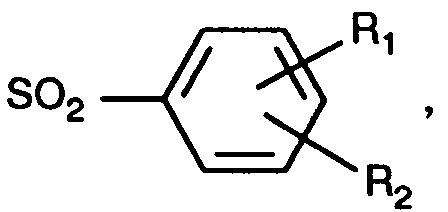
SO₂CH₃ oder SCH₃,
R₃ und R₄ unabhängig voneinander Wasserstoff, C₁-C₄-Alkyl oder eine Gruppe
bedeuten,
oder R₃ und R₄ zusammen einen Piperidinylrest bilden,
und insbesondere jene, worin x 2 ist und B zweimal eine Gruppe der Formel
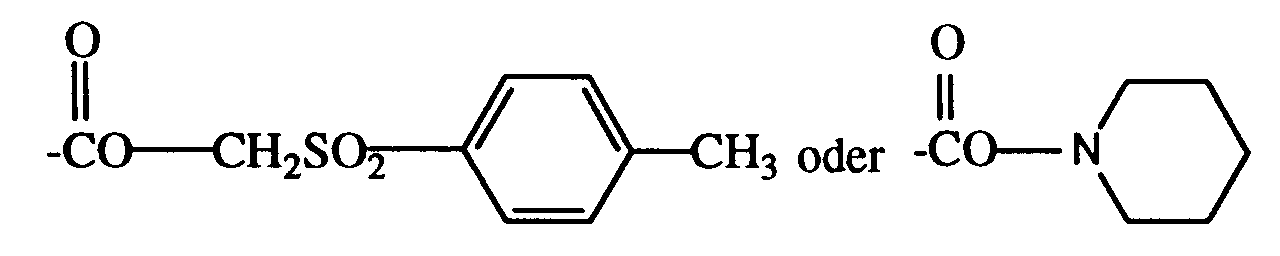
bedeutet. - Bevorzugte Verbindungen der Formel I sind
- a) Perylencarbonsäureimide der Formel


- b) Chinacridone der Formel

- c) Dioxazine der Formel

- d) Isoindoline der Formeln
 R₁₄ Wasserstoff, C₁-C₁₈-Aklyl, Benzyl oder eine Gruppe

R₁₅ die gleiche Bedeutung wie R₁₃ hat,
R₁₆, R₁₇, R₁₈ und R₁₉ unabhängig voneinander Wasserstoff, C₁-C₁₈-Alkyl, C₁-C₄-Alkoxy, Halogen oder Trifluormethyl bedeuten, - e) Indigoderivat der Formel

- f) Benzimidazolon-Azoverbindungen der Formel

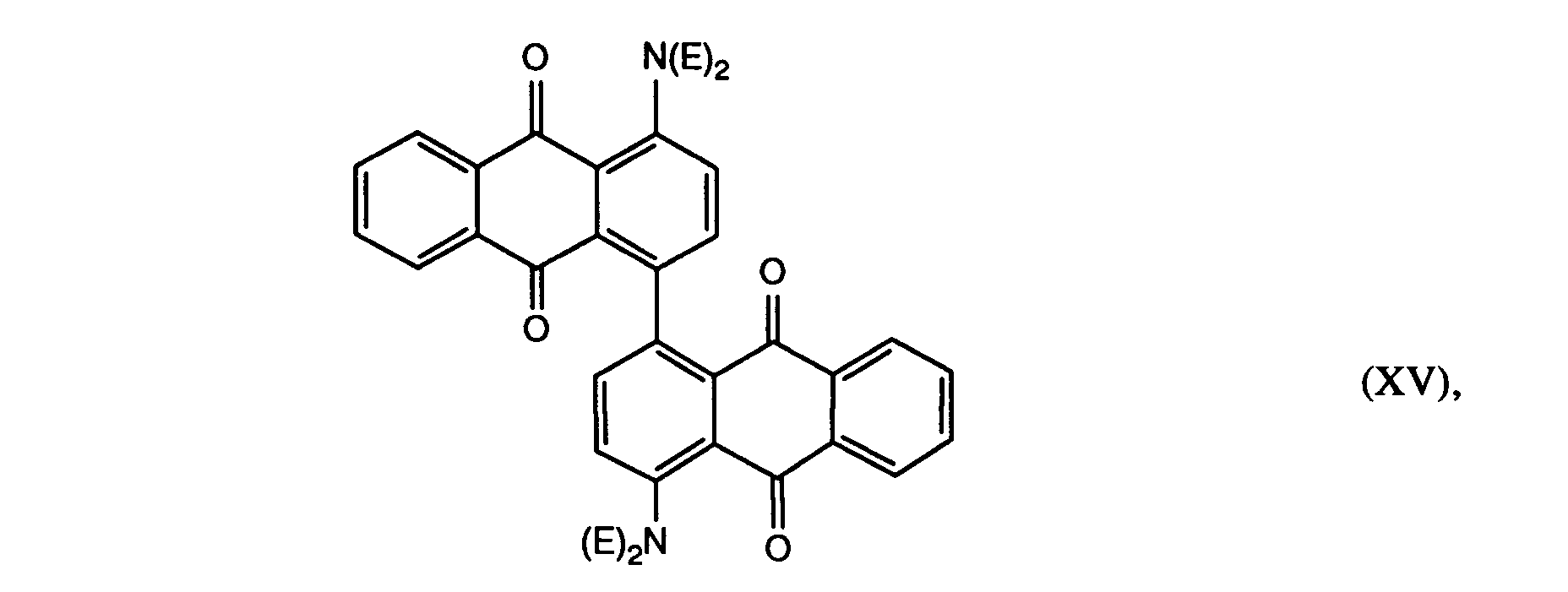
- g) anthrachinoide Verbindungen der Formel

- h) Phthalocyanine der Formel

X₁ H₂, Zn, Cu, Ni, Fe oder V,
X₂ -CH(R₂₄)- oder -SO₂-
R₂₃ Wasserstoff, C₁-C₄-Alkyl, -N(E)R₂₄, -NHCOR₂₅, -COR₂₅ oder
C₁-C₄-Alkyl oder C₁-C₄-Alkoxy bedeuten,
z für Null oder 1 und y für eine Zahl von 1 bis 4 stehen,
und - i) Pyrrolo[3,4-c]pyrrole der Formel


R₂₇ und R₂₈ unabhängig voneinander Wasserstoff, Halogen, C₁-C₁₈-Alkyl, C₁-C₁₈-Alkoxy, C₁-C₁₈-Alkylmercapto, C₁-C₁₈-Alkylamino, -CN, -NO₂, -Phenyl, Trifluormethyl, C₅-C₆-Cycloalkyl, -C=N-(C₁-C₁₈-Alkyl),
wobei in den obenerwähnten Formeln E jeweils Wasserstoff oder B bedeutet, mit der Massgabe, dass E in jeder Formel mindestens einmal B ist, und B die oben angegebene Bedeutung hat, für welche die obenerwähnten Bevorzugungen gelten. - Für R₂₇ und R₂₈ in Formel XVII stehen C₁-C₁₈-Alkylmercapto beispielsweise für Methylmercapto, Ethylmercapto, Propylmercapto, Butylmercapto, Octylmercapto, Decylmercapto, Hexadecylmercapto oder Octadecylmercapto und C₁-C₁₈-Alkylamino z.B. für Methylamino, Ethylamino, Propylamino, Hexylamino, Decylamino, Hexadecylamino oder Octadecylamino.
- Besonders bevorzugt ist die Verwendung von Chinacridonen der Formel VIII, worin R₁₀ und R₁₁ unabhängig voneinander Wasserstoff, Chlor oder Methyl bedeuten und E die oben angegebene Bedeutung hat, und/oder
Pyrrolo[3,4-c]pyrrolen der Formel XVII, worin G und L gleich sind und eine Gruppe der Formel
oder
sind,
worin R₂₇ und R₂₈ unabhängig voneinander Wasserstoff, Chlor, Brom, C₁-C₄-Alkyl, C₁-C₆-Alkoxy, C₁-C₆-Alkylamino, CN oder Phenyl bedeuten,
M -O-, -NR₃₃-, -N=N- oder -SO₂- ist,
R₂₉ und R₃₀ Wasserstoff und R₃₃ Wasserstoff, Methyl oder Ethyl bedeuten und E die oben angegebene Bedeutung hat. - Ganz besonders bevorzugt ist die Verwendung von Chinacridonen der Formeln

und/oder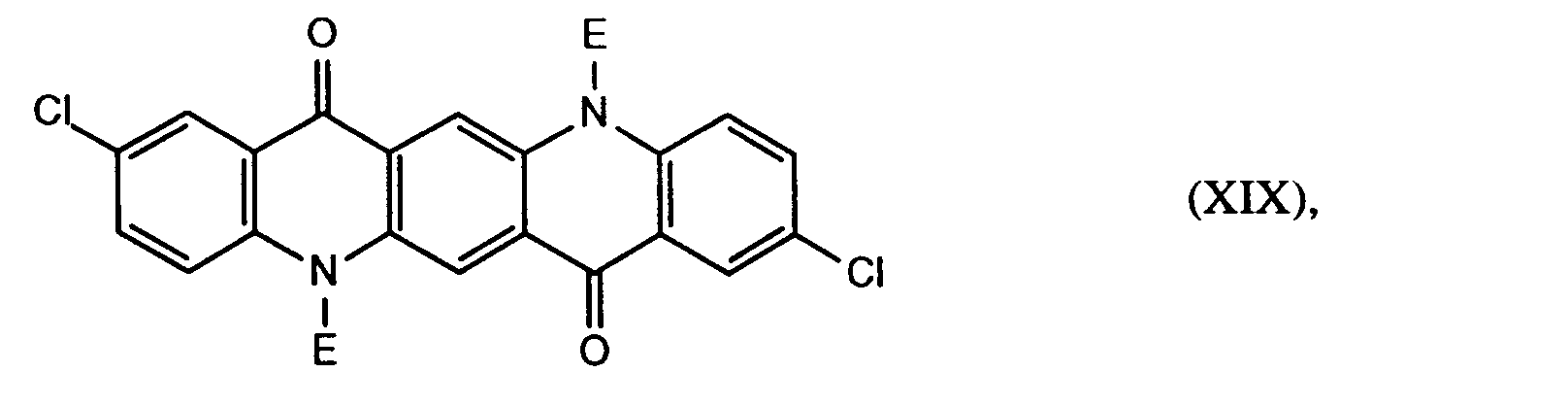
und/oder Pyrrolo[3,4-c]pyrrolen der Formel
worin R₂₇ und R₂₈ unabhängig voneinander Wasserstoff, Methyl, tert.-Butyl, Chlor, Brom, CN oder Phenyl bedeuten,
wobei E in den Formeln XVIII, XIX und XX eine Gruppe der Formel

bedeutet. - Die Verbindungen der Formel I können in Analogie zu an sich bekannten Methoden hergestellt werden, z.B. dadurch, dass eine Verbindung der Formel
A(H)x, (XXI)
worin A und x die oben angegebene Bedeutung haben, im gewünschten Molverhältnis mit einem Dicarbonat der Formel
B-O-B (XXII)
oder mit einem Trihaloessigsäureester der Formel
(R₃₄)₃C-B (XXIII),
oder mit einem Azid der Formel
BN₃ (XXIV),
oder mit einem Carbonat der Formel
B-OR₃₅ (XXV),
oder mit einem Alkylideniminooxyameisensäureester der Formel
worin B jeweils die oben angegebene Bedeutung hat, R₃₄ Chlor, Fluor oder Brom, R₃₅ C₁-C₄-Alkyl oder unsubstituiertes oder durch Halogen, C₁-C₄-Alkyl, C₁-C₄-Alkoxy oder -CN substituiertes Phenyl, R₃₆ -CN oder -COOR₃₅ und R₃₇ unsubstituiertes oder durch Halogen, C₁-C₄-Alkyl, C₁-C₄-Alkoxy oder -CN substituiertes Phenyl bedeuten, in einem aprotischen organischen Lösungsmittel in Gegenwart einer Base als Katalysator, zweckmässig bei Temperaturen zwischen 0 und 400°C, bevorzugt zwischen 10 und 200°C, während 2 bis 80 Stunden, umgesetzt wird. - Bevorzugt wird die Verbindung der Formel XXI mit einem Dicarbonat der Formel XVII umgesetzt.
- Die Verbindungen der Formel XXI, Dicarbonate der Formel XXII, Trihaloessigsäureester der Formel XXIII, Azide der Formel XXIV, Carbonate der Formel XXV und Alkylideniminooxyameisensäureester der Formel XXVI sind bekannte Substanzen. Sollten einige noch neu sein, so können sie in Analogie zu allgemein bekannten Methoden hergestellt werden.
- Das jeweilige Molverhältnis zwischen der Verbindung der Formel XXI und den Verbindungen der Formeln XXII - XXVI richtet sich nach x, d.h. nach der Zahl der einzuführenden Resten B. Zweckmässig werden die Verbindungen der Formeln XXII - XXVI allerdings im 2-bis 10-fachem Ueberschuss eingesetzt.
- Geeignete aprotische organische Lösungsmittel sind beispielsweise Ether, wie Tetrahydrofuran oder Dioxan, oder Glykoläther, wie Ethylenglykol-methyläther, Ethylenglykolethylether, Diethylenglykol-monomethylether oder Diethylenglykol-monoethylether, ferner dipolar-aprotische Lösungsmittel, wie Acetonitril, Benzonitril, N,N-Dimethylformamid, N,N-Dimethylacetamid, Nitrobenzol, N-Methylpyrrolidon, halogenierte aliphatische oder aromatische Kohlenwasserstoffe, wie Trichlorethan, Benzol oder durch Alkyl, Alkoxy oder Halogen substituiertes Benzol, wie Toluol, Xylol, Anisol oder Chlorbenzol oder aromatische N-Heterocyclen, wie Pyridin, Picolin oder Chinolin. Bevorzugte Lösungsmittel sind z.B. Tetrahydrofuran, N,N-Dimethylformamid, N-Methylpyrrolidon. Die genannten Lösungsmittel können auch als Mischungen eingesetzt werden. Zweckmässigerweise verwendet man 5-20 Gew.-Teile Lösungsmittel auf 1 Gew.-Teil der Reaktionsteilnehmer.
- Als Katalysator geeignete Basen sind beispielsweise die Alkalimetalle selbst, wie Lithium-, Natrium- oder Kalium sowie deren Hydroxide und Carbonate, oder Alkaliamide, wie Lithium-, Natrium- oder Kaliumamid oder Alkalihydride, wie Lithium-, Natrium- oder Kaliumhydrid, oder Erdalkali- oder Alkalialkoholate, die sich insbesondere von primären, sekundären oder tertiären aliphatischen Alkoholen mit 1 bis 10 C-Atomen ableiten, wie z.B. Lithium-, Natrium- oder Kaliummethylat, -ethylat, -n-propylat, -isopropylat, n-butylat, -sek.-butylat, tert.-butylat, -2-methyl-2-butylat, -2-methyl-2-pentylat, -3-methyl-3-pentylat, -3-ethyl-3-pentylat, und ferner organische aliphatische, aromatische oder heterocyclische N-Basen, darunter z.B. Diazabicycloocten, Diazabicycloundecen und 4-Dimethylaminopyridin und Trialkylamine, wie z.B. Trimethyl- oder Triethylamin. Man kann aber auch ein Gemisch der genannten Basen verwenden.
- Bevorzugt werden die organischen N-Basen, wie z.B. Diazabicycloocten, Diazabicycloundecen und insbesondere 4-Dimethylaminopyridin.
- Die Umsetzung wird bevorzugt bei Temperaturen zwischen 10 und 100°C, insbesondere zwischen 14 und 40°C, durchgeführt und zwar bei atomsphärischem Druck.
- Zur Durchführung des erfindungsgemässen Verfahrens werden die Verbindungen der Formel I entweder nach allgemein bekannten Methoden in Pulverform im gewünschten Verhältnis vermischt und das Gemisch wird im Lösungsmittel gelöst, oder sie werden zuerst einzeln im Lösungsmittel gelöst und die Lösungen im gewünschten Verhältnis vermischt.
- Es können zweckmässig folgende Lösungsmittel eingesetzt werden: Ether, wie Tetrahydrofuran oder Dioxan, oder Glykoläther, wie Ethylenglykol-methyläther, Ethylenglykol-ethylether, Diethylenglykol-monomethylether oder Diethylenglykol-monoethylether, Polyalkohole, wie Polyethylenglykol, Ketone, wie Aceton, Ethylmethylketon, Isobutylmethylketon oder Cyclohexanon, ferner dipolar-aprotische Lösungsmittel, wie Acetonitril, Benzonitril, N,N-Dimethylformamid, N,N-Dimethylacetamid, Nitrobenzol, N-Methylpyrrolidon, Dimethylsulfoxyd, halogenierte aliphatische oder aromatische Kohlenwasserstoffe, wie Trichlorethan, Dichlormethan, Chloroform, Benzol oder durch Alkyl, Alkoxy oder Halogen substituiertes Benzol, wie Toluol, Xylol, Anisol oder Chlorbenzol, aromatische N-Heterocyclen, wie Pyridin, Picolin oder Chinolin oder hochsiedende Lösungsmittel, wie Decalin, n-Dodecan oder Kerosin oder Gemische derselben. Bevorzugte Lösungsmittel sind z.B. Toluol, Diphenylether, N-Methylpyrrolidon, N,N-Dimethylformamid, Dimethylsulfoxyd und Chinolin.
- Die Konzentration der Verbindungen der Formel I im Lösungsmittel oder Lösungsmittelsystem kann je nach Lösungsmittel stark variieren. Zweckmässig setzt man 0,1 bis 20 Gew.% Verbindung der Formel I, bezogen auf die gesamte Lösung und vorzugsweise 0,2 bis 5 Gew.% ein.
- Aus der Lösung kann das Pigmentgemisch bestehend aus den den Verbindungen der Formel I zugrundeliegenden Pigmenten auf einfachste Weise ausgefällt werden, sei es durch a) thermische, d.h. z.B. durch Aufheizen auf Temperaturen zwischen 50 und 400°C, bevorzugt zwischen 100 und 200°C oder Laserbestrahlung, b) photolytische, d.h. z.B. durch Belichtung mit Wellenlängen unter 375 nm, oder c) chemische, d.h. z.B. mit organischen oder anorganischen Säuren, wie beispielsweise Essig-, Tosyl-, Trifluoressig-, Salz- oder Schwefelsäure, Behandlung des gelösten Gemisches und Isolierung des ausgefallenen Produktes nach üblichen Methoden.
- Da die Verbindungen der Formel I im allgemeinen in den zu färbenden hochmolekularen organischen Materialien löslich sind, können letztere auch als Lösungsmittel verwendet werden. So können auch mindestens zwei verschiedene Verbindungen der Formel I, entweder einzeln oder vermischt, in das zu färbende hochmolekulare organische Material, d.h. z.B. in Kunststoffen, Lacksysteme oder Druckfarbensysteme nach üblichen Methoden eingearbeitet und gelöst werden und in situ, mittels einer der obenerwähnten Methoden das Pigmentgemisch ausgefällt werden.
- Das Verhältnis zwischen den das Gemisch bildenden Verbindungen der Formel I kann sehr stark variieren und ist auch vom gewünschten Farbton abhängig. Bei Zweiergemischen beträgt das Verhältnis zwischen den beiden Komponenten zweckmässig 50-95:5-50, bevorzugt 65-90:10-35 Gew.%.
- Die nach dem erfindungsgemässen Verfahren erhaltenen Pigmentgemische zeichnen sich sowohl, wenn sie aus der Lösung isoliert und nachträglich ins zu färbende Material eingearbeitet werden, als auch wenn sie in situ, d.h. im Substrat ausgefällt werden, durch ganz hervorragende und gegenüber konventionell hergestellten Gemischen insgesamt verbesserten Eigenschaften, sei es koloristisch, wie z.B. Farbton, Reinheit des Farbtons, Farbstärke, Brillanz und Transparenz aber auch bezüglich Beständigkeit, wie z.B. Licht-, Wetter-, Migrations- und Hitzebeständigkeit aus.
- Bei geeigneter Wahl der Komponenten und der Mischungsverhältnisse können auch feste Lösungen entstehen, insbesondere wenn Komponenten und Mischverhältnisse gewählt werden, die nach konventionellen Methoden bekannter Weise feste Lösungen bilden. Das erfindungsgemässe Verfahren kann aber auch in Fällen, wo nach konventionellen Methoden keine feste Lösungen entstehen, zur Bildung von festen Lösungen führen.
- Feste Lösungen können durch ihr Röntgenbeugungsspektrum gekennzeichnet werden, welches sich von demjenigen des physikalischen Gemisches der beiden Einzelkomponenten unterscheidet. Das Röntgenbeugungsdiagramm der erfindungsgemässen festen Lösungen ist durch andere Linien gekennzeichnet als die Summe der Röntgenbeugungsdiagramme der Einzelkomponenten.
- Einer Mischung aus 14,75 g (0,0512 Mol) 1,4-Diketo-3,6-diphenyl-pyrrolo-[3,4-c]pyrrol und 3,23 g (0,0264 Mol) 4-Dimethylaminopyridin in 500 ml Tetrahydrofuran (über Molekularsieb getrocknet) werden in 3 Portionen im Abstand von einer Stunde 27,94 g (0,128 Mol) Di-tert.-butyl-dicarbonat zugegeben. Die erhaltene rote Suspension wird 2 Stunden bei Raumtemperatur unter Ausschluss von atmosphärischer Feuchtigkeit gerührt. Man erhält eine dunkelgrüne Lösung. Das Lösungsmittel wird bei vermindertem Druck abdestilliert. Der gelbe Rückstand wird mit einer 5 %igen wässrigen Natriumbicarbonatlösung gewaschen, mit Wasser ausgespült und im Vakuum getrocknet. Man erhält 24,5 g (98 % d.Th.) N,N'-Di-tert.-butoxycarbonyl-1,4-diketo-3,6-diphenylpyrrolo[3,4-c]-pyrrol
- ¹H-NMR (CDCl₃): 7,75 (d, 4H); 7,48-7,50 (m, 6H); 1,40 (s, 18H).
- b) Einer Mischung aus 8,44 g (0,021 Mol) 1,4-Diketo-3,6-di-(4-tert.-butylphenyl)-pyrrolo-[3,4-c]pyrrol und 1,49 g (0,012 Mol) 4-Dimethylaminopyridin in 100 ml N,N-Dimethylformamid (über Molekularsieb getrocknet) werden 24,29 g (0,111 Mol) Di-tert.-butyl-dicarbonat zugegeben. Die erhaltene rote Suspension wird 3 Stunden bei Raumtemperatur unter Ausschluss von atmosphärischer Feuchtigkeit gerührt. Es erfolgt ein Farbumschlag nach Orange. Die ausgefallene Substanz wird abfiltriert, der Rückstand wird wiederholt mit kaltem destilliertem Wasser gewaschen und im Vakuum bei Raumtemperatur getrocknet. Man erhält 11,40 g (90 % d.Th.) N,N'-Di-tert.-butoxycarbonyl-1,4-diketo-3,6-di-(4-tert.-butylphenyl)-pyrrolo[3,4-c]pyrrol als leuchtend gelbes Produkt.
- ¹H-NMR (CDCl₃): 7,69 (d, 4H); 7,48 (d, 4H); 1,43 (s, 18H); 1,34 (s, 18H).
- c) Eine Mischung von 1,77 g N,N'-Di-tert.-butoxycarbonyl-1,4-diketo-3,6-diphenyl-pyrrolo[3,4-c]pyrrol (a) und 0,38 g N,N'-Di-tert-butoxycarbonyl-1,4-diketo-3,6-di-(4-tert.-butylphenyl)-pyrrolo[3,4-c]pyrrol (b) wird in 100 ml Toluol bei Raumtemperatur gelöst. Die klare gelbe Lösung wird unter Rühren auf 60°C erhitzt dann werden 10 ml Trifluoressigsäure zugegeben, auf 90°C erhitzt, bei dieser Temperatur 20 Minuten gerührt und anschliessend auf Raumtemperatur abkühlen gelassen. Die gebildete purpurrote feste Substanz wird abfiltriert, zuerst mit Methanol, dann mit destilliertem Wasser gewaschen und im Vakuumtrockenschrank bei 70°C getrocknet. Man erhält 0,90 g (69,2 % d. Th.) eines Produktes dessen purpurrote Farbe sich von der Farbe beider ursprünglichen Komponenten und deren physikalischen Mischung unterscheidet. Dasselbe trifft für das Röntgenbeugungsspektrum, was als Nachweis für das Vorhandensein einer festen Lösung gilt.
- Verfährt man wie in Beispiel la beschrieben, mit der einzigen Ausnahme, dass man anstelle von 1,4-Diketo-3,6-diphenyl-pyrrolo[3,4-c]pyrrol die äquivalente Menge 1,4-Diketo-3,6-di(p-tolyl)-pyrrolo[3,4-c]pyrrol einsetzt, so erhält man mit 94 %iger Ausbeute N,N'-Di-tert.-butoxycarbonyl-1,4-diketo-3,6-di-(p-tolyl)-pyrrolo-[3,4-c]pyrrol.
- ¹H-NMR(CDCl₃): 7,65 (d, 4H); 7,28 (d, 4H); 2,42 (s, 6H); 1,43 (s, 18H):
- b) Verfährt man wie in Beispiel 1b beschrieben, mit der einzigen Ausnahme, dass man anstelle von 1,4-Diketo-3,6-di-(4-tert.-butylphenyl)-pyrrolo[3,4-c]pyrrol die äquivalente Menge 1,4-Diketo-3,6-di(m-tolyl)-pyrrolo[3,4-c]pyrrol einsetzt, so erhält man mit 92 %iger Ausbeute N,N'-Di-tert.-butoxycarbonyl-1,4-diketo-3,6-di-(m-tolyl)-pyrrolo-[3,4-c]pyrrol.
- ¹H-NMR(CDCl₃): 7,54-7,57 (m, 4H); 7,29-7,39 (m, 4H); 2,41(s, 6H); 1,39 (s, 18H);
- c) Eine Mischung von 0,85 g N,N'-Di-tert.-butoxycarbonyl-1,4-diketo-3,6-di-(p-tolyl)-pyrrolo[3,4-c]pyrrol (a) und 0,15 g N,N'-Di-tert-butoxycarbonyl-1,4-diketo-3,6-di-(m-tolyl)-pyrrolo[3,4-c]pyrrol (b) in 500 ml Diphenylether wird 1 Stunde bei 40°C gerührt, dann wird sie tropfweise, unter starkem Rühren, in 20 ml auf 220°C vorgeheiztem Diphenylether eingeführt. Die sich bildende rote Suspension wird 30 Minuten bei 220°C weitergerührt und dann auf 60°C abkühlen gelassen. Das ausgefallene Produkt wird abfiltriert, zuerst mit Methanol, dann mit destilliertem Wasser gewaschen und im Vakuumtrockenschrank getrocknet. Man erhält 0,55 g (98 % d. Th.) eines Produktes, dessen Röntgenbeugungsspektrum sich von jenem der ursprünglichen Komponenten unterscheidet und somit als Nachweis für das Vorhandensein einer festen Lösung gilt.
- Zu einer Mischung von 1,8 g (0,00576 Mol) Chinacridon und 0,3 g (0,00246 Mol) 4-Dimethylaminopyridin in 90 ml N,N-Dimethylformamid werden 6,0 g (0,0275 Mol) Di-tert.-butyl-dicarbonat gegeben. Die erhaltene violette Suspension wird über Nacht bei Raumtemperatur unter Ausschluss von atmosphärischer Feuchtigkeit gerührt. Die Farbe schlägt dabei auf gelborange um. Danach wird die Reaktionsmischung unter Rühren in 100 ml destilliertem Wasser gegossen. Der gelbe Niederschlag wird abfiltriert und der Rückstand mit destilliertem Wasser gewaschen und getrocknet. Man erhält 2,8 g (95 %d. Th.) N,N'-Di-tert.-butoxycarbonylchinacridon.
-
- ¹H-NMR(CDCl₃):
- 8,74 (s, 2H); 8,41 (d, 2H); 7,84 (d, 2H); 7,72 (t, 2H); 7,38 (t, 2H);
1,75 (s 18H). - b) Eine Mischung von 0,26 g N,N'-Di-tert.-butoxycarbonyl-1,4-diketo-3,6-diphenyl-pyrrolo[3,4-c]pyrrol (hergestellt gemäss Beispiel 1a) und 2,50 g N,N'-Di-tert.-butoxy-carbonyl-chinacridon (a) in 100 ml Toluol wird unter Rühren auf 80°C geheizt. Unter starkem Rühren werden dann 2,58 g Toluol-4-Sulfonsäurehydrat zugegeben, es wird weiter erhitzt und 1 Stunde bei 105°C gerührt. Danach wird die rote Suspension auf Raumtemperatur abgekühlt und abfiltriert. Der rote Rückstand wird zuerst mit Methanol, dann mit destilliertem Wasser gewaschen und unter Vakuum bei 60°C getrocknet. Man erhält 1,68 g eines Produktes dessen Röntgenbeugungspektrum mit demjenigen des α-Chinacridons identisch ist und somit das Vorhandensein einer festen Lösung von DPP in Chinacridon belegt.
- Wiederholt man das Beispiel 1 mit der einzigen Ausnahme, dass man in a) und b) anstelle von Di-tert.-butyl-dicarbonat ein Dicarbonat der Formel B-O-B eingesetzt, in welchem B jeweils die in der nachstehenden Tabelle angegebenen Bedeutung hat, so erhält man stets ein Produkt, das mit dem von Beispiel 1 praktisch identisch ist.


R₃ und R₄ unabhängig voneinander Wasserstoff, C₁-C₁₈-Alkyl eine Gruppe

worin X, Y, R₁, R₂, m und n die oben angegebene Bedeutung haben, oder R₃ und R₄ zusammen mit dem Stickstoffatom an dem sie gebunden sind einen Pyrrolidinyl-, Piperidinyl- oder Morpholinylrest bilden,
in Pulverform nach üblichen Methoden vermischt und in einem organischen Lösungsmittel löst oder zuerst einzeln löst und die Lösungen vermischt und danach durch thermische, photolytische oder chemische Behandlung das Pigmentgemisch bestehend aus den entsprechenden Pigmenten der Formel
A(H)x,
worin A und x die oben angegebene Bedeutung haben, aus dem gelösten Gemisch ausfällt.
Claims (6)
- Verfahren zur Herstellung synergistischer Pigmentgemische aus mindestens zwei verschiedenen Pigmenten der Chinacridon-, Anthrachinon-, Perylen-, Indigo-, Chinophthalon-, Isoindolinon-, Isoindolin-, Dioxazin-, Phthalocyanin-, Diketopyrrolo-pyrrol- oder Azoreihe, dadurch gekennzeichnet, dass man mindestens zwei Verbindungen der Formel
A(B)x, (I),
worin x eine ganze Zahl zwischen 1 und 4 bedeutet,
A für den Rest eines Farbstoffes der Chinacridon-, Anthrachinon-, Perylen-, Indigo-, Chinophthalon-, Isoindolinon-, Isoindolin-, Dioxazin-, Phthalocyanin-, Diketopyrrolopyrrol- oder Azoreihe steht, der x mit B verbundene N-Atome enthält,
B eine Gruppe der Formel


m, n und p unabhängig voneinander Null oder 1 sind,X C₁-C₁₄-Alkylen oder C₂-C₈-AlkenylenY eine Gruppe -V-(CH₂)q-,Z eine Gruppe -V-(CH₂)r-,V C₃-C₆-Cycloalkylen,q eine Zahl von 1 bis 6 undr eine Zahl von Null bis 6 bedeuten,R₁ und R₂ unabhängig voneinander Wasserstoff, C₁-C₆-Alkyl, C₁-C₄-Alkoxy, Halogen, CN, NO₂, unsubstituiertes oder durch C₁-C₄-Alkyl, C₁-C₄-Alkoxy oder Halogen substituiertes Phenyl oder Phenoxy sind,Q Wasserstoff, CN, Si(R₁)₃,R₃ und R₄ unabhängig voneinander Wasserstoff, C₁-C₁₈-Alkyl eine Gruppe
eine Gruppe C(R₅)(R₆)(R₇),
worin R₅, R₆ und R₇ unabhängig voneinander Wasserstoff oder Halogen sind und mindestens einer der Reste R₅, R₆ und R₇ Halogen bedeutet,
eine Gruppe
eine Gruppe SO₂R₈ oder SR₈, worin R₈ C₁-C₄-Alkyl ist,
eine Gruppe CH(R₉)₂, worin R₉ unsubstituiertes oder durch C₁-C₄-Alkyl,
C₁-C₄-Alkoxy oder Halogen substituiertes Phenyl bedeutet,
oder
eine Gruppe der Formel


in Pulverform nach üblichen Methoden vermischt und in einem organischen Lösungsmittel löst oder zuerst einzeln löst und die Lösungen vermischt und danach durch thermische, photolytische oder chemische Behandlung das Pigmentgemisch bestehend aus den entsprechenden Pigmenten der Formel
A(H)x,
worin A und x die oben angegebene Bedeutung haben, aus dem gelösten Gemisch ausfällt. - Verfahren gemäss Anspruch 1, gekennzeichnet durch die Verwendung zweier verschiedener Verbindungen der Formel I, worin x 1 oder 2 ist und B
eine Gruppe der Formel

m Null oder 1 bedeutet,
X C₁-C₄-Alkylen oder C₂-C₅-Alkenylen ist,
R₁ und R₂ unabhängig voneinander Wasserstoff, C₁-C₄-Alkyl, Methoxy, Chlor oder NO₂ bedeuten, und
Q Wasserstoff, CN, CCl₃, eine Gruppe
R₃ und R₄ unabhängig voneinander Wasserstoff, C₁-C₄-Alkyl oder eine Gruppe
oder R₃ und R₄ zusammen einen Piperidinylrest bilden, - Verfahren gemäss Anspruch 1, gekennzeichnet durch die Verwendung zweier verschiedener Verbindungen der Formel I, worin x 2 ist und B zweimal eine Gruppe der Formel

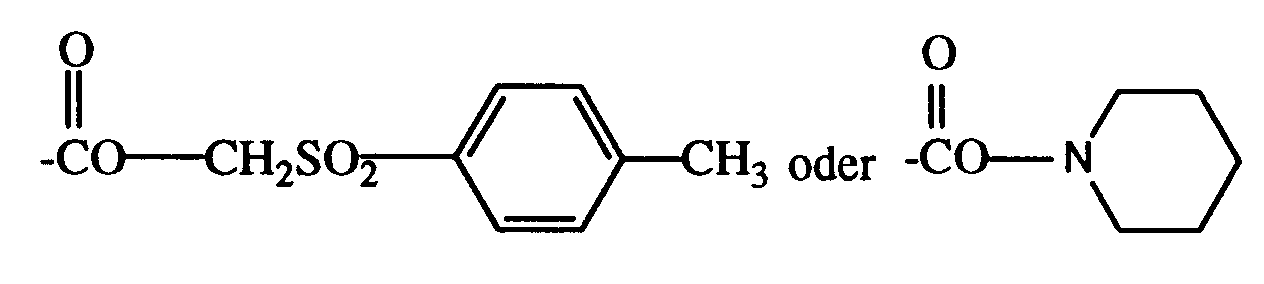
- Verfahren gemäss Anspruch 1, gekennzeichnet durch die Verwendung zweier verschiedener Verbindungen ausgewählt ausa) Perylencarbonsäureimiden der Formel

 b) Chinacridonen der Formel
 c) Dioxazinen der Formel
 d) Isoindolinen der Formeln
 bedeutet
R₁₅ die gleiche Bedeutung wie R₁₃ hat,
R₁₆, R₁₇, R₁₈ und R₁₉ unabhängig voneinander Wasserstoff, C₁-C₁₈-Alkyl, C₁-C₄-Alkoxy, Halogen oder Trifluormethyl bedeuten,e) Indigoderivaten der Formel f) Benzimidazolon-Azoverbindungen der Formel
 g) anthrachinoiden Verbindungen der Formel
 h) Phthalocyaninen der Formel
X₁ H₂, Zn, Cu, Ni, Fe oder V,
X₂ -CH(R₂₄)- oder -SO₂-
R₂₃ Wasserstoff, C₁-C₄-Alkyl, -N(E)R₂₄, -NHCOR₂₅, -COR₂₅ oder
C₁-C₄-Alkyl oder C₁-C₄-Alkoxy bedeuten,
z für Null oder 1 und y für eine Zahl von 1 bis 4 stehen,
undi) Pyrrolo[3,4-c]pyrrole der Formel


R₂₇ und R₂₈ unabhängig voneinander Wasserstoff, Halogen, C₁-C₁₈-Alkyl, C₁-C₁₈-Alkoxy, C₁-C₁₈-Alkylmercapto, C₁-C₁₈-Alkylamino, -CN, -NO₂, -Phenyl, Trifluormethyl, C₅-C₆-Cycloalkyl, -C=N-(C₁-C₁₈-Alkyl),
wobei in den obenerwähnten Formeln E jeweils Wasserstoff oder B bedeutet, mit der Massgabe, dass E in jeder Formel mindestens einmal B ist, und B die oben angegebene Bedeutung hat. - Verfahren gemäss Anspruch 4, gekennzeichnet durch die Verwendung von Chinacridonen der Formel VIII, worin R₁₀ und R₁₁ unabhängig voneinander Wasserstoff, Chlor oder Methyl bedeuten und E die oben angegebene Bedeutung hat, und/oder Pyrrolo[3,4-c]pyrrolen der Formel XVII, worin G und L gleich sind und eine Gruppe der Formel


worin R₂₇ und R₂₈ unabhängig voneinander Wasserstoff, Chlor, Brom, C₁-C₄-Alkyl,
C₁-C₆-Alkoxy, C₁-C₆-Alkylamino, CN oder Phenyl bedeuten,
M -O-, -NR₃₃-, -N=N- oder -SO₂- ist,
R₂₉ und R₃₀ Wasserstoff und R₃₃ Wasserstoff, Methyl oder Ethyl bedeuten und E die oben angegebene Bedeutung hat. - Verfahren gemäss Anspruch 5, gekennzeichnet durch die Verwendung von Chinacridonen der Formeln

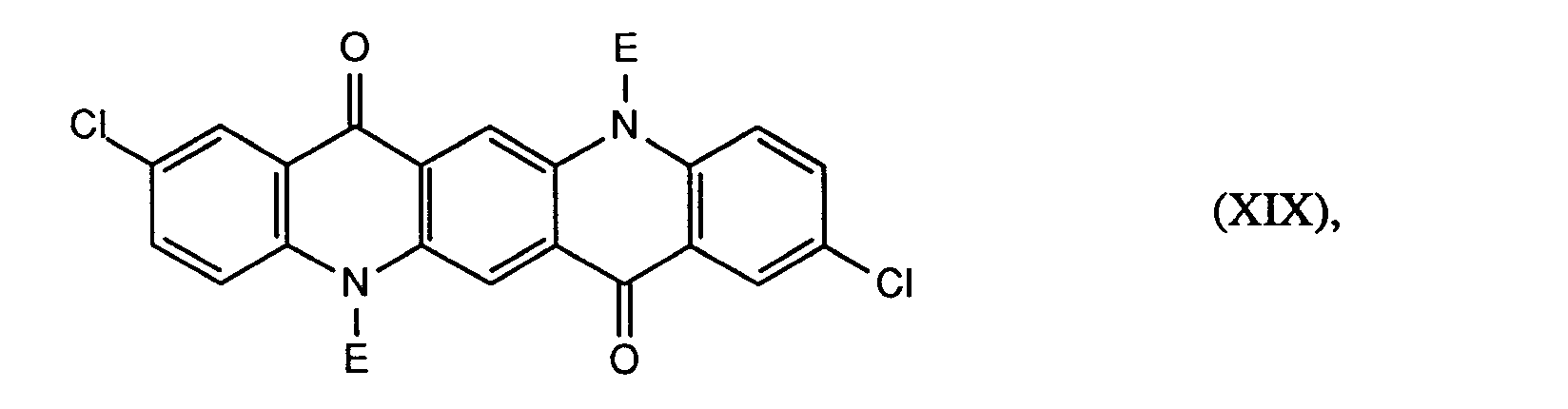

wobei E in den Formeln XVIII, XIX und XX eine Gruppe der Formel

Applications Claiming Priority (3)
| Application Number | Priority Date | Filing Date | Title |
|---|---|---|---|
| CH347793 | 1993-11-22 | ||
| CH3477/93 | 1993-11-22 | ||
| CH347793 | 1993-11-22 |
Publications (3)
| Publication Number | Publication Date |
|---|---|
| EP0654506A2 true EP0654506A2 (de) | 1995-05-24 |
| EP0654506A3 EP0654506A3 (de) | 1996-03-20 |
| EP0654506B1 EP0654506B1 (de) | 2000-05-17 |
Family
ID=4256820
Family Applications (1)
| Application Number | Title | Priority Date | Filing Date |
|---|---|---|---|
| EP94810650A Expired - Lifetime EP0654506B1 (de) | 1993-11-22 | 1994-11-14 | Verfahren zur Herstellung synergistischer Pigmentgemische |
Country Status (5)
| Country | Link |
|---|---|
| US (1) | US5518539A (de) |
| EP (1) | EP0654506B1 (de) |
| JP (1) | JP3712751B2 (de) |
| CA (1) | CA2135596A1 (de) |
| DE (1) | DE59409353D1 (de) |
Cited By (19)
| Publication number | Priority date | Publication date | Assignee | Title |
|---|---|---|---|---|
| EP0704496A1 (de) * | 1994-09-28 | 1996-04-03 | Ciba-Geigy Ag | Feste Lösungen von Pyrrolo(3,4-c)pyrrolen und Chinacridonen in Pigmentform |
| EP0704497A1 (de) * | 1994-09-28 | 1996-04-03 | Ciba-Geigy Ag | Mischkristalle und feste Lösungen von 1,4-Diketopyrrolopyrrolen |
| EP0761772A1 (de) * | 1995-07-28 | 1997-03-12 | Ciba SC Holding AG | Lösliche Chromophore mit leicht abspaltbaren löslichmachenden Gruppen |
| EP0764696A3 (de) * | 1995-09-20 | 1998-04-01 | Ciba SC Holding AG | Herstellung von Mischkristallen und festen Lösungen von 1,4-Diketopyrrolopyrrolen |
| EP0763572A3 (de) * | 1995-09-18 | 1998-04-01 | Ciba SC Holding AG | Feste Lösungen von 1,4-Diketopyrrolopyrrolen |
| EP0765919A3 (de) * | 1995-09-26 | 1998-04-01 | Ciba SC Holding AG | Monophasige feste Lösungen mit asymmetrischen Pyrrolo-[4,3-c]-pyrrolen als Wirten |
| EP0825234A3 (de) * | 1996-08-22 | 1998-04-08 | Ciba SC Holding AG | Kristallmodifikation eines Diketopyrrolopyrrolpigments |
| WO1998032800A1 (en) * | 1997-01-29 | 1998-07-30 | Clariant Finance (Bvi) Limited | Thiazine indigo pigments, solid solutions thereof and their preparation |
| WO1998032802A1 (en) * | 1997-01-27 | 1998-07-30 | Ciba Specialty Chemicals Holding Inc. | Soluble chromophores having improved solubilising groups |
| EP0874025A3 (de) * | 1997-04-25 | 1999-09-15 | Ciba SC Holding AG | Beta-Chinacridonpigment |
| WO2000061689A1 (en) * | 1999-04-08 | 2000-10-19 | Ciba Specialty Chemicals Holding Inc. | Pigment compositions and process of shading |
| EP1130475A1 (de) * | 2000-01-31 | 2001-09-05 | Canon Kabushiki Kaisha | Phthalozyaninkristall, Verfahren zu dessen Herstellung, elektrophotographisches lichtempfinfliches Element, Verfahrenskassette und Apparat worin dieses Kristall angewendet wird |
| EP1125986A3 (de) * | 2000-02-10 | 2001-10-04 | Clariant Finance (BVI) Limited | Neue Triphendisoxazinpigmente |
| EP1046681A3 (de) * | 1999-04-22 | 2003-02-12 | Clariant Finance (BVI) Limited | Hybride Pigmente |
| EP1046680A3 (de) * | 1999-04-08 | 2003-02-12 | Clariant Finance (BVI) Limited | Pigmente, Verfahren zu deren Herstellung und deren Verwendung |
| EP1086984A3 (de) * | 1999-09-24 | 2003-10-22 | Ciba SC Holding AG | Verbindungen zum Färben von Polymeren in der Masse |
| WO2010128063A3 (en) * | 2009-05-08 | 2011-02-24 | Basf Se | Indicator system for monitoring a sterilization process |
| US8088474B2 (en) | 2007-03-27 | 2012-01-03 | Agfa-Gevaert N.V. | Non-transparent microvoided biaxially stretched film, its use in synthetic paper and an image recording element comprising same |
| US9204598B2 (en) | 2013-05-27 | 2015-12-08 | Saudi Basic Indsutries Corporation | Solar energy funneling using thermoplastics for agricultural applications |
Families Citing this family (6)
| Publication number | Priority date | Publication date | Assignee | Title |
|---|---|---|---|---|
| US5753030A (en) * | 1996-05-13 | 1998-05-19 | Bayer Corporation | Crystal growth modifiers for perylene pigments |
| EP0822235B1 (de) * | 1996-07-31 | 2002-01-30 | Ciba SC Holding AG | Verfahren zur Herstellung von farbstarken Disazopigmentgemischen |
| US6274728B1 (en) | 1997-01-27 | 2001-08-14 | Ciba Specialty Chemicals Corp. | Soluble chromophores having improved solubilizing groups |
| EP0974074B1 (de) * | 1997-04-09 | 2003-01-08 | Ciba SC Holding AG | Hochtransparentes,farbpigmentiertes material mit hohem molekulargewicht |
| WO2000056819A1 (de) | 1999-03-24 | 2000-09-28 | Ciba Specialty Chemicals Holding Inc. | Purpurfarbene pigmentzusammensetzung und deren verwendung |
| KR101011943B1 (ko) * | 2002-10-07 | 2011-01-31 | 시바 홀딩 인크 | 착색 안료를 함유하는 불투명한 피복물 |
Family Cites Families (16)
| Publication number | Priority date | Publication date | Assignee | Title |
|---|---|---|---|---|
| US3160510A (en) * | 1960-04-25 | 1964-12-08 | Du Pont | Quinacridone pigment compositions |
| US3298847A (en) * | 1963-08-12 | 1967-01-17 | Du Pont | Method of making quinacridone solid solutions |
| NL7001362A (de) * | 1969-02-28 | 1970-09-01 | ||
| US3607336A (en) * | 1969-07-09 | 1971-09-21 | Du Pont | Process for making solid solutions |
| US3647494A (en) * | 1969-08-27 | 1972-03-07 | Du Pont | Process for making solid solutions of quinacridone and derivatives thereof |
| ZA712923B (en) * | 1970-05-06 | 1972-01-26 | Ciba Geigy Ag | Pigment compositions |
| US3681100A (en) * | 1970-10-08 | 1972-08-01 | Du Pont | Light stable orange pigment based on quinacridone solid solution |
| JPS5029561A (de) * | 1973-07-13 | 1975-03-25 | ||
| US4322303A (en) * | 1979-09-18 | 1982-03-30 | Ciba-Geigy Corporation | Dithiophosphate stabilizers |
| DE3436209A1 (de) * | 1984-10-03 | 1986-04-03 | Hoechst Ag, 6230 Frankfurt | Mischkristallpigmente auf der basis von perylentetracarbonsaeurediimiden, verfahren zu ihrer herstellung und ihre verwendung |
| DE3436206A1 (de) * | 1984-10-03 | 1986-04-03 | Hoechst Ag, 6230 Frankfurt | Verfahren zur herstellung von mischkristallpigmenten auf der basis von perylentetracarbonsaeurediimiden und deren verwendung |
| DE3436208A1 (de) * | 1984-10-03 | 1986-04-10 | Hoechst Ag, 6230 Frankfurt | Mischkristallpigmente auf der basis von perylentetracarbonsaeurediimiden, verfahren zu ihrer herstellung und ihre verwendung |
| DE3584138D1 (de) * | 1984-11-07 | 1991-10-24 | Ciba Geigy Ag | Pigmentmischungen. |
| US4783540A (en) * | 1986-08-07 | 1988-11-08 | Ciba-Geigy Corporation | Solid solutions of pyrrolo-(3,4-C)-pyrrols |
| US4810304A (en) * | 1987-02-02 | 1989-03-07 | Ciba-Geigy Corporation | Solid solutions of pyrrolo-(3,4-C)-pyrroles with quinacridones |
| DE3844063A1 (de) * | 1988-12-28 | 1990-07-05 | Hoechst Ag | Mischkristallpigmente der anthanthronreihe, verfahren zu ihrer herstellung und ihre verwendung |
-
1994
- 1994-11-14 EP EP94810650A patent/EP0654506B1/de not_active Expired - Lifetime
- 1994-11-14 DE DE59409353T patent/DE59409353D1/de not_active Expired - Fee Related
- 1994-11-18 US US08/341,720 patent/US5518539A/en not_active Expired - Fee Related
- 1994-11-18 CA CA002135596A patent/CA2135596A1/en not_active Abandoned
- 1994-11-22 JP JP28769094A patent/JP3712751B2/ja not_active Expired - Fee Related
Cited By (27)
| Publication number | Priority date | Publication date | Assignee | Title |
|---|---|---|---|---|
| EP0704497A1 (de) * | 1994-09-28 | 1996-04-03 | Ciba-Geigy Ag | Mischkristalle und feste Lösungen von 1,4-Diketopyrrolopyrrolen |
| EP0704496A1 (de) * | 1994-09-28 | 1996-04-03 | Ciba-Geigy Ag | Feste Lösungen von Pyrrolo(3,4-c)pyrrolen und Chinacridonen in Pigmentform |
| EP0761772A1 (de) * | 1995-07-28 | 1997-03-12 | Ciba SC Holding AG | Lösliche Chromophore mit leicht abspaltbaren löslichmachenden Gruppen |
| CN1076369C (zh) * | 1995-09-18 | 2001-12-19 | 西巴特殊化学品控股有限公司 | 1,4——二酮吡咯并吡咯的固溶体 |
| EP0763572A3 (de) * | 1995-09-18 | 1998-04-01 | Ciba SC Holding AG | Feste Lösungen von 1,4-Diketopyrrolopyrrolen |
| EP0764696A3 (de) * | 1995-09-20 | 1998-04-01 | Ciba SC Holding AG | Herstellung von Mischkristallen und festen Lösungen von 1,4-Diketopyrrolopyrrolen |
| EP0765919A3 (de) * | 1995-09-26 | 1998-04-01 | Ciba SC Holding AG | Monophasige feste Lösungen mit asymmetrischen Pyrrolo-[4,3-c]-pyrrolen als Wirten |
| CN1076744C (zh) * | 1995-09-26 | 2001-12-26 | 西巴特殊化学品控股有限公司 | 含有不对称的吡咯并[4,3-c]吡咯作为主体的单相固溶体 |
| EP0825234A3 (de) * | 1996-08-22 | 1998-04-08 | Ciba SC Holding AG | Kristallmodifikation eines Diketopyrrolopyrrolpigments |
| WO1998032802A1 (en) * | 1997-01-27 | 1998-07-30 | Ciba Specialty Chemicals Holding Inc. | Soluble chromophores having improved solubilising groups |
| US6200378B1 (en) * | 1997-01-29 | 2001-03-13 | CLARIANT FINANCE (BVIø) LIMITED | Thiazine indigo pigments, solid solutions thereof and their preparation |
| WO1998032800A1 (en) * | 1997-01-29 | 1998-07-30 | Clariant Finance (Bvi) Limited | Thiazine indigo pigments, solid solutions thereof and their preparation |
| EP0874025A3 (de) * | 1997-04-25 | 1999-09-15 | Ciba SC Holding AG | Beta-Chinacridonpigment |
| WO2000061689A1 (en) * | 1999-04-08 | 2000-10-19 | Ciba Specialty Chemicals Holding Inc. | Pigment compositions and process of shading |
| CN1298788C (zh) * | 1999-04-08 | 2007-02-07 | 西巴特殊化学品控股有限公司 | 颜料组合物以及调配色调的方法 |
| US6620235B1 (en) | 1999-04-08 | 2003-09-16 | Ciba Specialty Chemicals Corporation | Pigment compositions and process of shading |
| EP1046680A3 (de) * | 1999-04-08 | 2003-02-12 | Clariant Finance (BVI) Limited | Pigmente, Verfahren zu deren Herstellung und deren Verwendung |
| EP1046681A3 (de) * | 1999-04-22 | 2003-02-12 | Clariant Finance (BVI) Limited | Hybride Pigmente |
| EP1086984A3 (de) * | 1999-09-24 | 2003-10-22 | Ciba SC Holding AG | Verbindungen zum Färben von Polymeren in der Masse |
| US6447967B2 (en) | 2000-01-31 | 2002-09-10 | Canon Kabushiki Kaisha | Phthalocyanine crystal, production process therefor, and electrophotographic photosensitive member, process cartridge and apparatus using the crystal |
| US6768006B2 (en) | 2000-01-31 | 2004-07-27 | Canon Kabushiki Kaisha | Phthalocyanine crystal, production process therefor, and electrophotographic photosensitive member, process cartridge and apparatus using the crystal |
| EP1130475A1 (de) * | 2000-01-31 | 2001-09-05 | Canon Kabushiki Kaisha | Phthalozyaninkristall, Verfahren zu dessen Herstellung, elektrophotographisches lichtempfinfliches Element, Verfahrenskassette und Apparat worin dieses Kristall angewendet wird |
| US6515123B2 (en) * | 2000-02-10 | 2003-02-04 | Clariant Finance (Bvi) Limited | Triphendioxazine pigments, intermediates, their method of making and uses thereof |
| EP1125986A3 (de) * | 2000-02-10 | 2001-10-04 | Clariant Finance (BVI) Limited | Neue Triphendisoxazinpigmente |
| US8088474B2 (en) | 2007-03-27 | 2012-01-03 | Agfa-Gevaert N.V. | Non-transparent microvoided biaxially stretched film, its use in synthetic paper and an image recording element comprising same |
| WO2010128063A3 (en) * | 2009-05-08 | 2011-02-24 | Basf Se | Indicator system for monitoring a sterilization process |
| US9204598B2 (en) | 2013-05-27 | 2015-12-08 | Saudi Basic Indsutries Corporation | Solar energy funneling using thermoplastics for agricultural applications |
Also Published As
| Publication number | Publication date |
|---|---|
| JPH07196939A (ja) | 1995-08-01 |
| EP0654506B1 (de) | 2000-05-17 |
| DE59409353D1 (de) | 2000-06-21 |
| JP3712751B2 (ja) | 2005-11-02 |
| US5518539A (en) | 1996-05-21 |
| EP0654506A3 (de) | 1996-03-20 |
| CA2135596A1 (en) | 1995-05-23 |
Similar Documents
| Publication | Publication Date | Title |
|---|---|---|
| EP0654506B1 (de) | Verfahren zur Herstellung synergistischer Pigmentgemische | |
| EP0648817A1 (de) | Neue Fluoreszenzfarbstoffe | |
| EP0657436B1 (de) | Verfahren zur Herstellung von Perylen-3,4-dicarbonsäurederivaten | |
| EP0648770B1 (de) | Pyrrolo[3,4-c]pyrrole | |
| EP0761772B1 (de) | Lösliche Chromophore mit leicht abspaltbaren löslichmachenden Gruppen | |
| US5708188A (en) | Mixed crystals and solid solution of 1,4-diketopyrrolopyrroles | |
| DE60219037T2 (de) | Verfahren zur herstellung von diketopyrrolopyrrolen | |
| DE60005901T2 (de) | Elektrolumineszierende Anordungen mit Diketopyrrolopyrrolen | |
| EP0504872A1 (de) | Innere Salze von Perylenverbindungen, Verfahren zu deren Herstellung und ihre Verwendung | |
| DE60008472T2 (de) | Fluoreszente Diketopyrrolopyrrolen | |
| US6248165B1 (en) | Mixed crystals and solid solutions of 1,4-diketopyrrolopyrroles | |
| EP0690058B1 (de) | Neue Kristallmodifikation eines Diketopyrrolopyrrolpigments | |
| EP0711812B1 (de) | Verfahren zur Herstellung von Perylenimiden, neue di-, tri- und tetrachromophore Perylenfarbstoffe und deren Verwendung | |
| EP0638613A1 (de) | Perylenamidinimid-Farbstoffe, ein Verfahren zu deren Herstellung und deren Verwendung | |
| EP0769532A1 (de) | Naphthalinlactamimid-Fluoreszenzfarbstoffe | |
| EP0690059B1 (de) | Zwei neue Kristallmodifikationen eines Diketopyrrolopyrrolpigments | |
| KR101672390B1 (ko) | 프탈로시아닌 화합물 및 그 제조 방법, 및 당해 프탈로시아닌 화합물을 함유하는 착색 조성물 | |
| EP1870438B1 (de) | Phthalocyanin verbindung, ihr herstellungsverfahren, sowie die phthalocyaninverbindung enthaltende farbgebende zusammensetzung | |
| EP0690057B1 (de) | Neue Kristallmodifikation eines Diketopyrrolopyrrolpigments | |
| EP0337945A1 (de) | Monoketo-pyrrolopyrrole | |
| EP0174575B1 (de) | Basische Farbstoffe, ihre Herstellung und ihre Verwendung zum Färben von Cellulose | |
| US4256901A (en) | Phthalone derivatives utilizable as pigments | |
| EP1344778B1 (de) | Bipyrrolinonylidene-typ Verbindung, deren Benutzung als Farbstoff, und deren Verfahren zur Herstellung | |
| DE2342815A1 (de) | Neue dioxazinfarbstoffe | |
| CH642074A5 (de) | Cumarin- und benzocumarinderivate, verfahren zu deren herstellung und deren verwendung als pigmente. |
Legal Events
| Date | Code | Title | Description |
|---|---|---|---|
| PUAI | Public reference made under article 153(3) epc to a published international application that has entered the european phase |
Free format text: ORIGINAL CODE: 0009012 |
|
| AK | Designated contracting states |
Kind code of ref document: A2 Designated state(s): CH DE FR GB IT LI |
|
| PUAL | Search report despatched |
Free format text: ORIGINAL CODE: 0009013 |
|
| AK | Designated contracting states |
Kind code of ref document: A3 Designated state(s): CH DE FR GB IT LI |
|
| 17P | Request for examination filed |
Effective date: 19960910 |
|
| RAP1 | Party data changed (applicant data changed or rights of an application transferred) |
Owner name: CIBA SC HOLDING AG |
|
| RAP3 | Party data changed (applicant data changed or rights of an application transferred) |
Owner name: CIBA SPECIALTY CHEMICALS HOLDING INC. |
|
| 17Q | First examination report despatched |
Effective date: 19990430 |
|
| GRAG | Despatch of communication of intention to grant |
Free format text: ORIGINAL CODE: EPIDOS AGRA |
|
| GRAG | Despatch of communication of intention to grant |
Free format text: ORIGINAL CODE: EPIDOS AGRA |
|
| GRAH | Despatch of communication of intention to grant a patent |
Free format text: ORIGINAL CODE: EPIDOS IGRA |
|
| GRAH | Despatch of communication of intention to grant a patent |
Free format text: ORIGINAL CODE: EPIDOS IGRA |
|
| GRAA | (expected) grant |
Free format text: ORIGINAL CODE: 0009210 |
|
| AK | Designated contracting states |
Kind code of ref document: B1 Designated state(s): CH DE FR GB IT LI |
|
| REG | Reference to a national code |
Ref country code: CH Ref legal event code: EP |
|
| REF | Corresponds to: |
Ref document number: 59409353 Country of ref document: DE Date of ref document: 20000621 |
|
| GBT | Gb: translation of ep patent filed (gb section 77(6)(a)/1977) |
Effective date: 20000620 |
|
| ITF | It: translation for a ep patent filed | ||
| ET | Fr: translation filed | ||
| PLBE | No opposition filed within time limit |
Free format text: ORIGINAL CODE: 0009261 |
|
| STAA | Information on the status of an ep patent application or granted ep patent |
Free format text: STATUS: NO OPPOSITION FILED WITHIN TIME LIMIT |
|
| 26N | No opposition filed | ||
| REG | Reference to a national code |
Ref country code: GB Ref legal event code: IF02 |
|
| PGFP | Annual fee paid to national office [announced via postgrant information from national office to epo] |
Ref country code: FR Payment date: 20021017 Year of fee payment: 9 |
|
| PG25 | Lapsed in a contracting state [announced via postgrant information from national office to epo] |
Ref country code: FR Free format text: LAPSE BECAUSE OF NON-PAYMENT OF DUE FEES Effective date: 20040730 |
|
| REG | Reference to a national code |
Ref country code: FR Ref legal event code: ST |
|
| PGFP | Annual fee paid to national office [announced via postgrant information from national office to epo] |
Ref country code: CH Payment date: 20041013 Year of fee payment: 11 |
|
| PGFP | Annual fee paid to national office [announced via postgrant information from national office to epo] |
Ref country code: DE Payment date: 20041021 Year of fee payment: 11 |
|
| PGFP | Annual fee paid to national office [announced via postgrant information from national office to epo] |
Ref country code: GB Payment date: 20041022 Year of fee payment: 11 |
|
| PG25 | Lapsed in a contracting state [announced via postgrant information from national office to epo] |
Ref country code: IT Free format text: LAPSE BECAUSE OF NON-PAYMENT OF DUE FEES;WARNING: LAPSES OF ITALIAN PATENTS WITH EFFECTIVE DATE BEFORE 2007 MAY HAVE OCCURRED AT ANY TIME BEFORE 2007. THE CORRECT EFFECTIVE DATE MAY BE DIFFERENT FROM THE ONE RECORDED. Effective date: 20051114 Ref country code: GB Free format text: LAPSE BECAUSE OF NON-PAYMENT OF DUE FEES Effective date: 20051114 |
|
| PG25 | Lapsed in a contracting state [announced via postgrant information from national office to epo] |
Ref country code: LI Free format text: LAPSE BECAUSE OF NON-PAYMENT OF DUE FEES Effective date: 20051130 Ref country code: CH Free format text: LAPSE BECAUSE OF NON-PAYMENT OF DUE FEES Effective date: 20051130 |
|
| PG25 | Lapsed in a contracting state [announced via postgrant information from national office to epo] |
Ref country code: DE Free format text: LAPSE BECAUSE OF NON-PAYMENT OF DUE FEES Effective date: 20060601 |
|
| REG | Reference to a national code |
Ref country code: CH Ref legal event code: PL |
|
| GBPC | Gb: european patent ceased through non-payment of renewal fee |
Effective date: 20051114 |