EP0655487B1 - Selbstoxidierende Beschichtungszusammensetzung auf Wasserbasis - Google Patents
Selbstoxidierende Beschichtungszusammensetzung auf Wasserbasis Download PDFInfo
- Publication number
- EP0655487B1 EP0655487B1 EP94115926A EP94115926A EP0655487B1 EP 0655487 B1 EP0655487 B1 EP 0655487B1 EP 94115926 A EP94115926 A EP 94115926A EP 94115926 A EP94115926 A EP 94115926A EP 0655487 B1 EP0655487 B1 EP 0655487B1
- Authority
- EP
- European Patent Office
- Prior art keywords
- copolymer
- autoxidisable
- acrylic acid
- copolymerised
- water
- Prior art date
- Legal status (The legal status is an assumption and is not a legal conclusion. Google has not performed a legal analysis and makes no representation as to the accuracy of the status listed.)
- Expired - Lifetime
Links
Classifications
-
- C—CHEMISTRY; METALLURGY
- C08—ORGANIC MACROMOLECULAR COMPOUNDS; THEIR PREPARATION OR CHEMICAL WORKING-UP; COMPOSITIONS BASED THEREON
- C08F—MACROMOLECULAR COMPOUNDS OBTAINED BY REACTIONS ONLY INVOLVING CARBON-TO-CARBON UNSATURATED BONDS
- C08F8/00—Chemical modification by after-treatment
- C08F8/14—Esterification
-
- C—CHEMISTRY; METALLURGY
- C08—ORGANIC MACROMOLECULAR COMPOUNDS; THEIR PREPARATION OR CHEMICAL WORKING-UP; COMPOSITIONS BASED THEREON
- C08F—MACROMOLECULAR COMPOUNDS OBTAINED BY REACTIONS ONLY INVOLVING CARBON-TO-CARBON UNSATURATED BONDS
- C08F2810/00—Chemical modification of a polymer
- C08F2810/30—Chemical modification of a polymer leading to the formation or introduction of aliphatic or alicyclic unsaturated groups
Definitions
- This invention relates to a water-based autoxidisable air-drying coating composition, especially a gloss (including partial gloss) coating composition suitable for application to architectural surfaces, fittings or furnishings at ambient temperatures which composition contains water, a drier which promotes autoxidisation and a water-soluble autoxidisable film-forming addition copolymer containing copolymerised acrylic acid, copolymerised acrylate and/or methacrylate and 3-allyloxy-2-hydroxypropyl and/or its 1-butenyl analogue.
- the invention further relates to water-soluble autoxidisable film-forming addition copolymer of acrylic acid partially esterified by 3-allyloxy-2-hydroxypropyl moieties or their 1-butenyl analogue which copolymer is suitable for use in these coating compositions.
- the autoxidisable air-drying coating composition will generally be a paint, varnish, woodstain or timber preservative applicable by brush, roller, pad or spray to architectural surfaces, fittings or furnishings, that is to say surfaces usually found in buildings or on furniture.
- paints are sometimes called "decorative trim paints" because they are often used on such fittings as doors, window frames and skirting boards.
- a good paint for use on such surfaces should have a variety of standard properties normally expected of a decorative trim paint. Firstly it should have good opacity, that is to say it should be able to accommodate enough pigment to hide marks on the surface.
- this third requirement conflicts with the fourth which is that the applied paint should dry fast enough to achieve reasonably early resistance to water, particularly domestic condensation or spilled water.
- the fourth requirement in turn partially conflicts with the fifth which is that the paint must lap well at ambient temperature (say 20°C).
- ambient temperature say 20°C.
- good lapping means that when adjacent and overlapping bands of paint are applied to a substrate one after another and allowed to dry, it should be difficult for a casual observer to detect a boundary between adjacent contiguous bands of dried paint even when one band was applied several minutes after the other. The best paints lap well even when the application of adjacent contiguous bands is separated by as much as 10 minutes. The same is true for varnishes.
- Water-based air-drying gloss paints have been proposed which comprise water and an aqueous colloidal dispersion of non-autoxidisable water-insoluble film-forming polymer (including copolymers) such as for example a polymer or co-polymer of alkyl acrylate (including methacrylate).
- non-autoxidisable water-insoluble film-forming polymer including copolymers
- alkyl acrylate including methacrylate
- autoxidisable moieties examples include the long chain unsaturated fatty acids such as the fatty acid derived from linseed oil.
- the difficulty in practice was that the conventional autoxidisable moieties were very hydrophobic and so reduced the water-solubility of the copolymer.
- EP 0 425 085A or US 5 264 482 disclose that it is possible to introduce autoxidisable moieties into a water-soluble film-forming copolymer whilst retaining water-solubility to permit good lapping but only if
- Non-ionic water-solubilising moieties such as methoxypoly(ethylene glycol) methacrylates are sometimes used to impart water-solubility to addition copolymers.
- attempts to use them instead of the cationic water-solubilising moieties in autoxidisable copolymers containing 3-allyloxy-2-hydroxypropyl moieties were unsuccessful because in order to achieve the required degree of water-solubility, they had to be used in such large amounts that they re-introduced the imbibing problem.
- An object of this invention is to provide a water-based autoxidisable air-drying coating composition suitable for application to architectural surfaces, fittings or furnishings at ambient temperatures which contains water, a drier which promotes autoxidation and a water-soluble autoxidisable film-forming copolymer containing 3-allyloxy-2-hydroxypropyl moieties or its 1-butenyl analogue which achieves water-solubility without reliance on water-solubilising cationic moieties or methoxypoly(ethylene glycol) methacrylates and so combines good lapping ability with improved resistance to the imbibing of water into the dried coating.
- Another object of the invention is to provide such a water-soluble copolymer for use in the invention.
- the coating compositions of this invention are at least as good as those of EP 0 425 085A and US 5 264 482 in their ability to give opacity, to spread over a surface and to lap. However, in addition they form dried films having a substantially improved resistance to the imbibing of water together with improved short and long term resistance to domestic condensation and spilled water. It is thought that the improvements may be achieved because the pendant hydroxyl groups in the acrylate or methacrylate interact in some way with adjacent copolymer chains possibly because of free radical action or because of attraction to carboxylic acid groups. Whatever the interaction may be, it seems to be essentially irreversible for all practical purposes.
- the film-forming copolymer be dissolved in the aqueous component of the coating composition as opposed to merely being present as a dispersion of solid (including swollen) particles.
- the film-forming copolymers of this invention form a near perfect solution rather than a perfect solution as is evidenced by the fact that, whilst solutions may often appear fully transparent to the unaided eye they usually scatter light to a small extent.
- near perfect solutions have the important property of showing a mainly monotonic increase in viscosity as they dry. A monotonic increase in viscosity is essential if the coating compositions are to be applicable in a conventional way.
- Coating compositions of this invention need not contain organic cosolvents. However the presence of a small amount (preferably 1 to 15 wt% of the composition) of co-solvent may improve the clarity of some copolymer solutions and it also helps to control the viscosity of the composition as it dries.
- the cosolvent should be a water-miscible liquid which plasticises the film-forming copolymer and preferably has a boiling point of from 75 to 200°C at 1 bar absolute.
- An ideal cosolvent should also be of low odour and low toxicity and it should have a high flash point (preferably at least 30°C).
- cosolvents which can act as a chain transfer agent during copolymerisation of the acid and non-acid comonomers.
- useful cosolvents include alcohols, glycols, ester alcohols, ether alcohols and the esters of ether alcohols, for example n-butanol, propylene glycol, benzyl alcohol, 2,2,4 trimethylpentane 1,3 diomonoisobutyrate, propylene glycol monomethyl, - ethyl, -propyl and -butyl ether, diethylene glycol, dipropylene glycol, dipropylene glycol methyl ether, diethylene glycol ethyl ether, and most preferably 1-methoxy-2-hydroxy propane or MHP which is
- the autoxidisable film-forming copolymers of this invention do not need to be neutralised by cations to make them water-soluble. However their water-solubility can be increased by such neutralisation if some loss of resistance to water-imbibing can be tolerated. It is preferred not to neutralise more than 5% of available carboxylic acid groups in order to minimise the risk of totally losing an important advantage given by this invention.
- the autoxidisable film-forming copolymer is derivable by addition copolymerising the acrylic acid with the hydroxy ester to form a pre-copolymer containing from 15 to 28wt% of copolymerised acrylic acid and then esterifying some of the copolymerised acrylic acid by condensing it with allyl glycidyl ether or its 1-butenyl analogue, ie. where n is 1 or 2.
- the balance of the prepolymer is hydroxyethyl acrylate.
- the condensation introduces the autoxidisable esterifying moieties which convert the pre-copolymer to an autoxidisable copolymer according to this invention.
- the pre-copolymer Prior to partial esterification, the pre-copolymer preferably has a weight average molecular weight of from 3,000 to 30,000 and usually below 15,000. After partial esterification, the molecular weight may increase to 4,000 to 50,000.
- the autoxidisable moieties confer long term water resistance on the dried coatings by generating crosslinks in the presence of driers which promote oxidation.
- Typical driers include cobalt acetate, octoate or naphthenate. Too much autoxidisable ester will diminish the water-solubility of the copolymer and too little will fail to achieve long term water-resistance.
- the most preferred proportions are 34 to 44 wt% and the allyloxy moiety is the more preferred.
- the amount of residual unesterified copolymerised acrylic acid remaining in the autoxidisable copolymer after partial esterification has been completed will not exceed 7wt%.
- the presence of larger residual amounts of acid would only be achievable by use of a pre-copolymer which contained a much larger proportion of acrylic acid and copolymers containing such high proportions of acrylic acid have been found to be impracticable to make on a commercial plant.
- Amounts of residual acrylic acid below 0.5 wt% reduce the opportunities for interactions of the kind thought to be responsible for improved resistance to the imbibing of water.
- methacrylic acid as an alternative to acrylic acid produced copolymers of unmanageable viscosity.
- the autoxidisable copolymer should not contain more than about 70 wt% of the hydroxy ester for then there would be insufficient accommodation for enough of the copolymerised acrylic acid.
- the copolymer should contain at least 50 wt% of the hydroxy ester in order to achieve acceptable water solubility.
- Hydroxyethyl acrylate is the preferred hydroxy ester because it gives better long term water-resistance, harder films, better gloss and better water-solubility.
- the polyethoxylate acrylates and methacrylates give more water-soluble copolymers than hydroxyisopropyl acrylate.
- n is 6 to 8.
- Attempts to use hydroxyethyl methacrylate or polypropoxylate acrylates or methacrylates as the hydroxy esters failed to produce acceptably water-soluble autoxidisable copolymers.
- the preferred amounts of hydroxy ester are 55 to 65 wt%.
- the coating compositions usually have a total non-volatile content (including for example pigment) of from 10 to 70 wt% of the composition.
- Non-volatile content is determined according to the procedure of ASTM Test D 1210-9 performed at 150°C or 210°C if there is present a cosolvent having a boiling point above 150°C.
- the total non-volatile content is generally 30 to 60 wt% for gloss paints, 30 to 70 wt% for partial gloss paints, 10 to 50 wt% for varnishes and 10 to 30 wt% for woodstains and timber preservatives.
- from 10 to 100 wt% of the total non-volatile content may consist of the film-forming copolymer.
- gloss paints from 20 to 75 wt% of the total non-volatile content of the composition is film-forming copolymer and the corresponding preferred ranges for partial gloss paints, varnishes and woodstain or timber preservative are 10 to 60 wt%, 20 to 100 wt% and 20 to 100 wt% respectively.
- the coating compositions may additionally contain components conventionally used in making for example paints, varnishes, woodstains or timber preservatives.
- Such components include pigments, dyes, extenders, thickeners, fungicides, anti-skinning agents, flow improvers and drying agents and solid particles of insoluble organic polymeric material as disclosed in EP 0 425 085A or US 5 264 482.
- the coating compositions have also been found to have a good ability to soak into wood and so they are useful as woodstains and timber preservatives.
- Epoxide value of a copolymer is determined by adding cetyl trimethyl ammonium bromide and crystal violet indicator to a sample of the copolymer dissolved in glacial acetic acid and then titrating the solution against 0.1M perchloric acid until the indicator turns from violet to yellow.
- Epoxide value is expressed as: 5.61 x V W where V is the volume of perchloric acid used and W is the weight of copolymer originally in the solution.
- a test surface is prepared by coating a rectangular sheet of plasterboard with a coat of a conventional water-based white acrylic primer undercoat available as "Dulux” White Quick-Drying Wood Primer Undercoat from the Paints Division of Imperial Chemical Industries PLC (ICI).
- the undercoat is allowed to dry for 24 hours and then there is applied to it two coats of a conventional white-spirit-based white alkyd gloss paint also available from ICI as "Dulux” Brilliant White Gloss.
- "Dulux” is a registered trade mark of ICI.
- the top coat is allowed to dry and age for at least 7 days to produce the test surface on which the lapping tests can be performed. The tests are performed at a temperature of from 20°C to 23°C and at a relative humidity of from 40 to 60%.
- a coat of paint under test is applied by brush by an experienced professional painter to a band about 200 mm wide of the test surface. Two minutes later, the paint under test is similarly applied to a further portion of the test surface which lies adjacent to the band and the ability of the paint to lap with that of the band is assessed. Six further similarly adjacent portions are similarly painted one after another at about 2 minute intervals and the ability of their paint to lap with that of the band is also assessed. In this way, the painter can assess the ability of the paint to lap over a period of 2 to 14 minutes and compare it with the lapping ability of a conventional organic solvent-borne gloss subjected to the same test.
- Good lapping occurs when no boundary can be seen between the paint of the band and that of an adjacent portion.
- a conventional organic solvent-borne paint will show no evidence of a boundary even when the adjacent portion is painted 15 minutes after the band.
- the painter assesses the lapping ability of a paint on a scale of from 1 (good) to 5 (unacceptable) with the conventional alkyd paint being arbitrarily assigned to a score of 3.
- a deal panel was brush painted with the acrylic primer used in the Lapping Test described above and the coating was allowed to dry for 24 hours.
- a first coat of test paint was applied by brush by an experienced professional painter to the primed panel and allowed to dry for 24 hours.
- a second coat of the test paint was similarly applied and allowed to dry for one week.
- the panel was then mounted outdoors inclined at an angle of 45° to the vertical and facing South in Slough, England. It was exposed to the weather for 3 months during Spring.
- the coating was then assessed visually for disfiguration and assessed on a scale of 1 (good) to 5 (unacceptable).
- the coating was also tested for loss of hardness by attempting to mark it by pressing the edge of a thumb nail into it.
- Weight average molecular weights are measured by making a solution consisting of 0.5 wt% copolymer in 99.5 wt% tetrahydrofuran and subjecting the solution to gel permeation chromatography using a pair of 300 mm linear columns arranged in series and packed with 5 ⁇ m polystyrene gel supplied by Polymer Laboratories Ltd of Church Stretton, England. The results obtained are calibrated against a polystyrene standard.
- test paint was applied by an experienced professional painter to a dry alkyd gloss coated test surface obtained as in the Lapping Test described above. Twenty four hours later, a second coating of the test paint was similarly applied and its ease of application was observed.
- a coating 100 ⁇ m thick is applied to a dry coat of a conventional alkyd paint obtained as in the lapping test described above.
- the coating is allowed to dry for 24 hours at 8°C and 50% relative humidity.
- a l ml drop of water is deposited onto it, covered by a watch gloss and allowed to stand at 8°C for two hours.
- the glass is removed and the sample is immediately wiped dry and examined for disfiguration. It was assessed according to the following scale:
- a pre-copolymer consisting of 21 wt% of copolymerised acrylic acid and 79 wt% of copolymerised hydroxyethyl acrylate was made by a free-radical initiated addition copolymerisation using butyl peroxy-2-ethyl hexanoate as the free radical initiator.
- the half-life of the initiator at 125°C is 1.7 minutes.
- the copolymerisation was performed in 928g of 1-methoxy-2-hydroxy propane (MHP) organic solvent refluxing at 120 to 130°C. 268g of acrylic acid and 1380g of hydroxyethyl acrylate were mixed together and fed dropwise to the refluxing MHP over a period of 5 hours. A solution of 87.4g of the initiator in 57.0g MHP was also fed dropwise to the MHP over the same 5 hour period. Refluxing was continued for a further 15 minutes after feeding of the co-monomers and initiators had been completed whereupon a further solution of 17.5g initiator was added and the reaction continued for a further 30 minutes to ensure completion of the copolymerisation. A solution of the pre-copolymer in MHP was obtained and allowed to cool to ambient (18°C) temperature. The pre-copolymer had a number average molecular weight of 2 700.
- MHP 1-methoxy-2-hydroxy propane
- the solution of pre-copolymer obtained above was converted to an autoxidisable film-forming copolymer by condensing allyl glycidyl ether with some of the carboxylic acid groups of the copolymerised acrylic acid thereby partially esterifying the pre-copolymer with 3-allyloxy-2-hydroxypropyl moieties.
- the condensation is catalysed by benzyl trimethyl ammonium hydroxide which is an epoxide ring-opening catalyst.
- the condensation was performed by first re-heating the pre-copolymer solution to 118 to 120°C. Then 8.3g of the ring-opening catalyst was added and washed in with 16.0g MHP. Next 551.9g allyl glycidyl ether in 32.2g MHP was added dropwise over a period of 30 minutes. The solution was then re-heated up to its refluxing temperature, maintained there till its Epoxide Value had fallen to below 3 mgKOH/(g non-volatile contents of the solution) and then allowed to cool to ambient temperature.
- the solution had a non-volatiles content of 66.7 wt% and contained an autoxidisable film-forming copolymer consisting of 1.6 wt% acrylic acid, 60 wt% copolymerised hydroxyethyl acrylate and 38.4 wt% of the 3-allyloxy-2-hydroxypropyl ester of copolymerised acrylic acid.
- the copolymer had a theoretical acid value of 6.6mgKOH/g copolymer and a weight average molecular weight of 29,000.
- the solution of the copolymer obtained above was reheated to 60°C and some of its MHP was removed by subjecting it to a vacuum of 0.1 to 0.2 bar and then increasing its temperature by increments of 5°C to 90°C over a period of 30 minutes.
- a concentrated solution was obtained which consisted of 90 wt% copolymer and 10 wt% MHP.
- the concentrated solution was allowed to cool to 70 to 80°C whereupon 43.2 vol% of water (based on the volume of concentrated solution) was added to it to produce an aqueous solution consisting of 70 vol% copolymer, 25.5 vol% water and 4.5 vol% (4.1wt%) MHP.
- the aqueous solution was clear to the unaided eye and a small sample showed a monotonic increase in viscosity on drying.
- the main volume of the solution was divided into two halves.
- the first half of the solution was poured into a 2.5 litre high speed disperser fitted with a conventional 60 mm diameter apertured circular stirrer.
- the stirrer was rotated to 3000 rpm and then 0.06 vol% of a conventional anti-foaming composition followed by 22 vol% titanium dioxide particles followed by 3 vol% of water were all added to the aqueous solution in the disperser.
- the volume percentages were based on the volume of solution in the disperser prior to the addition of the anti-foaming agent.
- the titanium dioxide was a pigment grade rutile of number average particle size 240 nm. Rotation of the stirrer was continued for 30 minutes after the addition of the water whereupon there was obtained a thoroughly mixed dispersion of rutile particles in aqueous copolymer solution.
- the dispersion was transferred to a 2.5 litre slow speed mixer fitted with a 60 mm stirrer and the stirrer was rotated at 200 rpm.
- 0.5 vol% (based on the volume of the dispersion in the mixer) of the conventional anti-foaming agent was added to the dispersion in the mixer followed by the second half of the aqueous solution and by 0.2 wt% cobalt metal as cobalt octoate drier where the weight percentage is based on the total weight of copolymer in the two halves of the aqueous solution.
- 17.3 vol% (based on the volume of the contents now in the mixer) of an aqueous dispersion of conventional acrylic copolymer particles was added to the contents of the mixer.
- the particles had a number average particle size of 231 nm and consisted of an acrylic copolymer containing 43.2 wt% methyl methacrylate, 50.7 wt% 2-ethylhexyl acrylate and 6.2 wt% methoxy poly(ethylene glycol) methacrylate and which had a weight average molecular weight of 68,000 and a minimum film forming temperature of -15°C.
- the acrylic particles can be made according to Example 19 of EP 0 425 085A or US 5 264 482 and they serve to improve the gloss of the dried coating.
- a pre-copolymer consisting of 31.1wt% copolymerised acrylic acid and 68.9 wt% of a copolymerised hydroxy ester which was a polyethoxylate methacrylate having polyethoxylate chains containing a number average of seven ethoxylate groups was made by a free-radical initiated addition copolymerisation using butyl peroxy-2-ethyl hexanoate as the free radical initiator and mercaptopropyl trimethoxysilane as a chain transfer agent.
- the copolymerisation was performed in 300g of MHP refluxing at 120 to 130°C. 179g of acrylic acid, 395g of the polyethoxylate methacrylate and 12.2g of the chain transfer agent were mixed together and the mixture was fed to the refluxing MHP over a period of 3 hours. A solution of 17.3g of the initiator dissolved in 74g of MHP was also fed separately to the refluxing MHP over the same period of 3 hours. Refluxing was continued and 15 minutes later a further 5.7g of initiator dissolved in MHP was added to the refluxing MHP over a period of 30 minutes followed by a further 15 minutes of refluxing to ensure completion of the copolymerisation. A solution of pre-copolymer in MHP was obtained and allowed to cool to ambient (18°C) temperature. The pre-copolymer had a number average molecular weight of 2790.
- the solution of pre-copolymer obtained above was converted to an autoxidisable copolymer using the procedure of part b of Example 1 except that 3.3g of ring opening catalyst and 216g of allyl glycidyl ether were used and the autoxidisable copolymer obtained contained 5.3 wt% acrylic acid, 50 wt% of the polyethoxylate methacrylate and 44.7 wt% of the 3-allyloxy-2-hydroxypropyl ester of copolymerised acrylic acid.
- the autoxidisable copolymer obtained was less soluble than that obtained from Example 2 but it was nevertheless capable of use as a paint made in accordance with part c of Example 1.
- a pre-copolymer consisting of 31.1 wt.% copolymerised acrylic acid and 68.9 wt% of a copolymerised hydroxy ester which was a polyethoxylate methacrylate having polyethoxylate chains containing a number average of eight ethoxylate groups was made by a free-radical initiated addition copolymerisation using butyl peroxy-2-ethyl hexanoate as the free radical initiator and mercaptopropyl trimethoxysilane as a chain transfer agent.
- the copolymerisation was performed in 374g of MHP refluxing at 120 to 130°C. 179g of acrylic acid, 395g of the polyethoxylate methacrylate and 12.2g of the chain transfer agent and 17.3g of initiator in MHP were mixed together and the mixture was fed to the refluxing MHP over a period of 3 hours. Refluxing was continued and 15 minutes later a further 5.7g of initiator dissolved in MHP was added to the refluxing MHP over a period of 30 minutes followed by a further 15 minutes of refluxing to ensure completion of the copolymerisation. A solution of pre-copolymer in MHP was obtained and allowed to cool to ambient (18°C) temperature.
- the solution of pre-copolymer obtained above was converted to an autoxidisable copolymer using the procedure of part b of Example 1 except that 3.3g of ring opening catalyst and 216g of allyl glycidyl ether were used and the autoxidisable copolymer obtained contained 5.3 wt% acrylic acid, 50 wt% of the polyethoxylate methacrylate and 44.7 wt% of the 3-allyloxy-2-hydroxypropyl ester of copolymerised acrylic acid.
- the autoxidisable copolymer obtained was less soluble than that obtained from Example 2 but it was nevertheless capable of use as a paint made in accordance with part c of Example 1.
Landscapes
- Chemical & Material Sciences (AREA)
- General Chemical & Material Sciences (AREA)
- Health & Medical Sciences (AREA)
- Chemical Kinetics & Catalysis (AREA)
- Medicinal Chemistry (AREA)
- Polymers & Plastics (AREA)
- Organic Chemistry (AREA)
- Paints Or Removers (AREA)
Claims (10)
- Selbstoxidierende, lufttrocknende Beschichtungszusammensetzung auf Wasserbasis, die sich zum Aufbringen auf Gebäudeoberflächen, Einrichtungen oder Mobiliar bei Umgebungstemperaturen eignet, wobei die Zusammensetzung Wasser, einen die Selbstoxidation fördernden Trockner und ein wasserlösliches, selbstoxidierendes, filmbildendes Additionscopolymer enthält, das copolymerisierte Acrylsäure, copolymerisiertes Acrylat und/oder Methacrylat und selbstoxidierende Ester von copolymerisierter Acrylsäure, wobei die selbstoxidierenden Veresterungsreste unter 3-Allyloxy-2-hydroxypropyl und/oder dessen 1-Butenyl-Analogon ausgewählt sind, d.h.a) 0,5 bis 7 Gew.-% der copolymerisierten Acrylsäure,b) mindestens 50 Gew.-% copolymerisiertes Acrylat und/oder Methacrylat, das unter den folgenden Hydroxyestern ausgewählt ist:i) Hydroxyethylacrylat,ii) Hydroxyisopropylacrylat,iii) Polyethoxylatacrylaten, in denen die Polyethoxylat-Gruppe ein Zahlenmittel von 1 bis 10 Ethoxylat-Gruppen enthält, und/oderiv) Polyethoxylatmethacrylaten, in denen die Polyethoxylat-Gruppe ein Zahlenmittel von 4 bis 10 Ethoxylat-Gruppen enthält, undc) mindestens 30 Gew.-% eines selbstoxidierenden Esters von copolymerisierter Acrylsäure, wobei die Prozentsätze sich auf die kombinierten Gewichte der copolymerisierten Acrylsäure, des Hydroxyesters und des selbstoxidierenden Esters beziehen.
- Zusammensetzung nach Anspruch 1, wobei das Copolymer 55 bis 65 Gew.-% Hydroxyacrylat enthält.
- Zusammensetzung nach Anspruch 1, wobei das Copolymer 34 bis 44 Gew.-% selbstoxidierenden Ester enthält.
- Zusammensetzung nach Anspruch 1, wobei die Zusammensetzung ferner Bestandteile enthält, die üblicherweise zur Herstellung von Anstrichen, Klarlacken, Holzbeizen oder Holzkonservierungsmitteln verwendet werden.
- Wasserlösliches, selbstoxidierendes, filmbildendes Copolymer, wobei das Copolymer copolymerisierte Acrylsäure, copolymerisierte Acrylate und/oder Methacrylate und selbstoxidierende Ester von copolymerisierter Acrylsäure, wobei die selbstoxidierenden Veresterungsreste unter 3-Allyloxy-2-hydroxypropyl und/oder dessen 1-Butenyl-Analogon, d.h.a) 0,5 bis 7 Gew.-% der copolymerisierten Acrylsäure,b) mindestens 50 Gew.-% copolymerisiertes Acrylat und/oder Methacrylat, das unter den folgenden Hydroxyestern ausgewählt ist:i) Hydroxyethylacrylat,ii) Hydroxyisopropylacrylat,iii) Polyethoxylatacrylaten, in denen die Polyethoxylat-Gruppe 1 bis 10 Ethoxylat-Gruppen enthält, und/oderiv) Polyethoxylatmethacrylaten, in denen die Polyethoxylat-Gruppe ein Zahlenmittel von 4 bis 10 Ethoxylat-Gruppen enthält, undc) mindestens 30 Gew.-% eines selbstoxidierenden Esters der copolymerisierten Acrylsäure, wobei die Prozentsätze sich auf die kombinierten Gewichte der copolymerisierten Acrylsäure, des Hydroxyesters und des selbstoxidierenden Esters beziehen.
- Copolymer nach Anspruch 5, wobei der selbstoxidierende Ester 3-Allyloxy-2-hydroxypropyl-Reste enthält.
- Copolymer nach Anspruch 5, wobei das Copolymer 55 bis 65 Gew.-% Hydroxyacrylat enthält.
- Copolymer nach Anspruch 5, wobei das Copolymer 34 bis 44 Gew.-% selbstoxidierenden Ester enthält.
- Copolymer nach Anspruch 5, wobei das Copolymer durch Kondensation einer Epoxy-Verbindung der Formelwobei n 1 oder 2 ist, mit einem Präpolymer, das 15 bis 28 Gew.-% Acrylsäure und als Rest Hydroxyethylacrylat enthält, hergestellt wird.
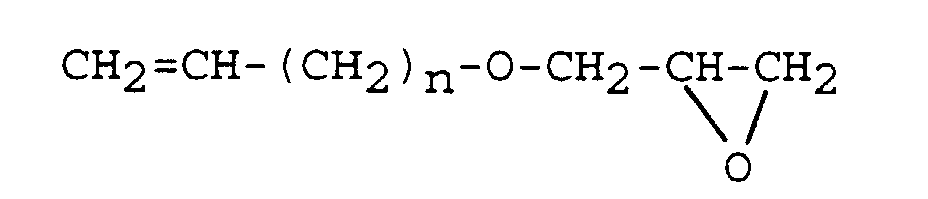
- Copolymer nach Anspruch 9, wobei die Epoxy-Verbindung Allylglycidylether ist.
Applications Claiming Priority (2)
| Application Number | Priority Date | Filing Date | Title |
|---|---|---|---|
| GB9322133 | 1993-10-27 | ||
| GB9322133A GB2283240A (en) | 1993-10-27 | 1993-10-27 | Water-based autoxidisable coating composition |
Publications (3)
| Publication Number | Publication Date |
|---|---|
| EP0655487A2 EP0655487A2 (de) | 1995-05-31 |
| EP0655487A3 EP0655487A3 (de) | 1996-12-11 |
| EP0655487B1 true EP0655487B1 (de) | 1998-12-16 |
Family
ID=10744183
Family Applications (1)
| Application Number | Title | Priority Date | Filing Date |
|---|---|---|---|
| EP94115926A Expired - Lifetime EP0655487B1 (de) | 1993-10-27 | 1994-10-10 | Selbstoxidierende Beschichtungszusammensetzung auf Wasserbasis |
Country Status (8)
| Country | Link |
|---|---|
| US (1) | US5422394A (de) |
| EP (1) | EP0655487B1 (de) |
| JP (1) | JPH07179810A (de) |
| AU (1) | AU688378B2 (de) |
| CA (1) | CA2134145C (de) |
| DE (1) | DE69415285T2 (de) |
| GB (1) | GB2283240A (de) |
| ZA (1) | ZA947890B (de) |
Families Citing this family (8)
| Publication number | Priority date | Publication date | Assignee | Title |
|---|---|---|---|---|
| US5859145A (en) | 1993-07-13 | 1999-01-12 | Chevron Chemical Company | Compositions having ethylenic backbone and benzylic, allylic, or ether-containing side-chains, oxygen scavenging compositions containing same, and process for making these compositions by esterification or transesterification of a polymer melt |
| BR9609232A (pt) * | 1995-06-07 | 1999-05-11 | Chevron Chem Co | Composição película camada em uma película ou artigo composições de múltiplas camadas e de parede espessa rígida e processo para produção de um polímero |
| US5739210A (en) * | 1995-11-03 | 1998-04-14 | Michigan State University | Polymers comprising reversible hydrophobic functionalities |
| IT1301974B1 (it) * | 1998-07-31 | 2000-07-20 | Atochem Elf Italia | Copolimeri acrilici idrosolubili |
| GB0102943D0 (en) * | 2001-02-07 | 2001-03-21 | Ici Plc | Thickened aqueous coating composition containing film-forming polymeric binder |
| US7384881B2 (en) * | 2002-08-16 | 2008-06-10 | H.B. Fuller Licensing & Financing, Inc. | Aqueous formaldehyde-free composition and fiberglass insulation including the same |
| US7470751B2 (en) * | 2004-09-21 | 2008-12-30 | Basf Corporation | Stabilized water-borne polymer compositions for use as water-based coatings |
| EP2508555B1 (de) | 2011-03-21 | 2015-05-13 | Electrolux Home Products Corporation N.V. | Verfahren zur Herstellung vorexpandierbarer Kunststoffkügelchen und anhand dieses Verfahrens herstellbare Kügelchen |
Family Cites Families (7)
| Publication number | Priority date | Publication date | Assignee | Title |
|---|---|---|---|---|
| US4033920A (en) * | 1974-06-14 | 1977-07-05 | Kansai Paint Company, Ltd. | Process for producing unsaturated resin emulsion |
| DE2926631A1 (de) * | 1979-07-02 | 1981-01-29 | Wacker Chemie Gmbh | Waessrige dispersion auf grundlage von (meth-)acrylsaeurederivaten, ihre herstellung und verwendung |
| DE2927932A1 (de) * | 1979-07-11 | 1981-02-05 | Hoechst Ag | Vinylpolymer mit acetylacetoxygruppen, verfahren zu seiner herstellung und daraus erhaltenes mittel |
| JPS59501165A (ja) * | 1982-06-29 | 1984-07-05 | デユラツクス オ−ストラリア リミテイド | 自動酸化可能な水性分散液 |
| US4988766A (en) * | 1987-05-13 | 1991-01-29 | Ppg Industries, Inc. | Polymers prepared by polymerizing alpha, beta-ethylenically unsaturated acids and epoxy compounds and crosslinked products therefrom |
| US5264482A (en) * | 1989-10-26 | 1993-11-23 | The Glidden Company | Water-based autoxidisable coating composition |
| GB2237276B (en) * | 1989-10-26 | 1993-12-15 | Ici Plc | Water-based autoxidisable air-drying coating composition and copolymers for use in it |
-
1993
- 1993-10-27 GB GB9322133A patent/GB2283240A/en not_active Withdrawn
- 1993-11-29 US US08/158,227 patent/US5422394A/en not_active Expired - Lifetime
-
1994
- 1994-10-07 ZA ZA947890A patent/ZA947890B/xx unknown
- 1994-10-10 EP EP94115926A patent/EP0655487B1/de not_active Expired - Lifetime
- 1994-10-10 DE DE69415285T patent/DE69415285T2/de not_active Expired - Fee Related
- 1994-10-24 CA CA002134145A patent/CA2134145C/en not_active Expired - Fee Related
- 1994-10-26 AU AU77465/94A patent/AU688378B2/en not_active Ceased
- 1994-10-26 JP JP6262567A patent/JPH07179810A/ja active Pending
Also Published As
| Publication number | Publication date |
|---|---|
| DE69415285T2 (de) | 1999-05-06 |
| JPH07179810A (ja) | 1995-07-18 |
| CA2134145C (en) | 1999-01-12 |
| DE69415285D1 (de) | 1999-01-28 |
| AU688378B2 (en) | 1998-03-12 |
| ZA947890B (en) | 1995-05-26 |
| EP0655487A3 (de) | 1996-12-11 |
| EP0655487A2 (de) | 1995-05-31 |
| CA2134145A1 (en) | 1995-04-28 |
| AU7746594A (en) | 1995-05-18 |
| GB9322133D0 (en) | 1993-12-15 |
| GB2283240A (en) | 1995-05-03 |
| US5422394A (en) | 1995-06-06 |
Similar Documents
| Publication | Publication Date | Title |
|---|---|---|
| US5089342A (en) | Wood or wood product coated with an aqueous, air-drying coating agent | |
| AU658425B2 (en) | Aqueous aerosol coating composition | |
| US5164449A (en) | Thixotropic binder system for thixotropic coating compositions | |
| JP2017507203A (ja) | 改善されたオープンタイムを有する水溶型コーティング組成物 | |
| GB2060661A (en) | Coating compositions of an alkyd-acrylic copolymer | |
| CA2952972A1 (en) | Sequentially polymerized hybrid latex | |
| CN105764934A (zh) | 低粘度、水性的、丙烯酸改性的醇酸分散体及其生产方法 | |
| EP0655487B1 (de) | Selbstoxidierende Beschichtungszusammensetzung auf Wasserbasis | |
| SK67096A3 (en) | Process for preparing water-dilutable, acrylate copolymer-based lacquer binders, and their use | |
| US5030684A (en) | Acrylate copolymers containing hydroxyl and fluorine groups as additives for aqueous anionic paint systems | |
| KR20090004973A (ko) | 개선된 광택을 갖는 도료용 수성 결합제 | |
| JPS63277284A (ja) | 水性着色アクリルヒドロゾルコーティング組成物 | |
| US5264482A (en) | Water-based autoxidisable coating composition | |
| KR0150626B1 (ko) | 수용성 아크릴계 수지로 된 상온형 도로표지용 도료조성물 | |
| EP0425085B1 (de) | Wässrige autooxydierbare Überzugszusammensetzung | |
| JPH01138216A (ja) | 水性グラフト共重合体エマルジョン、その製造法および水希釈可能な自然乾燥塗料のための結合剤としてのエマルジョンの使用 | |
| KR101281344B1 (ko) | 선박용 수용성 에폭시 에스테르 변성 비닐 수지 조성물의 제조방법 및 이를 이용한 도료 조성물 | |
| US3425977A (en) | Water-containing coating composition comprising a salt of an anhydride copolymer partial ester | |
| EP0316732B1 (de) | Wässriges Beschichtungsmittel, ein Verfahren zu seiner Herstellung und seine Verwendung | |
| US5019621A (en) | Acrylate copolymer additives for aqueous anionic paint systems | |
| JPH0146539B2 (de) |
Legal Events
| Date | Code | Title | Description |
|---|---|---|---|
| PUAI | Public reference made under article 153(3) epc to a published international application that has entered the european phase |
Free format text: ORIGINAL CODE: 0009012 |
|
| AK | Designated contracting states |
Kind code of ref document: A2 Designated state(s): BE DE ES FR GB IT LU NL SE |
|
| PUAL | Search report despatched |
Free format text: ORIGINAL CODE: 0009013 |
|
| AK | Designated contracting states |
Kind code of ref document: A3 Designated state(s): BE DE ES FR GB IT LU NL SE |
|
| 17P | Request for examination filed |
Effective date: 19961127 |
|
| 17Q | First examination report despatched |
Effective date: 19970310 |
|
| GRAG | Despatch of communication of intention to grant |
Free format text: ORIGINAL CODE: EPIDOS AGRA |
|
| GRAG | Despatch of communication of intention to grant |
Free format text: ORIGINAL CODE: EPIDOS AGRA |
|
| GRAH | Despatch of communication of intention to grant a patent |
Free format text: ORIGINAL CODE: EPIDOS IGRA |
|
| GRAH | Despatch of communication of intention to grant a patent |
Free format text: ORIGINAL CODE: EPIDOS IGRA |
|
| GRAA | (expected) grant |
Free format text: ORIGINAL CODE: 0009210 |
|
| AK | Designated contracting states |
Kind code of ref document: B1 Designated state(s): BE DE ES FR GB IT LU NL SE |
|
| PG25 | Lapsed in a contracting state [announced via postgrant information from national office to epo] |
Ref country code: NL Free format text: LAPSE BECAUSE OF FAILURE TO SUBMIT A TRANSLATION OF THE DESCRIPTION OR TO PAY THE FEE WITHIN THE PRESCRIBED TIME-LIMIT Effective date: 19981216 Ref country code: IT Free format text: LAPSE BECAUSE OF FAILURE TO SUBMIT A TRANSLATION OF THE DESCRIPTION OR TO PAY THE FEE WITHIN THE PRESCRIBED TIME-LIMIT;WARNING: LAPSES OF ITALIAN PATENTS WITH EFFECTIVE DATE BEFORE 2007 MAY HAVE OCCURRED AT ANY TIME BEFORE 2007. THE CORRECT EFFECTIVE DATE MAY BE DIFFERENT FROM THE ONE RECORDED. Effective date: 19981216 Ref country code: ES Free format text: THE PATENT HAS BEEN ANNULLED BY A DECISION OF A NATIONAL AUTHORITY Effective date: 19981216 Ref country code: BE Free format text: LAPSE BECAUSE OF FAILURE TO SUBMIT A TRANSLATION OF THE DESCRIPTION OR TO PAY THE FEE WITHIN THE PRESCRIBED TIME-LIMIT Effective date: 19981216 |
|
| REF | Corresponds to: |
Ref document number: 69415285 Country of ref document: DE Date of ref document: 19990128 |
|
| ET | Fr: translation filed | ||
| PG25 | Lapsed in a contracting state [announced via postgrant information from national office to epo] |
Ref country code: SE Free format text: LAPSE BECAUSE OF FAILURE TO SUBMIT A TRANSLATION OF THE DESCRIPTION OR TO PAY THE FEE WITHIN THE PRESCRIBED TIME-LIMIT Effective date: 19990316 |
|
| NLV1 | Nl: lapsed or annulled due to failure to fulfill the requirements of art. 29p and 29m of the patents act | ||
| PG25 | Lapsed in a contracting state [announced via postgrant information from national office to epo] |
Ref country code: LU Free format text: LAPSE BECAUSE OF NON-PAYMENT OF DUE FEES Effective date: 19991010 |
|
| PLBE | No opposition filed within time limit |
Free format text: ORIGINAL CODE: 0009261 |
|
| STAA | Information on the status of an ep patent application or granted ep patent |
Free format text: STATUS: NO OPPOSITION FILED WITHIN TIME LIMIT |
|
| 26N | No opposition filed | ||
| REG | Reference to a national code |
Ref country code: GB Ref legal event code: IF02 |
|
| PGFP | Annual fee paid to national office [announced via postgrant information from national office to epo] |
Ref country code: DE Payment date: 20030924 Year of fee payment: 10 |
|
| REG | Reference to a national code |
Ref country code: FR Ref legal event code: CA |
|
| PGFP | Annual fee paid to national office [announced via postgrant information from national office to epo] |
Ref country code: FR Payment date: 20040913 Year of fee payment: 11 |
|
| PGFP | Annual fee paid to national office [announced via postgrant information from national office to epo] |
Ref country code: GB Payment date: 20040916 Year of fee payment: 11 |
|
| PG25 | Lapsed in a contracting state [announced via postgrant information from national office to epo] |
Ref country code: DE Free format text: LAPSE BECAUSE OF NON-PAYMENT OF DUE FEES Effective date: 20050503 |
|
| PG25 | Lapsed in a contracting state [announced via postgrant information from national office to epo] |
Ref country code: GB Free format text: LAPSE BECAUSE OF NON-PAYMENT OF DUE FEES Effective date: 20051010 |
|
| GBPC | Gb: european patent ceased through non-payment of renewal fee |
Effective date: 20051010 |
|
| PG25 | Lapsed in a contracting state [announced via postgrant information from national office to epo] |
Ref country code: FR Free format text: LAPSE BECAUSE OF NON-PAYMENT OF DUE FEES Effective date: 20060630 |
|
| REG | Reference to a national code |
Ref country code: FR Ref legal event code: ST Effective date: 20060630 |