EP0655906B1 - Appareil et procede pour bronzer sans soleil - Google Patents
Appareil et procede pour bronzer sans soleil Download PDFInfo
- Publication number
- EP0655906B1 EP0655906B1 EP93908456A EP93908456A EP0655906B1 EP 0655906 B1 EP0655906 B1 EP 0655906B1 EP 93908456 A EP93908456 A EP 93908456A EP 93908456 A EP93908456 A EP 93908456A EP 0655906 B1 EP0655906 B1 EP 0655906B1
- Authority
- EP
- European Patent Office
- Prior art keywords
- amine
- dihydroxyacetone
- skin
- integer
- dha
- Prior art date
- Legal status (The legal status is an assumption and is not a legal conclusion. Google has not performed a legal analysis and makes no representation as to the accuracy of the status listed.)
- Expired - Lifetime
Links
Images




Classifications
-
- A—HUMAN NECESSITIES
- A61—MEDICAL OR VETERINARY SCIENCE; HYGIENE
- A61Q—SPECIFIC USE OF COSMETICS OR SIMILAR TOILETRY PREPARATIONS
- A61Q19/00—Preparations for care of the skin
- A61Q19/04—Preparations for care of the skin for chemically tanning the skin
-
- A—HUMAN NECESSITIES
- A61—MEDICAL OR VETERINARY SCIENCE; HYGIENE
- A61K—PREPARATIONS FOR MEDICAL, DENTAL OR TOILETRY PURPOSES
- A61K8/00—Cosmetics or similar toiletry preparations
- A61K8/18—Cosmetics or similar toiletry preparations characterised by the composition
- A61K8/30—Cosmetics or similar toiletry preparations characterised by the composition containing organic compounds
- A61K8/33—Cosmetics or similar toiletry preparations characterised by the composition containing organic compounds containing oxygen
- A61K8/35—Ketones, e.g. benzophenone
-
- A—HUMAN NECESSITIES
- A61—MEDICAL OR VETERINARY SCIENCE; HYGIENE
- A61K—PREPARATIONS FOR MEDICAL, DENTAL OR TOILETRY PURPOSES
- A61K8/00—Cosmetics or similar toiletry preparations
- A61K8/18—Cosmetics or similar toiletry preparations characterised by the composition
- A61K8/30—Cosmetics or similar toiletry preparations characterised by the composition containing organic compounds
- A61K8/40—Cosmetics or similar toiletry preparations characterised by the composition containing organic compounds containing nitrogen
- A61K8/41—Amines
-
- A—HUMAN NECESSITIES
- A61—MEDICAL OR VETERINARY SCIENCE; HYGIENE
- A61K—PREPARATIONS FOR MEDICAL, DENTAL OR TOILETRY PURPOSES
- A61K2800/00—Properties of cosmetic compositions or active ingredients thereof or formulation aids used therein and process related aspects
- A61K2800/80—Process related aspects concerning the preparation of the cosmetic composition or the storage or application thereof
- A61K2800/88—Two- or multipart kits
Definitions
- This invention relates to apparatus which is useful in the simulated tanning of skin. More particularly, the invention relates to apparatus which is used in the treatment of skin with dihydroxyacetone compositions, to form a brownish coloration thereon.
- FR-A- 1 252 400 discloses a composition and a method for imparting artificial tan to skin by applying dihydroxyacetone and amino acids.
- RIECHSTOFFE, AROMEN, K ⁇ RPERPFLEGEMITTEL, Vol. 28, No. 5, 1970, page 186: Sonnenschsch und B syndromenungsgel relates to a composition which contains dihydroxyacetone together with small amounts of monoisopropanolamine, and GB-A- 2 062 016 discloses the use of sulfur-containing amino acids and their sulfoxides together with dihydroxyacetone to colour keratin-containing substances.
- EP-A- 0 425 324 shows two separate receptacles containing fluids for imparting an artificial tan to skin.
- GB-A- 2 180 215 indicates a dispenser for forming in situ a composition consisting of two separately packaged constituents.
- the invention in one aspect, provides an apparatus for imparting artificial tan to skin, comprising: a receptacle containing a fluid formulation comprising dihydroxyacetone; a receptacle containing a fluid formulation comprising a primary amine; and dispensing means for simultaneously or sequentially providing desired amounts of dihydroxyacetone and amine.
- the invention also includes a method for imparting artificial tan to skin, comprising simultaneously or sequentially contacting the skin with dihydroxyacetone and a primary amine. Also included is a composition for immediate application to skin, comprising dihydroxyacetone, at least one primary amine and a suitable carrier.
- Fig. 1 is a cross-sectional view of a pouch container having two compartments.
- Fig. 2 is a cross-sectional view of a squeeze bottle having two compartments.
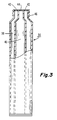
- Fig. 3 is a cross-sectional view of a dual-compartment tube container.
- Fig. 4 is a cross-sectional view of a container having two compartments and a dual pump dispenser.
- Fig. 5 is a cross-sectional view of a dual-compartment pressurized dispensing container.
- apparatus for imparting a simulated tan to skin, the apparatus having separate compartments for a formulation containing dihydroxyacetone and a formulation containing a primary amine.
- the apparatus can be configured to simultaneously dispense the formulations, in desired amounts, or to sequentially dispense them. If sequentially dispensed, the formulations can be mixed before spreading onto the skin, or can be spread in the order of dispensing.
- septum 12 which, in the least complex embodiment where the pouch comprises heat sealed layers of a thermoplastic substance, is merely a heat sealed seam to divide the volume of the pouch.
- This septum divides the volume into chambers 14 and 16.
- Tearing notch 18 can be provided to facilitate removal of the top of the pouch, when it is desired to dispense formulations contained therein.
- This embodiment will be used primarily for single-use quantities, the pouch holding an appropriate quantity for application once to the whole body or a portion thereof, such as only the face.
- septum 12 can be made frangible; applying pressure with the fingers to one side of the pouch will rupture the septum and permit mixing of the formulations by sequentially applying pressure to the two sides, after which a single composition containing both DHA and amine can be applied. Of course, such mixing should only be conducted immediately before use.
- another tearing notch (not shown) can be provided on the opposite side of the pouch from notch 18, and the septum can be extended to the uppermost limit of the pouch. This will permit only one compartment to be opened by pulling above a notch.
- Fig. 2 is a view of a squeeze bottle 20, which is provided with septum 22 to form two compartments 24 and 26.
- the bottle is conveniently formed by molding with thermoplastic substances, as is well known in the art.
- threads 34 will be provided for closure with a conventional screw cap (not shown). The threads will not be needed if the bottle is closed by alternative means, such as a pressed on flip cap.
- gripping indentations 28 are provided, to ensure that the bottle is squeezed in locations which will apply approximately uniform pressure to the two compartments, i.e., not to a less deformable area such as that directly over the septum.
- formulations are dispensed from the compartments through orifices 30 and 32.
- the bottle can be used for sequential applications of DHA and amine, by providing separate closures for the two orifices.
- individual snap caps can be provided over the orifices.
- the user would be required to dispense an appropriate amount of a component, rub that component into the skin and, immediately or after a prescribed time, apply the second component to the skin in a similar manner.
- Application of equal amounts of the components can be accomplished with sufficient accuracy by noting the lengths of dispensed fluids on the skin; the bottle can be provided with length scales marked thereon to make this more convenient.
- FIG. 3 there is shown a cross-sectional view of a collapsible tube assembly 36 which is useful in the invention.
- the outer tube 38 surrounds the inner tube 40, and contents of the outer and inner tubes can be discharged through outlets 42 and 44, respectively, by squeezing the assembly.
- a threaded area 46 is provided for attachment of a closure (not shown). Any desired number of outlets can be provided for the tubes and any desired type of closure can be used, the invention not being restricted to a threaded cap.
- the assembly can be fabricated from any materials normally utilized for tubes dispensing medications, cosmetic materials, hygiene products such as toothpastes, cleaning compositions and the like, subject to the usual requirement that the materials of construction do not react with formulations contained therein to an appreciable extent during at least the expected storage term. Frequently used materials include metals, polymers and composites, including laminates. Typically, the assembly will be closed at its bottom end by crimping or heat sealing, depending upon the materials of construction.
- means such as a key can be provided at the bottom of the assembly for uniformly collapsing the tubes; as the bottom of the assembly is wound around a rotated key, approximately the same pressure will be applied to the two tubes.
- dispensing container 48 comprises bottle 50, having dividing septum 52 which forms two compartments 54 having any desired geometry.
- Cap 56 is adapted to fit over the outlets of pumps 58, mounted to close the compartments and which can be any of the well-known spring loaded check valve pumps such as are used with hand lotions and other cosmetic products. Pressing down on the cap causes formulations to be simultaneously dispensed from conduits 62; releasing the cap permits it to rise under pressure from springs in the pumps, simultaneously reloading the pumps with stored formulations through dip tubes 60.
- This apparatus requires no particular care on the part of the user to obtain a correct ratio of the formulations, in cases where the formulations are to be simultaneously dispensed and applied, but permits complete separation of the components until dispensing.
- By providing separate caps over the pumps it would be possible to dispense the formulations at different times, should this be desired. In either embodiment, reproducible amounts will be dispensed simply by pressing the cap down for its full length of travel each time, without any need for a user to make measurements.
- Fig. 5 relates to a pressurized aerosol container which can be used to dispense two components simultaneously.
- Container 64 comprises external shell 66, with bottom closure 68 attached; preferably, both of these components will be fabricated from metals, with the bottom closure crimped or welded to the shell.
- Gas filling port 70 is provided to seal the container after a pressurizing gas is introduced.
- the container is divided by barrier 72, which is provided with one or more perforations 74 near the bottom of the container, to equalize gas pressure in the two sections formed by the barrier.
- barrier 72 which is provided with one or more perforations 74 near the bottom of the container, to equalize gas pressure in the two sections formed by the barrier.
- Each section has an accordion-pleated bag 76, preferably fabricated from a plastic material, to contain a formulation, the bags each being connected to an aerosol valve 78 which is actuated to release formulation by its depression into the container.
- Cap 80 is utilized to simultaneously depress the valves, and directs formulations through conduits 82 for application to a desired area.
- This apparatus has the advantages of dispensing desired relative amounts of the contained formulations without any special care on the part of the user, and being very simple to use.
- the aerosol container needs not be chemically compatible with the formulations, and the propellant will not normally be in contact with the formulations.
- costs can be reduced by changing the design to make use of sealed compartments having pistons driven by gas pressure to force formulations out through the valves, but piston sealing, compatibility of construction materials with the formulations and other considerations will complicate the product design. Many alternatives will be apparent to those skilled in aerosol container packaging.
- Another useful package for the present invention has two compartments, divided by a removable or frangible barrier.
- An example is the collapsible tube of U.S. Patent 2,176,923 to Nitardy, where two substances are separated in a tube by a transverse partition which is a collapsible disk having a central aperture; expressible plugs in the aperture are removed by applying pressure to the bottom of the tube, causing the substances to mix.
- U.S. Patent 3,290,017 to Davies et al. is related, having a disc which can be moved from a barrier position to a mixing position in a tube by external finger pressure.
- U.S. Patent 3,608,709 to Pike where a multiple-compartment laminated pouch is described.
- This pouch when external pressure is applied, will form a single compartment by breakage of the internal barrier, permitting two formulations contained therein to mix.
- Other packages having frangible internal barriers are shown in the following U.S. Patents: 3,756,389; 4,458,811; and 4,608,043; these can be adapted for use in the present invention.
- Each of these packages having a frangible or removable barrier will be suitable for single use unit packaging only, since it will be necessary to use the entire contents of the package promptly after the DHA and amine formulations are mixed, due to the previously discussed reaction.
- both formulations which are to be used together will be of the same type, e.g., if one is a gel, the other also will be a gel to facilitate application and mixing. However, it is not always necessary to observe this general principle.
- Amines which are useful in preparing the formulations of the invention have the general formula RNH 2 , where R is selected from the group consisting of:
- Cyclic groups having N, O or S in the ring include those based upon aziridine, azetidine, pyrrolidine, pyrrole, piperidine, diazole, imidazole, tetrazole, oxole, oxolane, thiole, thiazole and the like.
- amines having an oxole or oxolane group have been found useful in the invention.
- Volumes and active ingredient concentrations of dispensed formulations should be chosen to provide molar ratios of DHA to amine about 0.5 to about 10. More preferably, the ratios should be about 1 to about 5. Still more preferred are molar ratios about 1 to about 3. If the number of moles of DHA exceed the number of moles of amine, a portion of the DHA will remain free to react with amino groups in the skin, increasing the substantivity of the color formed; thus, a molar excess of DHA is preferred. Although the rate of color formation in the skin (with free amino groups present there) is considerably slower than that of DHA with provided primary amine on or near the skin surface, color formed in the skin is more resistant to removal by washing and abrasion. For this reason, it is preferable to establish both the early and frequently more intense color on the skin surface, and the more permanent but slower forming color in the skin layers.
- either the DHA formulation or the amine formulation should be able to establish pH values about 3 to about 13 locally when applied to the skin. More preferred are values about 7 to about 11, with values about 9 to about 10 being particularly preferred with some formulations.
- the optimal pH for a given amine application will be somewhat dependent upon the pK a of that amine, and can be determined by applying formulations having different pH values to the skin. For n-Dodecylamine, having a pK a of 10.63, a more reddish hue forms when the pH is much lower than 9 or 10, while a more yellowish hue forms at much higher pH values.
- Minolta Chroma Meter CR-200 which uses reflected light from a surface and gives results in terms of the CIE (International Commission on Illumination) tristimulus values. These values are subsequently transformed mathematically into the L* a* b* color space, wherein the magnitudes of changes in hue and intensity of color correspond closely with those percieved by the human eye.
- metric hue angle is the angle between the a* axis and the metric chroma line.
- Metric chroma indicates the strength of a color response (i.e., the extent to which a color differs from its matching shade of gray).
- Metric hue angle quantifies hue in degrees, with larger values indicating more yellow hues and smaller values indicating more red (or less yellow) hues.
- the meter is used to measure natural tans with a number of subjects, to establish a target for the appearance of tans produced by DHA reactions.
- points on a chromaticity plot for dark tans will have b* from about 19 to about 24, with a* ranging from about 10 to about 14.
- b* will be about 20 to about 24, with a* from about 9 to about 12.
- b* will be about 18 to about 20, with a* about 7 to about 10.
- the target color is represented by the area on the plot where natural tans lie.
- Metric lightness is the third required parameter for characterizing natural tans. L* values decrease as tans become darker, a difference of about one unit being discernable to a trained observer. For natural tans, L* ranges from about 47 to about 53 for dark tans, about 54 to about 57 for medium tans and about 58 to about 64 for light tans.
- the meter is also used to measure the characteristics of simulated tans obtained using only DHA applications.
- Several subjects are treated with an oil in water emulsion containing 5 percent DHA, with applications (2 mg DHA/cm 2 ) being made once each day for four days.
- values for b* are about 13 to about 21, the a* values are about 3 to about 8 and L* values are about 63 to about 74.
- b* is about 15 to about 23
- a* is about 5 to about 8
- L* is about 62 to about 72.
- b* is about 16 to about 23
- a* is about 5 to about 9 and L* is about 61 to about 71.
- b* is about 17 to about 24
- a* is about 5 to about 9
- L* is about 61 to about 70.
- the hues for all but a few of the readings are more yellowish than the tan target area, and all but a few of the readings indicate tans more light than natural tans, even though comparable levels of metric chroma are generated. It can generally be stated that simulated tans using only DHA are more yellow and lighter than natural tans having similar extents of color formation.
- a gel containing 5 percent n-Dodecylamine is prepared, using the following components:
- the gel is prepared by dissolving the amine in the alcohol, slowly adding the water, with stirring, to obtain a clear solution, adding the hydroxypropylcellulose with mixing, continuing mixing until the mixture is free of lumps, and adding the hydrochloric acid to obtain pH values of 9 to 9.5.
- hydroxypropylcellulose is sold as Klucel HFTM by Hercules Inc., Wilmington, Delaware U.S.A.
- a gel containing 10 percent n-Dodecylamine is prepared, using the procedure and components of the preceding example, and the following amounts:
- a gel containing 10 percent n-Dodecylamine is prepared with remaining ingredients as in the preceding example, but using 14 grams of water and 4.5 grams of hydrochloric acid. This gel has a pH about 10.
- a gel is prepared from the following components: Part Grams Component A 65.45 Water 1.44 Polyquarternium-10 B 19.16 Alcohol SD40-2 C 0.17 Water 0.02 Citric acid D 4.78 Water 7.10 Dihydroxyacetone 0.10 d,l-Panthenol 0.05 Aloe concentrate E 1.44 Polysorbate-80 0.29 Fragrance
- the gel containing 7.10 percent DHA, is prepared by adding the Polyquarternium-10 to the water of part A, with stirring until the mixture is thick (about one hour).
- the alcohol of part B is added slowly, with stirring, to the part A mixture to form a uniform gel.
- Citric acid is dissolved in the water of part C, then mixed into the gel.
- the part D ingredients are dissolved in the water of that part, then mixed into the gel. Finally, the fragrance and Polysorbate-80 are mixed, and combined with the gel.
- the polyquaternium-10 is available from Amerchol Corporation, Edison, New Jersey U.S.A. as Ucare Polymer JR-30MTM.
- the polysorbate-80 is sold by ICI Americas Inc., Wilmington, Delaware U.S.A. as Tween 80TM.
- a gel containing 10 percent DHA is prepared using the following components: Part Grams Component A 53.30 Water 1.50 Polyquaternium-10 B 20.00 Alcohol SD40-2 C 0.18 Water 0.02 Citric acid D 15.00 Water 10.00 Dihydroxyacetone
- the polymer of part A is slowly added, with constant stirring, to the water of that part; mixing is continued until the mixture Is thick.
- Alcohol of part B is slowly mixed into the thick mixture.
- Citric acid is dissolved in the water of part C and stirred into the mixture.
- the DHA is dissolved in the water of part D and combined with the mixture.
- the polyquaternium 10 can be obtained from Amerchol Corporation as Ucare Polymer JR-30MTM.
- a lotion is prepared using the following components: Part Grams Component A 61.32 Water B 10.00 Emulsifying wax C 10.00 n-Dodecylamine 10.00 Propylene glycol D 7.28 Water 1.40 Citric acid
- the water of part A is heated to 70° C., and the wax of part B is heated to 70° C.
- the heated components are combined, with rapid mixing, and cooled to 45° C. with mixing.
- the dodecylamine is heated to liquefaction and mixed into the propylene glycol, then the mixture is combined with the previous components.
- the combination is cooled to 35° C.
- the citric acid of part D is dissolved in the water of that part, and the solution is added to the preceding components, to adjust the pH of the composition to about 9.0 to 9.5.
- the emulsifying wax is sold as PolawaxTM by Croda Inc., New York, New York U.S.A.
- a lotion is prepared, using the following components: Part Grams Component A 62.00 Water B 15.00 Emulsifying wax 1.00 n-Hexadecyl alcohol 2.00 Polyoxyethylene(10)oleyl ether C 10.00 n-Dodecylamine D 1.75 Citric acid 5.00 Water E 3.25 Water
- the water of part A is heated to 70° C.
- the components of part B are combined, heated to 70° C., and the dodecylamine is added. All preceding components are combined, with vigorous mixing, and cooled to 45° C.
- the citric acid is dissolved in the water of part D and added to the preceding components, to obtain a pH about 9.
- the water of part E is then combined with the other components.
- the emulsifying wax is PolawaxTM, sold by Croda Inc.
- the polyoxyethylene(10)oleyl ether is sold by ICI Americas Inc., Wilmington, Delaware U.S.A. as Brij 97TM.
- a lotion is prepared, using the following components: Part Grams Component A 60.20 Water 1.18 Polyoxyethylene(10)cetyl ether B 6.50 Polyoxyethylene fatty alcohol ethers 0.82 Polyoxyethylene(2)cetyl ether 0.30 n-Hexadecyl alcohol 5.00 Isopropyl palmitate C 15.00 Water 10.00 Dihydroxyacetone D 1.00 Biocide
- the part A components are mixed and heated to about 75° C.
- the part B components are mixed and heated to about 75° C. to form a solution.
- Parts A and B components are combined with vigorous mixing, then cooled to about 50° C.
- the DHA is dissolved in the water of part C, and combined with preceding components. Finally, the biocide is mixed into the preparation.
- the polyoxyethylene(10)cetyl ether and polyoxyethylene(2)cetyl ether are sold by ICI Americas Inc., Wilmington, Delaware U.S.A. as Brij 56TM and Brij 52TM, respectively.
- the polyoxyethylene fatty alcohol ethers are sold by Amerchol Corp., Edison, New Jersey U.S.A. as Promulgen GTM.
- a lotion is prepared, as in the preceding example, except that 65.2 grams of water are used in part A and the isopropyl palmitate is omitted.
- An alcoholic solution is prepared by mixing 70 milliliters of SD-40 alcohol with 10 grams of n-Dodecylamine, adjusting the pH to 9.0 with concentrated hydrochloric acid, then adjusting the volume to 100 milliliters with additional alcohol.
- An alcoholic solution is prepared by dissolving 10 grams of Dihydroxyacetone in 50 milliliters of water, and diluting to 100 milliliters with SD-40 alcohol.
- the color formed by treating skin (5 cm x 5 cm) with 25 microliters of an amine formulation and 25 microliters of a DHA formulation is studied.
- the first applied formulation is well rubbed into the skin, then the second is promptly rubbed into the skin.
- skin which is originally measured to be outside the tanning target area acquires a color within the target area and with appropriate values of L*, when measured four hours after application of the formulations.
- Tests are conducted to determine the relative substantivity of color formed by the use of DHA and amine formulations of preceding examples. Substantivity is determined by measurement of color before and after a 10 x 8 centimeter, 500-gram block, fitted with a towel covering its lower surface, is pulled across the skin through five cycles, using a back-and-forth motion. This test is conducted both with the towel dry, and saturated with water.
- DHA and amine formulations are applied to skin immediately after readings are taken with the Minolta Chroma Meter, using 25 microliters of each formulation on a 25 cm 2 skin area. A period of seven hours is allowed for color development, then readings are again taken; the difference in total color is termed "Initial ⁇ E" for the tables which follow. After each of dry and wet rubbing, measurements are made and ⁇ E is again determined. Thus, ⁇ E always represents total color difference between treated and untreated skin.
- Results are as shown below, indicating that: (1) about two to three times more total color is formed after seven hours when both amine and DHA are applied, as compared to only DHA applications; and (2) the presence of amine improves resistance to both dry and wet rubbing. All results are averages for four subjects. Visually, differences in ⁇ E amounting to at least about 0.5 can be discerned by a trained observer. Amine No. DHA No.
- Substantivity to water rinsing indicates the water solubility of the color formed.
- a suitable test involves measuring skin color, applying formulations to the skin, allowing color to develop for about six hours, then repeating the color intensity measurement. A gentle stream of luke-warm tap water is allowed to flow over the treated skin for two minutes, then the skin is dried by gently patting with dry paper towels, taking care to not rub the skin. A final skin color measurement is then taken, thirty minutes later. Values of ⁇ E can be calculated, as in the preceding example.
- the amine "MAD” is n-Dodecylamine, formulated as in preceding Example 2.
- Glycine is used as an aqueous solution containing 4.1 percent of the amino acid, and adjusted to pH 9.0 with hydrochloric acid.
- the n-Butylamine is a 2.1 percent solution in 50 percent by volume ethanol, 50 percent by volume water, adjusted to pH 9.0.
- the n-Octylamine is a 3.5 percent solution in a similar 50 volume percent ethanol, adjusted to pH 9.1. Cetyl amine is 6.6 percent n-Hexadecylamine in ethanol, adjusted to pH 9.3.
- the DHA is formulated according to preceding Example 5, for the glycine and MAD tests (25 microliters of each formulation applied to 25 cm 2 of skin), and according to preceding Example 4 for the butyl, octyl and cetyl amine tests (10 microliters of each formulation applied to 6.25 cm 2 of skin).
- a test similar to that of the preceding example is conducted to compare the substantivity of an aliphatic amine and two ⁇ -amino acids.
- a 1.11 molar DHA formulation as in preceding Example 5 is used, together with one of the following formulations: 0.54 molar lysine in 50 percent by volume aqueous ethanol, adjusted to pH 9.0; 0.54 molar methionine sulfoxide (MSO) in water, adjusted to pH 9.0; or 0.54 molar n-Dodecylamine (MAD) in ethanol, adjusted to pH 9.0.
- MSO methionine sulfoxide
- MAD 0.54 molar n-Dodecylamine
- each of DHA and amine formulations are used on 25 cm 2 of skin, readings are taken after four hours of color development, water is allowed to flow over the test sites for two minutes, and readings are taken again after patting dry and air drying for thirty minutes.
- Results are as follows: Amine % Color Remaining Color Increase Lysine 25.3 0.5 MSO 36.2 1.1 MAD 87.0 4.0
- a test is conducted to demonstrate the more rapid color development obtained when skin is treated with both DHA and amine.
- Two 25 cm 2 areas are marked on the skin of two subjects. Both areas are treated with 25 microliters of the DHA formulation of preceding Example 5, and one of the areas is additionally treated with 25 microliters of the amine formulation of preceding Example 2.
- Values of ⁇ E are determined at hourly intervals for a period of seven hours.
- Each amine is incorporated into formulations, as with other amines in the preceding examples, and applied to skin with DHA to provide a simulated tan.
- Each amine has the general formula H 2 N-(CH 2 ) x -Z, where x and Z are as indicated.
Landscapes
- Health & Medical Sciences (AREA)
- Life Sciences & Earth Sciences (AREA)
- General Health & Medical Sciences (AREA)
- Veterinary Medicine (AREA)
- Public Health (AREA)
- Animal Behavior & Ethology (AREA)
- Birds (AREA)
- Epidemiology (AREA)
- Dermatology (AREA)
- Emergency Medicine (AREA)
- Cosmetics (AREA)
- Treatment And Processing Of Natural Fur Or Leather (AREA)
- Organic Low-Molecular-Weight Compounds And Preparation Thereof (AREA)
- Containers And Packaging Bodies Having A Special Means To Remove Contents (AREA)
- Medicinal Preparation (AREA)
Claims (21)
- Appareil pour impartir un bronzage artificiel à la peau, comprenant :(a) un réceptacle contenant une formulation fluide comprenant de la dihydroxyacétone;(b) un réceptacle contenant une formulation fluide contenant une amine primaire, à condition que l'amine ne soit pas un acide α-aminé; où l'amine a la formule RNH2, dans laquelle R est choisi dans le groupe consistant en :-(CH2)nCOOH;-(CH2)xCOOR';-(CH2)yCH3;-(CH2)xOH;-CH2(C6H5);-C(O)(C6H5);-(CH2)xCH(OR')2;-(CH2)xOR';-(OCH2CH2)zNH2;
les groupes cyliques contenant N, O ou S dans le cycle;-Si(OH)3; et-Si(OR')3;où n est un entier valant au moins 2, x est un entier valant jusqu'à 22, y est un entier valant de 5 à 22, z est un entier valant jusqu'à 10, et R' est un groupe alkyle ayant jusqu'à 10 atomes de carbone, et(c) des moyens de dispense pour fournir simultanément ou séquentiellement les quantités désirées de dihydroxyacétone et d'amine. - Appareil selon la revendication 1, où au moins l'une de la dihydroxyacétone et de l'amine est présente dans une solution.
- Appareil selon la revendication 1, où au moins une de la dihydroxyacétone et de l'amine est présente dans une émulsion.
- Appareil selon la revendication 1, où au moins l'une de la dihydroxyacétone et de l'amine est présente dans un gel.
- Appareil selon la revendication 1, où le moyen de dispense fournit des rapports molaires de dihydroxyacétone à amine de 0,5 à 10.
- Appareil selon la revendication 5, où des rapports molaires de dihydroxyacétone à amine de 1 à 5 sont fournis.
- Appareil selon la revendication 5, où des rapports molaires de dihydroxyacétone de 1 à 3 sont fournis.
- Appareil selon la revendication 1 dans lequel au moins une formulation établit des valeurs de pH de 3 à 13, lorsque les quantités désirées de formulation sont mélangées.
- Appareil selon la revendication 8, où des valeurs de pH de 7 à 11 sont établies.
- Appareil selon la revendication 8, dans lequel des valeurs de pH de 9 à 10 sont établies.
- Méthode pour impartir un bronzage artificiel à la peau humaine, comprenant la mise en contact de la peau avec de la dihydroxyacétone et une amine primaire ayant la formule RNH2, où R est choisi dans le groupe consistant en ;-(CH2)nCOOH;-(CH2)xCOOR';-(CH2)yCH3;-(CH2)xOH;-CH2(C6H5);-C(O)(C6H5);-(CH2)xCH(OR')2;-(CH2)xOR';-(OCH2CH2)zNH2;
les groupes cyliques contenant N, O ou S dans le cycle;-Si(OH)3; et-Si(OR')3;où n est un entier valant au moins 2, x est un entier valant jusqu'à 22, y est un entier valant de 5 à 22, z est un entier valant jusqu'à 10, et R' est un groupe alkyle ayant jusqu'à 10 atomes de carbone. - Méthode selon la revendication 1, où la dihydroxyacétone et l'amine sont appliquées à la peau séquentiellement.
- Méthode selon la revendication 11, où la dihydroxyacétone et l'amine sont appliquées à la peau substantiellement simultanément.
- Méthode selon la revendication 11, où une formulation contenant de la dihydroxyacétone et une amine est appliquée à la peau.
- Méthode selon la revendication 11, où des valeurs de pH entre 3 et 13 sont établies lorsque la peau est initialement mise en contact.
- Méthode selon la revendication 16, où des valeurs de pH entre 7 et 11 sont établies.
- Méthode selon la revendication 16, où des valeurs de pH entre 9 et 10 sont établies.
- Méthode selon la revendication 12 où le rapport molaire de la dihydroxyacétone à l'amine est de 0,5 à 10.
- Méthode selon la revendication 12, où le rapport molaire de la dihydroxyacétone à l'amine est de 1 à 5.
- Méthode selon la revendication 11, où le rapport molaire de la dihydroxyacétone à l'amine est de 1 à 3.
- Composition pour application immédiate à la peau, comprenant un mélange de :(a) une formulation contenant de la dihydroxyacétone; et(b) une formulation contenant une amine primaire ayant la formule RNH2, où R est choisi dans le groupe consistant en:-(CH2)nCOOH;-(CH2)xCOOR';-(CH2)yCH3;-(CH2)xOH;-CH2(C6H5);-C(O)(C6H5);-(CH2)xCH(OR')2;-(CH2)xOR';-(OCH2CH2)zNH2;
les groupes cyliques contenant N, O ou S dans le cycle;-Si(OH)3; et-Si(OR')3;où n est un entier valant au moins 2, x est un entier valant jusqu'à 22, y est un entier valant de 5 à 22, z est un entier valant jusqu'a 10, et R' est un groupe alkyle ayant jusqu'à 10 atomes de carbone.
Applications Claiming Priority (3)
| Application Number | Priority Date | Filing Date | Title |
|---|---|---|---|
| US93460192A | 1992-08-24 | 1992-08-24 | |
| US934601 | 1992-08-24 | ||
| PCT/US1993/002586 WO1994004130A1 (fr) | 1992-08-24 | 1993-03-25 | Appareil et procede pour bronzer sans soleil |
Publications (2)
| Publication Number | Publication Date |
|---|---|
| EP0655906A1 EP0655906A1 (fr) | 1995-06-07 |
| EP0655906B1 true EP0655906B1 (fr) | 1997-05-02 |
Family
ID=25465782
Family Applications (1)
| Application Number | Title | Priority Date | Filing Date |
|---|---|---|---|
| EP93908456A Expired - Lifetime EP0655906B1 (fr) | 1992-08-24 | 1993-03-25 | Appareil et procede pour bronzer sans soleil |
Country Status (10)
| Country | Link |
|---|---|
| US (1) | US5756075A (fr) |
| EP (1) | EP0655906B1 (fr) |
| JP (1) | JP2716263B2 (fr) |
| AT (1) | ATE152346T1 (fr) |
| AU (1) | AU683014B2 (fr) |
| CA (1) | CA2143110C (fr) |
| DE (1) | DE69310375T2 (fr) |
| GR (1) | GR3023935T3 (fr) |
| MX (1) | MX9301683A (fr) |
| WO (1) | WO1994004130A1 (fr) |
Families Citing this family (40)
| Publication number | Priority date | Publication date | Assignee | Title |
|---|---|---|---|---|
| CA2151802C (fr) * | 1992-12-16 | 1999-03-16 | Thomas A. Meyer | Appareil et methode de bronzage sans soleil |
| GB9414573D0 (en) * | 1994-07-19 | 1994-09-07 | Unilever Plc | Detergent composition |
| FR2725899B1 (fr) * | 1994-10-24 | 1996-12-13 | Oreal | Composition contenant un precurseur de la dihydroxyacetone |
| DE19505154A1 (de) * | 1995-02-16 | 1996-08-22 | Merck Patent Gmbh | Verwendung von Dihydroxyaceton |
| FR2746308B1 (fr) * | 1996-03-22 | 1998-04-30 | Oreal | Compositions de teinture des fibres keratiniques contenant des imidazolo-azoles ; leur utilisation en teinture comme coupleurs ; procede de teinture |
| FR2746306B1 (fr) * | 1996-03-22 | 1998-04-30 | Oreal | Compositions de teinture des fibres keratiniques contenant des pyrazolo-azoles ; leur utilisation pour la teinture comme coupleurs, procede de teinture |
| FR2746309B1 (fr) | 1996-03-22 | 1998-04-17 | Oreal | Composition de teinture des fibres keratiniques contenant des pyrazolopyrimidineoxo ; leur utilisation pour la teinture comme coupleurs, procedes de teinture |
| FR2746307B1 (fr) | 1996-03-22 | 1998-04-30 | Oreal | Compositions de teinture des fibres keratiniques contenant des pyrrolo-azoles ; utilisation comme coupleurs ; procede de teinture |
| FR2746391B1 (fr) | 1996-03-22 | 1998-04-17 | Oreal | Compositions cosmetiques a base de pyrazolin-4,5-diones, nouvelles pyrazolin-4,5 diones, procedes de preparation et utilisations |
| FR2746310B1 (fr) | 1996-03-22 | 1998-06-12 | Oreal | Compositions de teinture des fibres keratiniques contenant des pyrazolin-3,5-dione ; leur utilisation pour la teinture comme coupleurs, procede de teinture |
| FR2761601A1 (fr) | 1997-04-04 | 1998-10-09 | Oreal | Compositions cosmetiques autobronzantes |
| US6007797A (en) * | 1998-08-06 | 1999-12-28 | Ipa, Llc | Disappearing color sunscreen compositions |
| DE19847936A1 (de) * | 1998-10-09 | 2000-04-20 | Coty Bv | Parfümkomposition mit Bräunungseffekt oder Lichtschutz- und Bräunungseffekt |
| WO2002078655A2 (fr) * | 2001-03-30 | 2002-10-10 | L'oreal | Compositions revitalisantes de longue duree activees par la chaleur comprenant des saccharides et leurs procedes d'utilisation |
| US20040126339A1 (en) * | 2002-12-31 | 2004-07-01 | Roszell James A. | Sunscreen composition and methods for manufacturing and using a sunscreen composition |
| ATE338530T1 (de) | 2003-07-03 | 2006-09-15 | Procter & Gamble | Zweikomponenten hautpflegemittel enthaltend ein selbstbräunungsmittel |
| US7326405B2 (en) | 2004-07-01 | 2008-02-05 | The Procter & Gamble Company | Cosmetic compositions |
| US20060045857A1 (en) * | 2004-09-02 | 2006-03-02 | Roszell James A | Sunless tanning composition and methods for using |
| US20060246021A1 (en) * | 2005-05-02 | 2006-11-02 | Roszell James A | Sunless tanning composition and methods for using |
| US7378084B2 (en) * | 2005-07-01 | 2008-05-27 | Playtex Products, Inc. | Sunless tanning composition and method of sunless tanning |
| US8613910B2 (en) | 2005-07-27 | 2013-12-24 | Merck Patent Gmbh | Flavonoids as synergists for enhancing the action of self-tanning substances |
| WO2007012356A1 (fr) * | 2005-07-27 | 2007-02-01 | Merck Patent Gmbh | Flavonoides utilises comme synergistes pour renforcer l'effet de substances autobronzantes |
| WO2007019048A2 (fr) * | 2005-08-02 | 2007-02-15 | Mary Kay Inc. | Compositions a ph eleve |
| BRPI0614832A2 (pt) * | 2005-08-17 | 2011-04-19 | Mary Kay, Inc. | composições autobronzeadoras |
| US20080311058A1 (en) * | 2007-06-18 | 2008-12-18 | Connopco, Inc., D/B/A Unilever | Stable high internal phase emulsions and compositions comprising the same |
| US8425882B2 (en) * | 2008-04-01 | 2013-04-23 | Conopco, Inc. | In-shower and bath compositions |
| US20100086239A1 (en) * | 2008-10-08 | 2010-04-08 | The Dannon Company, Inc | Dual pack |
| US8096062B1 (en) * | 2008-10-08 | 2012-01-17 | Bellen Mark L | Towel drying system |
| US8299127B2 (en) * | 2009-03-11 | 2012-10-30 | Conopco, Inc. | Method and composition for evenly applying water soluble actives |
| JP5516200B2 (ja) * | 2009-08-05 | 2014-06-11 | 信越化学工業株式会社 | パターン形成方法、化学増幅ポジ型レジスト材料、及び、レジスト変性用組成物 |
| US8241614B2 (en) * | 2009-11-30 | 2012-08-14 | Conopco, Inc | Compositions and methods for imparting a sunless tan |
| CN103260596B (zh) * | 2009-12-18 | 2016-08-31 | 莱雅公司 | 包括能原位缩合的化合物和遮挡uv辐射的试剂的化妆处理方法 |
| USD645761S1 (en) | 2010-01-14 | 2011-09-27 | Jean-Yves Latour | Dual pack wrapper |
| US8821839B2 (en) | 2010-10-22 | 2014-09-02 | Conopco, Inc. | Compositions and methods for imparting a sunless tan with a vicinal diamine |
| US8398959B2 (en) | 2010-12-06 | 2013-03-19 | Conopco, Inc. | Compositions and methods for imparting a sunless tan with functionalized adjuvants |
| DE102011017519A1 (de) | 2011-04-26 | 2012-10-31 | Beiersdorf Ag | Kosmetische Zubereitung zur Färbung von Haaren |
| DE102011017522A1 (de) | 2011-04-26 | 2012-10-31 | Beiersdorf Ag | Kosmetische Zubereitungen zur Färbung von Haaren |
| FR2976482B1 (fr) * | 2011-06-16 | 2013-07-19 | Oreal | Utilisation d'un compose comprenant au moins une fonction nucleophile pour capturer les composes carbonyles issus de la reaction entre un ou plusieurs composes constituant le sebum et l'ozone |
| CN103826702B (zh) | 2011-09-26 | 2017-02-15 | 荷兰联合利华有限公司 | 头发组合物 |
| US8961942B2 (en) | 2011-12-13 | 2015-02-24 | Conopco, Inc. | Sunless tanning compositions with adjuvants comprising sulfur comprising moieties |
Family Cites Families (25)
| Publication number | Priority date | Publication date | Assignee | Title |
|---|---|---|---|---|
| US2176923A (en) * | 1938-10-20 | 1939-10-24 | Squibb & Sons Inc | Packaging |
| US2853423A (en) * | 1955-05-20 | 1958-09-23 | Olin Mathieson | Aerosol sun-screening composition |
| US3177120A (en) * | 1960-06-01 | 1965-04-06 | Plough | Stable cosmetic preparations containing dihydroxy acetone |
| NL249148A (fr) * | 1959-03-09 | |||
| FR1252400A (fr) * | 1960-03-22 | 1961-01-27 | Nestle Lemur Company | Procédé et produits pour la coloration de substances kératiniques |
| US3290017A (en) * | 1964-10-01 | 1966-12-06 | Henry K Davies | Barrier-mixer for tubular containers |
| US3403207A (en) * | 1966-11-14 | 1968-09-24 | Saul I. Kreps | Method of and composition for screening erythema inducing ultraviolet bands |
| US3608709A (en) * | 1969-09-08 | 1971-09-28 | Wayne Rogers V | Multiple compartment package |
| BE758098A (fr) * | 1969-10-28 | 1971-04-27 | Gillette Co | Emballage distributeur |
| US3756389A (en) * | 1971-08-24 | 1973-09-04 | F Firth | Multiple compartment package with frangible internal barrier means |
| US3809224A (en) * | 1972-02-14 | 1974-05-07 | D Greenwood | Compartmented pouch |
| US3983994A (en) * | 1975-01-29 | 1976-10-05 | Ihor Wyslotsky | Flexible package |
| FR2408387A2 (fr) * | 1975-06-30 | 1979-06-08 | Oreal | Compositions a base de dispersions aqueuses de spherules lipidiques |
| US4193989A (en) * | 1976-09-27 | 1980-03-18 | Anheuser-Busch, Incorporated | Sunscreen gel |
| DE2722725A1 (de) * | 1977-05-20 | 1978-11-30 | Merck Patent Gmbh | Kosmetische mittel |
| GB2062016B (en) * | 1979-10-03 | 1983-05-25 | Elf Aquitaine | Process and composition for the colouration of keratin-containing substances |
| US4434154A (en) * | 1981-01-26 | 1984-02-28 | Plough, Inc. | Tanning and ultra-violet screening composition having high stability |
| US4458811A (en) * | 1983-04-21 | 1984-07-10 | Abbott Laboratories | Compartmented flexible solution container |
| US4609544A (en) * | 1983-07-05 | 1986-09-02 | Repligen Corporation | Process for tanning the skin |
| US4496046A (en) * | 1983-09-15 | 1985-01-29 | Baxter Travenol Laboratories, Inc. | Multiple chamber container with inner diaphragm and intermediate chamber |
| US4608043A (en) * | 1984-06-22 | 1986-08-26 | Abbott Laboratories | I.V. fluid storage and mixing system |
| FR2586913B1 (fr) * | 1985-09-10 | 1990-08-03 | Oreal | Procede pour former in situ une composition constituee de deux parties conditionnees separement et ensemble distributeur pour la mise en oeuvre de ce procede |
| US4968497A (en) * | 1988-08-26 | 1990-11-06 | Clairol Incorporated | Skin tanning composition and method |
| FR2651126B1 (fr) * | 1989-08-29 | 1991-12-06 | Oreal | Association de dihydroxyacetone et de derives indoliques pour conferer a la peau une coloration similaire au bronzage naturel et procede de mise en óoeuvre. |
| FR2653334B1 (fr) * | 1989-10-19 | 1991-12-20 | Erphar Ste Civile | Preparation cosmetique de bronzage. |
-
1993
- 1993-03-25 AT AT93908456T patent/ATE152346T1/de active
- 1993-03-25 AU AU39273/93A patent/AU683014B2/en not_active Ceased
- 1993-03-25 US US08/712,944 patent/US5756075A/en not_active Expired - Lifetime
- 1993-03-25 CA CA002143110A patent/CA2143110C/fr not_active Expired - Lifetime
- 1993-03-25 MX MX9301683A patent/MX9301683A/es unknown
- 1993-03-25 JP JP6506224A patent/JP2716263B2/ja not_active Expired - Lifetime
- 1993-03-25 DE DE69310375T patent/DE69310375T2/de not_active Expired - Lifetime
- 1993-03-25 WO PCT/US1993/002586 patent/WO1994004130A1/fr not_active Ceased
- 1993-03-25 EP EP93908456A patent/EP0655906B1/fr not_active Expired - Lifetime
-
1997
- 1997-06-30 GR GR970401583T patent/GR3023935T3/el unknown
Also Published As
| Publication number | Publication date |
|---|---|
| AU3927393A (en) | 1994-03-15 |
| DE69310375T2 (de) | 1997-10-23 |
| MX9301683A (es) | 1994-02-28 |
| HK1000132A1 (en) | 1997-12-19 |
| CA2143110A1 (fr) | 1994-03-03 |
| ATE152346T1 (de) | 1997-05-15 |
| CA2143110C (fr) | 1999-12-14 |
| US5756075A (en) | 1998-05-26 |
| DE69310375D1 (de) | 1997-06-05 |
| AU683014B2 (en) | 1997-10-30 |
| GR3023935T3 (en) | 1997-09-30 |
| JP2716263B2 (ja) | 1998-02-18 |
| EP0655906A1 (fr) | 1995-06-07 |
| JPH07506593A (ja) | 1995-07-20 |
| WO1994004130A1 (fr) | 1994-03-03 |
Similar Documents
| Publication | Publication Date | Title |
|---|---|---|
| EP0655906B1 (fr) | Appareil et procede pour bronzer sans soleil | |
| EP0674504B1 (fr) | Procede et appareil pour bronzer sans soleil | |
| EP0692958B1 (fr) | Methode et appareil de bronzage sans soleil | |
| US5750092A (en) | Sunless tanning composition and method | |
| US8263045B2 (en) | Sunless tanning composition and method of sunless tanning | |
| EP0914083B1 (fr) | Composition et procede de bronzage sans soleil | |
| HK1000132B (en) | Apparatus and method for sunless tanning | |
| EP2969016B1 (fr) | Compositions de soins pour la peau pigmentées | |
| EP2969015B1 (fr) | Produits de soin pour peaux pigmentées | |
| EP0920855B1 (fr) | Compositions de teinture des cheveux contenant un 3-alkyl-4-aminophénol et un 1-naphtol substitué en position 2 | |
| HK30997A (en) | Method and apparatus for sunless tanning | |
| EP2969013B1 (fr) | Compositions de soins pour la peau pigmentées |
Legal Events
| Date | Code | Title | Description |
|---|---|---|---|
| PUAI | Public reference made under article 153(3) epc to a published international application that has entered the european phase |
Free format text: ORIGINAL CODE: 0009012 |
|
| 17P | Request for examination filed |
Effective date: 19950223 |
|
| AK | Designated contracting states |
Kind code of ref document: A1 Designated state(s): AT BE CH DE DK ES FR GB GR IE IT LI LU MC NL PT SE |
|
| 17Q | First examination report despatched |
Effective date: 19950825 |
|
| GRAG | Despatch of communication of intention to grant |
Free format text: ORIGINAL CODE: EPIDOS AGRA |
|
| GRAH | Despatch of communication of intention to grant a patent |
Free format text: ORIGINAL CODE: EPIDOS IGRA |
|
| GRAH | Despatch of communication of intention to grant a patent |
Free format text: ORIGINAL CODE: EPIDOS IGRA |
|
| GRAA | (expected) grant |
Free format text: ORIGINAL CODE: 0009210 |
|
| AK | Designated contracting states |
Kind code of ref document: B1 Designated state(s): AT BE CH DE DK ES FR GB GR IE IT LI LU MC NL PT SE |
|
| PG25 | Lapsed in a contracting state [announced via postgrant information from national office to epo] |
Ref country code: NL Free format text: LAPSE BECAUSE OF FAILURE TO SUBMIT A TRANSLATION OF THE DESCRIPTION OR TO PAY THE FEE WITHIN THE PRESCRIBED TIME-LIMIT Effective date: 19970502 Ref country code: LI Effective date: 19970502 Ref country code: ES Free format text: THE PATENT HAS BEEN ANNULLED BY A DECISION OF A NATIONAL AUTHORITY Effective date: 19970502 Ref country code: DK Effective date: 19970502 Ref country code: CH Effective date: 19970502 Ref country code: BE Effective date: 19970502 |
|
| REF | Corresponds to: |
Ref document number: 152346 Country of ref document: AT Date of ref document: 19970515 Kind code of ref document: T |
|
| REG | Reference to a national code |
Ref country code: CH Ref legal event code: EP |
|
| REF | Corresponds to: |
Ref document number: 69310375 Country of ref document: DE Date of ref document: 19970605 |
|
| REG | Reference to a national code |
Ref country code: IE Ref legal event code: FG4D Free format text: 73730 |
|
| ET | Fr: translation filed | ||
| PG25 | Lapsed in a contracting state [announced via postgrant information from national office to epo] |
Ref country code: SE Effective date: 19970802 |
|
| PG25 | Lapsed in a contracting state [announced via postgrant information from national office to epo] |
Ref country code: PT Effective date: 19970804 |
|
| REG | Reference to a national code |
Ref country code: GR Ref legal event code: FG4A Free format text: 3023935 |
|
| NLV1 | Nl: lapsed or annulled due to failure to fulfill the requirements of art. 29p and 29m of the patents act | ||
| REG | Reference to a national code |
Ref country code: CH Ref legal event code: PL |
|
| PLBE | No opposition filed within time limit |
Free format text: ORIGINAL CODE: 0009261 |
|
| STAA | Information on the status of an ep patent application or granted ep patent |
Free format text: STATUS: NO OPPOSITION FILED WITHIN TIME LIMIT |
|
| PG25 | Lapsed in a contracting state [announced via postgrant information from national office to epo] |
Ref country code: LU Free format text: LAPSE BECAUSE OF NON-PAYMENT OF DUE FEES Effective date: 19980325 Ref country code: IE Free format text: LAPSE BECAUSE OF NON-PAYMENT OF DUE FEES Effective date: 19980325 |
|
| 26N | No opposition filed | ||
| PG25 | Lapsed in a contracting state [announced via postgrant information from national office to epo] |
Ref country code: MC Free format text: LAPSE BECAUSE OF NON-PAYMENT OF DUE FEES Effective date: 19980930 |
|
| REG | Reference to a national code |
Ref country code: GB Ref legal event code: IF02 |
|
| PGFP | Annual fee paid to national office [announced via postgrant information from national office to epo] |
Ref country code: AT Payment date: 20110221 Year of fee payment: 19 Ref country code: FR Payment date: 20110304 Year of fee payment: 19 Ref country code: IT Payment date: 20110326 Year of fee payment: 19 |
|
| PGFP | Annual fee paid to national office [announced via postgrant information from national office to epo] |
Ref country code: GR Payment date: 20110224 Year of fee payment: 19 |
|
| PGFP | Annual fee paid to national office [announced via postgrant information from national office to epo] |
Ref country code: GB Payment date: 20110221 Year of fee payment: 19 Ref country code: DE Payment date: 20110331 Year of fee payment: 19 |
|
| GBPC | Gb: european patent ceased through non-payment of renewal fee |
Effective date: 20120325 |
|
| REG | Reference to a national code |
Ref country code: GR Ref legal event code: ML Ref document number: 970401583 Country of ref document: GR Effective date: 20121008 |
|
| REG | Reference to a national code |
Ref country code: AT Ref legal event code: MM01 Ref document number: 152346 Country of ref document: AT Kind code of ref document: T Effective date: 20120325 |
|
| REG | Reference to a national code |
Ref country code: FR Ref legal event code: ST Effective date: 20121130 |
|
| PG25 | Lapsed in a contracting state [announced via postgrant information from national office to epo] |
Ref country code: FR Free format text: LAPSE BECAUSE OF NON-PAYMENT OF DUE FEES Effective date: 20120402 Ref country code: GB Free format text: LAPSE BECAUSE OF NON-PAYMENT OF DUE FEES Effective date: 20120325 Ref country code: AT Free format text: LAPSE BECAUSE OF NON-PAYMENT OF DUE FEES Effective date: 20120325 |
|
| REG | Reference to a national code |
Ref country code: DE Ref legal event code: R119 Ref document number: 69310375 Country of ref document: DE Effective date: 20121002 |
|
| PG25 | Lapsed in a contracting state [announced via postgrant information from national office to epo] |
Ref country code: GR Free format text: LAPSE BECAUSE OF NON-PAYMENT OF DUE FEES Effective date: 20121008 Ref country code: IT Free format text: LAPSE BECAUSE OF NON-PAYMENT OF DUE FEES Effective date: 20120325 |
|
| PG25 | Lapsed in a contracting state [announced via postgrant information from national office to epo] |
Ref country code: DE Free format text: LAPSE BECAUSE OF NON-PAYMENT OF DUE FEES Effective date: 20121002 |