EP0657411B1 - Synthese de Bisindolylmaleimides - Google Patents
Synthese de Bisindolylmaleimides Download PDFInfo
- Publication number
- EP0657411B1 EP0657411B1 EP94308948A EP94308948A EP0657411B1 EP 0657411 B1 EP0657411 B1 EP 0657411B1 EP 94308948 A EP94308948 A EP 94308948A EP 94308948 A EP94308948 A EP 94308948A EP 0657411 B1 EP0657411 B1 EP 0657411B1
- Authority
- EP
- European Patent Office
- Prior art keywords
- compound
- reaction
- formula
- solution
- added
- Prior art date
- Legal status (The legal status is an assumption and is not a legal conclusion. Google has not performed a legal analysis and makes no representation as to the accuracy of the status listed.)
- Expired - Lifetime
Links
- 0 CC(C(C(*1*)=O)O*)C1=O Chemical compound CC(C(C(*1*)=O)O*)C1=O 0.000 description 4
Classifications
-
- C—CHEMISTRY; METALLURGY
- C07—ORGANIC CHEMISTRY
- C07D—HETEROCYCLIC COMPOUNDS
- C07D487/00—Heterocyclic compounds containing nitrogen atoms as the only ring hetero atoms in the condensed system, not provided for by groups C07D451/00 - C07D477/00
- C07D487/22—Heterocyclic compounds containing nitrogen atoms as the only ring hetero atoms in the condensed system, not provided for by groups C07D451/00 - C07D477/00 in which the condensed system contains four or more hetero rings
-
- C—CHEMISTRY; METALLURGY
- C07—ORGANIC CHEMISTRY
- C07C—ACYCLIC OR CARBOCYCLIC COMPOUNDS
- C07C43/00—Ethers; Compounds having groups, groups or groups
- C07C43/02—Ethers
- C07C43/03—Ethers having all ether-oxygen atoms bound to acyclic carbon atoms
- C07C43/14—Unsaturated ethers
- C07C43/17—Unsaturated ethers containing halogen
- C07C43/174—Unsaturated ethers containing halogen containing six-membered aromatic rings
- C07C43/1745—Unsaturated ethers containing halogen containing six-membered aromatic rings having more than one ether bound
-
- C—CHEMISTRY; METALLURGY
- C07—ORGANIC CHEMISTRY
- C07C—ACYCLIC OR CARBOCYCLIC COMPOUNDS
- C07C43/00—Ethers; Compounds having groups, groups or groups
- C07C43/02—Ethers
- C07C43/03—Ethers having all ether-oxygen atoms bound to acyclic carbon atoms
- C07C43/14—Unsaturated ethers
- C07C43/178—Unsaturated ethers containing hydroxy or O-metal groups
- C07C43/1785—Unsaturated ethers containing hydroxy or O-metal groups having more than one ether bound
-
- C—CHEMISTRY; METALLURGY
- C07—ORGANIC CHEMISTRY
- C07D—HETEROCYCLIC COMPOUNDS
- C07D498/00—Heterocyclic compounds containing in the condensed system at least one hetero ring having nitrogen and oxygen atoms as the only ring hetero atoms
- C07D498/22—Heterocyclic compounds containing in the condensed system at least one hetero ring having nitrogen and oxygen atoms as the only ring hetero atoms in which the condensed system contains four or more hetero rings
-
- C—CHEMISTRY; METALLURGY
- C07—ORGANIC CHEMISTRY
- C07D—HETEROCYCLIC COMPOUNDS
- C07D513/00—Heterocyclic compounds containing in the condensed system at least one hetero ring having nitrogen and sulfur atoms as the only ring hetero atoms, not provided for in groups C07D463/00, C07D477/00 or C07D499/00 - C07D507/00
- C07D513/22—Heterocyclic compounds containing in the condensed system at least one hetero ring having nitrogen and sulfur atoms as the only ring hetero atoms, not provided for in groups C07D463/00, C07D477/00 or C07D499/00 - C07D507/00 in which the condensed system contains four or more hetero rings
-
- C—CHEMISTRY; METALLURGY
- C07—ORGANIC CHEMISTRY
- C07F—ACYCLIC, CARBOCYCLIC OR HETEROCYCLIC COMPOUNDS CONTAINING ELEMENTS OTHER THAN CARBON, HYDROGEN, HALOGEN, OXYGEN, NITROGEN, SULFUR, SELENIUM OR TELLURIUM
- C07F7/00—Compounds containing elements of Groups 4 or 14 of the Periodic Table
- C07F7/02—Silicon compounds
- C07F7/08—Compounds having one or more C—Si linkages
- C07F7/18—Compounds having one or more C—Si linkages as well as one or more C—O—Si linkages
- C07F7/1804—Compounds having Si-O-C linkages
Definitions
- an antagonist which possesses both kinase selectivity for protein kinase C (PKC) and PKC isozyme selectivity is a potentially useful pharmacological agent. Hartenstein, J. H., et al., in “perspectives in Medicinal Chemistry," 99-118 (1993), VCH Publishers, New York. Such an antagonist of protein kinase C would be useful in treating disease states in which PKC has been implicated. Lester, D.S., et al., "Protein Kinase C: Current concepts and Future Perspectives", Ellis Horwood New York (1992). Specific isozymes of protein kinase C have been implicated in cancer (Ahmed, et al., Mol. Pharma.
- CNS diseases such as Alzheimer's; Demaerschalck, et al., Biochem. Biophys. Acta. 1181 , 214-218 (1993), cardiovascular disease; (Natarajan et al. Mol. cell. Endo. , 101 , 59-66 (1994)) and diabetic complications; King, et al., Proc. Nat. Acad. Sciences (USA) , 88 :22, 11059-63 (1992).
- triol ethers of similar structure to the compounds of Formula (II) are disclosed in Canadian Journal of Chemistry, 1957, 35 , p. 315-321 and Canadian Journal of Chemistry, 1964, 42 , p. 2025-2027.
- the present invention provides novel compounds of the Formula (II) and the stereoselective synthesis of these compounds. Under the preferred conditions, the compounds are produced in high yield and without utilizing expensive chromatographic separations. The synthesis is particularly advantageous because it further provides a stereoselective route of preparing the compounds of the Formula (I).
- the invention provides Compounds of the Formula: wherein:
- the invention further provides a stereoselective process of preparing these compounds, which comprises:
- Compound (II) is useful in the preparation of the compounds of the Formula (I), which are potent PKC inhibitors.
- the invention provides a novel synthesis for the preparation of a compound of the Formula (II):
- Particularly preferred compounds of the Formula II are when L 1 and L 1 are the same and are mesyl or iodo; n is 1; and R 2 is -O-trityl or -O-mono- or di- methoxytrityl.
- the most preferred compounds of the Formula I are those wherein R is hydrogen; R 1 is NR 5 R 6 ; n is 1; m is 1; and R 5 and R 6 are methyl.
- the compounds of Formula I are useful for treating conditions that protein kinase C has demonstrated a role in the pathology, such as ischemia, inflammation, central nervous system disorders, cardiovascular disease, dermatological disease, cancer and, in particular, diabetes mellitus.
- halo represents fluorine, chlorine, bromine, or iodine.
- C 1 -C 4 alkyl represents a cyclo, straight or branched chain alkyl group having from one to four carbon atoms such as methyl, ethyl, n-propyl, isopropyl, cyclopropyl, n-butyl, isobutyl, sec-butyl, t-butyl and the like.
- a haloalkyl is one such alkyl substituted with one or more halo atoms, preferably one to three halo atoms.
- An example of a haloalkyl is trifluoromethyl.
- a C 1 -C 4 alkoxy is a C 1 -C 4 alkyl group covalently bonded by an -O- linkage.
- aryl represents a substituted or unsubstituted phenyl or naphthyl.
- Aryl may be optionally substituted with one or two groups independently selected from hydroxy, carboxy, C 1 -C 4 alkoxy, C 1 -C 4 alkyl, haloalkyl, nitro, -NR 5 R 6 , -NHCO(C 1 -C 4 alkyl), -NHCO(benzyl), -NHCO(phenyl), SH, S(C 1 -C 4 alkyl), -OCO(C 1 -C 4 alkyl), -SO 2 (NR 5 R 6 ), -SO 2 (C 1 -C 4 alkyl), -SO 2 (phenyl), or halo.
- aryloxy is one such aryl covalently bonded by an -O- linkage.
- (CH 2 ) m aryl is preferably benzyl or phenyl.
- leaving group is any group or atom that enhances the electrophilicity of the atom to which it is attached for displacement.
- Preferred leaving groups are triflate, mesylate, tosylate, imidate, chloride, bromide, and iodide.
- hydroxy protecting group refers to one of the ether or ester derivatives of the hydroxy group commonly employed to block or protect the hydroxy group while reactions are carried out on other functional groups on the compound.
- the species of hydroxy protecting group employed is not critical so long as the derivatized hydroxy group is stable to the condition of subsequent reaction(s) and can be removed at the appropriate point without disrupting the remainder of the molecule.
- Preferred hydroxy protecting groups are tert-butyldiphenylsilyloxy (TBDPS), tert-butyldimethylsilyloxy (TBDMS), triphenylmethyl (trityl), mono-or di- methoxytrityl, or an alkyl or aryl ester.
- TDPS tert-butyldiphenylsilyloxy
- TDMS tert-butyldimethylsilyloxy
- triphenylmethyl trityl
- mono-or di- methoxytrityl or an alkyl or aryl ester.
- a related term is "protected hydroxy,” which refers to a hydroxy protecting group.
- amino protecting group refers to substituents of the amino group commonly employed to block or protect the amino functionality while reacting other functional groups on the compound.
- the species of amino-protecting group employed is not critical so long as the derivatized amino group is stable to the condition of subsequent reaction(s) and can be removed at the appropriate point without disrupting the remainder of the molecule.
- T. W. Greene and P. Wuts, Protective Groups in Organic Synthesis , Chapter 7, provide a list of commonly employed protecting groups. See also J. W. Barton, Protective Groups in Organic Chemistry , Chapter 2.
- Preferred amino-protecting groups are t-butoxycarbonyl, phthalimide, a cyclic alkyl, and benzyloxycarbonyl.
- protected amino defines an amino group substituted with an amino protecting group as previously defined.
- -NH protective groups refers to sub-class of amino protecting groups that are commonly employed to block or protect the -NH functionality while reacting other functional groups on the compound.
- the species of protecting group employed is not critical so long as the derivatized amino group is stable to the condition of subsequent reaction(s) and can be removed at the appropriate point without disrupting the remainder of the molecule.
- T. W. Greene and P. Wuts, Protective Groups in Organic Synthesis , Chapter 7, page 362-385 provide a list of commonly employed protecting groups.
- Preferred -NH protecting groups are carbamate, amide, alkyl or aryl sulfonamide.
- protected -NH defines a group substituted with an -NH protecting group as defined.
- R 7 is methyl or hydrogen.
- R and m are the same as previously defined.
- the reaction illustrated in Scheme 1 is often referred to as a Grignard reaction. The reaction is generally described by Brenner, et al., Tetrahedron , 44 , 2887-2892 (1988). Generally, the reaction of Scheme 1 is carried out in an inert solvent such as benzene, toluene, tetrahydrofuran or ether at a temperature between room temperature and reflux temperature of the reaction mixture.
- Compound (VII) is preferably prepared in situ from the indole and an alkyl magnesium halide such as ethyl magnesium bromide or ethyl magnesium iodide in a manner known in the art.
- reaction depicted in Scheme 1 is dependent on solvent conditions.
- Toluene:THF:ether solvent system the reaction of Scheme 1 provides Compound VIII in greater than 80 percent yield and greater than 95 percent purity.
- the product is precipitated from the reaction mixture with ammonium chloride, NH 4 Cl.
- the regioselective opening of epoxide, Compound (III), is carried out by alkylating a compound of Formula (III): with a lithium acetylide, a cerium acetylide, or organometalic reagent selected from vinyl cuprate, vinyl aluminum, vinyl tin, vinyl lithium, or vinyl Grignard.
- a vinyl organometalic reagent is a compound of the formula: vinyl MgBr, vinyl MgCl, vinyl Li, vinyl(thienyl)Cu(CN)Li 2 , Vinyl(thienyl)Cu(CN)LiMgBr, or a lithium acetlyene:EDTA complex.
- the reaction is carried out with vinyl MgBr or MgCl in the presence of a catalytic cuprate such as CuI or CuBr.
- a catalytic cuprate such as CuI or CuBr.
- the reaction is carried out in an inert solvent at a temperature between about -80°C to the reflux temperature of the reaction mixture; preferably the temperature is -20°C to 30°C.
- the reaction produces Compound (IV) which may be further reacted without purification.
- Compound IV is alkylated or allylated under conditions appreciated in the art for coupling an alcohol to a alkyl or allyl halide to form the ether
- Compound (V) The reaction is commonly known as the Williamson Synthesis. The reaction involves a nucleophilic substitution of an alkoxide ion with the halide ion (R 4 ). The alkoxide ion is preferably generated in the presence of a base such as NaOH, KOH, or NaH in an aprotic solvent such as DMSO, THF, DMF, ether, or toluene.
- a base such as NaOH, KOH, or NaH
- an aprotic solvent such as DMSO, THF, DMF, ether, or toluene.
- Compound (V) is converted to Compound (II) by techniques appreciated in the art.
- Compound (V) is converted to an ozonide by treating with ozone at low temperatures.
- the ozonide is then reduced with NaBH 4 , LiAlH 4 , BH 3 or catalytic hydrogenation with excess H 2 to produce a hydroxy moiety.
- the hydroxy may be readily converted to leaving group L 1 .
- the mesyl leaving group is prepared by reacting the hydroxy with methanesulfonyl chloride in triethylamine.
- the free hydroxy is converted to a iodide or bromide leaving group using, for example, CBr 4 in triphenylphosphine.
- the preparation of Compound (II) in a manner described is an advantageous means of preparing Compound (II) in high yield.
- the process is efficient and suitable for large scale.
- the synthesis is particularly advantageous when R 2 is a protected hydroxy, specifically O-trityl.
- R 2 is O-trityl
- Compound II may crystallized from the reaction mixture thus avoiding expensive chromatographic steps.
- R 2 is TBDPS or other protecting group, crystallization and purification are more difficult and expensive.
- the ability to produce a crystalline compound in high yield and purity without expensive chromatographic steps is clearly advantageous over other means of synthesizing Compound (II).
- the reaction represented by Scheme 3 is accomplished by any of the known methods of preparing N-substituted indoles. This reaction usually involves approximately equimolar amounts of the two reagents, although other ratios, especially those wherein the alkylating reagent is in excess, are operative. The reaction is best carried out in a polar aprotic solvent employing an alkali metal salt or other such alkylation conditions as are appreciated in the art. When the leaving group is bromo or chloro, a catalytic amount of iodide salt, such as potassium iodide may be added to speed the reaction. Reaction conditions include the following: Potassium hexamethyldisilazide in dimethylformamide or tetrahydrofuran, sodium hydride in dimethylformamide.
- the reaction is carried out under slow reverse addition with cesium carbonate in either acetonitrile, dimethylformamide (DMF), or tetrahydrofuran (THF).
- Slow reverse addition involves combining a mixture of Compound (VIII) and alkylating agent (II) with the base at a rate from about 0.1 mL/hour to about 2.0 ml/hour.
- the concentration of each reagent in the mixture is about 1.5 molar to about 0.001 molar.
- the slow addition results in a concentration of reagents in the reaction vessel of about 0.01 ⁇ molar to 1.5 molar.
- a lower concentration of reagents could be used in the reaction.
- the compound is added at about .14 mL/hour with the compound and the alkylating agent at 0.37 molar. It is preferred that the Cs 2 CO 3 be added in excess -- most preferably a 4:1 ratio Cs 2 CO 3 to alkylating agent.
- Preferred polar aprotic solvents are acetonitrile, dimethylformamide (DMF), acetone, dimethylsulfoxide (DMSO), dioxane, diethylene glycol methyl ether (diglyme), tetrahydrofuran (THF), or other polar aprotic solvents in which the reagents are soluble. The reaction is carried out at temperatures ranging from about 0°C to reflux.
- the ratio of the mixture of the compound and alkylating agent is not critical. However, it is preferred that the reagents are mixed in a ratio of 0.5 to 3 equivalents of each other. Most preferably, the reagents are mixed 1:1.
- the concentration of compound in the dissolving solvent is from saturation to about 0.01 M.
- Compound (XIII) is converted to the compound of the Formula I through the corresponding anhydride by an alkaline hydrolysis known in the art.
- Alkaline hydrolysis involves reacting the Compound (XIII) with a base, such as sodium hydroxide or potassium hydroxide, in C 1 -C 4 alcohol (preferably ethanol), DMSO/water, dioxane/water, or acetonitrile/water at a temperature ranging from about 25°C to preferably about reflux.
- a base such as sodium hydroxide or potassium hydroxide
- the anhydride is converted to the maleimide of Formula I by ammonolysis.
- Ammonolysis involves reacting the anhydride with an excess of hexamethyldisilazane or an ammonium salt (ammonium acetate, bromide, or chloride) and C 1 -C 4 alcohol (preferably methanol) in an polar aprotic solvent such as DMF at room temperature.
- hexamethyldisilazane or an ammonium salt is reacted at a ratio greater than about 5:1 equivalents of anhydride.
- R 2 The conversion of R 2 to the desired R 1 moiety is carried out by techniques known in the art for deprotecting an amine or hydroxy.
- R 2 when R 2 is -O-trityl, the compound is de-tritylated with HCl gas in methylene chloride.
- the resulting hydroxy or amine may then be converted to the various substitutions of R 1 under standard conditions.
- R 2 when R 2 is hydroxy, R 2 is converted to the mesylate with MS 2 O and pyridine in THF and subsequently converted to the dimethylamine or other amine substition.
- the present process is useful in preparing compounds of the Formula I.
- the compounds of the Formula I are PKC inhibitors and useful in treating diseases implicated by PKC.
- the compounds of Formula I inhibit PKC with an IC 50 of below 100 ⁇ m.
- the compounds selectively inhibit the beta-1 and beta-2 PKC isozymes and have an IC 50 value with respect to these isozymes of below 10 ⁇ m.
- the amount of compound administered is an amount that is capable of inhibiting PKC activity in mammals.
- the particular dose of the compound administered according to this invention will, of course, be determined by the particular circumstances surrounding the case, including the compound administered, the route of administration, the particular condition being treated, and similar considerations.
- the compounds of Formula I can be administered by a variety of routes including the oral, rectal, transdermal, subcutaneous, topical, intravenous, intramuscular or intranasal routes.
- a typical daily dose will contain from about 0.01 mg/kg to about 20 mg/kg of the active compound of this invention.
- Preferred daily doses will be about 0.05 to about 10 mg/kg, ideally about 0.1 to about 5 mg/kg.
- a typical dosage is about 1 to about 500 ⁇ g compound per cm 2 of an affected tissue.
- the applied amount of compound will range from about 30 to about 300 ⁇ g/cm 2 , more preferably, from about 50 to about 200 ⁇ g/cm 2 , and, most preferably, from about 60 to about 100 ⁇ g/cm 2 .
- Trityl chloride (2866 g, 10.3 mole) was dissolved in 7 L of CH 2 Cl 2 under N 2 .
- Triethylamine (1189 g, 1638 mL, 11.8 mole) was added, and then (R)-(-)-glycidol (795.0 g, 10.6 mole) was added using 1 L of CH 2 Cl 2 as a rinse.
- the reaction solution was heated to a gentle reflux (42° C) for 3-4 hours.
- the reaction was cooled to room temperature and then 3 L of brine was added.
- the organic layer was dried (600 g Na 2 SO 4 ) and evaporated in vacuo to give the titled compound as an oil that was recrystallized from ethanol to give 2354 g (70%) of the titled compound as a solid.
- reaction mixture was cooled to 20-30° C.
- Saturated ammonium chloride solution (1.76 L) was added, dropwise initially, until the exotherm to 35-40° C subsided, at which point the dark heterogeneous mixture converted to a red slurry.
- the slurry was stirred at 25-30° C for 2-4 hours.
- the product was isolated by filtration, rinsed with water and toluene, then dried in a vacuum oven at 50° C. 168 grams (80%) of product was obtained.
- a red slurry developed upon acidification.
- the reaction mixture was diluted with 500 mL of CH 2 Cl 2 and was stirred for 20 minutes and filtered to remove most of the salts.
- the salts were washed with additional CH 2 Cl 2 (1.5 L), and the filtrate was extracted twice with 1 L of water.
- the combined aqueous layers were back-extracted with 1 L of CH 2 Cl 2 , and the organic layer was dried (MgSO 4 ).
- the resultant solution was heated at 45° C for 7 hours.
- the reaction can be monitored by HPLC.
- Most of the DMF was removed in vacuo , and the resultant residue was extracted into 200 mL of ethyl acetate and washed with 200 mL of water and twice with 100 mL of an aqueous 5% LiCl solution.
- the aqueous layers were back-extracted with 100 mL of ethyl acetate.
- the combined organic layer was washed with 200 mL of a saturated aqueous solution of ammonium chloride.
- the reaction mixture was filtered, and the cesium salts were washed with acetone.
- the solvent was removed in vacuo .
- the resultant residue (941 g) was diluted with 300 mL of ethyl acetate and was extracted with 150 mL of water with 25 mL of brine to improve layer separation.
- This reaction can be monitored by HPLC.
- the reaction was then cooled and diluted with 600 mL of ethyl acetate and extracted twice with 300 mL of 1N HCl and once with 600 mL of water.
- the aqueous layers were back-extracted with 300 mL of ethyl acetate and the organic layer dried (MgSO 4 ).
- the resultant reaction mixture was allowed to warm to 0° C under N 2 and was then slowly added over 40 minutes to a solution of sodium borohydride (754 g, 19.9 mole, 6 eq.) in 2.5 L ethanol / 2.5 L water while keeping the reaction temperature below 30° C. The reaction was then allowed to stir at room temperature overnight. The reaction can be monitored by HPLC. The reaction mixture was cooled to 10°-15° C and was slowly added to 4 L of an aqueous saturated solution of ammonium chloride at ⁇ 20° C. The quenched reaction mixture was then filtered and the solids washed with 3 L of CH 2 Cl 2 .
- Trityl chloride (175.2 g, 0.616 mole) was dissolved in 500 mL of CH 2 Cl 2 under N 2 .
- Triethylamine (71.9 g, 100 mL, 0.710 mole) was added and then R,S-glycidol (50.0 g, 0.648 mole) was added, and the reaction solution was heated to a gentle reflux (42° C) for 4 hours.
- the reaction was cooled to room temperature and was extracted twice with 250 mL of an aqueous saturated solution of ammonium chloride and then 250 mL of brine.
- the reaction was quenched by cooling the reaction mixture to -30° C and 125 mL of an aqueous saturated solution of ammonium chloride was slowly added.
- the resultant mixture was extracted with 200 mL of ethyl acetate.
- the organic layer wan then extracted with an aqueous solution of 0.93 g (2.50 mmol, 0.1 eq.) of ethylenediaminetetraacetic acid, disodium salt dihydrate (EDTA) in 125 mL of deionized water to remove any metals.
- EDTA ethylenediaminetetraacetic acid, disodium salt dihydrate
- a 60% suspension of sodium hydride in mineral oil (6.13 g, 0.153 mol, 1.5 eq.) was suspended in 175 mL of dry THF was added at room temperature. The resultant mixture was stirred at room temperature for 1.5 hours and then 17.7 mL (0.204 mmol, 2.0 eq.) of freshly distilled allyl bromide was added via syringe. The reaction was heated to 45° C for 1 hour. The reaction can be monitored by TLC or HPLC. The reaction mixture was cooled to 0° C and 400 mL of an aqueous saturated solution of ammonium chloride was slowly added to quench the excess base.
- the resultant mixture was extracted with 800 mL of ethyl acetate and the organic layer was washed with 500 mL of water.
- the aqueous layers were back-extracted with 100 mL of ethyl acetate and the combined organic layers were washed with 200 mL of brine, dried (MgSO 4 ) and evaporated in vacuo to give 41.5 g (> 100%) of 1,1',1''-[[[2-(2-propenyloxy)-4-pentenyl]oxy]methylidyne]tris[benzene] as a yellow oil.
- 1,1',1''-[[[2-(2-propenyloxy)-4-pentenyl]oxy]methylidyne]tris[benzene] (39.3 g, 0.102 mol) was dissolved in a solution of 390 mL of anhydrous methyl alcohol and 60 mL of CH 2 Cl 2 and was cooled to -50° to -40° C while bubbling N 2 through the viscous reaction solution. Ozone was then bubbled through the reaction mixture at -50° to -40° C for 80 minutes until the reaction turned pail blue in color.
- the resultant reaction mixture was allowed to warn to 0° C under N2 and then a solution of sodium borohydride (23.15 g, 0.612 mole, 6 eq.) in 85 mL ethanol / 85 mL water was slowly added to quench the reaction while keeping the reaction temperature below 10° C.
- the reaction was stirred in an ice bath for 30 minutes and then was allowed to warm to room temperature and stir overnight. The temperature rose to 31° C upon warming.
- the reaction mixture was diluted with 400 mL of an aqueous saturated solution of ammonium chloride and was extracted with 800 mL of ethyl acetate.
- the resultant reaction mixture was diluted with additional CH 2 Cl 2 (300 mL) and was washed with 200 mL of water and 200 mL of an aqueous saturated solution of ammonium chloride.
- the aqueous layers were back-extracted with 50 mL of CH 2 Cl 2 and the combined organic layer was washed with 100 mL of brine and was dried (MgSO 4 ) and evaporated in vacuo to give 18.4 g (94%) of 3-(2-[(methylsulfonyl)oxy]ethoxy]-4-triphenylmethoxy)-1-butanol methane sulfonate as a white solid.
- the acetone was removed from the reaction mixture in vacuo and the resultant solid was extracted into a 300 mL of ethyl acetate/ 200 mL water mixture.
- the organic layer was washed with 200 mL more water and the combined aqueous layer was back-extracted with 100 mL of additional ethyl acetate.
- Dialkylated by-product was removed by elution with 5 hexane/1 ethyl acetate followed by elution of the product with 3 hexane/1 ethyl acetate to provide 8.2 g (57%) of the monoalkylated product, 3-[(N-1-(2-ethoxy-(3'''-(O)-4'''-(tert-butyldiphenylsilyloxy)-1'''-(tert-butyldimethylsilyloxy)-butane))-indol-3-yl]-4-[indol-3-yl]-1N(methyl)-pyrrole-2,5-dione.
- reaction was concentrated in vacuo, and the residue was dissolved in ether and washed with 10% sodium sulfite solution. The layers were separated, and the ether portion washed with 10% sodium sulfite solution, water, brine(2X), dried, and concentrated in vacuo .
Landscapes
- Chemical & Material Sciences (AREA)
- Organic Chemistry (AREA)
- Plural Heterocyclic Compounds (AREA)
- Pharmaceuticals Containing Other Organic And Inorganic Compounds (AREA)
- Indole Compounds (AREA)
- Nitrogen Condensed Heterocyclic Rings (AREA)
- Addition Polymer Or Copolymer, Post-Treatments, Or Chemical Modifications (AREA)
- Organic Low-Molecular-Weight Compounds And Preparation Thereof (AREA)
- Nitrogen And Oxygen Or Sulfur-Condensed Heterocyclic Ring Systems (AREA)
- Preparation Of Compounds By Using Micro-Organisms (AREA)
Claims (7)
- Composé répondant à la formule:dans laquelle:
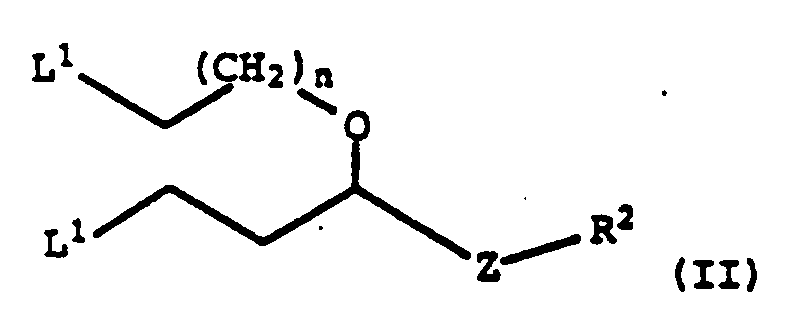 R2 représente un groupe N3, un groupe NH protégé, un groupe amino protégé ou un groupe hydroxyle protégé;L1 représente, de manière indépendante, un groupe qui s'éloigne;Z représente un groupe -(CH2)n-; etn représente, de manière indépendante, 1, 2 ou 3, R2 et L1 étant différents.
 - Composé selon la revendication 1, dans lequel R2 représente un groupe -O-triphénylméthyle ou un groupe -O-méthoxytriphénylméthyle.
- Composé selon la revendication 1, à savoir
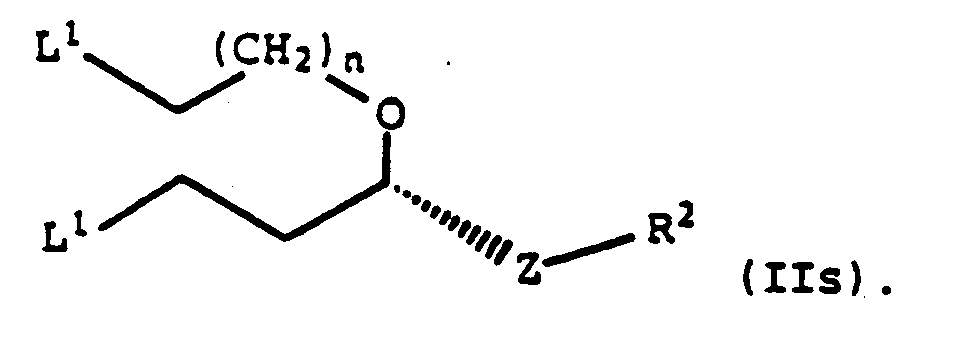
- Composé selon la revendication 3, dans lequel R2 représente un groupe -O-triphénylméthyle ou un groupe -O-méthoxytriphénylméthyle.
- Composé selon la revendication 1, à savoir
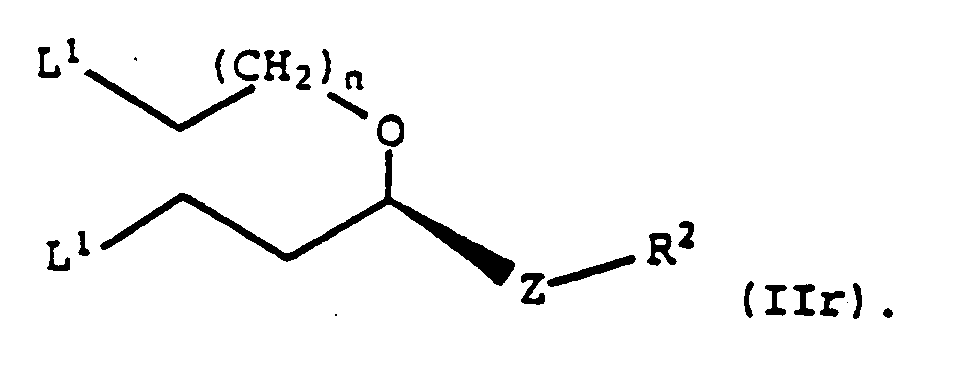
- Composé selon la revendication 5, dans lequel R2 représente un groupe -O-triphénylméthyle ou un groupe -O-méthoxytriphénylméthyle.
- Procédé pour préparer un composé selon l'une quelconque des revendications 1 à 6, qui comprend le fait de:(a) alkyler un composé de formule (III):avec un acétylure de lithium, un acétylure de cérium ou un réactif organométallique choisi parmi le cuprate de vinyle, le vinylaluminium, le vinylétain, le vinyllithium ou un réactif de Grignard contenant un groupe vinyle; pour obtenir un composé répondant à la formule (IV):

 (b) faire réagir un composé de formule (IV) avec un composé répondant à la formule:dans laquelle R3 représente un atome d'halogène, un groupe hydroxyle protégé ou se combine avec l'atome de carbone adjacent pour former une oléfine; R4 représente un groupe chloro, un groupe bromo ou un groupe iodo pour former un composé répondant à la formule
 (c) transformer le composé de formule (V) pour obtenir un composé selon l'une quelconque des revendications 1 à 6.
Priority Applications (1)
| Application Number | Priority Date | Filing Date | Title |
|---|---|---|---|
| SI9430278T SI0657411T1 (en) | 1993-12-07 | 1994-12-02 | Synthesis of bisindolylmaleimides |
Applications Claiming Priority (4)
| Application Number | Priority Date | Filing Date | Title |
|---|---|---|---|
| US16306093A | 1993-12-07 | 1993-12-07 | |
| US163060 | 1993-12-07 | ||
| US08/317,140 US5541347A (en) | 1993-12-07 | 1994-10-03 | Synthesis of bisindolylmaleimides |
| US317140 | 1994-10-03 |
Publications (2)
| Publication Number | Publication Date |
|---|---|
| EP0657411A1 EP0657411A1 (fr) | 1995-06-14 |
| EP0657411B1 true EP0657411B1 (fr) | 1999-06-09 |
Family
ID=26859319
Family Applications (1)
| Application Number | Title | Priority Date | Filing Date |
|---|---|---|---|
| EP94308948A Expired - Lifetime EP0657411B1 (fr) | 1993-12-07 | 1994-12-02 | Synthese de Bisindolylmaleimides |
Country Status (13)
| Country | Link |
|---|---|
| US (2) | US5614647A (fr) |
| EP (1) | EP0657411B1 (fr) |
| JP (1) | JPH07238044A (fr) |
| AT (1) | ATE181049T1 (fr) |
| BR (1) | BR9404830A (fr) |
| CA (1) | CA2137205A1 (fr) |
| DE (1) | DE69418978T2 (fr) |
| DK (1) | DK0657411T3 (fr) |
| ES (1) | ES2134910T3 (fr) |
| FI (1) | FI945705L (fr) |
| GR (1) | GR3030722T3 (fr) |
| HU (1) | HUT69164A (fr) |
| IL (1) | IL111851A (fr) |
Cited By (1)
| Publication number | Priority date | Publication date | Assignee | Title |
|---|---|---|---|---|
| EP2181999A1 (fr) | 2008-11-03 | 2010-05-05 | Zentiva, A.S. | Procédé de fabrication d'un ruboxistaurine |
Families Citing this family (15)
| Publication number | Priority date | Publication date | Assignee | Title |
|---|---|---|---|---|
| US5624949A (en) * | 1993-12-07 | 1997-04-29 | Eli Lilly And Company | Protein kinase C inhibitors |
| KR20000064764A (ko) * | 1996-03-20 | 2000-11-06 | 피터지.스트링거 | 인돌릴말레이미드의제조방법 |
| BR9710706A (pt) | 1996-05-01 | 1999-08-17 | Lilly Co Eli | Tratamento terap-utico para doen-as relacionadas a vegf |
| UA54427C2 (uk) * | 1996-05-01 | 2003-03-17 | Елі Ліллі Енд Компані | Спосіб лікування очних захворювань, які пов'язані з фактором васкулярного ендотеліального росту |
| US6232299B1 (en) | 1996-05-01 | 2001-05-15 | Eli Lilly And Company | Use of protein kinase C inhibitors to enhance the clinical efficacy of oncolytic agents and radiation therapy |
| US6107327A (en) * | 1996-08-30 | 2000-08-22 | Eli Lilly And Company | Therapeutic treatment for HIV infection |
| US5962446A (en) * | 1996-08-30 | 1999-10-05 | Eli Lilly And Company | Therapetutic treatment for human T cell lymphotrophic virus type 1 infection |
| US5859261A (en) * | 1997-03-20 | 1999-01-12 | Eli Lilly And Company | Synthesis of indolylmaleimides |
| US6093740A (en) * | 1997-04-30 | 2000-07-25 | Eli Lilly And Company | Therapeutic treatment for skin disorders |
| ATE423089T1 (de) | 1998-01-30 | 2009-03-15 | Daiso Co Ltd | Verfahren zur herstellung von butantriol- derivaten |
| US6291446B1 (en) | 1998-03-05 | 2001-09-18 | Eli Lilly And Company | Therapeutic treatment for cytomegalovirus infection |
| US6225301B1 (en) | 1998-03-05 | 2001-05-01 | Eli Lilly And Company | Therapeutic treatment for renal dysfunction |
| US6103712A (en) * | 1998-03-05 | 2000-08-15 | Eli Lilly And Company | Therapeutic treatment for asthma |
| US6103713A (en) * | 1998-03-05 | 2000-08-15 | Eli Lilly And Company | Therapeutic treatment for autoimmune diseases |
| US11319320B2 (en) | 2017-11-06 | 2022-05-03 | Snap Bio, Inc. | PIM kinase inhibitor compositions, methods, and uses thereof |
Family Cites Families (15)
| Publication number | Priority date | Publication date | Assignee | Title |
|---|---|---|---|---|
| US4785085A (en) * | 1986-11-21 | 1988-11-15 | Bristol-Myers Company | Rebeccamycin analogs |
| US4923986A (en) * | 1987-03-09 | 1990-05-08 | Kyowa Hakko Kogyo Co., Ltd. | Derivatives of physiologically active substance K-252 |
| US5438050A (en) * | 1988-02-06 | 1995-08-01 | Godecke Aktiengesellschaft | Indolocarbazole derivatives, processes for their preparation and compositions containing them |
| DE3803620A1 (de) * | 1988-02-06 | 1989-08-17 | Goedecke Ag | Indolocarbazol-derivate, verfahren zu deren herstellung und diese enthaltende arzneimittel |
| SK75289A3 (en) * | 1988-02-10 | 1998-05-06 | Hoffmann La Roche | Substituted pyrroles, their use for producing a drug, and the drug on their base |
| MC2096A1 (fr) * | 1989-02-23 | 1991-02-15 | Hoffmann La Roche | Pyrroles substitues |
| IL94274A0 (en) * | 1989-05-05 | 1991-03-10 | Goedecke Ag | Maleinimide derivatives,process for the preparation thereof and pharmaceutical compositions containing the same |
| DE3914764A1 (de) * | 1989-05-05 | 1990-11-08 | Goedecke Ag | Maleinimid-derivate und deren verwendung als arzneimittel |
| DE3942296A1 (de) * | 1989-12-21 | 1991-06-27 | Goedecke Ag | Indolocarbazol-derivate, verfahren zu deren herstellung und deren verwendung |
| DE4005969A1 (de) * | 1990-02-26 | 1991-08-29 | Boehringer Mannheim Gmbh | Neue trisubstituierte pyrrole, verfahren zu ihrer herstellung sowie arzneimittel, die diese verbindungen enthalten |
| DE4005970A1 (de) * | 1990-02-26 | 1991-08-29 | Boehringer Mannheim Gmbh | Neue trisubstituierte maleinimide, verfahren zu ihrer herstellung sowie arzneimittel, die diese verbindungen enthalten |
| CA2046801C (fr) * | 1990-08-07 | 2002-02-26 | Peter D. Davis | Pyrroles substitues |
| GB9123396D0 (en) * | 1991-11-04 | 1991-12-18 | Hoffmann La Roche | A process for the manufacture of substituted maleimides |
| US5461146A (en) * | 1992-07-24 | 1995-10-24 | Cephalon, Inc. | Selected protein kinase inhibitors for the treatment of neurological disorders |
| US5589472A (en) * | 1992-09-25 | 1996-12-31 | Vice; Susan F. | Diindolo compounds and pharmaceutical compositions containing them |
-
1994
- 1994-12-02 EP EP94308948A patent/EP0657411B1/fr not_active Expired - Lifetime
- 1994-12-02 JP JP6299401A patent/JPH07238044A/ja not_active Ceased
- 1994-12-02 FI FI945705A patent/FI945705L/fi unknown
- 1994-12-02 DE DE69418978T patent/DE69418978T2/de not_active Expired - Fee Related
- 1994-12-02 AT AT94308948T patent/ATE181049T1/de not_active IP Right Cessation
- 1994-12-02 IL IL11185194A patent/IL111851A/en not_active IP Right Cessation
- 1994-12-02 BR BR9404830A patent/BR9404830A/pt not_active Application Discontinuation
- 1994-12-02 CA CA002137205A patent/CA2137205A1/fr not_active Abandoned
- 1994-12-02 DK DK94308948T patent/DK0657411T3/da active
- 1994-12-02 ES ES94308948T patent/ES2134910T3/es not_active Expired - Lifetime
- 1994-12-02 HU HU9403467A patent/HUT69164A/hu unknown
-
1995
- 1995-05-25 US US08/452,613 patent/US5614647A/en not_active Expired - Fee Related
-
1996
- 1996-05-17 US US08/650,922 patent/US5665877A/en not_active Expired - Fee Related
-
1999
- 1999-07-07 GR GR990401805T patent/GR3030722T3/el unknown
Non-Patent Citations (2)
| Title |
|---|
| Introduction to Organic Chemistry,A.Streitwieser,Jr.and C.H.Heathcock,Macmillan Publ.Co.,New York, 1985,Chapter 9,pp157-183 * |
| Tetrahedron Letters,28,pp.5237-5240,1987. * |
Cited By (1)
| Publication number | Priority date | Publication date | Assignee | Title |
|---|---|---|---|---|
| EP2181999A1 (fr) | 2008-11-03 | 2010-05-05 | Zentiva, A.S. | Procédé de fabrication d'un ruboxistaurine |
Also Published As
| Publication number | Publication date |
|---|---|
| FI945705A7 (fi) | 1996-06-03 |
| HU9403467D0 (en) | 1995-02-28 |
| ES2134910T3 (es) | 1999-10-16 |
| DE69418978T2 (de) | 1999-10-28 |
| FI945705A0 (fi) | 1994-12-02 |
| JPH07238044A (ja) | 1995-09-12 |
| DK0657411T3 (da) | 1999-11-15 |
| US5614647A (en) | 1997-03-25 |
| ATE181049T1 (de) | 1999-06-15 |
| EP0657411A1 (fr) | 1995-06-14 |
| GR3030722T3 (en) | 1999-11-30 |
| CA2137205A1 (fr) | 1995-06-08 |
| US5665877A (en) | 1997-09-09 |
| IL111851A0 (en) | 1995-03-15 |
| IL111851A (en) | 1998-09-24 |
| BR9404830A (pt) | 1995-08-08 |
| HUT69164A (en) | 1995-08-28 |
| DE69418978D1 (de) | 1999-07-15 |
| FI945705L (fi) | 1996-06-03 |
Similar Documents
| Publication | Publication Date | Title |
|---|---|---|
| US5614647A (en) | Intermediates for the synthesis of bisindolylmaleimides | |
| KR100319945B1 (ko) | 단백질키나아제c억제제 | |
| KR100340159B1 (ko) | 단백질키나제c억제제 | |
| US7166730B2 (en) | Process for the preparation of prostaglandin derivatives | |
| US7786300B2 (en) | Process for preparation of entecavir and novel intermediates thereof via carbon-silicon oxidation | |
| AU2004218187C1 (en) | Methods for producing cyclic benzamidine derivatives | |
| US5541347A (en) | Synthesis of bisindolylmaleimides | |
| KR20000068323A (ko) | 비스인돌릴말리미드의 합성 | |
| US5843935A (en) | Protein kinase C inhibitors | |
| PL184728B1 (pl) | Nowe pochodne bisindolilomaleimidu z mostkiem N,N'i środek farmaceutyczny | |
| CN1964972B (zh) | 经由碳-硅氧化制备恩替卡韦及其新中间体的方法 | |
| EP3445745B1 (fr) | Procédé pour la préparation de bimatoprost | |
| US20120149908A1 (en) | Triazolylpiperidine derivatives and method for making the same |
Legal Events
| Date | Code | Title | Description |
|---|---|---|---|
| PUAI | Public reference made under article 153(3) epc to a published international application that has entered the european phase |
Free format text: ORIGINAL CODE: 0009012 |
|
| 17P | Request for examination filed |
Effective date: 19941213 |
|
| AK | Designated contracting states |
Kind code of ref document: A1 Designated state(s): AT BE CH DE DK ES FR GB GR IE IT LI LU NL PT SE |
|
| RAX | Requested extension states of the european patent have changed |
Free format text: LT PAYMENT 941213;SI PAYMENT 941213 |
|
| 17Q | First examination report despatched |
Effective date: 19960227 |
|
| GRAG | Despatch of communication of intention to grant |
Free format text: ORIGINAL CODE: EPIDOS AGRA |
|
| GRAG | Despatch of communication of intention to grant |
Free format text: ORIGINAL CODE: EPIDOS AGRA |
|
| GRAH | Despatch of communication of intention to grant a patent |
Free format text: ORIGINAL CODE: EPIDOS IGRA |
|
| GRAH | Despatch of communication of intention to grant a patent |
Free format text: ORIGINAL CODE: EPIDOS IGRA |
|
| GRAA | (expected) grant |
Free format text: ORIGINAL CODE: 0009210 |
|
| AK | Designated contracting states |
Kind code of ref document: B1 Designated state(s): AT BE CH DE DK ES FR GB GR IE IT LI LU NL PT SE |
|
| AX | Request for extension of the european patent |
Free format text: LT PAYMENT 19941213;SI PAYMENT 19941213 |
|
| REF | Corresponds to: |
Ref document number: 181049 Country of ref document: AT Date of ref document: 19990615 Kind code of ref document: T |
|
| REG | Reference to a national code |
Ref country code: CH Ref legal event code: NV Representative=s name: E. BLUM & CO. PATENTANWAELTE Ref country code: CH Ref legal event code: EP |
|
| REF | Corresponds to: |
Ref document number: 69418978 Country of ref document: DE Date of ref document: 19990715 |
|
| REG | Reference to a national code |
Ref country code: IE Ref legal event code: FG4D |
|
| ET | Fr: translation filed | ||
| ITF | It: translation for a ep patent filed | ||
| REG | Reference to a national code |
Ref country code: ES Ref legal event code: FG2A Ref document number: 2134910 Country of ref document: ES Kind code of ref document: T3 |
|
| REG | Reference to a national code |
Ref country code: DK Ref legal event code: T3 |
|
| REG | Reference to a national code |
Ref country code: PT Ref legal event code: SC4A Free format text: AVAILABILITY OF NATIONAL TRANSLATION Effective date: 19990817 |
|
| PLBE | No opposition filed within time limit |
Free format text: ORIGINAL CODE: 0009261 |
|
| STAA | Information on the status of an ep patent application or granted ep patent |
Free format text: STATUS: NO OPPOSITION FILED WITHIN TIME LIMIT |
|
| 26N | No opposition filed | ||
| PGFP | Annual fee paid to national office [announced via postgrant information from national office to epo] |
Ref country code: DK Payment date: 20000919 Year of fee payment: 7 |
|
| PGFP | Annual fee paid to national office [announced via postgrant information from national office to epo] |
Ref country code: NL Payment date: 20000929 Year of fee payment: 7 |
|
| PGFP | Annual fee paid to national office [announced via postgrant information from national office to epo] |
Ref country code: PT Payment date: 20001011 Year of fee payment: 7 |
|
| PGFP | Annual fee paid to national office [announced via postgrant information from national office to epo] |
Ref country code: GR Payment date: 20001023 Year of fee payment: 7 |
|
| PGFP | Annual fee paid to national office [announced via postgrant information from national office to epo] |
Ref country code: AT Payment date: 20001103 Year of fee payment: 7 |
|
| PGFP | Annual fee paid to national office [announced via postgrant information from national office to epo] |
Ref country code: SE Payment date: 20001201 Year of fee payment: 7 Ref country code: LU Payment date: 20001201 Year of fee payment: 7 |
|
| PGFP | Annual fee paid to national office [announced via postgrant information from national office to epo] |
Ref country code: ES Payment date: 20001218 Year of fee payment: 7 |
|
| PGFP | Annual fee paid to national office [announced via postgrant information from national office to epo] |
Ref country code: DE Payment date: 20001222 Year of fee payment: 7 |
|
| PGFP | Annual fee paid to national office [announced via postgrant information from national office to epo] |
Ref country code: CH Payment date: 20010103 Year of fee payment: 7 |
|
| PGFP | Annual fee paid to national office [announced via postgrant information from national office to epo] |
Ref country code: BE Payment date: 20010118 Year of fee payment: 7 |
|
| PGFP | Annual fee paid to national office [announced via postgrant information from national office to epo] |
Ref country code: IE Payment date: 20010314 Year of fee payment: 7 |
|
| LTLA | Lt: lapse of european patent or patent extension | ||
| PG25 | Lapsed in a contracting state [announced via postgrant information from national office to epo] |
Ref country code: LU Free format text: LAPSE BECAUSE OF NON-PAYMENT OF DUE FEES Effective date: 20011202 Ref country code: DK Free format text: LAPSE BECAUSE OF NON-PAYMENT OF DUE FEES Effective date: 20011202 Ref country code: AT Free format text: LAPSE BECAUSE OF NON-PAYMENT OF DUE FEES Effective date: 20011202 |
|
| PG25 | Lapsed in a contracting state [announced via postgrant information from national office to epo] |
Ref country code: SE Free format text: LAPSE BECAUSE OF NON-PAYMENT OF DUE FEES Effective date: 20011203 Ref country code: IE Free format text: LAPSE BECAUSE OF FAILURE TO SUBMIT A TRANSLATION OF THE DESCRIPTION OR TO PAY THE FEE WITHIN THE PRESCRIBED TIME-LIMIT Effective date: 20011203 |
|
| PG25 | Lapsed in a contracting state [announced via postgrant information from national office to epo] |
Ref country code: LI Free format text: LAPSE BECAUSE OF NON-PAYMENT OF DUE FEES Effective date: 20011231 Ref country code: GR Free format text: LAPSE BECAUSE OF NON-PAYMENT OF DUE FEES Effective date: 20011231 Ref country code: CH Free format text: LAPSE BECAUSE OF NON-PAYMENT OF DUE FEES Effective date: 20011231 Ref country code: BE Free format text: LAPSE BECAUSE OF NON-PAYMENT OF DUE FEES Effective date: 20011231 |
|
| REG | Reference to a national code |
Ref country code: GB Ref legal event code: IF02 |
|
| BERE | Be: lapsed |
Owner name: ELI LILLY AND CY Effective date: 20011231 |
|
| PG25 | Lapsed in a contracting state [announced via postgrant information from national office to epo] |
Ref country code: PT Free format text: LAPSE BECAUSE OF NON-PAYMENT OF DUE FEES Effective date: 20020630 |
|
| PG25 | Lapsed in a contracting state [announced via postgrant information from national office to epo] |
Ref country code: NL Free format text: LAPSE BECAUSE OF NON-PAYMENT OF DUE FEES Effective date: 20020701 |
|
| PG25 | Lapsed in a contracting state [announced via postgrant information from national office to epo] |
Ref country code: DE Free format text: LAPSE BECAUSE OF NON-PAYMENT OF DUE FEES Effective date: 20020702 |
|
| EUG | Se: european patent has lapsed |
Ref document number: 94308948.2 |
|
| REG | Reference to a national code |
Ref country code: CH Ref legal event code: PL |
|
| NLV4 | Nl: lapsed or anulled due to non-payment of the annual fee |
Effective date: 20020701 |
|
| REG | Reference to a national code |
Ref country code: DK Ref legal event code: EBP |
|
| REG | Reference to a national code |
Ref country code: PT Ref legal event code: MM4A Free format text: LAPSE DUE TO NON-PAYMENT OF FEES Effective date: 20020630 |
|
| REG | Reference to a national code |
Ref country code: IE Ref legal event code: MM4A |
|
| PG25 | Lapsed in a contracting state [announced via postgrant information from national office to epo] |
Ref country code: ES Free format text: LAPSE BECAUSE OF NON-PAYMENT OF DUE FEES Effective date: 20021203 |
|
| REG | Reference to a national code |
Ref country code: ES Ref legal event code: FD2A Effective date: 20030113 |
|
| PGFP | Annual fee paid to national office [announced via postgrant information from national office to epo] |
Ref country code: GB Payment date: 20051104 Year of fee payment: 12 |
|
| PGFP | Annual fee paid to national office [announced via postgrant information from national office to epo] |
Ref country code: FR Payment date: 20051201 Year of fee payment: 12 |
|
| PG25 | Lapsed in a contracting state [announced via postgrant information from national office to epo] |
Ref country code: IT Free format text: LAPSE BECAUSE OF NON-PAYMENT OF DUE FEES;WARNING: LAPSES OF ITALIAN PATENTS WITH EFFECTIVE DATE BEFORE 2007 MAY HAVE OCCURRED AT ANY TIME BEFORE 2007. THE CORRECT EFFECTIVE DATE MAY BE DIFFERENT FROM THE ONE RECORDED. Effective date: 20051202 |
|
| GBPC | Gb: european patent ceased through non-payment of renewal fee |
Effective date: 20061202 |
|
| REG | Reference to a national code |
Ref country code: FR Ref legal event code: ST Effective date: 20070831 |
|
| PG25 | Lapsed in a contracting state [announced via postgrant information from national office to epo] |
Ref country code: GB Free format text: LAPSE BECAUSE OF NON-PAYMENT OF DUE FEES Effective date: 20061202 |
|
| PG25 | Lapsed in a contracting state [announced via postgrant information from national office to epo] |
Ref country code: FR Free format text: LAPSE BECAUSE OF NON-PAYMENT OF DUE FEES Effective date: 20070102 |