EP0657441A2 - Cyclische Acetale, Verfahren zu deren Herstellung und deren Umsetzung zu Pflanzenschutzmitteln - Google Patents
Cyclische Acetale, Verfahren zu deren Herstellung und deren Umsetzung zu Pflanzenschutzmitteln Download PDFInfo
- Publication number
- EP0657441A2 EP0657441A2 EP94116758A EP94116758A EP0657441A2 EP 0657441 A2 EP0657441 A2 EP 0657441A2 EP 94116758 A EP94116758 A EP 94116758A EP 94116758 A EP94116758 A EP 94116758A EP 0657441 A2 EP0657441 A2 EP 0657441A2
- Authority
- EP
- European Patent Office
- Prior art keywords
- alkyl
- alkoxy
- group
- alkylthio
- phenyl
- Prior art date
- Legal status (The legal status is an assumption and is not a legal conclusion. Google has not performed a legal analysis and makes no representation as to the accuracy of the status listed.)
- Granted
Links
- 0 *C(c1c(*)cccc1*)=O Chemical compound *C(c1c(*)cccc1*)=O 0.000 description 1
Classifications
-
- C—CHEMISTRY; METALLURGY
- C07—ORGANIC CHEMISTRY
- C07D—HETEROCYCLIC COMPOUNDS
- C07D319/00—Heterocyclic compounds containing six-membered rings having two oxygen atoms as the only ring hetero atoms
- C07D319/04—1,3-Dioxanes; Hydrogenated 1,3-dioxanes
- C07D319/08—1,3-Dioxanes; Hydrogenated 1,3-dioxanes condensed with carbocyclic rings or ring systems
-
- A—HUMAN NECESSITIES
- A01—AGRICULTURE; FORESTRY; ANIMAL HUSBANDRY; HUNTING; TRAPPING; FISHING
- A01N—PRESERVATION OF BODIES OF HUMANS OR ANIMALS OR PLANTS OR PARTS THEREOF; BIOCIDES, e.g. AS DISINFECTANTS, AS PESTICIDES OR AS HERBICIDES; PEST REPELLANTS OR ATTRACTANTS; PLANT GROWTH REGULATORS
- A01N43/00—Biocides, pest repellants or attractants, or plant growth regulators containing heterocyclic compounds
- A01N43/02—Biocides, pest repellants or attractants, or plant growth regulators containing heterocyclic compounds having rings with one or more oxygen or sulfur atoms as the only ring hetero atoms
- A01N43/04—Biocides, pest repellants or attractants, or plant growth regulators containing heterocyclic compounds having rings with one or more oxygen or sulfur atoms as the only ring hetero atoms with one hetero atom
- A01N43/14—Biocides, pest repellants or attractants, or plant growth regulators containing heterocyclic compounds having rings with one or more oxygen or sulfur atoms as the only ring hetero atoms with one hetero atom six-membered rings
- A01N43/16—Biocides, pest repellants or attractants, or plant growth regulators containing heterocyclic compounds having rings with one or more oxygen or sulfur atoms as the only ring hetero atoms with one hetero atom six-membered rings with oxygen as the ring hetero atom
-
- A—HUMAN NECESSITIES
- A01—AGRICULTURE; FORESTRY; ANIMAL HUSBANDRY; HUNTING; TRAPPING; FISHING
- A01N—PRESERVATION OF BODIES OF HUMANS OR ANIMALS OR PLANTS OR PARTS THEREOF; BIOCIDES, e.g. AS DISINFECTANTS, AS PESTICIDES OR AS HERBICIDES; PEST REPELLANTS OR ATTRACTANTS; PLANT GROWTH REGULATORS
- A01N43/00—Biocides, pest repellants or attractants, or plant growth regulators containing heterocyclic compounds
- A01N43/02—Biocides, pest repellants or attractants, or plant growth regulators containing heterocyclic compounds having rings with one or more oxygen or sulfur atoms as the only ring hetero atoms
- A01N43/24—Biocides, pest repellants or attractants, or plant growth regulators containing heterocyclic compounds having rings with one or more oxygen or sulfur atoms as the only ring hetero atoms with two or more hetero atoms
- A01N43/32—Biocides, pest repellants or attractants, or plant growth regulators containing heterocyclic compounds having rings with one or more oxygen or sulfur atoms as the only ring hetero atoms with two or more hetero atoms six-membered rings
-
- A—HUMAN NECESSITIES
- A01—AGRICULTURE; FORESTRY; ANIMAL HUSBANDRY; HUNTING; TRAPPING; FISHING
- A01N—PRESERVATION OF BODIES OF HUMANS OR ANIMALS OR PLANTS OR PARTS THEREOF; BIOCIDES, e.g. AS DISINFECTANTS, AS PESTICIDES OR AS HERBICIDES; PEST REPELLANTS OR ATTRACTANTS; PLANT GROWTH REGULATORS
- A01N43/00—Biocides, pest repellants or attractants, or plant growth regulators containing heterocyclic compounds
- A01N43/48—Biocides, pest repellants or attractants, or plant growth regulators containing heterocyclic compounds having rings with two nitrogen atoms as the only ring hetero atoms
- A01N43/54—1,3-Diazines; Hydrogenated 1,3-diazines
-
- A—HUMAN NECESSITIES
- A01—AGRICULTURE; FORESTRY; ANIMAL HUSBANDRY; HUNTING; TRAPPING; FISHING
- A01N—PRESERVATION OF BODIES OF HUMANS OR ANIMALS OR PLANTS OR PARTS THEREOF; BIOCIDES, e.g. AS DISINFECTANTS, AS PESTICIDES OR AS HERBICIDES; PEST REPELLANTS OR ATTRACTANTS; PLANT GROWTH REGULATORS
- A01N43/00—Biocides, pest repellants or attractants, or plant growth regulators containing heterocyclic compounds
- A01N43/90—Biocides, pest repellants or attractants, or plant growth regulators containing heterocyclic compounds having two or more relevant hetero rings, condensed among themselves or with a common carbocyclic ring system
-
- C—CHEMISTRY; METALLURGY
- C07—ORGANIC CHEMISTRY
- C07D—HETEROCYCLIC COMPOUNDS
- C07D239/00—Heterocyclic compounds containing 1,3-diazine or hydrogenated 1,3-diazine rings
- C07D239/02—Heterocyclic compounds containing 1,3-diazine or hydrogenated 1,3-diazine rings not condensed with other rings
- C07D239/24—Heterocyclic compounds containing 1,3-diazine or hydrogenated 1,3-diazine rings not condensed with other rings having three or more double bonds between ring members or between ring members and non-ring members
- C07D239/28—Heterocyclic compounds containing 1,3-diazine or hydrogenated 1,3-diazine rings not condensed with other rings having three or more double bonds between ring members or between ring members and non-ring members with hetero atoms or with carbon atoms having three bonds to hetero atoms with at the most one bond to halogen, directly attached to ring carbon atoms
- C07D239/46—Two or more oxygen, sulphur or nitrogen atoms
- C07D239/60—Three or more oxygen or sulfur atoms
-
- C—CHEMISTRY; METALLURGY
- C07—ORGANIC CHEMISTRY
- C07D—HETEROCYCLIC COMPOUNDS
- C07D319/00—Heterocyclic compounds containing six-membered rings having two oxygen atoms as the only ring hetero atoms
- C07D319/10—1,4-Dioxanes; Hydrogenated 1,4-dioxanes
- C07D319/14—1,4-Dioxanes; Hydrogenated 1,4-dioxanes condensed with carbocyclic rings or ring systems
- C07D319/16—1,4-Dioxanes; Hydrogenated 1,4-dioxanes condensed with carbocyclic rings or ring systems condensed with one six-membered ring
- C07D319/18—Ethylenedioxybenzenes, not substituted on the hetero ring
-
- C—CHEMISTRY; METALLURGY
- C07—ORGANIC CHEMISTRY
- C07D—HETEROCYCLIC COMPOUNDS
- C07D327/00—Heterocyclic compounds containing rings having oxygen and sulfur atoms as the only ring hetero atoms
- C07D327/02—Heterocyclic compounds containing rings having oxygen and sulfur atoms as the only ring hetero atoms one oxygen atom and one sulfur atom
- C07D327/06—Six-membered rings
-
- C—CHEMISTRY; METALLURGY
- C07—ORGANIC CHEMISTRY
- C07D—HETEROCYCLIC COMPOUNDS
- C07D401/00—Heterocyclic compounds containing two or more hetero rings, having nitrogen atoms as the only ring hetero atoms, at least one ring being a six-membered ring with only one nitrogen atom
- C07D401/02—Heterocyclic compounds containing two or more hetero rings, having nitrogen atoms as the only ring hetero atoms, at least one ring being a six-membered ring with only one nitrogen atom containing two hetero rings
- C07D401/12—Heterocyclic compounds containing two or more hetero rings, having nitrogen atoms as the only ring hetero atoms, at least one ring being a six-membered ring with only one nitrogen atom containing two hetero rings linked by a chain containing hetero atoms as chain links
-
- C—CHEMISTRY; METALLURGY
- C07—ORGANIC CHEMISTRY
- C07D—HETEROCYCLIC COMPOUNDS
- C07D405/00—Heterocyclic compounds containing both one or more hetero rings having oxygen atoms as the only ring hetero atoms, and one or more rings having nitrogen as the only ring hetero atom
- C07D405/02—Heterocyclic compounds containing both one or more hetero rings having oxygen atoms as the only ring hetero atoms, and one or more rings having nitrogen as the only ring hetero atom containing two hetero rings
- C07D405/04—Heterocyclic compounds containing both one or more hetero rings having oxygen atoms as the only ring hetero atoms, and one or more rings having nitrogen as the only ring hetero atom containing two hetero rings directly linked by a ring-member-to-ring-member bond
-
- C—CHEMISTRY; METALLURGY
- C07—ORGANIC CHEMISTRY
- C07D—HETEROCYCLIC COMPOUNDS
- C07D407/00—Heterocyclic compounds containing two or more hetero rings, at least one ring having oxygen atoms as the only ring hetero atoms, not provided for by group C07D405/00
- C07D407/02—Heterocyclic compounds containing two or more hetero rings, at least one ring having oxygen atoms as the only ring hetero atoms, not provided for by group C07D405/00 containing two hetero rings
- C07D407/04—Heterocyclic compounds containing two or more hetero rings, at least one ring having oxygen atoms as the only ring hetero atoms, not provided for by group C07D405/00 containing two hetero rings directly linked by a ring-member-to-ring-member bond
-
- C—CHEMISTRY; METALLURGY
- C07—ORGANIC CHEMISTRY
- C07D—HETEROCYCLIC COMPOUNDS
- C07D413/00—Heterocyclic compounds containing two or more hetero rings, at least one ring having nitrogen and oxygen atoms as the only ring hetero atoms
- C07D413/02—Heterocyclic compounds containing two or more hetero rings, at least one ring having nitrogen and oxygen atoms as the only ring hetero atoms containing two hetero rings
- C07D413/04—Heterocyclic compounds containing two or more hetero rings, at least one ring having nitrogen and oxygen atoms as the only ring hetero atoms containing two hetero rings directly linked by a ring-member-to-ring-member bond
-
- C—CHEMISTRY; METALLURGY
- C07—ORGANIC CHEMISTRY
- C07D—HETEROCYCLIC COMPOUNDS
- C07D417/00—Heterocyclic compounds containing two or more hetero rings, at least one ring having nitrogen and sulfur atoms as the only ring hetero atoms, not provided for by group C07D415/00
- C07D417/02—Heterocyclic compounds containing two or more hetero rings, at least one ring having nitrogen and sulfur atoms as the only ring hetero atoms, not provided for by group C07D415/00 containing two hetero rings
- C07D417/04—Heterocyclic compounds containing two or more hetero rings, at least one ring having nitrogen and sulfur atoms as the only ring hetero atoms, not provided for by group C07D415/00 containing two hetero rings directly linked by a ring-member-to-ring-member bond
-
- C—CHEMISTRY; METALLURGY
- C07—ORGANIC CHEMISTRY
- C07F—ACYCLIC, CARBOCYCLIC OR HETEROCYCLIC COMPOUNDS CONTAINING ELEMENTS OTHER THAN CARBON, HYDROGEN, HALOGEN, OXYGEN, NITROGEN, SULFUR, SELENIUM OR TELLURIUM
- C07F7/00—Compounds containing elements of Groups 4 or 14 of the Periodic Table
- C07F7/02—Silicon compounds
- C07F7/08—Compounds having one or more C—Si linkages
- C07F7/0803—Compounds with Si-C or Si-Si linkages
- C07F7/081—Compounds with Si-C or Si-Si linkages comprising at least one atom selected from the elements N, O, halogen, S, Se or Te
- C07F7/0812—Compounds with Si-C or Si-Si linkages comprising at least one atom selected from the elements N, O, halogen, S, Se or Te comprising a heterocyclic ring
Definitions
- the above-mentioned compounds serve in particular as intermediates for the production of crop protection agents, e.g. of substituted salicylic acid derivatives which according to the prior art (for example DE-A 39 19 435, EP-A 346 789, EP-A 490 060, WO 93/03017, EP-A 249 708, 287 072, 287 079 and 315 889 ) have good herbicidal and / or bioregulatory activity. But they also show a good herbicidal action themselves.
- the object of the invention was to provide access to differently substituted salicylic acid derivatives, e.g. to facilitate the compounds described in the abovementioned publications, and to provide an advantageous process for the preparation of these compounds.
- the cyclic acetals I mentioned at the outset have been found. Furthermore, an advantageous method for converting the acetals I to the biologically active substances was found.
- the invention furthermore relates to chemically peculiar processes for the preparation of the acetals I, herbicidal compositions comprising the compounds 1 and their use for controlling unwanted vegetation.
- C 1 -C 4 -alkyl methyl, ethyl, 1-propyl, 2-propyl, 2-methyl-2-propyl, 2-methyl-1-propyl, 1-butyl , 2-butyl;
- C 1 -C 8 alkyl C 1 -C 4 alkyl and pentyl, 1-methylbutyl, 2-methylbutyl, 3-methylbutyl, 1,2-dimethylpropyl, 1,1-dimethylpropyl, 2,2-dimethylpropyl, 1- Ethyl propyl, hexyl, 1-methylpentyl, 2-methylpentyl, 3-methylpentyl, 4-methylpentyl, 1,2-dimethylbutyl, 1,3-dimethylbutyl, 2,3-dimethylbutyl, 1,1-dimethylbutyl, 2,2-dimethylbutyl, 3,3-dimethylbutyl, 1,1,2-trimethylpropy
- the starting materials are generally known or are accessible in a generally known manner.
- a dehydrating agent such as molecular sieve, acid anhydrides such as trifluoroacetic anhydride, acetic anhydride, sodium sulfate, calcium chloride can be added to bind the water formed in the reaction, if this promotes sales.
- a reactive acetal of the compound O CR 1 R 2 , such as, for example, a dimethyl acetal, diethyl acetal, ethylene acetal or propylene acetal, is also suitable.
- Acidic ion exchangers protonic acids such as toluenesulfonic acid, sulfuric acid, phosphoric acid etc.
- R 1 , R 2 , Y and A 4 or A 5 have the meanings described above and
- a 2 represents , for example, chlorine, bromine, iodine, C1-C4-haloalkylsulfonyloxy, in particular trifluoromethylsulfonyloxy, C1-C4-alkylsulfonyloxy or fluorosulfonyloxy.
- X is hydrogen, especially when A is A 5 , trialkylstannyl, for example tri-C 1 -C 8 -alkylstannyl such as trimethylstannyl, triethylstannyl, tripropylstannyl, tributylstannyl, tripentylstannyl or trihexylstannyl, dihydroxyboranyl, dialkoxyboranyl, for example di-C i -C 4 - alkoxyboranyl such as dimethoxyboranyl, diethoxyboranyl, dipropoxyboranyl, diisopropoxyboranyl or dibutoxyboranyl or isomers or alkylenedioxyboranyl, for example C1-C4-alkylenedioxyboranyl such as ethylenedioxyboranyl or 1,3-propylenedioxyboranyl.
- the boron or tin compounds used are either known or can be prepared analogously to known compounds.
- a catalytically active palladium compound is used in this new process.
- Any palladium salts or complexes which are at least partially soluble in the reaction mixture are suitable.
- the oxidation state of the palladium can be 0 or 2.
- the palladium salts include a. the following counterions are considered: chloride, bromide, iodide, sulfate, acetate, trifluoroacetate, acetylacetonate or hexafluoro-2,4-pentadionate.
- Many different palladium complexes can be used. The only requirement is that the ligands on the palladium can be displaced from the substrate under the reaction conditions. Phosphine ligands such as. B.
- aryl alkyl phosphines such as u. a. Methyldiphenylphosphine, isopropyldiphenylphosphine, triarylphosphines such as u. a. Triphenylphosphine, tritolylphosphine, trixylylphosphine, trihetarylphosphines such as trifurylphosphine or dimeric phosphines.
- Olefinic ligands such as u. a. Dibenzylidene acetone or its salts, cycloocta-1,5-diene or amines such as trialkylamines (e.g. triethylamine, tetramethylethylene diamine, N-methylmorpholine) or pyridine.
- the complex used can be used directly in the reaction. So you can z. B. with tetrakistriphenylphosphine palladium (0), bistriphenylphosphine palladium dichloride, bistriphenylphosphine palladium diacetate, a dibenzylideneacetone palladium (0) complex, tetrakismethyldiphenylphosphine palladium (0) or bis (1,2-diphenylphosphino dichloride).
- a palladium salt and, in addition, a suitable ligand can also be used, which then only form the catalytically active complex in situ. This procedure offers z. B. in the above salts and phosphine ligands such. B.
- trifurylphosphine or tritolylphosphine Palladium complexes such as. B. tris (dibenzylidene acetone) dipalladium, bis (dibenzylidene acetone) palladium or 1,5-cyclooctadiene palladium dichloride by the addition of ligands such as. B. trifurylphosphine or tritolylphosphine can be activated further.
- X is hydrogen
- an inorganic or organic base e.g. Calcium carbonate, sodium carbonate, sodium phosphate, potassium phosphate, sodium hydroxide, potassium hydroxide, calcium hydroxide, calcium carbonate, pyridine, triethylamine, etc.
- the reaction temperature is between -20 and 200 ° C, preferably between 50 and 160 ° C.
- the reaction times are usually between a few minutes and 50 hours, usually 0.5-10 hours. When using low-boiling solvents, it is sometimes useful to carry out the reaction under autogenous pressure in the autoclave.
- compound no. 1.017 from table 1 can be prepared by hydrolytic cleavage of the trimethylsilyl radical from compound no. 1.001 from table 1 in the presence of tetrabutylammonium fluoride.
- Cyclopentadiene and 3-sulfolene are particularly preferred dienes.
- Nitrile oxides which are substituted by R 31 are particularly suitable as 1,3-dipoles. In this way, various isoxazole and isoxazoline derivatives of the formula 1 are accessible (see Preparation Example No. 6).
- reaction times, temperatures and solvents described above are also suitable here; non-polar solvents such as hydrocarbons such as hexanes, heptanes or the like, aromatics such as toluene or chlorobenzene or chlorinated hydrocarbons are also suitable. In some cases it may make sense to add a protonic or Lewis acid as a catalyst.
- the reaction of the cyclic acetals I with the salt R 50 M and the further reaction with the heterocycle of the formula III can be carried out directly in a reaction vessel up to the active ingredient IV.
- the salt R 50 M is first added, which can also be prepared in situ from a compound R S ° H and a base. Then you add the heterocycle III.
- the addition of III should advantageously only take place when the first step of the reaction, the addition of the salt R 50 M to the intermediate I, has largely been completed. This can take between a few minutes and several hours, the reaction temperature being between -40 ° C and 200 ° C, usually between 0 ° C and 130 ° C.
- Polar solvents e.g. B. ethers such as diethyl ether, methyl tert-butyl ether, dimethoxyethane, tetrahydrofuran, dioxane, amides such as dimethylformamide, dimethylacetamide, N-methylpyrrolidone, dimethylpropyleneurea or dimethyl sulfoxide.
- a phase transfer catalyst such as a crown ether or a quaternary ammonium salt can be added if this promotes sales.
- the reaction temperature is between -40 and 200 ° C, preferably between 0 and 160 ° C.
- the reaction times are usually between a few minutes and 50 hours, usually 0.5-10 hours.
- the reaction can be carried out continuously or batchwise; at atmospheric pressure, overpressure or underpressure.
- a suitable work-up method consists, for example, of mixing the reaction mixture, from which the solvent can also be partially or completely evaporated beforehand, with water and filtering the product or extracting it with an organic solvent.
- the oily product is taken up in 2 l of methyl tert-butyl ether, mixed with 2 l of water and 2 l of saturated NaHCO 3 solution and stirred for about 1.5 h.
- the aqueous phase is separated off, extracted once with methyl tert-butyl ether, the combined organic phases are washed with brine, dried and concentrated in vacuo.
- the residue is stirred with 200 ml of n-pentane, suction filtered and dried in vacuo. Yield: 115 g (90%) mp 60-62 ° C. b)
- reaction solution is poured into a mixture of 250 ml of water and 6 g of orthophosphoric acid, extracted three times with methyl tert-butyl ether, the combined organic phases are washed with water and saturated sodium chloride solution, dried over sodium sulfate and concentrated. 2.6 g of a dark oil remain, which is chromatographed on silica gel with toluene / acetone. 1.3 g (57%) of a colorless solid, mp. 158-163 ° C. (recrystallized from hexane) are obtained. b)
- the compound described under a) can also be prepared analogously using 1.21 g (9 mmol) of phenylboronic acid instead of the boronic ester used above. Yield 1.7g (74%), physical data and purification as under a).
- reaction solution is poured into a mixture of 250 ml of water and 8 g of orthophosphoric acid, extracted three times with methyl tert-butyl ether, the combined organic phases are washed with water and saturated sodium chloride solution, dried over sodium sulfate and concentrated. There remain 7.6 g of a dark oil which is chromatographed on silica gel with toluene / acetone. A colorless oil is obtained, for NMR see Table No. 1,040.
- reaction solution is poured into 500 ml of phosphoric acid (pH 3) water at 0 ° C., extracted with methyl tert-butyl ether, the combined organic phases are washed carefully with water and saturated sodium chloride solution, dried over sodium sulfate and concentrated. There remain 14 g of a dark oil which is chromatographed on silica gel with n-hexane / ethyl acetate. This gives 7.0 g of colorless crystals, mp. 60 ° C (see Table 1, No. 1.009).
- reaction solution is then poured into phosphoric acid (pH 4) water at 0 ° C., extracted with methyl tert-butyl ether, the combined organic phases are washed carefully with water, dried over sodium sulfate and concentrated. 8.8 g of crude product remain, which is chromatographed on silica gel with n-hexane / ethyl acetate. 4.1 g of colorless crystals are obtained, mp. 74 ° C. (cf. Table 1, No. 1,020).
- Example 7a can be prepared using benzaldehyde dimethyl acetal analogously to Example 7a (mp. 97-103 ° C).
- reaction solution is then poured into 400 ml of phosphoric acid (pH 3) water at 0 ° C., extracted with methyl tert-butyl ether, the combined organic phases are washed with water, dried over sodium sulfate and concentrated. 6.4 g of crude product remain, which is chromatographed on silica gel with n-hexane / ethyl acetate. A colorless oil (1.2 g) is obtained.
- 1 H NMR (CDCl 3 ): 0 3.33 (s); 3.83 (s); 4.55 (q); 5.80 (s); 7.25-7.50 (m).
- the compounds I listed in Table 1 can, for example, be prepared analogously to the synthesis examples given in each case.
- the compounds I or the herbicidal compositions comprising them and their environmentally compatible salts of, for example, alkali metals, alkaline earth metals or ammonia and amines or the herbicidal compositions comprising them can very effectively control weeds and harmful grasses in crops such as wheat, rice, corn, soybeans and cotton, without significantly damaging the crops. This effect occurs especially at low application rates.
- the compounds can also be used in crops which have been made largely resistant to the action of or other herbicides by breeding and / or by means of genetic engineering methods.
- the herbicidal compositions or the active compounds can be applied pre- or post-emergence. If the active ingredients are less compatible with certain crop plants, application techniques can be used in which the herbicidal compositions are sprayed with the aid of sprayers in such a way that the leaves of the sensitive crop plants are not hit as far as possible, while the active ingredients are applied to the leaves of undesirable plants growing below them or the uncovered floor area (post-directed, lay-by).
- the compounds I or the herbicidal compositions comprising them can be sprayed or atomized, for example in the form of directly sprayable aqueous solutions, powders, suspensions, including high-strength aqueous, oily or other suspensions or dispersions, emulsions, oil dispersions, pastes, dusts, sprays or granules , Dusting, scattering or pouring.
- the application forms depend on the purposes; in any case, they should ensure the finest possible distribution of the active compounds according to the invention.
- mineral oil fractions from medium to high boiling point such as kerosene or diesel oil, furthermore coal tar oils and oils of vegetable or animal origin, aliphatic, cyclic and aromatic hydrocarbons, e.g. Paraffins, tetrahydronaphthalene, alkylated naphthalenes or their derivatives, alkylated benzenes and their derivatives, alcohols such as methanol, ethanol, propanol, butanol and cyclohexanol, ketones such as cyclohexanone or strongly polar solvents, e.g. Amines such as N-methylpyrrolidone, or water.
- mineral oil fractions from medium to high boiling point such as kerosene or diesel oil, furthermore coal tar oils and oils of vegetable or animal origin, aliphatic, cyclic and aromatic hydrocarbons, e.g. Paraffins, tetrahydronaphthalene, alkylated naphthalenes or their derivatives
- Aqueous use forms can be prepared from emulsion concentrates, suspensions, pastes, wettable powders or water-dispersible granules by adding water.
- emulsions, pastes or oil dispersions the substrates as such or in an oil or Solvent dissolved, homogenized in water using a wetting, adhesive, dispersing or emulsifying agent.
- concentrates consisting of an active substance, wetting agent, tackifier, dispersant or emulsifier and possibly solvent or oil, which are suitable for dilution with water.
- alkali, alkaline earth, ammonium salts of aromatic sulfonic acids e.g. Lignin, phenol, naphthalene and dibutylnaphthalenesulfonic acid, and of fatty acids, alkyl and alkylarylsulfonates, alkyl, lauryl ether and fatty alcohol sulfates, as well as salts of sulfated hexa-, hepta- and octadecanols as well as fatty alcohol glycol ethers, condensation products of sulfonated naphthalene and its derivatives Formaldehyde, condensation products of naphthalene or naphthalenesulfonic acids with phenol and formaldehyde, polyoxyethylene octylphenol ether, ethoxylated isooctyl, octyl or nonylphenol, alkylphenol, tributylphenyl polyglycol
- Powders, materials for broadcasting and dusts can be prepared by mixing or grinding the active substances together with a solid carrier.
- Granules e.g. Coated, impregnated and homogeneous granules can be produced by binding the active ingredients to solid carriers.
- Solid carriers are mineral earths such as silica gel, silicas, silica gels, silicates, talc, kaolin, limestone, lime, chalk, bolus, loess, clay, dolomite, diatomaceous earth, calcium and magnesium sulfate, magnesium oxide, ground plastics, fertilizers such as ammonium sulfate, ammonium phosphate, Ammonium nitrate, ureas and vegetable products such as corn flour, tree bark, wood and nutshell flour, cellulose powder or other solid carriers.
- mineral earths such as silica gel, silicas, silica gels, silicates, talc, kaolin, limestone, lime, chalk, bolus, loess, clay, dolomite, diatomaceous earth, calcium and magnesium sulfate, magnesium oxide, ground plastics
- the cyclic acetals can be mixed with numerous representatives of other herbicidal or growth-regulating active ingredient groups and applied together.
- the amount of active ingredient is 0.001 to 3.0 kg / ha of active substance (a.S.)
- the active ingredients suspended or emulsified in water were applied directly after sowing using finely distributing nozzles.
- the tubes were lightly sprinkled to promote germination and growth, and then covered with clear plastic hoods until the plants had grown. This cover causes the test plants to germinate evenly, provided that this has not been impaired by the active ingredients.
- test plants For the purpose of post-emergence treatment, the test plants, depending on the growth habit, were first grown to a height of 3 to 15 cm and only then treated with the active ingredients suspended or emulsified in water. For this purpose, the test plants were either sown directly and grown in the same containers, or they are first grown separately as seedlings and transplanted into the test containers a few days before the treatment.
- the application rate for post-emergence treatment was 3.0 kg / ha a.S.
- the plants were kept at temperatures of 10 - 25 ° C or 20 - 35 ° C depending on the species.
- the trial period lasted 2 to 4 weeks. During this time, the plants were cared for and their response to each treatment was evaluated.
- Evaluation was carried out on a scale from 0 to 100. 100 means no emergence of the plants or complete destruction of at least the aerial parts and 0 means no damage or normal growth.
Landscapes
- Chemical & Material Sciences (AREA)
- Organic Chemistry (AREA)
- Life Sciences & Earth Sciences (AREA)
- Agronomy & Crop Science (AREA)
- Pest Control & Pesticides (AREA)
- Plant Pathology (AREA)
- Health & Medical Sciences (AREA)
- Engineering & Computer Science (AREA)
- Dentistry (AREA)
- General Health & Medical Sciences (AREA)
- Wood Science & Technology (AREA)
- Zoology (AREA)
- Environmental Sciences (AREA)
- Plural Heterocyclic Compounds (AREA)
- Pharmaceuticals Containing Other Organic And Inorganic Compounds (AREA)
- Heterocyclic Compounds That Contain Two Or More Ring Oxygen Atoms (AREA)
- Agricultural Chemicals And Associated Chemicals (AREA)
Abstract

wobei die Substituenten folgende Bedeutung haben:
- R1, R2
- Wasserstoff, gegebenenfalls substituiertes Alkyl oder Phenyl; ferner R1 und R2 gemeinsam eine gegebenenfalls substituierte C2-C6-Alkylenkette;
- Y
- Sauerstoff oder Schwefel;
- A
- ein Rest A1 bis A6 ;
- A1
- Hydroxy;
- A2
- ein Halogenatom, Halogenalkylsulfonyloxy, Alkylsulfonyloxy oder Fluorsulfonyloxy;
- A3
- Cyano, Nitro, Formyl;
- A4
- ein Phenylring oder ein 5- oder 6-gliedriger gesättigter oder ungesättigter Heterocyclus mit bis zu vier Heteroatomen aus der Gruppe: Stickstoff, Schwefel, Sauerstoff im Ring;
- Naphthyl oder ein benzokondensierter 5- oder 6-gliedriger Heteroaromat mit 1 bis 3 Heteroatomen aus der Gruppe: Stickstoff, Schwefel, Sauerstoff;
- A5
- eine Alkenyl-, Cycloalkenyl-, Cycloalkadienyl- oder Alkinyl-Gruppe;
- A6
- eine Alkyl- oder Cycloalkyl-Gruppe;
- wobei die Reste A4, A5 oder A6 substituiert sein können;
- mit der Maßgabe, daß A nicht für eine Hydroxy-Gruppe steht, wenn R1 und R2 beide Wasserstoff bedeuten oder wenn R1 Wasserstoff und R2 Phenyl bedeutet;
- Verfahren zur Herstellung der Acetale I und deren Verwendung zur Herstellung von Pflanzenschutzmitteln.
Description
- Die vorliegende Erfindung betrifft cyclische Acetale der Formel I

wobei die Substituenten folgende Bedeutung haben: - R1, R2
- Wasserstoff;
- C1-C4-Alkyl, wobei dieser Rest jeweils ein bis fünf Halogenatome und/oder ein bis zwei C1-C4-AlkoxyGruppen tragen kann;
- Phenyl, wobei dieser Rest jeweils ein bis fünf Halogenatome und/oder ein bis zwei der folgenden Gruppen tragen kann: C1-C4-Alkyl, C1-C4-Alkoxy, C1-C4-Halogenalkyl oder Nitro;
- ferner können die beiden Reste gemeinsam eine C2-C6-Alkylenkette sein, die die durch ein bis fünf Halogenatome und/oder C1-C4-Alkylreste substituiert sein kann;
- Y
- Sauerstoff oder Schwefel;
- A
- ein Rest A1 bis A6 ;
- A1
- Hydroxy;
- A2
- ein Halogenatom, C1-C4-Halogenalkylsulfonyloxy, C1-C4-Alkylsulfonyloxy oder Fluorsulfonyloxy;
- A3
- Cyano, Nitro, Formyl;
- A4
- ein Phenylring oder ein 5- oder 6-gliedriger gesättigter oder ungesättigter Heterocyclus mit bis zu vier Heteroatomen aus der Gruppe: Stickstoff, Schwefel, Sauerstoff im Ring, die jeweils durch bis zu fünf Reste
- R31 bis R35 substituiert sein können;
- Naphthyl oder ein benzokondensierter 5- oder 6-gliedriger Heteroaromat mit 1 bis 3 Heteroatomen aus der Gruppe: Stickstoff, Schwefel, Sauerstoff im Ring, der durch bis zu fünf Reste R31 bis R35 substituiert sein kann;
- A5
- eine C2-C6-Alkenyl-, C3-C8-Cycloalkenyl-, C5-C8-Cycloalkadienyl- oder C2-C6-Alkinyl-Gruppe, die jeweils
- bis zu sieben Substituenten R31 bis R37 tragen können;
- A6
- eine C1-C8-Alkyl- oder C3-Cg-Cycloalkyl-Gruppe, die jeweils bis zu sieben Substituenten R31 bis R37 tragen können;
- R31, R32, R33, R34, R35, R36, R37
- a) eine C3-C8-Cycloalkylgruppe, welche ein bis drei C1-C4-Alkylreste tragen kann;
- b) eine C1-C8-Alkylgruppe, welche ein bis fünf Halogenatome und/oder einen der folgenden Reste tragen kann: C1-C4-Alkoxy, C1-C4-Halogenalkoxy, C1-C4-Alkylthio, Cyano, C3-C8-Cycloalkyl oder Di-C1-C4-Alkylamino;
- c) eine C1-C8-Alkoxygruppe oder eine C3-C5-Cycloalkoxygruppe, welche jeweils ein bis fünf Halogenatome und/oder einen der folgenden Reste tragen können: C1-C4-Alkoxy, C1-C4-Halogenalkoxy, C1-C4-Alkylthio, C3-C8-Cycloalkyl oder Di-C1-C4-Alkylamino;
- d) eine C1-C4-Alkylthiogruppe, welche ein bis fünf Halogenatome und/oder einen der folgenden Reste tragen kann: C1-C4-Alkoxy, C1-C4-Halogenalkoxy, C1-C4-Alkylthio, C3-C8-Cycloalkyl oder Di-C1-C4-Alkylamino;
- e) eine Di-Ci-C4-Alkylamino-, eine Di-C1-C4-Alkylaminoxygruppe, eine C5-C8-Cycloalkaniminoxygruppe oder eine C1-C1o-Alkaniminoxygruppe;
- f) eine C2-C6-Alkenyl- oder eine C2-C6-Alkinylgruppe, welche ein bis fünf Halogenatome und/oder einen der folgenden Reste tragen kann: C1-C4-Alkoxy, C1-C4-Halogenalkoxy oder C1-C4-Alkylthio;
- g) Wasserstoff;
- h) Nitro, Halogen, Cyano, Tri-Ci -C4-alkylsilyl;
mit der Maßgabe, daß A nicht für eine Hydroxy-Gruppe steht, wenn R1 und R2 beide Wasserstoff bedeuten oder wenn R1 Wasserstoff und R2 Phenyl bedeutet. - Die voranstehend genannten Verbindungen dienen insbesondere als Zwischenprodukte zur Herstellung von Pflanzenschutzmitteln, z.B. von substituierten Salicylsäurederivaten, die gemäß dem Stand der Technik (z.B. DE-A 39 19 435, EP-A 346 789, EP-A 490 060, WO 93/03017, EP-A 249 708, 287 072, 287 079 und 315 889) gute herbizide und/oder bioregulatorische Wirkung aufweisen. Sie zeigen aber auch selber eine gute herbizide Wirkung.
- Die Herstellung von 1,3-Benzodioxolen und Benzodioxanderivaten wird in Chemical Abstracts 91 (23): 193238u (L. Bonsignore et al., Rend. Semin. Fac. Sci. Univ. Cagliari, Bd. 48, S. 275-283 (1978)) beschrieben.
- Der Erfindung lag nun die Aufgabe zugrunde, den Zugang zu verschieden substituierten Salicylsäurederivaten, z.B. den in obengenannten Publikationen beschriebenen Verbindungen, zu erleichtern und ein vorteilhaftes Verfahren zur Herstellung dieser Verbindungen zur Verfügung zu stellen.
- Demgemäß wurden die eingangs genannten cyclischen Acetale I gefunden. Weiterhin wurde eine vorteilhafte Methode zur Umsetzung der Acetale I zu den biologisch aktiven Wirkstoffen gefunden. Gegenstand der Erfindung sind ferner chemisch eigenartige Verfahren zur Herstellung der Acetale I, herbizide Mittel, enthaltend die Verbindungen 1 und ihre Verwendung zur Bekämpfung unerwünschten Pflanzenwuchses.
- In der Beschreibung haben die unten genannten Substituenten bevorzugt folgende Bedeutung: C1-C4-Alkyl: Methyl, Ethyl, 1-Propyl, 2-Propyl, 2-Methyl-2 propyl, 2-Methyl-1-propyl, 1-Butyl, 2-Butyl; C1-C8-Alkyl: C1-C4-Alkyl sowie Pentyl, 1-Methylbutyl, 2-Methylbutyl, 3-Methylbutyl, 1,2-Dimethylpropyl, 1,1-Dimethylpropyl, 2,2-Dimethylpropyl, 1-Ethylpropyl, Hexyl, 1-Methylpentyl, 2-Methylpentyl, 3-Methylpentyl, 4-Methylpentyl, 1,2-Dimethylbutyl, 1,3-Dimethylbutyl, 2,3-Dimethylbutyl, 1,1-Dimethylbutyl, 2,2-Dimethylbutyl, 3,3-Dimethylbutyl, 1,1,2-Trimethylpropyl, 1,2,2-Trimethylpropyl, 1-Ethylbutyl, 2-Ethylbutyl, 1-Ethyl-2-methylpropyl; C1-C2-Halogenalkyl: Fluormethyl, Difluormethyl, Trifluormethyl, Chlordifluormethyl, Dichlorfluormethyl, Trichlormethyl, 1-Fluorethyl, 2-Fluorethyl, 2,2-Difluorethyl, 2,2,2-Trifluorethyl, 2-Chlor-2,2-difluorethyl, 2,2-Dichlor 2-fluorethyl, 2,2,2-Trichlorethyl und Pentafluorethyl; C,-C2-Halogenalkoxy: Difluormethoxy, Trifluormethoxy, Chlordifluormethoxy, 1-Fluorethoxy, 2-Fluorethoxy, 2,2-Difluorethoxy, 1,1,2,2-Tetrafluorethoxy, 2,2,2-Trifluorethoxy, 2-Chlor-1,1,2-trifluorethoxy und Pentafluorethoxy; C,-C4-Alkoxy: Methoxy, Ethoxy, Propoxy, 1-Methylethoxy, Butoxy, 1-Methylpropoxy, 2-Methylpropoxy, 1,1-Dimethylethoxy, insbesondere Methoxy, Ethoxy, 1-Methylethoxy; Cl-C4-Alkylthio: Methylthio, Ethylthio, Propylthio, 1-Methylethylthio, Butylthio, 1-Methylpropylthio, 2-Methylpropylthio, 1,1-Dimethylethylthio, insbesondere Methylthio und Ethylthio; C3-C6-Alkenyl: 2-Propenyl, 2-Butenyl, 3-Butenyl, 1-Methyl-2-propenyl, 2-Methyl-2-propenyl, 2-Pentenyl, 3-Pentenyl, 4-Pentenyl, 1-Methyl-2-butenyl, 2-Methyl-2-butenyl, 3-Methyl-2-butenyl, 1-Methyl-3-butenyl, 2-Methyl-3-butenyl, 3-Methyl-3-butenyl, 1,1-Dimethyl-2-propenyl, 1,2-Dimethyl-2-propenyl, 1-Ethyl-2-propenyl, 2-Hexenyl, 3-Hexenyl, 4-Hexenyl, 5-Hexenyl, 1-Methyl-2-pentenyl, 2-Methyl-2-pentenyl, 3-Methyl-2-pentenyl, 4-Methyl-2-pentenyl, 3-Methyl-3-pentenyl, 4-Methyl-3-pentenyl, 1-Methyl-4-pentenyl, 2-Methyl-4-pentenyl, 3-Methyl-4-pentenyl, 4-Methyl-4-pentenyl, 1,1-Dimethyl-2-butenyl, 1,1-Dimethyl-3-butenyl, 1,2-Dimethyl-2-butenyl, 1,2-Dimethyl-3-butenyl, 1,3-Dimethyl-2-butenyl, 1,3-Dimethyl-3-butenyl, 2,2-Dimethyl-3-butenyl, 2,3-Dimethyl-2-butenyl, 2,3-Dimethyl-3-butenyl, 1-Ethyl-2-butenyl, 1-Ethyl-3-butenyl, 2-Ethyl-2-butenyl, 2-Ethyl-3-butenyl, 1,1,2-Trimethyl-2-propenyl, 1-Ethyl-1-methyl-2-propenyl und 1-Ethyl-2-methyl-2-propenyl; C3-C6-Alkinyl: 2-Propinyl, 2-Butinyl, 3-Butinyl, 1-Methyl-2-propinyl, 2-Pentinyl, 3-Pentinyl, 4-Pentinyl, 1-Methyl-3-butinyl, 2-Methyl-3-butinyl, 1-Methyl-2-butinyl, 1,1-Dimethyl-2-propinyl, 1-Ethyl-2-propinyl, 2-Hexinyl, 3-Hexinyl, 4-Hexinyl, 5-Hexinyl, 1-Methyl-2-pentinyl, 1-Methyl-2-pentinyl, 1-Methyl-3-pentinyl, 1-Methyl-4-pentinyl, 2-Methyl-3-Pentinyl, 2-Methyl-4-pentinyl, 3-Methyl-4-pentinyl, 4-Methyl-2-pentinyl, 1,1-Dimethyl-2-butinyl, 1,1-Dimethyl-3-butinyl, 1,2-Dimethyl-3-butinyl, 2,2-Dimethyl-3-butinyl, 1-Ethyl-2-butinyl, 1-Ethyl-3- butinyl, 2-Ethyl-3-butinyl und 1-Ethyl-1-methyl-2-propinyl; Halogen: Chlor, Brom, lod, Fluor; C3-C8-Cycloalkenyl: Cyclopropenyl, Cyclobutenyl, Cyclopentenyl, Cycohexenyl, Cycloheptenyl, Cyclooctenyl, besonders bevorzugt Cyclopentenyl, Cycloheptenyl und Cyclooctenyl; C5-C8-Cycloalkadienyl: Cyclopentadienyl, 1,3-Cyclohexadienyl, 1,4-Cyclohexadienyl, 1,3-Cycloheptadienyl, 1,4-Cycloheptadienyl, 1,3-Cyclooctadienyl, 1,4-Cyclohoctadienyl, 1,5-Cyclohoctadienyl; C3-Cg-Cycloalkyl Cyclopropyl, Cyclobutyl, Cyclopentyl, Cyclohexyl, Cycloheptyl und Cycloheptyl, besonders bevorzugt Cyclopropyl, Cyclopentyl und Cyclohexyl; Di-Ci-C4-Alkylaminoxy: Dimethylaminoxy, N-Methyl-N-ethylaminoxy, Diethylaminoxy, N-Methyl-N-propylaminoxy, N-Ethyl-N-propylaminoxy, Dipropylaminoxy, Diisopropylaminoxy, N-Isopropyl-N-methylaminoxy, N-Ethyl-N-isopropylaminoxy, N-Isopropyl-N-propylaminoxy, Dibutylaminoxy, Di-2-methylpropylaminoxy, Di-1-methylpropylaminoxy, N-Butyl-N-methylaminoxy sowie Isomere, N-Butyl-N-ethylaminoxy sowie Isomere, N-Butyl-N-propylaminoxy sowie Isomere; C1-C10-Alkaniminoxy: Methaniminoxy, Ethaniminoxy, 1-Propaniminoxy, 2-Propaniminoxy, 1-Butaniminoxy, 2-Butaniminoxy, 2-Methylpropan-1-iminoxy, 1-Pentaniminoxy, 2-Pentaniminoxy, 3-Pentaniminoxy, 3-Methylbutan-2-iminoxy, 3-Methylbutan-1-iminoxy, 2-Methylbutan-1-iminoxy, 2,2-Dimethylpropan-l-iminoxy, Hexaniminoxy sowie Isomere, Heptaniminoxy sowie Isomere, Octaniminoxy sowie Isomere, Nonaniminoxy sowie Isomere, Decaniminoxy sowie Isomere; ganz besonders bevorzugt sind 2-Propaniminoxy, 2-Butaniminoxy, 2-Pentaniminoxy, 3-Pentaniminoxy, 2-Hexaniminoxy, 3-Hexaniminoxy sowie 2,2-Dimethylpropan-l-iminoxy; C5-C8-Cycloalkaniminoxy: Cyclopentaniminoxy, Cyclohexaniminoxy, Cycloheptaniminoxy, Cyclooctaniminoxy; Di-Ci-C4-Alkylamino: Dimethylamino, N-Methyl-N-ethylamino, Diethylamino, N-Methyl-N-propylamino, N-Ethyl-N-propylamino, Dipropylamino, Diisopropylamino, N-Isopropyl-N-methylamino, N-Ethyl-N-isopropylamino, N-Isopropyl-N-propylamino, Dibutylamino, Di-2-methylpropylamino, Di-1-methylpropylamino, N-Butyl-N-methylamino sowie Isomere, N-Butyl-N-ethylamino sowie Isomere, N-Butyl-N-propylamino sowie Isomere.
- Im Hinblick auf die bestimmungsgemäße Verwendung der Endprodukte (z.B. Salicylsäurederivate IV) sind Verbindungen der Formel 1 als Zwischenprodukte bevorzugt, bei denen die Substituenten folgende Bedeutung haben:
- R1, R2
- Wasserstoff;
- C1-C4-Alkyl, wobei dieser Rest jeweils ein bis fünf Halogenatome und/oder ein bis zwei C1-C4-AlkoxyGruppen tragen kann, ganz besonders bevorzugt sind Methyl und Ethyl;
- Phenyl, wobei dieser Rest jeweils ein bis fünf Halogenatome und/oder ein bis zwei der folgenden Gruppen tragen kann: C1-C4-Alkyl, C1-C4-Alkoxy, Ci-C4-Halogenalkyl, besonders C1-C2-Halogenalkyl oder Nitro, ganz besonders bevorzugt ist Phenyl;
- ferner können die beiden Reste gemeinsam eine C2-C6-Alkylenkette sein, wie eine 1,2-Ethylen-1,3-Propylen, 1,4-Butylen-, 1,5-Pentylen- oder 1,6-Hexylengruppe, die die durch ein bis fünf Halogenatome und/oder C1-C4-Alkylreste substituiert sein kann, ganz besonders bevorzugt sind die 1,4-Butylen- und 1,5-Pentylengruppen;
- A
- ein Rest A1 bis A6 ;
- A1
- Hydroxy;
- A2
- ein Halogenatom, C1-C4-Halogenalkylsulfonyloxy, C1-C4-Alkylsulfonyloxy oder Fluorsulfonyloxy;
- A3
- Cyano, Nitro, Formyl;
- A4
- ein Phenylring oder ein 5- oder 6-gliedriger gesättigter oder ungesättigter Heterocyclus mit ein bis vier Heteroatomen aus der Gruppe: Stickstoff, Schwefel, Sauerstoff im Ring, wie Phenyl, Pyridin-2-yl, Pyridin-3-yl, Pyridin-4-yl, Pyrimidin-2-yl, Pyrimidin-4-yl, Pyrimidin-5-yl, Pyrazin-2-yl, Pyridazin-3-yl, Pyridazin-4-yl, 1,3,5-Triazin-2-yl, 1,2,4-Triazin-3-yl, 1,2,4-Triazin-5-yl, 1,2,4-Triazin-6-yl, 1,2,4,5-Tetrazin-3-yl, Tetrahydrot- hiopyran-2-yl, Tetrahydrothiopyran-3-yl, Tetrahydrothiopyran-4-yl, Tetrahydropyran-2-yl, Tetrahydropyran-3-yl, Tetrahydropyran-4-yl, Dihydropyranyl, Dihydrothiopyranyl, Piperidin-2-yl, Piperidin-3-yl, Piperidin-4-yl, Morpholin-2-yl, Morpholin-3-yl, Furan-2-yl, Furan-3-yl, 2-Thienyl, 3-Thienyl, Tetrahydrofuran-2-yl, Tetrahydrofuran-3-yl, 2,3-Dihydrofuran-3-yl, 2,3-Dihydrofuran-2-yl, 2,3-Dihydrofuran-4-yl, 2,3-Dihydrofuran-5-yl, 3,4-Dihydrofuran-2-yl, 3,4-Dihydrofuran-3-yl, 2,3-Dihydrothien-3-yl, 2,3-Dihydrothien-2-yl, 2,3-Dihydrothien-4-yl, 2,3-Dihydrothien-5-yl, 3,4-Dihydrothien-2-yl, 3,4-Dihydrothien-3-yl, Tetrahydrothien-2-yl, Tetrahydrothien-3-yl, 2-Pyrrolyl, 3-Pyrrolyl, 2-Pyrrolidinyl, 3-Pyrrolidinyl, Imidazol-2-yl, Imidazol-4-yl, Imidazol-5-yl, Pyrazol-3-yl, Pyrazol-4-yl, Pyrazol-5-yl, 1,2,3-Triazol-4-yl, 1,2,3-Triazol-5-yl, 1,2,4-Triazol-3-yl, 1,2,4-Triazol-5-yl, Tetrazol-5-yl, 1,2,3-Thiadiazol-4-yl, 1,2,3-Thiadiazol-5-yl, 1,2,5-Thiadiazol-3-yl, 1,3,4-Thiadiazol-2-yl, 1,2,4-Thiadiazol-3-yl, 1,2,4-Thiadiazol-5-yl, 1,2,3-Oxadiazol-4-yl, 1,2,3-Oxadiazol-5-yl, 1,2,5-Oxadiazol-3-yl, 1,3,4-Oxadiazol-2-yl, 1,2,4-Oxadiazol-3-yl, 1,2,4-Oxadiazol-5-yl, 1,3-Dioxolan-2-yl, 1,3-Dioxolan-4-yl, 1,3-Dithiolan-2-yl, 1,3-Dithiolan-4-yl, Oxazol-2-yl, Oxazol-4-yl, Oxazol-5-yl, Oxazolin-2-yl, Oxazolin-4-yl, Oxazolin-5-yl, Isoxazol-2-yl, Isoxazol-4-yl, Isoxazol-5-yl, Isoxazolin-2-yl, Isoxazolin-4-yl, Isoxazolin-5-yl, Thiazol-2-yl, Thiazol-4-yl, Thiazol-5-yl, Thiazolin-2-yl, Thiazolin-4-yl, Thiazolin-5-yl, Isothiazol-2-yl, Isothiazol-4-yl, Isothiazol-5-yl, Isothiazolin-2-yl, Isothiazolin-4-yl, Isothiazolin-5-yl, die jeweils durch bis zu fünf Reste R31-R35 substituiert sein können;
- Naphthyl oder ein benzokondensierter 5- oder 6-gliedriger Heteroaromat mit ein bis drei Heteroatomen aus der Gruppe: Stickstoff, Schwefel, Sauerstoff im Ring, wie Benzofuranyl, Benzothienyl, 2,1,3-Benzothiadiazolyl, Indolyl, Indazolyl, Benzotriazolyl, 1,2,3-Benzothiadiazolyl, Benzoxazolyl, Benzisoxazolyl, Benzthiazolyl, Benzisothiazolyl, Chinolinyl, Cinnolinyl, Chinoxalinyl, Phthalazinyl oder Benzofuroxanyl, der durch bis zu fünf Reste R31-R35 substituiert sein kann;
- A5
- eine C2-C6-Alkenyl-, C3-C8-Cycloalkenyl-, C5-C8-Cycloalkadienyl- oder C2-C6-Alkinyl-Gruppe, die jeweils bis zu 7 Substituenten R31-R37 tragen können;
- A6
- eine C1-C8-Alkyl- oder C3-C8-Cycloalkyl-Gruppe, die jeweils bis zu 7 Substituenten R31-R37 tragen können; R31, R32, R33, R34, R35, R36, R37
- a) eine C3-C8-Cycloalkylgruppe, welche ein bis drei C1-C4-Alkylreste tragen kann;
- b) eine C1-C8-Alkylgruppe, welche ein bis fünf Halogenatome und/oder einen der folgenden Reste tragen kann: Cl-C4-Alkoxy, C1-C4-Halogenalkoxy, besonders C1-C2-Halogenalkoxy, C1-C4-Alkylthio, Cyano, C3-C8-Cycloalkyl oder Di-C1-C4-Alkylamino;
- c) eine C1-C8-Alkoxygruppe oder eine C3-C5-Cycloalkoxygruppe, welche jeweils ein bis fünf Halogenatome und/oder einen der folgenden Reste tragen können: C1-C4-Alkoxy, C1-C4-Halogenalkoxy, C1-C4-Alkylthio, C3-C8-Cycloalkyl oder Di-C1-C4-Alkylamino;
- d) eine C1-C4-Alkylthiogruppe, welche ein bis fünf Halogenatome und/oder einen der folgenden Reste tragen kann: Cl-C4-Alkoxy, C1-C4-Halogenalkoxy, besonders C1-C2-Halogenalkoxy, C1-C4-Alkylthio, C3-C8-Cycloalkyl oder Di-C1-C4-Alkylamino;
- e) eine Di-Ci-C4-Alkylamino-, eine Di-C1-C4-Alkylaminoxygruppe, eine C5-C8-Cycloalkaniminoxygruppe oder eine C1-C1o-Alkaniminoxygruppe;
- f) eine C2-C6-Alkenyl- oder eine C2-C6-Alkinylgruppe, welche ein bis fünf Halogenatome und/oder einen der folgenden Reste tragen kann: C1-C4-Alkoxy, C1-C4-Halogenalkoxy oder C1-C4-Alkylthio;
- g) Wasserstoff;
- h) Nitro, Halogen, Cyano, Tri-C1-C4-alkylsilyl;
- Y Sauerstoff oder Schwefel.
- Die Herstellung der cyclischen Acetale mit A=A', A2, A3 und A6 erfolgt, indem man die zugrunde liegenden 6-Hydroxybenzoesäuren (für Y=0) bzw. 6-Mercaptobenzoesäuren (für Y=S) mit einer Verbindung O = CR1 R2 in Gegenwart eines sauren Katalysators umsetzt:

(A = A1, A2, A3 oder A6)
Die Ausgangsstoffe sind allgemein bekannt oder in allgemein bekannter Weise zugänglich. - Man kann zur Bindung des bei der Reaktion entstehenden Wassers ein wasserentziehendes Mittel zusetzen wie z.B. Molsieb, Säureanhydride, wie Trifluoracetanhydrid, Acetanhydrid, Natriumsulfat, Calciumchlorid, wenn das den Umsatz fördert. Geeignet ist auch ein reaktionsfähiges Acetal der Verbindung O=CR1R2, wie z.B. ein Dimethylacetal, Diethylacetal, Ethylenacetal oder Propylenacetal. Als Katalysatoren eignen sich besonders saure lonenaustauscher, Protonensäuren wie z.B. Toluolsulfonsäure, Schwefelsäure, Phosphorsäure usw. oder Lewis-Säuren wie z.B. Aluminiumchlorid, Titantetrachlorid, Zinkchlorid, Calciumchlorid, Magnesiumchlorid, Zinnchloride usw. Oftmals lassen sich das gebildete Wasser oder der aus dem Acetal gebildete Alkohol direkt aus der Reaktionsmischung abdestillieren. Die cyclischen Acetale mit A=A1 lassen sich an der Hydroxylgruppe weiter modifizieren, indem man sie z.B. mit Sulfonsäureanhydriden oder -halogeniden umsetzt (s. Synthesebeispiele). Cyclische Acetale I mit A=A4 oder A5 erhält man besonders vorteilhaft durch Umsetzung von Verbindungen I mit A=A2 und Verbindungen X-A4 oder X-AS in Gegenwart einer katalytisch wirksamen Palladiumverbindung gemäß folgendem Reaktionsschema:

Dabei haben R1, R2, Y und A4 oder A5 die oben beschriebenen Bedeutungen und A2 steht z.B. für Chlor, Brom, lod, C1-C4-Halogenalkylsulfonyloxy, insbesondere Trifluormethylsulfonyloxy, C1-C4-Alkylsulfonyloxy oder Fluorsulfonyloxy. - X bedeutet Wasserstoff, insbesondere wenn A für A5 steht, Trialkylstannyl, z.B. Tri-C1-C8-alkylstannyl wie Trimethylstannyl, Triethylstannyl, Tripropylstannyl, Tributylstannyl, Tripentylstannyl oder Trihexylstannyl, Dihydroxyboranyl, Dialkoxyboranyl, z.B. Di-Ci-C4-alkoxyboranyl wie Dimethoxyboranyl, Diethoxyboranyl, Dipropoxyboranyl, Diisopropoxyboranyl oder Dibutoxyboranyl oder Isomere oder Alkylendioxyboranyl, z.B. C1-C4-Alkylendioxyboranyl wie Ethylendioxyboranyl oder 1,3-Propylendioxyboranyl. Die verwendeten Bor- oder Zinnverbindungen sind entweder bekannt oder analog zu bekannten Verbindungen herstellbar.
- Bei diesem neuen Verfahren wird eine katalytisch wirksame Palladiumverbindung eingesetzt. Dabei sind beliebige Palladiumsalze oder -Komplexe geeignet, die in der Reaktionsmischung zumindest teilweise löslich sind. Die Oxidationsstufe des Palladiums kann 0 oder 2 betragen. Bei den Palladiumsalzen kommen u. a. folgende Gegenionen in Betracht: Chlorid, Bromid, lodid, Sulfat, Acetat, Trifluoracetat, Acetylacetonat oder Hexafluoro-2,4-pentadionat. Es können viele verschiedene Palladiumkomplexe verwendet werden. Voraussetzung ist lediglich, daß die Liganden am Palladium unter den Reaktionsbedingungen vom Substrat verdrängt werden können. Besonders geeignet sind Phosphinliganden wie z. B. Aryl-Alkylphosphine wie u. a. Methyldiphenylphosphin, Isopropyldiphenylphosphin, Triarylphosphine wie u. a. Triphenylphosphin, Tritolylphosphin, Trixylylphosphin, Trihetarylphosphine wie Trifurylphosphin oder dimere Phosphine. Gut geeignet sind auch olefinische Liganden wie u. a. Dibenzylidenaceton oder seine Salze, Cycloocta-1,5-dien oder Amine wie Trialkylamine (z. B. Triethylamin, Tetramethylethylendiamin, N-Methylmorpholin) oder Pyridin.
- Man kann den verwendeten Komplex direkt bei der Reaktion einsetzen. So kann man z. B. mit Tetrakistriphenylphosphinpalladium(0), Bistriphenylphosphinpalladiumdichlorid, Bistriphenylphosphinpalladiumdiacetat, einem Dibenzylidenaceton-Palladium(0)-Komplex, Tetrakismethyldiphenylphosphinpalladium(0) oder Bis(1,2-diphenylphosphinoethan)palladiumdichlorid verfahren. Man kann auch ein Palladiumsalz und zusätzlich einen geeigneten Liganden verwenden, die dann erst in situ den katalytisch aktiven Komplex bilden. Diese Vorgehensweise bietet sich z. B. bei den oben genannten Salzen und Phosphinliganden wie z. B. Trifurylphosphin oder Tritolylphosphin an. Auch können Palladiumkomplexe wie z. B. Tris-(dibenzylidenaceton)dipalladium, Bis(dibenzylidenaceton)palladium oder 1,5-Cyclooctadienpalladiumdichlorid durch die Zugabe von Liganden wie z. B. Trifurylphosphin oder Tritolylphosphin weiter aktiviert werden.
- Üblicherweise werden 0,001 bis 10 mol-%, insbesondere 0,005 bis 5 mol-% der Palladiumverbindung (Salz oder Komplex), bezogen auf die Verbindung X-A4 bzw. X-AS verwendet. Höhere Mengen sind möglich, aber eher unwirtschaftlich.
- Die Menge an X-A4 bzw. X-A5, bezogen auf den Ausgangsstoff 1-A2 (I mit A=A2), liegt im allgemeinen bei 0,8 bis 3, bevorzugt 0,95 bis 1,5 Moläquivalenten.
- Für die Reaktion sind alle Lösungsmittel geeignet, die nicht selbst mit den verwendeten Substraten reagieren. Polare Lösungsmittel beschleunigen die Reaktion. Besonders geeignet sind Ether wie Diethylether, Methyl-tert.-butylether, Dimethoxyethan, Tetrahydrofuran, Dioxan, Amide wie Dimethylformamid, Dimethylacetamid, N-Methylpyrrolidon, Dimethylpropylenharnstoff oder Amine wie Triethylamin. Vorteilhaft ist oftmals die Verwendung von Mischungen z. B. von Ethern mit Amiden oder Mischungen der obengenannten Lösungsmittel mit Wasser oder aliphatischen Alkoholen. Die Zugabe von Tetraalkylammoniumhalogeniden oder Alkalimetallhalogeniden wie z. B. Lithiumchlorid ist oft hilfreich und insbesondere anzuraten, wenn A2 für Sulfonyloxireste steht.
- Wenn X Wasserstoff bedeutet, ist es häufig vorteilhaft, dem Reaktionsgemisch eine anorganische oder organische Base zuzusetzen wie z.B. Kalciumcarbonat, Natriumcarbonat, Natriumphosphat, Kaliumphosphat, Natriumhydroxid, Kaliumhydroxid, Calciumhydroxid, Calciumcarbonat, Pyridin, Triethylamin usw.
- Die Reaktionstemperatur liegt zwischen -20 und 200 °C, bevorzugterweise zwischen 50 und 160°C. Die Reaktionszeiten betragen üblicherweise zwischen einigen Minuten und 50 Stunden, meist 0,5-10 Stunden. Bei der Verwendung niedrig siedender Lösungsmittel ist es manchmal nützlich, die Umsetzung unter Eigendruck im Autoklaven durchzuführen.
- Gegebenenfalls können die so erhaltenen Produkte der Formel mit A=A4 oder A5 durch weitere Reaktionen in andere Zwischenprodukte der Formel mit A=A4 oder A5 überführt werden. So kann es erforderlich sein, Schutzgruppen abzuspalten. Beispielsweise kann die Verbindung Nr. 1.017 aus Tabelle 1 durch hydrolytische Abspaltung des Trimethylsilylrestes aus Verbindung Nr. 1.001 aus Tabelle 1 in Gegenwart von Tetrabutylammoniumfluorid hergestellt werden.
- Eine andere Möglichkeit zur Herstellung der Zwischenprodukte mit A=A4 ergibt sich durch Cycloaddition von cyclischen Acetalen I mit A=A5 an ein Dien, Heterodien oder 1,3-Dipol gemäß folgender Reaktionsgleichung:

- Für A5 kommen die voranstehend beschriebenen Alkene und Alkine in Betracht, ganz besonders bevorzugt sind Vinyl und Ethinyl.
- Hinsichtlich der (Hetero)Dienkomponente und möglicher 1,3-polarer Verbindungen sei auf G. March, Advanced Organic Chemistry, Second Edition, 1977, pp. 758-798 verwiesen.
- Besonders bevorzugte Diene sind Cyclopentadien und 3-Sulfolen. Als 1,3-Dipole sind Nitriloxide besonders geeignet, die durch R31 substituiert sind. Auf diese Weise sind verschiedene Isoxazol- und Isoxazolinderivate der Formel 1 zugänglich (s. Herstellbeispiel Nr. 6).
- Die oben beschriebenen Reaktionszeiten, -Temperaturen und Lösungsmittel sind auch hier geeignet, zusätzlich bieten sich unpolare Solventien wie Kohlenwasserstoffe wie Hexane, Heptane o. ä., Aromaten wie Toluol oder Chlorbenzol oder chlorierte Kohlenwasserstoffe an. In manchen Fällen Kann es sinnvoll sein als Katalysator eine Protonen- oder Lewis-Säure zuzusetzen.
- Die cyclischen Acetale I sind selber herbizid aktiv oder dienen zur Herstellung von Pflanzenschutzwirkstoffen, z.B. der Formel IV durch die Umsetzung mit einem Salz R50-M und einem Heterocyclus III gemäß folgendem Reaktionsschema:

wobei R1, R2, Y und A die oben beschriebenen Bedeutungen haben und die übrigen Reste bedeuten: - M
- ein Alkalimetallkation wie Lithium, Natrium, Kalium oder ein Äquivalent eines Erdalkalimetallkations wie Magnesium, Calcium, Barium;
- R41
- Halogen wie Fluor, Chlor, Brom, lod, Alkylsulfonyl, besonders Methylsulfonyl oder Halogenalkylsulfonyl, besonders Trifluormethylsulfonyl;
- R50
- a) ein über ein Stickstoffatom verknüpfter 5-gliedriger Heteroaromat wie Pyrrolyl, Pyrazolyl, Imidazolyl und Triazolyl, welcher ein bis zwei Halogenatome, insbesondere Fluor und Chlor und/oder ein bis zwei der folgenden Reste tragen kann:
- C1-C4-Alkyl;
- C1-C4-Halogenalkyl, insbesondere C1-C2-Halogenalkyl;
- C1-C4-Halogenalkoxy, insbesondere C1-C2-Halogenalkoxy;
- C1-C4-Alkoxy;
- C1-C4-Alkylthio;
- b) ein Rest -(O)m-NR6R7 in dem m für 0 oder 1 steht und R6 und R7, die gleich oder unterschiedlich sein können, die folgende Bedeutung haben:
- Wasserstoff;
- C1-C8-Alkyl, insbesondere C1-C4-Alkyl;
- C3-C6-Alkenyl, insbesondere 2-Propenyl, 2-Butenyl, 3-Methyl-2-butenyl und 3-Methyl-2-pentenyl;
- C3-C6-Alkinyl, vorzugsweise 2-Propinyl, 2-Butinyl, 1-Methyl-2-propinyl und 1-Methyl-2-butinyl, insbesondere 2-Propinyl;
- C3-Cg-Cycloalkyl, wie Cyclopropyl, Cyclobutyl, Cyclopentyl, Cyclohexyl, Cycloheptyl und Cyclooctyl, wobei diese Alkyl-, Cycloalkyl-, Alkenyl- und Alkinylgruppen jeweils ein bis fünf, insesondere ein bis drei Halogenatome, bevorzugt Fluor oder Chlor und/oder ein bis zwei der folgenden Gruppen tragen können: C1-C4-Alkyl, C1-C4-Alkoxy, C1-C4-Alkylthio, C1-C4-Halogenalkoxy, C3-C6-Alkenyloxy, C3-C6-Alkenylthio, C3-C6-Alkinyloxy, C3-C6-Alkinylthio, wobei die in diesen Resten vorliegenden Alkenyl- und Alkinylbestandteile vorzugsweise den oben genannten Bedeutungen entsprechen;
- C1-C4-Alkylcarbonyl wie insbesondere Methylcarbonyl, Ethylcarbonyl, Propylcarbonyl, 1-Methylethylcarbonyl, Butylcarbonyl, 1-Methylpropylcarbonyl, 2-Methylpropylcarbonyl, 1,1-Dimethylethylcarbonyl;
- C1-C4-Alkoxycarbonyl wie Methoxycarbonyl, Ethoxycarbonyl, Propyloxycarbonyl, 1-Methylethoxycarbonyl, Butyloxycarbonyl, 1-Methylpropyloxycarbonyl, 2-Methylpropyloxycarbonyl, 1,1-Dimethylethoxycarbonyl;
- C3-C6-Alkenylcarbonyl, C3-C6-Alkinylcarbonyl, C3-C6-Alkenyloxycarbonyl und C3-C6-Alkinyloxycarbonyl, wobei die Alkenyl- bzw. Alkinylreste vorzugsweise wie vorstehend definiert sind;
- Phenyl, gegebenenfalls ein oder mehrfach substituiert durch Halogen, Nitro, Cyano, C1-C4-Alkyl, C1-C4-Halogenalkyl, C1-C4-Alkoxy, C1-C4-Halogenalkoxy oder C1-C4-Alkylthio wie beispielsweise 2-Fluorphenyl, 3-Chlorphenyl, 4-Bromphenyl, 2-Methylphenyl, 3-Nitrophenyl, 4-Cyanophenyl, 2-Trifluormethylphenyl, 3-Methoxyphenyl, 4-Trifluorethoxyphenyl, 2-Methylthiophenyl, 2,4-Dichlorphenyl, 2-Methoxy-3-methylphenyl, 2,4-Dimethoxyphenyl, 2-Nitro-5-cyanophenyl, 2,6-Difluorphenyl;
- Di-C1-C4-alkylamino wie insbesondere Dimethylamino, Diethylamino, Dipropylamino, N-Propyl-N-methylamino, N-Propyl-N-ethylamino, Diisopropylamino, N-Isopropyl-N-methylamino, N-Isopropyl-N-ethylamino, N-Isopropyl-N-propylamino;
- R6 und R7 ferner Phenyl, das durch einen oder mehrere der folgenden Reste substituiert sein kann: Halogen, Nitro, Cyano, C1-C4-Alkyl, C1-C4-Halogenalkyl, insbesondere C1-C2-Halogenalkyl, C1-C4-Alkoxy, C1-C4-Halogenalkoxy, insbesondere C1-C2-Halogenalkoxy oder C1-C4-Alkylthio;
- oder R6 und R7 bilden gemeinsam eine zu einem Ring geschlossene, gegebenenfalls substituierte C4-C7-Alkylenkette, die ein Heteroatum, ausgewählt aus der Gruppe Sauerstoff, Schwefel oder Stickstoff, enthalten kann wie -(CH2)4-, -(CH2)5-, -(CH2)6-, -(CH2)7-, -(CH2)2-O-(CH2)2-, -CH2-S-(CH2)3-, -(CH2)2-O-(CH3)3-, -NH-(CH2)3-, -CH2-NH-(CH2)2-, -CH2-CH=CH-CH2-, -CH=CH-(CH2)3-, wobei als Substituenten insbesondere C1-C4-Alkylreste in Betracht kommen;
- c) ferner eine Gruppe

in der k die Werte 0, 1 und 2, p die Werte 1, 2, 3 und 4 annehmen und R8 für C1-C4-Alkyl, C1-C4-Halogenalkyl, C3-C6-Alkenyl, C3-C6-Alkinyl oder gegebenenfalls substituiertes Phenyl steht, wie insbesondere für R6 und R7 genannt; - d) ferner ein Rest OR9, worin R9 bedeutet:
- i) C3-C8-Cycloalkyl wie vorstehend genannt, welches ein bis drei C1-C4-Alkylgruppen tragen kann, insbesondere Cyclopropyl, Cyclopentyl, Cyclohexyl, Metylcyclohexyl;
- ii) C1-C8-Alkyl, welches ein bis fünf Halogenatome, insbesondere Fluor und Chlor und/oder einen der folgenden Reste tragen kann: C1-C4-Alkoxy, C1-C4-Alkylthio, Cyano, C1-C4-Alkylcarbonyl, C3-Cg-Cycloakyl, C1-C4-Alkoxycarbonyl, Phenyl, ein- oder mehrfach durch Halogen, Nitro, Cyano, C1-C4-Alkyl, C1-C4-Halogenalkyl, C1-C4-Alkoxy, C1-C4-Halogenalkoxy und/oder C1-C4-Alkylthio substituiertes Phenyl oder Phenoxy, wie inbesondere oben genannt;
- iii) eine C1-C8-Alkylgruppe, welche ein bis fünf, vorzugsweise ein bis drei Halogenatome, insbesondere Fluor und/oder Chlor tragen kann und einen der folgenden Reste trägt: ein 5-gliedriger Heteroaromat, enthaltend ein bis drei Stickstoffatome oder ein 5-gliedriger Heteroaromat, enthaltend ein Stickstoffatom und ein Sauerstoff- oder Schwefelatomt wie Pyrazolyl, Imidazolyl, Benzimidazolyl, Triazolyl, Benztriazolyl, Isooxazolyl, Oxazolyl, Thiazolyl, gebunden über ein C-Atom oder falls möglich N-Atom, wobei der Heteroaromat ein bis vier Halogenatome und/oder ein bis zwei der folgenden Reste tragen kann: Nitro, Cyano, C1-C4-Alkyl, C1-C4-Halogenalkyl, C1-C4-Alkoxy, Phenyl, C1-C4-Halogenalkoxy und/oder C1-C4-Alkylthio. Insbesondere seien genannt: 1-Pyrazolyl, 3-Methyl-l-pyrazolyl, 4-Methyl-1-pyrazolyl, 3,5-Dimethyl-1-pyrazolyl, 3-Phenyl-1-pyrazolyl, 4-Phenyl-1-pyrazolyl, 4-Chlor-1-pyrazolyl, 4-Brom-1-pyrazolyl, 1-Imidazolyl, 1-Benzimidazolyl, 1,2,4-Triazol-1-yl, 3-Methyl-1,2,4-triazol-1-yl, 5-Methyl-1,2,4-triazol-1-yl, 1-Benztriazolyl, 3-lsopropylisoxazol-5-yl, 3-Methylisoxazol-5-yl, Oxazol-2-yl, Thiazol-2-yl, Imidazol-2-yl, 3-Ethylisoxazol-5-yl, 3-Phenylisoxazol-5-yl, 3-tert.-Butylisoxazol-5-yl;
- iv) eine C2-C6-Alkylgrupe, welche in der 2-Position einen der folgenden Reste trägt: C1-C4-Alkoxyimi- no, C3-C6-Alkinyloxyimino, C3-C6-Halogenalkenyloxyimino oder Benzyloxyimino;
- v) eine C3-C6-Alkenyl- oder eine C3-C6-Alkinylgruppe, wobei diese Gruppen ihrerseits ein bis fünf Halogenatome tragen können;
- vi) R9 ferner ein Phenylrest, welcher ein bis fünf Halogenatome und/oder ein bis drei der folgenden Reste tragen kann: Nitro, Cyano, C1-C4-Alkyl, C1-C4-Halogenalkyl, C1-C4-Alkoxy, C1-C4-Halogenal- koxy und/oder C1-C4-Alkylthio, wie insbesondere oben genannt;
- vii) ein über ein Stickstoffatom verknüpfter 5-gliedriger Heteroaromat, enthaltend ein bis drei Stickstoffatome wie Pyrazolyl, Imidazolyl, Benzimidazolyl, Triazolyl, Benztriazolyl, vorzugsweise gebunden über die 1-Position, wobei der Heteroaromat ein bis zwei Halogenatome und/oder ein bis zwei der folgenden Reste tragen kann: C1-C4-Alkyl, C1-C4-Halogenalkyl, C1-C4-Alkoxy, Phenyl, C1-C4-Halogenalkoxy und/oder C1-C4-Alkylt- hio. Insbesondere seien genannt: 1-Pyrazolyl, 3-Methyl-1-pyrazolyl, 4-Methyl-1-pyrazolyl, 3,5-Dimethyl-1-pyrazolyl, 3-Phenyl-1-pyrazolyl, 4-Phenyl-1-pyrazolyl, 4-Chlor-1-pyrazolyl, 4-Brom-1-pyrazolyl, 1-Imidazolyl, 1-Benzimidazolyl, 1,2,4-Triazol-1-yl, 3-Methyl-1,2,4-triazol-1-yl, 5-Methyl-1,2,4-triazol-1-yl, 1-Benztriazolyl, 3,4-Dichlorimidazol-1-yl;
- viii) R9 ferner ein Gruppe -N=CR10R11, worin R10 und R11, die gleich oder verschieden sein können, bedeuten: C1-C12-Alkyl, C3-C6-Alkenyl, C3-C6-Alkinyl, C3-C8-Cycloalkyl, wobei diese Reste einen C1-C4-Alkoxy, C1-C4-Alkylthio und/oder einen gegebenenfalls substituierten Phenylrest, wie insbesondere vorstehend genannt, tragen können; Phenyl, das durch einen oder mehrere der folgenden Reste substituiert sein kann: Halogen, Nitro, Cyano, C1-C4-Alkyl, C1-C4-Halogenalkyl, C1-C4-Alkoxy, C1-C4-Halogenalkoxy oder C1-C4-Alkylthio; oder R10 und R11 bilden gemeinsam eine C3-C12 Alkylenkette, welche ein bis drei C1-C4-Alkylgruppen tragen und ein Heteroatom aus der Gruppe Sauerstoff, Schwefel und Stickstoff enthalten kann, wie insbesondere bei R6 und R7 genannt.
- e) oder R50 bildet einen Rest -NH-S02-R12, in dem R12 bedeutet: C1-C4-Alkyl, C3-C6-Alkenyl, C3-C6-Alkinyl, C3-C8-Cycloalkyl wie insbesondere vorstehend für R1 genannt, wobei diese Reste einen C1-C4-Alkoxy-, C1-C4-Alkylthio- und/oder einen Phenylrest wie oben genannt tragen können; Phenyl, gegebenenfalls substituiert, insbesondere wie vorstehend genannt;
- R42 die voranstehend im einzelnen genannten C1-C4-Alkyl-, C1-C4-Halogenalkyl-, C1-C4-Alkoxy-, C1-C4-Halogenalkoxy-, C1-C4-Alkylthiogruppen und Halogenatome, insbesondere Chlor, Methyl, Methoxy, Ethoxy, Difluormethoxy, Trifluormethoxy, besonders bevorzugt Methoxy;
- W Stickstoff oder CR13, worin
- R13 bevorzugt Wasserstoff bedeutet oder zusammen mit R43 eine 4-bis 5-gliedrige Alkylen- oder Alkenylenkette bildet, in der jeweils eine Methylengruppe durch Sauerstoff ersetzt ist wie -CH2-CH2-O-, -CH = CH-O-, -CH2-CH2-CH2-O-, -CH = CH-CH20-, insbesondere Wasserstoff und -CH2-CH2-0-;
- R43 Halogen, C1-C4-Alkyl, C1-C4-Halogenalkyl, besonders C1-C2-Halogenalkyl, C1-C4-Alkoxy, C1-C4-Halogenalkoxy, besonders C1-C2-Halogenalkoxy, C1-C4-Alkylthiogruppen, insbesondere Chlor, Fluor, Methyl, Methoxy, Ethoxy, Difluormethoxy, Trifluormethoxy, besonders bevorzugt Methoxy, oder mit R13 ist wie oben genannt zu einem 5- oder 6-gliedrigen Ring verknüpft.
- a) ein über ein Stickstoffatom verknüpfter 5-gliedriger Heteroaromat wie Pyrrolyl, Pyrazolyl, Imidazolyl und Triazolyl, welcher ein bis zwei Halogenatome, insbesondere Fluor und Chlor und/oder ein bis zwei der folgenden Reste tragen kann:
- Die Umsetzung der cyclischen Acetale I mit dem Salz R50M und die weitere Reaktion mit dem Heterocyclus der Formel III kann in einem Reaktionsgefäß direkt bis zum Wirkstoff IV durchgeführt werden. In diesem Fall gibt man zuerst das Salz R50M zu, das man auch in situ aus einer Verbindung RS°H und einer Base herstellen kann. Anschließend fügt man dann den Heterocyclus III hinzu. Die Zugabe von III sollte vorteilhaft erst erfolgen, wenn der erste Schritt der Reaktion, die Addition des Salzes R50M an das Zwischenprodukt I, weitgehend abgeschlossen ist. Das kann zwischen wenigen Minuten und etlichen Stunden dauern, wobei die Reaktionstemperatur zwischen -40°C und 200°C, meist zwischen 0°C und 130°C liegt.
- Es ist auch möglich, die Reaktion nach der ersten Stufe abzubrechen und das Zwischenprodukt V

zu isolieren. Die Verbindung V kann man dann nach bekannten Verfahren, z.B. wie in den eingangs genannten Offenlegungsschriften beschrieben, weiter umsetzen. - In beiden Fällen sind die üblichen Lösungsmittel geeignet, vorausgesetzt, sie können von der verwendeten Base oder dem Salz R50M nicht selbst deprotoniert werden und an der Reaktion teilnehmen. Besonders gut geeignet sind polare Lösungsmittel, z. B. Ether wie Diethylether, Methyl-tert.-butylether, Dimethoxyethan, Tetrahydrofuran, Dioxan, Amide wie Dimethylformamid, Dimethylacetamid, N-Methylpyrrolidon, Dimethylpropylenharnstoff oder Dimethylsulfoxid. Man kann einen Phasentransfer-Katalysator wie einen Kronenether oder ein quartäres Ammoniumsalz zusetzen, wenn das den Umsatz fördert.
- Die Reaktionstemperatur liegt zwischen -40 und 200 °C, bevorzugterweise zwischen 0 und 160°C. Die Reaktionszeiten betragen üblicherweise zwischen einigen Minuten und 50 Stunden, meist 0,5-10 Stunden.
- Pro Mol Ausgangsstoff werden im allgemeinen 0,8 bis 3, insbesondere 0,9 bis 1,5 Moläquivalente der Verbindung II (R50M) eingesetzt. Die Menge an Heterocyclus III liegt ebenfalls zweckmäßigerweise bei 0,8 bis 3, insbesondere 0,9 bis 1,5 Moläquivalenten, bezogen auf I.
- Die Umsetzung kann kontinuierlich oder diskontinuierlich; bei Atmosphärendruck, Über- oder Unterdruck vorgenommen werden.
- Die Möglichkeiten der Aufarbeitung sind vielfältig und hängen im Einzelfall von der Löslichkeit des Produktes in den verwendeten Lösungsmitteln sowie von der Mischbarkeit der Lösungsmittel mit Wasser und den Siedepunkten der Lösungsmittel ab. Sowohl wäßrige als auch nicht-wäßrige Aufarbeitungen sind möglich.
- Eine geeignete Aufarbeitungsmethode besteht beispielsweise darin, die Reaktionsmischung, aus der man vorher das Lösungsmittel auch teilweise oder ganz verdampfen kann, mit Wasser zu vermischen und das Produkt aufzufiltrieren oder mit einem organischen Lösungsmittel zu extrahieren.
-

- Man legt 100 g (0,66 Mol) 2,6-Dihydroxybenzoesäure in 800 ml Trifluoressigsäure vor und gibt 100 ml Aceton sowie 216 g (1,98 Mol) Trifluoracetanhydrid zu. Man kocht 2 h unter Rückfluß, und tropft anschließend während weiterer 5,5 h unter Rückfluß 50 ml Aceton pro Stunde zu (gesamte Reaktionszeit 7,5 h, gesamte Acetonzugabe 375 ml). Die Reaktionsmischung wird im Vakuum bei ca. 55°C eingeengt, dreimal mit Toluol aufgefüllt und wieder eingeengt und schließlich 1 h bei 45°C an der Ölpumpe getrocknet.
- Das ölige Produkt wird in 2 I Methyl-tert.-butylether aufgenommen, mit 2 I Wasser und 2 I gesättigter NaHCO3-Lösung versetzt und ca. 1,5 h gerührt. Man trennt die wäßrige Phase ab, extrahiert einmal mit Methyl-tert.-butylether, wäscht die vereinigten organischen Phasen mit Kochsalzlösung, trocknet und engt im Vakuum ein. Der Rückstand wird mit 200 ml n-Pentan verrührt, abgesaugt und im Vakuum getrocknet. Ausbeute: 115 g (90%) Schmp. 60-62 °C. b)
-

- Man löst 80 g (0,41 Mol) 5-Hydroxy-2,2-dimethyl-4H-(1, 3)benzodioxin-4-on in 1,5 I Methylenchlorid, gibt bei 0°C 129 g (1,28 Mol) Triethylamin zu und tropft dann innerhalb von 2 h 314 g (1,11 Mol) Trifluormethylsulfonsäureanhydrid zu. Man läßt auf 10°C erwärmen, rührt bei dieser Temperatur 10 min nach und gibt die Mischung dann unter Rühren in 1,5 I Wasser bei 0°C. Man trennt die organische Phase ab, extrahiert mit Methylenchlorid, wäscht die vereinigten organischen Phasen mit Wasser und gesättigter Kochsalzlösung, trocknet über Natriumsulfat und engt im Vakuum ein. Der Rückstand wird mit 200 ml n-Pentan verrührt, abfiltriert, mit n-Pentan nachgewaschen und bei 40°C an der Ölpumpe getrocknet. Ausbeute: 118 g (88 %) Schmelzpunkt: 115°C. c)

- Man löst 8,7 g 2,2-Dimethyl-5-trifluormethylsulfonyloxy-4H-(1, 3)benzodioxin-4-on, 23,2 g 2-Methoxy-5-tributylstannylpyridin, 3,4 g Lithiumchlorid, 0,6 g Tetrakistriphenylphosphinpalladiumo und 70 mg 2,6-Di-t.- butyl-4-methylphenol in 150 ml Dioxan und rührt 3 h bei 140°C im Autoklaven. Man engt im Vakuum ein, verrührt mit 200 ml n-Pentan, filtriert über wenig Kieselgel-60, wäscht mit n-Pentan nach und eluiert das Produkt mit Essigsäureethylester. Nach dem Einengen verbleiben 10,3 g vom Schmp. 160°C.
- 0,67 g Acetonoxim gelöst in 30 ml Toluol werden mit 1,66 g einer 30 %igen Natriummethylat-Lösung in Methanol versetzt und im Vakuum eingeengt. Man gebt 35 ml Dimethylformamid und dann 2,5 g 2,2-Dimethyl-5-(2-methoxypyridin-5-yl)-4H-(1,3)benzodioxin-4-onzu, rührt 15 min bei Raumtemperatur und fügt schließlich 1,9 g 4,6-Dimethoxy-2-methylsulfonylpyrimidin hinzu. Man rührt über Nacht nach, gießt in 300 ml Wasser, extrahiert mit Methyl-t.-butylether, wäscht gründlich mit Wasser und gesättigter Kochsalzlösung, trocknet über Natriumsulfat und engt im Vakuum ein. Das Rohprodukt wird durch Chromatographie an Kieselgel-60 mit n-Hexan/Essigsäureethylester gereinigt. 1H-NMR (CDCl3): 0 = 1,65 (s); 1,95 (s); 3,85 (s); 3,98 (s) ; 5,78 (s); 6,77 (d); 7,3-7,7 (m); 8,25 (d).
- Man löst 10,9 g 2,2-Dimethyl-5-trifluormethylsulfonyloxy-4H-(1, 3)benzodioxin-4-on, 16,0 g 6-Methoxy-2-tributylstannylpyridin, 4,25 g Lithiumchlorid, 0,78 g Tetrakistriphenylphosphinpalladiumo und 40 mg 2,6-Di-t.- butyl-4-methylphenol in 120 ml Dioxan und rührt 4 h bei 140°C im Autoklaven. Man engt im Vakuum ein und chromatographiert das Produkt an Kieselgel-60 mit Essigsäureethylester/Toluol. Man erhält 9,1 g (95 %) eines Feststoffes vom Schmp. 130-132 °C.
- 1,36 g Benzylalkohol gelöst in 50 ml Dimethylformamid werden mit 380 mg Natriumhydrid (80 %ig in Paraffinöl) versetzt und 1 h bei Raumtemperatur nachgerührt. Man gibt 3,0 g 2,2-Dimethyl-5-(6-methoxypy- ridin-2-yl)-4H-(1, 3)benzodioxin-4-on zu, rührt 3 h bei Raumtemperatur und fügt schließlich 2,65 g 4,6-Dimethoxy-2-methylsulfonylpyrimidin hinzu. Man rührt 2 h bei Raumtemperatur, 1,5 h bei 80 °C und 3 h bei 1150 C, gießt in phosphorsaures Eiswasser, extrahiert mit Essigsäureethylester, wäscht mit Wasser, trocknet über Natriumsulfat und engt im Vakuum ein. Das Rohprodukt wird durch Chromatographie an Kieselgel-60 mit Cyclohexan/Toluol/Essigsäureethylester gereinigt. 'H-NMR (CDCI3): 0 = 3,80 (s); 3,89 (s); 5,02 (s); 5,72 (s); 6,67 (d); 6,9-7,7 (m).
- Zur Lösung von 2,93 g (9 mmol) 2,2-Dimethyl-5-trifluormethylsulfonyloxy-4H-(1,3)benzodioxin-4-on in 50ml Dimethylformamid gibt man unter Stickstoff 0,23 g (0,2 mmol) Tetrakistriphenylphosphin-Palladium, rührt einige Minuten und fügt dann 2,97g (14 mmol) Kaliumphosphat und 2,04 g (9,9 mmol) Phenylboronsäurediisopropylester hinzu. Man erhitzt auf 100°C bis zum vollständigen Umsatz (ca. 16h). Nach dem Abkühlen gießt man die Reaktionslösung in eine Mischung aus 250 ml Wasser und 6 g Orthophosphorsäure, extrahiert dreimal mit Methyl-tert.-Butylether, wäscht die vereinigten organischen Phasen mi Wasser und gesättigter Kochsalzlösung, trocknet über Natriumsulfat und engt ein. Es verbleiben 2,6 g eines dunklen Öls, welches an Kieselgel mit Toluol/Aceton chromatographiert wird. Man erhält 1,3 g (57 %) eines farblosen Feststoffs, Fp. 158-163 °C (aus Hexan umkristallisiert). b)
- Die unter a) beschriebene Verbindung läßt sich analog auch unter Verwendung von 1,21 g (9 mmol) Phenylboronsäure anstatt des oben verwendeten Boronsäureesters herstellen. Ausbeute 1,7g (74%), physikalische Daten und Reinigung wie unter a).
- Zur Lösung von 4,24 g (13,6 mmol) 2,2-Dimethyl-5-trifluormethylsulfonyloxy-4H-(1,3)benzodioxin-4-on in 50 ml Dimethylformamid gibt man unter Stickstoff 0,35 g (0,3 mmol) Tetrakistriphenylphosphin-Palladium, rührt einige Minuten und fügt dann 4,24 g (20 mmol) Kaliumphosphat und 2,70 g (15 mmol) 3,4-(Ethylendioxy)-1-phenylboronsäure hinzu. Man erhitzt auf 100°C bis zum vollständigen Umsatz (ca. 16h). Nach dem Abkühlen gießt man die Reaktionslösung in eine Mischung aus 250 ml Wasser und 8 g Orthophosphorsäure, extrahiert dreimal mit Methyl-tert.-Butylether, wäscht die vereinigten organischen Phasen mit Wasser und gesättigter Kochsalzlösung, trocknet über Natriumsulfat und engt ein. Es verbleiben 7,6 g eines dunklen Öls, welches an Kieselgel mit Toluol/Aceton chromatographiert wird. Man erhält ein farbloses Öl, NMR siehe Tabelle Nr. 1.040.
- Zur Lösung von 15,0 g (46 mmol) 2,2-Dimethyl-5-trifluormethylsulfonyloxy-4H-(1,3)benzodioxin-4-on in 150 ml Dimethylformamid gibt man unter Stickstoff 0,64 g (0,92 mmol) Bistriphenylphosphin-Palladiumdichlorid, 4,4 ml (46 mmol) 3-Methyl-3-buten-1-in und 24 ml Triethylamin. Man erhitzt 0,5 h auf 115°C, gibt dann bei dieser Temperatur innerhalb von 1 h nochmals 6,6 ml 3-Methyl-3-buten-1-in zu und rührt 15 min nach. Nach dem Abkühlen gießt man die Reaktionslösung in 500 ml phosphorsaures (pH 3) Wasser bei 0°C, extrahiert mit Methyl-tert.-Butylether, wäscht die vereinigten organischen Phasen sorgfältig mit Wasser und gesättigter Kochsalzlösung, trocknet über Natriumsulfat und engt ein. Es verbleiben 14 g eines dunklen Öls, welches an Kieselgel mit n-Hexan/Ethylacetat chromatographiert wird. Man erhält 7,0 g farblose Kristalle, Fp. 60°C (vgl. Tabelle 1, Nr. 1.009).
- Man bereitet zunächst durch Chlorierung von Acetaldoxim mit elementarem Chlor eine Lösung von 1-Chlor-1-(N-hydroxyimino)ethan, die einen Gehalt von ca. 0,18 Mol in 210 ml Methyl-tert.-butylether hat.
- Zu einer Lösung von 8,0 g 2,2-Dimethyl-5-(ethinyl)-4H-(1,3)benzodioxin-4-on in 400 ml Methyl-tert.-butylether gibt man unter Rühren bei 0°C 53 ml der oben beschriebenen Lösung von 1-Chlor-1-(N-hydroxyimino)ethan und 6,3 ml Triethylamin, läßt auf Raumtemperatur kommen und rührt über Nacht nach. Man gibt nochmals 53 ml der oben beschriebenen Lösung von 1-Chlor-1-(N-hydroxyimino)ethan und 6,3 ml Triethylamin zu und rührt 24 h bei Raumtemperatur. Anschließend gießt man die Reaktionslösung in phosphorsaures (pH 4) Wasser bei 0°C, extrahiert mit Methyl-tert.-Butylether, wäscht die vereinigten organischen Phasen sorgfältig mit Wasser, trocknet über Natriumsulfat und engt ein. Es verbleiben 8,8 g Rohprodukt, welches an Kieselgel mit n-Hexan/Ethylacetat chromatographiert wird. Man erhält 4,1 g farblose Kristalle, Fp. 74 °C (vgl. Tabelle 1, Nr. 1.020).
- 20 g (106 mmol) 2-Chlor-6-mercaptobenzoesäure, 26 ml (212 mmol) 2,2-Dimethoxypropan und 2 g Amberlyst 15 (stark saures lonenaustauscherharz) werden in 1 I Toluol 3 h unter Rückfluß gekocht. Man destilliert nun 100 ml innerhalb von 2 h ab, fügt noch 10 ml 2,2-Dimethoxypropan zu, kocht eine kurze Zeit weiter, rührt über Nacht bei Raumtemperatur, filtriert und engt im Vakuum ein. Ausbeute: 22,4 g (92 %) Öl, 1H-NMR (CDCl3) 0 = 1,82 (s); 7,18-7,40 (m).
- Man löst 6,0 g (18,4 mmol) 2,2-Dimethyl-5-trifluormethylsulfonyloxy-4H-(1,3)benzodioxin-4-on, 7,0 g (19,0 mmol) 2-Tributylstannylpyridin 2,3 g (55,2 mmol) Lithiumchlorid und 420 mg (0,36 mmol) Tetrakistriphenylphosphinpalladium° in 60 ml Dioxan und 90 ml Dimethylformamid und kocht 1,5 h unter Rückfluß (Reaktionstemperatur ca. 120°C). Man rührt bei 0°C in 1,4 I Wasser ein, extrahiert mit Methyl-tert.-butylether, wäscht mit Wasser und Kochsalzlösung, trocknet über Natriumsulfat und engt im Vakuum ein. Man nimmt in 60 ml Essigsäureethylester auf, gibt 8 g Kaliumfluorid zu und rührt über Nacht. Es wird abfiltriert, mit reichlich Essigsäureethylester nachgewaschen und das Filtrat im Vakuum eingeengt. Das Rohprodukt wird durch Chromatographie an Kieselgel-60 mit Hexan/Essigsäureethylester gereinigt. Ausbeute: 2,39 g (51 %). Schmelzpunkt: 142°C.
- Man legt 2,0 g 2,2,2-Trifluorethanol in 80 ml Dimethylformamid vor und gibt bei Raumtemperatur 0,60 g 80%iges Natriumhydrid zu. Nach 1 h hat sich eine klare Lösung gebildet und man gibt 5,0 g 2,2-Dimethyl-5-(trimethylsilylethinyl)-4H-(1, 3)benzodioxin-4-on bei Raumtemperatur zu. Nach 20 min gibt man 4,0 g 4,6-Dimethoxy-2-methylsulfonylpyrimidin zu und rührt über Nacht bei Raumtemperatur. Anschließend gießt man die Reaktionslösung in 400 ml phosphorsaures (pH 3) Wasser bei 0°C, extrahiert mit Methyl-tert.-Butylether, wäscht die vereinigten organischen Phasen mit Wasser, trocknet über Natriumsulfat und engt ein. Es verbleiben 6,4 g Rohprodukt, welches an Kieselgel mit n-Hexan/Ethylacetat chromatographiert wird. Man erhält ein farbloses Öl (1,2 g).1H-NMR (CDCl3): 0 = 3,33 (s); 3,83 (s); 4,55 (q); 5,80 (s); 7,25-7,50 (m).
- a) 2,2-Dimethyl-5-(1-oxopyridin-4-yl)-4H-(1,3)benzodioxin-4-on Man legt 300 mg 2,2-Dimethyl-5-(pyridin-4-yl)-4H-[1,3]benzodioxin-4-on in 20 ml Methylenchlorid vor, gibt bei Raumtemperatur 260 mg 3-Chlorperbenzoesäure zu und rührt über Nacht. Die Reaktionsmischung wird direkt durch Chromatographie an Kieselgel-60 mit Methylenchlorid/Methanol aufgearbeitet. Ausbeute 200 mg. 1 H-NMR (CDCl3): 0: 1,80 (s); 6,95 (d); 7,07 (d); 7,25 (d); 7,60 (t); 8,25 (d). b) 2,2-Dimethyl-5-(2-chlorpyridin-4-yl)-4H-(1,3)benzodioxin-4-on Man legt 850 mg 2,2-Dimethyl-5-(1-oxopyridin-4-yl)-4H-(1,3)benzodioxin-4-on in 20 ml POCl3 vor und rührt 4 h bei 105°C. Man entfernt die flüchtigen Anteile im Vakuum, gießt in eine Mischung von 50 ml Eiswasser und 30 ml Methyl-tert.-butylether, stellt mit Natriumhydrogencarbonat-Lösung auf einen pH-Wert von 7,5 ein und extrahiert mit Methyl-tert.-butylether. Der Extrakt wird mit Kochsalz-Lösung gewaschen, über Natriumsulfat getrocknet und im Vakuum eingeengt. Ausbeute: 490 mg. 1H-NMR (CDCl3): δ: 1,80 (s); 6,95 (d); 7,07 (d); 7,16 (d); 7,27 (s); 7,59 (t); 8,40 (d).
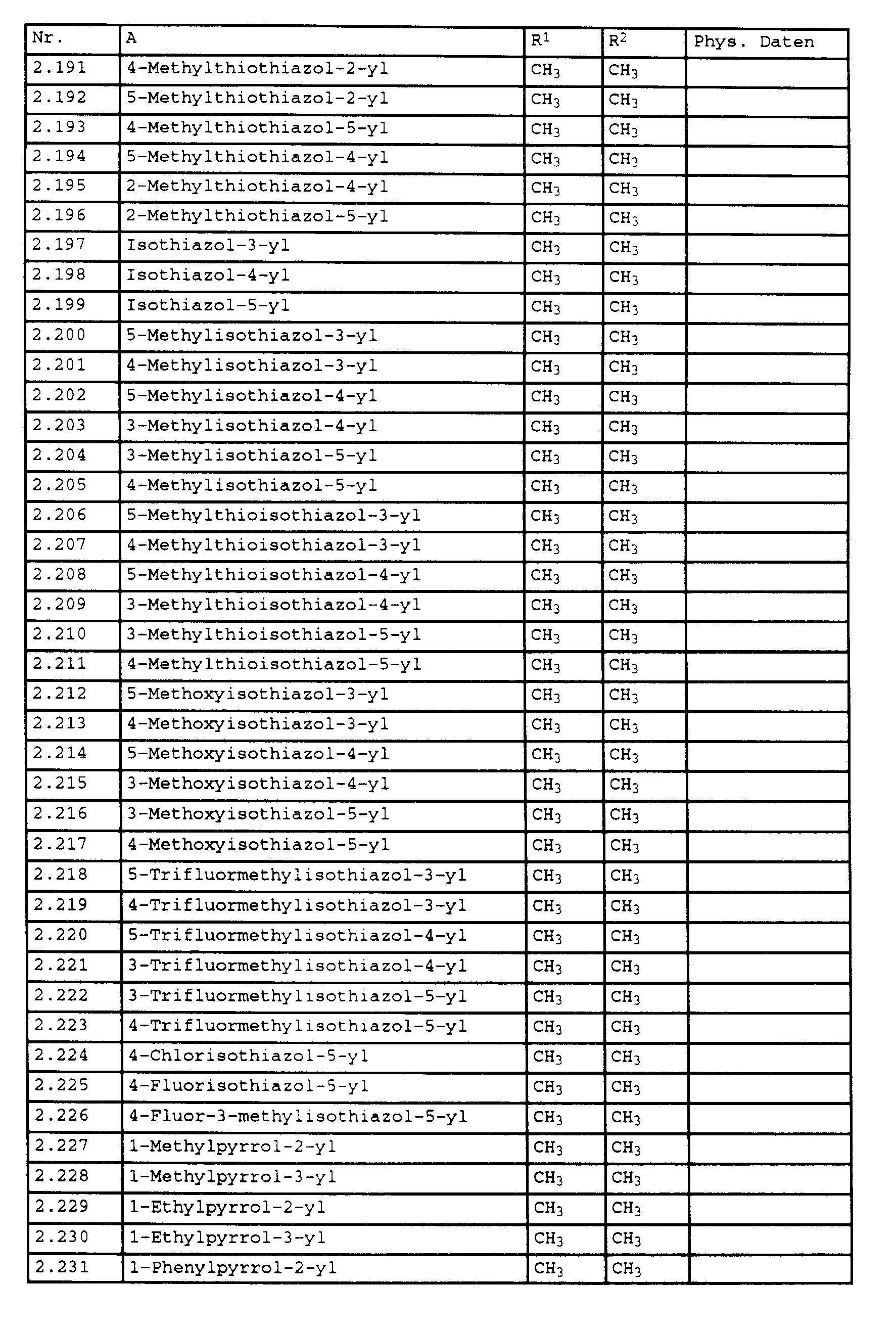
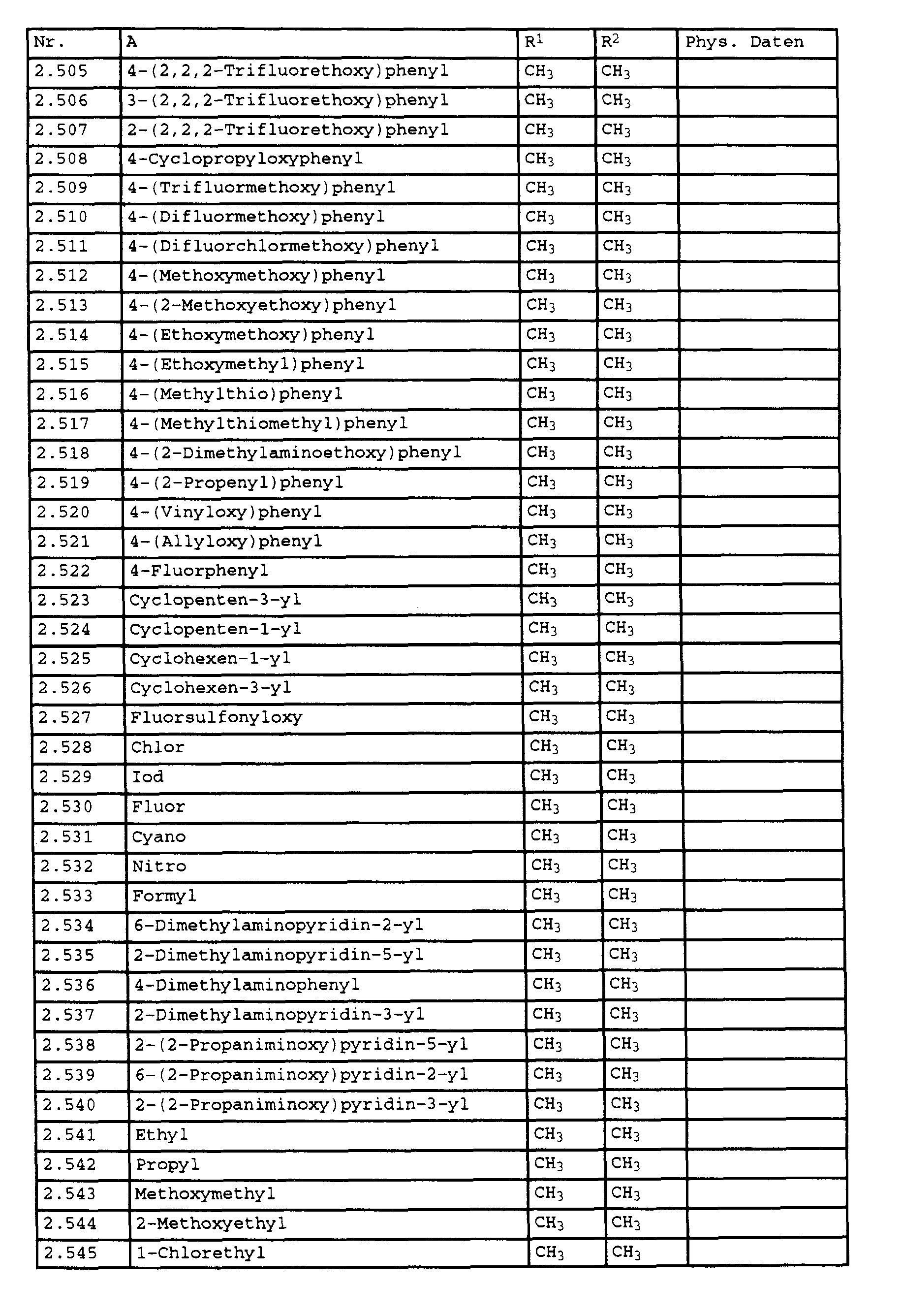
- Die in Tabelle 1 aufgeführten Verbindungen I können beispielsweise analog zu den jeweils angegebenen Synthesebeispielen hergestellt werden.
-





- Die Verbindungen I bzw. die sie enthaltenden herbiziden Mittel sowie deren umweltverträgliche Salze von beispielsweise Alkalimetallen, Erdalkalimetallen oder Ammoniak und Aminen bzw. die sie enthaltenden herbiziden Mittel können in Kulturen wie Weizen, Reis, Mais, Soja und Baumwolle Unkräuter und Schadgräser sehr gut bekämpfen, ohne die Kulturpflanzen nennenswert zu schädigen. Dieser Effekt tritt vor allem bei niedrigen Aufwandmengen auf.
- Unter Berücksichtigung der Vielseitigkeit der Applikationsmethoden können die Verbindungen I bzw. sie enthaltende Mittel noch in einer weiteren Zahl von Kulturpflanzen zur Beseitigung unerwünschter Pflanzen eingesetzt werden. In Betracht kommen beispielsweise folgende Kulturen:
- Allium cepa, Ananas comosus, Arachis hypogaea, Asparagus officinalis, Beta vulgaris spp. altissima, Beta vulgaris spp. rapa, Brassica napus var. napus, Brassica napus var. napobrassica, Brassica rapa var. silvestris, Camellia sinensis, Carthamus tinctorius, Carya illinoinensis, Citrus limon, Citrus sinensis, Coffea arabica (Coffea canephora, Coffea liberica), Cucumis sativus, Cynodon dactylon, Daucus carota, Elaeis guineensis, Fragaria vesca, Glycine max, Gossypium hirsutum, (Gossypium arboreum, Gossypium herbaceum, Gossypium vitifolium), Helianthus annuus, Hevea brasiliensis, Hordeum vulgare, Humulus lupulus, Ipomoea batatas, Juglans regia, Lens culinaris, Linum usitatissimum, Lycopersicon lycopersicum, Malus spp., Manihot esculenta, Medicago sativa, Musa spp., Nicotiana tabacum (N.rustica), Olea europaea, Oryza sativa, Phaseolus lunatus, Phaseolus vulgaris, Picea abies, Pinus spp., Pisum sativum, Prunus avium, Prunus persica, Pyrus communis, Ribes sylvestre, Ricinus communis, Saccharum officinarum, Secale cereale, Solanum tuberosum, Sorghum bicolor (s. vulgare), Theobroma cacao, Trifolium pratense, Triticum aestivum, Triticum durum, Vicia faba, Vitis vinifera, Zea mays.
- Darüber hinaus lassen sich die Verbindungen auch in Kulturen, die durch Züchtung und/oder mittels gentechnischer Methoden gegen die Wirkung von oder anderen Herbiziden weitgehend resistent gemacht wurden, einsetzen.
- Die Applikation der herbiziden Mittel bzw. der Wirkstoffe kann im Vorauflauf- oder im Nachauflaufverfahren erfolgen. Sind die Wirkstoffe für gewisse Kulturpflanzen weniger verträglich, so können Ausbringungstechniken angewandt werden, bei welchen die herbiziden Mittel mit Hilfe der Spritzgeräte so gespritzt werden, daß die Blätter der empfindlichen Kulturpflanzen nach Möglichkeit nicht getroffen werden, während die Wirkstoffe auf die Blätter darunter wachsender unerwünschter Pflanzen oder die unbedeckte Bodenfläche gelangen (post-directed, lay-by).
- Die Verbindungen I bzw. die sie enthaltenden herbiziden Mittel können beispielsweise in Form von direkt versprühbaren wäßrigen Lösungen, Pulvern, Suspensionen, auch hochprozentigen wäßrigen, öligen oder sonstigen Suspensionen oder Dispersionen, Emulsionen, Öldispersionen, Pasten, Stäubemitteln, Streumitteln oder Granulaten durch Versprühen, Vernebeln, Verstäuben, Verstreuen oder Gießen angewendet werden. Die Anwendungsformen richten sich nach den Verwendungszwecken; sie sollten in jedem Fall möglichst die feinste Verteilung der erfindungsgemäßen Wirkstoffe gewährleisten.
- Als inerte Hilfsstoffe für die Herstellung von direkt versprühbaren Lösungen, Emulsionen, Pasten oder Öldispersionen kommen im wesentlichen in Betracht: Mineralölfraktionen von mittlerem bis hohem Siedepunkt wie Kerosin oder Dieselöl, ferner Kohlenteeröle sowie Öle pflanzlichen oder tierischen Ursprungs, aliphatische, cyclische und aromatische Kohlenwasserstoffe, z.B. Paraffine, Tetrahydronaphthalin, alkylierte Naphthaline oder deren Derivate, alkylierte Benzole und deren Derivate, Alkohole wie Methanol, Ethanol, Propanol, Butanol und Cyclohexanol, Ketone wie Cyclohexanon oder stark polare Lösungsmittel, z.B. Amine wie N-Methylpyrrolidon, oder Wasser.
- Wäßrige Anwendungsformen können aus Emulsionskonzentraten, Suspensionen, Pasten, netzbaren Pulvern oder wasserdispergierbaren Granulaten durch Zusatz von Wasser bereitet werden. Zur Herstellung von Emulsionen, Pasten oder Öldispersionen können die Substrate als solche oder in einem Öl oder Lösungsmittel gelöst, mittels Netz-, Haft-, Dispergier- oder Emulgiermittel in Wasser homogenisiert werden. Es können aber auch aus wirksamer Substanz, Netz-, Haft-, Dispergier- oder Emulgiermittel und eventuell Lösungsmittel oder Öl bestehende Konzentrate hergestellt werden, die zur Verdünnung mit Wasser geeignet sind.
- Als oberflächenaktive Stoffe kommen die Alkali-, Erdalkali-, Ammoniumsalze von aromatischen Sulfonsäuren, z.B. Lignin-, Phenol-, Naphthalin- und Dibutylnaphthalinsulfonsäure, sowie von Fettsäuren, Alkyl-und Alkylarylsulfonaten, Alkyl-, Laurylether- und Fettalkoholsulfaten, sowie Salze sulfatierter Hexa-, Hepta-und Octadecanolen sowie von Fettalkoholglykolether, Kondensationsprodukte von sulfoniertem Naphthalin und seiner Derivate mit Formaldehyd, Kondensationsprodukte des Naphthalins bzw. der Naphthalinsulfonsäuren mit Phenol und Formaldehyd, Polyoxyethylenoctylphenolether, ethoxyliertes Isooctyl-, Octyl- oder Nonylphenol, Alkylphenol-, Tributylphenylpolyglykolether, Alkylarylpolyetheralkohole, Isotridecylalkohol, Fettalkoholethylenoxid-Kondensate, ethoxyliertes Rizinusöl, Polyoxyethylenalkylether oder Polyoxypropylen, Laurylalkoholpolyglykoletheracetat, Sorbitester, Lignin-Sulfitablaugen oder Methylcellulose in Betracht.
- Pulver-, Streu- und Stäubemittel können durch Mischen oder gemeinsames Vermahlen der wirksamen Substanzen mit einem festen Trägerstoff hergestellt werden.
- Granulate, z.B. Umhüllungs-, Imprägnierungs- und Homogengranulate können durch Bindung der Wirkstoffe an feste Trägerstoffe hergestellt werden. Feste Trägerstoffe sind Mineralerden wie Silicagel, Kieselsäuren, Kieselgele, Silikate, Talkum, Kaolin, Kalkstein, Kalk, Kreide, Bolus, Löß, Ton, Dolomit, Diatomeenerde, Calcium- und Magnesiumsulfat, Magnesiumoxid, gemahlene Kunststoffe, Düngemittel, wie Ammoniumsulfat, Ammoniumphosphat, Ammoniumnitrat, Harnstoffe und pflanzliche Produkte wie Getreidemehl, Baumrinden-, Holz- und Nußschalenmehl, Cellulosepulver oder andere feste Trägerstoffe.
- Die Formulierungen enthalten im allgemeinen zwischen 0,01 und 95 Gew.-%, vorzugsweise zwischen 0,5 und 90 Gew.-%, Wirkstoff. Die Wirkstoffe werden dabei in einer Reinheit von 90 % bis 100 %, vorzugsweise 95 % bis 100 % (nach NMR-Spektrum) eingesetzt. Die erfindungsgemäßen Verbindungen I können beispielsweise wie folgt formuliert werden:
- I. 20 Gewichtsteile der Verbindung Nr. werden in einer Mischung gelöst, die aus 80 Gewichtsteilen alkyliertem Benzol, 10 Gewichtsteilen des Anlagerungsproduktes von 8 bis 10 Mol Ethylenoxid an 1 Mol Ölsäure-N-monoethanolamid, 5 Gewichtsteilen Calciumsalz der Dodecylbenzolsulfonsäure und 5 Gewichtsteilen des Anlagerungsproduktes von 40 Mol Ethylenoxid an 1 Mol Ricinusöl besteht. Durch Ausgießen und feines Verteilen der Lösung in 100 000 Gewichtsteilen Wasser erhält man eine wäßrige Dispersion, die 0,02 Gew. % des Wirkstoffs enthält.
- 11. 20 Gewichtsteile der Verbindung Nr. werden in einer Mischung gelöst, die aus 40 Gewichtsteilen Cyclohexanon, 30 Gewichtsteilen Isobutanol, 20 Gewichtsteilen des Anlagerungsproduktes von 7 Mol Ethylenoxid an 1 Mol Isooctylphenol und 10 Gewichtsteilen des Anlagerungsproduktes von 40 Mol Ethylenoxid an 1 Mol Ricinusöl besteht. Durch Eingießen und feines Verteilen der Lösung in 100 000 Gewichtsteilen Wasser erhält man eine wäßrige Dispersion, die 0,02 Gew.-% des Wirkstoffs enthält.
- III. 20 Gewichtsteile des Wirkstoffs Nr. werden in einer Mischung gelöst, die aus 25 Gewichtsteilen Cyclohexanon, 65 Gewichtsteilen einer Mineralölfraktion vom Siedepunkt 210 bis 280°C und 10 Gewichtsteilen des Anlagerungsproduktes von 40 Mol Ethylenoxid an 1 Mol Ricinusöl besteht. Durch Eingießen und feines Verteilen der Lösung in 100 000 Gewichtsteilen Wasser erhält man eine wäßrige Dispersion, die 0,02 Gew.-% des Wirkstoffs enthält.
- IV. 20 Gewichtsteile des Wirkstoffs Nr. werden mit 3 Gewichtsteilen des Natriumsalzes der Diisobutylnaphthalin-a-sulfonsäure, 17 Gewichtsteilen des Natriumsalzes einer Ligninsulfonsäure aus einer Sulfit-Ablauge und 60 Gewichtsteilen pulverförmigem Kieselsäuregel gut vermischt und in einer Hammermühle vermahlen. Durch feines Verteilen der Mischung in 20 000 Gewichtsteilen Wasser enthält man eine Spritzbrühe, die 0,1 Gew.-% des Wirkstoffs enthält.
- V. 3 Gewichtsteile des Wirkstoffs Nr. werden mit 97 Gewichtsteilen feinteiligem Kaolin vermischt. Man erhält auf diese Weise ein Stäubemittel, das 3 Gew.-% des Wirkstoffs enthält.
- Vl. 20 Gewichtsteile des Wirkstoffs Nr. werden mit 2 Gewichtsteilen Calciumsalz der Dodecylbenzolsulfonsäure, 8 Gewichtsteilen Fettalkohol-polyglykolether, 2 Gewichtsteilen Natriumsalz eines Phenol-Harnstoff-Formaldehyd-Kondensates und 68 Gewichtsteilen eines paraffinischen Mineralöls innig vermischt. Man erhält eine stabile ölige Dispersion.
- Zur Verbreiterung des Wirkungsspektrums und zur Erzielung synergistischer Effekte können die cyclischen Acetale mit zahlreichen Vertretern anderer herbizider oder wachstumsregulierender Wirkstoffgruppen gemischt und gemeinsam ausgebracht werden. Beispielsweise kommen als Mischungspartner Diazine, 4H-3,1-Benzoxazinderivate, Benzothiadiazinone, 2,6-Dinitroaniline, N-Phenylcarbamate, Thiolcarbamate, Halogencarbonsäuren, Triazine, Amide, Harnstoffe, Diphenylether, Triazinone, Uracile, Benzofuranderivate, Cyclohexan-1,3-dionderivate, die in 2-Stellung z.B. eine Carboxy- oder Carbimino-Gruppe tragen, Chinolincarbonsäurederivate, Imidazolinone, Sulfonamide, Sulfonylharnstoffe, Aryloxy-, Heteroaryloxyphenoxypropionsäuren sowie deren Salze, Ester und Amide und andere in Betracht.
- Außerdem kann es von Nutzen sein, die Verbindungen 1 allein oder in Kombination mit anderen Herbiziden auch noch mit weiteren Pflanzenschutzmitteln gemischt, gemeinsam aus zubringen, beispielsweise mit Mitteln zur Bekämpfung von Schädlingen oder phytopathogenen Pilzen bzw. Bakterien. Von Interesse ist ferner die Mischbarkeit mit Mineralsalzlösungen, welche zur Behebung von Ernährungs- und Spurenelementmängeln eingesetzt werden. Es können auch nichtphytotoxische Öle und Ölkonzentrate zugesetzt werden.
- Die Aufwandmengen an Wirkstoff betragen je nach Bekämpfungsziel, Jahreszeit, Zielpflanzen und Wachstumsstadium 0,001 bis 3,0 kg/ha aktive Substanz (a.S.)
- Die herbizide Wirkung der cyclischen Acetale der Formel 1 ließ sich durch Gewächshausversuche zeigen:
- Als Kulturgefäße dienten Plastikblumentöpfe mit lehmigem Sand mit etwa 3,0 % Humus als Substrat. Die Samen der Testpflanzen wurden nach Arten getrennt eingesät.
- Bei Vorauflaufbehandlung wurden die in Wasser suspendierten oder emulgierten Wirkstoffe direkt nach Einsaat mittels fein verteilender Düsen aufgebracht. Die Gefäße wurden leicht beregnet, um Keimung und Wachstum zu fördern, und anschließend mit durchsichtigen Plastikhauben abgedeckt, bis die Pflanzen angewachsen waren. Diese Abdeckung bewirkt ein gleichmäßiges Keimen der Testpflanzen, sofern dies nicht durch die Wirkstoffe beeinträchtigt wurde.
- Zum Zweck der Nachauflaufbehandlung wurden die Testpflanzen je nach Wuchsform erst bis zu einer Wuchshöhe von 3 bis 15 cm angezogen und erst dann mit den in Wasser suspendierten oder emulgierten Wirkstoffen behandelt. Die Testpflanzen wurden dafür entweder direkt gesät und in den gleichen Gefäßen aufgezogen oder sie werden erst als Keimpflanzen getrennt angezogen und einige Tage vor der Behandlung in die Versuchsgefäße verpflanzt. Die Aufwandmenge für die Nachauflaufbehandlung betrug 3,0 kg/ha a.S.
- Die Pflanzen wurden artenspezifisch bei Temperaturen von 10 - 25 °C bzw. 20 - 35 °C gehalten. Die Versuchsperiode erstreckte sich über 2 bis 4 Wochen. Während dieser Zeit wurden die Pflanzen gepflegt, und ihre Reaktion auf die einzelnen Behandlungen wurde ausgewertet.
- Bewertet wurde nach einer Skala von 0 bis 100. Dabei bedeutet 100 kein Aufgang der Pflanzen bzw. völlige Zerstörung zumindest der oberirdischen Teile und 0 keine Schädigung oder normaler Wachstumsverlauf.
Claims (6)

wobei die Substituenten folgende Bedeutung haben:
mit der Maßgabe, daß A nicht für eine Hydroxy-Gruppe steht, wenn R1 und R2 beide Wasserstoff bedeuten oder wenn R1 Wasserstoff und R2 Phenyl bedeutet.

wobei Y und A die unter Anspruch 1 angegebenen Bedeutungen haben und die übrigen Reste die folgenden Bedeutungen haben:

in der R8 für C1-C4-Alkyl, Phenyl, ein- oder mehrfach durch Halogen, Nitro, Cyano, C1-C4-Alkyl, Ci-C4-Halogenalkyl, C1-C4-Alkoxy, C1-C4-Halogenalkoxy oder C1-C4-Alkylthio substituiertes Phenyl, C1-C4-Halogenalkyl, C3-C6-Alkenyl oder C3-C6-Alkinyl steht, p die Werte 1, 2, 3 oder 4 und k die Werte 0, 1 oder 2 annehmen;
oder R10 und R11 bilden gemeinsam eine C3-C12-Alkylenkette, welche ein bis drei C1-C4-Alkylgruppen tragen kann;
dadurch gekennzeichnet, daß man die cyclischen Acetale I gemäß Anspruch 1 mit einem Salz der Formel II

in der R50 die obengenannte Bedeutung hat und M für ein Alkalimetallkation oder ein Äquivalent eines Erdalkalimetallkations steht, und dann mit einer Pyrimidinverbindung der Formel III

in der die Reste folgende Bedeutung haben:
in einem inerten Lösungsmittel umsetzt.
Applications Claiming Priority (2)
| Application Number | Priority Date | Filing Date | Title |
|---|---|---|---|
| DE4337321A DE4337321A1 (de) | 1993-11-02 | 1993-11-02 | Cyclische Acetale, Verfahren zu deren Herstellung und deren Umsetzung zu Pflanzenschutzmitteln |
| DE4337321 | 1993-11-02 |
Publications (3)
| Publication Number | Publication Date |
|---|---|
| EP0657441A2 true EP0657441A2 (de) | 1995-06-14 |
| EP0657441A3 EP0657441A3 (de) | 1995-11-22 |
| EP0657441B1 EP0657441B1 (de) | 2000-03-01 |
Family
ID=6501583
Family Applications (1)
| Application Number | Title | Priority Date | Filing Date |
|---|---|---|---|
| EP94116758A Expired - Lifetime EP0657441B1 (de) | 1993-11-02 | 1994-10-24 | Cyclische Acetale, Verfahren zu deren Herstellung und deren Umsetzung zu Pflanzenschutzmitteln |
Country Status (8)
| Country | Link |
|---|---|
| US (2) | US5569640A (de) |
| EP (1) | EP0657441B1 (de) |
| JP (1) | JPH07188219A (de) |
| KR (1) | KR950014095A (de) |
| CN (1) | CN1106399A (de) |
| CA (1) | CA2134626A1 (de) |
| DE (2) | DE4337321A1 (de) |
| HU (1) | HU216713B (de) |
Families Citing this family (11)
| Publication number | Priority date | Publication date | Assignee | Title |
|---|---|---|---|---|
| DE4337322A1 (de) * | 1993-11-02 | 1995-05-04 | Basf Ag | Pyrid-N-oxid substituierte Salicylaldehyd- bzw. Salicylsäurederivate, Verfahren zu ihrer Herstellung und ihre Verwendung als Herbizide |
| DE4337323A1 (de) | 1993-11-02 | 1995-05-04 | Basf Ag | Substituierte Pyridylsalicylaldehyd- bzw. salicylsäurederivate, Verfahren zu ihrer Herstellung und ihre Verwendung als Herbizide |
| JPH09194474A (ja) * | 1996-01-16 | 1997-07-29 | Fujirebio Inc | 1,3−ジオキサン−4−オン誘導体の製造方法 |
| KR100738216B1 (ko) * | 2006-01-09 | 2007-07-12 | 엘지전자 주식회사 | 전류 미러 |
| BR112013027781B1 (pt) * | 2011-04-29 | 2018-12-18 | Basf Se | composição agroquímica, método para a fabricação da composição, uso do solvente da fórmula (a) e método de controle de fungos fitopatogênicos |
| US20140275503A1 (en) * | 2013-03-13 | 2014-09-18 | Dow Agrosciences Llc | Process for the preparation of certain triaryl rhamnose carbamates |
| JP6738326B2 (ja) * | 2014-06-06 | 2020-08-12 | ザ スクリプス リサーチ インスティテュート | フッ化硫黄(vi)化合物およびそれの製造方法 |
| CN104370875B (zh) * | 2014-09-25 | 2018-11-13 | 深圳波顿香料有限公司 | 一种乙基香兰素1,2-丙二醇缩醛的制备方法 |
| WO2017110863A1 (ja) * | 2015-12-25 | 2017-06-29 | 住友化学株式会社 | オキサジアゾール化合物及びその用途 |
| WO2017111152A1 (ja) * | 2015-12-25 | 2017-06-29 | 住友化学株式会社 | オキサジアゾール化合物及びその用途 |
| JP6809278B2 (ja) * | 2017-02-17 | 2021-01-06 | Jnc株式会社 | 重合性液晶化合物、重合性液晶組成物および液晶重合膜 |
Family Cites Families (11)
| Publication number | Priority date | Publication date | Assignee | Title |
|---|---|---|---|---|
| JPH082883B2 (ja) * | 1986-06-06 | 1996-01-17 | クミアイ化学工業株式会社 | 2−フエノキシピリミジン誘導体および除草剤 |
| US4752812A (en) * | 1987-01-12 | 1988-06-21 | International Business Machines Corporation | Permeable-base transistor |
| ATE63912T1 (de) * | 1987-02-05 | 1991-06-15 | Caber Farmaceutici | 4-oxo-1,3-benzodioxan-derivat. |
| DE3851773T2 (de) * | 1987-04-14 | 1995-04-20 | Ihara Chemical Ind Co | 2-Phenoxypyrimidin-Derivate und herbizide Zusammensetzungen. |
| US4923501A (en) * | 1987-11-04 | 1990-05-08 | Kumiai Chemical Industry Co., Ltd. | Pyrimidine derivatives, processes for their production, and herbicidal method and compositions |
| ES2063075T3 (es) * | 1988-06-16 | 1995-01-01 | Basf Ag | Derivados del acido salicilico y sus analogos azufrados. |
| DE3919435A1 (de) * | 1989-06-14 | 1990-12-20 | Basf Ag | Salicylaldehyd- und salicylsaeurederivate sowie deren schwefelanaloge, verfahren zu ihrer herstellung als herbizide und bioregulatoren |
| DE4034045A1 (de) * | 1990-10-26 | 1992-04-30 | Basf Ag | Salicylsaeurederivate |
| EP0490224B1 (de) * | 1990-12-14 | 1996-03-13 | BASF Aktiengesellschaft | Salicylaldehyd- und Salicylsäurederivate sowie deren Schwefelanaloge, Verfahren und Zwischenprodukte zu ihrer Herstellung |
| JPH0532638A (ja) * | 1991-07-31 | 1993-02-09 | Kumiai Chem Ind Co Ltd | ピリミジンまたはトリアジン誘導体及び除草剤 |
| DE4126937A1 (de) * | 1991-08-10 | 1993-02-11 | Basf Ag | Salicyl(thio)etherderivate, verfahren und zwischenprodukte zu ihrer herstellung |
-
1993
- 1993-11-02 DE DE4337321A patent/DE4337321A1/de not_active Withdrawn
-
1994
- 1994-10-24 EP EP94116758A patent/EP0657441B1/de not_active Expired - Lifetime
- 1994-10-24 DE DE59409166T patent/DE59409166D1/de not_active Expired - Lifetime
- 1994-10-28 CA CA002134626A patent/CA2134626A1/en not_active Abandoned
- 1994-11-01 JP JP6268791A patent/JPH07188219A/ja active Pending
- 1994-11-01 KR KR1019940028490A patent/KR950014095A/ko not_active Withdrawn
- 1994-11-01 HU HU9403135A patent/HU216713B/hu not_active IP Right Cessation
- 1994-11-01 US US08/332,083 patent/US5569640A/en not_active Expired - Fee Related
- 1994-11-02 CN CN94113792A patent/CN1106399A/zh active Pending
-
1996
- 1996-07-12 US US08/679,660 patent/US5777118A/en not_active Expired - Fee Related
Also Published As
| Publication number | Publication date |
|---|---|
| JPH07188219A (ja) | 1995-07-25 |
| DE4337321A1 (de) | 1995-05-04 |
| HU9403135D0 (en) | 1995-01-30 |
| CA2134626A1 (en) | 1995-05-03 |
| CN1106399A (zh) | 1995-08-09 |
| HUT69056A (en) | 1995-08-28 |
| US5777118A (en) | 1998-07-07 |
| HU216713B (hu) | 1999-08-30 |
| DE59409166D1 (de) | 2000-04-06 |
| US5569640A (en) | 1996-10-29 |
| EP0657441B1 (de) | 2000-03-01 |
| EP0657441A3 (de) | 1995-11-22 |
| KR950014095A (ko) | 1995-06-15 |
Similar Documents
| Publication | Publication Date | Title |
|---|---|---|
| EP0695295B1 (de) | 3-(het)aryl-carbonsäurederivate, verfahren und zwischenprodukte zu ihrer herstellung | |
| EP0657441B1 (de) | Cyclische Acetale, Verfahren zu deren Herstellung und deren Umsetzung zu Pflanzenschutzmitteln | |
| DE19536811A1 (de) | Zwischenprodukte und Verfahren zur Herstellung von substituierten Salicylsäurederivaten als Pflanzenschutzmittel | |
| EP0652216B1 (de) | Substituierte Pyridylsalicylaldehyd - bzw. -salicylsäurederivate, Verfahren zu ihrer Herstellung und ihre Verwendung als Herbizide | |
| JP3452359B2 (ja) | 3−(ヘテロ)アリールオキシ(チオ)カルボン酸誘導体、その製造方法およびその中間生成物 | |
| WO1998042703A1 (de) | Thiazolimin-derivate | |
| US5750469A (en) | Subtituted lactic acid derivatives having an N-organic radical in the .beta. | |
| US5627136A (en) | Pyridine-N-oxide-substituted salicylaldehyde or salicyclic acid derivatives, their preparation and their use as herbicides | |
| DE19536809A1 (de) | Heterocyclisch substituierte Salicylsäurederivate | |
| EP0695302B1 (de) | 3-halogen-3-hetarylcarbonsäurederivate, verfahren und zwischenprodukte zu ihrer herstellung | |
| WO1996016045A1 (de) | DERIVATE VON α-HALOGENCARBONYLVERBINDUNGEN, VERFAHREN UND ZWISCHENPRODUKTE ZU IHRER HERSTELLUNG | |
| DE19505181A1 (de) | (Het)aryloxyalkoxy-substituierte Benzo[1,3]dioxine | |
| WO1997015560A1 (de) | Sulfoxid- und sulfon-salizylsäure-derivate, verfahren zu ihrer herstellung und ihre verwendung als herbizide | |
| DE19602404A1 (de) | Sulfoxid- und Sulfon-substituierte Heterocyclen, Verfahren zu ihrer Herstellung und ihre Verwendung als Herbizide | |
| DE19505182A1 (de) | (Het)aryloxyalkoxy-substituierte Salicylsäuren |
Legal Events
| Date | Code | Title | Description |
|---|---|---|---|
| PUAI | Public reference made under article 153(3) epc to a published international application that has entered the european phase |
Free format text: ORIGINAL CODE: 0009012 |
|
| AK | Designated contracting states |
Kind code of ref document: A2 Designated state(s): BE CH DE FR GB IT LI NL |
|
| PUAL | Search report despatched |
Free format text: ORIGINAL CODE: 0009013 |
|
| AK | Designated contracting states |
Kind code of ref document: A3 Designated state(s): BE CH DE FR GB IT LI NL |
|
| 17P | Request for examination filed |
Effective date: 19951025 |
|
| RIN1 | Information on inventor provided before grant (corrected) |
Inventor name: WALTER, HELMUT, DR. Inventor name: WESTPHALEN, KARL-OTTO, DR. Inventor name: GERBER, MATTHIAS, DR. Inventor name: KOENIG, HARTMANN, DR. Inventor name: BAUMANN, ERNST, DR. Inventor name: VOGELBACHER, UWE JOSEF, DR. Inventor name: RHEINHEIMER, JOACHIM, DR. |
|
| 17Q | First examination report despatched |
Effective date: 19960205 |
|
| GRAG | Despatch of communication of intention to grant |
Free format text: ORIGINAL CODE: EPIDOS AGRA |
|
| GRAH | Despatch of communication of intention to grant a patent |
Free format text: ORIGINAL CODE: EPIDOS IGRA |
|
| GRAG | Despatch of communication of intention to grant |
Free format text: ORIGINAL CODE: EPIDOS AGRA |
|
| GRAH | Despatch of communication of intention to grant a patent |
Free format text: ORIGINAL CODE: EPIDOS IGRA |
|
| GRAH | Despatch of communication of intention to grant a patent |
Free format text: ORIGINAL CODE: EPIDOS IGRA |
|
| GRAA | (expected) grant |
Free format text: ORIGINAL CODE: 0009210 |
|
| AK | Designated contracting states |
Kind code of ref document: B1 Designated state(s): BE CH DE FR GB IT LI NL |
|
| REG | Reference to a national code |
Ref country code: CH Ref legal event code: EP |
|
| REF | Corresponds to: |
Ref document number: 59409166 Country of ref document: DE Date of ref document: 20000406 |
|
| GBT | Gb: translation of ep patent filed (gb section 77(6)(a)/1977) |
Effective date: 20000327 |
|
| ITF | It: translation for a ep patent filed | ||
| ET | Fr: translation filed | ||
| PLBE | No opposition filed within time limit |
Free format text: ORIGINAL CODE: 0009261 |
|
| STAA | Information on the status of an ep patent application or granted ep patent |
Free format text: STATUS: NO OPPOSITION FILED WITHIN TIME LIMIT |
|
| 26N | No opposition filed | ||
| PGFP | Annual fee paid to national office [announced via postgrant information from national office to epo] |
Ref country code: FR Payment date: 20010914 Year of fee payment: 8 |
|
| PGFP | Annual fee paid to national office [announced via postgrant information from national office to epo] |
Ref country code: CH Payment date: 20010917 Year of fee payment: 8 |
|
| PGFP | Annual fee paid to national office [announced via postgrant information from national office to epo] |
Ref country code: NL Payment date: 20010921 Year of fee payment: 8 |
|
| PGFP | Annual fee paid to national office [announced via postgrant information from national office to epo] |
Ref country code: GB Payment date: 20011015 Year of fee payment: 8 |
|
| PGFP | Annual fee paid to national office [announced via postgrant information from national office to epo] |
Ref country code: DE Payment date: 20011018 Year of fee payment: 8 |
|
| PGFP | Annual fee paid to national office [announced via postgrant information from national office to epo] |
Ref country code: BE Payment date: 20011119 Year of fee payment: 8 |
|
| REG | Reference to a national code |
Ref country code: GB Ref legal event code: IF02 |
|
| PG25 | Lapsed in a contracting state [announced via postgrant information from national office to epo] |
Ref country code: GB Free format text: LAPSE BECAUSE OF NON-PAYMENT OF DUE FEES Effective date: 20021024 |
|
| PG25 | Lapsed in a contracting state [announced via postgrant information from national office to epo] |
Ref country code: LI Free format text: LAPSE BECAUSE OF NON-PAYMENT OF DUE FEES Effective date: 20021031 Ref country code: CH Free format text: LAPSE BECAUSE OF NON-PAYMENT OF DUE FEES Effective date: 20021031 Ref country code: BE Free format text: LAPSE BECAUSE OF NON-PAYMENT OF DUE FEES Effective date: 20021031 |
|
| PG25 | Lapsed in a contracting state [announced via postgrant information from national office to epo] |
Ref country code: DE Free format text: LAPSE BECAUSE OF THE APPLICANT RENOUNCES Effective date: 20021116 |
|
| BERE | Be: lapsed |
Owner name: *BASF A.G. Effective date: 20021031 |
|
| PG25 | Lapsed in a contracting state [announced via postgrant information from national office to epo] |
Ref country code: NL Free format text: LAPSE BECAUSE OF NON-PAYMENT OF DUE FEES Effective date: 20030501 |
|
| GBPC | Gb: european patent ceased through non-payment of renewal fee |
Effective date: 20021024 |
|
| REG | Reference to a national code |
Ref country code: CH Ref legal event code: PL |
|
| PG25 | Lapsed in a contracting state [announced via postgrant information from national office to epo] |
Ref country code: FR Free format text: LAPSE BECAUSE OF NON-PAYMENT OF DUE FEES Effective date: 20030630 |
|
| NLV4 | Nl: lapsed or anulled due to non-payment of the annual fee |
Effective date: 20030501 |
|
| REG | Reference to a national code |
Ref country code: FR Ref legal event code: ST |
|
| PG25 | Lapsed in a contracting state [announced via postgrant information from national office to epo] |
Ref country code: IT Free format text: LAPSE BECAUSE OF NON-PAYMENT OF DUE FEES Effective date: 20051024 |