EP0657475B1 - Dispersants polymères comportant des groupes polyalkylène et succinniques - Google Patents
Dispersants polymères comportant des groupes polyalkylène et succinniques Download PDFInfo
- Publication number
- EP0657475B1 EP0657475B1 EP94309294A EP94309294A EP0657475B1 EP 0657475 B1 EP0657475 B1 EP 0657475B1 EP 94309294 A EP94309294 A EP 94309294A EP 94309294 A EP94309294 A EP 94309294A EP 0657475 B1 EP0657475 B1 EP 0657475B1
- Authority
- EP
- European Patent Office
- Prior art keywords
- molecular weight
- olefin
- copolymer
- high molecular
- polysuccinimide
- Prior art date
- Legal status (The legal status is an assumption and is not a legal conclusion. Google has not performed a legal analysis and makes no representation as to the accuracy of the status listed.)
- Expired - Lifetime
Links
Images
Classifications
-
- C—CHEMISTRY; METALLURGY
- C10—PETROLEUM, GAS OR COKE INDUSTRIES; TECHNICAL GASES CONTAINING CARBON MONOXIDE; FUELS; LUBRICANTS; PEAT
- C10M—LUBRICATING COMPOSITIONS; USE OF CHEMICAL SUBSTANCES EITHER ALONE OR AS LUBRICATING INGREDIENTS IN A LUBRICATING COMPOSITION
- C10M149/00—Lubricating compositions characterised by the additive being a macromolecular compound containing nitrogen
- C10M149/02—Macromolecular compounds obtained by reactions only involving carbon-to-carbon unsaturated bonds
- C10M149/06—Macromolecular compounds obtained by reactions only involving carbon-to-carbon unsaturated bonds containing monomers having an unsaturated radical bound to an amido or imido group
-
- C—CHEMISTRY; METALLURGY
- C08—ORGANIC MACROMOLECULAR COMPOUNDS; THEIR PREPARATION OR CHEMICAL WORKING-UP; COMPOSITIONS BASED THEREON
- C08F—MACROMOLECULAR COMPOUNDS OBTAINED BY REACTIONS ONLY INVOLVING CARBON-TO-CARBON UNSATURATED BONDS
- C08F255/00—Macromolecular compounds obtained by polymerising monomers on to polymers of hydrocarbons as defined in group C08F10/00
-
- C—CHEMISTRY; METALLURGY
- C08—ORGANIC MACROMOLECULAR COMPOUNDS; THEIR PREPARATION OR CHEMICAL WORKING-UP; COMPOSITIONS BASED THEREON
- C08F—MACROMOLECULAR COMPOUNDS OBTAINED BY REACTIONS ONLY INVOLVING CARBON-TO-CARBON UNSATURATED BONDS
- C08F255/00—Macromolecular compounds obtained by polymerising monomers on to polymers of hydrocarbons as defined in group C08F10/00
- C08F255/08—Macromolecular compounds obtained by polymerising monomers on to polymers of hydrocarbons as defined in group C08F10/00 on to polymers of olefins having four or more carbon atoms
- C08F255/10—Macromolecular compounds obtained by polymerising monomers on to polymers of hydrocarbons as defined in group C08F10/00 on to polymers of olefins having four or more carbon atoms on to butene polymers
-
- C—CHEMISTRY; METALLURGY
- C08—ORGANIC MACROMOLECULAR COMPOUNDS; THEIR PREPARATION OR CHEMICAL WORKING-UP; COMPOSITIONS BASED THEREON
- C08F—MACROMOLECULAR COMPOUNDS OBTAINED BY REACTIONS ONLY INVOLVING CARBON-TO-CARBON UNSATURATED BONDS
- C08F8/00—Chemical modification by after-treatment
-
- C—CHEMISTRY; METALLURGY
- C08—ORGANIC MACROMOLECULAR COMPOUNDS; THEIR PREPARATION OR CHEMICAL WORKING-UP; COMPOSITIONS BASED THEREON
- C08F—MACROMOLECULAR COMPOUNDS OBTAINED BY REACTIONS ONLY INVOLVING CARBON-TO-CARBON UNSATURATED BONDS
- C08F8/00—Chemical modification by after-treatment
- C08F8/30—Introducing nitrogen atoms or nitrogen-containing groups
- C08F8/32—Introducing nitrogen atoms or nitrogen-containing groups by reaction with amines
-
- C—CHEMISTRY; METALLURGY
- C08—ORGANIC MACROMOLECULAR COMPOUNDS; THEIR PREPARATION OR CHEMICAL WORKING-UP; COMPOSITIONS BASED THEREON
- C08G—MACROMOLECULAR COMPOUNDS OBTAINED OTHERWISE THAN BY REACTIONS ONLY INVOLVING UNSATURATED CARBON-TO-CARBON BONDS
- C08G73/00—Macromolecular compounds obtained by reactions forming a linkage containing nitrogen with or without oxygen or carbon in the main chain of the macromolecule, not provided for in groups C08G12/00 - C08G71/00
- C08G73/06—Polycondensates having nitrogen-containing heterocyclic rings in the main chain of the macromolecule
- C08G73/10—Polyimides; Polyester-imides; Polyamide-imides; Polyamide acids or similar polyimide precursors
- C08G73/1092—Polysuccinimides
-
- C—CHEMISTRY; METALLURGY
- C10—PETROLEUM, GAS OR COKE INDUSTRIES; TECHNICAL GASES CONTAINING CARBON MONOXIDE; FUELS; LUBRICANTS; PEAT
- C10L—FUELS NOT OTHERWISE PROVIDED FOR; NATURAL GAS; SYNTHETIC NATURAL GAS OBTAINED BY PROCESSES NOT COVERED BY SUBCLASSES C10G OR C10K; LIQUIFIED PETROLEUM GAS; USE OF ADDITIVES TO FUELS OR FIRES; FIRE-LIGHTERS
- C10L1/00—Liquid carbonaceous fuels
- C10L1/10—Liquid carbonaceous fuels containing additives
- C10L1/14—Organic compounds
- C10L1/18—Organic compounds containing oxygen
- C10L1/192—Macromolecular compounds
- C10L1/195—Macromolecular compounds obtained by reactions involving only carbon-to-carbon unsaturated bonds
- C10L1/196—Macromolecular compounds obtained by reactions involving only carbon-to-carbon unsaturated bonds derived from monomers containing a carbon-to-carbon unsaturated bond and a carboxyl group or salts, anhydrides or esters thereof homo- or copolymers of compounds having one or more unsaturated aliphatic radicals each having one carbon bond to carbon double bond, and at least one being terminated by a carboxyl radical or of salts, anhydrides or esters thereof
- C10L1/1966—Macromolecular compounds obtained by reactions involving only carbon-to-carbon unsaturated bonds derived from monomers containing a carbon-to-carbon unsaturated bond and a carboxyl group or salts, anhydrides or esters thereof homo- or copolymers of compounds having one or more unsaturated aliphatic radicals each having one carbon bond to carbon double bond, and at least one being terminated by a carboxyl radical or of salts, anhydrides or esters thereof poly-carboxylic
-
- C—CHEMISTRY; METALLURGY
- C10—PETROLEUM, GAS OR COKE INDUSTRIES; TECHNICAL GASES CONTAINING CARBON MONOXIDE; FUELS; LUBRICANTS; PEAT
- C10L—FUELS NOT OTHERWISE PROVIDED FOR; NATURAL GAS; SYNTHETIC NATURAL GAS OBTAINED BY PROCESSES NOT COVERED BY SUBCLASSES C10G OR C10K; LIQUIFIED PETROLEUM GAS; USE OF ADDITIVES TO FUELS OR FIRES; FIRE-LIGHTERS
- C10L1/00—Liquid carbonaceous fuels
- C10L1/10—Liquid carbonaceous fuels containing additives
- C10L1/14—Organic compounds
- C10L1/18—Organic compounds containing oxygen
- C10L1/192—Macromolecular compounds
- C10L1/198—Macromolecular compounds obtained otherwise than by reactions involving only carbon-to-carbon unsaturated bonds homo- or copolymers of compounds having one or more unsaturated aliphatic radicals, each having only one carbon to carbon double bond, and at least one being terminated by an acyloxy radical of a saturated carboxylic acid, of carbonic acid
-
- C—CHEMISTRY; METALLURGY
- C10—PETROLEUM, GAS OR COKE INDUSTRIES; TECHNICAL GASES CONTAINING CARBON MONOXIDE; FUELS; LUBRICANTS; PEAT
- C10L—FUELS NOT OTHERWISE PROVIDED FOR; NATURAL GAS; SYNTHETIC NATURAL GAS OBTAINED BY PROCESSES NOT COVERED BY SUBCLASSES C10G OR C10K; LIQUIFIED PETROLEUM GAS; USE OF ADDITIVES TO FUELS OR FIRES; FIRE-LIGHTERS
- C10L1/00—Liquid carbonaceous fuels
- C10L1/10—Liquid carbonaceous fuels containing additives
- C10L1/14—Organic compounds
- C10L1/20—Organic compounds containing halogen
- C10L1/206—Organic compounds containing halogen macromolecular compounds
- C10L1/208—Organic compounds containing halogen macromolecular compounds containing halogen, oxygen, with or without hydrogen
-
- C—CHEMISTRY; METALLURGY
- C10—PETROLEUM, GAS OR COKE INDUSTRIES; TECHNICAL GASES CONTAINING CARBON MONOXIDE; FUELS; LUBRICANTS; PEAT
- C10L—FUELS NOT OTHERWISE PROVIDED FOR; NATURAL GAS; SYNTHETIC NATURAL GAS OBTAINED BY PROCESSES NOT COVERED BY SUBCLASSES C10G OR C10K; LIQUIFIED PETROLEUM GAS; USE OF ADDITIVES TO FUELS OR FIRES; FIRE-LIGHTERS
- C10L1/00—Liquid carbonaceous fuels
- C10L1/10—Liquid carbonaceous fuels containing additives
- C10L1/14—Organic compounds
- C10L1/22—Organic compounds containing nitrogen
- C10L1/234—Macromolecular compounds
- C10L1/236—Macromolecular compounds obtained by reactions involving only carbon-to-carbon unsaturated bonds derivatives thereof
-
- C—CHEMISTRY; METALLURGY
- C10—PETROLEUM, GAS OR COKE INDUSTRIES; TECHNICAL GASES CONTAINING CARBON MONOXIDE; FUELS; LUBRICANTS; PEAT
- C10L—FUELS NOT OTHERWISE PROVIDED FOR; NATURAL GAS; SYNTHETIC NATURAL GAS OBTAINED BY PROCESSES NOT COVERED BY SUBCLASSES C10G OR C10K; LIQUIFIED PETROLEUM GAS; USE OF ADDITIVES TO FUELS OR FIRES; FIRE-LIGHTERS
- C10L1/00—Liquid carbonaceous fuels
- C10L1/10—Liquid carbonaceous fuels containing additives
- C10L1/14—Organic compounds
- C10L1/22—Organic compounds containing nitrogen
- C10L1/234—Macromolecular compounds
- C10L1/238—Macromolecular compounds obtained otherwise than by reactions involving only carbon-to-carbon unsaturated bonds
-
- C—CHEMISTRY; METALLURGY
- C10—PETROLEUM, GAS OR COKE INDUSTRIES; TECHNICAL GASES CONTAINING CARBON MONOXIDE; FUELS; LUBRICANTS; PEAT
- C10L—FUELS NOT OTHERWISE PROVIDED FOR; NATURAL GAS; SYNTHETIC NATURAL GAS OBTAINED BY PROCESSES NOT COVERED BY SUBCLASSES C10G OR C10K; LIQUIFIED PETROLEUM GAS; USE OF ADDITIVES TO FUELS OR FIRES; FIRE-LIGHTERS
- C10L1/00—Liquid carbonaceous fuels
- C10L1/10—Liquid carbonaceous fuels containing additives
- C10L1/14—Organic compounds
- C10L1/30—Organic compounds compounds not mentioned before (complexes)
- C10L1/301—Organic compounds compounds not mentioned before (complexes) derived from metals
- C10L1/303—Organic compounds compounds not mentioned before (complexes) derived from metals boron compounds
-
- C—CHEMISTRY; METALLURGY
- C10—PETROLEUM, GAS OR COKE INDUSTRIES; TECHNICAL GASES CONTAINING CARBON MONOXIDE; FUELS; LUBRICANTS; PEAT
- C10L—FUELS NOT OTHERWISE PROVIDED FOR; NATURAL GAS; SYNTHETIC NATURAL GAS OBTAINED BY PROCESSES NOT COVERED BY SUBCLASSES C10G OR C10K; LIQUIFIED PETROLEUM GAS; USE OF ADDITIVES TO FUELS OR FIRES; FIRE-LIGHTERS
- C10L10/00—Use of additives to fuels or fires for particular purposes
- C10L10/18—Use of additives to fuels or fires for particular purposes use of detergents or dispersants for purposes not provided for in groups C10L10/02 - C10L10/16
-
- C—CHEMISTRY; METALLURGY
- C10—PETROLEUM, GAS OR COKE INDUSTRIES; TECHNICAL GASES CONTAINING CARBON MONOXIDE; FUELS; LUBRICANTS; PEAT
- C10M—LUBRICATING COMPOSITIONS; USE OF CHEMICAL SUBSTANCES EITHER ALONE OR AS LUBRICATING INGREDIENTS IN A LUBRICATING COMPOSITION
- C10M133/00—Lubricating compositions characterised by the additive being an organic non-macromolecular compound containing nitrogen
- C10M133/52—Lubricating compositions characterised by the additive being an organic non-macromolecular compound containing nitrogen having a carbon chain of 30 or more atoms
- C10M133/56—Amides; Imides
-
- C—CHEMISTRY; METALLURGY
- C10—PETROLEUM, GAS OR COKE INDUSTRIES; TECHNICAL GASES CONTAINING CARBON MONOXIDE; FUELS; LUBRICANTS; PEAT
- C10M—LUBRICATING COMPOSITIONS; USE OF CHEMICAL SUBSTANCES EITHER ALONE OR AS LUBRICATING INGREDIENTS IN A LUBRICATING COMPOSITION
- C10M143/00—Lubricating compositions characterised by the additive being a macromolecular hydrocarbon or such hydrocarbon modified by oxidation
- C10M143/08—Lubricating compositions characterised by the additive being a macromolecular hydrocarbon or such hydrocarbon modified by oxidation containing aliphatic monomer having more than 4 carbon atoms
-
- C—CHEMISTRY; METALLURGY
- C10—PETROLEUM, GAS OR COKE INDUSTRIES; TECHNICAL GASES CONTAINING CARBON MONOXIDE; FUELS; LUBRICANTS; PEAT
- C10M—LUBRICATING COMPOSITIONS; USE OF CHEMICAL SUBSTANCES EITHER ALONE OR AS LUBRICATING INGREDIENTS IN A LUBRICATING COMPOSITION
- C10M145/00—Lubricating compositions characterised by the additive being a macromolecular compound containing oxygen
- C10M145/02—Macromolecular compounds obtained by reactions only involving carbon-to-carbon unsaturated bonds
- C10M145/10—Macromolecular compounds obtained by reactions only involving carbon-to-carbon unsaturated bonds containing monomers having an unsaturated radical bound to a carboxyl radical, e.g. acrylate
- C10M145/16—Macromolecular compounds obtained by reactions only involving carbon-to-carbon unsaturated bonds containing monomers having an unsaturated radical bound to a carboxyl radical, e.g. acrylate polycarboxylic
-
- C—CHEMISTRY; METALLURGY
- C08—ORGANIC MACROMOLECULAR COMPOUNDS; THEIR PREPARATION OR CHEMICAL WORKING-UP; COMPOSITIONS BASED THEREON
- C08F—MACROMOLECULAR COMPOUNDS OBTAINED BY REACTIONS ONLY INVOLVING CARBON-TO-CARBON UNSATURATED BONDS
- C08F2800/00—Copolymer characterised by the proportions of the comonomers expressed
- C08F2800/10—Copolymer characterised by the proportions of the comonomers expressed as molar percentages
-
- C—CHEMISTRY; METALLURGY
- C10—PETROLEUM, GAS OR COKE INDUSTRIES; TECHNICAL GASES CONTAINING CARBON MONOXIDE; FUELS; LUBRICANTS; PEAT
- C10L—FUELS NOT OTHERWISE PROVIDED FOR; NATURAL GAS; SYNTHETIC NATURAL GAS OBTAINED BY PROCESSES NOT COVERED BY SUBCLASSES C10G OR C10K; LIQUIFIED PETROLEUM GAS; USE OF ADDITIVES TO FUELS OR FIRES; FIRE-LIGHTERS
- C10L1/00—Liquid carbonaceous fuels
- C10L1/10—Liquid carbonaceous fuels containing additives
- C10L1/14—Organic compounds
- C10L1/22—Organic compounds containing nitrogen
- C10L1/234—Macromolecular compounds
- C10L1/236—Macromolecular compounds obtained by reactions involving only carbon-to-carbon unsaturated bonds derivatives thereof
- C10L1/2362—Macromolecular compounds obtained by reactions involving only carbon-to-carbon unsaturated bonds derivatives thereof homo- or copolymers derived from unsaturated compounds containing nitrile groups
-
- C—CHEMISTRY; METALLURGY
- C10—PETROLEUM, GAS OR COKE INDUSTRIES; TECHNICAL GASES CONTAINING CARBON MONOXIDE; FUELS; LUBRICANTS; PEAT
- C10L—FUELS NOT OTHERWISE PROVIDED FOR; NATURAL GAS; SYNTHETIC NATURAL GAS OBTAINED BY PROCESSES NOT COVERED BY SUBCLASSES C10G OR C10K; LIQUIFIED PETROLEUM GAS; USE OF ADDITIVES TO FUELS OR FIRES; FIRE-LIGHTERS
- C10L1/00—Liquid carbonaceous fuels
- C10L1/10—Liquid carbonaceous fuels containing additives
- C10L1/14—Organic compounds
- C10L1/22—Organic compounds containing nitrogen
- C10L1/234—Macromolecular compounds
- C10L1/236—Macromolecular compounds obtained by reactions involving only carbon-to-carbon unsaturated bonds derivatives thereof
- C10L1/2364—Macromolecular compounds obtained by reactions involving only carbon-to-carbon unsaturated bonds derivatives thereof homo- or copolymers derived from unsaturated compounds containing amide and/or imide groups
-
- C—CHEMISTRY; METALLURGY
- C10—PETROLEUM, GAS OR COKE INDUSTRIES; TECHNICAL GASES CONTAINING CARBON MONOXIDE; FUELS; LUBRICANTS; PEAT
- C10L—FUELS NOT OTHERWISE PROVIDED FOR; NATURAL GAS; SYNTHETIC NATURAL GAS OBTAINED BY PROCESSES NOT COVERED BY SUBCLASSES C10G OR C10K; LIQUIFIED PETROLEUM GAS; USE OF ADDITIVES TO FUELS OR FIRES; FIRE-LIGHTERS
- C10L1/00—Liquid carbonaceous fuels
- C10L1/10—Liquid carbonaceous fuels containing additives
- C10L1/14—Organic compounds
- C10L1/22—Organic compounds containing nitrogen
- C10L1/234—Macromolecular compounds
- C10L1/236—Macromolecular compounds obtained by reactions involving only carbon-to-carbon unsaturated bonds derivatives thereof
- C10L1/2366—Macromolecular compounds obtained by reactions involving only carbon-to-carbon unsaturated bonds derivatives thereof homo- or copolymers derived from unsaturated compounds containing amine groups
-
- C—CHEMISTRY; METALLURGY
- C10—PETROLEUM, GAS OR COKE INDUSTRIES; TECHNICAL GASES CONTAINING CARBON MONOXIDE; FUELS; LUBRICANTS; PEAT
- C10L—FUELS NOT OTHERWISE PROVIDED FOR; NATURAL GAS; SYNTHETIC NATURAL GAS OBTAINED BY PROCESSES NOT COVERED BY SUBCLASSES C10G OR C10K; LIQUIFIED PETROLEUM GAS; USE OF ADDITIVES TO FUELS OR FIRES; FIRE-LIGHTERS
- C10L1/00—Liquid carbonaceous fuels
- C10L1/10—Liquid carbonaceous fuels containing additives
- C10L1/14—Organic compounds
- C10L1/22—Organic compounds containing nitrogen
- C10L1/234—Macromolecular compounds
- C10L1/236—Macromolecular compounds obtained by reactions involving only carbon-to-carbon unsaturated bonds derivatives thereof
- C10L1/2368—Macromolecular compounds obtained by reactions involving only carbon-to-carbon unsaturated bonds derivatives thereof homo- or copolymers derived from unsaturated compounds containing heterocyclic compounds containing nitrogen in the ring
-
- C—CHEMISTRY; METALLURGY
- C10—PETROLEUM, GAS OR COKE INDUSTRIES; TECHNICAL GASES CONTAINING CARBON MONOXIDE; FUELS; LUBRICANTS; PEAT
- C10L—FUELS NOT OTHERWISE PROVIDED FOR; NATURAL GAS; SYNTHETIC NATURAL GAS OBTAINED BY PROCESSES NOT COVERED BY SUBCLASSES C10G OR C10K; LIQUIFIED PETROLEUM GAS; USE OF ADDITIVES TO FUELS OR FIRES; FIRE-LIGHTERS
- C10L1/00—Liquid carbonaceous fuels
- C10L1/10—Liquid carbonaceous fuels containing additives
- C10L1/14—Organic compounds
- C10L1/22—Organic compounds containing nitrogen
- C10L1/234—Macromolecular compounds
- C10L1/238—Macromolecular compounds obtained otherwise than by reactions involving only carbon-to-carbon unsaturated bonds
- C10L1/2383—Polyamines or polyimines, or derivatives thereof (poly)amines and imines; derivatives thereof (substituted by a macromolecular group containing 30C)
-
- C—CHEMISTRY; METALLURGY
- C10—PETROLEUM, GAS OR COKE INDUSTRIES; TECHNICAL GASES CONTAINING CARBON MONOXIDE; FUELS; LUBRICANTS; PEAT
- C10L—FUELS NOT OTHERWISE PROVIDED FOR; NATURAL GAS; SYNTHETIC NATURAL GAS OBTAINED BY PROCESSES NOT COVERED BY SUBCLASSES C10G OR C10K; LIQUIFIED PETROLEUM GAS; USE OF ADDITIVES TO FUELS OR FIRES; FIRE-LIGHTERS
- C10L1/00—Liquid carbonaceous fuels
- C10L1/10—Liquid carbonaceous fuels containing additives
- C10L1/14—Organic compounds
- C10L1/22—Organic compounds containing nitrogen
- C10L1/234—Macromolecular compounds
- C10L1/238—Macromolecular compounds obtained otherwise than by reactions involving only carbon-to-carbon unsaturated bonds
- C10L1/2383—Polyamines or polyimines, or derivatives thereof (poly)amines and imines; derivatives thereof (substituted by a macromolecular group containing 30C)
- C10L1/2387—Polyoxyalkyleneamines (poly)oxyalkylene amines and derivatives thereof (substituted by a macromolecular group containing 30C)
-
- C—CHEMISTRY; METALLURGY
- C10—PETROLEUM, GAS OR COKE INDUSTRIES; TECHNICAL GASES CONTAINING CARBON MONOXIDE; FUELS; LUBRICANTS; PEAT
- C10M—LUBRICATING COMPOSITIONS; USE OF CHEMICAL SUBSTANCES EITHER ALONE OR AS LUBRICATING INGREDIENTS IN A LUBRICATING COMPOSITION
- C10M2205/00—Organic macromolecular hydrocarbon compounds or fractions, whether or not modified by oxidation as ingredients in lubricant compositions
- C10M2205/02—Organic macromolecular hydrocarbon compounds or fractions, whether or not modified by oxidation as ingredients in lubricant compositions containing acyclic monomers
- C10M2205/028—Organic macromolecular hydrocarbon compounds or fractions, whether or not modified by oxidation as ingredients in lubricant compositions containing acyclic monomers containing aliphatic monomers having more than four carbon atoms
-
- C—CHEMISTRY; METALLURGY
- C10—PETROLEUM, GAS OR COKE INDUSTRIES; TECHNICAL GASES CONTAINING CARBON MONOXIDE; FUELS; LUBRICANTS; PEAT
- C10M—LUBRICATING COMPOSITIONS; USE OF CHEMICAL SUBSTANCES EITHER ALONE OR AS LUBRICATING INGREDIENTS IN A LUBRICATING COMPOSITION
- C10M2209/00—Organic macromolecular compounds containing oxygen as ingredients in lubricant compositions
- C10M2209/02—Macromolecular compounds obtained by reactions only involving carbon-to-carbon unsaturated bonds
- C10M2209/08—Macromolecular compounds obtained by reactions only involving carbon-to-carbon unsaturated bonds containing monomers having an unsaturated radical bound to a carboxyl radical, e.g. acrylate type
- C10M2209/086—Macromolecular compounds obtained by reactions only involving carbon-to-carbon unsaturated bonds containing monomers having an unsaturated radical bound to a carboxyl radical, e.g. acrylate type polycarboxylic, e.g. maleic acid
-
- C—CHEMISTRY; METALLURGY
- C10—PETROLEUM, GAS OR COKE INDUSTRIES; TECHNICAL GASES CONTAINING CARBON MONOXIDE; FUELS; LUBRICANTS; PEAT
- C10M—LUBRICATING COMPOSITIONS; USE OF CHEMICAL SUBSTANCES EITHER ALONE OR AS LUBRICATING INGREDIENTS IN A LUBRICATING COMPOSITION
- C10M2215/00—Organic non-macromolecular compounds containing nitrogen as ingredients in lubricant Compositions
- C10M2215/02—Amines, e.g. polyalkylene polyamines; Quaternary amines
- C10M2215/04—Amines, e.g. polyalkylene polyamines; Quaternary amines having amino groups bound to acyclic or cycloaliphatic carbon atoms
-
- C—CHEMISTRY; METALLURGY
- C10—PETROLEUM, GAS OR COKE INDUSTRIES; TECHNICAL GASES CONTAINING CARBON MONOXIDE; FUELS; LUBRICANTS; PEAT
- C10M—LUBRICATING COMPOSITIONS; USE OF CHEMICAL SUBSTANCES EITHER ALONE OR AS LUBRICATING INGREDIENTS IN A LUBRICATING COMPOSITION
- C10M2215/00—Organic non-macromolecular compounds containing nitrogen as ingredients in lubricant Compositions
- C10M2215/02—Amines, e.g. polyalkylene polyamines; Quaternary amines
- C10M2215/04—Amines, e.g. polyalkylene polyamines; Quaternary amines having amino groups bound to acyclic or cycloaliphatic carbon atoms
- C10M2215/042—Amines, e.g. polyalkylene polyamines; Quaternary amines having amino groups bound to acyclic or cycloaliphatic carbon atoms containing hydroxy groups; Alkoxylated derivatives thereof
-
- C—CHEMISTRY; METALLURGY
- C10—PETROLEUM, GAS OR COKE INDUSTRIES; TECHNICAL GASES CONTAINING CARBON MONOXIDE; FUELS; LUBRICANTS; PEAT
- C10M—LUBRICATING COMPOSITIONS; USE OF CHEMICAL SUBSTANCES EITHER ALONE OR AS LUBRICATING INGREDIENTS IN A LUBRICATING COMPOSITION
- C10M2215/00—Organic non-macromolecular compounds containing nitrogen as ingredients in lubricant Compositions
- C10M2215/086—Imides [having hydrocarbon substituents containing less than thirty carbon atoms]
-
- C—CHEMISTRY; METALLURGY
- C10—PETROLEUM, GAS OR COKE INDUSTRIES; TECHNICAL GASES CONTAINING CARBON MONOXIDE; FUELS; LUBRICANTS; PEAT
- C10M—LUBRICATING COMPOSITIONS; USE OF CHEMICAL SUBSTANCES EITHER ALONE OR AS LUBRICATING INGREDIENTS IN A LUBRICATING COMPOSITION
- C10M2215/00—Organic non-macromolecular compounds containing nitrogen as ingredients in lubricant Compositions
- C10M2215/24—Organic non-macromolecular compounds containing nitrogen as ingredients in lubricant Compositions having hydrocarbon substituents containing thirty or more carbon atoms, e.g. nitrogen derivatives of substituted succinic acid
- C10M2215/26—Amines
-
- C—CHEMISTRY; METALLURGY
- C10—PETROLEUM, GAS OR COKE INDUSTRIES; TECHNICAL GASES CONTAINING CARBON MONOXIDE; FUELS; LUBRICANTS; PEAT
- C10M—LUBRICATING COMPOSITIONS; USE OF CHEMICAL SUBSTANCES EITHER ALONE OR AS LUBRICATING INGREDIENTS IN A LUBRICATING COMPOSITION
- C10M2215/00—Organic non-macromolecular compounds containing nitrogen as ingredients in lubricant Compositions
- C10M2215/24—Organic non-macromolecular compounds containing nitrogen as ingredients in lubricant Compositions having hydrocarbon substituents containing thirty or more carbon atoms, e.g. nitrogen derivatives of substituted succinic acid
- C10M2215/28—Amides; Imides
-
- C—CHEMISTRY; METALLURGY
- C10—PETROLEUM, GAS OR COKE INDUSTRIES; TECHNICAL GASES CONTAINING CARBON MONOXIDE; FUELS; LUBRICANTS; PEAT
- C10M—LUBRICATING COMPOSITIONS; USE OF CHEMICAL SUBSTANCES EITHER ALONE OR AS LUBRICATING INGREDIENTS IN A LUBRICATING COMPOSITION
- C10M2217/00—Organic macromolecular compounds containing nitrogen as ingredients in lubricant compositions
- C10M2217/02—Macromolecular compounds obtained from nitrogen containing monomers by reactions only involving carbon-to-carbon unsaturated bonds
- C10M2217/024—Macromolecular compounds obtained from nitrogen containing monomers by reactions only involving carbon-to-carbon unsaturated bonds containing monomers having an unsaturated radical bound to an amido or imido group
-
- C—CHEMISTRY; METALLURGY
- C10—PETROLEUM, GAS OR COKE INDUSTRIES; TECHNICAL GASES CONTAINING CARBON MONOXIDE; FUELS; LUBRICANTS; PEAT
- C10M—LUBRICATING COMPOSITIONS; USE OF CHEMICAL SUBSTANCES EITHER ALONE OR AS LUBRICATING INGREDIENTS IN A LUBRICATING COMPOSITION
- C10M2217/00—Organic macromolecular compounds containing nitrogen as ingredients in lubricant compositions
- C10M2217/04—Macromolecular compounds from nitrogen-containing monomers obtained otherwise than by reactions only involving carbon-to-carbon unsaturated bonds
- C10M2217/046—Polyamines, i.e. macromoleculars obtained by condensation of more than eleven amine monomers
-
- C—CHEMISTRY; METALLURGY
- C10—PETROLEUM, GAS OR COKE INDUSTRIES; TECHNICAL GASES CONTAINING CARBON MONOXIDE; FUELS; LUBRICANTS; PEAT
- C10M—LUBRICATING COMPOSITIONS; USE OF CHEMICAL SUBSTANCES EITHER ALONE OR AS LUBRICATING INGREDIENTS IN A LUBRICATING COMPOSITION
- C10M2217/00—Organic macromolecular compounds containing nitrogen as ingredients in lubricant compositions
- C10M2217/06—Macromolecular compounds obtained by functionalisation op polymers with a nitrogen containing compound
-
- C—CHEMISTRY; METALLURGY
- C10—PETROLEUM, GAS OR COKE INDUSTRIES; TECHNICAL GASES CONTAINING CARBON MONOXIDE; FUELS; LUBRICANTS; PEAT
- C10M—LUBRICATING COMPOSITIONS; USE OF CHEMICAL SUBSTANCES EITHER ALONE OR AS LUBRICATING INGREDIENTS IN A LUBRICATING COMPOSITION
- C10M2227/00—Organic non-macromolecular compounds containing atoms of elements not provided for in groups C10M2203/00, C10M2207/00, C10M2211/00, C10M2215/00, C10M2219/00 or C10M2223/00 as ingredients in lubricant compositions
- C10M2227/06—Organic compounds derived from inorganic acids or metal salts
- C10M2227/061—Esters derived from boron
-
- C—CHEMISTRY; METALLURGY
- C10—PETROLEUM, GAS OR COKE INDUSTRIES; TECHNICAL GASES CONTAINING CARBON MONOXIDE; FUELS; LUBRICANTS; PEAT
- C10N—INDEXING SCHEME ASSOCIATED WITH SUBCLASS C10M RELATING TO LUBRICATING COMPOSITIONS
- C10N2040/00—Specified use or application for which the lubricating composition is intended
- C10N2040/08—Hydraulic fluids, e.g. brake-fluids
-
- C—CHEMISTRY; METALLURGY
- C10—PETROLEUM, GAS OR COKE INDUSTRIES; TECHNICAL GASES CONTAINING CARBON MONOXIDE; FUELS; LUBRICANTS; PEAT
- C10N—INDEXING SCHEME ASSOCIATED WITH SUBCLASS C10M RELATING TO LUBRICATING COMPOSITIONS
- C10N2040/00—Specified use or application for which the lubricating composition is intended
- C10N2040/25—Internal-combustion engines
-
- C—CHEMISTRY; METALLURGY
- C10—PETROLEUM, GAS OR COKE INDUSTRIES; TECHNICAL GASES CONTAINING CARBON MONOXIDE; FUELS; LUBRICANTS; PEAT
- C10N—INDEXING SCHEME ASSOCIATED WITH SUBCLASS C10M RELATING TO LUBRICATING COMPOSITIONS
- C10N2040/00—Specified use or application for which the lubricating composition is intended
- C10N2040/25—Internal-combustion engines
- C10N2040/251—Alcohol-fuelled engines
-
- C—CHEMISTRY; METALLURGY
- C10—PETROLEUM, GAS OR COKE INDUSTRIES; TECHNICAL GASES CONTAINING CARBON MONOXIDE; FUELS; LUBRICANTS; PEAT
- C10N—INDEXING SCHEME ASSOCIATED WITH SUBCLASS C10M RELATING TO LUBRICATING COMPOSITIONS
- C10N2040/00—Specified use or application for which the lubricating composition is intended
- C10N2040/25—Internal-combustion engines
- C10N2040/252—Diesel engines
-
- C—CHEMISTRY; METALLURGY
- C10—PETROLEUM, GAS OR COKE INDUSTRIES; TECHNICAL GASES CONTAINING CARBON MONOXIDE; FUELS; LUBRICANTS; PEAT
- C10N—INDEXING SCHEME ASSOCIATED WITH SUBCLASS C10M RELATING TO LUBRICATING COMPOSITIONS
- C10N2040/00—Specified use or application for which the lubricating composition is intended
- C10N2040/25—Internal-combustion engines
- C10N2040/252—Diesel engines
- C10N2040/253—Small diesel engines
-
- C—CHEMISTRY; METALLURGY
- C10—PETROLEUM, GAS OR COKE INDUSTRIES; TECHNICAL GASES CONTAINING CARBON MONOXIDE; FUELS; LUBRICANTS; PEAT
- C10N—INDEXING SCHEME ASSOCIATED WITH SUBCLASS C10M RELATING TO LUBRICATING COMPOSITIONS
- C10N2040/00—Specified use or application for which the lubricating composition is intended
- C10N2040/25—Internal-combustion engines
- C10N2040/255—Gasoline engines
-
- C—CHEMISTRY; METALLURGY
- C10—PETROLEUM, GAS OR COKE INDUSTRIES; TECHNICAL GASES CONTAINING CARBON MONOXIDE; FUELS; LUBRICANTS; PEAT
- C10N—INDEXING SCHEME ASSOCIATED WITH SUBCLASS C10M RELATING TO LUBRICATING COMPOSITIONS
- C10N2040/00—Specified use or application for which the lubricating composition is intended
- C10N2040/25—Internal-combustion engines
- C10N2040/255—Gasoline engines
- C10N2040/28—Rotary engines
-
- C—CHEMISTRY; METALLURGY
- C10—PETROLEUM, GAS OR COKE INDUSTRIES; TECHNICAL GASES CONTAINING CARBON MONOXIDE; FUELS; LUBRICANTS; PEAT
- C10N—INDEXING SCHEME ASSOCIATED WITH SUBCLASS C10M RELATING TO LUBRICATING COMPOSITIONS
- C10N2070/00—Specific manufacturing methods for lubricant compositions
- C10N2070/02—Concentrating of additives
Definitions
- the present invention relates to compositions that are useful as intermediates for dispersants used in lubricating oil compositions or as dispersants themselves.
- some of these compositions are useful in the preparation of novel high molecular weight dispersants that have superior dispersant properties for dispersing sludge and varnish and superior Viton Seal compatibility.
- the high molecular weight dispersants of the present invention also advantageously impart fluidity modifying properties to lubricating oil compositions sufficient to allow elimination of some proportion of viscosity index improver from multigrade lubricating oil compositions that contain these dispersants.
- Alkenyl-substituted succinic anhydrides have been used as dispersants. Such alkenyl-substituted succinic anhydrides have been prepared by various processes, including a thermal process (see, e.g., U.S. Pat. No. 3,361,673) and a chlorination process (see, e.g., U.S. Pat. No. 3,172,892).
- the polyisobutenyl succinic anhydride (“PIBSA”) produced by the thermal process has been characterized as a monomer containing a double bond in the product.
- copolymers of maleic anhydrides and some aliphatic alphaolefins have been prepared.
- the polymers so produced were useful for a variety of purposes, including dispersants for pigments and intermediates in the preparation of polyesters by their reaction with polyols or polyepoxides.
- olefins having more than about 30 carbon atoms were found to be relatively unreactive. (See, e.g., U.S. Pat. Nos. 3,461,108; 3,560,455; 3,560,456; 3,560,457; 3,580,893; 3,706,704; 3,729,450; and 3,729 ,451).
- bU.S. Patent No. 5,112,507 shows copolymers of unsaturated acidic reactants and high molecular weight olefins that are useful as dispersants in lubricating oils and fuels and as intermediates in the preparation of polysuccinimide additives that give excellent deposit control.
- the ratio of anhydride groups to the hydrocarbon groups in those copolymers is generally 1.0.
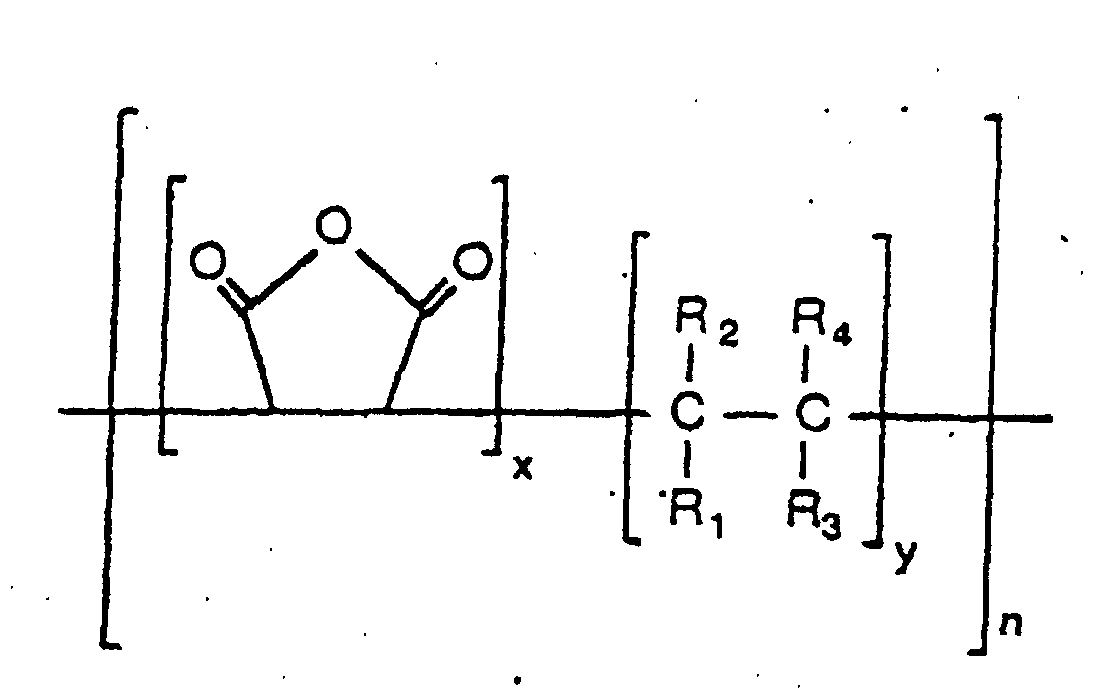
- the present invention provides a copolymer of an unsaturated acidic reactant and a high molecular weight olefin, wherein the ratio of anhydride groups to the hydrocarbon groups is at least 1.3, wherein the olefin is selected from the group consisting of alpha olefin and alkylvinylidene olefin, wherein the olefin has at least 32 carbon atoms, and wherein the copolymer has the formula: wherein n is 2 or greater; and wherein either:
- the present invention provides a copolymer of an unsaturated acidic reactant and a high molecular weight olefin, the copolymer having a ratio of anhydride groups to the hydrocarbon groups that is at least 1.3.
- the ratio of anhydride groups to the hydrocarbon groups is between 1.3 and 2.0.
- the copolymer can be formed by reacting the high molecular weight olefin and the unsaturated acidic reactant in the presence of a free radical initiator.
- copolymers are useful as dispersants themselves and also as intermediates in the preparation of other dispersant additives having improved dispersancy and/or detergency properties when employed in a lubricating oil. They do not contain double bonds, rings, other than succinic anhydride rings, or chlorine (in contrast to thermal and chlorination PIBSAs) and as such have improved stability, as well as improved environmental properties due to the absence of chlorine.
- the high molecular weight olefin has a sufficient number of carbon atoms (at least 32) such that the resulting copolymer is soluble in lubricating oil.
- the olefin is an alpha olefin or an alkylvinylidene olefin.
- the high molecular weight olefin is a high molecular weight alkylvinylidene olefin. More preferably, the olefin has at least 1 branch per 2 carbon atoms along the chain.
- the olefin is polyisobutene having an average molecular weight of 500 to 5000 (more preferably from 900 to 2500), and the alkylvinylidene isomer is methylvinylidene.
- the copolymer has the formula: wherein n is 2 or greater; either R 1 and R 2 are hydrogen and one of R 3 and R 4 is lower alkyl and the other is high molecular weight polyalkyl, or R 3 and R 4 are hydrogen and one of R 1 and R 2 is lower alkyl and the other is high molecular weight polyalkyl; and wherein x and y are 1 or greater, such that the sum of x is at least 1.3 times the sum of y for the total mixture.
- the high molecular weight polyalkyl comprises a polyisobutyl group of at least 50 carbon atoms and the lower alkyl is methyl.
- the present invention is also directed to polysuccinimides that are prepared by reacting a copolymer of the present invention with a polyamine having at least one basic nitrogen atom to give a polysuccinimide.
- the polyamine has the formula H 2 N(YNH) p H wherein Y is alkylene of 2 to 6 carbon atoms and p is an integer from 1 to 6.
- the charge mole ratio of polyamine to succinic groups in copolymer is from about 1 to about 0.1.
- the polysuccinimide can be reacted with a cyclic carbonate or with a boron compound.
- copolymers of the present invention contain greater than 1.3 anhydride groups per hydrocarbon groups
- polysuccinimides made from these will contain a higher concentration of nitrogen than dispersants made with one anhydride group per hydrocarbon group. This may be advantageous, for example, in controlling engine deposits in automobile engines, or in dispersing soot in diesel engines.
- copolymers and polysuccinimides of the present invention contain little if any chlorine (less than 50 ppm). Thus these products are preferable to use from an environmental point of view.
- the present invention is directed to modified polysuccinimides wherein one or more of the nitrogens of the polyamine component is substituted with a hydrocarbyl oxycarbonyl, a hydroxyhydrocarbyl oxycarbonyl or a hydroxy poly(oxyalkylene)-oxycarbonyl.
- modified polysuccinimides are improved dispersants and/or detergents for use in fuels or oils.
- the present invention also relates to a lubricating oil composition
- a lubricating oil composition comprising a major amount of an oil of lubricating viscosity and an amount of a copolymer, polysuccinimide or modified succinimide additive of the present invention sufficient to provide dispersancy and/or detergency.
- the additives of the present invention may also be formulated in lubricating oil concentrates which comprise from 90 to 50 weight percent of an oil of lubricating viscosity and from 10 to 50 weight percent of an additive of the present invention.
- composition aspect of the present invention is a fuel composition
- a fuel composition comprising a major portion of a fuel boiling in a gasoline or diesel range and from 30 to 5000 parts per million of copolymer, polysuccinimide or modified succinimide additives.
- the present invention is also directed to fuel concentrates comprising an inert stable oleophilic organic solvent boiling in the range of 65.6 to 204.4° C (150° F to 400° F) and from 5 to 50 weight percent of an additive of the present invention.
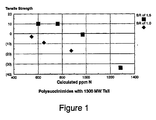
- Figure 1 shows a plot of tensile strength versus calculated ppm N for bpolysuccinimides with 1300 MW tail.
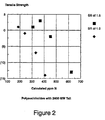
- Figure 2 shows a plot of tensile strength versus calculated ppm N for polysuccinimides with 2400 MW tail.
- the present invention encompasses a random copolymer of an unsaturated acidic reactant and a high molecular weight olefin, wherein the ratio of anhydride groups to the hydrocarbon groups is at least 1.3.
- the olefin is an alpha olefin or alkylvinylidene olefin.
- the olefin has a sufficient number of carbon atoms (at least 32) such that the resulting copolymer is soluble in lubricating oil.
- unsaturated acidic reactants refers to maleic reactants of the general formula: wherein X and X' -O- so as to form maleic anhydride.
- Suitable acidic reactants include electron-deficient olefins such as monophenyl maleic anhydride; monomethyl, dimethyl, monochloro, monobromo, monofluoro, dichloro and difluoro maleic anhydride.
- high molecular weight olefins refers to olefins (including polymerized olefins having a residual unsaturation) of sufficient molecular weight and chain length to lend solubility in lubricating oil to their reaction products. Olefins having 32 carbons or greater (preferably olefins having 52 carbons or more) suffice.
- soluble in lubricating oil refers to the ability of a material to dissolve in aliphatic and aromatic hydrocarbons such as lubricating oils or fuels in essentially all proportions.
- High molecular weight olefins are generally mixtures of molecules having different molecular weights and can have at least one branch per 6 carbon atoms along the chain, preferably at least one branch per 4 carbon atoms along the chain, and particularly preferred that there be one branch per 2 carbon atoms along the chain.
- These branched chain olefins may conveniently comprise polyalkenes prepared by the polymerization of olefins of from 3 to 6 carbon atoms, and preferably from olefins of from 3 to 4 carbon atoms, and more preferably from propylene or isobutylene.
- the addition-polymerizable olefins employed are normally 1-olefins.
- the branch may be of from 1 to 4 carbon atoms, more usually of from 1 to 2 carbon atoms and preferably methyl.
- the high molecular weight olefin is a high molecular weight alkylvinylidene olefin, but it can also be an alpha olefin.
- the preferred alkylvinylidene isomer comprises a methyl- or ethylvinylidene isomer, more preferably the methylvinylidene isomer.
- alkylvinylidene or “alkylvinylidene isomer” refers to high molecular weight olefins and polyalkylene components having the following vinylidene structure wherein R is alkyl or substituted alkyl of sufficient chain length to give the resulting molecule solubility in lubricating oils and fuels, thus R generally has at least 30 carbon atoms, preferably at least 50 carbon atoms and Rv is lower alkyl of 1 to 6 carbon atoms.
- alpha olefin refers to high molecular weight olefins and polyalkylene components having the following structure wherein R is alkyl or substituted alkyl of sufficient chain length to give the resulting molecule solubility in lubricating oils and fuels, thus R generally has at least 30 carbon atoms, preferably at least 50 carbon atoms.
- succinic ratio refers to the average number of succinic groups per polyolefin group in the alkenyl or alkyl succinic anhydride reaction product of maleic anhydride and polyolefin.
- a succinic ratio of 1.0 indicates an average of one succinic group per polyolefin group in the alkenyl or alkyl succinic anhydride product.
- a succinic ratio of 1.35 indicates an average of 1.35 succinic groups per polyolefin group in the alkenyl or alkyl succinic anhydride product, and so forth.
- the succinic ratio can be calculated from the saponification number (mg KOH per gram of sample), the actives content of the alkenyl or alkyl succinic anhydride product and the molecular weight of the starting polyolefin.
- the actives content of the alkenyl or alkyl succinic anhydride product is measured in terms of the actives fraction, wherein an actives fraction of 1.0 is equivalent to 100 weight percent actives. Accordingly, an actives fraction of 0.5 would correspond to 50 weight percent actives.
- the saponification number, P can be measured using known procedures, such as the procedure described in ASTM D94.
- the actives fraction of the alkenyl or alkyl succinic anhydride can be any actives fraction of the alkenyl or alkyl succinic anhydride.
- the especially preferred high molecular weight olefins used to prepare the copolymers of the present invention are polyisobutenes which comprise at least 20% of the more reactive methylvinylidene isomer, preferably at least 50% and more preferably at least 70%.
- Suitable polyisobutenes include those prepared using BF 3 catalysis. The preparation of such polyisobutenes in which the methylvinylidene isomer comprises a high percentage of the total composition is described in U.S. Pat. Nos. 4,152 ,499 and 4,605,808.
- polyisobutenes having average molecular weights of 500 to 5000. Especially preferred are those having average molecular weights of 900 to 2500.
- the copolymers of the present invention are prepared by reacting a high molecular weight olefin and an unsaturated acidic reactant in the presence of a free radical initiator.
- a free radical initiator Preferably, at least 20% of the total olefin composition comprises the alkylvinylidene isomer.
- the copolymers of the present invention differ from the copolymers disclosed in U.S. Patent No. 5,112,507 in that the ratio of anhydride groups to the hydrocarbon groups in the present invention is at least 1.3. Preferably, the ratio is between 1.3 and 2.0.
- Copolymers of an olefin, including high molecular weight olefins with an unsaturated acidic reactant are well known in the art (U.S. Patent Nos. 3,461,108; 3,560,455; 3,560,456; 3,560 457; 3,580,893; 3,706,704; 3,729,450; 3,729,451; and 5,112,507).
- U.S. Patent Nos. 3,461,108; 3,560,455; 3,560,456; 3,560 457; 3,580,893; 3,706,704; 3,729,450; 3,729,451; and 5,112,507 As reported by Trivedi and Culbertson in "Maleic Anhydride: 1982," Plenum Press, pg 288, as a rule, olefin-maleic anhydride copolymerizations, run in the presence of free radical initiators, give only equimolar copolymers.
- an unsaturated acidic reagent to polyolefin charge mole ratio (CMR) of greater than 1.3:1 and a sufficient temperature of breaction to produce a ratio of anhydride groups to hydrocarbon group of at least 1.3:1.
- CMR charge mole ratio
- temperature of the reaction of an unsaturated acidic reagent with an olefin is an important factor. For example, at a CMR of 2.0, a higher ratio of anhydride groups to hydrocarbon chain is obtained at 160° C than at 130° C.
- the CMR and temperature of the reaction can vary over a wide range such that the combination of CMR and temperature is sufficient to produce the desired result.
- the high molecular weight olefins used to prepare the copolymers of the present invention are generally mixtures of individual molecules of different molecular weights, individual copolymer molecules resulting will generally contain a mixture of high molecular weight polyalkyl groups of varying molecular weight.
- high molecular weight polyalkyl refers to polyalkyl groups of sufficient molecular weight and hydrocarbyl chain length that the products prepared having such groups are soluble in lubricating oil. Typically these high molecular weight polyalkyl groups have at least 30 carbon atoms, preferably at least 50 carbon atoms. These high molecular weight polyalkyl groups may be derived from high molecular weight olefins.
- the reaction produces copolymers predominately of the following formula: wherein n is 2 to 100, preferably 2 to 20, more preferably 2 to 10, and R 1 , R 2 , R 3 and R 4 are selected from hydrogen, lower alkyl of about 1 to 6 carbon atoms and higher molecular weight polyalkyl wherein x and y are 1 or greater, such that the sum of x is at least 1.3 times the sum of y for the total mixture.
- R 1 and R 2 are hydrogen and one of R 3 and R 4 is lower alkyl and the other is high molecular weight polyalkyl, or R 3 and R 4 are hydrogen and one of R 1 and R 2 is lower alkyl and the other is high molecular weight polyalkyl.
- the variables x and y can vary over the length of the polymer.
- the high molecular weight polyalkyl group has at least 30 carbon atoms (more preferably at least 50 carbon atoms).
- Preferred high molecular weight polyalkyl groups include polyisobutyl groups.
- Preferred polyisobutyl groups include those having average molecular weights of 500 to 5000, more preferably from 900 to 2500.
- Preferred lower alkyl groups include methyl and ethyl; especially preferred lower alkyl groups include methyl.
- such copolymers contain an initiator group, I, and a terminator group, T, as a result of the reaction with the free radical initiator used in the polymerization reaction.
- the initiator and terminator groups may be where R 7 is hydrogen, alkyl, aryl, alkaryl, cycloalkyl, alkoxy, cycloalkoxy, acyl, alkenyl, cycloalkenyl, alkynyl; or alkyl, aryl or alkaryl optionally substituted with 1 to 4 substituents independently selected from nitrile, keto, halogen, nitro, alkyl, aryl, and the like.
- the initiator group and/or terminator group may be derived from the reaction product of the initiator with another material such as solvent; for example, the initiator may react with toluene to produce a benzyl radical.
- the copolymers of the present invention differ from the PIBSAs prepared by the thermal process in that the thermal process products contain a double bond and a singly substituted succinic anhydride group.
- the copolymers of the present invention differ from the PIBSAs prepared by the chlorination process, since those products contain a double bond, a ring, other than a succinic anhydride ring or one or more chlorine atoms.
- the copolymers of the present invention differ from the copolymers of unsaturated acidic reactants and high molecular weight olefins in that ratio of anhydride groups to hydrocarbon groups is at least 1.3:1.
- the copolymers of the present invention are prepared by reacting a reactive high molecular weight olefin and an unsaturated acidic reactant in the presence of a free radical initiator.
- the reaction may be conducted at a temperature of -30° C. to 210° C., preferably from 120° C. to 180° C.
- the reaction may be conducted neat, that is, both the high molecular weight olefin, and acidic reactant and the free radical initiator are combined in the proper ratio, and then stirred at the reaction temperature.
- the reaction may be conducted in a diluent.
- the reactants may be combined in a solvent.
- suitable solvents include those in which the reactants and free radical initiator are soluble and include acetone, tetrahydrofuran, chloroform, methylene chloride, dichloroethane, toluene, dioxane, chlorobenzene, xylenes, or the like.
- volatile components may be stripped off.
- a diluent it is preferably inert to the reactants and products formed and is generally used in an amount sufficient to ensure efficient stirring.
- the reaction solvent must be one that dissolves both the acidic reactant and the high molecular weight olefin. It is necessary to dissolve the acidic reactant and high molecular weight olefin so as to bring them into intimate contact in the solution polymerization reaction. It has been found that the solvent must also be one in which the resultant copolymers are soluble.
- Suitable solvents include liquid saturated or aromatic hydrocarbons having from six to 20 carbon atoms; ketones having from three to five carbon atoms; and liquid saturated aliphatic dihalogenated hydrocarbons having from one to five carbon atoms per molecule, preferably from one to three carbon atoms per molecule.
- liquid is meant liquid under the conditions of polymerization.
- the halogens are preferably on adjacent carbon atoms.
- halogen is meant F, Cl and Br.
- the amount of solvent must be such that it can dissolve the acidic reactant and high molecular weight olefin in addition to the resulting copolymers.
- the volume ratio of solvent to high molecular weight olefin is suitably between 1:1 and 100:1 and is preferably between 1.5:1 and 4:1.
- Suitable solvents include the ketones having from three to six carbon atoms and the saturated dichlorinated hydrocarbons having from one to five, more preferably one to three, carbon atoms.
- Suitable solvents include, but are not limited to:
- the reaction can also be carried out using a process similar to the one described by U.S. Patent 5,175,225 where the oligomeric copolymer, which is the reaction product of the unsaturated acidic reactant and the high molecular weight olefin, is used as a "solvent" for the unsaturated acidic reactant, free radical initiator, and the high molecular weight olefin.
- the unsaturated acidic reactant, free radical initiator, and high molecular weight olefin are added to a sufficient amount of oligomeric copolymer to afford solubility of the reactants.
- copolymerization can be accomplished in the presence of dispersing agents. This copolymerization is called suspension copolymerization.
- a charge mole ratio (CMR) greater than 1.3 is required to produce the copolymers of this invention.
- the CMR is defined as the ratio of the number of moles of maleic anhydride to the number of moles of polybutene.
- the temperature of reaction must be sufficient to facilitate the production of copolymer with a succinic ratio greater than 1.3. Generally, temperatures in excess of 110° C are required. However, the temperature required to produce a copolymer with a succinic ratio greater than 1.3 is also dependent on the CMR and the concentration. In general, the higher the CMR and the more concentrated the reaction mixture, the lower the temperature of reaction that is required to produce a copolymer with greater than a 1.3 succinic ratio.
- the copolymerization can be initiated by any free radical initiator.
- free radical initiator are well known in the art.
- the choice of free radical initiator may be influenced by the reaction temperature employed.
- the preferred free-radical initiators are the peroxide-type polymerization initiators and the azo-type polymerization initiators. Radiation can also be used to initiate the reaction, if desired.
- the peroxide-type free-radical initiator can be organic or inorganic, the organic having the general formula: R 3 OOR 3 ' where R 3 is any organic radical and R 3 ' is selected from the group consisting of hydrogen and any organic radical. Both R 3 and R 3 ' can be organic radicals, preferably hydrocarbon, aroyl, and acyl radicals, carrying, if desired, substituents such as halogens, etc.
- Preferred peroxides include di-tert-butyl peroxide, tert-butyl peroxybenzoate, and dicumyl peroxide.
- Examples of other suitable peroxides include benzoyl peroxide; lauroyl peroxide; other tertiary butyl peroxides; 2,4-dichlorobenzoyl peroxide; tertiary butyl hydroperoxide; cumene hydroperoxide; diacetyl peroxide; acetyl hydroperoxide; diethylperoxycarbonate; tertiary butyl perbenzoate; and the like.
- suitable azo compounds include, but are not limited to, p-bromobenzenediazonium fluoborate; p-tolyldiazoaminobenzene; p-bromobenzenediazonium hydroxide; azomethane and phenyldiazonium halides.
- a suitable list of azo-type compounds can be found in U.S. Pat. No. 2,551,813, issued May 8, 1951 to Paul Pinkney.
- the amount of initiator to employ, exclusive of radiation, of course, depends to a large extent on the particular initiator chosen, the high molecular olefin used and the reaction conditions.
- the initiator must, of course, be soluble in the reaction medium.
- concentrations of initiator are between 0.001:1 and 0.2:1 moles of initiator per mole of acidic reactant, with preferred amounts between 0.005:1 and 0.10:1.
- the polymerization temperature must be sufficiently high to decompose the initiator to produce the desired free-radicals.
- a suitable initiator is ditertiarybutyl peroxide, which decomposes at a sufficient rate over the temperature range of 120° to 180° C.
- the reaction pressure should be sufficient to maintain the solvent and the free radical initiator in the liquid phase. Pressures can therefore vary between about atmospheric and 786 kPa (100 psig) or higher.
- the reaction time is usually sufficient to result in the substantially complete conversion of the acidic reactant and high molecular weight olefin to copolymer.
- the reaction time is suitable between one and 24 hours, with preferred reaction times between two and ten hours.
- the copolymer is conveniently separated from solvent and unreacted acidic reactant by conventional procedures such as phase separation, solvent bdistillation, precipitation and the like. If desired, dispersing agents and/or cosolvents may be used during the reaction.
- the isolated copolymer may then be reacted with a polyamine to form a polymeric succinimide.
- a polyamine to form a polymeric succinimide.
- Preferred copolymers include those prepared using a polyisobutene of average molecular weight of 500 to 5000, preferably of 950 to 2500 and wherein at least 50 percent of the total polyisobutene comprises the alkylvinylidene isomer.
- Preferred alkylvinylidene isomers include methylvinylidene and ethylvinylidene. Especially preferred is methylvinylidene.
- Particularly preferred copolymers have an average molecular weight of 900 to 2500.
- the copolymer of the present invention can be reacted with a polyamine having at least one basic nitrogen atom to form polyamino polysuccinimides.
- Polysuccinimides that may be prepared include monopolysuccinimides, bis-polysuccinimides, higher succinimides, or mixtures thereof.
- the polysuccinimides produced may depend on the charge mole ratio of polyamine to succinic groups in the copolymer molecule and the particular polyamine used. Charge mole ratios of polyamine to succinic group in copolymer of about 1:1 may produce predominately monopolysuccinimide.
- Charge mole ratios of polyamine to succinic group in copolymer of about 1:2 may produce predominately bis-polysuccinimide. Higher polysuccinimides may be produced if there is branching in the polyamine so that it may react with a succinic group from each of greater than two copolymer molecules. Preferably, the charge mole ratio of polyamine to succinic groups in copolymer is from 1:1 to 0.1:1.
- the polyamine employed to prepare the polyamino polysuccinimides is preferably polyamine having from 2 to 12 amine nitrogen atoms and from 2 to 40 carbon atoms.
- the polyamine is so selected so as to provide at least one basic amine per succinimide group.
- the polyamine preferably has a carbon-to-nitrogen ratio of from 1:1 to 10:1.
- the more preferred polyamines employed in this reaction are generally represented by the formula: H 2 N(YNH) a H wherein Y is an alkylene group of 2 to 10 carbon atoms, preferably from 2 to 6 carbon atoms, and a is an integer from about 1 to 11, preferably from 1 to 6.
- Y is an alkylene group of 2 to 10 carbon atoms, preferably from 2 to 6 carbon atoms
- a is an integer from about 1 to 11, preferably from 1 to 6.
- the preparation of these alkylene polyamines does not produce a single compound and cyclic heterocycles, such as piperazine, may be included to some extent in the alkylene diamines.
- U.S. Patent 5,112,507 for a full description of preferred polyamines.
- Preferred monopolysuccinimides include those having the following formula: wherein Am is a linking group having from 0 to 10 amine nitrogen atoms and from 2 to 40 carbon atoms; n is 1 or greater; R 5 and R 6 are independently hydrogen, lower alkyl of 1 to 6 carbon atoms, phenyl or taken together are alkylene of 3 to 6 carbon atoms to give a ring; and wherein x and y are 1 or greater, such that the sum of x is at least 1.3 times the sum of y for the total mixture.
- R 1 , R 2 , R 3 , and R 4 are selected so that either R 1 and R 2 are hydrogen and one of R 3 and R 4 is lower alkyl and the other is high molecular weight polyalkyl, or R 3 and R 4 are hydrogen and one of R 1 and R 2 is lower alkyl and the other is high molecular weight polyalkyl.
- Preferred polysuccinimides include those which partially comprise at least in part a bis-polysuccinimide structure. Some of these preferred polysuccinimides are random polysuccinimides that comprise units selected from: and wherein Am is a linking group having from 0 to 10 amine nitrogen atoms and from 2 to 40 carbon atoms; R 1 , R 2 , R 3 , R 4 , R 1 ', R 2 ', R 3 ', R 4 ' , R 1 '', R 2 '', R", and R 4 " are selected from hydrogen, lower alkyl of one to 6 carbon atoms and high molecular weight polyalkyl, wherein x, y; and y' are 1 or greater, such that the sum of x is at least 1.3 times the combined sum of y and y' for the total mixture; and a, a', b and b' are sites for a covalent bond; provided that at least one a or a' site of each unit is covalent
- R 1 and R 2 are hydrogen and one of R 3 and R 4 is lower alkyl and the other is polyalkyl, or R 3 and R 4 are hydrogen and one of R 1 and R 2 is lower alkyl and the other is polyalkyl; either R 1 ' and R 2 ' are hydrogen and one of R 3 ' and R 4 ' is lower alkyl and the other is polyalkyl, or R 3 ' and R 4 ' are hydrogen and one of R 1 ' and R 2 ' is lower alkyl and the other is polyalkyl; and either R 1 " and R 2 " are hydrogen and one of R 3 “ and R 4 " is lower alkyl and the other is polyalkyl or R 3 " and R 4 " are hydrogen and one of R 1 " and R 2 '' is lower alkyl and the other is polyalkyl and R 5 and R 6 are independently hydrogen, lower alkyl of 1 to 6 carbon atoms, phenyl or taken together are alkylene of 3 to 6 carbon atoms to give a ring.
- Preferred high molecular weight polyalkyl groups include polyisobutyl groups having at least 30 carbon atoms, more preferably, at least 50 carbon atoms. Especially preferred are polyisobutyl groups having an average molecular weight of 500 to 5000, more preferably from 900 to 2500.
- Preferred lower alkyl groups include methyl and ethyl. Especially preferred are compounds where the lower alkyl group is methyl.
- R 5 and R 6 are hydrogen or methyl.
- Especially preferred R 5 and R 6 groups include hydrogen.
- Am groups having from 0 to 10 amine nitrogen atoms and from about 2 to about 40 carbon atoms. More preferred are Am groups of the formula ⁇ [(ZNH) p Z'] ⁇ wherein Z and Z' are independently alkylene of from about 2 to about 6 carbon atoms and p is an integer from 1 to 6. Especially preferred are Am groups where Z and Z' are ethylene and p is 2, 3 or 4.
- Higher polysuccinimides are prepared by reacting the copolymers of the present invention with a polyamine having branching such that it can react with a succinic group from each of greater than two copolymer molecules. Due to this crosslinking, it is believed that these higher polysuccinimides may have gel-like properties besides the dispersant properties possessed by the other polysuccinimides.
- a polysuccinimide having at least one primary or secondary amine group can be reacted with a cyclic carbonate or it can be reacted with a boron compound, such as boron oxide, boron halide, boric acid or esters of boric acid.
- a boron compound such as boron oxide, boron halide, boric acid or esters of boric acid.
- the copolymers, polysuccinimides and modified polysuccinimides of this invention are useful as detergent and dispersant additives when employed in lubricating oils and lubricating oil concentrates.
- the lubricating oil composition has an oil of lubricating viscosity and a dispersant effective amount of the copolymers, polysuccinimides or modified polysuccinimides.
- the lubricating oil concentrate has from 90 to 50 weight percent of an oil of lubricating viscosity and from 10 to 50 weight percent of copolymers, polysuccinimides or modified polysuccinimides.
- additives which may be present in the formulation include rust inhibitors, foam inhibitors, corrosion inhibitors, metal deactivators, pour point depressants, antioxidants, V.l. improvers (either dispersant or nondispersant), and a variety of other well-known additives. It is also contemplated the additives of this invention may be employed as dispersants and detergents in hydraulic fluids, marine crankcase lubricants and the like.
- the copolymers, polysuccinimides and modified polysuccinimides of this invention are useful in fuel compositions and fuel concentrates.
- the fuel composition has a hydrocarbon boiling in a gasoline or diesel range and from 30 to 5000 parts per million of copolymers, polysuccinimides or modified polysuccinimides.
- the fuel concentrate has an inert stable oleophilic organic solvent boiling in the range of 65.6° C to 204.4° C (150° F. to 400°F.) and from 5 to 50 weight percent copolymers, polysuccinimides or modified polysuccinimides.
- Example 1 Preparation of a copolymer from maleic anhydride and polybutene with 1300 molecular weight and a CMR of 2.0.
- Example 2 Preparation of a copolymer from maleic anhydride and polybutene with 2400 molecular weight and a CMR of 2.0.
- Example one The procedure in Example one was repeated except that instead of using polybutene of 1300 molecular weight, 8310 g (3.46 mol) polybutene of 2400 molecular weight, (Glissopal EC 3252), was used.
- the maleic anhydride/polybutene charge mole ratio was 2.0 and the di-t-butylperoxide/polybutene charge mole ratio was 0.05.
- Example 1 and 2 show that a copolymer with a succinic ratio of 1.5 is produced in good yield over a range of polybutene molecular weights (1300 to 2400) at 160° C reaction temperature and a CMR of 2.0.
- Example 3 Preparation of a copolymer from maleic anhydride and polybutene with 1300 molecular weight using a CMR of 1.0.
- the residue was dissolved in hexane and filtered to remove unreacted maleic anhydride.
- the hexane was removed in a vacuum.
- the product had a SAP number of 45.0 and contained 59.3 % actives.
- the succinic ratio was calculated to be 1.0.
- Example 3 shows that when a CMR of 1.0 was used and a temperature of 140° C was used a copolymer with a succinic ratio greater than 1.3 was not produced.
- Example 4 Preparation of a copolymer from maleic anhydride and polybutene with 1300 molecular weight using a CMR of 0.33.
- Example 3 The procedure of Example 3 was repeated exactly except that 0.15 mol polybutene and 0.05 mol maleic anhydride was used. This product had a SAP number of 15.0 mg KOH/g sample and contained 31.7 % actives. The succinic ratio was calculated to be 0.6.
- Example 4 shows that when a CMR of 0.33 was used at a temperature of 140° C a copolymer with a succinic ratio greater than 1.3 was not produced.
- Example 5 Preparation of a copolymer from maleic anhydride and polybutene with 1300 molecular weight using a CMR of 3.0.
- Example 3 The procedure of Example 3 was repeated exactly except that 0.05 mol polybutene and 0.15 mol maleic anhydride was used. This product had a SAP number of 78.1 mg KOH/g sample and contained 67 % actives. The succinic ratio was calculated to be 1.5.
- Example 5 shows that when a CMR of 3.0 was used at a temperature of 140° C a copolymer with a succinic ratio of 1.5 was produced.
- Example 6 Preparation of a copolymer from maleic anhydride and polybutene with 1300 molecular weight with a CMR of 3.0 using a di-t-amyl peroxide.
- Example 5 The procedure of Example 5 was repeated exactly except that di-t-amylperoxide (1.74 g, 0.01 mol) was used instead of di-t-butylperoxide.
- the product from this reaction had a SAP number of 82.1 mg KOH/g sample and contained 65 % actives.
- the succinic ratio was calculated to be 1.6.
- Example 6 shows that other initiators besides di-t-butylperoxide can be used.
- Example 7 Preparation of a copolymer from maleic anhydride and polybutene with 1300 molecular weight with a CMR of 3.0 using t-butylperoctoate at 84° C.
- Example 7 shows that when the temperature of reaction is 84° C using a CMR of 3.0, a copolymer with a succinic ratio greater than 1.3 was not produced.
- Example 8 Preparation of a copolymer from maleic anhydride and polybutene with 2400 molecular weight with a CMR of 2.0 in 100 neutral oil as diluent at 130° C.
- Example 8 shows that 100 neutral oil is a satisfactory diluent oil for the reaction.
- the succinic ratio was less than 1.3, however, due to a combination of low CMR (2.0) and temperature (130° C).
- Example 9 Preparation of a copolymer from maleic anhydride and polybutene with 2400 molecular weight with a CMR of 2.0 in 100 neutral oil as diluent at 160° C.
- Example 8 The procedure of Example 8 was repeated exactly except that 160° C was used. This product had a SAP number of 40.9 mg KOH/g sample and contained 53.2 % actives. The succinic ratio was calculated to be 1.8.
- Example 10 Preparation of a polysuccinimide using the copolymer from Example 1, and DETA as the polyamine.
- Example 10 The procedure of Example 10 was followed exactly except that different polyamine/copolymer CMRs and different polyamines were used. The products produced are reported in Table 1. The succinic ratio was 1.5.
- Example 18 Preparation of a post treated polysuccinimide using a cyclic carbonate.
- Example 18 The procedure of Example 18 was repeated except that 313.5 g of the bis TETA PIBSA 1300 polysuccinimide from Example 15 was used. This was reacted with 30.0 g (0.34 mol) ethylene carbonate. The properties of this product are reported in Table 1.
- Example 20 Preparation of post treated polysuccinimide using TEPA as the polyamine.
- Example 18 The procedure of Example 18 was repeated except that 316.2 g of the bis TEPA PIBSA 1300 polysuccinimide from Example 16 was used. This was reacted with 38.6 g (0.439 mol) ethylene carbonate. The properties of this product are reported in Table 1.
- Example 21 Preparation of post treated polysuccinimide using HPA as the polyamine.
- Example 18 The procedure of Example 18 was repeated except that 326.8 g of the bis HPA PIBSA 1300 polysuccinimide from Example 17 was used. This was reacted with 62.8 g (0.714 mol) ethylene carbonate. The properties of this product are reported in Table 1.
- Example 22 Preparation of a polysuccinimide using the copolymer from Example 2 and DETA as the polyamine.
- Example 23-29 Preparation of polysuccinimides using different CMRs and different polyamines.
- Example 22 The procedure of Example 22 was repeated except that different polyamines and different polyamine/copolymer CMRs were used. The analytical data for these compounds are reported in Table 1. The succinic ratio was 1.5.
- Example 30 Preparation of post treated polysuccinimide using a cyclic carbonate.
- Example 31-33 Preparation of other post treated polysuccinimides using a cyclic carbonate.
- Example 30 The procedure of Example 30 was followed except that different polysuccinimides were used. These all used an ethylene carbonate/basic nitrogen CMR of 2.0. These products were analyzed and the data is reported in Table 1.
- Example A Preparation of a polysuccinimide from a copolymer that contains a succinic ratio of less than about 1.3 and a polybutene molecular weight of 1300.
- Example 10 The procedure of Example 10 was followed except that a copolymer with a succinic ratio of less than 1.3 was used. DETA was used as the polyamine. The product was analyzed and found to contain 0.74 % N, and a viscosity @ 100° C of 1193 ⁇ 10 -6 m 2 s -1 (cSt).
- Example B-D Preparation of polysuccinimides from a copolymer that contains a succinic ratio of less than about 1.3 with different polyamines.
- Example A The procedure of Example A was followed using TETA, TEPA, and HPA. These products were analyzed and the data is reported in Table 1.
- Example E Preparation of a polysuccinimide from a copolymer that contains a succinic ratio of less than about 1.3 and a polybutene molecular weight of 2400.
- Example 22 The procedure of Example 22 was followed except that a copolymer with a succinic ratio of less than 1.3 was used. DETA was used as the polyamine. The product was analyzed and found to contain 0.31 % N, had a TBN of 3.3, and had a viscosity @ 100° C of 571 x 10 -6 m 2 s -1 (cSt).
- Examples F-H Preparation of polysuccinimides from a copolymer that contains a succinic ratio of less than about 1.3 with different polyamines.
- Example D The procedure of Example D was followed except that TETA, TEPA and HPA were used instead of DETA. These products were analyzed and the data is reported in Table I.
- Examples A through H had a succinic ratio of 1.0.
- the VW3334 (September 1987) Seal Swell Test was carried out on samples of Viton from the Parker Prudifa Company, which were cut into dumbbell shapes, using a formulated lubricating test oil that contained succinimide dispersant, overbased detergent, antioxidant and viscosity index improver materials at a bath temperature of 150°C for a 96 hour immersion time.
- the immersion procedure was similar to ASTM D471-79 Standard Test Method for Rubber Property-Effect of Liquids.
- the Viton samples were then subjected to analysis of their tensile properties using procedures similar to ASTM D412-87 Standard Test Method for Rubber Properties in Tension.
- V.I. for the same examples as 26-33 except that the conventional thermal PIBSA was used is shown in the following table.
- Exxon 100N V.I.
- Exxon 600N bis DETA 10 140 105 bis TETA 10 133 99 bis TEPA 10 128 103 bis HPA 10 141 110 EC bis DETA 10 129 99 EC bis TETA 10 123 102 EC bis TEPA 10 124 103 EC bis HPA 10 133 105
Landscapes
- Chemical & Material Sciences (AREA)
- Oil, Petroleum & Natural Gas (AREA)
- Organic Chemistry (AREA)
- Chemical Kinetics & Catalysis (AREA)
- General Chemical & Material Sciences (AREA)
- Health & Medical Sciences (AREA)
- Engineering & Computer Science (AREA)
- Medicinal Chemistry (AREA)
- Polymers & Plastics (AREA)
- Emergency Medicine (AREA)
- Combustion & Propulsion (AREA)
- Addition Polymer Or Copolymer, Post-Treatments, Or Chemical Modifications (AREA)
- Lubricants (AREA)
Claims (20)
- Copolymère d'un corps réactionnel acide insaturé et d'une oléfine de haut poids moléculaire, dans lequel le rapport des groupes anhydride aux groupes hydrocarbonés est égal à au moins 1,3, dans lequel l'oléfine est choisie dans le groupe consistant en une alpha-oléfine et une oléfine alkylvinylidène, dans lequel l'oléfine possède au moins 32 atomes de carbone, le copolymère répondant à la formule :dans laquelle n est égal ou supérieur à 2 ; et
dans laquelle soit :dans laquelle x et y sont égaux ou supérieurs à 1, de telle sorte que la somme de x soit égale à au moins 1,3 fois la somme de y pour le mélange total(1) R1 et R2 représentent des atomes d'hydrogène et un des groupes R3 et R4 représente un groupe alkyle inférieur et l'autre représente un groupe polyalkyle de haut poids moléculaire, soit(2) R3 et R4 représentent des atomes d'hydrogène et un des groupes R1 et R2 représente un groupe alkyle inférieur et l'autre représente un groupe polyalkyle de haut poids moléculaire ; et - Copolymère suivant la revendication 1, dans lequel le rapport des groupes anhydride aux groupes hydrocarbonés est compris dans l'intervalle de 1,3 à 2,0.
- Copolymère suivant la revendication 1, dans lequel le corps réactionnel acide comprend l'anhydride maléique.
- Copolymère suivant la revendication 1, dans lequel l'oléfine de haut poids moléculaire est une oléfine alkylvinylidène de haut poids moléculaire ayant au moins une ramification pour 2 atomes de carbone le long de la chaíne.
- Copolymère suivant la revendication 4, dans lequel l'oléfine a un poids moléculaire moyen compris dans l'intervalle de 500 à 5000.
- Copolymère suivant la revendication 5, dans lequel l'oléfine a un poids moléculaire moyen compris dans l'intervalle de 900 à 2500.
- Copolymère suivant la revendication 4, dans lequel l'oléfine alkylvinylidène est le polyisobutène.
- Copolymère suivant la revendication 7, dans lequel l'oléfine alkylvinylidène est l'isomère méthylvinylidène du polyisobutène.
- Copolymère suivant la revendication 1, dans lequel le groupe polyalkyle de haut poids moléculaire comprend un groupe polyisobutyle ayant au moins 50 atomes de carbone.
- Copolymère suivant la revendication 9, dans lequel le groupe alkyle inférieur est un groupe méthyle.
- Polysuccinimide préparé en faisant réagir un copolymère suivant la revendication 1 avec une polyamine ayant au moins un atome d'azote basique.
- Polysuccinimide suivant la revendication 11, dans lequel la polyamine répond à la formule H2N(YNH)aH dans laquelle Y représente un groupe alkylène ayant 2 à 6 atomes de carbone et a est un nombre entier de 1 à 6.
- Polysuccinimide suivant la revendication 12, dans lequel le rapport molaire de charge de la polyamine aux groupes succiniques dans le copolymère est compris dans l'intervalle de 1 à 0,1.
- Produit préparé par le procédé qui comprend la réaction d'un polysuccinimide suivant la revendication 11 avec un carbonate cyclique, le polysuccinimide ayant au moins un groupe amine primaire ou secondaire.
- Produit préparé par le procédé qui comprend la réaction d'un polysuccinimide suivant la revendication 11 avec un composé de bore choisi dans le groupe consistant en l'oxyde de bore, un halogénure de bore, un acide borique et des esters d'acide borique.
- Composition d'huile lubrifiante comprenant une huile de viscosité propre à la lubrification et une quantité, efficace comme dispersant, d'un polysuccinimide suivant la revendication 11.
- Concentré d'huile lubrifiante comprenant 90 à 50 % en poids dune huile de viscosité propre à la lubrification et 10 à 50 % en poids d'un polysuccinimide suivant la revendication 11.
- Composition de carburant comprenant un hydrocarbure bouillant dans la plage de l'essence ou du carburant diesel et 30 à 5000 parties par million d'un polysuccinimide suivant la revendication 11.
- Concentré de carburant comprenant un solvant organique oléophile stable inerte bouillant dans la plage de 66°C à 204°C (150°F à 400°F) et 5 à 50 % en poids d'un polysuccinimide suivant la revendication 11.
- Procédé pour la préparation d'un copolymère suivant la revendication 1, qui comprénd l'étape de réaction dune oléfine de haut poids moléculaire avec un corps réactionnel acide insaturé en présence d'un initiateur radicalaire.
Applications Claiming Priority (2)
| Application Number | Priority Date | Filing Date | Title |
|---|---|---|---|
| US16587193A | 1993-12-13 | 1993-12-13 | |
| US165871 | 1998-10-02 |
Publications (2)
| Publication Number | Publication Date |
|---|---|
| EP0657475A1 EP0657475A1 (fr) | 1995-06-14 |
| EP0657475B1 true EP0657475B1 (fr) | 2003-06-04 |
Family
ID=22600829
Family Applications (1)
| Application Number | Title | Priority Date | Filing Date |
|---|---|---|---|
| EP94309294A Expired - Lifetime EP0657475B1 (fr) | 1993-12-13 | 1994-12-13 | Dispersants polymères comportant des groupes polyalkylène et succinniques |
Country Status (5)
| Country | Link |
|---|---|
| US (2) | US5565528A (fr) |
| EP (1) | EP0657475B1 (fr) |
| JP (1) | JP3001385B2 (fr) |
| DE (1) | DE69432781T2 (fr) |
| SG (1) | SG70986A1 (fr) |
Families Citing this family (76)
| Publication number | Priority date | Publication date | Assignee | Title |
|---|---|---|---|---|
| US6160054A (en) | 1995-05-08 | 2000-12-12 | Fmc Corporation | Hetero-telechelic polymers and processes for making same |
| HU213255B (en) * | 1995-09-25 | 1997-05-28 | Mol Magyar Olaj Es Gazipari Rt | Multiple- stage engineoil and lubricant composition and additive-pocket |
| US5616153A (en) * | 1995-10-03 | 1997-04-01 | Ethyl Corporation | Copolymer dispersants via vinyl terminated propene polymers |
| US5716912A (en) * | 1996-04-09 | 1998-02-10 | Chevron Chemical Company | Polyalkylene succinimides and post-treated derivatives thereof |
| US5821205A (en) * | 1995-12-01 | 1998-10-13 | Chevron Chemical Company | Polyalkylene succinimides and post-treated derivatives thereof |
| US6040031A (en) * | 1996-03-13 | 2000-03-21 | Nec Corporation | Contact recording magnetic disk device |
| US5792729A (en) * | 1996-08-20 | 1998-08-11 | Chevron Chemical Corporation | Dispersant terpolymers |
| US5753597A (en) * | 1996-08-20 | 1998-05-19 | Chevron Chemical Company | Polymeric dispersants |
| US5880070A (en) * | 1996-08-20 | 1999-03-09 | Chevron Chemical Company | Cross-linked succinimides from an acid derivative, a polyamine, and a polycarboxylic acid derivative |
| US5849047A (en) * | 1996-11-01 | 1998-12-15 | Ethyl Corporation | Polymeric dispersants and method of making same |
| US5733993A (en) * | 1996-11-14 | 1998-03-31 | Ethyl Corporation | Polymeric dispersants via novel terpolymers |
| US6100224A (en) * | 1997-10-01 | 2000-08-08 | Exxon Chemical Patents Inc | Copolymers of ethylene α-olefin macromers and dicarboxylic monomers and derivatives thereof, useful as additives in lubricating oils and in fuels |
| US6015863A (en) * | 1998-04-02 | 2000-01-18 | Ethyl Corporation | Polymeric mannich additives |
| US6015776A (en) * | 1998-09-08 | 2000-01-18 | Chevron Chemical Company | Polyalkylene polysuccinimides and post-treated derivatives thereof |
| DE19847868C2 (de) * | 1998-10-16 | 2003-09-25 | Clariant Gmbh | Sprengstoffe, enthaltend modifizierte Copolymere aus Polyisobutylen und Maleinsäureanhydrid als Emulgatoren |
| WO2000075217A1 (fr) * | 1999-06-09 | 2000-12-14 | Nippon Shokubai Co., Ltd. | Derive de (co)polymere de polysuccinimide et son procede de production |
| US6214775B1 (en) | 1999-10-13 | 2001-04-10 | Chevron Chemical Company Llc | Haze-free post-treated succinimides |
| US6451920B1 (en) | 1999-11-09 | 2002-09-17 | Chevron Chemical Company Llc | Process for making polyalkylene/maleic anhydride copolymer |
| US6906191B2 (en) | 1999-12-27 | 2005-06-14 | Idemitsu Kosan Co., Ltd. | Succinimide compounds and use thereof |
| DE10123553A1 (de) | 2001-05-15 | 2002-11-21 | Basf Ag | Verfahren zur Herstellung von Polyalkenylsuccinimidprodukten, neue Polyalkenylsuccinimidprodukte mit verbesserten Eigenschaften, Zwischenprodukte und Verwendungen |
| US20030024619A1 (en) * | 2001-06-29 | 2003-02-06 | Coolbaugh Thomas Smith | Explosive emulsion compositions containing modified copolymers of isoprene, butadiene, and/or styrene |
| US6906011B2 (en) * | 2001-11-09 | 2005-06-14 | Chevron Oronite Company Llc | Polymeric dispersants prepared from copolymers of low molecular weight polyisobutene and unsaturated acidic reagent |
| US7238650B2 (en) * | 2002-06-27 | 2007-07-03 | The Lubrizol Corporation | Low-chlorine, polyolefin-substituted, with amine reacted, alpha-beta unsaturated carboxylic compounds |
| EP1386956B1 (fr) * | 2002-07-30 | 2009-07-01 | Chevron Oronite S.A. | Composition d'additifs pour huile de transmission contenant du borate de metal alkalin hydraté et du nitrure de bore héxagonal |
| US7091306B2 (en) * | 2003-05-09 | 2006-08-15 | Chevron Oronite Company Llc | Process for preparing polyalkenylsuccinimides |
| US7256242B2 (en) * | 2003-06-27 | 2007-08-14 | Chevron Oronite Company, Llc | Esterified copolymers of polyalkenes/unsaturated acidic reagents useful as lubricant and fuel additives |
| US7884058B2 (en) * | 2003-09-30 | 2011-02-08 | Chevron Oronite Company Llc | Stable colloidal suspensions and lubricating oil compositions containing same |
| ES2403780T3 (es) * | 2003-11-28 | 2013-05-21 | Chevron Oronite S.A. | Composición de aditivo para aceite de transmisión |
| US7645728B2 (en) * | 2004-02-17 | 2010-01-12 | Afton Chemical Corporation | Lubricant and fuel additives derived from treated amines |
| US7879774B2 (en) * | 2004-07-19 | 2011-02-01 | Afton Chemical Corporation | Titanium-containing lubricating oil composition |
| US7875576B2 (en) * | 2004-07-29 | 2011-01-25 | Chevron Oronite Company Llc | Lubricating oil composition for internal combustion engines |
| US7705090B2 (en) * | 2004-08-20 | 2010-04-27 | Chevron Oronite Company Llc | Method for preparing polyolefins containing a high percentage of exo-olefin chain ends |
| AU2005277275B2 (en) * | 2004-08-20 | 2011-10-20 | Chevron Oronite Company Llc | Method for preparation of polyolefins containing exo-olefin chain ends |
| CA2528380C (fr) * | 2004-11-30 | 2013-05-14 | Infineum International Limited | Compositions d'huile lubrifiante a faible teneur en cendres sulfatees contenant un detergent surbasique |
| US20060135375A1 (en) | 2004-12-21 | 2006-06-22 | Chevron Oronite Company Llc | Anti-shudder additive composition and lubricating oil composition containing the same |
| US7674364B2 (en) * | 2005-03-11 | 2010-03-09 | Chevron U.S.A. Inc. | Hydraulic fluid compositions and preparation thereof |
| US8138130B2 (en) * | 2005-03-31 | 2012-03-20 | Chevron Oronite Company Llc | Fused-ring aromatic amine based wear and oxidation inhibitors for lubricants |
| EP1757673B1 (fr) | 2005-08-23 | 2020-04-15 | Chevron Oronite Company LLC | Composition lubrifiante pour un moteur à combustion interne |
| ES2660902T3 (es) * | 2005-12-28 | 2018-03-26 | Bridgestone Corporation | Composición de caucho con buenas propiedades de tracción en húmedo y bajo contenido de aceite aromático |
| US8013073B2 (en) * | 2005-12-30 | 2011-09-06 | Chevron Oronite Company Llc | Method for preparing polyolefins containing vinylidine end groups using nonaromatic heterocyclic compounds |
| US7816459B2 (en) * | 2005-12-30 | 2010-10-19 | Chevron Oronite Company Llc | Method for preparing polyolefins containing vinylidine end groups using polymeric nitrogen compounds |
| US7700673B2 (en) * | 2006-12-22 | 2010-04-20 | Bridgestone Corporation | Reduced oil rubber compositions including N-substituted polyalkylene succinimide derivates and methods for preparing such compositions |
| CN101486807B (zh) | 2007-12-31 | 2013-09-11 | 株式会社普利司通 | 引入橡胶组合物的金属皂及金属皂引入橡胶组合物的方法 |
| US8394897B2 (en) * | 2008-03-25 | 2013-03-12 | Chevron Oronite Company Llc | Production of vinylidene-terminated polyolefins via quenching with monosulfides |
| US20090258803A1 (en) * | 2008-04-14 | 2009-10-15 | Harrison James J | Copolymers made with quasi-living polyolefins and unsaturated acidic reagents, dispersants using same, and methods of making same |
| US8063154B2 (en) | 2008-06-24 | 2011-11-22 | The University Of Southern Mississippi | Preparation of exo-olefin terminated polyolefins via quenching with alkoxysilanes or ethers |
| ES2582231T3 (es) * | 2008-06-26 | 2016-09-09 | Bridgestone Corporation | Composiciones de caucho que incluyen derivados de poliisobutileno funcionalizado con metal y métodos para preparar tales composiciones |
| US20100016191A1 (en) * | 2008-07-18 | 2010-01-21 | Harrison James J | Copolymers Made With Allyl-Terminated Polyolefins And Unsaturated Acidic Reagents, Dispersants Using Same, and Methods of Making Same |
| JP2010077403A (ja) * | 2008-08-29 | 2010-04-08 | Sanyo Chem Ind Ltd | 潤滑油添加剤及び潤滑油組成物 |
| US9029304B2 (en) * | 2008-09-30 | 2015-05-12 | Chevron Oronite Company Llc | Lubricating oil additive composition and method of making the same |
| US8153566B2 (en) * | 2008-09-30 | 2012-04-10 | Cherron Oronite Company LLC | Lubricating oil compositions |
| US8133954B2 (en) | 2008-10-22 | 2012-03-13 | Chevron Oronite Company Llc | Production of vinylidene-terminated and sulfide-terminated telechelic polyolefins via quenching with disulfides |
| US20100160193A1 (en) * | 2008-12-22 | 2010-06-24 | Chevron Oronite LLC | Additive composition and method of making the same |
| US8859473B2 (en) * | 2008-12-22 | 2014-10-14 | Chevron Oronite Company Llc | Post-treated additive composition and method of making the same |
| US8344073B2 (en) | 2009-01-16 | 2013-01-01 | The University Of Southern Mississippi | Functionalization of polyolefins with phenoxy derivatives |
| US8389609B2 (en) | 2009-07-01 | 2013-03-05 | Bridgestone Corporation | Multiple-acid-derived metal soaps incorporated in rubber compositions and method for incorporating such soaps in rubber compositions |
| US9803060B2 (en) * | 2009-09-10 | 2017-10-31 | Bridgestone Corporation | Compositions and method for making hollow nanoparticles from metal soaps |
| US8901050B2 (en) | 2010-03-31 | 2014-12-02 | Chevron Oronite Company Llc | Method for improving copper corrosion performance |
| US8933001B2 (en) | 2010-03-31 | 2015-01-13 | Chevron Oronite Company Llc | Method for improving fluorocarbon elastomer seal compatibility |
| US8492491B2 (en) | 2010-06-10 | 2013-07-23 | Chevron Oronite Company Llc | Methods for producing telechelic polyolefins from terpene initiators |
| US8592527B2 (en) | 2010-06-14 | 2013-11-26 | University Of Southern Mississippi | Vinyl ether end-functionalized polyolefins |
| US8802755B2 (en) | 2011-01-18 | 2014-08-12 | Bridgestone Corporation | Rubber compositions including metal phosphate esters |
| US8969484B2 (en) | 2011-07-08 | 2015-03-03 | Chevron Oronite Company Llc | Methods of producing mono- and multi-functional polymers from terpene-based initiators |
| EP2914654B1 (fr) | 2012-11-02 | 2017-05-31 | Bridgestone Corporation | Compositions de caoutchouc comportant des carboxylates métalliques et leurs procédés de fabrication |
| CN113652284A (zh) | 2013-09-23 | 2021-11-16 | 雪佛龙日本有限公司 | 燃料经济性机油组合物 |
| US9528071B2 (en) | 2015-02-13 | 2016-12-27 | Chevron Oronite Technology B.V. | Lubricating oil compositions with enhanced piston cleanliness |
| US9528074B2 (en) | 2015-02-13 | 2016-12-27 | Chevron Oronite Technology B.V. | Lubricating oil compositions with enhanced piston cleanliness |
| US9499765B2 (en) | 2015-03-23 | 2016-11-22 | Chevron Japan Ltd. | Lubricating oil compositions for construction machines |
| US20160281020A1 (en) | 2015-03-23 | 2016-09-29 | Chevron Japan Ltd. | Lubricating oil compositions for construstion machines |
| JP2020534408A (ja) * | 2017-09-18 | 2020-11-26 | シェブロン・オロナイト・カンパニー・エルエルシー | ポリオレフィン分散剤およびその製造および使用方法 |
| US10604719B2 (en) | 2018-02-22 | 2020-03-31 | Chevron Japan Ltd. | Lubricating oils for automatic transmissions |
| CN117794961A (zh) | 2021-08-06 | 2024-03-29 | 路博润公司 | 用于生产聚异丁烯与烯键式不饱和酰化剂的反应产物的方法 |
| EP4469542A1 (fr) | 2022-01-25 | 2024-12-04 | Chevron Japan Ltd. | Composition d'huile lubrifiante |
| CN119630767A (zh) | 2022-08-05 | 2025-03-14 | 路博润公司 | 用于产生自由基官能化的pibsa产物衍生物的方法以及包含其的组合物 |
| US20260109911A1 (en) | 2023-04-17 | 2026-04-23 | Chevron Oronite Company Llc | Friction modifier for wet clutch |
| AU2024257381A1 (en) | 2023-04-17 | 2025-11-06 | Chevron Oronite Company Llc | Friction modifier for automatic transmission fluid |
Family Cites Families (23)
| Publication number | Priority date | Publication date | Assignee | Title |
|---|---|---|---|---|
| US2551813A (en) * | 1949-02-25 | 1951-05-08 | Du Pont | Free radical addition of h2s to olefins |
| DE1248643B (de) * | 1959-03-30 | 1967-08-31 | The Lubrizol Corporation, Cleveland, Ohio (V. St. A.) | Verfahren zur Herstellung von öllöslichen aeylierten Aminen |
| NL124842C (fr) * | 1959-08-24 | |||
| US3381022A (en) * | 1963-04-23 | 1968-04-30 | Lubrizol Corp | Polymerized olefin substituted succinic acid esters |
| US3461108A (en) * | 1965-10-14 | 1969-08-12 | Gulf Research Development Co | Process of forming copolymers of maleic anhydride and an aliphatic olefin having six carbon atoms |
| US3706704A (en) * | 1966-10-25 | 1972-12-19 | Gulf Research Development Co | Preparation of c6-c10 olefin-maleic anhydride copolymers |
| US3580893A (en) * | 1966-10-25 | 1971-05-25 | Gulf Research Development Co | Process for the preparation of cyclic acid anhydrides |
| US3560455A (en) * | 1969-05-26 | 1971-02-02 | Gulf Research Development Co | Process of forming copolymers of maleic anhydride and an aliphatic olefin having from 20 to 30 carbon atoms |
| US3560456A (en) * | 1969-05-26 | 1971-02-02 | Gulf Research Development Co | Process of forming copolymers of maleic anhydride and an aliphatic olefin having from 16 to 18 carbon atoms |
| US3560457A (en) * | 1969-05-26 | 1971-02-02 | Gulf Research Development Co | Process of forming copolymers of maleic anhydride and an aliphatic olefin having from 12 to 14 carbon atoms |
| US3729450A (en) * | 1971-03-10 | 1973-04-24 | Gulf Research Development Co | Method of recovering copolymers |
| US3729451A (en) * | 1972-07-10 | 1973-04-24 | Gulf Research Development Co | Process for copolymerization of maleic anhydride with 1-olefins |
| DE2702604C2 (de) * | 1977-01-22 | 1984-08-30 | Basf Ag, 6700 Ludwigshafen | Polyisobutene |
| US4234435A (en) * | 1979-02-23 | 1980-11-18 | The Lubrizol Corporation | Novel carboxylic acid acylating agents, derivatives thereof, concentrate and lubricant compositions containing the same, and processes for their preparation |
| GB8329082D0 (en) * | 1983-11-01 | 1983-12-07 | Bp Chem Int Ltd | Low molecular weight polymers of 1-olefins |
| US4747965A (en) * | 1985-04-12 | 1988-05-31 | Chevron Research Company | Modified succinimides |
| CA1333596C (fr) * | 1986-10-16 | 1994-12-20 | Robert Dean Lundberg | Additifs de dispersants olesolubles a faible poids moleculaire multifonctionnels, utiles dans des compositions oleagineuses |
| GB8818711D0 (en) * | 1988-08-05 | 1988-09-07 | Shell Int Research | Lubricating oil dispersants |
| JP3174305B2 (ja) * | 1988-09-29 | 2001-06-11 | シェブロン リサーチ アンド テクノロジー カンパニー | ポリアルキレン基とスクシン基とを交互に有する新規なポリマー系分散剤 |
| US5112507A (en) * | 1988-09-29 | 1992-05-12 | Chevron Research And Technology Company | Polymeric dispersants having alternating polyalkylene and succinic groups |
| US5175225A (en) * | 1989-09-29 | 1992-12-29 | Chevron Research And Technology Company | Process for preparing polymeric dispersants having alternating polyalkylene and succinic groups |
| EP0503909A1 (fr) * | 1991-03-14 | 1992-09-16 | Chevron Research And Technology Company | Polyéthylène modifié à l'anhydride maléique substantiellement non-réticulé et procédé de préparation |
| CA2110649C (fr) * | 1992-12-17 | 2004-10-26 | Jacob Emert | Additifs dispersants d'alpha-olefine sans gel utilises dans des compositions oleagineuses |
-
1994
- 1994-12-12 JP JP6307909A patent/JP3001385B2/ja not_active Expired - Lifetime
- 1994-12-13 EP EP94309294A patent/EP0657475B1/fr not_active Expired - Lifetime
- 1994-12-13 SG SG1996007636A patent/SG70986A1/en unknown
- 1994-12-13 DE DE69432781T patent/DE69432781T2/de not_active Expired - Lifetime
-
1995
- 1995-06-05 US US08/465,507 patent/US5565528A/en not_active Expired - Lifetime
- 1995-12-14 US US08/572,497 patent/US5616668A/en not_active Expired - Lifetime
Also Published As
| Publication number | Publication date |
|---|---|
| DE69432781T2 (de) | 2003-12-04 |
| US5565528A (en) | 1996-10-15 |
| EP0657475A1 (fr) | 1995-06-14 |
| SG70986A1 (en) | 2000-03-21 |
| JPH07258347A (ja) | 1995-10-09 |
| DE69432781D1 (de) | 2003-07-10 |
| JP3001385B2 (ja) | 2000-01-24 |
| US5616668A (en) | 1997-04-01 |
Similar Documents
| Publication | Publication Date | Title |
|---|---|---|
| EP0657475B1 (fr) | Dispersants polymères comportant des groupes polyalkylène et succinniques | |
| US5112507A (en) | Polymeric dispersants having alternating polyalkylene and succinic groups | |
| EP0387346B1 (fr) | Nouveaux dispersants polymeres comportant des groupes polyalkylene et succiniques alternes | |
| US5616153A (en) | Copolymer dispersants via vinyl terminated propene polymers | |
| EP0610469B1 (fr) | Procede en une etape pour la preparation d'anhydride succinique a alcenyle | |
| EP0605716B1 (fr) | Procede thermique a deux etapes de preparation d'ahydride succinique alcenyle | |
| US5175225A (en) | Process for preparing polymeric dispersants having alternating polyalkylene and succinic groups | |
| EP0605715B1 (fr) | Procede a catalyse radicalaire en deux etapes pour la preparation d'anhydride succinique d'alcenyle | |
| US6451920B1 (en) | Process for making polyalkylene/maleic anhydride copolymer | |
| US20030130140A1 (en) | Polymeric dispersants prepared from copolymers of low molecular weight polyisobutene and unsaturated acidic reagent | |
| US5733993A (en) | Polymeric dispersants via novel terpolymers | |
| EP0446211B1 (fr) | Procede pour preparer des dispersants polymeres possedant des groupes alternes polyalkylenes et succiniques | |
| JP3001215B2 (ja) | 交互するポリアルキレンおよびスクシン基を有するポリマー分散剤の製造方法 |
Legal Events
| Date | Code | Title | Description |
|---|---|---|---|
| PUAI | Public reference made under article 153(3) epc to a published international application that has entered the european phase |
Free format text: ORIGINAL CODE: 0009012 |
|
| AK | Designated contracting states |
Kind code of ref document: A1 Designated state(s): DE FR GB |
|
| 17P | Request for examination filed |
Effective date: 19951207 |
|
| 17Q | First examination report despatched |
Effective date: 19971015 |
|
| RAP1 | Party data changed (applicant data changed or rights of an application transferred) |
Owner name: CHEVRON CHEMICAL COMPANY LLC |
|
| RAP1 | Party data changed (applicant data changed or rights of an application transferred) |
Owner name: CHEVRON CHEMICAL COMPANY LLC |
|
| RAP1 | Party data changed (applicant data changed or rights of an application transferred) |
Owner name: CHEVRON ORONITE COMPANY LLC |
|
| GRAG | Despatch of communication of intention to grant |
Free format text: ORIGINAL CODE: EPIDOS AGRA |
|
| GRAG | Despatch of communication of intention to grant |
Free format text: ORIGINAL CODE: EPIDOS AGRA |
|
| GRAG | Despatch of communication of intention to grant |
Free format text: ORIGINAL CODE: EPIDOS AGRA |
|
| GRAH | Despatch of communication of intention to grant a patent |
Free format text: ORIGINAL CODE: EPIDOS IGRA |
|
| GRAH | Despatch of communication of intention to grant a patent |
Free format text: ORIGINAL CODE: EPIDOS IGRA |
|
| GRAA | (expected) grant |
Free format text: ORIGINAL CODE: 0009210 |
|
| AK | Designated contracting states |
Designated state(s): DE FR GB |
|
| REG | Reference to a national code |
Ref country code: GB Ref legal event code: FG4D |
|
| REF | Corresponds to: |
Ref document number: 69432781 Country of ref document: DE Date of ref document: 20030710 Kind code of ref document: P |
|
| ET | Fr: translation filed | ||
| PLBE | No opposition filed within time limit |
Free format text: ORIGINAL CODE: 0009261 |
|
| STAA | Information on the status of an ep patent application or granted ep patent |
Free format text: STATUS: NO OPPOSITION FILED WITHIN TIME LIMIT |
|
| 26N | No opposition filed |
Effective date: 20040305 |
|
| PGFP | Annual fee paid to national office [announced via postgrant information from national office to epo] |
Ref country code: GB Payment date: 20131126 Year of fee payment: 20 |
|
| PGFP | Annual fee paid to national office [announced via postgrant information from national office to epo] |
Ref country code: FR Payment date: 20131126 Year of fee payment: 20 |
|
| PGFP | Annual fee paid to national office [announced via postgrant information from national office to epo] |
Ref country code: DE Payment date: 20131230 Year of fee payment: 20 |
|
| REG | Reference to a national code |
Ref country code: DE Ref legal event code: R071 Ref document number: 69432781 Country of ref document: DE |
|
| REG | Reference to a national code |
Ref country code: GB Ref legal event code: PE20 Expiry date: 20141212 |
|
| PG25 | Lapsed in a contracting state [announced via postgrant information from national office to epo] |
Ref country code: GB Free format text: LAPSE BECAUSE OF EXPIRATION OF PROTECTION Effective date: 20141212 |