EP0658410B1 - Objet moulé multicouche et procédé pour le fabriquer - Google Patents
Objet moulé multicouche et procédé pour le fabriquer Download PDFInfo
- Publication number
- EP0658410B1 EP0658410B1 EP94119963A EP94119963A EP0658410B1 EP 0658410 B1 EP0658410 B1 EP 0658410B1 EP 94119963 A EP94119963 A EP 94119963A EP 94119963 A EP94119963 A EP 94119963A EP 0658410 B1 EP0658410 B1 EP 0658410B1
- Authority
- EP
- European Patent Office
- Prior art keywords
- molded article
- glass fiber
- multilayer molded
- molds
- producing
- Prior art date
- Legal status (The legal status is an assumption and is not a legal conclusion. Google has not performed a legal analysis and makes no representation as to the accuracy of the status listed.)
- Expired - Lifetime
Links
Images
Classifications
-
- B—PERFORMING OPERATIONS; TRANSPORTING
- B32—LAYERED PRODUCTS
- B32B—LAYERED PRODUCTS, i.e. PRODUCTS BUILT-UP OF STRATA OF FLAT OR NON-FLAT, e.g. CELLULAR OR HONEYCOMB, FORM
- B32B5/00—Layered products characterised by the non- homogeneity or physical structure, i.e. comprising a fibrous, filamentary, particulate or foam layer; Layered products characterised by having a layer differing constitutionally or physically in different parts
- B32B5/18—Layered products characterised by the non- homogeneity or physical structure, i.e. comprising a fibrous, filamentary, particulate or foam layer; Layered products characterised by having a layer differing constitutionally or physically in different parts characterised by features of a layer of foamed material
- B32B5/20—Layered products characterised by the non- homogeneity or physical structure, i.e. comprising a fibrous, filamentary, particulate or foam layer; Layered products characterised by having a layer differing constitutionally or physically in different parts characterised by features of a layer of foamed material foamed in situ
-
- B—PERFORMING OPERATIONS; TRANSPORTING
- B29—WORKING OF PLASTICS; WORKING OF SUBSTANCES IN A PLASTIC STATE IN GENERAL
- B29C—SHAPING OR JOINING OF PLASTICS; SHAPING OF MATERIAL IN A PLASTIC STATE, NOT OTHERWISE PROVIDED FOR; AFTER-TREATMENT OF THE SHAPED PRODUCTS, e.g. REPAIRING
- B29C44/00—Shaping by internal pressure generated in the material, e.g. swelling or foaming ; Producing porous or cellular expanded plastics articles
- B29C44/02—Shaping by internal pressure generated in the material, e.g. swelling or foaming ; Producing porous or cellular expanded plastics articles for articles of definite length, i.e. discrete articles
- B29C44/12—Incorporating or moulding on preformed parts, e.g. inserts or reinforcements
- B29C44/14—Incorporating or moulding on preformed parts, e.g. inserts or reinforcements the preformed part being a lining
-
- B—PERFORMING OPERATIONS; TRANSPORTING
- B32—LAYERED PRODUCTS
- B32B—LAYERED PRODUCTS, i.e. PRODUCTS BUILT-UP OF STRATA OF FLAT OR NON-FLAT, e.g. CELLULAR OR HONEYCOMB, FORM
- B32B27/00—Layered products comprising a layer of synthetic resin
- B32B27/06—Layered products comprising a layer of synthetic resin as the main or only constituent of a layer, which is next to another layer of the same or of a different material
- B32B27/065—Layered products comprising a layer of synthetic resin as the main or only constituent of a layer, which is next to another layer of the same or of a different material of foam
-
- B—PERFORMING OPERATIONS; TRANSPORTING
- B32—LAYERED PRODUCTS
- B32B—LAYERED PRODUCTS, i.e. PRODUCTS BUILT-UP OF STRATA OF FLAT OR NON-FLAT, e.g. CELLULAR OR HONEYCOMB, FORM
- B32B3/00—Layered products comprising a layer with external or internal discontinuities or unevennesses, or a layer of non-planar shape; Layered products comprising a layer having particular features of form
- B32B3/26—Layered products comprising a layer with external or internal discontinuities or unevennesses, or a layer of non-planar shape; Layered products comprising a layer having particular features of form characterised by a particular shape of the outline of the cross-section of a continuous layer; characterised by a layer with cavities or internal voids ; characterised by an apertured layer
- B32B3/28—Layered products comprising a layer with external or internal discontinuities or unevennesses, or a layer of non-planar shape; Layered products comprising a layer having particular features of form characterised by a particular shape of the outline of the cross-section of a continuous layer; characterised by a layer with cavities or internal voids ; characterised by an apertured layer characterised by a layer comprising a deformed thin sheet, i.e. the layer having its entire thickness deformed out of the plane, e.g. corrugated, crumpled
-
- B—PERFORMING OPERATIONS; TRANSPORTING
- B32—LAYERED PRODUCTS
- B32B—LAYERED PRODUCTS, i.e. PRODUCTS BUILT-UP OF STRATA OF FLAT OR NON-FLAT, e.g. CELLULAR OR HONEYCOMB, FORM
- B32B5/00—Layered products characterised by the non- homogeneity or physical structure, i.e. comprising a fibrous, filamentary, particulate or foam layer; Layered products characterised by having a layer differing constitutionally or physically in different parts
- B32B5/02—Layered products characterised by the non- homogeneity or physical structure, i.e. comprising a fibrous, filamentary, particulate or foam layer; Layered products characterised by having a layer differing constitutionally or physically in different parts characterised by structural features of a fibrous or filamentary layer
- B32B5/022—Non-woven fabric
-
- B—PERFORMING OPERATIONS; TRANSPORTING
- B32—LAYERED PRODUCTS
- B32B—LAYERED PRODUCTS, i.e. PRODUCTS BUILT-UP OF STRATA OF FLAT OR NON-FLAT, e.g. CELLULAR OR HONEYCOMB, FORM
- B32B5/00—Layered products characterised by the non- homogeneity or physical structure, i.e. comprising a fibrous, filamentary, particulate or foam layer; Layered products characterised by having a layer differing constitutionally or physically in different parts
- B32B5/02—Layered products characterised by the non- homogeneity or physical structure, i.e. comprising a fibrous, filamentary, particulate or foam layer; Layered products characterised by having a layer differing constitutionally or physically in different parts characterised by structural features of a fibrous or filamentary layer
- B32B5/024—Woven fabric
-
- B—PERFORMING OPERATIONS; TRANSPORTING
- B32—LAYERED PRODUCTS
- B32B—LAYERED PRODUCTS, i.e. PRODUCTS BUILT-UP OF STRATA OF FLAT OR NON-FLAT, e.g. CELLULAR OR HONEYCOMB, FORM
- B32B5/00—Layered products characterised by the non- homogeneity or physical structure, i.e. comprising a fibrous, filamentary, particulate or foam layer; Layered products characterised by having a layer differing constitutionally or physically in different parts
- B32B5/02—Layered products characterised by the non- homogeneity or physical structure, i.e. comprising a fibrous, filamentary, particulate or foam layer; Layered products characterised by having a layer differing constitutionally or physically in different parts characterised by structural features of a fibrous or filamentary layer
- B32B5/026—Knitted fabric
-
- B—PERFORMING OPERATIONS; TRANSPORTING
- B32—LAYERED PRODUCTS
- B32B—LAYERED PRODUCTS, i.e. PRODUCTS BUILT-UP OF STRATA OF FLAT OR NON-FLAT, e.g. CELLULAR OR HONEYCOMB, FORM
- B32B5/00—Layered products characterised by the non- homogeneity or physical structure, i.e. comprising a fibrous, filamentary, particulate or foam layer; Layered products characterised by having a layer differing constitutionally or physically in different parts
- B32B5/22—Layered products characterised by the non- homogeneity or physical structure, i.e. comprising a fibrous, filamentary, particulate or foam layer; Layered products characterised by having a layer differing constitutionally or physically in different parts characterised by the presence of two or more layers which are next to each other and are fibrous, filamentary, formed of particles or foamed
- B32B5/24—Layered products characterised by the non- homogeneity or physical structure, i.e. comprising a fibrous, filamentary, particulate or foam layer; Layered products characterised by having a layer differing constitutionally or physically in different parts characterised by the presence of two or more layers which are next to each other and are fibrous, filamentary, formed of particles or foamed one layer being a fibrous or filamentary layer
- B32B5/245—Layered products characterised by the non- homogeneity or physical structure, i.e. comprising a fibrous, filamentary, particulate or foam layer; Layered products characterised by having a layer differing constitutionally or physically in different parts characterised by the presence of two or more layers which are next to each other and are fibrous, filamentary, formed of particles or foamed one layer being a fibrous or filamentary layer another layer next to it being a foam layer
-
- B—PERFORMING OPERATIONS; TRANSPORTING
- B32—LAYERED PRODUCTS
- B32B—LAYERED PRODUCTS, i.e. PRODUCTS BUILT-UP OF STRATA OF FLAT OR NON-FLAT, e.g. CELLULAR OR HONEYCOMB, FORM
- B32B7/00—Layered products characterised by the relation between layers; Layered products characterised by the relative orientation of features between layers, or by the relative values of a measurable parameter between layers, i.e. products comprising layers having different physical, chemical or physicochemical properties; Layered products characterised by the interconnection of layers
- B32B7/04—Interconnection of layers
- B32B7/12—Interconnection of layers using interposed adhesives or interposed materials with bonding properties
-
- B—PERFORMING OPERATIONS; TRANSPORTING
- B32—LAYERED PRODUCTS
- B32B—LAYERED PRODUCTS, i.e. PRODUCTS BUILT-UP OF STRATA OF FLAT OR NON-FLAT, e.g. CELLULAR OR HONEYCOMB, FORM
- B32B2262/00—Composition or structural features of fibres which form a fibrous or filamentary layer or are present as additives
- B32B2262/10—Inorganic fibres
- B32B2262/101—Glass fibres
Definitions
- This invention relates to a process for producing a multilayer molded article comprising a foamed thermoplastic resin and laminated thereon a skin material and to the thus-produced multilayer molded article, which can be used for automobile interior parts and home electric products.
- Multilayer molded articles laminated with a skin material on their surface are widely used in various fields, for example, as automobile interior parts and home electric products in view of their good shaping property and low production costs.
- EP-A- 0 544 501 discloses a process for preparing composite foamed molded articles.
- the present invention provides a process according to claim 1 for producing a multilayer molded article wherein a skin material is laminated on a surface of a foamed thermoplastic resin base, which comprises the steps of
- the present invention is illustrated in detail as follows.
- the content of the glass fiber in the thermoplastic resin is 3 - 40 % by weight and the bending modulus of elasticity (measurement according to JIS K6758) at room temperature of the glass fiber-containing thermoplastic resin is 20,000 kg/cm 2 or more.
- the bending modulus of elasticity of the thermoplastic resin is brought to the above-mentioned values by the adjustment of the amount of glass fiber to be blended.
- thermoplastic resins are not particularly limited as far as they satisfy these conditions.
- polypropylene resin is preferably used in the present invention.
- thermoplastic resins various conventional additives such as a coloring agent and a filler such as talc and calcium carbonate, and a weatherability agent may be blended.
- melt flow index is a value measured according to JIS K7210 (230 °C, 2.16 kg).
- the glass fiber to be blended with the above mentioned thermoplastic resin is not restricted in its kind and shape, but those with the average fiber length in the multilayer molded article in a range 0.5 - 15 mm, particularly glass fiber with average fiber length of 1 mm or more is preferred, and it is preferred that fiber diameter is within the range 3 - 20 ⁇ m.
- the said average fiber length can be determined as follows: After the combustion of base resin of the multilayer molded article, residual glass fibers which remain as ash are randomly collected and the sum of sampled glass fiber length is divided by the number of the sampled glass fiber. The number of the sampled glass fiber is usually about 200 or more.
- the foaming agent used in the present invention is not particularly restricted, but those conventionally used in the production of foamed thermoplastic resin articles can be used.
- inorganic foaming agents such as sodium bicarbonate and organic foaming agents such as azodicarbonamide are exemplified.
- the amount of said foaming agent is the same as in the conventional usages and not particularly restricted. It is usually 0.5 - 5 % by weight of the glass fiber-containing thermoplastic resin.
- thermoplastic resin e.g. polyolefin resin, polyvinylchloride resin and polystyrene resin
- thermosetting resin such as polyurethane, foamed rubber of cis-1,4-polybutadiene, ethylene - propylene copolymer and so on
- foamed article of thermoplastic resin such as polyolefin resin, polyvinylchloride resin and polystyrene resin
- thermosetting resin such as polyurethane, foamed rubber of cis-1,4-polybutadiene, ethylene - propylene copolymer and so on
- These skin materials may be used alone or as multilayered skin materials wherein two or more of said materials are laminated with an adhesive, for example, a woven fabric, non-woven fabric, sheet or film of thermoplastic resin or thermoplastic elastomer is laminated on a foamed sheet.
- an adhesive for example, a woven fabric, non-woven fabric, sheet or film of thermoplastic resin or thermoplastic elastomer is laminated on a foamed sheet.
- pre-heating and pre-shaping may be performed in advance in order to adjust tensile stress and the elongation of the skin materials.
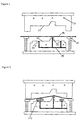
- Figure 1 is a rough sketch of the cross section of the mold apparatus of the process of the present invention, wherein the skin material is placed between open molds.
- Figure 2 is a rough sketch of the cross section of the mold apparatus of the process of the present invention, wherein the molten resin composition is fed between the skin material and the female mold.
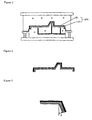
- Figure 3 is a rough sketch of the cross section of the mold apparatus of the process of the present invention, wherein the resin is foamed by opening slightly the molds after closing.
- Figure 4 is the cross section of the central part of the multilayer molded article obtained by the process of the present invention.
- Figure 5 shows a deformed state at the end of bended part of the multilayer molded article.
- a resin-feeding pass (5) for providing molten resin and arbitrary numbers of resin-feeding openings (4), through which molten resin is provided in the cavity, are equipped.
- the said resin-feeding pass (5) and resin-feeding openings (4) may be equipped on the female mold (1) when the mold design requires.
- Cooling pipe (7) for cooling molds may be equipped on both or one of male mold (2) and female mold (1) according to its necessity.
- the skin material (6) is fixed by the clamper (3) and placed between unclosed female (1) and male (2) molds ( Figure 1).
- a molten resin composition (11) obtained beforehand by melt kneading of a thermoplastic resin, glass fiber and a foaming agent by an injection machine (not shown in figure) is provided between the skin material (6) and male mold (2) through the resin-feeding pass (5) and the resin-feeding opening (4) ( Figure 2).
- the molten resin composition may be fed after the female mold (1) has been lowered or during the female mold (1) is being lowered, but in the latter case, the feeding of the molten resin composition must be finished at the same time or before the finish of clamping of the molds.
- the female mold (1) is taken down further after the molten resin is fed, and the molten resin composition fed is spread in the mold and filled in the cavity formed by the pair of female and male molds. By this time the foaming agent in the molten resin composition has already decomposed and the gas generated is contained in the resin. Then, the female mold (1) is opened a little, and by reducing pressure, the unsolidified molten resin composition is foamed, and the thus foamed molten resin composition (12) is cooled and solidified as it stands ( Figure 3). After that, the molds are opened to take out the molded article.
- the multilayer molded article (20) wherein the skin material is laminated on the surface of the foamed thermoplastic resin can be obtained. Further, the extent of the foaming of the molten resin can be adjusted freely by adjusting the extent of the opening of the female mold (1). The female mold (1) is again lowered a little before the molded article is taken out and the solidified or unsolidified foamed thermoplastic resin composition (12) may be pressed again.
- a laminated sheet comprising a foamed polypropylene sheet (thickness of 3 mm, an expansion rate of 15 ) laminated as a lining material on a polypropylene elastomer sheet with a thickness of 0.5 mm was placed on a clamper ( Figure 1), and was clamped between a parting plane of a female mold by bringing down the female mold. While a skin material being slipped into a cavity, the female mold was further slowly taken down and, when the cavity clearance reached 20 mm, a molten polypropylene resin composition (melt temperature : 200°C) was fed between the surface of a male mold and the skin material from a resin-feeding opening as shown in figure 2.
- a molten polypropylene resin composition (melt temperature : 200°C) was fed between the surface of a male mold and the skin material from a resin-feeding opening as shown in figure 2.
- the molten polypropylene resin composition used here was obtained by melt kneading of 95 parts by weight of a glass fiber-containing polypropylene resin composition comprising a mixture of glass fiber and Sumitomo Norblene® AX568 (polypropylene resin manufactured by Sumitomo Chemical Co., Ltd., MI:65), the content of glass fiber being 15 % by weight and average glass fiber length being 2 mm, and the bending modulus of elasticity of the mixture being 31,000 kg/cm 2 , and 5 parts by weight of an polyethylenic foaming agent masterbatch (MB1023 manufactured by Sankyo Chemical Co., Ltd.) which contains 30 % by weight of foaming agent.
- a glass fiber-containing polypropylene resin composition comprising a mixture of glass fiber and Sumitomo Norblene® AX568 (polypropylene resin manufactured by Sumitomo Chemical Co., Ltd., MI:65), the content of glass fiber being 15 % by weight and average glass fiber
- the female mole was further taken down to close the molds, and then raised a little to open the molds.
- the molds were cooled at this state so that the resin composition was solidified ( Figure 3), then the molds were opened, and the molded article was taken out.
- the female mold was adjusted to 30°C and the male mold to 70 °C before cooling.
- an interior part of an automobile comprising a skin material laminated on the surface of a foamed resin with a thickness of 2.5 mm and an expansion rate by foaming of 1.4 times, which had the dimension with length of 900 mm, a width of 750 mm, a bending angle at the end of 90 degrees, and a height at the end of bended part of 10 mm, and of which cross section of central part is shown in figure 4, was obtained.
- the bended part was slightly opened outward, the bending angle was 93 degrees and the deformation angle ( ⁇ ) was 3 degrees.
- Example 2 In the same manner as in Example 1 but using the glass fiber-containing polypropylene resin composition with average glass fiber length of 1.3 mm, glass fiber content of 7 % by weight and the bending modulus of elasticity of 22,000 kg/cm 2 at 23°C, a similar interior part of an automobile was obtained.
- the bending angle was 95 degrees and the deformation angle ( ⁇ ) was 5 degrees.
- Example 2 In the same manner as in Example 1 but using the glass fiber-containing polypropylene resin composition with average glass fiber length of 0.6 mm, glass fiber content of 15 % by weight and the bending modulus of elasticity of 29,000 kg/cm 2 at 23 °C, a similar interior part of an automobile was obtained. After the interior part of an automobile obtained was allowed to stand in a room for a day, the bending angle was 98 degrees and the deformation angle ( ⁇ ) was 8 degrees.
- Example 2 In the same manner as in Example 1 except that Sumitomo Norblene AX574 (manufactured by Sumitomo Chemical Co., Ltd., MI: 45) as a polypropylene resin was used and the glass fiber-containing polypropylene resin composition with a bending modulus of elasticity of 19,000 kg/cm 2 at 23 °C, containing glass fiber with average glass fiber length of 1.5 mm in an amount of 4 % by weight was used, a similar interior part of an automobile was obtained.
- Sumitomo Norblene AX574 manufactured by Sumitomo Chemical Co., Ltd., MI: 45
- the bending angle was 115 degrees and the deformation angle ( ⁇ ) was 15 degrees.
Landscapes
- Engineering & Computer Science (AREA)
- Textile Engineering (AREA)
- Casting Or Compression Moulding Of Plastics Or The Like (AREA)
- Laminated Bodies (AREA)
- Injection Moulding Of Plastics Or The Like (AREA)
Claims (6)
- Procédé de fabrication d'un article moulé multicouche dans lequel un matériau de croûte est stratifié sur la surface d'une base de mousse de résine thermoplastique, le procédé comprenant les étapes consistant à :placer un matériau de croûte entre une paire non fermée de moules femelle et mâle ;fournir une composition de résine fondue comprenant un agent moussant et une résine thermoplastique contenant des fibres de verre ayant un module d'élasticité en flexion de 20 000 kg/cm2 ou plus à température ambiante et contenant 3 à 40% en poids de fibres de verre, entre ledit matériau de croûte et un des moules femelle et mâle ;fermer ladite paire de moules pour remplir la cavité formée par lesdits moules avec ladite composition de résine fondue ;ouvrir les deux moules pour faire mousser la composition de résine fondue sous pression réduite ; etrefroidir pour la solidifier.
- Procédé de fabrication d'un article moulé multicouche selon la revendication 1, caractérisé en ce que la longueur de fibre moyenne des fibres de verre est 1 mm ou plus.
- Procédé de fabrication d'un article moulé multicouche selon la revendication 1 ou 2, caractérisé en ce que la résine thermoplastique est une résine de polypropylène.
- Procédé de fabrication d'un article moulé multicouche décrit dans la revendication 3, caractérisé en ce que l'indice d'écoulement à l'état fondu à 230°C de la résine de polypropylène est dans une plage de 15 à 300 g/10 min.
- Procédé de fabrication d'un article moulé multicouche selon la revendication 1, caractérisé en ce que la longueur de fibre moyenne des fibres de verre est dans une plage de 0,5 à 15 mm.
- Procédé de fabrication d'un article moulé multicouche selon la revendication 1, caractérisé en ce que le diamètre de fibre des fibres de verre est dans une plage de 3 à 20 µm.
Applications Claiming Priority (3)
| Application Number | Priority Date | Filing Date | Title |
|---|---|---|---|
| JP318287/93 | 1993-12-17 | ||
| JP31828793 | 1993-12-17 | ||
| JP31828793A JP3282328B2 (ja) | 1993-12-17 | 1993-12-17 | 多層成形品の製造方法および多層成形品 |
Publications (3)
| Publication Number | Publication Date |
|---|---|
| EP0658410A2 EP0658410A2 (fr) | 1995-06-21 |
| EP0658410A3 EP0658410A3 (fr) | 1996-02-07 |
| EP0658410B1 true EP0658410B1 (fr) | 2001-06-20 |
Family
ID=18097524
Family Applications (1)
| Application Number | Title | Priority Date | Filing Date |
|---|---|---|---|
| EP94119963A Expired - Lifetime EP0658410B1 (fr) | 1993-12-17 | 1994-12-16 | Objet moulé multicouche et procédé pour le fabriquer |
Country Status (3)
| Country | Link |
|---|---|
| EP (1) | EP0658410B1 (fr) |
| JP (1) | JP3282328B2 (fr) |
| DE (1) | DE69427519T2 (fr) |
Families Citing this family (13)
| Publication number | Priority date | Publication date | Assignee | Title |
|---|---|---|---|---|
| KR100475398B1 (ko) * | 1996-02-16 | 2005-05-16 | 이데미쓰세끼유가가꾸가부시끼가이샤 | 섬유강화열가소성수지경량성형품의제조방법및경량성형품 |
| JPH1058573A (ja) * | 1996-08-20 | 1998-03-03 | Sumitomo Chem Co Ltd | 繊維強化熱可塑性樹脂発泡成形体およびその製造方法 |
| JP3710014B2 (ja) * | 1996-11-08 | 2005-10-26 | 株式会社ジェイエスピー | 表皮材付発泡成形体の製造方法及びそれにより得られる車輌用内装材 |
| DE19711794A1 (de) * | 1997-03-21 | 1997-07-24 | Audi Ag | Verfahren zur Herstellung eines Karosserieaußenhautbauteils |
| EP1193163B1 (fr) * | 1998-10-21 | 2005-07-06 | ArvinMeritor GmbH | Elément composite pour carrosseries de véhicule |
| CA2351424A1 (fr) | 1998-11-20 | 2000-06-02 | Krauss-Maffei Kunststofftechnik Gmbh | Procede pour produire des pieces moulees par injection dans une machine de moulage par injection |
| JP4572443B2 (ja) | 2000-05-15 | 2010-11-04 | 住友化学株式会社 | 熱可塑性樹脂自動車内装用発泡成形体 |
| JP2002018919A (ja) * | 2000-07-07 | 2002-01-22 | Kasai Kogyo Co Ltd | 発泡性基材の成形方法並びに成形装置 |
| US6770230B2 (en) * | 2001-04-17 | 2004-08-03 | The University Of Massachusetts | Surface finishing compression molding with multi-layer extrusion |
| WO2005028180A1 (fr) * | 2003-09-03 | 2005-03-31 | Johnson Controls Interiors Gmbh & Co. Kg | Piece moulee, notamment piece de revetement pour automobile, et procede pour la produire |
| DE202005020256U1 (de) | 2005-05-10 | 2006-06-22 | Sks Sitzkomponenten Gmbh & Co. Kg | Mehrschichtiges Werkstoffteil und daraus hergestelltes Formteil |
| DE202005020257U1 (de) | 2005-05-10 | 2006-06-22 | Sks Sitzkomponenten Gmbh & Co. Kg | Baueinheit in Form eines Hohlraumformteils |
| FR2919218B1 (fr) * | 2007-07-25 | 2011-12-02 | Faurecia Automotive Ind | Composant moule d'insonorisation,et son procede de fabrication |
Family Cites Families (10)
| Publication number | Priority date | Publication date | Assignee | Title |
|---|---|---|---|---|
| GB1201040A (en) * | 1966-12-19 | 1970-08-05 | Ici Ltd | Panels for vehicles |
| JPS5423377B2 (fr) * | 1972-06-02 | 1979-08-13 | ||
| US4351911A (en) * | 1973-07-02 | 1982-09-28 | General Electric Company | Foamable polyester composition |
| JPS5247864A (en) * | 1975-10-15 | 1977-04-16 | Japan Synthetic Rubber Co Ltd | Method of manufacturing synthetic wood |
| CS193772B1 (en) * | 1977-01-26 | 1979-11-30 | Jan Ruzicka | Mixture especially for jacketing the lead |
| JPS5774126A (en) * | 1980-10-27 | 1982-05-10 | Kobunshi Giken Kk | Manufacture of formed product of fiber-reinforced foamed plastics |
| JP2503753B2 (ja) * | 1990-10-12 | 1996-06-05 | 住友化学工業株式会社 | 登泡層が裏打ちされた表皮材を貼合したポリプロピレン樹脂成形体の成形方法 |
| EP0544501B1 (fr) * | 1991-11-28 | 1997-01-29 | Mitsui Petrochemical Industries, Ltd. | Procédé pour produire un article composite en mousse par moulage |
| JP3182217B2 (ja) * | 1992-06-04 | 2001-07-03 | 昭和電工株式会社 | 繊維強化気泡入り樹脂構造体の製造方法 |
| US5263389A (en) * | 1993-01-25 | 1993-11-23 | Brunswick Corp. | Torque rated floating marine propeller wrench |
-
1993
- 1993-12-17 JP JP31828793A patent/JP3282328B2/ja not_active Expired - Lifetime
-
1994
- 1994-12-16 EP EP94119963A patent/EP0658410B1/fr not_active Expired - Lifetime
- 1994-12-16 DE DE69427519T patent/DE69427519T2/de not_active Expired - Lifetime
Non-Patent Citations (1)
| Title |
|---|
| EDITORS OF MODERN PLASTICS ENCYCLOPEDIA: "GUIDE TO PLASTICS", 1991, MCGRAW-HILL, INC., NEW YORK * |
Also Published As
| Publication number | Publication date |
|---|---|
| JPH07171841A (ja) | 1995-07-11 |
| EP0658410A2 (fr) | 1995-06-21 |
| DE69427519D1 (de) | 2001-07-26 |
| EP0658410A3 (fr) | 1996-02-07 |
| DE69427519T2 (de) | 2002-03-28 |
| JP3282328B2 (ja) | 2002-05-13 |
Similar Documents
| Publication | Publication Date | Title |
|---|---|---|
| US5154872A (en) | Process for producing a multilayer molded article | |
| EP0658410B1 (fr) | Objet moulé multicouche et procédé pour le fabriquer | |
| US7846533B2 (en) | Molded thermoplastic articles | |
| US6977110B2 (en) | Foamed thermoplastic resin molding for automotive interior and production method thereof | |
| CA2104364C (fr) | Element lamelle | |
| KR0179387B1 (ko) | 적층 성형 제품 및 그의 제조방법 | |
| EP0466181B1 (fr) | Procédé pour la fabrication d'un article moulé en résine thermoplastique | |
| EP0477476B1 (fr) | Méthode et dispositif pour la production d'objets moulés | |
| US6183680B1 (en) | Process for producing multilayer molded article | |
| CA2120909C (fr) | Tableau de bord | |
| US20080264544A1 (en) | Foamed thermoplastic resin molding with a functional component | |
| US20060163765A1 (en) | Method for producing a thermoplastic resin article | |
| US20100109190A1 (en) | Process for producing thermoplastic resin molding | |
| JP4388853B2 (ja) | 熱可塑性樹脂発泡成形品の製造方法 | |
| CA2086246C (fr) | Article moule multicouche et methode de fabrication de celui-ci | |
| GB2342889A (en) | Coating glass mat thermoplastics | |
| JP3599838B2 (ja) | 多層品の製造方法 | |
| EP0654336A1 (fr) | Procede de production de pieces moulees multi-couches | |
| JP3378333B2 (ja) | 多層成形品の製造方法 | |
| JP2717336B2 (ja) | 多層成形品およびその製造方法 | |
| JP2003159736A (ja) | 熱可塑性樹脂発泡成形体の製造方法 | |
| JP2009274460A (ja) | 熱可塑性樹脂発泡成形品の製造方法 |
Legal Events
| Date | Code | Title | Description |
|---|---|---|---|
| PUAI | Public reference made under article 153(3) epc to a published international application that has entered the european phase |
Free format text: ORIGINAL CODE: 0009012 |
|
| AK | Designated contracting states |
Kind code of ref document: A2 Designated state(s): DE FR GB IT |
|
| PUAL | Search report despatched |
Free format text: ORIGINAL CODE: 0009013 |
|
| AK | Designated contracting states |
Kind code of ref document: A3 Designated state(s): DE FR GB IT |
|
| 17P | Request for examination filed |
Effective date: 19960307 |
|
| 17Q | First examination report despatched |
Effective date: 19961210 |
|
| GRAG | Despatch of communication of intention to grant |
Free format text: ORIGINAL CODE: EPIDOS AGRA |
|
| GRAG | Despatch of communication of intention to grant |
Free format text: ORIGINAL CODE: EPIDOS AGRA |
|
| GRAG | Despatch of communication of intention to grant |
Free format text: ORIGINAL CODE: EPIDOS AGRA |
|
| GRAH | Despatch of communication of intention to grant a patent |
Free format text: ORIGINAL CODE: EPIDOS IGRA |
|
| GRAH | Despatch of communication of intention to grant a patent |
Free format text: ORIGINAL CODE: EPIDOS IGRA |
|
| GRAA | (expected) grant |
Free format text: ORIGINAL CODE: 0009210 |
|
| AK | Designated contracting states |
Kind code of ref document: B1 Designated state(s): DE FR GB IT |
|
| ITF | It: translation for a ep patent filed | ||
| REF | Corresponds to: |
Ref document number: 69427519 Country of ref document: DE Date of ref document: 20010726 |
|
| ET | Fr: translation filed | ||
| REG | Reference to a national code |
Ref country code: GB Ref legal event code: IF02 |
|
| PLBE | No opposition filed within time limit |
Free format text: ORIGINAL CODE: 0009261 |
|
| STAA | Information on the status of an ep patent application or granted ep patent |
Free format text: STATUS: NO OPPOSITION FILED WITHIN TIME LIMIT |
|
| 26N | No opposition filed | ||
| PGFP | Annual fee paid to national office [announced via postgrant information from national office to epo] |
Ref country code: GB Payment date: 20131211 Year of fee payment: 20 Ref country code: DE Payment date: 20131211 Year of fee payment: 20 |
|
| PGFP | Annual fee paid to national office [announced via postgrant information from national office to epo] |
Ref country code: IT Payment date: 20131213 Year of fee payment: 20 Ref country code: FR Payment date: 20131209 Year of fee payment: 20 |
|
| REG | Reference to a national code |
Ref country code: DE Ref legal event code: R071 Ref document number: 69427519 Country of ref document: DE |
|
| REG | Reference to a national code |
Ref country code: GB Ref legal event code: PE20 Expiry date: 20141215 |
|
| PG25 | Lapsed in a contracting state [announced via postgrant information from national office to epo] |
Ref country code: GB Free format text: LAPSE BECAUSE OF EXPIRATION OF PROTECTION Effective date: 20141215 |