EP0659111B1 - Verfahren zur herstellung von kunststoffgegenständen durch kontrolliertes form-warmformen - Google Patents
Verfahren zur herstellung von kunststoffgegenständen durch kontrolliertes form-warmformen Download PDFInfo
- Publication number
- EP0659111B1 EP0659111B1 EP93919415A EP93919415A EP0659111B1 EP 0659111 B1 EP0659111 B1 EP 0659111B1 EP 93919415 A EP93919415 A EP 93919415A EP 93919415 A EP93919415 A EP 93919415A EP 0659111 B1 EP0659111 B1 EP 0659111B1
- Authority
- EP
- European Patent Office
- Prior art keywords
- plastics material
- process according
- preform
- blank
- moulding cavity
- Prior art date
- Legal status (The legal status is an assumption and is not a legal conclusion. Google has not performed a legal analysis and makes no representation as to the accuracy of the status listed.)
- Expired - Lifetime
Links
Images

Classifications
-
- A—HUMAN NECESSITIES
- A61—MEDICAL OR VETERINARY SCIENCE; HYGIENE
- A61F—FILTERS IMPLANTABLE INTO BLOOD VESSELS; PROSTHESES; DEVICES PROVIDING PATENCY TO, OR PREVENTING COLLAPSING OF, TUBULAR STRUCTURES OF THE BODY, e.g. STENTS; ORTHOPAEDIC, NURSING OR CONTRACEPTIVE DEVICES; FOMENTATION; TREATMENT OR PROTECTION OF EYES OR EARS; BANDAGES, DRESSINGS OR ABSORBENT PADS; FIRST-AID KITS
- A61F2/00—Filters implantable into blood vessels; Prostheses, i.e. artificial substitutes or replacements for parts of the body; Appliances for connecting them with the body; Devices providing patency to, or preventing collapsing of, tubular structures of the body, e.g. stents
- A61F2/02—Prostheses implantable into the body
- A61F2/30—Joints
- A61F2/3094—Designing or manufacturing processes
- A61F2/30965—Reinforcing the prosthesis by embedding particles or fibres during moulding or dipping
-
- A—HUMAN NECESSITIES
- A61—MEDICAL OR VETERINARY SCIENCE; HYGIENE
- A61F—FILTERS IMPLANTABLE INTO BLOOD VESSELS; PROSTHESES; DEVICES PROVIDING PATENCY TO, OR PREVENTING COLLAPSING OF, TUBULAR STRUCTURES OF THE BODY, e.g. STENTS; ORTHOPAEDIC, NURSING OR CONTRACEPTIVE DEVICES; FOMENTATION; TREATMENT OR PROTECTION OF EYES OR EARS; BANDAGES, DRESSINGS OR ABSORBENT PADS; FIRST-AID KITS
- A61F2/00—Filters implantable into blood vessels; Prostheses, i.e. artificial substitutes or replacements for parts of the body; Appliances for connecting them with the body; Devices providing patency to, or preventing collapsing of, tubular structures of the body, e.g. stents
- A61F2/02—Prostheses implantable into the body
- A61F2/30—Joints
-
- B—PERFORMING OPERATIONS; TRANSPORTING
- B29—WORKING OF PLASTICS; WORKING OF SUBSTANCES IN A PLASTIC STATE IN GENERAL
- B29C—SHAPING OR JOINING OF PLASTICS; SHAPING OF MATERIAL IN A PLASTIC STATE, NOT OTHERWISE PROVIDED FOR; AFTER-TREATMENT OF THE SHAPED PRODUCTS, e.g. REPAIRING
- B29C43/00—Compression moulding, i.e. applying external pressure to flow the moulding material; Apparatus therefor
- B29C43/02—Compression moulding, i.e. applying external pressure to flow the moulding material; Apparatus therefor of articles of definite length, i.e. discrete articles
- B29C43/18—Compression moulding, i.e. applying external pressure to flow the moulding material; Apparatus therefor of articles of definite length, i.e. discrete articles incorporating preformed parts or layers, e.g. compression moulding around inserts or for coating articles
- B29C43/183—Compression moulding, i.e. applying external pressure to flow the moulding material; Apparatus therefor of articles of definite length, i.e. discrete articles incorporating preformed parts or layers, e.g. compression moulding around inserts or for coating articles the preformed layer being a lining, e.g. shaped in the mould before compression moulding, or a preformed shell adapted to the shape of the mould
- B29C43/184—Compression moulding, i.e. applying external pressure to flow the moulding material; Apparatus therefor of articles of definite length, i.e. discrete articles incorporating preformed parts or layers, e.g. compression moulding around inserts or for coating articles the preformed layer being a lining, e.g. shaped in the mould before compression moulding, or a preformed shell adapted to the shape of the mould shaped by the compression of the material during moulding
-
- B—PERFORMING OPERATIONS; TRANSPORTING
- B29—WORKING OF PLASTICS; WORKING OF SUBSTANCES IN A PLASTIC STATE IN GENERAL
- B29C—SHAPING OR JOINING OF PLASTICS; SHAPING OF MATERIAL IN A PLASTIC STATE, NOT OTHERWISE PROVIDED FOR; AFTER-TREATMENT OF THE SHAPED PRODUCTS, e.g. REPAIRING
- B29C43/00—Compression moulding, i.e. applying external pressure to flow the moulding material; Apparatus therefor
- B29C43/32—Component parts, details or accessories; Auxiliary operations
- B29C43/36—Moulds for making articles of definite length, i.e. discrete articles
- B29C43/361—Moulds for making articles of definite length, i.e. discrete articles with pressing members independently movable of the parts for opening or closing the mould, e.g. movable pistons
-
- B—PERFORMING OPERATIONS; TRANSPORTING
- B29—WORKING OF PLASTICS; WORKING OF SUBSTANCES IN A PLASTIC STATE IN GENERAL
- B29C—SHAPING OR JOINING OF PLASTICS; SHAPING OF MATERIAL IN A PLASTIC STATE, NOT OTHERWISE PROVIDED FOR; AFTER-TREATMENT OF THE SHAPED PRODUCTS, e.g. REPAIRING
- B29C45/00—Injection moulding, i.e. forcing the required volume of moulding material through a nozzle into a closed mould; Apparatus therefor
- B29C45/14—Injection moulding, i.e. forcing the required volume of moulding material through a nozzle into a closed mould; Apparatus therefor incorporating preformed parts or layers, e.g. injection moulding around inserts or for coating articles
- B29C45/1418—Injection moulding, i.e. forcing the required volume of moulding material through a nozzle into a closed mould; Apparatus therefor incorporating preformed parts or layers, e.g. injection moulding around inserts or for coating articles the inserts being deformed or preformed, e.g. by the injection pressure
-
- B—PERFORMING OPERATIONS; TRANSPORTING
- B29—WORKING OF PLASTICS; WORKING OF SUBSTANCES IN A PLASTIC STATE IN GENERAL
- B29C—SHAPING OR JOINING OF PLASTICS; SHAPING OF MATERIAL IN A PLASTIC STATE, NOT OTHERWISE PROVIDED FOR; AFTER-TREATMENT OF THE SHAPED PRODUCTS, e.g. REPAIRING
- B29C45/00—Injection moulding, i.e. forcing the required volume of moulding material through a nozzle into a closed mould; Apparatus therefor
- B29C45/14—Injection moulding, i.e. forcing the required volume of moulding material through a nozzle into a closed mould; Apparatus therefor incorporating preformed parts or layers, e.g. injection moulding around inserts or for coating articles
- B29C45/14778—Injection moulding, i.e. forcing the required volume of moulding material through a nozzle into a closed mould; Apparatus therefor incorporating preformed parts or layers, e.g. injection moulding around inserts or for coating articles the article consisting of a material with particular properties, e.g. porous, brittle
-
- B—PERFORMING OPERATIONS; TRANSPORTING
- B29—WORKING OF PLASTICS; WORKING OF SUBSTANCES IN A PLASTIC STATE IN GENERAL
- B29C—SHAPING OR JOINING OF PLASTICS; SHAPING OF MATERIAL IN A PLASTIC STATE, NOT OTHERWISE PROVIDED FOR; AFTER-TREATMENT OF THE SHAPED PRODUCTS, e.g. REPAIRING
- B29C45/00—Injection moulding, i.e. forcing the required volume of moulding material through a nozzle into a closed mould; Apparatus therefor
- B29C45/17—Component parts, details or accessories; Auxiliary operations
- B29C45/46—Means for plasticising or homogenising the moulding material or forcing it into the mould
- B29C45/56—Means for plasticising or homogenising the moulding material or forcing it into the mould using mould parts movable during or after injection, e.g. injection-compression moulding
- B29C45/561—Injection-compression moulding
-
- B—PERFORMING OPERATIONS; TRANSPORTING
- B29—WORKING OF PLASTICS; WORKING OF SUBSTANCES IN A PLASTIC STATE IN GENERAL
- B29C—SHAPING OR JOINING OF PLASTICS; SHAPING OF MATERIAL IN A PLASTIC STATE, NOT OTHERWISE PROVIDED FOR; AFTER-TREATMENT OF THE SHAPED PRODUCTS, e.g. REPAIRING
- B29C70/00—Shaping composites, i.e. plastics material comprising reinforcements, fillers or preformed parts, e.g. inserts
- B29C70/68—Shaping composites, i.e. plastics material comprising reinforcements, fillers or preformed parts, e.g. inserts by incorporating or moulding on preformed parts, e.g. inserts or layers, e.g. foam blocks
- B29C70/78—Moulding material on one side only of the preformed part
-
- A—HUMAN NECESSITIES
- A61—MEDICAL OR VETERINARY SCIENCE; HYGIENE
- A61F—FILTERS IMPLANTABLE INTO BLOOD VESSELS; PROSTHESES; DEVICES PROVIDING PATENCY TO, OR PREVENTING COLLAPSING OF, TUBULAR STRUCTURES OF THE BODY, e.g. STENTS; ORTHOPAEDIC, NURSING OR CONTRACEPTIVE DEVICES; FOMENTATION; TREATMENT OR PROTECTION OF EYES OR EARS; BANDAGES, DRESSINGS OR ABSORBENT PADS; FIRST-AID KITS
- A61F2/00—Filters implantable into blood vessels; Prostheses, i.e. artificial substitutes or replacements for parts of the body; Appliances for connecting them with the body; Devices providing patency to, or preventing collapsing of, tubular structures of the body, e.g. stents
- A61F2/02—Prostheses implantable into the body
- A61F2/30—Joints
- A61F2/3094—Designing or manufacturing processes
-
- A—HUMAN NECESSITIES
- A61—MEDICAL OR VETERINARY SCIENCE; HYGIENE
- A61F—FILTERS IMPLANTABLE INTO BLOOD VESSELS; PROSTHESES; DEVICES PROVIDING PATENCY TO, OR PREVENTING COLLAPSING OF, TUBULAR STRUCTURES OF THE BODY, e.g. STENTS; ORTHOPAEDIC, NURSING OR CONTRACEPTIVE DEVICES; FOMENTATION; TREATMENT OR PROTECTION OF EYES OR EARS; BANDAGES, DRESSINGS OR ABSORBENT PADS; FIRST-AID KITS
- A61F2/00—Filters implantable into blood vessels; Prostheses, i.e. artificial substitutes or replacements for parts of the body; Appliances for connecting them with the body; Devices providing patency to, or preventing collapsing of, tubular structures of the body, e.g. stents
- A61F2/02—Prostheses implantable into the body
- A61F2/30—Joints
- A61F2/32—Joints for the hip
- A61F2/34—Acetabular cups
-
- A—HUMAN NECESSITIES
- A61—MEDICAL OR VETERINARY SCIENCE; HYGIENE
- A61F—FILTERS IMPLANTABLE INTO BLOOD VESSELS; PROSTHESES; DEVICES PROVIDING PATENCY TO, OR PREVENTING COLLAPSING OF, TUBULAR STRUCTURES OF THE BODY, e.g. STENTS; ORTHOPAEDIC, NURSING OR CONTRACEPTIVE DEVICES; FOMENTATION; TREATMENT OR PROTECTION OF EYES OR EARS; BANDAGES, DRESSINGS OR ABSORBENT PADS; FIRST-AID KITS
- A61F2/00—Filters implantable into blood vessels; Prostheses, i.e. artificial substitutes or replacements for parts of the body; Appliances for connecting them with the body; Devices providing patency to, or preventing collapsing of, tubular structures of the body, e.g. stents
- A61F2/02—Prostheses implantable into the body
- A61F2/30—Joints
- A61F2/38—Joints for elbows or knees
- A61F2/389—Tibial components
-
- A—HUMAN NECESSITIES
- A61—MEDICAL OR VETERINARY SCIENCE; HYGIENE
- A61F—FILTERS IMPLANTABLE INTO BLOOD VESSELS; PROSTHESES; DEVICES PROVIDING PATENCY TO, OR PREVENTING COLLAPSING OF, TUBULAR STRUCTURES OF THE BODY, e.g. STENTS; ORTHOPAEDIC, NURSING OR CONTRACEPTIVE DEVICES; FOMENTATION; TREATMENT OR PROTECTION OF EYES OR EARS; BANDAGES, DRESSINGS OR ABSORBENT PADS; FIRST-AID KITS
- A61F2/00—Filters implantable into blood vessels; Prostheses, i.e. artificial substitutes or replacements for parts of the body; Appliances for connecting them with the body; Devices providing patency to, or preventing collapsing of, tubular structures of the body, e.g. stents
- A61F2/02—Prostheses implantable into the body
- A61F2/30—Joints
- A61F2002/30001—Additional features of subject-matter classified in A61F2/28, A61F2/30 and subgroups thereof
- A61F2002/30003—Material related properties of the prosthesis or of a coating on the prosthesis
- A61F2002/3006—Properties of materials and coating materials
- A61F2002/30084—Materials having a crystalline structure
-
- A—HUMAN NECESSITIES
- A61—MEDICAL OR VETERINARY SCIENCE; HYGIENE
- A61F—FILTERS IMPLANTABLE INTO BLOOD VESSELS; PROSTHESES; DEVICES PROVIDING PATENCY TO, OR PREVENTING COLLAPSING OF, TUBULAR STRUCTURES OF THE BODY, e.g. STENTS; ORTHOPAEDIC, NURSING OR CONTRACEPTIVE DEVICES; FOMENTATION; TREATMENT OR PROTECTION OF EYES OR EARS; BANDAGES, DRESSINGS OR ABSORBENT PADS; FIRST-AID KITS
- A61F2/00—Filters implantable into blood vessels; Prostheses, i.e. artificial substitutes or replacements for parts of the body; Appliances for connecting them with the body; Devices providing patency to, or preventing collapsing of, tubular structures of the body, e.g. stents
- A61F2/02—Prostheses implantable into the body
- A61F2/30—Joints
- A61F2/30767—Special external or bone-contacting surface, e.g. coating for improving bone ingrowth
- A61F2002/30929—Special external or bone-contacting surface, e.g. coating for improving bone ingrowth having at least two superposed coatings
-
- B—PERFORMING OPERATIONS; TRANSPORTING
- B29—WORKING OF PLASTICS; WORKING OF SUBSTANCES IN A PLASTIC STATE IN GENERAL
- B29C—SHAPING OR JOINING OF PLASTICS; SHAPING OF MATERIAL IN A PLASTIC STATE, NOT OTHERWISE PROVIDED FOR; AFTER-TREATMENT OF THE SHAPED PRODUCTS, e.g. REPAIRING
- B29C43/00—Compression moulding, i.e. applying external pressure to flow the moulding material; Apparatus therefor
- B29C43/32—Component parts, details or accessories; Auxiliary operations
- B29C43/36—Moulds for making articles of definite length, i.e. discrete articles
- B29C43/361—Moulds for making articles of definite length, i.e. discrete articles with pressing members independently movable of the parts for opening or closing the mould, e.g. movable pistons
- B29C2043/3615—Forming elements, e.g. mandrels or rams or stampers or pistons or plungers or punching devices
-
- B—PERFORMING OPERATIONS; TRANSPORTING
- B29—WORKING OF PLASTICS; WORKING OF SUBSTANCES IN A PLASTIC STATE IN GENERAL
- B29C—SHAPING OR JOINING OF PLASTICS; SHAPING OF MATERIAL IN A PLASTIC STATE, NOT OTHERWISE PROVIDED FOR; AFTER-TREATMENT OF THE SHAPED PRODUCTS, e.g. REPAIRING
- B29C43/00—Compression moulding, i.e. applying external pressure to flow the moulding material; Apparatus therefor
- B29C43/32—Component parts, details or accessories; Auxiliary operations
- B29C43/36—Moulds for making articles of definite length, i.e. discrete articles
- B29C43/361—Moulds for making articles of definite length, i.e. discrete articles with pressing members independently movable of the parts for opening or closing the mould, e.g. movable pistons
- B29C2043/3615—Forming elements, e.g. mandrels or rams or stampers or pistons or plungers or punching devices
- B29C2043/3618—Forming elements, e.g. mandrels or rams or stampers or pistons or plungers or punching devices plurality of counteracting elements
-
- B—PERFORMING OPERATIONS; TRANSPORTING
- B29—WORKING OF PLASTICS; WORKING OF SUBSTANCES IN A PLASTIC STATE IN GENERAL
- B29C—SHAPING OR JOINING OF PLASTICS; SHAPING OF MATERIAL IN A PLASTIC STATE, NOT OTHERWISE PROVIDED FOR; AFTER-TREATMENT OF THE SHAPED PRODUCTS, e.g. REPAIRING
- B29C45/00—Injection moulding, i.e. forcing the required volume of moulding material through a nozzle into a closed mould; Apparatus therefor
- B29C45/14—Injection moulding, i.e. forcing the required volume of moulding material through a nozzle into a closed mould; Apparatus therefor incorporating preformed parts or layers, e.g. injection moulding around inserts or for coating articles
- B29C45/1418—Injection moulding, i.e. forcing the required volume of moulding material through a nozzle into a closed mould; Apparatus therefor incorporating preformed parts or layers, e.g. injection moulding around inserts or for coating articles the inserts being deformed or preformed, e.g. by the injection pressure
- B29C2045/14286—Injection moulding, i.e. forcing the required volume of moulding material through a nozzle into a closed mould; Apparatus therefor incorporating preformed parts or layers, e.g. injection moulding around inserts or for coating articles the inserts being deformed or preformed, e.g. by the injection pressure means for heating the insert
-
- B—PERFORMING OPERATIONS; TRANSPORTING
- B29—WORKING OF PLASTICS; WORKING OF SUBSTANCES IN A PLASTIC STATE IN GENERAL
- B29C—SHAPING OR JOINING OF PLASTICS; SHAPING OF MATERIAL IN A PLASTIC STATE, NOT OTHERWISE PROVIDED FOR; AFTER-TREATMENT OF THE SHAPED PRODUCTS, e.g. REPAIRING
- B29C51/00—Shaping by thermoforming, i.e. shaping sheets or sheet like preforms after heating, e.g. shaping sheets in matched moulds or by deep-drawing; Apparatus therefor
-
- B—PERFORMING OPERATIONS; TRANSPORTING
- B29—WORKING OF PLASTICS; WORKING OF SUBSTANCES IN A PLASTIC STATE IN GENERAL
- B29K—INDEXING SCHEME ASSOCIATED WITH SUBCLASSES B29B, B29C OR B29D, RELATING TO MOULDING MATERIALS OR TO MATERIALS FOR MOULDS, REINFORCEMENTS, FILLERS OR PREFORMED PARTS, e.g. INSERTS
- B29K2105/00—Condition, form or state of moulded material or of the material to be shaped
- B29K2105/06—Condition, form or state of moulded material or of the material to be shaped containing reinforcements, fillers or inserts
- B29K2105/08—Condition, form or state of moulded material or of the material to be shaped containing reinforcements, fillers or inserts of continuous length, e.g. cords, rovings, mats, fabrics, strands or yarns
- B29K2105/0809—Fabrics
-
- B—PERFORMING OPERATIONS; TRANSPORTING
- B29—WORKING OF PLASTICS; WORKING OF SUBSTANCES IN A PLASTIC STATE IN GENERAL
- B29K—INDEXING SCHEME ASSOCIATED WITH SUBCLASSES B29B, B29C OR B29D, RELATING TO MOULDING MATERIALS OR TO MATERIALS FOR MOULDS, REINFORCEMENTS, FILLERS OR PREFORMED PARTS, e.g. INSERTS
- B29K2995/00—Properties of moulding materials, reinforcements, fillers, preformed parts or moulds
- B29K2995/0037—Other properties
- B29K2995/0088—Molecular weight
-
- B—PERFORMING OPERATIONS; TRANSPORTING
- B29—WORKING OF PLASTICS; WORKING OF SUBSTANCES IN A PLASTIC STATE IN GENERAL
- B29L—INDEXING SCHEME ASSOCIATED WITH SUBCLASS B29C, RELATING TO PARTICULAR ARTICLES
- B29L2031/00—Other particular articles
- B29L2031/753—Medical equipment; Accessories therefor
- B29L2031/7532—Artificial members, protheses
Definitions
- the present invention relates to a manufacturing process by controlled molding-thermoforming of plastic parts resistant to friction and creep as well as a device necessary for the implementation of the process and the parts resulting from the implementation of said process.
- a number of plastic parts such as joint prostheses or mechanical parts such as pinion, guide plate, bearing, bearing, and screws, etc. have a limited lifetime over time due to material creep and wear phenomena linked to the friction generated during the use of said parts.
- This problem is particularly crucial in the case of orthopedic implants, mainly hip and knee prostheses which are made of metal with the interposition of a friction piece.
- High molecular weight polyethylene (Pe.h.Pm) has particularly prevailed for this manufacturing.
- this material with exceptional rubbing and anti-wear properties cannot be used by conventional techniques applied to polymers such as injection for example. This is why most implants are made by machining.
- these machined embodiments have the great disadvantage of not providing an excellent surface condition having machining crests.
- a process for manufacturing plastic parts by controlled molding-thermoforming is also described in US-A-4,459,092.
- This patent includes the introduction into a molding cavity of a plastic blank P1 and a plastic material P2 at a temperature close to, or equal to the melting temperature of P2, the part being formed in the mold at by means of a movable punch in said cavity and of the injection pressure of the plastic material P2.
- the blank P1 does not undergo any heat treatment.
- the aim of the present invention is therefore to propose a method of manufacturing parts such as joint prostheses, various mechanical parts, etc., having markedly improved mechanical properties, in particular as regards resistance to creep, traction, wear and tear without exhibiting significant shrinkage during their manufacture.
- Another object of the invention is to propose a device for simple and rapid implementation of said method.
- the present invention relates for this purpose to a process for manufacturing plastic parts by controlled molding-thermoforming according to claim 1.
- the plastic material P2 which has a molecular weight less than or equal to P1 is introduced by injection and the punch is moved so that it comes into contact preferably with the blank of so as to force the blank and the injected plastic to match the profile of the closed matrix formed by the walls of the mold cavity forming an imprint of the cavity and the punch. Therefore, the blank, which is made of a material which is a polymer, has molecular chains oriented parallel to the friction surface at least in the area of the part located below or flush with this surface.
- This process is more particularly intended for the manufacture of orthopedic prostheses or implants and various mechanical parts.
- the implementation of the process allowing the production of plastic parts which have good resistance to wear, creep and fatigue requires having a mold and making a blank 4 of plastic P1.
- the mold is generally an open mold in two parts.
- This mold is generally equipped with an injection nozzle and its molding cavity 1 can be closed by a movable punch 3.
- This blank 4 to allow the mechanical properties of the final part to be optimized, will preferably be made up of a non-injectable crystalline or semi-crystalline thermoplastic material such as for example a high molecular weight plastic material.
- a non-injectable crystalline or semi-crystalline thermoplastic material such as for example a high molecular weight plastic material.
- This blank can also be reinforced by means of a woven or nonwoven reinforcement such as a load of glass fibers for example.
- This heated blank has zones of different temperature, at least one of the zones being brought to a temperature close to or equal to the melting temperature of the material P1 used.
- near temperature is meant a temperature higher or lower than the melting temperature of the material.
- a temperature is chosen in the range from 20 ° C. below the melting temperature TF of the polyethylene to 10 ° C. above this melting temperature TF or more.
- the melting temperature TF of the polyethylene is determined by calorimetry and that it corresponds to the maximum of the transformation speed recorded in calorimetry.
- This blank may also be heated on a single face which will be the face which must adhere to the plastic material P2 injected or compressed. We speak in this case of heating in surface or in surface. This heating is always carried out prior to the introduction of the blank into the mold.
- a plastic material P2 brought to a temperature equal to or close to the melting temperature may be introduced inside the molding cavity, this plastic material preferably being injectable.
- This plastic material P2 has a lower molecular weight than that of the material P1.
- This plastic material P2 can be injected inside the molding cavity according to a large number of embodiments which are a function of the configuration of the mold and of the number of blanks introduced. These different embodiments will be described below.
- the plastic material P2 is not, as is often the case for the plastic material P1, injectable.
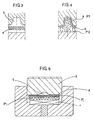
- the plastics P1 laminates and P2 are placed in respective forms of blank and slug inside the molding cavity, then the assembly is compressed to form the part. This embodiment is shown in FIG. 5.
- the compression step which allows the forming of the part and which is subsequent to the steps of introducing the plastics P1 and P2 into the mold can be carried out in a variable and programmed manner.
- the part is formed in the mold either by means of the injection pressure and only by means of this as shown in FIG. 4, either by means of a movable punch 3 in the molding cavity as shown in FIG. 5, or by means of both the injection pressure and of the movable punch 3 as shown in FIG. 1.
- the blank made of a material highly resistant to creep and fatigue, that is to say generally a high molecular weight plastic material and therefore capable of undergoing a certain number of friction, or disposed on the surface of the part, as is the case in Figures 1, 3 and 5.
- the injectable material which is disposed on the surface of the part, as is the case in Figures 1, 3 and 5.
- the advantage of being able to use a movable punch inside the molding cavity and possibly to combine it with the injection pressure to form the part, as shown in FIGS. 1 and 2, is to be able to orient the chains. molecular of the constituent polymer of the blank so that they are parallel to the friction surface at least in the area of the part located below or flush with this surface.
- This particular characteristic is notably obtained by virtue of the fact that the movable punch is moved so that it comes into contact with the blank 4 so as to force the blank 4 to orient itself in a similar manner to that specified above.
- the molecular orientation following the implementation introduced into the level of mechanical properties an anisotropy which can be detrimental to the dimensional stability of the finished product. Injecting, or combining with a reinforced material, a blank at low temperature increases the orientation of the latter all the more that the flow temperature is low.
- the process makes it possible to obtain on the blank, for example the rubbing part of the part, crystallites of small sizes and a maximum orientation in the direction of the force.
- this orientation can be better controlled by the fact that one is working on a viscous mattress 5 of the injected material P2.
- the action of the punch 3 on the blank 4 forces the blank and the injected plastic material P2 to conform to the profile of the matrix formed by the walls of the mold cavity and possibly the punch.
- the fact of heating and bringing to the melting point only a part of the blank as shown for example in FIGS. 1 and 2 makes it possible to better orient the molecular chains in the cold part.
- these adjustment possibilities in particular the fact that the advance of the piston can be controlled with respect to the shear value of the material of the viscous mattress or with respect to the injection speed, make it possible to obtain an example part. of internal tension.
- the reinforced material is the material P2.
- the blank which is reinforced. Reinforcing the blank makes it possible to obtain a part whose surface, based on very high molecular weight material, has a better resistance to wear, to fatigue with a good coefficient of friction and with mechanical performance, however, which, thanks to the reinforcement, provide resistance to creep, the recovery of forces being made by the reinforcing materials.
- This reinforcing material is integrated or independent of the blank.
- the punch 3 movable in the molding cavity 1 is displaceable in translation in said cavity in the direction of the height of the blank 4.
- the pressure applied to the punch 3 to move the punch to a final position allowing the forming of said materials is a function both of the composition of the blank 4 and possibly, when it is present, of the injected plastic material P2.
- the punch is held in the final position for a variable period generally of a few seconds so as to obtain a homogeneous shrinkage and good dimensional control of the final part without internal tension. Then, the formed part is extracted from the molding cavity by ejection means known per se.
- This molding cavity and this mold can be, depending on the applications, of very variable shape, the mold being able to be formed in several parts, the injection point being on one of the parts of the mold and the punch movable on the either part of the mold or, on the contrary, it is also possible to use, in accordance with FIG. 3, a mold comprising only an injection point without movable punch, or alternatively a mold comprising only a movable punch. Thanks to this process, it becomes easy to manufacture joint prostheses, in particular hip cups and tibial trays or even mechanical parts.
- FIGS. 1 and 2 An example of manufacture of a bearing-bearing support is provided below in accordance with FIGS. 1 and 2.
- the blank 4 made of plastic P1 is composed of a polyethylene of very high molecular weight machined (6,000,000 moles). It is brought to a temperature of 160 ° at the surface over a thickness 4a of 2mm, the other thickness, of 4mm, being around 80 ° C.
- the plastic material 5 injected P2 is a very high molecular weight polyethylene (3,500,000) loaded with glass fibers. It is brought to 170 ° C.
- the blank 4 is placed in the mold and then a volume of material smaller than the volume of the imprint is injected very quickly (1.5 seconds). Then, the piston compresses the blank on the mattress of material injected up to dimension C. During this phase, the injection pressure is kept below the residual pressure in the impression by the force F2 of the punch. Then, after the injection channel has cooled, the pressure of the piston will be programmed in time for approximately 120 seconds.
- the injection is controlled relative to the advance of the compression piston on the blank, which makes it possible to adjust the orientation rates of the blank material.
- the injection side of the mold will be regulated at 50-60 ° C, that on the blank compression side will be regulated from 125 ° C to 60 ° C linearly for a time of 240 seconds.
- the pressure on the piston will also be degressive 120kg / cm 2 to 50 Kg / cm 2 during the cooling time of 240 seconds using an appropriate curve.
Landscapes
- Engineering & Computer Science (AREA)
- Health & Medical Sciences (AREA)
- Mechanical Engineering (AREA)
- Manufacturing & Machinery (AREA)
- Vascular Medicine (AREA)
- Life Sciences & Earth Sciences (AREA)
- Orthopedic Medicine & Surgery (AREA)
- Cardiology (AREA)
- Oral & Maxillofacial Surgery (AREA)
- Transplantation (AREA)
- Biomedical Technology (AREA)
- Heart & Thoracic Surgery (AREA)
- Veterinary Medicine (AREA)
- Public Health (AREA)
- Animal Behavior & Ethology (AREA)
- General Health & Medical Sciences (AREA)
- Composite Materials (AREA)
- Chemical & Material Sciences (AREA)
- Injection Moulding Of Plastics Or The Like (AREA)
- Casting Or Compression Moulding Of Plastics Or The Like (AREA)
- Moulds For Moulding Plastics Or The Like (AREA)
- Blow-Moulding Or Thermoforming Of Plastics Or The Like (AREA)
- Processing And Handling Of Plastics And Other Materials For Molding In General (AREA)
- Moulding By Coating Moulds (AREA)
Claims (13)
- Verfahren zur Herstellung von Kunststoffgegenständen durch kontrolliertes Form-Warmformen mit der Einführung mindestens eines Vorformlings (4) aus Kunststoff P1 in einen Formraum (1) und fakultativ mit der Einführung eines Kunststoffs P2 mit einer Temperatur nahe oder gleich der Schmelztemperatur des Kunststoffs P2 in den besagten Formraum, nach dem zuvor der besagte Vorformling so erhitzt wird, daß er unterschiedliche Temperaturbereiche aufweist, wobei mindestens einer der Temperaturbereiche nahe oder gleich der Schmelztemperatur des Kunststoffs P1 ist, und nach dem das Formen des Gegenstands im Formwerkzeug mittels eines im Formraum (1) beweglichen Stempels (3) und/oder des Spritzdrucks des Kunststoffs P2, wenn dieser eingespritzt wird, erfolgt.
- Herstellungsverfahren nach Anspruch 1, dadurch gekennzeichnet, daß der Vorformling (4) aus Kunststoff P1 mindestens einen Temperaturbereich nahe oder gleich der Schmelztemperatur von P1 aufweist.
- Herstellungsverfahren nach Anspruch 1, dadurch gekennzeichnet, daß der Kunststoff P1 vor seiner Einführung in den Formraum (1) mittels eines geeigneten Verstärkungswerkstoffs verstärkt wird.
- Herstellungsverfahren nach Anspruch 1, dadurch gekennzeichnet, daß ein unabhängiges Verstärkungselement vor oder nach der Einführung des Kunststoffs P1 in den Formraum eingeführt wird.
- Verfahren nach Anspruch 1 , dadurch gekennzeichnet, daß der Vorformling (4) aus mindestens einem nicht spritzfähigen Thermoplast P1 besteht, etwa aus einem Kunststoff mit sehr hohem Molekulargewicht.
- Verfahren nach Anspruch 5 , dadurch gekennzeichnet, daß der Vorformling (4) ein Polymer ist, dessen Molekülketten parallel zur Reibungsfläche zumindest in dem Bereich des Gegenstands orientiert sind, der unterhalb dieser Fläche oder daran anliegend angeordnet ist.
- Verfahren nach einem der Ansprüche 1, 3 oder 4, dadurch gekennzeichnet, daß der Kunststoff P2 verstärkt wird.
- Verfahren nach einem der Ansprüche 3, 4 oder 7, dadurch gekennzeichnet, daß die Verstärkung aus einem Gewebematerial besteht.
- Verfahren nach Anspruch 1 , dadurch gekennzeichnet, daß der Stempel (3) so verschoben wird, daß er vorzugsweise mit dem Vorformling (4) in Berührung kommt, damit sich der Vorformling (4) an das Profil der geschlossenen Matrize anpassen muß, die durch die Wände des Formraums (1) und des Stempels (3) gebildet wird.
- Verfahren nach Anspruch 1 , dadurch gekennzeichnet, daß der Kunststoff P2 so eingespritzt wird, daß er vorzugsweise mit dem Vorformling (4) in Berührung kommt, damit sich der Vorformling an das Profil der geschlossenen Matrize anpassen muß, die durch die Wände des Formraums (1) und des Stempels (3) in Zurückgefahrener Position in dem besagten Formraum (1) gebildet wird.
- Verfahren nach einem der vorangehenden Ansprüche, dadurch gekennzeichnet, daß unter der Einwirkung des Spritzdrucks des Kunststoffs P2 und/oder des beweglichen Stempels (3) zumindest der Kunststoff P1 in die Form eines Implantats gebracht wird.
- Verfahren nach Anspruch 11 , dadurch gekennzeichnet, daß das besagte Implantat eine Hüftgelenkpfanne ist.
- Verfahren nach einem der Ansprüche 1 bis 10, dadurch gekennzeichnet, daß unter der Einwirkung des Spritzdrucks des Kunststoffs P2 und/oder des beweglichen Stempels zumindest der Kunststoff P1 in die Form eines Maschinenteils gebracht wird.
Applications Claiming Priority (3)
| Application Number | Priority Date | Filing Date | Title |
|---|---|---|---|
| FR9210658 | 1992-09-03 | ||
| FR9210658A FR2695063B3 (fr) | 1992-09-03 | 1992-09-03 | Procédé de fabrication de pièce plastique par moulage-thermoformage contrôlé. |
| PCT/FR1993/000844 WO1994005481A1 (fr) | 1992-09-03 | 1993-09-03 | Procede de fabrication de pieces en matiere plastique par moulage-thermoformage controle et dispositif pour sa mise en ×uvre |
Publications (2)
| Publication Number | Publication Date |
|---|---|
| EP0659111A1 EP0659111A1 (de) | 1995-06-28 |
| EP0659111B1 true EP0659111B1 (de) | 1997-05-21 |
Family
ID=9433268
Family Applications (1)
| Application Number | Title | Priority Date | Filing Date |
|---|---|---|---|
| EP93919415A Expired - Lifetime EP0659111B1 (de) | 1992-09-03 | 1993-09-03 | Verfahren zur herstellung von kunststoffgegenständen durch kontrolliertes form-warmformen |
Country Status (8)
| Country | Link |
|---|---|
| US (1) | US5690880A (de) |
| EP (1) | EP0659111B1 (de) |
| JP (1) | JPH08501259A (de) |
| AU (1) | AU4965393A (de) |
| DE (1) | DE69310921T2 (de) |
| ES (1) | ES2105313T3 (de) |
| FR (1) | FR2695063B3 (de) |
| WO (1) | WO1994005481A1 (de) |
Families Citing this family (12)
| Publication number | Priority date | Publication date | Assignee | Title |
|---|---|---|---|---|
| GB9417288D0 (en) * | 1994-08-25 | 1994-10-19 | Howmedica | Prosthetic bearing element and process for making such an element |
| US5493777A (en) * | 1994-09-09 | 1996-02-27 | Jason Incorporated | Idler roller and method of making |
| SE515339C2 (sv) * | 1999-12-16 | 2001-07-16 | Propel Ab | Användning av en värmbar matta för tillverkning av en ortos |
| DE10124122C1 (de) * | 2001-05-17 | 2002-05-29 | Gerg Products Gmbh | Verfahren und Vorrichtung zum Herstellen eines faserverstärkten Kunststoffteils |
| DE102004043253B4 (de) * | 2004-02-28 | 2007-09-13 | Schuster Kunststofftechnik Gmbh | Verfahren zur Herstellung von Kunststoffspritzgießteilen und Vorrichtung zur Durchführung des Verfahrens |
| SE530101C2 (sv) * | 2006-07-05 | 2008-03-04 | Tetra Laval Holdings & Finance | Metod och anordning för att formspruta del av förpackningsbehållare |
| EP2536361B1 (de) * | 2010-02-19 | 2015-07-29 | Inspire AG IRPD | Verfahren und vorrichtung zur herstellung eines patientenspezifischen implantats |
| AT513534A1 (de) * | 2012-11-13 | 2014-05-15 | Htp High Tech Plastics Gmbh | Spritzgußformteil und Werkzeug sowie Verfahren zur Herstellung |
| JP5860095B2 (ja) * | 2013-05-15 | 2016-02-16 | 東芝機械株式会社 | 成形品の製造方法及び成形品製造装置 |
| KR101517571B1 (ko) * | 2014-06-26 | 2015-05-06 | 고동근 | 진공환경에서 금속을 용해하고 성형하는 장치 및 방법 |
| ES2892285T3 (es) * | 2018-05-24 | 2022-02-03 | Rhodia Operations | Procedimiento para fabricar artículos compuestos |
| CN113143546B (zh) * | 2021-05-28 | 2022-11-11 | 北京大学第三医院(北京大学第三临床医学院) | 一种半月板移植替代物及其制作方法 |
Family Cites Families (18)
| Publication number | Priority date | Publication date | Assignee | Title |
|---|---|---|---|---|
| DE833118C (de) * | 1950-12-31 | 1952-03-03 | Otto Zollfrank | Verfahren zur Herstellung von Formgegenstaenden aus thermoplastischen Kunststoffen mit artgleichem Folienueberzug |
| US3763548A (en) * | 1972-03-17 | 1973-10-09 | L Anderson | Method of mounting a rotatable suturing member on a device |
| US3781969A (en) * | 1972-08-11 | 1974-01-01 | Medical Inc | Method of forming rotatable suturing member on a device |
| FR2214460B1 (de) * | 1973-01-18 | 1976-05-14 | Ceraver | |
| FR2482514A1 (fr) * | 1980-05-13 | 1981-11-20 | Cotte Sarl Ets Marcel | Procede pour inserer sans saillie un element rapporte |
| US4357381A (en) * | 1980-11-20 | 1982-11-02 | Wilson Ted R | Thermoplastic building enclosure member |
| JPS5791246A (en) * | 1980-11-29 | 1982-06-07 | Yoshida Kogyo Kk <Ykk> | Method and apparatus for molding cubic part automatically and decoratively |
| US4547910A (en) * | 1981-05-18 | 1985-10-22 | Rensselaer Polytechnic Institute | Low friction bearing surfaces and structures particularly for artificial prosthetic joints |
| FR2578780B1 (fr) * | 1985-03-12 | 1987-08-14 | Commissariat Energie Atomique | Piece en polyolefine de haut poids moleculaire, notamment pour prothese articulaire, et son procede de fabrication par forgeage en matrice fermee |
| US4784814A (en) * | 1985-07-11 | 1988-11-15 | Ciba-Geigy Corporation | Pressure reaction injection molding process for making molded bodies of thermosets optionally containing filler and/or reinforcing material |
| FR2602454B3 (fr) * | 1986-08-11 | 1989-05-05 | Medico Chirurgical Intern Off | Procede et dispositif permettant d'obtenir des pieces en polymere forgees, et application des pieces ainsi obtenues a la preparation de protheses orthopediques |
| DE68915817T2 (de) * | 1988-03-01 | 1994-11-03 | Toray Industries | Verfahren zunm Herstellen eines geformten laminierten Gegenstandes. |
| JPH01235613A (ja) * | 1988-03-16 | 1989-09-20 | Sumitomo Chem Co Ltd | 多層成形品の製造方法 |
| US5082436A (en) * | 1989-07-14 | 1992-01-21 | General Electric Company | Apparatus for deforming thermoplastic material using RF heating |
| US5037928A (en) * | 1989-10-24 | 1991-08-06 | E. I. Du Pont De Nemours And Company | Process of manufacturing ultrahigh molecular weight linear polyethylene shaped articles |
| JPH04241915A (ja) * | 1991-01-14 | 1992-08-28 | Sumitomo Chem Co Ltd | 多層成形品の製造方法 |
| CA2081575C (en) * | 1991-02-28 | 1997-09-23 | Akitaka Miyake | Sheet for covering a substrate and a method for producing a molding using the same |
| JP3136685B2 (ja) * | 1991-09-10 | 2001-02-19 | 住友化学工業株式会社 | 多層成形品の成形方法 |
-
1992
- 1992-09-03 FR FR9210658A patent/FR2695063B3/fr not_active Expired - Lifetime
-
1993
- 1993-03-09 US US08/392,891 patent/US5690880A/en not_active Expired - Fee Related
- 1993-09-03 JP JP6506931A patent/JPH08501259A/ja active Pending
- 1993-09-03 EP EP93919415A patent/EP0659111B1/de not_active Expired - Lifetime
- 1993-09-03 AU AU49653/93A patent/AU4965393A/en not_active Abandoned
- 1993-09-03 ES ES93919415T patent/ES2105313T3/es not_active Expired - Lifetime
- 1993-09-03 DE DE69310921T patent/DE69310921T2/de not_active Expired - Fee Related
- 1993-09-03 WO PCT/FR1993/000844 patent/WO1994005481A1/fr not_active Ceased
Also Published As
| Publication number | Publication date |
|---|---|
| FR2695063A1 (fr) | 1994-03-04 |
| US5690880A (en) | 1997-11-25 |
| WO1994005481A1 (fr) | 1994-03-17 |
| AU4965393A (en) | 1994-03-29 |
| ES2105313T3 (es) | 1997-10-16 |
| JPH08501259A (ja) | 1996-02-13 |
| FR2695063B3 (fr) | 1994-11-25 |
| EP0659111A1 (de) | 1995-06-28 |
| DE69310921T2 (de) | 1998-01-02 |
| DE69310921D1 (de) | 1997-06-26 |
Similar Documents
| Publication | Publication Date | Title |
|---|---|---|
| EP0659111B1 (de) | Verfahren zur herstellung von kunststoffgegenständen durch kontrolliertes form-warmformen | |
| EP0015202B1 (de) | Ringförmige Dichtung für das Giessen ophthalmischer oder optischer Linsen aus organischem Material und Verfahren zur Anwendung dieser Dichtung | |
| EP0581098B1 (de) | Verfahren zur Herstellung eines Skis | |
| EP1136239A2 (de) | Verfahren zur Herstellung eines verstärkten thermoplastischen Werkstücks | |
| EP1315606B1 (de) | Giesseinheit mit einer membranbegrenzten ausgleichkammer, membran für eine solche einheit und eine maschine mit dieser einheit | |
| EP0914267B1 (de) | Stossfänger- tragkörper und sein herstellungsverfahren | |
| FR2760398A1 (fr) | Procede de realisation de pieces creuses de precision en materiau composite | |
| FR2879494A1 (fr) | Procede pour la fabrication d'un corps creux multicouche comprenant au moins une soudure | |
| EP1136237A2 (de) | Faserverstärktes Kunststoffteil und Verfahren zur Herstellung | |
| FR2744947A1 (fr) | Procede d'habillage, par une feuille, d'une piece injectee, moule pour la mise en oeuvre du procede et piece obtenue | |
| EP0636465B1 (de) | Verfahren zum Herstellen durch Giessen eines Gegenstandes mit einem hohlen Bereich | |
| FR3029132A1 (fr) | Procede de surmoulage d'un insert pre-impregne et son utilisation | |
| EP0764507A1 (de) | Hohle Profilverbindung | |
| EP0693362B1 (de) | Verfahren zur Herstellung von Gegenständen aus wenigstens zwei thermoplastischen Materialien | |
| EP1022105A1 (de) | Aus einem Schaumkern und einer Deckschicht bestehender Gegenstand und Verfahren zu seiner Herstellung | |
| EP3747640B1 (de) | Verfahren zur herstellung eines kraftfahrzeugteils und entsprechendes fahrzeugteil | |
| EP0727301B1 (de) | Verfahren zum Herstellen eines mehrschichtigen Gegenstandes | |
| EP1348534A1 (de) | Verfahren zur Herstellung von einem Optischen Reflektor | |
| FR2729886A1 (fr) | Procede de realisation d'un revetement sur une surface d'une piece en matiere plastique et utilisation | |
| FR3070897A1 (fr) | Procede de fabrication d'un corps moule hybride de forme tubulaire, et corps moule hybride tubulaire ainsi produit | |
| FR2807964A1 (fr) | Procede de formage d'une piece en mousse de polyurethanne | |
| FR2640909A1 (en) | Reinforced thermoformed shell and its method of manufacture | |
| FR2602454A1 (fr) | Procede et dispositif permettant d'obtenir des pieces en polymere forgees, et application des pieces ainsi obtenues a la preparation de protheses orthopediques | |
| FR2458376A1 (fr) | Procede perfectionne pour le thermoformage de polypropylene en feuilles | |
| WO2026022308A1 (fr) | Procédé de thermocompression pour fabriquer une pièce en matériau composite à matrice polymère thermoplastique |
Legal Events
| Date | Code | Title | Description |
|---|---|---|---|
| PUAI | Public reference made under article 153(3) epc to a published international application that has entered the european phase |
Free format text: ORIGINAL CODE: 0009012 |
|
| 17P | Request for examination filed |
Effective date: 19950224 |
|
| AK | Designated contracting states |
Kind code of ref document: A1 Designated state(s): BE DE ES FR GB IT NL |
|
| GRAG | Despatch of communication of intention to grant |
Free format text: ORIGINAL CODE: EPIDOS AGRA |
|
| 17Q | First examination report despatched |
Effective date: 19960515 |
|
| GRAH | Despatch of communication of intention to grant a patent |
Free format text: ORIGINAL CODE: EPIDOS IGRA |
|
| GRAH | Despatch of communication of intention to grant a patent |
Free format text: ORIGINAL CODE: EPIDOS IGRA |
|
| GRAA | (expected) grant |
Free format text: ORIGINAL CODE: 0009210 |
|
| AK | Designated contracting states |
Kind code of ref document: B1 Designated state(s): BE DE ES FR GB IT NL |
|
| PG25 | Lapsed in a contracting state [announced via postgrant information from national office to epo] |
Ref country code: NL Free format text: LAPSE BECAUSE OF FAILURE TO SUBMIT A TRANSLATION OF THE DESCRIPTION OR TO PAY THE FEE WITHIN THE PRESCRIBED TIME-LIMIT Effective date: 19970521 |
|
| REF | Corresponds to: |
Ref document number: 69310921 Country of ref document: DE Date of ref document: 19970626 |
|
| GBT | Gb: translation of ep patent filed (gb section 77(6)(a)/1977) |
Effective date: 19970821 |
|
| PG25 | Lapsed in a contracting state [announced via postgrant information from national office to epo] |
Ref country code: BE Free format text: LAPSE BECAUSE OF NON-PAYMENT OF DUE FEES Effective date: 19970930 |
|
| REG | Reference to a national code |
Ref country code: ES Ref legal event code: FG2A Ref document number: 2105313 Country of ref document: ES Kind code of ref document: T3 |
|
| NLV1 | Nl: lapsed or annulled due to failure to fulfill the requirements of art. 29p and 29m of the patents act | ||
| PLBE | No opposition filed within time limit |
Free format text: ORIGINAL CODE: 0009261 |
|
| STAA | Information on the status of an ep patent application or granted ep patent |
Free format text: STATUS: NO OPPOSITION FILED WITHIN TIME LIMIT |
|
| BERE | Be: lapsed |
Owner name: LE COENT FERNAND Effective date: 19970930 |
|
| 26N | No opposition filed | ||
| REG | Reference to a national code |
Ref country code: GB Ref legal event code: IF02 |
|
| PGFP | Annual fee paid to national office [announced via postgrant information from national office to epo] |
Ref country code: GB Payment date: 20020904 Year of fee payment: 10 |
|
| PGFP | Annual fee paid to national office [announced via postgrant information from national office to epo] |
Ref country code: ES Payment date: 20020912 Year of fee payment: 10 |
|
| PGFP | Annual fee paid to national office [announced via postgrant information from national office to epo] |
Ref country code: FR Payment date: 20020930 Year of fee payment: 10 |
|
| PGFP | Annual fee paid to national office [announced via postgrant information from national office to epo] |
Ref country code: DE Payment date: 20021219 Year of fee payment: 10 |
|
| PG25 | Lapsed in a contracting state [announced via postgrant information from national office to epo] |
Ref country code: GB Free format text: LAPSE BECAUSE OF NON-PAYMENT OF DUE FEES Effective date: 20030903 |
|
| PG25 | Lapsed in a contracting state [announced via postgrant information from national office to epo] |
Ref country code: ES Free format text: LAPSE BECAUSE OF NON-PAYMENT OF DUE FEES Effective date: 20030904 |
|
| PG25 | Lapsed in a contracting state [announced via postgrant information from national office to epo] |
Ref country code: DE Free format text: LAPSE BECAUSE OF NON-PAYMENT OF DUE FEES Effective date: 20040401 |
|
| GBPC | Gb: european patent ceased through non-payment of renewal fee | ||
| PG25 | Lapsed in a contracting state [announced via postgrant information from national office to epo] |
Ref country code: FR Free format text: LAPSE BECAUSE OF NON-PAYMENT OF DUE FEES Effective date: 20040528 |
|
| REG | Reference to a national code |
Ref country code: FR Ref legal event code: ST |
|
| REG | Reference to a national code |
Ref country code: ES Ref legal event code: FD2A Effective date: 20030904 |
|
| PG25 | Lapsed in a contracting state [announced via postgrant information from national office to epo] |
Ref country code: IT Free format text: LAPSE BECAUSE OF NON-PAYMENT OF DUE FEES;WARNING: LAPSES OF ITALIAN PATENTS WITH EFFECTIVE DATE BEFORE 2007 MAY HAVE OCCURRED AT ANY TIME BEFORE 2007. THE CORRECT EFFECTIVE DATE MAY BE DIFFERENT FROM THE ONE RECORDED. Effective date: 20050903 |