EP0659794B1 - Bad und elektrolytisches Verfahren zum Aufbringen von Polypyrrol auf einer oxydierbaren Metalloberfläche durch Elektropolymerisierung - Google Patents
Bad und elektrolytisches Verfahren zum Aufbringen von Polypyrrol auf einer oxydierbaren Metalloberfläche durch Elektropolymerisierung Download PDFInfo
- Publication number
- EP0659794B1 EP0659794B1 EP94402920A EP94402920A EP0659794B1 EP 0659794 B1 EP0659794 B1 EP 0659794B1 EP 94402920 A EP94402920 A EP 94402920A EP 94402920 A EP94402920 A EP 94402920A EP 0659794 B1 EP0659794 B1 EP 0659794B1
- Authority
- EP
- European Patent Office
- Prior art keywords
- solution
- groups
- pyrrole
- process according
- ions
- Prior art date
- Legal status (The legal status is an assumption and is not a legal conclusion. Google has not performed a legal analysis and makes no representation as to the accuracy of the status listed.)
- Expired - Lifetime
Links
- 238000000034 method Methods 0.000 title claims abstract description 31
- 238000000576 coating method Methods 0.000 title claims abstract description 24
- 239000011248 coating agent Substances 0.000 title claims abstract description 22
- 229920000128 polypyrrole Polymers 0.000 title claims abstract description 20
- KAESVJOAVNADME-UHFFFAOYSA-N Pyrrole Chemical compound C=1C=CNC=1 KAESVJOAVNADME-UHFFFAOYSA-N 0.000 claims abstract description 64
- 229910052751 metal Inorganic materials 0.000 claims abstract description 42
- 239000002184 metal Substances 0.000 claims abstract description 42
- 239000000243 solution Substances 0.000 claims abstract description 26
- 150000002500 ions Chemical class 0.000 claims abstract description 20
- 150000003233 pyrroles Chemical class 0.000 claims abstract description 17
- 125000003178 carboxy group Chemical group [H]OC(*)=O 0.000 claims abstract description 13
- 239000008151 electrolyte solution Substances 0.000 claims abstract description 10
- 229910006069 SO3H Inorganic materials 0.000 claims abstract description 7
- 125000003710 aryl alkyl group Chemical group 0.000 claims abstract description 6
- 125000003118 aryl group Chemical group 0.000 claims abstract description 6
- 239000004593 Epoxy Substances 0.000 claims abstract description 5
- 125000004122 cyclic group Chemical group 0.000 claims abstract description 5
- 229910052717 sulfur Inorganic materials 0.000 claims abstract description 5
- 125000002877 alkyl aryl group Chemical group 0.000 claims abstract description 4
- 229910052760 oxygen Inorganic materials 0.000 claims abstract description 4
- 125000003837 (C1-C20) alkyl group Chemical group 0.000 claims abstract 3
- 125000004191 (C1-C6) alkoxy group Chemical group 0.000 claims abstract 3
- XEEYBQQBJWHFJM-UHFFFAOYSA-N Iron Chemical compound [Fe] XEEYBQQBJWHFJM-UHFFFAOYSA-N 0.000 claims description 22
- 238000000151 deposition Methods 0.000 claims description 19
- HCHKCACWOHOZIP-UHFFFAOYSA-N Zinc Chemical compound [Zn] HCHKCACWOHOZIP-UHFFFAOYSA-N 0.000 claims description 17
- 229910052725 zinc Inorganic materials 0.000 claims description 17
- 239000011701 zinc Substances 0.000 claims description 17
- PXHVJJICTQNCMI-UHFFFAOYSA-N Nickel Chemical compound [Ni] PXHVJJICTQNCMI-UHFFFAOYSA-N 0.000 claims description 14
- 229910052742 iron Inorganic materials 0.000 claims description 11
- RYGMFSIKBFXOCR-UHFFFAOYSA-N Copper Chemical compound [Cu] RYGMFSIKBFXOCR-UHFFFAOYSA-N 0.000 claims description 9
- 229910052782 aluminium Inorganic materials 0.000 claims description 9
- XAGFODPZIPBFFR-UHFFFAOYSA-N aluminium Chemical compound [Al] XAGFODPZIPBFFR-UHFFFAOYSA-N 0.000 claims description 9
- 229910052802 copper Inorganic materials 0.000 claims description 9
- 239000010949 copper Substances 0.000 claims description 9
- 229910045601 alloy Inorganic materials 0.000 claims description 7
- 239000000956 alloy Substances 0.000 claims description 7
- 229910052759 nickel Inorganic materials 0.000 claims description 7
- 230000007797 corrosion Effects 0.000 claims description 4
- 238000005260 corrosion Methods 0.000 claims description 4
- QVGXLLKOCUKJST-UHFFFAOYSA-N atomic oxygen Chemical group [O] QVGXLLKOCUKJST-UHFFFAOYSA-N 0.000 claims description 2
- 239000001301 oxygen Substances 0.000 claims description 2
- 239000004411 aluminium Substances 0.000 claims 3
- 230000008021 deposition Effects 0.000 abstract description 15
- 230000001464 adherent effect Effects 0.000 abstract description 8
- 150000001875 compounds Chemical class 0.000 description 14
- 229920000642 polymer Polymers 0.000 description 14
- YGSDEFSMJLZEOE-UHFFFAOYSA-N salicylic acid Chemical compound OC(=O)C1=CC=CC=C1O YGSDEFSMJLZEOE-UHFFFAOYSA-N 0.000 description 12
- 238000012360 testing method Methods 0.000 description 11
- 238000006243 chemical reaction Methods 0.000 description 10
- 239000000178 monomer Substances 0.000 description 10
- 229910000831 Steel Inorganic materials 0.000 description 9
- 239000010959 steel Substances 0.000 description 9
- 239000000758 substrate Substances 0.000 description 8
- 238000004132 cross linking Methods 0.000 description 7
- 230000003647 oxidation Effects 0.000 description 7
- 238000007254 oxidation reaction Methods 0.000 description 7
- XLYOFNOQVPJJNP-UHFFFAOYSA-N water Substances O XLYOFNOQVPJJNP-UHFFFAOYSA-N 0.000 description 7
- 239000012153 distilled water Substances 0.000 description 6
- 239000003292 glue Substances 0.000 description 6
- 238000005259 measurement Methods 0.000 description 6
- 239000003973 paint Substances 0.000 description 6
- FJKROLUGYXJWQN-UHFFFAOYSA-N papa-hydroxy-benzoic acid Natural products OC(=O)C1=CC=C(O)C=C1 FJKROLUGYXJWQN-UHFFFAOYSA-N 0.000 description 6
- BASFCYQUMIYNBI-UHFFFAOYSA-N platinum Chemical compound [Pt] BASFCYQUMIYNBI-UHFFFAOYSA-N 0.000 description 6
- 229960004889 salicylic acid Drugs 0.000 description 6
- 125000001424 substituent group Chemical group 0.000 description 6
- ABBQHOQBGMUPJH-UHFFFAOYSA-M Sodium salicylate Chemical compound [Na+].OC1=CC=CC=C1C([O-])=O ABBQHOQBGMUPJH-UHFFFAOYSA-M 0.000 description 5
- 125000000217 alkyl group Chemical group 0.000 description 5
- ZOMNIUBKTOKEHS-UHFFFAOYSA-L dimercury dichloride Chemical class Cl[Hg][Hg]Cl ZOMNIUBKTOKEHS-UHFFFAOYSA-L 0.000 description 5
- 239000003792 electrolyte Substances 0.000 description 5
- 229960004025 sodium salicylate Drugs 0.000 description 5
- CSCPPACGZOOCGX-UHFFFAOYSA-N Acetone Chemical compound CC(C)=O CSCPPACGZOOCGX-UHFFFAOYSA-N 0.000 description 4
- 229910001335 Galvanized steel Inorganic materials 0.000 description 4
- 150000001450 anions Chemical class 0.000 description 4
- 239000008397 galvanized steel Substances 0.000 description 4
- 239000007858 starting material Substances 0.000 description 4
- 238000011282 treatment Methods 0.000 description 4
- OXHNLMTVIGZXSG-UHFFFAOYSA-N 1-Methylpyrrole Chemical compound CN1C=CC=C1 OXHNLMTVIGZXSG-UHFFFAOYSA-N 0.000 description 3
- 239000002253 acid Substances 0.000 description 3
- 239000000853 adhesive Substances 0.000 description 3
- 230000001070 adhesive effect Effects 0.000 description 3
- 238000004090 dissolution Methods 0.000 description 3
- 238000005868 electrolysis reaction Methods 0.000 description 3
- 229910052739 hydrogen Inorganic materials 0.000 description 3
- 150000002739 metals Chemical class 0.000 description 3
- 150000003891 oxalate salts Chemical class 0.000 description 3
- 238000002161 passivation Methods 0.000 description 3
- 229910052697 platinum Inorganic materials 0.000 description 3
- 230000001681 protective effect Effects 0.000 description 3
- 239000011734 sodium Substances 0.000 description 3
- OPPHMZSHWVEIHW-UHFFFAOYSA-N 1-(oxiran-2-ylmethyl)pyrrole Chemical compound C1=CC=CN1CC1CO1 OPPHMZSHWVEIHW-UHFFFAOYSA-N 0.000 description 2
- KUKMFTBQDUOSFP-UHFFFAOYSA-N 6-pyrrol-1-ylhexan-1-ol Chemical compound OCCCCCCN1C=CC=C1 KUKMFTBQDUOSFP-UHFFFAOYSA-N 0.000 description 2
- XKRFYHLGVUSROY-UHFFFAOYSA-N Argon Chemical compound [Ar] XKRFYHLGVUSROY-UHFFFAOYSA-N 0.000 description 2
- UDHXJZHVNHGCEC-UHFFFAOYSA-N Chlorophacinone Chemical compound C1=CC(Cl)=CC=C1C(C=1C=CC=CC=1)C(=O)C1C(=O)C2=CC=CC=C2C1=O UDHXJZHVNHGCEC-UHFFFAOYSA-N 0.000 description 2
- LFQSCWFLJHTTHZ-UHFFFAOYSA-N Ethanol Chemical compound CCO LFQSCWFLJHTTHZ-UHFFFAOYSA-N 0.000 description 2
- 125000003545 alkoxy group Chemical group 0.000 description 2
- 239000002585 base Substances 0.000 description 2
- 230000015572 biosynthetic process Effects 0.000 description 2
- 239000003054 catalyst Substances 0.000 description 2
- 239000004020 conductor Substances 0.000 description 2
- 125000003700 epoxy group Chemical group 0.000 description 2
- 238000001704 evaporation Methods 0.000 description 2
- 230000008020 evaporation Effects 0.000 description 2
- 239000007789 gas Substances 0.000 description 2
- 238000010438 heat treatment Methods 0.000 description 2
- AMWRITDGCCNYAT-UHFFFAOYSA-L hydroxy(oxo)manganese;manganese Chemical compound [Mn].O[Mn]=O.O[Mn]=O AMWRITDGCCNYAT-UHFFFAOYSA-L 0.000 description 2
- 239000012071 phase Substances 0.000 description 2
- 230000010287 polarization Effects 0.000 description 2
- 238000006116 polymerization reaction Methods 0.000 description 2
- 230000001737 promoting effect Effects 0.000 description 2
- 238000003466 welding Methods 0.000 description 2
- 125000001462 1-pyrrolyl group Chemical group [*]N1C([H])=C([H])C([H])=C1[H] 0.000 description 1
- SDGVPSSJMSATMT-UHFFFAOYSA-N 2-pyrrol-1-ylhexanoic acid Chemical compound CCCCC(C(O)=O)N1C=CC=C1 SDGVPSSJMSATMT-UHFFFAOYSA-N 0.000 description 1
- NKBASRXWGAGQDP-UHFFFAOYSA-N 5-chlorosalicylic acid Chemical compound OC(=O)C1=CC(Cl)=CC=C1O NKBASRXWGAGQDP-UHFFFAOYSA-N 0.000 description 1
- QGZKDVFQNNGYKY-UHFFFAOYSA-O Ammonium Chemical compound [NH4+] QGZKDVFQNNGYKY-UHFFFAOYSA-O 0.000 description 1
- MCYRRFVAIVCTRP-UHFFFAOYSA-N C[n]1c(C([U]C)=O)ccc1 Chemical compound C[n]1c(C([U]C)=O)ccc1 MCYRRFVAIVCTRP-UHFFFAOYSA-N 0.000 description 1
- 239000005977 Ethylene Substances 0.000 description 1
- 229910001209 Low-carbon steel Inorganic materials 0.000 description 1
- 150000001422 N-substituted pyrroles Chemical class 0.000 description 1
- MUBZPKHOEPUJKR-UHFFFAOYSA-N Oxalic acid Chemical compound OC(=O)C(O)=O MUBZPKHOEPUJKR-UHFFFAOYSA-N 0.000 description 1
- 238000001069 Raman spectroscopy Methods 0.000 description 1
- PMZURENOXWZQFD-UHFFFAOYSA-L Sodium Sulfate Chemical compound [Na+].[Na+].[O-]S([O-])(=O)=O PMZURENOXWZQFD-UHFFFAOYSA-L 0.000 description 1
- 150000007513 acids Chemical class 0.000 description 1
- 229910052783 alkali metal Inorganic materials 0.000 description 1
- 150000001340 alkali metals Chemical class 0.000 description 1
- 229940100198 alkylating agent Drugs 0.000 description 1
- 239000002168 alkylating agent Substances 0.000 description 1
- 125000002947 alkylene group Chemical group 0.000 description 1
- 125000003277 amino group Chemical group 0.000 description 1
- 238000004458 analytical method Methods 0.000 description 1
- 239000007864 aqueous solution Substances 0.000 description 1
- 229910052786 argon Inorganic materials 0.000 description 1
- 230000000903 blocking effect Effects 0.000 description 1
- 239000003795 chemical substances by application Substances 0.000 description 1
- 238000009833 condensation Methods 0.000 description 1
- 230000005494 condensation Effects 0.000 description 1
- 238000007796 conventional method Methods 0.000 description 1
- 229920001577 copolymer Polymers 0.000 description 1
- 238000005137 deposition process Methods 0.000 description 1
- 150000004985 diamines Chemical class 0.000 description 1
- 125000005442 diisocyanate group Chemical group 0.000 description 1
- 238000001035 drying Methods 0.000 description 1
- 230000000694 effects Effects 0.000 description 1
- 238000001962 electrophoresis Methods 0.000 description 1
- 238000005516 engineering process Methods 0.000 description 1
- 230000002708 enhancing effect Effects 0.000 description 1
- 230000002349 favourable effect Effects 0.000 description 1
- 239000012530 fluid Substances 0.000 description 1
- 125000000524 functional group Chemical group 0.000 description 1
- PCHJSUWPFVWCPO-UHFFFAOYSA-N gold Chemical compound [Au] PCHJSUWPFVWCPO-UHFFFAOYSA-N 0.000 description 1
- 229910052737 gold Inorganic materials 0.000 description 1
- 239000010931 gold Substances 0.000 description 1
- 125000004435 hydrogen atom Chemical group [H]* 0.000 description 1
- 230000002209 hydrophobic effect Effects 0.000 description 1
- 239000007791 liquid phase Substances 0.000 description 1
- 238000012423 maintenance Methods 0.000 description 1
- 238000004519 manufacturing process Methods 0.000 description 1
- 239000000463 material Substances 0.000 description 1
- 150000001457 metallic cations Chemical class 0.000 description 1
- KTSFULCMXNBBQV-UHFFFAOYSA-N n-ethyl-1-methylpyrrol-2-amine Chemical compound CCNC1=CC=CN1C KTSFULCMXNBBQV-UHFFFAOYSA-N 0.000 description 1
- 150000002823 nitrates Chemical class 0.000 description 1
- 229910000510 noble metal Inorganic materials 0.000 description 1
- 229920006254 polymer film Polymers 0.000 description 1
- 239000002861 polymer material Substances 0.000 description 1
- 238000001556 precipitation Methods 0.000 description 1
- 238000002360 preparation method Methods 0.000 description 1
- 125000002924 primary amino group Chemical group [H]N([H])* 0.000 description 1
- 125000000168 pyrrolyl group Chemical group 0.000 description 1
- 150000003254 radicals Chemical class 0.000 description 1
- 229960001860 salicylate Drugs 0.000 description 1
- -1 salicylate ions Chemical class 0.000 description 1
- 229910052938 sodium sulfate Inorganic materials 0.000 description 1
- 235000011152 sodium sulphate Nutrition 0.000 description 1
- YURBHIGWUCRYFI-UHFFFAOYSA-M sodium;5-chloro-2-hydroxybenzoate Chemical compound [Na+].OC1=CC=C(Cl)C=C1C([O-])=O YURBHIGWUCRYFI-UHFFFAOYSA-M 0.000 description 1
- 239000002904 solvent Substances 0.000 description 1
- 239000000126 substance Substances 0.000 description 1
- 125000000020 sulfo group Chemical group O=S(=O)([*])O[H] 0.000 description 1
- 230000001988 toxicity Effects 0.000 description 1
- 231100000419 toxicity Toxicity 0.000 description 1
- 238000012546 transfer Methods 0.000 description 1
Classifications
-
- C—CHEMISTRY; METALLURGY
- C08—ORGANIC MACROMOLECULAR COMPOUNDS; THEIR PREPARATION OR CHEMICAL WORKING-UP; COMPOSITIONS BASED THEREON
- C08G—MACROMOLECULAR COMPOUNDS OBTAINED OTHERWISE THAN BY REACTIONS ONLY INVOLVING UNSATURATED CARBON-TO-CARBON BONDS
- C08G61/00—Macromolecular compounds obtained by reactions forming a carbon-to-carbon link in the main chain of the macromolecule
- C08G61/12—Macromolecular compounds containing atoms other than carbon in the main chain of the macromolecule
- C08G61/122—Macromolecular compounds containing atoms other than carbon in the main chain of the macromolecule derived from five- or six-membered heterocyclic compounds, other than imides
- C08G61/123—Macromolecular compounds containing atoms other than carbon in the main chain of the macromolecule derived from five- or six-membered heterocyclic compounds, other than imides derived from five-membered heterocyclic compounds
- C08G61/124—Macromolecular compounds containing atoms other than carbon in the main chain of the macromolecule derived from five- or six-membered heterocyclic compounds, other than imides derived from five-membered heterocyclic compounds with a five-membered ring containing one nitrogen atom in the ring
Definitions
- the present invention relates to a method of deposit of an adherent coating of polypyrrole on the surface of an oxidizable metal part, in particular based iron, zinc, copper, nickel, aluminum or their alloys, by electropolymerization of a solution electrolytic aqueous or hydroalcoholic pyrrole and / or one or more substituted pyrroles, where the anode of the electropolymerization device consists of said piece of oxidizable metal.
- polypyrrole in the present application, conventionally used the expression "polypyrrole" to designate both a pyrrole polymer and a polymer of a pyrrole derivative or a copolymer comprising pyrrole.
- Such deposits are not possible on more oxidizable metal parts, for example iron, steel, zinc, copper, nickel or aluminum, because said metal part which serves as anode is dissolved in the aqueous electrolytic solution or hydroalcoholic; this phenomenon of anodic dissolution generally increases when the temperature of the solution increases.
- adhesion and homogeneity of the deposit obtained depend on the conditions of realization of the deposit.
- this adhesion increases with the temperature of the electropolymerization solution; but as the temperature increases also that of the dissolution of the substrate at the expense of the electropolymerization reaction of the pyrrole, we remain limited adhesion.
- baths do not allow high electrolysis intensities, i.e. high deposition rates, while retaining the adhesion and homogeneity properties of the deposit.
- pretreatment passivation of the metal part to be coated by for example by depositing manganese oxide, in order to avoid substrate dissolution phase at the start of polarization of the anode.
- the invention therefore aims to allow a adherent, homogeneous and conductive deposit of polypyrrole on a piece of oxidizable metal, not only based on iron, but also especially in zinc, copper, nickel, aluminum or their alloys, to avoid pretreatment with said piece, greatly improve the speed of deposition, including included in electrolytic deposition processes in continuous, especially when the metal part is a sheet moving at high speed.
- ions of formula I such as salicylate ions in the aqueous electrolytic bath surprisingly allows both to slow down strongly the oxidation of the metal on the surface of the part in oxidizable metal and impart properties to said surface electrocatalytic close to that of a platinum surface with respect to the electropolymerization reaction pyrrole.
- the ions of formula I can be combined in solution with metallic cations (in particular of alkali metals) or of ammonium N + (R) 4 (where R is an alkyl or aralkyl group) soluble in the electrolytic bath.
- the ions of formula I can advantageously be choose so that they improve the contact between the electrolytic bath and the metal part to be coated and / or the solubility of the monomers of pyrrole and / or one or more substituted pyrroles. This advantageous selection widens the range of polymers of pyrrole or pyrrole derivatives deposited by the method according to the invention depending on the properties coating requirements.
- Polymerizable pyrrolics used as starting materials are of course pyrolytic compounds unsubstituted in alpha position.
- Pyrrole derivatives used as starting materials are known or can be prepared according to known methods; see for example patents and patent applications US-A-4,567,250, US-A-4,697,000, EP-A-257 573, EP-A-229 992 and EP-A-315 559.
- the lower oligomers pyrrole and pyrrole derivatives can be obtained for example according to the methods described by KAUFFMAN and LEXY, Chem. Ber. 114, 3674-3683 (1981) and by LINDENBERGER et al., Synthetic Metals, 18, 37-41 (1987).
- pyrrolics from suitably substituted departure, it is possible to reduce the porosity of the deposit by crosslinking polypyrrole chains, to facilitate subsequent hanging glue or paint, or improve protective qualities of the coating obtained.
- substituents according to their contribution to the gas impermeability of the layer polymer formed; see for example VAN KREVELEN, Properties of Polymers, Correlations with Chemical Structure, Elsevier Publishers Company (1972), chapter 18. It is also obvious to specialists that by the choice suitable for one or more substitutes on the product from the start, it will be possible to obtain a polymer layer containing reactive groups capable of promoting, by chemical reaction (establishment of covalent bonds), the attachment of a layer of paint or a later applied glue.
- the starting materials derived from pyrrole containing substituents with polar groups make it possible to reinforce the adhesion properties of the polymer formed on the metal substrate. It is known that metal adhesives practically all contain such polar groups.
- alkyl groups or substituted or unsaturated aryl and alkyl groups unsaturated can in particular facilitate hanging paint or glue, or allow crosslinking.
- the electropolymerization bath may in particular contain, in addition to a polymerizable pyrrolic compound, pyrrolic compounds suitably substituted in the alpha position, which will block the elongation of the polymer chains, but which will be able to interact to form crosslinking bonds .
- the bath can contain at least one compound of formula III: and at least one compound of formula IV: in which Y 1 and Y 2 are functional groups capable of interacting to form a covalent bond between a unit derived from a monomer of formula III and a unit derived from a monomer of formula IV.
- the substituent Y 1 may represent for example - (Z) m -CO 2 H and Y 2 may represent - (Z ') n -NH 2 , Z and Z' independently representing an alkylene group, and m and n independently represent numbers equal to zero or 1.
- a treatment can therefore also be carried out which makes it possible to crosslink the coating, for example by reaction of the groups Y 1 and Y 2 , as indicated above.
- the crosslinking treatment can be carried out by heating to a temperature sufficient to establish amide bonds by reaction of the carboxylic and amine groups.
- One can operate in particular at a temperature of the order of 150 to 180 ° C., in the absence of catalyst, or at a lower temperature in the presence of a catalyst.
- the concentration in solution of the ions of formula I is advantageously greater than 0.1 mole / liter and preferably greater than or equal to 0.5 mol / liter.
- the concentration in solution of the compounds of formula II is advantageously greater than 0.1 mole / liter and preferably greater than 0.4 mol / liter.
- the solubility limits are approximately: Ambient temperature 50 ° C pyrrole 2.5 moles / l 4 moles / l sodium salicylate 4 moles / l 4 moles / l.
- the pH of the electrolytic bath is understood between 3 and 10 and preferably between 4 and 6.
- a temperature of aqueous or hydroalcoholic electrolytic bath included between 10 ° C and 60 ° C.
- Coating thickness is a function of time electropolymerization. As the coating is conductive and that its surface is not passive, it is so thick coatings possible.
- the method according to the invention allows in particular to deposit on moving parts in the electrolytic solution at a speed greater than 10 m / minute and therefore allows deposits to be made continuous on these moving sheets.
- the coating obtained has very good adhesion to the surface of the metal part, great homogeneity and good aptitude for electrophoresis which results from the maintenance of this good adhesion of the coating even under cathodic polarization.
- the polypyrrolic coating thus obtained is in the doped and conducting state; film conductivity coating reaches values comparable to that of a film deposited on platinum in an electrolytic bath aqueous or hydroalcoholic.
- a metal part thus coated or a sandwich sheet comprising a sheet coated in this way covered of a second sheet can be easily assembled by electric welding by conventional means and according to a conventional preparation of the sheets without removal of the coating at the place of the weld; we can also submit a metal part as well coated to other subsequent filing treatments, especially electrolytic.
- the method according to the invention is usable for the production of primary coatings, including protection against surface corrosion oxidizable metal parts or attachment of layers of polymer material, for example glue or paint, on the surface of the same type of parts.
- the part to be coated can be in any material previously coated with a metal oxidizable, such as zinc, copper, nickel, aluminum or their alloys.
- An aqueous electrolytic bath is prepared consisting of 6.4 g of sodium salicylate and 1.35 g of pyrrole in 40 cm 3 of distilled water; salicylic acid is added to bring the pH of the solution to about 5.
- a metal plate of zinc, iron or copper, previously degreased, is soaked in solution.
- Polypyrrole is then deposited by electropolymerization on this plate which serves as an anode by passing between the electrodes a current of approximately 0.5 A / dm 2 for approximately 20 seconds. During the deposition period, the measurement of the potential difference between the anode and a saturated calomel reference electrode gives an approximately constant value of 0.8 V.
- the film is then rinsed with distilled water and with ethanol, dried under vacuum, then stored under argon.
- the conductivity of the deposited film is approximately 6 S / cm (measurement made by the four-point method).
- the thickness of the deposit obtained reaches 1 micrometer.
- the deposit speed is here on the order of 0.016 micrometer per second.
- the film obtained has the same qualities grip and structure, independent of type galvanized steel.
- the film obtained has the same qualities adhesion and structure as in Example 1.
- the electrolytic bath consists of 3.9 grams of sodium 5-chlorosalicylate and 1.35 grams of pyrrole dissolved in 40 cm 3 of distilled water.
- the pH of the bath is adjusted to a value close to 5 by the addition of 5-chlorosalicylic acid.
- a zinc metal plate, previously degreased, is soaked in the bath.
- Polypyrrole is then deposited by electropolymerization on this plate which serves as an anode by passing between the electrodes a current of approximately 0.4 A / dm 2 for 1 minute.
- the deposit obtained is very homogeneous.
- a zinc or electrogalvanized steel disc is mounted on rotary drive means and immersed in the electrolytic bath.
- the deposition of a polypyrrole film is then carried out by electropolymerization on this disc which serves as anode by passing a current of approximately 30 A / dm 2 for approximately 5 seconds.
- the deposit obtained is very homogeneous.
- the thickness of the film deposited is approximately 5 micrometers.
- the conductivity of the deposited film is approximately 4.8 S / cm (measurement by the four-way method points), a value much higher than that of films deposited in an oxalate medium according to the prior art.
- the aqueous electrolytic bath consisting of 12.8 g of sodium salicylate, 2.7 g of pyrrole in 40 cm 3 of distilled water is prepared. Salicylic acid is added to bring the pH down to around 5.
- a zinc or electrogalvanized steel disc is mounted on rotary drive means and immersed in the electrolytic bath.
- the deposition of a polypyrrole film is then carried out by electropolymerization on this disc which serves as anode by passing a current of approximately 100 A / dm 2 for about 1 second.
- the bath temperature is about 42 ° C.
- the thickness of the film deposited is approximately 3 micrometers.
- the conductivity of the deposited film is approximately 0.65 S / cm (measurement by the four-way method spikes).
- the pH of the bath is adjusted to 5 by adding salicylic acid as in Example 1.
- a metal plate of iron, steel, zinc or galvanized steel, previously degreased, is soaked in solution.
- the polymer is then deposited by electropolymerization on this plate, as in Example 1 and, since the oxidation potentials of the pyrrole and the N-substituted derivative are very close, we measures a potential difference of about 0.8 V between the anode and a saturated calomel reference electrode during the deposit.
- the polymer layer thus obtained is composed of both radicals and pyrrole chains and N-substituted pyrrole radicals or chains.
- the films deposited have adhesion and homogeneity to less equivalent to their described counterparts in example 1 and which correspond to polypyrroles standard, not containing N-substituted pyrrolic units in the chains.
- the relative proportions of pyrrole and of the pyrrolic derivatives are in the ratios 1: 0.1: 0.1.
- the pH of the bath is adjusted to 5 by adding salicylic acid.
- a metal plate of iron, steel, zinc or galvanized steel, previously degreased, is soaked in solution.
- the deposited polymer films have a adhesion and homogeneity at least equivalent to those of their counterparts described in Example 1.
- the films are heated in an oven at 180 ° C for 10 minutes, which has the effect of causing condensation between the groups -COOH and -NH 2 and as a result of cross-linkages with formation of amide bonds between the derivatives carboxylated and amino.
- An aqueous electrolytic bath is prepared consisting of 70.4 kg of sodium salicylate and 7.4 l of pyrrole in 220 l of distilled water.
- the pH of the bath is adjusted to 5 by adding salicylic acid.
- the electropolymerization is carried out in an electrolyte circulation cell.
- the metal plate to be coated is a steel plate, with a useful surface of 170 cm 2 , previously coated with 10 ⁇ m of zinc. It is kept fixed while the electrolyte is in circulation. It is connected to the pole (+) (anode) of a generator allowing the delivery of high intensities (a few hundred amperes per square decimeter). The other pole of the generator is connected to a zinc cathode. The distance between the anode and the cathode is 10 mm.
- the deposition time and the resulting deposition thickness varies in the same proportions from 0.5 ⁇ to 2 ⁇ ; all the layers thus deposited have good adhesion to the substrate (100% according to standardized test, see example 5) and good homogeneity.
- Test 7 corresponds to a current density higher deposit, which does not affect the properties of adhesion and homogeneity of the layer.
- Test 4 is intermediate between the first and the second series of tests: the high flow speed bath prevents any risk of precipitation which may occur due to a longer duration high deposit.
- a zinc or electrogalvanized steel disc is mounted on rotary drive means and immersed in the electrolytic bath.
- the deposition of a polypyrrole film is carried out by electropolymerization on this disc which serves as anode, by passing between the electrodes a current of about 70 A / dm 2 for about 1 s.
- the thickness of the film deposited is approximately 1 ⁇ m.
- a second aqueous electrolytic bath consisting of 0.32 g of N-methylpyrrole and 2.8 g of sodium sulfate (Na 2 SO 4 ) in 40 ml of distilled water is then prepared.
- the zinc-plated steel disc coated with polypyrrole is mounted on the same drive means as previously and immersed in the new electrolytic bath.
- the poly (N-methylpyrrole) film is deposited on the polypyrrole film by electropolymerization on this disc which serves as anode, passing a current of 30 A / dm 2 for approximately 2 s.
- the new deposit obtained is very homogeneous and, due to the hydrophobic nature of poly (N-methylpyrrole), further improves the corrosion resistance of the substrate.
Landscapes
- Chemical & Material Sciences (AREA)
- Chemical Kinetics & Catalysis (AREA)
- Medicinal Chemistry (AREA)
- Polymers & Plastics (AREA)
- Organic Chemistry (AREA)
- Health & Medical Sciences (AREA)
- Electrolytic Production Of Non-Metals, Compounds, Apparatuses Therefor (AREA)
- Laminated Bodies (AREA)
- Polyoxymethylene Polymers And Polymers With Carbon-To-Carbon Bonds (AREA)
- Electrolytic Production Of Metals (AREA)
- Silicon Polymers (AREA)
- Chemically Coating (AREA)
- Paints Or Removers (AREA)
- Electroplating And Plating Baths Therefor (AREA)
Claims (13)
- Verfahren zur Abscheidung des haftenden Polypyrrol-Überzugs auf der Oberfläche eines Gegenstandes aus oxidierbarem Metall, insbesondere auf der Grundlage von Eisen, Zink, Kupfer, Nickel oder Aluminium oder Legierungen davon, durch Elektropolymerisation einer wäßrigen oder wäßrig-alkoholischen Elektrolytlösung von Pyrrol und/oder einem oder mehreren substituierten Pyrrolen, wobei die Anode der Elektropolymerisations-Einrichtung aus dem genannten Gegenstand aus dem oxidierbaren Metall gebildet ist und die Lösung Ionen enthält, ausgewählt aus Ionen der Formel:in der
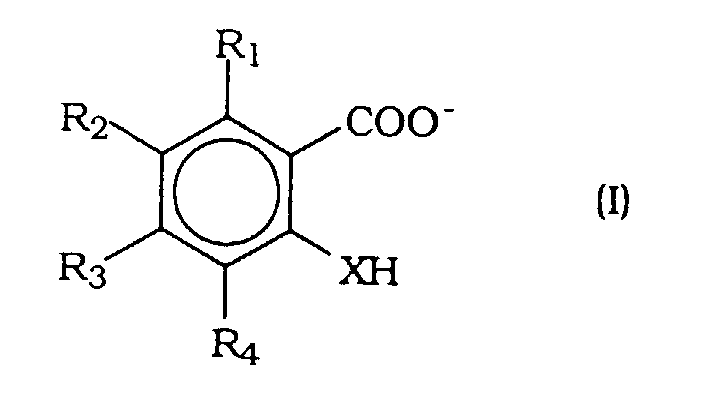 X aus O, S und NH ausgewählt ist, undR1, R2, R3 und R4 unabhängig voneinander aus -H, -Cl, -Br, -F, -I, -OH, -SH, -NH2, -CHO, -COOH, -SO3H, Arylgruppen, C1-C20-Alkylgruppen, Aralkylgruppen und Alkylarylgruppen, wobei diese Gruppen durch eine oder mehrere Gruppen ausgewählt aus -OH, -SH, -NH2, -CHO, -COOH, =O, -CONH2, -SO3H, Epoxy oder C1-C6-Alkoxy substituiert sein können oder untereinander eine cyclische Struktur bilden können, ausgewählt sind.
 - Verfahren nach Anspruch 1, dadurch gekennzeichnet, daß die Lösung Ionen der Formel I enthält, in der X Sauerstoff bedeutet.
- Verfahren nach Anspruch 1 oder 2, dadurch gekennzeichnet, daß die Konzentration der Lösung an Ionen der Formel I größer oder gleich ist als 0,1 Mol/Liter.
- Verfahren nach Anspruch 3, dadurch gekennzeichnet, daß die Konzentration an Ionen der Formel I größer oder gleich ist als 0,5 Mol/Liter.
- Verfahren nach einem der vorhergehenden Ansprüche, dadurch gekennzeichnet, daß die Stromdichte bei der Elektropolymerisation gleich oder größer ist als 0,4 A/dm2.
- Verfahren nach Anspruch 5, dadurch gekennzeichnet, daß die Stromdichte der Elektropolymerisation größer ist als 10 A/dm2.
- Verfahren nach einem der vorhergehenden Ansprüche, dadurch gekennzeichnet, daß die Gesamtkonzentration von Pyrrol und/oder einem oder mehreren substituierten Pyrrolen in der Lösung größer ist als 0,1 Mol/Liter.
- Verfahren nach einem der vorhergehenden Ansprüche, dadurch gekennzeichnet, daß die Gesamtkonzentration an Pyrrol und/oder einem oder mehreren substituierten Pyrrolen in der Lösung größer ist als 0,4 Mol/Liter.
- Verfahren nach einem der vorhergehenden Ansprüche, dadurch gekennzeichnet, daß der pH-Wert der Lösung zwischen 3 und 10 liegt.
- Verfahren nach einem der vorhergehenden Ansprüche, dadurch gekennzeichnet, daß der pH-Wert der Lösung zwischen 4 und 6 liegt.
- Verfahren nach einem der vorhergehenden Ansprüche, dadurch gekennzeichnet, daß die Anode in der Elektrolytlösung mit einer Geschwindigkeit von größer als 10 m/Minute bewegt wird.
- Wäßriges oder wäßrig-alkoholisches Bad für die Elektropolymerisation zur Durchführung eines Verfahrens zurAbscheidung eines haftenden Überzugs aus Polypyrrol an einem Gegenstand aus einem oxidierbaren Material, insbesondere auf der Grundlage von Eisen, Zink, Kupfer, Nickel oder Aluminium oder Legierungen davon, durch Elektropolymerisation einer wäßrigen Elektrolytlösung von Pyrrol und/oder einem oder mehreren substituierten Pyrrolen, wobei die Anode der Elektropolymerisations-Einrichtung durch den Gegenstand aus dem oxidierbaren Metall gebildet wird, dadurch gekennzeichnet, daß sie in der wäßrigen Elektrolytlösung Pyrrol und/oder ein oder mehrere substituierte Pyrrole und Ionen ausgewählt aus Ionen der Formel:in der
 enthält.X aus O, S und NH ausgewählt ist, undR1, R2, R3 und R4 unabhängig voneinander aus -H, -Cl, -Br, -F, -I, -OH, -SH, -NH2, -CHO, -COOH, -SO3H, Arylgruppen, C1-C20-Alkylgruppen, Aralkylgruppen und Alkylarylgruppen, wobei diese Gruppen durch eine oder mehrere Gruppen ausgewählt aus -OH, -SH, -NH2, -CHO, -COOH, =O, -CONH2, -SO3H, Epoxy oder C1-C6-Alkoxy substituiert sein können oder untereinander eine cyclische Struktur bilden können, ausgewählt sind,
 - Verfahren zum Schutz von Gegenständen aus einem oxidierbaren Metall, insbesondere auf der Grundlage von Eisen, Zink, Kupfer, Aluminium oder Legierungen davon, gegen Korrosion, dadurch gekennzeichnet, daß man auf der Oberfläche des Gegenstandes einen Überzug aus Polypyrrolen gemäß einem der Ansprüche 1 bis 11 abscheidet.
Applications Claiming Priority (2)
| Application Number | Priority Date | Filing Date | Title |
|---|---|---|---|
| FR9315385A FR2714077B1 (fr) | 1993-12-21 | 1993-12-21 | Procédé et bain de dépôt électrolytique de polypyrrole sur une surface de métal oxydable par électropolymérisation. |
| FR9315385 | 1993-12-21 |
Publications (2)
| Publication Number | Publication Date |
|---|---|
| EP0659794A1 EP0659794A1 (de) | 1995-06-28 |
| EP0659794B1 true EP0659794B1 (de) | 1999-03-10 |
Family
ID=9454173
Family Applications (1)
| Application Number | Title | Priority Date | Filing Date |
|---|---|---|---|
| EP94402920A Expired - Lifetime EP0659794B1 (de) | 1993-12-21 | 1994-12-16 | Bad und elektrolytisches Verfahren zum Aufbringen von Polypyrrol auf einer oxydierbaren Metalloberfläche durch Elektropolymerisierung |
Country Status (8)
| Country | Link |
|---|---|
| US (1) | US5522981A (de) |
| EP (1) | EP0659794B1 (de) |
| JP (1) | JP3186484B2 (de) |
| KR (1) | KR100330648B1 (de) |
| AT (1) | ATE177444T1 (de) |
| DE (1) | DE69416971T2 (de) |
| ES (1) | ES2131654T3 (de) |
| FR (1) | FR2714077B1 (de) |
Families Citing this family (12)
| Publication number | Priority date | Publication date | Assignee | Title |
|---|---|---|---|---|
| FR2787581A1 (fr) * | 1998-12-16 | 2000-06-23 | Commissariat Energie Atomique | Procede et equipement de garnissage de sites d'une biopuce |
| FR2787582B1 (fr) | 1998-12-16 | 2001-01-12 | Commissariat Energie Atomique | Procede de fabrication d'une biopuce et biopuce |
| ATE302827T1 (de) * | 2001-01-11 | 2005-09-15 | De Paiva Martins Jose I Ferrao | Verfahren und elektrolytisches bad zur herstellung durch elektropolymerisierung eines homogenen und haftenden polypyrrol-überzugs auf der oberfläche von oxydierbaren metallen |
| US6914026B2 (en) * | 2001-09-07 | 2005-07-05 | Engelhard Corporation | Hydrothermally stable metal promoted zeolite beta for NOx reduction |
| FR2832162B1 (fr) * | 2001-11-14 | 2004-11-12 | Commissariat Energie Atomique | Procede de formation d'une couche de polymeres d'epaisseur homogene a la surface d'un support solide, support solide obtenu et ses applications |
| US20040035498A1 (en) * | 2002-06-04 | 2004-02-26 | Lumimove, Inc. D/B/A/ Crosslink Polymer Research | Corrosion-responsive coating formulations for protection of metal surfaces |
| CA2500348C (en) | 2002-09-25 | 2013-04-23 | Alexander Mikhailovich Timonov | Method for the manufacture of electrode for energy-storage devices |
| JP2007529620A (ja) * | 2004-03-04 | 2007-10-25 | ナムローゼ・フェンノートシャップ・ベーカート・ソシエテ・アノニム | 固有導電性ポリマーを含むコーティング層で被覆した金属体 |
| CN104928713B (zh) * | 2015-06-17 | 2017-10-31 | 上海交通大学 | 导电聚合物包覆的镍基产氢电极的制备方法及其用途 |
| FR3115717A1 (fr) * | 2020-10-30 | 2022-05-06 | Nof Metal Coatings Europe | Revêtement à base de pyrrole pour la protection contre la corrosion |
| KR102675003B1 (ko) * | 2021-09-30 | 2024-06-14 | 주식회사 엘지에너지솔루션 | 비수 전해질용 첨가제를 포함하는 비수 전해질 및 이를 포함하는 리튬 이차전지 |
| CN116535924B (zh) * | 2023-06-07 | 2023-10-17 | 南京中金润恒金属科技股份有限公司 | 一种复合冷镀锌涂料及其制备方法 |
Family Cites Families (6)
| Publication number | Priority date | Publication date | Assignee | Title |
|---|---|---|---|---|
| DE3049551A1 (de) * | 1980-12-31 | 1982-07-29 | Basf Ag, 6700 Ludwigshafen | Elektrisch leitfaehige poly(pyrrol)-derivate |
| DE3327012A1 (de) * | 1983-07-27 | 1985-02-07 | Basf Ag, 6700 Ludwigshafen | Verfahren zur elektrochemischen polymerisation von pyrrolen, anode zur durchfuehrung dieses verfahrens sowie nach diesem verfahren erhaltene produkte |
| JPS62189714A (ja) * | 1986-02-17 | 1987-08-19 | 日通工株式会社 | 固体電解コンデンサの半導体層形成方法 |
| WO1990010095A1 (en) * | 1989-02-24 | 1990-09-07 | Itc Uniadvice Limited | Polymeric coating compositions for corrosion protection |
| JP2826341B2 (ja) * | 1989-05-13 | 1998-11-18 | 日本ケミコン株式会社 | 固体電解コンデンサの製造方法 |
| FR2679240B1 (fr) * | 1991-07-17 | 1993-10-22 | Centre Nal Recherc Scientifique | Procede d'obtention d'une couche mince de polymere d'aniline ou d'heterocycles aromatiques, sur un substrat metallique, par polymerisation et deposition par voie chimique. |
-
1993
- 1993-12-21 FR FR9315385A patent/FR2714077B1/fr not_active Expired - Fee Related
-
1994
- 1994-12-16 ES ES94402920T patent/ES2131654T3/es not_active Expired - Lifetime
- 1994-12-16 EP EP94402920A patent/EP0659794B1/de not_active Expired - Lifetime
- 1994-12-16 AT AT94402920T patent/ATE177444T1/de not_active IP Right Cessation
- 1994-12-16 DE DE69416971T patent/DE69416971T2/de not_active Expired - Fee Related
- 1994-12-20 KR KR1019940035399A patent/KR100330648B1/ko not_active Expired - Fee Related
- 1994-12-20 US US08/360,039 patent/US5522981A/en not_active Expired - Fee Related
- 1994-12-21 JP JP33567794A patent/JP3186484B2/ja not_active Expired - Fee Related
Also Published As
| Publication number | Publication date |
|---|---|
| DE69416971T2 (de) | 1999-10-07 |
| JP3186484B2 (ja) | 2001-07-11 |
| DE69416971D1 (de) | 1999-04-15 |
| FR2714077B1 (fr) | 1996-03-08 |
| JPH07331491A (ja) | 1995-12-19 |
| US5522981A (en) | 1996-06-04 |
| ATE177444T1 (de) | 1999-03-15 |
| FR2714077A1 (fr) | 1995-06-23 |
| KR950018676A (ko) | 1995-07-22 |
| ES2131654T3 (es) | 1999-08-01 |
| EP0659794A1 (de) | 1995-06-28 |
| KR100330648B1 (ko) | 2002-11-01 |
Similar Documents
| Publication | Publication Date | Title |
|---|---|---|
| JP7582839B2 (ja) | 導電性または半導電性表面上における有機電気グラフト化被膜の形成 | |
| CA2540871C (fr) | Procede de formation d'un film polymere sur une surface conductrice ou semi-conductrice de l'electricite par electro-greffage, surfaces obtenues et applications | |
| EP0659794A1 (de) | Bad und elektrolytisches Verfahren zum Aufbringen von Polypyrrol auf einer oxydierbaren Metalloberfläche durch Elektropolymerisierung | |
| Hung et al. | Improvement of the corrosion protection of polypyrrole coating for CT3 mild steel with 10-camphorsulfonic acid and molybdate as inhibitor dopants | |
| EP2922987B1 (de) | Verfahren zur beschichtung der oberfläche eines organischen oder metallmaterials mit speziellen organischen verbindungen mittels elektrochemischer impulsstromreduktion der diazoniumionen dieser organischen verbindungen | |
| EP1989345B1 (de) | Verfahren zur bildung von organischen schichten auf elektrisch leitenden oder halbleitenden oberflächen ausgehend von einer wässrigen lösung | |
| WO2001059178A1 (fr) | Materiau metallique dont la surface est modifiee, son procede de preparation et utilisation du materiau modifie | |
| US8288009B2 (en) | Formation of ultra-thin films that are grafted to electrically-conducting or semi-conducting surfaces | |
| FR2910006A1 (fr) | Procede de preparation d'un film organique a la surface d'un support solide dans des conditions non-electrochimiques, support solide ainsi obtenu et kit de preparation | |
| FR2679240A1 (fr) | Procede d'obtention d'une couche mince de polymere d'aniline ou d'heterocycles aromatiques, sur un substrat metallique, par polymerisation et deposition par voie chimique. | |
| FR2910007A1 (fr) | Procede de preparation d'un film organique a la surface d'un support solide dans des conditions non-electrochimiques, support solide ainsi obtenu et kit de preparation | |
| EP1227135B1 (de) | Verfahren und elektrolytisches Bad zur Herstellung durch Elektropolymerisierung eines homogenen und haftenden Polypyrrol-Überzugs auf der Oberfläche von oxydierbaren Metallen | |
| FR2698379A1 (fr) | Procédé de préparation d'un revêtement adhérent d'un polypyrrole sur un substrat métallique à base de fer par électropolymérisation. | |
| FR2897876A1 (fr) | Procede de formation de films organiques sur des surfaces conductrices ou semi-conductrices de l'electricite a partir de solutions aqueuses | |
| KR20010021672A (ko) | 조성물 제조방법 | |
| Subathira et al. | Corrosion Protection of Stainless Steel by Polyaniline/Polypyrrole Composite Coating | |
| WO2022090524A1 (fr) | Revetement a base de pyrrole pour la protection contre la corrosion | |
| HK1094232B (en) | Method for forming a polymer film on a surface that conducts or semiconducts electricity by means of electrografting, surfaces obtained, and applications thereof | |
| FR2929137A1 (fr) | Procede d'electrogreffage localise sur des substrats conducteurs ou semi-conducteurs en presence d'une microelectrode | |
| FR2977812A1 (fr) | Procede de preparation d'un film organique hydrophobe a la surface d'un support solide |
Legal Events
| Date | Code | Title | Description |
|---|---|---|---|
| PUAI | Public reference made under article 153(3) epc to a published international application that has entered the european phase |
Free format text: ORIGINAL CODE: 0009012 |
|
| AK | Designated contracting states |
Kind code of ref document: A1 Designated state(s): AT BE CH DE DK ES FR GB GR IE IT LI LU NL PT SE |
|
| 17P | Request for examination filed |
Effective date: 19951106 |
|
| 17Q | First examination report despatched |
Effective date: 19970218 |
|
| GRAG | Despatch of communication of intention to grant |
Free format text: ORIGINAL CODE: EPIDOS AGRA |
|
| GRAG | Despatch of communication of intention to grant |
Free format text: ORIGINAL CODE: EPIDOS AGRA |
|
| GRAH | Despatch of communication of intention to grant a patent |
Free format text: ORIGINAL CODE: EPIDOS IGRA |
|
| GRAH | Despatch of communication of intention to grant a patent |
Free format text: ORIGINAL CODE: EPIDOS IGRA |
|
| GRAA | (expected) grant |
Free format text: ORIGINAL CODE: 0009210 |
|
| AK | Designated contracting states |
Kind code of ref document: B1 Designated state(s): AT BE CH DE DK ES FR GB GR IE IT LI LU NL PT SE |
|
| PG25 | Lapsed in a contracting state [announced via postgrant information from national office to epo] |
Ref country code: SE Free format text: THE PATENT HAS BEEN ANNULLED BY A DECISION OF A NATIONAL AUTHORITY Effective date: 19990310 Ref country code: GR Free format text: LAPSE BECAUSE OF NON-PAYMENT OF DUE FEES Effective date: 19990310 |
|
| REF | Corresponds to: |
Ref document number: 177444 Country of ref document: AT Date of ref document: 19990315 Kind code of ref document: T |
|
| ITF | It: translation for a ep patent filed | ||
| REG | Reference to a national code |
Ref country code: CH Ref legal event code: EP |
|
| REF | Corresponds to: |
Ref document number: 69416971 Country of ref document: DE Date of ref document: 19990415 |
|
| REG | Reference to a national code |
Ref country code: IE Ref legal event code: FG4D Free format text: FRENCH |
|
| PG25 | Lapsed in a contracting state [announced via postgrant information from national office to epo] |
Ref country code: DK Free format text: LAPSE BECAUSE OF FAILURE TO SUBMIT A TRANSLATION OF THE DESCRIPTION OR TO PAY THE FEE WITHIN THE PRESCRIBED TIME-LIMIT Effective date: 19990610 |
|
| PG25 | Lapsed in a contracting state [announced via postgrant information from national office to epo] |
Ref country code: PT Free format text: LAPSE BECAUSE OF FAILURE TO SUBMIT A TRANSLATION OF THE DESCRIPTION OR TO PAY THE FEE WITHIN THE PRESCRIBED TIME-LIMIT Effective date: 19990611 |
|
| GBT | Gb: translation of ep patent filed (gb section 77(6)(a)/1977) |
Effective date: 19990614 |
|
| REG | Reference to a national code |
Ref country code: ES Ref legal event code: FG2A Ref document number: 2131654 Country of ref document: ES Kind code of ref document: T3 |
|
| PG25 | Lapsed in a contracting state [announced via postgrant information from national office to epo] |
Ref country code: IE Free format text: LAPSE BECAUSE OF NON-PAYMENT OF DUE FEES Effective date: 19991019 |
|
| REG | Reference to a national code |
Ref country code: IE Ref legal event code: FD4D |
|
| PG25 | Lapsed in a contracting state [announced via postgrant information from national office to epo] |
Ref country code: LI Free format text: LAPSE BECAUSE OF NON-PAYMENT OF DUE FEES Effective date: 19991231 Ref country code: CH Free format text: LAPSE BECAUSE OF NON-PAYMENT OF DUE FEES Effective date: 19991231 |
|
| PLBE | No opposition filed within time limit |
Free format text: ORIGINAL CODE: 0009261 |
|
| STAA | Information on the status of an ep patent application or granted ep patent |
Free format text: STATUS: NO OPPOSITION FILED WITHIN TIME LIMIT |
|
| 26N | No opposition filed | ||
| REG | Reference to a national code |
Ref country code: GB Ref legal event code: IF02 |
|
| PGFP | Annual fee paid to national office [announced via postgrant information from national office to epo] |
Ref country code: AT Payment date: 20031114 Year of fee payment: 10 |
|
| PGFP | Annual fee paid to national office [announced via postgrant information from national office to epo] |
Ref country code: LU Payment date: 20031117 Year of fee payment: 10 |
|
| PGFP | Annual fee paid to national office [announced via postgrant information from national office to epo] |
Ref country code: NL Payment date: 20031118 Year of fee payment: 10 |
|
| PGFP | Annual fee paid to national office [announced via postgrant information from national office to epo] |
Ref country code: DE Payment date: 20031205 Year of fee payment: 10 |
|
| PGFP | Annual fee paid to national office [announced via postgrant information from national office to epo] |
Ref country code: GB Payment date: 20031209 Year of fee payment: 10 |
|
| PGFP | Annual fee paid to national office [announced via postgrant information from national office to epo] |
Ref country code: FR Payment date: 20031216 Year of fee payment: 10 Ref country code: ES Payment date: 20031216 Year of fee payment: 10 |
|
| PGFP | Annual fee paid to national office [announced via postgrant information from national office to epo] |
Ref country code: BE Payment date: 20031231 Year of fee payment: 10 |
|
| PG25 | Lapsed in a contracting state [announced via postgrant information from national office to epo] |
Ref country code: LU Free format text: LAPSE BECAUSE OF NON-PAYMENT OF DUE FEES Effective date: 20041216 Ref country code: GB Free format text: LAPSE BECAUSE OF NON-PAYMENT OF DUE FEES Effective date: 20041216 Ref country code: AT Free format text: LAPSE BECAUSE OF NON-PAYMENT OF DUE FEES Effective date: 20041216 |
|
| PG25 | Lapsed in a contracting state [announced via postgrant information from national office to epo] |
Ref country code: ES Free format text: LAPSE BECAUSE OF NON-PAYMENT OF DUE FEES Effective date: 20041217 |
|
| PG25 | Lapsed in a contracting state [announced via postgrant information from national office to epo] |
Ref country code: BE Free format text: LAPSE BECAUSE OF NON-PAYMENT OF DUE FEES Effective date: 20041231 |
|
| BERE | Be: lapsed |
Owner name: *SOLLAC Effective date: 20041231 |
|
| PG25 | Lapsed in a contracting state [announced via postgrant information from national office to epo] |
Ref country code: NL Free format text: LAPSE BECAUSE OF NON-PAYMENT OF DUE FEES Effective date: 20050701 Ref country code: DE Free format text: LAPSE BECAUSE OF NON-PAYMENT OF DUE FEES Effective date: 20050701 |
|
| GBPC | Gb: european patent ceased through non-payment of renewal fee |
Effective date: 20041216 |
|
| PG25 | Lapsed in a contracting state [announced via postgrant information from national office to epo] |
Ref country code: FR Free format text: LAPSE BECAUSE OF NON-PAYMENT OF DUE FEES Effective date: 20050831 |
|
| NLV4 | Nl: lapsed or anulled due to non-payment of the annual fee |
Effective date: 20050701 |
|
| REG | Reference to a national code |
Ref country code: FR Ref legal event code: ST |
|
| PG25 | Lapsed in a contracting state [announced via postgrant information from national office to epo] |
Ref country code: IT Free format text: LAPSE BECAUSE OF NON-PAYMENT OF DUE FEES;WARNING: LAPSES OF ITALIAN PATENTS WITH EFFECTIVE DATE BEFORE 2007 MAY HAVE OCCURRED AT ANY TIME BEFORE 2007. THE CORRECT EFFECTIVE DATE MAY BE DIFFERENT FROM THE ONE RECORDED. Effective date: 20051216 |
|
| REG | Reference to a national code |
Ref country code: ES Ref legal event code: FD2A Effective date: 20041217 |
|
| BERE | Be: lapsed |
Owner name: *SOLLAC Effective date: 20041231 |