EP0659894B1 - Legierung auf Stahlbasis mit hohem Modul und Verfahren zu deren Herstellung - Google Patents
Legierung auf Stahlbasis mit hohem Modul und Verfahren zu deren Herstellung Download PDFInfo
- Publication number
- EP0659894B1 EP0659894B1 EP94120574A EP94120574A EP0659894B1 EP 0659894 B1 EP0659894 B1 EP 0659894B1 EP 94120574 A EP94120574 A EP 94120574A EP 94120574 A EP94120574 A EP 94120574A EP 0659894 B1 EP0659894 B1 EP 0659894B1
- Authority
- EP
- European Patent Office
- Prior art keywords
- iron
- modulus
- boride
- powders
- based alloy
- Prior art date
- Legal status (The legal status is an assumption and is not a legal conclusion. Google has not performed a legal analysis and makes no representation as to the accuracy of the status listed.)
- Expired - Lifetime
Links
- XEEYBQQBJWHFJM-UHFFFAOYSA-N Iron Chemical compound [Fe] XEEYBQQBJWHFJM-UHFFFAOYSA-N 0.000 title claims description 274
- 229910052742 iron Inorganic materials 0.000 title claims description 132
- 229910045601 alloy Inorganic materials 0.000 title claims description 99
- 239000000956 alloy Substances 0.000 title claims description 99
- 238000000034 method Methods 0.000 title claims description 59
- 230000008569 process Effects 0.000 title claims description 37
- 238000004519 manufacturing process Methods 0.000 title claims description 25
- 239000002245 particle Substances 0.000 claims description 80
- 239000000843 powder Substances 0.000 claims description 73
- 239000011159 matrix material Substances 0.000 claims description 70
- 238000005245 sintering Methods 0.000 claims description 35
- 239000011812 mixed powder Substances 0.000 claims description 24
- 239000010959 steel Substances 0.000 claims description 21
- 238000002156 mixing Methods 0.000 claims description 20
- 229910000831 Steel Inorganic materials 0.000 claims description 18
- 229910001021 Ferroalloy Inorganic materials 0.000 claims description 12
- 238000006243 chemical reaction Methods 0.000 claims description 10
- OKTJSMMVPCPJKN-UHFFFAOYSA-N Carbon Chemical compound [C] OKTJSMMVPCPJKN-UHFFFAOYSA-N 0.000 claims description 9
- 239000000126 substance Substances 0.000 claims description 7
- 229910052799 carbon Inorganic materials 0.000 claims description 6
- 239000012535 impurity Substances 0.000 claims description 6
- 229910000734 martensite Inorganic materials 0.000 claims description 6
- 239000010419 fine particle Substances 0.000 claims description 4
- 239000000523 sample Substances 0.000 description 51
- 229910000640 Fe alloy Inorganic materials 0.000 description 50
- 230000000052 comparative effect Effects 0.000 description 20
- 239000000463 material Substances 0.000 description 20
- QYEXBYZXHDUPRC-UHFFFAOYSA-N B#[Ti]#B Chemical compound B#[Ti]#B QYEXBYZXHDUPRC-UHFFFAOYSA-N 0.000 description 18
- 229910033181 TiB2 Inorganic materials 0.000 description 18
- 230000005484 gravity Effects 0.000 description 15
- 229910052804 chromium Inorganic materials 0.000 description 14
- 239000011651 chromium Substances 0.000 description 14
- VYZAMTAEIAYCRO-UHFFFAOYSA-N Chromium Chemical compound [Cr] VYZAMTAEIAYCRO-UHFFFAOYSA-N 0.000 description 13
- 230000006872 improvement Effects 0.000 description 9
- 239000000203 mixture Substances 0.000 description 9
- ZOXJGFHDIHLPTG-UHFFFAOYSA-N Boron Chemical compound [B] ZOXJGFHDIHLPTG-UHFFFAOYSA-N 0.000 description 8
- 229910052796 boron Inorganic materials 0.000 description 8
- RTAQQCXQSZGOHL-UHFFFAOYSA-N Titanium Chemical compound [Ti] RTAQQCXQSZGOHL-UHFFFAOYSA-N 0.000 description 7
- 230000008859 change Effects 0.000 description 7
- 239000002131 composite material Substances 0.000 description 7
- 150000001875 compounds Chemical class 0.000 description 7
- 239000007769 metal material Substances 0.000 description 7
- 230000015572 biosynthetic process Effects 0.000 description 6
- 239000010936 titanium Substances 0.000 description 6
- ZOKXTWBITQBERF-UHFFFAOYSA-N Molybdenum Chemical compound [Mo] ZOKXTWBITQBERF-UHFFFAOYSA-N 0.000 description 5
- 238000004458 analytical method Methods 0.000 description 5
- LGLOITKZTDVGOE-UHFFFAOYSA-N boranylidynemolybdenum Chemical compound [Mo]#B LGLOITKZTDVGOE-UHFFFAOYSA-N 0.000 description 5
- 239000013078 crystal Substances 0.000 description 5
- 238000000280 densification Methods 0.000 description 5
- 150000001247 metal acetylides Chemical class 0.000 description 5
- 229910052750 molybdenum Inorganic materials 0.000 description 5
- 239000011733 molybdenum Substances 0.000 description 5
- 239000010955 niobium Substances 0.000 description 5
- 239000012071 phase Substances 0.000 description 5
- 238000006467 substitution reaction Methods 0.000 description 5
- 229910052719 titanium Inorganic materials 0.000 description 5
- 229910052720 vanadium Inorganic materials 0.000 description 5
- LEONUFNNVUYDNQ-UHFFFAOYSA-N vanadium atom Chemical compound [V] LEONUFNNVUYDNQ-UHFFFAOYSA-N 0.000 description 5
- 229910001200 Ferrotitanium Inorganic materials 0.000 description 4
- 238000002441 X-ray diffraction Methods 0.000 description 4
- 230000008901 benefit Effects 0.000 description 4
- 239000006185 dispersion Substances 0.000 description 4
- 239000007791 liquid phase Substances 0.000 description 4
- 229910052758 niobium Inorganic materials 0.000 description 4
- GUCVJGMIXFAOAE-UHFFFAOYSA-N niobium atom Chemical compound [Nb] GUCVJGMIXFAOAE-UHFFFAOYSA-N 0.000 description 4
- 229910000851 Alloy steel Inorganic materials 0.000 description 3
- 239000000470 constituent Substances 0.000 description 3
- 239000011888 foil Substances 0.000 description 3
- 239000007970 homogeneous dispersion Substances 0.000 description 3
- 150000002506 iron compounds Chemical class 0.000 description 3
- 229910052751 metal Inorganic materials 0.000 description 3
- 239000002184 metal Substances 0.000 description 3
- 150000004767 nitrides Chemical class 0.000 description 3
- 238000004663 powder metallurgy Methods 0.000 description 3
- 238000002360 preparation method Methods 0.000 description 3
- 230000009467 reduction Effects 0.000 description 3
- 230000002787 reinforcement Effects 0.000 description 3
- 230000007704 transition Effects 0.000 description 3
- XKRFYHLGVUSROY-UHFFFAOYSA-N Argon Chemical compound [Ar] XKRFYHLGVUSROY-UHFFFAOYSA-N 0.000 description 2
- 230000003247 decreasing effect Effects 0.000 description 2
- 238000011161 development Methods 0.000 description 2
- 230000018109 developmental process Effects 0.000 description 2
- 238000005516 engineering process Methods 0.000 description 2
- 230000005496 eutectics Effects 0.000 description 2
- 238000005242 forging Methods 0.000 description 2
- 239000007789 gas Substances 0.000 description 2
- 238000010438 heat treatment Methods 0.000 description 2
- 239000011261 inert gas Substances 0.000 description 2
- 238000012545 processing Methods 0.000 description 2
- 238000004445 quantitative analysis Methods 0.000 description 2
- MTPVUVINMAGMJL-UHFFFAOYSA-N trimethyl(1,1,2,2,2-pentafluoroethyl)silane Chemical compound C[Si](C)(C)C(F)(F)C(F)(F)F MTPVUVINMAGMJL-UHFFFAOYSA-N 0.000 description 2
- 229910000838 Al alloy Inorganic materials 0.000 description 1
- 241001640117 Callaeum Species 0.000 description 1
- FYYHWMGAXLPEAU-UHFFFAOYSA-N Magnesium Chemical compound [Mg] FYYHWMGAXLPEAU-UHFFFAOYSA-N 0.000 description 1
- 229910000861 Mg alloy Inorganic materials 0.000 description 1
- 229910019742 NbB2 Inorganic materials 0.000 description 1
- 229910001295 No alloy Inorganic materials 0.000 description 1
- 229910001069 Ti alloy Inorganic materials 0.000 description 1
- QCWXUUIWCKQGHC-UHFFFAOYSA-N Zirconium Chemical compound [Zr] QCWXUUIWCKQGHC-UHFFFAOYSA-N 0.000 description 1
- QRVBPFUUACXMQU-UHFFFAOYSA-N [Mo].[Fe].[Cr] Chemical compound [Mo].[Fe].[Cr] QRVBPFUUACXMQU-UHFFFAOYSA-N 0.000 description 1
- 238000005275 alloying Methods 0.000 description 1
- XAGFODPZIPBFFR-UHFFFAOYSA-N aluminium Chemical compound [Al] XAGFODPZIPBFFR-UHFFFAOYSA-N 0.000 description 1
- 229910052786 argon Inorganic materials 0.000 description 1
- 230000009286 beneficial effect Effects 0.000 description 1
- WUKWITHWXAAZEY-UHFFFAOYSA-L calcium difluoride Chemical compound [F-].[F-].[Ca+2] WUKWITHWXAAZEY-UHFFFAOYSA-L 0.000 description 1
- 238000004364 calculation method Methods 0.000 description 1
- -1 carbides Chemical class 0.000 description 1
- 238000005266 casting Methods 0.000 description 1
- 238000004581 coalescence Methods 0.000 description 1
- 238000009694 cold isostatic pressing Methods 0.000 description 1
- 238000007596 consolidation process Methods 0.000 description 1
- 238000001816 cooling Methods 0.000 description 1
- 238000007723 die pressing method Methods 0.000 description 1
- 230000000694 effects Effects 0.000 description 1
- 238000001125 extrusion Methods 0.000 description 1
- 239000000446 fuel Substances 0.000 description 1
- 229910052735 hafnium Inorganic materials 0.000 description 1
- VBJZVLUMGGDVMO-UHFFFAOYSA-N hafnium atom Chemical compound [Hf] VBJZVLUMGGDVMO-UHFFFAOYSA-N 0.000 description 1
- 238000001192 hot extrusion Methods 0.000 description 1
- 238000001513 hot isostatic pressing Methods 0.000 description 1
- 230000003993 interaction Effects 0.000 description 1
- 229910000765 intermetallic Inorganic materials 0.000 description 1
- 239000011777 magnesium Substances 0.000 description 1
- 238000005551 mechanical alloying Methods 0.000 description 1
- 239000011156 metal matrix composite Substances 0.000 description 1
- 238000010587 phase diagram Methods 0.000 description 1
- 230000000704 physical effect Effects 0.000 description 1
- 238000010298 pulverizing process Methods 0.000 description 1
- 239000010453 quartz Substances 0.000 description 1
- 239000002994 raw material Substances 0.000 description 1
- 230000009257 reactivity Effects 0.000 description 1
- 238000007670 refining Methods 0.000 description 1
- 230000003014 reinforcing effect Effects 0.000 description 1
- 239000012783 reinforcing fiber Substances 0.000 description 1
- 238000011160 research Methods 0.000 description 1
- 238000012827 research and development Methods 0.000 description 1
- 238000009774 resonance method Methods 0.000 description 1
- 239000011163 secondary particle Substances 0.000 description 1
- VYPSYNLAJGMNEJ-UHFFFAOYSA-N silicon dioxide Inorganic materials O=[Si]=O VYPSYNLAJGMNEJ-UHFFFAOYSA-N 0.000 description 1
- 239000007787 solid Substances 0.000 description 1
- 239000010935 stainless steel Substances 0.000 description 1
- 229910001220 stainless steel Inorganic materials 0.000 description 1
- 239000007858 starting material Substances 0.000 description 1
- 238000005728 strengthening Methods 0.000 description 1
- 239000000725 suspension Substances 0.000 description 1
- 229910052715 tantalum Inorganic materials 0.000 description 1
- GUVRBAGPIYLISA-UHFFFAOYSA-N tantalum atom Chemical compound [Ta] GUVRBAGPIYLISA-UHFFFAOYSA-N 0.000 description 1
- 230000009466 transformation Effects 0.000 description 1
- WFKWXMTUELFFGS-UHFFFAOYSA-N tungsten Chemical compound [W] WFKWXMTUELFFGS-UHFFFAOYSA-N 0.000 description 1
- 229910052721 tungsten Inorganic materials 0.000 description 1
- 239000010937 tungsten Substances 0.000 description 1
- 239000002699 waste material Substances 0.000 description 1
- 229910052726 zirconium Inorganic materials 0.000 description 1
Images

Classifications
-
- C—CHEMISTRY; METALLURGY
- C22—METALLURGY; FERROUS OR NON-FERROUS ALLOYS; TREATMENT OF ALLOYS OR NON-FERROUS METALS
- C22C—ALLOYS
- C22C33/00—Making ferrous alloys
- C22C33/02—Making ferrous alloys by powder metallurgy
- C22C33/0257—Making ferrous alloys by powder metallurgy characterised by the range of the alloying elements
- C22C33/0278—Making ferrous alloys by powder metallurgy characterised by the range of the alloying elements with at least one alloying element having a minimum content above 5%
- C22C33/0292—Making ferrous alloys by powder metallurgy characterised by the range of the alloying elements with at least one alloying element having a minimum content above 5% with more than 5% preformed carbides, nitrides or borides
-
- B—PERFORMING OPERATIONS; TRANSPORTING
- B22—CASTING; POWDER METALLURGY
- B22F—WORKING METALLIC POWDER; MANUFACTURE OF ARTICLES FROM METALLIC POWDER; MAKING METALLIC POWDER; APPARATUS OR DEVICES SPECIALLY ADAPTED FOR METALLIC POWDER
- B22F2998/00—Supplementary information concerning processes or compositions relating to powder metallurgy
- B22F2998/10—Processes characterised by the sequence of their steps
Definitions
- This invention relates to a high-modulus iron-based alloy and a process for manufacturing the same. More particularly, it relates to an iron-based alloy which has a high Young's or specific Young's modulus and is useful as a high-modulus structural metallic material, and a process for manufacturing the same.
- a composite material which comprises a matrix of a lightweight metal, such as a magnesium, aluminum or titanium alloy, and reinforcing fibers or particles employed for increasing the strength or modulus of the material.
- a composite material made by dispersing high-modulus particles in a lightweight metal matrix provides a high-modulus bulky material.
- Some borides of transition elements show relatively high Young's modulus, but there has hardly been reported any result obtained by dispersing boride particles in an iron-alloy matrix to achieve an high-modulus iron-based alloy.
- Miodownik, et al. report high-modulus iron-based alloy containing chromium and molybdenum boride particles [N.J. Saunders, L.M. Pan, K. Clay, C. Small and A.P. Miodownik: In User Aspects of Phase Diagrams, Inst. Materials, UK (1991), 64].
- the iron-based alloy is processed by hot extrusion of rapidly solidified amorphous foil and subsequent heat treatment and is reported as having a Young's modulus in the vicinity of 25,000 kgf/mm 2 .
- high-modulus material containing not more than 20% by volume of high-modulus compound particles in an iron-based alloy matrix and a process for manufacturing it
- high Young's modulus compound is introduced into a matrix by mechanical alloying, which results in a particle-dispersed iron-based alloy of high Young's modulus of at least 22,500 kgf/mm 2 and an impact value of at least 8 kgf-m/cm 2 .
- the particles in the high-modulus iron-based alloy proposed by Miodownik, et al. are, however, complex molybdenum-chromium-iron boride phase resulting from the reaction of boron with the iron-alloy matrix.
- Young's modulus of the complex boride is by far lower than that of a binary boride, i.e. chromium or molybdenum boride.
- the complex boride has a specific gravity of about 8.4 which is rather higher than that of the matrix. Therefore, the iron-based alloy containing the complex boride dispersed therein has an undesirably low specific Young's modulus.
- the amorphous foil used is difficult to manufacture by existing facilities, since rapid cooling process is required in order to dissolve enormously high content boron into the foil.
- the Japanese patent application referred to above discloses particles of a variety of compounds, such as carbides, borides and nitrides, but does not contain any disclosure at all as to the thermodynamic stability of those particles in the iron-alloy matrix.
- carbides or nitrides of transition elements generally show high Young's modulus in themselves, their modulus is considerably lowered in an iron-alloy matrix, since the transition elements are partly substituted by iron atoms in the matrix. Therefore, it is impossible to achieve any high Young's modulus conforming to the law of mixture as disclosed by way of examples in the Japanese application. Even if those particles may retain their high Young's modulus in the matrix, it is hard to expect any conformity to the law of mixture.
- the modulus of a composite material usually varies with the volume fraction of the particles along a curve stated theoretically in Materials Science and Technology, vol. 8 (1992), 922.
- US 4,419,130 discloses an iron-based alloy consisting of a matrix formed of an iron-alloy and unavoidable impurities and one boride of a Group IVa element, namely TiB 2 , in an amount of 2-10 % by weight.
- a weight boride content of 10 % corresponds to a volume boride content of approximately 16-17 %.
- EP 0 433 856 A1 discloses TiB 2 -Fe materials and methods for manufacturing the same.
- the inventors of this invention focused on the importance of providing particles that not only have a high Young's modulus, but are also thermodynamically stable in an iron alloy matrix.
- the partial substitution of metal atoms by iron atoms, or the formation of a complex iron compound does not lead to any product having a satisfactorily high modulus, even if the particles may possess a high Young's modulus.
- a boride containing a Group Va element and iron or an iron alloy react to form a complex boride of the Group Va element and iron having a high Young's modulus and a low specific gravity. More specifically, we have found that the complex boride which can realize a high Young's modulus, a low specific gravity and thereby a high specific Young's modulus is formed by the reaction of a boride of a Group Va element, or ferroboron, a ferroalloy containing a Group Va element and iron in an iron alloy.
- the high-modulus iron-based alloy of this invention comprises a matrix composed of iron or an iron alloy; and at least one boride selected from among borides of Group IVa elements and complex borides of one or more Group Va elements and iron, and dispersed in the matrix. It has a very high Young's modulus owing to the boride which is uniformly dispersed in the matrix.
- the boride employed in the alloy of this invention provides excellent strengthening particles, as it has a high Young's modulus and is thermodynamically stable.
- the dispersion of its particles enables a higher modulus than the modulus that has been available from any conventional product containing an equal volume fraction of particles. If the boride is a complex one having a specific gravity lower than that of the matrix, the iron-based alloy has a lower specific gravity and thereby a high specific Young's modulus.
- the boride of a Group IVa element is a compound having an orderly crystal structure formed by strongly bound atoms, and has, therefore, a very high Young's modulus, since the binding force for its atoms has a direct bearing on its Young's modulus. It is thermodynamically stable in the matrix, and does not undergo any crystallographic change due to its reaction with the matrix, such as the substitution of its atoms by atoms of other elements, or the formation of any complex iron compound, but maintains its strong binding force and thereby its high Young's modulus in the matrix. Thus, the iron-based alloy of this invention has a very high Young's modulus.
- the complex boride is also a compound having an orderly crystal structure formed by strongly bound atoms, and has, therefore, a very high Young's modulus. It is also thermodynamically stable in the matrix. Moreover, it has a specific gravity which is lower than that of the matrix. Thus, the iron-based alloy of this invention containing any such complex boride has a very high specific Young's modulus.
- a high-modulus iron-based alloy which comprises an iron or iron-alloy matrix, and at least one boride of Group IVa elements dispersed in the matrix. It offers a very high Young's modulus owing to the boride particles dispersed uniformly in the matrix.
- the boride having an ordered crystal structure of firmly bound atoms possesses a very high Young's modulus.
- the boride is in thermodynamic equilibrium with an iron-alloy matrix and does not undergo any crystallographic change due to the reaction with the matrix, such as the substitution by iron atoms in the matrix, or the formation of any complex iron compound. Therefore, the boride retains its high Young's modulus in the matrix and enables the iron-based alloy of this invention to exhibit very high Young's modulus.
- the high-modulus iron-based alloy can be manufactured by a process which comprises the steps of mixing an iron, or iron-alloy powder and a powder of at least one boride of a Group IVa element to prepare a mixed powder, compacting the mixed powder into a shaped body, and sintering, in which at least one boride of IVa elements is dispersed in the iron.
- This process facilitates the manufacture of the alloy of this invention at a low cost.
- the step of mixing the powders can be carried out by any known method without any special facility, or prior treatment. Any known method can be employed at ordinary pressure for compacting the mixed powder to form an appropriately shaped body with sufficient strength for normal handling, since the mixed powder consists mainly of the iron, or iron-alloy powder with high compactibility.
- the compacted body is sintered.
- the sintering can be carried out in a vacuum or inert gas atmosphere at ordinary temperature and time as for iron/steel sintered materials, which benefits high sinterability of the iron, or iron-alloy powder.
- the boride phase is in thermodynamic equilibrium with the matrix and remains as uniformly dispersed particles even during sintering in a high temperature range.
- the process which has been described can manufacture the high-modulus iron-based alloy at a low cost, since it is based on a common powder metallurgy process carried out by employing easily available powders of raw materials and existing facilities.
- the high-modulus iron-based alloy according to the first aspect of this invention can also be manufactured by another process that comprises the steps of mixing an iron, or iron-alloy powder, a ferroboron powder and a ferroalloy powder containing at least one Group IVa element to prepare a mixed powder, compacting the mixed powder into an appropriately shaped body, and sintering it, the ferroboron and ferroalloy powders forming at least one boride of a Group IVa element dispersed in a matrix formed by the iron, or iron-alloy powder.
- the powders which are employed by this process are less expensive than those employed by the process which has first been described.
- the ferroboron and ferroalloy powders react with each other to form the fine boride particles during the sintering step. Additionally, the ferroboron promotes the densification of a sintered product.
- this second process can manufacture the high-modulus iron-based alloy more easily at a lower cost. Otherwise, it shares the advantages with the first process. No repeated description is, therefore, made, but reference is made to the foregoing description of the mixing, compacting and sintering steps of the first process.
- the high-modulus iron-based alloy of this invention would hopefully satisfy all of these requirements, which have not been accomplished by any known steel or iron alloy, or particle-dispersed iron-based alloy.
- the alloy of this invention is, therefore, applicable to a wide variety of structural parts, including not only automobile engine parts or suspensions, but also various kinds of shafts, and parts for audio apparatus.
- the dispersion of reinforcement in a matrix for improving its strength, modulus and wear resistance is well known in the art of the composite materials.
- some consolidation processes at high temperature are employed for composing reinforcement with a matrix as a bulky material.
- the interaction of co-existing phases inevitably occurs to cause a number of undesirable changes, including phase transformation of reinforcement and formation of brittle reacted layer along the interface.
- These changes usually impair the properties of the composite material to a far lower level than the theoretical one calculated in accordance with the law of mixture.
- At least one boride of the Group IVa element Ti (titanium), Zr (zirconium) or Hf (hafnium) is employed in the high-modulus iron-based alloy according to the first aspect of this invention. While any such boride having a Young's modulus of at least 25,000 kgf/mm 2 contributes to the improvement of the alloy, diborides represented by chemical formula MB 2 (M: a Group IVa element) show particularly high Young's modulus among others, and are preferred for the purpose of this invention. Any such diboride is a suitable material for the alloy of this invention, since the inherent or chemical stability promotes availability and easy handling.
- the boride is in the form of fine particles of a diameter below 100 microns, and homogeneously dispersed in the matrix.
- the boride particle having a particle diameter not exceeding 100 microns ensures that the alloy provides sufficiently high mechanical properties for practical use, including strength, toughness and ductility.
- Boride particles having a diameter not exceeding 20 microns are, however, more preferable, as they give an alloy having still higher levels of mechanical properties.
- the alloy has a boride content of 10% to 50% by volume with respect to the volume of the whole alloy to achieve satisfactorily high modulus. No alloy having a boride content below 10% by volume has satisfactorily high modulus, while any alloy having a boride content over 50% by volume will have its mechanical properties degraded by the cohesion or coalescence of boride particles. A range of 10 to 40% by volume is preferred.
- iron alloys including ferritic, austenitic and martensitic ones
- the matrix is preferably formed from an iron alloy having a carbon content not exceeding 0.1% by weight to ensure that the boride exhibit such a high level of thermodynamic stability in the matrix without allowing formation of any carbide or boro-carbide, which leads to the failure of intended high-modulus.
- powder metallurgy is, among others, preferred for the homogeneous dispersion of fine boride particles.
- An iron or iron-alloy powder and a powder of at least one boride of a Group IVa element are mixed to prepare a mixed powder.
- the mixed powder is compacted into an appropriately shaped body.
- the compacted body is sintered to produce a high-modulus iron-based alloy containing the boride particles dispersed in the iron or iron alloy matrix.
- the iron or iron-alloy powder may be a commercially available one, or may be prepared by any known method. It is, thus, possible to use an inexpensive powder prepared by e.g. atomizing or electrolytic refining, such as a pure iron or stainless steel powder. While many commercially available powders are sieved below a particle diameter of, say, 150 microns (-#100), one having a particle diameter not exceeding 45 microns (-#330) facilitates the homogeneous dispersion of boride particles and the densification of a sintered product. Extremely fine powder having a particle diameter in the order of one micron or less is, however, undesirable, because of the difficulties in handling and compacting.
- the boride powder may likewise be a commercially available one, or may be prepared by any known method. It preferably has a particle diameter of several microns. In case where only a powder of larger particle diameter is available, it is advisable to pulverize it to an appropriate particle size by e.g. a ball or vibration mill, or an attritor.
- a V-blender, or a ball or vibration mill can, for example, be employed for mixing the powders. If the boride powder is cohesive form secondary particles, however, mixing in an attritor, or high energy ball mill is preferable employed to ensure the homogeneous dispersion of fine particles.
- a compacting pressure of at least 2 tons/cm 2 is preferably employed to produce a sintered product having a satisfactorily high density.
- the compacted body is preferably sintered in a vacuum, or in an inert gas atmosphere by employing a sintering temperature of 1000 ° C to 1250 ° C and a sintering time of about 1 to 4 hours.
- a sintering temperature 1000 ° C to 1250 ° C
- a sintering time of about 1 to 4 hours.
- No product of satisfactorily high density can be obtained by less than 0.5 hour of sintering or at a temperature below 1000 ° C.
- No higher density can be expected from over four hours of sintering, but it is merely a waste of energy.
- No temperature over 1250 ° C is appropriate, since the large amount of liquid phase resulting from the eutectic reaction causes the distortion of sintered product.
- the compacted body is preliminarily sintered at a temperature of 800 ° C to 1000° C for 0.5 to 1 hour, and that the preliminarily sintered product is compacted again before secondary sintering under the conditions as described above.
- ferroboron and ferroalloy powders are employed instead of the boride powder.
- ferroboron and ferroalloy powders are both commercially available as crushed products of ingots, it is advisable to employ products of composition close to intermetallic compounds because of the advantage in pulverizing with e.g. a ball or vibration mill, or an attritor.
- the proportions of the ferroboron and ferroalloy powders have to be so selected that the boride formed by their reaction may occupy an appropriate volume fraction. Milder conditions are available in the sintering, since ferroboron is reported to promote the densification effect in a sintered iron alloy.
- the sintering step is preferably followed by hot working.
- the sintered density can easily be improved to its theoretically sufficient value by hot working, for example, forging, extrusion or swaging.
- the processing temperature is preferably at a temperature of 700 °C to 1250 ° C. While poor formability and enormously high stress are imposed below 700 ° C, and it is undesirably likely to form a liquid phase above 1250 ° C.
- Hot isostatic pressing is also effective for the densification of the sintered product.
- the process is preferably carried out under the conditions including temperature of 900 ° C to 1200 ° C, a pressure of 500 to 2000 atm. and time of 1 to 10 hours, though the optimum conditions may vary with its reactivity with the atmosphere gas, the densification behavior and the economical factor.
- a high-modulus iron-based alloy which comprises an iron or iron-alloy matrix and at least one complex boride of at least one Group Va element and iron dispersed in the matrix.
- This alloy also has a very high Young's modulus owing to not only the inherent high modulus of the complex boride, but also its thermodynamic stability. Moreover, it has a very high specific Young's modulus, since the complex boride with lower specific gravity than that of the matrix effectively lowers the specific gravity of the matrix as a whole.
- the high-modulus iron-based alloy according to the second aspect of this invention can be manufactured easily at a low cost by employing either of the processes as hereinabove described in connection with the first aspect of this invention employing an appropriate boride or ferroalloy powder containing a Group Va element is employed.
- the high-modulus iron-based alloys according to the second aspect of this invention contain at least one complex boride of at least one of the Group Va elements V (vanadium), Nb (niobium) and Ta (tantalum) and iron in the matrix.
- No report on the complex boride has hitherto been available, and of which even the basic physical properties are not well known.
- the density and Young's modulus can, however, be estimated to 6.1 to 6.9 and 40,000 kgf/mm 2 , respectively, from the experimental results on the alloy of this invention as will be obvious from the description of examples.
- the boride powder may be a commercially available one, or may be prepared by any known method.
- M a Group Va element
- the use of a diboride MB 2 is, however, preferred, since the chemical stability promotes availability and easy handling.
- the sintering step is preferably carried out at a temperature of 1000 ° C to 1300 ° C so as to last for, say, 1 to 4 hours. At any temperature above 1300 ° C, the large amount of liquid phase resulting from the eutectic reaction causes the distortion of the sintered product.
- the sintering step is preferably followed by hot working at a temperature of 700 ° C to 1300 ° C. The sintered product is undesirably likely to form a liquid phase above 1300 ° C.
- a commercially available electrolytic iron powder (-#330) and a commercially available titanium diboride (TiB 2 ) powder having an average particle diameter of 4 microns were employed in amounts shown in Table 1, and mixed in an attritor having an argon gas atmosphere for 10 minutes to prepare a mixed powder.
- the mixed powder was compacted in a die at a pressure of 4 tons/cm 2 to form a solid cylindrical body having a diameter of 12.7 mm and a height of 12 mm.
- the compacted body was sintered at 1200 ° C for an hour in a vacuum furnace.
- the sintered product was heated to 1200 ° C in vacuum and then compressed to 75% reduction at a rate of 0.05 mm per second by a hot working simulator to obtain a higher density.
- there were prepared three disk-shaped samples having a diameter of about 25 mm (Samples Nos. 1 to 3).
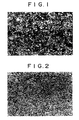
- Figure 1 is a photomicrograph of 600 magnifications showing the metallographic structure of the sintered iron-based alloy obtained as Sample No. 2.
- fine boride particles having a diameter of 1 to several microns in diameter are dispersed homogeneously uniformly in a pure iron matrix.
- the volume fraction of the boride particles in each sample is shown in Table 1.
- the local quantitative analysis by an electron probe microanalyzer indicated that the boride particles contained 1.5% of iron, 69.1% of titanium and 29.3% of boron, all on a weight basis.
- the boride little dissolves the iron from the matrix, which is consistent with the result of X-ray diffraction characterizing titanium diboride.
- Examples Nos. 4 to 6 Three disk-shaped samples of iron-based alloys similar in size to EXAMPLE 1 (Samples Nos. 4 to 6) were prepared by employing a commercially available Fe-l7Cr powder (-#330) and a commercially available TiB 2 powder similar in size to EXAMPLE 1, and repeating the mixing, compacting, sintering and hot working steps of EXAMPLE 1.
- FIG. 2 is a photomicrograph of 600 magnification showing the metallographic structure of Sample No. 5.
- fine boride particles having a diameter of 1 to several microns in diameter are dispersed homogeneously in a ferritic Fe-l7Cr alloy matrix.
- the volume fraction of the boride in each sample is shown in Table 1.
- the local quantitative analysis by an electron probe microanalyzer indicated that the boride particles contained 1.0% of iron, 0.2% of chromium, 69.0% of titanium and 29.7% of boron, all on a weight basis.
- the boride little dissolves the iron and chromium from the matrix, which is consistent with the result by X-ray diffraction characterizing titanium diboride.
- the iron-based alloys obtained in EXAMPLES 1 and 2 were evaluated for their Young's modulus.
- a testpicce in the form of a rectangular column measuring 1 mm by 2 mm by 11.2 mm was cut from each Sample, and examined for its Young's modulus by a piezoelectric resonance method employing a quartz resonator.
- the results are shown in Table 1.
- the Young's modulus generally showed an improvement with an increase in the volume fraction of the titanium diboride particles, and reached a maximum of about 29,000 kgf/mm 2 as shown by the sample containing about 30% by volume of boride. This is an improvement of 40% or more over the Young's modulus of any conventional iron alloy, and an improvement of 70% or more over the specific Young's modulus.
- the iron-based alloy in which it is dispersed has a lower density with increasing volume fraction of titanium diboride. It, therefore, follows that the high-modulus iron-based alloy of this invention provides a dimensional for lighter inertia of any structural part enhanced with its low specific gravity.
- a disk-shaped sample of a sintered iron-based alloy similar in size to the foregoing Examples was prepared by employing a commercially available Fe-l7Cr powder (-#330), a commercially available TiB 2 powder similar in size to the foregoing Examples and graphite powder, and repeating the mixing, compacting, sintering and hot working steps of EXAMPLE 1.
- Its Young's modulus was determined by the method employed in EXAMPLES 1 and 2, and is shown in Table 1. As is obvious from Table 1, Sample No. 7 showed an improvement of about 20% in Young's modulus over any conventional iron alloy. Due to the presence of carbon, however, its Young's modulus was about 7.3% lower than that of Sample No. 5 in EXAMPLE 2, despite the fact that the same fraction of titanium diboride particles had been dispersed in both Samples.
- a comparative disk-shaped sample of sintered iron similar in size to the foregoing Examples (Sample No. C1) was prepared by employing a commercially available electrolytic iron powder (-#330) alone, and repeating the mixing, compacting, sintering and hot working steps of EXAMPLE 1.
- the Young's modulus was determined by the method employed in EXAMPLE 2, and is shown in Table 1. It was as low as 18,910 kgf/mm 2 .
- a comparative disk-shaped sample of a sintered iron alloy similar in size to the foregoing Examples (Sample No. C2) was prepared by employing a commercially available Fe-17Cr powder (-#330) alone and repeating the mixing, compacting, sintering and hot working steps of EXAMPLE 1.
- the Young's modulus was determined by the method employed in EXAMPLE 2, and is shown in Table 1. It was as low as 20,250 kgf/mm 2 .
- a comparative disk-shaped sample of a sintered iron-based alloy similar in size to the foregoing Exanples was prepared by employing commercial Fe-17Cr powder (-#330) and commercial MoB powder having an average particle diameter of 1.7 microns, and repeating the mixing, compacting, sintering and hot working steps of EXAMPLE 1.
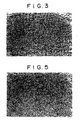
- Figure 3 is a photomicrograph of 600 magnification showing the metallographic structure of Sample No. C3.
- fine boride particles having a diameter of several microns and dispersed in a ferritic Fe-17Cr matrix. Table 1 shows the volume fraction of the boride particles as measured from Sample No. C3.
- the boride particles were found to contain a large amount of iron, which was a main constituent of the matrix, and some chromium, too.
- the X-ray diffraction revealed that the boride was a complex boride of iron, chromium and molybdenum represented by chemical formula Mo 2 (Fe,Cr)B 2 .
- the Young's modulus of Sample No. C3 was determined by the method employed in EXAMPLE 2, and is shown in Table 1. Although Sample No. C3 showed an improved Young's modulus owing to the presence of the boride over Sample No. C2, it was as low as 24,580 kgf/mm 2 despite the presence of as much as 26.2% by volume of the boride.
- a comparative disk-shaped sample of a sintered iron-based alloy similar in size to the foregoing Examples was prepared by employing a commercially available Fe-l7Cr powder (-#330) and a TiC powder having an average particle diameter of 2 microns, and repeating the mixing, compacting, sintering and hot working steps of EXAMPLE 1.
- the volume fraction of the carbide particles as measured from Sample No. C4 is shown in Table 1.
- the carbide particles were found to contain a large amount of iron, which was main constituent of the matrix, and some chromium, too. These results revealed the substantial substitution of iron for titanium atoms in the carbide. It follows that titanium carbide in the iron alloy matrix lacked thermodynamical stability and was useless for the purpose of this invention.
- the Young's modulus of Sample No. C4 was determined by the method employed in EXAMPLE 2, and is shown in Table 1. Although Sample No.C4 showed an improved Young's modulus owing to the carbide, it was as low as 25,330 kgf/mm 2 despite the presence of as much as 33.5% by volume of carbide.
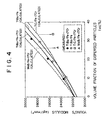
- Figure 4 compares the measured Young's moduli of the iron-based alloys according to EXAMPLES 1 and 2 and COMPARATIVE EXAMPLES 3 and 4 plotted against the volume fraction of the boride or carbide in each alloy, and the corresponding values obtained by calculation from the theoretical formula for the Young's moduli of the composite materials which is described in Materials Science and Technology, vol. 8 (1992), 922.
- the alloys according to EXAMPLES 1 and 2 containing titanium diboride showed the Young's moduli which substantially coincided with the calculated values, and it was confirmed that titanium diboride provided excellent reinforcing phases imparting a theoretically high modulus to the iron alloy.
- the Young's modulus of the product of COMPARATIVE EXAMPLE 3 containing molybdenum boride was by far lower than the calculated value. This was due to the fact that the molybdenum boride had transformed to a complex boride of iron, chromium and molybdenum with lower Young's modulus, as is obvious from the foregoing discussion.
- the Young's modulus of the product of COMPARATIVE EXAMPLE 4 containing carbide was also by far lower than the calculated value. This was apparently due to a substantial substitution of iron for titanium atoms in the titanium carbide resulting in a reduction of Young's modulus, as is obvious from the foregoing discussion.
- a commercially available Fe-l7Cr powder (-#330) and a commercially available VB 2 powder having an average particle diameter of 2 microns were employed in the amounts shown in Table 2, undergoing the mixing, compacting, sintering and hot working steps as in EXAMPLE 1, and formed into two disk-shaped samples similar in size to those of the foregoing Examples (Sample Nos. 8 and 9).
- Figure 5 is a photomicrograph of 600 magnifications showing the metallographic structure of the sintered iron-based alloy obtained as Sample No. 9.
- fine complex boride particles of several microns, in diameter are dispersed homogeneously in a ferritic Fe-17Cr matrix.
- the volume fraction and density of the boride particles in each Sample were measured, and are shown in Table 2.
- the local analysis by an electron probe microanalyzer indicated that the boride particles contained 35.9% of vanadium and 30.0% of iron, 22.2% of chromium and 12.0% of boron, all on a weight basis. It is obvious that the vanadium diboride in the mixed powder reacted with iron in the matrix at the high sintering and hot working temperature to form the complex boride.
- a disk-shaped sample of a sintered iron-based alloy similar in size to the foregoing Examples was prepared by employing a commercially available Fe-l7Cr powder (-#330), a commercially available VB 2 powder having an average particle diameter of two microns and a commercially available graphite powder, and repeating the mixing, compacting, sintering and hot working steps of EXAMPLE 1.
- the volume fraction of the boride particles in the sample and its density and Young's modulus were determined by employing the methods employed in EXAMPLES 1 and 2. The results are shown in Table 2. As is obvious from Table 2, Sample No. 10 showed an improvement of about 20% in Young's modulus over the conventional iron alloy.
- each sample for its metallographic structure confirmed that it contained fine boride particles of several microns in diameter are dispersed homogeniously in a ferritic Fe-l7Cr matrix.
- the niobium diboride, in the mixed powder reacted with iron in the matrix at the high sintering and hot working temperature to form the complex boride.
- the volume fraction of the complex boride particles in each sample and its density and Young's modulus were determined by the methods employed in EXAMPLE 2. The results are shown in Table 2. As is obvious from Table 2, Sample Nos. 11 and 12, having boride volume showed relatively high Young's modulus. The density of the samples decreased with increasing volume fraction of boride particles. thus it follows that the complex boride had a lower specific density than that of the iron-alloy matrix.
- Figure 6 shows the specific Young' s modulus of each of the products of EXAMPLES 4 and 6 and COMPARATIVE EXAMPLE 3 in relation to its volume fraction of boride.
- the specific Young's modulus of each product was obtained by dividing its Young's modulus by its specific gravity.
- curves A, B and C show the specific Young's moduli of the product of EXAMPLE 4 containing complex boride particles of vanadium and iron, the product of EXAMPLE 6 containing a complex boride of niobium and iron, and the product of COMPARATIVE EXAMPLE 3 containing a complex boride of molybdenum and iron, respectively.
- Examples Nos. 13 to 15 Three disk-shaped samples of sintered iron-based alloys each similar in size to the foregoing Examples (Samples Nos. 13 to 15) were prepared by employing a pulverized ferrotitanium powder and a pulverized ferroboron powder, both having an average particle diameter of four microns, as well as a commercially available Fe-l7Cr powder (-#330) in the amounts shown in Table 3, and repeating the mixing, compacting, sintering and hot working steps of EXAMPLE 1.
- the volume fraction of precipitated particles in each sample was measured, and is shown in Table 3.
- the local analysis by an electron probe microanalyzer indicated that the particles contained 0.9% of iron, 68.5% of titanium and 30.4% of boron, all on a weight basis.
- the formation of titanium diboride with little iron was confirmed. It is, thus, obvious that the ferrotitanium and ferroboron particles react at the high sintering and hot working temperature to form the titanium diboride particles which are thermodynamically stable in the iron-alloy matrix.
- the Young's modulus of each sample was determined by employing the method employed in EXAMPLE 2, and is shown in Table 3. As is obvious from Table 3, the samples showed Young's modulus increased with increasing volume fraction of boride particles, including Sample No. 15 containing about 30% by volume showing a Young's modulus as high as 29,500 kgf/mm 2 . These are comparable in Young's modulus to the products of EXAMPLE 2 produced with titanium diboride powder. These results confirm that the use of ferrotitanium and ferroboron powders as the starting materials is also effective for manufacturing high-modulus iron-based alloy in which titanium diboride particles are dispersed. Sample No.
Landscapes
- Chemical & Material Sciences (AREA)
- Engineering & Computer Science (AREA)
- Materials Engineering (AREA)
- Mechanical Engineering (AREA)
- Metallurgy (AREA)
- Organic Chemistry (AREA)
- Powder Metallurgy (AREA)
Claims (10)
- Eine Legierung auf Eisenbasis mit hohem Modul, die aus
einer aus ferritischem, austenitischem oder martensitischem Stahl oder Eisen und unvermeidbaren Verunreinigungen gebildeten Matrix und
mindestens einem Borid besteht, das aus der Gruppe bestehend aus Boriden von Elementen der Gruppe IVa und komplexen Boriden von Elementen der Gruppe Va und Eisen ausgewählt ist,
wobei das mindestens eine Borid einheitlich in der Matrix verteilt ist und das Borid in der Matrix thermodynamisch stabil ist und mit der Matrix in einem thermodynamischen Gleichgewicht steht, wobei das mindestens eine Borid aus feinen Teilchen mit einem Durchmesser von nicht mehr als 100 µm zusammengesetzt ist und der Gehalt des mindestens einen Borids 10 bis 50 Vol.-% beträgt und die Legierung auf Eisenbasis einen Young'schen Modul von 23120 kgf/mm2 oder mehr aufweist. - Legierung auf Eisenbasis mit hohem Modul nach Anspruch 1, bei welcher der Kohlenstoffgehalt nicht mehr als 0,1 Gew.-% beträgt.
- Legierung auf Eisenbasis mit hohem Modul nach Anspruch 1 oder 2, bei der das mindestens eine Borid der Boride von Elementen der Gruppe IVa ein Diborid der chemischen Formel MB2 ist, worin M für Elemente der Gruppe IVa steht.
- Legierung auf Eisenbasis mit hohem Modul nach einem der Ansprüche 1 bis 3, bei welcher der Gehalt des mindestens einen Borids 10 bis 40 Vol.-% beträgt.
- Legierung auf Eisenbasis mit hohem Modul nach einem der Ansprüche 1 bis 4, bei der die feinen Teilchen einen Durchmesser von weniger als 20 µm aufweisen.
- Ein Verfahren zur Herstellung einer Legierung auf Eisenbasis mit hohem Modul, wobei das Verfahren die Schritte des
Mischens von Eisen- oder Stahlpulvern und Pulvern von mindestens einem Borid von Elementen der Gruppe IVa zur Herstellung von Mischpulvern,
Pressens der Mischpulver zu einem Formkörper, und
Sinterns des Formkörpers umfasst, wodurch die Teilchen des mindestens einen Borids von Elementen der Gruppe IVa in einer aus ferritischem, austenitischem oder martensitischem Stahl oder Eisen und unvermeidbaren Verunreinigungen gebildeten Matrix einheitlich verteilt werden, wodurch eine Legierung auf Eisenbasis nach einem der Ansprüche 1 bis 5 erhalten wird. - Ein Verfahren zur Herstellung einer Legierung auf Eisenbasis mit hohem Modul, wobei das Verfahren die Schritte des
Mischens von Eisen- oder Stahlpulvern, Ferroborpulvern und Ferrolegierungspulvern, die mindestens ein Element der Gruppe IVa enthalten, zur Herstellung von Mischpulvern,
Pressens der Mischpulver zu einem Formkörper, und
Sinterns des Formkörpers umfasst, wodurch eine Reaktion der Ferroborpulver und der Ferrolegierungspulver zur Bildung mindestens eines Borids von Elementen der Gruppe IVa und zur einheitlichen Verteilung von Teilchen davon in einer aus ferritischem, austenitischem oder martensitischem Stahl oder Eisen und unvermeidbaren Verunreinigungen gebildeten Matrix verursacht wird, wodurch eine Legierung auf Eisenbasis nach einem der Ansprüche 1 bis 5 erhalten wird. - Ein Verfahren zur Herstellung einer Legierung auf Eisenbasis mit hohem Modul, wobei das Verfahren die Schritte des
Mischens von Eisen- oder Stahlpulvern und Pulvern von mindestens einem Borid von Elementen der Gruppe Va zur Herstellung von Mischpulvern,
Pressens der Mischpulver zu einem Formkörper, und
Sintems des Formkörpers umfasst, wodurch Teilchen von mindestens einem komplexen Borid von mindestens einem Element der Gruppe Va und Eisen in einer aus ferritischem, austenitischem oder martensitischem Stahl oder Eisen und unvermeidbaren Verunreinigungen gebildeten Matrix einheitlich verteilt werden, wodurch eine Legierung auf Eisenbasis nach Anspruch 1 oder 2 oder 4 oder 5 erhalten wird. - Ein Verfahren zur Herstellung einer Legierung auf Eisenbasis mit hohem Modul, wobei das Verfahren die Schritte des
Mischens von Eisen- oder Stahlpulvern, Ferroborpulvern und Ferrolegierungspulvern, die mindestens ein Borid von Elementen der Gruppe Va enthalten, zur Herstellung von Mischpulvern,
Pressens der Mischpulver zu einem Formkörper, und
Sinterns des Formkörpers umfasst, wodurch eine Reaktion der Ferroborpulver und der Ferrolegierungspulver zur Bildung mindestens eines komplexen Borids von mindestens einem Element der Gruppe Va und Eisen und zur einheitlichen Verteilung von Teilchen davon in einer aus ferritischem, austenitischem oder martensitischem Stahl oder Eisen und unvermeidbaren Verunreinigungen gebildeten Matrix verursacht wird, wodurch eine Legierung auf Eisenbasis nach Anspruch 1 oder 2 oder 4 oder 5 erhalten wird. - Verfahren nach einem der Ansprüche 6 bis 9, das ferner nach dem Sintern eine Warmverarbeitung umfasst.
Applications Claiming Priority (6)
| Application Number | Priority Date | Filing Date | Title |
|---|---|---|---|
| JP35446793A JP3314505B2 (ja) | 1993-12-27 | 1993-12-27 | 高剛性鉄基合金およびその製造方法 |
| JP354467/93 | 1993-12-27 | ||
| JP35446793 | 1993-12-27 | ||
| JP06759094A JP3379203B2 (ja) | 1994-03-11 | 1994-03-11 | 高剛性鉄基合金およびその製造方法 |
| JP67590/94 | 1994-03-11 | ||
| JP6759094 | 1994-03-11 |
Related Child Applications (1)
| Application Number | Title | Priority Date | Filing Date |
|---|---|---|---|
| EP03019553 Division | 2003-09-02 |
Publications (3)
| Publication Number | Publication Date |
|---|---|
| EP0659894A2 EP0659894A2 (de) | 1995-06-28 |
| EP0659894A3 EP0659894A3 (de) | 1995-11-15 |
| EP0659894B1 true EP0659894B1 (de) | 2005-05-04 |
Family
ID=26408804
Family Applications (1)
| Application Number | Title | Priority Date | Filing Date |
|---|---|---|---|
| EP94120574A Expired - Lifetime EP0659894B1 (de) | 1993-12-27 | 1994-12-23 | Legierung auf Stahlbasis mit hohem Modul und Verfahren zu deren Herstellung |
Country Status (3)
| Country | Link |
|---|---|
| US (1) | US5854434A (de) |
| EP (1) | EP0659894B1 (de) |
| DE (1) | DE69434357T2 (de) |
Cited By (2)
| Publication number | Priority date | Publication date | Assignee | Title |
|---|---|---|---|---|
| US7175687B2 (en) | 2003-05-20 | 2007-02-13 | Exxonmobil Research And Engineering Company | Advanced erosion-corrosion resistant boride cermets |
| US8323790B2 (en) | 2007-11-20 | 2012-12-04 | Exxonmobil Research And Engineering Company | Bimodal and multimodal dense boride cermets with low melting point binder |
Families Citing this family (10)
| Publication number | Priority date | Publication date | Assignee | Title |
|---|---|---|---|---|
| US6330164B1 (en) * | 1985-10-18 | 2001-12-11 | Formfactor, Inc. | Interconnect assemblies and methods including ancillary electronic component connected in immediate proximity of semiconductor device |
| US6156443A (en) * | 1998-03-24 | 2000-12-05 | National Research Council Of Canada | Method of producing improved erosion resistant coatings and the coatings produced thereby |
| US6664628B2 (en) | 1998-07-13 | 2003-12-16 | Formfactor, Inc. | Electronic component overlapping dice of unsingulated semiconductor wafer |
| US7707082B1 (en) * | 1999-05-25 | 2010-04-27 | Silverbrook Research Pty Ltd | Method and system for bill management |
| WO2003051529A1 (en) * | 2001-12-18 | 2003-06-26 | The Regents Of The University Of California | A process for making dense thin films |
| US7731776B2 (en) | 2005-12-02 | 2010-06-08 | Exxonmobil Research And Engineering Company | Bimodal and multimodal dense boride cermets with superior erosion performance |
| US7517375B2 (en) | 2006-01-04 | 2009-04-14 | Iowa State University Research Foundation, Inc. | Wear-resistant boride composites with high percentage of reinforcement phase |
| US20100040500A1 (en) * | 2007-12-13 | 2010-02-18 | Gm Global Technology Operations, Inc. | METHOD OF MAKING TITANIUM ALLOY BASED AND TiB REINFORCED COMPOSITE PARTS BY POWDER METALLURGY PROCESS |
| US8268453B2 (en) * | 2009-08-06 | 2012-09-18 | Synthesarc Inc. | Steel based composite material |
| AU2015363754B2 (en) | 2014-12-17 | 2021-04-01 | Uddeholms Ab | A wear resistant alloy |
Family Cites Families (12)
| Publication number | Priority date | Publication date | Assignee | Title |
|---|---|---|---|---|
| US4439236A (en) * | 1979-03-23 | 1984-03-27 | Allied Corporation | Complex boride particle containing alloys |
| US4419130A (en) * | 1979-09-12 | 1983-12-06 | United Technologies Corporation | Titanium-diboride dispersion strengthened iron materials |
| US4971624A (en) * | 1981-03-05 | 1990-11-20 | Clark Eugene V | Abrasion and erosion resistant articles |
| SE457537B (sv) * | 1981-09-04 | 1989-01-09 | Sumitomo Electric Industries | Diamantpresskropp foer ett verktyg samt saett att framstaella densamma |
| US4836982A (en) * | 1984-10-19 | 1989-06-06 | Martin Marietta Corporation | Rapid solidification of metal-second phase composites |
| JPS62182249A (ja) * | 1986-02-05 | 1987-08-10 | Hitachi Metals Ltd | R−B−Fe系焼結磁石およびその製造方法 |
| JPS6365056A (ja) * | 1986-09-05 | 1988-03-23 | Nissan Motor Co Ltd | 耐摩耗性鉄基焼結合金 |
| US5036028A (en) * | 1988-05-03 | 1991-07-30 | Agency Of Industrial Science And Technology | High density metal boride-based ceramic sintered body |
| JP2777373B2 (ja) * | 1988-06-28 | 1998-07-16 | 日産自動車株式会社 | 耐熱耐摩耗性鉄基焼結合金 |
| DE3941536A1 (de) * | 1989-12-15 | 1991-06-20 | Kempten Elektroschmelz Gmbh | Hartmetall-mischwerkstoffe auf basis von boriden, nitriden und eisenbindemetallen |
| JP3324658B2 (ja) * | 1992-07-21 | 2002-09-17 | 東芝タンガロイ株式会社 | 微細孔を有する焼結合金及びその製造方法 |
| JP3565684B2 (ja) * | 1997-07-02 | 2004-09-15 | 松下電器産業株式会社 | 映像信号受信再生装置 |
-
1994
- 1994-12-23 EP EP94120574A patent/EP0659894B1/de not_active Expired - Lifetime
- 1994-12-23 DE DE69434357T patent/DE69434357T2/de not_active Expired - Fee Related
-
1997
- 1997-01-21 US US08/785,087 patent/US5854434A/en not_active Expired - Fee Related
Non-Patent Citations (1)
| Title |
|---|
| RÖmpp Chemie-Lexikon, Vol. III, page 1735, 9.Ed.,(1990) * |
Cited By (2)
| Publication number | Priority date | Publication date | Assignee | Title |
|---|---|---|---|---|
| US7175687B2 (en) | 2003-05-20 | 2007-02-13 | Exxonmobil Research And Engineering Company | Advanced erosion-corrosion resistant boride cermets |
| US8323790B2 (en) | 2007-11-20 | 2012-12-04 | Exxonmobil Research And Engineering Company | Bimodal and multimodal dense boride cermets with low melting point binder |
Also Published As
| Publication number | Publication date |
|---|---|
| DE69434357T2 (de) | 2006-03-09 |
| DE69434357D1 (de) | 2005-06-09 |
| EP0659894A3 (de) | 1995-11-15 |
| US5854434A (en) | 1998-12-29 |
| EP0659894A2 (de) | 1995-06-28 |
Similar Documents
| Publication | Publication Date | Title |
|---|---|---|
| Suryanarayana et al. | Nanostructured materials and nanocomposites by mechanical alloying: an overview | |
| US5854966A (en) | Method of producing composite materials including metallic matrix composite reinforcements | |
| US6024776A (en) | Cermet having a binder with improved plasticity | |
| Durlu | Titanium carbide based composites for high temperature applications | |
| Parashivamurthy et al. | Review on TiC reinforced steel composites | |
| EP0875588B1 (de) | Kaltarbeitswerkzeugstahlteilchen mit hoher Schlagfestigkeit aus Metallpulver und Verfahren zu seiner Herstellung | |
| US5854434A (en) | High-modulus iron-based alloy with a dispersed boride | |
| US5918103A (en) | Plate-crystalline tungsten carbide-containing hard alloy, composition for forming plate-crystalline tungsten carbide and process for preparing said hard alloy | |
| US20090148334A1 (en) | Nanophase dispersion strengthened low cte alloy | |
| WO2004029312A1 (ja) | 超硬質・強靭で優れた耐食性を有するナノ結晶オ−ステナイト鋼バルク材及びその製造方法 | |
| JP4652490B2 (ja) | 統合粉末冶金法により製造したスチールとその熱処理工具及び該スチールの工具への使用 | |
| EP0433856B1 (de) | Hartmetall-Mischwerkstoffe auf Basis von Boriden, Nitriden und Eisenbindemetallen | |
| EP0759480A1 (de) | Flächen-kristallines Wolframkarbid enthaltendes Hartmetall, Zusammensetzung zur Herstellung von flächen-kristallines Wolframkarbid und Verfahren zur Herstellung des Hartmetalls | |
| US5015290A (en) | Ductile Ni3 Al alloys as bonding agents for ceramic materials in cutting tools | |
| CA2084085A1 (en) | Metal carbides and derived composites | |
| Cruse et al. | Evaluation of methods to produce tough Cr3Si based composites | |
| Bourdeau et al. | Development of iron aluminides | |
| JP3314505B2 (ja) | 高剛性鉄基合金およびその製造方法 | |
| WO1993020250A1 (en) | In situ formation of metal-ceramic oxide microstructures | |
| JP2000096193A (ja) | 高強度高耐食性フェライト鋼の製造方法 | |
| JP3898387B2 (ja) | 高剛性鋼 | |
| JP3379203B2 (ja) | 高剛性鉄基合金およびその製造方法 | |
| Kulikowski et al. | Mechanical and microstructural behaviour of a particulate reinforced steel for structural applications | |
| CN1176240C (zh) | 氮化物颗粒/非晶态合金基体的复合材料 | |
| JP2999355B2 (ja) | 低熱膨張率強靱サーメットの製造法 |
Legal Events
| Date | Code | Title | Description |
|---|---|---|---|
| PUAI | Public reference made under article 153(3) epc to a published international application that has entered the european phase |
Free format text: ORIGINAL CODE: 0009012 |
|
| AK | Designated contracting states |
Kind code of ref document: A2 Designated state(s): DE FR GB |
|
| PUAL | Search report despatched |
Free format text: ORIGINAL CODE: 0009013 |
|
| RHK1 | Main classification (correction) |
Ipc: C22C 33/02 |
|
| AK | Designated contracting states |
Kind code of ref document: A3 Designated state(s): DE FR GB |
|
| 17P | Request for examination filed |
Effective date: 19951108 |
|
| 17Q | First examination report despatched |
Effective date: 19960801 |
|
| GRAG | Despatch of communication of intention to grant |
Free format text: ORIGINAL CODE: EPIDOS AGRA |
|
| GRAG | Despatch of communication of intention to grant |
Free format text: ORIGINAL CODE: EPIDOS AGRA |
|
| APAB | Appeal dossier modified |
Free format text: ORIGINAL CODE: EPIDOS NOAPE |
|
| APAD | Appeal reference recorded |
Free format text: ORIGINAL CODE: EPIDOS REFNE |
|
| APBT | Appeal procedure closed |
Free format text: ORIGINAL CODE: EPIDOSNNOA9E |
|
| GRAP | Despatch of communication of intention to grant a patent |
Free format text: ORIGINAL CODE: EPIDOSNIGR1 |
|
| GRAS | Grant fee paid |
Free format text: ORIGINAL CODE: EPIDOSNIGR3 |
|
| GRAU | Approval following communication of intention to grant |
Free format text: ORIGINAL CODE: EPIDOSNAGR4 |
|
| GRAA | (expected) grant |
Free format text: ORIGINAL CODE: 0009210 |
|
| AK | Designated contracting states |
Kind code of ref document: B1 Designated state(s): DE FR GB |
|
| REG | Reference to a national code |
Ref country code: GB Ref legal event code: FG4D |
|
| REF | Corresponds to: |
Ref document number: 69434357 Country of ref document: DE Date of ref document: 20050609 Kind code of ref document: P |
|
| APAH | Appeal reference modified |
Free format text: ORIGINAL CODE: EPIDOSCREFNO |
|
| PLBE | No opposition filed within time limit |
Free format text: ORIGINAL CODE: 0009261 |
|
| STAA | Information on the status of an ep patent application or granted ep patent |
Free format text: STATUS: NO OPPOSITION FILED WITHIN TIME LIMIT |
|
| ET | Fr: translation filed | ||
| 26N | No opposition filed |
Effective date: 20060207 |
|
| PGFP | Annual fee paid to national office [announced via postgrant information from national office to epo] |
Ref country code: FR Payment date: 20061208 Year of fee payment: 13 |
|
| PGFP | Annual fee paid to national office [announced via postgrant information from national office to epo] |
Ref country code: GB Payment date: 20061220 Year of fee payment: 13 |
|
| GBPC | Gb: european patent ceased through non-payment of renewal fee |
Effective date: 20071223 |
|
| REG | Reference to a national code |
Ref country code: FR Ref legal event code: ST Effective date: 20081020 |
|
| PG25 | Lapsed in a contracting state [announced via postgrant information from national office to epo] |
Ref country code: GB Free format text: LAPSE BECAUSE OF NON-PAYMENT OF DUE FEES Effective date: 20071223 |
|
| PG25 | Lapsed in a contracting state [announced via postgrant information from national office to epo] |
Ref country code: FR Free format text: LAPSE BECAUSE OF NON-PAYMENT OF DUE FEES Effective date: 20071231 |
|
| PGFP | Annual fee paid to national office [announced via postgrant information from national office to epo] |
Ref country code: DE Payment date: 20081219 Year of fee payment: 15 |
|
| PG25 | Lapsed in a contracting state [announced via postgrant information from national office to epo] |
Ref country code: DE Free format text: LAPSE BECAUSE OF NON-PAYMENT OF DUE FEES Effective date: 20100701 |