EP0660811B1 - Laminar product for glazing the surfaces of tiles and other purposes, and application of said product - Google Patents
Laminar product for glazing the surfaces of tiles and other purposes, and application of said product Download PDFInfo
- Publication number
- EP0660811B1 EP0660811B1 EP93922616A EP93922616A EP0660811B1 EP 0660811 B1 EP0660811 B1 EP 0660811B1 EP 93922616 A EP93922616 A EP 93922616A EP 93922616 A EP93922616 A EP 93922616A EP 0660811 B1 EP0660811 B1 EP 0660811B1
- Authority
- EP
- European Patent Office
- Prior art keywords
- glaze
- mixture
- product
- inert substances
- laminar
- Prior art date
- Legal status (The legal status is an assumption and is not a legal conclusion. Google has not performed a legal analysis and makes no representation as to the accuracy of the status listed.)
- Expired - Lifetime
Links
- XLYOFNOQVPJJNP-UHFFFAOYSA-N water Substances O XLYOFNOQVPJJNP-UHFFFAOYSA-N 0.000 claims abstract description 33
- 239000000203 mixture Substances 0.000 claims abstract description 30
- 239000000126 substance Substances 0.000 claims abstract description 26
- 229920003043 Cellulose fiber Polymers 0.000 claims abstract description 12
- 238000001035 drying Methods 0.000 claims abstract description 9
- 229920000867 polyelectrolyte Polymers 0.000 claims abstract description 9
- 238000004381 surface treatment Methods 0.000 claims abstract description 5
- 230000003311 flocculating effect Effects 0.000 claims abstract description 4
- 239000000463 material Substances 0.000 claims description 30
- 238000000034 method Methods 0.000 claims description 13
- 238000003825 pressing Methods 0.000 claims description 11
- 230000015572 biosynthetic process Effects 0.000 claims description 10
- 239000004372 Polyvinyl alcohol Substances 0.000 claims description 8
- 239000004927 clay Substances 0.000 claims description 8
- 238000010304 firing Methods 0.000 claims description 8
- 229920002451 polyvinyl alcohol Polymers 0.000 claims description 8
- 238000009826 distribution Methods 0.000 claims description 7
- 239000000919 ceramic Substances 0.000 claims description 5
- 238000011282 treatment Methods 0.000 claims description 5
- 239000006185 dispersion Substances 0.000 claims description 4
- 239000000835 fiber Substances 0.000 claims description 2
- 239000002657 fibrous material Substances 0.000 claims description 2
- 230000008569 process Effects 0.000 claims description 2
- 229910052572 stoneware Inorganic materials 0.000 claims description 2
- 238000004026 adhesive bonding Methods 0.000 claims 1
- 230000000717 retained effect Effects 0.000 claims 1
- 230000014759 maintenance of location Effects 0.000 abstract description 3
- 239000000047 product Substances 0.000 description 25
- 239000000123 paper Substances 0.000 description 17
- 229920002678 cellulose Polymers 0.000 description 10
- 239000001913 cellulose Substances 0.000 description 10
- 239000003643 water by type Substances 0.000 description 10
- 238000001914 filtration Methods 0.000 description 7
- 238000004519 manufacturing process Methods 0.000 description 7
- 238000005520 cutting process Methods 0.000 description 6
- 239000000725 suspension Substances 0.000 description 6
- 238000005406 washing Methods 0.000 description 6
- 230000008901 benefit Effects 0.000 description 5
- 238000010586 diagram Methods 0.000 description 4
- 230000005484 gravity Effects 0.000 description 4
- 238000009966 trimming Methods 0.000 description 4
- 238000002156 mixing Methods 0.000 description 3
- 238000005086 pumping Methods 0.000 description 3
- 238000004064 recycling Methods 0.000 description 3
- 239000002699 waste material Substances 0.000 description 3
- 229910000906 Bronze Inorganic materials 0.000 description 2
- OAICVXFJPJFONN-UHFFFAOYSA-N Phosphorus Chemical compound [P] OAICVXFJPJFONN-UHFFFAOYSA-N 0.000 description 2
- 238000010009 beating Methods 0.000 description 2
- 239000010974 bronze Substances 0.000 description 2
- KUNSUQLRTQLHQQ-UHFFFAOYSA-N copper tin Chemical compound [Cu].[Sn] KUNSUQLRTQLHQQ-UHFFFAOYSA-N 0.000 description 2
- 238000010790 dilution Methods 0.000 description 2
- 239000012895 dilution Substances 0.000 description 2
- 239000003792 electrolyte Substances 0.000 description 2
- 239000013505 freshwater Substances 0.000 description 2
- 238000000265 homogenisation Methods 0.000 description 2
- 239000012535 impurity Substances 0.000 description 2
- 239000002245 particle Substances 0.000 description 2
- 238000011084 recovery Methods 0.000 description 2
- 239000011265 semifinished product Substances 0.000 description 2
- 239000007790 solid phase Substances 0.000 description 2
- 239000007921 spray Substances 0.000 description 2
- 229910001220 stainless steel Inorganic materials 0.000 description 2
- 239000010935 stainless steel Substances 0.000 description 2
- 230000007306 turnover Effects 0.000 description 2
- 229920001131 Pulp (paper) Polymers 0.000 description 1
- 229910000831 Steel Inorganic materials 0.000 description 1
- 230000006978 adaptation Effects 0.000 description 1
- 230000002411 adverse Effects 0.000 description 1
- 239000007900 aqueous suspension Substances 0.000 description 1
- 238000003490 calendering Methods 0.000 description 1
- 239000011111 cardboard Substances 0.000 description 1
- 238000011109 contamination Methods 0.000 description 1
- 239000000109 continuous material Substances 0.000 description 1
- 230000007547 defect Effects 0.000 description 1
- 230000006866 deterioration Effects 0.000 description 1
- 230000008030 elimination Effects 0.000 description 1
- 238000003379 elimination reaction Methods 0.000 description 1
- 230000007613 environmental effect Effects 0.000 description 1
- 238000000605 extraction Methods 0.000 description 1
- 238000011049 filling Methods 0.000 description 1
- 239000007788 liquid Substances 0.000 description 1
- 239000007791 liquid phase Substances 0.000 description 1
- 238000007726 management method Methods 0.000 description 1
- 230000007246 mechanism Effects 0.000 description 1
- 239000012528 membrane Substances 0.000 description 1
- 239000011812 mixed powder Substances 0.000 description 1
- 238000004806 packaging method and process Methods 0.000 description 1
- 239000011087 paperboard Substances 0.000 description 1
- 229920003023 plastic Polymers 0.000 description 1
- 239000004033 plastic Substances 0.000 description 1
- 238000002360 preparation method Methods 0.000 description 1
- 238000004513 sizing Methods 0.000 description 1
- 239000010802 sludge Substances 0.000 description 1
- 238000005507 spraying Methods 0.000 description 1
- 239000010959 steel Substances 0.000 description 1
- 238000013517 stratification Methods 0.000 description 1
- 229920002994 synthetic fiber Polymers 0.000 description 1
- 238000011144 upstream manufacturing Methods 0.000 description 1
- 239000002351 wastewater Substances 0.000 description 1
Images



Classifications
-
- C—CHEMISTRY; METALLURGY
- C04—CEMENTS; CONCRETE; ARTIFICIAL STONE; CERAMICS; REFRACTORIES
- C04B—LIME, MAGNESIA; SLAG; CEMENTS; COMPOSITIONS THEREOF, e.g. MORTARS, CONCRETE OR LIKE BUILDING MATERIALS; ARTIFICIAL STONE; CERAMICS; REFRACTORIES; TREATMENT OF NATURAL STONE
- C04B41/00—After-treatment of mortars, concrete, artificial stone or ceramics; Treatment of natural stone
- C04B41/009—After-treatment of mortars, concrete, artificial stone or ceramics; Treatment of natural stone characterised by the material treated
-
- C—CHEMISTRY; METALLURGY
- C04—CEMENTS; CONCRETE; ARTIFICIAL STONE; CERAMICS; REFRACTORIES
- C04B—LIME, MAGNESIA; SLAG; CEMENTS; COMPOSITIONS THEREOF, e.g. MORTARS, CONCRETE OR LIKE BUILDING MATERIALS; ARTIFICIAL STONE; CERAMICS; REFRACTORIES; TREATMENT OF NATURAL STONE
- C04B41/00—After-treatment of mortars, concrete, artificial stone or ceramics; Treatment of natural stone
- C04B41/45—Coating or impregnating, e.g. injection in masonry, partial coating of green or fired ceramics, organic coating compositions for adhering together two concrete elements
- C04B41/4505—Coating or impregnating, e.g. injection in masonry, partial coating of green or fired ceramics, organic coating compositions for adhering together two concrete elements characterised by the method of application
- C04B41/4511—Coating or impregnating, e.g. injection in masonry, partial coating of green or fired ceramics, organic coating compositions for adhering together two concrete elements characterised by the method of application using temporarily supports, e.g. decalcomania transfers or mould surfaces
- C04B41/4513—Coating or impregnating, e.g. injection in masonry, partial coating of green or fired ceramics, organic coating compositions for adhering together two concrete elements characterised by the method of application using temporarily supports, e.g. decalcomania transfers or mould surfaces the temporary support- and coating material being mixed together, e.g. tile glazing paper sheets
-
- C—CHEMISTRY; METALLURGY
- C04—CEMENTS; CONCRETE; ARTIFICIAL STONE; CERAMICS; REFRACTORIES
- C04B—LIME, MAGNESIA; SLAG; CEMENTS; COMPOSITIONS THEREOF, e.g. MORTARS, CONCRETE OR LIKE BUILDING MATERIALS; ARTIFICIAL STONE; CERAMICS; REFRACTORIES; TREATMENT OF NATURAL STONE
- C04B41/00—After-treatment of mortars, concrete, artificial stone or ceramics; Treatment of natural stone
- C04B41/80—After-treatment of mortars, concrete, artificial stone or ceramics; Treatment of natural stone of only ceramics
- C04B41/81—Coating or impregnation
-
- D—TEXTILES; PAPER
- D21—PAPER-MAKING; PRODUCTION OF CELLULOSE
- D21H—PULP COMPOSITIONS; PREPARATION THEREOF NOT COVERED BY SUBCLASSES D21C OR D21D; IMPREGNATING OR COATING OF PAPER; TREATMENT OF FINISHED PAPER NOT COVERED BY CLASS B31 OR SUBCLASS D21G; PAPER NOT OTHERWISE PROVIDED FOR
- D21H17/00—Non-fibrous material added to the pulp, characterised by its constitution; Paper-impregnating material characterised by its constitution
- D21H17/63—Inorganic compounds
- D21H17/67—Water-insoluble compounds, e.g. fillers, pigments
- D21H17/68—Water-insoluble compounds, e.g. fillers, pigments siliceous, e.g. clays
Definitions
- the invention relates to the formation of a laminar product - hereafter referred to as "glaze paper" for brevity - intended to facilitate the preparation of the tile with the layer to be fused in the firing or in the second firing for the production of glazed tiles.
- JP-A-52 027 406 A method for the production of "glaze paper” is disclosed in JP-A-52 027 406. According to this known method, the laminar product is obtained with a mixture of 90% of glaze and 10% of fibrous material, comprising at least 60% of synthetic fibres and the remaining portion of cellulose pulp.
- a first subject of the invention is an improved method for the formation of the said laminar product - capable of being combined with a support for floor or wall tiles or with the material for the formation of such a support, to glaze the surface thereof which is intended to be visible when in use - according to which method,
- the inert substances and cellulose fibres will advantageously be in proportions of approximately 95% and 5%.
- the mixture may be a dispersion of inert substances and cellulose fibres with a concentration of the order of 20% of the total weight, the remainder being substantially water.
- the percentage of water varies according to the requirements of the type of dewatering equipment used.
- the dry substance number of the product may be as much as 1000 g/m 2 , with a relatively slow formation rate of the order of 2 to 15 m/min. and above, in the case of dewatering equipment of the paper-making machine type.
- the inert substances are based on glazes, advantageously with the presence of clay, which may be present in an amount of the order of 10% by weight of the total inert substances.
- the said equipment substantially comprises: means for forming a mixture of inert substances capable of forming vitreous glaze and of cellulose fibres in water; and means of feeding the said mixture to a machine for the formation of the said layer, in other words the laminar product, from this mixture, and for its dewatering and finishing.
- the equipment may comprise a dewatering press with two opposing continuous filter belts, followed by calendering means if required.
- the equipment may be of the paper-making type - such as that using a flat table, that using a drum machine, or other machines - with suitable adaptation in relation to the characteristics of the suspension formed with the mixture.
- the equipment may comprise: tanks with agitators for the mixing and homogenization of a mixture of inert substances capable of forming vitreous glaze and of cellulose fibres in an aqueous dispersion; pumping means for the forced feed of the said mixture to the so-called flat suction table of the said equipment; a unit with a metering pump to introduce a flocculating electrolyte into the circuit or into each circuit for feeding the mixture to the flat table; and means of distributing the said mixture, in aqueous dispersion, with the addition of the polyelectrolyte, over the belt of the said flat table.
- the metering pump for the polyelectrolyte introduces it into the delivery circuit or into each delivery circuit of the pumping and dispersal means before or during the distribution over the flat table.
- the means of distribution may comprise, at the end of the delivery circuit or of each delivery circuit, a gravity sliding wall which is shaped to distribute the suspension in fan form until it reaches the initial part of the flat table.
- the said sliding wall may be inclined downwards and in the direction of advance of the screen of the flat table, and with a horizontal section which is convex in the direction of advance of the said screen.
- the pumping means for the mixture advantageously comprise a closed circuit with forced circulation from a supply chest or vat for the homogenization of the mixture and - for the feed to the table - circuits branching off from the said closed circuit, each having a metering pump for the mixture, and each being combined with an electrolyte metering and dispersing system.
- the equipment also comprises: a breaker or pulper which can be filled with the cellulose and operates in a closed cycle with means for purifying thick pulp and beating means, such as a conical beater; a vat which receives the cellulose pulp; a mixer and agitator of the gate or similar type - for the final mixture, to which the inert substances are added; means for the recovery of first and second waters, for the settling of at least the second waters and for their re-use in the pulper and/or in the mixer of the final mixture.
- a breaker or pulper which can be filled with the cellulose and operates in a closed cycle with means for purifying thick pulp and beating means, such as a conical beater
- a vat which receives the cellulose pulp
- a mixer and agitator of the gate or similar type - for the final mixture to which the inert substances are added
- means for the recovery of first and second waters for the settling of at least the second waters and for their re-use in the pulper and/or in the
- waste products such as dry trimmings, machine-shop rejects and other materials
- the equipment also comprises, downstream from the flat table, a wet press or flat press, a dry end and a glazing machine if necessary, the dry end comprising at least one hot-air drier with a support for a flat advance, and particularly a number of hot-air driers, with, between these, means of distribution of atomized size, such as PVA; a transverse cutting and turn-over unit may also be provided upstream from one of the driers, to expose the previously downward-facing surface to the subsequent size distributor.
- a further subject of the invention is a glaze paper product made as specified above.
- the invention also comprises the use of a glaze paper product made as defined and applied above, to create a layer of glaze on a previously fired ceramic support or, preferably, on a ceramic support to be finished by firing - particularly by the so-called single firing process - during which the cellulose fibres are destroyed.
- a laminar product as specified is placed above the material held in the mould, after the mould has been filled with powdered clay, for subsequent pressing.
- the laminar product may be inserted between the first and the second pressing.
- a system for retaining the laminar product comprising a porous wall in the pad by means of which retention is provided by suction.
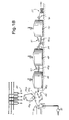
- 1 indicates a settling unit with conical hopper for the second waters
- 3 and 4 indicate two vats for receiving and agitating the first and second waters respectively.
- 6 indicates a breaker or pulper, which receives first water and/or second water together with the cellulose to be broken down and homogenized; a thick pulp purifier 8 and a beater 10, which may be a beater of the conical type, are provided in a circuit combined with the said pulper 6.
- the material - as an alternative to the closed circuit described previously - may be sent, after beating, to a tank 12 with an agitator for the mixture of water and cellulose, or to a second tank 14 with an agitator, from which the material may be collected and sent to a finished pulp mixing container 16 with an agitator, for example of the gate type, the helical type, or other type; this container 16 may also be fed from the tank 12 and/or from the first and/or second waters, and may also receive the inert substance (glaze).
- a supply tank or vat of relatively small capacity which is supplied with the mixture of inert substance and cellulose prepared in the container 16; in the tank 18 the material is kept at a constant level and agitated through a closed circuit which comprises a vertical pump 20 and a closed-circuit duct 22, where the pulp circulates at a relatively high speed to maintain the uniformity of the pulp mixture in the container 18.
- Circuits 30 for the feed of the polyelectrolyte which is taken from a tank 32 by metering pumps 34, open into the ducts 24 of the feed circuits, mainly downstream from the metering pumps 26.
- the ducts 24 of the feed circuits open, with suitable terminals 24A, on an equal number of gravity sliding walls 38, which are curved - in horizontal section - with their convex sides facing the flat table 28 and inclined downwards and towards the flat table, in other words in the direction of advance of the screen of the table 28 as shown by the arrow f28.
- the distributors 24A feed the pulp to the individual walls 38 so that the material is discharged from these in a substantially uniform way on to the front of the screen advancing as shown by the arrow f28 along the table 28, where the first and second waters are removed, simply by gravity in the case of the first water and by suction in the case of the second water; the said waters are collected in containers 40 and 42 respectively, and are then circulated according to the system shown in Fig. 1.
- a wet press or flat press 44 of the conventional type Downstream from the screen of the flat table 28 there is a wet press or flat press 44 of the conventional type with a suction cylinder 44A round which a screen 44B runs, while the material from the flat table 28 is conveyed by a conveyor 44C.
- the dry end comprising, according to the illustrated system, three hot-air driers 46, 48, 50, disposed in series with flat conveyors 46A, 48A, 50A, is disposed downstream from the said wet press or flat press 44.
- 52 indicates an atomizer for polyvinyl alcohol (PVA) or other size, capable of distributing on the upper surface of the continuous material which has passed through the first drier 46 and is on the conveyor 48A of the second drier 48.
- PVA polyvinyl alcohol
- a unit 54 for transverse cutting and for turning over the sections of product separated by the transverse cutting may be provided at the exit from the said drier 48, to place the individual overturned sections on the conveyor 50A of the third hot-air drier 50; a second atomizer 56 similar to that 52 distributes the size on the surface of the product which faced downwards in the passage through the driers 46 and 48.
- a machine 58 known as a glazing machine may be located at the exit from the drier 50, for the surface treatment of the sheets of material obtained from the drying and subsequently accumulated on a conveying means 60 or equivalent. The material constitutes the "glaze paper".
- the equipment may be completed by washing units such as those indicated schematically by 62 and 64, for washing the various mechanisms with untreated water or with first or second water, according to the requirements and possibilities.
- the whole of the equipment will be constructed with special materials, and particularly with a predominant use of stainless steel, to avoid the presence of any impurities in the glazes which may lead to colour changes in the glazes during firing.
- the waste water cycle is a practically closed cycle which does not require the consumption of appreciable quantities of water, since the water is totally purified within the cycle and recycled.
- the equipment is close to other equipment capable of using water with a 50-100 ppm content of suspended inorganic substances, in other words glaze, clean water could be used instead of recycled water at certain particularly sensitive points (felt washing, stuffing-box seals), with a significant advantage in the operation of the equipment, with better drying before the dry end (through better operation of the pumps and seals), less wear of the pump shafts, and other advantages.
- the operating cycle requires the preliminary breaking of the paper pulp, which is carried out in the breaker or pulper 6.
- the pulper can treat a batch of cellulose sufficient for a number of shifts, possibly with intermittent operation.
- the pulp broken down by the pulper 6 is sent by a pump to the thick pulp purifier 8, then to the conical beater 10, and then again in the closed cycle to the pulper 6, until the desired refinement characteristics are obtained.
- the cellulose pulp is sent to the vat and agitator 14, from which it is taken according to the manufacturing requirements. Any dry trimmings, operating waste products and other materials may be reworked in the pulper 6 in the closed circuit comprising the beater 10 and, when completely broken down, sent to the vat 12 to await re-use.
- a Hollander may be used in this position for recycling.
- the refined cellulose pulp and the rebroken trimmings are periodically added in metered batches to the vat or to one of the vats 16 with the gate or other agitator, to which are added - manually from bags or with suitable automatic metering equipment - the glaze to be pulped as an inert substance with the refined cellulose pulp from the pulper 6.
- the glaze may alternatively be added as an aqueous suspension.
- the pulp is sent to the vat 18 for feeding the continuous paper machine.
- the vat 18 is kept at a constant level with an automatic filling system.
- the material in the vat 18 is agitated by recycling with a vertical pump or pumps 29 which continuously deliver the pulp - with a total concentration of 20% and 80% water - to the duct 22 and from there to the set of metering pumps 26 (of the membrane or other types) which meter it and distribute it through the ducts 24 and the distributors 24A to the forming screen of the flat table 28 by sliding along the sliding walls 38.
- the pulp In its passage between the metering pump 26 and the screen, the pulp has the correct amount of polyelectrolyte, measured by the other set of metering pumps 34 of suitable capacity, added to it, and is homogenized by a suitable system.
- the flat table 28 is provided with all the appropriate accessories and has low- and high-intensity vacuum sections for the removal of the first and second waters, to provide sufficient drainage for the formation of a sheet having a substance number of the order of 800 g/m 2 (or + 200) at a rate of the order of 10 m/minute.
- the first water is removed with minimum pressure drop, in practice by gravity, to form a filtering layer, with the aid of the polyelectrolytes.
- the waters extracted from the low-vacuum equipment known as the "first water” in paper-making jargon, with a glaze concentration of approximately 0.5-2% are recycled to the vat 3 to be re-used for dilution in the vat 16 and in the pulper 6.
- the waters extracted by the high-vacuum pumps and those from the screen and felt washing sprays, known as the "second water” in paper-making jargon, is recycled to the settling unit 1, from where they are passed to the vat 4 to be re-used for the washing sprays, for the seals of the vacuum pumps, and for dilution, in case of unavailability of "first water” or untreated water.
- the fresh water requirement of the equipment, as described here, is therefore very low, and corresponds - in theory - to the evaporated water only, or even less than this, if vapour recovery is provided. If extracted water can be used elsewhere, a greater use of fresh water for the washing operations may be specified.
- the sludge deposited in the settling unit 1 and the water containing the screen trimmings and any "wet" scraps are sent by a pump 70 to the first water in the vat 3.
- the semi-finished product for the "glaze paper” passes to the flat press 44, where it is brought to a dryness of approximately 70-75%, and from there to the hot-air dry end 46, 48, 50; where an input of air at approximately 150-170°C and an output of air at approximately 50-70°C is provided.
- the time required for drying from 70% to 95% with hot air is in practice less than 2 minutes.
- the paper On leaving the first drier 46, the paper is treated with PVA sprayed on by the device 52, and enters the second drier 48. On leaving the latter, the paper can be cut transversely and turned over to receive the PVA on the underside. This may be done with the devices 54 and 56.
- the cutting and turning system may be constructed to turn over either in the same line - as in the drawing - or with rotation of the direction of advance through 180° or 90° towards the third drier 50, depending on the available space.
- final drying is carried out in the unit 50. It is also possible to operate continuously without cutting and without turning, sizing the two surfaces. In this case it is possible to cut and stack, or wind on reels, subsequently.
- the glaze paper may be squeezed between two steel cylinders 58 similar to those of what is known as the glazing machine, and then pass to the final stage of cutting and packaging or immediate use.
- the equipment may comprise a dewatering machine not of the type used for paper, but of the pressing type with two opposing filter belts between which the mixture to be dewatered is fed and advanced.
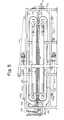
- Fig. 5 is a diagram of a dewatering machine which comprises a feeder 102 which discharges the product to be dewatered on to the upper length of a conveyor belt 104, running over a plurality of rollers 106A, 106B,... 106N.
- the lower active length of a further filtering conveyor belt 108, running around a plurality of rollers 110A, 110B,... 110N, extends above the upper active length cf the filtering conveyor belt 104.
- the two adjacent horizontal active lengths of the two conveyor belts 104 and 108 are externally flanked by the upper active length of a lower belt 112 and the active lower length of an upper belt 114; these belts 112, 114 form longitudinal drainage channels.
- Two pressing cases 116 and 118 which may be of the hydraulic type, associated with suitable stiffening frames, flank the outside of the active lengths of the belts.
- 120 indicates suction devices for the liquid extracted - by pressing and suction - from the pulp fed at 102, to obtain the laminar product L at the exit, on the right in the drawing.
- the conveyor belts 104 and 108 are of the filtering type and the belts 112 and 114 are pressure belts which act on the active lengths of the belts 104 and 108; the belts 112 and 114 have longitudinal channels for the outflow and discharge of the liquid phase, which is collected by the extraction devices 120.
- the filtering conveyor belts 104 and 108 ensure the maximum conservation, in the laminar material L, of the content of the pulp fed.
- the equipment may comprise a device of the type used in the production - again continuous - of paper, known as "drum machines".
- drum machines a device of the type used in the production - again continuous - of paper
- the sheet is formed on the cylindrical surface of one or more drums rotating with a horizontal axis, covered by a phosphor bronze screen and with approximately two thirds immersed in vats containing the highly diluted pulp; the water filtering inside them deposits on the screen a uniform layer of fibres which is collected by an endless felt which, through systems not dissimilar to those in the continuous machine having the disposition illustrated and described previously, takes the sheet to the presses, to the drying cylinders and to the subsequent treatments.
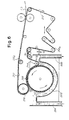
- Fig. 6 is a diagram of such a drum machine.
- 202 indicates a vat which is fed from a passage 204 for continuous circulation to the vat 202 and to an outlet 206 located opposite the feed 204.
- the suspension kept suitably homogeneous with suitable means to avoid stratification and settling, is fed into the vat 202.
- a drum 208 rotating with a horizontal axis and covered with a suction screen made of phosphor bronze or other material is partially immersed in the vat 202 which has a partially cylindrical form; a certain degree of vacuum is created inside the drum 208 to provide suction from the vat through the filtering wall of the said screen.
- the screen retains the solid phases in suspension, separating them from the water which is collected inside the drum and removed.
- the suspended particles accumulate on the screen and, by the rotation of the drum in the direction of the arrows, there emerges from the level of the vat 202, on the side of the outlet 206, a thickness of the material - already present in the suspension - which has been deposited on the screen.
- the emerging section of the drum 208 is adjacent to a continuous felt 212 which in particular runs around rollers 214 and 216, defining the arc of the continuous felt which is located on the drum 208.
- the felt subsequently runs around rollers 216A-216N, which also have functions appropriate for the treatment of the felt.
Landscapes
- Chemical & Material Sciences (AREA)
- Engineering & Computer Science (AREA)
- Ceramic Engineering (AREA)
- Materials Engineering (AREA)
- Structural Engineering (AREA)
- Organic Chemistry (AREA)
- Dispersion Chemistry (AREA)
- Inorganic Chemistry (AREA)
- Paper (AREA)
- Application Of Or Painting With Fluid Materials (AREA)
- Glass Compositions (AREA)
- Finishing Walls (AREA)
- Silicon Compounds (AREA)
- Panels For Use In Building Construction (AREA)
- Laminated Bodies (AREA)
Applications Claiming Priority (3)
| Application Number | Priority Date | Filing Date | Title |
|---|---|---|---|
| ITFI920182A IT1259678B (it) | 1992-09-17 | 1992-09-17 | Metodo ed attrezzatura perfezionati per la formazione di un manufatto laminare per la smaltatura della superficie di piastrelle ed altro e sistemi applicativi per tale manufatto |
| ITFI920182 | 1992-09-17 | ||
| PCT/IT1993/000097 WO1994006728A1 (en) | 1992-09-17 | 1993-09-14 | Improved method and equipment for the formation of a laminar product for glazing the surfaces of tiles and other purposes, and systems for the application of the said product |
Publications (2)
| Publication Number | Publication Date |
|---|---|
| EP0660811A1 EP0660811A1 (en) | 1995-07-05 |
| EP0660811B1 true EP0660811B1 (en) | 1996-12-27 |
Family
ID=11350215
Family Applications (1)
| Application Number | Title | Priority Date | Filing Date |
|---|---|---|---|
| EP93922616A Expired - Lifetime EP0660811B1 (en) | 1992-09-17 | 1993-09-14 | Laminar product for glazing the surfaces of tiles and other purposes, and application of said product |
Country Status (14)
| Country | Link |
|---|---|
| EP (1) | EP0660811B1 (cs) |
| AT (1) | ATE146768T1 (cs) |
| AU (1) | AU5160393A (cs) |
| BG (1) | BG99498A (cs) |
| BR (1) | BR9307063A (cs) |
| CZ (1) | CZ53295A3 (cs) |
| DE (1) | DE69306962T2 (cs) |
| ES (1) | ES2096332T3 (cs) |
| FI (1) | FI951089A7 (cs) |
| HU (1) | HUT75888A (cs) |
| IT (1) | IT1259678B (cs) |
| PL (1) | PL306374A1 (cs) |
| SK (1) | SK34295A3 (cs) |
| WO (1) | WO1994006728A1 (cs) |
Families Citing this family (3)
| Publication number | Priority date | Publication date | Assignee | Title |
|---|---|---|---|---|
| ES2094677B1 (es) * | 1994-01-31 | 1997-12-01 | Eurolistel Iberica S L | Procedimiento de fabricacion de piezas ceramicas sin soporte, piezas ceramicas obtenidas por el mismo y aplicaciones. |
| IT1285350B1 (it) * | 1995-05-23 | 1998-06-03 | Eurolistel Iberica S A | Procedimento di fabbricazione di elementi ceramici senza sopporto, elementi ceramici ottenuti con il medesimo e loro applicazioni. |
| ES2636930T3 (es) | 2012-10-22 | 2017-10-10 | Imerys Ceramics France | Proceso para elaborar una lámina inorgánica |
Family Cites Families (3)
| Publication number | Priority date | Publication date | Assignee | Title |
|---|---|---|---|---|
| JPS5190313A (ja) * | 1975-02-06 | 1976-08-07 | Tsukiseitairusejushi | |
| JPS5227406A (en) * | 1975-08-04 | 1977-03-01 | Tomoegawa Paper Co Ltd | Tile paper |
| JP2648918B2 (ja) * | 1987-09-11 | 1997-09-03 | 日東電工株式会社 | コーティング方法 |
-
1992
- 1992-09-17 IT ITFI920182A patent/IT1259678B/it active IP Right Grant
-
1993
- 1993-09-14 CZ CZ95532A patent/CZ53295A3/cs unknown
- 1993-09-14 SK SK342-95A patent/SK34295A3/sk unknown
- 1993-09-14 PL PL93306374A patent/PL306374A1/xx unknown
- 1993-09-14 ES ES93922616T patent/ES2096332T3/es not_active Expired - Lifetime
- 1993-09-14 AT AT93922616T patent/ATE146768T1/de not_active IP Right Cessation
- 1993-09-14 HU HU9500794A patent/HUT75888A/hu unknown
- 1993-09-14 WO PCT/IT1993/000097 patent/WO1994006728A1/en not_active Ceased
- 1993-09-14 AU AU51603/93A patent/AU5160393A/en not_active Abandoned
- 1993-09-14 EP EP93922616A patent/EP0660811B1/en not_active Expired - Lifetime
- 1993-09-14 DE DE69306962T patent/DE69306962T2/de not_active Expired - Fee Related
- 1993-09-14 BR BR9307063A patent/BR9307063A/pt not_active Application Discontinuation
-
1995
- 1995-03-08 FI FI951089A patent/FI951089A7/fi unknown
- 1995-03-13 BG BG99498A patent/BG99498A/xx unknown
Also Published As
| Publication number | Publication date |
|---|---|
| CZ53295A3 (en) | 1995-12-13 |
| IT1259678B (it) | 1996-03-25 |
| WO1994006728A1 (en) | 1994-03-31 |
| ES2096332T3 (es) | 1997-03-01 |
| SK34295A3 (en) | 1995-07-11 |
| DE69306962D1 (de) | 1997-02-06 |
| HUT75888A (en) | 1997-05-28 |
| FI951089A0 (fi) | 1995-03-08 |
| EP0660811A1 (en) | 1995-07-05 |
| FI951089A7 (fi) | 1995-03-08 |
| PL306374A1 (en) | 1995-03-20 |
| ATE146768T1 (de) | 1997-01-15 |
| HU9500794D0 (en) | 1995-05-29 |
| DE69306962T2 (de) | 1997-05-15 |
| BR9307063A (pt) | 1999-06-29 |
| BG99498A (en) | 1995-12-29 |
| ITFI920182A1 (it) | 1994-03-17 |
| ITFI920182A0 (it) | 1992-09-17 |
| AU5160393A (en) | 1994-04-12 |
Similar Documents
| Publication | Publication Date | Title |
|---|---|---|
| US3871952A (en) | Manufacture of non-woven fibrous material from a foamed furnish | |
| FI81136C (fi) | Foerfarande och anordning foer behandling av massa. | |
| GB2027356A (en) | Screw press | |
| US3067087A (en) | Manufacture of paper of organic hydrophobic fibers | |
| US2360779A (en) | Method of screening and washing paper pulp | |
| EP0660811B1 (en) | Laminar product for glazing the surfaces of tiles and other purposes, and application of said product | |
| US3806405A (en) | Method of applying a binder to a wetlaid fibrous web | |
| US4251320A (en) | Method of producing a mineral fiber product | |
| EP0168191A2 (en) | Process for making cement composite materials | |
| EP0006326B1 (en) | Apparatus for spreading fibres uniformly over a conveyor surface | |
| EP0168991A2 (en) | Apparatus for making cement composite materials | |
| US1905541A (en) | Fireproof wall board | |
| US4410573A (en) | Board made of fibrous material | |
| US11396727B2 (en) | Deodorant-paper manufacturing method | |
| JPS5945793B2 (ja) | 閉じた白水循環装置を有する加湿装置による木材繊維板製造方法 | |
| SE1250289A1 (sv) | Förfarande och anordning för rengöring av lignocellulosamaterial under impregnering | |
| JPS6111360B2 (cs) | ||
| US2500923A (en) | Apparatus for manufacturing cement-asbestos board | |
| US840386A (en) | Machine for making millboard. | |
| US2675745A (en) | Protection of dispersed asbestos | |
| US1927047A (en) | Fibrous product and method of making the same | |
| US3265558A (en) | Apparatus for preparing paper stocks | |
| US2887430A (en) | Method of treating fibre pulp for the production of fibre products such as paper, fibre boards and the like | |
| US902178A (en) | Means for manufacturing paper, board, and pulp. | |
| US1434212A (en) | Wall board |
Legal Events
| Date | Code | Title | Description |
|---|---|---|---|
| PUAI | Public reference made under article 153(3) epc to a published international application that has entered the european phase |
Free format text: ORIGINAL CODE: 0009012 |
|
| 17P | Request for examination filed |
Effective date: 19950127 |
|
| AK | Designated contracting states |
Kind code of ref document: A1 Designated state(s): AT BE CH DE DK ES FR GB GR IE IT LI LU MC NL PT SE |
|
| 17Q | First examination report despatched |
Effective date: 19950718 |
|
| GRAG | Despatch of communication of intention to grant |
Free format text: ORIGINAL CODE: EPIDOS AGRA |
|
| GRAH | Despatch of communication of intention to grant a patent |
Free format text: ORIGINAL CODE: EPIDOS IGRA |
|
| GRAH | Despatch of communication of intention to grant a patent |
Free format text: ORIGINAL CODE: EPIDOS IGRA |
|
| GRAH | Despatch of communication of intention to grant a patent |
Free format text: ORIGINAL CODE: EPIDOS IGRA |
|
| GRAA | (expected) grant |
Free format text: ORIGINAL CODE: 0009210 |
|
| AK | Designated contracting states |
Kind code of ref document: B1 Designated state(s): AT BE CH DE DK ES FR GB GR IE IT LI LU MC NL PT SE |
|
| PG25 | Lapsed in a contracting state [announced via postgrant information from national office to epo] |
Ref country code: GR Free format text: LAPSE BECAUSE OF FAILURE TO SUBMIT A TRANSLATION OF THE DESCRIPTION OR TO PAY THE FEE WITHIN THE PRESCRIBED TIME-LIMIT Effective date: 19961227 Ref country code: DK Effective date: 19961227 Ref country code: BE Effective date: 19961227 Ref country code: AT Effective date: 19961227 |
|
| REF | Corresponds to: |
Ref document number: 146768 Country of ref document: AT Date of ref document: 19970115 Kind code of ref document: T |
|
| REG | Reference to a national code |
Ref country code: CH Ref legal event code: NV Representative=s name: DIPL.-ING. ETH H. R. WERFFELI PATENTANWALT |
|
| REF | Corresponds to: |
Ref document number: 69306962 Country of ref document: DE Date of ref document: 19970206 |
|
| REG | Reference to a national code |
Ref country code: IE Ref legal event code: FG4D Free format text: 71287 |
|
| ET | Fr: translation filed | ||
| REG | Reference to a national code |
Ref country code: ES Ref legal event code: FG2A Ref document number: 2096332 Country of ref document: ES Kind code of ref document: T3 |
|
| ITF | It: translation for a ep patent filed | ||
| PG25 | Lapsed in a contracting state [announced via postgrant information from national office to epo] |
Ref country code: SE Effective date: 19970327 |
|
| REG | Reference to a national code |
Ref country code: PT Ref legal event code: SC4A Free format text: AVAILABILITY OF NATIONAL TRANSLATION Effective date: 19970318 |
|
| PG25 | Lapsed in a contracting state [announced via postgrant information from national office to epo] |
Ref country code: IE Free format text: LAPSE BECAUSE OF NON-PAYMENT OF DUE FEES Effective date: 19970914 |
|
| PLBE | No opposition filed within time limit |
Free format text: ORIGINAL CODE: 0009261 |
|
| STAA | Information on the status of an ep patent application or granted ep patent |
Free format text: STATUS: NO OPPOSITION FILED WITHIN TIME LIMIT |
|
| 26N | No opposition filed | ||
| PGFP | Annual fee paid to national office [announced via postgrant information from national office to epo] |
Ref country code: FR Payment date: 20000728 Year of fee payment: 8 |
|
| PGFP | Annual fee paid to national office [announced via postgrant information from national office to epo] |
Ref country code: MC Payment date: 20000731 Year of fee payment: 8 |
|
| PGFP | Annual fee paid to national office [announced via postgrant information from national office to epo] |
Ref country code: PT Payment date: 20000802 Year of fee payment: 8 |
|
| PGFP | Annual fee paid to national office [announced via postgrant information from national office to epo] |
Ref country code: CH Payment date: 20000807 Year of fee payment: 8 |
|
| PGFP | Annual fee paid to national office [announced via postgrant information from national office to epo] |
Ref country code: LU Payment date: 20000814 Year of fee payment: 8 |
|
| PGFP | Annual fee paid to national office [announced via postgrant information from national office to epo] |
Ref country code: GB Payment date: 20000913 Year of fee payment: 8 |
|
| PGFP | Annual fee paid to national office [announced via postgrant information from national office to epo] |
Ref country code: ES Payment date: 20000918 Year of fee payment: 8 |
|
| PGFP | Annual fee paid to national office [announced via postgrant information from national office to epo] |
Ref country code: NL Payment date: 20000930 Year of fee payment: 8 |
|
| PGFP | Annual fee paid to national office [announced via postgrant information from national office to epo] |
Ref country code: DE Payment date: 20001122 Year of fee payment: 8 |
|
| PG25 | Lapsed in a contracting state [announced via postgrant information from national office to epo] |
Ref country code: MC Free format text: LAPSE BECAUSE OF NON-PAYMENT OF DUE FEES Effective date: 20010801 |
|
| PG25 | Lapsed in a contracting state [announced via postgrant information from national office to epo] |
Ref country code: LU Free format text: LAPSE BECAUSE OF NON-PAYMENT OF DUE FEES Effective date: 20010914 Ref country code: GB Free format text: LAPSE BECAUSE OF NON-PAYMENT OF DUE FEES Effective date: 20010914 |
|
| PG25 | Lapsed in a contracting state [announced via postgrant information from national office to epo] |
Ref country code: ES Free format text: LAPSE BECAUSE OF NON-PAYMENT OF DUE FEES Effective date: 20010915 |
|
| PG25 | Lapsed in a contracting state [announced via postgrant information from national office to epo] |
Ref country code: LI Free format text: LAPSE BECAUSE OF NON-PAYMENT OF DUE FEES Effective date: 20010930 Ref country code: CH Free format text: LAPSE BECAUSE OF NON-PAYMENT OF DUE FEES Effective date: 20010930 |
|
| REG | Reference to a national code |
Ref country code: GB Ref legal event code: IF02 |
|
| PG25 | Lapsed in a contracting state [announced via postgrant information from national office to epo] |
Ref country code: PT Free format text: LAPSE BECAUSE OF NON-PAYMENT OF DUE FEES Effective date: 20020331 |
|
| PG25 | Lapsed in a contracting state [announced via postgrant information from national office to epo] |
Ref country code: NL Free format text: LAPSE BECAUSE OF NON-PAYMENT OF DUE FEES Effective date: 20020401 |
|
| GBPC | Gb: european patent ceased through non-payment of renewal fee |
Effective date: 20010914 |
|
| PG25 | Lapsed in a contracting state [announced via postgrant information from national office to epo] |
Ref country code: DE Free format text: LAPSE BECAUSE OF NON-PAYMENT OF DUE FEES Effective date: 20020501 |
|
| REG | Reference to a national code |
Ref country code: CH Ref legal event code: PL |
|
| PG25 | Lapsed in a contracting state [announced via postgrant information from national office to epo] |
Ref country code: FR Free format text: LAPSE BECAUSE OF NON-PAYMENT OF DUE FEES Effective date: 20020531 |
|
| NLV4 | Nl: lapsed or anulled due to non-payment of the annual fee |
Effective date: 20020401 |
|
| REG | Reference to a national code |
Ref country code: FR Ref legal event code: ST |
|
| REG | Reference to a national code |
Ref country code: PT Ref legal event code: MM4A Free format text: LAPSE DUE TO NON-PAYMENT OF FEES Effective date: 20020331 |
|
| NLV4 | Nl: lapsed or anulled due to non-payment of the annual fee |
Effective date: 20020401 |
|
| REG | Reference to a national code |
Ref country code: ES Ref legal event code: FD2A Effective date: 20021011 |
|
| PG25 | Lapsed in a contracting state [announced via postgrant information from national office to epo] |
Ref country code: IT Free format text: LAPSE BECAUSE OF NON-PAYMENT OF DUE FEES Effective date: 20050914 |