EP0662776A2 - Extention de cellule dans un système cellulaire de radiocommunications AMRT - Google Patents
Extention de cellule dans un système cellulaire de radiocommunications AMRT Download PDFInfo
- Publication number
- EP0662776A2 EP0662776A2 EP94119639A EP94119639A EP0662776A2 EP 0662776 A2 EP0662776 A2 EP 0662776A2 EP 94119639 A EP94119639 A EP 94119639A EP 94119639 A EP94119639 A EP 94119639A EP 0662776 A2 EP0662776 A2 EP 0662776A2
- Authority
- EP
- European Patent Office
- Prior art keywords
- radio
- tdma
- base station
- time
- bts
- Prior art date
- Legal status (The legal status is an assumption and is not a legal conclusion. Google has not performed a legal analysis and makes no representation as to the accuracy of the status listed.)
- Ceased
Links
Images

Classifications
-
- H—ELECTRICITY
- H04—ELECTRIC COMMUNICATION TECHNIQUE
- H04W—WIRELESS COMMUNICATION NETWORKS
- H04W16/00—Network planning, e.g. coverage or traffic planning tools; Network deployment, e.g. resource partitioning or cells structures
- H04W16/24—Cell structures
- H04W16/26—Cell enhancers or enhancement, e.g. for tunnels, building shadow
-
- H—ELECTRICITY
- H04—ELECTRIC COMMUNICATION TECHNIQUE
- H04B—TRANSMISSION
- H04B7/00—Radio transmission systems, i.e. using radiation field
- H04B7/24—Radio transmission systems, i.e. using radiation field for communication between two or more posts
- H04B7/26—Radio transmission systems, i.e. using radiation field for communication between two or more posts at least one of which is mobile
- H04B7/2603—Arrangements for wireless physical layer control
- H04B7/2609—Arrangements for range control, e.g. by using remote antennas
Definitions
- the invention relates to a base station for a cellular radio network according to the preamble of claim 1.
- the timing advance can be changed between 0 ⁇ s and 233 ⁇ s, which is used to compensate for equally long signal delays within the radio cell.
- the extension of the radio cell is limited to a maximum radius of 35 km corresponding to the maximum signal runtime of 233 ⁇ s.
- the limitation of the radio cell is in the described GSM radio network due to a limitation in the coding of the timing advance. Radio pulses from mobile stations outside of this radio cell cannot be received.
- the book proposes to occupy only every second time slot within the time slot sequence, which is equivalent to an increase in the protection times between the radio pulses.
- this measure requires a change in the reception process in the base station, as the authors note on p. 347.
- this measure means that only half the channel capacity can be used for radio transmission. Measures that circumvent these problems are not addressed in the book.
- the TDMA base station In the Australian patent application PM 2427 dated November 15, 1993, it is proposed to equip the TDMA base station with two receivers that operate on one receiving frequency, but around the max. Signal delay time offset from each other, received. As a result, one receiver receives the TDMA radio pulses from mobile stations inside the radio cell and the other receiver receives the TDMA radio pulses from mobile stations outside the radio cell.
- the coverage area of the TDMA base station has thus been expanded to an extended radio cell with a double cell radius.
- the TDMA radio pulses that the mobile stations send out can be received at the receiving location, i.e. collide at the location of the base station. This causes interference between the TDMA radio channels.
- the object of the invention is to provide a base station and means for a TDMA radio transmission within a radio cell, which enables simple expansion of the radio cell while avoiding the problems mentioned above.
- the object is achieved by a base station with the features of claim 1 and by a TDMA time control with the features of claim 4.
- a base station for a cellular radio network which, in addition to the (conventionally one) TDMA radio receiver, contains at least one further TDMA radio receiver which receives on the same carrier frequency as the former, but is lagging by at least the time period which corresponds to the maximum signal propagation time.
- the time slot allocation is controlled by a TDMA time controller connected to the base station by assigning the mobile stations inside and outside the radio cell for sending the TDMA radio pulses to those of the time slots which are adjacent to one another, as a result of which the base station transmits the TDMA radio pulses to as many mobile stations as possible receives within an expanded radio cell.
- an expanded radio cell CE is shown schematically, which is supplied centrally by a base station BTS.
- the expanded radio cell Ce has a radius R and concentrically encloses a radio cell C with the radius r.
- Within this radio cell C there are mobile stations MS1 and MS2, each of which is assigned a different time slot for sending TDMA radio pulses.
- the mobile stations transmit a time period (timing advance) so that the TDMA radio pulses when received in the base station overlap into the sequence of time slots and the signal transit time within the radio cell C is compensated.
- the mobile stations MS1 and MS2 are able to send out the TDMA radio pulses in advance up to a maximum of 233 microseconds. This time period corresponds to the maximum signal transit time that a radio signal requires for radio transmission from the edge of the radio cell to the location of the base station.
- the radio cell therefore has a radius r of approximately 35 km.
- a mobile station MS3 which also sends out TDMA radio pulses in a lead period of between 0 ⁇ s and 233 ⁇ s.
- a conventional base station cannot receive the TDMA radio pulses sent by this mobile station.
- the radio base station BTS according to the invention described in more detail below is able to receive these TDMA radio pulses within a reception radius R which is greater than the radius r of the radio cell C.
- An expanded radio cell Ce is thus created, the radius R of which in this example is twice r.
- radio base station BTS An embodiment of the radio base station BTS according to the invention is described below with reference to FIGS. 1b and 2.
- the structure of the base station BTS is shown schematically in FIG. 1b.
- This contains a radio transmitter TX with a transmission antenna connected to it, a TDMA radio receiver RX with a reception antenna and an additional TDMA radio receiver RX2 with a further reception antenna.
- the radio transmitter TX and the two TDMA radio receivers are connected to a digital circuit BSB, which processes the radio signals to be transmitted or received in the baseband.
- the base station BTS also contains a time control TC which is connected to the digital circuit and which controls the time slot allocation for the TDMA radio transmission and the synchronization.
- the base stations and the mobile stations are designed for a TDMA radio transmission according to the GSM standard.
- the base station accordingly uses its radio transmitter TX to inform the mobile stations of the assignment of those time slots in which the mobile stations send their TDMA radio signals.
- the radio signals transmitted by the mobile stations are received in the two TDMA radio receivers RX and RXe, the reception in the additional TDMA radio receiver RXe lagging the reception of the TDMA radio receiver RX for a period of time. This time period corresponds to the maximum signal runtime that the mobile radio base stations can compensate for.
- the time-shifted reception of the two TDMA radio receivers is achieved by a time-shifted sampling of the radio signals received.
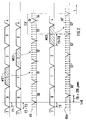
- the transmission and reception of the TDMA radio pulses is described in more detail below with reference to FIG. 2.
- the 2 shows over the time axis t the time intervals in which the TDMA radio pulses are transmitted by the mobile stations on the transmission side and received and scanned by the TDMA radio receivers on the reception side.
- the mobile stations within the radio cell C send their TDMA radio pulses in such a way that they are incorporated into this sequence of time slots when they are received in the radio receiver RX.
- the time shifts described below relate to signal transit times of the TDMA radio pulses, i.e. on signal propagation times of electromagnetic waves.
- the location of this fictitious light transmitter is shown in Fig. 1a.
- the distances shown in FIG. 1a between each of the mobile stations and the base station correspond to the signal propagation times of the various TDMA radio pulses shown in FIG. 2.
- the above considerations serve to clearly illustrate the temporal processes in Fig. 2. usual in GSM, time reference given by the base station BTS.
- the mobile station MS1 sends, for example, a lead to the time slot S1 by a time period T1 which compensates for the signal delay for the distance d from the base station.
- the mobile station MS2 which is located at the edge of the radio cell C, sends ahead to the time slot S2 by a time period T2 which compensates for the maximum signal propagation time TD for the radius r of the radio cell C.
- the method for calculating these time periods in order to compensate for the signal propagation times is known per se, for example, from GSM under the term "timing advance control". This method is e.g. in the book "GSM" by Mouly and Pautet.
- the compensation of the signal propagation times causes the TDMA radio pulses transmitted by the mobile stations to be integrated in the sequence of time slots S0 to S7 in the TDMA radio receiver upon receipt without overlap.
- FIG. 2 also shows the time interval in which the mobile radio station MS3 transmits its TDMA radio pulses. Although this mobile station is outside the radio cell C, it is assigned a time slot S3 within the sequence and a time period (timing advance) T3 by the base station, as is customary in GSM.
- a timing control timing advance control
- a timing advance control is also used for those mobile stations MS3 which are located outside the (normal) radio cell C, as for the (normal) mobile stations within the radio cell.
- the additional radio receiver RXe receives the (normal) radio receiver RX with a time delay. As shown in Fig. 2, the additional radio receiver RXe lags the received radio signals by a time period TD.
- This time span TD is, for example, 233 microseconds long and corresponds to the maximum signal transit time within the radio cell C.
- the received sequence of time slots S0 ', S01', ... to S07 'in the additional receiver RXe is time-shifted so that TDMA radio pulses occur Send out more distant mobile station (like here MS3) with a usual timing advance, receive it in time and scan it.
- the radio base station is thus able to supply an extended radio cell Ce, while maintaining the usual timing advance control method, within which the mobile stations only have to compensate for signal delay times that are less than or equal to the maximum signal delay TD.
- the time control TC assigns the time slots to the mobile stations as follows: The mobile stations within the radio cell are assigned adjacent time slots within the sequence, such as S1 and S2 here. Neighboring time slots are also assigned to the mobile stations in the extended area of the radio cell. This prevents the TDMA radio pulses from near and far mobile stations from arriving alternately at the base station, as a result of which the TDMA radio pulses would overlap at the receiving end. Such an overlap would exist, for example, if the time slots with the even order numbers S0, S2, S4 etc. were assigned to the mobile stations within the radio cell and the time slots with the odd order numbers S1, S3, S5 etc. were assigned to the mobile stations in the expansion area . As can be seen from FIG. 2, there would then be an overlap of a radio pulse received in time slot S3 'and a radio pulse received in time slot S4.
- the base station BTS assigns the mobile stations inside the radio cell and outside the radio cell C adjacent radio time slots so that the mobile stations within the radio cell C receive time slots with a lower order number than the mobile stations outside the radio cell.
- the base station BTS assigns the mobile stations inside the radio cell and outside the radio cell C adjacent radio time slots so that the mobile stations within the radio cell C receive time slots with a lower order number than the mobile stations outside the radio cell.
- radio time slots are used for message transmission, ie they are so-called traffic channels.
- the radio time slot is used for signaling, in particular for establishing a connection, as a so-called RACCH (Random Access Chanel)
- RACCH Random Access Chanel
- the subsequent radio time slot S1 should be kept free. This will a collision of signaling radio pulses (Random Access Burst), which transmit more distant mobile stations, with traffic radio pulses (Traffic Burst), which other mobile stations transmit, avoided.
- the radio base station BTS described here is able to correlate with one another the TDMA radio signals received on the different reception branches (RX and RXe) according to the diversity reception principle.
- the TDMA radio pulse received in time slot S3 'via the radio receiver RXe is also received in a time interval DIV via the radio receiver RX.
- This time interval DIV covers partial areas of the time slots S3 and S4 in relation to the reception branch RX. Since each of the two reception branches has a separate reception antenna and the corresponding TDMA radio receiver, a diversity reception signal is formed by correlating the scanning values from both reception branches within the baseband processing. The assignment of sampled values SV, SV 'sampled at the same time is important here. This makes the base station BTS suitable for compensation of multipath reception.
- the described radio base station BTS with the described expanded radio cell is a possible embodiment of the invention.
- An expanded radio cell is also conceivable, which is formed from several ring-like expansion zones, each of which has a maximum radial extent which corresponds to the maximum permissible signal propagation time in the system.
- conventional mobile stations can move in the expanded radio cell and communicate with the base station in the same way as in a conventional and spatially limited radio cell.
- the invention has been described using the example of a mobile radio system.
- Embodiments for cellular radio networks with stationary remote stations, so-called fixed wireless radio networks are also conceivable.
- the invention allows a large expansion of the Radio cells, which leads to a reduction in the total number of base stations in the system. This reduces the infrastructure costs.
- the invention is also applicable to cellular building radio networks such as DECT (Digital European Cordless Telephone) can be used.
- DECT Digital European Cordless Telephone
- the proposed base station allows simple and quick expansion of existing radio cells. This enables very flexible radio network planning.
Landscapes
- Engineering & Computer Science (AREA)
- Computer Networks & Wireless Communication (AREA)
- Signal Processing (AREA)
- Mobile Radio Communication Systems (AREA)
Applications Claiming Priority (2)
| Application Number | Priority Date | Filing Date | Title |
|---|---|---|---|
| DE4400331A DE4400331A1 (de) | 1994-01-07 | 1994-01-07 | Funkzellen-Erweiterung |
| DE4400331 | 1994-01-07 |
Publications (2)
| Publication Number | Publication Date |
|---|---|
| EP0662776A2 true EP0662776A2 (fr) | 1995-07-12 |
| EP0662776A3 EP0662776A3 (fr) | 1995-12-27 |
Family
ID=6507576
Family Applications (1)
| Application Number | Title | Priority Date | Filing Date |
|---|---|---|---|
| EP94119639A Ceased EP0662776A3 (fr) | 1994-01-07 | 1994-12-13 | Extention de cellule dans un système cellulaire de radiocommunications AMRT. |
Country Status (7)
| Country | Link |
|---|---|
| US (1) | US5544171A (fr) |
| EP (1) | EP0662776A3 (fr) |
| CN (1) | CN1121279A (fr) |
| AU (1) | AU688414B2 (fr) |
| CA (1) | CA2139479A1 (fr) |
| DE (1) | DE4400331A1 (fr) |
| FI (1) | FI950064L (fr) |
Cited By (4)
| Publication number | Priority date | Publication date | Assignee | Title |
|---|---|---|---|---|
| EP0721290A1 (fr) * | 1995-01-02 | 1996-07-10 | Alcatel Cit | Procédé et dispositif pour allouer des voies de communication à des mobiles proches et lointains dans un système de radiocommunication cellulaire AMRT, notamment un système GSM |
| WO1996037082A1 (fr) * | 1995-05-18 | 1996-11-21 | Nokia Telecommunications Oy | Accroissement de la capacite d'un reseau telephonique mobile cellulaire |
| EP0959636A1 (fr) * | 1998-05-18 | 1999-11-24 | TELEFONAKTIEBOLAGET L M ERICSSON (publ) | Systéme de radiocommunication AMRT multicellulaire, à travers des sous-ensembles limités de tranches de temps |
| DE102017116273A1 (de) * | 2017-03-30 | 2018-10-04 | Riedel Communications International GmbH | Netzwerkgerät für ein Intercom-Netzwerk |
Families Citing this family (39)
| Publication number | Priority date | Publication date | Assignee | Title |
|---|---|---|---|---|
| FI106824B (fi) * | 1993-07-05 | 2001-04-12 | Nokia Networks Oy | Tukiasema |
| FI97094C (fi) * | 1994-11-21 | 1996-10-10 | Nokia Telecommunications Oy | Tukiasemaverkon testauslaitteisto |
| AUPN240195A0 (en) * | 1995-04-13 | 1995-05-11 | Alcatel Australia Limited | A gsm base station arrangement |
| US5758090A (en) * | 1995-09-22 | 1998-05-26 | Airnet Communications, Inc. | Frequency reuse planning for CDMA cellular communication system by grouping of available carrier frequencies and power control based on the distance from base station |
| US5740166A (en) * | 1996-03-18 | 1998-04-14 | Telefonaktiebolaget Lm Ericsson | United access channel for use in a mobile communications system |
| US6088592A (en) * | 1996-03-25 | 2000-07-11 | Airnet Communications Corporation | Wireless system plan using in band-translators with diversity backhaul to enable efficient depolyment of high capacity base transceiver systems |
| US5930728A (en) * | 1996-08-29 | 1999-07-27 | Ericsson Inc. | Up converted home base station |
| DE19635327C1 (de) * | 1996-08-30 | 1997-10-09 | Siemens Ag | Verfahren zum Belegen von Zeitschlitzen in drahtlosen Kommunikationsnetzen |
| TW357501B (en) * | 1996-09-30 | 1999-05-01 | Siemens Ag | Method to increase the effective range in a time-division-method |
| US6031832A (en) * | 1996-11-27 | 2000-02-29 | Telefonaktiebolaget L M Ericsson (Publ) | Method and apparatus for improving performance of a packet communications system |
| US5953637A (en) * | 1996-12-20 | 1999-09-14 | Airnet Communications Corporation | Time slot recovery for remote in-band translator in time division multiple access wireless system |
| FI105875B (fi) * | 1997-04-29 | 2000-10-13 | Nokia Networks Oy | Tukiasema |
| EP0896492A1 (fr) * | 1997-08-06 | 1999-02-10 | TELEFONAKTIEBOLAGET L M ERICSSON (publ) | Procédé et arrangement supportant la compensation de retard de propagation |
| DE19741681A1 (de) * | 1997-09-22 | 1999-03-25 | Cit Alcatel | Drahtloses Kommunikationssystem mit Funkfeststation und Mobilstationen, insbesondere FDD/TDMA-Kommunikationssysstem |
| US6400966B1 (en) * | 1997-10-07 | 2002-06-04 | Telefonaktie Bolaget Lm Ericsson (Publ) | Base station architecture for a mobile communications system |
| US6487187B1 (en) * | 1997-11-26 | 2002-11-26 | Airnet Communications Corporation | Random access control channel gain control and time slot recovery for remote in-band translator in time division multiple access wireless system |
| US6363261B1 (en) | 1998-08-31 | 2002-03-26 | Lucent Technologies Inc. | Extended range concentric cell base station |
| US6212405B1 (en) * | 1998-08-31 | 2001-04-03 | Lucent Technologies Inc. | Extended range concentric cell base station |
| US6304759B1 (en) * | 1998-08-31 | 2001-10-16 | Lucent Technologies Inc. | Method for extending the range of a wireless communication system |
| US6323805B1 (en) * | 1998-09-09 | 2001-11-27 | Qualcomm, Inc. | Data boundary aware base station assisted position location |
| US6088570A (en) * | 1998-11-24 | 2000-07-11 | Airnet Communications Corporation | Method and apparatus employing delay elements in multiple diversity paths of a wireless system repeater translator to allow for selective diversity and automatic level control in a time-division multiple access system |
| KR100551163B1 (ko) * | 1999-01-09 | 2006-02-13 | 유티스타콤코리아 유한회사 | Cdma 이동통신시스템의 타이밍적으로 제한된 통화권역의 확장시 이동국의 통화권역이동에 따른 통화불능상태를 해결하는 기지국 운용방법 |
| US7316780B1 (en) * | 1999-01-29 | 2008-01-08 | Pall Corporation | Range separation devices and processes |
| US6314535B1 (en) * | 1999-05-18 | 2001-11-06 | Xircom Wireless, Inc. | Dynamic forward error correction |
| US6330700B1 (en) | 1999-05-18 | 2001-12-11 | Omnipoint Corporation | Out-of-band forward error correction |
| KR100345683B1 (ko) * | 1999-12-30 | 2002-07-27 | 주식회사 큐리텔 | 무선 가입자망 시스템에서 기지국과 기지국 제어기간 무선 광 정합장치 및 그 방법 |
| KR100351425B1 (ko) * | 2000-01-26 | 2002-09-05 | 주식회사 하이닉스반도체 | 기지국 통화 반경 확장용 클럭 발생 장치 |
| KR100331121B1 (ko) | 2000-02-22 | 2002-04-01 | 박종섭 | 기지국 통화반경 확장용 채널카드 |
| AU2000243410A1 (en) * | 2000-04-11 | 2001-10-23 | Airnet Communications Corporation | Method and apparatus employing delay combining for receive diversity in a wireless system repeater |
| US20060121855A1 (en) * | 2004-12-07 | 2006-06-08 | Motorola, Inc. | System and method for adjusting a range of access for a cell |
| US8547948B2 (en) * | 2005-10-06 | 2013-10-01 | Lockheed Martin Corporation | Antenna management system |
| US8121065B2 (en) | 2006-01-30 | 2012-02-21 | Marvell World Trade Ltd. | TDMA controller for a wireless communication system and method of operating same |
| US8043512B2 (en) * | 2008-04-11 | 2011-10-25 | Pall Corporation | Fluid treatment arrangements and methods |
| US8048315B2 (en) * | 2008-07-28 | 2011-11-01 | Pall Corporation | Fluid treatment arrangements and methods |
| US11102746B2 (en) * | 2014-03-03 | 2021-08-24 | Rosemount Inc. | Positioning system |
| US10942250B2 (en) | 2014-03-03 | 2021-03-09 | Rosemount Inc. | Positioning system |
| WO2020061016A1 (fr) | 2018-09-17 | 2020-03-26 | Rosemount Inc. | Système avec perception de localisation |
| USD1002676S1 (en) | 2019-08-30 | 2023-10-24 | Dometic Sweden Ab | Appliance |
| USD1053913S1 (en) | 2020-08-31 | 2024-12-10 | Dometic Sweden Ab | Refrigerator |
Family Cites Families (13)
| Publication number | Priority date | Publication date | Assignee | Title |
|---|---|---|---|---|
| DE3011935C2 (de) * | 1980-03-27 | 1982-06-16 | Siemens AG, 1000 Berlin und 8000 München | Mobiles Funknetz mit netzweiter Synchronisation |
| DE3441722A1 (de) * | 1984-11-15 | 1986-05-15 | Robert Bosch Gmbh, 7000 Stuttgart | Funktelefonnetz |
| SE455750B (sv) * | 1987-06-11 | 1988-08-01 | Ericsson Telefon Ab L M | Digitalt tidsmultiplext mobiltelefonisystem med ett effektivt utnyttjande av varje tidsram |
| JP2615753B2 (ja) * | 1988-02-10 | 1997-06-04 | 日本電気株式会社 | 自動位相調整方式 |
| EP0511614B1 (fr) * | 1991-04-27 | 1998-02-04 | Nec Corporation | Circuit de contrÔle de synchronisation pour un système de communication TDMA |
| JP2723691B2 (ja) * | 1991-04-30 | 1998-03-09 | 日本電気株式会社 | 可変タイミング信号発生回路 |
| DE4140742C2 (de) * | 1991-12-11 | 1994-09-22 | Detecon Gmbh | Verfahren zum Betrieb eines digitalen, zellularen Mobilfunkkommunikationsnetzes und ein nach dem Verfahren arbeitendes Mobilfunkkommunikationsnetz |
| US6101177A (en) * | 1992-03-30 | 2000-08-08 | Telefonaktiebolaget Lm Ericsson | Cell extension in a cellular telephone system |
| JP3212169B2 (ja) * | 1993-01-06 | 2001-09-25 | 株式会社東芝 | 無線通信システム及び基地局 |
| FR2702320B1 (fr) * | 1993-03-03 | 1995-04-14 | Alcatel Radiotelephone | Procédé pour allouer un intervalle de temps au sein d'une trame à un mobile accédant à une cellule de communication et station émettrice-réceptrice de base mettant en Óoeuvre ce procédé. |
| JPH06284085A (ja) * | 1993-03-25 | 1994-10-07 | Toshiba Corp | ディジタル無線通信装置 |
| FI97594C (fi) * | 1993-07-05 | 1997-01-10 | Nokia Telecommunications Oy | Aikajakoinen monikäyttöradiojärjestelmä, menetelmä kapasiteetin jakamiseksi solun sisällä sekä menetelmä solun sisäisen handoverin suorittamiseksi |
| US5363376A (en) * | 1993-07-30 | 1994-11-08 | Bell Communications Research, Inc. | Method and apparatus for synchronizing timing among radio ports in wireless communications systems |
-
1994
- 1994-01-07 DE DE4400331A patent/DE4400331A1/de not_active Withdrawn
- 1994-12-13 EP EP94119639A patent/EP0662776A3/fr not_active Ceased
- 1994-12-19 AU AU81506/94A patent/AU688414B2/en not_active Ceased
- 1994-12-28 US US08/365,519 patent/US5544171A/en not_active Expired - Fee Related
-
1995
- 1995-01-03 CA CA002139479A patent/CA2139479A1/fr not_active Abandoned
- 1995-01-05 FI FI950064A patent/FI950064L/fi unknown
- 1995-01-06 CN CN95101126A patent/CN1121279A/zh active Pending
Cited By (5)
| Publication number | Priority date | Publication date | Assignee | Title |
|---|---|---|---|---|
| EP0721290A1 (fr) * | 1995-01-02 | 1996-07-10 | Alcatel Cit | Procédé et dispositif pour allouer des voies de communication à des mobiles proches et lointains dans un système de radiocommunication cellulaire AMRT, notamment un système GSM |
| WO1996037082A1 (fr) * | 1995-05-18 | 1996-11-21 | Nokia Telecommunications Oy | Accroissement de la capacite d'un reseau telephonique mobile cellulaire |
| EP0959636A1 (fr) * | 1998-05-18 | 1999-11-24 | TELEFONAKTIEBOLAGET L M ERICSSON (publ) | Systéme de radiocommunication AMRT multicellulaire, à travers des sous-ensembles limités de tranches de temps |
| WO1999060808A1 (fr) * | 1998-05-18 | 1999-11-25 | Telefonaktiebolaget Lm Ericsson (Publ) | Radiocommunication amrt a cellules multiples, par des sous-ensembles limites d'intervalles de temps |
| DE102017116273A1 (de) * | 2017-03-30 | 2018-10-04 | Riedel Communications International GmbH | Netzwerkgerät für ein Intercom-Netzwerk |
Also Published As
| Publication number | Publication date |
|---|---|
| CA2139479A1 (fr) | 1995-07-08 |
| FI950064A7 (fi) | 1995-07-08 |
| FI950064L (fi) | 1995-07-08 |
| DE4400331A1 (de) | 1995-07-27 |
| EP0662776A3 (fr) | 1995-12-27 |
| CN1121279A (zh) | 1996-04-24 |
| AU688414B2 (en) | 1998-03-12 |
| US5544171A (en) | 1996-08-06 |
| AU8150694A (en) | 1995-07-20 |
| FI950064A0 (fi) | 1995-01-05 |
Similar Documents
| Publication | Publication Date | Title |
|---|---|---|
| EP0662776A2 (fr) | Extention de cellule dans un système cellulaire de radiocommunications AMRT | |
| DE69923951T2 (de) | Tdma-tdd/fdd-funkkommunikationssystem sowie kanalselektionsverfahren für eine derartige anordnung | |
| DE3689234T2 (de) | Funkkanalsteuerungsverfahren für ein mobiles Kommunikationssystem. | |
| DE69423355T2 (de) | Zeitmultiplex-vielfachzugriff-funksystem, verfahren zur kapazitätszuweisung innerhalb einer zelle und verfahren zum ausführen einer übergabe innerhalb einer zelle | |
| DE69425518T2 (de) | Verfahren zur Zuteilung eines Zeitschlitzes in einem Rahmen für ein auf eine Kommunikationszelle zugreifendes Mobil und Sende/Empfangsbasisstation dafür | |
| DE69926297T2 (de) | Verfahren zum Weiterreichen zwischen zwei Relays einer Zelle eines digitalen zellularen Funkkommunikationssystems mittels eines gemeinsamen Übergangskanals. | |
| DE69219886T2 (de) | Verfahren zur steuerung einer funksendereinheit | |
| EP1251646B1 (fr) | Méthode pour la transmission semi-duplex d' informations entre appareils de communication avec répéteurs | |
| DE69422177T2 (de) | Basisstation mit an die entfernung zwischen basisstation und mobilstation angepassten übertragungszeitpunkten | |
| DE69328646T2 (de) | Zellenerweiterung in einem zellulären Telefonsystem | |
| DE69113251T3 (de) | Funksendeempfänger. | |
| DE2615198C3 (de) | Nachrichtenübertragungssystem zum zweiseitig gerichteten Nachrichtenverkehr zwischen einer Hauptstation und mehreren Unterstationen über einen Satelliten | |
| EP0617861B2 (fr) | Procede destine a l'amelioration de la couverture des cellules radio d'un systeme radiocellulaire mobile et dispositif d'application dudit procede | |
| DE69727291T2 (de) | Dynamische kanalzuteilung | |
| EP0139034A1 (fr) | Procédé pour la transmission de services d'informations par satellites | |
| DE68925821T2 (de) | Verfahren und system für ein grossflächen-funkkommunikationssystem | |
| DE69832746T2 (de) | Zugriffssystem für sektorisierte Funknetze | |
| DE69527427T2 (de) | Verfahren zur erhöhung der qualität der verbindungen in einer zellularen funkübertragungsanordnung und basisstation dafür | |
| DE69715127T2 (de) | Zellulares Funkübertragungssystem für Informationen zwischen einer Infrastruktur und mobilen Stationen | |
| EP0166885A2 (fr) | Système de radiotéléphonie | |
| EP1188261B1 (fr) | Transitions alternantes de liaison montante/descendante lors de l'attribution de canaux dans une trame de transmission drt avec plusieurs instants de commutation | |
| DE69723712T2 (de) | Dual-mode tragbares telefongerät | |
| DE19916064A1 (de) | Synchronisationsverfahren für Basisstationen | |
| DE3402941A1 (de) | Digitales zellenfunksystem mit zeitmultiplex | |
| EP1121773B1 (fr) | Systeme radiotelephonique mobile et station mobile fonctionnant en mode duplex et en mode semi-duplex |
Legal Events
| Date | Code | Title | Description |
|---|---|---|---|
| PUAI | Public reference made under article 153(3) epc to a published international application that has entered the european phase |
Free format text: ORIGINAL CODE: 0009012 |
|
| AK | Designated contracting states |
Kind code of ref document: A2 Designated state(s): DE FR GB IT SE |
|
| PUAL | Search report despatched |
Free format text: ORIGINAL CODE: 0009013 |
|
| AK | Designated contracting states |
Kind code of ref document: A3 Designated state(s): DE FR GB IT SE |
|
| 17P | Request for examination filed |
Effective date: 19960215 |
|
| 17Q | First examination report despatched |
Effective date: 20000707 |
|
| GRAG | Despatch of communication of intention to grant |
Free format text: ORIGINAL CODE: EPIDOS AGRA |
|
| STAA | Information on the status of an ep patent application or granted ep patent |
Free format text: STATUS: THE APPLICATION HAS BEEN REFUSED |
|
| 18R | Application refused |
Effective date: 20021223 |