EP0663636A1 - Mémoire physique à adressage logique pour système d'ordinateur à mémoire virtuelle qui supporte plusieurs tailles de pages - Google Patents
Mémoire physique à adressage logique pour système d'ordinateur à mémoire virtuelle qui supporte plusieurs tailles de pages Download PDFInfo
- Publication number
- EP0663636A1 EP0663636A1 EP94309733A EP94309733A EP0663636A1 EP 0663636 A1 EP0663636 A1 EP 0663636A1 EP 94309733 A EP94309733 A EP 94309733A EP 94309733 A EP94309733 A EP 94309733A EP 0663636 A1 EP0663636 A1 EP 0663636A1
- Authority
- EP
- European Patent Office
- Prior art keywords
- page
- address
- address space
- virtual
- physical
- Prior art date
- Legal status (The legal status is an assumption and is not a legal conclusion. Google has not performed a legal analysis and makes no representation as to the accuracy of the status listed.)
- Granted
Links
Images





Classifications
-
- G—PHYSICS
- G06—COMPUTING OR CALCULATING; COUNTING
- G06F—ELECTRIC DIGITAL DATA PROCESSING
- G06F12/00—Accessing, addressing or allocating within memory systems or architectures
- G06F12/02—Addressing or allocation; Relocation
- G06F12/08—Addressing or allocation; Relocation in hierarchically structured memory systems, e.g. virtual memory systems
- G06F12/10—Address translation
- G06F12/1009—Address translation using page tables, e.g. page table structures
-
- G—PHYSICS
- G06—COMPUTING OR CALCULATING; COUNTING
- G06F—ELECTRIC DIGITAL DATA PROCESSING
- G06F12/00—Accessing, addressing or allocating within memory systems or architectures
- G06F12/02—Addressing or allocation; Relocation
-
- G—PHYSICS
- G06—COMPUTING OR CALCULATING; COUNTING
- G06F—ELECTRIC DIGITAL DATA PROCESSING
- G06F12/00—Accessing, addressing or allocating within memory systems or architectures
- G06F12/02—Addressing or allocation; Relocation
- G06F12/08—Addressing or allocation; Relocation in hierarchically structured memory systems, e.g. virtual memory systems
- G06F12/10—Address translation
- G06F12/1027—Address translation using associative or pseudo-associative address translation means, e.g. translation look-aside buffer [TLB]
-
- G—PHYSICS
- G06—COMPUTING OR CALCULATING; COUNTING
- G06F—ELECTRIC DIGITAL DATA PROCESSING
- G06F2212/00—Indexing scheme relating to accessing, addressing or allocation within memory systems or architectures
- G06F2212/65—Details of virtual memory and virtual address translation
- G06F2212/651—Multi-level translation tables
-
- G—PHYSICS
- G06—COMPUTING OR CALCULATING; COUNTING
- G06F—ELECTRIC DIGITAL DATA PROCESSING
- G06F2212/00—Indexing scheme relating to accessing, addressing or allocation within memory systems or architectures
- G06F2212/65—Details of virtual memory and virtual address translation
- G06F2212/652—Page size control
Definitions
- the present invention relates to the field of computer systems. More specifically, the present invention relates to the mapping of virtual pages to physical pages in a virtual memory computer system that supports multiple page sizes.
- Virtual memory is a technique that allows an application program to utilize a memory system as providing a large uniform primary memory. In reality the memory may he smaller, more fragmented, and/or partially simulated by secondary storage such as a hard disk. Applications access memory through virtual addresses, which are translated (mapped) by special hardware onto physical addresses. Paging and segmentation are two common implementations of virtual memory.
- the virtual address space is divided into a number of fixed-size blocks called pages, each of which can he mapped onto any of the similarly sized physical pages available on the system.
- special memory management hardware such as a memory management unit (MMU) or a paged memory management unit (PMMU) performs the address translation from virtual addresses to physical addresses.
- MMU memory management unit
- PMMU paged memory management unit
- any attempt to access data that are not present in physical (system) memory causes the PMMU to send an interrupt signal to the central processing unit (CPU); the operating system then transfers the data in from other storage (such as hard disk), without the application program "knowing" about the transfer.
- a first process may refer to a given physical address using a first virtual address and a second process running on the same CPU, or on a different CPU in a multi-processor environment, will refer to the given physical address by a second virtual address.
- the two virtual addresses corresponding to the same physical address are referred to as "aliases”.
- Some CPUs are able to operate using more than one size of virtual page.
- a virtual memory computer system address translation mechanism that supports multiple page sizes is described in U.S. patent application 08/139,549, filed on October 20, 1993.
- a virtual address to physical address translation cache that supports multiple page sizes is described in U.S. patent application 08/118,398, filed on September 8, 1993.
- an addressing scheme is typically used wherein a certain number of the least significant bits of a virtual or physical address are used to indicate a particular word within a page.
- the number of least significant bits used to indicate a word within a page is dependent upon the size of the page being represented. For a given page size, however, the number of least significant bits dedicated to the word position within the page is fixed and is the same regardless of whether the address is a virtual address or a physical address.
- the remaining most significant bits of a virtual address are then used to indicate which particular page of virtual memory is being addressed.
- the remaining most significant bits of a physical address are used to indicate the particular page of physical memory that is being addressed.
- Implicit within this addressing scheme is a requirement that each page be aligned on a boundary that is an integral multiple of the size of the page being addressed. Therefore, when loading a page into physical memory, it is not sufficient to merely find a free contiguous portion of physical memory equal in size to that of the page to be loaded. The contiguous portion of free physical memory required must begin on a page boundary dictated by the size of the page that is being loaded into physical memory. The larger the page size, the fewer the possible places in a given sized physical memory that can accommodate a given sized page.
- big pages address a larger portion of physical memory than small pages
- the operating system will map the virtual memory to physical memory incrementally over time using small pages. This results in a continuous region of virtual memory that could be mapped using a single large page being mapped by several small pages. Typically these small pages occupy non-contiguous regions in physical memory.
- the operating system will recognize that the mapping made using the several small pages can be replaced by a mapping using a single large page and then make the replacement from the several small page mappings to a large page mapping. Because the small pages typically are not located in a contiguous portion of physical memory that begins on a big page boundary, to promote the small pages to a single big page, the operating system will have to find a suitable portion of physical memory that can accommodate the big page and then move the contents of the several small pages into it. Thus, although page promotion is beneficial, the promotion process is a time consuming process.
- a method and apparatus for providing logically addressable physical memory within a computer system having virtual memory that can be mapped onto physical memory using multiple page sizes.
- the use of an intermediate addressing scheme permits the mapping of several non-contiguous small pages in physical memory onto a bigger sized virtual memory page. Rather than translating a virtual address directly into a physical address, a virtual address is translated into an intermediate address that may or may not be a physical address. If the virtual page is backed by physical memory that is contiguous and aligned on a proper boundary for the page size, then the intermediate address will be the physical address and no second translation is required. If the intermediate address is not a physical address, it is then translated into a physical address. This is the case where a big page in virtual memory is backed by more than one smaller page in physical memory.
- intermediate addresses that are not physical addresses permits the physical memory to be treated as though it is logical memory. Therefore, non-contiguous small pages in physical memory can be mapped together using an intermediate translation to form a single big page.
- This process removes the requirement that a big page be mapped using a single contiguous portion of physical memory. Furthermore, this process removes the requirement that the big page be aligned within physical memory upon a corresponding big page boundary.
- several small pages can he promoted to a single big page simply by changing the virtual address to intermediate address mappings and also changing the intermediate address to physical address mappings to reflect the promotion. Therefore, the need to move the contents of the small pages into a single contiguous, big page aligned region of physical memory during a page promotion operation is eliminated.
- a big page in virtual memory can be backed by mapping together smaller pages in physical memory
- a big page sized region of virtual memory that has one or more smaller page sized holes within it can be treated as a single big virtual memory page and be backed in physical memory using only as many smaller pages as are required to back the non-hole regions of the virtual address space.
- aliases also reap the benefits of the intermediate addressing scheme.
- FIG. 1 a computer system is illustrated that uses a memory management unit based embodiment of the present invention to perform address translation from a virtual address to an intermediate address and then to a physical address if the intermediate address is not a physical address.
- central processing unit (CPU) 110 operates upon data and instructions that are addressed using virtual addresses. These virtual addresses are grouped into pages of continuous regions of virtual memory. Because computer system 100 can operate using more than one size of virtual page at a time, a contiguous portion of virtual memory can be viewed alternately as a single big page or as two or more smaller pages.
- a test is made to determine whether or not the desired virtual page contents currently reside in physical memory (PM) 170. If the desired virtual page contents are found to be residing in physical memory 170, then CPU 110 accesses the desired instruction or data directly within physical memory 170. If, on the other hand, the desired virtual page contents are found not to be residing in physical memory 170, then CPU 110 must wait until the desired virtual page contents have been loaded into physical memory 170 before an access can be made to the desired instruction or data within physical memory 170.
- PM physical memory
- Memory management unit (MMU) 130 translates a virtual address (VA) 120 received from CPU 110 into an intermediate address (IA) 140.
- Remap management unit (RMU) 150 then takes the intermediate address 140 and translates it into a physical address (PA) 160.
- the physical address 160 can then be used to access the appropriate portion of physical memory 170.
- the range of the intermediate address space is the same as the range of the physical address space. If a virtual address is contained in a page that is stored in physical memory 170 as a single contiguous portion of physical memory that begins upon an appropriate page boundary, then the intermediate address provided by MMU 130 can be used as a physical address when accessing physical memory 170. In such a case, RMU 150 simply passes through the intermediate address as the physical address; that is, without translating the intermediate address to a physical address.
- the intermediate address provided by MMU 130 is remapped by RMU 150 into a physical address or addresses that can be used to access physical memory 170.
- a first case where a non-trivial intermediate address to physical address translation occurs is when the virtual address page containing the virtual address to be translated is not stored in physical memory as a single contiguous portion of physical memory.
- a second non-trivial intermediate address to physical address translation case occurs when only a smaller portion of the physical memory than the virtual memory page being mapped has relevant data.
- MMU 130 and RMU 150 operate together to map two or more pages of physical memory and onto a page of virtual memory.
- the pages of physical memory mapped onto a page of virtual memory by RMU 150 can have a different page size than that of the virtual page to which they are mapped.
- several different sized (and/or non-contiguous) pages of physical memory can be mapped together by RMU 150 onto a bigger virtual page.
- RMU 150 therefore permits physical memory 170 to be treated as logical memory and therefore to be logically addressed.
- non-contiguous portions of physical memory 170 can be mapped together by RMU 150 into a single virtual page.
- RMU 150 permits large pages to be mapped onto several smaller page pieces throughout physical memory 170 and, although these smaller page pieces still begin on a page boundary, the page boundary upon which they begin is that of a smaller page rather than that of the larger page to which they are mapped. Moreover, RMU 150 permits small virtual pages to be mapped onto larger physical pages.
- CPU 110 supports four page sizes. These page sizes are 8K words (i.e. 213 words), 64K words (i.e. 216 words), 512K words (i.e. 219 words) and 4M words (i.e. 221 words) in size.
- 8K words i.e. 213 words
- 64K words i.e. 216 words
- 512K words i.e. 219 words
- 4M words i.e. 221 words
- the system interconnect e.g. the system bus
- RMU 150 can be placed on the physical memory 170 side of the system interconnect and the system interconnect will then carry intermediate addresses 140 (as well as data and control signals that are not shown) to RMU 150.
- Caches for data and instructions can be added to computer system 100 if desired.
- Caches typically have address based tags. Depending upon where within system 100 the cache is placed, the address space for the cache tags will be that of the virtual, intermediate or physical address space. If computer system 100 is expanded to be a multiprocessor system by adding additional CPUs, similarly situated caches within system 100 can use the same address space for their tags in order to maintain cache coherency. For faster accesses to caches, it is expected that caches be addressed using virtual or intermediate addresses.
- TLB 230 is basically a translation table entry (TTE) cache. Each translation table entry (TTE) contains virtual address to intermediate address translation information for at least one virtual page. If a virtual address translation is requested for a virtual page that does not have a translation table entry stored in TLB 230, then a TLB miss occurs and TLB miss handler 235 provides the requested translation to TLB 230, and ultimately to CPU 110.
- TLB translation lookaside buffer
- RMU 150 of Figure 1 is shown in computer system 200 of Figure 2 as being implemented by remap lookaside buffer (RLB) 250 operating in conjunction with RLB miss handler 255.
- RLB 250 operates similarly to TLB 230, however, whereas TLB 230 provides virtual address to intermediate address translations, RLB 250 provides intermediate address to physical address translations.
- RLB 250 is basically a remap table entry (RTE) cache. Each remap table entry (RTE) contains intermediate address to physical address translation information for at least one physical page. If a physical address translation is requested for a physical page that does not have a translation stored in RLB 250, then a RLB miss occurs and RLB miss handler 255 provides the requested translation to RLB 250.
- TLB miss handler 235 and RLB miss handler 255 are each executed by separate processors dedicated to executing the TLB miss handling function or dedicated to executing the RLB miss handling function, respectively. In another embodiment, TLB miss handler 235 and RLB miss handler 255 are both executed by a single separate processor dedicated to executing both the TLB miss handling and RLB miss handling functions. In yet another embodiment, either TLB miss handler 235 or RLB miss handler 255 (or both TLB 235 and RLB 255 miss handlers) are executed by CPU 110.
- TLB miss handler 235 provides the same algorithms to implement TLB miss handler 235 as can be used to implement RLB miss handler 255. This means that only a single miss handling hardware or software implementation need be supported.
- translation table entry (TTE) 310 is made up of four fields.
- the first two fields of TTE 310 are TLB tag field 320 and TLB data field 330.
- TLB tag field 320 identifies a particular page in virtual memory space that contains the virtual address to be translated.
- TLB data field 330 identifies a particular intermediate address space page that corresponds to the virtual page identified by TLB tag field 320.
- the attributes field 340 of TTE 310 contains information regarding the page sire being mapped and regarding the type of operations that are permitted to be performed on the data of the virtual page corresponding to TTE 310.
- attributed field 340 may contain a bit that indicates that one can read from, but not write to, the virtual page corresponding to TTE 310.
- the single bit field pass through flag 350 is set to indicate to the RLB that there is no need for the RLB to perform a remap translation. In effect, when the pass through bit is set, the RLB simply passes through the intermediate address translation as the physical address translation. If pass through bit 350 is not set, then the RLB uses a RTE such as RTE 360 to translate an intermediate address into a physical address.
- RTE 360 is made up of three fields.
- the first two fields of RTE 360 are RLB tag field 370 and RLB data field 380.
- RLB tag field 370 identifies a particular page in intermediate memory space that contains the intermediate address to he translated.
- RLB data field 380 identifies a particular physical address space page that corresponds to the intermediate space page identified by RLB tag field 370.
- the attributes field 390 of RTE 360 contains information regarding the page size being mapped and regarding the type of operations that are permitted to be performed on the data of the intermediate page corresponding to RTE 360.
- attributes field 390 may contain a bit that indicates that can one can read from, but not write to, the intermediate page corresponding to RTE 360.
- the information stored in attributes field 390 of RTE 360 will be redundant in light of the information stored in attributes field 340 of TTE 310. In such a case, attributes field 390 can be eliminated from RTE 360.
- virtual address space 410 is an eight small sized page contiguous region of the virtual address space.
- virtual address space 410 is formed by the eight small sized virtually addressed pages VP-0 through VP-7.
- virtual address space 410 can be viewed alternately as four middle sized pages. Pages in virtual address space 410 must be page aligned. Therefore, a first middle sized page could be formed by mapping together small pages VP-0 and VP-1, a second middle sized page could be formed by mapping together small pages VP-2 and VP-3, a third middle sized page could be formed by mapping together small pages VP-4 and VP-5 and a fourth middle sized page could be formed by mapping together small pages VP-6 and VP-7.
- a middle sized virtual address space page could not be formed, for example, by mapping together VP-1 and VP-2 because VP-1 does not begin on a middle sized page boundary.
- a middle sized virtual address space page could not be formed, for example, by mapping together VP-0 and VP-2 because VP-0 is not contiguous to VP-2.
- virtual address space 410 can be viewed alternately as two big sized pages.
- pages in virtual address space 410 must be page aligned. Therefore, a first big sized page could be formed by mapping together small pages VP-0, VP-1, VP-2 and VP-3 and a second big sized page could be formed by mapping together small pages VP-4, VP-5, VP-6 and VP-7.
- a big sized virtual address space page could not be formed, for example, by mapping together VP-1, VP-2, VP-3 and VP-4 because VP-1 does not begin on a big sized page boundary.
- a big sized virtual address space page could not be formed, for example, by mapping together VP-0 and VP-2, VP-3 and VP-4 because VP-0 is not contiguous to VP-2.
- virtual address space 410 can be viewed as a single big sized page, a single middle sized page and two small sized pages.
- the single big sized page could he formed by VP-0, VP-1, VP-2 and VP-3.
- the single middle sized page could be formed by VP-4 and VP-5.
- VP-6 and VP-7 would then each represent a different small sized page.
- intermediate address space 450 is a four small sized page contiguous region of the intermediate address space. Intermediate address space 450 is formed by the four small sized intermediately addressed pages IP-0 through IP-3.
- intermediate address space 450 can be viewed alternately as two middle sized pages.
- pages in intermediate address space 450 must be page aligned. Therefore, a first middle sized page could be formed by mapping together small pages IP-0 and IP-1 and a second middle sized page could be formed by mapping together small pages IP-2 and IP-3. Due to the page alignment constraint imposed upon the intermediate address space, a middle sized intermediate address space page could not be formed, for example, by mapping together IP-1 and IP-2 because IP-1 does not begin on a middle sized page boundary. Furthermore, due to the contiguous page constraint imposed upon the intermediate address space, a middle sized intermediate address space page could not be formed, for example, by mapping together IP-0 and IP-2 because IP-0 is not contiguous to IP-2.
- intermediate address space 450 can be viewed alternately as one big sized page formed by mapping together small pages IP-0, IP-1, IP-2 and IP-3.
- intermediate address space 450 can he viewed as a single middle sized page and two small sized pages.
- the single middle sized page could be formed by IP-0 and IP-1.
- IP-2 and IP-3 would then each represent a different small sized page.
- physical address space 490 is a four small sized page contiguous region of the physical address space. Therefore physical address space 490 has the same range as intermediate address space 450. Physical address space 490 is formed by the four small sired physically addressed pages PP-0 through PP-3.
- physical address space 490 can be viewed alternately as two middle sized pages. Small pages from physical address space 490 can be mapped together to back a single middle sized page from intermediate address space 450. Therefore, page portions in physical address space 490 must be small page aligned.
- a first middle sized page could he formed by mapping together small pages PP-0 and PP-1 and a second middle sized page could be formed by mapping together small pages PP-2 and PP-3.
- To map a region of physical address space to a region of virtual address space without using an intermediate address space dictates that the regions in both address spaces to follow the contiguity and alignment constraints.
- the intermediate address region When an intermediate address space mapping is added, the intermediate address region has to obey the constraints but the physical address space need not.
- any combination of small sized physical pages can be made to correspond to one larger page of mapping from virtual to intermediate address spaces. If a middle sized page mapping is used for the intermediate to physical address, the constraints will have to be obeyed for that middle sized page mapping.
- IP-0 and IP-1 obey the contiguity and alignment constraints.
- the physical pages corresponding to IP-0 and IP-1 need not obey the same constraints. If PP-0 and PP-2 correspond to IP-0 and IP-1 respectively, then two small sized page entries (472 B and 474 B) are used in RLB 250. If on the other hand, PP-2 and PP-3 correspond to IP-0 and IP-1, then a single middle sized mapping entry can be used in RTLB 250.
- physical address space 490 can be viewed alternately as one big sized page formed by mapping together small pages PP-0, PP-1, PP-2 and PP-3. Because physical address space 490 is equal in size to a single big sized page, the entire physical address space 490 is required to back a complete big sired page of intermediate address space 450. Portions of this big page, however, need not be kept in order within physical address space 490.
- the first small page sized portion of the big page could be stored in PP-1
- the second small page sized portion of the big page could be stored in PP-3
- the third small page sized portion of the big page could be stored in PP-2
- the fourth small page sized portion of the big page could be stored in PP-0.
- physical address space 490 can be viewed as a combination of middle and small sized pages. Therefore, for example, physical address space 490 can be viewed as a single middle sized page and two small sized pages.
- VP-0 through VP-3 was mapped onto IP-0 through IP-3 by a large page mapping, and IP-0 through IP-3 corresponded to PP-0, PP-1, PP-3 and PP-2, respectively
- one middle page sized mapping could be used for mapping IP-0 through IP-1 onto PP-0 through PP-1.
- one small page mapping would be used for mapping IP-2 onto PP-3 and another small page mapping would be used for mapping IP-3 onto PP2.
- the alignment and contiguity constraints would have to be obeyed for the middle sized page mapping from IP-0 through IP1 onto PP-0 through PP-1.
- translation lookaside buffer (TLB) 230 performs the translation function described previously.
- TLB 230 stores translation table entries (TTEs) that provide the mapping of virtual address space pages onto intermediate address space pages.
- remap lookaside buffer (RLB) 250 performs the remap function described previously.
- RLB 250 stores remap table entries (RTEs) that provide the mapping of intermediate address space pages onto physical address space pages.
- Middle sized page 422 is formed by small pages VP-2 and VP-3 in virtual address space 410 and is mapped onto middle sized page 442 formed by IP-0 and IP-1 of intermediates address space 450 as indicated by line 432A.
- middle sized pages 422 and 442 are aligned on a middle sized page boundary and are formed by contiguous regions of virtual and intermediate address spaces 410 and 450, respectively.
- TTE 432B of TLB 230 contains the mapping indicated by line 432A.
- Middle sized page 422 in address space 410 is mapped onto a middle sized page in physical address space 490 formed by small pages PP-0 and PP-2.
- the first half (462) of middle sized page 442 in physical address space 410 is mapped onto a small sized page PP-0 (482) in physical address space 490 as indicated by line 472A.
- RTE 472B of RLB 250 contains the mapping indicated by line 472A.
- the second half (464) of middle sized page 442 in physical address space 410 is mapped onto a small sized page PP-2 (484) in physical address space 490 as indicated by line 474A.
- RTE 474B of RLB 250 contains the mapping indicated by line 474A.
- middle sized page 442 is aligned on a middle sized page boundary and is formed by a contiguous region of intermediate address space 450, its physical representation in physical address space 490 is not constrained to be a single middle page sized contiguous portion of physical memory. Furthermore, the middle sized page is also not constrained to begin on a medium page size alignment boundary in physical address space 490. In fact, it is merely coincidental that page 482 does begin on a medium page size aligned boundary in physical address space 490.
- single small page 426 in virtual address space 410 is mapped onto single small page 446 in intermediate address space 450 (IP-2) as indicated by line 436A.
- TTE 436A of TLB 230 contains the mapping indicated by line 436A.
- Single small page 466 in intermediate address space 450 (IP-2) is in turn mapped onto single small page 486 in physical address space 490 (PP-1) as indicated by line 476A.
- RTE 476B of RLB 250 contains the mapping indicated by line 476A.
- single small page 428 in virtual address space 410 (VP-6) is mapped onto single small page 448 in intermediate address space 450 (IP-3) as indicated by line 438A.
- TTE 438B of TLB 230 contains the mapping indicated by line 438A.
- Single small page 466 in intermediate address space 450 (IP-3) is in turn mapped onto single small page 488 in physical address space 490 (PP-3) as indicated by line 478.
- each intermediate page would be backed by an equally sized physical page that was both contiguous and aligned upon a proper boundary for its page size.
- TTEs 432B, 436B and 438B would each indicate that a pass through condition existed. Therefore, due to the fact that a second remapping translation was not required, there would be no need to have any valid RTEs in RLB 250.
- Figure 5 illustrates the mapping of a region of virtual address space onto a region of intermediate address space and then onto a region of physical address space prior to the promotion of the several small sized pages into the single big sired page.
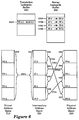
- Figure 6 illustrates the mappings after the promotion.
- Page promotion permits a single big page TTE in the TLB to replace several smaller page TTEs. Therefore, the benefit provided by big page mapping of an increased likelihood of having a TLB hit is realized.
- a big page sized region of virtual address space can be backed in physical memory by mapping together smaller sized pages.
- the physical memory backing does not have to meet the traditional virtual memory page criterion of being a contiguous region the size of the page being used for the mapping that is boundary aligned in physical memory upon a boundary for the size of the virtual memory page that is being backed.
- virtual address space 510 is formed by small sized pages VP-0 through VP-3 and therefore is half of the virtual address space 410 of Figure 4 .
- Intermediate address space 450 and physical address space 490 of Figure 5 are the same as their respective counterparts in Figure 4 .
- the mapping of a region of virtual address space 510 onto a region of intermediate address space 450 and then onto a region of physical address space 490 prior to the promotion of several small sired pages into a single big sized page is illustrated.
- TLB 230 and RLB 250 have only changed from Figure 4 to the extent that the translation information stored within the TTEs of TLB 230 and the remapping information stored within the RTEs of RLB 250 have changed to reflect the mappings of Figure 5 .
- single small page 522 in virtual address space 510 is mapped onto single small page 542 in intermediate address space 450 (IP-0) as indicated by line 532A.
- TTE 532B of TLB 230 contains the mapping indicated by line 532A.
- Single small page 562 in intermediate address space 450 (IP-0) is in turn mapped onto single small page 582 in physical address space 490 (PP-3) as indicated by line 572A.
- RTE 572B of RLB 250 contains the mapping indicated by line 572A.
- single small page 524 in virtual address space 510 is mapped onto single small page 544 in intermediate address space 450 (IP-1) as indicated by line 534A.
- TTE 534B of TLB 230 contains the mapping indicated by line 534A.
- Single small page 564 in intermediate address space 450 (IP-1) is in turn mapped onto single small page 584 in physical address space 490 (PP-1) as indicated by line 574A.
- RTE 574B of RLB 250 contains the mapping indicated by line 574A.
- single small page 526 in virtual address space 510 is mapped onto single small page 546 in intermediate address space 450 (IP-2) as indicated by line 536A.
- TTE 536B of TLB 230 contains the mapping indicated by line 536A.
- Single small page 566 in intermediate address space 450 (IP-2) is in turn mapped onto single small page 586 in physical address space 490 (PP-0) as indicated by line 576A.
- RTE 576B of RLB 250 contains the mapping indicated by line 576A.
- single small page 528 in virtual address space 510 is mapped onto single small page 548 in intermediate address space 450 (IP-3) as indicated by line 538A.
- TTE 538B of TLB 230 contains the mapping indicated by line 538A.
- Single small page 568 in intermediate address space 450 (IP-3) is in turn mapped onto single small page 588 in physical address space 490 (PP-2) as indicated by line 578A.
- RTE 578B of RLB 250 contains the mapping indicated by line 578A.
- the four small sized pages VP-0 through VP-3 in virtual address space 510 are ripe for promotion to a single big sized page.
- the contents of regions of physical memory would have to be moved around so that the promoted big page was backed properly by a big page in physical memory that was both contiguous and big page boundary aligned.
- the current contents of small page 584 in this example are properly located in PP-1, before a page promotion could occur, the current contents of small page 582 would have to be moved into PP-0, the current contents of small page 586 would have to be moved into PP-2, and the current contents of small page 588 would have to be moved into PP-3.
- virtual address space 610, intermediate address space 450 and physical address space 490 are the same as their respective counterparts in Figure 5 .
- the mapping of a region of virtual address space 610 onto a region of intermediate address space 450 and then onto a region of physical address space 490 after to the promotion of several small sized pages into a single big sized page is illustrated.
- TLB 230 has only changed from Figure 5 to the extent that the translation information stored within the TTEs of TLB 230 have changed to reflect the mappings of Figure 6 caused by the promotion.
- the remapping information stored within the RTEs of RLB 250 have not changed from their values within Figure 5 because the promotion did not affect the mappings from intermediate address space 450 to physical address space 490.
- single big page 622 in virtual address space 510 (VP-0, VP-1, VP-2 and VP-3) is mapped onto single big page 642 in intermediate address space 450 (IP-0, IP-1, IP-2 and IP-3) as indicated by line 632A.
- TTE 632B of TLB 230 contains the mapping indicated by line 632A. Therefore, the mapping between virtual address space 510 and intermediate address space 450 has been changed through promotion so that four small pages are now represented as a single big page. Thus, the four TTEs previously required in the TLB (one per old small page) have been replaced by a single TTE for the new big page. Note that the promotion process has occurred without the need to change the mappings between the pages of intermediate address space 450 and physical address space 490.
- single small page 562 in intermediate address space 450 (IP-0) is still mapped onto single small page 582 in physical address space 490 (PP-3) as indicated by line 572A and RTE 572B of RLB 250 still contains the mapping indicated by line 572A.
- single small page 564 in intermediate address space 450 (IP-1) is still mapped onto single small page 584 in physical address space 490 (PP-1) as indicated by line 574A and RTE 574B of RLB 250 still contains the mapping indicated by line 574A.
- single small page 566 in intermediate address space 450 (IP-2) is in turn mapped onto single small page 586 in physical address space 490 (PP-0) as indicated by line 576A and RTE 576B of RLB 250 still contains the mapping indicated by line 576A.
- single small page 568 in intermediate address space 450 (IP-3) is in turn mapped onto single small page 588 in physical address space 490 (PP-2) as indicated by line 578A and RTE 578B of RLB 250 still contains the mapping indicated by line 578A.
- the single big sized page of virtual address space 510 is backed by four small sized pages of physical address space 490 but the requirement that the backing pages in physical memory be contiguous and big sized page boundary aligned has been eliminated. Thus the promotion overhead caused by relocating pages resident in physical memory no longer applies.
- Figure 7 illustrates the mapping of a region of virtual address space onto a region of intermediate address space and then onto a region of physical address space when the small page sized hole is at the end of the big sized page.
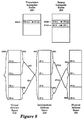
- Figure 8 illustrates the mappings when the small page sized hole is not at the end of the big sized page.
- a single big page TTE in the TLB can replace several smaller page TTEs. Therefore, the benefit provided by big page mapping of an increased likelihood of having a TLB hit is realized for a region of virtual address space that does not fit the traditional virtual memory page criterion of being a contiguous region the size of the page being used for the mapping.
- mapping is illustrated of a region of virtual address space 610 onto a region of intermediate address space 450 and then onto a region of physical address space 490 wherein a middle sized page and a small sized page are treated as a single big sized page having a small page sized "hole" at the end of the big sired page.
- TLB 230 and RLB 250 have only changed from Figure 6 to the extent that the translation information stored within the TTEs of TLB 230 and the remapping information stored within the RTEs of RLB 250 have changed to reflect the mappings of Figure 7 .
- region 702 of virtual address space 510 (formed by VP-0, VP-1 and VP-2) is treated as though it is a single big sized page (722) with a single small page sized "hole" at the end (VP-3).
- the present invention permits a region of virtual address space to be promoted to a larger sized page than has actually been allocated.
- a single big page TTE that describes region 722 is used.
- the single big page 722 in virtual address space 610 is mapped onto single big page 742 in intermediate address space 450 (IP-0, IP-1, IP-2 and IP-3) as indicated by line 732A.
- TTE 732B of TLB 230 contains the mapping indicated by line 732A.
- Only three of the four small sired sections of intermediate address space 450 are actually backed by physical memory.
- a single small page sized portion of physical memory and a single middle page sized portion have been mapped together to provide the backing for region 702.
- Single middle sized page 762 in intermediate address space 450 IP-0 and IP-1) is mapped onto single middle sized page 782 in physical address space 490 (PP-0 and PP-1) as indicated by line 772A.
- RTE 772B of RLB 250 contains the mapping indicated by line 772A.
- single small page 764 in intermediate address space 450 (IP-2) is mapped onto single small page 784 in physical address space 490 (PP-3) as indicated by line 774A.
- RTE 774B of RLB 250 contains the mapping indicated by line 774A.
- physical backing for region 702 could be provided by mapping three small sized pages in intermediate address space 450 onto three small sized pages in physical address space 490.
- RTEs one for the middle sized page and one for the small sized page
- RLB 250 three RTEs (one per small sized page) would be required in RLB 250, but the contiguity constraint and the middle sized page boundary alignment constraint imposed on the middle sized page in the former case would be not apply.
- mapping is illustrated of a region of virtual address space 610 onto a region of intermediate address space 450 and then onto a region of physical address space 490 wherein a middle sized page and a small sized page are treated as a single big sized page having a small page sized "hole" within the big sized page.
- TLB 230 and RLB 250 have only changed from Figure 7 to the extent that the translation information stored within the TTEs of TLB 230 and the remapping information stored within the RTEs of RLB 250 have changed to reflect the mappings of Figure 8 .
- region 822 (formed by VP-0 and VP-1) and region 824 (formed by VP-3) of virtual address space 510 are mapped together and are then treated as though they are a single big sized page 802A (formed by VP-0, VP-1, VP-2 and VP-3) with a single small page sized "hole" (VP-2) located within it.
- the present invention permits a region of virtual address space to be promoted to a larger sized page than has actually been allocated.
- a single big page TTE (802B) that describes region 802A is used.
- the single middle sized page 822 (VP-0 and VP-1) and the single small sized page 824 (VP-3) in virtual address space 610 are mapped onto single big page 842 in intermediate address space 450 (IP-0, IP-1, IP-2 and IP-3) as indicated by lines 832 and 834, respectively. Only three of the four small page sized sections of intermediate address space 450 are actually backed by physical memory. In this example, a single small page sized portion of physical memory and a single middle page sized portion have been mapped together to provide the backing for regions 824 and 822.
- Single middle sized page 862 in intermediate address space 450 (IP-0 and IP-1) is mapped onto single middle sized page 882 in physical address space 490 (PP-2 and PP-3) as indicated by line 872A.
- single small page 864 in intermediate address space 450 (IP-3) is mapped onto single small page 884 in physical address space 490 (PP-1) as indicated by line 874A.
- physical backing for regions 822 and 824 could be provided by mapping three small sized pages in intermediate address space 450 onto three small sized pages in physical address space 490.
- only two RTEs one for the middle sized page and one for the small sized page
- three RTEs one per small sized page
- Figure 9 illustrates the mapping of a region of virtual address space onto a region of intermediate address space and then onto a region of physical address space wherein two different small page sized regions in virtual address space are backed by the same single small sized page in physical memory.
- Figure 10 illustrates the mappings when two different middle page sized regions in virtual address space are backed by mapping together the same two small sized pages in physical memory.
- the small sized page of physical memory obeys the contiguity constraint and the boundary alignment constraint.
- Figure 9 illustrates the mapping of a region of virtual address space onto a region of intermediate address space and then onto a region of physical address space wherein two different small page sired regions in virtual address space are backed by the same single small sized page in physical memory.
- virtual address space 610, intermediate address space 450 and physical address space 490 are the same as their respective counterparts in Figure 8 .
- TLB 230 and RLB 250 have only changed from Figure 8 to the extent that the translation information stored within the TTEs of TLB 230 and the remapping information stored within the RTEs of RLB 250 have changed to reflect the mappings of Figure 9 .
- single small page 922 in virtual address space 610 is mapped onto single small page 942 in intermediate address space 450 (IP-1) as indicated by line 932A.
- TTE 932B of TLB 230 contains the mapping indicated by line 932A.
- Single small page 962 in intermediate address space 450 (IP-1) is in turn mapped onto single small page 982 in physical address space 490 (PP-1) as indicated by line 972A.
- RTE 972B of RLB 250 contains the mapping indicated by line 972A.
- single small page 924 in virtual address space 610 is mapped onto single small page 944 in intermediate address space 450 (IP-2) as indicated by line 934A.
- TTE 934B of TLB 230 contains the mapping indicated by line 934A.
- Single small page 964 in intermediate address space 450 (IP-2) is in turn mapped onto single small page 984 in physical address space 490 (PP-1) as indicated by line 974A.
- RTE 974B of RLB 250 contains the mapping indicated by line 974A.
- Figure 10 illustrates the mapping of a region of virtual address space onto a region of intermediate address space and then onto a region of physical address space wherein two different middle page sired regions in virtual address space are backed by mapping together the same two small sized pages in physical memory.
- virtual address space 610, intermediate address space 450 and physical address space 490 are the same as their respective counterparts in Figure 9 .
- TLB 230 and RLB 250 have only changed from Figure 9 to the extent that the translation information stored within the TTEs of TLB 230 and the remapping information stored within the RTEs of RLB 250 have changed to reflect the mappings of Figure 10 .
- single middle sired page 1032 in virtual address space 610 (VP-0 and VP-1) is mapped onto single middle sized page 1042 in intermediate address space 450 (IP-0 and IP-1) as indicated by line 1032A.
- TTE 1032B of TLB 230 contains the mapping indicated by line 1032A.
- the small page sized first half 1062 of single middle sized page 1042 in intermediate address space 450 (IP-0) is in turn mapped onto single small sired page 1082 in physical address space 490 (PP-1) as indicated by line 1072A.
- RTE 1072B of RLB 250 contains the mapping indicated by line 1072A.
- the small page sized second half 1064 of single middle sized page 1042 in intermediate address space 450 (IP-1) is in turn mapped onto single small sized page 1084 in physical address space 490 (PP-3) as indicated by line 1074A.
- RTE 1074B of RLB 250 contains the mapping indicated by line 1074A.
- single middle sized page 1026 in virtual address space 610 (VP-2 and VP-3) is mapped onto single middle sized page 1046 in intermediate address space 450 (IP-2 and IP-3) as indicated by line 1036A.
- TTE 1036B of TLB 230 contains the mapping indicated by line 1036A.
- the small page sized first half 1066 of single middle sized page 1046 in intermediate address space 450 (IP-2) is in turn mapped onto single small sized page 1082 in physical address space 490 (PP-1) as indicated by line 1076A.
- RTE 1076B of RLB 250 contains the mapping indicated by line 1076A.
- the small page sized second half 1068 of single middle sized page 1048 in intermediate address space 450 (IP-3) is in turn mapped onto single small sized page 1084 in physical address space 490 (PP-3) as indicated by line 1078A.
- RTE 1078B of RLB 250 contains the mapping indicated by line 1078A.
Landscapes
- Engineering & Computer Science (AREA)
- Theoretical Computer Science (AREA)
- Physics & Mathematics (AREA)
- General Engineering & Computer Science (AREA)
- General Physics & Mathematics (AREA)
- Memory System Of A Hierarchy Structure (AREA)
Applications Claiming Priority (2)
| Application Number | Priority Date | Filing Date | Title |
|---|---|---|---|
| US18065894A | 1994-01-12 | 1994-01-12 | |
| US180658 | 2002-06-26 |
Publications (2)
| Publication Number | Publication Date |
|---|---|
| EP0663636A1 true EP0663636A1 (fr) | 1995-07-19 |
| EP0663636B1 EP0663636B1 (fr) | 2001-10-31 |
Family
ID=22661259
Family Applications (1)
| Application Number | Title | Priority Date | Filing Date |
|---|---|---|---|
| EP94309733A Expired - Lifetime EP0663636B1 (fr) | 1994-01-12 | 1994-12-23 | Mémoire physique à adressage logique pour système d'ordinateur à mémoire virtuelle qui supporte plusieurs tailles de pages |
Country Status (6)
| Country | Link |
|---|---|
| US (1) | US5784707A (fr) |
| EP (1) | EP0663636B1 (fr) |
| JP (1) | JPH0836528A (fr) |
| KR (1) | KR100354772B1 (fr) |
| DE (1) | DE69428881T2 (fr) |
| SG (1) | SG45399A1 (fr) |
Cited By (23)
| Publication number | Priority date | Publication date | Assignee | Title |
|---|---|---|---|---|
| GB2381886A (en) * | 2001-11-07 | 2003-05-14 | Sun Microsystems Inc | Virtual memory and paging mechanism |
| US6950918B1 (en) | 2002-01-18 | 2005-09-27 | Lexar Media, Inc. | File management of one-time-programmable nonvolatile memory devices |
| US6957295B1 (en) | 2002-01-18 | 2005-10-18 | Lexar Media, Inc. | File management of one-time-programmable nonvolatile memory devices |
| US6973519B1 (en) | 2003-06-03 | 2005-12-06 | Lexar Media, Inc. | Card identification compatibility |
| US7000064B2 (en) | 2001-09-28 | 2006-02-14 | Lexar Media, Inc. | Data handling system |
| US7102671B1 (en) | 2000-02-08 | 2006-09-05 | Lexar Media, Inc. | Enhanced compact flash memory card |
| US7111140B2 (en) | 1995-07-31 | 2006-09-19 | Lexar Media, Inc. | Increasing the memory performance of flash memory devices by writing sectors simultaneously to multiple flash memory devices |
| US7167944B1 (en) | 2000-07-21 | 2007-01-23 | Lexar Media, Inc. | Block management for mass storage |
| US7185208B2 (en) | 2001-09-28 | 2007-02-27 | Lexar Media, Inc. | Data processing |
| US7215580B2 (en) | 2001-09-28 | 2007-05-08 | Lexar Media, Inc. | Non-volatile memory control |
| US7231643B1 (en) | 2002-02-22 | 2007-06-12 | Lexar Media, Inc. | Image rescue system including direct communication between an application program and a device driver |
| US7254724B2 (en) | 2001-09-28 | 2007-08-07 | Lexar Media, Inc. | Power management system |
| US7275686B2 (en) | 2003-12-17 | 2007-10-02 | Lexar Media, Inc. | Electronic equipment point-of-sale activation to avoid theft |
| US7340581B2 (en) | 2001-09-28 | 2008-03-04 | Lexar Media, Inc. | Method of writing data to non-volatile memory |
| US7370166B1 (en) | 2004-04-30 | 2008-05-06 | Lexar Media, Inc. | Secure portable storage device |
| US7441090B2 (en) | 1995-07-31 | 2008-10-21 | Lexar Media, Inc. | System and method for updating data sectors in a non-volatile memory using logical block addressing |
| US7464306B1 (en) | 2004-08-27 | 2008-12-09 | Lexar Media, Inc. | Status of overall health of nonvolatile memory |
| US7523249B1 (en) | 1995-07-31 | 2009-04-21 | Lexar Media, Inc. | Direct logical block addressing flash memory mass storage architecture |
| US7594063B1 (en) | 2004-08-27 | 2009-09-22 | Lexar Media, Inc. | Storage capacity status |
| US7725628B1 (en) | 2004-04-20 | 2010-05-25 | Lexar Media, Inc. | Direct secondary device interface by a host |
| US7917709B2 (en) | 2001-09-28 | 2011-03-29 | Lexar Media, Inc. | Memory system for data storage and retrieval |
| US8171203B2 (en) | 1995-07-31 | 2012-05-01 | Micron Technology, Inc. | Faster write operations to nonvolatile memory using FSInfo sector manipulation |
| US10303619B2 (en) | 2013-05-29 | 2019-05-28 | Huawei Technologies Co., Ltd. | Method and apparatus for determining physical address |
Families Citing this family (59)
| Publication number | Priority date | Publication date | Assignee | Title |
|---|---|---|---|---|
| US6336180B1 (en) * | 1997-04-30 | 2002-01-01 | Canon Kabushiki Kaisha | Method, apparatus and system for managing virtual memory with virtual-physical mapping |
| DE19640316A1 (de) * | 1996-09-30 | 1998-04-02 | Siemens Ag | Schaltungsanordnung mit einem Mikroprozessor und einem Stapelspeicher |
| US6182201B1 (en) * | 1997-04-14 | 2001-01-30 | International Business Machines Corporation | Demand-based issuance of cache operations to a system bus |
| KR100263672B1 (ko) * | 1997-05-08 | 2000-09-01 | 김영환 | 가변적인 페이지 크기를 지원하는 어드레스 변환장치 |
| US6065010A (en) * | 1997-06-10 | 2000-05-16 | Daikin Us Corporation | Computer implemented method of generating virtual files for sharing information of physical information file |
| US6021482A (en) * | 1997-07-22 | 2000-02-01 | Seagate Technology, Inc. | Extended page mode with a skipped logical addressing for an embedded longitudinal redundancy check scheme |
| US6067581A (en) * | 1998-01-20 | 2000-05-23 | Micron Electronics, Inc. | Method for identifying the orignal source device in a transaction request initiated from address translator to memory control module and directly performing the transaction therebetween |
| US6301645B1 (en) * | 1998-01-20 | 2001-10-09 | Micron Technology, Inc. | System for issuing device requests by proxy |
| US6275830B1 (en) * | 1998-03-18 | 2001-08-14 | Oracle Corporation | Compile time variable size paging of constant pools |
| JP2000057054A (ja) * | 1998-08-12 | 2000-02-25 | Fujitsu Ltd | 高速アドレス変換システム |
| US6233666B1 (en) * | 1998-09-17 | 2001-05-15 | International Business Machines Corporation | Deferred disk drive space allocation for virtual memory pages with management of disk address recording in multipage tables without external process interrupts for table for input/output to memory |
| US6609153B1 (en) | 1998-12-24 | 2003-08-19 | Redback Networks Inc. | Domain isolation through virtual network machines |
| US6970992B2 (en) * | 1999-10-04 | 2005-11-29 | Intel Corporation | Apparatus to map virtual pages to disparate-sized, non-contiguous real pages and methods relating thereto |
| US6857058B1 (en) | 1999-10-04 | 2005-02-15 | Intel Corporation | Apparatus to map pages of disparate sizes and associated methods |
| US6446186B1 (en) | 1999-10-27 | 2002-09-03 | Nvidia Corporation | Method, apparatus and article of manufacture for mapping physical memory in a virtual address system |
| US6718453B2 (en) * | 2001-03-26 | 2004-04-06 | Intel Corporation | Apparatus and method for a channel adapter non-contiguous translation protection table |
| US6789156B1 (en) * | 2001-05-22 | 2004-09-07 | Vmware, Inc. | Content-based, transparent sharing of memory units |
| US8719661B1 (en) | 2010-11-15 | 2014-05-06 | Vmware, Inc. | Transparent and lightweight recovery from hardware memory errors |
| US20060168413A1 (en) * | 2002-09-30 | 2006-07-27 | Thomas Schoebel-Theuer | Method for regulating access to data in at least one data storage device in a system consisting of several individual systems |
| US7900017B2 (en) * | 2002-12-27 | 2011-03-01 | Intel Corporation | Mechanism for remapping post virtual machine memory pages |
| US8417913B2 (en) * | 2003-11-13 | 2013-04-09 | International Business Machines Corporation | Superpage coalescing which supports read/write access to a new virtual superpage mapping during copying of physical pages |
| US7328288B2 (en) | 2003-12-11 | 2008-02-05 | Canon Kabushiki Kaisha | Relay apparatus for relaying communication from CPU to peripheral device |
| US7278008B1 (en) * | 2004-01-30 | 2007-10-02 | Nvidia Corporation | Virtual address translation system with caching of variable-range translation clusters |
| US7296139B1 (en) * | 2004-01-30 | 2007-11-13 | Nvidia Corporation | In-memory table structure for virtual address translation system with translation units of variable range size |
| US7334108B1 (en) | 2004-01-30 | 2008-02-19 | Nvidia Corporation | Multi-client virtual address translation system with translation units of variable-range size |
| US7426625B2 (en) | 2004-03-31 | 2008-09-16 | International Business Machines Corporation | Data processing system and computer program product for support of system memory addresses with holes |
| US20060004983A1 (en) * | 2004-06-30 | 2006-01-05 | Tsao Gary Y | Method, system, and program for managing memory options for devices |
| WO2006032103A1 (fr) * | 2004-09-24 | 2006-03-30 | Synaptic Laboratories Limited | PROCEDE ET APPAREIL DE MISE EN CORRELATION DES IDENTIFIANTS DE n BITS DE MOINS DE 2n RESSOURCES |
| US7516298B2 (en) * | 2004-11-15 | 2009-04-07 | Platform Solutions Incorporated | Sparse table compaction method |
| US7370174B2 (en) * | 2005-01-05 | 2008-05-06 | Intel Corporation | Method, system, and program for addressing pages of memory by an I/O device |
| US7853957B2 (en) * | 2005-04-15 | 2010-12-14 | Intel Corporation | Doorbell mechanism using protection domains |
| EP1736887A3 (fr) * | 2005-05-31 | 2009-04-22 | Stmicroelectronics Sa | Repertoire de pages memoire |
| US7543123B2 (en) * | 2005-11-07 | 2009-06-02 | International Business Machines Corporation | Multistage virtual memory paging system |
| US20080028181A1 (en) * | 2006-07-31 | 2008-01-31 | Nvidia Corporation | Dedicated mechanism for page mapping in a gpu |
| US8239657B2 (en) | 2007-02-07 | 2012-08-07 | Qualcomm Incorporated | Address translation method and apparatus |
| US20090031100A1 (en) * | 2007-07-23 | 2009-01-29 | David Hansen | Memory reallocation in a computing environment |
| US8151076B2 (en) * | 2008-04-04 | 2012-04-03 | Cisco Technology, Inc. | Mapping memory segments in a translation lookaside buffer |
| US7930515B2 (en) * | 2008-07-29 | 2011-04-19 | International Business Machines Corporation | Virtual memory management |
| US8527697B2 (en) * | 2009-07-20 | 2013-09-03 | Netapp, Inc. | Virtualized data storage in a network computing environment |
| JP4915756B2 (ja) * | 2009-12-16 | 2012-04-11 | インターナショナル・ビジネス・マシーンズ・コーポレーション | アドレス変換を高速化する方法及びシステム |
| US20110238946A1 (en) * | 2010-03-24 | 2011-09-29 | International Business Machines Corporation | Data Reorganization through Hardware-Supported Intermediate Addresses |
| US8683169B2 (en) | 2011-05-05 | 2014-03-25 | International Business Machines Corporation | Selecting an auxiliary storage medium for writing data of real storage pages |
| US8656133B2 (en) | 2011-05-05 | 2014-02-18 | International Business Machines Corporation | Managing storage extents and the obtaining of storage blocks within the extents |
| US8799611B2 (en) | 2011-05-05 | 2014-08-05 | International Business Machines Corporation | Managing allocation of memory pages |
| US8793444B2 (en) | 2011-05-05 | 2014-07-29 | International Business Machines Corporation | Managing large page memory pools |
| US8868876B2 (en) | 2011-12-28 | 2014-10-21 | International Business Machines Corporation | Dedicated large page memory pools |
| US9058268B1 (en) | 2012-09-20 | 2015-06-16 | Matrox Graphics Inc. | Apparatus, system and method for memory management |
| CN103077120B (zh) * | 2012-12-31 | 2016-01-27 | 东软集团股份有限公司 | 程序共享内存的地址转换方法和装置 |
| US9183057B2 (en) | 2013-01-21 | 2015-11-10 | Micron Technology, Inc. | Systems and methods for accessing memory |
| US20160019161A1 (en) * | 2013-03-12 | 2016-01-21 | Hewlett-Packard Development Company, L.P. | Programmable address mapping and memory access operations |
| US9405703B2 (en) * | 2014-06-04 | 2016-08-02 | Advanced Micro Devices, Inc. | Translation lookaside buffer |
| GB2536201B (en) | 2015-03-02 | 2021-08-18 | Advanced Risc Mach Ltd | Handling address translation requests |
| GB2536880B (en) | 2015-03-24 | 2021-07-28 | Advanced Risc Mach Ltd | Memory management |
| US10719451B2 (en) * | 2017-01-13 | 2020-07-21 | Optimum Semiconductor Technologies Inc. | Variable translation-lookaside buffer (TLB) indexing |
| TW201928689A (zh) * | 2017-12-21 | 2019-07-16 | 晨星半導體股份有限公司 | 硬體控制系統及硬體控制方法 |
| CN110096457B (zh) * | 2018-01-31 | 2023-05-23 | 联发科技股份有限公司 | 硬件控制系统及硬件控制方法 |
| US12066949B2 (en) * | 2021-12-03 | 2024-08-20 | Micron Technology, Inc. | Address translation based on page identifier and queue identifier |
| CN115964310B (zh) * | 2023-03-16 | 2023-07-04 | 芯动微电子科技(珠海)有限公司 | 一种非线性多存储信道数据交织方法及交织模块 |
| KR102909802B1 (ko) * | 2023-10-25 | 2026-01-08 | 리벨리온 주식회사 | 빔 서치를 위한 메모리 매핑 방법 및 장치 |
Citations (4)
| Publication number | Priority date | Publication date | Assignee | Title |
|---|---|---|---|---|
| FR2315744A1 (fr) * | 1975-06-27 | 1977-01-21 | Telemecanique Electrique | Dispositif auxiliaire d'adressage virtuel |
| EP0373780A2 (fr) * | 1988-12-15 | 1990-06-20 | International Business Machines Corporation | Traduction d'adresse pour pages de tailles multiples |
| EP0408070A2 (fr) * | 1989-07-14 | 1991-01-16 | Hitachi, Ltd. | Procédé d'attribution de pages réelles à des pages virtuelles de dimensions différentes |
| JPH1017137A (ja) * | 1996-06-27 | 1998-01-20 | Toyo Kanetsu Kk | 仕分設備 |
Family Cites Families (4)
| Publication number | Priority date | Publication date | Assignee | Title |
|---|---|---|---|---|
| US4757438A (en) * | 1984-07-12 | 1988-07-12 | Texas Instruments Incorporated | Computer system enabling automatic memory management operations |
| US5404485A (en) * | 1993-03-08 | 1995-04-04 | M-Systems Flash Disk Pioneers Ltd. | Flash file system |
| US5479627A (en) * | 1993-09-08 | 1995-12-26 | Sun Microsystems, Inc. | Virtual address to physical address translation cache that supports multiple page sizes |
| US5446854A (en) * | 1993-10-20 | 1995-08-29 | Sun Microsystems, Inc. | Virtual memory computer apparatus and address translation mechanism employing hashing scheme and page frame descriptor that support multiple page sizes |
-
1994
- 1994-12-23 DE DE69428881T patent/DE69428881T2/de not_active Expired - Fee Related
- 1994-12-23 SG SG1996005974A patent/SG45399A1/en unknown
- 1994-12-23 EP EP94309733A patent/EP0663636B1/fr not_active Expired - Lifetime
-
1995
- 1995-01-12 JP JP7018785A patent/JPH0836528A/ja not_active Withdrawn
- 1995-01-12 KR KR1019950000463A patent/KR100354772B1/ko not_active Expired - Fee Related
-
1996
- 1996-04-19 US US08/634,956 patent/US5784707A/en not_active Expired - Lifetime
Patent Citations (4)
| Publication number | Priority date | Publication date | Assignee | Title |
|---|---|---|---|---|
| FR2315744A1 (fr) * | 1975-06-27 | 1977-01-21 | Telemecanique Electrique | Dispositif auxiliaire d'adressage virtuel |
| EP0373780A2 (fr) * | 1988-12-15 | 1990-06-20 | International Business Machines Corporation | Traduction d'adresse pour pages de tailles multiples |
| EP0408070A2 (fr) * | 1989-07-14 | 1991-01-16 | Hitachi, Ltd. | Procédé d'attribution de pages réelles à des pages virtuelles de dimensions différentes |
| JPH1017137A (ja) * | 1996-06-27 | 1998-01-20 | Toyo Kanetsu Kk | 仕分設備 |
Non-Patent Citations (1)
| Title |
|---|
| PATENT ABSTRACTS OF JAPAN vol. 13, no. 191 (P - 867) 9 May 1989 (1989-05-09) * |
Cited By (53)
| Publication number | Priority date | Publication date | Assignee | Title |
|---|---|---|---|---|
| US8554985B2 (en) | 1995-07-31 | 2013-10-08 | Micron Technology, Inc. | Memory block identified by group of logical block addresses, storage device with movable sectors, and methods |
| US7908426B2 (en) | 1995-07-31 | 2011-03-15 | Lexar Media, Inc. | Moving sectors within a block of information in a flash memory mass storage architecture |
| US8171203B2 (en) | 1995-07-31 | 2012-05-01 | Micron Technology, Inc. | Faster write operations to nonvolatile memory using FSInfo sector manipulation |
| US8078797B2 (en) | 1995-07-31 | 2011-12-13 | Micron Technology, Inc. | Increasing the memory performance of flash memory devices by writing sectors simultaneously to multiple flash memory devices |
| US8032694B2 (en) | 1995-07-31 | 2011-10-04 | Micron Technology, Inc. | Direct logical block addressing flash memory mass storage architecture |
| US8397019B2 (en) | 1995-07-31 | 2013-03-12 | Micron Technology, Inc. | Memory for accessing multiple sectors of information substantially concurrently |
| US7424593B2 (en) | 1995-07-31 | 2008-09-09 | Micron Technology, Inc. | Increasing the memory performance of flash memory devices by writing sectors simultaneously to multiple flash memory devices |
| US7774576B2 (en) | 1995-07-31 | 2010-08-10 | Lexar Media, Inc. | Direct logical block addressing flash memory mass storage architecture |
| US7111140B2 (en) | 1995-07-31 | 2006-09-19 | Lexar Media, Inc. | Increasing the memory performance of flash memory devices by writing sectors simultaneously to multiple flash memory devices |
| US8793430B2 (en) | 1995-07-31 | 2014-07-29 | Micron Technology, Inc. | Electronic system having memory with a physical block having a sector storing data and indicating a move status of another sector of the physical block |
| US9026721B2 (en) | 1995-07-31 | 2015-05-05 | Micron Technology, Inc. | Managing defective areas of memory |
| US7549013B2 (en) | 1995-07-31 | 2009-06-16 | Lexar Media, Inc. | Increasing the memory performance of flash memory devices by writing sectors simultaneously to multiple flash memory devices |
| US7523249B1 (en) | 1995-07-31 | 2009-04-21 | Lexar Media, Inc. | Direct logical block addressing flash memory mass storage architecture |
| US7441090B2 (en) | 1995-07-31 | 2008-10-21 | Lexar Media, Inc. | System and method for updating data sectors in a non-volatile memory using logical block addressing |
| US7263591B2 (en) | 1995-07-31 | 2007-08-28 | Lexar Media, Inc. | Increasing the memory performance of flash memory devices by writing sectors simultaneously to multiple flash memory devices |
| US7102671B1 (en) | 2000-02-08 | 2006-09-05 | Lexar Media, Inc. | Enhanced compact flash memory card |
| US7167944B1 (en) | 2000-07-21 | 2007-01-23 | Lexar Media, Inc. | Block management for mass storage |
| US8208322B2 (en) | 2001-09-28 | 2012-06-26 | Micron Technology, Inc. | Non-volatile memory control |
| US9032134B2 (en) | 2001-09-28 | 2015-05-12 | Micron Technology, Inc. | Methods of operating a memory system that include outputting a data pattern from a sector allocation table to a host if a logical sector is indicated as being erased |
| US7254724B2 (en) | 2001-09-28 | 2007-08-07 | Lexar Media, Inc. | Power management system |
| US8694722B2 (en) | 2001-09-28 | 2014-04-08 | Micron Technology, Inc. | Memory systems |
| US8135925B2 (en) | 2001-09-28 | 2012-03-13 | Micron Technology, Inc. | Methods of operating a memory system |
| US7215580B2 (en) | 2001-09-28 | 2007-05-08 | Lexar Media, Inc. | Non-volatile memory control |
| US7185208B2 (en) | 2001-09-28 | 2007-02-27 | Lexar Media, Inc. | Data processing |
| US8386695B2 (en) | 2001-09-28 | 2013-02-26 | Micron Technology, Inc. | Methods and apparatus for writing data to non-volatile memory |
| US7000064B2 (en) | 2001-09-28 | 2006-02-14 | Lexar Media, Inc. | Data handling system |
| US9489301B2 (en) | 2001-09-28 | 2016-11-08 | Micron Technology, Inc. | Memory systems |
| US7340581B2 (en) | 2001-09-28 | 2008-03-04 | Lexar Media, Inc. | Method of writing data to non-volatile memory |
| US7917709B2 (en) | 2001-09-28 | 2011-03-29 | Lexar Media, Inc. | Memory system for data storage and retrieval |
| US7944762B2 (en) | 2001-09-28 | 2011-05-17 | Micron Technology, Inc. | Non-volatile memory control |
| GB2381886B (en) * | 2001-11-07 | 2004-06-23 | Sun Microsystems Inc | Computer system with virtual memory and paging mechanism |
| US6970991B2 (en) * | 2001-11-07 | 2005-11-29 | Sun Microsystems, Inc. | Computer system with virtual memory and paging mechanism |
| GB2381886A (en) * | 2001-11-07 | 2003-05-14 | Sun Microsystems Inc | Virtual memory and paging mechanism |
| US6957295B1 (en) | 2002-01-18 | 2005-10-18 | Lexar Media, Inc. | File management of one-time-programmable nonvolatile memory devices |
| US6950918B1 (en) | 2002-01-18 | 2005-09-27 | Lexar Media, Inc. | File management of one-time-programmable nonvolatile memory devices |
| US7231643B1 (en) | 2002-02-22 | 2007-06-12 | Lexar Media, Inc. | Image rescue system including direct communication between an application program and a device driver |
| US6973519B1 (en) | 2003-06-03 | 2005-12-06 | Lexar Media, Inc. | Card identification compatibility |
| US7275686B2 (en) | 2003-12-17 | 2007-10-02 | Lexar Media, Inc. | Electronic equipment point-of-sale activation to avoid theft |
| US8316165B2 (en) | 2004-04-20 | 2012-11-20 | Micron Technology, Inc. | Direct secondary device interface by a host |
| US8090886B2 (en) | 2004-04-20 | 2012-01-03 | Micron Technology, Inc. | Direct secondary device interface by a host |
| US7725628B1 (en) | 2004-04-20 | 2010-05-25 | Lexar Media, Inc. | Direct secondary device interface by a host |
| US7370166B1 (en) | 2004-04-30 | 2008-05-06 | Lexar Media, Inc. | Secure portable storage device |
| US8151041B2 (en) | 2004-04-30 | 2012-04-03 | Micron Technology, Inc. | Removable storage device |
| US10049207B2 (en) | 2004-04-30 | 2018-08-14 | Micron Technology, Inc. | Methods of operating storage systems including encrypting a key salt |
| US7865659B2 (en) | 2004-04-30 | 2011-01-04 | Micron Technology, Inc. | Removable storage device |
| US8612671B2 (en) | 2004-04-30 | 2013-12-17 | Micron Technology, Inc. | Removable devices |
| US9576154B2 (en) | 2004-04-30 | 2017-02-21 | Micron Technology, Inc. | Methods of operating storage systems including using a key to determine whether a password can be changed |
| US7743290B2 (en) | 2004-08-27 | 2010-06-22 | Lexar Media, Inc. | Status of overall health of nonvolatile memory |
| US7464306B1 (en) | 2004-08-27 | 2008-12-09 | Lexar Media, Inc. | Status of overall health of nonvolatile memory |
| US7594063B1 (en) | 2004-08-27 | 2009-09-22 | Lexar Media, Inc. | Storage capacity status |
| US8296545B2 (en) | 2004-08-27 | 2012-10-23 | Micron Technology, Inc. | Storage capacity status |
| US7949822B2 (en) | 2004-08-27 | 2011-05-24 | Micron Technology, Inc. | Storage capacity status |
| US10303619B2 (en) | 2013-05-29 | 2019-05-28 | Huawei Technologies Co., Ltd. | Method and apparatus for determining physical address |
Also Published As
| Publication number | Publication date |
|---|---|
| KR950033840A (ko) | 1995-12-26 |
| DE69428881D1 (de) | 2001-12-06 |
| KR100354772B1 (ko) | 2003-01-24 |
| US5784707A (en) | 1998-07-21 |
| EP0663636B1 (fr) | 2001-10-31 |
| SG45399A1 (en) | 1998-01-16 |
| JPH0836528A (ja) | 1996-02-06 |
| DE69428881T2 (de) | 2002-07-18 |
Similar Documents
| Publication | Publication Date | Title |
|---|---|---|
| US5784707A (en) | Method and apparatus for managing virtual computer memory with multiple page sizes | |
| US6249853B1 (en) | GART and PTES defined by configuration registers | |
| US6069638A (en) | System for accelerated graphics port address remapping interface to main memory | |
| US7777752B2 (en) | Method of implementing an accelerated graphics port for a multiple memory controller computer system | |
| US5956756A (en) | Virtual address to physical address translation of pages with unknown and variable sizes | |
| CN1160631C (zh) | 改进虚拟存储器系统中存储器访问的技术 | |
| EP0674267B1 (fr) | Transactions cohérentes d'écriture pour sous-ligne d'une antémémoire | |
| US4499539A (en) | Method and apparatus for limiting allocated data-storage space in a data-storage unit | |
| US6772315B1 (en) | Translation lookaside buffer extended to provide physical and main-memory addresses | |
| US6717582B2 (en) | Accelerated graphics port for a multiple memory controller computer system | |
| CN101589374B (zh) | 用于在处理器中设置高速缓存策略的方法和设备 | |
| US6374341B1 (en) | Apparatus and a method for variable size pages using fixed size translation lookaside buffer entries | |
| US6604184B2 (en) | Virtual memory mapping using region-based page tables | |
| JP3264319B2 (ja) | バスブリッジ | |
| JPH05210585A (ja) | キャッシュ管理システム | |
| CN1093961C (zh) | 增强存储器性能的方法及数据处理系统 | |
| CA2313257C (fr) | Port graphique accelere pour systeme informatique a controleurs de memoire multiples | |
| US7107431B2 (en) | Apparatus and method for lazy segment promotion for pre-translated segments | |
| US8347034B1 (en) | Transparent level 2 cache that uses independent tag and valid random access memory arrays for cache access | |
| US7071946B2 (en) | Accelerated graphics port for a multiple memory controller computer system | |
| CN1517882A (zh) | 内存地址的重新映射方法 | |
| US7685372B1 (en) | Transparent level 2 cache controller | |
| JPS6194159A (ja) | メモリ装置 | |
| US6594750B1 (en) | Method and apparatus for handling an accessed bit in a page table entry | |
| JPH10301848A (ja) | 多重ページサイズを有する仮想記憶装置 |
Legal Events
| Date | Code | Title | Description |
|---|---|---|---|
| PUAI | Public reference made under article 153(3) epc to a published international application that has entered the european phase |
Free format text: ORIGINAL CODE: 0009012 |
|
| AK | Designated contracting states |
Kind code of ref document: A1 Designated state(s): DE FR GB NL |
|
| RIN1 | Information on inventor provided before grant (corrected) |
Inventor name: TALLURI, MADHUSUDHAN Inventor name: JOSHI, VIKRAM P. Inventor name: KHALIDI, YOUSEF A. |
|
| 17P | Request for examination filed |
Effective date: 19960104 |
|
| 17Q | First examination report despatched |
Effective date: 20000222 |
|
| GRAG | Despatch of communication of intention to grant |
Free format text: ORIGINAL CODE: EPIDOS AGRA |
|
| GRAG | Despatch of communication of intention to grant |
Free format text: ORIGINAL CODE: EPIDOS AGRA |
|
| GRAG | Despatch of communication of intention to grant |
Free format text: ORIGINAL CODE: EPIDOS AGRA |
|
| GRAH | Despatch of communication of intention to grant a patent |
Free format text: ORIGINAL CODE: EPIDOS IGRA |
|
| GRAH | Despatch of communication of intention to grant a patent |
Free format text: ORIGINAL CODE: EPIDOS IGRA |
|
| GRAA | (expected) grant |
Free format text: ORIGINAL CODE: 0009210 |
|
| AK | Designated contracting states |
Kind code of ref document: B1 Designated state(s): DE FR GB NL |
|
| REF | Corresponds to: |
Ref document number: 69428881 Country of ref document: DE Date of ref document: 20011206 |
|
| REG | Reference to a national code |
Ref country code: GB Ref legal event code: IF02 |
|
| ET | Fr: translation filed | ||
| PLBE | No opposition filed within time limit |
Free format text: ORIGINAL CODE: 0009261 |
|
| STAA | Information on the status of an ep patent application or granted ep patent |
Free format text: STATUS: NO OPPOSITION FILED WITHIN TIME LIMIT |
|
| 26N | No opposition filed | ||
| PGFP | Annual fee paid to national office [announced via postgrant information from national office to epo] |
Ref country code: NL Payment date: 20031205 Year of fee payment: 10 |
|
| PGFP | Annual fee paid to national office [announced via postgrant information from national office to epo] |
Ref country code: FR Payment date: 20031210 Year of fee payment: 10 |
|
| PGFP | Annual fee paid to national office [announced via postgrant information from national office to epo] |
Ref country code: GB Payment date: 20031217 Year of fee payment: 10 |
|
| PGFP | Annual fee paid to national office [announced via postgrant information from national office to epo] |
Ref country code: DE Payment date: 20040102 Year of fee payment: 10 |
|
| PG25 | Lapsed in a contracting state [announced via postgrant information from national office to epo] |
Ref country code: GB Free format text: LAPSE BECAUSE OF NON-PAYMENT OF DUE FEES Effective date: 20041223 |
|
| PG25 | Lapsed in a contracting state [announced via postgrant information from national office to epo] |
Ref country code: NL Free format text: LAPSE BECAUSE OF NON-PAYMENT OF DUE FEES Effective date: 20050701 Ref country code: DE Free format text: LAPSE BECAUSE OF NON-PAYMENT OF DUE FEES Effective date: 20050701 |
|
| GBPC | Gb: european patent ceased through non-payment of renewal fee |
Effective date: 20041223 |
|
| PG25 | Lapsed in a contracting state [announced via postgrant information from national office to epo] |
Ref country code: FR Free format text: LAPSE BECAUSE OF NON-PAYMENT OF DUE FEES Effective date: 20050831 |
|
| NLV4 | Nl: lapsed or anulled due to non-payment of the annual fee |
Effective date: 20050701 |
|
| REG | Reference to a national code |
Ref country code: FR Ref legal event code: ST |