EP0663932B1 - Verwendung von acetaldehydacetaleinheiten enthaltenden polyacetalen in wasch- und reinigungsmitteln - Google Patents
Verwendung von acetaldehydacetaleinheiten enthaltenden polyacetalen in wasch- und reinigungsmitteln Download PDFInfo
- Publication number
- EP0663932B1 EP0663932B1 EP93921854A EP93921854A EP0663932B1 EP 0663932 B1 EP0663932 B1 EP 0663932B1 EP 93921854 A EP93921854 A EP 93921854A EP 93921854 A EP93921854 A EP 93921854A EP 0663932 B1 EP0663932 B1 EP 0663932B1
- Authority
- EP
- European Patent Office
- Prior art keywords
- acid
- compounds
- polyacetals
- ether
- ester
- Prior art date
- Legal status (The legal status is an assumption and is not a legal conclusion. Google has not performed a legal analysis and makes no representation as to the accuracy of the status listed.)
- Expired - Lifetime
Links
- 229920006324 polyoxymethylene Polymers 0.000 title claims abstract description 72
- WDLUEZJSSHTKAP-UHFFFAOYSA-N acetaldehyde;1,1-diethoxyethane Chemical group CC=O.CCOC(C)OCC WDLUEZJSSHTKAP-UHFFFAOYSA-N 0.000 title claims abstract description 14
- 239000012459 cleaning agent Substances 0.000 title abstract description 9
- 238000005406 washing Methods 0.000 title abstract description 5
- QYKIQEUNHZKYBP-UHFFFAOYSA-N Vinyl ether Chemical class C=COC=C QYKIQEUNHZKYBP-UHFFFAOYSA-N 0.000 claims abstract description 63
- 150000001875 compounds Chemical class 0.000 claims abstract description 56
- 239000000203 mixture Chemical group 0.000 claims abstract description 36
- 125000002887 hydroxy group Chemical group [H]O* 0.000 claims abstract description 23
- 229910019142 PO4 Inorganic materials 0.000 claims abstract description 7
- 239000010452 phosphate Substances 0.000 claims abstract description 7
- 239000002270 dispersing agent Substances 0.000 claims abstract description 6
- 239000003599 detergent Substances 0.000 claims description 28
- 239000004094 surface-active agent Substances 0.000 claims description 20
- NBIIXXVUZAFLBC-UHFFFAOYSA-K phosphate Chemical compound [O-]P([O-])([O-])=O NBIIXXVUZAFLBC-UHFFFAOYSA-K 0.000 claims description 3
- 239000003638 chemical reducing agent Substances 0.000 claims 1
- 239000000463 material Substances 0.000 claims 1
- 238000000034 method Methods 0.000 abstract description 9
- 239000000654 additive Substances 0.000 abstract description 6
- 230000000996 additive effect Effects 0.000 abstract description 3
- 229910052500 inorganic mineral Inorganic materials 0.000 abstract description 3
- 239000011707 mineral Substances 0.000 abstract description 3
- 238000006116 polymerization reaction Methods 0.000 abstract description 2
- MWZJGRDWJVHRDV-UHFFFAOYSA-N 1,4-bis(ethenoxy)butane Chemical compound C=COCCCCOC=C MWZJGRDWJVHRDV-UHFFFAOYSA-N 0.000 description 49
- MUBZPKHOEPUJKR-UHFFFAOYSA-N Oxalic acid Chemical compound OC(=O)C(O)=O MUBZPKHOEPUJKR-UHFFFAOYSA-N 0.000 description 36
- -1 cyclic divinyl ethers Chemical class 0.000 description 28
- 229930182556 Polyacetal Natural products 0.000 description 25
- LZCLXQDLBQLTDK-UHFFFAOYSA-N ethyl 2-hydroxypropanoate Chemical compound CCOC(=O)C(C)O LZCLXQDLBQLTDK-UHFFFAOYSA-N 0.000 description 24
- 239000000243 solution Substances 0.000 description 19
- ZIBGPFATKBEMQZ-UHFFFAOYSA-N triethylene glycol Chemical compound OCCOCCOCCO ZIBGPFATKBEMQZ-UHFFFAOYSA-N 0.000 description 19
- 229930006000 Sucrose Natural products 0.000 description 17
- CZMRCDWAGMRECN-UGDNZRGBSA-N Sucrose Chemical compound O[C@H]1[C@H](O)[C@@H](CO)O[C@@]1(CO)O[C@@H]1[C@H](O)[C@@H](O)[C@H](O)[C@@H](CO)O1 CZMRCDWAGMRECN-UGDNZRGBSA-N 0.000 description 17
- 229960004793 sucrose Drugs 0.000 description 17
- 229920002472 Starch Polymers 0.000 description 16
- 239000008107 starch Substances 0.000 description 16
- 235000019698 starch Nutrition 0.000 description 16
- YSAVZVORKRDODB-UHFFFAOYSA-N Diethyl tartrate Chemical compound CCOC(=O)C(O)C(O)C(=O)OCC YSAVZVORKRDODB-UHFFFAOYSA-N 0.000 description 15
- KRKNYBCHXYNGOX-UHFFFAOYSA-N citric acid Chemical compound OC(=O)CC(O)(C(O)=O)CC(O)=O KRKNYBCHXYNGOX-UHFFFAOYSA-N 0.000 description 15
- XLYOFNOQVPJJNP-UHFFFAOYSA-N water Substances O XLYOFNOQVPJJNP-UHFFFAOYSA-N 0.000 description 15
- HOVAGTYPODGVJG-UVSYOFPXSA-N (3s,5r)-2-(hydroxymethyl)-6-methoxyoxane-3,4,5-triol Chemical compound COC1OC(CO)[C@@H](O)C(O)[C@H]1O HOVAGTYPODGVJG-UVSYOFPXSA-N 0.000 description 13
- HOVAGTYPODGVJG-UHFFFAOYSA-N methyl beta-galactoside Natural products COC1OC(CO)C(O)C(O)C1O HOVAGTYPODGVJG-UHFFFAOYSA-N 0.000 description 13
- 239000000178 monomer Substances 0.000 description 13
- LFQSCWFLJHTTHZ-UHFFFAOYSA-N Ethanol Chemical compound CCO LFQSCWFLJHTTHZ-UHFFFAOYSA-N 0.000 description 12
- WQZGKKKJIJFFOK-GASJEMHNSA-N Glucose Natural products OC[C@H]1OC(O)[C@H](O)[C@@H](O)[C@@H]1O WQZGKKKJIJFFOK-GASJEMHNSA-N 0.000 description 12
- WQZGKKKJIJFFOK-VFUOTHLCSA-N beta-D-glucose Chemical compound OC[C@H]1O[C@@H](O)[C@H](O)[C@@H](O)[C@@H]1O WQZGKKKJIJFFOK-VFUOTHLCSA-N 0.000 description 12
- XRHZVJBBBITKAK-UHFFFAOYSA-N ethyl 2-ethenoxyacetate Chemical compound CCOC(=O)COC=C XRHZVJBBBITKAK-UHFFFAOYSA-N 0.000 description 12
- 235000006408 oxalic acid Nutrition 0.000 description 12
- 239000002002 slurry Substances 0.000 description 12
- FBPFZTCFMRRESA-FSIIMWSLSA-N D-Glucitol Natural products OC[C@H](O)[C@H](O)[C@@H](O)[C@H](O)CO FBPFZTCFMRRESA-FSIIMWSLSA-N 0.000 description 11
- FBPFZTCFMRRESA-JGWLITMVSA-N D-glucitol Chemical compound OC[C@H](O)[C@@H](O)[C@H](O)[C@H](O)CO FBPFZTCFMRRESA-JGWLITMVSA-N 0.000 description 11
- 238000009472 formulation Methods 0.000 description 11
- 159000000000 sodium salts Chemical class 0.000 description 11
- 239000000600 sorbitol Substances 0.000 description 11
- 235000010356 sorbitol Nutrition 0.000 description 11
- 239000005720 sucrose Substances 0.000 description 11
- 238000006243 chemical reaction Methods 0.000 description 10
- 239000011541 reaction mixture Substances 0.000 description 10
- HEMHJVSKTPXQMS-UHFFFAOYSA-M Sodium hydroxide Chemical compound [OH-].[Na+] HEMHJVSKTPXQMS-UHFFFAOYSA-M 0.000 description 9
- 239000006185 dispersion Substances 0.000 description 9
- 239000008103 glucose Substances 0.000 description 9
- QJJDJWUCRAPCOL-UHFFFAOYSA-N 1-ethenoxyoctadecane Chemical compound CCCCCCCCCCCCCCCCCCOC=C QJJDJWUCRAPCOL-UHFFFAOYSA-N 0.000 description 8
- IAYPIBMASNFSPL-UHFFFAOYSA-N Ethylene oxide Chemical compound C1CO1 IAYPIBMASNFSPL-UHFFFAOYSA-N 0.000 description 8
- HDDLVZWGOPWKFW-UHFFFAOYSA-N trimethyl 2-hydroxypropane-1,2,3-tricarboxylate Chemical compound COC(=O)CC(O)(C(=O)OC)CC(=O)OC HDDLVZWGOPWKFW-UHFFFAOYSA-N 0.000 description 8
- 229960000834 vinyl ether Drugs 0.000 description 8
- 229920002554 vinyl polymer Polymers 0.000 description 7
- PEDCQBHIVMGVHV-UHFFFAOYSA-N Glycerine Chemical compound OCC(O)CO PEDCQBHIVMGVHV-UHFFFAOYSA-N 0.000 description 6
- OKKJLVBELUTLKV-UHFFFAOYSA-N Methanol Chemical compound OC OKKJLVBELUTLKV-UHFFFAOYSA-N 0.000 description 6
- WYURNTSHIVDZCO-UHFFFAOYSA-N Tetrahydrofuran Chemical compound C1CCOC1 WYURNTSHIVDZCO-UHFFFAOYSA-N 0.000 description 6
- DOOTYTYQINUNNV-UHFFFAOYSA-N Triethyl citrate Chemical compound CCOC(=O)CC(O)(C(=O)OCC)CC(=O)OCC DOOTYTYQINUNNV-UHFFFAOYSA-N 0.000 description 6
- 239000007795 chemical reaction product Substances 0.000 description 6
- 235000013681 dietary sucrose Nutrition 0.000 description 6
- 229930182478 glucoside Natural products 0.000 description 6
- 229920000642 polymer Polymers 0.000 description 6
- 238000002360 preparation method Methods 0.000 description 6
- 239000000047 product Substances 0.000 description 6
- 239000000126 substance Substances 0.000 description 6
- 125000000391 vinyl group Chemical group [H]C([*])=C([H])[H] 0.000 description 6
- GUBGYTABKSRVRQ-XLOQQCSPSA-N Alpha-Lactose Chemical compound O[C@@H]1[C@@H](O)[C@@H](O)[C@@H](CO)O[C@H]1O[C@@H]1[C@@H](CO)O[C@H](O)[C@H](O)[C@H]1O GUBGYTABKSRVRQ-XLOQQCSPSA-N 0.000 description 5
- LYCAIKOWRPUZTN-UHFFFAOYSA-N Ethylene glycol Chemical compound OCCO LYCAIKOWRPUZTN-UHFFFAOYSA-N 0.000 description 5
- GUBGYTABKSRVRQ-QKKXKWKRSA-N Lactose Natural products OC[C@H]1O[C@@H](O[C@H]2[C@H](O)[C@@H](O)C(O)O[C@@H]2CO)[C@H](O)[C@@H](O)[C@H]1O GUBGYTABKSRVRQ-QKKXKWKRSA-N 0.000 description 5
- GOOHAUXETOMSMM-UHFFFAOYSA-N Propylene oxide Chemical compound CC1CO1 GOOHAUXETOMSMM-UHFFFAOYSA-N 0.000 description 5
- 150000001298 alcohols Chemical class 0.000 description 5
- 235000015165 citric acid Nutrition 0.000 description 5
- 150000002148 esters Chemical class 0.000 description 5
- 239000008101 lactose Substances 0.000 description 5
- 239000002736 nonionic surfactant Substances 0.000 description 5
- 239000012266 salt solution Substances 0.000 description 5
- CYIGRWUIQAVBFG-UHFFFAOYSA-N 1,2-bis(2-ethenoxyethoxy)ethane Chemical compound C=COCCOCCOCCOC=C CYIGRWUIQAVBFG-UHFFFAOYSA-N 0.000 description 4
- 239000004375 Dextrin Substances 0.000 description 4
- 229920001353 Dextrin Polymers 0.000 description 4
- RTZKZFJDLAIYFH-UHFFFAOYSA-N Diethyl ether Chemical compound CCOCC RTZKZFJDLAIYFH-UHFFFAOYSA-N 0.000 description 4
- ZQPPMHVWECSIRJ-UHFFFAOYSA-N Oleic acid Natural products CCCCCCCCC=CCCCCCCCC(O)=O ZQPPMHVWECSIRJ-UHFFFAOYSA-N 0.000 description 4
- QAOWNCQODCNURD-UHFFFAOYSA-N Sulfuric acid Chemical compound OS(O)(=O)=O QAOWNCQODCNURD-UHFFFAOYSA-N 0.000 description 4
- GWEVSGVZZGPLCZ-UHFFFAOYSA-N Titan oxide Chemical compound O=[Ti]=O GWEVSGVZZGPLCZ-UHFFFAOYSA-N 0.000 description 4
- 150000001241 acetals Chemical class 0.000 description 4
- 239000003054 catalyst Substances 0.000 description 4
- 235000019425 dextrin Nutrition 0.000 description 4
- 235000014113 dietary fatty acids Nutrition 0.000 description 4
- 230000000694 effects Effects 0.000 description 4
- ZQPPMHVWECSIRJ-MDZDMXLPSA-N elaidic acid Chemical compound CCCCCCCC\C=C\CCCCCCCC(O)=O ZQPPMHVWECSIRJ-MDZDMXLPSA-N 0.000 description 4
- ZANNOFHADGWOLI-UHFFFAOYSA-N ethyl 2-hydroxyacetate Chemical compound CCOC(=O)CO ZANNOFHADGWOLI-UHFFFAOYSA-N 0.000 description 4
- 229930195729 fatty acid Natural products 0.000 description 4
- 239000000194 fatty acid Substances 0.000 description 4
- IPCSVZSSVZVIGE-UHFFFAOYSA-N hexadecanoic acid Chemical compound CCCCCCCCCCCCCCCC(O)=O IPCSVZSSVZVIGE-UHFFFAOYSA-N 0.000 description 4
- 239000003999 initiator Substances 0.000 description 4
- QXJSBBXBKPUZAA-UHFFFAOYSA-N isooleic acid Natural products CCCCCCCC=CCCCCCCCCC(O)=O QXJSBBXBKPUZAA-UHFFFAOYSA-N 0.000 description 4
- SAMJGBVVQUEMGC-UHFFFAOYSA-N 1-ethenoxy-2-(2-ethenoxyethoxy)ethane Chemical compound C=COCCOCCOC=C SAMJGBVVQUEMGC-UHFFFAOYSA-N 0.000 description 3
- QTBSBXVTEAMEQO-UHFFFAOYSA-N Acetic acid Chemical compound CC(O)=O QTBSBXVTEAMEQO-UHFFFAOYSA-N 0.000 description 3
- DNIAPMSPPWPWGF-UHFFFAOYSA-N Propylene glycol Chemical compound CC(O)CO DNIAPMSPPWPWGF-UHFFFAOYSA-N 0.000 description 3
- 239000002253 acid Substances 0.000 description 3
- 150000001720 carbohydrates Chemical class 0.000 description 3
- 235000014633 carbohydrates Nutrition 0.000 description 3
- 125000002091 cationic group Chemical group 0.000 description 3
- 239000008121 dextrose Substances 0.000 description 3
- MTHSVFCYNBDYFN-UHFFFAOYSA-N diethylene glycol Chemical compound OCCOCCO MTHSVFCYNBDYFN-UHFFFAOYSA-N 0.000 description 3
- 150000002009 diols Chemical class 0.000 description 3
- HNPSIPDUKPIQMN-UHFFFAOYSA-N dioxosilane;oxo(oxoalumanyloxy)alumane Chemical compound O=[Si]=O.O=[Al]O[Al]=O HNPSIPDUKPIQMN-UHFFFAOYSA-N 0.000 description 3
- 238000004519 manufacturing process Methods 0.000 description 3
- 239000003921 oil Substances 0.000 description 3
- TWNQGVIAIRXVLR-UHFFFAOYSA-N oxo(oxoalumanyloxy)alumane Chemical compound O=[Al]O[Al]=O TWNQGVIAIRXVLR-UHFFFAOYSA-N 0.000 description 3
- 150000002989 phenols Chemical class 0.000 description 3
- 229920001223 polyethylene glycol Polymers 0.000 description 3
- 239000007787 solid Substances 0.000 description 3
- 239000007858 starting material Substances 0.000 description 3
- 239000000725 suspension Substances 0.000 description 3
- 229920001567 vinyl ester resin Polymers 0.000 description 3
- PUPZLCDOIYMWBV-UHFFFAOYSA-N (+/-)-1,3-Butanediol Chemical compound CC(O)CCO PUPZLCDOIYMWBV-UHFFFAOYSA-N 0.000 description 2
- YWWVWXASSLXJHU-AATRIKPKSA-N (9E)-tetradecenoic acid Chemical compound CCCC\C=C\CCCCCCCC(O)=O YWWVWXASSLXJHU-AATRIKPKSA-N 0.000 description 2
- OYHQOLUKZRVURQ-NTGFUMLPSA-N (9Z,12Z)-9,10,12,13-tetratritiooctadeca-9,12-dienoic acid Chemical compound C(CCCCCCC\C(=C(/C\C(=C(/CCCCC)\[3H])\[3H])\[3H])\[3H])(=O)O OYHQOLUKZRVURQ-NTGFUMLPSA-N 0.000 description 2
- WRIDQFICGBMAFQ-UHFFFAOYSA-N (E)-8-Octadecenoic acid Natural products CCCCCCCCCC=CCCCCCCC(O)=O WRIDQFICGBMAFQ-UHFFFAOYSA-N 0.000 description 2
- ORTVZLZNOYNASJ-UPHRSURJSA-N (z)-but-2-ene-1,4-diol Chemical compound OC\C=C/CO ORTVZLZNOYNASJ-UPHRSURJSA-N 0.000 description 2
- ZXHDVRATSGZISC-UHFFFAOYSA-N 1,2-bis(ethenoxy)ethane Chemical compound C=COCCOC=C ZXHDVRATSGZISC-UHFFFAOYSA-N 0.000 description 2
- UNVGBIALRHLALK-UHFFFAOYSA-N 1,5-Hexanediol Chemical compound CC(O)CCCCO UNVGBIALRHLALK-UHFFFAOYSA-N 0.000 description 2
- AUWDOZOUJWEPBA-UHFFFAOYSA-N 2-(4-methoxyphenyl)ethanol Chemical compound COC1=CC=C(CCO)C=C1 AUWDOZOUJWEPBA-UHFFFAOYSA-N 0.000 description 2
- BWLBGMIXKSTLSX-UHFFFAOYSA-N 2-hydroxyisobutyric acid Chemical compound CC(C)(O)C(O)=O BWLBGMIXKSTLSX-UHFFFAOYSA-N 0.000 description 2
- QPRQEDXDYOZYLA-UHFFFAOYSA-N 2-methylbutan-1-ol Chemical compound CCC(C)CO QPRQEDXDYOZYLA-UHFFFAOYSA-N 0.000 description 2
- LQJBNNIYVWPHFW-UHFFFAOYSA-N 20:1omega9c fatty acid Natural products CCCCCCCCCCC=CCCCCCCCC(O)=O LQJBNNIYVWPHFW-UHFFFAOYSA-N 0.000 description 2
- HNVRRHSXBLFLIG-UHFFFAOYSA-N 3-hydroxy-3-methylbut-1-ene Chemical compound CC(C)(O)C=C HNVRRHSXBLFLIG-UHFFFAOYSA-N 0.000 description 2
- FRDAATYAJDYRNW-UHFFFAOYSA-N 3-methyl-3-pentanol Chemical compound CCC(C)(O)CC FRDAATYAJDYRNW-UHFFFAOYSA-N 0.000 description 2
- HMBNQNDUEFFFNZ-UHFFFAOYSA-N 4-ethenoxybutan-1-ol Chemical compound OCCCCOC=C HMBNQNDUEFFFNZ-UHFFFAOYSA-N 0.000 description 2
- QSBYPNXLFMSGKH-UHFFFAOYSA-N 9-Heptadecensaeure Natural products CCCCCCCC=CCCCCCCCC(O)=O QSBYPNXLFMSGKH-UHFFFAOYSA-N 0.000 description 2
- IKHGUXGNUITLKF-UHFFFAOYSA-N Acetaldehyde Chemical compound CC=O IKHGUXGNUITLKF-UHFFFAOYSA-N 0.000 description 2
- CIWBSHSKHKDKBQ-JLAZNSOCSA-N Ascorbic acid Chemical compound OC[C@H](O)[C@H]1OC(=O)C(O)=C1O CIWBSHSKHKDKBQ-JLAZNSOCSA-N 0.000 description 2
- IJGRMHOSHXDMSA-UHFFFAOYSA-N Atomic nitrogen Chemical compound N#N IJGRMHOSHXDMSA-UHFFFAOYSA-N 0.000 description 2
- VTYYLEPIZMXCLO-UHFFFAOYSA-L Calcium carbonate Chemical compound [Ca+2].[O-]C([O-])=O VTYYLEPIZMXCLO-UHFFFAOYSA-L 0.000 description 2
- CURLTUGMZLYLDI-UHFFFAOYSA-N Carbon dioxide Chemical compound O=C=O CURLTUGMZLYLDI-UHFFFAOYSA-N 0.000 description 2
- FBPFZTCFMRRESA-KVTDHHQDSA-N D-Mannitol Chemical compound OC[C@@H](O)[C@@H](O)[C@H](O)[C@H](O)CO FBPFZTCFMRRESA-KVTDHHQDSA-N 0.000 description 2
- RGHNJXZEOKUKBD-SQOUGZDYSA-N D-gluconic acid Chemical compound OC[C@@H](O)[C@@H](O)[C@H](O)[C@@H](O)C(O)=O RGHNJXZEOKUKBD-SQOUGZDYSA-N 0.000 description 2
- FEWJPZIEWOKRBE-JCYAYHJZSA-N Dextrotartaric acid Chemical compound OC(=O)[C@H](O)[C@@H](O)C(O)=O FEWJPZIEWOKRBE-JCYAYHJZSA-N 0.000 description 2
- 239000004386 Erythritol Substances 0.000 description 2
- UNXHWFMMPAWVPI-UHFFFAOYSA-N Erythritol Natural products OCC(O)C(O)CO UNXHWFMMPAWVPI-UHFFFAOYSA-N 0.000 description 2
- WGCNASOHLSPBMP-UHFFFAOYSA-N Glycolaldehyde Chemical compound OCC=O WGCNASOHLSPBMP-UHFFFAOYSA-N 0.000 description 2
- VEXZGXHMUGYJMC-UHFFFAOYSA-N Hydrochloric acid Chemical compound Cl VEXZGXHMUGYJMC-UHFFFAOYSA-N 0.000 description 2
- CPELXLSAUQHCOX-UHFFFAOYSA-N Hydrogen bromide Chemical compound Br CPELXLSAUQHCOX-UHFFFAOYSA-N 0.000 description 2
- QIGBRXMKCJKVMJ-UHFFFAOYSA-N Hydroquinone Chemical compound OC1=CC=C(O)C=C1 QIGBRXMKCJKVMJ-UHFFFAOYSA-N 0.000 description 2
- KFZMGEQAYNKOFK-UHFFFAOYSA-N Isopropanol Chemical compound CC(C)O KFZMGEQAYNKOFK-UHFFFAOYSA-N 0.000 description 2
- 229930195725 Mannitol Natural products 0.000 description 2
- LRHPLDYGYMQRHN-UHFFFAOYSA-N N-Butanol Chemical compound CCCCO LRHPLDYGYMQRHN-UHFFFAOYSA-N 0.000 description 2
- 239000005642 Oleic acid Substances 0.000 description 2
- 239000004435 Oxo alcohol Substances 0.000 description 2
- 235000021314 Palmitic acid Nutrition 0.000 description 2
- ISWSIDIOOBJBQZ-UHFFFAOYSA-N Phenol Chemical compound OC1=CC=CC=C1 ISWSIDIOOBJBQZ-UHFFFAOYSA-N 0.000 description 2
- NBIIXXVUZAFLBC-UHFFFAOYSA-N Phosphoric acid Chemical compound OP(O)(O)=O NBIIXXVUZAFLBC-UHFFFAOYSA-N 0.000 description 2
- 229920003171 Poly (ethylene oxide) Polymers 0.000 description 2
- CDBYLPFSWZWCQE-UHFFFAOYSA-L Sodium Carbonate Chemical compound [Na+].[Na+].[O-]C([O-])=O CDBYLPFSWZWCQE-UHFFFAOYSA-L 0.000 description 2
- PMZURENOXWZQFD-UHFFFAOYSA-L Sodium Sulfate Chemical compound [Na+].[Na+].[O-]S([O-])(=O)=O PMZURENOXWZQFD-UHFFFAOYSA-L 0.000 description 2
- UIIMBOGNXHQVGW-UHFFFAOYSA-M Sodium bicarbonate Chemical compound [Na+].OC([O-])=O UIIMBOGNXHQVGW-UHFFFAOYSA-M 0.000 description 2
- 235000021355 Stearic acid Nutrition 0.000 description 2
- FEWJPZIEWOKRBE-UHFFFAOYSA-N Tartaric acid Natural products [H+].[H+].[O-]C(=O)C(O)C(O)C([O-])=O FEWJPZIEWOKRBE-UHFFFAOYSA-N 0.000 description 2
- KKEYFWRCBNTPAC-UHFFFAOYSA-N Terephthalic acid Chemical compound OC(=O)C1=CC=C(C(O)=O)C=C1 KKEYFWRCBNTPAC-UHFFFAOYSA-N 0.000 description 2
- DKGAVHZHDRPRBM-UHFFFAOYSA-N Tert-Butanol Chemical compound CC(C)(C)O DKGAVHZHDRPRBM-UHFFFAOYSA-N 0.000 description 2
- DTQVDTLACAAQTR-UHFFFAOYSA-N Trifluoroacetic acid Chemical compound OC(=O)C(F)(F)F DTQVDTLACAAQTR-UHFFFAOYSA-N 0.000 description 2
- ZJCCRDAZUWHFQH-UHFFFAOYSA-N Trimethylolpropane Chemical compound CCC(CO)(CO)CO ZJCCRDAZUWHFQH-UHFFFAOYSA-N 0.000 description 2
- 229910021536 Zeolite Inorganic materials 0.000 description 2
- YIMQCDZDWXUDCA-UHFFFAOYSA-N [4-(hydroxymethyl)cyclohexyl]methanol Chemical compound OCC1CCC(CO)CC1 YIMQCDZDWXUDCA-UHFFFAOYSA-N 0.000 description 2
- DHKHKXVYLBGOIT-UHFFFAOYSA-N acetaldehyde Diethyl Acetal Natural products CCOC(C)OCC DHKHKXVYLBGOIT-UHFFFAOYSA-N 0.000 description 2
- 230000002378 acidificating effect Effects 0.000 description 2
- 238000007259 addition reaction Methods 0.000 description 2
- WNLRTRBMVRJNCN-UHFFFAOYSA-N adipic acid Chemical compound OC(=O)CCCCC(O)=O WNLRTRBMVRJNCN-UHFFFAOYSA-N 0.000 description 2
- 150000007824 aliphatic compounds Chemical class 0.000 description 2
- 125000002947 alkylene group Chemical group 0.000 description 2
- XXROGKLTLUQVRX-UHFFFAOYSA-N allyl alcohol Chemical compound OCC=C XXROGKLTLUQVRX-UHFFFAOYSA-N 0.000 description 2
- DTOSIQBPPRVQHS-PDBXOOCHSA-N alpha-linolenic acid Chemical compound CC\C=C/C\C=C/C\C=C/CCCCCCCC(O)=O DTOSIQBPPRVQHS-PDBXOOCHSA-N 0.000 description 2
- 235000020661 alpha-linolenic acid Nutrition 0.000 description 2
- 150000001408 amides Chemical class 0.000 description 2
- 150000001491 aromatic compounds Chemical class 0.000 description 2
- IISBACLAFKSPIT-UHFFFAOYSA-N bisphenol A Chemical compound C=1C=C(O)C=CC=1C(C)(C)C1=CC=C(O)C=C1 IISBACLAFKSPIT-UHFFFAOYSA-N 0.000 description 2
- 239000007844 bleaching agent Substances 0.000 description 2
- ILAHWRKJUDSMFH-UHFFFAOYSA-N boron tribromide Chemical compound BrB(Br)Br ILAHWRKJUDSMFH-UHFFFAOYSA-N 0.000 description 2
- WTEOIRVLGSZEPR-UHFFFAOYSA-N boron trifluoride Chemical compound FB(F)F WTEOIRVLGSZEPR-UHFFFAOYSA-N 0.000 description 2
- WERYXYBDKMZEQL-UHFFFAOYSA-N butane-1,4-diol Chemical compound OCCCCO WERYXYBDKMZEQL-UHFFFAOYSA-N 0.000 description 2
- KBPLFHHGFOOTCA-UHFFFAOYSA-N caprylic alcohol Natural products CCCCCCCCO KBPLFHHGFOOTCA-UHFFFAOYSA-N 0.000 description 2
- 150000001735 carboxylic acids Chemical class 0.000 description 2
- 230000003197 catalytic effect Effects 0.000 description 2
- YCIMNLLNPGFGHC-UHFFFAOYSA-N catechol Chemical compound OC1=CC=CC=C1O YCIMNLLNPGFGHC-UHFFFAOYSA-N 0.000 description 2
- 239000004927 clay Substances 0.000 description 2
- 229920001577 copolymer Polymers 0.000 description 2
- 238000007334 copolymerization reaction Methods 0.000 description 2
- 238000004132 cross linking Methods 0.000 description 2
- MWKFXSUHUHTGQN-UHFFFAOYSA-N decan-1-ol Chemical compound CCCCCCCCCCO MWKFXSUHUHTGQN-UHFFFAOYSA-N 0.000 description 2
- 238000010790 dilution Methods 0.000 description 2
- 239000012895 dilution Substances 0.000 description 2
- PVRATXCXJDHJJN-UHFFFAOYSA-N dimethyl 2,3-dihydroxybutanedioate Chemical compound COC(=O)C(O)C(O)C(=O)OC PVRATXCXJDHJJN-UHFFFAOYSA-N 0.000 description 2
- XBDQKXXYIPTUBI-UHFFFAOYSA-N dimethylselenoniopropionate Natural products CCC(O)=O XBDQKXXYIPTUBI-UHFFFAOYSA-N 0.000 description 2
- LQZZUXJYWNFBMV-UHFFFAOYSA-N dodecan-1-ol Chemical compound CCCCCCCCCCCCO LQZZUXJYWNFBMV-UHFFFAOYSA-N 0.000 description 2
- YRIUSKIDOIARQF-UHFFFAOYSA-N dodecyl benzenesulfonate Chemical compound CCCCCCCCCCCCOS(=O)(=O)C1=CC=CC=C1 YRIUSKIDOIARQF-UHFFFAOYSA-N 0.000 description 2
- UNXHWFMMPAWVPI-ZXZARUISSA-N erythritol Chemical compound OC[C@H](O)[C@H](O)CO UNXHWFMMPAWVPI-ZXZARUISSA-N 0.000 description 2
- 235000019414 erythritol Nutrition 0.000 description 2
- 229940009714 erythritol Drugs 0.000 description 2
- 125000004185 ester group Chemical group 0.000 description 2
- FJKIXWOMBXYWOQ-UHFFFAOYSA-N ethenoxyethane Chemical compound CCOC=C FJKIXWOMBXYWOQ-UHFFFAOYSA-N 0.000 description 2
- RRAFCDWBNXTKKO-UHFFFAOYSA-N eugenol Chemical compound COC1=CC(CC=C)=CC=C1O RRAFCDWBNXTKKO-UHFFFAOYSA-N 0.000 description 2
- 239000003925 fat Substances 0.000 description 2
- 235000019197 fats Nutrition 0.000 description 2
- 150000004665 fatty acids Chemical class 0.000 description 2
- 125000000524 functional group Chemical group 0.000 description 2
- 235000011187 glycerol Nutrition 0.000 description 2
- BXWNKGSJHAJOGX-UHFFFAOYSA-N hexadecan-1-ol Chemical compound CCCCCCCCCCCCCCCCO BXWNKGSJHAJOGX-UHFFFAOYSA-N 0.000 description 2
- ZSIAUFGUXNUGDI-UHFFFAOYSA-N hexan-1-ol Chemical compound CCCCCCO ZSIAUFGUXNUGDI-UHFFFAOYSA-N 0.000 description 2
- IXCSERBJSXMMFS-UHFFFAOYSA-N hydrogen chloride Substances Cl.Cl IXCSERBJSXMMFS-UHFFFAOYSA-N 0.000 description 2
- 229910000041 hydrogen chloride Inorganic materials 0.000 description 2
- 230000007062 hydrolysis Effects 0.000 description 2
- 238000006460 hydrolysis reaction Methods 0.000 description 2
- XLSMFKSTNGKWQX-UHFFFAOYSA-N hydroxyacetone Chemical compound CC(=O)CO XLSMFKSTNGKWQX-UHFFFAOYSA-N 0.000 description 2
- 150000003949 imides Chemical class 0.000 description 2
- 239000003112 inhibitor Substances 0.000 description 2
- RBTARNINKXHZNM-UHFFFAOYSA-K iron trichloride Chemical compound Cl[Fe](Cl)Cl RBTARNINKXHZNM-UHFFFAOYSA-K 0.000 description 2
- ZXEKIIBDNHEJCQ-UHFFFAOYSA-N isobutanol Chemical compound CC(C)CO ZXEKIIBDNHEJCQ-UHFFFAOYSA-N 0.000 description 2
- CPJRRXSHAYUTGL-UHFFFAOYSA-N isopentenyl alcohol Chemical compound CC(=C)CCO CPJRRXSHAYUTGL-UHFFFAOYSA-N 0.000 description 2
- 229960004488 linolenic acid Drugs 0.000 description 2
- KQQKGWQCNNTQJW-UHFFFAOYSA-N linolenic acid Natural products CC=CCCC=CCC=CCCCCCCCC(O)=O KQQKGWQCNNTQJW-UHFFFAOYSA-N 0.000 description 2
- RLSSMJSEOOYNOY-UHFFFAOYSA-N m-cresol Chemical compound CC1=CC=CC(O)=C1 RLSSMJSEOOYNOY-UHFFFAOYSA-N 0.000 description 2
- NNICRUQPODTGRU-UHFFFAOYSA-N mandelonitrile Chemical compound N#CC(O)C1=CC=CC=C1 NNICRUQPODTGRU-UHFFFAOYSA-N 0.000 description 2
- 239000000594 mannitol Substances 0.000 description 2
- 235000010355 mannitol Nutrition 0.000 description 2
- 238000005259 measurement Methods 0.000 description 2
- BDAGIHXWWSANSR-UHFFFAOYSA-N methanoic acid Natural products OC=O BDAGIHXWWSANSR-UHFFFAOYSA-N 0.000 description 2
- ZWOMTUQOMSFPSL-UHFFFAOYSA-N methyl 10-hydroxyoctadecanoate Chemical compound CCCCCCCCC(O)CCCCCCCCC(=O)OC ZWOMTUQOMSFPSL-UHFFFAOYSA-N 0.000 description 2
- 125000002496 methyl group Chemical group [H]C([H])([H])* 0.000 description 2
- 235000010755 mineral Nutrition 0.000 description 2
- WQEPLUUGTLDZJY-UHFFFAOYSA-N n-Pentadecanoic acid Natural products CCCCCCCCCCCCCCC(O)=O WQEPLUUGTLDZJY-UHFFFAOYSA-N 0.000 description 2
- 150000002825 nitriles Chemical class 0.000 description 2
- QWVGKYWNOKOFNN-UHFFFAOYSA-N o-cresol Chemical compound CC1=CC=CC=C1O QWVGKYWNOKOFNN-UHFFFAOYSA-N 0.000 description 2
- GLDOVTGHNKAZLK-UHFFFAOYSA-N octadecan-1-ol Chemical compound CCCCCCCCCCCCCCCCCCO GLDOVTGHNKAZLK-UHFFFAOYSA-N 0.000 description 2
- QIQXTHQIDYTFRH-UHFFFAOYSA-N octadecanoic acid Chemical compound CCCCCCCCCCCCCCCCCC(O)=O QIQXTHQIDYTFRH-UHFFFAOYSA-N 0.000 description 2
- OQCDKBAXFALNLD-UHFFFAOYSA-N octadecanoic acid Natural products CCCCCCCC(C)CCCCCCCCC(O)=O OQCDKBAXFALNLD-UHFFFAOYSA-N 0.000 description 2
- 235000021313 oleic acid Nutrition 0.000 description 2
- IWDCLRJOBJJRNH-UHFFFAOYSA-N p-cresol Chemical compound CC1=CC=C(O)C=C1 IWDCLRJOBJJRNH-UHFFFAOYSA-N 0.000 description 2
- SECPZKHBENQXJG-FPLPWBNLSA-N palmitoleic acid Chemical compound CCCCCC\C=C/CCCCCCCC(O)=O SECPZKHBENQXJG-FPLPWBNLSA-N 0.000 description 2
- WXZMFSXDPGVJKK-UHFFFAOYSA-N pentaerythritol Chemical compound OCC(CO)(CO)CO WXZMFSXDPGVJKK-UHFFFAOYSA-N 0.000 description 2
- 229920005862 polyol Polymers 0.000 description 2
- 150000003077 polyols Chemical class 0.000 description 2
- 229920001451 polypropylene glycol Polymers 0.000 description 2
- 229920000909 polytetrahydrofuran Polymers 0.000 description 2
- ASUAYTHWZCLXAN-UHFFFAOYSA-N prenol Chemical compound CC(C)=CCO ASUAYTHWZCLXAN-UHFFFAOYSA-N 0.000 description 2
- BDERNNFJNOPAEC-UHFFFAOYSA-N propan-1-ol Chemical compound CCCO BDERNNFJNOPAEC-UHFFFAOYSA-N 0.000 description 2
- GHMLBKRAJCXXBS-UHFFFAOYSA-N resorcinol Chemical compound OC1=CC=CC(O)=C1 GHMLBKRAJCXXBS-UHFFFAOYSA-N 0.000 description 2
- WBHHMMIMDMUBKC-XLNAKTSKSA-N ricinelaidic acid Chemical compound CCCCCC[C@@H](O)C\C=C\CCCCCCCC(O)=O WBHHMMIMDMUBKC-XLNAKTSKSA-N 0.000 description 2
- FEUQNCSVHBHROZ-UHFFFAOYSA-N ricinoleic acid Natural products CCCCCCC(O[Si](C)(C)C)CC=CCCCCCCCC(=O)OC FEUQNCSVHBHROZ-UHFFFAOYSA-N 0.000 description 2
- 229960003656 ricinoleic acid Drugs 0.000 description 2
- SMQUZDBALVYZAC-UHFFFAOYSA-N salicylaldehyde Chemical compound OC1=CC=CC=C1C=O SMQUZDBALVYZAC-UHFFFAOYSA-N 0.000 description 2
- 238000004062 sedimentation Methods 0.000 description 2
- 239000008117 stearic acid Substances 0.000 description 2
- 238000003860 storage Methods 0.000 description 2
- 239000011975 tartaric acid Substances 0.000 description 2
- 235000002906 tartaric acid Nutrition 0.000 description 2
- YLQBMQCUIZJEEH-UHFFFAOYSA-N tetrahydrofuran Natural products C=1C=COC=1 YLQBMQCUIZJEEH-UHFFFAOYSA-N 0.000 description 2
- 125000000101 thioether group Chemical group 0.000 description 2
- 239000004408 titanium dioxide Substances 0.000 description 2
- 238000004448 titration Methods 0.000 description 2
- JOXIMZWYDAKGHI-UHFFFAOYSA-N toluene-4-sulfonic acid Chemical compound CC1=CC=C(S(O)(=O)=O)C=C1 JOXIMZWYDAKGHI-UHFFFAOYSA-N 0.000 description 2
- YNJBWRMUSHSURL-UHFFFAOYSA-N trichloroacetic acid Chemical compound OC(=O)C(Cl)(Cl)Cl YNJBWRMUSHSURL-UHFFFAOYSA-N 0.000 description 2
- 239000010457 zeolite Substances 0.000 description 2
- VACHUYIREGFMSP-UHFFFAOYSA-N (+)-threo-9,10-Dihydroxy-octadecansaeure Natural products CCCCCCCCC(O)C(O)CCCCCCCC(O)=O VACHUYIREGFMSP-UHFFFAOYSA-N 0.000 description 1
- AAFJXZWCNVJTMK-KVTDHHQDSA-N (1S,2S)-1,2-bis[(2R)-oxiran-2-yl]ethane-1,2-diol Chemical compound C([C@@H]1[C@@H](O)[C@H](O)[C@@H]2OC2)O1 AAFJXZWCNVJTMK-KVTDHHQDSA-N 0.000 description 1
- PAEMERHSTIDLSE-QMCAAQAGSA-N (2r,3r,4s,5s,6r)-2-hexadecoxy-6-(hydroxymethyl)oxane-3,4,5-triol Chemical compound CCCCCCCCCCCCCCCCO[C@@H]1O[C@H](CO)[C@@H](O)[C@H](O)[C@H]1O PAEMERHSTIDLSE-QMCAAQAGSA-N 0.000 description 1
- ZFTFOHBYVDOAMH-XNOIKFDKSA-N (2r,3s,4s,5r)-5-[[(2r,3s,4s,5r)-5-[[(2r,3s,4s,5r)-3,4-dihydroxy-2,5-bis(hydroxymethyl)oxolan-2-yl]oxymethyl]-3,4-dihydroxy-2-(hydroxymethyl)oxolan-2-yl]oxymethyl]-2-(hydroxymethyl)oxolane-2,3,4-triol Chemical class O[C@H]1[C@H](O)[C@@H](CO)O[C@@]1(CO)OC[C@@H]1[C@@H](O)[C@H](O)[C@](CO)(OC[C@@H]2[C@H]([C@H](O)[C@@](O)(CO)O2)O)O1 ZFTFOHBYVDOAMH-XNOIKFDKSA-N 0.000 description 1
- SZCWBURCISJFEZ-UHFFFAOYSA-N (3-hydroxy-2,2-dimethylpropyl) 3-hydroxy-2,2-dimethylpropanoate Chemical compound OCC(C)(C)COC(=O)C(C)(C)CO SZCWBURCISJFEZ-UHFFFAOYSA-N 0.000 description 1
- DXALOGXSFLZLLN-WTZPKTTFSA-N (3s,4s,5r)-1,3,4,6-tetrahydroxy-5-[(2r,3r,4s,5s,6r)-3,4,5-trihydroxy-6-(hydroxymethyl)oxan-2-yl]oxyhexan-2-one Chemical compound OCC(=O)[C@@H](O)[C@H](O)[C@@H](CO)O[C@H]1O[C@H](CO)[C@@H](O)[C@H](O)[C@H]1O DXALOGXSFLZLLN-WTZPKTTFSA-N 0.000 description 1
- BJEPYKJPYRNKOW-REOHCLBHSA-N (S)-malic acid Chemical compound OC(=O)[C@@H](O)CC(O)=O BJEPYKJPYRNKOW-REOHCLBHSA-N 0.000 description 1
- GPHWXFINOWXMDN-UHFFFAOYSA-N 1,1-bis(ethenoxy)hexane Chemical compound CCCCCC(OC=C)OC=C GPHWXFINOWXMDN-UHFFFAOYSA-N 0.000 description 1
- 229940015975 1,2-hexanediol Drugs 0.000 description 1
- DPHCECBDKYPIPO-UHFFFAOYSA-N 1,4-bis(ethenoxy)hexane Chemical compound C=COC(CC)CCCOC=C DPHCECBDKYPIPO-UHFFFAOYSA-N 0.000 description 1
- JOSFJABFAXRZJQ-UHFFFAOYSA-N 1,6-bis(ethenoxy)hexane Chemical compound C=COCCCCCCOC=C JOSFJABFAXRZJQ-UHFFFAOYSA-N 0.000 description 1
- UEIPWOFSKAZYJO-UHFFFAOYSA-N 1-(2-ethenoxyethoxy)-2-[2-(2-ethenoxyethoxy)ethoxy]ethane Chemical compound C=COCCOCCOCCOCCOC=C UEIPWOFSKAZYJO-UHFFFAOYSA-N 0.000 description 1
- JPFGKGZYCXLEGQ-UHFFFAOYSA-N 1-(4-methoxyphenyl)-5-methylpyrazole-4-carboxylic acid Chemical compound C1=CC(OC)=CC=C1N1C(C)=C(C(O)=O)C=N1 JPFGKGZYCXLEGQ-UHFFFAOYSA-N 0.000 description 1
- SERLAGPUMNYUCK-DCUALPFSSA-N 1-O-alpha-D-glucopyranosyl-D-mannitol Chemical compound OC[C@@H](O)[C@@H](O)[C@H](O)[C@H](O)CO[C@H]1O[C@H](CO)[C@@H](O)[C@H](O)[C@H]1O SERLAGPUMNYUCK-DCUALPFSSA-N 0.000 description 1
- UOEFDXYUEPHESS-SYHAXYEDSA-N 1-O-isopropyl-beta-D-glucopyranoside Chemical compound CC(C)O[C@@H]1O[C@H](CO)[C@@H](O)[C@H](O)[C@H]1O UOEFDXYUEPHESS-SYHAXYEDSA-N 0.000 description 1
- PWMWNFMRSKOCEY-UHFFFAOYSA-N 1-Phenyl-1,2-ethanediol Chemical compound OCC(O)C1=CC=CC=C1 PWMWNFMRSKOCEY-UHFFFAOYSA-N 0.000 description 1
- OPHAQGBSVLXVOL-JFUSQASVSA-N 1-[(2R,3S,4R)-4,6-diacetyl-3,4-dihydroxy-2-(hydroxymethyl)-2,3-dihydropyran-5-yl]ethanone Chemical compound CC(=O)C1=C(C(C)=O)[C@](O)(C(C)=O)[C@@H](O)[C@@H](CO)O1 OPHAQGBSVLXVOL-JFUSQASVSA-N 0.000 description 1
- RWNUSVWFHDHRCJ-UHFFFAOYSA-N 1-butoxypropan-2-ol Chemical compound CCCCOCC(C)O RWNUSVWFHDHRCJ-UHFFFAOYSA-N 0.000 description 1
- OZCMOJQQLBXBKI-UHFFFAOYSA-N 1-ethenoxy-2-methylpropane Chemical compound CC(C)COC=C OZCMOJQQLBXBKI-UHFFFAOYSA-N 0.000 description 1
- FPSURBCYSCOZSE-UHFFFAOYSA-N 1-ethenoxybutan-1-ol Chemical compound CCCC(O)OC=C FPSURBCYSCOZSE-UHFFFAOYSA-N 0.000 description 1
- UZKWTJUDCOPSNM-UHFFFAOYSA-N 1-ethenoxybutane Chemical compound CCCCOC=C UZKWTJUDCOPSNM-UHFFFAOYSA-N 0.000 description 1
- NSOAQRMLVFRWIT-UHFFFAOYSA-N 1-ethenoxydecane Chemical compound CCCCCCCCCCOC=C NSOAQRMLVFRWIT-UHFFFAOYSA-N 0.000 description 1
- HIHSUGQNHLMGGK-UHFFFAOYSA-N 1-ethenoxyhexan-1-ol Chemical compound CCCCCC(O)OC=C HIHSUGQNHLMGGK-UHFFFAOYSA-N 0.000 description 1
- YAOJJEJGPZRYJF-UHFFFAOYSA-N 1-ethenoxyhexane Chemical compound CCCCCCOC=C YAOJJEJGPZRYJF-UHFFFAOYSA-N 0.000 description 1
- XXCVIFJHBFNFBO-UHFFFAOYSA-N 1-ethenoxyoctane Chemical compound CCCCCCCCOC=C XXCVIFJHBFNFBO-UHFFFAOYSA-N 0.000 description 1
- OVGRCEFMXPHEBL-UHFFFAOYSA-N 1-ethenoxypropane Chemical compound CCCOC=C OVGRCEFMXPHEBL-UHFFFAOYSA-N 0.000 description 1
- QYLFHLNFIHBCPR-UHFFFAOYSA-N 1-ethynylcyclohexan-1-ol Chemical compound C#CC1(O)CCCCC1 QYLFHLNFIHBCPR-UHFFFAOYSA-N 0.000 description 1
- CSZZMFWKAQEMPB-UHFFFAOYSA-N 1-methoxybutan-2-ol Chemical compound CCC(O)COC CSZZMFWKAQEMPB-UHFFFAOYSA-N 0.000 description 1
- AUVMRIGHINCVLS-UHFFFAOYSA-N 10,12-dihydroxyoctadecanoic acid Chemical compound CCCCCCC(O)CC(O)CCCCCCCCC(O)=O AUVMRIGHINCVLS-UHFFFAOYSA-N 0.000 description 1
- VGOATRDANDXCMD-UHFFFAOYSA-N 10,13-dihydroxyoctadec-11-enoic acid Chemical compound CCCCCC(O)C=CC(O)CCCCCCCCC(O)=O VGOATRDANDXCMD-UHFFFAOYSA-N 0.000 description 1
- WPPBDPYWQAWPCV-UHFFFAOYSA-N 10-hydroxyoctadeca-12,15-dienoic acid Chemical compound CCC=CCC=CCC(O)CCCCCCCCC(O)=O WPPBDPYWQAWPCV-UHFFFAOYSA-N 0.000 description 1
- OWEGMIWEEQEYGQ-UHFFFAOYSA-N 100676-05-9 Natural products OC1C(O)C(O)C(CO)OC1OCC1C(O)C(O)C(O)C(OC2C(OC(O)C(O)C2O)CO)O1 OWEGMIWEEQEYGQ-UHFFFAOYSA-N 0.000 description 1
- QMKHGSJBAHFCPY-UHFFFAOYSA-N 12,13-dihydroxy-9-oxooctadec-10-enoic acid Chemical compound CCCCCC(O)C(O)C=CC(=O)CCCCCCCC(O)=O QMKHGSJBAHFCPY-UHFFFAOYSA-N 0.000 description 1
- ZWNMRZQYWRLGMM-UHFFFAOYSA-N 2,5-dimethylhexane-2,5-diol Chemical compound CC(C)(O)CCC(C)(C)O ZWNMRZQYWRLGMM-UHFFFAOYSA-N 0.000 description 1
- WULAHPYSGCVQHM-UHFFFAOYSA-N 2-(2-ethenoxyethoxy)ethanol Chemical compound OCCOCCOC=C WULAHPYSGCVQHM-UHFFFAOYSA-N 0.000 description 1
- KTIBRDNFZLYLNA-UHFFFAOYSA-N 2-(2-hydroxyethenoxy)ethenol Chemical class OC=COC=CO KTIBRDNFZLYLNA-UHFFFAOYSA-N 0.000 description 1
- SBASXUCJHJRPEV-UHFFFAOYSA-N 2-(2-methoxyethoxy)ethanol Chemical compound COCCOCCO SBASXUCJHJRPEV-UHFFFAOYSA-N 0.000 description 1
- FALRKNHUBBKYCC-UHFFFAOYSA-N 2-(chloromethyl)pyridine-3-carbonitrile Chemical compound ClCC1=NC=CC=C1C#N FALRKNHUBBKYCC-UHFFFAOYSA-N 0.000 description 1
- XNWFRZJHXBZDAG-UHFFFAOYSA-N 2-METHOXYETHANOL Chemical compound COCCO XNWFRZJHXBZDAG-UHFFFAOYSA-N 0.000 description 1
- BZAZNULYLRVMSW-UHFFFAOYSA-N 2-Methyl-2-buten-3-ol Natural products CC(C)=C(C)O BZAZNULYLRVMSW-UHFFFAOYSA-N 0.000 description 1
- XRBWKWGATZNBFW-UHFFFAOYSA-N 2-[2-(2-ethenoxyethoxy)ethoxy]ethanol Chemical compound OCCOCCOCCOC=C XRBWKWGATZNBFW-UHFFFAOYSA-N 0.000 description 1
- UTOONOCRMYRNMO-UHFFFAOYSA-N 2-[2-[2-(2-ethenoxyethoxy)ethoxy]ethoxy]ethanol Chemical compound OCCOCCOCCOCCOC=C UTOONOCRMYRNMO-UHFFFAOYSA-N 0.000 description 1
- OYPQPQHDNYNAEK-UHFFFAOYSA-N 2-[2-[2-[2-(2-ethenoxyethoxy)ethoxy]ethoxy]ethoxy]ethanol Chemical compound OCCOCCOCCOCCOCCOC=C OYPQPQHDNYNAEK-UHFFFAOYSA-N 0.000 description 1
- POAOYUHQDCAZBD-UHFFFAOYSA-N 2-butoxyethanol Chemical compound CCCCOCCO POAOYUHQDCAZBD-UHFFFAOYSA-N 0.000 description 1
- VZIQXGLTRZLBEX-UHFFFAOYSA-N 2-chloro-1-propanol Chemical compound CC(Cl)CO VZIQXGLTRZLBEX-UHFFFAOYSA-N 0.000 description 1
- SZIFAVKTNFCBPC-UHFFFAOYSA-N 2-chloroethanol Chemical compound OCCCl SZIFAVKTNFCBPC-UHFFFAOYSA-N 0.000 description 1
- GNUGVECARVKIPH-UHFFFAOYSA-N 2-ethenoxypropane Chemical compound CC(C)OC=C GNUGVECARVKIPH-UHFFFAOYSA-N 0.000 description 1
- ZNQVEEAIQZEUHB-UHFFFAOYSA-N 2-ethoxyethanol Chemical compound CCOCCO ZNQVEEAIQZEUHB-UHFFFAOYSA-N 0.000 description 1
- CEBKHWWANWSNTI-UHFFFAOYSA-N 2-methylbut-3-yn-2-ol Chemical compound CC(C)(O)C#C CEBKHWWANWSNTI-UHFFFAOYSA-N 0.000 description 1
- MSXVEPNJUHWQHW-UHFFFAOYSA-N 2-methylbutan-2-ol Chemical compound CCC(C)(C)O MSXVEPNJUHWQHW-UHFFFAOYSA-N 0.000 description 1
- WBPAQKQBUKYCJS-UHFFFAOYSA-N 2-methylpropyl 2-hydroxypropanoate Chemical compound CC(C)COC(=O)C(C)O WBPAQKQBUKYCJS-UHFFFAOYSA-N 0.000 description 1
- DSSAWHFZNWVJEC-UHFFFAOYSA-N 3-(ethenoxymethyl)heptane Chemical compound CCCCC(CC)COC=C DSSAWHFZNWVJEC-UHFFFAOYSA-N 0.000 description 1
- IWTBVKIGCDZRPL-LURJTMIESA-N 3-Methylbutanol Natural products CC[C@H](C)CCO IWTBVKIGCDZRPL-LURJTMIESA-N 0.000 description 1
- NSPPRYXGGYQMPY-UHFFFAOYSA-N 3-Methylbuten-2-ol-1 Natural products CC(C)C(O)=C NSPPRYXGGYQMPY-UHFFFAOYSA-N 0.000 description 1
- OSWFIVFLDKOXQC-UHFFFAOYSA-N 4-(3-methoxyphenyl)aniline Chemical compound COC1=CC=CC(C=2C=CC(N)=CC=2)=C1 OSWFIVFLDKOXQC-UHFFFAOYSA-N 0.000 description 1
- SJZRECIVHVDYJC-UHFFFAOYSA-M 4-hydroxybutyrate Chemical compound OCCCC([O-])=O SJZRECIVHVDYJC-UHFFFAOYSA-M 0.000 description 1
- BUPLCMMXKFWTTA-UHFFFAOYSA-N 4-methylidene-1,3-dioxetan-2-one Chemical compound C=C1OC(=O)O1 BUPLCMMXKFWTTA-UHFFFAOYSA-N 0.000 description 1
- PVXPPJIGRGXGCY-TZLCEDOOSA-N 6-O-alpha-D-glucopyranosyl-D-fructofuranose Chemical compound O[C@@H]1[C@@H](O)[C@H](O)[C@@H](CO)O[C@@H]1OC[C@@H]1[C@@H](O)[C@H](O)C(O)(CO)O1 PVXPPJIGRGXGCY-TZLCEDOOSA-N 0.000 description 1
- JNTPTNNCGDAGEJ-UHFFFAOYSA-N 6-chlorohexan-1-ol Chemical compound OCCCCCCCl JNTPTNNCGDAGEJ-UHFFFAOYSA-N 0.000 description 1
- BWDBEAQIHAEVLV-UHFFFAOYSA-N 6-methylheptan-1-ol Chemical compound CC(C)CCCCCO BWDBEAQIHAEVLV-UHFFFAOYSA-N 0.000 description 1
- ZCYVEMRRCGMTRW-UHFFFAOYSA-N 7553-56-2 Chemical compound [I] ZCYVEMRRCGMTRW-UHFFFAOYSA-N 0.000 description 1
- YDFAJMDFCCJZSI-UHFFFAOYSA-N 8-chlorooctan-1-ol Chemical compound OCCCCCCCCCl YDFAJMDFCCJZSI-UHFFFAOYSA-N 0.000 description 1
- VACHUYIREGFMSP-SJORKVTESA-N 9,10-Dihydroxystearic acid Natural products CCCCCCCC[C@@H](O)[C@@H](O)CCCCCCCC(O)=O VACHUYIREGFMSP-SJORKVTESA-N 0.000 description 1
- XVKIWIGTILQJBP-UHFFFAOYSA-N 9,12-dihydroxyoctadec-10-enoic acid Chemical compound CCCCCCC(O)C=CC(O)CCCCCCCC(O)=O XVKIWIGTILQJBP-UHFFFAOYSA-N 0.000 description 1
- YWWVWXASSLXJHU-UHFFFAOYSA-N 9E-tetradecenoic acid Natural products CCCCC=CCCCCCCCC(O)=O YWWVWXASSLXJHU-UHFFFAOYSA-N 0.000 description 1
- 229910015900 BF3 Inorganic materials 0.000 description 1
- MRABAEUHTLLEML-UHFFFAOYSA-N Butyl lactate Chemical compound CCCCOC(=O)C(C)O MRABAEUHTLLEML-UHFFFAOYSA-N 0.000 description 1
- FQUZZUGCTWCPPK-UHFFFAOYSA-N C(C1=CC=CC=C1)S(=O)(=O)[O-].[SH3+] Chemical compound C(C1=CC=CC=C1)S(=O)(=O)[O-].[SH3+] FQUZZUGCTWCPPK-UHFFFAOYSA-N 0.000 description 1
- UGFAIRIUMAVXCW-UHFFFAOYSA-N Carbon monoxide Chemical compound [O+]#[C-] UGFAIRIUMAVXCW-UHFFFAOYSA-N 0.000 description 1
- NPBVQXIMTZKSBA-UHFFFAOYSA-N Chavibetol Natural products COC1=CC=C(CC=C)C=C1O NPBVQXIMTZKSBA-UHFFFAOYSA-N 0.000 description 1
- KRKNYBCHXYNGOX-UHFFFAOYSA-K Citrate Chemical compound [O-]C(=O)CC(O)(CC([O-])=O)C([O-])=O KRKNYBCHXYNGOX-UHFFFAOYSA-K 0.000 description 1
- RGHNJXZEOKUKBD-UHFFFAOYSA-N D-gluconic acid Natural products OCC(O)C(O)C(O)C(O)C(O)=O RGHNJXZEOKUKBD-UHFFFAOYSA-N 0.000 description 1
- WQZGKKKJIJFFOK-QTVWNMPRSA-N D-mannopyranose Chemical compound OC[C@H]1OC(O)[C@@H](O)[C@@H](O)[C@@H]1O WQZGKKKJIJFFOK-QTVWNMPRSA-N 0.000 description 1
- 102000004190 Enzymes Human genes 0.000 description 1
- 108090000790 Enzymes Proteins 0.000 description 1
- WYUFTYLVLQZQNH-JAJWTYFOSA-N Ethyl beta-D-glucopyranoside Chemical compound CCO[C@@H]1O[C@H](CO)[C@@H](O)[C@H](O)[C@H]1O WYUFTYLVLQZQNH-JAJWTYFOSA-N 0.000 description 1
- 239000005770 Eugenol Substances 0.000 description 1
- 229920002670 Fructan Polymers 0.000 description 1
- 229930091371 Fructose Natural products 0.000 description 1
- RFSUNEUAIZKAJO-ARQDHWQXSA-N Fructose Chemical compound OC[C@H]1O[C@](O)(CO)[C@@H](O)[C@@H]1O RFSUNEUAIZKAJO-ARQDHWQXSA-N 0.000 description 1
- 239000005715 Fructose Substances 0.000 description 1
- DSLZVSRJTYRBFB-UHFFFAOYSA-N Galactaric acid Natural products OC(=O)C(O)C(O)C(O)C(O)C(O)=O DSLZVSRJTYRBFB-UHFFFAOYSA-N 0.000 description 1
- SQUHHTBVTRBESD-UHFFFAOYSA-N Hexa-Ac-myo-Inositol Natural products CC(=O)OC1C(OC(C)=O)C(OC(C)=O)C(OC(C)=O)C(OC(C)=O)C1OC(C)=O SQUHHTBVTRBESD-UHFFFAOYSA-N 0.000 description 1
- UFHFLCQGNIYNRP-UHFFFAOYSA-N Hydrogen Chemical compound [H][H] UFHFLCQGNIYNRP-UHFFFAOYSA-N 0.000 description 1
- 229920001202 Inulin Polymers 0.000 description 1
- 229910021578 Iron(III) chloride Inorganic materials 0.000 description 1
- AYRXSINWFIIFAE-SCLMCMATSA-N Isomaltose Natural products OC[C@H]1O[C@H](OC[C@@H](O)[C@@H](O)[C@H](O)[C@@H](O)C=O)[C@@H](O)[C@@H](O)[C@@H]1O AYRXSINWFIIFAE-SCLMCMATSA-N 0.000 description 1
- JVTAAEKCZFNVCJ-UHFFFAOYSA-M Lactate Chemical compound CC(O)C([O-])=O JVTAAEKCZFNVCJ-UHFFFAOYSA-M 0.000 description 1
- JPFGFRMPGVDDGE-UHFFFAOYSA-N Leucrose Natural products OC1C(O)C(O)C(CO)OC1OC1C(O)C(O)C(O)(CO)OC1 JPFGFRMPGVDDGE-UHFFFAOYSA-N 0.000 description 1
- 229920002774 Maltodextrin Polymers 0.000 description 1
- GUBGYTABKSRVRQ-PICCSMPSSA-N Maltose Natural products O[C@@H]1[C@@H](O)[C@H](O)[C@@H](CO)O[C@@H]1O[C@@H]1[C@@H](CO)OC(O)[C@H](O)[C@H]1O GUBGYTABKSRVRQ-PICCSMPSSA-N 0.000 description 1
- AMQJEAYHLZJPGS-UHFFFAOYSA-N N-Pentanol Chemical class CCCCCO AMQJEAYHLZJPGS-UHFFFAOYSA-N 0.000 description 1
- 235000021319 Palmitoleic acid Nutrition 0.000 description 1
- ALQSHHUCVQOPAS-UHFFFAOYSA-N Pentane-1,5-diol Chemical compound OCCCCCO ALQSHHUCVQOPAS-UHFFFAOYSA-N 0.000 description 1
- 239000002202 Polyethylene glycol Substances 0.000 description 1
- UVMRYBDEERADNV-UHFFFAOYSA-N Pseudoeugenol Natural products COC1=CC(C(C)=C)=CC=C1O UVMRYBDEERADNV-UHFFFAOYSA-N 0.000 description 1
- XKGDWZQXVZSXAO-ADYSOMBNSA-N Ricinoleic Acid methyl ester Chemical compound CCCCCC[C@@H](O)C\C=C/CCCCCCCC(=O)OC XKGDWZQXVZSXAO-ADYSOMBNSA-N 0.000 description 1
- 239000004115 Sodium Silicate Substances 0.000 description 1
- KDYFGRWQOYBRFD-UHFFFAOYSA-N Succinic acid Natural products OC(=O)CCC(O)=O KDYFGRWQOYBRFD-UHFFFAOYSA-N 0.000 description 1
- UWHCKJMYHZGTIT-UHFFFAOYSA-N Tetraethylene glycol, Natural products OCCOCCOCCOCCO UWHCKJMYHZGTIT-UHFFFAOYSA-N 0.000 description 1
- XTXRWKRVRITETP-UHFFFAOYSA-N Vinyl acetate Chemical compound CC(=O)OC=C XTXRWKRVRITETP-UHFFFAOYSA-N 0.000 description 1
- 125000004036 acetal group Chemical group 0.000 description 1
- 235000011054 acetic acid Nutrition 0.000 description 1
- 239000012190 activator Substances 0.000 description 1
- 239000004480 active ingredient Substances 0.000 description 1
- 239000001361 adipic acid Substances 0.000 description 1
- 235000011037 adipic acid Nutrition 0.000 description 1
- 229910052910 alkali metal silicate Inorganic materials 0.000 description 1
- 150000001336 alkenes Chemical class 0.000 description 1
- HSFWRNGVRCDJHI-UHFFFAOYSA-N alpha-acetylene Natural products C#C HSFWRNGVRCDJHI-UHFFFAOYSA-N 0.000 description 1
- BJEPYKJPYRNKOW-UHFFFAOYSA-N alpha-hydroxysuccinic acid Natural products OC(=O)C(O)CC(O)=O BJEPYKJPYRNKOW-UHFFFAOYSA-N 0.000 description 1
- 229910000147 aluminium phosphate Inorganic materials 0.000 description 1
- 235000012211 aluminium silicate Nutrition 0.000 description 1
- DIZPMCHEQGEION-UHFFFAOYSA-H aluminium sulfate (anhydrous) Chemical compound [Al+3].[Al+3].[O-]S([O-])(=O)=O.[O-]S([O-])(=O)=O.[O-]S([O-])(=O)=O DIZPMCHEQGEION-UHFFFAOYSA-H 0.000 description 1
- 239000007864 aqueous solution Substances 0.000 description 1
- 235000010323 ascorbic acid Nutrition 0.000 description 1
- 239000011668 ascorbic acid Substances 0.000 description 1
- 229960005070 ascorbic acid Drugs 0.000 description 1
- 230000001580 bacterial effect Effects 0.000 description 1
- GUBGYTABKSRVRQ-QUYVBRFLSA-N beta-maltose Chemical compound OC[C@H]1O[C@H](O[C@H]2[C@H](O)[C@@H](O)[C@H](O)O[C@@H]2CO)[C@H](O)[C@@H](O)[C@@H]1O GUBGYTABKSRVRQ-QUYVBRFLSA-N 0.000 description 1
- KGBXLFKZBHKPEV-UHFFFAOYSA-N boric acid Chemical compound OB(O)O KGBXLFKZBHKPEV-UHFFFAOYSA-N 0.000 description 1
- 239000004327 boric acid Substances 0.000 description 1
- BMRWNKZVCUKKSR-UHFFFAOYSA-N butane-1,2-diol Chemical compound CCC(O)CO BMRWNKZVCUKKSR-UHFFFAOYSA-N 0.000 description 1
- KDYFGRWQOYBRFD-NUQCWPJISA-N butanedioic acid Chemical compound O[14C](=O)CC[14C](O)=O KDYFGRWQOYBRFD-NUQCWPJISA-N 0.000 description 1
- 229910000019 calcium carbonate Inorganic materials 0.000 description 1
- 235000010216 calcium carbonate Nutrition 0.000 description 1
- 125000004432 carbon atom Chemical group C* 0.000 description 1
- 239000001569 carbon dioxide Substances 0.000 description 1
- 229910002092 carbon dioxide Inorganic materials 0.000 description 1
- 229910002091 carbon monoxide Inorganic materials 0.000 description 1
- BVKZGUZCCUSVTD-UHFFFAOYSA-N carbonic acid Chemical class OC(O)=O BVKZGUZCCUSVTD-UHFFFAOYSA-N 0.000 description 1
- MMCOUVMKNAHQOY-UHFFFAOYSA-N carbonoperoxoic acid Chemical class OOC(O)=O MMCOUVMKNAHQOY-UHFFFAOYSA-N 0.000 description 1
- 125000003178 carboxy group Chemical group [H]OC(*)=O 0.000 description 1
- 239000004359 castor oil Substances 0.000 description 1
- 235000019438 castor oil Nutrition 0.000 description 1
- 239000011951 cationic catalyst Substances 0.000 description 1
- 238000010538 cationic polymerization reaction Methods 0.000 description 1
- 239000004568 cement Substances 0.000 description 1
- 239000000919 ceramic Substances 0.000 description 1
- 229960000541 cetyl alcohol Drugs 0.000 description 1
- SECPZKHBENQXJG-UHFFFAOYSA-N cis-palmitoleic acid Natural products CCCCCCC=CCCCCCCCC(O)=O SECPZKHBENQXJG-UHFFFAOYSA-N 0.000 description 1
- 239000002734 clay mineral Substances 0.000 description 1
- 238000004140 cleaning Methods 0.000 description 1
- 238000003776 cleavage reaction Methods 0.000 description 1
- 239000008139 complexing agent Substances 0.000 description 1
- 239000012141 concentrate Substances 0.000 description 1
- 239000000470 constituent Substances 0.000 description 1
- 238000013270 controlled release Methods 0.000 description 1
- HPXRVTGHNJAIIH-UHFFFAOYSA-N cyclohexanol Chemical compound OC1CCCCC1 HPXRVTGHNJAIIH-UHFFFAOYSA-N 0.000 description 1
- 230000000994 depressogenic effect Effects 0.000 description 1
- 229940028356 diethylene glycol monobutyl ether Drugs 0.000 description 1
- XXJWXESWEXIICW-UHFFFAOYSA-N diethylene glycol monoethyl ether Chemical compound CCOCCOCCO XXJWXESWEXIICW-UHFFFAOYSA-N 0.000 description 1
- 229940075557 diethylene glycol monoethyl ether Drugs 0.000 description 1
- 238000007865 diluting Methods 0.000 description 1
- 239000003085 diluting agent Substances 0.000 description 1
- SZXQTJUDPRGNJN-UHFFFAOYSA-N dipropylene glycol Chemical compound OCCCOCCCO SZXQTJUDPRGNJN-UHFFFAOYSA-N 0.000 description 1
- 150000002016 disaccharides Chemical class 0.000 description 1
- 238000004090 dissolution Methods 0.000 description 1
- 229940071161 dodecylbenzenesulfonate Drugs 0.000 description 1
- 239000003814 drug Substances 0.000 description 1
- 230000008030 elimination Effects 0.000 description 1
- 238000003379 elimination reaction Methods 0.000 description 1
- 230000002255 enzymatic effect Effects 0.000 description 1
- NHOGGUYTANYCGQ-UHFFFAOYSA-N ethenoxybenzene Chemical compound C=COC1=CC=CC=C1 NHOGGUYTANYCGQ-UHFFFAOYSA-N 0.000 description 1
- 125000005677 ethinylene group Chemical group [*:2]C#C[*:1] 0.000 description 1
- 229960002217 eugenol Drugs 0.000 description 1
- 235000019253 formic acid Nutrition 0.000 description 1
- DSLZVSRJTYRBFB-DUHBMQHGSA-N galactaric acid Chemical compound OC(=O)[C@H](O)[C@@H](O)[C@@H](O)[C@H](O)C(O)=O DSLZVSRJTYRBFB-DUHBMQHGSA-N 0.000 description 1
- YVECGMZCTULTIS-PBXRRBTRSA-N glucal Chemical compound OC[C@H]1OC=C[C@@H](O)[C@@H]1O YVECGMZCTULTIS-PBXRRBTRSA-N 0.000 description 1
- 239000000174 gluconic acid Substances 0.000 description 1
- 235000012208 gluconic acid Nutrition 0.000 description 1
- 150000004676 glycans Chemical class 0.000 description 1
- ZEMPKEQAKRGZGQ-XOQCFJPHSA-N glycerol triricinoleate Natural products CCCCCC[C@@H](O)CC=CCCCCCCCC(=O)OC[C@@H](COC(=O)CCCCCCCC=CC[C@@H](O)CCCCCC)OC(=O)CCCCCCCC=CC[C@H](O)CCCCCC ZEMPKEQAKRGZGQ-XOQCFJPHSA-N 0.000 description 1
- SXCBDZAEHILGLM-UHFFFAOYSA-N heptane-1,7-diol Chemical compound OCCCCCCCO SXCBDZAEHILGLM-UHFFFAOYSA-N 0.000 description 1
- KDOWHHULNTXTNS-UHFFFAOYSA-N hex-3-yne-2,5-diol Chemical compound CC(O)C#CC(C)O KDOWHHULNTXTNS-UHFFFAOYSA-N 0.000 description 1
- FHKSXSQHXQEMOK-UHFFFAOYSA-N hexane-1,2-diol Chemical compound CCCCC(O)CO FHKSXSQHXQEMOK-UHFFFAOYSA-N 0.000 description 1
- AVIYEYCFMVPYST-UHFFFAOYSA-N hexane-1,3-diol Chemical compound CCCC(O)CCO AVIYEYCFMVPYST-UHFFFAOYSA-N 0.000 description 1
- QVTWBMUAJHVAIJ-UHFFFAOYSA-N hexane-1,4-diol Chemical compound CCC(O)CCCO QVTWBMUAJHVAIJ-UHFFFAOYSA-N 0.000 description 1
- XXMIOPMDWAUFGU-UHFFFAOYSA-N hexane-1,6-diol Chemical compound OCCCCCCO XXMIOPMDWAUFGU-UHFFFAOYSA-N 0.000 description 1
- 239000012456 homogeneous solution Substances 0.000 description 1
- 239000001257 hydrogen Substances 0.000 description 1
- 229910052739 hydrogen Inorganic materials 0.000 description 1
- 229910000042 hydrogen bromide Inorganic materials 0.000 description 1
- 230000003301 hydrolyzing effect Effects 0.000 description 1
- 230000000640 hydroxylating effect Effects 0.000 description 1
- 230000033444 hydroxylation Effects 0.000 description 1
- 238000005805 hydroxylation reaction Methods 0.000 description 1
- 150000002463 imidates Chemical class 0.000 description 1
- 239000012442 inert solvent Substances 0.000 description 1
- CDAISMWEOUEBRE-GPIVLXJGSA-N inositol Chemical compound O[C@H]1[C@H](O)[C@@H](O)[C@H](O)[C@H](O)[C@@H]1O CDAISMWEOUEBRE-GPIVLXJGSA-N 0.000 description 1
- 229960000367 inositol Drugs 0.000 description 1
- JYJIGFIDKWBXDU-MNNPPOADSA-N inulin Chemical compound O[C@H]1[C@H](O)[C@@H](CO)O[C@@]1(CO)OC[C@]1(OC[C@]2(OC[C@]3(OC[C@]4(OC[C@]5(OC[C@]6(OC[C@]7(OC[C@]8(OC[C@]9(OC[C@]%10(OC[C@]%11(OC[C@]%12(OC[C@]%13(OC[C@]%14(OC[C@]%15(OC[C@]%16(OC[C@]%17(OC[C@]%18(OC[C@]%19(OC[C@]%20(OC[C@]%21(OC[C@]%22(OC[C@]%23(OC[C@]%24(OC[C@]%25(OC[C@]%26(OC[C@]%27(OC[C@]%28(OC[C@]%29(OC[C@]%30(OC[C@]%31(OC[C@]%32(OC[C@]%33(OC[C@]%34(OC[C@]%35(OC[C@]%36(O[C@@H]%37[C@@H]([C@@H](O)[C@H](O)[C@@H](CO)O%37)O)[C@H]([C@H](O)[C@@H](CO)O%36)O)[C@H]([C@H](O)[C@@H](CO)O%35)O)[C@H]([C@H](O)[C@@H](CO)O%34)O)[C@H]([C@H](O)[C@@H](CO)O%33)O)[C@H]([C@H](O)[C@@H](CO)O%32)O)[C@H]([C@H](O)[C@@H](CO)O%31)O)[C@H]([C@H](O)[C@@H](CO)O%30)O)[C@H]([C@H](O)[C@@H](CO)O%29)O)[C@H]([C@H](O)[C@@H](CO)O%28)O)[C@H]([C@H](O)[C@@H](CO)O%27)O)[C@H]([C@H](O)[C@@H](CO)O%26)O)[C@H]([C@H](O)[C@@H](CO)O%25)O)[C@H]([C@H](O)[C@@H](CO)O%24)O)[C@H]([C@H](O)[C@@H](CO)O%23)O)[C@H]([C@H](O)[C@@H](CO)O%22)O)[C@H]([C@H](O)[C@@H](CO)O%21)O)[C@H]([C@H](O)[C@@H](CO)O%20)O)[C@H]([C@H](O)[C@@H](CO)O%19)O)[C@H]([C@H](O)[C@@H](CO)O%18)O)[C@H]([C@H](O)[C@@H](CO)O%17)O)[C@H]([C@H](O)[C@@H](CO)O%16)O)[C@H]([C@H](O)[C@@H](CO)O%15)O)[C@H]([C@H](O)[C@@H](CO)O%14)O)[C@H]([C@H](O)[C@@H](CO)O%13)O)[C@H]([C@H](O)[C@@H](CO)O%12)O)[C@H]([C@H](O)[C@@H](CO)O%11)O)[C@H]([C@H](O)[C@@H](CO)O%10)O)[C@H]([C@H](O)[C@@H](CO)O9)O)[C@H]([C@H](O)[C@@H](CO)O8)O)[C@H]([C@H](O)[C@@H](CO)O7)O)[C@H]([C@H](O)[C@@H](CO)O6)O)[C@H]([C@H](O)[C@@H](CO)O5)O)[C@H]([C@H](O)[C@@H](CO)O4)O)[C@H]([C@H](O)[C@@H](CO)O3)O)[C@H]([C@H](O)[C@@H](CO)O2)O)[C@@H](O)[C@H](O)[C@@H](CO)O1 JYJIGFIDKWBXDU-MNNPPOADSA-N 0.000 description 1
- 229940029339 inulin Drugs 0.000 description 1
- 239000011630 iodine Substances 0.000 description 1
- 229910052740 iodine Inorganic materials 0.000 description 1
- UQSXHKLRYXJYBZ-UHFFFAOYSA-N iron oxide Inorganic materials [Fe]=O UQSXHKLRYXJYBZ-UHFFFAOYSA-N 0.000 description 1
- 235000013980 iron oxide Nutrition 0.000 description 1
- BAUYGSIQEAFULO-UHFFFAOYSA-L iron(2+) sulfate (anhydrous) Chemical compound [Fe+2].[O-]S([O-])(=O)=O BAUYGSIQEAFULO-UHFFFAOYSA-L 0.000 description 1
- VBMVTYDPPZVILR-UHFFFAOYSA-N iron(2+);oxygen(2-) Chemical class [O-2].[Fe+2] VBMVTYDPPZVILR-UHFFFAOYSA-N 0.000 description 1
- RUTXIHLAWFEWGM-UHFFFAOYSA-H iron(3+) sulfate Chemical compound [Fe+3].[Fe+3].[O-]S([O-])(=O)=O.[O-]S([O-])(=O)=O.[O-]S([O-])(=O)=O RUTXIHLAWFEWGM-UHFFFAOYSA-H 0.000 description 1
- 229910000359 iron(II) sulfate Inorganic materials 0.000 description 1
- 229910000360 iron(III) sulfate Inorganic materials 0.000 description 1
- PHTQWCKDNZKARW-UHFFFAOYSA-N isoamylol Chemical compound CC(C)CCO PHTQWCKDNZKARW-UHFFFAOYSA-N 0.000 description 1
- 239000000905 isomalt Substances 0.000 description 1
- 235000010439 isomalt Nutrition 0.000 description 1
- HPIGCVXMBGOWTF-UHFFFAOYSA-N isomaltol Natural products CC(=O)C=1OC=CC=1O HPIGCVXMBGOWTF-UHFFFAOYSA-N 0.000 description 1
- DLRVVLDZNNYCBX-RTPHMHGBSA-N isomaltose Chemical compound O[C@@H]1[C@@H](O)[C@H](O)[C@@H](CO)O[C@@H]1OC[C@@H]1[C@@H](O)[C@H](O)[C@@H](O)C(O)O1 DLRVVLDZNNYCBX-RTPHMHGBSA-N 0.000 description 1
- NLYAJNPCOHFWQQ-UHFFFAOYSA-N kaolin Chemical compound O.O.O=[Al]O[Si](=O)O[Si](=O)O[Al]=O NLYAJNPCOHFWQQ-UHFFFAOYSA-N 0.000 description 1
- 150000002576 ketones Chemical class 0.000 description 1
- AIHDCSAXVMAMJH-GFBKWZILSA-N levan Chemical compound O[C@H]1[C@H](O)[C@@H](CO)O[C@@]1(CO)OC[C@@H]1[C@@H](O)[C@H](O)[C@](CO)(CO[C@@H]2[C@H]([C@H](O)[C@@](O)(CO)O2)O)O1 AIHDCSAXVMAMJH-GFBKWZILSA-N 0.000 description 1
- TWNIBLMWSKIRAT-VFUOTHLCSA-N levoglucosan Chemical compound O[C@@H]1[C@@H](O)[C@H](O)[C@H]2CO[C@@H]1O2 TWNIBLMWSKIRAT-VFUOTHLCSA-N 0.000 description 1
- 239000007788 liquid Substances 0.000 description 1
- 239000001630 malic acid Substances 0.000 description 1
- 235000011090 malic acid Nutrition 0.000 description 1
- IWYDHOAUDWTVEP-UHFFFAOYSA-M mandelate Chemical compound [O-]C(=O)C(O)C1=CC=CC=C1 IWYDHOAUDWTVEP-UHFFFAOYSA-M 0.000 description 1
- 239000000155 melt Substances 0.000 description 1
- XKGDWZQXVZSXAO-RAXLEYEMSA-N methyl (z)-12-hydroxyoctadec-9-enoate Chemical compound CCCCCCC(O)C\C=C/CCCCCCCC(=O)OC XKGDWZQXVZSXAO-RAXLEYEMSA-N 0.000 description 1
- DXDXMIJAVYJTFI-ARJAWSKDSA-N methyl (z)-2-hydroxybut-2-enoate Chemical compound COC(=O)C(\O)=C\C DXDXMIJAVYJTFI-ARJAWSKDSA-N 0.000 description 1
- QWTHVRJCMMNKKB-UHFFFAOYSA-N methyl 10-hydroxyoctadec-12-enoate Chemical compound CCCCCC=CCC(O)CCCCCCCCC(=O)OC QWTHVRJCMMNKKB-UHFFFAOYSA-N 0.000 description 1
- PNLBJIATRHARGQ-UHFFFAOYSA-N methyl 13-hydroxyhexadecanoate Chemical compound CCCC(O)CCCCCCCCCCCC(=O)OC PNLBJIATRHARGQ-UHFFFAOYSA-N 0.000 description 1
- OJURWUUOVGOHJZ-UHFFFAOYSA-N methyl 2-[(2-acetyloxyphenyl)methyl-[2-[(2-acetyloxyphenyl)methyl-(2-methoxy-2-oxoethyl)amino]ethyl]amino]acetate Chemical compound C=1C=CC=C(OC(C)=O)C=1CN(CC(=O)OC)CCN(CC(=O)OC)CC1=CC=CC=C1OC(C)=O OJURWUUOVGOHJZ-UHFFFAOYSA-N 0.000 description 1
- LQZITXGTIYKQBJ-UHFFFAOYSA-N methyl 2-hydroxyhexadecanoate Chemical compound CCCCCCCCCCCCCCC(O)C(=O)OC LQZITXGTIYKQBJ-UHFFFAOYSA-N 0.000 description 1
- RQEPEDPOJQCJJT-UHFFFAOYSA-N methyl 3-hydroxy-2-(hydroxymethyl)-2-methylpropanoate Chemical compound COC(=O)C(C)(CO)CO RQEPEDPOJQCJJT-UHFFFAOYSA-N 0.000 description 1
- BTXFAUMOGLPUPB-UHFFFAOYSA-N methyl 3-hydroxyhex-4-enoate Chemical compound COC(=O)CC(O)C=CC BTXFAUMOGLPUPB-UHFFFAOYSA-N 0.000 description 1
- IUDKODJDYRSPCO-UHFFFAOYSA-N methyl 9-hydroxy-10-oxooctadec-12-enoate Chemical compound CCCCCC=CCC(=O)C(O)CCCCCCCC(=O)OC IUDKODJDYRSPCO-UHFFFAOYSA-N 0.000 description 1
- XJRBAMWJDBPFIM-UHFFFAOYSA-N methyl vinyl ether Chemical compound COC=C XJRBAMWJDBPFIM-UHFFFAOYSA-N 0.000 description 1
- 150000002772 monosaccharides Chemical class 0.000 description 1
- TVMXDCGIABBOFY-UHFFFAOYSA-N n-Octanol Natural products CCCCCCCC TVMXDCGIABBOFY-UHFFFAOYSA-N 0.000 description 1
- 125000004108 n-butyl group Chemical group [H]C([H])([H])C([H])([H])C([H])([H])C([H])([H])* 0.000 description 1
- GOQYKNQRPGWPLP-UHFFFAOYSA-N n-heptadecyl alcohol Natural products CCCCCCCCCCCCCCCCCO GOQYKNQRPGWPLP-UHFFFAOYSA-N 0.000 description 1
- 125000001280 n-hexyl group Chemical group C(CCCCC)* 0.000 description 1
- SLCVBVWXLSEKPL-UHFFFAOYSA-N neopentyl glycol Chemical compound OCC(C)(C)CO SLCVBVWXLSEKPL-UHFFFAOYSA-N 0.000 description 1
- 229910052757 nitrogen Inorganic materials 0.000 description 1
- VJQGGZWPOMJLTP-UHFFFAOYSA-N octadecane-1,1-diol Chemical compound CCCCCCCCCCCCCCCCCC(O)O VJQGGZWPOMJLTP-UHFFFAOYSA-N 0.000 description 1
- OEIJHBUUFURJLI-UHFFFAOYSA-N octane-1,8-diol Chemical compound OCCCCCCCCO OEIJHBUUFURJLI-UHFFFAOYSA-N 0.000 description 1
- 229960002969 oleic acid Drugs 0.000 description 1
- 150000002482 oligosaccharides Polymers 0.000 description 1
- 239000003605 opacifier Substances 0.000 description 1
- 230000003287 optical effect Effects 0.000 description 1
- 230000001590 oxidative effect Effects 0.000 description 1
- JCGNDDUYTRNOFT-UHFFFAOYSA-N oxolane-2,4-dione Chemical compound O=C1COC(=O)C1 JCGNDDUYTRNOFT-UHFFFAOYSA-N 0.000 description 1
- SERHXTVXHNVDKA-UHFFFAOYSA-N pantolactone Chemical compound CC1(C)COC(=O)C1O SERHXTVXHNVDKA-UHFFFAOYSA-N 0.000 description 1
- 235000011837 pasties Nutrition 0.000 description 1
- WCVRQHFDJLLWFE-UHFFFAOYSA-N pentane-1,2-diol Chemical compound CCCC(O)CO WCVRQHFDJLLWFE-UHFFFAOYSA-N 0.000 description 1
- UQGPCEVQKLOLLM-UHFFFAOYSA-N pentaneperoxoic acid Chemical compound CCCCC(=O)OO UQGPCEVQKLOLLM-UHFFFAOYSA-N 0.000 description 1
- HWGNBUXHKFFFIH-UHFFFAOYSA-I pentasodium;[oxido(phosphonatooxy)phosphoryl] phosphate Chemical compound [Na+].[Na+].[Na+].[Na+].[Na+].[O-]P([O-])(=O)OP([O-])(=O)OP([O-])([O-])=O HWGNBUXHKFFFIH-UHFFFAOYSA-I 0.000 description 1
- 150000002972 pentoses Chemical class 0.000 description 1
- 239000002304 perfume Substances 0.000 description 1
- WVDDGKGOMKODPV-ZQBYOMGUSA-N phenyl(114C)methanol Chemical compound O[14CH2]C1=CC=CC=C1 WVDDGKGOMKODPV-ZQBYOMGUSA-N 0.000 description 1
- 229920000867 polyelectrolyte Polymers 0.000 description 1
- 230000000379 polymerizing effect Effects 0.000 description 1
- 229920001282 polysaccharide Polymers 0.000 description 1
- 239000005017 polysaccharide Substances 0.000 description 1
- 229920002451 polyvinyl alcohol Polymers 0.000 description 1
- 235000019422 polyvinyl alcohol Nutrition 0.000 description 1
- GRLPQNLYRHEGIJ-UHFFFAOYSA-J potassium aluminium sulfate Chemical compound [Al+3].[K+].[O-]S([O-])(=O)=O.[O-]S([O-])(=O)=O GRLPQNLYRHEGIJ-UHFFFAOYSA-J 0.000 description 1
- 239000000843 powder Substances 0.000 description 1
- TVDSBUOJIPERQY-UHFFFAOYSA-N prop-2-yn-1-ol Chemical compound OCC#C TVDSBUOJIPERQY-UHFFFAOYSA-N 0.000 description 1
- 235000019260 propionic acid Nutrition 0.000 description 1
- IUVKMZGDUIUOCP-BTNSXGMBSA-N quinbolone Chemical compound O([C@H]1CC[C@H]2[C@H]3[C@@H]([C@]4(C=CC(=O)C=C4CC3)C)CC[C@@]21C)C1=CCCC1 IUVKMZGDUIUOCP-BTNSXGMBSA-N 0.000 description 1
- 230000035484 reaction time Effects 0.000 description 1
- XKGDWZQXVZSXAO-UHFFFAOYSA-N ricinoleic acid methyl ester Natural products CCCCCCC(O)CC=CCCCCCCCC(=O)OC XKGDWZQXVZSXAO-UHFFFAOYSA-N 0.000 description 1
- 239000011435 rock Substances 0.000 description 1
- 239000012047 saturated solution Substances 0.000 description 1
- 230000007017 scission Effects 0.000 description 1
- CDAISMWEOUEBRE-UHFFFAOYSA-N scyllo-inosotol Natural products OC1C(O)C(O)C(O)C(O)C1O CDAISMWEOUEBRE-UHFFFAOYSA-N 0.000 description 1
- 229910000030 sodium bicarbonate Inorganic materials 0.000 description 1
- 235000017557 sodium bicarbonate Nutrition 0.000 description 1
- 235000019795 sodium metasilicate Nutrition 0.000 description 1
- 229960001922 sodium perborate Drugs 0.000 description 1
- NTHWMYGWWRZVTN-UHFFFAOYSA-N sodium silicate Chemical compound [Na+].[Na+].[O-][Si]([O-])=O NTHWMYGWWRZVTN-UHFFFAOYSA-N 0.000 description 1
- 229910052911 sodium silicate Inorganic materials 0.000 description 1
- 229910052938 sodium sulfate Inorganic materials 0.000 description 1
- 235000011152 sodium sulphate Nutrition 0.000 description 1
- 235000019832 sodium triphosphate Nutrition 0.000 description 1
- YKLJGMBLPUQQOI-UHFFFAOYSA-M sodium;oxidooxy(oxo)borane Chemical compound [Na+].[O-]OB=O YKLJGMBLPUQQOI-UHFFFAOYSA-M 0.000 description 1
- 239000007921 spray Substances 0.000 description 1
- 230000006641 stabilisation Effects 0.000 description 1
- 238000011105 stabilization Methods 0.000 description 1
- 238000003756 stirring Methods 0.000 description 1
- 229940014800 succinic anhydride Drugs 0.000 description 1
- 235000000346 sugar Nutrition 0.000 description 1
- 230000002123 temporal effect Effects 0.000 description 1
- 235000010215 titanium dioxide Nutrition 0.000 description 1
- 229910000349 titanium oxysulfate Inorganic materials 0.000 description 1
- FAQYAMRNWDIXMY-UHFFFAOYSA-N trichloroborane Chemical compound ClB(Cl)Cl FAQYAMRNWDIXMY-UHFFFAOYSA-N 0.000 description 1
- 239000001069 triethyl citrate Substances 0.000 description 1
- VMYFZRTXGLUXMZ-UHFFFAOYSA-N triethyl citrate Natural products CCOC(=O)C(O)(C(=O)OCC)C(=O)OCC VMYFZRTXGLUXMZ-UHFFFAOYSA-N 0.000 description 1
- 235000013769 triethyl citrate Nutrition 0.000 description 1
- JSPLKZUTYZBBKA-UHFFFAOYSA-N trioxidane Chemical compound OOO JSPLKZUTYZBBKA-UHFFFAOYSA-N 0.000 description 1
- ODHUFJLMXDXVRC-UHFFFAOYSA-N tripropyl 2-hydroxypropane-1,2,3-tricarboxylate Chemical compound CCCOC(=O)CC(O)(C(=O)OCCC)CC(=O)OCCC ODHUFJLMXDXVRC-UHFFFAOYSA-N 0.000 description 1
- 229940070710 valerate Drugs 0.000 description 1
- MWOOGOJBHIARFG-UHFFFAOYSA-N vanillin Chemical compound COC1=CC(C=O)=CC=C1O MWOOGOJBHIARFG-UHFFFAOYSA-N 0.000 description 1
- FGQOOHJZONJGDT-UHFFFAOYSA-N vanillin Natural products COC1=CC(O)=CC(C=O)=C1 FGQOOHJZONJGDT-UHFFFAOYSA-N 0.000 description 1
- 235000012141 vanillin Nutrition 0.000 description 1
- 238000006886 vinylation reaction Methods 0.000 description 1
- 230000000007 visual effect Effects 0.000 description 1
Classifications
-
- C—CHEMISTRY; METALLURGY
- C04—CEMENTS; CONCRETE; ARTIFICIAL STONE; CERAMICS; REFRACTORIES
- C04B—LIME, MAGNESIA; SLAG; CEMENTS; COMPOSITIONS THEREOF, e.g. MORTARS, CONCRETE OR LIKE BUILDING MATERIALS; ARTIFICIAL STONE; CERAMICS; REFRACTORIES; TREATMENT OF NATURAL STONE
- C04B24/00—Use of organic materials as active ingredients for mortars, concrete or artificial stone, e.g. plasticisers
- C04B24/24—Macromolecular compounds
- C04B24/28—Macromolecular compounds obtained otherwise than by reactions only involving carbon-to-carbon unsaturated bonds
-
- C—CHEMISTRY; METALLURGY
- C04—CEMENTS; CONCRETE; ARTIFICIAL STONE; CERAMICS; REFRACTORIES
- C04B—LIME, MAGNESIA; SLAG; CEMENTS; COMPOSITIONS THEREOF, e.g. MORTARS, CONCRETE OR LIKE BUILDING MATERIALS; ARTIFICIAL STONE; CERAMICS; REFRACTORIES; TREATMENT OF NATURAL STONE
- C04B24/00—Use of organic materials as active ingredients for mortars, concrete or artificial stone, e.g. plasticisers
- C04B24/24—Macromolecular compounds
- C04B24/38—Polysaccharides or derivatives thereof
- C04B24/383—Cellulose or derivatives thereof
-
- C—CHEMISTRY; METALLURGY
- C08—ORGANIC MACROMOLECULAR COMPOUNDS; THEIR PREPARATION OR CHEMICAL WORKING-UP; COMPOSITIONS BASED THEREON
- C08B—POLYSACCHARIDES; DERIVATIVES THEREOF
- C08B31/00—Preparation of derivatives of starch
-
- C—CHEMISTRY; METALLURGY
- C08—ORGANIC MACROMOLECULAR COMPOUNDS; THEIR PREPARATION OR CHEMICAL WORKING-UP; COMPOSITIONS BASED THEREON
- C08G—MACROMOLECULAR COMPOUNDS OBTAINED OTHERWISE THAN BY REACTIONS ONLY INVOLVING UNSATURATED CARBON-TO-CARBON BONDS
- C08G65/00—Macromolecular compounds obtained by reactions forming an ether link in the main chain of the macromolecule
- C08G65/34—Macromolecular compounds obtained by reactions forming an ether link in the main chain of the macromolecule from hydroxy compounds or their metallic derivatives
-
- C—CHEMISTRY; METALLURGY
- C09—DYES; PAINTS; POLISHES; NATURAL RESINS; ADHESIVES; COMPOSITIONS NOT OTHERWISE PROVIDED FOR; APPLICATIONS OF MATERIALS NOT OTHERWISE PROVIDED FOR
- C09K—MATERIALS FOR MISCELLANEOUS APPLICATIONS, NOT PROVIDED FOR ELSEWHERE
- C09K23/00—Use of substances as emulsifying, wetting, dispersing, or foam-producing agents
- C09K23/42—Ethers, e.g. polyglycol ethers of alcohols or phenols
-
- C—CHEMISTRY; METALLURGY
- C11—ANIMAL OR VEGETABLE OILS, FATS, FATTY SUBSTANCES OR WAXES; FATTY ACIDS THEREFROM; DETERGENTS; CANDLES
- C11D—DETERGENT COMPOSITIONS; USE OF SINGLE SUBSTANCES AS DETERGENTS; SOAP OR SOAP-MAKING; RESIN SOAPS; RECOVERY OF GLYCEROL
- C11D3/00—Other compounding ingredients of detergent compositions covered in group C11D1/00
- C11D3/16—Organic compounds
- C11D3/37—Polymers
- C11D3/3703—Macromolecular compounds obtained otherwise than by reactions only involving carbon-to-carbon unsaturated bonds
- C11D3/3707—Polyethers, e.g. polyalkyleneoxides
Definitions
- the invention relates to soluble polyacetals containing acetaldehyde acetal units, which are obtainable by cationically initiated polyaddition of alcohols and divinyl ethers, a process for the preparation of the acetals mentioned and the use of the acetals in detergents and cleaning agents and as dispersants for finely divided minerals.
- FR-A-2 336 936 also discloses the production of crosslinked insoluble polyacetals.
- the crosslinked polyacetals are obtained by reacting cyclic divinyl ethers with glycerin.
- the invention has for its object to show additives for detergents and cleaning agents that reduce the viscosities of nonionic surfactants.
- crosslinking - even in the absence of dihydroxy compounds and / or monohydroxy compounds - can be prevented if the ratio of the hydroxyl groups to vinyl ether groups in the compounds (a) and (b) is greater than one .
- the crosslinking of the resulting polyacetals can also be practically prevented by using compounds of group (c) in the polyaddition. These compounds are used in the polyaddition in amounts such that polyacetals containing water-soluble acetaldehyde acetal units are formed.
- Suitable compounds of group (a) polyhydroxy compounds which contain at least 3 OH groups in the molecule for example glycerol, oligoglycerols with 2 to 10 glycerol units, trimethylolpropane, erythritol, pentaerythritol, polyvinyl alcohols with molecular weights up to 100,000, polyallyl alcohols with molecular weights (Number average) to 100,000, polyhydroxymethylenes which can be obtained by polymerizing vinylidene carbonate, monosaccharides such as glucose, mannose, fructose, levoglucosan, disaccharides such as sucrose, lactose, maltose, leucrose, isomaltose, isomaltulose, oligo- and polysaccharides such as degraded starch, starch, Inulin, fructopolysaccharides, maltodextrins, pentoses, levan, branched fructans, reduced carbohydrates such as
- Preferred compounds of group (a) are glucose, sucrose, alkyl glucosides such as methyl glucoside, dextrose, sorbitol, mannitol, erythritol and pentaerythritol.
- the compounds of group (b) are divinyl ethers containing terminal vinyl ether groups or their mixtures with monovinyl ethers.
- Suitable divinyl ethers are, for example, all 2-fold vinylated diols, e.g. Ethylene glycol divinyl ether, Propylenglykoldivinylether, butanediol divinyl ether, Butindioldivinylether, Butendioldivinylether, hexanediol divinyl ether, bis (hyroxymethyl) cyclohexandivinylether, diethylene glycol divinyl ether, triethylene glycol divinyl ether, tetraethylene glycol divinyl ether, and divinyl ethers of polyethylene glycols having a molecular weight of the polyethylene glycol to 20,000, Polypropylenglykoldivinylether having molecular weights up to 10,000, and divinyl ethers of copolymers of poly
- Preferred compounds of group (b) are 1,4-butanediol divinyl ether, 1,6-hexanediol divinyl ether, ethylene glycol divinyl ether, diethylene and triethylene glycol divinyl ether.
- Suitable monovinyl ethers which are used in a mixture with the divinyl ethers are, for example, C 1 -C 20 -alkyl vinyl ethers, such as methyl vinyl ether, ethyl vinyl ether, n-propyl vinyl ether, isopropyl vinyl ether, n-butyl vinyl ether, isobutyl vinyl ether, hexyl vinyl ether, 2-ethylhexyl vinyl ether, octyl vinyl ether, decyl vinyl ether and C 20 alkyl vinyl ether.
- C 1 -C 20 -alkyl vinyl ethers such as methyl vinyl ether, ethyl vinyl ether, n-propyl vinyl ether, isopropyl vinyl ether, n-butyl vinyl ether, isobutyl vinyl ether, hexyl vinyl ether, 2-ethylhexyl vinyl ether, octyl vinyl ether, de
- Suitable monovinyl ethers are phenyl vinyl ether, vinyl ethers of hydroxycarboxylic acid esters, such as ethyl vinyl oxylacetate, methyl vinyl oxylacetate, methyl vinyl oxypropionate, methyl vinyl oxypropionate, vinyl vinyl valerate, vinyl oxyvalerate, methyl vinyl ester, dimethyl vinyl ester, methyl vinyl ester Vinyl ethers of citric acid trialkyl esters, such as vinyl ethers of citric acid trimethyl ester and the vinyl ethers of citric acid triethyl ester.
- Glucals can also be used as monovinyl ethers, for example triacetylgalactal glucal or tetrabenzyl-2-hydroxyglucal.
- Suitable monovinyl ethers are hydroxyvinyl ethers, which can be obtained, for example, by vinylation of a hydroxyl group of diols.
- Suitable monovinyl ethers of this type are, for example, butanediol monovinyl ether, hexanediol monovinyl ether, diethylene glycol monovinyl ether, triethylene glycol monovinyl ether, tetraethylene glycol monovinyl ether, pentaethylene glycol monovinyl ether and monovinyl ether of copolymers of ethylene oxide and propylene oxide and monovinyl ether of polyethylene oxide and propylene oxide with molecular weight and 10,000 ethylene oxide and molecular weight propylene oxide
- these mixtures contain 1 to 100, preferably 20 to 100 mol% of divinyl ethers containing terminal vinyl ether groups.
- Dihydroxy compounds and / or monohydroxy compounds are suitable as monomers of group (c).
- all compounds which have 2 OH groups for example alkylene glycols, such as ethylene glycol, diethylene glycol, triethylene glycol, tetraethylene glycol, polyethylene glycols up to molecular weights of 10,000, propylene glycol, dipropylene glycol, polypropylene glycols with molecular weights of up to 10,000, can be used as dihydroxy compounds
- those dihydroxy compounds which also carry other functional groups for example ester, amide, nitrile, ether, acetal, imidoester, ketone, imide, can also be used as monomers of group (c). and thioether groups as well as CC double or CC triple bonds.
- suitable compounds of this type are tartaric acid dimethyl ester, tartaric acid diethyl ester, 2,2-bis (hydroxymethyl) propionic acid methyl ester, hydroxypivalic acid neopentyl glycol ester, 2-butene-1,4-diol and 3-hexyne-2,5-diol, terephthalic acid bis (ethylene glycol ester), 1-phenylethylene glycol, octadecanediol from hydrogenated castor oil.
- suitable monomers from the group (c) are dihydroxycarboxylic acid esters which can be isolated from natural fats and oils or which can be prepared by means of enzymatic, bacterial or chemical reactions.
- dihydroxy fatty acids such as 10,12-dihydroxystearic acid, 9,10-dihydroxystearic acid, 9,12-dihydroxy-10-octadecenoic acid, 9,12-dihydroxy-9-oxo-10-octadecenoic acid, 10,13-dihydroxy-11 -octadecenoic acid and 12,13-dihydroxy-9-oxo-10-octadecenoic acid.
- Dihydroxy fatty acid esters can also be obtained by hydroxylating and oxidizing fatty acids of natural origin, for example from ricinoleic acid, linoleic acid, oleic acid, linolenic acid, elaidic acid, palmitoleic acid, myristoleic acid, palmitic acid and stearic acid.
- Diols formed by the elimination of water from polyols such as, for example, dianhydrosorbitol, dianhydromannitol, dianhydroerythritol, are also suitable.
- Monomers of group (c) used with preference are triethylene glycol, tartaric acid dimethyl ester and tartaric acid diethyl ester.
- Suitable monohydroxy compounds of group (c), which are optionally used in the cationically initiated polyaddition, are aliphatic and aromatic compounds, each having a hydroxyl group.
- the aliphatic and aromatic compounds which normally contain hydroxyl groups and contain up to 30 carbon atoms in the molecule. These substances are primarily alcohols and phenols. However, they can also contain further functional groups, for example ester, amide, nitrile, ether, acetal, amido ester, imide and thioether groups, as well as CC double bonds and CC triple bonds.
- Suitable compounds are C 1 - to C 30 monohydric alcohol, such as methanol, ethanol, n-propanol, isopropanol, n-butanol, isobutanol, tert-butanol, pentanols, 2-methylbutanol, 3-methylbutanol, tert .-Amyl alcohol, 3-methyl-3-pentanol, cyclohexanol, n-hexanol, n-octanol, isooctanol, decanol, dodecanol, stearyl alcohol and palmityl alcohol, and also oxo alcohols, which can be obtained by adding carbon monoxide and hydrogen to olefins using the oxo process, Allyl alcohol, phenol, o-, m- and p-cresol, alkylphenols, benzyl alcohol, propargyl alcohol, butinol, 3-methyl-3-buten-1-
- Suitable as monomers of group (c) are reaction products of monohydric alcohols and phenols with 1 to 100 mol of alkylene oxides.
- Suitable alkylene oxides are, for example, ethylene oxide, propylene oxide and butylene oxides.
- Suitable alkoxylation products are, for example, ethylene glycol monomethyl ether, ethylene glycol monoethyl ether, ethylene glycol monobutyl ether, propylene glycol monobutyl ether, 1,2-butylene glycol monomethyl ether, 2- (4-methoxyphenyl) ethanol, diethylene glycol monomethyl ether, diethylene glycol monoethyl ether, diethylene glycol monobutyl ether, reaction products of 1 mole of methanol with 3.9 or 25 moles of ethylene oxide, reaction products of an oxo alcohol with 3 to 25 moles of ethylene oxide.
- hydroxy fatty acid esters which can be prepared bacterially, enzymatically or by chemical hydroxylation of oils or fats of natural origin, for example based on linoleic acid, linolenic acid, oleic acid, elaidic acid, ricinoleic acid, palmitic acid and stearic acid.
- All monomers of group (c) can be used in the form of the mono- and divinyl ethers as monomers of group (b).
- the monomers (a), (b) and (c) are polymerized cationically.
- the OH group of a monomer of group (a) adds to a vinyl ether group of the monomer of group (b) to form an acetaldehyde acetal.
- a polymeric main or side chain is obtained, in which the monomer units are formed via acetaldehyde acetal units of the structure are linked together.
- the ratio of the sum of the hydroxyl groups of the compounds (a) and (c) to the sum of the vinyl ether groups of the compounds (b) is usually 0.1 to 10, preferably 0.5 to 5.
- Suitable cationic initiators are, for example, oxalic acid, tartaric acid, adipic acid, succinic acid, succinic anhydride, citric acid, formic acid, acetic acid, propionic acid, malic acid, mono- or poly-halogenated carboxylic acids, such as trifluoroacetic acid or trichloroacetic acid, hydrogen chloride, hydrogen bromide, hydrogen chloride, phosphoric acid, sulfuric acid, sulfuric acid, hydrogen sulfide -Toluenesulfonic acid, boric acid, ascorbic acid, acidic aluminum oxide, aluminum sulfate, potassium aluminum sulfate, iron (II) sulfate, iron (III) sulfate, aluminum oxide, titanyl sulfate, iron (III) chlor
- the initiators for the cationic polymerization are usually used in amounts of 0.001 to 20, preferably 0.01 to 1% by weight, based on the monomers of groups (a) and (b).
- the copolymerization is generally very exothermic.
- the reaction temperatures are between -20 and 250, preferably 0 to 200 ° C.
- the order of adding the components to the reaction mixture is arbitrary.
- the compounds of the component are preferably laid (a) together with the initiator and successively adds the remaining reaction components. For example, 1 mol of sorbitol can be reacted first with 1 mol of vinyloxyacetic acid ethyl ester, then with 1 mol of octadecyl vinyl ether and then with 1 mol of butanediol divinyl ether.
- polyacetals can also proceed by first reacting, for example, 1 mol of sorbitol with 4 mol of ethyl vinyloxyacetate and then with 1 mol of butanediol divinyl ether.
- Another example of the preparation of the polyacetals is that a solution of methyl glucoside in triethylene glycol is allowed to react with butanediol divinyl ether.
- Polyacetals are also formed when a solution of methyl glucoside in tartaric acid diethyl ester is allowed to react with butanediol divinyl ether.
- a suspension of methyl gucoside in tartaric acid diethyl ester or triethylene glycol can also be reacted with butanediol divinyl ether or polymerized methyl glucoside first with vinyl vinyl acetic acid ethyl ester and then with butanediol divinyl ether.
- Solids such as starch are also accessible to this reaction, for example by reacting starch first with ethyl vinyloxyacetate and then with butanediol divinyl ether.
- the reaction product can also be reacted with triethyl citrate, which ester is added to a vinyl ether group still present in the polyacetal.
- Starch can also be reacted first with butanediol divinyl ether and then with citric acid triethyl ester or with citric acid trimethyl ester to polyacetals containing acetaldehyde acetal units.
- the compounds of group (a) are soluble at least at higher temperatures in the dihydroxy compounds of component (c). Therefore, whether a solution or a slurry of the compound of group (a) in dihydroxy compounds and / or monohydroxy compounds is used in the reaction depends on the temperature. For example, methyl glucoside is completely clearly soluble in tartaric acid diethyl ester at a temperature of 150 ° C, whereas it dissolves only incompletely at temperatures below 150 ° C and thus a suspension or a saturated solution is present. The solution or suspension is then with at least one bond of group (b), for example with butanediol divinyl ether, and reacted.
- group (b) for example with butanediol divinyl ether
- the compounds of group (c) can be used as diluents. It is preferable to start from a melt, a slurry or a solution of the compounds (a) in a compound of group (c) and carry out the cationically initiated polyaddition at temperatures of at least 70, preferably at temperatures above 90 ° C., by the compounds of group (b) are added in portions or continuously, the reaction being carried out in the presence of cationic catalysts.
- the catalysts can, for example, be introduced into the reaction zone together with the compounds of group (c).
- the compounds containing at least 3 hydroxyl groups i.e.
- the group (a) compounds) can be mixed with the entire required amount of group (b) compounds and catalyst and heated to the required reaction temperature.
- the compounds of group (a) and the compound of group (b) are often immiscible with one another.
- a homogeneous reaction mixture forms in the course of the cationically initiated addition reaction.
- a homogeneous, clear and colorless reaction mixture is formed when methyl glucoside or sorbitol is reacted with vinyl acetate and ethyl 1,4-butanediol divinyl ether in the presence of catalytic amounts of oxalic acid.
- the reaction temperatures in this case are preferably 110 to 170 ° C.
- the course of the addition reaction can be followed by iodametric titration of the vinyl ether groups.
- the polyacetals containing acetaldehyde acetal units have K values (determined according to H. Fikentscher in tetrahydrofuran at 25 ° C. and a polyacetal concentration of 1% by weight) from 9 to 100. They can be hydrolyzed at pH values below 7.
- the acetaldehyde acetal units are cleaved to form acetaldehyde and other hydrolysis products.
- the hydrolysis products are biodegradable. Already the influence of carbon dioxide leads to hydrolytic cleavage of the acetal groups in aqueous solution.
- the polyacetals are biodegradable. They are used as an additive to low-phosphate and phosphate-free detergents and cleaning agents and as a dispersant for finely divided minerals, in particular clay minerals, titanium dioxide and chalk.
- Low-phosphate detergents should be understood to mean those detergents whose phosphate content is less than 25% by weight, calculated from sodium triphosphate.
- the composition of the detergent and cleaning agent formulations can be very different. Washing and cleaning formulations usually contain 2 to 50% by weight of surfactants and optionally builders. This information applies to both liquid and powder detergent formulations. Examples of the composition of detergent formulations which are common in Europe, the USA and Japan can be found, for example, in Chemical and Eng. News, Volume 67, 35 (1989), tabulated. Further information on the composition of detergents and cleaning agents can be found in WO-A-90/13581 and Ullmann's Encyclopedia of Industrial Chemistry, Verlag Chemie, Weinheim 1983, 4th edition, pages 63-160. Also of interest are detergent formulations which contain up to 60% by weight of an alkali silicate and up to 10% by weight of a polyacetal prepared according to the invention.
- the detergents may optionally also contain a bleach, e.g. Sodium perborate, which, if used, can be present in the detergent formulation in amounts of up to 30% by weight.
- a bleach e.g. Sodium perborate
- the detergents and cleaning agents can optionally contain other conventional additives, e.g. Complexing agents, opacifiers, optical brighteners, enzymes, perfume oils, color transfer inhibitors, graying inhibitors and / or bleach activators and zeolite.
- the polyacetals are used in detergents in amounts of 0.5 to 20, preferably 2 to 10,% by weight.
- hydrolyzed and neutralized polyacetals are also suitable as dispersants for finely divided substances, e.g. Clays, chalk, calcium carbonate, titanium dioxide, iron oxides, kaolins, aluminum oxide, cement and oxidic glazes for ceramic purposes.
- dispersant amounts of 0.02 to 1% by weight, based on the finely divided substances, are usually necessary.
- the percentages in the examples are percentages by weight and the K value of the polyacetals was measured in 1% strength solution in tetrahydrofuran at a temperature of 25 ° C. according to H. Fikentscher, cf. Cell. Chem., Vol. 13, 58-64 and 71-74 (1932).
- esters 150 ml of ethanol are added to 30 g of polyacetal and the esters are saponified by adding equivalent amounts of a 25% strength aqueous sodium hydroxide solution. The ester groups are saponified at a temperature of 20 ° C. The ethanol is then removed in vacuo and the solution obtained is diluted with water.
- polyacetal 8 To prepare polyacetal 8 according to the general instructions, a solution of 39.5 g (0.2 mol) of glucose, 45 g (0.3 mol) of triethylene glycol and 0.3 g of oxalic acid at 145 ° C. with 92 g (0.05 65 mol) butanediol divinyl ether reacted. The ratio of the OH groups to the vinyl ether groups was 1.08. The K value of the polyacetal 8 is 22. The alkaline aftertreatment (see above) gives the sodium salt solution.
- the amounts of methylglucoside and ethyl vinyloxyacetate given in Table 3 are weighed into a round bottom flask and 20 to 40 mg of oxalic acid are added and the mixture is heated to a temperature of 130 ° C. until a homogeneous reaction mixture is formed. Then butanediol divinyl ether is added and the reaction mixture is kept at a temperature of 130 ° C. for 1 hour.
- the K values of the polyacetals thus obtainable are given in Table 3.
- the sodium salts are obtained by alkaline aftertreatment of the polyacetals with sodium hydroxide solution.
- a solution of 3.4 g (0.01 mol) of sucrose in 2.25 g (0.015 mol) of triethylene glycol and 20 mg of oxalic acid is prepared and heated to a temperature of 130.degree. At this temperature, first 3.9 g (0.0275 mol) of 1,4-butanediol divinyl ether and then 7.15 g (0.055 mol) of ethyl vinyloxyacetate are added. A polyacetal with a K value of 15.6 is obtained. The sodium salt form of the polyacetal is formed from this by alkaline aftertreatment. The ratio of OH groups to vinyl ether groups was 1.0.
- a solution of 2 g (0.01 mol) of dextrose in 2.25 g (0.015 mol) of triethylene glycol and 20 mg of oxalic acid is prepared and heated to a temperature of 130.degree. At this temperature, a mixture of 2.8 g (0.02 mol) of 1,4-butanediol divinyl ether and 5.2 g (0.04 mol) of vinyloxyacetic acid ethyl ester is added. The ratio of OH groups to vinyl ether groups of the starting products is 1.03. A polyacetal with a K value of 11 is obtained. The sodium salt form of the polyacetals can be obtained therefrom by alkaline aftertreatment.
- a solution of 2.0 g (0.01 mol) of dextrose in 2.25 g (0.015 mol) of triethylene glycol is prepared and 20 mg of oxalic acid are added.
- the reaction mixture is heated to a temperature of 130 ° C. and a mixture of 3.55 g (0.025 mol) of 1,4-butanediol divinyl ether and 3.9 g (0.03 mol) of ethyl vinyloxyacetate is added at this temperature.
- a polyacetal with a K value of 13.2 is obtained.
- the sodium salt form of the polyacetal can be obtained from this polyacetal by alkaline aftertreatment with sodium hydroxide solution.
- a mixture of 18.2 g (0.1 mol) of sorbitol, 0.15 g of oxalic acid and 13 g (0.1 mol) of vinyloxyacetic acid ethyl ester is heated to a temperature of 110 ° C. and stirred at this temperature for 2 hours. This creates a homogeneous reaction product from the initially two-phase reaction mixture. 14.2 g (0.1 mol) of butanediol divinyl ether are then added and, after a reaction time of 1 hour, 28 g (0.1 mol) of octadecyl vinyl ether and the reaction mixture is stirred then another 1 hour at a temperature of 110 ° C. Thereafter, the content of vinyl ether groups is 0.0003 mol.
- the sodium salt is obtained by alkaline aftertreatment. It has surfactant properties.
- Finely ground china clay SPS 151 is used as a model for particulate dirt - 1 g of clay is intensively dispersed in a standing cylinder (100 ml) for 10 minutes with the addition of 1 ml of a 0.1% sodium salt solution of the polyelectrolyte in 98 ml of water. Immediately after stirring, a 2.5 ml sample is taken from the center of the standing cylinder and, after dilution to 25 ml, the turbidity of the dispersion is determined using a turbidimeter. After the dispersion has stood for 30 or 60 minutes, samples are taken again and the turbidity determined as above.
- the turbidity of the dispersion is given in NTU (nephelometric turbidity units). The less the dispersion settles during storage, the higher the measured turbidity values and the more stable the dispersion.
- the polyacetals described above can be used as viscosity depressants for surfactants.
- a concentration range with a very high viscosity often occurs. This phenomenon is often troublesome when transporting the formulations in pipelines, metering with the aid of pumps and the dissolving speed in the wash liquor. If the viscosity is high, a great deal of mechanical energy must be expended to process the surfactants. In addition, the further dissolution process of the surfactants is associated with an increased expenditure of time due to the high viscosity of a partially diluted surfactant.
- the increase in the viscosity of surfactants when diluted with water occurs primarily with nonionic surfactants, especially with polyalkoxylated compounds. If the above-described polyacetals are added to the surfactants in amounts of 0.1 to 50, preferably 0.5 to 10% by weight, the viscosity of such mixtures can be significantly reduced on dilution.
- the polyacetals to be used in detergents according to the invention are preferably first dissolved or dispersed in the concentrated surfactant. The mixture is then diluted by adding water.
- the surfactant concentrate mixed with the polyacetals to be used according to the invention can also be introduced into an aqueous washing liquor. However, it is also possible to add a highly viscous, dilute aqueous surfactant solution with the polyacetals to be used according to the invention in order to subsequently lower the viscosity.
- the polyacetals listed in Table 5 are tested for their properties as flow improvers for nonionic surfactants by producing a mixture of an anhydrous surfactant and the polyacetals listed in Table 5.
- the addition product of 7 mol of ethylene oxide with 1 mol of a C 13 / C 15 alcohol mixture was used as the surfactant.
- the proportion of polyacetals in the mixture was 5%.
- Table 5 shows the viscosities of the described mixture of the above-mentioned surfactant and the polyacetals at different water contents. As can be seen from the table, the polyacetals described therein act as a viscosity depressant for the water-containing surfactant.
- Table 5 Flow improver for non-ionic surfactants Viscosity measurements depending on the surfactant content example Polyacetal No. Viscosity [mPas] of the aqueous surfactant mixture with a nonionic surfactant content of 80% 60% 40% 20% 29 5 92 6050 486 169 30th 6 90 6210 591 172 31 7 106 3560 356 287 32 13 148 4120 412 250 33 14 121 3840 671 262 34 15 158 3670 651 281 See e.g. No. 2 without polymer 46000 25000 158000 1000
- the polymers to be used according to the invention are important auxiliaries in the production of phosphate-reduced and phosphate-free detergents and cleaning agents. By using these tools, the slurry concentration in the crutcher can be increased to at least 80%. This means better economy through cheaper utilization of the spray tower and a saving in energy because less water has to be evaporated.
- the homogenizing and viscosity-reducing effect of the polymers to be used according to the invention is illustrated below by viscosity measurements on detergent formulations.
- a rheometer from Physika serves as the measuring device. Measuring system is a Z 3 DIN type.
- a slurry of 80% by weight detergent components and 20% by weight water is used as the detergent slurry.
- the polyacetals indicated in Table 6 in an amount of 2% by weight, based on the detergent formulation, are used as viscosity-reducing additives.
Landscapes
- Chemical & Material Sciences (AREA)
- Engineering & Computer Science (AREA)
- Organic Chemistry (AREA)
- Ceramic Engineering (AREA)
- Chemical Kinetics & Catalysis (AREA)
- Materials Engineering (AREA)
- Structural Engineering (AREA)
- Medicinal Chemistry (AREA)
- Polymers & Plastics (AREA)
- Life Sciences & Earth Sciences (AREA)
- Health & Medical Sciences (AREA)
- Biochemistry (AREA)
- Oil, Petroleum & Natural Gas (AREA)
- Wood Science & Technology (AREA)
- Detergent Compositions (AREA)
- Organic Low-Molecular-Weight Compounds And Preparation Thereof (AREA)
- Polyethers (AREA)
Abstract
Description
- Die Erfindung betrifft Acetaldehydacetaleinheiten enthaltende lösliche Polyacetale, die durch kationisch initiierte Polyaddition von Alkohlen und Divinylethern erhältlich sind, ein Verfahren zur Herstellung der genannten Acetale sowie die Verwendung der Acetale in Wasch- und Reinigungsmitteln und als Dispergiermittel für feinteilige Mineralien.
- Aus Journal of Polymer Science: Polymer Letters Edition, Vol. 18, 293-297 (1980) ist die Herstellung von Polyacetalen durch Säure katalysierte Anlagerung von Polyolen an Divinylether bekannt. So erhält man beispielsweise durch Polyaddition von trans-1,4-Cyclohexandimethanol an Butandiol-divinylether unter der katalytischen Wirkung von p-Toluolsulfonsäure ein Polyacetal mit einem Molekulargewichtvon 200.000.
- Bei der Umsetzung von Diethylenglykoldivinylether, Bisphenol A und 1,1,1-Trimethylolpropan im molaren Verhältnis von 6:3:2 in Gegenwart von Trichloressigsäure als Katalysator entstehen vernetzte Polyacetale. Die Polyacetale werden in der Medizin zur kontrollierten Freisetzung von Wirkstoffen verwendet.
- Aus der FR-A-2 336 936 ist ebenfalls die Herstellung von vernetzten unlöslichen Polyacetalen bekannt. Die vernetzten Polyacetale werden durch Umsetzung von cyclischen Divinylethern mit Glycerin erhalten.
- Der Erfindung liegt die Aufgabe zugrunde, für Wasch- und Reinigungsmittel Additive aufzuzeigen, die die Viskositäten nichtionischer Tenside erniedrigen.
- Die Aufgabe wird erfindungsgemäß gelöst mit der Verwendung von Acetaldehydacetaleinheiten enthaltenden löslichen Polyacetalen, die erhältlich sind durch kationisch initiierte Polyaddition von
- (a) Verbindungen, die mindestens drei Hydroxygruppen enthalten,
- (b) endständige Vinylethergruppen enthaltenden Vinylethern oder Mischungen aus solchen Divinylethern und Monovinylethern und
- (c) Dihydroxyverbindungen und/oder Monohydroxyverbindungen, wobei das Verhältnis der Summe der Hydroxygruppen der Verbindungen (a) und (c) zur Summe der Vinylethergruppen der Verbindungen (b) 0,1 bis 10 beträgt, als Zusatz zu phosphatarmen und phosphatfreien Wasch- und Reinigungsmitteln.
- Bei der Umsetzung der Komponenten (a) und (b) kann eine Vernetzung - auch in Abwesenheit von Dihydroxyverbindungen und/oder Monohydroxyverbindungen - verhindert werden, wenn das Verhältnis der Hydroxygruppen zu Vinylethergruppen in den Verbindungen (a) und (b) größer als eins ist. Die Vernetzung der entstehenden Polyacetale kann außerdem dadurch praktisch verhindert werden, indem man bei der Polyaddition Verbindungen der Gruppe (c) mitverwendet. Diese Verbindungen werden bei der Polyaddition in solchen Mengen eingesetzt, daß wasserlösliche Acetaldehydacetaleinheiten enthaltende Polyacetale entstehen.
- Geeignete Verbindungen der Gruppe (a) Polyhydroxyverbindungen, die mindestens 3 OH-Gruppen im Molekül enthalten, beispielsweise Glycerin, Oligoglycerine mit 2 bis 10 Glycerineinheiten, Trimethylolpropan, Erythrit, Pentaerythrit, Polyvinylalkohole mit Molekulargewichten bis 100.000, Polyallylalkohole mit Molekulargewichten (Zahlenmittel) bis 100.000, Polyhydroxymethylene, die durch Polymerisation von Vinylidencarbonat erhältlich sind, Monosaccharide wie Glukose, Mannose, Fructose, Levoglucosan, Disaccharide wie Saccharose, Lactose, Maltose, Leucrose, Isomaltose, Isomaltulose, Oligo- und Polysaccharide wie abgebaute Stärke, Stärke, Inulin, Fructo-polysaccharide, Maltodextrine, Pentosen, Levan, verzweigte Fructane, reduzierte Kohlenhydrate wie Beispielsweise Sorbit, Mannit, Isomalt, Inosit und oxidierte Kohlenhydradte, die Carboxylgruppen tragen, wie Zuckercarbonsäuren, Gluconsäure und Schleimsäure sowie modifizierte Kohlenhydrate, wie C1- bis C20-Alkylglucoside, wie Methylglucosid, Ethylglucosid, n-Propylglucosid, Isopropylglucosid, n-Butylglucosid, Isobutylglucosid, n-Hexylglucosid und Palmitylglucosid und Levoglucan. Bevorzugt eingesetzte Verbindungen der Gruppe (a) sind Glucose, Saccharose, Alkylglucoside wie Methylglucosid, Dextrose, Sorbit, Mannit, Erythrit und Pentaerythrit.
- Die Verbindungen der Gruppe (b) sind endständige Vinylethergruppen enthaltende Divinylether oder ihre Gemische mit Monovinylethern. Geeignete Divinylether sind beispielsweise alle 2-fach vinylierten Diole, z.B. Ethylenglykoldivinylether, Propylenglykoldivinylether, Butandioldivinylether, Butindioldivinylether, Butendioldivinylether, Hexandioldivinylether, Bis (hyroxymethyl)cyclohexandivinylether, Diethylenglykoldivinylether, Triethylenglykoldivinylether, Tetraethylenglykoldivinylether sowie Divinylether von Polyethylenglykolen mit einem Molekulargewicht des Polyethylenglykols bis zu 20.000, Polypropylenglykoldivinylether mit Molekulargewichten bis zu 10.000 sowie Divinylether von Copolymerisaten aus Polyethylenoxid und Polypropylenoxid mit Molekulargewichten bis zu 10.000 sowie Polytetrahydrofurandivinylether. Bevorzugt eingesetzte Verbindungen der Gruppe (b) sind 1,4-Butandioldivinylether, 1,6-Hexandioldivinylether, Ethylenglykoldivinylether, Diethylen- und Triethylenglykoldivinylether.
- Geeignete Monovinylether, die in Mischung mit den Divinylethern eingesetzt werden, sind beispielsweise C1- bis C20-Alkylvinylether, wie Methylvinylether, Ethylvinylether, n-Propylvinylether, Isopropylvinylether, n-Butylvinylether, Isobutylvinylether, Hexylvinylether, 2-Ethylhexylvinylether, Octylvinylether, Decylvinylether und C20-Alkylvinylether. Andere geeignete Monovinylether sind Phenylvinylether, Vinylether von Hydroxycarbonsäureestern, wie Vinyloxiessigsäureethylester, Vinyloxiessigsäuremethylester, Vinyloxipropionsäureethylester, Vinyloxipropionsäuremethylester, Vinyloxivaleriansäuremethylester, Vinyloxyvaleriansäureethylester, Vinyloxybernsteinsäuredimethylester, Vinyloxistearinsäuremethylester, Vinyloxitricarballylsäuretrimethylester, Vinylether von Zitronensäuretrialkylestern, wie Vinylether des Zitronensäuretrimethylesters und der Vinylether des Zitronensäuretriethylesters. Als Monovinylether können ebenso Glucale eingesetzt werden, z.B. Triacetylgalactalglucal oder Tetrabenzyl-2-hydroxyglucal.
- Weitere geeignete Monovinylether sind Hydroxyvinylether, die beispielsweise durch Vinylierung einer Hydroxygruppe von Diolen erhältlich sind. Geeignete Monovinylether dieser Art sind beispielsweise Butandiolmonovinylether, Hexandiolmonovinylether, Diethylenglykolmonovinylether, Triethylenglykolmonovinylether, Tetraethylenglykolmonovinylether, Pentaethylenglykolmonovinylether sowie Monovinylether von Copolymerisaten aus Ethylenoxid und Propylenoxid und Monovinylether von Polyethylenoxid und Propylenoxid mit Molekulargewichten (Zahlenmittel) bis zu 10.000
- Falls als Komponente (b) Mischungen aus Divinylethern und Monovinylethern eingesetzt werden, so enthalten diese Mischungen 1 bis 100, vorzugsweise 20 bis 100 Mol-% an endständigen Vinylethergruppen enthaltenden Divinylethern.
- Als Monomere der Gruppe (c) kommen Dihydroxyverbindungen und/oder Monohydroxyverbindungen in Betracht. Als Dihydroxyverbindungen können prinzipiell alle Verbindungen verwendet werden, die 2 OH-Gruppen aufweisen, z.B. Alkylenglykole, wie Ethylenglykol, Diethylenglykol, Triethylenglykol, Tetraethylenglykol, Polyethylenglykole bis zu Molekulargewichten von 10 000, Propylenglykol, Dipropylenglykol, Polypropylenglykole mit Molekulargewichten bis zu 10 000, Copolymerisate aus Ethylenoxid und Propylenoxid und gegebenenfalls Butylenoxid mit Molekulargewichten bis zu 10 000, Polytetrahydrofuran mit Molekulargewichten bis zu 10 000, 1,2-Butandiol, 1,3-Butandiol, 1,4-Butandiol, 1,2-Pentandiol, Neopentylglykol, 1,5-Pentandiol, 1,2-Hexandiol, 1,3-Hexandiol, 1,4-Hexandiol, 1,5-Hexandiol, 1,6-Hexandiol, 1,7-Heptandiol, 1,8-Octandiol, 2,5-Dimethyl-2,5-hexandiol, 1,4-Bis-(hydroxymethyl)cyclohexan, Brenzkatechin, Resorzin und Hydrochinon. Außer den Alkylenglykolen und Phenolen können auch solche Dihydroxiverbindungen als Monomer der Gruppe (c) eingesetzt werden, die zusätzlich weitere funktionelle Gruppen tragen, z.B. Ester-, Amid-, Nitril-, Ether-, Acetal-, Imidoester-, Keton-, Imid- und Thioethergruppen sowie CC-Doppel- oder CC-Dreifachbindungen. Beispiele für geeignete Verbindungen dieser Art sind Weinsäuredimethylester, Weinsäurediethylester, 2,2-Bis(hydroxymethyl)propionsäuremethylester, Hydroxypivalinsäureneopentylglykolester, 2-Buten-1,4-diol und 3-Hexin-2,5-diol, Terephthalsäure-bis(ethylenglykolester), 1-Phenyl-ethylenglykol, Octadecandiol aus hydriertem Rizinusöl. Beispiele für weitere geeignete Monomere der Gruppe (c) sind Dihydroxycarbonsäureester, die aus natürlichen Fetten und Ölen isoliert werden können oder mittels enzymatischen, bakteriellen oder chemischen Reaktionen herstellbar sind. Beispiele für solche Verbindungen sind Dihydroxyfettsäuren wie 10,12-Dihydroxystearinsäure, 9,10-Dihydroxystearinsäure, 9,12-Dihydroxy-10-octadecensäure, 9,12-Dihydroxy-9-oxo-10-octadecensäure, 10,13-Dihydroxy-11-octadecensäure und 12,13-Dihydroxy-9-oxo-10-octadecensäure. Dihydroxyfettsäureester sind außerdem durch Hydroxylieren und Oxidieren von Fettsäuren natürlicher Herkunft erhältlich, beispielsweise aus Ricinolsäure, Linolsäure, Ölsäure, Linolensäure, Elaidinsäure, Palmitoleinsäure, Myristoleinsäure, Palmitinsäure und Stearinsäure. Durch Wasserabspaltung von Polyolen entstandene Diole, wie beispielsweise Dianhydrosorbit, Dianhydromannit, Dianhydroerythrit sind ebenfalls geeignet. Bevorzugt eingesetzte Monomere der Gruppe (c) sind Triethylenglykol, Weinsäuredimethylester und Weinsäurediethylester.
- Geeignete Monohydroxyverbindungen der Gruppe (c), die gegebenenfalls bei der kationisch initiierten Polyaddition mitverwendet werden, sind aliphatische und aromatische Verbindungen, die jeweils eine Hydroxylgruppe aufweisen. Die üblicherweise in Betracht kommenden Hydroxylgruppen enthaltenden aliphatischen und aromatischen Verbindungen enthalten bis zu 30 Kohlenstoffatome im Molekül. Bei diesen Stoffen handelt es sich in erster Linie um Alkohole und Phenole. Sie können jedoch auch noch weitere funktionelle Gruppen enthalten, beispielsweise Ester-, Amid-, Nitril-, Ether, Acetal-, Amidoester-, Imid- und Thioethergruppen sowie CC-Doppelbindungen und CC-Dreifachbindungen enthalten. Beispiele für in Betracht kommende Verbindungen sind C1- bis C30-einwertige Alkohle, wie Methanol, Ethanol, n-Propanol, Isopropanol, n-Butanol, Isobutanol, tert.-Butanol, Pentanole, 2-Methylbutanol, 3-Methylbutanol, tert.-Amylalkohol, 3-Methyl-3-pentanol, Cyclohexanol, n-Hexanol, n-Octanol, Isooctanol, Decanol, Dodecanol, Stearylalkohol und Palmitylalkohol, sowie Oxoalkohole, die durch Anlagerung von Kohlenmonoxid und Wasserstoff an Olefine nach dem Oxoverfahren erhältlich sind, Allylalkohol, Phenol, o-, m- und p- Kresol, Alkylphenole, Benzylalkohol, Propargylalkohol, Butinol, 3-Methyl-3-buten-1-ol, 3-Methyl-2-buten-1-ol, 2-Methyl-3-buten-2-ol, 2-Methyl-3-butin-2-ol und 1-Ethinylcyclohexanol.
- Außerdem kommen als Monomere der Gruppe (c) Umsetzungsprodukte von einwertigen Alkoholen und Phenolen mit 1 bis 100 Mol Alkylenoxiden in Betracht. Geeignete Alkylenoxide sind beispielsweise Ethylenoxid, Propylenoxid und Butylenoxide. Geeignete Alkoxylierungsprodukte sind beispielsweise Ethylenglykolmonomethylether, Ethylenglykolmonoethylether, Ethylenglykolmonobutylether, Propylenglykolmonobutylether, 1,2-Butylenglykolmonomethylether, 2-(4-Methoxyphenyl)-ethanol, Diethylenglykolmonomethylether, Diethylenglykolmonoethylether, Diethylenglykolmonobutylether, Umsetzungsprodukte von 1 Mol Methanol mit 3,9 oder 25 Mol Ethylenoxid, Umsetzungsprodukte eines Oxoalkohols mit 3 bis 25 mol Ethylenoxid. Weitere geeignete monofunktionelle Alkohole sind beispielsweise Ethylenchlorhydrin, Propylenchlorhydrin, 6-Chlorhexanol, 8-Chloroctanol, Glykolsäuremethylester, Glykolsäureethylester, Milchsäuremethylester, Milchsäureethylester, Milchsäureisopropylether, Milchsäure-n-butylester, Milchsäure-isobutylester, Mandelsäuremethylester, Mandelsäureethylester, Hydroxipropionnitril, Hydroxibuttersäuremethylester, Hydroxybuttersäureethylester, Hydroxyvaleriansäuremethylester, Hydroxyvaleriansäureethylester, Hydroxyvaleriansäureisopropylester, Hydroxyisovaleriansäuremethylester, Hydroxyisovaleriansäureethylester, Hydroxyisobuttersäuremethylester, Hydroxyisobuttersäureethylester, Hydroxypivalinsäuremethylester, Hydroxypivalinsäureethylester, Benzilsäureethylester, Mandelsäurenitril, Hydroxymalonsäurediethylester, Hydroxymethylmaleinsäurediethylester, Hydroxymethylmalonsäurediethylester, Äpfelsäurediethylester, Zitronensäuretriethylester, Hydroxycrotonsäureethylester, Äpfelsäuredimethylester, Zitronensäuretrimethylester, Zitronensäuretri-n-propylester, Hydroxycrotonsäuremethylester, 3-Hydroxy-4-hexensäuremethylester, 2-Hydroxy-3,3-Dimethylbutyrolacton, Hydroxyaceton, Glykolaldehyd, Vanillin, Eugenol, Salicylaldehyd und Acetoin.
- Außerdem eignen sich Hydroxyfettsäureester, die bakteriell, enzymatisch oder durch chemische Hydroxylierung von Ölen oder Fetten natürlichen Ursprungs herstellbar sind, beispielsweise auf Basis von Linolsäure, Linolensäure, Ölsäure, Elaidinsäure, Ricinolsäure, Palmitinsäure und Stearinsäure. Hieraus erhält man beispielsweise 10-Hydroxy-12-octadecensäuremethylester, 10-Hydroxy-12,15-octadecadiensäuremethylester, 12-Hydroxyölsäuremethylester, Ricinolsäuremethylester, 10-Hydroxyoctadecansäuremethylester, 10-Hydroxystearinsäuremethylester, Hydroxypalmitinsäuremethylester, 10-Hydroxyhexadecansäuremethylester, 13-Hydroxy-12,13-epoxy-10-octadecansäuremethylester, 9-Hydroxy-10-oxo-12-octadecensäuremethylester und 13-Hydroxypalmitinsäuremethylester.
- Alle Monomere der Gruppe (c) können in Form der Mono- und Divinylether als Monomere der Gruppe (b) eingesetzt werden.
- Die Monomeren (a), (b) und (c) werden kationisch polymerisiert. Hierbei addiert die OH-Gruppe eines Monomeren der Gruppe (a) an eine Vinylethergruppe des Monomers der Gruppe (b) unter Bildung eines Acetaldehydacetals. Bei dieser Polymerisation erhält man eine polymere Haupt- oder Seitenkette, in der die Monomereinheiten über Acetaldehydacetal-Einheiten der Struktur

- Die kationische Copolymerisation der Monomeren der Gruppen (a), (b) und gegebenenfalls (c) kann mit Hilfe von allen organischen oder anorganischen sauer reagierenden Stoffen initiiert werden. Geeignete kationische Initiatoren sind beispielsweise Oxalsäure, Weinsäure, Adipinsäure, Bernsteinsäure, Bernsteinsäureanhydrid, Zitronensäure, Ameisensäure, Essigsäure, Propionsäure, Äpfelsäure, ein- oder mehrfach halogenierte Carbonsäuren, wie Trifluoressigsäure oder Trichloressigsäure, Chlorwasserstoff, Bromwasserstoff, Jodwasserstoff, Schwefelsäure, Phosphorsäure, Benzolsulfonsäure, p-Toluolsulfonsäure, Borsäure, Ascorbinsäure, saures Aluminiumoxid, Aluminiumsulfat, Kaliumaluminiumsulfat, Eisen-II-sulfat, Eisen-III-sulfat, Aluminiumoxid, Titanylsulfat, Eisen-III-chlorid, Bortrifluorid, Bortrichlorid, Bortribromid, Jod, Ionenaustauscher in der Säureform und mit Säure beladene inerte feste Stoffe. Die Initiatoren für die kationische Polymerisation werden üblicherweise in Mengen von 0,001 bis 20, vorzugsweise 0,01 bis 1 Gew.-%, bezogen auf die Monomeren der Gruppen (a) und (b), eingesetzt. Die Copolymerisation verläuft im allgemeinen stark exotherm. Die Reaktionstemperaturen betragen je nach Aktivität des eingesetzten Initiators zwischen -20 und 250, vorzugsweise 0 bis 200°C.
- Acetaldehydacetaleinheiten enthaltende lösliche Polyacetale sind beispielsweise durch Umsetzung folgender Verbindungen erhältlich:
- Stärke, Butandioldivinylether, Milchsäureethylester,
- Stärke, Triethylenglykoldivinylether und Vinyloxyessigsäureethylester,
- Stärke, Butandioldivinylether, Triethylenglykol und Milchsäureethylester,
- Stärke, Butandioldivinylether und Zitronensäure,
- Stärke, Butandioldivinylether und Zitronensäuretriethylester,
- abgebaute Stärke, Butandioldivinylether und Vinyloxypropionsäureethylester,
- abgebaute Stärke, Butandioldivinylether, Glykolsäureethylester,
- abgebaute Stärke, Butindioldivinylether und Vinyloxyessigsäureethylester,
- abgebaute Stärke, Butendioldivinylether und Hydroxybutylvinylether-Ethoxylate,
- Dextrin, Hydroxybutylvinylether-Ethoxylate, Triethylenglykoldivinylether und Vinyloxyessigsäureethylester,
- Dextrin, Weinsäurediethylester, Milchsäureethylester und Butandioldivinylether,
- Saccharose, Butandioldivinylether und Vinyloxyessigsäureethylester,
- Saccharose, Butandioldivinylether und Milchsäureethylester,
- Saccharose, Triethylenglykol, Butandioldivinylether und Milchsäureethylester,
- Saccharose, Weinsäurediethylester, Butindioldivinylether und Milchsäureethylester,
- Saccharose, Weinsäurediethylester, Butandioldivinylether und Zitronensäuretriethylester,
- Saccharose, Weinsäurediethylester, Butandioldivinylether und Zitronensäure,
- Lactose, Weinsäurediethylester, Butandioldivinylether und Milchsäureethylester,
- Lactose, Vinyloxyessigsäureethylester und Butandioldivinylether,
- Glucose, Weinsäurediethylester, Butandioldivinylether und Milchsäureethylester,
- Glucose, Triethylenglykol, Butandioldivinylether und Milchsäureethylester,
- Glucose, Vinyloxyessigsäureethylester und Butandioldivinylether,
- Sorbit, Vinyloxyessigsäureethylester und Butandioldivinylether,
- Sorbit, Triethylenglykol, Butandioldivinylether und Milchsäureethylester,
- Sorbit, Weinsäurediethylester, Butandioldivinylether und Glykolsäureethylester,
- Sorbit, Octadecylvinylether und Butandioldivinylether,
- Sorbit, Butandioldivinylether, Vinyloxyessigsäureethylester und Octadecylvinylether,
- Methylglucosid, Vinyloxyessigsäureethylester, Butandiol-divinylether und Octadecylvinylether,
- Methylglucosid, Weinsäurediethylester, Butandioldivinylether und Glykolsäureethylester,
- Methylglucosid, Triethylenglykol, Butandioldivinylether und Milchsäureethylester,
- Methylglycosid, Weinsäure, Butandioldivinylether und Zitronensäure.
- Bei dem Verfahren zur Herstellung von Acetaldehydacetaleinheiten enthaltenden löslichen Polyacetalen, die praktisch nicht vernetzt sind, verfährt man so, daß man
- (a) Verbindungen, die mindestens 3 Hydroxygruppen enthalten, und
- (b) endständige Vinylethergruppen enthaltende Divinylether oder Mischungen aus solchen Divinylethern und Alkylvinylethern in Gegenwart von
- (c) Dihydroxyverbindungen und/oder Monohydroxyverbindungen und sauren Katalysatoren, die die kationische Polyaddition initiieren,
- bei Temperaturen von mindestens -20°C in solchen Verhältnissen umsetzt, daß wasserlösliche Additionsprodukte entstehen. Die Reihenfolge der Zugabe der Komponenten zum Reaktionsgemisch ist beliebig. Vorzugsweise legt man die Verbindungen der Komponente (a) zusammen mit dem Initiator vor und fügt nacheinander die übrigen Reaktionskomponenten hinzu. So kann man beispielsweise 1 Mol Sorbit zunächst mit 1 Mol Vinyloxyessigsäureethylester, dann mit 1 Mol Octadecylvinylether und danach mit 1 Mol Butandioldivinylether reagieren lassen. Man kann jedoch auch so vorgehen, daß man zunächst beispielsweise 1 Mol Sorbit zuerst mit 4 Mol Vinyloxyessigsäureethylester und danach mit 1 Mol Butandioldivinylether reagieren läßt. Ein anderes Beispiel für die Herstellung der Polyacetale besteht darin, daß man eine Lösung von Methylglucosid in Triethylenglykol mit Butandioldivinylether reagieren läßt. Ebenso entstehen Polyacetale, wenn man eine Lösung von Methylglucosid in Weinsäurediethylester mit Butandiol-divinylether reagieren läßt.
- Man kann auch eine Suspension von Methylgucosid in Weinsäurediethylester oder Triethylenglykol mit Butandioldivinylether umsetzen oder Methylglucosid zuerst mit Vinyloxyessigsäureethylester und danach mit Butandioldivinylether kationisch polymerisieren.
- Auch Feststoffe wie Stärke sind dieser Reaktion zugänglich, indem man beispielsweise Stärke zunächst mit Vinyloxyessigsäureethylester und danach mit Butandioldivinylether zur Reaktion bringt. Das Reaktionsprodukt kann man außerdem noch mit Zitronensäuretriethylester umsetzen, wobei sich dieser Ester an eine noch im Polyacetal vorhandene Vinylethergruppe addiert. Stärke kann man auch zunächst mit Butandioldivinylether und danach mit Zitronensäuretriethylester oder mit Zitronensäuretrimethylester zu Acetaldehydacetaleinheiten enthaltenden Polyacetalen umsetzen. Auch die umgekehrte Reihenfolge ist möglich, indem man zunächst Butandioldivinylether mit Zitronensäuretriethylester oder Zitronensäuretrimethylester zur Reaktion bringt und das Reaktionsprodukt anschließend mit Stärke umsetzt. Anstelle von Stärke kann man auch Methylglucosid verwenden.
- Die Verbindungen der Gruppe (a) sind zumindest bei höheren Temperaturen in den Dihydroxyverbindungen der Komponente (c) löslich. Ob daher bei der Reaktion eine Lösung oder eine Aufschlämmung der Verbindung der Gruppe (a) in Dihydroxyverbindungen und/oder Monohydroxyverbindungen verwendet wird, ist somit von der Temperatur abhängig. Beispielsweise ist Methylglucosid bei einer Temperatur von 150°C in Weinsäurediethylester vollständig klar löslich, während es sich bei Temperaturen unterhalb von 150°C nur unvollständig löst und somit eine Suspension bzw. eine gesättigte Lösung vorliegt. Die Lösung oder Suspension wird anschließend mit mindestens einer Bindung der Gruppe (b), z.B. mit Butandioldivinylether versetzt und zur Reaktion gebracht.
- Bei der Herstellung der löslichen bzw. unvernetzten Polyacetale benötigt man keine inerten Lösemittel. Man kann vielmehr die Verbindungen der Gruppe (c) als Verdünnungsmittel einsetzen. Vorzugsweise geht man von einer Schmelze, einer Aufschlämmung oder einer Lösung der Verbindungen (a) in einer Verbindung der Gruppe (c) aus und führt bei Temperaturen von mindestens 70, bevorzugt bei Temperaturen von oberhalb 90°C die kationische initiierte Polyaddition durch, indem man die Verbindungen der Gruppe (b) portionweise oder kontinuierlich zufügt, wobei die Umsetzung in Gegenwart kationischer Katalysatoren vorgenommen wird. Die Katalysatoren können beispielsweise zusammen mit den Verbindungen der Gruppe (c) in die Reaktionszone eingebracht werden. Man kann jedoch auch die Verbindungen, die mindestens 3 Hydroxygruppen enthalten (d.h. die Verbindungen der Gruppe (a)) mit der gesamten erforderlichen Menge an Verbindungen der Gruppe (b) und Katalysator versetzen und auf die erforderliche Reaktionstemperatur erhitzen. Die Verbindungen der Gruppe (a) und die Verbindung der Gruppe (b) sind oft nicht miteinander mischbar. Wie oben bereits erwähnt, bildet sich jedoch im Verlauf der kationisch initiierten Additionsreaktion eine homogene Reaktionsmischung aus. Beispielsweise entsteht eine homogene, klare und farblose Reaktionsmischung, wenn man Methylglucosid oder Sorbit bei Anwesenheit von katalytischen Mengen an Oxalsäure mit Vinyloxyessigsäureethylester und 1,4-Butandioldivinylether zur Reaktion bringt. Die Reaktionstemperaturen betragen in diesem Fall vorzugsweise 110 bis 170°C. Der Verlauf der Additionsreaktion läßt sich durch iodametrische Titration der Vinylethergruppen verfolgen.
- Die Acetaldehydacetaleinheiten enthaltenden Polyacetale haben K-Werte (bestimmt nach H. Fikentscher in Tetrahydrofuran bei 25°C und einer Polyacetalkonzentration von 1 Gew.-%) von 9 bis 100. Sie sind bei pH-Werten unterhalb von 7 hydrolysierbar. Die Acetaldehydacetaleinheiten werden dabei unter Bildung von Acetaldehyd und anderen Hydrolyseprodukten gespalten. Die Hydrolyseprodukte sind biologisch abbaubar. Bereits der Einfluß von Kohlendioxid führt in wäßriger Lösung zur hydrolytischen Spaltung der Acetalgruppen. Die Polyacetale sind biologisch abbaubar. Sie werden als Zusatz zu phosphatarmen und phosphatfreien Wasch- und Reinigungsmitteln und als Dispergiermittel für feinteilige Mineralien, insbesondere Tonmineralien, Titandioxid und Kreide verwendet.
- Unter phosphatarmen Waschmitteln sollen solche Waschmittel verstanden werden, deren Phosphatgehalt weniger als 25 Gew.-%, berechnet aus Natriumtriphosphat, beträgt. Die Zusammensetzung der Wasch- und Reinigungsmittelformulierungen kann sehr unterschiedlich sein. Wasch- und Reinigungsformulierungen enthalten üblicherweise 2 bis 50 Gew.-% Tenside und gegebenenfalls Builder. Diese Angaben gelten sowohl für flüssige als auch für pulverförmige Wasch- und Reinigungsmittelformulierungen. Beispiele für die Zusammensetzung von Waschmittelformulierungen, die in Europa, in den USA und in Japan gebräuchlich sind, findet man beispielsweise in Chemical and Eng. News, Band 67, 35 (1989), tabellarisch dargestellt. Weitere Angaben über die Zusammensetzung von Wasch- und Reinigungsmitteln können der WO-A-90/13581 sowie Ullmanns Encyklopädie der technischen Chemie, Verlag Chemie, Weinheim 1983, 4. Auflage, Seiten 63-160, entnommen werden. Außerdem sind solche Waschmittelformulierungen von Interesse, die bis zu 60 Gew.-% eines Alkalisilikats und bis zu 10 Gew.-% eines erfindungsgemäß hergestellten Polyacetals enthalten.
- Die Waschmittel können gegebenenfalls noch ein Bleichmittel enthalten, z.B. Natriumperborat, das im Fall seines Einsatzes in Mengen bis zu 30 Gew.-% in der Waschmittelformulierung enthalten sein kann. Die Wasch- und Reinigungsmittel können gegebenenfalls weitere übliche Zusätze enthalten, z.B. Komplexbildner, Trübungsmittel, optische Aufheller, Enzyme, Parfümöle, Farbübertragungsinhibitoren, Vergrauungsinhibitoren und/oder Bleichaktivatoren sowie Zeolith.
- Die Polyacetale werden in Waschmitteln in Mengen von 0,5 bis 20, vorzugsweise 2 bis 10 Gew.-% eingesetzt.
- Die hydrolysierten und neutralisierten Polyacetale eignen sich außerdem als Dispergiermittel für feinteilige Stoffe, z.B. Tone, Kreide, Kalziumcarbonat, Titandioxid, Eisenoxide, Kaoline, Aluminiumoxid, Zement und oxidische Glasuren für keramische Zwecke. Bei der Anwendung als Dispergiermittel sind üblicherweise Mengen von 0,02 bis 1 Gew.-%, bezogen auf die feinteiligen Stoffe notwendig.
- Die Prozentangaben in den Beispielen sind Gewichtsprozent der K-Wert der Polyacetale wurde in 1 %iger Lösung in Tetrahydrofuran bei einer Temperatur von 25°C nach H. Fikentscher gemessen, vgl. Cell. Chem., Bd. 13, 58-64 und 71-74 (1932).
- Allgemeine Vorschrift zur alkalischen Nachbehandlung der estergruppentragenden Polyacetale (Herstellung wäßriger Natriumsalzlösungen):
- Zu 30 g Polyacetal gibt man 150 ml Ethanol und verseift die Ester durch Zugabe von äquivalenten Mengen einer 25 %igen wäßrigen Natronlauge. Die Verseifung der Estergruppen erfolgt bei einer Temperatur von 20°C. Danach wird das Ethanol im Vakuum entfernt und die erhaltene Lösung mit Wasser verdünnt.
- Allgemeine Vorschrift zur Herstellung der Acetaldehydacetal-einheiten enthaltenden Polyacetale
- In einem Rundkolben, der mit Rührer und mit einer Vorrichtung für das Arbeiten unter Stickstoff versehen ist, werden jeweils. die Komponenten (a) und (c) vorgelegt und mit 0,3 g Oxalsäure versetzt. Die Mischung wird dann auf eine Temperatur von 150°C erhitzt. Bei Temperaturen oberhalb von 150°C bildet sich eine homogene Lösung. Man dosiert 1,4-Butandioldivinylether (Komponente (b)) zu und läßt das Reaktionsgemisch 1 Stunde bei 150°C nachreagieren. Mit Hilfe der Iodtitration von Proben, die dem Reaktionsgemisch entnommen werden, bestimmt man die Abnahme des Vinylethergruppengehalts. Nach Beendigung der Polyaddition beträgt der Vinylethergruppengehalt weniger als 1/100 des Anfangswerts. Zur Stabilisierung fügt man den Polyacetalen 2 g festes Natriumhydrogencarbonat zu. In Tabelle 1 sind die Einsatzstoffe, das Verhältnis der Hydroxylgruppen zu den Vinylethergruppen der Einsatzstoffe sowie der K-Wert der erhaltenen Polyacetale angegeben.

- Zur Herstellung von Polyacetal 8 gemäß der allgemeinen Vorschrift wird eine Lösung von 39,5 g (0,2 mol) Glucose, 45 g (0,3 mol) Triethylenglykol und 0,3 g Oxalsäure bei 145°C mit 92 g (0,65 mol) Butandioldivinylether zur Reaktion gebracht. Das Verhältnis der OH-Gruppen zu den Vinylethergruppen betrug 1,08. Der K-Wert des Polyacetals 8 beträgt 22. Durch alkalische Nachbehandlung (vgl. oben) erhält man die Natriumsalzlösung.
- Zur Herstellung des Polyacetals 9 wird gemäß der allgemeinen Vorschrift eine Lösung von 68,5 g (0,2 mol) Saccharose, 62 g (0,3 mol) Weinsäurediethylester und 0,3 g Oxalsäure bei 110°C mit 78 g (0,55 mol) Butandioldivinylether zur Reaktion gebracht. Der K-Wert des so erhaltenen Polyacetals beträgt 10. Durch alkalische Nachbehandlung gemäß der oben angegebenen Vorschrift erhält man die Natriumsalzlösung. Bei den Einsatzstoffen betrug das Verhältnis der OH-Gruppen zu den Vinylethergruppen 2,14.
- Zur Herstellung des Polyacetals 10 wird gemäß der oben angegebenen allgemeinen Vorschrift eine Lösung von 68,5 g (0,2 mol) Saccharose, 45 g (0,3 mol) Triethylenglykol und 0,3 g Oxalsäure bei 110°C mit 99 g (0,7 mol) 1,4-Butandioldivinylether zur Reaktion gebracht. Das Verhältnis der OH-Gruppen zu Vinylethergruppen beträgt 1,57. Man erhält ein Polyacetal mit einem K-Wert von 11. Durch alkalische Nachbehandlung erhält man die Natriumsalzlösung des Polyacetals.
- In Analogie zur oben angegebenen Vorschrift wird eine Lösung von Milchsäureethylester und Butandioldivinylether zu einer Lösung oder Aufschlämmung von Methylglucosid in Weinsäurediethylester zugegeben, die 0,2 g Oxalsäure enthält. Die Einsatzmengen der Stoffe, die Reaktionstemperatur sowie das Verhältnis der OH-Gruppen zu Vinylethergruppen der Ausgangsstoffe ist in Tabelle 2 zusammen mit dem K-Wert der Polyacetale angegeben.

- In einem Rundkolben werden die in Tabelle 3 angegebenen Mengen an Methylglukosid und Vinyloxyessigsäureethylester eingewogen und mit 20 bis 40 mg Oxalsäure versetzt und auf eine Temperatur von 130°C erhitzt, bis sich eine homogene Reaktionsmischung bildet. Dann fügt man Butandioldivinylether zu und hält das Reaktionsgemisch 1 Stunde bei einer Temperatur von 130°C. Die K-Werte der so erhältlichen Polyacetale sind in Tabelle 3 angegeben. Durch alkalische Nachbehandlung der Polyacetale mit Natronlauge erhält man die Natriumsalze.
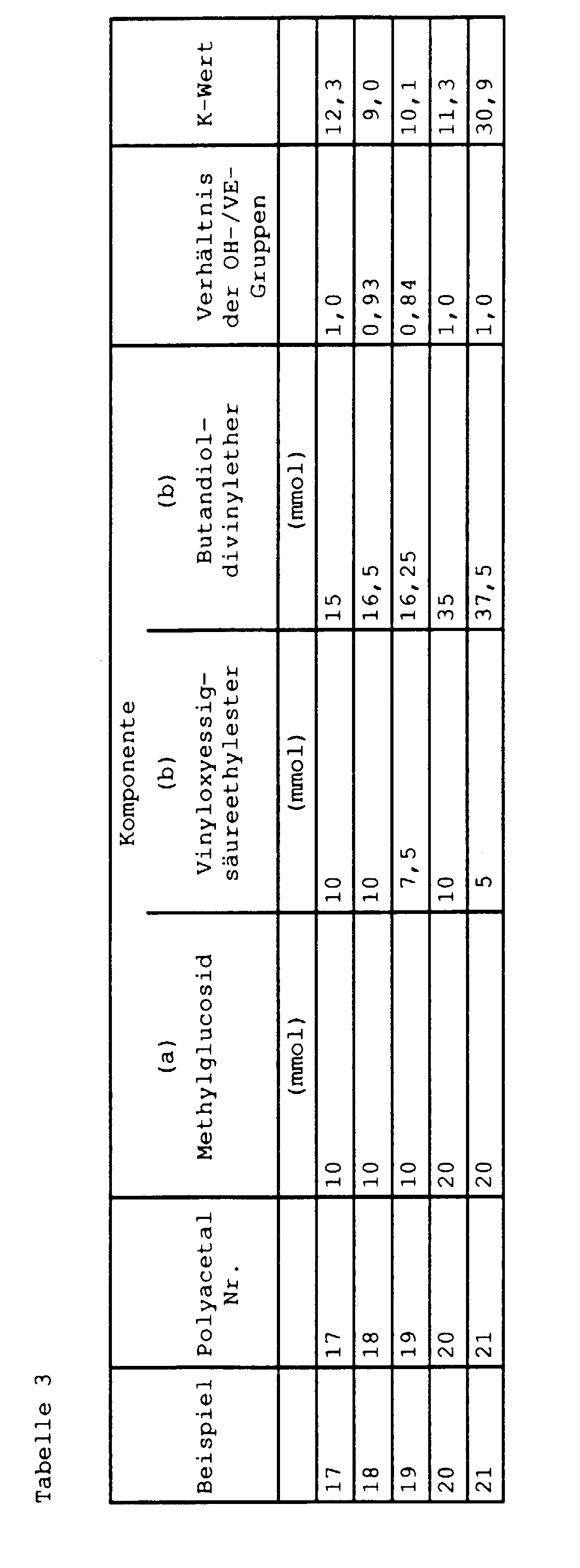
- Gemäß der oben angegebenen Vorschrift wird eine Lösung von 3,4 g (0,01 mol) Saccharose in 2,25 g (0,015 mol) Triethylenglykol und 20 mg Oxalsäure hergestellt und auf eine Temperatur von 130°C erhitzt. Bei dieser Temperatur gibt man zunächst 3,9 g (0,0275 mol) 1,4-Butandioldivinylether und dann 7,15 g (0,055 mol) Vinyloxyessigsäureethylester hinzu. Man erhält ein Polyacetal mit einem K-Wert von 15,6. Durch alkalische Nachbehandlung entsteht daraus die Natriumsalzform des Polyacetals. Das Verhältnis von OH-Gruppen zu Vinylethergruppen betrug 1,0.
- Gemäß der oben angegebenen Vorschrift wird eine Lösung von 2 g (0,01 mol) Dextrose in 2,25 g (0,015 mol) Triethylenglykol und 20 mg Oxalsäure hergestellt und auf eine Temperatur von 130°C erhitzt. Bei dieser Temperatur fügt man eine Mischung aus 2,8 g (0,02 mol) 1,4-Butandioldivinylether und 5,2 g (0,04 mol) Vinyloxyessigsäureethylester zu. Das Verhältnis der OH-Gruppen zu Vinylether-Gruppen der Ausgangsprodukte beträgt 1,03. Man erhält ein Polyacetal mit einem K-Wert von 11. Daraus ist durch alkalische Nachbehandlung die Natriumsalzform der Polyacetale erhältlich.
- Gemäß der oben angegebenen Vorschrift wird eine Lösung aus 2,0 g (0,01 mol) Dextrose in 2,25 g (0,015 mol) Triethylenglykol hergestellt und mit 20 mg Oxalsäure versetzt. Das Reaktionsgemisch wird auf eine Temperatur von 130°C erhitzt und bei dieser Temperatur mit einer Mischung von 3,55 g (0,025 mol) 1,4-Butandiol-divinylether und 3,9 g (0,03 mol) Vinyloxyessigsäureethylester versetzt. Man erhält ein Polyacetal mit einem K-Wert von 13,2. Aus diesem Polyacetal ist durch alkalische Nachbehandlung mit Natronlauge die Natriumsalzform des Polyacetals erhältlich.
- Eine Mischung aus 18,2 g (0,1 mol) Sorbit, 0,15 g Oxalsäure und 13 g (0,1 mol) Vinyloxyessigsäureethylester wird auf eine Temperatur von 110°C erhitzt und 2 Stunden bei dieser Temperatur gerührt. Dabei entsteht aus der anfangs zweiphasigen Reaktionsmischung ein homogenes Reaktionsprodukt. Man fügt dann 14,2 g (0,1 mol) Butandioldivinylether zu und nach 1 Stunde Reaktionszeit 28 g (0,1 mol) Octadecylvinylether und rührt das Reaktionsgemisch dann noch 1 Stunde bei einer Temperatur von 110°C. Danach beträgt der Gehalt an Vinylethergruppen 0,0003 mol. Durch alkalische Nachbehandlung erhält man das Natriumsalz. Es besitzt Tensideigenschaften.
- Als Modell für partikulären Schmutz wird feingemahlener China-Clay SPS 151 benutzt- 1 g Clay wird unter Zusatz von 1 ml einer 0,1 %igen Natriumsalzlösung des Polyelektrolyten in 98 ml Wasser 10 Minuten in einem Standzylinder (100 ml) intensiv dispergiert. Sofort nach dem Rühren nimmt man aus der Mitte des Standzylinders eine Probe von 2,5 ml und bestimmt nach dem Verdünnen auf 25 ml die Trübung der Dispersion mit einem Turbidimeter. Nach 30- bzw. 60minütiger Standzeit der Dispersion werden erneut Proben genommen und wie oben die Trübung bestimmt. Die Trübung der Dispersion wird in NTU (nephelometric turbidity units) angegeben. Je weniger sich die Dispersion während der Lagerung absetzt, desto höher sind die gemessenen Trübungswerte und um so stabiler ist die Dispersion. Als zweite physikalische Meßgröße wird die Dispersionskonstante bestimmt, die das zeitliche Verhalten des Sedimentationsprozesses beschreibt. Da der Sedimentationsprozeß annähernd durch ein monoexpotentielles Zeitgesetz beschrieben werden kann, gibt T die Zeit an, in der die Trübung auf 1/e-tel des Ausgangszustandes zum Zeitpunkt t=0 abfällt.
- Je höher ein Wert für T ist, um so langsamer setzt sich die Dispersion ab.
Tabelle 4 Beispiel Polyacetal Nr. Trübung nach Lagerung Dispersionskonstante T (min) sofort 30 min 60 min (NTU) 26 1 700 520 480 221 27 2 680 450 410 176 28 11 650 410 370 157 Vgl.Bsp. 1 ohne Polyacetal 600 37 33 41 - Die oben beschriebenen Polyacetale können als Viskositätserniedriger für Tenside verwendet werden. Beim Verdünnen von konzentrierten, wasserarmen oder wasserfreien Tensidformulierungen mit Wasser, wie dies im Bereich der gewerblichen Wäschereien oder bei der Herstellung von Waschmittelformulierungen üblich ist, tritt häufig ein Konzentrationsbereich mit einer sehr hohen Viskosität auf. Diese Erscheinung ist beim Transport der Formulierungen in Rohrleitungen, der Dosierung mit Hilfe von Pumpen und der Auflösegeschwindigkeit in der Waschflotte oft störend. Bei einer hohen Viskosität muß ein hoher Aufwand an mechanischer Energie zur Verarbeitung der Tenside aufgewandt werden. Außerdem ist der weitere Auflösevorgang der Tenside aufgrund der hohen Viskosität eines teilweise verdünnten Tensids mit erhöhtem Zeitaufwand verbunden. Die Zunahme der Viskosität von Tensiden beim Verdünnen mit Wasser tritt vor allem bei nichtionischen Tensiden auf, insbesondere bei polyalkoxylierten Verbindungen . Sofern man den Tensiden die oben beschriebenen Polyacetale in Mengen von 0,1 bis 50, vorzugsweise 0,5 bis 10 Gew.-% zusetzt, kann die Viskosität solcher Mischungen beim Verdünnen deutlich vermindert werden. Die erfindungsgemäß in Waschmitteln zu verwendenden Polyacetale werden dabei vorzugsweise zuerst im konzentrierten Tensid gelöst oder dispergiert. Danach wird die Mischung durch Zugabe von Wasser verdünnt. Das mit den erfindungsgemäß zu verwendenden Polyacetalen versetzte Tensidkonzentrat kann auch in eine wäßrige Waschflotte eingetragen werden. Es ist aber auch möglich, eine bereits mit Wasser versetzte hochviskose verdünnte wäßrige Tensidlösung mit den erfindungsgemäß zu verwendenden Polyacetalen zu versetzen, um die Viskosität nachträglich zu erniedrigen.
- Die in Tabelle 5 angegebenen Polyacetale werden auf ihre Eigenschaft als Fließverbesserer für nichtionische Tenside geprüft, indem man eine Mischung aus einem wasserfreien Tensid und den in der Tabelle 5 angegebenen Polyacetalen herstellt. Als Tensid wurde das Additionsprodukt von 7 mol Ethylenoxid an 1 mol eines C13/C15-Alkoholgemisches verwendet. Der Anteil der Polyacetale in der Mischung betrug 5 %. In Tabelle 5 sind die Viskositäten der beschriebenen Mischung aus dem obengenannten Tensid und den Polyacetalen bei unterschiedlichen Gehalten an Wasser angegeben. Wie aus der Tabelle hervorgeht, wirken die darin beschriebenen Polyacetale als Viskositätserniedriger für das wasserhaltige Tensid.
Tabelle 5 Fließverbesser für nichtionische Tenside Viskositätsmessungen in Abhängigkeit vom Tensidgehalt Beispiel Polyacetal Nr. Viskosität [mPas] der wäßrigen Tensidmischung mit einem Gehalt an nichtionischem Tensid von 80 % 60 % 40 % 20 % 29 5 92 6050 486 169 30 6 90 6210 591 172 31 7 106 3560 356 287 32 13 148 4120 412 250 33 14 121 3840 671 262 34 15 158 3670 651 281 Vgl.bsp.Nr.2 ohne Polymer 46000 25000 158000 1000 - Aufgrund der viskositätserniedrigenden Wirkung sind die erfindungsgemäß zu verwendenden Polymeren wichtige Hilfsmittel bei der Herstellung phosphatreduzierter und phosphatfreier Wasch- und Reinigungsmittel. Durch die Verwendung dieser Hilfsmittel gelingt es, die Slurry-Konzentration im Crutcher auf mindestens 80 % anzuheben. Dies bedeutet eine bessere Wirtschaftlichkeit durch günstigere Auslastung des Sprühturmes sowie eine Einsparung an Energie, weil weniger Wasser verdampft werden muß. Die homogenisierende und viskositätserniedrigende Wirkung der erfindungsgemäß zu verwendenden Polymerisate wird im folgenden durch Viskositätsmessungen an Waschmittelformulierungen veranschaulicht. Als Meßgerät dient ein Rheometer der Fa. Physika. Meßsystem ist ein Z 3 DIN-Typ. Als Waschmittelslurry wird eine Aufschlämmung von 80 Gew.-% Waschmittelbestandteilen und 20 Gew.-% Wasser verwendet. Als viskositätserniedrigende Zusätze werden die in Tabelle 6 jeweils angegebenen Polyacetale in einer Menge von 2 Gew.-%, bezogen auf die Waschmittelformulierung, eingesetzt.
- Das Waschmittel zur Herstellung des Slurry setzt sich folgendermaßen zusammen:
- 10 Gew.-%
- Dodecylbenzolsulfonat in Form des Natriumsalzes
- 6 Gew.-%
- Tensid (Anlagerungsprodukt von 7 Mol Ethylenoxid an 1 Mol eines C13/C15-Alkoholgemisches)
- 30 Gew.-%
- Zeolith A
- 10 Gew.-%
- Soda
- 5 Gew.-%
- Natriummetasilikat mit 5 H2O und
- 39 Gew.-%
- Natriumsulfat.
- Alle oben aufgeführten Waschmittelbestandteile und das in Tabelle 6 jeweils angegebene Polyacetal wurden bei 60°C mit Hilfe eines Flügelrührers in Wasser eingerührt, so daß eine Mischung, bestehend aus
- 80 Gew.-Teilen der oben beschriebenen Waschmittelbestandteile,
- 18 Gew.-Teilen Wasser und
- 2 Gew.-Teilen Polyacetal
- Aus den Meßwerten in Tabelle 6 ist deutlich zu erkennen, daß die Polyacetale homogenisierende und viskositätserniedrigende Wirkung auf die Waschmittelslurries besitzen.
Tabelle 6 Fließverbesserer für Waschmittelslurries Beispiel Polyacetal Viskosität visuelles Aussehen der Slurries (mPas) 35 3 156 niedrigviskos, homogen verteilt 36 4 172 niedrigviskos, homogen verteilt 37 12 113 niedrigviskos, homogen verteilt Vglbsp.Nr.3 ohne Polymer 28700 sehr pastös, nicht homogen verteilt
Claims (4)
- Verwendung von Acetaldehydacetaleinheiten enthaltenden löslichen Polyacetalen, die erhältlich sind durch kationisch initiierte Polyaddition von(a) Verbindungen, die mindestens 3 Hydroxygruppen enthalten,(b) endständige Vinylethergruppen enthaltenden Divinylethern oder Mischungen aus solchen Divinylethern und Monovinylethern und(c) Dihydroxyverbindungen und/oder Monohydroxyverbindungen,wobei das Verhältnis der Summe der Hydroxygruppen der Verbindungen (a) und (c) zur Summe der Vinylethergruppen der Verbindungen (b) 0,1 bis 10 beträgt, als Zusatz zu phosphatarmen und phosphatfreien Wasch- und Reinigungsmitteln.
- Verwendung nach Anspruch 1, dadurch gekennzeichnet, daß in den Polyacetalen das Verhältnis der Summe der Hydroxygruppen der Verbindungen (a) und (c) zur Summe der Vinylethergruppen der Verbindungen (b) 0,5 bis 5 beträgt.
- Verwendung nach Anspruch 1, dadurch gekennzeichnet, daß man die Polyacetale als Dispergiermittel für feinteilige Mineralien einsetzt.
- Verwendung nach Anspruch 1, dadurch gekennzeichnet, daß man die Polyacetale als Viskositätserniedriger für Tenside einsetzt.
Applications Claiming Priority (3)
| Application Number | Priority Date | Filing Date | Title |
|---|---|---|---|
| DE4233340A DE4233340A1 (de) | 1992-10-05 | 1992-10-05 | Acetaldehydacetaleinheiten enthaltende Polyacetale, Verfahren zu ihrer Herstellung und ihre Verwendung in Wasch- und Reinigungsmitteln |
| DE4233340 | 1992-10-05 | ||
| PCT/EP1993/002613 WO1994007939A1 (de) | 1992-10-05 | 1993-09-25 | Acetaldehydacetaleinheiten enthaltende polyacetale, verfahren zu ihrer herstellung und ihre verwendung in wasch- und reinigungsmitteln |
Publications (2)
| Publication Number | Publication Date |
|---|---|
| EP0663932A1 EP0663932A1 (de) | 1995-07-26 |
| EP0663932B1 true EP0663932B1 (de) | 1997-05-07 |
Family
ID=6469598
Family Applications (1)
| Application Number | Title | Priority Date | Filing Date |
|---|---|---|---|
| EP93921854A Expired - Lifetime EP0663932B1 (de) | 1992-10-05 | 1993-09-25 | Verwendung von acetaldehydacetaleinheiten enthaltenden polyacetalen in wasch- und reinigungsmitteln |
Country Status (7)
| Country | Link |
|---|---|
| US (1) | US5520834A (de) |
| EP (1) | EP0663932B1 (de) |
| JP (1) | JPH08501815A (de) |
| CA (1) | CA2144726A1 (de) |
| DE (2) | DE4233340A1 (de) |
| ES (1) | ES2100568T3 (de) |
| WO (1) | WO1994007939A1 (de) |
Families Citing this family (7)
| Publication number | Priority date | Publication date | Assignee | Title |
|---|---|---|---|---|
| DE19524973A1 (de) * | 1995-07-08 | 1997-01-09 | Huels Chemische Werke Ag | Sauer spaltbare Tenside auf Basis von Alkylglykosiden |
| FI106669B (fi) * | 1997-08-20 | 2001-03-15 | Nokia Networks Oy | Lähetysmenetelmä ja radiojärjestelmä |
| US20050148488A1 (en) * | 2002-05-15 | 2005-07-07 | Maren Jekel | Detergent tablets with active phase |
| JP5403740B2 (ja) * | 2008-11-14 | 2014-01-29 | 国立大学法人福井大学 | 焼成ペースト組成物 |
| EP2706117A1 (de) * | 2012-09-07 | 2014-03-12 | Basf Se | Verfahren zur Herstellung von Sebacinsäure |
| WO2016066173A1 (en) * | 2014-10-30 | 2016-05-06 | Danmarks Tekniske Universitet | Dual-role plasticizer and dispersant for ceramic layers |
| WO2025045899A1 (en) * | 2023-08-31 | 2025-03-06 | Unilever Ip Holdings B.V. | Laundry compositions |
Family Cites Families (2)
| Publication number | Priority date | Publication date | Assignee | Title |
|---|---|---|---|---|
| GB1089871A (en) * | 1964-01-03 | 1967-11-08 | Canadian Ind | Foams from vinyl ether prepolymers |
| US4713441A (en) * | 1986-08-01 | 1987-12-15 | Sandoz Pharmaceuticals Corp. | Polyacetal hydrogels formed from divinyl ethers and polyols |
-
1992
- 1992-10-05 DE DE4233340A patent/DE4233340A1/de not_active Withdrawn
-
1993
- 1993-09-25 US US08/397,244 patent/US5520834A/en not_active Expired - Fee Related
- 1993-09-25 JP JP6508682A patent/JPH08501815A/ja active Pending
- 1993-09-25 WO PCT/EP1993/002613 patent/WO1994007939A1/de not_active Ceased
- 1993-09-25 DE DE59306412T patent/DE59306412D1/de not_active Expired - Lifetime
- 1993-09-25 ES ES93921854T patent/ES2100568T3/es not_active Expired - Lifetime
- 1993-09-25 EP EP93921854A patent/EP0663932B1/de not_active Expired - Lifetime
- 1993-09-25 CA CA002144726A patent/CA2144726A1/en not_active Abandoned
Also Published As
| Publication number | Publication date |
|---|---|
| EP0663932A1 (de) | 1995-07-26 |
| CA2144726A1 (en) | 1994-04-14 |
| DE59306412D1 (de) | 1997-06-12 |
| US5520834A (en) | 1996-05-28 |
| ES2100568T3 (es) | 1997-06-16 |
| JPH08501815A (ja) | 1996-02-27 |
| WO1994007939A1 (de) | 1994-04-14 |
| DE4233340A1 (de) | 1994-04-07 |
Similar Documents
| Publication | Publication Date | Title |
|---|---|---|
| EP0474915B2 (de) | Waschmittel | |
| EP0728795B1 (de) | Verfahren zur Herstellung von feinteiligen Mischungen aus amphiphilen Polymeren und Polycarboxylaten und ihre Verwendung | |
| EP0285935B1 (de) | Verwendung von Pfropfpolymerisaten auf Basis von Polyalkylenoxiden als Vergrauungsinhibitoren beim Waschen und Nachbehandeln von Synthesefasern enthaltendem Textilgut | |
| EP0573463B1 (de) | Verwendung von polyacetalen in wasch- und reinigungsmitteln | |
| DE3716543A1 (de) | Verwendung von wasserloeslichen copolymerisaten, die monomere mit mindestens zwei ethylenisch ungesaettigten doppelbindungen einpolymerisiert enthalten, in wasch- und reinigungsmitteln | |
| EP0832139B1 (de) | Polymerisate, deren herstellung und verwendung | |
| EP0285037A2 (de) | Verwendung von Propfpolymerisaten auf Basis von Polyalkylenoxiden als Vergrauungsinhibitoren beim Waschen und Nachbehandeln von Synthesefasern enthaltendem Textilgut | |
| DE4108626A1 (de) | Citronensaeure-ester von polyhydroxyverbindungen und ihre verwendung in wasch- und reinigungsmitteln | |
| DE4034334A1 (de) | Verwendung von weinsaeure einkondensiert enthaltenden polyestern als waschmittelzusatz, verfahren zur herstellung der polyester und polyester aus weinsaeure und tetracarbonsaeuren | |
| EP0663932B1 (de) | Verwendung von acetaldehydacetaleinheiten enthaltenden polyacetalen in wasch- und reinigungsmitteln | |
| EP0337259A2 (de) | Verwendung von wasserlöslichen Copolymerisaten auf Basis von monoethylenisch ungesättigten Carbonsäuren | |
| DE4213282A1 (de) | Verfahren zur Herstellung von Polyestern aus Citronensäure und Polyhydroxyverbindungen und ihre Verwendung | |
| DE112023002378T5 (de) | Zusammensetzung, die ein vinylalkoholpolymer umfasst, verfahren zu deren herstellung, vinylalkoholpolymer und harzmaterial | |
| EP0344591B1 (de) | Verfahren zur Herstellung von wasserlöslichen Polymerisaten und ihre Verwendung | |
| EP0667878B1 (de) | Blockcopolyacetale, verfahren zu ihrer herstellung und ihre verwendung in wasch- und reinigungsmitteln | |
| EP2931769B1 (de) | Die primärwaschkraft verbessernde polymere wirkstoffe | |
| DE69333363T2 (de) | Verbessertes Verfahren zur Herstellung von Alkylglykosiden | |
| DE2411480A1 (de) | Reinigungsmittelmischung | |
| DE4142131A1 (de) | Polykondensate aus butantetracarbonsaeure und polyhydroxyverbindungen und ihre verwendung in wasch- und reinigungsmitteln | |
| EP0457965A1 (de) | Schwachschäumende Maschinen-Waschmittel | |
| DE736671C (de) | Verfahren zur Herstellung geformter Waschmittel | |
| EP3786150B1 (de) | Hydroxycarbonsäureester enthaltende wasch- und reinigungsmittel und verwendung von hydroxycarbonsäureestern | |
| DE19923627A1 (de) | Verfahren zur Herstellung von Tensidgranulaten | |
| EP0687278B1 (de) | Polyacetalblöcke enthaltende polymerisate, verfahren zu ihrer herstellung und ihre verwendung | |
| WO2000071654A1 (de) | Verfahren zur herstellung von tensidgranulaten |
Legal Events
| Date | Code | Title | Description |
|---|---|---|---|
| PUAI | Public reference made under article 153(3) epc to a published international application that has entered the european phase |
Free format text: ORIGINAL CODE: 0009012 |
|
| 17P | Request for examination filed |
Effective date: 19950308 |
|
| AK | Designated contracting states |
Kind code of ref document: A1 Designated state(s): BE DE ES FR GB IT NL |
|
| 17Q | First examination report despatched |
Effective date: 19960304 |
|
| GRAG | Despatch of communication of intention to grant |
Free format text: ORIGINAL CODE: EPIDOS AGRA |
|
| GRAH | Despatch of communication of intention to grant a patent |
Free format text: ORIGINAL CODE: EPIDOS IGRA |
|
| GRAH | Despatch of communication of intention to grant a patent |
Free format text: ORIGINAL CODE: EPIDOS IGRA |
|
| GRAA | (expected) grant |
Free format text: ORIGINAL CODE: 0009210 |
|
| AK | Designated contracting states |
Kind code of ref document: B1 Designated state(s): BE DE ES FR GB IT NL |
|
| REF | Corresponds to: |
Ref document number: 59306412 Country of ref document: DE Date of ref document: 19970612 |
|
| REG | Reference to a national code |
Ref country code: ES Ref legal event code: FG2A Ref document number: 2100568 Country of ref document: ES Kind code of ref document: T3 |
|
| GBT | Gb: translation of ep patent filed (gb section 77(6)(a)/1977) |
Effective date: 19970523 |
|
| ET | Fr: translation filed | ||
| PLBE | No opposition filed within time limit |
Free format text: ORIGINAL CODE: 0009261 |
|
| STAA | Information on the status of an ep patent application or granted ep patent |
Free format text: STATUS: NO OPPOSITION FILED WITHIN TIME LIMIT |
|
| 26N | No opposition filed | ||
| PGFP | Annual fee paid to national office [announced via postgrant information from national office to epo] |
Ref country code: FR Payment date: 19990803 Year of fee payment: 7 |
|
| PGFP | Annual fee paid to national office [announced via postgrant information from national office to epo] |
Ref country code: NL Payment date: 19990810 Year of fee payment: 7 |
|
| PGFP | Annual fee paid to national office [announced via postgrant information from national office to epo] |
Ref country code: ES Payment date: 19990906 Year of fee payment: 7 |
|
| PGFP | Annual fee paid to national office [announced via postgrant information from national office to epo] |
Ref country code: BE Payment date: 19990910 Year of fee payment: 7 |
|
| PGFP | Annual fee paid to national office [announced via postgrant information from national office to epo] |
Ref country code: GB Payment date: 19990915 Year of fee payment: 7 |
|
| PGFP | Annual fee paid to national office [announced via postgrant information from national office to epo] |
Ref country code: DE Payment date: 19990928 Year of fee payment: 7 |
|
| PG25 | Lapsed in a contracting state [announced via postgrant information from national office to epo] |
Ref country code: DE Free format text: LAPSE BECAUSE OF THE APPLICANT RENOUNCES Effective date: 20000918 |
|
| PG25 | Lapsed in a contracting state [announced via postgrant information from national office to epo] |
Ref country code: GB Free format text: LAPSE BECAUSE OF NON-PAYMENT OF DUE FEES Effective date: 20000925 |
|
| PG25 | Lapsed in a contracting state [announced via postgrant information from national office to epo] |
Ref country code: ES Free format text: LAPSE BECAUSE OF NON-PAYMENT OF DUE FEES Effective date: 20000926 |
|
| PG25 | Lapsed in a contracting state [announced via postgrant information from national office to epo] |
Ref country code: BE Free format text: LAPSE BECAUSE OF NON-PAYMENT OF DUE FEES Effective date: 20000930 |
|
| BERE | Be: lapsed |
Owner name: BASF A.G. Effective date: 20000930 |
|
| PG25 | Lapsed in a contracting state [announced via postgrant information from national office to epo] |
Ref country code: NL Free format text: LAPSE BECAUSE OF NON-PAYMENT OF DUE FEES Effective date: 20010401 |
|
| GBPC | Gb: european patent ceased through non-payment of renewal fee |
Effective date: 20000925 |
|
| PG25 | Lapsed in a contracting state [announced via postgrant information from national office to epo] |
Ref country code: FR Free format text: LAPSE BECAUSE OF NON-PAYMENT OF DUE FEES Effective date: 20010531 |
|
| NLV4 | Nl: lapsed or anulled due to non-payment of the annual fee |
Effective date: 20010401 |
|
| REG | Reference to a national code |
Ref country code: FR Ref legal event code: ST |
|
| REG | Reference to a national code |
Ref country code: ES Ref legal event code: FD2A Effective date: 20011011 |
|
| PG25 | Lapsed in a contracting state [announced via postgrant information from national office to epo] |
Ref country code: IT Free format text: LAPSE BECAUSE OF NON-PAYMENT OF DUE FEES;WARNING: LAPSES OF ITALIAN PATENTS WITH EFFECTIVE DATE BEFORE 2007 MAY HAVE OCCURRED AT ANY TIME BEFORE 2007. THE CORRECT EFFECTIVE DATE MAY BE DIFFERENT FROM THE ONE RECORDED. Effective date: 20050925 |