EP0666103B1 - Procédé pour purifier des gaz d'échappement - Google Patents
Procédé pour purifier des gaz d'échappement Download PDFInfo
- Publication number
- EP0666103B1 EP0666103B1 EP95101492A EP95101492A EP0666103B1 EP 0666103 B1 EP0666103 B1 EP 0666103B1 EP 95101492 A EP95101492 A EP 95101492A EP 95101492 A EP95101492 A EP 95101492A EP 0666103 B1 EP0666103 B1 EP 0666103B1
- Authority
- EP
- European Patent Office
- Prior art keywords
- porous support
- loaded
- exhaust gas
- storage component
- process according
- Prior art date
- Legal status (The legal status is an assumption and is not a legal conclusion. Google has not performed a legal analysis and makes no representation as to the accuracy of the status listed.)
- Expired - Lifetime
Links
Images
Classifications
-
- B—PERFORMING OPERATIONS; TRANSPORTING
- B01—PHYSICAL OR CHEMICAL PROCESSES OR APPARATUS IN GENERAL
- B01D—SEPARATION
- B01D53/00—Separation of gases or vapours; Recovering vapours of volatile solvents from gases; Chemical or biological purification of waste gases, e.g. engine exhaust gases, smoke, fumes, flue gases, aerosols
- B01D53/34—Chemical or biological purification of waste gases
- B01D53/92—Chemical or biological purification of waste gases of engine exhaust gases
- B01D53/94—Chemical or biological purification of waste gases of engine exhaust gases by catalytic processes
- B01D53/9445—Simultaneously removing carbon monoxide, hydrocarbons or nitrogen oxides making use of three-way catalysts [TWC] or four-way-catalysts [FWC]
- B01D53/945—Simultaneously removing carbon monoxide, hydrocarbons or nitrogen oxides making use of three-way catalysts [TWC] or four-way-catalysts [FWC] characterised by a specific catalyst
-
- B—PERFORMING OPERATIONS; TRANSPORTING
- B01—PHYSICAL OR CHEMICAL PROCESSES OR APPARATUS IN GENERAL
- B01D—SEPARATION
- B01D53/00—Separation of gases or vapours; Recovering vapours of volatile solvents from gases; Chemical or biological purification of waste gases, e.g. engine exhaust gases, smoke, fumes, flue gases, aerosols
- B01D53/34—Chemical or biological purification of waste gases
- B01D53/92—Chemical or biological purification of waste gases of engine exhaust gases
- B01D53/94—Chemical or biological purification of waste gases of engine exhaust gases by catalytic processes
- B01D53/9481—Catalyst preceded by an adsorption device without catalytic function for temporary storage of contaminants, e.g. during cold start
-
- B—PERFORMING OPERATIONS; TRANSPORTING
- B01—PHYSICAL OR CHEMICAL PROCESSES OR APPARATUS IN GENERAL
- B01J—CHEMICAL OR PHYSICAL PROCESSES, e.g. CATALYSIS OR COLLOID CHEMISTRY; THEIR RELEVANT APPARATUS
- B01J23/00—Catalysts comprising metals or metal oxides or hydroxides, not provided for in group B01J21/00
- B01J23/38—Catalysts comprising metals or metal oxides or hydroxides, not provided for in group B01J21/00 of noble metals
- B01J23/54—Catalysts comprising metals or metal oxides or hydroxides, not provided for in group B01J21/00 of noble metals combined with metals, oxides or hydroxides provided for in groups B01J23/02 - B01J23/36
- B01J23/56—Platinum group metals
- B01J23/58—Platinum group metals with alkali- or alkaline earth metals
-
- B—PERFORMING OPERATIONS; TRANSPORTING
- B01—PHYSICAL OR CHEMICAL PROCESSES OR APPARATUS IN GENERAL
- B01J—CHEMICAL OR PHYSICAL PROCESSES, e.g. CATALYSIS OR COLLOID CHEMISTRY; THEIR RELEVANT APPARATUS
- B01J23/00—Catalysts comprising metals or metal oxides or hydroxides, not provided for in group B01J21/00
- B01J23/38—Catalysts comprising metals or metal oxides or hydroxides, not provided for in group B01J21/00 of noble metals
- B01J23/54—Catalysts comprising metals or metal oxides or hydroxides, not provided for in group B01J21/00 of noble metals combined with metals, oxides or hydroxides provided for in groups B01J23/02 - B01J23/36
- B01J23/56—Platinum group metals
- B01J23/63—Platinum group metals with rare earths or actinides
-
- B—PERFORMING OPERATIONS; TRANSPORTING
- B01—PHYSICAL OR CHEMICAL PROCESSES OR APPARATUS IN GENERAL
- B01D—SEPARATION
- B01D2255/00—Catalysts
- B01D2255/90—Physical characteristics of catalysts
- B01D2255/91—NOx-storage component incorporated in the catalyst
-
- B—PERFORMING OPERATIONS; TRANSPORTING
- B01—PHYSICAL OR CHEMICAL PROCESSES OR APPARATUS IN GENERAL
- B01J—CHEMICAL OR PHYSICAL PROCESSES, e.g. CATALYSIS OR COLLOID CHEMISTRY; THEIR RELEVANT APPARATUS
- B01J37/00—Processes, in general, for preparing catalysts; Processes, in general, for activation of catalysts
- B01J37/02—Impregnation, coating or precipitation
- B01J37/024—Multiple impregnation or coating
- B01J37/0248—Coatings comprising impregnated particles
-
- F—MECHANICAL ENGINEERING; LIGHTING; HEATING; WEAPONS; BLASTING
- F01—MACHINES OR ENGINES IN GENERAL; ENGINE PLANTS IN GENERAL; STEAM ENGINES
- F01N—GAS-FLOW SILENCERS OR EXHAUST APPARATUS FOR MACHINES OR ENGINES IN GENERAL; GAS-FLOW SILENCERS OR EXHAUST APPARATUS FOR INTERNAL-COMBUSTION ENGINES
- F01N2570/00—Exhaust treating apparatus eliminating, absorbing or adsorbing specific elements or compounds
- F01N2570/16—Oxygen
-
- Y—GENERAL TAGGING OF NEW TECHNOLOGICAL DEVELOPMENTS; GENERAL TAGGING OF CROSS-SECTIONAL TECHNOLOGIES SPANNING OVER SEVERAL SECTIONS OF THE IPC; TECHNICAL SUBJECTS COVERED BY FORMER USPC CROSS-REFERENCE ART COLLECTIONS [XRACs] AND DIGESTS
- Y02—TECHNOLOGIES OR APPLICATIONS FOR MITIGATION OR ADAPTATION AGAINST CLIMATE CHANGE
- Y02T—CLIMATE CHANGE MITIGATION TECHNOLOGIES RELATED TO TRANSPORTATION
- Y02T10/00—Road transport of goods or passengers
- Y02T10/10—Internal combustion engine [ICE] based vehicles
- Y02T10/12—Improving ICE efficiencies
Definitions
- the present invention relates to a catalyst for purifying exhaust gases. More particularly, it relates to the catalyst which can efficiently purify nitrogen oxides (NO x ) in the exhaust gases whose oxygen concentrations are at the stoichiometric point or more than required for oxidizing carbon monoxide (CO) and hydrocarbons (HC) therein.
- NO x nitrogen oxides
- the 3-way catalysts As catalysts for purifying automotive exhaust gases, there have been employed 3-way catalysts so far which oxidize CO and HC and reduce NO x to purify the exhaust gases.
- the 3-way catalysts have been known widely which comprise a heat resistant support formed of cordierite, a catalyst carrier layer formed of gamma-alumina and disposed on the support, and a noble metal catalyst ingredient selected from the group consisting of Pt, Pd and Rh and loaded on the catalyst carrier layer.
- the purifying performance of the 3-way catalysts for purifying exhaust gases depends greatly on the air-fuel ratio A/F of automotive engine. For instance, when the air-fuel weight ratio is larger than 14.6, i.e., when the fuel concentration is low (or on the fuel-lean side), the oxygen concentration is high in exhaust gases. Accordingly, the oxidation reactions purifying CO and HC are active, but the reduction reactions purifying NO x are inactive. On the other hand, when the air-fuel ratio is smaller than 14.6, i.e., when the fuel concentration is higher (or on the fuel-rich side), the oxygen concentration is low in exhaust gases. Accordingly, the oxidation reactions are inactive, but the reduction reactions are active.
- the applicants et al. of the present invention proposed a novel catalyst in Japanese Unexamined Patent Publication (KOKAI) No. 5-168,860.
- an NO x storage component such as La and the like, and Pt.
- NO x which includes NO in an amount of about 90% by volume and the balance of NO 2 etc., especially the NO is oxidized to NO 2 by Pt.
- the NO 2 is stored on the NO x storage component, such as La and the like.
- the stored NO 2 is released. Further, on the Pt, the released NO 2 is reacted with the reducing gases, such as HC and CO, included in the exhaust gases, and thereby the NO 2 is reduced and purified to N 2 . As a result, the NO x is inhibited from being released from the catalyst during the fuel-lean side (i.e., in the oxygen-rich atmospheres) driving. Thus, the catalyst is improved in terms of NO x purifying performance.
- exhaust-gases-purifying catalysts When exhaust-gases-purifying catalysts are used actually, it is necessary for them to exhibit 3-way catalytic performance. That is, they are required to simultaneously carry out the oxidation of HC and CO and the reduction of NO x at the stoichiometric point.
- the air-fuel mixture even when the air-fuel mixture is said to have the stoichiometric point, its air-fuel ratio A/F varies in the acceleration and deceleration during driving in urban areas. Namely, the air-fuel mixture may be put into the fuel-lean state, and thereby it may include oxygen excessively. Consequently, exhaust-gases-purifying catalysts do not cause the reduction of NO x but to carry out the adsorption of NO x . If the NO x is stored saturatedly, exhaust-gases-purifying catalysts cannot store NO x any further, but release NO x to the outside as it is.
- a substance having oxygen-storage ability such as ceria (CeO 2 ) and the like, can be loaded together with a noble metal catalyst ingredient in order to store oxygen in the oxygen-rich atmospheres (i.e., during the fuel-lean side driving), thereby facilitating the reduction reactions of NO x .
- Ceria can store and release oxygen by itself. That is, ceria can store oxygen in the oxygen-rich atmospheres (i.e., during the fuel-lean side driving), and it can release oxygen in the oxygen-lean atmospheres (i.e., during the fuel-rich side driving).
- ceria When ceria is loaded adjacent to a noble metal catalyst ingredient, oxygen comes in and goes out at a great rate in a large amount. Accordingly, ceria buffers or reduces the fluctuation in the air-fuel ratio A/F, and it can maximize the oxidation and reduction activity of noble metal catalyst ingredient.
- EP-A-0 199 509 discloses a catalyst for catalytically oxidizing hydrocarbons and CO.
- Pd is loaded on alumina particles which are stabilized by Ba.
- ceria particles are added to be in the condition of slurry.
- the slurry is loaded on a support.
- EP-A-0 171 151 discloses a catalyst for lean exhaust systems, where Pt is loaded on alumina particles which are stabilzed by Ba. Then ceria particles are added to be in the condition of slurry. After that, the slurry is loaded on the support.
- EP-A-0 372 156 discloses an exhaust gas purifying catalyst. Alumina particles on which Pt and Rh are loaded, alumina particles on which NO x -adsorbing elements are loaded and ceria particles are mixed to be in the condition of slurry. The slurry is loaded on a support.
- EP-A-0 613 714 discloses a catalyst which contains CeSe rare-earth element. Ce is used as a NO x -adsorbing element so that a nobel metal is adjacently disposed. Ce is not segregated from said nobel metal catalyst.
- the present invention has been developed in view of the aforementioned circumstances. It is therefore an object of the present invention to provide a catalyst on which not only an NO x storage component and a noble metal catalyst ingredient are loaded, but also ceria is loaded so as not to be adjacent to the noble metal catalyst ingredient. Thus, it is possible to minimize a rate and an amount of oxygen being released from ceria in reducing atmospheres, and to control the oxidation reactions of HC and CO resulting from the released oxygen, thereby facilitating the reduction reactions of NO x .
- a process for purifying an exhaust gas from a lean burn engine which is intermittently changed from lean burn to fuel-rich, said process comprising: simultaneously removing said carbon monoxide, hydrocarbons and nitrogen oxides by bringing said exhaust gas from a lean burn engine into contact with an exhaust gas purifying catalyst comprising:
- porous support the following porous substances can be listed as examples: alumina, zeolite, zirconia, silica-alumina, silica and the combinations of them. These porous substances themselves can constitute a porous support, or they can be coated on a surface of a honeycomb body made from cordierite, heat resistant metal, etc.
- alkaline-earth metals constituting the NO x , storage component it is possible to select at least one alkaline-earth metal from the group consisting of barium (Ba), beryllium (Be), magnesium (Mg), calcium (Ca) and strontium (Sr).
- rare-earth elements constituting the NO x storage component it is possible to select at least one rare-earth element from the group consisting of scandium (Sc), yttrium (Y), lanthanum (La), praseodymium (Pr) and neodymium (Nd).
- the term, "rare-earth elements,” herein includes not only the chemical elements with atomic numbers 58 through 71, but also 21 Sc, 39 Y and 57 La.
- the alkali metals constituting the NO x storage component it is possible to select at least one alkali metal from the group consisting of lithium (Li), sodium (Na), potassium (K), rubidium (Rb), cesium (Cs) and francium (Fr).
- the NO x storage component in amount of from 0.025 to 0.5 moles with respect to 1 liter of the porous support.
- the noble metal catalyst ingredient it is possible to select at least one noble metal element from the group consisting of Pt, Rh and Pd.
- the noble metal catalyst ingredient in an amount of from 0.1 to 20 grams, further preferably from 0.5 to 10 grams, with respect to 1 liter of the porous support.
- the ceria in an amount of from 0.025 to 0.5 moles, further preferably from 0.05 to 0.30 moles, with respect to 1 liter of the porous support.
- the operations of the present catalyst will be hereinafter described.
- the oxygen-storage or oxygen-release capability of ceria is maximized, and thereby ceria stores or releases oxygen at a great rate in a large amount.
- the noble metal catalyst ingredient is disposed adjacent to the NO x storage component, not adjacent to the ceria. Accordingly, the ceria releases oxygen at a low rate in a small amount in reducing atmospheres. As a result, HC and CO are inhibited from reacting with the released oxygen and from being oxidized before they react with NO x .
- the present catalyst can be improved in terms of NO x purifying performance.
- the present invention it is possible to inhibit ceria from releasing oxygen at a greater rate in a large amount in reducing atmospheres. Accordingly, it is possible to inhibit HC and CO from being consumed unnecessarily. As a result, it is possible to facilitate the reduction reactions of NO x caused by HC and CO, thereby giving the present exhaust-gases-purifying catalyst high NO x purifying performance.
- the air-fuel ratio A/F of fuel-air mixture can be controlled to fluctuate less by loading ceria.
- ceria stores oxygen to produce reducing atmospheres in the oxygen-rich atmospheres (i.e., during the fuel-lean driving). As a result, it is possible to further facilitate the reduction reactions of NO x . All in all, the present exhaust-gases-purifying catalyst is further upgraded in terms of NO x purifying performance.
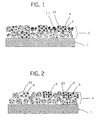
- FIG. 1 there is illustrated an enlarged cross-sectional view on a major portion of an exhaust-gases-purifying catalyst of a First Preferred Embodiment according to the present invention.
- This exhaust-gases-purifying catalyst comprises a honeycomb substrate 1 made from cordierite, and a coating layer 2 coated on the surface of the honeycomb substrate 1.
- the coating layer 2 is formed by calcinating an alumina powder 20 and a ceria powder 21.
- alumina powder 20 there are loaded Pt and Ba designated, respectively, at 3 and 4. That is, Pt (designated at 3) is loaded adjacent to Ba (designated at 4) working as the NO x storage component.
- the exhaust-gases-purifying catalysts of the First Preferred Embodiment were produced in the following manner.
- an alumina powder was added to a platinum dinitrodiammine aqueous solution. After stirring the mixture, the alumina powder was dried and calcinated, thereby loading Pt thereon. Moreover, the resulting alumina powder with Pt loaded thereon was added to and mixed with a barium acetate aqueous solution. After stirring the mixture, the alumina powder was dried and calcinated, thereby preparing an alumina powder with Pt and Ba loaded thereon.
- honeycomb substrates 1 formed of cordierite were immersed into the slurry. After taking each of the substrates 1 out of the slurry, each of them was blown to blow away the slurry in excess. Thereafter, each of the substrates 1 was dried at 80 °C for 20 minutes, and each of them was calcinated at 500 °C for 1 hour, thereby producing the exhaust-gases-purifying catalysts of the First Preferred Embodiment.
- the coating amount of the slurry was 189 grams with respect to 1 liter of the honeycomb substrate.
- the loading amount of Pt was 1.0 gram with respect to 1 liter of the honeycomb substrate.
- the loading amount of Ba was 0.2 moles with respect to 1 liter of the honeycomb substrate.
- the loading amount of Ce was 0.2 moles with respect to 1 liter of the honeycomb substrate.
- the exhaust-gases-purifying catalysts of the Second through Fifth Preferred Embodiments had the same arrangement as those of the First Preferred Embodiment, and were produced similarly thereto.
- FIG 2 there is illustrated an enlarged cross-sectional view on a major portion of an exhaust-gases-purifying catalyst of a Sixth Preferred Embodiment according to the present invention.
- This exhaust-gases-purifying catalyst comprises, similarly to those of the First Preferred Embodiment, a honeycomb substrate 1 made from cordierite, and a coating layer 2 coated on the surface of the honeycomb substrate 1.
- the coating layer 2 is formed by calcinating a first alumina powder 22 and a second alumina powder 23.
- first alumina powder 22 there are loaded Pt, Ba and Li designated, respectively, at 3, 4 and 5. That is, Pt (designated at 3) is loaded adjacent to Ba and Li (designated, respectively, at 4 and 5) working as the NO x storage component.
- second alumina powder 23 there is loaded Ceria (CeO 2 ) designated at 6.
- the exhaust-gases-purifying catalysts of the Sixth Preferred Embodiments were produced in the following manner.
- an alumina powder was added to a platinum dinitrodiammine aqueous solution. After stirring the mixture, the alumina powder was dried and calcinated, thereby loading Pt thereon. Moreover, the resulting alumina powder with Pt loaded thereon was added to and mixed with a mixed aqueous solution containing barium acetate and lithium nitrate. After stirring the mixture, the alumina powder was dried and calcinated, thereby preparing a first alumina powder with Pt, Ba and Li loaded thereon.
- alumina powder was added to a cerium nitrate aqueous solution. After stirring the mixture, the alumina powder was dried and calcinated, thereby preparing a second alumina powder with Ceria (CeO 2 ) loaded thereon.
- honeycomb substrates 1 formed of cordierite were immersed into the slurry. After taking each of the substrates 1 out of the slurry, each of them was blown to blow away the slurry in excess. Thereafter, each of the substrates 1 was dried at 80 °C for 20 minutes, and each of them was calcinated at 500 °C for 1 hour, thereby producing the exhaust-gases-purifying catalysts of the Sixth Preferred Embodiment.
- the coating amount of the slurry was 190 grams with respect to 1 liter of the honeycomb substrate.
- the loading amount of Pt was 1.0 gram with respect to 1 liter of the honeycomb substrate.
- the loading amount of Ba was 0.3 moles with respect to 1 liter of the honeycomb substrate.
- the loading amount of Li was 0.1 mole with respect to 1 liter of the honeycomb substrate.
- the loading amount of Ceria (CeO 2 ) was 0.2 moles with respect to 1 liter of the honeycomb substrate.
- an exhaust-gases-purifying catalyst of Comparative Example No. 1 had the same arrangement as those of the First through Eighth Preferred Embodiments according to the present invention, though no drawing is illustrated therefor.
- the exhaust-gases-purifying catalysts of Comparative Example No. 1 was produced in the following manner.
- honeycomb substrates formed of cordierite were immersed into the slurry. After taking each of the substrates out of the slurry, each of them was blown to blow away the slurry in excess. Thereafter, each of the substrates was dried at 80 °C for 20 minutes, and each of them was calcinated at 500 °C for 1 hour,thereby forming a coating layer thereon.
- each of the honeycomb substrates having the coating layer was immersed into a platinum dinitrodiammine aqueous solution for 1 hour. After taking each of the substrates out of the solution, each of them was dried and calcinated, thereby loading Pt thereon. Further, each of the substrates with Pt loaded thereon was immersed into a barium acetate aqueous solution. After taking each of the substrates out of the solution, each of them was dried at 80 °C for 20 minutes and calcinated at 500 °C for 1 hour, thereby producing the exhaust-gases-purifying catalysts of Comparative Example No. 1.
- the exhaust-gases-purifying catalysts of Comparative Example No. 4 had the same arrangement as those of the First Preferred Embodiment, and were produced similarly thereto.
- Each of the catalysts of the First through Eighth Preferred Embodiments and Comparative Examples Nos. 1 through 4 was disposed in an exhaust line of an actual vehicle equipped with a lean burn engine.
- the lean burn engine had a displacement of 1.6 liters.
- the vehicle was driven in the urban area running mode, for instance, it was alternately driven in the 10-mode for a certain period of time and then in the 15-mode for another certain period of time, thereby examining the catalysts for the conversion of CO, HC and NO x .
- the results of the examination are summarized in the columns designated at "Initial Conversion" in Table 1.
- each of the catalysts of the First through Eighth Preferred Embodiments and Comparative Examples Nos. 1 through 4 was subjected to a bench test on durability which utilized the same type of engine as above. Namely, each of them was disposed in an exhaust line of the engine, and then the engine was run at an air-fuel ratio A/F of 18 for 50 hours while adjusting the temperature of the exhaust gas introduced into them at 650 °C. After this bench test was over, each of them was again disposed in the exhaust line of the actual vehicle. The vehicle was driven in the same manner as described above, thereby examining the catalysts for the conversion of CO, HC and NO x . The results of the examination are summarized in the columns designated at "Conversion after Durability Test" in Table 1.
- the catalysts of the First through Eighth Preferred Embodiments were superior to the catalysts of Comparative Examples Nos. 1 through 4 in terms of the initial NO x conversion and the NO x conversion after the durability test. It is obvious that this advantageous effect resulted from the arrangement that the noble metal catalyst ingredient is loaded adjacent to the NO x storage component and is separated from the ceria.
- the honeycomb substrate having the alumina coating layer was employed to constitute the porous support.
- the present invention is not limited thereto. That is, it is possible to form a coating layer with silica, titania, etc. Further, it is possible to make a substrate from one of these porous supports (i.e., alumina, silica, titania, etc.).
- the shape of the substrate is not limited to the honeycomb shape. For instance, it is possible to form the substrate as a pellet-shaped substrate.
Landscapes
- Chemical & Material Sciences (AREA)
- Engineering & Computer Science (AREA)
- Chemical Kinetics & Catalysis (AREA)
- Materials Engineering (AREA)
- Health & Medical Sciences (AREA)
- Environmental & Geological Engineering (AREA)
- Analytical Chemistry (AREA)
- General Chemical & Material Sciences (AREA)
- Oil, Petroleum & Natural Gas (AREA)
- Biomedical Technology (AREA)
- Combustion & Propulsion (AREA)
- Organic Chemistry (AREA)
- Catalysts (AREA)
- Exhaust Gas Treatment By Means Of Catalyst (AREA)
- Gas Separation By Absorption (AREA)
Claims (15)
- Procédé pour purifier un gaz d'échappement d'un moteur à mélange pauvre en essence, qui passe par intermittence de pauvre en essence à riche en essence, ledit procédé comprenant l'enlèvement simultané desdits monoxyde de carbone, hydrocarbures et oxydes d'azote en mettant ledit gaz d'échappement d'un moteur à mélange pauvre en essence en contact avec un catalyseur de purification de gaz d'échappement comprenant :dans lequel une majorité desdits oxydes d'azote dans ledit gaz d'échappement sont adsorbés audit composant de stockage de NOx sur ledit support poreux sous une atmosphère pauvre en essence dans laquelle les concentrations oxydantes sont au-dessus d'un point stoechiométrique qui est nécessaire pour oxyder les composants devant être oxydés dans ledit gaz d'échappement, et lesdits oxydes d'azote adsorbés sont libérés et réduits chimiquement par une réaction avec lesdits hydrocarbures et monoxyde de carbone dans ledit gaz d'échappement sous une atmosphère stoechiométrique ou une atmosphère riche en essence dans laquelle les concentrations en oxygène sont au-dessous dudit point stoechiométrique.un support poreux;un composant de stockage de NOx chargé sur ledit support poreux incluant au moins un membre choisi dans le groupe constitué par les métaux alcalins, les métaux alcalino-terreux, et les éléments des terres rares à l'exclusion de Ce;un ingrédient de catalyseur de métal noble chargé sur ledit support poreux et entremêlé avec ledit composant de stockage de NOx; etde l'oxyde de cérium (CeO2) chargé sur ledit support poreux et séparé dudit ingrédient de catalyseur de métal noble;
- Procédé selon la revendication 1, dans lequel ledit support poreux inclut au moins un membre choisi dans le groupe constitué par une alumine, une zéolite, une zircone, une silice-alumine, une silice et les combinaisons de celles-ci.
- Procédé selon la revendication 2, dans lequel ledit support poreux est constitué d'au moins un membre choisi dans le groupe constitué par une alumine, une zéolite, une zircone, une silice-alumine, une silice et les combinaisons de celles-ci.
- Procédé selon la revendication 2, dans lequel ledit support poreux est revêtu d'au moins un membre choisi dans le groupe constitué par une alumine, une zéolite, une zircone, une silice-alumine, une silice et les combinaisons de celles-ci.
- Procédé selon la revendication 1, dans lequel ledit composant de stockage de NOx est au moins un métal alcalino-terreux choisi dans le groupe constitué par le baryum (Ba), le béryllium (Be), le magnésium (Mg), le calcium (Ca) et le strontium (Sr).
- Procédé selon la revendication 1, dans lequel ledit composant de stockage de NOx est au moins un élément des terres rares choisi dans le groupe constitué par le scandium (Sc), l'yttrium (Y), le lanthane (La), le praséodyme (Pr) et le néodyme (Nd).
- Procédé selon la revendication 1, dans lequel ledit composant de stockage de NOx est au moins un métal alcalin choisi dans le groupe constitué par le lithium (Li), le sodium (Na), le potassium (K), le rubidium (Rb), le césium (Cs) et le francium (Fr).
- Procédé selon la revendication 1, dans lequel ledit composant de stockage de NOx est chargé dans une quantité qui est efficace pour stocker l'oxyde d'azote (NOx) dans les gaz d'échappement dont les concentrations en oxygène sont au point stoechiométrique ou supérieures à celles requises pour l'oxydation du monoxyde de carbone (CO) et des hydrocarbures (HC).
- Procédé selon la revendication 8, dans lequel ledit composant de stockage de NOx est chargé dans une quantité de 0,025 à 0,5 moles par rapport à 1 litre dudit support poreux.
- Procédé selon la revendication 1, dans lequel ledit ingrédient de catalyseur de métal noble est au moins un élément choisi dans le groupe constitué par Pt, Rh et Pd.
- Procédé selon la revendication 1, dans lequel ledit ingrédient de catalyseur de métal noble est chargé dans une quantité qui est efficace pour purifier NOx, CO et HC dans les gaz d'échappement dont les concentrations en oxygène sont au point stoechiométrique ou supérieure à celles requises pour oxyder CO et HC.
- Procédé selon la revendication 11, dans lequel ledit ingrédient de catalyseur de métal noble est chargé dans une quantité de 0,1 à 20 grammes par rapport à 1 litre dudit support poreux.
- Procédé selon la revendication 1, dans lequel ledit oxyde de cérium est chargé dans une quantité qui est efficace pour stocker l'oxygène dans les gaz d'échappement dont les concentrations en oxygène sont au point stoechiométrique ou supérieures à celles requises pour oxyder CO et HC.
- Procédé selon la revendication 13, dans lequel ledit oxyde de cérium est chargé dans une quantité de 0,025 à 0,5 moles par rapport à 1 litre dudit support poreux.
- Procédé pour purifier un gaz d'échappement d'un moteur à mélange pauvre en essence, qui passe par intermittence de pauvre en essence à riche en essence, ledit procédé comprenant l'enlèvement simultané desdits monoxyde de carbone, hydrocarbures et oxydes d'azote en mettant ledit gaz d'échappement d'un moteur à mélange pauvre en essence en contact avec un catalyseur de purification de gaz d'échappement comprenant :dans lequel une majorité desdits oxydes d'azote dans ledit gaz d'échappement sont adsorbés audit composant de stockage de NOx sur ledit premier support poreux sous une atmosphère pauvre en essence dans laquelle les concentrations oxydantes sont au-dessus d'un point stoechiométrique qui est nécessaire pour oxyder les composants devant être oxydés dans ledit gaz d'échappement, et lesdits oxydes d'azote adsorbés sont libérés et réduits chimiquement par une réaction avec lesdits hydrocarbures et monoxyde de carbone dans ledit gaz d'échappement sous une atmosphère stoechiométrique ou une atmosphère riche en essence dans laquelle les concentrations en oxygène sont au-dessous dudit point stoechiométrique.une première poudre de support poreux;un composant de stockage de NOx chargé sur ladite première poudre de support poreux incluant au moins un membre choisi dans le groupe constitué par les métaux alcalins, les métaux alcalino-terreux, et les éléments des terres rares à l'exclusion de Ce;un ingrédient de catalyseur de métal noble chargé sur ladite première poudre de support poreux et entremêlé avec ledit composant de stockage de NOx;une seconde poudre de support poreux; etde l'oxyde de cérium (CeO2) chargé sur ladite seconde poudre de support poreux;
Applications Claiming Priority (3)
| Application Number | Priority Date | Filing Date | Title |
|---|---|---|---|
| JP01275494A JP3363564B2 (ja) | 1994-02-04 | 1994-02-04 | 排ガス浄化用触媒 |
| JP12754/94 | 1994-02-04 | ||
| JP1275494 | 1994-02-04 |
Publications (2)
| Publication Number | Publication Date |
|---|---|
| EP0666103A1 EP0666103A1 (fr) | 1995-08-09 |
| EP0666103B1 true EP0666103B1 (fr) | 2000-10-04 |
Family
ID=11814203
Family Applications (1)
| Application Number | Title | Priority Date | Filing Date |
|---|---|---|---|
| EP95101492A Expired - Lifetime EP0666103B1 (fr) | 1994-02-04 | 1995-02-03 | Procédé pour purifier des gaz d'échappement |
Country Status (4)
| Country | Link |
|---|---|
| US (1) | US5948376A (fr) |
| EP (1) | EP0666103B1 (fr) |
| JP (1) | JP3363564B2 (fr) |
| DE (1) | DE69518994T2 (fr) |
Families Citing this family (54)
| Publication number | Priority date | Publication date | Assignee | Title |
|---|---|---|---|---|
| JP3375790B2 (ja) * | 1995-06-23 | 2003-02-10 | 日本碍子株式会社 | 排ガス浄化システム及び排ガス浄化方法 |
| US5750082A (en) * | 1995-09-21 | 1998-05-12 | Ford Global Technologies, Inc. | Nox trap with improved performance |
| US20040086441A1 (en) | 1995-12-06 | 2004-05-06 | Masao Hori | Process for purifying exhaust gas from gasoline engines |
| JP3494331B2 (ja) * | 1996-02-02 | 2004-02-09 | トヨタ自動車株式会社 | 排ガス浄化用触媒及びその製造方法 |
| KR100408502B1 (ko) * | 1996-07-23 | 2004-02-14 | 삼성전기주식회사 | 자동차배기가스정화용촉매 |
| JPH1057809A (ja) * | 1996-08-23 | 1998-03-03 | Honda Motor Co Ltd | 排気ガス浄化用複合触媒および排気ガス用改質触媒 |
| DE19640161A1 (de) * | 1996-09-28 | 1998-04-02 | Volkswagen Ag | NOx-Abgasreinigungsverfahren |
| JP3965711B2 (ja) * | 1996-10-25 | 2007-08-29 | 株式会社日立製作所 | 窒素酸化物の浄化触媒及び浄化方法 |
| JP3389851B2 (ja) * | 1997-01-21 | 2003-03-24 | トヨタ自動車株式会社 | 排ガス浄化用触媒 |
| EP1618945A3 (fr) * | 1997-09-12 | 2006-06-07 | Toyota Jidosha Kabushiki Kaisha | Catalyseur pour purifier un gaz d'échappement |
| JP3741303B2 (ja) * | 1997-12-08 | 2006-02-01 | トヨタ自動車株式会社 | 排ガス浄化用触媒 |
| DE69826030T2 (de) * | 1997-12-22 | 2005-09-22 | Toyota Jidosha K.K., Toyota | Katalysator zum reinigen von abgas, verfahren zu seiner herstellung und verfahren zum reinigen von abgas |
| US6350421B1 (en) * | 1998-08-24 | 2002-02-26 | Dmc2 Degussa Metals Catalysts Cerdec Ag | Nitrogen oxide storage material and nitrogen oxide storing catalyst prepared therefrom |
| US20040179986A1 (en) * | 1998-09-09 | 2004-09-16 | Porzellanwerk Kloster Veilsdorf Gmbh | Ceramic catalyst for the selective decomposition of N2O and method for making same |
| JP3370957B2 (ja) * | 1998-09-18 | 2003-01-27 | トヨタ自動車株式会社 | 内燃機関の排気浄化装置 |
| JP4012320B2 (ja) | 1998-10-15 | 2007-11-21 | 株式会社アイシーティー | 希薄燃焼エンジン用排気ガス浄化用触媒 |
| JP4438114B2 (ja) * | 1999-01-14 | 2010-03-24 | 株式会社日立製作所 | 内燃機関の排ガス浄化方法,排ガス浄化触媒及び排ガス浄化装置 |
| US6497848B1 (en) | 1999-04-02 | 2002-12-24 | Engelhard Corporation | Catalytic trap with potassium component and method of using the same |
| US6391822B1 (en) * | 2000-02-09 | 2002-05-21 | Delphi Technologies, Inc. | Dual NOx adsorber catalyst system |
| JP4590733B2 (ja) * | 2000-02-22 | 2010-12-01 | マツダ株式会社 | 排気ガス浄化用触媒及び該触媒による排気ガス浄化方法 |
| US6296822B1 (en) * | 2000-03-29 | 2001-10-02 | Ford Global Technologies, Inc | Process for manufacturing nox traps with improved sulfur tolerance |
| FI118326B (fi) | 2000-04-10 | 2007-10-15 | Ecocat Oy | Adsorbenttikatalyytti |
| DE60126515T2 (de) * | 2000-06-22 | 2007-11-22 | Mitsubishi Jidosha Kogyo K.K. | Katalysator zur Abgasreinigung |
| JP2002079106A (ja) * | 2000-06-29 | 2002-03-19 | Mazda Motor Corp | 排気ガス浄化用触媒、及び排気ガス浄化装置 |
| EP1174173B1 (fr) * | 2000-07-17 | 2013-03-20 | Mitsubishi Jidosha Kogyo Kabushiki Kaisha | Catalyseur pour la purification de gaz d'échappement |
| GB0022786D0 (en) * | 2000-09-16 | 2000-11-01 | Johnson Matthey Plc | NOx-Trap composition |
| US6662951B1 (en) * | 2000-09-27 | 2003-12-16 | Basic Resources, Inc. | Process for extracting and purifying naturally occurring zeolite |
| CN1479648A (zh) * | 2000-11-06 | 2004-03-03 | 康宁股份有限公司 | 一种用于废气净化的催化剂 |
| GB0028198D0 (en) * | 2000-11-20 | 2001-01-03 | Johnson Matthey Plc | High temperature nox-trap component |
| US6670296B2 (en) * | 2001-01-11 | 2003-12-30 | Delphi Technologies, Inc. | Alumina/zeolite lean NOx catalyst |
| US6624113B2 (en) * | 2001-03-13 | 2003-09-23 | Delphi Technologies, Inc. | Alkali metal/alkaline earth lean NOx catalyst |
| JP2002355561A (ja) * | 2001-03-26 | 2002-12-10 | Mazda Motor Corp | 排気ガス浄化用触媒、及び排気ガス浄化方法 |
| JP4645786B2 (ja) * | 2001-06-08 | 2011-03-09 | 三菱自動車工業株式会社 | 排ガス浄化用触媒 |
| US6677272B2 (en) | 2001-08-15 | 2004-01-13 | Corning Incorporated | Material for NOx trap support |
| US6756338B2 (en) * | 2001-09-19 | 2004-06-29 | Johnson Matthey Public Limited Company | Lean NOx trap/conversion catalyst |
| US6930073B2 (en) * | 2001-11-05 | 2005-08-16 | Delphi Technologies, Inc. | NiO catalyst configurations, methods for making NOx adsorbers, and methods for reducing emissions |
| EP1316354A1 (fr) * | 2001-11-30 | 2003-06-04 | OMG AG & Co. KG | Catalyseur pour la réduction d'oxydes d'azote dans le gaz d'échappement de moteurs à mélange pauvre |
| US6964157B2 (en) * | 2002-03-28 | 2005-11-15 | Ricardo, Inc | Exhaust emission control system and method for removal and storage of vehicle exhaust gas nitrogen oxides during cold operation |
| EP1378288A3 (fr) * | 2002-04-18 | 2004-01-14 | Ford Global Technologies, LLC, A subsidary of Ford Motor Company | Revêtements catalytiques exempt de métal du groupe du platine dans des filtres à particules pour gaz d'échappement |
| US7399729B2 (en) | 2003-12-22 | 2008-07-15 | General Electric Company | Catalyst system for the reduction of NOx |
| US7238640B2 (en) | 2003-12-30 | 2007-07-03 | Ford Global Technologies, Llc | Minimization of purge NOx release from NOx traps by optimizing the oxygen storage capacity |
| JP4959129B2 (ja) * | 2004-02-16 | 2012-06-20 | 株式会社キャタラー | 排ガス浄化用触媒 |
| JP4277771B2 (ja) | 2004-09-09 | 2009-06-10 | トヨタ自動車株式会社 | 排ガス浄化用触媒、排ガス浄化装置および内燃機関を備えるシステム |
| CN100398198C (zh) * | 2005-12-02 | 2008-07-02 | 济南大学 | 柴油车尾气碳烟燃烧和NOx存储-还原的双功能催化剂及制备方法 |
| JP4952369B2 (ja) * | 2007-05-18 | 2012-06-13 | トヨタ自動車株式会社 | 微量金属の分析方法 |
| JP5118886B2 (ja) | 2007-05-21 | 2013-01-16 | 国立大学法人 熊本大学 | 酸素吸放出材及びそれを含む排ガス浄化用触媒 |
| JP5470099B2 (ja) * | 2010-03-05 | 2014-04-16 | 日立Geニュークリア・エナジー株式会社 | 沸騰水型原子力プラントおよび蒸気乾燥器 |
| JP5405538B2 (ja) * | 2010-09-01 | 2014-02-05 | 日本碍子株式会社 | ハニカム構造体 |
| KR101438953B1 (ko) | 2012-12-18 | 2014-09-11 | 현대자동차주식회사 | 저온에서의 NOx 흡장성능이 개선된 LNT촉매 |
| KR101575327B1 (ko) * | 2014-04-24 | 2015-12-21 | 현대자동차 주식회사 | 질소산화물 저감 촉매, 이의 제조 방법, 및 질소산화물 저감 촉매 시스템 |
| EP3880345B1 (fr) * | 2018-11-16 | 2023-03-29 | UMICORE AG & Co. KG | Adsorbeur d'oxyde d'azote à basse température |
| DE102019132874A1 (de) | 2018-12-04 | 2020-06-04 | Hyundai Motor Company | Katalysator zum Entfernen von Stickoxiden |
| US12320288B2 (en) * | 2019-10-18 | 2025-06-03 | Umicore Shokubai Japan Co., Ltd. | Exhaust gas purification catalyst, method of purifying exhaust gas, and method of manufacturing exhaust gas purification catalyst |
| KR20210047488A (ko) | 2019-10-22 | 2021-04-30 | 현대자동차주식회사 | 질소 산화물 제거용 촉매 |
Citations (1)
| Publication number | Priority date | Publication date | Assignee | Title |
|---|---|---|---|---|
| JPH05168860A (ja) * | 1991-12-26 | 1993-07-02 | Toyota Motor Corp | 排気ガス浄化方法 |
Family Cites Families (10)
| Publication number | Priority date | Publication date | Assignee | Title |
|---|---|---|---|---|
| US4426365A (en) * | 1972-06-16 | 1984-01-17 | Noxso Corporation | Method for removing nitrogen oxides from gas streams and regenerating spent sorbent |
| JPS56102940A (en) * | 1980-01-18 | 1981-08-17 | Toyota Motor Corp | Catalyst for cleaning exhaust gas |
| BR8502767A (pt) * | 1984-06-14 | 1986-02-18 | Engelhard Corp | Processo para oxidar simultaneamente hidrocarbonetos gasosos e monoxido de carbono,processo para preparacao de catalisador de tres vias,e processo para oxidacao de hidrocarbonetos e monosido de carbono e para reducao de oxidos de nitrogenio em uma corrente de gas |
| US4678770A (en) * | 1985-01-31 | 1987-07-07 | Engelhard Corporation | Three-way catalyst for lean exhaust systems |
| US4624940A (en) * | 1985-04-12 | 1986-11-25 | Engelhard Corporation | High temperature catalyst compositions for internal combustion engine |
| FR2622126B1 (fr) * | 1987-10-21 | 1991-06-14 | Procatalyse Ste Fse Produits C | Catalyseur pour le traitement des gaz d'echappement des moteurs a combustion interne et procede de fabrication de ce catalyseur |
| JP2598817B2 (ja) * | 1988-12-09 | 1997-04-09 | 株式会社日本触媒 | 排ガス浄化用触媒 |
| JP2783074B2 (ja) * | 1991-10-29 | 1998-08-06 | トヨタ自動車株式会社 | 内燃機関の排気浄化装置 |
| US5412945A (en) * | 1991-12-27 | 1995-05-09 | Kabushiki Kaisha Toyota Cho Kenkusho | Exhaust purification device of an internal combustion engine |
| DE69427602T2 (de) * | 1993-01-11 | 2001-11-22 | Cataler Industrial Co., Ltd. | Verfahren zur Reinigung von Abgasen |
-
1994
- 1994-02-04 JP JP01275494A patent/JP3363564B2/ja not_active Expired - Lifetime
-
1995
- 1995-02-03 DE DE69518994T patent/DE69518994T2/de not_active Expired - Lifetime
- 1995-02-03 EP EP95101492A patent/EP0666103B1/fr not_active Expired - Lifetime
-
1996
- 1996-03-14 US US08/615,789 patent/US5948376A/en not_active Expired - Lifetime
Patent Citations (1)
| Publication number | Priority date | Publication date | Assignee | Title |
|---|---|---|---|---|
| JPH05168860A (ja) * | 1991-12-26 | 1993-07-02 | Toyota Motor Corp | 排気ガス浄化方法 |
Also Published As
| Publication number | Publication date |
|---|---|
| EP0666103A1 (fr) | 1995-08-09 |
| DE69518994D1 (de) | 2000-11-09 |
| JPH07213902A (ja) | 1995-08-15 |
| US5948376A (en) | 1999-09-07 |
| JP3363564B2 (ja) | 2003-01-08 |
| DE69518994T2 (de) | 2001-04-12 |
Similar Documents
| Publication | Publication Date | Title |
|---|---|---|
| US5948376A (en) | Catalyst for purifying exhaust gases | |
| EP0669157B1 (fr) | Catalyseur et procédé pour purifier des gaz d'échappement | |
| EP0657204B1 (fr) | Catalyseur pour la purification de gaz d'échappement | |
| EP0645173B1 (fr) | Catalyseur et procédé pour la purification de gaz d'échappement | |
| US5762892A (en) | Process for purifying exhaust gases | |
| EP0613714B1 (fr) | Procédé pour la purification de gaz d'échappements | |
| US4157316A (en) | Polyfunctional catalysts | |
| US8454917B2 (en) | Nitrogen oxide storage catalytic converter for use in a motor vehicle in a close-coupled position | |
| EP1252925B1 (fr) | Catalyseur et méthode de purification des gaz d'échapement | |
| JP3328318B2 (ja) | 排気ガスの浄化方法 | |
| US5804152A (en) | Method for purifying exhaust gases | |
| US6806225B1 (en) | Catalyst for exhaust gas purification, process for producing the same, and method of purifying exhaust gas | |
| US4552733A (en) | Polyfunctional catalysts and method of use | |
| EP0562516B1 (fr) | Méthode pour la purification de gaz d'échappement | |
| EP0653238B1 (fr) | Catalyseur et procédé pour la purification de gaz d'échappement | |
| US6004521A (en) | Catalyst for purifying exhaust gases | |
| EP0658370B1 (fr) | Procédé de préparation d'un catalyseur pour la purification de gaz d'échappement | |
| US5968462A (en) | Process for purifying exhaust gases | |
| EP0666102B1 (fr) | Procédé pour la préparation d'un catalyseur pour la purification de gaz d'échappement | |
| JPH08117602A (ja) | 排ガス浄化用触媒 | |
| JPH0857312A (ja) | 高耐熱性排気ガス浄化用触媒 | |
| JP3739353B2 (ja) | 排気ガス浄化用触媒 | |
| JPH06285371A (ja) | リーンバーンエンジンからの排気ガスを浄化するための触媒および浄化方法 |
Legal Events
| Date | Code | Title | Description |
|---|---|---|---|
| PUAI | Public reference made under article 153(3) epc to a published international application that has entered the european phase |
Free format text: ORIGINAL CODE: 0009012 |
|
| 17P | Request for examination filed |
Effective date: 19950203 |
|
| AK | Designated contracting states |
Kind code of ref document: A1 Designated state(s): DE FR GB |
|
| 17Q | First examination report despatched |
Effective date: 19960411 |
|
| GRAG | Despatch of communication of intention to grant |
Free format text: ORIGINAL CODE: EPIDOS AGRA |
|
| RTI1 | Title (correction) |
Free format text: PROCESS FOR PURIFYING EXHAUST GASES |
|
| RTI1 | Title (correction) |
Free format text: PROCESS FOR PURIFYING EXHAUST GASES |
|
| GRAG | Despatch of communication of intention to grant |
Free format text: ORIGINAL CODE: EPIDOS AGRA |
|
| GRAH | Despatch of communication of intention to grant a patent |
Free format text: ORIGINAL CODE: EPIDOS IGRA |
|
| GRAA | (expected) grant |
Free format text: ORIGINAL CODE: 0009210 |
|
| AK | Designated contracting states |
Kind code of ref document: B1 Designated state(s): DE FR GB |
|
| RIN1 | Information on inventor provided before grant (corrected) |
Inventor name: TATEISHI, SYUJI, C/O CATALER INDUSTRIAL CO., LTD. Inventor name: KASAHARA, KOICHI, C/O CATALER INDUSTRIAL CO., LTD Inventor name: ISHIBASHI, KAZUNOBU, Inventor name: TANIZAWA, TUNEYUKI, Inventor name: MIYOSHI, NAOTO, |
|
| ET | Fr: translation filed | ||
| REF | Corresponds to: |
Ref document number: 69518994 Country of ref document: DE Date of ref document: 20001109 |
|
| PLBE | No opposition filed within time limit |
Free format text: ORIGINAL CODE: 0009261 |
|
| STAA | Information on the status of an ep patent application or granted ep patent |
Free format text: STATUS: NO OPPOSITION FILED WITHIN TIME LIMIT |
|
| 26N | No opposition filed | ||
| REG | Reference to a national code |
Ref country code: GB Ref legal event code: IF02 |
|
| PGFP | Annual fee paid to national office [announced via postgrant information from national office to epo] |
Ref country code: DE Payment date: 20140129 Year of fee payment: 20 |
|
| PGFP | Annual fee paid to national office [announced via postgrant information from national office to epo] |
Ref country code: FR Payment date: 20140211 Year of fee payment: 20 |
|
| PGFP | Annual fee paid to national office [announced via postgrant information from national office to epo] |
Ref country code: GB Payment date: 20140129 Year of fee payment: 20 |
|
| REG | Reference to a national code |
Ref country code: DE Ref legal event code: R071 Ref document number: 69518994 Country of ref document: DE |
|
| REG | Reference to a national code |
Ref country code: DE Ref legal event code: R071 Ref document number: 69518994 Country of ref document: DE |
|
| REG | Reference to a national code |
Ref country code: GB Ref legal event code: PE20 Expiry date: 20150202 |
|
| PG25 | Lapsed in a contracting state [announced via postgrant information from national office to epo] |
Ref country code: GB Free format text: LAPSE BECAUSE OF EXPIRATION OF PROTECTION Effective date: 20150202 |